The Audit Committee convened on April 27, 2016, with all members present. The meeting included approval of minutes, recognition of awards, a monthly activity report, a detailed review of outstanding audit recommendations, a performance audit of select contracts, an IT audit report, a quarterly fraud hotline report, and the FY2017 budget proposal for the Office of the City Auditor. All votes were unanimous. Consent Calendar - Approved minutes from the March 9, 2016 meeting. Public Comments & Testimony - No members of the public spoke. Discussion Items - Monthly Activity Report (Information Item) – Presented by City Auditor Mr. Luna. Noted issuance of several audit products (contracting follow-up, IT audit on treasurer's tax systems, quarterly fraud hotline report, semi-annual recommendation follow-up). An ongoing audit on the San Diego Public Library is in the report writing phase. A planned fleet services audit was replaced with a street lighting audit per administration request, citing recent fleet review and public safety concerns. - Recommendation Follow-Up Status Update as of December 31, 2015 – Committee member Mr. Hebreck led a detailed review of older audit recommendations, expressing concern about delays. Discussed: Housing Commission audit (10-002) – target date extended to June 2016; City Treasurer delinquent accounts (10-010) – recommendation 1 deemed immaterial and recommended for removal; Code enforcement audit (11-001) – a committee formed two months ago, progress expected by December 2016; Facilities maintenance (13-001) – first recommendation now complete, remaining work to be coordinated; Industrial wastewater control (multiple recommendations) – delay due to drought restrictions and water rate work; Police add-on pay (14-013) – policy changed, recommendation no longer applicable; Park and Recreation asset assessments (10-001) – all but last component complete, with commitment to resolve by 2017. Mr. Hebreck moved to accept the report and drop recommendations 14-013 and 10-010 (recommendation 1). Motion carried unanimously. - Performance Audit of Select Contracts – Presented by auditor Sonny McClarnan. Management agreed with all recommendations. A procurement-to-pay (P2P) system overhaul began in early 2015, including technology and policy changes. Most recommendations expected to be completed within the calendar year. No public testimony. Motion to accept report passed unanimously. - IT Audit Report: Treasurer's R Tax and B Tax Systems – Presented by Steve Shelby of Moss Adams. Concluded controls were effective; no recommendations. First year of stepped-up IT audits. Motion to accept passed unanimously. - Quarterly Fraud Hotline Report (Q3 FY2016) – Presented by fraud investigator Andy Harida. 11 complaints assigned to City Auditor; 12 referred to departments. 25 cases carried forward from prior quarters; 7 closed. One case (15) updated from unsubstantiated to closed after the quarter ended. Motion to accept report passed unanimously. - FY2017 Office of the City Auditor Budget – Presented by Mr. Luna. The requested budget was fully met in the mayor's proposed budget; no additional positions were requested. Motion to recommend approval to City Council passed unanimously. Key Outcomes - Approved the minutes and accepted the monthly activity report. - Accepted the recommendation follow-up report and voted to drop two outdated recommendations (14-013 and 10-010 recommendation 1). - Accepted the performance audit of select contracts, with management committed to implementing recommendations by end of 2016. - Accepted the IT audit report with no recommendations. - Accepted the quarterly fraud hotline report. - Unanimously recommended the FY2017 Office of the City Auditor budget to City Council.
Public Meetings - San Diego, California
Public Meetings - San Diego, CaliforniaThe Budget and Government Efficiency Committee, chaired by Councilmember Gloria, met on April 13, 2016, with a quorum of Councilmembers Cole, Sherman, Kate, and Gloria. The meeting began with announcements about the FY2017 budget process, including the Mayor's budget release, budget review committee dates, and public input opportunities. The committee then addressed three agenda items: a disparity study recommendation, an appeal of a contractor pre-qualification denial, and a contract increase for parking citation services. Consent Calendar - The committee's record of actions from the March 16, 2016 meeting was approved by unanimous consent without discussion. Public Comments & Testimony - No public speakers for non-agenda items. - For Item 1 (disparity study), Rosalind Winstead, a San Diego resident and business owner for 25 years, spoke in support of the Citizens Equal Opportunity Commission's recommendation for a disparity study. She expressed concerns about the city's data tracking, outreach, and the City Attorney's legal memorandum regarding the Commission's composition. Discussion Items - Item 1: Citizens Equal Opportunity Commission Recommendation for a Disparity Study - Laura Warner, Chair of the Commission, presented the recommendation, citing data from the SANDAG 2014 disparity study showing low disparity indices for minority and women-owned businesses (e.g., African Americans at 16, Caucasian women at 49). The city's own data showed 0% contract awards to African American and Native American firms in construction. The Commission recommended a disparity study to set DBE goals, identify disparities, and provide legal framework. - Councilmember Gloria directed the Independent Budget Analyst (IBA) to provide an overview of other cities' disparity studies and a cost estimate by the first week of May. The motion passed unanimously. - Discussion included the cost ($1 million+), data issues with SAP and Planet Bids, and the need for qualitative interviews. - Item 2: Appeal by ACO Engineered Systems Regarding Pre-qualification Denial - David Stuckey, Public Works Contracts Manager, explained that ACO was denied pre-qualification due to negative net worth ($5.867 million) based on financial statements. Even after removing ESOP-related adjustments, liabilities exceeded assets. - John Peterson, ACO CFO, argued that the negative equity was due to unearned ESOP shares, a non-cash item, and that the company had positive working capital ($80 million) and bonding capacity ($600 million). He stated that common stock and retained earnings totaled $150 million positive. - The committee voted unanimously to deny the appeal, noting that ACO could reapply with updated financials or work as a subcontractor. The decision was based on the city's consistent application of pre-qualification rules. - Item 3: Increase in Parking Citation Services Contract with City of Inglewood - Deputy Director Didi Alari and Parking Program Manager Jonathan Carey presented the request to increase the not-to-exceed amount from $950,000 to $1,060,000 for FY16 and FY17, due to a 16% increase in citations (55,000 additional citations). The increase is offset by additional parking citation revenue of approximately $720,000. - The contract processes about 475,000 citations annually, generating $28 million in revenue. The committee approved the increase unanimously. Key Outcomes - Motion to direct the IBA to provide a disparity study overview and cost estimate by the first week of May passed unanimously. - Appeal by ACO Engineered Systems was denied unanimously; the company may reapply or work as a subcontractor. - Contract increase with the City of Inglewood for parking citation services was approved unanimously.
This meeting of the City Council's Rules Committee, chaired by Councilmember Leitner, addressed two major issues: the proliferation of oversized student rental homes ('mini-dorms') near San Diego State University and a proposed general obligation bond to fund the construction of fire stations across the city. The committee heard extensive public testimony and deliberation, resulting in referrals for further study and a vote to advance the bond measure to the full council. Public Comments & Testimony - Supporters of mini-dorm regulation (residents, community leaders, and volunteers) testified that supersized mini-dorms (five-plus bedrooms) have overwhelmed single-family neighborhoods, causing noise, trash, partying, parking problems, and increased city costs. Many noted that investor-owned properties are converting living rooms, garages, and yards into bedrooms and parking lots, displacing families and degrading community character. Specific data presented included: 82% of supersized mini-dorms have required city intervention; 54% of houses cited under the city's Chronic Annoyance Program (CAP) have five or more bedrooms; and on some streets, police issue an average of 2,000 parking violations per year. - Opponents of the proposed ordinance included property owners, landlords, and the San Diego County Apartment Association. They argued that the ordinance would reduce affordable housing, create a landlord's market, and displace residents to other areas, increasing commuting and environmental impacts. They also contended that existing regulations (RHOP, CAP) are not fully enforced and that a construction moratorium would hurt the construction industry and reduce city revenue. Some opponents expressed willingness to work with the community but urged more stakeholder input before any emergency action. Specific concerns were raised about the cost of requiring on-site managers (triggering labor law obligations) and the risk of neighbor lawsuits. Discussion Items 1. Nuisance Rental Housing / Mini-Dorms near SDSU Council President Pro Tem Emerald presented a report and draft ordinance to address the proliferation of mini-dorms. The proposed overlay zone would require conditional use permits for homes with five or more bedrooms, limit parking to four spaces per home (with no more than two in rear yards visible from the street), impose operating standards for repeat violators, and allow private lawsuits for abatement. An interim administrative hold on permits for five-plus bedroom homes was also requested. Councilmembers debated the scope and legality of an emergency moratorium. Councilmember Leitner suggested a proactive code enforcement pilot and asked DSD for a 90-day feasibility analysis. Councilmember Cole supported the effort but noted SDSU must do more to house students. Councilmember Kate emphasized the need for inclusive stakeholder dialogue and opposed an interim hold. Councilmember Kercy questioned whether the situation qualified as an emergency and called for a broader working group involving all parties. Ultimately, a motion was made to direct city staff, the City Attorney, the Mayor's Office, and the IBA to conduct a comprehensive analysis and draft an ordinance, returning within 90 days. The motion also asked the City Attorney to research the feasibility of an interim urgency ordinance and to launch a pilot proactive code enforcement program in the college area. 2. Fire Station General Obligation Bond Council President Pro Tem Emerald introduced a proposal for a $205 million general obligation bond to build 18 fire stations over ten years, addressing gaps identified in the 2010 Citigate study. The bond would cost the average homeowner about $25 per year ($5 per $100,000 assessed value). Fire Chief Brian Fennessey noted that while six stations are already partly funded, the new study (starting June 2016) may revise priorities. The IBA raised concerns about ongoing operational costs ($2.2 million per station per year), potential double taxation from impact fees, and the need for a thorough fiscal analysis. Councilmembers Cole and Leitner strongly supported moving the measure to the full council for ballot placement. Councilmembers Kate and Kercy expressed concerns about insufficient detail on station locations, timelines, and cost schedules, as well as the pending Citigate study that won't be complete until October 2016—after ballots would be mailed. Councilmember Kercy also worried about staffing capacity to hire for new stations. Despite these reservations, a motion passed 3-2 to send the proposal to the full council for further consideration of placing a bond measure on the November 2016 ballot. Key Outcomes - Mini-Dorm Ordinance Referral: Motion passed 4-1 (Councilmember Kercy dissenting) to direct the City Attorney, Development Services, Mayor's Office, IBA, and District 9 staff to conduct a thorough analysis of the proposed ordinance and return to the committee within 90 days. The motion also directs the City Attorney to study whether an interim urgency ordinance is legally permissible. Additionally, Development Services will launch a proactive code enforcement pilot in the college area. - Fire Station Bond Advancement: Motion passed 3-2 (Councilmembers Kate and Kercy dissenting) to refer the fire station bond proposal to the full City Council for consideration of placing a general obligation bond on the November 2016 ballot. The council will receive the measure after the June 2016 primary election results are certified.
The Economic Development and Intergovernmental Relations Committee convened on April 7, 2016, at 10:00 AM. Chair Cole presided, with Vice Chair Kersey and Councilmembers Kate and Alvarez present. The agenda included updates on the World Trade Center San Diego and the revitalized filming program, as well as an action item to advance FY2017 business improvement district (BID) budgets to the full City Council. Consent Calendar - The minutes from the March 10, 2016 meeting were approved by unanimous consent. - A consent agenda item from the Commission for Arts and Culture, recommending reduction of the mayor's appointments from seven to six to allow a nominee from Council District 9, was moved by Councilmember Alvarez, seconded by Councilmember Kate, and passed unanimously. Public Comments & Testimony - Non‑agenda public comment: A speaker criticized the city for being anti‑business, referencing fees, loans, and cable company payments. He stated that the city takes money from businesses without proper use. - World Trade Center: No public comments were offered. - Film update: Richard Disbrough, a business agent for the International Alliance of Theatrical Stage Employees (IATSE) in San Diego, spoke in strong support of the revived film office. He provided data on the pilot "Pitch" (20th Century Fox): 14 filming days in San Diego, a cast of 60, a base crew of 125, a budget allocation of $7.3 million, and an estimated $6 million spent locally. He urged the committee to hire a strong executive director with Los Angeles ties to attract major network series. Ben Nichols also spoke in support. - BID budgets: Martha Welsh spoke in opposition, arguing that street cleaning and maintenance are city responsibilities and that BID assessments are unfair. Several others (Sheila Fortune, Richard Stigner, Lise Gorshkin, Ricky Ganderillo, Enrique, Ben Nichols, Michael Trimble, Sarah Burns, Christopher Gomez) expressed support but did not speak. Discussion Items - World Trade Center San Diego Update: Nikia Clark (Director, World Trade Center) reported on the relaunch of the World Trade Center under the San Diego Regional Economic Development Corporation (EDC). She highlighted global trade trends (shift from goods to services/data, emerging markets) and San Diego's position: 110,000 jobs directly linked to foreign direct investment (FDI) and exports; 20% of local R&D from foreign companies; top trade/investment partners include UK, Japan, France, Sweden, Canada, Mexico, China, and Australia. The World Trade Center’s three work streams are: (1) export pipeline (MetroConnect program, which provided 15 companies with $10,000 each to globalize, funded by JP Morgan Chase through the Global Cities Initiative), (2) FDI attraction and retention (trade missions, protocol network, Invest San Diego collateral in Japanese, Chinese, Spanish), and (3) global identity (media placement, rankings project, brand alliance). Eric Calwell (Economic Development Director) added that San Diego is geographically positioned to access Pacific Rim markets. Councilmembers asked about collaboration with other entities (e.g., Biocom, Clean Tech San Diego), measurement of export growth, and outreach to underrepresented districts. Vice Chair Kersey praised the initiative and the new collateral materials. - Special Events and Filming Department Update: Carolyn Wormser (Director, Special Events and Filming) and Brandi Shima Bukuro (Filming Program Manager) presented. Since the FY2016 budget funded a film program, they have: hired Brandi in December 2015; renamed the department; authorized over 1,200 filming days in the past fiscal year; benchmarked 34 top filming destinations; launched a Real Scout location gallery with more than 600 locations region‑wide (in partnership with the city, county, and port); developed an advertising campaign for four trade publications (e.g., Locations International, Movie Maker); and improved online resources. Highlights include the TV series "Monica the Medium" (second season) and the pilot "Pitch" (which features San Diego as itself). A future RFP is anticipated in early FY2017 to supplement outreach to studios and industry events. Councilmembers asked about staff size and budget comparisons, regional coordination, next steps (strategic plan, RFP, resources). Councilmember Alvarez emphasized that budget hearings are approaching and urged staff to identify funding needs. - FY2017 Business Improvement District Budgets: Elizabeth Studebaker and Alicia Martinez Hicks presented the request to move the FY2017 budget appropriation package for 17 BIDs to the full City Council. The package includes Adams Avenue, City Heights, College Area, Diamond, Downtown, East Village, El Cajon Boulevard Central, El Cajon Boulevard Gateway, Gaslamp, Hillcrest, La Jolla, Little Italy, Mission Hills, North Park, Ocean Beach, Old Town, Pacific Beach, and San Isidro. The process requires two hearings: one for advisory board appointments and preliminary approval, and a public hearing to confirm budgets and levy assessments. Chair Cole asked about assessment levels (set by business community vote, would require disestablishment to change) and how to add businesses outside boundaries (they can become associate members voluntarily). Councilmember Cole also raised the impact of homelessness on BIDs, noting that low assessments prevent some from contracting outreach services; staff indicated BID funds are typically not used for homeless services. Key Outcomes - World Trade Center update was informational; no action required. - Film program update was informational; no action required. - BID budgets: Motion by Councilmember Alvarez, seconded by Councilmember Kate, to move the FY2017 budget appropriation package to the full City Council. Passed unanimously. - The next committee meeting is scheduled for April 28, 2016. All actions and discussions were conducted in accordance with the agenda, and no discrepancies between agenda, minutes, and transcript were noted.
The San Diego City Council's Rules Committee met on March 23, 2016, to consider three significant items: a proposed ballot measure to increase affordable housing capacity, an ordinance requiring disclosure of public business conducted on personal devices, and amendments to the city's ticket policy for Qualcomm Stadium and Petco Park. All three items were unanimously forwarded to the full City Council for further action, with directions for additional legal review and stakeholder input. Public Comments & Testimony - Beryl Flum (League of Women Voters of San Diego) spoke on both the affordable housing ballot measure (supporting it) and the disclosure ordinance (urging that it apply to all employees and elected officials, not just unrepresented employees). - Robert McNamara spoke in support of the disclosure ordinance, noting the San Diego chapter of the Society of Professional Journalists also supports it. - Irene McCormick spoke in support of the disclosure ordinance, advocating for public right to know. - Ron Cho (Rancho Penasquitos Little League) spoke in support of the ticket policy amendments, emphasizing oversight and transparency. - Steph Gross (Claremont Town Council) spoke in support of the ticket policy amendments, citing alignment with equality and community investment. - Sid Vivek (YMCA of San Diego County) spoke in support of the ticket policy amendments, noting the opportunity for underserved youth to attend games. - Bob Oddley (Salary Setting Commission) opposed the ticket policy amendments, arguing that the program should be terminated by voter decision. He claimed the city gives away approximately $1,010,000 in tickets annually ($450,000 for Chargers, $560,000 for Padres) and that this money could instead fund parks, libraries, rec centers, and firehouses. Discussion Item: Affordable Housing Ballot Measure - The San Diego Housing Commission presented a proposal for a November 2016 ballot measure to increase the city's affordable housing capacity by an additional 10,000 units. The city currently has 10,500 units authorized, with only 3,247 units of capacity remaining. The Housing Commission recommended the 10,000-unit increase based on past usage and a reasonable horizon, but acknowledged that the San Diego Association of Governments (SANDAG) estimates a need for 38,680 affordable units (at or below 80% of area median income) by 2020. - Council President Pro Tem Emerald expressed interest in a larger number and noted the high cost of housing as a driver of poverty in San Diego. He and Councilmember Cole supported affordable housing but emphasized balanced communities and job growth. - Chair Leitner recommended amending the request to 38,680 units to align with SANDAG's regional housing needs assessment and avoid returning to voters soon. - The committee voted unanimously to forward the matter to the full City Council with the recommendation to increase the request to 38,680 units and direct the City Attorney to work with the Housing Commission to prepare ballot materials for November 2016. Discussion Item: Disclosure of Public Business on Personal Devices - Donna Fry (on behalf of Californians Aware) presented the proposal for the fourth time. The City Attorney had drafted an ordinance amending the municipal code to require disclosure of public business conducted on personal devices. The committee had previously requested legal review and input from a working group, but the working group had concluded its work. - City Attorney's Office clarified that the ordinance could move forward for unrepresented employees immediately, but represented employees (covered by labor unions) would require meet-and-confer negotiations before inclusion. - Public speakers supported the measure, emphasizing transparency and the need to update municipal code for electronic media. - A motion by Council President Pro Tem Emerald, seconded by Councilmember Cole, passed unanimously to: - Forward the ordinance to the full City Council for placement on the November 2016 ballot. - Direct the City Attorney to amend the ordinance language to cover all city employees (both represented and unrepresented). - Initiate meet-and-confer negotiations with labor unions. - Seek input from the Mayor's Office and City Clerk on records retention time frames. Discussion Item: Amendments to Ticket Policy (Council Policy 700-22) - Councilmember Kate and his Deputy Chief of Staff, Ian Clampett, presented proposed amendments to the city's ticket distribution policy for Qualcomm Stadium and Petco Park. Key proposals included: - Removing behest authority from individual council members and consolidating it under the Council President's Office. - Making Council Administration the official ticket coordinator. - Prioritizing nonprofit organizations and community groups (including "friends groups" and local chapters) as Category 1 recipients. - Prioritizing city employees as Category 1 recipients, linked to the city's rewards and recognition program. - Limiting tickets to one event per organization every six months. - Requiring a signed code of conduct from ticket recipients. - The presentation noted that in 2015, the city's suites (26 seats at Petco Park, 52 at Qualcomm Stadium) were fully occupied for only 9 events and completely empty for 11 events. - Council President Pro Tem Leitner requested review by the Ethics Commission to ensure compliance with Fair Political Practices Commission (FPPC) regulations. - Councilmember Kersey asked about prohibiting nonprofits from using tickets for fundraising auctions; the City Attorney noted such use has historically been prohibited under FPPC rules, and the committee agreed to include explicit language in the policy. - The motion by Councilmember Kate, seconded by Council President Pro Tem Emerald, passed unanimously to: - Direct the City Attorney to draft ordinance language reflecting the proposed amendments. - Include review by the Ethics Commission and City Attorney before presentation to the full City Council. - Address the prohibition on resale or auction of tickets by recipients. Key Outcomes - All three items were forwarded to the full City Council with unanimous votes. - For the affordable housing measure: the committee recommended amending the request from 10,000 to 38,680 additional units, aligning with SANDAG’s regional housing needs assessment. - For the disclosure ordinance: direction was given to amend language to cover all employees, begin meet-and-confer, and obtain input on records retention policies. - For the ticket policy: direction was given to draft amendments consolidating authority under the Council President, prioritizing nonprofits and city employees, and ensuring FPPC compliance, with Ethics Commission review.
The Budget and Government Efficiency Committee met on March 16, 2016, at 9:00 a.m. (17:00 UTC) to consider six items: SDCERS charter amendments, a revised reserve policy, an amendment to the CGI IT services contract, an MOU with the County for a case management system, an increase in expenditure authority for office furniture, and a report on hiring process improvements. All items were approved unanimously, some with modifications. Chair Gloria noted he would leave at 11 a.m. for a ground-breaking ceremony; Vice Chair Sherman would take over. Consent Calendar - Approval of committee actions from the February 24, 2016 meeting was granted by unanimous consent. - No non-agenda public comment was requested. Public Comments & Testimony - No members of the public spoke on any agenda item. Discussion Items 1. SDCERS Charter Amendments (Item 1) - Presentation: Johnny Trent, SDCERS, presented two proposals to clarify the City Charter: (1) incorporate the group trust powers (already approved by council in 2007) and (2) make charter language consistent with the California Constitution regarding investment plenary authority. He argued the current language is outdated and unnecessary. - City Attorney Position: Joan Dawson stated the charter already references the California Constitution and the amendments are unnecessary. She also noted that striking the auditor/controller oversight language could affect CFO’s ability to stop certain payments to SDCERS. - CFO Comment: Ms. Lewis confirmed that the CFO still needs ability to withhold payments for non-pension services (e.g., retiree health administration). - Committee Discussion: Members expressed that while the changes might be nice, a ballot measure is costly; higher-priority charter changes exist. They agreed to recommend to the Charter Review Committee not to advance these changes. - Vote: Motion by Cole, seconded by Sherman, to oppose the amendments. Passed unanimously. 2. Revised Reserve Policy (Item 2) - Presentation: CFO Mary Lewis and Budget Coordinator Michael Clark proposed increasing the general fund reserve from 14% to 16.7% over five years, establishing a pension payment stabilization reserve at 8% target, and funding risk management reserves (public liability, workers’ comp) to current policy levels. Total contributions of $96.9 million over five years, with $27.2 million from FY2016 excess equity. - IBA Position: Andrea Tevlin supported the policy but recommended deferring the actual funding allocations to the FY2016 year-end report and FY2017 budget process to maintain council flexibility. - Committee Discussion: Chair Gloria, supported by IBA, moved to approve the policy but defer funding decisions. Councilmember Sherman asked to strike the IBA’s suggested modification 2 (which would have removed a specific funding date), fearing delays. Chair agreed, and the motion was amended. - Vote: Motion by Chair, seconded by Cole, as amended by Sherman. Passed unanimously. 3. CGI Technology Solutions Contract Amendment (Item 5, taken out of order) - Presentation: CIO Jonathan Banke requested a two-year, eight-month extension and an increased not-to-exceed amount of $144 million (from $70.6 million). The contract supports application development and maintenance for over 300 city applications. Savings from competitive rates: $7.1 million in first four years; blended hourly rate of $64 vs. $78 (SDDPC) and $93 (County). Customer satisfaction scores were high (8–10 out of 10). - Discussion: Councilmember Kate asked about modernization progress and SLBE participation ($10 million projected). Savings since dissolving SDDPC were estimated in the range of $7.4–$20.1 million; staff expect to confirm within six months. - Vote: Motion by Kate, seconded by Cole. Passed unanimously. 4. Case Management System MOU with County (Original Item 3) - Presentation: Tanya Tomlinson, City Attorney’s Office, described a long-standing partnership using the District Attorney’s custom case management system. No initial software cost; annual costs average $60,000. The system handles misdemeanor prosecutions, allows easy case transfers, and includes recent updates for body-worn cameras. - Discussion: Councilmember Sherman praised the low cost and collaboration. The current MOU had expired about a year ago; no interruption of service occurred. - Vote: Motion by Sherman, seconded by Kate. Passed unanimously. 5. GM Business Interiors Furniture Contract (Original Item 4) - Presentation: Christina Peralta, Purchasing & Contracting, requested a $7.6 million increase for a cooperative furniture contract (expiring Dec 31, 2016). Funds cover moves for several departments (e.g., Development Services, Code Compliance) and unscheduled moves. Cost per employee ($3,900) includes full office furnishings. - Discussion: Councilmember Sherman noted the need for modern workspaces. Councilmember Cole linked furniture investment to building upgrades. Chair asked about lease negotiations; staff confirmed that moves depend on successful lease agreements. - Vote: Motion by Sherman, seconded by Cole. Passed unanimously. 6. City Hiring Process Improvements (Item 6) - Presentation: YA? (Yahida) and Doug Edwards, Personnel, reported on progress since 2014 IBA and Auditor recommendations. Key metrics: time to provide eligible list dropped from 100 days (2012) to 46 days (2015) when recruitment needed; from 17 to 11 days when no recruitment needed. Hiring volume increased: 910 hires in 2012 to 1,375 in 2015; recruitments from 203 to 356. Efficiencies include online hiring center (NeoGov), digital fingerprinting, and out-of-state recruiting for police. - Discussion: Councilmember Sherman requested additional breakdowns by department. Councilmember Kate acknowledged need for more resources; staff mentioned budget requests for additional personnel to support expanded recruiting. Chair thanked staff and IBA. - Vote: Motion by Sherman to accept the report, seconded by Kate. Passed unanimously. Key Outcomes - All six agenda items passed unanimously. - The committee formally recommended to the Charter Review Committee that the proposed SDCERS charter amendments not be advanced. - The revised reserve policy was approved, but actual funding allocations for FY2016 and FY2017 will be addressed in the year-end and budget processes. - The CGI contract amendment was approved, extending the term and increasing the expenditure cap; savings will be tracked in the coming months. - The MOU with the County was retroactively approved. - Expenditure authority for the GM Business Interiors contract was increased by $7.6 million. - The personnel department’s hiring process report was accepted; staff will provide additional data and pursue budget requests for more recruiters. - The next meeting is scheduled for April 13, 2016 at 9:00 a.m.
The Economic Development and Intergovernmental Relations Committee met on March 10, 2016, to discuss economic development initiatives, open data progress, a federal grant application, the city's economic development strategy, and a proposed charter amendment regarding SD SERS board elections. Chair Councilmember Cole presided, with Councilmembers Kate and Alvarez and Vice Chair Kersey present. The committee approved the previous meeting's minutes and heard public testimony on two items. Consent Calendar - Minutes of the February 11, 2016 meeting were approved by unanimous consent. Public Comments & Testimony - Open Data Program: Xavier Leonard, brigade captain for Open San Diego, expressed strong support for the city's open data program and praised Chief Data Officer Maxim Petursky's thoughtful execution. Joe Lacava, chair of the Pining Group, supported the program and highlighted the usefulness of Open DSD for responding to community inquiries; he urged increased budget for faster implementation. Jerry Hall also indicated support but did not speak. - SD SERS Charter Amendment: Brett Lobner, general counsel for the Airport Authority, supported allowing port and airport employees/retirees to run for SD SERS board seats, citing 1,800 employees and principles of representation. Ellen Gross, assistant general counsel for the San Diego Unified Port District, supported the measure, noting the port has $370 million in assets and 1,200 retirees/active employees in the system. Discussion Items - Convention Center & Tourism Authority Mid-Year FY2016 Update: The board chair, Rabbi Lori Koske, and CEOs Tom Mazako and Joe Tursey reported on sales and marketing performance. FY2015 set a record, exceeding room night goals by 116%. As of FY2016 mid-year, 34 citywide conventions had been booked, versus 13 in the prior year. The tentative pipeline includes three years of Comic-Con negotiations (2019–2021), contributing about 190,000 room nights. Lost business is primarily due to lack of space or preferred dates (over 60%). The board announced the hiring of new President/CEO Rip Rippetoe, starting April 18, 2016. This was an informational item. - Open Data Program Update: Director Almus Idris and Chief Data Officer Maxim Petursky reported on implementation of the 2014 open data policy. The data inventory (dataSD.org) launched February 29, 2016, with 115 data sets. As of the meeting date, the site had received 194 votes from 66 unique voters and 919 unique visitors over 1,100 visits. The full data portal is slated for launch July 1, 2016, with at least 20 data sets initially. Petursky recently won a Sunshine Award from the Society of Professional Journalists for this work. This was an informational item. - Resiliency and Economic Diversity Grant: Libby Day, Senior Business Finance Officer, presented a request to apply for and accept up to $1.8 million from the Department of Defense Office of Economic Adjustment (increased from $1.5 million), with $221,650 in matching funds from regional partners. The grant would strengthen aerospace and defense industry resilience through research, asset mapping, and the Connectory database update. Committee members expressed strong support and praised the collaboration. The action was approved unanimously. - Economic Development Strategy Update: Director Eric Caldwell and Lydia Moreno presented revisions to the 2014–2016 EDS. The update reflects completed actions, the city's new strategic plan, the Climate Action Plan, and global trade initiatives. They highlighted accomplishments including land development code reforms, California Competes tax credits (33 companies, $35.7 million in credits, $1.1 billion in capital investment), and workforce programs. Councilmember Alvarez raised concerns about losing the redevelopment focus and the need for metrics; Councilmember Kate requested metrics for each action. The committee voted to forward the EDS to full Council without recommendation, with the right to bring it back if major changes are made. - SD SERS Charter Amendment Proposal: Susan Youngflesh, SD SERS Associate General Counsel, asked the committee to support amending the Charter to allow port and airport employees/retirees to run for four elected seats on the Board of Administration. Public speakers supported the change. Committee members debated the cost of ballot measures and governance implications. Vice Chair Kersey proposed an ex-officio non-voting member, but this was not adopted. Instead, the committee voted to return the matter to the Charter Review Committee without recommendation. Key Outcomes - Approved minutes of February 11, 2016. - Unanimously approved the application for the $1.8 million OEA grant (motion by Councilmember Kate, second by Councilmember Alvarez). - Unanimously forwarded the EDS update to full Council without recommendation, reserving the right to return for major changes (motion by Councilmember Alvarez, second by Councilmember Kate). - Unanimously returned the SD SERS charter amendment to the Charter Review Committee without recommendation (motion by Councilmember Alvarez, second by Councilmember Kate). - Next committee meeting scheduled for April 7, 2016.
The San Diego Audit Committee met on March 9, 2016, at 9:00 AM to review audit reports, receive updates on prior audits, and consider new performance audits. Key items included approval of February 2016 minutes, a non-agenda public comment, the city auditor's monthly activity report, an update on the Lifeguard Division audit, a performance audit of the Street Preservation Ordinance (SPO), the internal controls report, and the auditor's annual accomplishments report. Consent Calendar - Approval of Minutes (February 2016): Unanimously approved without changes. Public Comments & Testimony - Martha Welch (non-agenda): Criticized the committee for not auditing financial statements, specifically sewer and water funds, and stated the committee is a problem for the city. - Mr. Harris (on Lifeguard Division update): Expressed concern that the workforce plan is still in draft form after six years, noted that 48% of lifeguard staff are scheduled to leave in the next five years (up from 40% in the original audit), and warned of a public safety crisis. He requested the matter be referred to the Public Safety and Livable Neighborhoods (PS&LN) committee. Discussion Items - City Auditor's Monthly Activity Report (Eduardo Luna): Reported two audit products issued since last meeting: performance audit of the Street Preservation Ordinance (SPO) and 2015 Accomplishments Report. Provided status of ongoing audits, including pedestrian safety, convention center, and IT audits. - Lifeguard Division Audit Update (Chief Rick Wirtz): Presented progress on the workforce plan, noting a draft plan created by an advisory committee, six identified workforce gaps (e.g., boating safety unit, training, diversity), and early implementation of recommendations (e.g., advanced scheduling for seasonal lifeguards, extended boating academies). On beach concessions, the next RFP is for kayak concessions in 2018. Committee members asked about attrition (average age 48 at boating unit), diversity outreach (Tots to Teens program, 430 free swim lessons, 9 interns becoming lifeguards), and coordination with military. - Performance Audit of Street Preservation Ordinance (Danielle Knighton): Found that city departments (e.g., Public Utilities, Street Division) did not always comply with SPO requirements for emergency excavations, waiver submissions, and coordination. Key findings: 4,655 emergency excavations not properly repaired (e.g., lacking final mill and pave after 30 days); poor communication in the MCAT system (65% of survey respondents said conflict resolution was sometimes difficult, leading to project delays/cancellations); and lack of systematic tracking of street damage fees (approximately $2.5M collected from FY2013-Sept 2015, but no process to ensure all fees assessed). Eight recommendations made; management agreed to implement all. Public Works and Transportation/Stormwater staff discussed hiring 12 new FTEs, purchasing a milling machine, and upgrading coordination software. - Internal Controls Report (Rolando Charvel): Presented the annual report on internal controls over financial reporting, using the COSO framework. Noted strong control environment (independent audit committee, code of conduct, fraud hotline). Documented 118 processes in 2015, improved petty cash procedures, and enhanced monitoring of payroll entry/approval. No material weaknesses identified. Committee praised progress. - Auditor's Annual Accomplishments Report (Kyle Elser): Highlighted completion of 14 performance audits, 2 hotline investigations, 3 follow-up reports, and 69 recommendations (100% agreed to by administration). Commended staff and administration for cooperation. Key Outcomes - Lifeguard Division Update: Motion passed unanimously (Mr. Hebrink, seconded by Mr. Valdivia) to have the Lifeguard Division return in 90 days to present the finalized workforce plan addressing all audit recommendations. - Street Preservation Ordinance Audit: Motion passed unanimously (Mr. Hebrink, seconded by Mr. Spencer) to forward the audit report to City Council and request the administration provide an update in July 2016 on implementation status, including billing for unbilled street damage fees and repair backlog. - Internal Controls Report: Motion passed unanimously to accept and forward the report. - Auditor's Annual Accomplishments Report: Noted for information; no formal vote required.
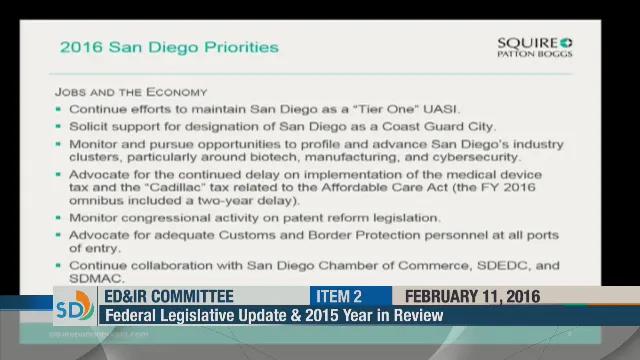
The Economic Development and Intergovernmental Relations Committee met on February 11, 2016, at 10:00 AM, chaired by Councilmember Cole. All members were present, including Vice Chair Kirsey, Councilmember Kate, and new member Councilmember Alvarez. The committee approved the minutes from January 21, 2016, by unanimous consent. No public comments were made. Committee members discussed priorities and a recent advocacy trip to Sacramento, focusing on water and economic development. The committee reviewed two informational reports: the Tourism Marketing District (TMD) FY2015 performance and the federal lobbying year-in-review and outlook. Consent Calendar - Approval of the committee record of actions from January 21, 2016, by unanimous consent. Public Comments & Testimony - None. Discussion Items Item 1: Report on San Diego Tourism Marketing District (TMD) FY2015 Performance - Presented by Meredith Dibden Brown (Economic Development Department) and Lauren Stewart (Executive Director, TMD Corporation). - The report highlighted the importance of tourism to San Diego. City TOT receipts for FY2015 were $186 million, $16 million higher than FY2014, partly due to the TMD program. - The renewed TMD district includes all lodging businesses within the city. Deployment of funding was delayed in early months, and a reserve of $12 million was held at end of FY2015, projected to reach $30 million by end of FY2017. - One outstanding lawsuit continues; a March 2016 court date is scheduled for the merits phase. - The San Diego Tourism Authority (SDTA) received $22.5 million in TMD funds, supporting approximately 3.7 million TMD room nights, yielding $584 million in hotel revenue, with a return on investment (ROI) of 26:1. - Overall TMD funding deployed in FY2015: $24,509,828, supporting 3.9 million TMD room nights, yielding $605 million in revenue, with an overall ROI of 25:1. - Other funded events and their ROIs: SportsFirst (6:1), California State Games (11:1), San Diego Bay Fair (25:1), La Jolla Playhouse's Hunchback of Notre Dame (12,000:1 – note: the transcript states $18,000 funding yielded $224,000 revenue, so ROI is 12.4:1; the figure given is 12,000 to one, which appears to be a misstatement – likely 12:1), Beer Week (17:1), Holiday Bowl (29,000 room nights, $4.3 million revenue), Farmers Insurance Open (31:1), Crew Classic, and Rock 'n' Roll Marathon (15:1). - Committee members questioned measurement methods, particularly for craft beer tourism, and discussed future events like the 2016 MLB All-Star Game (funded $400,000 through a supplemental application) and the 2017 World Beach Games. The need for a strategic destination master plan was emphasized. Item 2: Report from Federal Lobbyist Squire Patton Boggs – 2015 Year in Review and 2016 Outlook - Presented by Alejandro Kobaldon (Mayor's Office) and Pamela Welsh (Squire Patton Boggs). - Key federal successes in 2015: two-year budget deal, five-year surface transportation reauthorization (FAST Act), extension of EB-5 and tax extenders (including permanent R&D tax credit, New Markets Tax Credit through 2019), and delay of Cadillac and medical device taxes. - San Diego-specific advocacy: Pure Water and drought funding (Senator Feinstein's reintroduced bill includes increased Bureau of Reclamation project cap from $4 million to $20 million, and creation of RIFIA for recycled water), Point Loma wastewater treatment (EPA waiver expected by late spring/early summer 2016, with a five-year extension), homelessness funding (HUD agreed to waive fair market rent up to 160%), HUD Moving to Work program extension through 2028, and transportation (Tiger grant for Port, Mid-Coast Trolley funding). - 2016 outlook: Election year slowdown expected by May. Priorities include maintaining UASI funding (president's budget proposed cuts), cybersecurity, protecting municipal bond tax exemption, supporting the Coast Guard City designation, and continuing work on homelessness formula disparity, banking regulations, and workforce initiatives. - Committee members asked about CBP personnel at ports, banking regulations, DOD procurement, and alternatives to incarceration programs. Key Outcomes - Both items were informational only; no motions were required. - The committee acknowledged the TMD performance report and thanked Lauren Stewart for his service as he departs in March 2016. - The committee received the federal lobbying report and expressed appreciation for the detailed San Diego-specific focus. - The meeting was adjourned to the next meeting scheduled for March 10, 2016.
The Audit Committee of the City of San Diego met on February 10, 2016, at 9:00 AM. The meeting included approval of prior minutes, a monthly activity report from the City Auditor, a presentation of the San Diego Housing Commission's fiscal year 2015 audited financial statements, an audit of the city's overhead rate calculation process, and a quarterly fraud hotline report. All items were approved unanimously. Consent Calendar - Approval of minutes from the January 20, 2016 meeting was granted by unanimous consent. Public Comments & Testimony - No public speakers were present for any agenda items. Discussion Items - Monthly Activity Report (City Auditor Eduardo Luna): Mr. Luna reported on ongoing audits, including a memorandum to amend City Charter Section 111 (closeout audits of departing officials), which was considered by the City Council on January 25, 2016. Audits in progress include the San Diego Public Library, Housing Commission, IT Excel implementation, and pedestrian safety. The auditor also noted that the municipal code requires review of fiscal impact analyses for up to four potential ballot measures (redistricting, Rebuild San Diego, minimum wage/earned sick leave, and charter amendments). - Housing Commission CAFR Presentation (Tracy McDermott, interim CFO; Amadou Bokar, audit partner): The Housing Commission received an unmodified (clean) audit opinion with no management comments. Key financial highlights for fiscal year 2015: total assets of $606 million (up $24 million), net position of $484 million (up $27 million), total revenue of $236 million (up 3%), total expenses of $209 million (down $7 million). Grant revenue (81% of total) and housing assistance payments (70% of expenses) were the largest components. Operational highlights included over 20,000 housing inspections, assistance to 950 new families, and $19 million spent on homelessness. The commission's pension plan is a 401(k) type, not subject to GASB 68. Questions addressed the composition of unrestricted net assets ($244.6 million, with only $9.9 million truly unrestricted), the structure of the Housing Commission as a component unit of the city, and the treatment of affordable housing loans (non-cash deeds of trust monitored for compliance). - Audit of City's Overhead Rate Calculation Process (Danielle Knighton, Deputy City Auditor): The audit reviewed the standard cost allocation and non-discretionary cost allocation processes for overhead rates, focusing on the Public Utilities Department (PUD) and the libraries. The audit found that while rates were reasonable and equitable, formal documentation and guidance were lacking. Four recommendations were made: (1) The Comptroller's Office should provide training and document cost allocation decisions; (2) Financial Management (FM) should enhance monitoring, require sign-offs, and improve communication; (3) PUD should formalize its cost classification review; (4) PUD and the Comptroller should document the change from four overhead rates to one. All departments agreed with the recommendations. No material control weaknesses were identified. The audit did not cover external fees or charges. - Quarterly Fraud Hotline Report (Andy Harida, fraud investigator): For the second quarter of fiscal year 2016, 21 complaints were received: 8 assigned to the City Auditor, 13 to departments, and 6 were outside purview. 16 cases were closed, leaving 22 open. Four corrective actions were taken: updating a reference in wastewater testing reports, requiring a contractor to use a city email account, issuing a civil penalty for a code violation, and issuing an administrative warning for water theft from a fire hydrant. Two cases were over a year old: one awaiting debarment procedures (expected by June 30, 2016), and one with a confidential draft being finalized. The office noted an increase in complaints (121 in FY15 vs. 75 in prior year) and may need additional resources for proactive fraud prevention. Key Outcomes - All reports were accepted by the committee and forwarded to the City Council with unanimous votes. - The next regular meeting was scheduled for March 9, 2016.