The Public Safety Committee of the San Diego City Council met on June 5, 2024, at 10:00 AM to consider several items related to surveillance technology and other public safety matters. The committee unanimously approved the consent agenda and three discussion items regarding the use of covert cloud-based mobile applications, object trackers, and vehicle trackers. Public comment was heard on various topics including border security, marijuana policy, and surveillance concerns. Consent Calendar - Approved the meeting minutes of previous committee actions (unanimous 4-0). - Approved Consent Agenda items 1–3: (1) Code 5 Group GPS bike program under the surveillance technology ordinance; (2) TLO XP single-source investigative tool for accessing public records; (3) First Amendment to contract with Tom's Janitorial Services for janitorial maintenance. All passed unanimously. Public Comments & Testimony - On past minutes: A speaker (DRA) requested clearer minutes reflecting public positions, especially regarding border security and a reported rape of a five-year-old girl. Another speaker (Lori Saldonia) criticized Councilmember Whitburn for missing a previous meeting on towing technology and highlighted the city's financial losses from poverty tows. - Non-agenda public comment: Multiple speakers addressed border issues (e.g., a military ID found at the border, a child rape), marijuana policy (support for the mayor's removal of the C proposal from the budget, concerns about cannabis-induced psychosis and impaired driving), and surveillance technology (opposition to bait bikes and data collection, citing UN Agenda 21). Speaker Joy Sunyata praised city hall security and requested more community policing. - On consent agenda: Speakers expressed opposition to the bike GPS program (entrapment concerns) and TLO XP (privacy and data sharing with TransUnion). Catherine Douglas supported the bike program, citing its effectiveness in apprehending felons. - On item 4 (CBMA): Speakers raised concerns about police endorsements and conflicts of interest, while others supported the technology with PAB oversight. - On item 5 (object trackers): Speakers reiterated concerns about conflict of interest and the rejection of all PAB recommendations. Blair Beekman urged better sharing of internal audits with the PAB. - On item 6 (vehicle trackers): Speakers supported the technology for safety and efficiency, though one speaker questioned rising police costs. Another speaker highlighted the Fourth Amendment warrant requirement. Discussion Items - Item 4 – Covert Cloud-Based Mobile Application (CBMA): Lt. Matt Dobbs presented the software, which records conversations with one-party consent for undercover operations and victim/suspect communications. He explained the 13 PAB recommendations: 5 accepted, 3 partially accepted, 5 rejected. Rejected recommendations included requiring a warrant or limiting use to specific crimes. The committee approved the item unanimously. - Item 5 – Object Trackers: GPS devices placed on property with owner consent to track stolen items, used for series crimes like organized retail theft. The PAB made 4 recommendations, all rejected. Lt. Dobbs clarified that the devices are not entrapment and that use is approved through a chain of command. The committee approved unanimously. - Item 6 – Vehicle Trackers: Magnetic GPS devices placed on vehicles with a warrant or Fourth Amendment waiver. Used for historical tracking and geo-fencing to protect victims. PAB made 8 recommendations: 5 accepted, 1 partially accepted, 2 rejected. Rejected items concerned exhaustive crime lists. The committee approved unanimously. Key Outcomes - All agenda items were approved unanimously (4-0). - The committee will next meet on July 10, 2024, at 2:00 PM. - Public comments highlighted ongoing concerns about border security, marijuana policy, and the balance between surveillance technology and civil liberties.
Public Meetings - San Diego, California
Public Meetings - San Diego, CaliforniaThe Environment Committee of the San Diego City Council met on May 23, 2024, at 1:00 PM PDT. Chair Joe LaCava (District 1) presided, with Vice Chair Vaughn Wolford (District 5) taking over for the final items. The meeting covered consent items, the Climate Action Plan annual report, San Diego Community Power programs, urban forestry, undergrounding of utilities, and SDG&E's climate equity initiatives. Consent Calendar - Items 1–6 were approved unanimously (4-0). These included: a contract with DNV GL for water modeling software (Item 1); a fifth amendment to the Regional Stormwater Copermittees MOU (Item 2); as-needed engineering services agreements with Corolla Engineers, HDR Engineering, and Kleinfelder (Item 3); a groundwater services agreement with Rincon Consultants (Item 4); a stormwater environmental monitoring agreement with WSP USA (Item 5); and amendments to the Community Forest Advisory Board composition (Item 6), which reduced seats, allowed the chair to be appointed by members, and enabled flexible expertise. Public Comments & Testimony - Non-Agenda Public Comments: Speakers addressed a variety of topics: a resident (Cesar Javier) reported health hazards from a ceramics business operating in a residential zone since 1984, claiming toxicity from kiln fumes and inadequate code enforcement. Ann Feige, co-leader of the Kate Sessions Commitment, advocated for community engagement in urban forestry grants. Terry Ann Skelly, a public health educator, urged a ban on smoking in all multi-unit housing to protect children from secondhand smoke. Blair Beekman emphasized accountability and openness in government, particularly regarding stormwater issues and the Israel-Hamas conflict. Becky Rapp, a planning group member, reported that a tobacco shop in her neighborhood continues to sell flavored tobacco despite the city's ban. Kathleen Lippett raised concerns about climate policies increasing inflation and the need to consider cost-benefit. Peggy Walker, supporting a smoke-free multi-unit housing policy, cited a 19% drop in heart attacks in cities with smoking bans. Another speaker (the original) criticized the city for allowing migrants to trash the environment. Judy Strang highlighted the health hazards of secondhand smoke, including marijuana, and called for a public places ban. Jay Powell requested that records from the former Sustainable Energy Advisory Board be made available on the city website. - Consent Agenda Public Comments: Speakers commented on multiple items. One speaker (Laurie Saldania) raised concerns about engineering contract compliance, tree advisory board training, and the importance of stormwater management. Another speaker (the original) warned about cybersecurity risks in water modeling, linked storms to geoengineering, and opposed the groundwater monitoring program, advocating for drilling instead of recycled water. A third speaker (Blair Beekman) stressed accountability after the January floods and urged connection with Tijuana for regional solutions. - Item 7 (CAP Annual Report): Speakers included Cesar Javier (questioning grassroots understanding), Kelly Linden (noting challenges and underfunding), Anthony Deng (Climate Action Campaign – commenting on the dashboard and urging urgent building reach codes), Masada Disenhaus (San Diego 350 – advocating for building reach code, stormwater transit infrastructure, and SANDAG leadership), and Craig Jones (350 SD – supporting microtransit and urging aggressive action). - Item 8 (SDCP Customer Programs): One speaker (the original) criticized battery storage, referencing the Otay Mesa fire and calling lithium batteries dangerous. Blair Beekman supported community energy separation from SDG&E. - Item 9 (Urban Forestry): Speakers included Cesar Javier (urging faster action), Ann Feige (emphasizing tree protection, quality nursery stock, and information systems), Michael Pallet (West Coast Arborist – praising Brian Wagner), Craig Jones (Urban Collaborative Project – urging community-driven tree planting in Encanto), and others (Tree San Diego – congratulating on grants and announcing a regional urban forestry master plan). Jim Smith (CFAB chair) noted only 1,000+ trees planted last year vs. 100,000 goal, and called for updated codes and data on tree survival. Another speaker criticized the use of toxic chemicals like Roundup. - Item 10 (Undergrounding): One speaker (Jay Powell) questioned the $250–300 million fund balance and requested more city control. The original speaker criticized the undergrounding program and the county's corruption. - Item 11 (SDG&E Undergrounding): Cesar Javier raised concerns about radiation from high-voltage lines. Jay Powell questioned SDG&E's asset ownership and rate base. Another speaker warned about dangers of underground lines and monopoly. - Item 12 (SDG&E Climate Equity): Cesar Javier asked about SDG&E political contributions. Kelly Linden urged SDG&E to pilot gas pipeline decommissioning for building electrification. Other speakers criticized lithium batteries and the World Economic Forum. Discussion Items - Item 7: Climate Action Plan Annual Report and Dashboard – Staff (Shelby Busso, Marissa Westerfield) presented the 2023 CAP annual report and a new interactive dashboard tracking 190 actions across 20 measures. Key highlights: $83 million in direct CAP costs in FY23, rising to $213 million in FY24; greenhouse gas emissions showing a modest reduction in 2022; progress on building electrification, fleet electrification, mobility, waste (200,000 green bins distributed), urban forestry ($10M grant), and water infrastructure. Council members praised the dashboard and asked about cost-benefit analysis (dollar per GHG reduction), the status of the reach code (paused due to Ninth Circuit ruling, being redrafted), the mobility master plan (briefing before adoption), and coordination with departments to embed CAP ownership. Council President Elo Rivera noted the dashboard's 95% retention rate for SDCP customers. - Item 8: San Diego Community Power Customer Programs – Colin Santulli (SDCP) presented programs: solar battery savings program, vehicle-to-grid pilots, roof repair pilot (focusing on Logan Heights), efficient refrigeration pilot for corner stores, application assistance for commercial customers, and funding efforts (regional energy network with county, EPA climate pollution reduction grants, Equitable Building Decarbonization grant). Council members discussed the 95% retention rate, Power 100 product uptake (8–10% of load), coordination with the city, and the potential to expand the roof repair pilot to flood-impacted communities. Chair LaCava highlighted the importance of getting the word out to low-income residents. - Item 9: Urban Forestry Program Update – Brian Wagner (City Forester) presented the program overview, accomplishments (Tree City USA 14th year, $10M ReadySet Grow grant, 4,000+ trees to be planted in FY25, Arbor Day wins), and challenges (proposed elimination of Free Tree SD program, pruning cycle increase from 13 to 16 years due to budget cuts, need for canopy data). Council members discussed the 8,333 trees per year goal vs. 1,125 planted in FY24 (net 440 after removals), the cost to achieve the goal, opportunities for philanthropic partnerships, and the tension between palm trees (high maintenance, low climate benefit) and shade trees. The council also discussed tree protection during infill development, sidewalk damage, and the need for code consolidation. - Item 10: Utilities Undergrounding Program Update – Chris Gascon (Transportation) presented program improvements: quarterly executive meetings, enforcement mechanisms for timelines, updated naming conventions (clearer phases), and a project pipeline (16 projects in design, 20 miles slotted for FY25). The fund balance is expected to decrease as expenditures ramp up. Council members discussed cost escalation, joint projects vs. SDG&E-delivered projects (joint projects are cheaper but capacity-constrained), and the need for more ENCP staff. Council President Rivera questioned whether the community would always choose undergrounding over other investments, while staff noted safety and reliability benefits. - Item 11: SDG&E Presentation on Major Projects and Undergrounding – Erica Schumel Giles (SDG&E) reported that 63% of the regional distribution system is underground (400 miles in San Diego). Active projects: 21 projects spanning 74 miles. FY24 spend $16M, projected to exceed $100M in FY25. Risks: permitting (improving, lead times decreasing), design capacity (mitigated by internal/external firms), and supply chain constraints (buying international, qualifying more suppliers). Opportunities: parallel permit reviews, shorter design cycles, earlier SIP communication, bundling, shared staging yards, coordinated traffic control. Council members requested data on savings from undergrounding vs. overhead, and noted that SDG&E's permits are often a bottleneck for builders. They also requested a future presentation on major energy projects beyond undergrounding. - Item 12: SDG&E Climate Equity Presentation – Connor Paris (SDG&E) presented the San Diego Solar Equity program (funded by shareholders, $1M/year), which has completed 40 projects in two years, with 15 taking advantage of panel upgrade incentives. Year two introduced a phased approach to better distribute projects across districts. Future plans: launch of SGIP (battery storage for income-qualified, $22M for San Diego) and a market support program (concierge service to navigate incentives – filed at CPUC). Council members appreciated the partnership but expressed concerns about SDG&E's high rates and the proposed fixed charge. Key Outcomes - Consent items 1–6 were approved unanimously (4-0). - Information items 7–12 were received and filed; no votes were taken. - Staff will follow up on: providing a cost-benefit analysis for CAP actions, briefing council on the mobility master plan and reach code, exploring volunteer watering programs for new trees, increasing ENCP capacity for joint undergrounding projects, and scheduling a future presentation on SDG&E's major energy projects. - The committee will keep an eye out for a potential special meeting in early to mid-June for timely items.
The Economic Development and Intergovernmental Relations Committee met on May 22, 2024, at 17:00 UTC. The meeting covered a consent agenda item, lease amendments, an exclusive negotiation agreement for affordable housing, downtown property and business improvement district (PBID) and tourism marketing district (TMD) budgets, and an update on the World Design Capital 2024. All action items passed unanimously. Consent Calendar - Item 1: Fourth Implementation Agreement with SD EEC LLC for the San Diego Energy Equity Campus at Valencia Business Park. The project will bring 72 permanent full-time equivalent jobs and green sustainable industry to the Imperial Corridor. Approved unanimously. Public Comments & Testimony - Item 8 (World Design Capital 2024): Blair Beekman expressed support for the binational collaboration and called for more open conversations about border issues. - Items 2 & 3 (Lease Amendments): Manny Rodriguez and Blair Beekman spoke in support of the Courtyard lease at 1301 Market Street, noting its use as a free community gathering space with music events. - Item 4 (Exclusive Negotiation Agreement – 7th & Market): Janet Bourjois (East Village) supported the project but criticized the design as “very ugly,” requesting a more attractive building. Blair Beekman also spoke, urging preservation of historic buildings nearby. - Item 5 (Downtown PBID Budget): Alonso Vivas (Downtown San Diego Partnership) highlighted accomplishments: over 78,000 sidewalks cleaned, 1.4 million pounds of trash removed, 116,000 safety patrols, and 500+ street light repairs. - Item 6 (TMD Budget): Danielle Walker (owner of The Mental Bar in District 4) and Chris Liang (owner of Common Theory in District 6) spoke in support, citing benefits from the Tourism Authority’s DEI Accelerator Program. - Non-Agenda Public Comment: Blair Beekman urged openness and accountability in local government. Peggy Walker, Megan Stewart, and Becky Rapp raised concerns about economic costs of cannabis legalization, citing studies on increased substance use disorders, homelessness, and unpaid taxes. Discussion Items - Item 8 – World Design Capital 2024 Progress Report: - Jonathan Glus (Executive Director, Commission for Arts and Culture) and Mai Wen (Board Chair, WDC San Diego Tijuana 2024) presented. The $3 million city contract (November 2023) covers three areas: $1 million for grants and pavilion, $1 million for general administration, and $1 million for other deliverables. - Key accomplishments: 400 community submissions, 300 endorsed initiatives, 17 grants awarded ($75,000 and $25,000 each), pavilion to be installed in Plaza de Panama (end of July 2024), over 250 million media impressions, and signature events including the World Design Festival in Tijuana. - Vice Chair Lee expressed disappointment that the $1 million designated for grants was partially used for the pavilion ($350,000), leaving only $550,000 for grants. She requested a detailed budget briefing, noting the request was made six months prior. - Councilmember Campbell asked for better communication of events to council offices and suggested using print and television media in addition to social media. - Councilmember Foster requested a written memorandum with accounting and an IBA analysis. - The item was informational only; no vote taken. - Items 2 & 3 – Lease Amendments: - Item 2: First amendment to lease with Courtyard at 1301 Market Street (East Village). Monthly rent $1,800, through July 2025, with two one-year renewal options. Generates $21,000 annually for the Low-Mod Housing Fund. The site operates as a multi-use public gathering space. - Item 3: Fourth amendment to lease with Neighborhood House Association at 808 West Cedar Street (Little Italy). Monthly rent over $20,000, through August 2025, with two one-year renewal options. The Head Start program serves 54 children daily. Generates $243,000 annually for the housing fund. - Councilmember Foster noted that the two leases combined will help fund at least five additional housing units via the Bridge to Home program. Approved unanimously. - Item 4 – Exclusive Negotiation Agreement (ENA) with Chelsea Investment Corporation for 7th & Market Street: - The site (bounded by 7th Ave, Market St, 8th Ave, and Island Ave) is a former redevelopment agency asset. After a terminated 2016 DDA, the city declared the site surplus in March 2023 and issued a Notice of Availability (NOA) under the Surplus Land Act (SLA). Three responses were received; selected Chelsea Investment Corporation for proposing the greatest number of affordable units. - Proposed development: 405 residential units, 402 of which are affordable (multi-building mid-rise). Financial terms to be negotiated in a future DDA. The ENA outlines a 180-day negotiation period with a possible 90-day extension. - Councilmember Campbell asked about developer capacity; Jim Anderson (Chelsea) confirmed they have 10–12 projects under construction statewide. - Councilmember Lee asked about height limits; Christina Bibler (Director of Economic Development) said there is no height limit downtown, but FAA restrictions apply. The SLA prioritizes maximum affordable units, leading to 100% affordable proposal. - Councilmember Foster stressed amenities, aesthetic quality, and labor engagement. Kim Miller (Chelsea) stated the project will be prevailing wage and is working with trade unions, including carpenters. - Approved unanimously. - Item 5 – Downtown PBID FY2025 Budget: - The Downtown San Diego Partnership operates the Clean and Safe program. The FY2025 budget is $12.4 million, including $150,000 for city administration. The PBID covers 275 blocks, 13,964 parcels, with six neighborhood zones. Services include sidewalk maintenance, graffiti removal, safety ambassadors, and beautification. - Councilmember Campbell asked about street light repairs and Big Belly trash cans. Alonso Vivas noted 700 lights were repaired, and Big Belly modified trash cans to reduce cost by 70–80%. - Approved unanimously. - Item 6 – Tourism Marketing District (TMD) FY2025 Budget: - The TMD covers lodging businesses with 70+ rooms. The FY2025 budget is $50.9 million, funded by assessments ($47.6 million) and prior year savings ($16.6 million). Expected to generate $1.5 billion in hotel room night revenue and associated TOT. - Key allocations: Sports San Diego ($1.8 million, projected $31 million return), San Diego Tourism Authority ($47.5 million, projected $1.4 billion return). - Councilmember Campbell noted the ROI (24:1 to 25:1) and suggested marketing in Pittsburgh and highlighting San Diego’s low crime rate. - Councilmember Foster asked about the large carryover; Colleen Anderson explained it results from unspent event funds and better-than-expected assessment collections, which go into the Opportunity/Catastrophe reserve. - Approved unanimously. - Item 7 – Bridge to Home NOFA Informational Update: - Presented by Michelle Morano and Letitia Thomas. The program has approved 10 projects in rounds 1–2, creating 897 affordable units (232 permanent supportive housing). Round 3 (August 2023) offered $20 million; five projects were recommended in January 2024. - A new project, Grantville Mission Trails (5945 Mission Gorge Rd, District 7), is recommended for a $2.5 million CDBG loan. It will be a 47-unit affordable housing development (20–60% AMI, including 14 supportive housing units). Project completion anticipated August 2026. - Vice Chair Lee asked about timing; the round 3 NOFA was issued in FY2024 budget. Staff noted that cumulative bridge-to-home units will reach 1,344 by end of 2024. Round 4 is expected later in 2024 with $15–20 million available. - Item was informational; no vote taken. Key Outcomes - Items 1, 2, 3, 4, 5, 6: All approved unanimously by the committee (4 votes in favor). - Item 8 (World Design Capital): No action taken; councilmembers requested a detailed budget briefing and written memorandum with IBA analysis. - Item 7 (Bridge to Home): No action taken; informational only. - Next Meeting: The committee will reconvene on Wednesday, June 12, 2024, at 12:00 p.m.
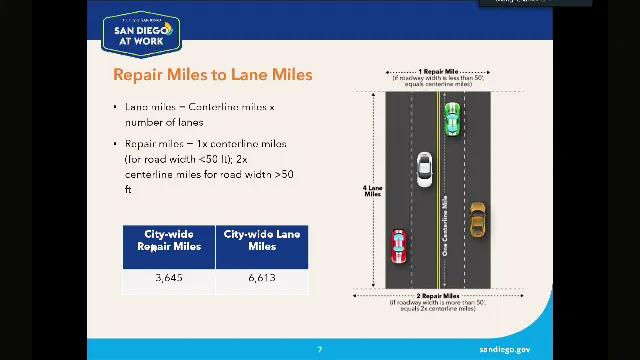
The Active Transportation and Infrastructure Committee met on May 22, 2024, chaired by Councilmember Whitburn. The committee approved the previous meeting minutes, adopted a consent agenda of five routine items, and discussed four action items: Community Parking District FY2025 plans, CIP budget revisions, Transnet program updates, and RMRA-funded slurry seal contracts. A final informational update covered citywide asset management. All votes were unanimous unless noted. Consent Calendar - Approved unanimously (4-0) items including construction change orders, an emergency sole source contract, a contract amendment for pump station upgrades, a reimbursement agreement with SANDAG for the Eastern Hillcrest Bikeway (Normal Street Promenade), and the 11th amendment to taxi/ride-hailing regulations with MTS. - Councilmember Whitburn highlighted the Hillcrest Bikeway project, noting community support and its role in improving biking, pedestrian safety, and community events. Public Comments & Testimony - Non-Agenda Public Comment: - Lori Saldania reported a fall on a broken streetery platform in Little Italy, urging better inspection and repair enforcement. - Terry Ann Skelly expressed concerns about drug-impaired driving, citing statistics and urging continued public messaging. - Blair Beekman advocated for preserving historic buildings in downtown redevelopment and urged open communication on surveillance technology. - Michael Schmidt requested urgent road overlay on Sun Nouveau Way and Carmel Mountain Road. - Consent Agenda Public Comment: Blair Beekman spoke on items 4 and 5, urging transparency on technology (surveillance) in bikeway projects and support for ride-sharing programs. - Item 6 – Community Parking Districts: - Michael Meachum, Jerry Trussell, and Benjamin Nichols spoke in support of the Uptown Parking District budget, highlighting added parking and community benefits. - Mark Ionnnen (Circuit operator) thanked the city for partnership on Fred and Beach Bug services. - Gary Hewitt (virtual) criticized Circuit for using customer emails to advocate for funding, calling it a violation of terms of service. - Dominic Lamondry (East Village Association) supported downtown CPD budgets. - Blair Beekman (virtual) emphasized equitable distribution of parking revenue. - Alicia Kelly (virtual) expressed concern that parking meters near low-income homes burden residents. - Item 7 – CIP Budget Revisions: No public comment. - Item 8 – Transnet Program: No public comment. - Item 9 – Slurry Seal Contracts: No public comment. - Item 10 – Asset Management Update: No public comment. Discussion Items - Item 6: Community Parking District FY2025 Annual Plans and Budgets - Staff presented an overview of seven parking districts, revenue projections ($9M gross meter revenue), and proposed budgets for FY2025. Highlights included the launch of Beach Bug (30,000 passengers in nine months), new meters in Pacific Beach, and planned projects like curb ramp installations and the Normal Street Promenade. The city attorney reminded that parking meter revenue must be used only for traffic/parking regulation within the same zone. The committee unanimously approved the staff recommendation. - Item 7: CIP Year-End Budget Monitoring and Revisions - Staff requested $79.7M in appropriations, deappropriations, and reallocations. The IBA noted a growing debt-financing backlog of $653.8M and concerns about long-term debt ratios. The committee approved the recommendation with an exception: Councilmember Foster requested that the Market Street/Euclid/PETA project (S16022) not be closed and its funds not be reallocated, pending further community discussion. The motion passed 4-0 with that modification. - Item 8: Transnet Local Street and Roads Program – RTIP and Program of Projects - Staff reported that the city is efficiently managing Transnet funds, projecting a year-end fund balance of $36.3M (11% decrease). The FY2025 proposed budget is $47.1M, with $32.6M for congestion relief and $14M for maintenance. The committee unanimously approved the required SANDAG resolutions and the five-year program of projects. - Item 9: FY2025 RMRA-Funded Slurry Seal Projects - Staff presented six contracts covering 238 lane miles (128 repair miles) of slurry seal and cape seal treatments. The city will use $35.3M in RMRA funding, which is about 60% of the pavement management plan’s estimated need. Cape seal, a new treatment for roads with PCI between 55 and 70, was introduced. The committee approved the project list and contracts unanimously. - Item 10: Progress Update on Citywide Asset Management and EAM System - Staff provided an informational update on asset management practices, including the re-established steering committee, inventory progress, implementation of the BlueWorks mobile work management system (570+ deployments), and SAP modernization plans. The IBA recommended conducting a facilities condition assessment, which remains unfunded. No vote was taken; the item was for discussion only. Key Outcomes - Minutes of April 25, 2024 approved 4-0. - Consent agenda approved 4-0. - Item 6 (Community Parking District budgets) approved 4-0. - Item 7 (CIP budget revisions) approved 4-0 with an amendment to retain the Market Street/Euclid/PETA project. - Item 8 (Transnet program) approved 4-0. - Item 9 (Slurry seal contracts) approved 4-0. - Item 10 (Asset management) received as information; committee expressed interest in annual updates.
The Land Use and Housing Committee met on May 17, 2024, at 9:30 AM. The meeting included approval of minutes, non-agenda public comment, an informational presentation on housing data, and discussion of two major agenda items: the General Plan Environmental Justice Element and the 2024 Land Development Code update. All votes were unanimous. Consent Calendar - Approval of Committee Minutes (April 18, 2024): Approved unanimously. One virtual speaker requested more detail in minutes (mention of a book recommendation). Public Comments & Testimony - Non-Agenda Public Comment: - Cesar Javier (Southeastern San Diego, District 9): Described a long-running home occupation (ceramics/kiln) operating in a residential zone, citing violations of state law and city code, including Proposition 65. Called for enforcement. - Joy Sanyata (District 3): Shared a positive experience taking the trolley to the U.S.-Mexico border and welcomed migrants. - Bill (member of MB Dems): Criticized the historical district application process, arguing it rewards not improving property and leads to property tax losses via Mills Act. Asked committee to revisit the process. - Saad Asad: Noted the pause of the Riverwalk project (4,300 homes, 430 affordable) in Mission Valley and urged exploring alternative financing. Also encouraged adopting AB 1033 to allow ADUs to be sold as condos, citing Berkeley’s example. - Virtual speaker (border security): Expressed concern about dropped IDs and dog tags at the border, arguing asylum seekers are not eligible and that the city ignores national security threats. - Kathleen Lippett: Recalled 2017 opposition to marijuana businesses in environmental justice communities and urged not to further burden those communities with unregulated products. - Item 3 (Equinox Dashboard) Public Comments: - Joy Sanyata: Thanked USD for data, suggested too many nonprofits are “cooks in the kitchen” and need more collaboration. - Virtual speaker (The Original): Criticized nonprofits for profiting, claimed affordable housing is unaffordable, and alleged that government actions worsen problems. - Don (virtual): Asked if USD studied the correlation between upzoning and increased housing prices. - Kathleen Lippett: Shared experience that nonprofits prioritize bureaucracy over helping clients become independent. - Item 1 (Environmental Justice Element) Public Comments: - Joy Sanyata: Quoted staff report, noted “food apartheid” statistics (downtown 60%, San Ysidro 100%, uptown 8%). Called environmental justice a work in progress. - Evan Strawn (San Diego Regional Chamber of Commerce): Supported many aspects but expressed concerns about expanding incompatible industrial land use regulation and a reach code, urging separate stakeholder engagement. - Virtual speakers: One speaker accused the city of using “environmental justice” to enslave people. Julie Corrales (Environmental Health Coalition, Barrio Logan) stressed that her community is 95th percentile for asthma and 93rd for cancer risk statewide; pleaded to keep the element strong and not cave to industry. - Craig Benedetto (NAOP San Diego): Supported incentives but urged caution on industrial use changes and building decarbonization, asking for further discussion with job creators. - Item 2 (LDC Update) Public Comments: - Joy Sanyata: Commented on C Street Corridor, Gaslamp outdoor spaces, and SRO exemptions. - Saad Asad (MB Dems): Supported housing production incentives, mixed-use development, and streamlining. Opposed amendments that would reduce ADU size or increase setbacks. - Evan Strawn (Chamber): Supported the update, especially sidewalk cafe exemption, behavioral health facilities streamlining, and child care FAR bonus. - Dana Givitt (Neighbors for a Better San Diego): Requested three amendments: (1) apply tree requirement limitation to ADU floor area in open space zones, (2) clarify transition planes in Complete Communities, (3) add a sunset clause for downtown density bonus. - Lori Feyler (BIA): Supported item 17 with revisions, called it a win-win for Complete Communities. - Stuart Johnson: Opposed behavioral health facilities in residential areas, citing noise and safety issues from a nearby facility. - Virtual speakers: Clayton Fowler (Downtown San Diego Partnership) supported downtown updates. Dan Courtney opposed item 52, noting a facility near a school. Craig Benedetto (NAOP/BOMA) supported the update. The Original speaker criticized the process and the impact on residents. Discussion Items - Item 3: Informational Presentation – Equinox Quality of Life Dashboard (USD Nonprofit Institute) - Presenters: Dr. Tessa Tinkler and Io Hanabusa. Highlighted top concerns among San Diego residents: homelessness and affordable housing. 38% of respondents are considering leaving the region, with 75% citing cost of living. - Key data: Median single-family home price rose from $548,000 (2015) to $911,000 (2023) – a 66% increase. Only 11% of households can afford a median-priced home (down from 29% in 2019). Fair market rent for a 2-bedroom unit doubled from $1,390 (2015) to over $2,800 (2024). Needed hourly wage to afford that rent without cost burden is $54.48, while mean renter wage is $28.57. - Chair Lee expressed alarm at the 38% considering leaving and asked about demographic breakdown (not yet available). Council President Pro Tem Lakava asked for context on out-migration and deeper dive into reasons. Councilmember Whitburn noted that adding housing supply has moderated rents in District 3 (downtown rents down 2.1% year-over-year). - No action was taken on this informational item. - Item 1: General Plan Environmental Justice Element - Presented by Samira Rao (Assistant Deputy Director) and team. Objectives: comply with SB 1000 by identifying disadvantaged communities and developing policies to address environmental justice. Used multiple data tools (CalEnviroScreen 4.0, CEJST 1.0, city climate/resiliency maps) to define EJ communities. Conducted 47 engagement events with over 1,400 participants, partnering with five community-based organizations. Draft element covers seven sections: inclusive public engagement, pollution exposure/air quality, active play, healthy food access, safe and healthy homes, climate change, and infrastructure prioritization. - Councilmember Lakava moved staff recommendation, noting the element consolidates existing policies and does not change any specific ordinance. He committed to pursuing funding for studies called for in actions EJ B8 and B9 (regarding incompatible industrial uses). Chair Lee seconded. Vote: unanimous. - Item 2: 2024 Land Development Code Update and Local Coastal Program - Presented by Liz Sid Conian (Development Project Manager) and Brian Schoenfish (Deputy Director, DSD). 99 amendments: 72 citywide, 27 downtown. Key citywide items: sports arenas/stadiums multimodal updates, ADU front setback clarification (25), Complete Communities pedestrian circulation (27), behavioral health facilities streamlining (52), EMX zone residential as primary use (56), CPIOZ alternative compliance fee (58), ADU rear setback alignment (60), electrified fences in industrial zones (61), child care FAR bonus expansion (67), parcel map alignment (68). Key downtown items: incentivizing active uses on C Street, Gaslamp PDO consolidation, density bonuses for underutilized sites and middle-income housing, housing accelerator bonus, and increasing outdoor use threshold from 350 to 2,000 sq ft. - A May 16 memo revised item 58 fee to $3,901 per linear foot and item 27 to allow flexibility for urban parkway width (14 ft total) with balcony/upper-floor projection above 25 ft. - City attorney noted recent changes may require further review before council. - Chair Lee made a motion to approve the update with May 16 memo revisions. Councilmember Whitburn seconded. Motion passed unanimously. Key Outcomes - Item 1 (Environmental Justice Element): Recommended to City Council approval unanimously. Councilmember Lakava committed to seeking funding for future studies on incompatible industrial uses (EJ B8/B9). - Item 2 (2024 LDC Update): Recommended to City Council approval unanimously, incorporating May 16, 2024 memo revisions. Staff will continue to work with city attorney on any legal concerns before council hearing (scheduled for June 2024). - Item 3 (Equinox Dashboard): No action taken; informational only. Chair Lee encouraged future demographic analysis of residents considering leaving the region. - The next regularly scheduled meeting of the Land Use and Housing Committee is Thursday, June 13, 2024, at 1:00 PM.
The Budget Review Committee met on Thursday, May 16, 2024, starting at 9:30 AM, to discuss the Fiscal Year 2024 Third Quarter Budget Monitoring Report and the May Revision of the Fiscal Year 2025 Proposed Budget. The meeting covered financial projections, program restorations, and significant public testimony on equity programs. Key votes included approval of the third quarter monitoring report authorities and a separate motion regarding compliance with budgetary principles. Public Comments & Testimony - Item 1 (Third Quarter Report): Numerous public speakers expressed opposition to cuts in equity programs, including the cannabis social equity program, community equity fund, youth care and development program, and climate equity fund. Speakers criticized the lack of notice and the impact on underserved communities. Some speakers supported the fiscal restraint and elimination of the cannabis equity program, citing public health concerns. - Item 2 (May Revision): Many speakers urged restoration of funding for arts and culture (CPPS and ACCF grants), youth drop-in centers, the seed program, climate equity fund, affordable housing funds, and library/parks programs. Speakers also voiced concerns about diverting $8 million from the Housing Commission's Affordable Housing Fund, warning it would reduce permanent affordable housing production. - Non-Agenda Public Comment: Speakers addressed budgetary principles, the structural deficit, immigration, and drug policy, with some defending cannabis equity programs and others opposing them. Discussion Items - FY2024 Third Quarter Budget Monitoring Report: Presented by Department of Finance and Independent Budget Analyst (IBA). Revenues projected to exceed budget by $8.5 million, expenditures under by $14.6 million, resulting in a negative net position of $46.4 million but improved from mid-year. Excess equity projected at $82.5 million, up from $5 million at mid-year. Mitigation actions included suspending non-essential spending, delaying hiring, and using capital improvement funds. The report noted program reductions for cannabis social equity, community equity fund, youth development, and reserve contributions. The IBA highlighted that the required written notice of potential unintended consequences was not provided, leading to debate about compliance with budgetary principle 3. - FY2025 May Revision: Presented by Department of Finance. The budget remains balanced using one-time resources. Restorations included: $7 million for homelessness programs (via Housing Commission), eviction prevention, public safety (juvenile services, no shots fired, fire rescue positions), parks and libraries (Wi-Fi, after-school programs, teen centers, youth librarians), and design phase of San Carlos Library. The revision also added $1.1 million to the climate equity fund. The IBA noted that key structural deficits remain, requiring future revenue or deeper cuts. Council members expressed concern over the $8 million diversion from the Affordable Housing Fund, insufficient funding for homelessness prevention (HIP program), and lack of direct flood assistance. Key Outcomes - Item 1 – Motion to Approve Third Quarter Report Authorities: Passed 7-0 (Councilmember Foster voted no, Councilmember Campillo absent). The motion approved requested authorities and appropriation adjustments as outlined in the report. - Item 1 – Motion on Budgetary Principle 3: Passed 5-3. The motion stated that the administration did not adhere to Budgetary Principle 3, which requires written notice and description of equity impacts before significant program reductions. The vote was 5 in favor, 3 against. - Item 2 (Informational): No vote taken. The committee will reconvene on June 7, 2024, to discuss IBA final recommendations, with final budget adoption by the full City Council on June 11, 2024. Additional Notes - The committee acknowledged the importance of ongoing communication between the administration and council regarding budget decisions, especially during difficult fiscal times. - Councilmembers expressed intent to pursue further modifications, including restoring equity programs, fully funding the Housing Commission, and addressing flood recovery needs.
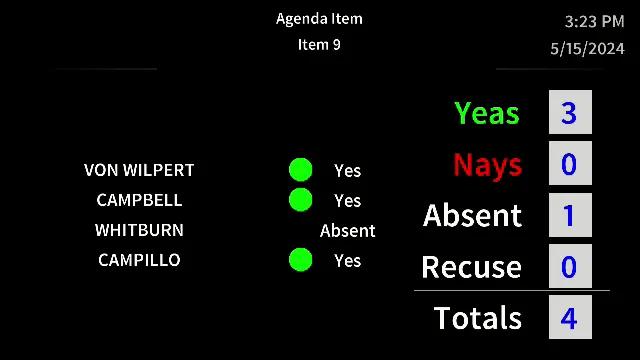
The Public Safety Committee of the San Diego City Council met on May 15, 2024, at 9:30 AM. The meeting was chaired by Councilmember Marni von Wilpert, with Vice Chair Campillo and Councilmember Campbell present. Councilmember Whitburn was absent. The committee addressed several significant items including the renewal of military equipment use, the introduction of a firearm dealer accountability ordinance, approval of surveillance technologies, and a new TASER contract. All votes were unanimous (3-0) with Councilmember Whitburn absent. Consent Calendar - Approved minutes of April 25, 2024: Passed unanimously 3-0. - Consent Agenda Items 1-4: Approved unanimously, including: - First amendment to towing services agreement with TEXCO (Auto Return). - Approval of CP CLEAR surveillance technology. - Continued membership in ARJIS. - Approval of CoreLogic RealQuest online services. Public comment on the consent agenda included concerns about towing impacts on vehicle residents and privacy/security of internet-based surveillance data. Public Comments & Testimony - Laurie Saldania spoke on the minutes, urging an update on a backlog of sexual assault kits. - Joyce Yata (District 3) spoke in support of CP CLEAR and CoreLogic, noting the robust backup materials and PAB recommendations. - Laurie Saldania (virtual) raised concerns about towing's disproportionate impact on low-income residents and the security of CP CLEAR data. - Multiple speakers testified on the firearm dealer ordinance, including Roseanne Sharp, Therese Heimer, and Carol Landale, expressing strong support. - Laurie Saldania and Catherine Douglas commented on various items, generally supportive but with some privacy and training concerns. - Non-agenda public comment included speakers on cannabis policy, mental health, and concerns about TASER training and workforce diversity. Discussion Items - Item 5: Military Equipment Renewal (AB 481) – Presented by Lieutenant Rick Aguilar. The department requested approval for continued use of military-style equipment. The presentation covered the equipment inventory, budget (approximately 1.3 million for FY23, 0.02% of the overall budget), and case examples. The committee approved the renewal unanimously. - Item 6: Firearm Dealer Accountability Act (Ira Sharp Ordinance) – Introduced by Chair von Wilpert. The ordinance requires firearm/ammunition dealers to comply with federal, state, and local laws and to disclose inspections. Passed with an amendment to request the last two inspection reports instead of a five-year window. Passed unanimously. - Item 7: Cell Hawk surveillance technology – Presented by Bailey Feist. Software for mapping location-based data from warrants. All seven PAB recommendations were accepted. Passed unanimously. - Item 8: Berla IVE toolkit – Presented by Detective Michael Gottfried. Tool for extracting data from vehicle infotainment systems. All PAB recommendations accepted. Passed unanimously. - Item 9: TASER 10 procurement – Presented by Lieutenants Waltheim and Ramsey. New five-year agreement with Axon for TASER 10 devices, which feature 45-foot range, 10 probes, and automatic BWC activation. Approximate cost: $10 million. Passed unanimously. Key Outcomes - Minutes: Approved. - Consent Agenda: Approved. - Item 5: Motion to approve military equipment renewal passed 3-0. - Item 6: Motion to approve the Firearm Dealer Accountability Act (with amendment) passed 3-0. - Item 7: Motion to approve Cell Hawk passed 3-0. - Item 8: Motion to approve Berla IVE toolkit passed 3-0. - Item 9: Motion to approve TASER 10 procurement passed 3-0. The next public safety committee meeting is scheduled for June 5, 2024, at 2:00 PM.
The Community Neighborhood Services Committee of the San Diego City Council met on Thursday, May 9, 2024, to consider the fiscal year 2025 recreation center fund budgets, the opportunity fund allocation, the recreation equity report, and annual reports for maintenance assessment districts (MADs) overseen by the Parks and Recreation and Economic Development departments. The meeting began with approval of prior minutes and included extensive public testimony on a range of topics before committee members voted unanimously on all agenda items. Consent Calendar - Approval of Minutes: The committee unanimously approved the minutes from the April 11, 2024 meeting after no public comment was offered. Public Comments & Testimony - Non‑Agenda Public Comment (in‑person and virtual): - Perita Javier and Cesar Javier, residents from Streamview Drive, Limona Avenue, and Lee Street (District 9), raised concerns about a home‑occupation pottery and ceramics business operating since 1984 in a residential zone. They claimed the kiln releases toxic gases (lead, silica, asbestos) that cause health issues and stated they had been redirected from District 4 to District 9 and from a commission hearing to the committee. - Joyce Sunyata (District 3) praised a “proactive, not reactive” community spirit, noted improved alignment of petty cabs, questioned a large billboard near the Gaslamp trolley stop, and promoted a robotics and drone event at San Carlos Library on May 18, 2024. - Kathleen Lippett opposed the city’s marijuana equity program, arguing it normalizes drug use among youth and diverts resources from parks and youth programs. She claimed the state is reducing equity business funding and that a cost analysis would have shown the program is not worthwhile. - Terry Ann Skelly also opposed marijuana businesses, advocating instead for parks and recreation funding as true social equity. - Terry Best (District 3) questioned how drug prevention dollars are spent, suggesting they may be used to lobby against cannabis regulations rather than educate youth about fentanyl, and called for ending the school‑to‑prison pipeline. - Layla Aziz praised Parks After Dark programs but criticized the city’s flood response, asking for an audit of why Southcrest and other recreation centers were not opened as hubs. She also questioned why Martin Luther King and Candle Recreation Centers did not receive opportunity funds. - Judy Strang spoke in support of parks, sharing positive childhood memories of community centers and thanking the committee for its decisions. - Public Comment on Item 1 (FY2025 recreation funds): - Joyce Sunyata expressed strong support for expanding recreation center funds regardless of where collected to promote equity, and thanked staff for the audit update. - Layla Aziz again asked why her local rec centers were excluded from opportunity funds and noted that a flood survivor organizer is charged $60/week to use a rec center space. - Kathleen Lippett praised the presentation on parks and rec as the “best news” from the city, highlighting the focus on youth programming and health. - Public Comment on Items 2 & 3 (MAD annual reports): - Joyce Sunyata (“Joy Sunyata”) said she is “mad about maintenance” and thanked staff for community engagement. - Benjamin Nichols, Executive Director of the Hillcrest Business Association, spoke in support of the Economic Development MAD program, noting that every dollar invested leverages $11 in services, and highlighted sidewalk pressure washing, trash can services, tree trimming, security, and maintenance of the Hillcrest sign. - Kathleen Lippett (on Item 3) thanked Councilmember Von Wilpert for recognizing that prevention is cheaper than crisis management, citing deferred flood channel maintenance that cost $1.6 billion. Discussion Items - Item 1: Fiscal Year 2025 Recreation Center Fund Budget, Opportunity Fund Budget, and 2024 Recreation Equity Report - Sarah Irazzo (Deputy Director of Citywide Recreation Services) and Salome Martinez (Program Equity Manager) presented. The proposed FY2025 budget for all recreation center funds totals just over $6.7 million, with projected revenues of $4.5 million from program registration and permits. The Opportunity Fund has $375,000 available for allocation, up from $84,000 the prior year. The fund will support 10 recreation centers (previously 6) with up to $50,000 each, plus a smaller amount for City Heights. Two new funds were requested for Bay Terraces Community Park & Senior Center and East Village Green Recreation Center; the Dusty Roads fund will be folded into Ocean Beach. - The equity report highlighted the “Come Play Outside” summer program: 448,728 total participants in 2023, impacting over 98,000 youth, seniors, and adults since inception. Parks After Dark events at four sites in communities of concern drew 32,000 participants over eight weeks, with 17,000 meals, 14,000 desserts, and fresh produce distributed. The department held 11 vendor fairs to onboard contract service providers. The Park Ambassador Leader Academy had 25 participants per session. The department faces a 17.7% vacancy rate and continues recruitment and retention efforts. An audit (22‑005) found the department lacks resources for a data‑driven equity approach; implementing its 16 recommendations would require an estimated $671,000 for staffing and $1.7 million to reduce disparities in recreation center funds. - Items 2 & 3: Fiscal Year 2025 Maintenance Assessment District Annual Reports (Parks and Recreation Department and Economic Development Department) - Michael Jones (Assistant Deputy Director, Parks and Recreation) and Rhea Aguinaldo (Small Business Engagement Specialist, Economic Development) presented jointly. San Diego has 65 maintenance assessment districts: 55 overseen by Parks and Recreation (53 city‑managed, 2 self‑managed) and 10 by Economic Development (with 7 also managing business improvement districts). Assessment Engineer Reports (AERs) govern each district. This year there is a $234,000 discrepancy in the general fund contribution from the Parks and Recreation Open Space Division that will be corrected in FY2025. Staff described ongoing community engagement, notification of assessment increases, and the use of CPI‑U adjustment in some districts (e.g., Bay Terraces Parkside). - Committee members asked about landscaping contract concerns (Rancho Bernardo MAD), conversion of concrete medians to landscape (requires district‑specific AER provisions), and the impact of planning group mergers (none). Key Outcomes - Item 1: The committee unanimously adopted a motion (moved by Councilmember Von Wilpert, seconded by Councilmember Campillo) to approve staff recommendations, including creating new recreation center funds for Bay Terraces and East Village Green, closing the Dusty Roads fund and transferring its balance to Ocean Beach, appropriating and expending recreation center funds in FY2025, and authorizing the Treasurer to transfer opportunity funds to identified recreation centers. The motion passed 5‑0. - Item 2: The committee unanimously approved the FY2025 annual reports for Parks and Recreation Maintenance Assessment Districts (moved by Councilmember Campillo, seconded by Councilmember Von Wilpert). Passed 5‑0. - Item 3: The committee unanimously approved the FY2025 annual reports for Economic Development Maintenance Assessment Districts (moved by Councilmember Campillo, seconded by Councilmember Foster). Passed 5‑0. - Next Meeting: The committee will next meet on Thursday, June 27, 2024, at 1:00 p.m.
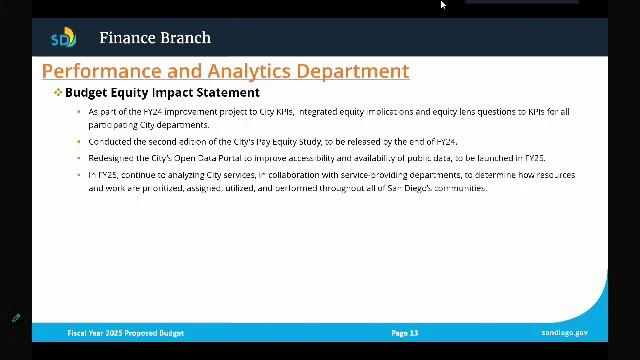
The Budget Review Committee convened on Tuesday, May 7, 2024, as part of a continuous budget hearing process that began May 1. The meeting covered several sub‑items of the information agenda, including the Commission for Arts and Culture, the Financial Branch (IT, Performance & Analytics, citywide expenditures, and special promotional programs), the San Diego City Employees Retirement System (SDCERS), the Convention Center Corporation, the City Attorney, the Personnel Department, and additional department reviews. No formal votes were taken; the meeting was informational, with public testimony heard for each item. The committee will reconvene on May 16 to review the May revision. Public Comments & Testimony - Arts & Culture (Subitem P): Over 20 speakers, representing artists, arts organizations, and coalitions, urged restoration of funding for the Community Projects, Programs, and Services (CPPS) and Arts, Culture, and Community Festivals (ACCF) programs. Several speakers noted the importance of these funds as a lifeline for small‑to‑medium organizations and described specific programs that would be eliminated if cuts stand. Councilmembers also voiced concern that the proposed budget walks back progress toward the “Penny for the Arts” goal. - Financial Branch (Subitem O): Public speakers supported maintaining digital equity programs (SD Access for All) and opposed reductions that would cut Wi‑Fi at 59 park and recreation sites and slash digital literacy training by 90%. The San Diego Parks Foundation highlighted that it had installed the free Wi‑Fi infrastructure and cautioned that turning off service would cost more later. Several callers also stressed the importance of a 311 phone system to complement the Get It Done app. - SDCERS (Subitem Q): A few callers questioned salary increases and pension costs, while others noted the importance of a well‑funded retirement system for employee retention. No official comment from the public in chambers. - Convention Center (Subitem R): Speakers emphasized the facility’s aging infrastructure and the need for dedicated capital funding to avoid equipment failures that could jeopardize events and the $40.2 million in annual tax revenue generated. One speaker called for the center to align with the city’s Climate Action Plan. - City Attorney (Subitem S): Commenters acknowledged the office’s work on domestic violence and gun violence restraining orders, but expressed concerns about enforcement of homelessness‑related citations and the processing of evidence in criminal cases. - Personnel (Subitem T): Speakers supported the department’s efforts to improve hiring times and diversity, but cautioned that leaving an equal employment investigations position vacant could lead to costly discrimination settlements. - Additional Departments (Subitem U): The public supported funding for the Ethics Commission and requested a position for the City Clerk’s office to improve meeting management. One caller urged faster hiring of an executive director for the Commission on Police Practices. Discussion Items - Commission for Arts and Culture: Director Jonathan Glus presented the FY25 proposed budget of approximately $3 million (a 42% decrease from FY24, largely due to one‑time World Design Capital funding). The decrease included removal of $500,000 for ACCF and the proposed cut to CPPS. Councilmembers Moreno, Campbell, Von Wilpert, Foster, and Lee advocated for reversing those cuts and stressed that arts funding should not backslide from 5.6% to 4.8% of TOT revenue. The IBA noted that the decrease in funding moves the city further from the “Penny for the Arts” goal. - Financial Branch – IT Department: The proposed budget included a $57,000 reduction in digital literacy training (expected to cut 90% of classes) and unfunded requests of $227,000 for hotspot/Chromebook lending and $500,000 for Wi‑Fi at 59 parks. CFO Matt Vesby indicated the May revise may restore some of that funding. Councilmembers Moreno, Foster, and Von Wilpert emphasized the importance of digital equity, especially after the end of the federal Affordable Connectivity Program. - Financial Branch – Performance & Analytics (PANDA): Director Kirby Brady highlighted the release of a customer experience strategy, a pay equity study, and deployment of over 370 Get It Done enhancements. The proposed budget cuts $100,000 from transparency tools (OpenGov) and $105,000 by holding a position vacant. The IBA noted that additional funding will be needed to sustain Get It Done expansion. - SDCERS: CEO Greg Rodemaker presented an $18.3 million administrative budget (a 7.1% increase) to serve 26,000 members. Salary and benefit increases accounted for most of the rise, offset by a net staff reduction of one through outsourcing retiree health care. The board has plenary authority; the city council does not approve the budget. The IBA noted that investment expenses decreased by $3.3 million in FY23, but capital needs remain. - Convention Center Corporation: President Rip Rippetoe and CFO Martin Maddox presented a budget facing a $5 million shortfall in requested capital support. The facility has over $400 million in deferred capital needs. Without dedicated funding, imminent electrical failures could cause event cancellations. The IBA suggested exploring options such as redirecting debt service savings after FY28 and engaging the Port of San Diego. Councilmembers expressed concern and asked for creative solutions. - City Attorney: City Attorney Mara Elliott requested $109,000 (for security at Your Safe Place and a case management system) in addition to the proposed budget. The office’s $1.7 million reduction target is being met through personnel savings. Councilmembers thanked the office for its work on gun violence restraining orders and the family justice center. - Personnel Department: Interim Director David Galarza reported progress on reducing hiring times (from 272 to 172 days) and efforts to improve diversity (e.g., partnerships with Center for Employment Opportunities). The department’s $291,000 reduction is achieved by holding three positions vacant. The IBA noted that an unfunded request for a payroll audit specialist was not included. Councilmembers praised the outstation program for cutting vacancy rates. - Additional Departments: Councilmember Marino requested a detailed accounting of expenses for street vendor enforcement. Ethics Commission Executive Director Sharon Spivak explained that a $32,000 cut from personnel would harm its enforcement ability; the Department of Finance agreed to move the cut to contracts, but she noted that cumulative cuts have already reduced the contracts budget by $100,000 over five years. Council President Pro Tem LaCava thanked the City Attorney’s office and the Independent Budget Analyst. Key Outcomes - No motions or votes were taken; these were informational hearings. - The committee received extensive public testimony and councilmember comments urging the restoration of funding for arts programs (CPPS, ACCF), digital equity (SD Access for All), convention center capital, and ethics commission operations. - CFO Matt Vesby indicated that the May revision may include some restorations for SD Access for All (up to $250,000) and that efforts to lock in long‑term capital funding for the convention center are ongoing. - Several councilmembers expressed support for a mid‑year review of TOT revenue to potentially increase arts funding. - The committee will reconvene on Thursday, May 16, 2024, at 2:00 p.m. to review the May revision of the proposed budget.
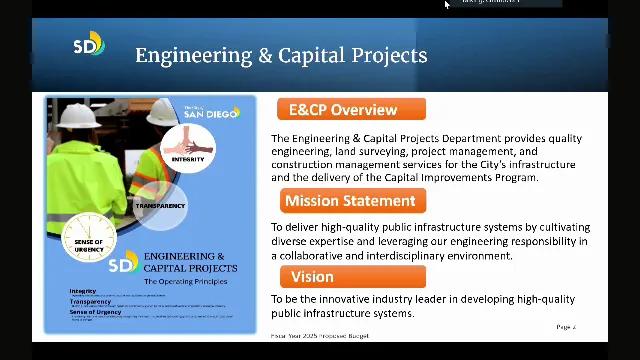
This meeting was part of the continuous budget review committee session held from May 1-7, 2024. The committee reviewed proposed FY2025 budgets for multiple departments: Homelessness Strategies and Solutions (HSSD), the San Diego Housing Commission (SDHC), the Office of Emergency Services (OES), and Engineering and Capital Projects (ECP), along with the Capital Improvement Program (CIP) update. Public testimony focused heavily on proposed cuts to the Neil Good Day Center and SDHC homelessness programs. Council members expressed concern about funding gaps, the need for prevention, and the moral imperative to provide shelter. Several programs were indicated for potential restoration in the May Revise. Public Comments & Testimony - Over 50 speakers testified on Subitem K (HSSD), most advocating against cuts to the Neil Good Day Center. Speakers from Father Joe's Villages, PATH, and Lived Experience Advisors detailed essential services: showers, laundry, mail, case management, harm reduction, and respite. Many argued that cutting these services would increase encampments and public health risks. - On Subitem L (SDHC), speakers urged full funding for homelessness prevention programs, including the Housing Instability Prevention Program (HIP) and eviction prevention. Several praised SDHC's transparency and effectiveness, especially during the January flood response. - On Subitem N (CIP), speakers from San Carlos requested immediate funding for the long-delayed San Carlos Library. Discussion Items Homelessness Strategies and Solutions (HSSD) - Subitem K - Director Sarah Jarman presented a $100 million total budget ($55.5M general fund), including $15 million offset from the San Diego Housing Commission. New spending includes $4.3M for safe parking at H Barracks, $2.8M for Kettner & Vine shelter operations, $3.7M for downtown portable restrooms, and $1M for shelter staff cost-of-living increases. - IBA Analyst Amy Lee noted that without new ongoing revenue, these new programs could create an unsteady fiscal path, with an estimated $26.5M (60%) increase over FY2024. She presented four options: (1) approve as proposed, risking housing commission cuts; (2) delay new spending; (3) pursue permanent shelter consolidation; (4) fund only safe parking and family shelter expansions. - Council raised concerns: Councilmember Moreno questioned why KPIs measure activity not outcomes (e.g., persons served vs. reduction in homelessness). Councilmember Whitburn argued for adding shelter beds immediately, citing a state audit showing only 21% of referrals to shelter succeed, and 624 homeless deaths in 2023. Councilmember Lee highlighted the need for prevention and criticized the lack of collaboration with the housing commission. San Diego Housing Commission - Subitem L - President Lisa Jones presented a proposed $715 million budget, noting a $24 million gap between the commission's recommended $52M for city homelessness programs and the mayor's proposed $27M. She stated the commission does not have $15M in reserves to offset the city cut, and that programs like HIP, the multidisciplinary outreach team (MDOT), peer program, and day center would face severe reductions or elimination. - IBA Analyst Amy Lee noted that the housing commission's HUD-held reserves will dip below one month of voucher payments, and that pulling from the waitlist is paused. She suggested exploring regional partnerships for HIP. - Councilmembers emphasized that prevention is more cost-effective than crisis response. Council President Pro Tem LaCava asked about reserving the $15M reduction, and Jones reiterated it is not feasible. Councilmember Moreno noted the $15M was not earmarked for specific programs and questioned the city's approach. Councilmember von Wilpert praised the flood response and sought better communication between the city and housing commission. Office of Emergency Services - Subitem M - Director Chris Seiser presented a modest 3.6% reduction ($145,300) from FY2024, mainly from non-personnel costs. Highlights included response to the January 22 flood, active shooter exercises, and the launch of the San Diego Hazard Dashboard. - Councilmember Moreno criticized OES's response to the January flood, rating it a failure and requesting a full report on shortcomings. Seiser acknowledged gaps in situational awareness on the 23rd. Councilmember von Wilpert asked about cyberattack preparedness and training for future floods. Councilmember Foster called for a lessons-learned session with CalOES. Engineering and Capital Projects / CIP - Subitem N - Director Rania Amin presented an $871.9 million CIP budget—the largest in city history. Highlights include 71 miles of road overlay projected for FY2024, reduction in vacancies from 17% to 10%, and the merger of the Strategic Capital Projects department back into ECP to improve synergy. - IBA Analyst noted a $4.8 billion infrastructure funding gap and concerns about reliance on debt financing ($652M backlog). The city faces challenges with low bidder interest and high bid prices. - Councilmember Campillo requested immediate funding for the San Carlos Library. Councilmember Moreno sought clarity on emergency projects ($24M for new emergencies in FY25) and raised equity concerns about flood resilience spending. Councilmember von Wilpert asked about fire station 48 and 33 timelines and the fire training facility. Councilmember Foster requested a corrected, user-friendly CIP project list. Key Outcomes - No formal votes were taken; these were informational hearings. - Multiple programs were signaled for potential restoration in the May Revise (to be released May 14): MDOT, eviction prevention (partial), day center, and housing instability prevention. The Mayor's Office confirmed ongoing discussions. - Council members generally opposed the $15 million reduction from SDHC reserves and urged the administration to work more collaboratively with the housing commission on a sustainable funding plan. - Councilmember Moreno requested a full after-action report from OES on the January flood response. - Several councilmembers requested individual district briefings on road repair plans. - The CIP budget will be further discussed at the May 16 budget review committee meeting and the May 22 ATI committee meeting for the year-end CIP monitoring report.