The Land Use and Housing Committee met on November 6, 2019, to consider the 12th update phase two to the land development code and local coastal program, which included 39 items addressing changing land use, increasing housing stock, streamlining review processes, and correcting errors in the code. The committee also approved a consent agenda item and heard public testimony on several issues. Consent Calendar - Item 3: 70.47 acres of undeveloped land in the Mission Trails area, part of the Pardee development, was dedicated to the city as open space and parkland in perpetuity. Councilmember Sherman noted it will help complete a missing section of mountain biking trail used by thousands of people monthly. The consent agenda was approved unanimously. Public Comments & Testimony - John Brady (Yigby Task Force): Expressed support for zoning changes to allow faith-based properties to develop low- and moderate-income housing. Requested the committee consider reducing parking requirements for assembly spaces from 25 spaces per 1,000 square feet back to the originally proposed 10 spaces per 1,000 square feet to facilitate faster affordable housing development. - Cindy Jones (South Park resident, former Technical Advisory Committee member): Supported modifications to allow churches to build housing units on their property, emphasizing that newer housing is needed to meet accessibility codes for people with disabilities. - Thomas Thysen (Coordinator, Yes in God's Backyard): Strongly supported the amendments regarding faith community properties and advocated for the original 10 spaces per 1,000 square feet parking standard. He stated that this is the most cost-effective way to bring housing into communities without requiring city funding. - Jonathan Doolittle (Senior Pastor, Claremont Lutheran Church): Supported the regulatory changes, describing his congregation's four-year struggle to build a 12-18 unit affordable housing building on their parking lot due to historical review, parking studies, and environmental impact report requirements. He noted that regulatory delays significantly increased costs. - Sally Jacobis (Cathedral Plaza resident): Supported the amendments, stating that faith-based housing is instrumental for seniors and those needing adequate housing. - Matt Adams (Building Industry Association): Supported the overall update but raised concerns about item 30 (30% planning requirement for open space in urban infill projects) and the five-foot planting setback requirement, suggesting a size threshold or exceptions for smaller projects. - Melanie Cohen (Biocom): Supported issue item 5 (descriptions of use categories) to allow accessory amenities in life science developments while preserving industrial zone character. - Becky Rapp (concerned parent): Opposed item 12 (marijuana regulations), stating that planning groups had not reviewed the code changes and that the path of travel between dispensaries and child-oriented facilities was being manipulated via walls to circumvent the 1,000-foot limit. - Kathleen Lippett (opposition): Expressed concern about the lack of transparency in the marijuana code changes, alleging that the process was influenced by lobbyists and former city planners now working for the marijuana industry. She argued that the changes were bundled into the code update without proper public or planning group review. - Anthony Plevva: Registered in favor but did not speak. Discussion Items - 12th Update Phase Two: Staff presented 39 items, including: - Issue 6: Continuing care retirement communities – allowed as limited use in multifamily zones with density requirement removed. - Issue 7: Development on premises with a utilized development permit – allows additional capacity without amending the permit. - Issue 12: Marijuana regulations – changes term to cannabis, adds 1,000-foot distance from sensitive receptors for billboard advertising, prohibits secondary window signs advertising cannabis. The path of travel distance requirement was separated for further review at planning commission on December 12. - Issue 27: Floodplain regulations to meet National Flood Insurance Program criteria. - Issue 19: Child care centers processed under limited use category. - Issue 10: Homeless facilities allowed in coastal overlay zone. - Issue 9: Minimum lot size in RS-1-2 zone in Encanto reduced to 5,000 square feet. - Parking for Assembly Uses: Staff originally proposed 10 spaces per 1,000 square feet; planning commission directed staff to re-evaluate, and staff proposed 25 spaces per 1,000 square feet. Councilmember Sherman expressed hesitance to change without further analysis, while Councilmember Campbell advocated for returning to 10 spaces to facilitate affordable housing on church properties. Councilmember Ward requested more data on the calculation. The committee did not amend the number. - City Attorney Comment: The ordinance may be revised before final council action. Key Outcomes - The committee voted unanimously to forward the 12th update phase two to the City Council as presented, with the understanding that further analysis on parking requirements for assembly uses and the common open space percentage (item 30) would be provided before council consideration. - The consent agenda (including the 70.47-acre dedication) was approved unanimously. - The meeting was adjourned; the next special meeting is scheduled for December 5, 2019, at 12:00 p.m.
Public Meetings - San Diego, California
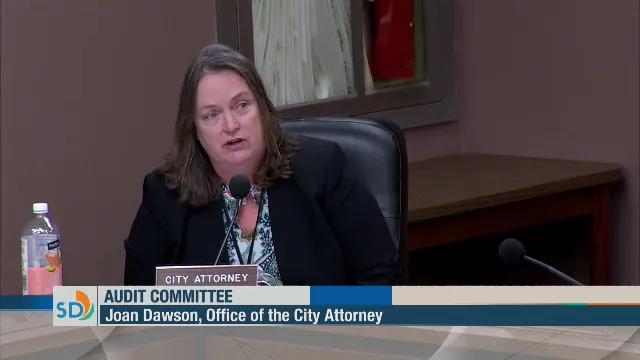
Public Meetings - San Diego, CaliforniaThe San Diego City Audit Committee met on Oct. 30, 2019, to consider routine approvals, hear public comment, receive the interim city auditor's monthly activity report, review the first-quarter FY20 fraud hotline report, and conduct the semi-annual follow-up on outstanding audit recommendations. Chair Sherman presided; Vice Chair Councilmember Campbell and members Spencer, Valdivia, and Halpern were present, joined by Interim City Auditor Kyle Elser, Deputy City Auditor Danielle Knighton, and city staff. Consent Calendar - The committee approved the minutes of the Oct. 2, 2019 meeting on a motion by Councilmember Campbell, seconded by Spencer. The chair announced unanimous passage while noting one abstention by Mr. Valdivia. Public Comments & Testimony - Martha Welch, a non-agenda speaker, used her two-minute public comment period to allege corruption and improper payments, claiming city actions are illegal and that federal and state authorities are investigating. She criticized the use of performance audits, said Mission Bay funds are diverted from parks, and expressed anger over city financial management. Discussion: Monthly Activity Report - Interim City Auditor Kyle Elser reported two audit products issued since the previous meeting: the FY20 first-quarter fraud hotline report and the recommendation follow-up report for the period ending June 30, 2019. - Two audits are in report-writing stage with November release targets: IT audit of network perimeter controls and audit of neighborhood services' homelessness efforts. - Four audits are in fieldwork and slated for December completion: risk management/city attorney liability payouts, development services charges for deposit accounts, strategic human capital management, and fiscal sustainability/financial condition. - Two audits are in planning: IT audit of citywide sensitive data encryption standards and audit of the San Diego Police Department's crime analysis unit. Eleven audits on the annual plan have not yet started. - In FY20 to date, the office has issued two audit reports and two hotline investigation reports containing 23 recommendations. Discussion: Quarterly Fraud Hotline Activity Report - Fraud investigator Andy Harita reported 53 reports received in the first quarter of FY20: 37 were within the fraud hotline's purview (6 assigned to the City Auditor's office and 31 to departments) and 16 were outside purview. - There were 58 city-related open cases on July 1, 2019; adding 37 brought the inventory to 95. Forty-two cases were closed, leaving 53 open at quarter end. - Two city auditor investigations were substantiated and resulted in public reports on improper free trash collection and unfair award of a multimillion-dollar contract. Seven department investigations were substantiated, including allegations of theft of time, a possible Brown Act violation, an unpermitted construction project, unfair parking privileges, an employee bringing a BB gun to city property, and abuse of discretion regarding a customer fee. Seven department investigations led to corrective actions. - Members discussed case-management tracking and analytics. Harita explained that the process uses a third-party call database plus Excel tracking, with 30-day department response deadlines and follow-up. Spencer suggested exploring more robust software. Harita said volume remains on track for about 200 reports per year. - Councilmember Campbell asked about a Brown Act violation case; Harita said the department fixed it by rehearing the item with a more specific agenda description. - The committee accepted the report on a motion by Valdivia, seconded by Halpern, passed unanimously. Discussion: Recommendation Follow-Up Report - Deputy City Auditor Danielle Knighton presented the follow-up for the period ending June 30, 2019. There were 141 open recommendations across 42 audit reports. Since the Dec. 31, 2018 follow-up (117 open), five new performance audits added 24 recommendations. - In this cycle, 25 recommendations were implemented, one was reported as will not implement, and two were determined not applicable, leaving 113 carried forward. Of the 141 recommendations, 46 in process are over two years old, 17 are one to two years old, and 50 are under a year old. - Auditor staff highlighted three recently implemented recommendations: (1) Parks and Recreation corrected permit fees for city employees conducting business at parks, invoicing an employee about $4,000 and improving training and software; (2) Public Utilities added photo capabilities to water meter cover work orders, reducing wasted trips; and (3) the Stormwater Division and Communications Department created a public outreach plan, including a Think Blue website and public service announcements, after the audit identified a five-year funding gap of about $460 million that has since grown to more than $700 million. - Auditor staff also asked the committee to drop three recommendations: two debarment referrals involving vendors no longer in business, and one permanent-debarment recommendation where Purchasing and Contracting instead pursued a non-responsible hearing that resulted in a five-year bar. Deputy City Attorney Joan Dawson advised that debarment is governed by ordinance and is a mayoral quasi-judicial decision, making further action by the committee unlikely. Auditor staff maintained that permanent debarment was warranted. Department-by-Department Follow-Up Review - Assistant Chief Operating Officer: Jury duty service rod recommendation has no update; working with the City Attorney's office, with an expected completion in early 2020. - Chief Operating Officer/Convention Center: Recommendation tied to pending ballot measure discussions; no change. - Communications/Office of Boards and Commissions: Brown Act training video was created, but documentation of delivery was missing; the item will transfer to the Office of Boards and Commissions. The office later said all recommendations were implemented, with over 300 commissioners trained and an administrative regulation circulating for approval. - Department of Finance: One recommendation was reported close to completion, ahead of the December 2020 target. - Department of Information Technology: CIO Jonathan Bakey said the IT contract hotline recommendation is on track for June 2020; an IT governance administrative regulation for the Exella permitting system was drafted and in review. - Development Services: Director Elise Lowe and Interim Deputy Director John Twilliger said Exella permitting system implementation continues, with user testing under way, discretionary processing rollout targeted for February 2020, and ministerial permits later in the year. Some controls will not be implemented until the new system is live. - Economic Development: Director Christina Bibler reported all four recommendations were implemented, including council approval of the business cooperation program and rollout of the revamped Council Policy 900-12 in March. - Sustainability and Environmental Services: Cody Hooven said the energy billing system was overhauled and departmental trainings will finish in December, keeping the item on track. - Fleet Operations: Casey Smith said most recommendations are implemented; documentation will be uploaded, and a program coordinator was hired June 22. - Human Resources: Julie Rasco said the waste-in-transportation-alternatives recommendation is on track for July 2020, with contract negotiations under way with REOs. - Parks and Recreation: Andy Field said the recreation permit calculation recommendation is in pilot and full implementation is expected by January, rather than the earlier October 2019 end date. - Planning: Mike Hansen said community planning group email boilerplate was received; implementation will be evidenced once changes are active. - Public Utilities: Matthew Vespey said seven industrial wastewater recommendations are on track for January 2020; water billing recommendation two remains on track for April 2020. Several recommendations were extended to July 2021, including skip/trouble code analysis and crew size evaluation. Tom Howard described work to streamline 129 codes, reorganize teams, and evaluate data. The department also discussed using the AMI contract to address the box-and-lid backlog. - Purchasing and Contracting: Christina Pratt said about 70% of SAP contracts are in Ariba and the December 2020 target may be pulled up. Documentation for one selected-contracts recommendation is being gathered; a handheld-device recommendation is unfunded and may slip depending on budget, with costs estimated from about $20,000 upward. - Real Estate Assets: Christy Geitz said Council Policy 700-10 updates should be docketed in December; another item is pushed to January. - Risk Management: Chris Olson reported that the transportation alternatives program recommendation was fully implemented in October through an in-house SAP portal for benefit and transit passes, with pre-tax payroll deductions. - Transportation and Stormwater: Nathan Patterson said street light auto repair is on track for November and the undergrounding item was approved by council Oct. 15 and is implemented. Everett Houser said Vision Zero subcommittee work is on track for December 2020 and related items are on target for December 2019. Drew Kleist said a stormwater pipe repair crew recommendation was not funded in FY20; the full 24-position, $7 million crew request will go in the FY21 budget. - During the discussion, Councilmember Campbell noted the city is $700 million behind on stormwater maintenance, and residents pay about 95 cents per month vs. $11.35 in Sacramento, supporting a stormwater fee increase. Key Outcomes - The committee approved the Oct. 2, 2019 meeting minutes. - The committee accepted the FY20 first-quarter fraud hotline activity report. - The committee voted unanimously to accept the recommendation follow-up report and to drop the three recommendations identified by auditor staff as no longer applicable or will not be implemented. - The next Audit Committee meeting was scheduled for Dec. 11, 2019, at 9 a.m.
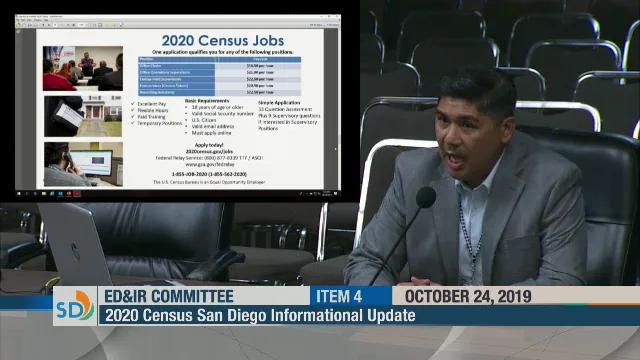
The committee met on October 24, 2019, to discuss divestment and socially responsible investing, updates to the regional revolving loan fund, and the 2020 Census. Vice Chair Montgomery and Councilmember Kercy were present; Councilmember Bree joined later. Consent Calendar - The committee unanimously approved the minutes and record of action from the September 26, 2019 meeting. Public Comments & Testimony - Non-agenda public comments (4 speakers): - Martha Welch criticized county property tax practices and claimed county failure in animal control and 911. - Rosa Vidal (Paradise Hills resident, District 4) demanded agenda time for community data on cannabis equity, arguing the cannabis industry had an hour to present while the community was not given time. - Imani Marshall (Mid City Canns) stated that Black San Diegans are arrested for cannabis at six times the rate of white San Diegans, Pacific Islanders at four times, and Latinos at nearly double. She requested time at the November meeting to discuss law enforcement data. - Diana Ross urged the committee to allow community data and stories on cannabis arrests, noting her brother’s incarceration and that statistics represent real broken homes. - Public comments on Item 1 (Socially Responsible Investment Policy): - Tony Young (Civic Link Strategies, representing SDG&E) commended the initiative but urged removing the ban on investor-owned utilities, citing SDG&E's record of minority/women/LGBTQ hiring, union contracting, and climate leadership. - Nancy Cottingham (Hillcrest Indivisible) strongly supported divestment, drawing parallels to South Africa divestment and urging consistency with the city’s Climate Action Plan. - Scott Murray (Carmel Mountain Ranch) spoke from experience managing a trust, saying divestment did not reduce returns. He cited personal losses from gun violence, tobacco, and fossil fuels, and criticized investor-owned utilities for hindering renewable energy. - Laura Walsh (Surfrider Foundation) supported the policy, noting it reflects prior council actions like Community Choice Energy, offshore oil bans, styrofoam bans, and border wall opposition. - Several additional speaker slips were submitted in favor. Discussion Items - Item 2 – Fossil Fuel Divestment and Socially Responsible Investment Policy (Informational) - Masada Dizenhouse (San Diego 350), Wendy Wheatcroft (San Diegans for Gun Violence Prevention), and Malika Marsden (Climate Action Campaign) presented. They defined divestment and highlighted that 1,115 institutions have divested over $11 trillion from fossil fuels, including California cities. Proposed divestment categories: fossil fuel extraction, firearms illegal in California, tobacco/nicotine/vaping, private prisons/immigration detention, investor-owned utilities, single-use plastics, border wall expansion, and palm oil. They urged proactive investment in renewable energy and environmental justice. - Martha Welch spoke in support, expressing strong opposition to fracking. - Item 1 – Socially Responsible Investment Policy (Discussion) - Brian Elliott (Council District 3 staff) presented a proposed policy with two components: divestment from listed industries and proactive investment in clean energy, equality, community economic development, and environmental justice. The city currently holds $30 million in corporate notes from fossil fuel companies. Proposed implementation: 30 days after council passage, existing funds held to maturity. - Councilmember Bree learned the city invests in corporate bonds (e.g., Exxon, Chevron) and requested a full list. Chief Investment Officer Kent Morris noted the city’s investment portfolio is limited by state law (Gov. Code 53601) to high-grade securities; corporate bonds are only a small portion (28%). CFO Rolanda Trev clarified that such divestment policies typically apply to larger pension funds, not the city’s constrained portfolio. - Councilmember Kercy expressed concern about subjectivity: who decides which industries are harmful? He asked about opioid manufacturers like Johnson & Johnson, and noted the list could expand arbitrarily. He argued the treasurer’s duty is to earn returns, not make moral judgments. - Vice Chair Montgomery supported moving the item forward but raised issues about local lending practices (e.g., Bank of America contract with no branches in District 4) and the need for inclusive criteria. - Councilmember Bree supported further analysis but noted most of the policy does not apply to the city’s limited portfolio; the real target is the pension fund (independent of council control). She suggested focusing on what the city can actually invest in. - Kent Morris estimated implementing the policy would cost $250,000 for compliance (staff, software) plus $250,000 annual lost earnings from needed divestment from the state pool (LAIF). - Item 3 – San Diego Region Revolving Loan Fund Update (Informational) - Christina Bibler and Rosalina Enriquez (Economic Development) presented a consolidated loan fund merging two prior funds. Since 2002, 79 loans totaling $8.9 million have been made. Current available lending: $2.1 million. New features: micro-loans ($10K-$50K), standard loans ($50K-$500K), interest rates 4%-10%, online application, and priority for underserved communities and startup businesses (6 months operating history). The loan advisory board approved updates; EDA approved consolidation. - Kevin Pointer (City of Chula Vista) praised regional collaboration. - Vice Chair Montgomery asked about targeting underserved areas; staff confirmed priority for Promise Zones, opportunity zones, and older commercial neighborhoods using census tract data. Councilmember Bree asked about turnaround time; staff hopes for 30 days or less and will market through BIDs and business associations. - Item 4 – 2020 Census San Diego Informational Update - Andrew O’Marel (U.S. Census Bureau Partnership Specialist) presented. The census determines distribution of $675 billion in federal funds. In 2010, national response rate was 80%, but 416,427 San Diegans needed enumerator follow-up. There are 49 hard-to-count census tracts in San Diego (population 256,000) with participation rates below 70%. This year, online response begins March 12, 2020; paper forms available; call centers in 13 non-English languages; language guides in 59 languages. The Bureau is hiring 7,700 employees for San Diego County, paying above living wage. Key challenges: hard-to-count communities (immigrants, LGBTQ, homeless, children under 5). O’Marel encouraged council offices to promote the census, host events, and share information. - Vice Chair Montgomery raised concerns about funding distribution: the city forwarded allocation to United Way without specific conditions. She requested more involvement in how outreach funds are spent. O’Marel noted the SANDAG Complete Count Committee allocated funds; further discussion with United Way possible after October 31. He encouraged the city to form its own Complete Count Committee. Key Outcomes - Item 1 (Socially Responsible Investment Policy): A motion to direct staff (city attorney, mayor’s office, council staff) to draft a policy was made and seconded. After discussion, the motion resulted in no recommendation out of committee; the item will be submitted as a Legislative Service Request (LSR) to the city attorney’s office for further analysis. Councilmember Bree will also receive a full list of the city’s corporate bond holdings. - Item 2 (Divestment Informational): No action required; the presentation concluded the informational item. - Item 3 (Revolving Loan Fund): Informational only; no motion. The updated loan program will begin active outreach. - Item 4 (2020 Census): Informational only; no motion. The committee encouraged continued engagement and noted the need for city coordination on hard-to-count communities. The next meeting of this committee is scheduled for November 14, 2019 at 2:00 p.m.
On October 23, 2019, the Public Safety and Livable Neighborhoods Committee convened with all council members present. The meeting covered eight agenda items, including a ballot measure for an independent police commission, revisions to massage industry regulations, and updates on homelessness outreach and police communications. Consent Calendar - Approved minutes from the previous meeting unanimously. Public Comments & Testimony - William Perno (Central Region Prevention Coalition) urged the committee to delay votes on the 12th update to the Land Development Code Phase 2, citing lack of transparency and input from community planning groups. He noted that the Community Planners Committee had voted to postpone their recommendation and requested the city council do the same. - Sandy Alera described a hazardous encounter with a needle at NTC Park and reported ongoing safety issues at playgrounds, calling for designated children's play areas. - Kathleen Lippett criticized the process for marijuana permitting approvals as skewed, lacking transparency, and raising appeal fees from $100 to $1,000, making appeals unaffordable. - Martha Welch expressed frustration with the city’s handling of police and fire services, alleging understaffing and lack of responsiveness. - Kelly McCormick raised concerns about the Code Monitoring Team, stating it operates secretly, violates the Brown Act, and has members with conflicts of interest. She supported reducing marijuana billboards near sensitive areas. Discussion Items - Item 1: Ballot Measure for Independent Commission on Police Practices - The city attorney presented a draft charter amendment. The IBA recommended excluding informal complaints from investigative and review capacities. - Public speakers overwhelmingly supported the measure, emphasizing the need for independent oversight, community trust, and representation for youth and impacted communities. - Committee motion passed unanimously with amendments to exclude complaints where the complainant requests no action or where no specific officer is identified, and to strike a sentence on reviews. - Item 2: Revisions to Massage Industry Municipal Code and Fees - Lt. Andrew Brown presented data on human trafficking in massage businesses, including 57% prostitution arrest rate in covert operations and 76% overall violation rate in 2019. - Proposed changes include requiring all massage establishments to obtain a permit, a two-year prohibition on permits at locations where previous permits were revoked, and posting human trafficking notices. - Opposition from sole practitioners who felt unfairly targeted; support from anti-trafficking advocates called for trauma-informed enforcement. - Motion passed unanimously. - Item 3: Repayment of HUD Loan for Valencia Business Park - The city would repay $2.515 million to HUD, which would then return the funds as CDBG program income for eligible projects. - Motion passed unanimously. - Item 4: Agreement with Airbus Helicopters - Approval to enter a five-year agreement and purchase one H125 helicopter with an option for three additional, contingent on council approval. - Motion passed unanimously. - Item 5: Reimplementation of Resource Access Program (RAP) – Information Item - The program resumed with paramedics and county clinicians targeting high 911 utilizers. Preliminary data showed a 41% decrease in 911 calls among 16 high-acuity clients, with 7 housed. - No action taken. - Item 6: Barrio Logan Commercial Vehicle Enforcement – Information Item - Captain Holden reported 49 citations in 2019 (up from 20 in 2017) for violating the truck route. Residents and the Environmental Health Coalition presented video evidence of persistent violations, health impacts, and safety hazards. - Committee requested monthly enforcement updates at community planning meetings. - No action taken. - Item 7: Neighborhood Policing Division Update – Information Item - Captain Wall described outreach efforts including expanded hours, added social workers, and weekly coordinated outreach events. The division handled over 10,000 Get It Done complaints. - Advocates criticized lack of data and insufficient scale, while the committee acknowledged progress but stressed need for measurable outcomes. - No motion. - Item 8: Police Communications Division Update – Information Item - Captain Griffin reported historic low vacancies, 92% of 911 calls answered in 10 seconds or less (average 4 seconds), and 77% of non-emergency calls answered in under 2 minutes (average 1 minute 46 seconds), a 62% improvement over FY2018. - No action taken. Key Outcomes - Approved minutes from previous meeting. - Voted unanimously to forward the ballot measure for an independent police commission to full City Council for meet-and-confer, with specific amendments. - Voted unanimously to adopt revisions to the massage industry code and fees, moving it to full council. - Voted unanimously to authorize repayment of the HUD loan and the helicopter purchase agreement. - Information items were received and discussed; no formal actions were taken. - The next meeting is scheduled for December 2, 2019, at 6 p.m. as a community meeting.
The committee met to discuss dockless scooter operations and a public works construction update. No votes were taken; the items were informational. Consent Calendar None. Public Comments & Testimony - Martha Welch provided disjointed comments about buses, bathrooms, and alleged government misconduct. - Jennifer Hunt, San Diego County Bicycle Coalition, announced the upcoming CicloSDias event on Sunday, October 27, from 10 a.m. to 3 p.m., inviting the community to enjoy open streets. - Lime representatives Katie Stevens and Kimia Tolebian presented an update, noting that e-scooters are successfully replacing car trips. They proposed potential regulatory changes: expanding corrals to keep sidewalks clear, establishing a curfew to reduce nighttime misuse, reducing operator response time from three hours to one hour, requiring ID scanning to prevent underage riding, and linking fleet increases to performance metrics. - Bird representative Tim Harder presented an update on compliance efforts, supporting corrals but noting challenges with street sweeping fines due to scooters in corrals. - Alec Goosy, a Bird charger and user, emphasized the importance of micromobility and the need for more corrals, citing data that riders who start in corrals are more likely to end trips there. - Councilmember Kercy expressed strong initial support for scooters but noted a recent lack of them downtown and urged against placing enforcement burdens on police. Discussion Items - Vice Chair Ward thanked staff and operators for the update. He supported expanding the corral program and suggested requiring riders to end trips only in corrals downtown. He advocated for continued education via scooter apps, license scanning to verify age, and commended Bird's parking discounts. - Councilmember Kate asked about the timeline for the Gold Coast Drive project (a separate public works project). Staff clarified that designs will be completed this fiscal year, with construction funding needed in fiscal year 2021. He also expressed interest in seeing proposed scooter regulatory revisions at the next meeting. Key Outcomes - No formal actions were taken; the items were for information and discussion only. - Staff and the mayor's office will bring back proposed revisions to scooter regulations for consideration at the next committee hearing on Wednesday, November 20, 2019, at 2 p.m.
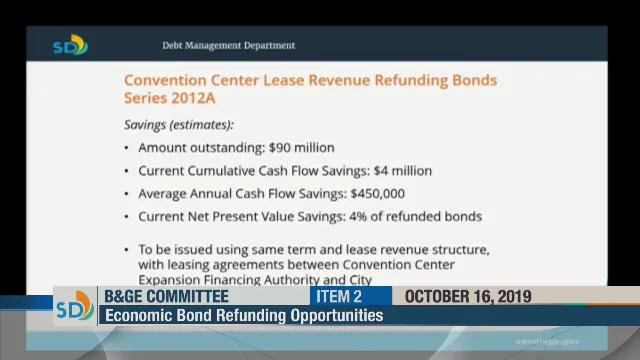
The Budget and Government Efficiency Committee met on October 16, 2019, to review the Fiscal Year 2019 Year-End Performance Report, approve several contract extensions and refunding proposals, and hear public comment. The committee approved all action items unanimously, including a two-year extension of the Ontario Systems contract and authorization for economic bond refinancing. Consent Calendar - The committee approved the record of actions from the September 11, 2019 hearing unanimously. Public Comments & Testimony - Ms. Welch addressed the committee, expressing frustration with the city's budget transparency, police and fire overtime costs, water estimates, franchise fees, and what she perceived as unfulfilled council promises. She urged the city to disclose more financial details. Discussion Items - Fiscal Year 2019 Year-End Performance Report (Informational Item): Rolanda Trevelle (CFO), Sarah Mahon (Assistant Director, Department of Finance), Adam Jones (Financial Operations Manager), and Jose Mendoza (Principal Accountant) presented the report. Revenues were less than 1% higher than third-quarter projections, expenditures about 1% lower, resulting in an excess equity of approximately $25.4 million. Deputy COO Johnny Perkins noted the reopening of La Jolla Cove street and the 101 Ash Street building's 83% completion, with first employee move-in in mid-November. Councilmembers asked about cannabis tax breakdowns, homeless outreach data (Assistant Chief Paul Conley stated about 11% of touches connect to services), the Navigation Center's opening around Thanksgiving, smart streetlight sensor concerns, and the status of rape kit testing funding (Chief Dave Nisleit reported $500,000 was allocated in FY18 for instruments and overtime, with $202,000 returned to the general fund). Vice Chair Kate raised concerns about using excess equity for homelessness services and asked for metrics. - Ontario Systems Contract Extension (Action Item): The City Treasurer's Office requested a one-year extension with two additional one-year options to continue using the Revenue Plus Collector System while transitioning to a new system. The annual cost is approximately $240,000. The IBA suggested limiting to two years and requiring progress updates. Councilmember Montgomery moved to approve a two-year extension, which passed unanimously. - Economic Bond Refinancing (Action Item): Debt management proposed advanced refundings of 2012/2013 lease revenue bonds (savings $600,000 annually to general fund), 2012 Convention Center bonds ($450,000 annually), and 2012 PFFA water bonds ($1.9 million annually to water fund). The refundings would be taxable due to the 2017 Tax Cuts and Jobs Act. The committee voted unanimously to forward to City Council. - NASPO Cooperative Agreement with Verizon (Action Item): The Department of IT requested approval for a cooperative agreement with Verizon through NASPO ValuePoint for wireless communications. The agreement has a not-to-exceed amount of $19 million through August 2024, with volume discounts from over 2,000 public sector customers. The IBA noted Verizon represents 72% of city cellular spend ($3.9 million in FY19). Councilmember Montgomery asked about financial benefits and EOCP compliance, then moved approval, which passed unanimously. Key Outcomes - Approved the September 11, 2019 hearing record (unanimous). - Approved a two-year extension of the Ontario Systems contract (moved by Councilmember Montgomery, seconded by Vice Chair Kate, passed unanimously). - Approved forwarding economic refunding proposals to City Council (moved by Vice Chair Kate, seconded by Councilmember Montgomery, passed unanimously). - Approved the NASPO cooperative agreement with Verizon (moved by Councilmember Montgomery, seconded by Vice Chair Kate, passed unanimously). - The committee will reconvene on November 13, 2019 at 9 a.m.
The Budget and Government Efficiency Committee of the San Diego City Council met on October 16, 2019, at 10:00 AM. The meeting was chaired by Councilmember Bree, with Vice Chair Kate and Councilmember Montgomery present. Councilmember Moreno was absent. Also present were Angela Colton from the IBA, CFO Rolanda Charval, and Deputy City Attorney Brett Bartalotta. The committee reviewed the Fiscal Year 2019 year-end performance report, discussed several city programs, and approved three action items. Consent Calendar - Approval of Minutes: The committee approved the record of actions from the September 11, 2019 hearing by a unanimous vote. Public Comments & Testimony - Ms. Welch spoke during non-agenda public comment. She criticized the city for its handling of police and fire overtime expenses, water estimates, and lack of transparency in financial audits. She also expressed opposition to franchise fees and alleged that city council votes for projects that never materialize. Discussion Items - Fiscal Year 2019 Year-End Performance Report: The Department of Finance presented the fourth and final monitoring report of the fiscal year. Key points: - Revenues were within 1% of third-quarter projections, with a net increase of $9.8 million driven by property tax ($2.8M), sales tax ($2.3M), and departmental revenue ($3.8M, including FEMA reimbursements, parking meter district revenue, and cannabis business tax). - Expenditures were 1% lower than projected, with a net decrease of $15.5 million due to vacancy savings, lower contract costs (e.g., bridge shelter), reduced litigation expenses (Florida litigation carried forward), lower utility costs (solar conversion), and reduced IT maintenance. - Estimated excess equity was $23 million, of which $19.5 million is expected to be available for future programming after accounting for carry-forwards. - The general fund met all reserve targets, including a 15.25% reserve and contribution to the pension stabilization reserve. - Updates were provided on the 101 Ash Street building (83% complete, first employees moving in mid-November), Clean San Diego initiative, homeless services, and energy-efficient outdoor lighting upgrades. - Discussion Highlights: - Councilmember Montgomery inquired about the effectiveness of the Homeless Outreach Team (HOT), noting an 11% connection rate to services. Assistant Chief Paul Conley stated that with new shelters, this rate is expected to increase. - Keely Halsey provided an update on the Navigation Center, stating it is on track to open around Thanksgiving at a final tenant improvement cost of approximately $400,000 (originally $300,000). Metrics for success are included in the operating contract. - Cody Hooven reported that Phase 2 of smart street lights is underway, with an RFP to be released soon. A memo responding to community concerns about sensor cameras was shared with council. - Chief David Nisleit discussed the use of $500,000 allocated in FY2018 for rape kit testing: funding was used for DNA instruments, overtime, and a database, with $202,000 returned to the general fund. An RFP for backlog testing is expected that week. - Vice Chair Kate raised concerns about maintaining homeless service funding from savings, and requested data on the impact of outreach funding levels. - Chair Bree asked for a list of Navigation Center providers and a tour once open. Key Outcomes - Item 1: Extension of Ontario Systems Contract: The committee approved a two-year extension (instead of the requested three) for the delinquent accounts collection system (Revenue Plus Collector) at an annual cost of approximately $240,000. The city is in the process of implementing a new system from CCS Inc., with an 18-month timeline. Motion by Councilmember Montgomery, seconded by Vice Chair Kate; passed unanimously. - Item 2: Economic Bond Refinancing Opportunities: The committee forwarded to the City Council a proposal to refund four series of bonds (2012/2013 general fund CIP lease revenue, 2012 convention center, and 2012 water revenue bonds). Potential savings are estimated at $1 million annually for the general fund and $1.9 million annually for the water fund. Refundings will proceed only if debt policy thresholds (3-4% NPV savings) are met. Motion by Vice Chair Kate, seconded by Councilmember Montgomery; passed unanimously. - Item 3: Cooperative Agreement with Verizon Wireless: The committee approved a resolution authorizing the mayor to execute an agreement with Verizon Wireless through the NASPO ValuePoint cooperative contract, with a not-to-exceed amount of $19 million through August 2024. The contract covers cellular equipment and services for over 6,000 city lines, with 71% funded by the general fund. Motion by Councilmember Montgomery, seconded by Vice Chair Kate; passed unanimously.
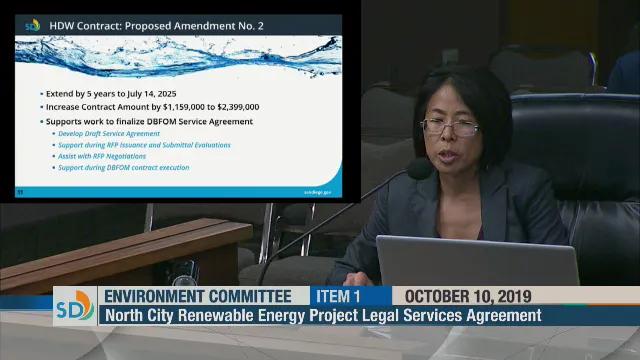
The Environment Committee of the San Diego City Council met on October 10, 2019, at 1:00 PM. Chair Councilmember Campbell presided, with Councilmembers Moreno, Sherman, and Bree present. The committee heard non‑agenda public comments on several topics, including the proposed consolidation of advisory boards, animal rescue rights, and climate emergency declaration. The committee then considered three items related to the Pure Water San Diego Program, voting on amendments and an incentive agreement. Public Comments & Testimony Non‑Agenda Public Comments - Ann Feige (Chair, Community Foundation Advisory Committee) expressed disappointment that the Community Forest Advisory Board (CFAB) was to be disbanded without input, and urged the committee to consider a subcommittee for trees within a new environment board. - Vince Mukalonis (District 7 representative, CFAB) stated he was "100% opposed to the manner" of disbanding CFAB without consultation, and argued that the new board must include urban forestry expertise. - Virginia Wilson (CFAB representative) voiced concern that the proposed 15‑member board would not cover all areas of expertise, especially forestry, and noted that the city’s five‑year forestry plan requires staffing and budget advocacy. - Andrew Meyer (San Diego Audubon Society) requested an opportunity to present the Rewild Mission Bay Project, highlighting the need for wetland restoration and climate adaptation, and delivered 100 postcards urging clean water and shoreline restoration. - Seven speakers (Cameron Maita, Shannon Sears, Stacy Plukitis, Melanie Bazell, Liz Jacobelli, Rachel Holser, and Lindsay Demek) spoke in support of a “Right to Rescue” resolution, arguing that California’s penal code is not enforced for farm animals, that animal cruelty is widespread, and that all animals – not just pets – deserve protection. Shannon Sears stated she faces felony charges for protesting outside a duck farm. They urged the city to adopt a local ordinance to protect rescuers. - Nancy Cassidy (co‑founder, San Diego Climate Mobilization) called on the committee to recommend a declaration of a climate emergency, citing methane releases in the Arctic and the need for a massive mobilization to replace fossil fuels. - Derek Cassidy (co‑founder, San Diego Climate Mobilization) echoed the request, noting that 200,000 Americans die annually from air pollution, and urged the council to pass a climate emergency resolution. Public Comments on Agenda Items - Lonnie Lutar (speaking as an individual) spoke in favor of the Stantec contract amendment (Item 2), emphasizing the critical importance of continuity and community outreach for the Pure Water program, which is now a national and international model. - Sophie Barnhorst (San Diego Regional Chamber of Commerce) spoke in support of the incentive agreement with Metropolitan Water District (Item 3), calling the $285 million in credits a huge benefit to ratepayers and key to moving Pure Water forward. Discussion Items Item 1: Pure Water Amendment No. 2 – Hawkins Delafield & Wood (Sole Source Legal Services) Staff presented an amendment to extend the contract for specialized legal services for the North City Renewable Energy Project, increasing the total by $1.1 million to $2.4 million and extending the term by five years. Councilmember Moreno moved to approve the staff recommendation. Councilmember Sherman stated he would vote no because the Pure Water program includes a provision requiring union-only jobs, which he said discriminates against 85% of the workforce. The motion passed 3‑1 (Moreno, Campbell, Bree in favor; Sherman opposed). Item 2: Pure Water Amendment No. 3 – Stantec Inc. (Engineering Technical Services) Staff presented an amendment to increase the contract from $56.4 million to $94.1 million and extend the term to 2025, without competitive bidding. Councilmember Moreno expressed concern about the lack of competitive bidding and the tripling of the original contract amount. She moved to forward the item to full council “without recommendation,” and requested that the Independent Budget Analyst (IBA) work with the Public Utilities Department to produce a report analyzing whether the city is getting a good deal, including benchmarking program management costs and oversight mechanisms. The motion passed 3‑1 (Moreno, Campbell, Bree in favor; Sherman opposed). Item 3: North City Pure Water Facility Local Resources Program Incentive Agreement Staff presented an agreement with the Metropolitan Water District of Southern California that would provide the city with credits of approximately $340 per acre‑foot of water produced by Phase 1 of Pure Water, valued at an estimated $11.4 million per year ($285 million over 25 years). Councilmember Moreno moved to approve the staff recommendation. Councilmember Sherman asked if the credits would go only to Pure Water; staff confirmed they are credits on the city’s water bill for imported water. The motion passed unanimously 4‑0. Key Outcomes - Item 1 (Hawkins Delafield & Wood) : Approved 3‑1, to be forwarded to full council. - Item 2 (Stantec) : Forwarded to full council without recommendation (3‑1), with a request for an IBA report on contract value and oversight. - Item 3 (MWD Incentive Agreement) : Approved 4‑0, to be forwarded to full council. - The committee’s next scheduled meeting is Thursday, November 7, 2019, at 1:00 PM.
The Land Use and Housing Committee met on October 9, 2019, to consider several items including land sales, a movable tiny homes ordinance, and an informational presentation on the airports division business plan. The meeting included non-agenda public comments, discussion on city-owned property dispositions, and a unanimous vote to draft a municipal code amendment for movable tiny homes. Consent Calendar - Approval of September 11, 2019 Action Items: Moved by Councilmember Sherman, seconded by Councilmember Campbell. Approved unanimously. - Item 1 (Consent): Approved unanimously. Items 2 and 3 were pulled for discussion. Public Comments & Testimony - Joy Sunata thanked committee members for bringing state affordable housing advocates to the previous committee meeting and encouraged the TV audience to review details from that meeting. - Martha Welsh spoke about housing issues, alleging unfair practices in Section 8 housing and expressing anger about perceived mismanagement of affordable housing and senior housing. - Nancy Maldonado (President/CEO, Chicano Federation of San Diego County) urged the city to end housing segregation by eliminating single-family zoning and adopting a local ordinance modeled on SB 50, called SD50, to add density in job-rich areas and protect tenants from displacement. - Ricardo Flores (Executive Director, Local Initiative Support Corporation) supported ending single-family zoning, citing historical segregation through redlining, and urged passage of SD50. - Rachel Stevens (Regional Organizing Director, California YIMBY) supported ending exclusionary zoning, noting that zip codes determine opportunities, and backed SD50. - Mr. Honoré (NAACP San Diego) urged the council to be forward-looking and change discriminatory zoning laws that perpetuate segregation. - Matthew Adams (Building Industry Association) commended the innovative movable tiny homes idea and urged adoption as one tool to address the housing crisis. - Joy Sunata (position in favor, did not speak) registered support for movable tiny homes. Discussion Items - Item 2: Sale of 0.17 acres near 2nd and Mariposa (APN 669-010-32). Staff requested a revised action to authorize sale at or above appraised value to no specific buyer due to a late offer. Councilmember Ward spoke against piecemeal sales, advocating for a comprehensive strategy to use city-owned land for affordable housing. Councilmember Sherman noted the parcel is 7,400 sq ft, 40 ft wide, and incapable of independent development. Motion to approve staff recommendation failed (2-2? Actually voting: ayes and noes, motion did not carry; then moved without recommendation, which carried). Outcome: sent to full council without recommendation. - Item 3: Sale of land adjacent to 6405 Ider Street (APN 554-073-32). Similar discussion; Councilmember Ward reiterated concerns. Motion to approve failed; moved without recommendation and carried. - Item 4: Sale of property on Bonita Drive (APN 552-190-19, 11,700 sq ft). Staff presented two offers: Habitat for Humanity ($500, to build one SFR and one ADU at 80% AMI) and CityMark Communities ($60,000, market-rate units). Councilmember Sherman favored market-rate to avoid picking winners and losers and to fulfill fiduciary duty, but chair moved to recommend sale to Habitat. Councilmember Ward supported, noting Habitat's work. Motion passed 3-1 (Sherman opposed). - Item 5: Movable Tiny Homes Ordinance – Presentation by Barrett Tetler (Councilmember Sherman's office). Defined movable tiny homes (150-400 sq ft, on wheels, built to higher standards than RVs). Advantages: lower cost ($40k-$100k), quick occupancy (30-45 days), naturally occurring affordable housing ($900/month rent). Other jurisdictions (Fresno, San Luis Obispo, Denver) have passed similar ordinances. State HCD provided an advice letter encouraging the ordinance. Motion by Councilmember Sherman, seconded by Ward, to request the city attorney, council district 7, and committee consultant prepare a municipal code amendment for movable tiny homes, to be considered by end of 2019 if possible. Passed unanimously. - Item 6: Airport Division Business Plan FY2020 – Informational presentation by Rod Propes. Overview of goals: safety, compliance, financial self-sufficiency, economic development, environmental stewardship. Financial highlights: total assets $53M, net position $45M, cash on hand $14.6M after capital projects. Operating loss due to depreciation and one-time costs (Brownfield runway reconstruction, CEQA). Development opportunities at Montgomery Gibbs and Brown Field. Councilmembers asked about lead fuel, noise complaints, and hours of operation. No action taken. Key Outcomes - Consent Calendar: Approved minutes from September 11, 2019. - Item 2 (2nd & Mariposa): Motion to approve failed; referred to full council without recommendation. - Item 3 (Ider Street): Motion to approve failed; referred to full council without recommendation. - Item 4 (Bonita Drive): Approved (3-1) to recommend sale to Habitat for Humanity at $500 for affordable housing at 80% AMI, requiring a waiver of council policy 700-10. - Item 5 (Movable Tiny Homes): Unanimously approved motion to draft a municipal code amendment for movable tiny homes as a type of ADU, to return before the end of 2019. - Item 6 (Airport Business Plan): Informational; no action required. Next regular meeting: November 6, 2019.
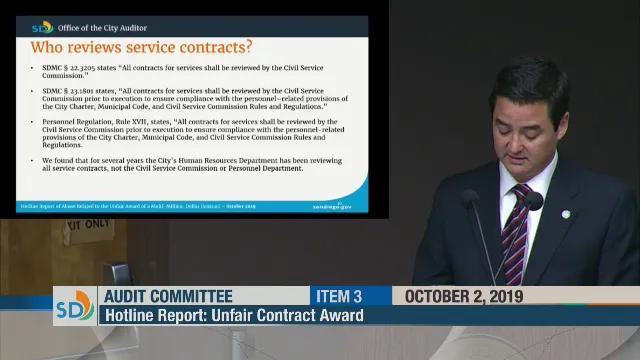
The Audit Committee met on October 2, 2019, at 5:00 PM to review several items, including a proposed ballot measure to change the city auditor selection process, performance audits, fraud hotline reports, and inventory verification. The meeting lasted approximately three hours. Consent Calendar - Approval of Minutes: The committee unanimously approved the minutes from the July 10, 2019 meeting. Public Comments & Testimony - Martha (public speaker): Expressed concern about the lack of financial audits, stating that the city focuses too much on performance audits and hides where money goes. She specifically mentioned that a council-approved project (pump) was not on the list to be built and questioned estimates for water bills. She urged the auditor to look into these financial issues. Discussion Items - Mayor's Appointment of City Auditor: Councilmember Campbell noted that the appointment of the new city auditor (nominated by the mayor) was not on the agenda. Almas from the mayor's office explained that the nomination was not pulled but was being reconsidered depending on ongoing charter amendment discussions. The committee agreed to schedule the matter for a future meeting. - Advisory Review of Ballot Measure to Amend City Charter Section 39.2 (Auditor Selection): Councilmember Sherman presented a proposal to change the auditor selection process from mayoral appointment to an audit committee-led selection, with council confirmation. The IBA (Jeff Kawar) provided comparative data on auditor terms in other cities, noting that most exclude mayoral involvement and have terms of 4 years or indefinite. The mayor's office suggested three modifications: (1) two five-year term limit for the auditor, (2) requiring no fewer than three candidates from the committee, and (3) specifying that the principal assistant serves as interim auditor during a vacancy. After discussion, the committee voted 3-1 to recommend the following modifications to the council: a five-year term with a possibility of reappointment for a second five-year term (not to exceed 10 years), with the council able to waive a national search for reappointment; the council must select from at least three candidates identified by the audit committee; and the principal assistant shall serve as interim auditor. The motion passed with Councilmember Campbell dissenting on the term limit. - Performance Audit of Public Utilities Department (PUD) Advanced Metering Infrastructure (AMI) Implementation: The city auditor presented findings on the Smart Water Meter project. Key issues: poor project management, staffing shortages (22% vacancies, 44% annual turnover), inaccurate cost tracking, and data entry errors causing billing delays. Only 6% of meters were actively transmitting data as of the audit. PUD management agreed with all 13 recommendations and outlined steps to improve, including hiring a third-party contractor via RFP, developing a staffing plan, and enhancing system controls. The committee accepted the report and forwarded it to the city council. - Hotline Report of Abuse Related to Unfair Award of a Multi-Million Dollar Contract: The fraud investigator presented findings of potential violations of state law, city charter, and municipal code in the award of a piggyback contract. The vendor had extensive pre-award meetings with city staff, and the contract was modified from the source contract. The committee discussed the confidentiality of the full 100-page report (only 50-page public version available). The city attorney advised that state law limits disclosure. Management agreed to implement all eight recommendations. The committee accepted the report and forwarded it to the city council. - Hotline Report of Improper Free Trash Collection at Short-Term Residential Occupancy Units (STROs): The investigator found that the city provides free trash collection to about 16,000 STROs, likely violating the People's Ordinance. Management partially agreed and planned to evaluate impacts by December 2020. The committee accepted the report and forwarded it to the city council. - Central Stores Inventory Verification (Agreed-Upon Procedures): MGO presented the results of the physical inventory count as of June 30, 2019. Of the 208 sampled items, 72 had variances (mostly small dollar amounts, netting about $9,500). The committee discussed presentation improvements and accepted the report. - Quarterly Fraud Hotline Activity Report (FY19 Q4): The fraud investigator reported 69 new cases in Q4, with 45 assigned for investigation. There was an increase in theft-of-time allegations. Twelve cases were substantiated with corrective actions. The committee received the report as information. Key Outcomes - Ballot Measure: The committee voted 3-1 to recommend modifications to the auditor selection charter amendment (term limits, candidate pool, interim succession) to the city council. - AMI Audit: Accepted and forwarded to city council; PUD to implement all recommendations by July 2020. - Hotline Report (Contract): Accepted and forwarded to city council; management to implement recommendations. - Hotline Report (Trash): Accepted and forwarded to city council. - Central Stores Inventory: Accepted. - Fraud Hotline Report: Received as information. - Next Meeting: Scheduled for October 30, 2019, at 9:00 AM.