The San Diego City Audit Committee convened on June 12, 2019, under Chair Sherman, with Vice Chair Councilmember Campbell, members Spencer, Valdivia, and new member Halpern. The committee reviewed two performance audits (Public Utilities Department call center and urban forestry tree maintenance), discussed a monthly activity report, and heard non-agenda public comment. All votes were unanimous. Consent Calendar - Approval of Minutes (May 22, 2019): Moved by Councilmember Campbell, seconded by Mr. Valdivia, passed unanimously. Public Comments & Testimony - Anne Faggy (community representative): Expressed gratitude for adding a position to the urban forestry program and restoring tree trimming. Recruited board members for the Community Forest Advisory Board, noting many terms expiring. Praised the audit’s data but urged inclusion of technology recommendations for tree inventories and care. Stated the additional FTE is “only a down payment” and requested continued investment in urban foresters and tree care. Discussion Items Item 2: Performance Audit – PUD Customer Support Division (Call Center) - Auditor Presentation (Chine Pickney, Megan Garth): Found that PUD does not fully leverage its call center software (e.g., unused emergency messaging module), relies on institutional knowledge without adequate documentation, uses inconsistent performance metrics (e.g., calls-per-agent per day instead of first-call resolution), and 80% of calls require supervisor intervention. Staff morale is low due to lack of autonomy and training. Made six recommendations including hiring a subject matter expert, revising authorization levels, and improving training. - Management Response (Johnny Perkins, Matt Vesby, Jeremy Cluco, Craig Boyd): Agreed with all findings. Noted an internal assessment (since September 2018) led to a proposed reorganization (customer success, customer advocacy, workforce development). Target implementation dates: most by December 31, 2019, or January 31, 2020. Key changes include: new program coordinator, enhanced training (adding soft skills and water operations), and exploration of system upgrade or replacement. - Committee Questions: - Mr. Valdivia asked about system age (last major update 2011) and turnover (25%). Auditors confirmed low morale. - Mr. Spencer queried whether a new system is still considered. Management confirmed ongoing analysis, but committed to implementing improvements by January 2020 regardless. - Councilmember Campbell noted anecdotal positive customer experience and asked about manager roles. Management identified Jennifer Manos as call center manager pending meet-and-confer. - Mr. Halpern asked about user-friendliness, staff empowerment, and tracking first-call resolution (FCR). Management stated that data integrity issues are being addressed, with baseline FCR tracking expected by early 2020. - Lisa Byrne (IBA) asked about customer satisfaction survey automation. Management confirmed plans to automate the survey. - Outcome: Motion to accept and forward to City Council passed unanimously. Item 1: Performance Audit – Right-of-Way Tree Maintenance Program - Auditor Presentation (Chris Kime, Laura Reyes Cortez): Found that Transportation & Stormwater Department lacks a contract compliance plan for the tree maintenance contractor, with no formal inspection process. Over 14,000 palm trees billed at two rates without substantiating documentation. The sole KPI (44,000 trees trimmed/year) does not capture staff workload; service notifications increased 140% over two years (avg. 484/month in FY2019) while crew positions remained flat (7–8 occupied). Four recommendations: implement contract compliance plan, require palm tree documentation, track additional KPIs (e.g., response times by priority), and create reporting mechanisms. All were agreed to. - Committee Questions: - Mr. Valdivia asked about equipment (no crane, one bucket truck). Management confirmed need but noted budget constraints. - Mr. Spencer inquired how the city ensures contractor work meets specifications. Management acknowledged spot checks but no formal compliance plan. The city forester (Brian Widener) stated that one new arborist was added in the FY2020 budget. - Mr. Halpern asked about priority levels; management agreed the five-level system could be simplified (e.g., dropping medium priority). - Councilmember Campbell discussed her Environment Committee's urban canopy initiative, including a tree-planting contest with SDG&E. She asked if a cost analysis of in-house vs. contracted trimming had been done; management said it would require further study. - Chair Sherman questioned whether technology (e.g., photos) could be required in the next contract to verify work. Management confirmed they are exploring contractor field software. - Outcome: Motion to accept and forward to City Council passed unanimously. Item 3: Monthly Activity Report (Informational) - Interim City Auditor Kyle Elser: Reported two audit products issued (the two presented), three audits in report-writing stage (IT disaster recovery, PUD AMI implementation, homelessness – delayed to July), one in fieldwork (network perimeter controls), five in planning, and one not started. In FY2019 so far, 17 audit reports and 2 hotline reports issued, with 78 recommendations. - Committee Questions: - Mr. Spencer asked about the call center audit exceeding budgeted hours by one-third. Auditors explained that initial single-auditor scope expanded to two when complexity was discovered. - He also asked about the risk management audit (used 25% of hours in planning) due to access issues with City Attorney’s office; auditors are working to resolve without scope impairment. - Chair Sherman asked about prioritization when audits exceed hours; auditors carry over lowest-priority audits to next year’s plan. - Outcome: Committee considered themselves informed. Key Outcomes - Consent Calendar: Minutes approved unanimously. - Item 2 (Call Center): Audit accepted and forwarded to City Council; management committed to 6‑month implementation timeline with specific milestones (e.g., new training, system decision by Jan 31, 2020). - Item 1 (Tree Maintenance): Audit accepted and forwarded to City Council; management will incorporate contract compliance plan into upcoming RFP and develop additional KPIs. - Next Meeting: Scheduled for July 10, 2019, 9:00 a.m., same location.
Public Meetings - San Diego, California
Public Meetings - San Diego, CaliforniaThe Land Use and Housing Committee of the San Diego City Council convened on June 12, 2019, at 9:00 AM. Present were Councilmembers Moreno (Chair), Campbell, Sherman, and Ward. The committee addressed several items, including approval of consent calendar items, a contentious lease agreement for De Anza Cove and Campland, sales of city-owned properties, a comprehensive code update, and informational reports on housing programs. Key votes included a 3-1 approval of the De Anza/Campland leases with an amendment, and unanimous approvals of property sales and the code update. Consent Calendar - Approved the record of action for April 10, 2019, and May 23, 2019, by voice vote. - Approved Item 1: First Amendment to the contract with CNM Transfer of San Diego (CNM Relocation Systems Inc.) unanimously. Public Comments & Testimony - Non-agenda public comment: - Kathleen Lippett alleged city bias in treatment of marijuana production facilities vs. churches, citing a Brown Act violation in October 2018. - Scott Chipman presented a community plan for the De Anza Special Study Area, urging a balance of recreation, education, and environment. - Martha Welsh criticized lack of affordable family housing (2- and 3-bedroom units) and HUD funding, claiming senior buildings are full of non-paying residents. - Kelly McCormick called for enforcement and stricter standards for marijuana billboards near schools, citing state law and health risks to youth. - Jim Pugh (Audubon Society) expressed concern about a potential Brown Act violation regarding closed-session council action affecting agenda item 2. - Item 2 (De Anza Cove/Campland leases) public comment: - Supporters included Jacob Galfand (Campland on the Bay lessee), Cynthia Ralph, Terry Campbell, Barry Homer, Jim McCoy, Diane Disdall, Lourdes de Leon, Matthew Gardner (Mission Beach Town Council President), Russell Moore, James Howard, Scott Chipman, Sean Schwab (Friends of Campland), Slater Schwab, and Celia Schwab. They cited benefits such as cleanup of hazardous mobile homes, continued affordable camping, job preservation, and the proven track record of Campland. Sean Schwab delivered 1,130 emails of support. - Opponents included Chris Redfern (San Diego Audubon), Ryan Carlsgott (UNITE HERE Local 30), David McCullough (C3/Beautiful PB), Cynthia Wooten, Tyler Vanosdell, Jim Pugh, Scott Andrews, Bill Tippets, Chuck Dunning, Andrew Meyer, Frank Landis, Deborah Knight (Friends of Rose Canyon), John Heatherington (Environmental Center of San Diego), Rod Mead, Leslie Hando, Denise Friedman, and Tommy Howe. They argued the leases were negotiated behind closed doors, would preclude or delay wetland restoration, were not truly short-term, and lacked transparency. Some supported including the 'Wildest' alternative in the EIR and requested quarterly updates. - Item 3 (Valencia Park properties) public comment: Martha Welsh expressed disappointment that the Housing Commission did not acquire the properties for affordable housing. - Item 4 (415 Euclid Ave) public comment: Martha Welsh again questioned why the Housing Commission did not step up to build housing on the site. - Item 5 (12th Update to Municipal Code) public comment: - Don Taylor spoke in favor but requested stronger aesthetic controls for wireless facilities in historic districts. - Amy Hayes (SOHO), Priscilla Ann Bergie, Bill Burningham, and Vicki Pincus spoke in opposition to the wireless provisions as written, urging adoption of the Planning Commission's recommendation to include Secretary of Interior standards for designated and potential historic districts. Discussion Items - Item 2: Percentage Lease with Northwest MB LLC (De Anza Cove) and First Amendment to Lease with Campland LLC - Staff presented a short-term lease for De Anza Cove (initial 4-year term, June 30, 2023, with possible extensions) and an amendment to Campland's lease to be co-terminous. The lessee would invest $8,050,000 in public benefit improvements, including removal of 167 deteriorating mobile homes, repurposing 150 sites for RV camping, and repairing bike/pedestrian paths. Planning Director Mike Hanson stated the leases would not interfere with the De Anza revitalization plan, with construction not expected until 2025 at the earliest. Public comment was extensive. Councilmember Campbell moved to forward staff recommendation to full council, adding an annual informational item to the Environment Committee. Councilmember Ward offered an amendment to add language that the lease does not restrict the city's discretion over long-term planning, which was accepted. Ward also proposed an amendment requiring all lease options to return to council; Campbell declined. Ward voted no. The motion carried 3-1 (Campbell, Sherman, Ward? Actually Ward voted no, so yes: Campbell, Sherman, Moreno voted yes; Ward no). - Item 3: Sale of 13 City-Owned Properties in Valencia Park - Staff recommended authorizing sale at or above appraised value ($65,000-$110,000 each) with a 4.5% broker commission to Colliers International. Six offers were received, including one for all 13 properties. Councilmember Sherman moved approval; seconded by Ward. Motion carried unanimously. - Item 4: Sale of City-Owned Property at 415 Euclid Avenue - Staff recommended selling the 6.621-acre property to San Diego County at appraised value ($1.4 million) for health and social services. The building requires nearly $1 million in deferred maintenance. Councilmember Moreno moved to approve; seconded by Sherman. Motion carried unanimously. - Item 5: 12th Update to Phase One of the Municipal Code and Local Coastal Program - Staff presented a comprehensive code update with 56 issue items, including allowing interim ground-floor residential in vacant commercial space, expanding permanent supportive housing, and streamlining wireless facility regulations. Several advisory groups approved, though the Community Planners Committee opposed Item 6 (environmental document distribution). Councilmember Moreno moved to forward staff recommendation with a request for staff/city attorney analysis on courtesy notice to planning groups for items 11 and 13 (permanent supportive housing and transitional housing). Councilmember Ward expressed concerns about wireless facility impacts on historic districts and requested offline follow-up. Motion carried unanimously. - Item 6: Informational Report on Source of Income Ordinance - The San Diego Housing Commission reported on education and outreach efforts since the ordinance's passage in July 2018. Highlights included over 70 trainings with 2,300 attendees, 7,974 flyers distributed, and a hotline receiving 15 calls. The commission is implementing a landlord partnership program with incentives. Enforcement begins August 1, 2019. No action required. - Item 7: Informational Report on Affordable Infill and Sustainable Expedite Program - Development Services reported that from October 2017 to December 2018, 22 discretionary projects were approved (1,252 dwelling units, 25% affordable). Projects under review in 2019 represent 8,057 units, a 320% increase. The program achieved its goal of 50% faster processing times compared to standard. No action required. Key Outcomes - Item 2 approved (3-1) with amendment adding language that the lease does not restrict or limit city discretion over long-term planning. Campland/De Anza leases to proceed to full council. The committee also requested annual informational reports to the Environment Committee. - Item 3 approved unanimously: Authorization to sell 13 Valencia Park properties at or above appraised value, with 4.5% broker commission. - Item 4 approved unanimously: Authorization to sell 415 Euclid Avenue to San Diego County at appraised value of $1.4 million. - Item 5 approved unanimously: 12th Update to Municipal Code forwarded to full council with added request for analysis on courtesy notice to planning groups for PSH/transitional housing. - Items 6 and 7 were informational; no action taken. The next regularly scheduled meeting is July 17, 2019.
The Economic Development and Intergovernmental Relations Committee of the San Diego City Council met on June 6, 2019, at 10:00 a.m. Committee members Vice Chair Montgomery and Councilmember Kercy were absent; Council President Gomez participated. The committee approved the April 11, 2019, minutes, heard public comments, unanimously adopted a resolution opposing the exclusion of transgender persons from U.S. military service, and received an informational report on a badge program used by the San Diego Unified School District. Consent Calendar - The minutes from the April 11, 2019, committee meeting were approved unanimously on a motion by Councilmember Bree, seconded by Chair Ward. Public Comments & Testimony - Terry Skelly expressed concern about the safety of businesses located near marijuana extraction labs, citing that 27 of 40 city MPF applications are for extraction labs and that six extraction lab explosions occurred in the San Diego area in the past six weeks. Skelly referenced a May 8, 2019, DEA investigation involving 220 butane canisters and suggested the committee receive a report from county hazmat staff and ask DSD staff to describe required protections. - Item 1 (transgender military ban resolution): Rebecca Hookheld, on behalf of the San Diego LGBT Community Center, voiced support for the resolution, stating the policy impacts up to 15,000 transgender service members. Michelle Duncan spoke in support, arguing that the city has a history of military support and that norms must be breached to protect marginalized groups. - Item 4 (badge program report): Brad Barnum of the Associated General Contractors expressed concerns, not outright opposition, about the proposed badging policy, questioning how it would work on non-union job sites and suggesting the city first consult its own compliance staff. Gretchen Newsom of IBEW 569 urged support, citing a U.S. Department of Labor study showing misclassified workers increased by 42% between 2000 and 2007. Angelina Corassani of the Center on Policy Initiatives also urged support, highlighting the drain on government resources from misclassification. Discussion Items - Item 1: Resolution opposing the exclusion of transgender persons from U.S. military service. Veronica Zara, retired Major from the U.S. Army, and Tristan Sotomayor, veteran U.S. Navy Petty Officer, presented personal testimony and background. They noted that the ban went into effect on April 12, 2019, and affects approximately 15,000 active transgender service members. Council President Gomez and Councilmember Rottenbury expressed strong support, citing the city's first legislative policy priority to oppose actions that detrimentally impact diverse communities. The resolution directs the city council to send it to the President and San Diego congressional delegation. - Item 4: Informational report on San Diego Unified School District's project stabilization agreement volunteer project access badge program. Carol Kim of the San Diego County Building and Construction Trades Council, Doug Hicks of Carpenters Local 619, and Lee Dolgoroff of San Diego Unified School District presented. They highlighted that San Diego Unified has covered 154 projects, created 23,881 job years of employment, and invested over $1.5 million per day in renovations. The badging program, in place since 2014, allows union representatives access to job sites to help ensure compliance. Councilmember Bree asked about on-time/on-budget performance and safety; Dolgoroff noted projects are on average 3% under budget and no major accidents in recent years. Council President Gomez questioned current city checks and balances; Deputy City Director Claudia Barca described the city's existing prevailing wage monitoring. No formal action was taken on this item. Key Outcomes - The resolution opposing the transgender military ban passed unanimously on a motion by Council President Gomez, seconded by Councilmember Rottenbury. It will be forwarded to the full City Council. - Agenda items 2 and 3 were continued to a future committee date. - Item 4 was for information only; councilmembers expressed interest in exploring a similar badging policy for the city, with further discussions to continue offline. - The next committee meeting was scheduled for June 27, 2019, at 2 p.m.
The committee, consisting of the Chair (name not stated), Vice Chair Kate, and Councilmember Moreno, met on June 5, 2019, to consider three agenda items out of order. Topics included a proposed safe storage of firearms ordinance, a memorandum of agreement for an emergency vehicle operations course (EVOC) with the county, and an informational update on smart streetlights. Non-agenda public comments were heard at the start. The meeting began at approximately 5:00 PM UTC (local time) and had to be paused early due to loss of quorum. Public Comments & Testimony - Sandy Gate Algra (non-agenda): Expressed concern over unsafe conditions at parks for children, citing a needle scratch incident involving her toddler at NTC Park. She advocated for an ordinance to designate children's play areas in parks, noting support from planning groups and a petition with nearly 2,500 signatures. She stated she had not received responses from Parks and Rec to her reports. - Martha Waltz (non-agenda): Raised issues with police and fire overtime, citing Prop B (2012) on pensions for firefighters, and expressed concern about police academy staffing and temporary fire stations with inadequate facilities (kitchen, sleep, showers). She also noted police stations closed to the public and reliance on online reporting. - Kelly McCormick (non-agenda): Expressed support for tighter restrictions on marijuana advertising, particularly billboards near sensitive areas (schools, recreation centers). She cited studies on youth exposure and argued the city moved faster on dispensary legislation than on quality-of-life regulations. - Kathleen Lippett (non-agenda): Applauded efforts to control gun violence but urged the city to ensure certified marijuana testing labs are in place before commercial products come online. She discussed risks of high-potency THC, teen vaping, and contamination, and compared marijuana marketing to Purdue Pharma's role in the opioid crisis. - Public testimony in favor of safe storage ordinance: 14 speakers (including Tim Taylor, Wendy Wheatcroft, Mari Clevin, Carol Landale, Lori Van Orden, Therese Heimer, Richie Gibson, Cara Chine, Sandra Clausen, Bishop Cornelius Bowser, Jack Doxy) provided testimony emphasizing the need for secure firearm storage to prevent domestic violence, youth suicide, veteran suicides, theft, and accidental shootings. Many cited statistics: 160 gun violence restraining orders in San Diego, 111 veteran suicides in 2017, 73% of children under nine knowing where firearms are stored, and the effectiveness of safe storage laws in reducing youth suicide in Massachusetts (35% below national average). - Public testimony in opposition: Three speakers (Wendy Hoffman, Mary Widows, Mike Johnson) argued the ordinance is duplicative of state law (Child Access Prevention), would infringe on the right to self-defense, is unenforceable without door-to-door searches, and lacks exemptions for law enforcement and concealed carry permit holders. They raised concerns about definitions of safe storage and accessibility during emergencies. Discussion Items - Safe Storage of Firearms Ordinance (Item 2): City Attorney Mara Elliott presented the proposal to amend Chapter 5, Article 3 of the San Diego Municipal Code to add Section 53.17 (Safe Storage of Firearms). Storage would require devices like trigger locks, safe, or lockbox unless firearm is under immediate control of authorized user. Elliott argued the ordinance complements existing state law (Child Access Prevention) by providing an affirmative standard and preventing tragedies before they occur. She noted 15 other California communities have similar laws, and cited support from groups including Alzheimer's San Diego, Giffords Law Center, and YWCA. Relevant statistics: 40% of teens in homes with guns report easy access; 46% of firearm-owning parents do not secure weapons; suicide attempts by firearms are 85% fatal vs. <10% by other means. - Councilmember Moreno expressed support, calling it a common sense reform. Councilmember Kate opposed, citing enforceability difficulties (only 33 arrests and 1 conviction under state storage law in a year), lack of enforcement carve-outs for law enforcement and concealed carry permit holders, and the belief that current state law is sufficient. The Chair supported the ordinance based on compelling public health data. A 2-1 vote (Moreno and Chair in favor, Kate opposed) moved the item to full City Council without a committee recommendation, per rule 6.9.1 C. - Memorandum of Agreement for EVOC Training Facility (Item 1): Presented by Sibel Thompson (Real Estate Assets), Lt. Dave Bautista (SDPD), and Dave Maley. The city would contribute $5 million (from police decentralization fund) for access to a 40-acre county-owned site in Otay Mesa. In exchange, the city receives minimum 60 training days per year (not to exceed 70 without extra charge), priority scheduling, and ability to roll over unused days. Projected completion December 2020; if not complete within 5 years, county returns $5 million with interest. Alternatives (San Bernardino or Alameda counties) would cost $9.5 million over 15 years. The item passed unanimously (3-0). - Smart Streetlight Update (Item 3): Information only. Presented by Lt. Jeff Jordan (SDPD) and Cody Hooven (Sustainability Department). The project involves 4,200 sensors installed on LED streetlights citywide, generating metadata (pedestrian/vehicle movement, speed, temperature, etc.) from optical, acoustic, and environmental sensors. Video footage is not actively monitored; retained for 5 days, overwritten unless used in serious crime investigations (homicide, sex crimes, robbery, traffic fatalities). As of May 2019, used in 99 cases (60 made significant or somewhat difference). Features: no facial recognition, no license plate readers, no audio recording, no pan/tilt/zoom; private property automatically redacted. Community outreach ongoing. Public comment from Amanda Lee (ACLU) expressed concerns about privacy, potential bias, and need for public approval before expanding capabilities. Councilmember Moreno questioned use of CDBG funds for the project and asked about cybersecurity. Councilmember Kate expressed comfort with current policies but noted concerns about future AI/predictive policing. No action taken; balance of agenda continued. Key Outcomes - Safe storage of firearms ordinance: Moved to full City Council without recommendation (2-1 vote). - EVOC memorandum of agreement: Approved unanimously (3-0). The city will pay $5 million from police decentralization fund for use of the county's EVOC facility. - Smart streetlight update: Received as information. Further community outreach will be conducted, and staff will return to committee with feedback and recommendations. - Continuation: The balance of the agenda was continued to the regularly scheduled committee meeting on June 26, 2019, due to loss of quorum.
The San Diego City Council Rules Committee met on June 5, 2019, at approximately 10:00 AM. The meeting covered four discussion items: proposed amendments to lobbying disclosure rules, legal analysis on withdrawing initiative ballot measures, permanent changes to council rules and procedures, and an informational update on public outreach for right-of-way construction projects. The committee also approved previous meeting records and heard one public comment. Consent Calendar - Approval of Records of Action: The committee unanimously approved the records of action from the March 13, 2019 and May 15, 2019 meetings. (Motion by Councilmember, seconded, all ayes.) Public Comments & Testimony - Martha Welsh (non-agenda public comment, 2 minutes): Expressed concerns about city processes, including bill fees, the elimination of MADCA, cable revenue, term limits, and lease practices. She stated that residents did not vote for council term extensions and criticized rules she considered unfair. Discussion Items 1. Proposed Amendments to Lobbyist Disclosure Rules - Presenter: Stacey Fulhurst, Ethics Commission. - Proposal: Two changes to the city's lobbying laws: (1) require a connection between activity expenses (payments to city officials or their family) and the lobbying entity's lobbying activities; (2) change disclosure from exact dollar amounts to dollar ranges, similar to Form 700. - Discussion: Council President Georgette Gomez expressed support but proposed adding three additional ranges (25,000-50,000, 50,000-75,000, 75,000-100,000) and keeping 100,000+ as the top bracket. Committee members agreed. - Outcome: Motion to adopt the amendments with the added ranges passed unanimously. 2. Legal Analysis of California Election Code Section 9604 - Presenter: Sharon Spivak, Senior Deputy City Attorney. - Overview: Explained San Diego's charter requirement (Section 23) that qualified initiatives must go to the ballot, and that new state law (effective Jan 2019) allows withdrawal up to 88 days before an election for general law cities but not directly for charter cities. Two options for San Diego: (a) amend municipal code to allow withdrawal before qualification, or (b) amend the city charter to allow withdrawal after qualification (subject to constitutional challenges). - Discussion: Councilmember Bree Ward expressed interest in exploring a future charter amendment, noting no immediate need. Councilmember Kate raised concern about proponents using withdrawal as a leverage tool, and stated caution. No motion was made. - Outcome: Informational item; no action taken. 3. Proposed Amendments to Rules of Council and San Diego Municipal Code - Presenters: Ruth Martin (committee consultant) and Priscilla Degar (City Attorney's Office). - Proposal: Permanently adopt temporary name changes for two committees (Land Use & Housing; Active Transportation & Infrastructure) and shift responsibilities. Also move committee work plan deadline from March 1 to February 1, and require the Council President to present a council work plan in March. City Attorney proposed minor clarifying edits (e.g., revising Rule 6.9.1 language). - Discussion: Councilmember Ward objected to changes in Rule 2.10 (substitute motions), arguing that Robert's Rules should continue to allow subsidiary motions. He cited a recent instance where he was ruled out of order. Councilmember Kate supported retaining flexibility. Council President Gomez agreed to remove the Rule 2.10 amendment and to add a future amendment designating the City Clerk as parliamentarian. - Outcome: Motion passed unanimously to adopt the amendments as modified (excluding the Rule 2.10 changes). 4. Public Outreach for Right-of-Way Construction Projects (Informational) - Presenters: Katie Keach (Communications) and James Nagelvoort (Public Works). - Overview: Described the current landscape: record infrastructure investment (largest in city history for FY2020), concurrent private development, utility work, and emergencies. Current outreach includes letters within 300 feet, door hangers, project signs, a CIP website, and heat maps. Proposed improvements: mobile-optimized website, augmented reality app to replace project signs, and the new Project Finder tool (replacing IMCAT). - Discussion: Councilmembers emphasized the need for consistency across departments, better notification radii (e.g., half-mile), timely updates to the CIP website, and inclusion of council offices in project notifications. Councilmember Ward suggested integrating with the Get It Done app. Councilmember Kate noted the importance of holding utilities accountable. Council President Gomez highlighted issues with no-parking signs posted weeks before work begins. - Outcome: Informational item; staff will return with action items. Key Outcomes - Approved: Records of action from March 13 and May 15, 2019 (unanimous). - Adopted: Amendments to lobbying disclosure rules (with additional dollar ranges) – unanimous. - Adopted: Permanent amendments to council rules and municipal code (excluding Rule 2.10 changes) – unanimous. - No Action: Legal analysis on initiative withdrawal; further exploration deferred. - Next Steps: Staff will develop action items on construction outreach consistency; the committee’s next meeting is scheduled for July 31, 2019 at 1:00 PM, focusing on potential ballot measures for the March 2020 primary.
The San Diego City Council's Land Use and Housing Committee met on May 23, 2019, to receive a report from the Planning Department on a proposed municipal code and local coastal program amendment establishing six new mixed-use zoning districts (RMX and EMX). After hearing public testimony and committee discussion, the committee voted unanimously to forward the item to the full City Council for approval. Public Comments & Testimony - Terrianne Skelly, a parent of three, spoke in opposition, expressing concern that the city's commercialization of marijuana has led to a saturation of pot shops near schools and residences. She described four dispensaries clustered near two middle schools and two private schools, noting that two additional shops are being permitted. She urged the committee to prioritize public health, safety, and welfare for children and not escalate marijuana commercialization. - Becky Johnson spoke in opposition, raising concerns about marijuana storefronts and billboards near youth-oriented facilities. She noted that facilities not in standalone buildings are not counted as sensitive uses, citing a tutoring center with 45% of its square footage used for services. She urged the committee to protect young people from poorly placed marijuana retailers and advertising. - Cliff Williams, a land use analyst representing Unibail-Rodamco-Westfield (URW), spoke in support. He said URW favors the new mixed-use zones and their application to areas like Mission Valley, praised staff for responsiveness, and noted the ordinance improved through the review process. He emphasized commitments to vibrant retail and transit-oriented development. - Jonathan Frankel, chair of the Mission Valley Planning Group, expressed strong support on behalf of the board, thanking staff for collaboration and saying the ordinance would help realize a walkable, transit-oriented community that could serve as a model for San Diego. - Matt Adams, representing the Building Industry Association and a member of the Technical Advisory Committee, spoke in favor, citing the collaborative process, the shift to floor area ratio (FAR) density, and the menu of options that provides flexibility and efficiency. He said the industry supports the proposal. Discussion Items - Planning Department staff (Renee Mezzo and Laura Black) presented the proposed mixed-use zoning project. The goals are to support high-density housing and jobs in transit priority areas, align with the Climate Action Plan and City of Villages strategy, streamline processes, and increase housing units. Staff cited the Grantville Plan District Ordinance (adopted 2015) as a model, noting 2,000 units are in process or built with 25% affordable. The six new zones (three residential RMX, three employment EMX) would permit, not mandate, vertical or horizontal mixed uses, provide design flexibility, activate street fronts through design rather than mandated uses, and for the first time calculate density by floor area ratio (FAR) instead of dwelling units per acre. The recommendation was to move the item to City Council. - City Attorney's Office: The attorney stated the draft ordinance is still under review and wording may change; the office will notify staff and council of legal concerns. - Committee discussion: Councilmember Ward asked about precedents in other cities and how the zones would accelerate production. Staff explained that once community plans are updated, qualifying projects could proceed by right without discretionary review. Ward also asked about a record of the Planning Commission's 15–8 vote, and raised questions about ground-floor commercial flexibility, child care facilities, community gardens, adult-oriented uses, and homeless facilities. Councilmember Sherman supported the flexibility, noting empty ground-floor retail in Grantville and arguing the market should dictate uses until a walkable neighborhood matures. He referenced the Point Loma Nazarene study finding that over 45% of building costs come from regulation. Councilmember Campbell asked about the relationship to community plans and overlays; staff confirmed the zones do not supersede height limit overlays, do not change ADA requirements, and that surface parking for disabled people remains allowed. Campbell also suggested separated bike paths. Key Outcomes - The committee voted unanimously to approve the recommendation to move the mixed-use zoning municipal code amendment and local coastal program amendment to the City Council. The motion was made by Councilmember Ward and seconded by Councilmember Sherman. - Councilmember Marino requested that planning staff discuss with Development Services the possibility of an expedited rezone program for RMX/EMX applications and report back before the item is heard by council. - The next regularly scheduled meeting of the Land Use and Housing Committee is June 12, 2019.
The Environment Committee of the San Diego City Council met on Thursday, May 23, 2019, at 1:00 PM (afternoon) to consider the Fiesta Island Amendment to the Mission Bay Park Master Plan. The meeting included a consent calendar item, public comment on non-agenda topics, and a lengthy discussion on the two options (A and B) for the southwest sub-area of Fiesta Island. The committee unanimously voted to recommend Option B to the full City Council. Consent Calendar - Water Supply Assessment for UC San Diego Hillcrest Long Range Development Plan Update: Approved unanimously. (Item 1) Public Comments & Testimony Non-Agenda Public Comment (22 speakers, one minute each): - Fur Ban: Several speakers (Jose Caballero, Cheyenne Cox, Coral Kyler, Dave Engel) representing San Diego Vegan Democrats urged the committee to propose a citywide fur ban. They cited pending state legislation (AB 44), existing bans in other California cities, minimal economic impact, and animal welfare/environmental concerns. No committee action was taken on this item. - Waterless Urinals: Joseph Dix advocated for waterless urinals in city buildings, citing water savings and cost benefits. - De Anza Cove / Campland Lease: Multiple speakers (Kieran Zirk, Denise Friedman, John Heatherington, Linda Hardy, Chuck Dunning, Andrew Meyer, Justin Daniel, and others) opposed a proposed lease transfer to Campland, arguing it would circumvent the ongoing public planning process, hinder wetland restoration (Rewild Mission Bay), and delay critical habitat improvements. They called for the Rewild alternative to be fully considered. - Air Pollution / Smoke-Free Policies: Kathleen Lippitt requested that the city update smoke-free policies to include marijuana smoking and vaping in public places and multi-unit housing. Discussion Items Fiesta Island Amendment to Mission Bay Park Master Plan Staff presented the proposed amendment, which formalizes existing uses and adds improvements. Two options were presented for the southwest sub-area: - Option A: Includes an 85-acre fenced off-leash dog park, a road, parking, a developed park with playground, swimming beach, and a non-motorized boat storage area. This option was supported by the paddling community (outrigger, dragon boat, kayak clubs) who argued for a permanent safe launch site. - Option B: Includes a 92-acre fenced off-leash dog area, with parking, trails, and a small dog area. Supported by FIDO (Friends of Fiesta Island Dog Park), Audubon Society, California Native Plant Society, and many dog owners/open space advocates who emphasized preserving the existing natural, multi-use open space. Organized Presentations (in favor of A): - James Gonzalez (paddling community) presented a 15-minute presentation highlighting the need for a dedicated non-motorized watercraft facility, noting that there are 17 off-leash dog parks in San Diego but zero dedicated spaces for non-motorized watercraft. He emphasized the community's contributions (disability programs, cancer survivor groups, youth programs) and argued that Option A allows sharing. Organized Presentations (in favor of B): - Deborah Madden (FIDO) presented a 12-minute presentation, quoting the Mission Bay Park Master Plan's vision for open space and noting that nearly half of San Diego households have a dog. She argued that Option A would reduce the off-leash area by 30%, create exclusive use for private clubs, and require costly infrastructure. She noted that the Mission Bay Park Committee and Park and Recreation Board both recommended Option B. - Kathleen Bendel and Kathy Parrish also spoke in favor of Option B, highlighting alternative paddle sites (South Shores, Mariners Point) that already have infrastructure. Individual Speakers (1 minute each): - Over 60 speakers addressed the committee, with the majority in favor of Option B. Many shared personal stories about the health benefits (mental and physical) of the open space, including veterans with PTSD, cancer survivors, and families. A few speakers (e.g., Kieran Riggs Saberton) provided detailed cost and environmental analysis, warning that Option A would disturb contaminated soil from the former sludge site and harm least tern habitat. Committee Discussion: - Chair Campbell asked staff to commit to working with District 2 office, follow Class I bike/pedestrian paths, and engage with the California Native Plant Society. Staff agreed. - Councilmember Sherman presented a comparison of amenities at South Shores (existing parking, restrooms, beach, ADA access) versus the need to build them at Fiesta Island, and suggested a feasibility study for South Shores as an alternative for paddlers. He received a commitment from the mayor's office to explore that. - Councilmember Bree and Councilmember Moreno expressed support for preserving open space and the multi-use character of Fiesta Island. Both noted they are dog owners and understand the importance of the off-leash area. Key Outcomes - Motion by Chair Campbell, seconded by Councilmember Sherman, to recommend Option B to the City Council. - Vote: Unanimous (all present in favor). - Directive to staff: Work with the mayor's office to conduct a feasibility study for using South Shores (or other locations) as a permanent site for non-motorized watercraft storage and launch. - Next Steps: The item will go to the full City Council on June 17, 2019, and then to the California Coastal Commission.
The San Diego Audit Committee met on May 22, 2019, at approximately 10:00 AM (PDT) to review audit reports, a recommendation follow-up, and other committee business. The meeting was chaired by Chair Sherman and included Vice Chair Councilmember Jen Campbell, members Alan Spencer, Tom Hebrink, and Ricardo Valdivia, along with interim City Auditor Kyle Elser, Deputy City Auditor Danielle Knighton, and other city officials. The committee recognized Tom Hebrink for his nine years of service. Consent Calendar - Approved the minutes from the April 24, 2019 meeting unanimously. Public Comments & Testimony - No non-agenda public comments were made. Discussion Items - Monthly Activity Report (Information Item): Interim City Auditor Kyle Elser reported that two audit products were issued since the last meeting (Mission Bay Fund audit and recommendation follow-up report), and four audits are in the report writing stage, including the Transportation Stormwater Tree Trimming Process, IT disaster recovery, Public Utilities call center operations, and AMI implementation. The audit of neighborhood services efforts to combat homelessness is in field work, with a target completion by end of June or early July. IT audits on network perimeter and ransomware are planned. - Audit of Mission Bay and San Diego Regional Parks Improvement Funds FY2018: Presented by Danielle Knighton. The audit covered revenues, expenditures, and compliance. The Mission Bay Improvement Fund received $8.2 million in revenues, with $6.2 million in expenditures, leaving a balance of $38 million. The San Diego Regional Parks Improvement Fund received $4.4 million, with $2.7 million in expenditures, leaving a balance of $17.2 million. No audit findings were identified, but two matters were noted: the Regional Parks Committee had 7 of 11 members with 4 vacancies, and two members had exceeded 8-year term limits; and 127 citywide lease holdover agreements (24% of active agreements) were identified, with an immaterial number in Mission Bay. The Office of the City Auditor plans to audit citywide holdover agreements in FY2020. The committee accepted the report unanimously. - City Auditors' Recommendation Follow-Up Report: Presented by Danielle Knighton and Andy Hanao. As of December 31, 2018, there were 145 open recommendations. Since the last report, 28 recommendations were implemented, leaving 117 outstanding. 41 of the in-process recommendations are over two years old. The committee discussed overdue recommendations from the 2013 audit of the Industrial Wastewater Control Program (IWCP), which had not been implemented for six years. The IWCP program costs were not tracked, and fees had not been updated since 1984, resulting in only 15% cost recovery. The Office of the City Auditor announced a follow-up audit of IWCP to address both public and confidential recommendations. The committee then reviewed attachment C, discussing delinquent recommendations with department representatives, covering areas such as pedestrian safety (Vision Zero Task Force – first meeting held May 1), Convention Center audit (on hold pending ballot measure), gas and electric utility billing (new system going live May 25), Brown Act training video (implemented, pending verification), AREBA contract system (target December 2020), IT cost allocations (RFP for automation tool), development services (Excel system implementation by February 2020), and many others. The committee accepted the follow-up report unanimously. Key Outcomes - Unanimously approved the minutes of the April 24, 2019 meeting. - Unanimously accepted the Mission Bay and San Diego Regional Parks Improvement Funds audit report. - Unanimously accepted the recommendation follow-up report. - The committee requested that the City Treasurer review other management agreements for routine audits and close the loop on the Newport Pacific Capital management audit. - The committee requested that the City Attorney's office consider retroactive billing for the IWCP fee underpayments dating back to 1984. - The committee noted the importance of implementing the AREBA system and encouraged purchasing and contracting to expedite contract loading. - The committee acknowledged the need for a follow-up audit on the IWCP, which will be conducted by the Office of the City Auditor. - The meeting concluded with a move to closed session, with no public comment on closed session items.
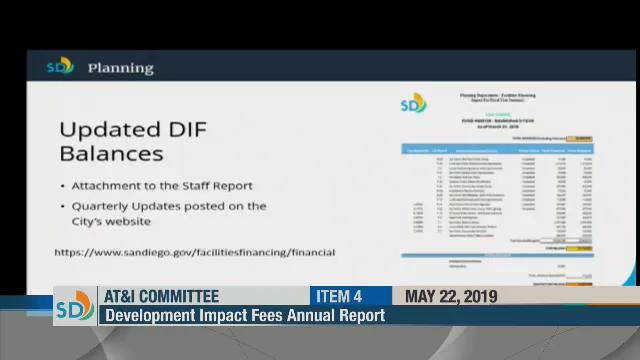
The committee met on Wednesday, May 22, 2019, at 10:00 AM. Chair Kirsey presided, with Vice Chair Ward, Councilmembers Kate and Moreno present. The meeting covered four major items: the FY2019 Capital Improvement Program (CIP) year-end budget report, community parking district plans, the development impact fee annual report, and a consultant agreement for a new fire/police training center. The committee approved all items unanimously. Consent Calendar - The meeting minutes from April 17, 2019, were approved unanimously after a motion by Councilmember Kate. Public Comments & Testimony - Kevin Swanson (Paradise Hills resident) spoke about Balboa Park, urging the city to use existing infrastructure for automated electric shuttles and to make Inspiration Point a transportation hub. He asked for a point person on park infrastructure. - Renee Smith (retired naval officer, systems analyst) presented on behalf of the Restrooms and Roofs Coalition, asking the committee to retain $9.3 million in Balboa Park for capital repairs, particularly restrooms and roofs. She noted the coalition includes the Balboa Park Committee, Conservancy, Cultural Partnership, Friends of Balboa Park, and others. - Jean Samuels (President, Spreckels Organ Society) supported retaining the $9.3 million, noting that visitor complaints about restroom conditions are embarrassing for a top tourist attraction. - Tomas Herrera Michler (CEO, Balboa Park Conservancy) asked for support to retain the $9.3 million, stating cultural institutions have invested over $80 million in the last nine years and have $100 million more planned, but city investment is needed for basic infrastructure. - John Bolthouse (Executive Director, Friends of Balboa Park) urged the committee to ensure the $9.3 million remains in Balboa Park, emphasizing the city's stewardship responsibility. - Vicky Granowitz (Balboa Park Committee) expressed agreement with previous speakers, thanked the IBA and mayor's office, and urged careful planning for restroom locations and sizes. - Tudie Thomas (public speaker) highlighted mid-city parking district projects, including adding 100+ parking spaces, a crosswalk at Kansas Street (where a journalist was killed), a pilot bus lane on El Cajon Boulevard, and bike lanes on 30th Street. Discussion Items - FY2019 CIP Year-End Budget Monitoring Report – Finance Director Tracy McCraner and staff presented the report, which consolidates over 100 actions, saving 500 staff hours and appropriating, reallocating, and transferring $62.7 million. Of $30.6 million in new appropriations, 79% came from developer fees, Fiesta Island Mitigation Fund, and grants. Notable allocations: $3 million grant for bridge rehabilitation, $11.5 million for park improvements (including Fiesta Island, Hickman Fields, Coral Gate, Bayer Parks), and $5.6 million for the Pacific Highlands Ranch Library. The report also requests transferring $10 million from street resurfacing to drainage improvements and $9.3 million from the Plaza de Panama project to Balboa Park improvements. The IBA noted progress on TransNet spend-down (from $55 million in 2016 to $27.5 million projected end of FY2019) and large balances in general fund, capital outlay, and infrastructure funds totaling about $50 million. Councilmember Moreno expressed concern about underfunded storm drain maintenance and suggested increasing stormwater fees. Councilmember Kate asked about design funding details; staff clarified that design phases include property acquisition, environmental permitting, and actual design. Vice Chair Ward supported retaining the $9.3 million in Balboa Park and asked for a timeline to specify projects. The motion to approve passed unanimously. - Community Parking District FY20 Plans and Budgets – Elizabeth Studebaker (Neighborhood Investment Manager) and Tanner French (Senior Traffic Engineer) presented the annual plans for five districts: Uptown, Downtown, Mid-City, Old Town, and Pacific Beach. Downtown’s plan will come later due to transitions with Civic San Diego. The districts use 45% of net meter revenue for parking management and mobility projects. Performance measures showed over 70% productivity rates. Uptown allocated over $3 million toward the Fourth and Fifth Avenue Bikeways and Normal Street Promenade. Mid-City completed a parking study on El Cajon Boulevard. The city’s 55% portion goes to technology, mobility, and connectivity. Vice Chair Ward praised collaboration and asked about the timeline for downtown’s plan (expected summer). Councilmember Moreno asked about forming new parking districts; staff noted that funding is limited to areas with existing meters. The motion to approve passed unanimously. - Development Impact Fee (DIF) Annual Report for FY2018 – Scott Mercer (Supervising Management Analyst) presented the report required by state law. The report shows $98 million in DIF funds held for five years or longer, 99% appropriated to CIPs. The city collected $72 million in FY2018, ending with a $437 million balance. Fees collected in FY2019 through Q3 were $38.5 million, trending lower. An audit by the Office of the City Auditor found adequate controls. No public comment. The motion to approve passed unanimously. - Consultant Agreement for Fire Rescue & Police Training Center – Elif Chittin (Deputy Director, Public Works) and staff presented the request to award a $950,000 feasibility study contract to CCBG Architects for a new regional training center on a 24-acre city-owned lot in Kearny Mesa (between I-805 and SR-52). The current center at Liberty Station must vacate for the Pure Water Phase II project. The new site will include administration, classrooms, a wellness center, training tower, firing range, and SWAT facilities. The study will assess fit, phasing, funding strategies, and community outreach (neighbors have expressed concerns). Councilmember Kate noted the need for early engagement with the mobile home park and businesses. Councilmember Moreno asked about site alternatives; the location was chosen for central location, city ownership, and industrial zoning. Vice Chair Ward asked about the timeline (2027 Pure Water deadline) and land acquisition (a swap with Public Utilities). The motion to approve passed unanimously. Key Outcomes - The committee unanimously approved the FY2019 CIP Year-End Budget Monitoring Report and revisions, including the $9.3 million reallocation to Balboa Park. - The committee unanimously approved the FY2020 Community Parking District Plans and Budgets for Uptown, Mid-City, and Old Town (Downtown to come later). - The committee unanimously accepted the FY2018 Development Impact Fee Annual Report. - The committee unanimously authorized the consultant agreement with CCBG Architects for the Fire Rescue and Police Training Center feasibility study, with a budget of $950,000. - All items will be forwarded to the full City Council with a recommendation for approval.
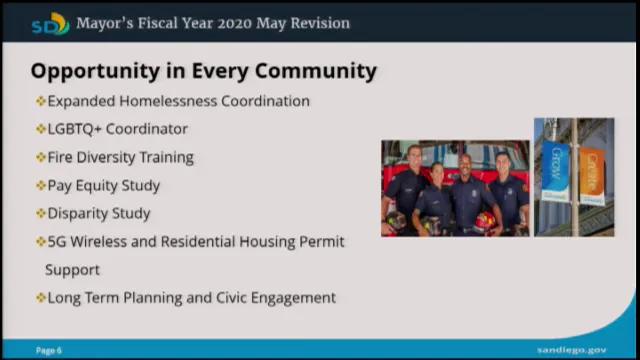
The Budget Review Committee held its final hearing of the budget season on May 17, 2019, reviewing the FY 2019 year-end budget monitoring report and the Mayor's May revision to the FY 2020 proposed budget. The committee heard public testimony, discussed council priorities, approved the year-end report unanimously, and received the May revision as an informational item. FY 2019 Year-End Budget Monitoring Report - City Comptroller Tracy McCraner and Finance staff presented the year-end report based on nine months of actual activity. - The report projects a $3.4 million budgetary surplus for FY 2019 and a projected excess equity of $7.4 million, of which $4.9 million is proposed for the May revision, leaving $2.5 million for additional programming ($500,000 ongoing, $2.0 million one-time). - Recommended appropriation adjustments include a $2.94 million increase in general fund revenues and expenditures, primarily for fire rescue overtime and fringe benefits, offset by a $3 million decrease in police department expenditures from directly billing the seized asset fund for neighborhood policing overtime. - The report also requests authority to accept, appropriate, and expend a Highway Safety Improvement Program grant (TSW) and notes a development services fee noticing requirement (no action taken). - The committee voted unanimously to approve the item. Public Comments & Testimony - Opposition speakers from the Community Budget Alliance and Center on Policy Initiatives (Andrea Gaspar, Malika Marsden, Viani Ruvokava, Carol Kim) presented a list of budget priorities, including fully funding the Emerald Hills Park renovation, a tenants' rights-to-counsel program, an office of tenants protections, interpretation services at community planning groups, targeted hiring in city departments, and additional staff to enforce minimum wage and earned sick days ordinances. - Malika Marsden (Climate Action Campaign) expressed support for mobility funding but called for a citywide complete streets policy and a five-year Climate Action Plan outlook. - Carol Kim (San Diego Building and Construction Trades Council) requested filling vacant positions with targeted local hire and creation of an office of labor standards and enforcement. - Support speakers included Nick Wright (MEA) requesting two corrosion engineer positions; Phil Rath supporting development services staffing and fee increases; Vanessa Garcia (SDG&E) and Cassandra Weinlein (Cox Communications) supporting DSD FTE increases; and Joan Reese (Friends of the San Diego Public Library) requesting an additional $100,000 for library programs and an increased city match. Discussion Items - Councilmembers praised the May revision for restoring basic services like brush management, graffiti abatement, and tree trimming, but some expressed concerns. - Council President Gomez questioned the expanded homeless coordination positions and LGBTQ+ coordinator, opposed funding for convention center dewatering and additional PR staff, and requested a briefing on the 5G staffing plan. - Councilmember Ward stated he was not supportive of expanding homeless coordination without a plan, nor the LGBTQ+ coordinator position, but appreciated the police down payment assistance pilot. - Councilmember Montgomery asked for details on the Clean SD expansion and illegal dumping hot spots; staff committed to sharing maps and work plans. - Councilmember Moreno requested funding for corrosion engineers in public utilities, full funding for the firefighter wellness program, and HVAC repairs at the Chollas Park Community Center. - Councilmember Campbell supported the Ocean Beach Library CIP and asked for more lifeguard positions and library security funding. - Councilmember Kate raised questions about skate world disposition and street capacity, and indicated support for the police housing program and library master plan funding. Key Outcomes - The FY 2019 year-end budget monitoring report was approved unanimously. - The May revision was received as informational; no action taken. - Councilmembers' budget modification priority memos are due to the IBA by close of business Monday, May 20, 2019. - The IBA will issue a report and recommendations for the June 10 council meeting.