The Budget and Government Efficiency Committee of the San Diego City Council met on May 15, 2019, at 9:00 AM. The meeting was called to order with a quorum present, consisting of committee members Kate Montgomery and Moreno. Also present were IBA representative Chris Olson, CFO Rolanda Sharval, and Deputy City Attorney Brett Bartellotta. The committee approved the record of actions from the April 10, 2019 meeting. The committee then proceeded through five action items, all of which were approved unanimously. Consent Calendar - There were no consent agenda items. Public Comments & Testimony - Non‑agenda public comment: Three members of the public addressed the committee. Martha Welch criticized the city budget, stating that voter‑approved library funding (a 6% ordinance) had not been followed, that the pension system was “out of whack” due to too few employees supporting retirees, and that the city has many vacancies and lacks employees to respond to infrastructure issues. She urged the city to hold police and fire academies to address upcoming retirements (150 in the next few years). Chris Saberton expressed concern that the new parking lot planned for Fiesta Island would not be handicapped accessible. Karen Riggs Saberton (a UC San Diego funds manager) alleged egregious violations of city regulations regarding expenditure of city funds to benefit a third party in the development of the Fiesta Island Southwest Fenced Area. She stated that at a city planning commission meeting, a commissioner directly asked a benefited third party for explicit approval before proceeding, which she argued establishes a contracting relationship. She claimed that $4 million in directed expenditures (road, utilities, clubhouse, storage) and $250,000 in annual operating costs would benefit only the third party, that the city would need extensive soil testing for PCBs and DDT, and that a better, lower‑cost parking location exists near the east side fence. She requested the city consult its legal team before proceeding. - No public testimony was offered on any of the action items. Discussion Items - Item 2 – Auto‑Return Renewal Agreement Sergeant Brandy Sorby and Captain Laura McLean of the San Diego Police Department presented a request to sole‑source a five‑year agreement with Auto‑Return, the city’s tow dispatch center since 2009. The agreement is cost‑neutral: the $22 per‑vehicle fee is paid by tow providers and passed to vehicle owners. Auto‑Return has not increased fees and has integrated with the police department’s new CAD and MPS systems. Councilmember Montgomery asked how the $22 fee compared with other jurisdictions; staff responded that no other agency in the county uses Auto‑Return, and provided sample tow fees from CHP ($166) and Chula Vista ($209). Vice Chair Kate moved the item, seconded by Councilmember Montgomery; the motion passed unanimously. - Item 1 – Water Commercial Paper Program, Second Installment Debt management staff (Jyoti Pantlu, Charles Monica, Elson Falkenstein) presented a request to approve the second $250 million allocation for the water utility’s commercial paper program. The first $250 million, authorized in December 2016, has been nearly fully utilized ($214 million spent, $36 million remaining). The new $250 million would provide interim financing: $60 million for the Pure Water program (to be refinanced with a WIFIA loan) and $190 million for baseline CIP (water mains, large‑diameter transmission lines, pump stations, reservoirs, treatment plants). The program’s not‑to‑exceed amount remains $250 million, and the borrowing rate cap is 11%. Current short‑term rates (1.6%) compared to long‑term rates (4.1%) are expected to generate $8 million in annual debt service savings. Vice Chair Kate asked about refinancing of the remaining $44 million and about miscellaneous projects ($9 million), which staff explained include a groundwater asset development pilot ($3.4 million) and a new operations center. Vice Chair Kate moved the item; the motion was seconded and passed unanimously. - Item 3 – Workers’ Compensation Managed Care Services Contracts Risk management staff (Bill Dickman, Jill Degan, Quinnell Allen) requested approval of three‑year agreements (with two one‑year renewal options) with MedData, Allied Managed Care, RehabWest, and Keystone Medical Resources for managed care services. The estimated annual cost is $3.8 million, funded from the workers’ compensation fund. The city is self‑insured and self‑administered, with a $5 million self‑insured retention. In FY2018, these services saved $19.3 million (91% from medical bill repricing, 9% from utilization review and pharmacy networks). Chair Bree asked about the number of open claims (4,000) and total program costs ($33 million per year, including the $3.8 million). She expressed interest in a future briefing on injury types and claim validity. Chair Bree moved the item; Vice Chair Kate seconded; the motion passed unanimously. - Item 4 – Fleet Services NAPA Auto Parts Contract Extension Fleet Operations staff (Matthew Cleary, Jim Dagler) requested an 18‑month extension to the existing contract with Genuine Parts Company (NAPA Auto Parts), the sole supplier of automotive parts for the city’s 4,400 vehicles. The initial contract was approved in July 2014; the first amendment in August 2018 removed the annual $12 million cap but kept the total $60 million cap. The extension would authorize expenditure of up to $24 million, based on a $13 million annual spend plus a 20% contingency for tariff‑driven cost increases. The extension allows time for a thorough RFP to incorporate industry changes and service improvements. Councilmember Moreno asked why an extension was not sought earlier; staff explained that service deficiencies were not identified until after the 2018 amendment. Councilmember Moreno moved the item; Vice Chair Kate seconded; the motion passed unanimously. - Item 5 – Verizon Cellular Equipment and Services Contract Amendment Department of Information Technology staff (Jonathan Banke, Denise McConnelly) requested a six‑month extension (through December 31, 2019) of the Verizon contract under the NASPO ValuePoint cooperative, increasing the not‑to‑exceed amount by $2 million to $7.65 million. The city has over 6,000 lines with Verizon, supporting critical public safety applications (police, fire rescue, lifeguards) and workforce mobility. Spending is discretionary; the estimated run rate for the extension is $1.4 million for normal operations, plus $400,000 for new lines and equipment. 68% of Verizon spending is from the general fund. Councilmember Montgomery asked about the estimated actual spend; staff confirmed typical run rate and additional allowances. Councilmember Montgomery moved the item; Vice Chair Kate seconded; the motion passed unanimously. Key Outcomes - All five action items were approved unanimously by the committee, with votes recorded as aye. - The committee adjourned and will reconvene on June 19, 2019, at 9:00 AM. Note: The transcript includes a separate press conference by Mayor Kevin Faulconer (2019‑05‑15) regarding the May Revise budget, which is not part of the committee meeting and has been excluded from this summary.
Public Meetings - San Diego, California
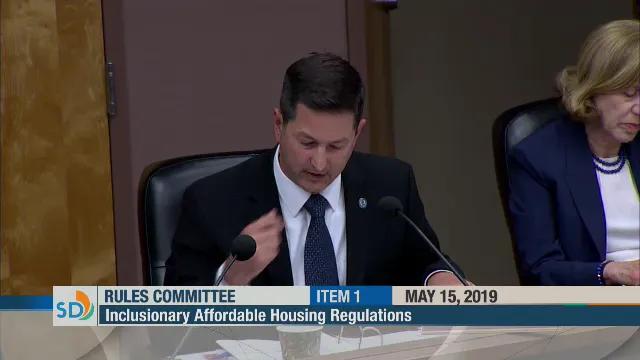
Public Meetings - San Diego, CaliforniaThe San Diego City Council's Special Rules Committee, chaired by Council President Georgette Gomez and including Councilmembers Ward and Kate (joined late), convened on May 15, 2019, to consider proposed amendments to the City of San Diego's inclusionary affordable housing regulations. The amendments aim to require on-site affordable units in new residential developments, mixed-use projects, and condominium conversions, with a three-year phase-in. After a presentation by policy staff and the consultant KMA, extensive public testimony, and committee debate, the committee voted 2-1 to forward the proposal to the full City Council with modifications. Public Comments & Testimony - Opposition testimony (approximately 25 speakers, many with seated time): - Dr. Lynn Reaser (economist) presented a study finding that increasing inclusionary requirements would reduce overall housing production by 13%, raising average rents by $255/month and home prices by 7%, while adding only 162 affordable units at a cost of 875 market-rate units (a 5:1 trade-off). She cited similar negative experiences in Portland, San Francisco, and San Jose. - Matthew Adams (Building Industry Association) cited a 73% drop in San Diego housing permits in Q1 2019 and a 63% decline in Portland after its inclusionary program, arguing the policy would worsen the supply crisis. - Multiple developers (Gilman Bishop, Ian Gill, Dave Hammer, Mike Mahoney, others) stated the proposed fee increase (from $10.82/sq ft to $25/sq ft) would make projects infeasible, push investment to other states, and not reduce land values as assumed. They urged protecting pipeline projects, reducing the fee, and extending the phase-in. - Realtors and residents (Jessica Meshovik, Rebecca, John LaRai) expressed concern that costs would be passed to middle-income renters and buyers, making it even harder for young families and military personnel to afford homes. - Jeanette Temple (Atlantis Group) and Jim Schmidt (Chelsea Investments) noted that very low-income housing developers rely on in-lieu fees from the current program to leverage other funding; raising the fee too high could reduce that funding source. - Haney Hong (San Diego County Taxpayers Association) recommended varying requirements by submarket and including a sunset provision for accountability. - Support testimony (approximately 10 speakers): - Keith Maddox (San Diego & Imperial Counties Labor Council) argued the current in-lieu fee policy has failed to produce affordable units and a new baseline is needed for workforce housing. He supported increasing the fee to incentivize on-site construction. - Carol Kim (San Diego Building and Construction Trades Council) urged requiring 10% at 50% AMI only (not the 15% at 80% AMI option) to target the deepest need. - Richard Bates (Unite Here Local 30) stated the current $10.82 fee is woefully insufficient and a meaningful inclusionary policy is overdue. - Arnulfo Manriquez (MAC) and others stressed the human impact, describing families living in overcrowded conditions and the need for affordable units for children and working families. - Matthew Vossalakis (Climate Action Campaign) supported the policy for its potential to reduce vehicle miles traveled by promoting affordable housing near transit. - Steven Russell (San Diego Housing Federation) offered recommendations: increase the in-lieu fee to $18–$22, allow a combination of on-site and fee compliance, and create a production bank. He also called for a housing bond on the 2020 ballot. Discussion Items - Presentation and staff report: - Laura Gates (Chief of Policy for Council President Gomez) and Paul Maurer (KMA) presented the proposed ordinance, which would require rental developers to provide 10% of units at 50% AMI or 15% at 80% AMI (and for-sale: 10% at 100% AMI or 15% at 120% AMI). Developers could comply by building on-site, off-site within the same community, or paying an in-lieu fee (proposed at $25/sq ft, rising from the current $10.82). A three-year phase-in would apply. - KMA’s financial feasibility analysis, based on 8 prototypes, showed that under the “District 9 proposal” (15% at 50% AMI or 20% at 80% AMI), many scenarios resulted in 30% reductions in residual land value (deemed infeasible). The alternative requirement (10% at 50% AMI or 15% at 80% AMI) had fewer infeasible cells, especially when combined with density bonus. - Exemptions: projects under 10 units exempt (up from 2); on-site affordable units exempt from development impact fees and benefit assessment district fees. - Councilmember Ward’s motion: - Moved to adopt the staff recommendation with three amendments: 1. Remove the 15% at 80% AMI option, keeping only 10% at 50% AMI as the on-site requirement. 2. Reduce the maximum in-lieu fee from $25 to $22 per square foot. 3. Expand alternative compliance to include rehabilitation of existing market-rate units, conversion of non-residential to residential (e.g., motel rooms), and preservation of at-risk affordable housing or SRO hotel rooms. - Ward noted the middle-income density bonus ordinance will be brought to council concurrently to balance the impacts. - Councilmember Kate’s concerns: - Had just received KMA data and found the analysis showed up to a 55% reduction in residual land value for garden apartments under the density bonus scenario, which KMA itself said was infeasible. She questioned why the density bonus, intended to incentivize more units, actually made projects less feasible in this case. - Stated she could not support the motion because the data did not demonstrate feasibility and the policy could suppress overall housing production, harming the middle class. She noted her own family is being forced to leave San Diego due to costs. - Councilmember Bry’s remarks: - Supported the motion, noting the three-year phase-in allows adjustments and developers have multiple compliance options (on-site, off-site, fee). She argued the Portland and San Jose comparisons were not apples-to-apples because their requirements are more stringent. She emphasized the need to produce housing for all income levels and that this is one part of a larger puzzle. - Council President Gomez: - Expressed commitment to affordable housing for very low-income families (50% AMI is above that, but a compromise). She highlighted other ongoing city efforts to streamline permitting, increase density near transit, and improve processes. She stated the policy is overdue and urged moving forward. - City Attorney’s Office: - Deputy City Attorney Sharon Spivak noted the ordinance is still under legal review and wording may change before full council. - Independent Budget Analyst (Jeff Killar): - Warned that exempting development impact fees for on-site affordable units could reduce funding for community infrastructure (traffic signals, parks, fire stations), potentially shifting costs elsewhere. Key Outcomes - Motion carried 2-1 (Councilmembers Ward and Bry in favor; Councilmember Kate opposed). - The committee directed staff to forward the proposed ordinance to the full City Council with the following amendments: - On-site inclusionary requirement: 10% of units at 50% area median income (AMI) for rental housing (removal of the 15% at 80% AMI option). - Maximum in-lieu fee: $22 per square foot (down from $25), with a three-year phase-in (year 1: $8.33 but not less than $12.73; year 2: $16.67; year 3: $22). - Alternative compliance methods expanded to include rehabilitation of existing market-rate units, conversion of non-residential to residential (e.g., motel rooms), and preservation of at-risk affordable housing or SRO hotels (with a 2:1 credit ratio for preservation projects in lieu of new units). - The ordinance retains: exemption for projects under 10 units; exemption from development impact fees for on-site affordable units; ability for developers to combine on-site units with fee payments; and off-site production within the same community planning area. - KMA will complete a formal economic feasibility study based on the revised requirements. - The San Diego Housing Commission will update its implementation manual. - The item is scheduled for Housing Commission Board on June 14, 2019, Planning Commission on July 11, 2019, and City Council on July 29, 2019. - The middle-income density bonus ordinance will be brought to council at the same time to provide additional incentives for 80% AMI units. - City Attorney will continue legal review and may make wording changes before final passage.
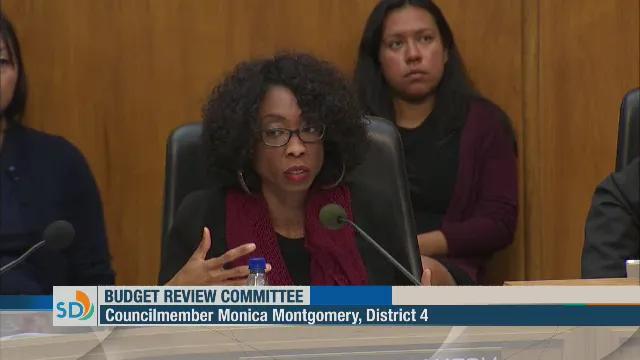
The San Diego City Council Budget Review Committee met on May 7, 2019, to review proposed budgets for several city departments, including the City Attorney's Office, Civic San Diego, the Special Promotional Program (TOT), Government Affairs, the Office of Boards and Commissions, and the Performance and Analytics Department. Public testimony included allegations of a conspiracy to cover up child abuse at the San Diego Junior Theater, as well as strong support for arts and culture funding. The committee will reconvene on May 17 to consider the Fiscal Year 2020 May Revise. Public Comments & Testimony - Joyce Sunyatta (District 3) spoke about the Central Library, urging the committee to review security contract changes and support stressed staff. She expressed deep concern about security and staff well-being. - Matt Valenti and several other speakers (including his daughter Sophia Valenti, Francia Cohen, Sean Evans, Ruth Mellon, and Jennifer Valenti) presented detailed allegations against the City Attorney's Office, claiming that City Attorney Mara Elliott and other officials conspired to obstruct justice and cover up child sexual abuse at the San Diego Junior Theater. They called for an independent investigation and for the city to withhold funding from Junior Theater. Specific allegations included: forwarding a confidential complaint to a board member, retaliating against whistleblowers, and rehiring staff with known inappropriate relationships with minors. - Sophia Valenti (age 13) testified that she questioned City Attorney Elliott at a workshop about abuse at Junior Theater, and was told Elliott could not act because it was a nonprofit—a statement she believes was false. - Sean Evans stated that as a theater director, he warned Junior Theater in 2015 about a predator, but was ignored; the predator later raped a child. - Frances Cohen, a former employee, said she was threatened with a cease-and-desist letter for speaking out about an incident where the executive director shook a girl. - Ruth Mellon, a former parent, described a campaign of intimidation by the board, including a cease-and-desist letter sent to her son. - Jennifer Valenti alleged that Junior Theater rehired a teacher fired for an inappropriate relationship with a student and that the board president is under investigation for sexual abuse of a minor. - Supporters of arts and culture (including Steve Snyder, Terrell Donnell Sledge, Natalia Valerdi Rogers, Jessica Barron, Shayla James, and Alan Ziter) spoke in favor of the mayor's proposed arts budget, emphasizing the economic, educational, and social benefits of arts funding. They urged the city to move toward full "Penny for the Arts" funding. Discussion Items - Office of the City Attorney: City Attorney Mara Elliott presented the department's budget request, highlighting the need to make 10.25 supplemental positions permanent, fund client parking at the Family Justice Center ($44,040), and continue the 211 navigation program ($25,000). The Independent Budget Analyst (IBA) agreed that the positions should be added to the budget, potentially offset by existing vacancy savings. Councilmembers expressed support for the Family Justice Center, gun violence restraining orders, and the SMART and PLEADS programs. Councilmember Ward noted the allegations but focused on the budget. Council President Gomez asked about the status of homeless court funding. Councilmember Sherman supported the 211 request. - Civic San Diego: Andrew Phillips presented the FY2020 budgets for the Successor Agency and Civic San Diego. The Successor Agency budget is subject to state DOF approval and includes $100 million in disbursements. Civic San Diego's administrative budget is unchanged, but capital projects increased by $18 million. The IBA noted a pending settlement that may return planning and parking functions to the city. Councilmember Ward praised progress on East Village Green and the park at grade crossing. Councilmember Moreno asked about the settlement's impact, which would eliminate $1.5 million and 7 FTEs from Civic San Diego's budget. - Special Promotional Program (TOT): The Department of Finance presented the $126.2 million special promotional program, funded by five cents of the TOT tax. Major increases include $11.4 million for lifeguard services and street sweeping. Arts and culture funding is $14.2 million, with a $3.9 million one-time transfer from the general fund to maintain levels. The IBA noted that this is the third consecutive year of one-time transfers and recommended ongoing funding. Councilmembers criticized the reliance on one-time funds and called for restoring the "Penny for the Arts" goal. Councilmember Moreno specifically asked for closer alignment with the one-cent TOT target. - Government Affairs: Director Patrick Buteller presented the $1.4 million budget for the newly formalized department, which includes six FTEs (one new immigrant affairs position). The department focuses on legislative advocacy and grant coordination. Councilmember Ward noted the importance of the grant coordinator position starting in May. Councilmember Kate inquired about performance metrics; Buteller said they track progress on the legislative platform. - Office of Boards and Commissions: Director Joel Day and Jonathan Gloos (Arts & Culture) presented. The office now has a full staff and is implementing audit recommendations, including quarterly training and standardized annual reports. The Arts & Culture budget is $14.2 million, with a 3% reduction applied to administrative and public art funds, not to core grants. Gloos announced plans for a citywide cultural plan and an access and equity assessment. Councilmembers praised the efforts but expressed concern about the 44 boards without dedicated staff. Council President Gomez asked to hold off funding for Junior Theater pending investigation. Councilmember Montgomery highlighted the Citizens Equal Opportunity Commission's need for resources. - Performance and Analytics (PANDA): Director Behija Humphrey presented the $3.9 million budget for the team behind the Get It Done app. The department is expanding the app and launching Optimize SD, a data-driven budgeting initiative. The proposed budget includes a $117,000 reduction, which may delay enhancements like Spanish translation. Councilmember Campbell asked about the app's "closed" status communication and telecommuting. Councilmember Kate asked about paying for trash cans with credit cards (soon available). Councilmember Sherman asked about the impact of the reduction on enhancements. Council President Gomez stressed the importance of Spanish translation. The IBA noted that the budget does not address workload impacts on departments receiving Get It Done requests. Key Outcomes - No formal votes were taken; the committee heard presentations and public testimony for informational purposes. The committee will reconvene on May 17, 2019, to consider the Fiscal Year 2020 May Revise. - Support for City Attorney requests: Councilmembers expressed general support for making supplemental positions permanent, funding Family Justice Center parking, and the 211 navigation program. The IBA recommended offsetting the cost with vacancy savings. - Concerns about Junior Theater funding: Council President Gomez and others indicated they would seek to withhold or delay the $90,000 arts grant to Junior Theater pending further investigation into the allegations. Councilmember Kercy suggested placing the funds in escrow. - Arts and culture funding: Multiple councilmembers called for moving toward the "Penny for the Arts" goal of one cent of TOT revenue (approximately $24.3 million), criticizing the reliance on one-time transfers. The city is currently at $14.2 million. - Civic San Diego settlement: The anticipated settlement will reduce Civic San Diego's budget by $1.5 million and eliminate 7 FTEs, with planning and parking functions returning to the city. The May revise will reflect these changes. - Optimize SD initiative: The Performance and Analytics Department will launch a data-driven budgeting approach in partnership with the Department of Finance, with briefings to the Audit Committee planned. - Get It Done enhancements: The team will continue to improve the app, including adding credit card payment for trash cans and working toward Spanish translation, but the $117,000 reduction may delay non-essential enhancements. - Public testimony on Junior Theater: The council president and other members acknowledged the seriousness of the allegations and stated they would follow up with the district attorney and consider independent investigation.
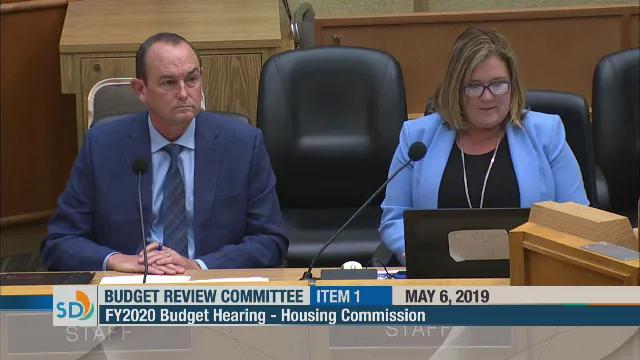
The Budget Review Committee of the San Diego City Council convened on May 6, 2019, to review proposed fiscal year 2020 budgets for multiple city departments. The meeting included presentations from department heads, independent budget analyst (IBA) reports, public testimony, and council member discussions. No formal votes were taken; the committee will make recommendations to the full council. Consent Calendar - No consent calendar items were listed or discussed. Public Comments & Testimony - Police Department: Michael McConnell spoke in opposition to increased funding for homeless enforcement, arguing it is ineffective and costly (approximately $8,000 per unsheltered individual). Robert McNamara spoke in favor of the police budget, supporting recruitment and retention funding but raising concerns about the untested rape kit backlog. - Fire-Rescue Department: Mary Beth Cruden, a University Heights resident, presented a petition with over 600 signatures requesting a one-time budget line item to complete brush abatement in the canyon under the Vermont Street Bridge. Chris Vamos, representing Teamsters Local 911 (San Diego Lifeguards), requested additional lifeguard positions and questioned why lifeguard priorities were not included in the budget. - San Diego Housing Commission: Michael McConnell spoke in opposition, questioning the effectiveness of current spending on homelessness and asking for more transparency on per-person costs. Joyce Sanyata, John Brady, and Stephen Russell spoke in favor of the budget, supporting increased rental assistance and homelessness prevention efforts, but raised concerns about the use of one-time revenues for ongoing programs. Discussion Items Police Department - Chief Dave Nisleit and Kyle Mukes presented the SDPD FY20 proposed general fund budget of $539 million, a $65 million increase from FY19, with 2,655 FTEs (a net decrease of 1.875 FTEs). Key adjustments included $5.5 million for overtime alignment, $3.5 million for Clean SD expansion, $4.3 million for neighborhood policing (including homeless outreach), and reductions in civilian positions and SWAT training overtime. - The IBA noted police overtime in the proposed budget totals $35.9 million, a historical high, and raised concerns about the use of one-time funds for ongoing homelessness programs. The IBA also highlighted a reduction of four Police Investigative Service Officer (PISO) positions, from 26 to 22. - Council members questioned recruitment and retention, attrition rates (10-11 per month), the hot team expansion, and the impact of PISO reductions. Councilmember Sherman requested follow-up on pedestrian safety enforcement. Councilmember Ward expressed concern about the lack of measurable performance metrics for response times. Fire-Rescue Department - Interim Chief Stowe and Michelle Yamamoto presented the FY20 proposed general fund budget of $284 million, an increase of $14.7 million from FY19, with 1,302 FTEs (an increase of 61). Major additions included 37 positions for a relief pool to reduce overtime, 9 full-time academy instructors, 6 bomb squad positions, and 6 fire inspectors. The budget also included $820,000 for helicopter maintenance and $520,000 for pilot training. - The IBA noted that the relief pool is expected to yield a net savings of $300,000, and the academy instructors a net savings of $500,000. Fire overtime in the proposed budget is $36.6 million, a $1.5 million decrease from FY19, but $9.3 million less than projected FY19 actuals. The IBA also noted that three peak-hour engines recommended by the 2017 Citigate report were not funded. - Council members raised concerns about the wellness program funding, the lack of additional lifeguard positions, and the need for more brush management staffing. Fire Marshal Doug Perry stated that the brush management unit has only 7 staff for 45,000 inspections, and doubling to 15-16 would allow inspections every 18 months instead of every 3.5-4 years. Department of Homeland Security - Director John Valencia presented the Office of Homeland Security (OHS) budget, which is a net reduction of $30,000 from FY19, due to over 50% of activities being grant-funded. OHS highlighted its work in emergency management, unmanned aircraft systems, and targeted violence prevention. - No public speakers. Councilmember Kirsey commended the department and expressed interest in expanding the use of UAVs for city assessments. Department of Communications - Director Katie Keach presented the Communications Department budget. Key highlights included City TV broadcasting 144 public meetings (347 hours), a 20% increase in Public Records Act (PRA) requests (on track for 5,800 this year), and a proposed reduction of one senior public information officer position. - The IBA noted the department requested but did not receive funding for two program coordinators and $272,000 in expenses to support the PRA program, which currently has only 3 FTEs. - Council members discussed the need for better metrics on PRA workload, social media integration, and the status of the Vision Zero communications plan. Councilmember Kate asked about the social media policy, which is still with the City Attorney's office. Ethics Commission - Stacy Fulhorst presented the Ethics Commission budget. The commission has a staff of 5 FTEs, down from 8 ten years ago. The commission requested an additional position to allow training under the current education program manager, who retires in 2021. The mayor's staff indicated the position would be included in the May revise. - No IBA comments or public speakers. Councilmembers expressed strong support for the commission's work and the need for the additional position. City Auditor - Interim City Auditor Kyle Elser presented the Office of the City Auditor's FY20 budget of $4 million with 22 FTEs. The audit committee recommended no cuts from the FY19 budget. The office issued 15 performance audits and 8 hotline reports in FY18, with 100% management agreement on recommendations. - No public speakers. Councilmembers thanked the office for its work, including the water bill audit and pay disparity report. San Diego Housing Commission - Jeff Davis and Tracy McDermott presented the Housing Commission's proposed FY20 budget of $452 million, a $65 million increase. This includes a 14% ($20 million) increase in federal rental assistance funding, expansion of homelessness programs (exceeding $100 million for the first time), and support for the city's bridge shelters and storage connect center. - The IBA noted the budget relies on $5.2 million in property reserves and $8 million in federal Moving to Work reserves to fund bridge shelters and storage, and that the city's reimbursement falls short by $13.1 million. The commission is reducing its contingency reserve from 5% to 3.5%. - Public speakers: Michael McConnell opposed, while Joyce Sanyata, John Brady, and Stephen Russell supported with concerns about sustainable funding. Council members discussed the use of property reserves, the waiting list for housing vouchers (90,000 families, 10-year wait), and the need for a housing bond. San Diego City Employees Retirement System (SDCERS) - CEO Greg Rodemaker and Controller Ted Lasalvia presented the SDCERS administrative budget for FY20 of $13.7 million, a decrease of $205,000 from FY19. The budget includes 50 positions, a $7.9 million salary and benefits budget, and a $600,000 reduction in legal fees due to resolved litigation. - The IBA noted that the budget does not require City Council approval, and that investment management expenses are about 0.46% of assets under management. The pension system's assumed rate of return was lowered to 6.5%. - No public speakers. Council members praised the system's management and conservative approach. Key Outcomes - The committee completed budget reviews for eight departments and received public testimony. No formal votes were taken; the committee will incorporate these discussions into its budget recommendations to the full City Council. - Several departments were asked to provide follow-up information, including police response time metrics, fire brush management staffing needs, Housing Commission program outcome data, and Communications PRA workload details. - The mayor's office agreed to include an additional Ethics Commission position in the May revise. - The committee will reconvene the following day to continue budget hearings.
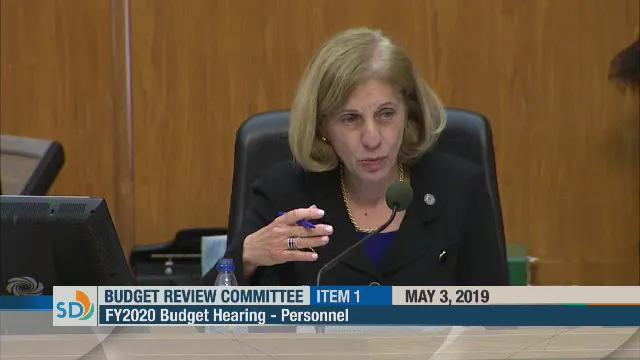
The Budget Review Committee of the San Diego City Council met on May 3, 2019, to review the proposed Fiscal Year 2020 budgets for several city departments, including Internal Operations, Purchasing and Contracting, Information Technology, Human Resources, Real Estate Assets, Personnel, and the City Clerk. The committee heard presentations from department directors, received an analysis from the Independent Budget Analyst (IBA), and engaged in discussion on budget priorities, staffing levels, and departmental performance. Public Comments & Testimony - Ms. Hagins, a member of the public, expressed concern about the reclassification of 12 positions from classified to unclassified within a department. She argued that management could have achieved better outcomes by using existing processes to increase wages for classified employees, rather than creating unclassified positions at higher cost. She noted that the cost of absorbing the work of these 12 positions would double or triple. Discussion Items - Internal Operations Overview (Jeff Sterak, Deputy Chief for Internal Operations): Presented the department's role in supporting all city departments through fleet management (over 4,400 vehicles, 12 facilities, 50,000 repair tickets annually), human resources (11,500 employees, six employee organizations), information technology, purchasing and contracting (over $2 billion contract portfolio), and real estate assets (120,000 acres including stadium, concourse, airports). Highlighted plans for an enterprise asset management system, purchase of 50 electric vehicles, and a wireless radio system upgrade. - Purchasing and Contracting (Christina Prata, Director): Reported achievements including certification of 210 small local business enterprises by Q3 FY19, $126,000 savings from the administrative hearing program serving 1,500 citation recipients, implementation of electronic payroll reporting for living wage compliance, and publication of the first citywide procurement plan. Future priorities include expanding the administrative hearing program and implementing an AREBA module for vendor performance monitoring. Councilmember Moreno inquired about asset ownership if a contract is not extended; Prata confirmed that city-funded assets remain with the city. Councilmembers expressed concern about the disparity study and the reclassification of 12 FTEs. - Information Technology (Jonathan Bankie, CIO): Reported 120 employees providing citywide technology services and public safety radio communications. Key accomplishments: improved radio systems for first responders, completed transition of network services contract to Zensar Technologies, and streamlined budget publication. The IT fund budget includes a nearly $50 million increase to account for pass-through expenses, $821,000 for data center transition, and $531,000 for enhanced cybersecurity. Councilmember Sherman asked about performance indicators; Bankie noted over 100 internal SLAs. Councilmember Moreno emphasized the need for back-end integration to ensure compliance. - Human Resources (Julie Rasco, Director): Highlighted that 13% of new FY18 hires were former City volunteers, interns, or mentees. Completed one city management academy (35 employees) and six supervisor academies (177 employees). The FY20 budget increases by approximately $500,000 due to a net increase of three FTEs, including two program managers for senior HR officers (made permanent) and one program coordinator for employee assistance and light duty programs. A reduction of one employee assistance program manager is proposed, with services to be outsourced. The department also requests $250,000 for an external EAP contract. - Real Estate Assets (Sibelle Thompson, Director): Manages the city's real estate portfolio including stadium, concourse, airports, and Petco Park JUMA. Identified 22 properties zoned residentially for city purposes. Sold $13 million in property in FY18 and $2 million in FY19. Airports division completed a $12 million runway rehab at Brownfield and obtained approval for a 50-year lease with Metro Air Park. Future work includes an RFP for eight city-owned sites for permanent supportive housing, potentially yielding 265 units. Budget adjustments include $689,000 for relocation to 101 Ash Street, $180,000 for central plant maintenance, and addition of one property agent for telecom leases. Reductions include two vacant positions (associate management analyst and property agent) and significant cuts to facilities maintenance (10 FTE reductions, leading to primarily reactive maintenance). The IBA noted concerns about the loss of a position tracking city-owned land, the need for a long-term real estate strategy, and ongoing negotiations with SDSU for the stadium site. - Personnel Department (Doug Edwards, Director): Briefly presented the department's role in supporting a diverse workforce through personnel services and civil service commission support. - City Clerk: Presented achievements including a passport acceptance facility that processed over 21,000 applications and generated $700,000 in gross revenue since 2014, and efforts to provide online disclosure materials and maintain the municipal code. Key Outcomes - Councilmember Campbell requested that the Real Estate Assets Department provide a complete list of the city’s 1,600 owned properties to all council members to identify potential sites for housing and homeless support programs. - Councilmember Sherman asked the Information Technology Department to consider including additional performance indicators in future briefings beyond the near-100% metrics currently reported. - Councilmembers expressed support for the use of city-owned land for permanent supportive housing and directed staff to work with the mayor's office on the RFP. - The committee noted concerns from the IBA about reduced facility maintenance staffing potentially accelerating deferred capital backlog and costs, and about the loss of a position that tracks city-owned land potentially delaying responses to council requests. - No formal votes were taken; the meeting served as a review and discussion session for proposed FY20 budgets.
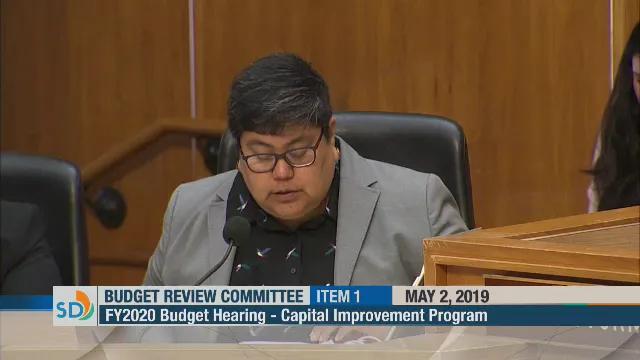
The Budget Review Committee of the San Diego City Council convened on May 2, 2019, to review the proposed Fiscal Year 2020 Capital Improvement Program (CIP) budget, the largest in city history at $715.8 million. The meeting included presentations from the Infrastructure and Public Works Branch, an analysis by the Independent Budget Analyst (IBA), public testimony, and committee member questions and comments. No formal votes were taken; the meeting served as a discussion and review session. Public Comments & Testimony - Nicole Burgess (Opposition): Expressed opposition to the $80 million allocated for resurfacing 430 miles of streets, arguing that the fast pace misses opportunities to improve bike and pedestrian safety. She noted that previously, with 100 miles of streets, 50% were improved for bikes, but at 430 miles, only an estimated 8% (35 miles) would include bike improvements. She urged the committee to consider safer street designs. - Peter Kamiski (In Favor – Balboa Park Cultural Partnership): Supported the mayor's budget and emphasized the need to keep the $9.4 million capital fund designated for Balboa Park within the park for reinvestment. He highlighted that cultural partners have invested $18 million in city buildings over nine years, with $200 million expected in the next nine years, and called for prioritizing capital reinvestment in structures and public restrooms. - Clarissa Falcon (In Favor – Biomed Realty): Spoke on behalf of Biomed Realty and Biocom San Diego, supporting the CIP but requesting prioritization of storm drain channel maintenance at Roselle Street and Estuary Way in Sorrento Valley to address flooding and water quality issues at Los Peñasquitos Lagoon. She noted a holistic restoration project is in development with TSW staff. - Andrea Schlager (In Favor): Supported the CIP but urged that staff be empowered to complete feasibility studies and break ground on projects like the Ocean Beach lifeguard station, which has been in study for over a year. She cited increased cliff rescues and inadequate facilities. Discussion Items - Presentation by Infrastructure and Public Works Branch: Johnny Perkins (Deputy COO) introduced the branch, noting it includes nearly 4,000 staff across departments. James Nagelfort (City Engineer) presented the State of the CIP, covering the first six months of FY2019, including $231 million in expenditures, progress on Pure Water Phase One (13 contracts, $1.3 billion), West Mission Bay Bridge construction, and 118 miles of street resurfacing completed. He noted challenges: vacancies, staff training, and the difficulty of retaining talent in a booming economy. Myrna Dayton presented the five-year CIP outlook (FY2020-2024), showing $5.6 billion in projected needs versus $3.7 billion in available funding, a gap of $1.8 billion concentrated in general fund assets. Karen McGriff (Finance) presented the FY2020 proposed CIP budget of $715.8 million, with 54% for pure water projects, 17% for water distribution, 11% for wastewater, 9.6% for city buildings, 5% for transportation, and 2% for parks. She noted an additional $294.3 million in anticipated funds (DIF, bonds, grants) to be allocated during the year. - IBA Comments: Jillian Cassif (Office of the Independent Budget Analyst) reported that the proposed CIP is a 28% increase over FY2019 adopted budget, but noted $19 million less funding for general fund capital projects due to diversions to balance the budget. She highlighted that the city continues to spend down $88.5 million in commercial paper funding, with $71 million unencumbered. Sidewalk funding: $1 million for ADA compliance and $2.4 million for new sidewalks, estimated to produce about 2.5 miles. No new funding for sidewalk repair backlog ($94 million). She also noted unfunded projects including street light circuits, storm drain pipelining, and court repairs. - Committee Member Q&A: Councilmembers raised several issues: - Sidewalk costs: Councilmember Sherman questioned the cost of $2.4 million for roughly a mile of new sidewalks. TSW Director Chris McFadden explained costs vary based on environmental factors, with the estimate being a worst-case scenario; the department identified projects that would yield closer to 2.5 miles. - Mission Bay Golf Course Clubhouse: Councilmember Sherman questioned the $3 million demolition cost; Deputy Director Akron Passier clarified it includes building a new clubhouse and surrounding improvements. - Infrastructure fund expenditures: Councilmember Moreno noted only $2.6 million of the $17 million infrastructure fund had been spent by December 2018. Staff explained that payments lag due to construction milestones and priority given to grant-funded projects with expiration dates. - Commercial paper and tobacco bonds: Moreno asked about slow expenditure; staff said funds became available at the start of FY2019 and are now allocated to projects, with ramp-up expected. - Street resurfacing and bike infrastructure: Councilmember Gomez and Ward emphasized the need to link street repaving with bike and pedestrian improvements. TSW Director McFadden stated that for the 430 miles of resurfacing, about 35-40 miles include bike improvements, down from 50 miles last year due to focus on downtown mobility plan. The downtown mobility plan Phase 2 is set to be advertised in June 2019. - Sidewalk implementation: Councilmember Gomez requested a list of identified sidewalk projects; TSW agreed to provide it. - Balboa Park capital fund: Councilmember Ward and others voiced support for keeping the $9.4 million fund in the park for reinvestment, noting the need for restroom upgrades. - Ocean Beach projects: Councilmember Campbell requested funding for the OB branch library annex and a combined lifeguard station/police substation. Deputy Director Mark Nasser said the lifeguard feasibility study is finalizing and will consider office space. - Mission Bay leasees: Campbell asked about using Mission Bay Park Improvement Fund for lessee concerns. Parks Assistant Director Andy Field said they would work with her office and noted a future allocation action in fall. - Pipeline replacement: Councilmember Kercy asked about water main replacement targets; staff confirmed they will meet the 175-mile target over five years despite delays combining with Pure Water contracts. - Chollas Lake improvements: Councilmember Montgomery noted progress on the comfort station and electricity, with construction anticipated in FY2021. - Streamview Drive: Montgomery asked about Phase 2 design; deputy director said a consultant is being selected for remaining design. - Gas tax funding: Montgomery inquired about $4 million in gas tax funding; staff clarified that total annual gas tax revenue is about $30 million, with the $4 million being the portion allocated to CIP. - Consultant dependence: Councilmember Bry noted concerns about reliance on consultants, referencing high-speed rail issues, and emphasized the need for in-house expertise. - La Jolla projects: Bry submitted written questions about El Camino Real widening, SR 56 expansion, and North Torrey Pines Road Bridge. Key Outcomes - No formal votes or decisions were made during this hearing; it was a review session. The committee will continue discussions in subsequent hearings. - Requests for information: Staff agreed to provide lists of sidewalk projects (Gomez), details on gas tax revenue and older road conditions (Montgomery), and written responses to questions on La Jolla projects (Bry). - Future actions: The committee noted that additional funding from anticipated sources ($294.3 million) will be allocated through future council actions, including a potential mid-year review. The Mission Bay Park Improvement Fund allocation will be revisited in fall 2019. - Notable discussion points: The structural budget deficit and the need for more revenue to address CIP backlog were highlighted by Councilmember Moreno. The importance of linking street repaving with bike and pedestrian safety was stressed by multiple members. - Break: The meeting was adjourned for a break until 2:00 PM, with the afternoon session to continue with operational budgets of infrastructure departments.
On May 2, 2019, the San Diego City Council Budget Review Committee convened for Session 2 of Infrastructure and Public Works Day. The meeting featured presentations from the Public Works, Public Utilities, Transportation and Stormwater, and Environmental Services departments, covering their Fiscal Year 2020 proposed budgets, accomplishments, and challenges. Councilmembers and public speakers addressed staffing vacancies, infrastructure deficits, service cuts, and environmental compliance. Public Comments & Testimony - Johnny Perkins, Deputy Chief Operating Officer for Infrastructure and Public Works, opened the session, noting the branch's focus on safety and customer service. He highlighted $610 million in CIP expenditures in FY19 and a planned $1.3 billion in construction contract awards. - Kathleen Higgins (San Diego Municipal Employees Association) expressed support for Public Works and Public Utilities, advocating for additional corrosion engineer positions and stating that MEA is "keeping track of the recruitment and retention." - Patrick McDonough (San Diego Coastkeeper) urged the city to address the massive shortfall for stormwater funding, noting that a bulk of funding will likely need to come from a public measure and emphasizing the need for community engagement. - Mary Beth Cruden (University Heights resident) presented a petition with over 600 signatures requesting brush abatement in the Vermont Street Bridge canyon, citing two fires in 2018 and a citation from the fire marshal that had not been fully addressed. - Maya Rosus (Circulate San Diego) called for more Vision Zero funding, noting 35 pedestrian deaths in 2018 and requesting priority for two bicycle master plan projects. - Andy Hanshaw (Mobility Board) urged implementation of Vision Zero projects, continuation of the downtown mobility plan, and maintenance of existing bike facilities. - Ann Fage and Jackie Higgins spoke against the proposed tree trimming reductions, stating that uninspected trees pose liability and that the cuts would undermine the climate action plan. Public Works Department Director James Nagelfort presented the proposed operating budget for the Engineering and Capital Projects (ECP) branch. Key points: - FY19 achievements: 73 construction contracts awarded ($725M), 32 architectural engineering contracts ($235M), $610M in invoices paid. - FY20 request: 43.75 additional FTEs ($11.9M) to support Pure Water, private development, 5G permits, and other needs. This would bring ECP to 789.5 FTEs ($110.7M). - ECP fund deficit: projected $13M (updated to $11.5M), due to vacancies and a lowered overhead rate (from 94.7% to 155.9% by FY20). - Vacancy rate: 95.5 vacant positions (14%). Director noted difficulty hiring due to market competition; a 16% pay raise for engineers was implemented but results are pending. - Councilmembers Moreno, Montgomery, Kate, Gomez, Campbell, Sherman, and Kirsey expressed concerns about adding positions on top of vacancies. Director responded that the positions are needed to meet demand and that unfilled positions would increase reliance on consultants. - Council requested a mid-year update on vacancy filling and discussed creative strategies (signing bonuses, earlier pay raises). Public Utilities Department Interim Director Matt Vespi presented the FY20 proposed budget, emphasizing a reorganization to become customer-focused. - Total budget: $1.65B (up 19% from FY19), with $1.62B in revenues. CIP accounts for 43% ($703M), driven by Pure Water. - Operating budget increases 6% ($27.7M), including 52.4 net new FTEs (96 added, 31 eliminated, 8 transferred). - Water rate increase: 6.1% (below the approved 7% cap). No sewer rate increase. - Reorganization: new Pure Water operations division, business support branch, dispersal of long-range planning functions. - Key performance indicators: water main breaks and sewer overflows below targets. - Public speaker Kathleen Higgins (MEA) supported the reorganization and requested corrosion engineers. - Councilmembers asked about vacancies (10-13% historically), rate case timeline (early 2020), reservoir closures (one additional day per month for recreation), and water quality testing (100,000 tests per year). - Council President Gomez highlighted equity concerns in rate design; Councilmember Sherman questioned the tiered rate structure. Transportation and Stormwater Department Director Chris McFadden presented the FY20 proposed budget, noting significant cuts. - Achievements: exceeded mayor's 1,000-mile street repair goal (October 2018); 40,000 potholes filled in FY19; 37,000 trees trimmed; $14M in grants secured. - FY20 plans: 430 miles of street repair, 6 million in sidewalk contracts, 8,500 sidewalk slicing locations. - Proposed general fund reductions: $1.1M for tree trimming (eliminates non-palm trimming, reducing frequency from every 9 years to every 43 years); $300K for graffiti abatement (eliminates private property contract); $310K for stormwater monitoring; $1M for channel maintenance; $500K for green waste mitigation credits. - Use of infrastructure fund ($4M) and gas tax ($13.9M) to support general fund operations, avoiding deeper cuts. - IBA highlighted a $3.1B need for stormwater infrastructure through FY2035 and warned of potential fines for non-compliance. - Councilmembers Campbell, Ward, Gomez, Moreno, Montgomery, Kirsey, and Sherman opposed the cuts, particularly tree trimming, graffiti abatement, and stormwater monitoring. Councilmember Moreno requested a summary of tree-related liability claims. - Councilmember Ward noted that brush management funding was reduced in FY18 and that fire marshal citations are not followed up. - Director stated that the department will work with fire department to address high fire hazard areas. Environmental Services Department Director Mario Sierra presented the FY20 proposed budget. - General fund: $47.9M for 172 FTEs. Non-general funds (recycling, refuse disposal) total $68M for 256 FTEs. - Clean SD expansion: $2.7M in one-time funds for 3 term-limited code compliance FTEs and contracts. IBA expressed concern about using one-time funds for ongoing service levels. - Recycling fund: $2.7M revenue reduction due to China's National Sword policy. New curbside recycling contract expected to require city payment, potentially leading to AB 939 fee increases. - Proposed reductions: asbestos/lead inspector (from 8 to 7), assistant engineer, security guard services, and others. - Council President Gomez questioned the loss of HUD grant funding and asked about zero waste plan updates. Director noted industry changes and need to revisit the plan. - Councilmember Moreno asked about the lead inspector reduction; Director stated consultants can provide backup. Key Outcomes - Councilmembers indicated they will seek to restore several proposed cuts in the May revise, including tree trimming, graffiti abatement, stormwater monitoring, channel maintenance, and asbestos inspector positions. - Committee requested a mid-year review of Public Works vacancy filling and hiring progress. - Council directed staff to provide updates on the 5G permit process, the mobility action plan, and the rate structure review. - No formal votes were taken; decisions will be made as part of the overall budget adoption process. - The meeting adjourned at 9:00 p.m. to reconvene the following morning at 9:00 a.m.
The Budget Review Committee convened on May 1, 2019, to examine Mayor Faulkner's proposed Fiscal Year 2020 budget. The meeting included a moment of silence for the Poway synagogue shooting victim Lori Kay, presentations from the Independent Budget Analyst (IBA), department budget reviews, and public testimony. Council members identified priorities such as homelessness, affordable housing, library and park funding, climate action, and public safety while grappling with a tight budget featuring a deficit closed primarily through one-time funds. Public Comments & Testimony - A homeless advocate spoke about representing homeless individuals trying to do the right thing, urging compassion and long-term thinking about future generations. - Library supporters including the Library Foundation CEO, Friends of the Library, and Library Commission chair advocated for increased program funding and materials budget, noting the current $100,000 programming budget is only $3,000 per branch. - Ocean Beach Friends of the Library asked for $500,000 in seed money to expand the historic OB Library, supported by Councilmember Campbell. - MEA union representatives highlighted library security concerns and opposed proposed cuts to park ranger positions. - Public speakers for Parks & Rec emphasized the importance of park rangers for safety and open space management, and opposed cutting three ranger positions (later stated to be restored in May revise). - Homeless service and mental health advocates called for shifting from enforcement-driven homelessness response to outreach and long-term housing solutions. - Community Budget Alliance members requested funding for simultaneous interpretation services at community planning groups, an office of tenant protections, a sustainability grant writer, and a transportation justice coordinator. - Lifeguard union representatives requested four additional full-time positions, a five percent salary increase for seasonal lifeguards, and raised concerns about recruitment and retention due to low pay. - Other speakers addressed local parks, street safety improvements in Linda Vista, and support for Chollas Creek restoration and park development. Discussion Items Independent Budget Analyst (IBA) Report: - The IBA presented a high-level analysis of the mayor's proposed FY2020 budget, noting general fund revenues of $1.454 billion (up 7.5%). The mayor faced a $65.6 million deficit, closed by 62% one-time measures, including $30 million in remaining excess equity, $15 million in departmental reductions, and an infrastructure fund gas tax swap. - The IBA raised concerns about the use of one-time funds for police overtime in Clean SD program, reductions in stormwater, tree trimming, park maintenance, and brush management funding. - They highlighted that the council has authority to modify the budget but only modest modifications have occurred historically. - IBA noted that the mayor's budget maintains library hours, recreation center hours, and pool hours, but several council priorities (e.g., expanded homeless outreach, tree inspection) were not fully addressed. Library Department: - Director Misty Jones reported a slight budget decrease to $55.7 million, maintaining library hours and programming. Key achievements: new Mission Hills Hillcrest and San Isidro libraries, elimination of fines, and expansion of Library Next program. - IBA noted that library security funding was not carried forward due to anticipated savings from a new citywide security contract, and that $100,000 for programming was maintained. - Council members praised library services but expressed concern about aging facilities, technology needs, and the need for a library master plan. Council President Gomez questioned materials budget adequacy and equity. Parks and Recreation Department: - Director Herman Parker presented a $5.2 million increase in general fund, adding 12 FTEs for new parks and maintenance. Proposed reduction of 4 FTEs including 3 park rangers (later stated to be restored in May revise) and 1 aquatic tech. - IBA noted that the brush management funding was reduced by $555,000, reverting to 450 acres cleared per year. Council members expressed strong concern and interest in restoring funding. - Councilmember Ward called for a Balboa Park improvement fund and strategic plan. Councilmember Campbell asked about Dusty Roads Park staffing and fencing of dog parks. Homelessness Strategies: - Chief Keely Halsey presented the city's homeless spending, noting funds are spread across departments. The budget includes 3 new FTEs for program coordination. The $14.1 million HEAP grant supports relocation of women's shelter, safe parking expansion, rental aid, and a flexible subsidy pool. - IBA expressed concern about continued one-time funding for bridge shelters and storage center, and recommended clarity on future funding stability. - Council members criticized the heavy use of enforcement funding (police overtime for homeless outreach) and called for a shift to social work-based outreach, stronger performance metrics, and a comprehensive strategic plan. Sustainability Department: - Director Cody Hooven presented the first budget for this new department, funded by $755,000 in general fund (triple transfer from last year). The budget supports CAP implementation, community choice aggregation (CCA), and equity indicators. A request for $310,000 for a climate adaptation plan was not funded. - IBA noted that 91% of CAP-related new funding ($392.2 million) goes to Pure Water, and that tree trimming and CAP monitoring remain underfunded. - Council members voiced frustration with lack of a comprehensive CAP financial plan and insufficient resources for mode shift and resilience. Planning Department: - Director Mike Hanson reported a slight budget reduction, with $100,000 for housing affordability initiatives (lower than $250,000 in five-year outlook). The department will use increased General Plan Maintenance Fee revenue to offset cuts. - IBA noted that the reduction of $297,000 in non-personnel expenditures could impact community planning, but the department expects to mitigate via GPMF revenue. - Council members supported continued community plan updates and expressed interest in adding an economist position. Economic Development Department: - Director Christina Bibler reported an increase of 1.65 FTEs and restructuring of corporate partnerships. The budget reduces general fund for safe parking by transferring costs to HEAP funds. - IBA highlighted that the small business enhancement program is underfunded relative to council policy (requiring $2 million vs. proposed $1.2 million). - Council members questioned tracking of business assists and impacts in underserved areas, and requested data by district. Development Services Department: - Director Elise Lowe noted a 10% increase in permitting workload (60,000 permits in 2018). The budget reduces 3 code enforcement positions (vacant). The enterprise fund projects a $3.1 million deficit despite a 4.5% fee increase. - IBA stated the fee increase analysis was released the evening before and appears justified, but recent special salary adjustments add further pressure. - Council members expressed concern about code enforcement capacity and inspection turnaround times, particularly for new construction. Finance Branch – Citywide Programs and Funds: - CFO Rolando Charvel highlighted the merger of Comptroller and Financial Management, finance academy, and PCI compliance. City Treasurer Liz Correa reported expanding cannabis tax compliance (projected $12.3 million) and adding 5 FTEs for short-term rental tax compliance. - Finance Department Director Tracy McCraner presented a $3.2 million personnel cost increase due to reclassification of analysts and pension costs. A budget reduction proposal eliminates one FTE, potentially reducing transparency in budget volumes and agency reviews. - Citywide Program Expenditures include $24 million infrastructure fund transfer, $11.9 million to general fund reserves, and $4.3 million to pension stabilization reserve. The budget also includes $1 million for SDG&E franchise agreement consulting and $300,000 for ADU fee waiver program. - Debt Management Director Lakshmi Kommi noted the department manages a $3.8 billion portfolio and is planning financing for Pure Water program's $1.4 billion need. - Risk Management Director Julio Canizales presented a $13.1 million budget with 89 FTEs, using excess reserves to offset operating expenses in public liability and workers' compensation. Key Outcomes - No formal votes were taken; the meeting was informational. Council members indicated intentions to restore park ranger positions, increase brush management funding, enhance homeless outreach with social workers, boost library materials and programming, create an office of tenant protections, and fund translation services at planning groups. - Council President Gomez expressed strong interest in a comprehensive climate action plan financial strategy and equity-focused investments. - Councilmember Sherman emphasized that housing affordability is a top priority and suggested increasing the ADU fee waiver budget. - Councilmember Campbell and others urged a unified regional approach to homelessness with wraparound services, and stressed the need for performance metrics. - The evening public comment session featured over 20 speakers requesting investments in parks, tenant rights, lifeguard pay, and community safety improvements. - The committee will continue budget reviews over the following days, with the mayor's May revise expected on May 14.
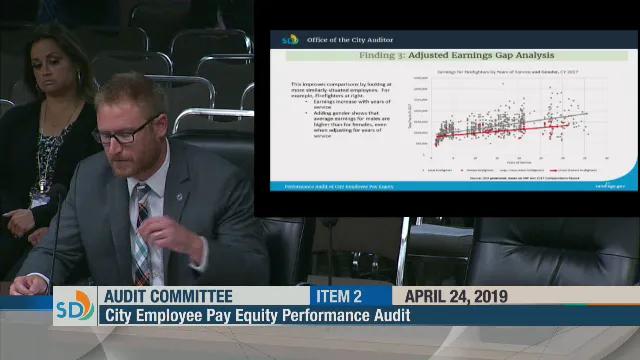
The Audit Committee of the San Diego City Council met on April 24, 2019, at 9:00 a.m. to receive information and discuss several audit reports, including the City Auditor's monthly activity report, the quarterly fraud hotline activity report, the fiscal year 2018 single audit, a performance audit of city employee pay equity, and a performance audit of joint use agreements with the San Diego Unified School District. All action items passed unanimously. Consent Calendar - Approved the meeting agenda and previous meeting minutes unanimously. Discussion Items - City Auditor’s Monthly Activity Report (Info Item): Interim City Auditor Kyle Elser presented the report, noting three audit products issued since the last meeting (pay equity, joint use agreements, quarterly fraud hotline), five audits in fieldwork, and three yet to start. No action required. - Quarterly Fraud Hotline Activity Report (Info Item): Fraud Investigator Andy Jorida reported 64 hotline reports received in Q3 FY19; 38 assigned to city departments for investigation, 8 substantiated. Committee members questioned classification consistency (e.g., “theft of time” categorized differently) and suggested future trend analysis and fraud risk assessments. No vote taken. - Fiscal Year 2018 Single Audit Report: Scott Clark (Department of Finance) and Kevin Starkey (MGO) presented the audit of federal awards. The audit covered four major programs totaling $55.7 million (66% of federal expenditures). No findings or deficiencies were identified; an unmodified opinion was issued. The committee accepted the report and forwarded it to council unanimously. - Performance Audit of City Employee Pay Equity: Lead auditors Andy Hanau and Nathan Otto presented findings. Key statistics: female city employees earned on average 83 cents per dollar earned by males; non-white employees earned 80 cents per dollar of white employees. Adjusted analysis (controlling for line of work, age, years of service) found statistically significant gaps in certain positions, e.g., female firefighters earned $25,000 less per year than similarly situated male firefighters (driven by overtime). Differences by race/ethnicity were smaller. Chief Operating Officer Chris Michelle stated the disparities are “unacceptable” and that the city will contract an outside consultant for a pay equity study. Committee members discussed educational tracking, recruitment, and overtime. The committee accepted the report and forwarded it to council unanimously. - Performance Audit of Joint Use Agreements with San Diego Unified School District: Auditors Chris Kime and Kevin Christensen reported that the city had not tracked key financial terms from the 2002 MOU. Estimated $1.2 million in prior maintenance costs from the district and $355,000 annually in ongoing costs were not invoiced. The council policy from 1981 was never updated. Parks and Recreation Assistant Director Andy Field agreed with all four recommendations, including revising the MOU, implementing a tracking system, and updating council policy. The committee accepted the report and forwarded it to council unanimously. Key Outcomes - Accepted the FY18 Single Audit Report and forwarded to council. - Accepted the Pay Equity Performance Audit and forwarded to council with six recommendations; the administration agreed to implement them. - Accepted the Joint Use Performance Audit and forwarded to council with four recommendations; management agreed to implement. - No motions were required for the information items (City Auditor’s monthly activity and quarterly fraud hotline). - The next Audit Committee meeting was scheduled for May 22, 2019, at 9:00 a.m.
The transcript provided for the meeting on April 18, 2019, contains no discernible city government discussion, agenda items, or public testimony. The text consists of song lyrics, personal reflections, and nonsensical phrases with no relation to municipal proceedings. No consent calendar, public comments, discussion items, or outcomes can be identified. Note - The raw transcription does not reflect any actual meeting content. It may be an error in the source material or a placeholder. No decisions, votes, or substantive deliberations were recorded.