891

JUL 23, 2018 · SAN DIEGO, CALIFORNIA · ACTIVE TRANSPORTATION & INFRASTRUCTURE COMMITTEE
San Diego City Meeting Summary - July 23, 2018
PROCEDURAL 100%
An attempt to summarize the meeting is made, but the provided transcript is unintelligible and does not contain coherent discussion, agenda items, or decisions. The minutes and agenda were also unavailable. Therefore, no substantive information about the meeting can be extracted. Transcript Content - The raw transcription consists of garbled, nonsensical phrases (e.g., "Crows away across the lawn, through the phone night...") that do not correspond to any recognizable meeting dialogue, motions, or public comments. Key Outcomes - No decisions, votes, or actionable items can be derived from the available material. - It is recommended to obtain a corrected or alternative record of the meeting for an accurate summary.

This meeting recording contains only the unintelligible phrase 'Half a new boy book with a broken leg in the shower conversation.' No agenda, minutes, or recognizable discussion were available. As a result, no meaningful summary of public comments, discussion items, or key outcomes can be provided. Consent Calendar - None. Public Comments & Testimony - None. Discussion Items - None. Key Outcomes - None.

The meeting materials provided (agenda, minutes) were unavailable, and the only transcript excerpt is "Notification eight executions by trip to beat the", which does not convey any identifiable discussion or decisions. No public comments, votes, or action items can be extracted due to the lack of usable information.
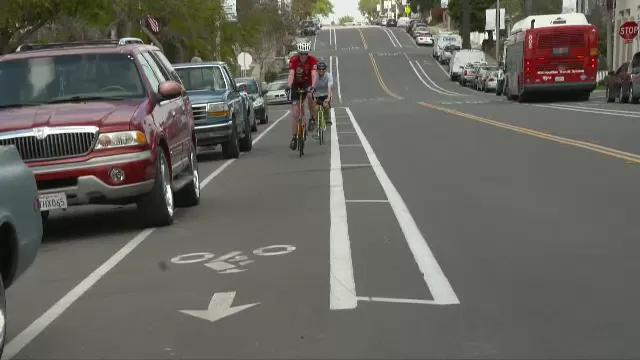
This briefing was a pre-ride safety talk delivered to a group of cyclists. The speaker instructed participants to check tire pressure, reminded them to stay to the right, ride with traffic, and use the full lane, treating the road as theirs. The speaker also noted that all traffic laws for cars and trucks apply to cyclists, including stopping at stop signs and traffic lights.
No official agenda or minutes were provided for this meeting. The only available transcript contains an informal exchange unrelated to city business: a brief invitation to play basketball. Consequently, no formal actions, public testimony, or discussion items can be reported.

The meeting was scheduled for 2018-07-19 at 09:00 UTC. However, no agenda or minutes were provided, and the raw transcription consists of non-meeting content (song lyrics) with no relation to city proceedings. Consequently, no consent calendar, public comments, discussion items, or key outcomes can be extracted. Note - The available transcript does not contain any meeting discussion, votes, or testimony. No meaningful summary of actions or decisions is possible.
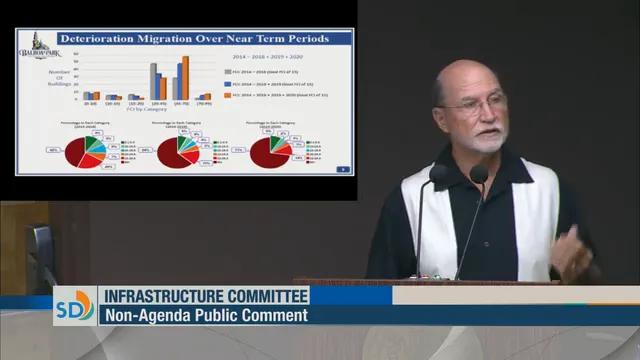
The Infrastructure Committee of the San Diego City Council met on Wednesday, July 18, 2018, at 1:30 PM. Chairperson Kercy presided, with Vice Chair Alvarez and Councilmembers Zaf and Ward present. The meeting included a non-agenda public comment, an organized presentation on Balboa Park infrastructure, approval of the consent calendar, and an informational presentation on construction management of capital improvement projects (CIP) and private development. Consent Calendar - The committee approved the meeting minutes from June 20, 2018, as distributed. - A single consent agenda item (not specified) was moved by Councilmember Zaf, seconded by Vice Chair Alvarez, and passed unanimously. Public Comments & Testimony - Martha Welch (non-agenda public comment, 2 minutes): Expressed frustration about aging infrastructure, specifically mentioning Pump Station 2, and alleged that County Supervisor Bill Horn has mishandled funds. She claimed the city is unable to investigate or use modern tools like social media to address problems. - Renee Smith (organized presentation, 8 minutes): A retired Navy Supply Corps commander and MIT graduate, unaffiliated with any organization, presented a detailed analysis of Balboa Park infrastructure funding. She argued that the CIP budget has insufficiently funded the park, citing a $300 million shortfall as of 2020. Her analysis, based on 40,000 data cells from public records, showed that the Facility Condition Index (FCI) for over two-thirds of the park's buildings will exceed acceptable thresholds (FCI 15-20) by 2020. She recommended the committee provide direction to review her report, set FCI targets (e.g., 10-15), and consider public-private partnerships to address the gap. She also noted the need for proactive maintenance to avoid crises. Discussion Items - Construction Management of CIP Projects and Private Development: Staff from Public Works Construction Management & Field Services (CMFS) — Deputy Director Luis Charr, Assistant Deputy Directors Chris Shacklford and Wendy Gamboa — presented the first-ever report on construction management. Highlights: - The division manages CIP projects, O&M projects, and permit projects (private development in the public right-of-way). - Workload has grown dramatically: $500 million in active CIP projects, 350 projects in construction, 2,100 permits issued in FY18, and 220 miles of survey work. - Key performance indicators: change order percentage under 4% (below industry standard), 94 notices to proceed issued, 66 notices of completion, 67,000 lab tests, and 84% survey milestone achievement. - Challenges: young workforce (100 staff with <3 years experience), need for improved customer service, data hub development, and coordination with private developers. - Looking ahead: FY19 includes high-profile projects like West Mission Bay Bridge, South Torrey Pines upgrades for U.S. Open, Pure Water Program, Nash Street, and Plaza de Panama. The division will shift to semi-annual reports (end of calendar year and fiscal year). - Committee and IBA Questions: - IBA Representative Andrea Teblin asked about the experience level of new staff and how customer service is managed. Staff responded that they provide bi-weekly training and plan to use project assistants to handle community inquiries, freeing inspectors for core duties. - Councilmember Ward stressed the need for accurate constituent communication, contractor accountability, and timely project completion. Staff explained that resident engineers oversee contractor schedules and enforce liquidated damages for delays. Private development oversight is more challenging due to a two-year permit window; the city is working with DSD to strengthen notification and diligence requirements. - Vice Chair Alvarez requested future reports include workload per section, national standards for caseload, and a tracking of project delays and contract amendments. He also raised the specific issue of the Otay Mesa Road project, which affects all San Ysidro high school students, noting that sidewalks are not expected until August and the road completion is still anticipated for fall 2018. Staff confirmed the timeline. - Councilmember Zaf suggested using Waze or Google Maps to inform commuters of construction, rather than relying solely on door hangers. Staff noted they are developing an internal data hub for traffic control coordination and could explore sharing data with third-party apps. Chairperson Kercy encouraged collaboration with the Communications Department and praised the online CIP project map. He also highlighted the difficulty of managing private developer projects in the public right-of-way and requested that such projects be added to the CIP map, and that the committee receive a preview before the next report. Key Outcomes - The consent agenda and meeting minutes were approved unanimously. - The informational presentation on construction management was received; no formal action was taken. - Staff will return for a semi-annual update later in 2018, with a request to meet with committee members before the next hearing to incorporate specific project feedback. - The committee adjourned at approximately 3:00 PM, with the next meeting scheduled for September 26, 2018.
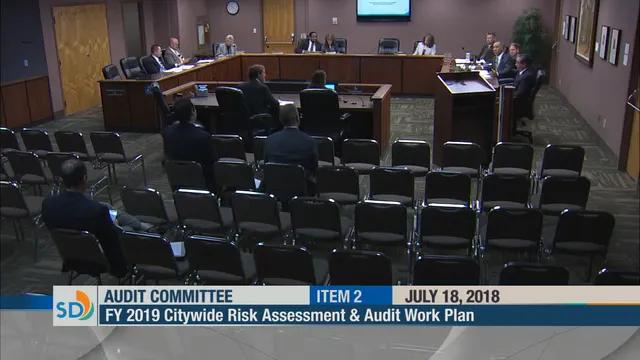
The Audit Committee of the San Diego City Council met on July 18, 2018, at 1:15 PM to discuss several audit-related items, including the citywide human capital fact book, the annual risk assessment and audit work plan, IT audit priorities, and a quarterly fraud hotline report. The meeting was chaired by Councilmember [Chair] and included members Scott Sherman, Thomas Hebrank, Ricardo Valdivia, and Alan Spencer. The committee approved the minutes of the May and June meetings by unanimous consent. Consent Calendar - Approval of Minutes: The record of action for the May and June 2018 meetings was approved by unanimous consent without discussion. Public Comments & Testimony - Martha Welch (non-agenda public speaker) expressed concern about funds not being spent properly, referencing a MAD for Ecunanum (unclear project) that had a budget of $2.5 million but spent only $2,000. She stated that the city is not using money for sidewalks and licenses as intended, and that the issue is mounting. Discussion Items Monthly Activity Report (City Auditor Eduardo Luna) - The City Auditor presented the first monthly activity report of FY2019. Since the last meeting, the office issued four audit products: the citywide human capital fact book, the annual citywide risk assessment and audit work plan, the annual IT risk assessment and audit work plan, and the quarterly fraud hotline activity report. - Upcoming audits include the public utilities customer support and water billing audit (to be released July 24), real estate asset surplus properties, and a water meter cover replacement process audit. Several other audits are in progress, including community planning groups, fleet services, and IT audits. Citywide Human Capital Fact Book and Identified Risk Areas - Presentation: Andy Hannah (Principal Performance Auditor), Nathan Otto, and Laura Reyes Cortez presented the fact book. Key findings: The city has over 11,000 employees, spending $1.4 billion on salaries and benefits (40% of the city budget). Only 30% of managers believe the city is effective at retaining talent, and quits are increasing faster than retirements. Average years of service at separation dropped from 10 years (2011) to 5 years (2018). Voluntary turnover is estimated to cost $40 million annually. Employee satisfaction is 74% overall but varies widely by department. Only 35% of employees feel poor performance is dealt with effectively. The report identified four risk areas: retention, organizational agility, employee satisfaction, and compensation. - Committee Discussion: Councilmember Sherman emphasized that the discipline and incentive issues are tied to collective bargaining agreements, and that the city is losing high performers. Chair noted the low discipline scores (35%) and the disparity across departments. Members discussed the need for audits to drill down into these issues, particularly retention and performance management. - Outcome: The committee voted unanimously to accept the report and forward it to the full City Council. City Auditor’s Annual Citywide Risk Assessment and Audit Work Plan (FY2019) - Presentation: Kyle Elser (Assistant City Auditor) presented the work plan, which includes 21 projects. Six audits are carried over from FY2018: transportation stormwater curb painting, real estate surplus properties, fleet services, water meter cover replacement, community planning groups, and water billing. Ten new performance audits are planned, including financial reporting, park joint use agreements, tree trimming, call center, capital project charges, DSD deposit accounts, advanced metering infrastructure, and homelessness reduction. The work plan totals approximately 25,000 hours. - Committee Discussion: Councilmember Sherman highlighted the value of the DSD billing and water meter audits. Councilmember Spencer questioned the efficiency of the audit office’s administrative time and the scope of cross-departmental audits. The committee discussed the prioritization of audits and the role of council requests. - Outcome: The committee approved the work plan unanimously. IT Risk Assessment and Audit Work Plan (FY2019) - Presentation: Steven Gomez (Principal IT Auditor) presented the IT audit plan. Three audits are carried over (SL implementation, City Hub security, disaster recovery preparedness) and two new IT audits are planned: network perimeter controls and citywide sensitive data encryption standards. The audits are ranked by risk to the city. - Committee Discussion: Members questioned the backlog and the separate treatment of IT audits. The auditor explained that IT audits require specialized skills and that hours were reallocated to the water billing audit. The committee noted the importance of these audits for cybersecurity. - Outcome: The committee approved the IT audit work plan unanimously. Draft Administrative Regulation 1510 (Audit Report Replies) - Presentation: Kyle Elser presented the updated AR, which establishes procedures for city departments to respond to audit reports, implement corrective actions, and provide documentation for closure. The regulation aligns with generally accepted government auditing standards. - Committee Discussion: Councilmember Sherman clarified that the AR applies to mayoral departments but also expects independent departments to follow it. The committee noted the importance of ensuring audit recommendations are addressed. - Outcome: The committee approved the draft AR, supporting the mayor’s authority to issue it. Quarterly Fraud Hotline Activity Report (Q4 FY2018) - Presentation: Andy Harita (Fraud Investigator) reported that the hotline received 226 cases in FY2018, a 10% increase from the prior year. In Q4, 53 complaints were received, 37 assigned to departments, 11 retained by the city auditor, and 16 deemed not in purview. Substantiated cases involved a parks custodian making illegal water connections and two public utilities employees using unauthorized disabled parking placards. Departments took corrective actions. The report also noted that the hotline has led to over $6,000 in recoveries. - Committee Discussion: Councilmember Hebering commended the productivity. The committee discussed the need for strong consequences for theft and the importance of publicizing outcomes to deter fraud. The fraud investigator noted that staff augmentation from audit staff helps manage the caseload. - Outcome: The committee accepted the report unanimously. Key Outcomes - Votes: All agenda items were approved by unanimous vote: acceptance of human capital report (moved to full council), approval of citywide and IT audit work plans, approval of administrative regulation 1510, and acceptance of the fraud hotline report. - Next Steps: The next special meeting is scheduled for August 1, 2018, at 2:00 PM.
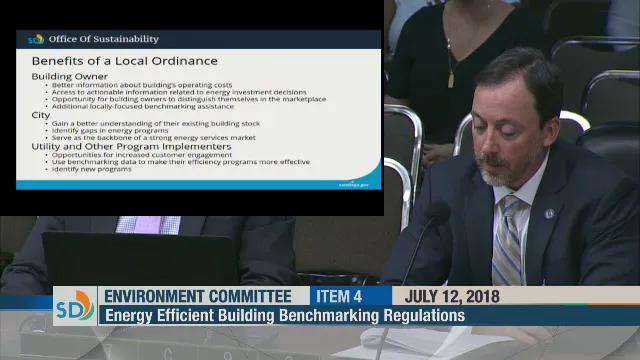
The Environmental Committee of the San Diego City Council met on July 12, 2018, to discuss and take action on several items including the 100% renewable energy initiative, an energy efficient building benchmarking ordinance, an energy regulatory update, the Pure Water program, and a WIFIA loan authorization. The committee heard public comments and approved a consent agenda. Consent Calendar - Three items were approved unanimously by the committee. Public Comments & Testimony - Tyson Siegel (San Diego 350) criticized SDG&E's proposed 100% renewable energy plan, citing a third-party review that raised questions and the Sustainable Energy Advisory Board's rejection of the proposal. He argued that SDG&E's plan lacked transparency and would take 24-48 months for CPUC approval. - Joyce Lane (San Diego 350 and San Diego Community Choice Alliance) expressed support for community choice aggregation (CCA), noting endorsements from the San Diego Unified School District, San Diego Community College District, Assemblymember Shirley Weber, union groups, and over 3,000 small businesses. - Mark Hughes (utilities background) praised the city's work on the 100% renewable energy initiative and the city attorney's position on PCIA hearings. He argued that the utility business model serves shareholders, not customers, and that Moody's had given Marin Clean Energy a strong rating, showing CCA viability. - Aaron Nieves (San Diego Community Choice Alliance) expressed excitement for the local build-out study and business plan, urging that the CCA program prioritize environmental justice communities and local renewable energy. - Sebastian Sarria (Climate Action Campaign and Community Choice Alliance) thanked council members for supporting CCA and urged the council to demand a vote on CCA from the mayor's office, noting that Los Angeles has already launched a large CCA program. - Vanessa Garcia (SDG&E Public Affairs Manager) stated that SDG&E appreciates working with the city and supports the city's goals, but emphasized that any proposal must ensure cost neutrality for SDG&E's other customers. She said SDG&E would support the city if it chooses CCA. - Hannah Green (Center for Sustainable Energy) supported the building benchmarking ordinance, noting that it would align San Diego with 24 leading U.S. municipalities and help cut energy bills and carbon emissions. - Sebastian Sarria (Climate Action Campaign) supported the benchmarking ordinance but noted the city is behind on residential energy conservation disclosure, asking for timelines on expanding to smaller commercial buildings and developing a residential ordinance. - Rick Bramhall (San Diego 350) opposed SDG&E's petition to use ratepayer funds for lobbying against CCA, urging the committee to track the issue. - Elaine Moltz (San Diego 350) criticized SDG&E's general rate case, noting that profits doubled from 2006 to 2016 while rates remained the highest in California, and that SDG&E is seeking another $218 million increase. - Sebastian Sarria (Climate Action Campaign) thanked staff for tracking regulatory issues, noted that other jurisdictions are moving forward with CCA despite the PCIA proceeding, and opposed the CCA code of conduct modification. - Brad Barnum (Associate General Contractors) expressed concerns about the Pure Water program's apprenticeship language, which he said only allows union-only apprenticeship programs, arguing it could face legal challenges. He urged the committee to work with AGC on the skilled workforce language. - Tom Lemon (San Diego Building Trades) supported the Pure Water program, stating that union apprenticeship programs graduate 92% of all apprentices in the state and 95% of women and people of color, and that there is no legal challenge to the apprenticeship language. - Gretchen Newsom (IBEW 569) urged the city to incorporate local hire, skilled and trained workforce provisions, and veteran training programs like Helmets to Hard Hats in Pure Water contracts. - Brad Barnum (AGC) also commented on the WIFIA loan, supporting it but warning of potential legal challenges if state revolving fund loans are used with union-only contract language. - Martha Welch (public speaker) criticized the Pure Water project, alleging past waste and misuse of funds, and questioned the city's debt and transparency. Discussion Items - Item 6: 100% Renewable Energy Initiative Update – Cody Hooven, Chief Sustainability Officer, presented an update on two pathways to reach the city's 100% renewable energy goal by 2035: Community Choice Aggregation (CCA) and an SDG&E proposal. The business plan for CCA is being finalized, but the committee is awaiting the California Public Utilities Commission's (CPUC) proposed decision on the Power Charge Indifference Adjustment (PCIA) exit fee, expected by end of July 2018. The SDG&E proposal is also being updated. Staff is developing criteria to evaluate both pathways, including cost, governance, and community impact. The city's Office of Sustainability has engaged stakeholders and plans to present a recommendation by the end of 2018. Committee members discussed the uncertainty of the PCIA decision, the need to prioritize disadvantaged communities, and the risk of spending resources on the SDG&E pathway if CCA is preferred. Councilmember Gomez expressed a preference for CCA and competition. - Item 4: Energy Efficient Building Benchmarking Ordinance – Jack Clark and Aaron Lou presented an ordinance to require commercial and multifamily buildings over 50,000 square feet to benchmark and report energy use using Energy Star Portfolio Manager, aligning with state AB 802 but allowing local oversight. The ordinance includes a phase-in for smaller buildings (20,000 sq ft) in second phase. Stakeholder outreach involved over 30 organizations. Benefits include energy savings, market differentiation, and better data for climate action planning. The committee discussed enforcement, with concerns about premature fines. Councilmember Sherman proposed a grace period of several years before enforcement, and Councilmember Gomez requested a reexamination of building size thresholds after two years. The committee voted to forward the ordinance without recommendation, with direction to include a grace period and a review of building sizes. - Item 7: Energy Regulatory Update – Jack Clark provided a high-level overview of several regulatory proceedings: PCIA rulemaking, CCA code of conduct petition for modification, resource adequacy program, integrated resource planning, SDG&E's Energy Resource Recovery Account, SDG&E's general rate case (Phase 1 and 2), and Senate Bill 100. The city is actively participating in or tracking these proceedings. The PCIA decision is expected by end of July 2018. The petition for modification would allow utilities to use ratepayer funds for lobbying; the city opposed it. The resource adequacy program may affect CCA start-up costs. SDG&E's rate case requests a $1.7 billion electric revenue requirement for 2019. SB 100 would increase the renewable portfolio standard to 60% by 2030 with a goal of 100% by 2045. This item was informational. - Item 8: Pure Water Program Implementation Update – John Helminski reported on Phase 1 of the Pure Water program, including design progress (100% for some elements), a dispute with SDG&E over utility relocation costs (estimated $98 million, with potential litigation), and the formation of a governance committee. Community working groups have been formed in four areas. The program is also developing an Owner Controlled Insurance Program (OCIP) to streamline coverage. Regulatory approvals are underway: Title 22 report expected by October 2018, NPDES permit by February 2019. Construction authorization for all Phase 1 packages is planned for committee approval in September and council in October 2018. The committee discussed the SDG&E dispute and community engagement. - Item 5: Authorizing WIFIA Loan for Pure Water Program – Lakshmi Komi presented a request to authorize a loan from the EPA Water Infrastructure Finance and Innovation Act (WIFIA) of up to $530 million for the water system portion of Pure Water Phase 1. The loan has a fixed interest rate of about 3% (versus 4% for bonds), a 35-year term, and is subordinate to existing water system debt. The city also plans to use state SRF loans and pay-as-you-go funding. The fiscal impact includes annual debt service estimated at $24.5 million after construction, plus interest during construction. The committee discussed the repayment options and the need to present a full financial picture to the council. The motion to approve and forward to council passed unanimously. Key Outcomes - Consent calendar approved unanimously. - Energy efficient building benchmarking ordinance forwarded to the full council without recommendation, with direction to staff to include a grace period before enforcement and to reexamine building size thresholds after two years. - WIFIA loan authorization approved by the committee and forwarded to the city council for final approval. Staff recommended paying interest during construction rather than deferring. - Other items (100% renewable energy update, energy regulatory update, Pure Water update) were informational; no formal action taken. - The committee noted that the August 2018 meeting is expected to have a heavy agenda and will be scheduled accordingly.
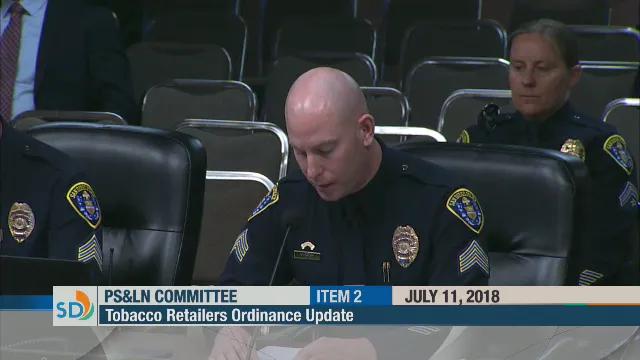
The Public Safety and Livable Neighborhoods Committee met on July 11, 2018, to receive updates on the new Neighborhood Policing Division, the annual Tobacco Retailers Ordinance report, and the Human Relations Commission's 2017 annual report. The meeting included public comments on homelessness, downtown safety, and concerns about the marijuana industry, followed by committee member questions and discussion. Public Comments & Testimony - First Speaker (name unclear): Expressed concerns about fire truck shortages, police officer shortages, and alleged misconduct by Supervisor Bill Horn, citing his use of an office number (5135) for 20 years. Criticized the city's handling of pensions, fire station conditions, and the use of Proposition B, stating it has caused problems. Also claimed the county shifted dispatch responsibilities to cities. - Orville Glenn (lives at Second and Beach, believes Chris Ward is his representative): Stated that seniors and homeless people are often invisible or ignored by the public and drivers. Called for solutions to homelessness, citing mental health issues, veterans, and women with children. Urged immediate action. - Kelly McCormick: Referenced a San Diego Union Tribune article about dubious medical claims for marijuana, quoting Dr. Joseph Califano (UC San Diego) comparing it to tobacco post-WWII. Also cited an AP article about the United Cannabis Business Association asking Governor Brown to delay testing standards. Argued the commercial pot industry is not ready, citing lack of track-and-trace systems, no state resources for code compliance, and a code enforcement backlog of 20 days. Concluded the situation does not improve public safety or neighborhood livability. Discussion Items 1. Update from Neighborhood Policing Division - Presenters: Captain Scott Wall, Lieutenant Dave Bautista, Dr. Mark Marvin (PERT), and others. - The division was established March 10, 2018, consolidating quality-of-life teams, homeless outreach teams, and PERT administration under one command, with about 72 personnel. - Mission: Enhance quality of life and safety through problem-solving partnerships and compassionate enforcement. - The division has an enforcement branch and an outreach branch. Officers work seven days a week and are not required to handle radio calls, allowing time for complex issues. - Homeless Outreach Team: Seven full-time officers, four provisional officers, two county health specialists, and two PERT clinicians. Conducts weekly coordinated outreach with service providers to connect homeless individuals to appropriate services. - Serial Inebriate Program (SIP): One full-time officer (David McGowan) coordinates with city attorney, public defender, EMS, mental health systems, county, and McAllister Institute. On call 24/7. The program saved an estimated $1.4 million in transports in 2018. The chronic list dropped from 887 to 135. - PERT (Psychiatric Emergency Response Team): SDPD has 24 of 50 county PERT clinicians. 25% of patrol staff are trained for PERT. County plans to add 20 clinicians by January 2019, with SDPD expecting 10 in mid-August and 10 in January, aiming for third watch coverage. - Get It Done App: Since May 4, 2018, the division received nearly 700 complaints (within about two months), mostly homeless-related. Response goal is within 48-72 hours to prevent encampments. - Councilmember Zaft: Discussed challenges of severely mentally ill individuals, and the need for patience and trust-building. Asked about categories of homelessness and barriers to help. Lieutenant Bautista noted that about 1 in 10 homeless individuals accept help when offered. - Vice Chair Bree: Asked about additional resources needed. Captain Wall emphasized staffing growth and enhanced use of the Get It Done app. Bree asked about typical complaints and availability of services. Officers stated they find workarounds for service gaps and focus on relationship building. - Councilmember Gomez: Questioned whether officers were relocated from other commands to form the division (yes, existing quality-of-life teams were consolidated). Asked about hot beds (50 beds, occupancy between 40-50). Inquired about data tracking for services provided; a survey app is in pilot phase, planned for full deployment by July 28. Gomez raised the HUD suggestion to evaluate police-led outreach; Captain Wall defended the model as bringing providers to the forefront. - Chair Kate: Asked about reactive vs. proactive stance. Captain Wall emphasized using community reports to be proactive and prevent large encampments. 2. Update on Tobacco Retailers Ordinance (Annual Report for Calendar Year 2017) - Presenters: Acting Lieutenant Daniel Meyer and Sergeant Brian McGillray (Vice, Permits and Licensing). - The ordinance regulates sale of tobacco, e-cigarettes, and related products through police-permitting since 2007 (amended 2014). - In 2017, the state had 1,053 tobacco licenses in San Diego; the city issued 982 permits (93% compliance). - 79 violation notices were issued for expired permits. - 46 permitted hookah locations (down 5 from 2016) and 21 vape shops (down 4). - Conducted 169 covert decoy inspections (using minors aged 15-20) resulting in 18 citations (10.65% violation rate, down from 11.02% in 2016). Six citations were for e-cigarettes/vaping juice (3.55%). - 146 overt inspections were conducted in response to complaints or randomly. - Revenue: $181,298 collected ($166,768 renewal + $14,529 new permits), down $18,928 from 2016 due to fewer businesses. - Vice Chair Bree noted fewer tobacco businesses is good news. Asked if fees cover enforcement (yes, by Prop 26). Asked about needed tools; Meyer stated they are working with the city attorney to adjust the municipal code but need more regulatory evidence. - Councilmember Gomez requested breakdown of overt inspections per council district; Meyer said they can attempt to pull data. Gomez asked about denial of permits; Meyer said denials are limited to crimes of moral turpitude; the decrease is due to fewer applications. 3. 2017 Annual Report from the Human Relations Commission (HRC) - Presenters: Dr. Joel Day (Director of Office of Boards and Commissions) and Chair Steph Gross. - Dr. Day described HRC as