Browse by city
Date range
Search help

Search titles, summaries, topics and stored transcripts together. Keywords may match separately; put the whole query in double quotes for a phrase. Matching follows word analysis, so punctuation is not exact. Both dates are included. Documents are not searched.

SHOWING 1201–1210 ENTRIES
1201
JAN 14, 2022 · SAN FRANCISCO, CALIFORNIA · PUBLIC UTILITIES COMMISSION
San Francisco Public Utilities Commission Special Meeting - January 14, 2022

The San Francisco Public Utilities Commission held a special meeting on January 14, 2022, via teleconference, to discuss the FY 2022-23 and FY 2023-24 operating budgets and capital plans for the Water, Hetch Hetchy Water, and Wastewater Enterprises. The meeting included a review of questions from the prior budget hearing, staff presentations, commissioner deliberation, and public comment. No formal votes on the budgets were taken; the meeting was continued to January 20, 2022. Public Comments & Testimony - David Pilpel commented on the water enterprise budget, expressing support for new positions but urging trade-offs with vacant positions. He requested organization charts and better communication of asset conditions. On the Hetch Hetchy budget, he suggested eventually moving Hetch Hetchy Water and Power under the Power Enterprise. On the wastewater budget, he advocated for reducing vacant positions, reexamining the relationship with DPW, and updating CIP pages with zero totals. - Nicole Sandkulla (Bay Area Water Supply and Conservation Agency) emphasized the importance of reliable water supply and urged the commission not to return to pre-Wholesale System Improvement Program (WSIP) days. She supported using previously appropriated funds but cautioned against long-term reliance. - Multiple callers alleged corruption, nepotism, and mismanagement at the PUC, claiming that hiring practices and sole-source contracts have hindered project delivery. Discussion Items - Item 3: Summary of January 7, 2022 Budget Hearing Questions – Staff responded to prior questions. Commissioners debated the unfunded portion of the capital plan (10–15%) and deliverability. Commissioner Harrington noted the water capital plan alone is off by $200 million, making detailed project prioritization difficult. Chair Ajani suggested exploring alternative financing methods (e.g., WIFIA loans at 1.5% interest). Commissioner Maxwell acknowledged tension between planning and fiscal responsibility and recommended a fully funded capital plan as a priority. - Item 4: Water Enterprise Budget and Capital Plan – Presented by Assistant General Manager Steve Ritchie. The budget proposes no retail rate increase for FY 2022-23. Key capital projects include the Lab and Shops project ($47.7 million in FY 2023-24), dam safety improvements (e.g., Pilarcitos and San Andreas dams), and alternative water supply studies (e.g., purified water). Commissioner discussion focused on deliverability constraints, the need to staff critical positions, and the impact of climate variability on supply. Public comment supported the budget but questioned project trade-offs. - Item 5: Hetch Hetchy Water Enterprise Budget and Capital Plan – Presented by AGM Ritchie. The budget addresses wildfire mitigation, dam safety, and staffing for the Hetch Hetchy system. Commissioner questions were minimal. Public comment reiterated organizational structure concerns. - Item 6: Wastewater Enterprise Budget and Capital Plan – Presented by Assistant General Manager Greg Norby and Steven Robinson. The operating budget shows a 2% change from current levels. Staff proposes one new operating position for green infrastructure scaling and several capital-funded positions for GIS transition from DPW. Commissioner Harrington inquired about reabsorbing functions from DPW; General Manager Dennis Herrera confirmed discussions have begun. Commissioner Ajani asked about cost per gallon and energy use. Public comment suggested reducing salaries and reexamining DPW overhead. Key Outcomes - Motion to Continue Meeting – A motion to continue the meeting to Thursday, January 20, 2022, was made by Commissioner Maxwell, seconded, and approved unanimously (5 ayes). The commission will reconvene to continue budget deliberations. - Directives to Staff – Staff will explore a fully funded capital plan option, provide additional information on alternative financing and organizational capacity, and initiate discussions with DPW on potential transfers of responsibilities. Commissioners requested updated organization charts and clearer connection between asset conditions and capital program needs.
WATER RESOURCE MANAGEMENT 39% · BUDGET AND FINANCE 13% · WASTEWATER SERVICES 12% · PUBLIC COMMENT 9%
1202
JAN 13, 2022 · SAN FRANCISCO, CALIFORNIA · PUBLIC SAFETY AND NEIGHBORHOOD SERVICES COMMITTEE
Public Safety and Neighborhood Services Committee Meeting - January 13, 2022

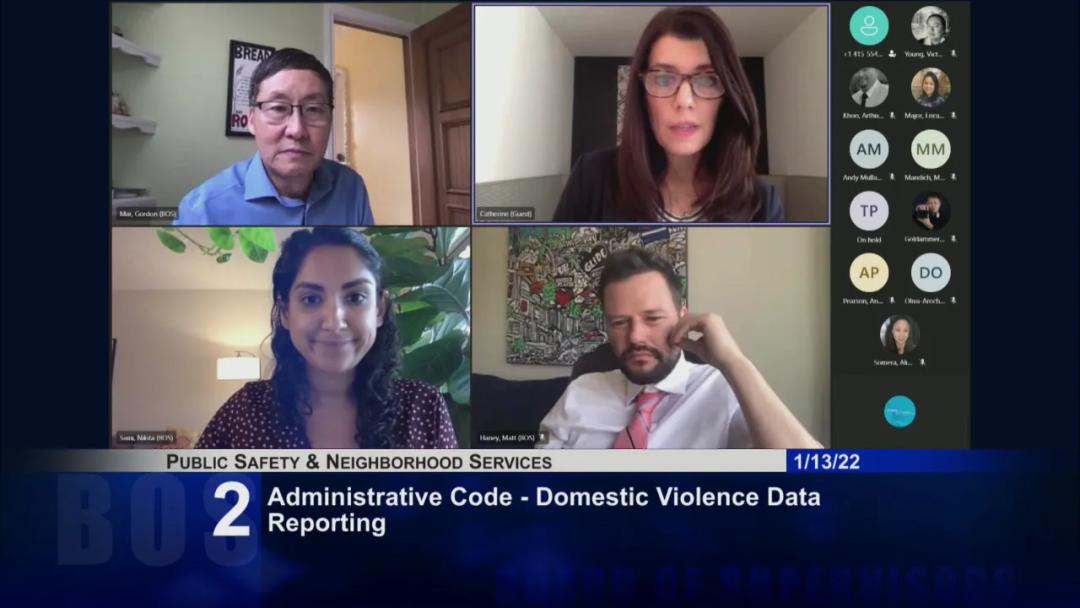
The Public Safety and Neighborhood Services Committee of the San Francisco Board of Supervisors met on Thursday, January 13, 2022, at 6:15 PM. The committee considered two items: an ordinance requiring the police department to analyze implementation of private security regulations (Article 25 of the Police Code), and an ordinance amending domestic violence data reporting requirements. Both items were passed unanimously with amendments. Public Comments & Testimony - Leah Weinberg (District 2 resident) expressed support for the private security ordinance, citing harassment of children of color by armed private security guards and urging police department oversight. - Katie Collie (District 2 resident, mother of two Black children) described specific incidents: a private security officer stopping a Black teenage boy on a public street, holding him without authority, and threatening him with a gun; and another officer following a 12-year-old boy of color, verbally threatening him, and taking pictures without consent. She implored the committee to move the legislation forward. - Trish Tierney (San Francisco resident) supported the ordinance, calling the incidents horrific and emphasizing the need for oversight to ensure safety for all, especially young people and people of color. Discussion Items - Item 1 (210869) – Police Code: Private Protection and Security Services – Supervisor Stefani introduced the ordinance, which requires the San Francisco Police Department (SFPD), in consultation with the Controller’s Office, to conduct a gap analysis of Article 25 of the Police Code. Article 25, enacted in 1972, mandates SFPD to register and regulate private security firms but has never been meaningfully implemented. The analysis would assess feasibility, necessary updates (including non-discrimination provisions, complaint processes, and penalties), and potential conflicts with state law. Diana Oliva Roche, Director of Policy and Public Affairs for SFPD, expressed support and noted that the department has not received permit applications for 49 years, and that state regulation often overlaps. She emphasized the need to determine whether the regulatory function should remain with SFPD. The committee heard public comment and then voted unanimously to send the ordinance to the full Board of Supervisors with a positive recommendation. - Item 2 (211172) – Administrative Code: Domestic Violence Data Reporting – Supervisor Stefani presented amendments to a previously passed ordinance (duplicated by Supervisor Ronan) that requires quarterly reports from SFPD and the District Attorney’s Office on domestic violence cases. The amendments, developed in collaboration with Supervisor Ronan’s office, refine definitions of abuse and domestic violence, specify reporting categories (e.g., cases under Penal Code sections 273.5 and 243(e)(1), cases presented by SFPD’s Special Victims Unit, and cases referred to the DA’s domestic violence unit), and require reporting on victim services provided. A technical change was made to strike “including but not limited to” on page two, line four, to avoid altering the SFPD reporting structure. A correction was also made to restore language from the December meeting that supplemental information shall not include personal identifying information. No public comments were received. The committee adopted the amendments unanimously and then voted to send the amended ordinance to the full Board with a positive recommendation. Key Outcomes - Item 1: Motion to send the ordinance to the full Board of Supervisors with a positive recommendation passed unanimously (3 ayes: Vice Chair Stefani, Member Haney, Chair Maher). - Item 2: Amendments to the ordinance were adopted unanimously (3 ayes). The motion to send the amended ordinance to the full Board with a positive recommendation passed unanimously (3 ayes).

POLICE OVERSIGHT 34% · DOMESTIC VIOLENCE 26% · PUBLIC COMMENT 20% · PROCEDURAL 10%
1203
JAN 11, 2022 · SAN FRANCISCO, CALIFORNIA · PORT COMMISSION
Port Commission Meeting: January 11, 2022 – Election of Officers and 2022 Strategic Outlook

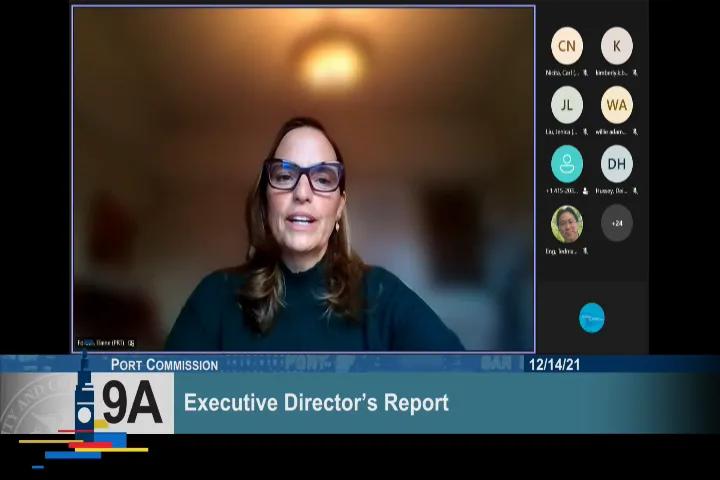
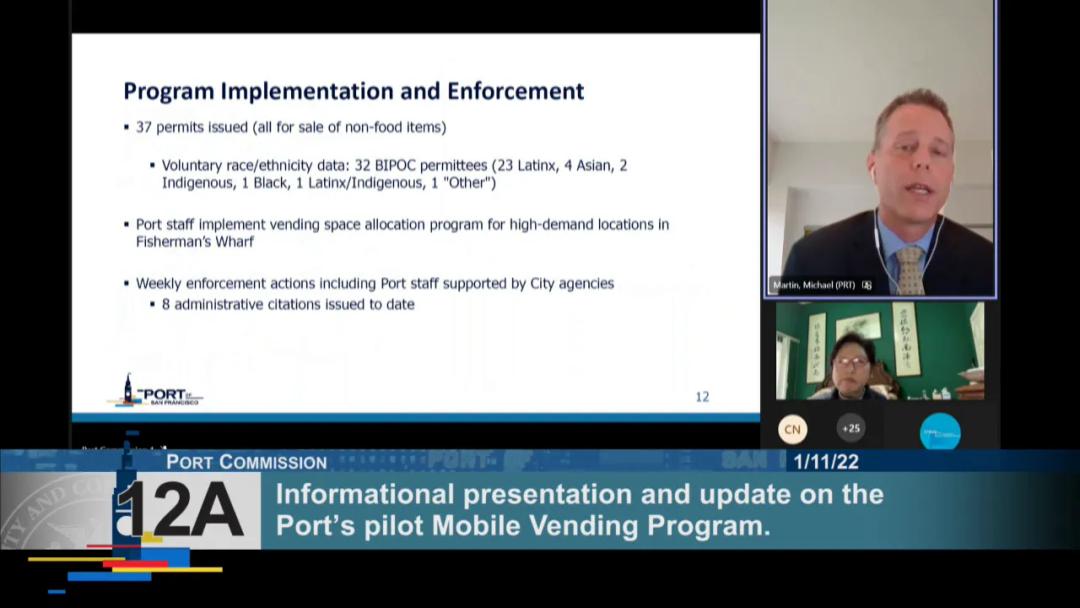
The San Francisco Port Commission convened on January 11, 2022, at 10:45 AM. The meeting included the election of new officers, a comprehensive report on the port's 2021 impact and 2022 strategy, approval of consent calendar items, a cost reimbursement agreement with PG&E, and an update on the pilot mobile vending program. No public comments were received on any agenda item. Election of Officers - Commissioner Willie Adams was unanimously elected Port Commission President, succeeding Kimberly Brandon. Commissioner Doreen Wuho was unanimously elected Vice President. Both elections were confirmed by roll call vote. Consent Calendar - Resolution 2201: Approved remote meetings for 30 more days under new state urgency legislation, with a directive to agendize a similar resolution within 30 days. - Resolution 2202: Authorized advertising for competitive bids for Construction Contract No. 2841, Heron’s Head Shoreline Resilience. - Resolution 2203: Authorized a sole source contract for testing and re-commissioning of the shoreside power system at the James R. Herman Cruise Terminal, at $400,000 for a four-year term. - All three resolutions passed unanimously. Public Comments & Testimony - No members of the public provided comment on any agenda item. Discussion Items Executive Director’s Report – 2021 Impact and 2022 Strategy - Executive Director Elaine Forbes presented the port’s achievements: zero COVID-19 on-site transmissions in 2021, $800,000 in micro-LBE loans to BIPOC-owned businesses, 125 affordable homes opened at 88 Broadway and 735 Davis Street, 16 trade women at the Mission Rock project, and 30 REAP actions implemented. The port secured American Rescue Plan funding, providing a two-year financial reprieve. Unpaid rent reached an all-time high. The 2022 strategy focuses on economic recovery, equity, and resilience, including 23 early projects for Prop A spending on sea level rise preparedness. Commissioners praised the report and highlighted priorities: activating the waterfront with BIPOC small businesses, supporting cruise ship recovery, and pursuing state and federal infrastructure funds (Governor Newsom allocated $2 billion for ports; $2 billion federal infrastructure funds available). Cost Reimbursement Agreement with PG&E (Item 11A) - Carol Bach presented a resolution to approve a cost reimbursement agreement with PG&E for management of residual petroleum hydrocarbons on port property near the former Potrero Power Plant and Pier 70. The agreement covers a 20-year term with a $5 million reimbursement cap, renewable if reached earlier. The commission approved Resolution 2204 unanimously. Pilot Mobile Vending Program Update (Item 12A) - Mike Martin, Assistant Port Director, reported that the program has issued 37 permits (all non-food merchandise vendors) since October 2021. Eight administrative citations have been issued to unpermitted vendors, but citations have not proven an effective deterrent. The program includes 44 vending spaces, with a lottery for high-demand locations at Fisherman’s Wharf. MEDA (Mission Economic Development Agency) provided outreach to 100+ vendors, with 20 completed applications. Food vendors remain unpermitted due to additional DPH requirements. The commission discussed enforcement challenges, potential conflicts, and the need for a citywide vending program, which was introduced at the Board of Supervisors on December 14, 2021. No action was taken; the item was informational. Key Outcomes - Election of Officers: Willie Adams elected President, Doreen Wuho elected Vice President. - Consent Items: Resolutions 2201, 2202, 2203 approved unanimously. - PG&E Agreement: Resolution 2204 approved unanimously, pending Board of Supervisors approval. - Mobile Vending: Program continues with ongoing enforcement and technical assistance; staff will monitor citywide legislation. - Adjournment: The meeting adjourned at 5:02 PM.

STREET VENDING REGULATION 25% · PROCEDURAL 19% · PORT MANAGEMENT 11% · EXECUTIVE DIRECTOR'S REPORT 8%
1204
JAN 11, 2022 · SAN FRANCISCO, CALIFORNIA · PUBLIC UTILITIES COMMISSION
San Francisco Public Utilities Commission Meeting - January 11, 2022

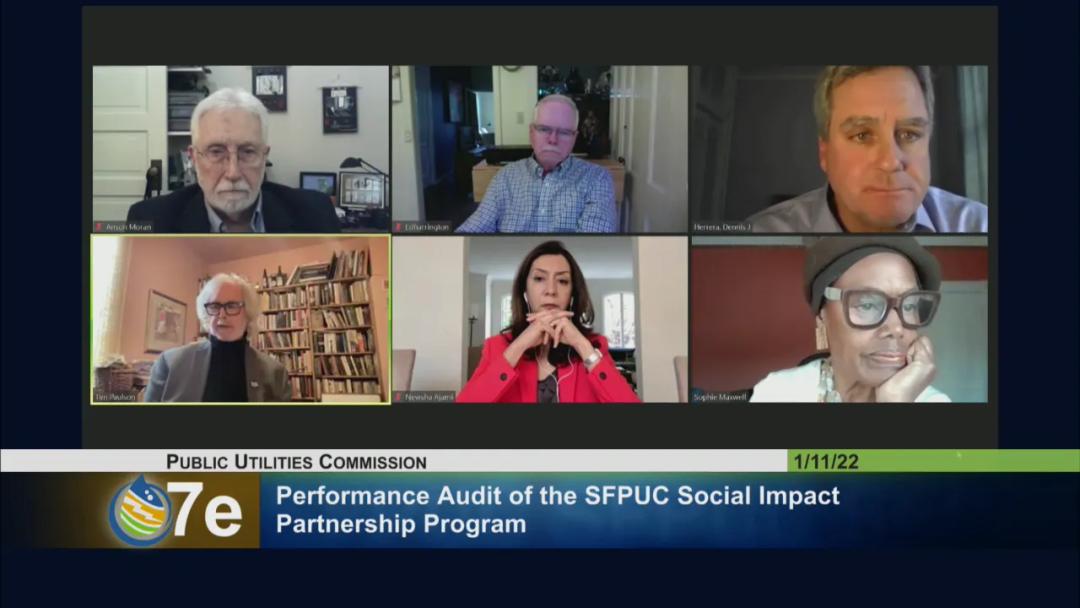
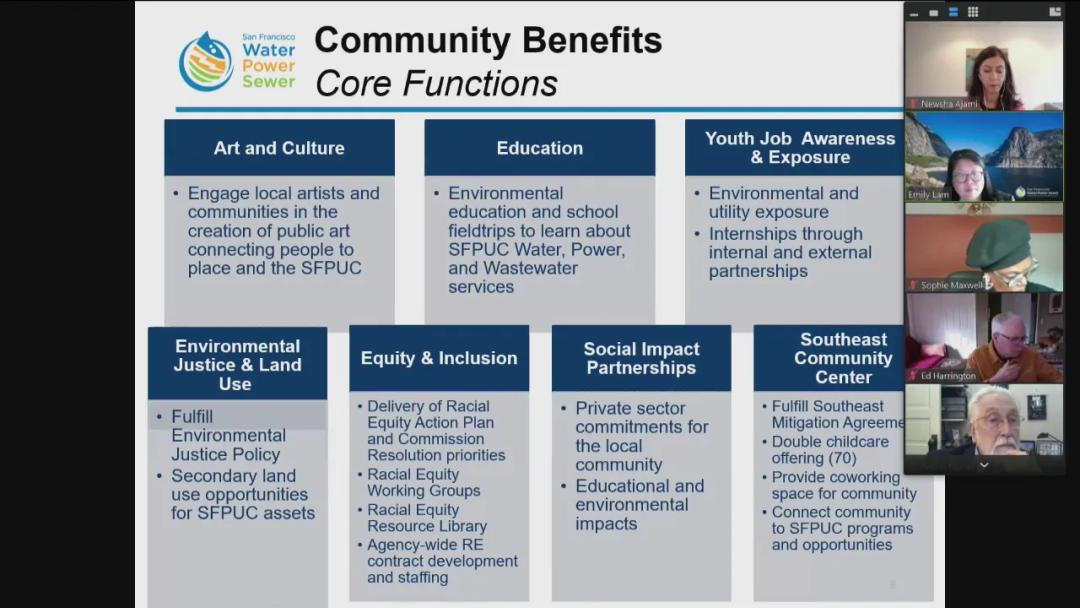
The San Francisco Public Utilities Commission (SFPUC) held a regular meeting on January 11, 2022, via teleconference due to the COVID-19 emergency. The meeting was chaired by President Moran. Key topics included a drought conditions update, results of recent bond sales, a performance audit of the Social Impact Partnership Program, quarterly reports for capital programs, and several consent and regular calendar items. Public comment was heard on multiple agenda items, with speakers addressing drought management, program accountability, and contract concerns. Consent Calendar - Items 9a through 9k were approved collectively, with the removal of Item 9f (Contract WD-2729) and Item 9h (Contract WD-2843) for separate consideration. Item 9f was later approved with an amendment correcting a typo in the contract duration. Public Comments & Testimony - General Public Comment: Speakers included representatives from the Coalition for San Francisco Neighborhoods (Eileen Bogan), Tuolumne River Trust (Peter Dreckmeyer), and community members. Topics ranged from long-term water vulnerability, drought surcharge optics, LBE program fraud allegations, and calls for renewable energy access. - Drought Update (Item 7a): David Pilpel recommended submitting the drought monitor later for timeliness. Peter Dreckmeyer noted the SFPUC has ample water storage and urged against alarmism. A caller criticized the agency's focus on human needs at the expense of salmon. - Bond Sales (Item 7b): David Pilpel asked staff to compare actual interest rates with projections and thanked Rich Morales for his work. - Social Impact Partnership Audit (Item 7e): Two callers criticized the program, alleging fraud and lack of transparency, with one claiming the audit whitewashed misconduct. - Wastewater Quarterly Report (Item 7d): A caller questioned cost overruns, linking them to LBE program issues and contractor selection. - New Commission Business (Item 8): Several callers opposed a proposal to eliminate natural gas appliances, citing feasibility and cost concerns, while others supported electrification. - Consent Calendar: A caller raised concerns about LBE eligibility for listed subcontractors. - Item 10-13: David Pilpel requested mapping and environmental review documentation improvements. A representative from the Bay Area Water Supply and Conservation Agency supported the San Bruno MOU. Discussion Items - Drought Conditions Update (Item 7a): Assistant General Manager Steve Ritchie reported significant precipitation in late December, with Hetch Hetchy storage 28% above last year. Snowpack is tracking close to 2017 (second wettest year). Water deliveries dropped to 132 MGD. Commissioners discussed the drought surcharge scheduled for April 1, with questions about possibly withdrawing or adjusting it if wet conditions continue. Vice President Jamy suggested reviewing the surcharge timeline and revenue recovery. - Wastewater and Power Bond Sales Results (Item 7b): Rich Morales presented results. Wastewater bonds (approx. $297M) sold at an aggregate true interest cost of 3.03%. Wastewater notes ($347M) sold at 0.77%. Power bonds ($124M) sold at 2.63%. Commissioners discussed green bond performance; Morales noted green series may have contributed but not definitively in competitive sales. - Performance Audit of Social Impact Partnership Program (Item 7e): General Manager Dennis Herrera presented the audit's findings (weak internal controls, lack of transparency) and committed to implementing all seven recommendations in 2022. Commissioners praised the response, emphasizing data-driven improvements and best practices. Herrera noted a preliminary review found no disproportionate beneficiaries but pledged further analysis. - Hetch Hetchy Capital Improvement Program Quarterly Report (Item 7c): Katie Miller reported on changes to reporting format, project status, and the ongoing mountain tunnel shutdown (first of six major shutdowns for construction). 100% of water supply is currently from Bay Area sources. Commissioners commended coordination and COVID safety. - Wastewater Enterprise Quarterly Report (Item 7d): Stephen Robinson presented updates on major projects. Biosolids forecast increased from $1.68B to $2.37B due to market conditions, supply chain, and schedule changes. Headworks project increased from $619M to $679M. The Southeast Community Center remained on budget and schedule. Commissioners acknowledged challenges and stressed lessons learned. - New Commission Business (Item 8): Commissioner Harrington proposed studying whether eliminating natural gas appliances in homes (costing $4-5B) could reduce post-earthquake fire risk and GHG emissions, potentially replacing the planned emergency firefighting water system (cost $2-3B). Staff were directed to investigate the idea. Commissioner Maxwell added that state climate funds might be leveraged. - Item 9f (Contract WD-2729): Susan Howe presented an amendment to accept work and authorize final payment for fish passage facilities in Alameda Creek. A typo in the contract duration was corrected. Approved. - Items 10-13: - Item 10: Approved a no-fee, 10-year right-of-way permit renewal with the National Park Service for radio facilities in Yosemite. - Item 11: Approved a MOU with San Bruno for up to $314,500 for an additional 1 MG emergency water storage tank. - Item 12: Approved selection of APX Incorporated for power scheduling coordination (up to $136.5M over 5 years). Only one bidder responded; Commissioner Jamy queried the cost increase due to market evolution. - Item 13: Approved a MOU with Recreation and Park Department for green infrastructure in McLaren Park, including daylighting half a mile of creek and stormwater reuse for irrigation. Key Outcomes - Remote Meetings: Continued for 30 days via adopted resolution (unanimous). - Consent Calendar: Adopted (items 9a-9e, 9g, 9i-9k) as amended (removing 9f and 9h). - Contract WD-2729 Amendment: Approved as amended to correct contract duration (5-0). - Item 10 (Right-of-Way Permit): Approved (5-0). - Item 11 (San Bruno MOU): Approved (5-0). - Item 12 (APX Agreement): Approved (5-0). - Item 13 (McLaren Park MOU): Approved (5-0). - Social Impact Partnership Audit: All seven recommendations to be implemented in 2022; staff to develop revised policies and report back. No vote required. - Drought Surcharge: Remains set for April 1; staff to provide updates in February/March for potential reconsideration if wet conditions persist. - Natural Gas Study: Staff directed to investigate feasibility of eliminating natural gas appliances as alternative to emergency firefighting water system. - Closed Session: No reportable actions taken.

PROCEDURAL 34% · WATER RESOURCE MANAGEMENT 18% · PUBLIC COMMENT 16% · AUDIT AND COMPLIANCE 8%
1205
JAN 7, 2022 · SAN FRANCISCO, CALIFORNIA · PUBLIC UTILITIES COMMISSION
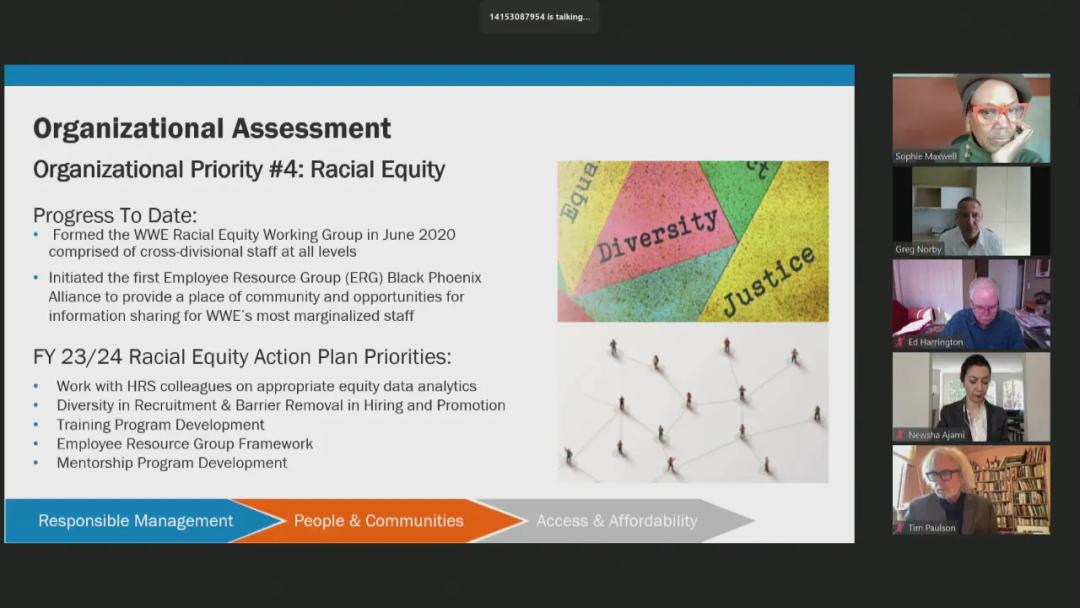
San Francisco Public Utilities Commission Budget Hearing – January 7, 2022

The San Francisco Public Utilities Commission (SFPUC) held a public hearing on January 7, 2022, to review and discuss the proposed two-year operating budget (FY 2022-23 and FY 2023-24), the 10-year capital plan, and the 10-year financial plan. Commissioners received presentations from General Manager Dennis Herrera, Deputy CFO Charles Pearl, Budget Director Laura Bush, and bureau heads for Infrastructure, General Manager, External Affairs, and Business Services. The meeting concluded with a unanimous vote to continue the budget discussion to a special meeting on January 14, 2022. Consent Calendar - None. The meeting focused entirely on budget presentations and public comment; no routine consent items were considered. Public Comments & Testimony - David Pilpel commented on the proposed budget, suggesting a reduction in net new FTE positions, reallocation of vacant infrastructure positions, and consolidation of certain bureaus. He also praised customer service staff. - Nicole Senko Laboska (CEO, BOSCA) raised concerns about the PUC's low capital spending relative to appropriations, the unfunded portion of the capital plan, and the use of demand projections that she argued were inconsistent with adopted long-term plans. She urged the commission to present clearer financial planning data. - Additional callers provided brief remarks, but no other public comments were recorded. Discussion Items 1. Overview of Budget Priorities (General Manager Herrera) - Herrera outlined three overarching priorities: responsible management, access and affordability, and supporting people and communities. - He highlighted economic uncertainty from the pandemic, ongoing drought, a tight labor market ("silver tsunami"), and the need for racial equity investments. - The proposed $1.6 billion operating budget for FY 2022-23 represents a 5% increase over the current year. 2. Operating Budget (Laura Bush) - The budget adds 57 net new positions (21% operating, two-thirds off-budget project funded). - Revenue-funded capital is decreasing due to a thorough baseline process that identified previously appropriated but unspent funds. - Debt service is the largest driver of the $120 million increase over the two-year budget. 3. Capital Plan and Budget (Charles Pearl) - The 10-year capital plan totals approximately $4.7 billion, with $2 billion in existing appropriations to be reprioritized before new funds are requested. - Only a one-year capital budget (FY 2022-23) will be proposed for approval; the FY 2023-24 capital budget will follow a year later after a capital reimagining effort. - An unfunded portion (10–15% of each enterprise’s plan) was acknowledged, common for capital plans. 4. 10-Year Financial Plan (Charles Pearl) - Assumes average annual rate increases of 3% for water and 4% for wastewater over the budget years. - No rate increase is proposed for the current year due to surplus and rate stabilization fund. - Sales volume projections reflect pandemic recovery, drought surcharge assumptions, and modest growth in clean power. 5. Infrastructure Bureau (Acting AGM Alan Johansson) - Infrastructure manages capital project planning and delivery; the presentation covered staffing, overhead rates (155% multiplier), and challenges in hiring (especially engineers). - A pilot mentoring program for internal staff was discussed. 6. General Manager’s Office and Human Resources (Rachel Gardunio) - Focus on aligning with the three overarching principles, including racial equity action plan and workforce development. - HR is working on recruitment and retention, with a pilot mentoring program and classification studies. 7. External Affairs (presentation not detailed in transcript) - Brief overview of external communications and community engagement activities. 8. Business Services (Ron Flynn) - Noted the retirement of CFO Eric Sandler. - Budget proposals include a data maturity initiative, cybersecurity enhancements (additional position and software), and continued investment in customer service technology. Key Outcomes - Motion to Continue: Commissioner Paulson moved to continue the meeting to a special meeting noticed for January 14, 2022; the motion passed unanimously (6-0). - No formal budget approvals were made; the discussion will continue at the January 14 meeting, followed by a February vote on the final budget. - Staff committed to providing additional sensitivity analyses (e.g., drought surcharge duration, per capita water use) and a clearer presentation of demand projections in future meetings.

BUDGET AND FINANCE 30% · ENGINEERING AND INFRASTRUCTURE 15% · FINANCE AND DEBT 9% · CAPITAL PLANNING 7%
1206
JAN 6, 2022 · SAN FRANCISCO, CALIFORNIA · GOVERNMENT AUDIT AND OVERSIGHT COMMITTEE
Government Audit and Oversight Committee Meeting - January 6, 2022

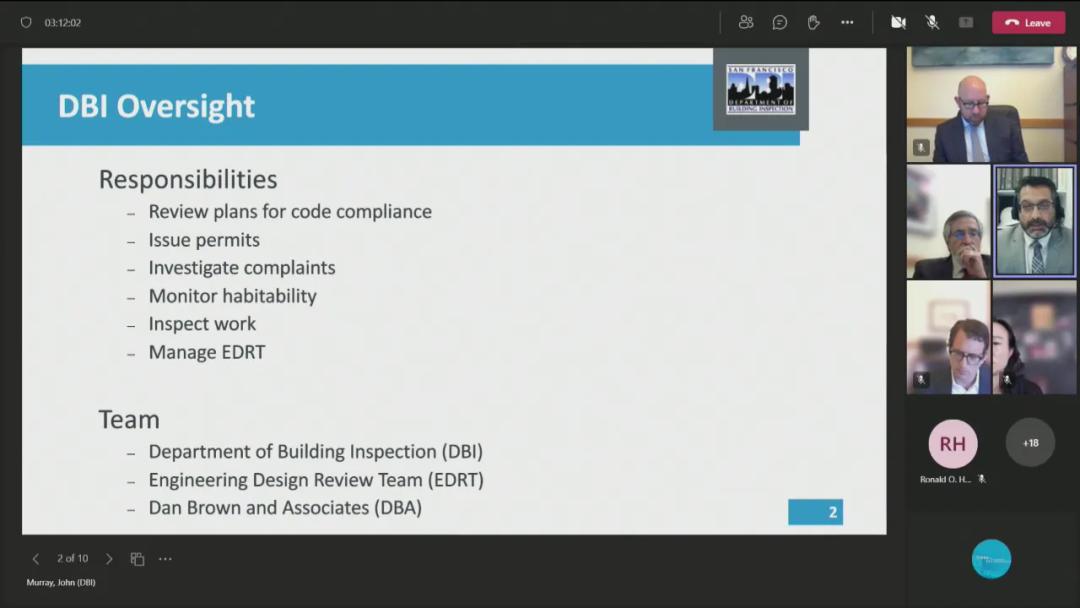
The Government Audit and Oversight Committee of the San Francisco Board of Supervisors met on Thursday, January 6, 2022, at 6:15 PM. The meeting was chaired by Supervisor Dean Preston, with Vice Chair Connie Chan and Member Raphael Mandelman present. The committee reviewed three major agenda items: six community benefit district (CBD) annual reports, a hearing on infrastructure project notification processes, and an update on the seismic retrofit of 301 Mission Street (Millennium Tower). All items were addressed with public comment and votes. Consent Calendar - Items 1 through 6 were considered together: resolutions approving annual reports for the Yerba Buena, Ocean Avenue, Castro/Upper Market, Noe Valley, Discover Polk, and Lower Polk Community Benefit Districts for fiscal years 2018-2019 and 2019-2020. These were recommended to the full Board of Supervisors on a unanimous vote (3-0). Public Comments & Testimony - No public comments were received on the CBD items. One caller connected but did not speak during the infrastructure hearing; no callers were in the queue for the Millennium Tower hearing. Discussion Items Community Benefit District Annual Reports (Items 1-6) - Chris Corgas from the Office of Economic and Workforce Development (OEWD) presented findings on each CBD, including four benchmarks: variance from management plan, non-assessment revenue, budget vs. actuals, and carryover funds. Key issues: - Yerba Buena CBD: Met three of four benchmarks; missed non-assessment revenue due to COVID-19 (3% vs. required 5.08%). The CBD awarded community grants and increased cleaning during the pandemic. - Ocean Avenue CBD: Missed two benchmarks; OEWD noted Brown Act violations and governance issues, recommending new board recruitment, term limits, and strategic planning. New Executive Director Pierre Schmidt stated progress on recommendations. - Castro/Upper Market CBD: Missed one benchmark due to spending variance; raised 45% of budget from non-assessment sources. Reported 87,000 pounds of trash, 3,000 dirty needles, and 5,000 instances of human feces removed in FY2019-2020. - Noe Valley CBD: Missed one benchmark historically; rectified by renewal. Over 30% of budget from non-assessment sources. The district activated Noe Valley Town Square with 16-20 major events per year. - Discover Polk CBD: Met all four benchmarks. Underwent leadership transition, hired new cleaning contractor, and implemented Big Belly program. - Lower Polk CBD: Met all benchmarks in FY2018-2019 but missed one in FY2019-2020; reports were delayed due to staff turnover. The district operates a tenant-landlord clinic serving hundreds of low-income clients annually. - Each CBD executive director presented highlights. The committee voted unanimously to recommend the resolutions to the full board. Hearing on Infrastructure Projects Affecting Street and Sidewalk Access (Item 7) - Supervisor Mandelman introduced the hearing, citing a September 2021 incident on Castro Street where a sewer and water main replacement project by the Public Utilities Commission (PUC) left residents without driveway access for up to 10 days, despite notices stating steel plates would provide temporary access. - Jeremy Spitz (PUC) detailed the project: replacing pipes from the 1880s-1930s, with completion expected summer 2022. He acknowledged that the contractor did not submit the 10-day notice for PUC review, and that the contractor demolished a large section of roadway and sidewalk simultaneously, causing extended access loss. New procedures include a two-week and 24-hour notice for driveway restrictions, a concrete pour sequence in smaller sections, and a hard stop if settlement exceeds 0.25 inches per pile. - Brian Dahl (Department of Public Works) presented DPW's standard outreach: 30-day, 14-day, and 10-day notices, with PIO review, door-to-door outreach, and opt-in email alerts. DPW's 95% design review includes public affairs input. - Supervisor Mandelman questioned the lack of penalties for contractor performance and the low-bid contract system. Vice Chair Chan requested details on penalty clauses. The hearing was filed on a unanimous vote (3-0). Hearing on Seismic Retrofit of 301 Mission Street (Millennium Tower) (Item 8) - Supervisor Peskin, the sponsor, noted that the building continues to sink and tilt, with tilt now exceeding 24 inches to the west and 8 inches to the north. The original perimeter pile fix (52 piles) has been reduced to 18 piles in the latest proposal. - Ron Hamburger (Simpson Gumpertz & Heger) presented: the building remains safe but tilts at 3 inches per year. The 18-pile design, with piles at 1,000 kips each (up from 800), is intended to arrest settlement and allow some tilt recovery. He attributed earlier settlement to over-excavation during construction, corrected in a pilot program using modified techniques. - John Egan (geotechnical engineer) confirmed that the 18 piles, concentrated at the northwest corner, are sufficient to stop settlement based on indicator pile tests. - Neville Pereira (DBI) stated DBI supports resuming construction, pending review of the revised scope. The Engineering Design Review Team (EDRT) is analyzing the 18-pile plan and expects to complete its review by end of February 2022. - Ben Turner (Dan Brown & Associates) explained that improved drilling procedures (e.g., reduced drill bit diameter, real-time monitoring) have minimized additional settlement during pilot installations. He noted no grout placement issues under the new procedures. - Dr. Greg Deierlein (EDRT chair) reported that the building's tilt (0.3% of height) is within typical construction tolerances and has negligible impact on earthquake safety. The EDRT is reviewing the reduced pile scope and detailed analyses of mat foundation stresses. - Dr. Robert Pike (independent geotechnical engineer) criticized the design team's handling, arguing that the 18-pile solution is not supported by evidence and that the building's ongoing settlement is due to secondary consolidation. He suggested that zero perimeter piles might be a better long-term solution and called for a complete review. - The committee continued the hearing to the call of the chair on a unanimous vote (3-0). Key Outcomes - Items 1-6: Approved on a 3-0 vote to recommend to the full Board of Supervisors. - Item 7: Filed as heard on a 3-0 vote. - Item 8: Continued to the call of the chair on a 3-0 vote, with the EDRT review expected by February 2022.

ENGINEERING AND INFRASTRUCTURE 34% · PUBLIC WORKS 20% · COMMUNITY ENGAGEMENT 8% · COMMUNITY BENEFIT DISTRICTS 7%
1207
DEC 14, 2021 · SAN FRANCISCO, CALIFORNIA · PORT COMMISSION
San Francisco Port Commission Meeting: December 14, 2021

Date: December 14, 2021 Time: 2:00 PM – 5:05 PM This regular meeting of the San Francisco Port Commission was called to order by President Kimberly Brandon. The Commission approved consent items, adopted a new five-year ferry and excursion landing fee schedule, received an informational update on the Waterfront Resilience Program's early projects, and reviewed the Mission Rock project's construction progress and public art plan. All votes were unanimous.

PROCEDURAL 38% · PUBLIC COMMENT 11% · WATER RESOURCE MANAGEMENT 8% · INFRASTRUCTURE 7%
1208
DEC 14, 2021 · SAN FRANCISCO, CALIFORNIA · PUBLIC UTILITIES COMMISSION
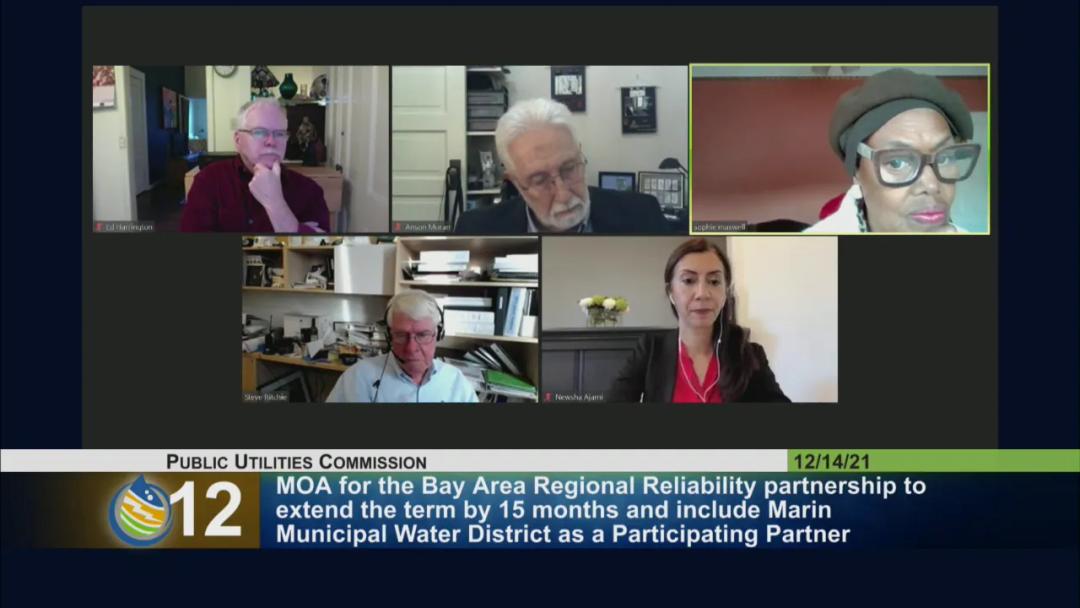
San Francisco Public Utilities Commission Meeting – December 14, 2021

The San Francisco Public Utilities Commission (SFPUC) held a regular meeting on December 14, 2021, via teleconference due to the COVID-19 emergency. The commission addressed a range of topics including renewal of remote meeting findings, water supply development, drought conditions, long-duration energy storage procurement, emergency firefighting water system expansion, and routine consent calendar items. All votes were unanimous (5-0) unless noted. Consent Calendar - Item 10a: Decommission up to eight former irrigation wells. - Item 10b: Engineering Design Services contract with Stantec Consulting Services Inc. for Oceanside Plant. - Item 10c: Increase contract duration contingency by 180 days for Contract No. DB-129.1, Bay Corridor Transmission and Distribution. - Item 10d: Increase contract duration contingency by 180 days for Contract No. DB-129.2, Bay Corridor Transmission and Distribution. - Item 10e: Increase contract duration contingency by 240 days for Contract No. WD-2861, Auxiliary Water Supply System Clarendon Supply 2019. - Item 10f: Increase contract duration contingency by 180 days for Contract No. WW-696, Cargo Way Flush Line. - Item 10g: Increase contract duration contingency by 30 days for Contract No. WW-703, Mission Street Brick Sewer Rehabilitation. Public Comments & Testimony - Eileen Boken (Coalition for San Francisco Neighborhoods) spoke on blended water quality, stating that water quality is declining while rates rise, and urged the commission to revisit the blended water issue. She also opposed making San Jose and Santa Clara permanent customers, saying “give the water to the salmon, not the Silicon Valley Growth Machine.” - Peter Dreckmeyer (Tuolumne River Trust) urged the commission to take action on the Bay Delta Water Quality Control Plan, noting that demand has been under 200 MGD for seven years and that the SFPUC could voluntarily contribute its share of unimpaired flow. He also requested that the commission discuss the design drought at the first meeting in January 2022. - David Pilpel recognized departing employees for their public service and later commented on the contract advertisement report, requesting a narrative report on SFPUC real estate in the southeast sector of the city. - Dave Warner (Palo Alto) provided a fish passage update, calculating that one salmon passes by on average every 70 minutes on the Tuolumne River, and thanked Commissioner Harrington for requesting fish passage data be reported with water supply updates. - An unnamed caller raised concerns about water quality, safety issues at the Oceanside plant, and the need for real data on leaking pipes. Discussion Items Renewed Findings for Remote Meetings (Item 3) - The commission unanimously adopted renewed findings under state urgency legislation to continue remote meetings for the next 30 days, with a directive to agendize a similar resolution within 30 days. (5-0) Approval of Minutes (Item 4) - The minutes of November 23, 2021, were approved unanimously. (5-0) Communications (Item 6) - Commissioner Harrington requested an executive summary format for the Alternative Water Supply Program quarterly report. Commissioner Ajami praised the Water Resources Division annual report. Commissioner Moran noted the program may not be ambitious enough and called for a future agenda item to discuss the report in depth. Commissioner Paulson cautioned against treating the commission as a “think tank.” Water Supply Development Report (Item 7) - Assistant General Manager Steve Richie presented the annual report, noting that San Jose and Santa Clara (interruptible customers) have current combined demands of about 5 MGD, down from the original 9 MGD target. The 2009 water supply agreement extended the decision deadline to 2028. Gary Welling (Santa Clara) and Jeff Provenzano (San Jose) presented their cities’ water conservation efforts and requested permanent status. Commissioner Moran questioned the disconnect between the 184 MGD supply assurance and actual demand of 162 MGD. Commissioner Ajami explored potential trades with other customers. The commission agreed to advance discussions, with President Moran urging a quicker conclusion. Public comment: Eileen Boken opposed permanent status. Report of the General Manager (Item 8) 8a: California Community Power Long-Duration Storage Procurement - Barbara Hill presented the Tumbleweed project (69 MW, 8-hour lithium-ion battery in Kern County), which would meet more than half of Clean Power SF’s 15.5 MW procurement mandate. The project has a 15-year fixed price, with total cost estimated at $45–65 million over 15 years. Commissioner Maxwell expressed concern that workforce language “encourages” rather than “requires” local labor and apprenticeships. Commissioner Harrington asked about dispatch priority and market signals. Public comment: David Pilpel questioned the environmental impact of lithium mining and asked who bears ultimate responsibility. The item will return for a vote in January/February 2022. 8b: Drought Conditions Update - Steve Richie reported that as of December 6, storage levels were unchanged due to a cold storm bringing snow rather than rain. Year-to-date precipitation was 7.25 inches (20% of annual average) before the current storm, which brought it to about 30% (11 inches). Snowpack was above the median for the date. The state water board suspended curtailments on October 19 and continued suspension through December. Vice President Ajami noted that demand rebounded quickly after the previous atmospheric river, emphasizing the need for clear communication. Public comment: Dave Warner provided a fish passage update. 8c: Emergency Firefighting Water System Update - John Scarpula presented a draft citywide plan for the Auxiliary Water Supply System (AWSS). The proposed expansion would add pipelines in Districts 7, 10, and 11 at an estimated cost of $1.6 billion (2021 dollars), escalating to $2.6 billion over 15 years or $3.3 billion over 25 years. The plan includes connecting additional reservoirs and increasing seawater pump station capacity. Commissioner Harrington voiced strong opposition, calling the project a “religious fervor” and questioning its necessity. Commissioner Ajami asked about data on system failures and the potential for multi-benefit use with alternative water supplies. Public comment: Eileen Boken criticized the AECOM report as incomplete and noted Supervisor Marr’s opposition to draining Lake Merced. David Pilpel suggested a public workshop to discuss pros and cons. 8d: Water System Improvement Program Quarterly Report - Katie Miller reported that the program is 99% complete, with five projects in construction and $112 million remaining budget. The quarterly report format will be revised for Hetchy and Sewer programs but kept unchanged for WSIP due to stakeholder familiarity. No public comment. 8e: Report on Recent SFPUC Activities - General Manager Dennis Herrera noted that the Controller’s Office issued a performance audit of the Social Impact Partnership Program on December 9, and the commission will discuss it in January 2022. No public comment. New Commission Business (Item 9) - No commissioners raised new business. Key Outcomes - Item 3: Adopted renewed findings for remote meetings (5-0). - Item 4: Approved November 23, 2021 minutes (5-0). - Item 10: Consent calendar adopted as a whole (5-0). - Item 11: Authorized MOU for stream gauge monitoring on Pillar Point Creek, $9,695 for 58 months (5-0). - Item 12: Authorized amendment to Bay Area Regional Reliability Partnership MOA, extending term 15 months to March 31, 2023, and adding Marin Municipal Water District (5-0). - Item 13: Authorized purchase of three properties totaling 653 acres in Alameda and Santa Clara counties for $9,151,875, plus up to $200,000 for due diligence (5-0). - Closed Session (Items 14-19): The commission voted to assert attorney-client privilege (5-0) and not to disclose the discussions (5-0). The meeting adjourned, with the December 28, 2021 regular meeting canceled.

WATER RESOURCE MANAGEMENT 33% · PROCEDURAL 26% · PUBLIC COMMENT 16% · FIRE SAFETY 7%
1209
DEC 9, 2021 · SAN FRANCISCO, CALIFORNIA · PUBLIC SAFETY AND NEIGHBORHOOD SERVICES COMMITTEE
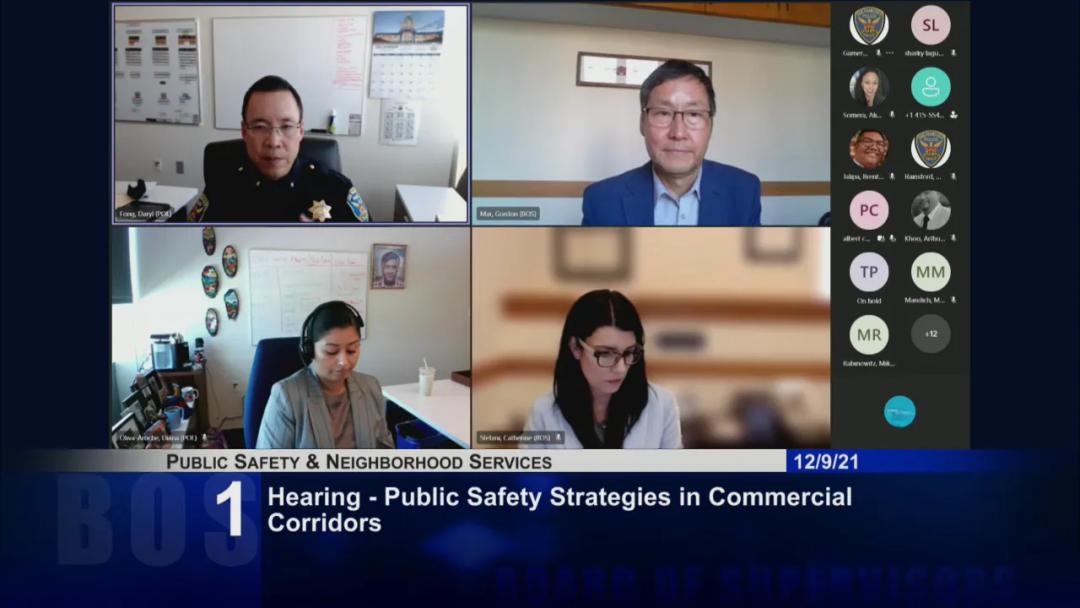
Public Safety and Neighborhood Services Committee Hearing on Commercial Corridors, Cannabis Equity, and Domestic Violence Reporting - December 9, 2021

The Public Safety and Neighborhood Services Committee, chaired by Supervisor Gordon Maher and joined by Supervisors Catherine Stefani and Matt Haney, met on Thursday, December 9, 2021, to discuss three main agenda items: public safety strategies in commercial corridors, the status of cannabis equity applicants and a possible five-year moratorium, and an ordinance requiring domestic violence data reporting. The meeting included presentations from the San Francisco Police Department (SFPD), the Office of Economic and Workforce Development (OEWD), the Office of Civic Engagement and Immigrant Affairs (OCEIA), and the District Attorney’s Office, along with testimony from small business owners and public comment. Public Comments & Testimony - Item 1 (Public Safety Strategies): Four small business leaders shared perspectives. Michael Shu (Footprint Shoe Store) described repeated burglaries and called for better consequences for perpetrators. Mario Mogano (Council of District Merchants Association) emphasized that perception of crime damages business more than actual crime and advocated for collaborative solutions. Sharky Laguana (Small Business Commission president) cited evidence-based policies beyond policing, such as improving physical environments and engaging youth, and noted that San Francisco has the highest percentage of smash-and-grab break-ins in America. Albert Chow (Great Wall Hardware) expressed frustration with lack of recourse and suggested using retired officers and sheriff’s deputies for patrols. - Item 2 (Cannabis Equity): Two callers: one opposed cannabis legalization statewide, calling it dangerous; Alex, an equity applicant, described the difficulty of finding a location and capital, urging patience and opposing a moratorium. - Item 3 (Domestic Violence Reporting): No public comments. Discussion Items Item 1 – Hearing on Public Safety Strategies in Commercial Corridors Chair Maher opened the hearing, emphasizing the impact of property crime on small businesses, including the Storefront Vandalism Relief Grant Program. Supervisor Stefani noted police staffing shortages, citing a study finding the city needs nearly 500 new officers. SFPD Commander Daryl Fong presented crime data for 25 commercial corridors (2019-2021). Key statistics: - Top corridors for vandalism during the period: Central Market, Market Castro, Chinatown. - Burglaries: Central Market, Market Castro, Union Street, and Chinatown (which saw a 50% reduction from 70 to 35 incidents year-to-date in 2021). - Clearance rates (2021 year-to-date): vandalism 21%, burglary 13%, robbery 33%. - Staffing levels remain well below consultant-recommended minimums, particularly in Tenderloin (101) district. Strategies include foot/bicycle patrols, fixed posts, abatement operations, Safe Shopper Command (Union Square), and a community ambassador program (23 ambassadors, aiming for 30+). OEWD’s Chris Corgus described the Storefront Vandalism Relief Grant: 281 awards issued, $1.3 million total reported damages, average reported damage over $3,000. Also covered neighborhood economic development grants (e.g., camera installations in Chinatown and Bayview) and 15 Community Benefit Districts (CBDs) with safety services. OCEIA Director Adrienne Pond updated on the Community Ambassador Program (CAP), expanding from four to seven districts with Board-supervisor funding. Since July 2020, ambassadors made over 11,000 merchant visits and handled 417 direct assistance calls. Efforts to expand language access through interpreter training and pilot programs were noted. District Attorney’s Office Chief Assistant Marshall Khine and ADA Cecily Brewster reported on organized retail theft task forces, leading to recovery of over $8 million in stolen goods in 2020. For commercial burglaries, 638 cases were presented to the DA in 2021; charges were filed in 70% (436 cases), almost all felonies. Brewster described the Community Liaison Program providing merchant education and case follow-up. Item 2 – Hearing on Cannabis Equity Applicant Review and Possible 5-Year Moratorium Supervisor Safai (sponsor) introduced the hearing. Acting OCA Director John Pierce presented: - 15 equity-owned retail dispensaries, plus 35 medical cannabis dispensaries (total 50 active). - 94 equity applications in pipeline (with a viability path); all permits issued to date are equity. - Market growth: state sales tax collected rose from $500k (2011) to $2.5M (2019), disrupted by COVID but recovering; median vendor quarterly revenue about $500k in 2019, dropping to $250k during lockdown, then recovering to $800k in most recent quarter. - Proposed moratorium would reduce equity businesses and workforce opportunities; office recommended more study via the recently approved local cannabis tax suspension and market study. Supervisor Safai questioned market saturation, delivery enforcement, and parity. OEWD Workforce Director Joshua Arce highlighted the First Source Hiring program and collective bargaining agreements as successful equity outcomes. Item 3 – Administrative Code – Domestic Violence Data Reporting Original ordinance (sponsored by Supervisor Stefani) passed at full board but was duplicated and sent to committee for amendments by Supervisor Ronen. Nikita Saini (Ronen’s office) presented amendments to expand reporting beyond physical-injury cases (Penal Code 273.5 and 243(e)(1)) to include all forms of domestic violence (e.g., threats, restraining order violations, stalking) and to require DA reporting on victim services contacts. Supervisor Stefani expressed concerns about adopting substantive changes without SFPD review; SFPD’s Diana Oliva-Rocha confirmed they first saw the amendments at the hearing and needed time to assess feasibility given staffing limits. Key Outcomes - Item 1: The committee voted to file the hearing (2-0-1, with Haney absent). Chair Maher announced he would develop a proposal to strengthen SFPD foot patrol and community policing frameworks through a clearer community engagement process at the district station level. - Item 2: The committee voted to continue the item to the call of the chair (3-0). Supervisor Safai committed to further study of market saturation, delivery regulation, and tax levels. - Item 3: The committee adopted one amendment (subsection F allowing DA to provide supplemental information) and continued the amended duplicate file to the next committee meeting on January 13, 2022 (3-0). Supervisor Stefani and Supervisor Ronen’s office will continue working on remaining amendments.

PUBLIC SAFETY 34% · CANNABIS REGULATION 15% · COMMUNITY ENGAGEMENT 13% · DOMESTIC VIOLENCE 11%
1210
DEC 2, 2021 · SAN FRANCISCO, CALIFORNIA · GOVERNMENT AUDIT AND OVERSIGHT COMMITTEE
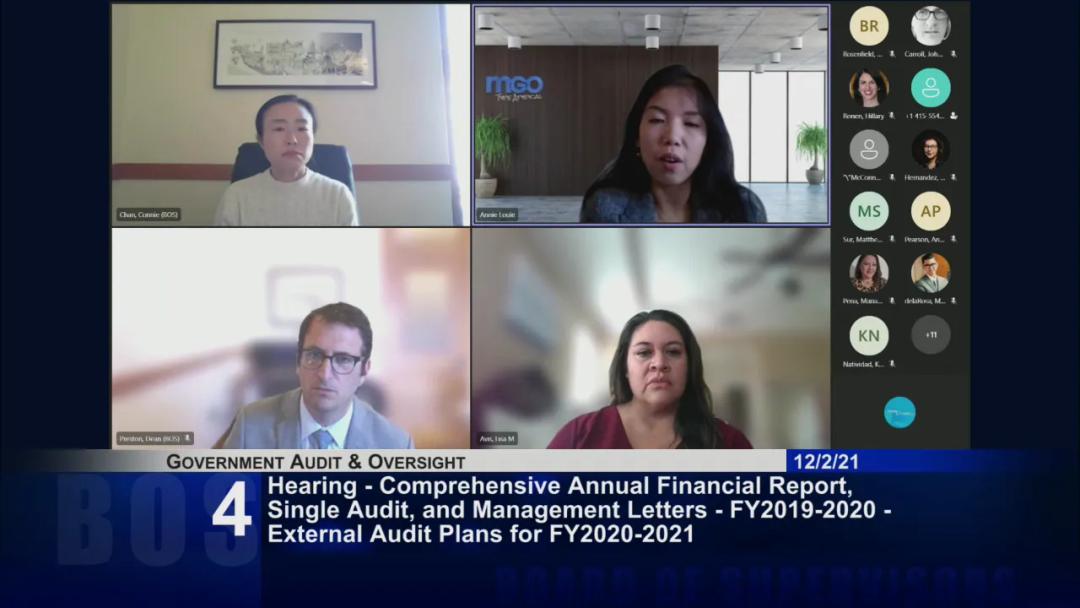
Government Audit and Oversight Committee Meeting - December 2, 2021

The Government Audit and Oversight Committee of the San Francisco Board of Supervisors met on December 2, 2021, at 6:15 PM UTC. The meeting was chaired by Supervisor Dean Preston, with Vice Chair Connie Chan and Supervisor Hillary Ronen present (Supervisor Mandelman was excused). The committee considered several items, including a labor MOU amendment, a Mills Act historical property contract, a Treasure Island infrastructure financing plan amendment, a hearing on the city's financial audit, and a hearing and resolution on the criminal trials backlog in San Francisco Superior Court. Consent Calendar - Item 1 (Ordinance adopting first amendment to MOU with Operating Engineers Local 39): Recommended as a committee report to the Board of Supervisors for the December 7, 2021 meeting. The amendment eliminates mandatory annual shift bidding at the Wastewater Enterprise, introduces voluntary semiannual shifts, affirms management rights to adjust staffing with notice, and expands the joint labor-management committee from two to four members. (Unanimous vote: Chan aye, Ronen absent, Preston aye; later Ronen present but no further vote recorded; motion passed.) - Item 3 (Resolution approving addition of territory and amendments to the infrastructure financing plan for Treasure Island IRFD No. 1): Recommended as a committee report to the Board of Supervisors. This step finalizes the legislative process for the amended IFP, with a scheduled January 11, 2022 hearing. (Unanimous vote: Chan aye, Ronen aye, Preston aye.) - Item 4 (Hearing to receive and file the comprehensive annual financial report, single audit, and management letters for FY 2019-2020, and external audit plans for FY 2020-2021): Filed. The controller's office presented, noting a clean audit opinion and 24 findings (including 6 repeat findings). (Unanimous vote to file.) Public Comments & Testimony - Item 2 (Mills Act contract for 714 Steiner Street): One public commenter, a neighbor, spoke in strong support of the property owner’s rehabilitation efforts, praising the owner's commitment to preserving the historic Painted Lady row and cooperating with the community. - Items 5 & 6 (Hearing and resolution on criminal trials backlog): - Victim's family member (Ms. Natividad): Described her brother Robert’s case – he spent 259 days in jail as an innocent man, missing his best friend's death and unable to care for his terminally ill grandfather, because the court could not find a space for trial. She demanded the court prioritize criminal trials. - Marshall Klein, Managing Attorney, District Attorney's Office: Expressed general support for the resolution’s goals but noted the DA’s office was not the primary actor; they favored the amendment to specify “non-urgent” civil trials. He urged collaboration between the city and courts. - The Presiding Judge of the Superior Court did not attend the hearing, despite being invited. Chair Preston expressed disappointment, stating the court’s absence prevented necessary problem-solving. Discussion Items - Item 2 (Mills Act contract for 714 Steiner Street): Chair Preston recused himself because the property is within 500 feet of his residence. Vice Chair Chan presided. Planning and Assessor's staff presented the contract, which provides a property tax reduction in exchange for a 10-year maintenance and restoration plan for the historic Painted Lady. Supervisor Peskin moved to continue the item to the call of the chair to allow further discussion with the owner. (Motion passed: Chan aye, Ronen aye, Preston recused.) - Items 5 & 6 (Hearing on criminal trials backlog and accompanying resolution): Chair Preston made opening remarks, stating that over 200 people are in jail awaiting trial, and that the court has failed to uphold speedy trial rights. He noted a discrepancy in numbers: the agenda cited 437 felony cases and 248 untried defendants in custody, while he cited 451 criminal cases with 218 in custody. The resolution originally urged the Superior Court to prioritize criminal trials and open more courtrooms; an amendment was offered and passed to insert “non-urgent” before “civil” on page 4, line 2, to clarify that civil trials necessary for safety or other urgent reasons should not be halted. After the amendment, the resolution was forwarded to the full board with a positive recommendation. (Unanimous votes on amendment and on forwarding as amended.) Key Outcomes - Item 1: Passed and sent to full board as a committee report for December 7, 2021. - Items 7-9 (Closed session litigation settlements): The committee convened in closed session to discuss three lawsuit settlements: Judy O’Neil ($2,500,000), Steven D. Lee ($600,000), and Andrea Gansheimer ($315,000). The committee voted unanimously not to disclose the closed session deliberations. - Item 3: Passed and sent to full board. - Item 2: Continued to the call of the chair for further discussion with the property owner. - Item 4: Hearing filed. - Item 5: Hearing held; the hearing was not separately filed but was subsumed into the action on Item 6. - Item 6: Resolution amended (adding “non-urgent” before “civil”) and forwarded to the full Board of Supervisors with a positive recommendation. Supervisors Chan and Preston added themselves as co-sponsors.

PROCEDURAL 18% · AUDIT AND COMPLIANCE 15% · JUSTICE AND CORRECTIONS 14% · HISTORIC PRESERVATION 9%
OPENPUBLICA · PUBLIC MEETING INDEXUPDATED DAILY · openpublica.com