Browse by city
Date range
Search help

Search titles, summaries, topics and stored transcripts together. Keywords may match separately; put the whole query in double quotes for a phrase. Matching follows word analysis, so punctuation is not exact. Both dates are included. Documents are not searched.

SHOWING 1211–1220 ENTRIES
1211
NOV 23, 2021 · SAN FRANCISCO, CALIFORNIA · PUBLIC SAFETY AND NEIGHBORHOOD SERVICES COMMITTEE
Public Safety and Neighborhood Services Committee Special Meeting - November 23, 2021

Consent Calendar - The committee approved two liquor license transfers without opposition. The first was a type 51 (nonprofit club) license for Treasure Island Yacht Club, with zero letters of protest and support from the Treasure Island Development Authority. The second was a type 21 (off-sale general) license for Bottle Bacchanal, a woman-owned boutique bottle shop, with a condition to monitor loitering. Both were sent to the full Board of Supervisors with positive recommendations. Public Comments & Testimony - For Item 3: Brian McGilly (UFCW Local 5) expressed full support for the cannabis ordinance, stating it would protect workers, ensure fair wages and benefits, and bring parity to the industry through labor peace agreements and apprenticeship programs. - For Item 4: Multiple community members spoke. Judy Irving (former chair of Parks and Trees Committee) urged clarifying watering responsibilities to prevent tree deaths. Brian Wiedenmeyer (Friends of the Urban Forest) called the inequitable distribution of trees an environmental injustice and requested dedicated planting funding. Josh Clift (Mission Verde) advocated for creating a city forest officer or office to oversee all city trees and green infrastructure. Catherine Howard (Sierra Club) supported funding through bonds and general fund allocation. Other speakers (Stephanie Peak, Michael Nalty, D Chabuler, Lance Kearns, Charles, John Nolte, Jian Hong) emphasized need for better data, departmental coordination, tree replacement plans, and equitable expansion of the urban forest. Discussion Items - Item 3: Ordinance on Cannabis Businesses (Files 211030) – Sponsored by Supervisor Safai, the ordinance amends the Police and Health Codes to extend the temporary authorization period for medical cannabis dispensaries (MCDs) from 120 to 150 days for complaint review, and requires MCDs with 10+ employees to enter into a labor peace agreement or collective bargaining agreement. It also mandates that 35% of new hires come from certified apprenticeship programs. Acting Director of the Office of Cannabis, John Pierce, noted that 35 MCDs remain under temporary permits and the office needs two years to process them. Supervisor Peskin raised a concern about a due process issue regarding complaints filed just before renewal, but Pierce clarified it is an extension and part of a holistic review. Supervisor Mar added himself as a co-sponsor. The committee voted unanimously to send the ordinance to the full board with positive recommendation. - Item 4: Hearing on Urban Canopy and Street Tree Maintenance – Supervisor Peskin called the hearing as a follow-up to an October session. Dan Goncher from the Budget and Legislative Analyst (BLA) office presented an audit of the Department of Public Works' Street Tree SF program. Key findings: only 32% of initial priority key maps were pruned in the first three years (projected to take 8 years total instead of 3-5); no arborist apprentices have been hired; tree distribution is uneven; and there is no dedicated funding for new tree planting. The city plants an average of 2,154 trees annually, far below the 5,000 needed to offset 4% mortality and meet urban forest goals. The BLA recommended realistic annual goals, specific recruitment, geographic equity, a management plan, and dedicated funding. Carla Short (Acting Director of Public Works and head of Bureau of Urban Forestry) acknowledged the challenges, citing pandemic impacts and hiring difficulties, but expressed support for the recommendations. She noted that tree watering costs about $1,500 of the $2,000 per tree, and that creative partnerships (e.g., Mission Verde volunteer watering) can reduce costs. She also stated that the department is working on a management plan and asset management system, and that a federal grant could help expedite MCD transitions. The committee discussed the need for a funding strategy and potential new sources. The hearing was filed unanimously. Key Outcomes - Item 1: Unanimous vote (3-0) to send Treasure Island Yacht Club license to the full board with positive recommendation. - Item 2: Unanimous vote (3-0) to send Bottle Bacchanal license to the full board with positive recommendation, including the condition to monitor loitering. - Item 3: Unanimous vote (3-0) to send the cannabis ordinance to the full board with positive recommendation. - Item 4: Unanimous vote (3-0) to file the hearing on urban canopy and street tree maintenance.

URBAN FORESTRY 46% · PUBLIC COMMENT 22% · CANNABIS REGULATION 14% · LIQUOR LICENSE TRANSFER 7%
1212
NOV 23, 2021 · SAN FRANCISCO, CALIFORNIA · PUBLIC UTILITIES COMMISSION
SFPUC Declares Water Shortage Emergency and Approves Key Contracts - November 23, 2021

The San Francisco Public Utilities Commission (SFPUC) met on Tuesday, November 23, 2021, via teleconference due to the COVID-19 emergency. The commission declared a water shortage emergency, approved federal funds from the American Rescue Plan Act, and authorized several contracts, including a lease for child care services and engineering support for Hetch Hetchy projects. The meeting also included updates on the Bay Area Water Supply and Conservation Agency (BAWSCA), quarterly audit and budget reports, and a public hearing on drought conditions. Consent Calendar - Item 10a: Approved the use of earthquake-resistant ductile iron pipe for water infrastructure, with staff noting materials cost about twice that of standard pipe but representing only 5-10% of total contract cost. - Item 10b: Approved Amendment No. 1 to the Treasure Island Wastewater Treatment Plant engineering services contract with Carollo Engineers, Inc., increasing the amount by $1.2 million (from $4.8 million to $6.0 million) to support a shift from design-bid-build to design-build delivery. The commission discussed cost overruns and the need for improved project tracking; the General Manager committed to reviewing guidelines for contract amendments. Passed 4-0 (Commissioner Maxwell recused? Actually, roll call showed 4 ayes). Public Comments & Testimony - General Public Comment: Speakers addressed redistricting, Lake Merced's algae, and the need for environmental metrics in water supply updates. Peter Dreckmeyer (Tuolumne River Trust) urged the commission to direct staff to include environmental indicators and conduct a probability analysis of the design drought. Gina Fromer (Southeast Community Facility Commission) thanked the commission for investment in the 1550 Evans facility and inquired about Hetch Hetchy reservoir levels. David Pilpel suggested revisions to the commission's rules of order, including clearer public hearing notice requirements and consent calendar procedures. - Item 6 (Communications): Alida Dubris advocated for covering the remaining part of Sunset Reservoir with solar panels, emphasizing clean energy and resilience. - Item 7 (BAWSCA Update): Peter Dreckmeyer criticized the Tuolumne River Voluntary Agreement, stating it would produce little additional water and that the 50% rationing scenario is based on unlikely assumptions. He urged the commission to modify the design drought analysis. - Item 10b: A caller commented on change orders in public projects, citing the Central Subway and Water System Improvement Program as examples of cost overruns. David Pilpel urged limiting outside engineering staff augmentation and increasing in-house staff. - Item 11 (Water Shortage Emergency): Multiple callers spoke. Nicole Sandkulla (BAWSCA CEO) expressed support for the staff recommendation, noting member agencies are already using record low water. Peter Dreckmeyer argued that the SFPUC has enough water storage (1,048,000 acre-feet as of November 12, 2021) to last 4.5 years and claimed staff is manufacturing a crisis; he questioned the urgency and asked about negotiations with irrigation districts. David Pilpel supported the declaration, commending staff for planning efforts. - Item 12 (ARPA Funds): David Pilpel noted a typo in the staff report and suggested the funds stay at the PUC to defray arrearages. He thanked staff for their work. - Item 13 (Wu Yee Lease): A caller questioned the choice of zip code 94124 for preference and asked about environmental concerns at the site. America Sanchez (Southeast Community Facility Commission vice chair) expressed support for the lease, emphasizing the priority for local children. Discussion Items - Item 7: Bay Area Water Supply and Conservation Agency Update: BAWSCA CEO Nicole Sandkulla reported that the governor's secretaries indicated the proposed voluntary actions for the San Joaquin River tributaries do not meet state board requirements. She warned that failure to reach a voluntary agreement could lead to a reduction of 90 million gallons per day during drought years, requiring up to 50% use reduction. She called on the commission to act boldly. Vice President Jami acknowledged the challenge and expressed commitment to finding a path forward. Commissioner Harrington noted that the state's uncertainty forces more conservative planning. - Item 8a: Quarterly Audit and Performance Review Report: Charles Pearl presented the first quarter FY2022 audit update. Of 24 planned audits, three were completed: the 2020 post-audit (highlighted strengths and areas for improvement in accounting), the FY2020 wholesale revenue requirement audit (found $230,000 in cost allocation errors, about 0.1% of the $260 million requirement), and the sales/use tax audit (allocated $24,000 to the SFPUC). There are currently no open audit recommendations. Public integrity audits, including one related to the former general manager, are underway and expected in the third quarter. Commissioner Harrington requested direct copies of finalized public integrity audits. Commissioner Maxwell asked for concrete process improvements; staff noted that management responses to findings are tracked by the controller's office. - Item 8b: Quarterly Budget Status Report: Laura Bush presented the first quarter FY2022 budget variance. Water and wastewater revenues are down significantly due to drought conservation measures and slower COVID-19 recovery, offset partly by a 5% drought surcharge beginning April 2022. Water is projected at a negative $31.6 million, wastewater at negative $25.7 million. Power (Hetch Hetchy) is positive due to higher wholesale energy prices, but clean power SF shows a slight shortfall. All policy targets for coverages and reserves are still met. Salary savings from vacancies helped offset some deficits. - Item 11: Water Shortage Emergency Declaration: Assistant General Manager Steve Richie presented the drought situation. Hetch Hetchy storage is at 267,000 acre-feet, total system storage at 72.7% of normal (below the 80% typical for this time of year). State curtailments have eliminated access to the 340,000 acre-foot water bank in Don Pedro Reservoir. The proposed declaration sets a baseline of 197.4 million gallons per day (MGD) from FY2019-20 and calls for a 10% voluntary reduction, targeting 177.7 MGD system-wide. Under the Water Shortage Allocation Plan, wholesale customers would need a 13.7% reduction (113.7 MGD share) and retail customers 2% reduction. The declaration also triggers a retail drought surcharge of up to 5% on volumetric water and wastewater rates beginning April 2022, and a likely wholesale rate increase in July 2022. Commissioners discussed the uncertainty from curtailments, the need to rethink water bank management, and the importance of developing less weather-dependent water supplies (e.g., recycling). The declaration passed unanimously (5-0). - Item 12: Accept and Expend Federal Funds from the American Rescue Plan Act: Aaron Franks presented two state programs (water/wastewater and power) to pay off customer arrearages from March 2020 to June 2021. The water program is expected to fully cover eligible debts, including discount programs; the power programs (Hetch Hetchy and CleanPowerSF) will receive only about half of requested amounts due to high demand. Staff proposed an amendment to add $500,000 to the authorized amount to capture additional water funding. The commission approved the resolution with that amendment, also correcting a typo. The collections moratorium is expected to be extended until all state funds are disbursed, with a comprehensive restart plan to come. Passed 5-0. - Item 13: Lease with Wu Yee Children's Services: The commission approved a 5-year lease (with a 3-year option) at $1 per year for 1550 Evans Avenue, to provide child care for up to 70 infants, toddlers, and preschoolers, with preference for residents of zip code 94124. The lease includes $124,000 in scholarships for low-income families. Wu Yee, a federally selected Head Start provider, will relocate from 1800 Oakdale. The Southeast Community Facility Commission recommended approval. Passed 5-0. - Item 14: Engineering Services Contracts for Hetch Hetchy: The commission approved the selection of four firms (Kennedy/Jenks-Terra JV, Kleinfelder/Lee JV, Stantec, and Mott MacDonald) for up to $5 million each (total $20 million) over five years for renewal and replacement projects under $5 million. Discussion focused on the balance between using outside consultants and building in-house capacity. General Manager Herrera acknowledged citywide hiring challenges and is working with other departments to improve recruitment. Passed 5-0. Key Outcomes - Water Shortage Emergency Declared: The commission unanimously approved a resolution declaring a water shortage emergency, setting a 10% voluntary water use reduction target, activating the Water Shortage Allocation Plan, and authorizing a drought surcharge (up to 5% on retail rates) beginning April 2022. Wholesale water rates will likely increase July 2022. - ARP Funds Accepted: Authorized acceptance and expenditure of up to $6.5 million (amended from $6 million) from state programs funded by the American Rescue Plan Act to pay off customer utility arrearages. The collections moratorium will be extended until all funds are disbursed. - Contracts Approved: - Amendment to Treasure Island wastewater contract (Carollo Engineers) for $1.2 million, passed 4-0. - Lease with Wu Yee Children's Services, passed 5-0. - Four engineering services agreements for Hetch Hetchy (up to $20 million total), passed 5-0. - Remote Meetings Extended: Renewed findings to allow remote meetings for another 30 days, passed 4-0. - Closed Session: No reportable action taken; commission voted not to disclose discussions.

PROCEDURAL 35% · WATER RESOURCE MANAGEMENT 21% · PUBLIC COMMENT 11% · PUBLIC WORKS 8%
1213
NOV 18, 2021 · SAN FRANCISCO, CALIFORNIA · GOVERNMENT AUDIT AND OVERSIGHT COMMITTEE
San Francisco Government Audit and Oversight Committee Meeting - November 18, 2021

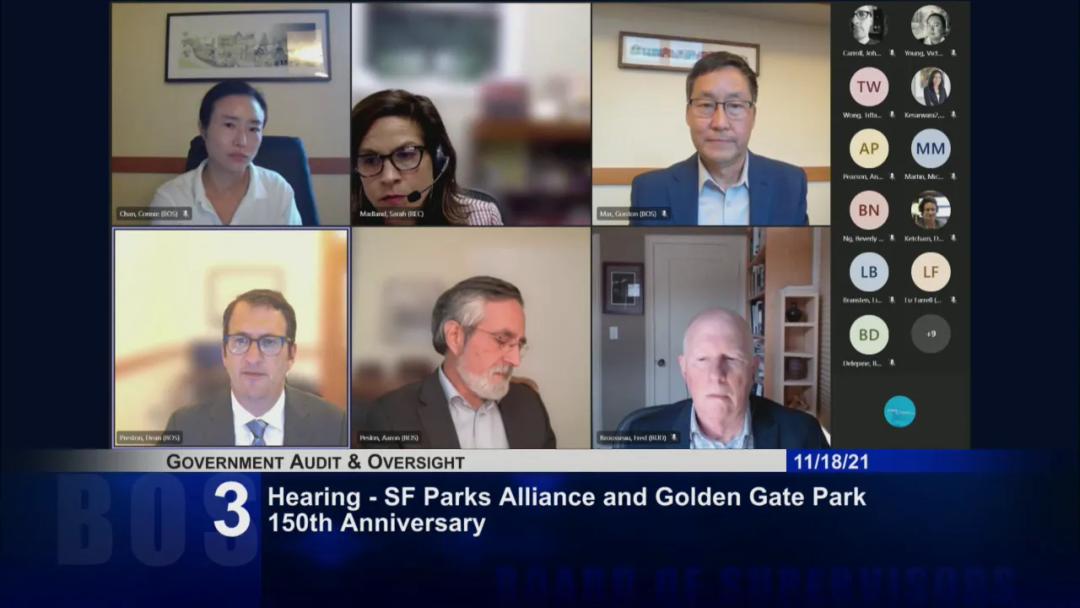
The Government Audit and Oversight Committee of the San Francisco Board of Supervisors met on November 18, 2021, chaired by Supervisor Dean Preston with Vice Chair Connie Chan and Supervisor Gordon Mar (substituting for Supervisor Raphael Mandelman). The committee heard three major items: an update on the Emergency Firefighting Water System (EFWS) expansion, the abrupt cancellation of a planned drop-in center for homeless youth at 730 Stanyan Street, and a review of the San Francisco Parks Alliance’s relationships with city departments. The committee also approved several lawsuit settlements in closed session. Civil Grand Jury Report on Emergency Firefighting Water System (Item 1) - Presentation by John Scarpula (PUC): The PUC presented findings from two studies: the neighborhood firefighting demand study and the seawater supply study. The demand study estimated that 240,000 gallons per minute would be needed citywide for 25 hours after a 7.9 San Andreas earthquake, based on building inventory, vegetation, and future development projections. The seawater supply study concluded that a seawater pump station on the west side is not immediately advised due to permitting challenges, erosion, and cost (estimated $68 million for a small 3,000 gpm station, $180 million for a full 37,000 gpm station). The preferred plan is to connect Lake Merced (1.7 billion gallons, providing three weeks of supply) and other sources, with pipelines and water source modifications totaling $1.6 billion (2021 dollars). A 15- to 25-year construction timeline was suggested. - Presentation by Severin Campbell (BLA): The BLA analyzed financing options, concluding that general obligation bonds are the most viable source. The city has capacity within its debt limit (currently at 1.8% of assessed valuation vs. 3% limit). Recommendations included resizing a planned transportation bond, using development agreements, and creating a long-term financial plan. - Public Comment: Multiple callers (including Dick Morton, Ted Lowenberg, Pat Skein, Catherine Howard, Jeff Rigo, Erica Zweig) expressed urgency, criticized PUC’s pace, opposed using potable water, and called for immediate acquisition of portable hose tenders. Some urged inclusion of a seawater pump station on the west side. - Key Outcome: The committee voted unanimously to continue the hearing to the call of the chair. Supervisor Mar requested that the comprehensive action plan due December 31, 2021, include a scenario with a west side seawater pump station and a financing plan. The fire department was asked to develop a plan for acquiring hose tenders. Interim Use Plan for 730 Stanyan Street – Drop-in Center for Homeless Youth (Item 2) - Background: Supervisor Preston stated that the city had promised to open a day drop-in center for transitional age youth (TAY) at 730 Stanyan by end of October 2021, after the successful safe sleeping site (CAMP) closed in June. On October 21, HSH informed his office the project would not proceed, citing a funding gap. The mayor later gave conflicting reasons. - Presentation by Director McSpadden (HSH): She said the project was cancelled because the $90,000 in first-year funding (from an ad-back) was insufficient; the estimated annual cost was $372,000. She also cited a need to prioritize housing placement and staff bandwidth. She stated that even if additional funds were found, HSH would not proceed. - Presentation by Director Shaw (MOCD): MOCD’s interim use policy prioritizes city-serving uses; current focus is on security. The site is slated for 100% affordable housing, with construction expected to begin in September 2023. - Public Comment: Dozens of callers spoke. Supporters (including Homeless Youth Alliance staff, Coalition on Homelessness, and residents) urged the city to honor its promise, highlighting the need for bathrooms, showers, and referrals. Opponents (including neighborhood associations) cited safety concerns and argued the site should remain vacant until housing is built. Several callers accused the mayor of bowing to a vocal anti-homeless group. - Key Outcome: The committee voted unanimously to continue the hearing to the call of the chair. Supervisor Preston criticized the mayor’s intervention and requested a breakdown of the project budget from HSH. Review of San Francisco Parks Alliance Relationships (Items 3-6) - Controller’s Office Presentation (Tiffany Wong, Amanda Sebrapenia): The controller’s public integrity review (September 2020) found that the Parks Alliance had subaccounts for Public Works that operated outside city financial systems, creating pay-to-play risks. Recommendations included formal MOUs, prohibiting anonymous donations, and restricting department head solicitation. The controller had not reviewed similar subaccounts for Rec and Park. - BLA Presentation (Fred Brusseau): The BLA assessed five agreements between Rec and Park and Parks Alliance (including the Golden Gate Park 150th anniversary, SkyStar wheel, and Conservatory of Flowers). Key findings: the 2003 Conservatory of Flowers agreement expired in 2012 and contains no minimum guarantee; the SkyStar use permit caps city revenue at $900,000 to avoid triggering charter Section 9.118; anonymous donations totaled $1.5–$3 million from 72 donors; and there are no competitive bidding requirements for in-kind services. The BLA recommended strengthening conflict-of-interest and prevailing wage provisions. - Port of San Francisco (Item 6): Assistant Director Mike Martin presented an MOU for Parks Alliance to fundraise up to $7 million for Crane Cove Park improvements, with an 11% fee. The port incorporated all controller recommendations. - Public Comment: Several callers supported increased oversight and transparency. No callers opposed. - Key Outcomes: - The committee voted to issue a subpoena to the Parks Alliance for records of Rec and Park subaccounts and transactions over the past five fiscal years. - Items 4 and 5 (annual support grants and Tea Garden restoration) were continued to the call of the chair. - Item 6 (Crane Cove Park MOU) was also continued to the call of the chair, pending resolution of outstanding issues. Litigation (Closed Session, Items 7-13) - The committee convened in closed session and unanimously recommended approving five lawsuit settlements and two unlitigated claim settlements, to be considered by the full Board on November 30, 2021. The committee voted not to disclose the closed session discussions. Key Outcomes - Continued all three major hearings to the call of the chair. - Issued a subpoena to the San Francisco Parks Alliance for subaccount records with Rec and Park. - Directed the PUC and other departments to include a west side seawater pump station scenario in the comprehensive EFWS action plan due December 31, 2021. - Requested a financing plan for the EFWS and a fire department hose tender acquisition plan. - Approved litigation settlements in closed session for recommendation to the full Board.

HOMELESSNESS 21% · PARKS AND RECREATION 17% · PUBLIC COMMENT 14% · PROCEDURAL 9%
1214
NOV 9, 2021 · SAN FRANCISCO, CALIFORNIA · PORT COMMISSION
San Francisco Port Commission Meeting – November 9, 2021

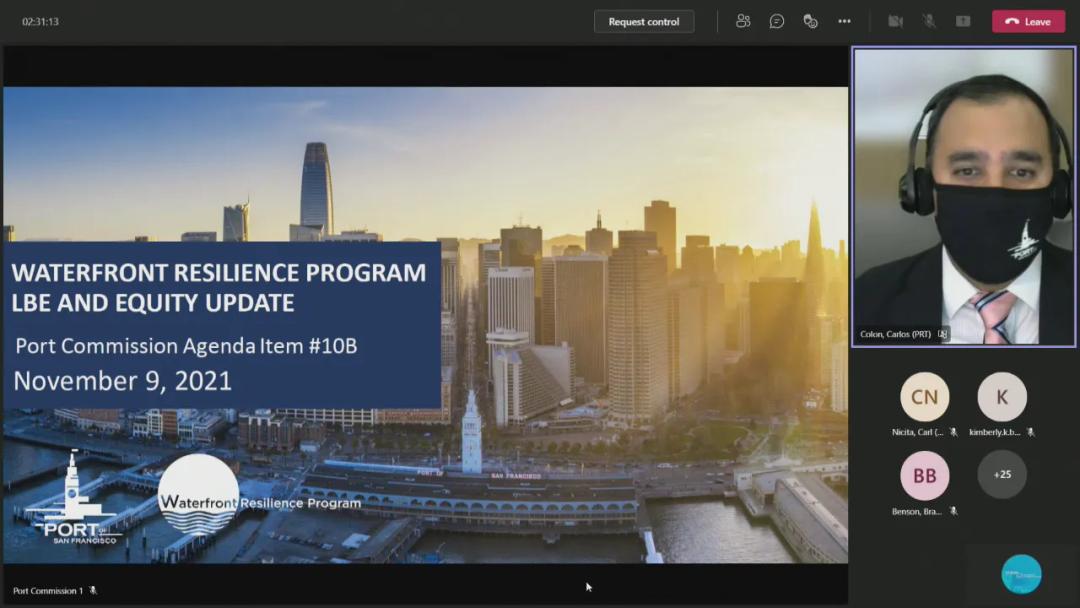
The Port Commission met on Tuesday, November 9, 2021, with President Brandon presiding. Vice President Adams arrived later, while Commissioner Burton was absent. The meeting covered the Executive Director's report, the consent calendar, an update on tenant delinquencies, FY2021 LBE contracting activity, and Waterfront Resilience Program presentations. The meeting adjourned at 5:38 p.m. Approval of Minutes - The commission approved the minutes of the October 26, 2021 meeting. President Brandon, Commissioner Gilman, and Commissioner Wuho voted yes; Vice President Adams was not yet present. The motion passed unanimously. Consent Calendar - The commission unanimously adopted the consent calendar by a 4-0 roll call vote (resolutions 21-47 and 21-48). - Resolution 21-47 adopts findings under new state urgency legislation allowing remote meetings during the COVID-19 emergency for the next 30 days and directs the Commission Affairs Manager to agendize a similar resolution within 30 days. - Resolution 21-48 makes permanent the program for retail fish sales from boats at Fisherman's Wharf, including a one-year pilot allowing the sale of live Dungeness crab. Public Comments & Testimony - No members of the public called in to speak during any public comment period on the agenda, including non-agenda items, the Executive Director's report, the consent calendar, and informational items 8A, 9A, 10A, and 10B. Executive Director’s Report - Executive Director Elaine Forbes reported on economic recovery and equity. She noted that international travel restrictions were lifted on November 8, 2021, and the port hopes to welcome 24 million visitors again. - The port submitted a $115 million American Rescue Plan Act (ARPA) application to the State Lands Commission; the first tranche of approximately $60 million is expected in December. The port lost over 40% of its revenues due to COVID-19 and faced a 50% budget reduction. - The port opened 88 Broadway, two new buildings with 100% affordable housing on port-owned land. - Mission Rock is advancing: on November 10, the city will close on $64 million in community finance district bonds (the second issuance of the $3.7 billion bond authorization). A 16-woman construction training cohort, all San Francisco residents, recently graduated. - A new nature exploration area opened at Heron's Head Park; the mayor introduced a resolution to accept a California Department of Fish and Wildlife grant for the Heron's Head Park Shoreline Resiliency Project. - Commercial Dungeness crab season was delayed for the third year due to endangered whales and sea turtles. - Commissioners praised the report and the port's recovery progress. Discussion Items 8A. Delinquency Challenges in the Port’s Property Portfolio - Deputy Director Rebecca Benissini reported that the port has $24.5 million in outstanding tenant delinquencies, about seven times the 2019 level. Percentage rent tenants owe $8.7 million; commercial, industrial, and open land tenants owe $7.2 million across 132 agreements; parking and miscellaneous agreements account for the rest. Twenty-four agreements each owe over $250,000, totaling $17.1 million. - Staff proposed a goal of collecting as much delinquent rent as possible in an efficient, transparent, and fair manner, using a checklist (A–J) to guide settlement decisions. Settlements above $25,000 require Port Commission approval. - Commissioner Wuho recommended pursuing a time-limited increase in the Executive Director’s delegated settlement authority through the Board of Supervisors in parallel with the checklist process. He also requested more detail on a write-off policy and lease language requiring financial disclosure from delinquent tenants. - Commissioner Gilman supported the approach and suggested adding geography and neighborhood-serving considerations to the checklist. President Brandon said some checklist items, such as pursuing grants/loans and remaining open, should be mandatory minimums. - Staff said the next step is to return with the first settlement agreement(s), in open or closed session, rather than a formal policy. 9A. FY2021 Contracting Activity and Local Business Enterprise (LBE) Strategy - Contracts and Procurement Manager Stephanie Tang reported there were 1,022 certified LBEs as of June 30, down 211 firms (17%) from the prior year, including a loss of 14 African American-owned and 14 Asian-owned firms. - In FY2021, $6.9 million was awarded in 12 contracts; 9 (70%) went to LBEs, including $1.1 million to African American-owned firms. Payments to LBEs totaled about $9 million, or 30% of payments. Excluding a large dredging contract at Mission Bay Ferry Landing, construction payments to LBEs were 70%. - Private developments at Pier 70 and Mission Rock have cumulatively awarded $124 million to LBEs, including $22.4 million to Black-owned LBEs. - Mission Bay Ferry Landing was completed 11 days early and $1.6 million under budget. Two LBE-related non-compliance memos were issued: one for Dutra dredging and one for BAE Urban Economics. - The Board of Supervisors unanimously approved changes to Chapter 14B of the Administrative Code (mayor’s signature expected within the week), including increased firm-size thresholds, higher penalties, faster subcontractor payments, and expanded reporting. - Senior Community Development Specialist Tiffany Tatum highlighted a success story: Two Rivers, a minority woman-owned firm, won a port contract and later two additional city contracts after staff coaching. She also described a planned construction management certificate program with City College of San Francisco and OEWD, funding 25 slots for Black and brown single parents. - Commissioners asked about the drop in certified firms and stressed prompt payments to contractors. They praised the staff’s passion and outreach. 10A. Waterfront Resilience Program – Early Projects Framework - Resilience staff presented key findings: port-wide sea level rise plus a 100-year flood event could affect approximately 14,000 residents, wastewater systems serving almost 600,000 residents, 360,000 regional commuters, and 25 miles of Muni and cable car tracks. - Earthquake risk is high north of the Bay Bridge and very high in most bulkhead wharves; liquefaction could damage the Embarcadero roadway. A disaster response exercise with over 60 organizations confirmed the importance of deep-water berths and the Embarcadero roadway. - Proposition A provides $425 million, but the early projects alone could exceed several billion dollars. Staff are coordinating with SFMTA, SFPUC, Planning, DEM, Public Works, and other agencies. - Community engagement reached over 700 people through 30 presentations with community-based organizations. - Staff will return in December with detailed early project recommendations, including options for a coastal flood defense “line of defense.” Elevation increases of 2 to 7 feet may be needed. - Commissioners praised the collaborative, proactive approach and looked forward to the December presentation. 10B. Waterfront Resilience Program – LBE Subcontracting and Equity Actions - Administrator Carlos Cologne reported that CH2M Hill’s LBE payments increased from 12.1% in September 2019 to 22.9% by September 2021. Since the 2019 contract amendment, 32.5% of payments went to LBE firms. Approximately 10% went to minority-owned firms when including those self-identifying as WBEs. Phase one actual LBE participation was 23.4%; phase two task authorizations were 67% LBE. - Civic Edge’s communications contract ended August 20, 2021, with 43% LBE participation, exceeding the 36% requirement; including Civic Edge as an LBE, participation was 87.9%. - Commissioner Gilman asked for clarity on how LBE percentages were calculated, and President Brandon requested that future reports include CH2M’s strategy for increasing minority and women subcontracting. Staff said they would follow up. Key Outcomes - The commission unanimously approved the consent calendar (Resolutions 21-47 and 21-48) on a 4-0 roll call vote. - The commission approved the October 26, 2021 minutes. - The commission received the Executive Director’s report and all informational presentations; no formal actions were taken on informational items. - Staff will return in December with: (1) the first settlement agreements under the new delinquency checklist process, (2) a detailed Waterfront Resilience Program early projects presentation, and (3) updates on the LBE and resilience equity work. - The commission directed staff to consider a parallel path to raise the Executive Director’s delegated settlement authority via the Board of Supervisors and to incorporate additional equity and geography factors into the delinquency settlement checklist.

PUBLIC COMMENT 21% · LOCAL BUSINESS ENTERPRISE 19% · WATERFRONT RESILIENCE 18% · LEASING 10%
1215
NOV 9, 2021 · SAN FRANCISCO, CALIFORNIA · PUBLIC UTILITIES COMMISSION
San Francisco Public Utilities Commission Meeting – November 9, 2021

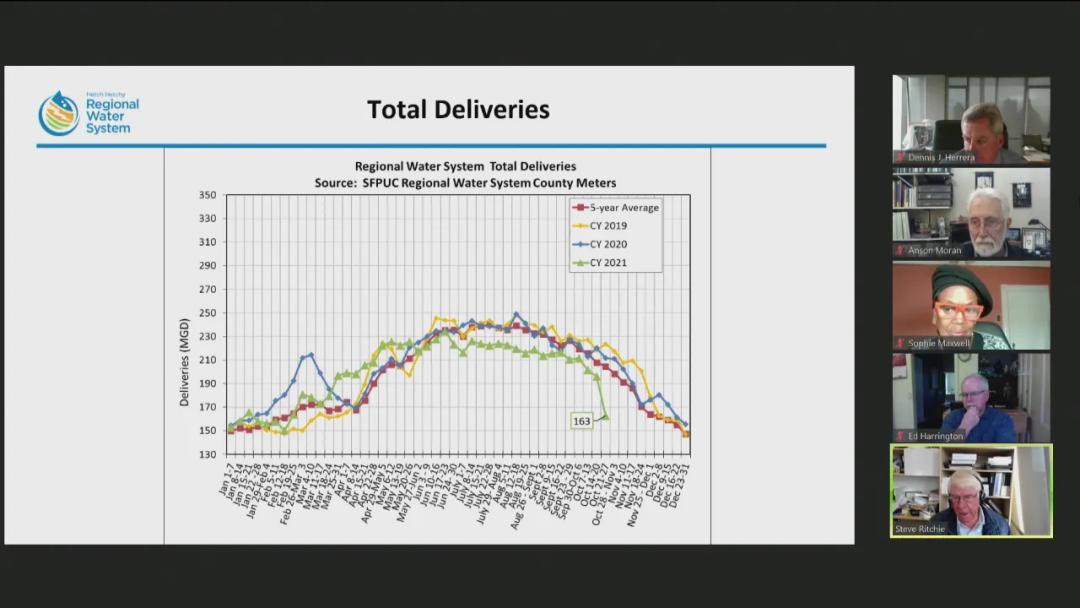
The San Francisco Public Utilities Commission (SFPUC) held a regular meeting on November 9, 2021, via teleconference due to the COVID-19 emergency. The meeting included a drought update, approval of consent calendar items, issuance of up to $127 million in power revenue bonds, and adoption of a resolution establishing priorities for the new General Manager Dennis Herrera. Public comment focused on environmental stewardship, the Tuolumne River, and welcoming the new General Manager. The commission also adopted renewed findings for remote meetings and approved minutes from previous meetings. Consent Calendar - 9a: First Amendment to the Prepayment and Collection Agreement between the Bay Area Water Supply and Conservation Agency (BAWSCA) and the City and County of San Francisco – approved unanimously. - 9b: Award Contract No. WD-2871, Sunol Valley Water Treatment Plant and Chloramination Facility Aqua Ammonia Structural Repairs and Tank Replacement, in the amount of $1,769,014 – approved unanimously. - 9c: Award Contract No. WW-704, Various Locations Sewer Replacement No. 9, in the amount of $3,898,770 – approved unanimously. Public Comments & Testimony - Seventeen callers spoke during general public comment and on specific items. Key themes: - Many speakers welcomed new General Manager Dennis Herrera and urged him to adopt stronger environmental leadership, particularly regarding the Tuolumne River and Bay-Delta health. - Several speakers called for the SFPUC to withdraw from lawsuits against the State Water Board’s 2018 Bay-Delta Plan and to prioritize science-based water management, fish and wildlife protection, and water recycling. - Speakers from organizations such as the Golden State Salmon Association, Tuolumne River Trust, Center for Biological Diversity, Sierra Club, and Save California Salmon expressed support for improved river flows, habitat restoration, and sustainable water supply planning. - A few speakers raised concerns about contract integrity, corruption, and the need for workforce development and transparency. - One speaker requested inclusion of AWSS (auxiliary water supply system) expansion and desalination on the west side. Discussion Items - Item 3: State Urgency Legislation for Remote Meetings – Adopted findings to continue remote meetings for 30 days. Commissioner Harrington inquired about returning to in-person meetings; staff reported no information on a timeline beyond December 2021. Passed 4-0 (Commissioner Paulson absent). - Item 4: Approval of Minutes – Minutes of October 26 and October 29, 2021 meetings approved unanimously. - Item 7A: Drought Update – Assistant General Manager Steve Ritchie presented a detailed update. Reservoir storage exceeded 1 million acre-feet (up to 4.5 years of supply). October storms provided 81,000 acre-feet to the city, more than the entire previous water year (57,000 acre-feet). Demand dropped sharply during the storm to 163 million gallons per day. Curtailments on the Tuolumne were suspended as of November 1. The SFPUC plans to propose a water shortage emergency declaration at the next meeting. Commissioner Harrington requested inclusion of environmental health indicators (e.g., salmon returns) in future reports. Commissioner Ajami suggested communicating per capita water use to the state. - Item 11: Issuance of up to $127 million in 2021 Series AB Power Revenue Bonds – Rich Morales, Deputy General Manager, presented the bond structure: two subseries (A for generation projects, B for transmission and redevelopment), 30-year maturity, fixed rate, competitive sale, green bond designation for Series A. Estimated true interest cost (yield to maturity) 3.29%. The bonds will refund commercial paper used for interim financing. Approved unanimously (5-0). - Item 12: Resolution Establishing Commission Priorities for the General Manager – President Moran introduced the resolution, which was extensively amended during the meeting. Amendments added: - A new bullet on regional leadership: “continued strengthening of the PUC’s working relationship with BAWSCA representing the PUC’s wholesale customers.” - Under environmental leadership: “review the status of the Tuolumne River Voluntary Agreement with a view towards strengthening relationships with state and local government partners.” - Revised a bullet to: “coordinate with Tuolumne state and local partners toward early implementation of habitat measures in the Tuolumne River Voluntary Agreement.” - Under capital program effectiveness: “integrate SFPUC capital planning between SFPUC enterprises and with other city departments to maximize public benefits in addressing climate change, sea level rise, flood resiliency, and water supply resiliency.” - Under organizational leadership: “special attention to effective and successful workforce development in the commission’s capital and employment contracts and priorities.” - Additional bullet: “established programs to support SFPUC employee growth and professional development and excellence.” - The resolution also directed that the term “EDI” be spelled out as “Equity, Diversity, and Inclusion.” The amended resolution passed unanimously (5-0). Key Outcomes - Remote meeting extension approved for 30 days (4-0). - Minutes of October 26 and October 29, 2021 adopted unanimously. - Consent Calendar items 9a, 9b, 9c approved unanimously. - Item 10 (Folsom Area Stormwater Improvements) was pulled from the agenda and will be heard at a future meeting. - Power Revenue Bonds – Authorized issuance of up to $127 million Series AB; staff will report back on sale results. - Commission Priorities Resolution – Adopted with multiple amendments; the resolution will guide General Manager Dennis Herrera’s performance evaluation. - Next steps – Staff will bring a proposed water shortage emergency declaration to the next commission meeting. The commission will continue to monitor drought conditions and federal infrastructure funding opportunities.

PUBLIC COMMENT 26% · WATER RESOURCE MANAGEMENT 23% · PROCEDURAL 16% · ENVIRONMENTAL REVIEW 13%
1216
NOV 4, 2021 · SAN FRANCISCO, CALIFORNIA · GOVERNMENT AUDIT AND OVERSIGHT COMMITTEE
Government Audit and Oversight Committee Regular Meeting – November 4, 2021

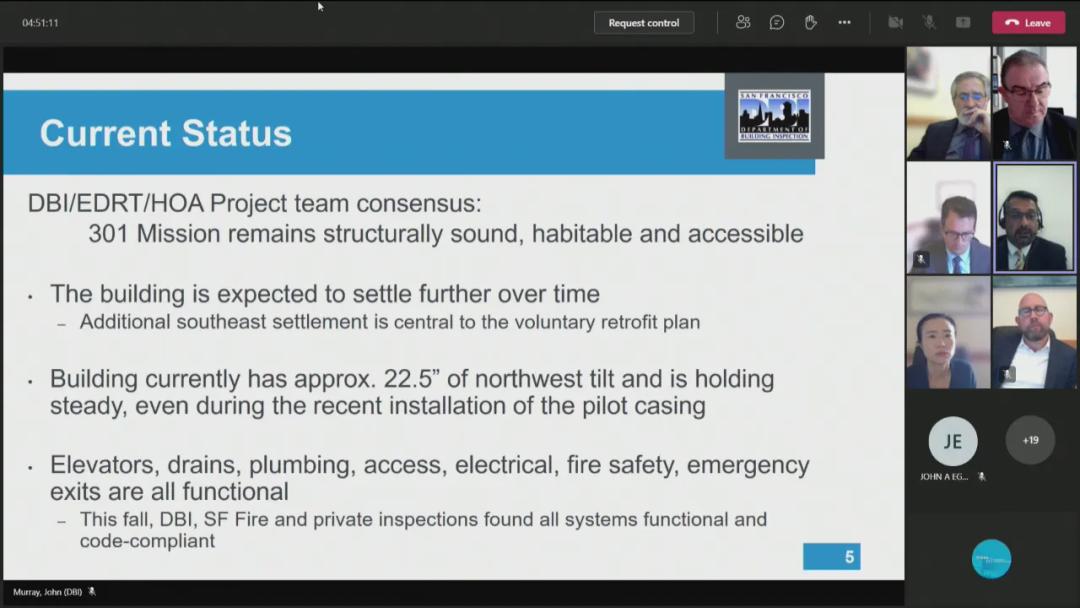
The Government Audit and Oversight Committee, chaired by Supervisor Dean Preston and including Vice Chair Connie Chan and Committee Member Supervisor Raphael Mandelman, held a regular meeting on November 4, 2021, at 18:15 UTC (10:15 AM PST). The meeting addressed four agenda items, including annual reports from two improvement districts, a hearing on Muni service restoration, and a hearing on the seismic retrofit of 301 Mission Street (Millennium Tower). The meeting was held remotely due to the pandemic. Consent Calendar - Resolution approving annual report for the Tourism Improvement District (TID) and Moscone Expansion District (MED) for FY 2019-2020 – Unanimously approved with a positive recommendation to the full Board of Supervisors (3-0). - Resolution approving annual report for the Japantown Community Benefit District (CBD) for FY 2019-2020 – Unanimously approved with a positive recommendation to the full Board (3-0). Public Comments & Testimony - Muni Service Restoration (Item 3): Over a dozen callers spoke, including representatives from Japantown for Justice, Senior & Disability Action, Transit Equity SF, and community members. All urged full restoration of all Muni lines to pre-pandemic levels, criticized shortened routes and increased transfers, and called for more inclusive community engagement. Speakers emphasized that the current “transfer-most” approach disproportionately harms seniors, people with disabilities, and low-income riders. - Millennium Tower Seismic Retrofit (Item 4): One caller, David Williams, raised concerns about potential risks from the foundation upgrade, including asymmetric stiffness and durability of the mat slab. Discussion Items - Muni Service Restoration: SFMTA Director Jeff Tumlin, Transit Director Julie Kirschbaum, and Board Chair Gwyneth Borden presented a proposed Winter 2022 service restoration plan. Key points included: - The plan recommends restoring six of eight suspended all-day routes (e.g., the 6 Parnassus, 28R, 23, 43) and partial restoration of the 2, 10, 21, and 31, while not restoring the 47 or 3 Jackson. - The J Church line pilot (surface-only with transfer) is under review, with options for full subway service at lower frequency. - Staffing shortages due to operator vacancies and the vaccine mandate (110 operators unavailable) remain barriers. 95% of staff are vaccinated. - Federal funding (including $29M from MTC) buys time but does not cover long-term structural deficits; ongoing funding is needed. - TWU Local 250A President Roger Marenko and Executive Vice President Pete Wilson criticized the agency for an “austerity approach” and failure to meet and confer on service changes, and argued that enough operators exist to restore full pre-pandemic service. - Supervisor Preston urged a clear commitment to restore all lines and full routes, not just partial services, and called for transparent future outreach. - Millennium Tower Seismic Retrofit: Supervisor Aaron Peskin, sponsor of the hearing, led discussion. Presentations from: - Charles Litt (HOA attorney) defended the fix as having expert consensus. - Ron Hamburger (Simpson Gumpertz & Heger, structural engineer) detailed the perimeter pile upgrade (52 casings/piles) which caused accelerated settlement (building tilted 28 inches NW). New installation methods (pilot tested in October) reduced settlement to negligible levels. He stated the building could safely tilt up to 40 inches (serviceability) or even 80 inches west under extreme earthquake, though these figures have not been fully reviewed by the city’s Engineering Design Review Team (EDRT). - Matt Dutro (project manager) reported ongoing interior monitoring and repairs. - Neville Pereira (DBI) and Patrick O’Reardin outlined DBI’s oversight, including daily inspections and a new threshold (0.25” settlement per installation) triggering a pause. - Greg Deerlin (Stanford professor, EDRT chair) described the team’s independent review of design and monitoring. He noted the EDRT has not yet validated Hamburger’s latest safety thresholds. - Ben Turner (Dan Brown & Associates, drilling expert) confirmed the pilot casings were successful, and the next step is a 24-inch pile test. - Supervisor Peskin expressed concern about relying on the same geotechnical firm (Treadwell & Rollo) for EDRT review given original design errors, and called for a third-party independent assessment of the “point of no return” for tilt. Key Outcomes - Muni Service Restoration: The hearing was continued to the call of the chair (passed 2-0, with Member Mandelman absent). No final decisions were made; the committee will revisit after further developments. - Millennium Tower Seismic Retrofit: The hearing was continued to the call of the chair (passed 2-0, with Member Mandelman absent). Supervisor Peskin requested a future hearing to review the EDRT’s analysis of new tilt thresholds and potential legislative action for independent oversight.

ENGINEERING AND INFRASTRUCTURE 25% · PUBLIC TRANSPORTATION 19% · PUBLIC COMMENT 9% · BUILDING INSPECTION 8%
1217
OCT 29, 2021 · SAN FRANCISCO, CALIFORNIA · PUBLIC UTILITIES COMMISSION
Special SFPUC Meeting on Climate Change & Regional Water System – October 29, 2021

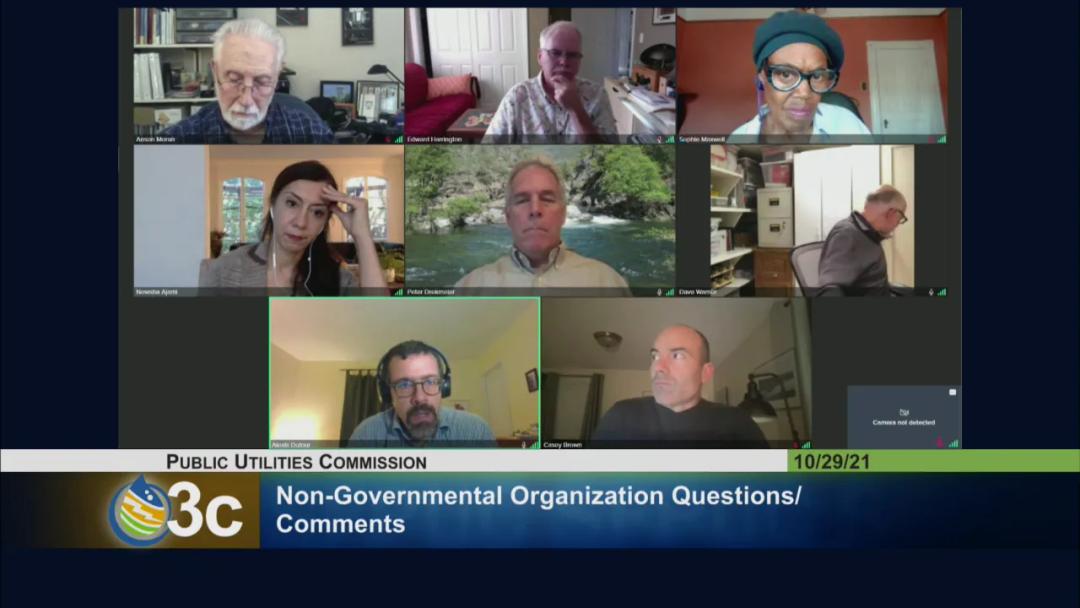
On October 29, 2021, the San Francisco Public Utilities Commission (SFPUC) held a special meeting via teleconference to discuss climate change impacts on the regional water system. Commission President Moran presided, with Commissioners Ajami, Harrington, Maxwell, and Paulson (who joined later). The agenda included a staff presentation, expert analysis from Dr. Casey Brown of the University of Massachusetts Amherst, stakeholder comments from BAWSCA and non-governmental organizations, and public comment. There were no formal votes; the meeting was informational and focused on enhancing shared understanding of climate risks and tools for planning. Staff Presentations & Analysis - History of Climate Analysis: Ellen Levin, Deputy Manager of the Water Enterprise, reviewed nearly 15 years of SFPUC climate work, including the PEIR for the Water System Improvement Program and a 2012 joint study with Turlock Irrigation District that evaluated 18 climate scenarios (up to 5°C warming and 15% precipitation decrease). The 2012 study projected earlier snowmelt and increased runoff in winter/early spring, with the most severe effects when temperature rose and precipitation fell. - Observed Climate Trends: Alexi DeFour, Water Resource Engineer, presented observed data from SFPUC watersheds (upcountry, Peninsula, East Bay). Key findings include: warming in all regions, with the East Bay showing a 2°C increase in daily minimum temperature since the 1950s; no statistically significant trend in annual precipitation; snowpack disappearing 15–20 days earlier over the last 30 years; and a shifting distribution of runoff, with a greater portion of annual water available to the city occurring before June 15. DeFour also highlighted an extreme event at Moccasin Reservoir in 2018 where inflows exceeded the probable maximum flood. - Climate Tools and Collaboration: Dave Bihar, SFPUC Climate Program Director, described ongoing collaborations such as the Water Utility Climate Alliance (WUCA), Bay Area Climate Adaptation Network (BayCAN), and the citywide sea level rise guidance. He noted the SFPUC’s role in developing hydraulically sophisticated inundation maps and the use of a 'likely/unlikely but possible' uncertainty framework for sea level rise projections. - Long-Term Vulnerability Assessment (LTVA): Dr. Casey Brown presented the forthcoming Water Research Foundation study. The analysis used a stress test approach with over 1,000 climate scenarios, covering temperature changes up to +7°C and precipitation changes from -40% to +40%. Findings: the system is resilient to changes in mean climate at a baseline demand of 227 million gallons per day (MGD), but vulnerability emerges with a 20% reduction in precipitation, a level that is at the low end of climate projections. Climate change exacerbates other vulnerabilities, such as increased demand and infrastructure failures. Drought recurrence intervals shorten under drier scenarios; e.g., a 100-year drought (1976–77) becomes a 25-year event under a 20% precipitation decrease. The system’s reliability falls below the 90% threshold at about 20% precipitation reduction. Demand increases significantly reduce reliability; at 265 MGD, the system is vulnerable unless precipitation increases. Infrastructure failures related to upcountry water imports are most impactful. Water quality (turbidity, total organic carbon) was not a major concern, though modeling had limitations. Financial analysis showed that major capital investments would require substantial water price increases if demand does not grow. Commission Discussion - Commissioner Ajami raised concerns about interannual variability (e.g., snow events followed by warm periods) and the implications for reservoir operations, and called for building in-house capacity for climate and hydrologic modeling. She praised the partnership with UMass and the co-development of tools. - Commissioner Moran asked whether the study considered multi-year droughts and how storage was accounted for. Dr. Brown confirmed the analysis included 500-year plausible hydrology and multiple multi-year drought realizations, and that the reliability results reflect those. Moran also questioned how the study might inform the current planning process, which is historically based. - Commissioner Maxwell asked about the relationship between temperature and precipitation, and whether earlier runoff would affect San Francisco’s water rights under the Raker Act. Dr. Brown and Alexi DeFour clarified that annual precipitation changes are uncertain, but warmer temperatures increase precipitation intensity and reduce snowpack, leading to greater variability in water available to the city. - Commissioner Ajami also noted her concern about the water bank’s operational limitations, and staff agreed that operators will face more complex conditions. Stakeholder Comments - BAWSCA (Bay Area Water Supply and Conservation Agency): Nicole Sandkuhla expressed strong support for the LTVA and thanked the Commission for the presentation. She asked how the study’s tools would be used to evaluate the design drought and alternative water supplies, and specifically whether the analysis addresses interconnected vulnerabilities, such as climate change increasing wildfire risk and affecting water quality. - Tuolumne River Trust: Peter Drekmeier raised several points: the baseline demand used (227 MGD) is 12% higher than actual current demand (200 MGD); he argued that earlier runoff under the Raker Act could benefit San Francisco significantly (citing a calculation that moving runoff three weeks earlier could yield an additional 217,000 acre-feet). He also suggested the report should include additional model runs (e.g., with current or reduced demand, or with improved water rights). Dave Warner asked about the data used for drought recurrence intervals and the confidence in those figures, and suggested adding the design drought to the table. He noted the expert elicitation ranged from -30% to +30% precipitation, which is a very wide range for planning. Public Comment - Caller 1: An unidentified member of the public criticized the Commission for not strictly following the Raker Act, accused members of greed, and called for acknowledgment that water was taken from Indigenous peoples. He also warned about salmon extinction. - Caller 2: Professor Iris Stewart of Santa Clara University, a hydrology expert, appreciated the modeling and results but asked how in-stream flow requirements were represented relative to demand increases, and noted that demand growth and infrastructure weaknesses also increase rationing frequency. She emphasized the ecological importance of in-stream flows for salmon. Key Outcomes - No formal votes were taken; the meeting was informational and educational. - The final LTVA report will be published by the Water Research Foundation in mid-November 2021; it is about 600 pages long. - SFPUC staff will continue using the tools developed for the LTVA to evaluate alternative water supplies, update planning, and refine forecasts. - Commissioner Ajami’s call to build in-house capacity for climate modeling was acknowledged by staff, who noted existing expertise and training efforts. - The Commission plans to incorporate the study’s findings into future policy decisions and to engage stakeholders further as the report becomes available. - No minutes were available for this meeting; the transcript served as the primary source.

WATER RESOURCE MANAGEMENT 43% · CLIMATE ADAPTATION 38% · PUBLIC COMMENT 5% · PROCEDURAL 4%
1218
OCT 28, 2021 · SAN FRANCISCO, CALIFORNIA · PUBLIC SAFETY AND NEIGHBORHOOD SERVICES COMMITTEE
San Francisco Public Safety and Neighborhood Services Committee – October 28, 2021

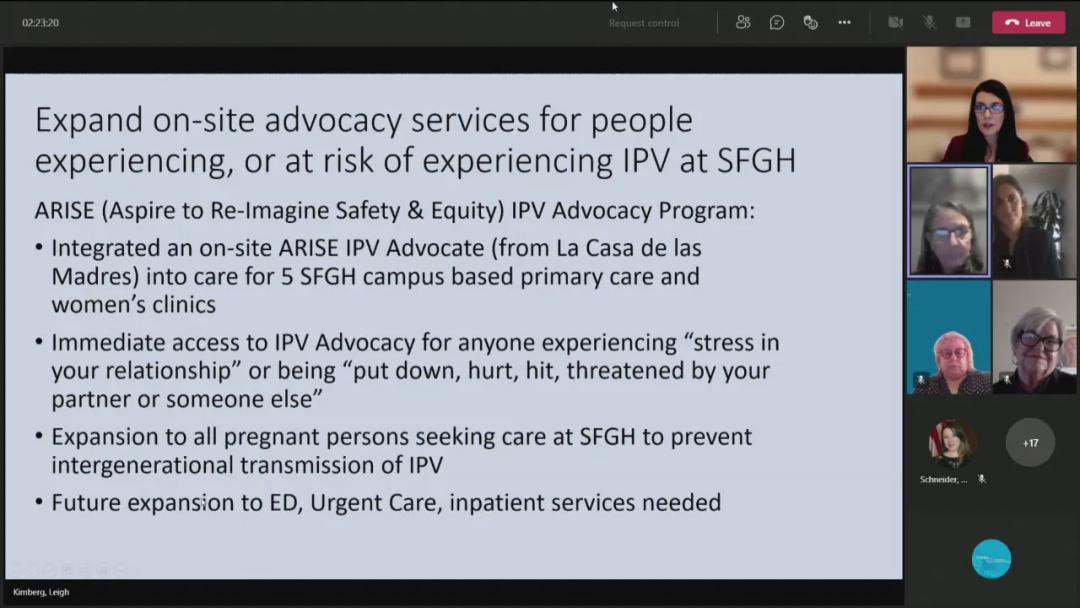
Liquor License Transfer – 2539 Mission Street (Evergreen Market) Officer Fernares of the SFPD ABC Liaison Unit reported zero letters of protest or support, that the location is in a high-crime census tract and high-saturation area, and that ALU recommended approval with conditions. Ishmael Ahmed, son of the owner, spoke in favor, saying Evergreen Market has operated since 1986 and seeks to bring imported spirits from Peru, Brazil, and Argentina to meet community demand. The committee voted unanimously (Haney, Mar, Stephanie) to approve a resolution determining the license serves public convenience or necessity, sending it to the full board with a positive recommendation. Liquor License Transfer – 524 Post Street (The Olympic Club) Officer Fernares reported zero letters of protest or support, a high-crime and high-saturation location, no opposition from Central Station, and an ALU recommendation for approval with no conditions. Avi Sankar, director of the Olympic Club's city clubhouse, described the club's historic role (stating it was founded in 1816 and rebuilt after the 1906 earthquake) and said the type 21 license would allow off-sale alcohol to-go, a popular COVID-era service that would generate revenue and support jobs. The committee voted unanimously to approve and forward the resolution with a positive recommendation. Domestic Violence Data Reporting Ordinance (Item 3) Supervisor Stephanie introduced the ordinance, explaining it was born out of concerns that domestic violence cases were not being prosecuted or resolved safely. She cited SFPD data showing 131 felony domestic violence cases presented to the district attorney's office in Q4 2020, with 113 dismissed. She also described a fatal child abuse case where prior DV charges were dismissed, and a case involving a loaded gun and knife with 30 prior incidents that was reduced to misdemeanor vandalism. The ordinance would require the police department and district attorney to submit quarterly reports to the Board of Supervisors on DV-related 911 calls, presence of children or firearms, cases presented, charges filed, and case dispositions. Supervisor Stephanie said she received a last-minute letter from the DA's office contesting her understanding, but insisted the data is not difficult to provide. Supervisor Melgar co-sponsored, sharing her personal experience as a child survivor of domestic violence and emphasizing the need for honest data to evaluate interventions. Supervisor Haney and Chair Mar asked to be added as co-sponsors. Amendments were offered to expand reporting to the mayor, Office of Racial Equity, Human Rights Commission, Department on the Status of Women, and Police Commission, and to require the reports be posted on department websites. Family Violence Council Report Hearing (Item 4) The Family Violence Council presented its 10th comprehensive report for fiscal year 2019–2020. Key data and findings included: domestic violence is reported in 60–80% of child abuse cases; a firearm in a domestic violence situation increases homicide risk by 500%; 533 of 5,000 child abuse reports were substantiated (about 10%), and police data showed 500 incidents leading to 253 arrests, 145 special victims unit investigations, 52 cases received by the DA, and 33 prosecuted. DV crisis lines received 11,000 calls, a 30% increase from FY19, while 7,000 911 calls were DV-related. The Department on the Status of Women administered $8.5 million to support nearly 30 community-based organizations serving over 14,000 individuals. Elder abuse substantiations increased 23% over six years; 448 elder physical abuse incidents led to 188 arrests. Racial disparities were stark: Black children accounted for 4 in 10 substantiated child abuse cases, and more than half of DV victims were Black or Latinx. Shelter turnaway rates remained at about 78%. Presenters highlighted pandemic-driven economic stressors: food insecurity rose from 6% to 19%, and unemployment increased 500% since February 2020. Recommendations included investments in prevention, universal basic income for marginalized families, standardized training for frontline staff, geriatric emergency response units (GEMS), child welfare system transformation, and expanding on-site DV advocacy at Zuckerberg San Francisco General Hospital. The council reported that DGO 6.09 (domestic violence general order) was approved by the Police Commission in January 2021 but has not yet been rolled out. The Department of Homelessness and Supportive Housing described a shelter-in-place hotel floor that served 38 households (24% transgender or gender non-binary), a rapid rehousing program for 25 survivor households, and a pending DV bonus grant to fund 136 survivor households and 25 additional rapid rehousing slots. Public Comments & Testimony - A caller criticized the length of the presentation and called for audits of public safety entities, citing roughly $600 million in spending and unresolved COPS recommendations. - A caller thanked the council for addressing domestic violence, asked that Park Police be included in DV responses for Presidio families, and raised concerns about family court outcomes, stating that 84% of women who raise domestic violence in custody cases lose custody of their children. She requested trauma-informed judges and transparency in family court. - Zach Dillon from the Public Defender's Office argued the ordinance should also require reporting from the Adult Probation Department to evaluate the effectiveness of 52-week DV intervention programs, describing APD as a "black box." Key Outcomes - Approved the Evergreen Market liquor license transfer resolution unanimously (3–0) and sent it to the full board. - Approved the Olympic Club liquor license transfer resolution unanimously (3–0) and sent it to the full board. - Excused Supervisor Haney from the remainder of the meeting after noon (2–0). - Amended and recommended the domestic violence data reporting ordinance to the full board as amended (2–0). - Filed the Family Violence Council report hearing (2–0). - Items are expected to appear on the Board of Supervisors' agenda on November 9, 2021, as announced by the clerk.

DOMESTIC VIOLENCE 63% · CANNABIS REGULATION 6% · CHILD WELFARE 6% · PROCEDURAL 4%
1219
OCT 26, 2021 · SAN FRANCISCO, CALIFORNIA · PORT COMMISSION
San Francisco Port Commission Meeting - October 26, 2021

The Port Commission of the City and County of San Francisco met on Tuesday, October 26, 2021, starting at 2:00 PM and adjourning at 5:53 PM. The meeting included a consent calendar, public comment, several informational presentations, and votes on real estate and homelessness issues. Commissioners present: President Kimberly Brandon, Vice President Willie Adams, Commissioner John Burton, Commissioner Gil Gilman, and Commissioner Dorian Wuho (joined later). Consent Calendar - Item 10A (Resolution 2144): Authorized staff to advertise with competitive bids for a two-year Maintenance Dredging Program (construction contract 2842). Approved unanimously. Public Comments & Testimony - Public Comment on Items Not Listed on the Agenda: Three callers spoke about workers at San Francisco Bay Railway attempting to unionize with the Brotherhood of Maintenance of Way (a Teamsters division). Benjamin Lockheed, a worker, requested the commission's support. Doug Block (Teamsters Joint Council 7) and Carrie Dahl (organizing director) also spoke, asking for a card-check neutrality process to expedite union recognition. The commission directed staff to follow up. - Public Comment on Item 11A: Meg O'Neill (Five Keys) spoke in support of the Embarcadero Navigation Center extension, highlighting its community services. - Public Comment on Item 12A: Multiple callers addressed the proposed expansion of retail fish sales. Angela Sentata (Alia Delazio family, 80-year tenant) opposed, citing health/safety concerns and unfair competition. Nick Krieger (fisherman) and John Barnett (Crab Boat Owners Association) supported the expansion, noting other ports allow it. Dan Strazulo (Pier 45 tenant) requested a level playing field regarding regulations. Discussion Items - Item 11A (Resolution 2145) – Embarcadero Safe Navigation Center Extension: Staff (Kim Beale, Emily Cohen, Randy Cassada) presented findings that the Department of Homelessness and Supportive Housing (HSH) met all four conditions for a 24-month option extension. Key metrics: a 90% decrease in unsheltered homelessness within the outreach zone (area bordered by Market, Fourth, and Bay streets) since the center opened; a 32% decrease in crime incidents in the safety zone (Folsom, Second Street, Embarcadero to Ferry Building) between March 2019 and August 2021; dedicated SFPD beat officers (four officers, 11 AM–9 PM, 7 days/week); and enhanced cleaning by Five Keys (3–5 times daily). The center operated at 91 beds (down from 200 due to COVID-19). Commissioner questions addressed the citywide homeless count (last official count January 2019: 8,000; next count January 2022), cost per bed ($100/night), and the need for more supportive housing. - Item 11B (Resolution 2146) – Lease Negotiations for Building 49 at Crane Cove Park: Staff (Jamie Hurley) recommended authorizing lease negotiations with the YMCA of San Francisco, the highest-scoring respondent in the RFP. The YMCA proposed partnering with Dog Patch Paddle (water sports) and Daily Driver (food/beverage). The Port Southern Advisory Committee expressed strong support. The NICE building RFP was terminated as no proposal adequately met objectives. Approved unanimously. - Item 12A – Informational Presentation on Retail Fish Sales Expansion: Dominic Moreno (Maritime Division) presented a proposal to make the retail fish sales program permanent and expand it to include Dungeness crab (originally excluded). The pilot program began in 2017; currently two boats participate. The expansion aims to support fishermen impacted by COVID-19 and the Pier 45 fire. Commissioners discussed health/safety oversight (California Department of Fish and Wildlife, not the port), potential competition with existing businesses, and the need for a pilot program. Guidance was given to return with a one-year pilot for crab sales and a permanent program for fish sales. - Item 13A – Informational Presentation on Equity in Construction Project Delivery Methods: Rod Iwashta and Stephanie Tang presented strategies for incorporating equity (LBE goals, community benefits, workforce development) into contract selection. The port has used low-bid, JOC, design-build, and CMGC methods. The presentation highlighted trade-offs: larger contracts favor community benefits but fewer LBE primes; smaller contracts favor LBE participation. Staff noted the maintenance dredging contract (Item 10A) was structured as a two-year term to prepare the market for future non-cost criteria. No vote taken. Key Outcomes - Resolution 2144: Unanimously approved (5-0) – authorization to advertise for maintenance dredging. - Resolution 2145: Unanimously approved (5-0) – affirmed HSH's compliance and extended the Embarcadero Safe Navigation Center MOU for 24 months. - Resolution 2146: Unanimously approved (5-0) – authorized staff to enter lease negotiations with YMCA for Building 49. - Item 12A: Commission directed staff to return with an action item for a one-year pilot expansion of crab sales and to make the existing fish sales program permanent. - Item 13A: Informational only; no action taken. Staff will continue to use equity considerations in selecting delivery methods. - Public comment follow-up: Commission requested staff to assist workers at San Francisco Bay Railway with their unionization efforts.

PROCEDURAL 17% · PUBLIC COMMENT 17% · FISHERIES MANAGEMENT 15% · HOMELESSNESS 14%
1220
OCT 26, 2021 · SAN FRANCISCO, CALIFORNIA · PUBLIC UTILITIES COMMISSION
San Francisco PUC Meeting October 26, 2021: Bonds, BAWSCA, and Cross-Course Permits

The San Francisco Public Utilities Commission (SFPUC) held a regular meeting on October 26, 2021, to address routine approvals, receive updates on water supply and drought allocation, discuss a revocable permit for a cross-country course, and authorize major wastewater revenue bonds and notes. The meeting began with a land acknowledgment of Ohlone territory and proceeded through public comment, reports, and votes. Consent Calendar - Items approved unanimously (5-0): - Revocable license to BG Sunnyvale LLC for use of SFPUC Parcel No. 173. - Amendment No. 1 to Engineering Services for Pilarcitos Dam and Reservoir Improvements (increase contract contingency). - Increase in contract duration contingency for Contract WW-677 (Sewer Replacement No. 6) with Precision Engineering, Inc. - Acceptance of work by Michael O’Shaughnessy Construction, Inc. for Contract WW-678 (Sewer Replacement No. 7). - Approval of plans, specs, and award for Contract WW-715 (As-Needed Spot Sewer Replacement No. 43). - (No items were removed from the consent calendar.) Public Comments & Testimony - General Public Comment (item 4): Multiple speakers addressed various topics: - Eileen Bogan questioned why solar panels on terminal reservoirs only appear after community advocacy; noted San Francisco is an urban heat island. - Dave Warner criticized the collapse of voluntary agreement negotiations for the Lower San Joaquin River, urging the commission to push for a win-win deal. - Denise Louis (Center for Biological Diversity) urged the SFPUC to promote native plants and biodiversity. - Peter Drekmeier (Tuolumne River Trust) noted the failure of voluntary agreements and called for interim actions; reported only 45 fall-run Chinook salmon counted this year, compared to an average of 600. - David Pilpel raised concerns about requiring staff to return to office, calling it an unnecessary loss of talent; thanked acting GM Michael Carlin. - Ali Al Taha alleged contract fixing at the SFPUC, referencing the federal filing against former GM Harlan Kelly and questioned the role of procurement lawyers. - On Communications (item 5D – Crystal Springs cross-country course): Numerous callers expressed support or opposition: - Supporters (including residents, students, and community members): Many said the course is a beloved resource, that the Belmont Heights Civic Improvement Association does not represent them, that traffic impacts are minimal, and that a small vocal minority should not dictate closure. Speakers included neighbors, a former mayor of Belmont, and parents of student-athletes. - Opponents (neighbors near the course): Raised concerns about increased event volume, spectator numbers (estimated 9,000 athletes and 11,000 spectators this season), parking, and traffic; argued the use has expanded beyond a simple cross-country course and that CEQA analysis was never performed. - On BAWSCA Update (item 6): David Pilpel asked for more detail on supply/demand options; a caller criticized large corporate water users and alleged data misrepresentation. - On General Manager Report (item 7A): One caller questioned the testing of the sewer system and pipe replacement data. - On New Commission Business (item 8): Two callers sharply criticized Acting GM Carlin and the commission, alleging corruption; a third caller (Dave Warner) defended Mr. Carlin and thanked him for his service. - On Consent Calendar (item 9): Callers questioned contract increases and cost overruns; one cited the Pilarcitos Dam project exceeding its budget. - On Item 10 (Bond issuance): A caller expressed concerns about SSIP cost overruns and green bonds, warning of global financial risks. Discussion Items - Bay Area Water Supply and Conservation Agency (BAWSCA) Update (item 6): CEO Nicole Sandkulla presented drought allocation plans. Key points: - The water supply agreement includes Tier 1 (retail vs. wholesale cuts) and Tier 2 (cuts among wholesale customers). Under a 20% regional cut, San Francisco retail would face a 10% reduction while wholesale customers average 25% (range 10%-45%). - Residential per capita water use across BAWSCA agencies is at historic lows (average 63 gpcd in FY 2019-20, down from 79 in FY 2012-13). 32% of the service area uses less than 55 gpcd. - Other supplies (groundwater, surface water, recycled) are severely impacted by drought; some agencies have lost nearly all local supply. - The Tier 2 plan is being updated and will be adopted by BAWSCA board on November 18, 2021. - Commissioners noted the value of the data and asked for continued updates. - Annual Policy and Government Affairs Update (item 7A): Megan Scott (Acting Director) reported on federal and state advocacy: - Secured first-ever appropriation for Army Corps dam repair loans (up to $950 million). - Helped secure $100 million in federal water/wastewater aid for California and $185 million in state water/wastewater ratepayer relief, plus $193.5 million for energy. - SFPUC anticipates full funding for eligible water enterprise arrears ($3.8 million) and partial funding for wastewater/power arrears. - Highlighted the need for better metering to streamline assistance. - Commissioner Discussion on Crystal Springs Cross-Country Permit (item 5D): Commissioners expressed concern about revoking the permit based solely on a neighbor group's opposition; they noted the use is compatible with watershed protection and that neighborhood issues (parking, traffic) are not SFPUC’s responsibility. Staff confirmed the permit has no end date and that they are working with the College of San Mateo. No action was taken; a more thorough report is expected in January. - New Commission Business (item 8): President Morant announced a resolution to be considered at the next meeting, codifying the commission’s policy priorities to guide the incoming General Manager. Commissioner Chami requested a future detailed update on the voluntary agreement status. - Wastewater Revenue Notes and Bonds (item 10): Rich Morales (Treasury Manager) presented: - Proposed issuance of up to $390 million in 2021 Series AB Wastewater Revenue Notes (interim financing for SSIP biosolids and headworks projects) and up to $380 million in 2021 Series AB Wastewater Revenue Bonds (long-term financing). - The notes will be paid down by low-cost federal WIFIA loans (1.45% vs. 3.25% for typical bonds); notes are expected to have interest rates of 0.5%-0.75%. - Both series will be sold competitively, with closure expected in November 2021. Subseries A notes/bonds will be designated as “green.” - Commissioners asked about past green bond performance; staff agreed to report results after the sale. Key Outcomes - Approved Minutes of October 12, 2021 (unanimous). - Consent Calendar approved (5-0). - Item 10 – Wastewater Financing: Motion to authorize issuance of up to $390 million in 2021 Series AB Wastewater Revenue Notes and up to $380 million in 2021 Series AB Wastewater Revenue Bonds, approve related documents, and authorize the General Manager to sell on a competitive (or by necessity negotiated) basis and award to lowest bidder. Approved unanimously (5-0). - Closed Session: Motion to assert attorney-client privilege regarding litigation (San Joaquin Tributaries Authority vs. State Water Board); following closed session, motion not to disclose discussions. Both passed. - Procedural Change: The President announced that items will no longer be removed from the consent calendar based on pre-meeting emails or memos; only requests made during the meeting will be honored. - Directives: Staff to provide a detailed report on Crystal Springs cross-country course by January 2022; staff to report results of green bond/note sale; staff to schedule a presentation on voluntary agreement negotiations. - Acknowledgments: Commission and public thanked Acting General Manager Michael Carlin for his leadership over the past 11 months.

PROCEDURAL 30% · WATER RESOURCE MANAGEMENT 21% · PUBLIC COMMENT 18% · FINANCE AND DEBT 13%
OPENPUBLICA · PUBLIC MEETING INDEXUPDATED DAILY · openpublica.com