Browse by city
Date range
Search help

Search titles, summaries, topics and stored transcripts together. Keywords may match separately; put the whole query in double quotes for a phrase. Matching follows word analysis, so punctuation is not exact. Both dates are included. Documents are not searched.

SHOWING 1191–1200 ENTRIES
1191
FEB 17, 2022 · SAN FRANCISCO, CALIFORNIA · GOVERNMENT AUDIT AND OVERSIGHT COMMITTEE
San Francisco Government Audit and Oversight Committee Meeting - February 17, 2022

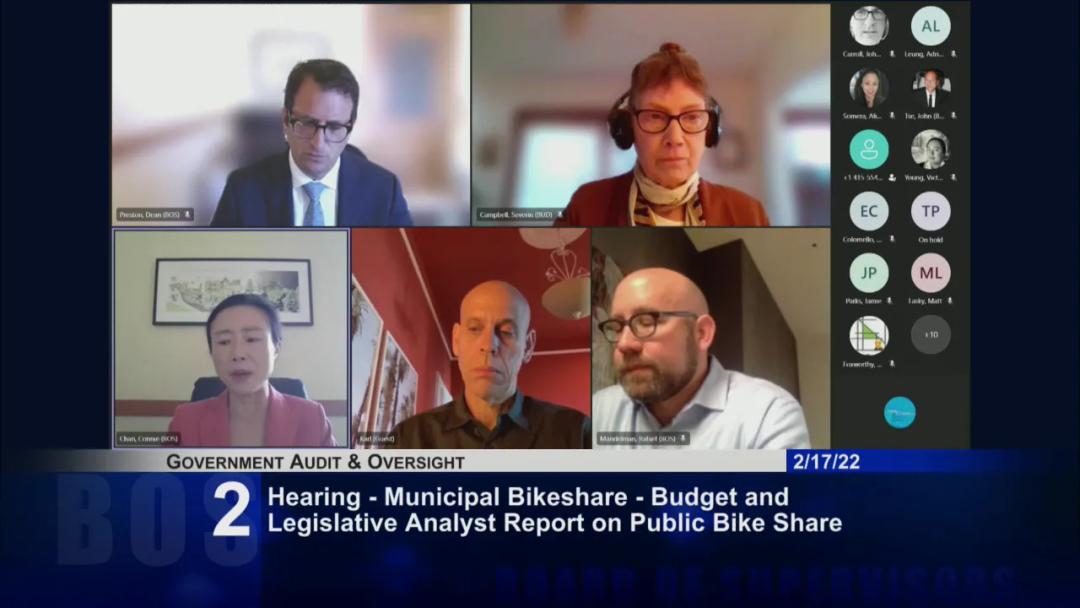
The Government Audit and Oversight Committee of the San Francisco Board of Supervisors met on February 17, 2022, starting at 6:15 PM UTC (10:15 AM PST). The meeting, chaired by Supervisor Dean Preston, included Vice Chair Connie Chan and Supervisor Raphael Mandelman. The committee considered three agenda items: a resolution confirming annexation of property to the Transbay Community Facilities District, a hearing on municipal bikeshare featuring a Budget and Legislative Analyst (BLA) report, and a hearing on the 706 Mission Street Purchase and Sale Agreement community benefits update. All items were acted upon unanimously. Consent Calendar - The committee unanimously recommended to the full Board of Supervisors a resolution (File No. 211309) confirming the annexation of 75 Howard Street into the Transbay Community Facilities District No. 2014-1 and affirming the annexation process. The resolution was presented by Bridget Katz from the Controller's Office of Public Finance, with no public comment and no opposition. Public Comments & Testimony - Item 2 (Bikeshare Hearing): Over 20 callers provided public comment. Key positions included: - Zach Lipton (District 6 resident) expressed support for public ownership but cautioned against destabilizing the regional system, noting that San Francisco's bike share system is now the most expensive in the world. - David Alexander (Richmond Family Transportation Network) supported municipal bike share, stressing the need for better infrastructure. - Christopher White (San Francisco Bicycle Coalition) stated that the current system fails to prioritize affordability, access, and equity. - Parker Day (District 3 resident) noted that e-bike trips are often as expensive as Lyft rides, undermining the goal of reducing car dependency. - Roland Aldonado (Oakland resident) supported a regional municipal system to ensure equity across the Bay Area. - Jay Bain (Richmond District resident) called for cargo bike share and adaptive bike share programs, noting Lyft's lack of interest. - Cliff Barger (Potrero Hill resident) emphasized the need for regional coordination, especially with Caltrain. - Clara Mobley (San Francisco Bicycle Coalition) stressed that the current system is inaccessible to underserved communities, particularly in the Tenderloin. - Jesse Fernandez (Bicis del Pueblo) supported public ownership, citing lack of community engagement from private operators. - Oscar Grande (Excelsior Bike Club) advocated for community ownership to ensure accountability and equity. - Stan Jones (TWU Local 320) supported full municipalization or a public-private hybrid, noting that Bay Wheels expanded only 4 stations in the past year compared to 355 in New York. - Emily Houston (journalist) urged a return to public control, referencing historical precedent. - Several callers (e.g., David Alexander, Curtis Wu) emphasized the need for safer bike infrastructure to support increased ridership. - Item 3 (706 Mission PSA): Three callers provided comment: - Alan Lowe called for governance and accountability in the administration of community benefit funds, citing the PSA's provision for a community review process. - Misha Olivas (United Players) expressed frustration that the $1.8 million open space fee was allocated to capital costs without community consultation, and urged an ordinance for oversight of development agreements. - Heather Phillips (Friends of Gene Friend and Victoria Manalo Draves Park) advocated for a community process to ensure funds are used as additional enhancements, not substitutions for city maintenance. Discussion Items Item 2: Bikeshare Hearing - Budget and Legislative Analyst Report on Public Bike Share - Chair Preston opened the hearing, stating that the purpose was to explore public alternatives to the current privatized model, emphasizing the need to align bike share with climate goals, equity, and public control. He noted that the current for-profit system raises concerns about conflicts of interest, pricing, data transparency, and affordability. - Severin Campbell and Carl Bytel from the BLA presented their report, released that day. Key findings: - San Francisco accounts for 87% of the Bay Area Bike Share system, with 3,600 bikes (2,000 classic, 1,600 e-bikes) and 255 docking stations. - Between August and November 2021, San Francisco had about 700,000 rides out of 800,000 regionally. - Ridership shifted from members to casual riders during the pandemic; e-bikes account for a growing share. - The current model (private ownership and operation) is used by San Francisco and New York. Other models: public ownership with private operation (Boston, Washington DC, Chicago, Boston) and fully public ownership and operation (Montreal). - Montreal has lower fees ($99 annual vs. $159 in SF; $0.05/min vs. $0.20/min) and higher ridership (5.5 daily rides per 1,000 residents vs. 1.0 in SF). - Estimated costs for a municipal system in SF: $33.2 million to purchase assets (for a larger system of 4,500 bikes, 325 stations), $13.3 million annual operating cost (nonprofit model) or $18.2 million (civil service), with a public subsidy of $3-4 million per year. - Lyft does not share data; other cities expressed frustration with lack of transparency. - The BLA identified three options: fully public (Montreal model), public ownership with private operation, or continuation of the current model. - Adrian Long, SFMTA Bike Share Program Manager, presented the agency's perspective. He noted that the current regional agreement runs through 2027, with an e-bike agreement through 2024. He highlighted successes (7 million trips, 9 million vehicle miles reduced, low-cost annual membership, no taxpayer cost) and challenges (slow expansion, misaligned incentives with Lyft, theft and vandalism). He recommended maintaining existing contracts and beginning deeper analysis for the next phase, including supplemental programming like library memberships and youth bike share. - Jamie Parks, SFMTA Livable Streets Director, clarified that the e-bike pricing was not determined in the original contract, and Lyft has a right of first offer for e-bikes, limiting negotiation options until 2024. - In discussion, Supervisor Preston asked about Lyft's profitability and data sharing. The BLA responded that Lyft has not shared data, and other cities reported similar frustrations. Supervisor Mandelman questioned theft and vandalism costs; Lyft claims San Francisco's costs are twice New York's total, but this could not be verified. Supervisor Chan expressed support for a comprehensive approach integrating bike share with transit and land use planning. Item 3: Hearing on 706 Mission Street PSA - Community Benefits Update - Supervisor Peskin, who requested the hearing, provided background: the 2013 Purchase and Sale Agreement (PSA) with Millennium Partners included community benefits for open space, the Mexican Museum, and affordable housing, intended to mitigate impacts on the SOMA neighborhood. He noted that funds have been slow to be spent and community consultation has been lacking. - Deputy City Attorney Heidi Gerwitz outlined the PSA's fee structures: affordable housing fee ($4.3 million to OCI), GMOS SOMA open space payment (annual, with 50% for Yerba Buena Gardens and 50% for SOMA open space), a cultural component endowment ($5 million, one-third paid), transfer payments (percentage of condo sales for public benefits in SOMA), and a one-time open space fee ($1.8 million). She noted that the $1.8 million payment was initially subject to interpretation about whether it could be used for Yerba Buena Gardens, but was ultimately determined to be for SOMA open spaces only. - Ken Bukowski (Deputy City Administrator) reported that the city's Real Estate Department has received: - $440,782 in GMOS SOMA open space payments (for FY21 and FY22), to be transferred to Rec and Park. - $404,000 in transfer payments from condo sales (lower than expected due to slow sales), which will be transferred to the Mayor's Office of Housing and Community Development (MOHCD) for the SOMA Stabilization Fund. - The $1.8 million one-time open space fee was transferred to Rec and Park in the past week and allocated to the Gene Friend Recreation Center capital project. - Aaron Foxworthy (OCII) reported that the $4.3 million affordable housing fee for OCII has received only $899,000 to date. The second installment (40%) was due November 2021, but the developer has requested an extension citing force majeure due to COVID-19. OCII is evaluating the request; interest is not specified in the agreement. - Antonio Guerra and Stacy Bradley (Rec and Park) confirmed that the $1.8 million open space fee was allocated to the Gene Friend Recreation Center capital project, which is also funded by developer impact fees and a bond. They stated that the decision was made in consultation with city agencies, but not with the broader community. - Supervisor Peskin expressed concern that the community was not consulted, and that the funds should be used for programming and enhancements, not as a substitute for city maintenance. He indicated intent to bring forward legislation to establish a community review process for such funds. Key Outcomes - Item 1 (Annexation Resolution): Recommended to the full Board of Supervisors by a unanimous vote (3-0). - Item 2 (Bikeshare Hearing): Continued to the call of the chair by a unanimous vote (3-0). Chair Preston indicated that the conversation will continue with stakeholders, including labor, SFMTA, the public, and regional partners, to inform future decisions before the 2027 contract renewal. - Item 3 (706 Mission PSA Hearing): Filed by a unanimous vote (3-0). Supervisor Peskin announced plans to draft legislation requiring a community review process for the expenditure of these funds, and warned Rec and Park not to spend the $1.8 million until the community and board have input.

PUBLIC TRANSPORTATION 38% · PUBLIC FINANCE 9% · TRANSPORTATION 9% · LEGAL 8%
1192
FEB 16, 2022 · SAN FRANCISCO, CALIFORNIA · BUDGET AND APPROPRIATIONS COMMITTEE
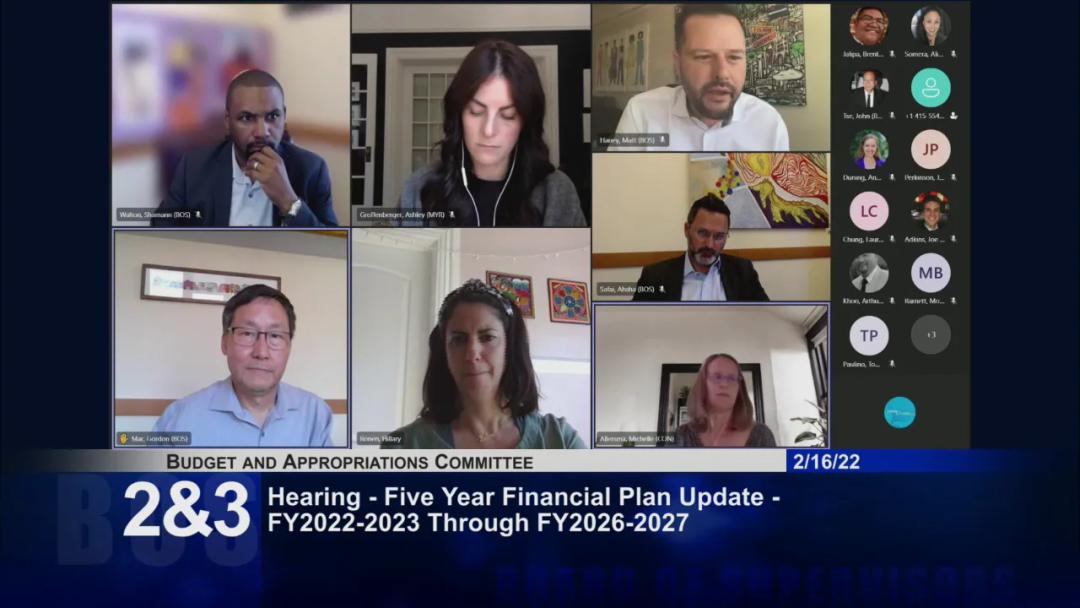
San Francisco Budget Committee Reviews Financial Outlook and Approves Two-Year Budget - Feb 16, 2022

The Budget and Appropriations Committee, chaired by Supervisor Matt Haney and joined by President Shamann Walton, Supervisors Ahsha Safaí, Hillary Ronen, and Gordon Mar, held a regular meeting on February 16, 2022, to review the city's financial outlook, budget instructions, and a six-month budget status report. The committee also voted on a resolution adopting a fixed two-year budget cycle for three enterprise departments. Consent Calendar - Resolution 211267 – Adopted a fixed two-year budget cycle for the Airport, Port, and Public Utilities Commission for fiscal years 2022-2023 and 2023-2024. The resolution defines terms and sets deadlines. The committee voted to forward the resolution to the full Board of Supervisors with a positive recommendation (5-0). Public Comments & Testimony - David Pilpel (public comment on Items 2 & 3) – Expressed support for the improved financial forecast and commended fiscal discipline at City Hall. He agreed with focusing on basic services within existing means and urged limiting salary growth while filling vacant positions. He also requested a report on reductions in unfunded pension and post-retirement benefit liabilities. Discussion Items - Items 2 & 3: Five-Year Financial Plan Update and Mayor's Budget Instructions – Ashley Groffenberger (Mayor's Budget Director) presented an improved financial forecast projecting a $108.1 million surplus for the upcoming two budget years (FY2022-2023 and FY2023-2024), driven by growth in general fund revenues and a significant reduction in employer pension contributions. The structural deficit has fallen to approximately $150 million. The Mayor's budget instructions emphasize restoring vibrancy through clean and safe streets, recovery of the economy, and core service delivery without net new costs. Departments are directed not to increase general fund support but to reprioritize within existing budgets and fill vacant positions. Risks include the ongoing pandemic, economic recovery pace, state ballot measures, and potential changes to excess ERAF. Committee members discussed the vacancy rates, revenue assumptions (including new taxes like Prop I and Prop L), and the structural deficit. - Item 4: Six-Month Budget Status Report (FY2022-2023) – Michelle Allersma (Controller's Office) presented the report, showing a projected $32.7 million increase in the current year ending balance compared to the prior forecast. Key factors included higher-than-expected real property transfer tax (due to a few large transactions like PG&E headquarters), state subventions for sales tax, and salary savings from vacancies. However, the city faces challenges with record absences during the Omicron surge, rising workers' compensation claims (projected $11.4 million overage citywide), and staffing shortfalls in police and fire departments. The report also noted that $7.4 million has been appropriated for outreach and ambassador expenditures, and $2 million in COVID emergency funds were redirected to the Tenderloin emergency. Questions focused on police and fire overages, workers' comp claim trends, and the use of reserves. - Item 5: Updates on the City’s Economy, Financial Condition, and Other Issues – Ashley Groffenberger stated there were no new updates beyond what was already presented. The hearing was continued to the call of the chair. Key Outcomes - Item 1 – Moved to the full Board of Supervisors with a positive recommendation (5-0). - Items 2 & 3 – Hearings filed (5-0). - Item 4 – Hearing filed (5-0). - Item 5 – Hearing continued to the call of the chair (5-0). - The committee will reconvene as the budget process continues, with the Mayor's proposed budget expected on May 1, 2022, and full budget submission on June 1, 2022.

BUDGET AND FINANCE 71% · PROCEDURAL 13% · PUBLIC COMMENT 6% · PERSONNEL MATTERS 5%
1193
FEB 10, 2022 · SAN FRANCISCO, CALIFORNIA · PUBLIC SAFETY AND NEIGHBORHOOD SERVICES COMMITTEE
Public Safety and Neighborhood Services Committee Meeting - February 10, 2022

The Public Safety and Neighborhood Services Committee of the San Francisco Board of Supervisors met on February 10, 2022, at 6:00 PM remotely. The committee considered one agenda item: an ordinance amending the Health Code to require general acute care hospitals to report annually on subacute care patient transfers out of county. Supervisor Gordon Mar (Chair) and Supervisor Catherine Stefani (Vice Chair) were present; Supervisor Haney was excused. Supervisor Ahsha Safai temporarily joined the committee to present the legislation. Public Comments & Testimony - Patrick Manad Shaw stated that the legislation "needs massive amendments or a complete rewrite" to broaden the scope of out-of-county data to be reported, which facilities must report, and the types of facilities patients are discharged to. He also noted he recently won a Sunshine Ordinance complaint against the Department of Public Health, which had claimed its Epic database does not track out-of-county discharges, but Epic Corporation confirmed the data is collected in structured fields. Discussion Items - Supervisor Safai explained the ordinance is a response to the elimination of subacute care beds at St. Luke’s Hospital under the CPMC agreement, which forced patients to be sent out of county. He noted that San Francisco is "the only county in the Bay Area that does not have in hospital care at an appropriate level." The goal is to require data collection on subacute care transfers and to work with the Department of Public Health to refine the scope. He expressed willingness to continue the item to allow further input from DPH and community advocates. - Supervisor Mar acknowledged the need to get details right and consider requests from community advocates like Dr. Palmer and Patrick Manad Shaw to expand reporting to other types of care for which patients are involuntarily discharged out of county. - Supervisor Stefani thanked Supervisor Safai for his commitment, noting she visited the Subacute Hospital at Davies with him. Key Outcomes - The committee voted unanimously (3-0) to continue Agenda Item 1 to the call of the Chair, allowing time for further amendments and consultation with the Department of Public Health and community advocates. The item is expected to return on a future agenda.

PUBLIC HEALTH 53% · PROCEDURAL 47%
1194
FEB 8, 2022 · SAN FRANCISCO, CALIFORNIA · PORT COMMISSION
Port Commission Meeting - February 8, 2022: Budget, Structural Assessment, and Policy Updates

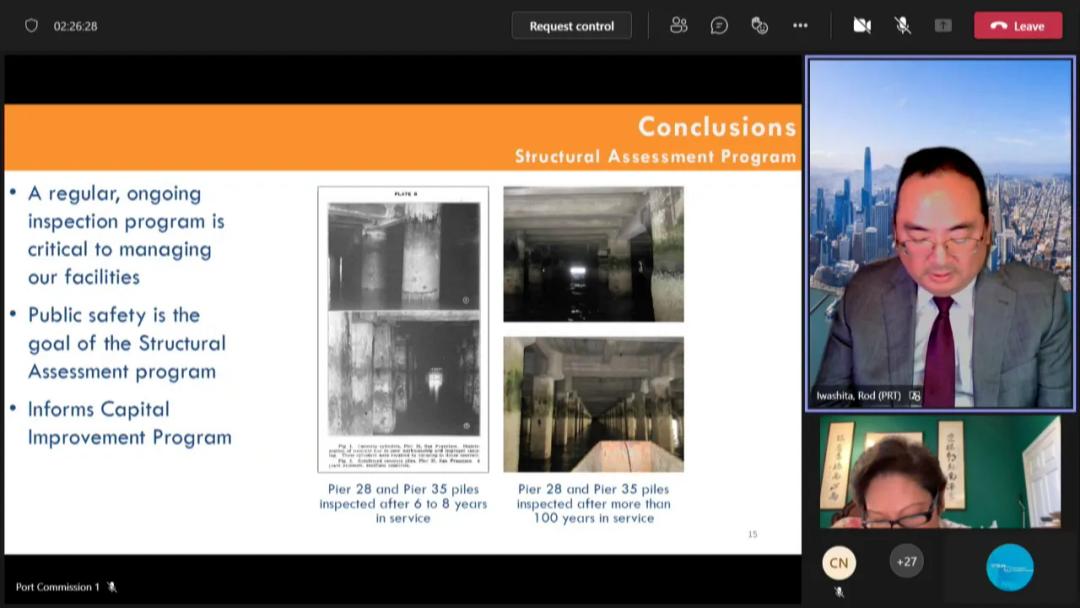
The San Francisco Port Commission met on Tuesday, February 8, 2022, from 3:15 PM to 5:47 PM, with Vice President Doreen Wuho presiding. Commissioners Kimberly Brandon, John Burton (late arrival), and Gail Gillman were present; President Willie Adams was absent. The meeting covered the Executive Director’s report, a proposed change to the meeting schedule, the consent calendar, the biennial budget and capital plan, a structural assessment update, and a proposed write-off policy update. Consent Calendar - Resolution 2206 (ADOPTED unanimously): Approval of findings under new state urgency legislation to allow remote meetings during the COVID-19 emergency, continuing remote meetings for 30 days and directing the Commission Affairs Manager to agendize a similar resolution within 30 days. - Resolution 2207 (ADOPTED unanimously): Retroactive authorization for a Memorandum of Understanding between the Port of San Francisco and the San Francisco Bay Conservation and Development Commission for review of changes to the San Francisco Bay Waterfront Special Area Plan, not to exceed $150,000. - Resolution 2208 (ADOPTED unanimously): Application of delegation of authority to offer leasing incentives (Resolution No. 21-16) to select existing maritime tenants. Public Comments & Testimony No public comments were made on any agenda item during the meeting. Discussion Items - 6b. Proposed Amendment to Rules of Order (Meeting Schedule): Carl Massida, Port Commission Affairs Manager, presented a proposal to reduce the commission’s regular meetings from 18 to 14 per year by canceling the second meeting in March, May, September, and October. Commissioners raised concerns about long meetings and transparency, but after discussion (including a suggestion to treat it as a pilot), the resolution passed unanimously. The first in-person meeting was announced for March 8, 2022. - 8a. Biennial Operating and Capital Budget Presentation: Katie Petruccioni and Nate Cruz presented the FY22-23 and FY23-24 budget, including the acceptance and expenditure of federal stimulus funds (ARPA) totaling up to $115 million and the five-year Capital Improvement Program (CIP) of $208.4 million. The budget assumes tourism returns to pre-pandemic levels by FY25-26, 15% of office workers telecommuting permanently, and four restaurant vacancies. Key investments include $70 million in ARPA-funded capital projects, $5 million for waterfront resilience (flood study), and new positions for equity, economic recovery, and resilience. Commissioners asked for more detail on defunded projects, ARPA allocations, and execution risk; staff committed to providing a budget book and additional information for the next meeting. - 9a. Structural Assessment Program: Rod Iwashta, Chief Harbor Engineer, reported on the port’s structural assessment program, which inspects about 200 buildings and 150 marine structures. The port has 32 red-tagged facilities (fully restricted) and 37 yellow-tagged (load-restricted). The FERPA program provides in-depth inspections. The total estimated capital backlog to achieve state of good repair is $2 billion. Commissioners noted the scale of need and requested beautification of fencing around restricted areas. - 10a. Proposed Update to Write-Off Policy: Rebecca Benissini presented a proposed policy to replace the 1984 version, defining write-offs as accounting actions after tenants leave and collection efforts are exhausted. The policy would delegate approval to the Executive Director (with designee) after review by the City Attorney and Controller, with annual reporting to the commission. Commissioners requested transparency for large write-offs, especially those that may arise from failed settlement negotiations. Staff will incorporate a disclosure mechanism before bringing the policy back for action. Key Outcomes - Resolution 2205 (ADOPTED unanimously): Amended the Port Commission Rules of Order to reduce the regular meeting schedule from 18 to 14 meetings per year, effective for 2022 with a review after one year. - Consent Calendar (Resolutions 2206, 2207, 2208): All adopted unanimously. - New Business Items: Three items were recorded for future agendas: (1) an informational presentation on connecting waterfront communities via signage and mapping (Vice President Wuho); (2) a review of financial policies, particularly the 15% operating reserve (Commissioner Burton); (3) an invitation to SFMTA to discuss park-and-ride commitments from the Embarcadero Freeway demolition (Commissioner Gilman). - Next Steps: The budget and write-off policy will return for action at a future meeting; the budget will also be submitted to the Mayor’s office in March/April.

PORT MANAGEMENT 22% · BUDGET AND FINANCE 21% · CAPITAL PLANNING 14% · PUBLIC COMMENT 13%
1195
FEB 8, 2022 · SAN FRANCISCO, CALIFORNIA · PUBLIC UTILITIES COMMISSION
San Francisco Public Utilities Commission Regular Meeting – February 8, 2022

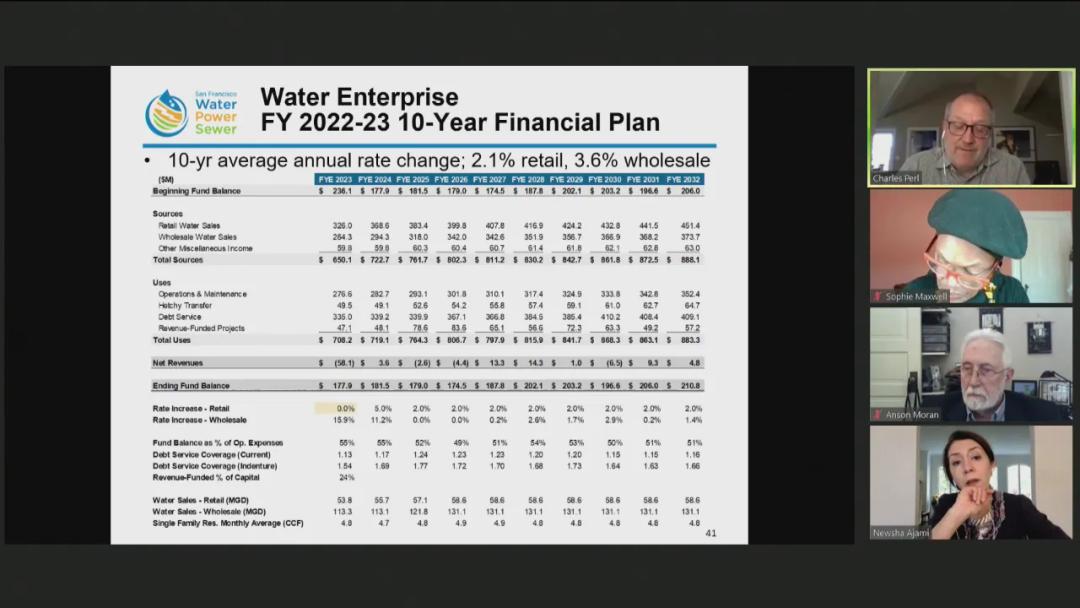
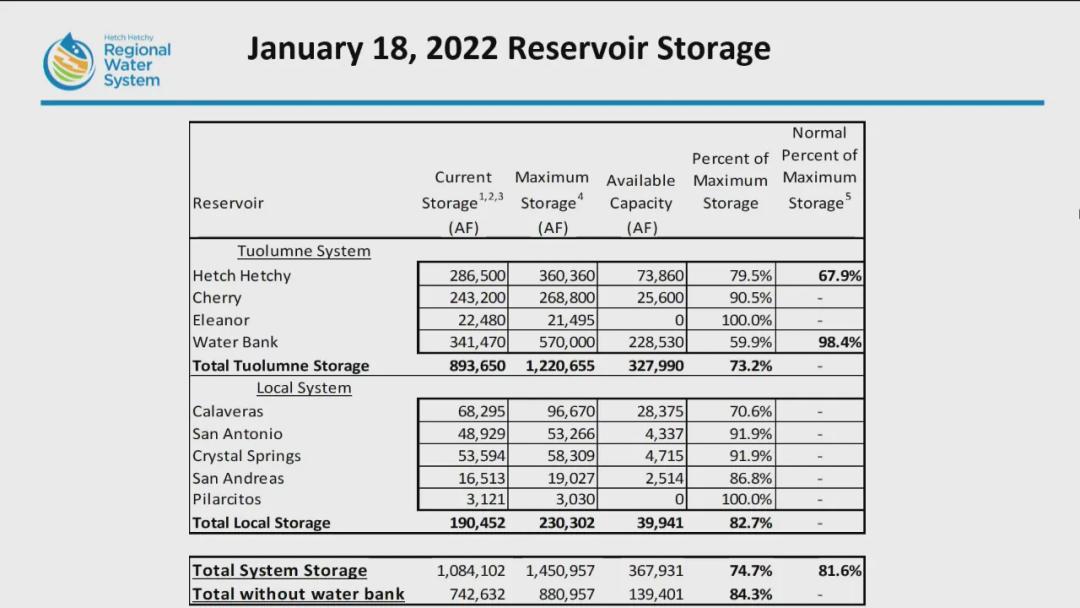
On February 8, 2022, the San Francisco Public Utilities Commission (SFPUC) held a regular meeting via teleconference due to the COVID-19 emergency. Commissioners present: President Moran, Vice President Jamy, Commissioner Maxwell, and Commissioner Paulson. The meeting included updates on drought conditions, adoption of the biennial operating budget, capital budget, 10-year capital and financial plans, and several contract awards. All votes were unanimous (4-0). Consent Calendar - Item 9: Approved consent calendar en bloc, including three contracts: WD-2882 (Trousdale Oaks Tree Removal, $2,655,026), correction to Resolution No. 21-0082 (Yerba Buena Engineering closeout), and WW-648 (Oceanside Water Pollution Control Plant clarifier improvements, $6,490,014). Public Comments & Testimony - Item 5 (General Public Comment): - Bill Martin (San Francisco resident, Sierra Club signatory) urged deeper research on alternative water supplies and review of the Long-Term Vulnerability Assessment (LTVA). - A caller from Turlock Irrigation District (TID) described Project Nexus (solar panels over canals) and urged the commission to invite TID to present. - David Pilpel expressed alarm over the high number of staff vacancies and acting assignments across the commission, urging priority attention. - Nicole Sandkulla (BAWSCA CEO) supported using the LTVA for long-term planning and urged adherence to scientific data. - Alita Dupree advocated for expanding Clean Power SF, electrification, and a hybrid in-person meeting format. - Another caller referenced corruption tied to former SFPUC officials Harlan Kelly and Juliet Ellis, alleging misuse of funds. - Item 6 (Communications): Commissioner Moran noted the LTVA is dense and requires careful reading to avoid misinterpretation. - Item 7a (Drought Update): No public comments. - Item 9 (Consent Calendar): No public comments. - Item 10 (WW712 Increase): David Pilpel praised improved clarity of the item and expressed support. - Item 12 (Tree Services): A caller questioned consultation with indigenous peoples on forest thinning and tree mortality. - Item 13 (MOU with SFMTA): Eileen Vogen (Coalition for San Francisco Neighborhoods) disputed accuracy of project descriptions regarding pipe sizes and route; David Pilpel requested better mapping and explanation of cost-sharing timing. A final caller urged fact-checking by presenters. - Items 14-17 (Budget): Eileen Vogen urged specific capital plan amendments; David Pilpel stressed focusing on people infrastructure, expressed concern over rate freeze effects, and requested responses to earlier written comments. Discussion Items - Item 3: Renewed Remote Meeting Findings – Unanimously adopted for another 30 days. - Item 4: Approval of Minutes – Minutes for January 14, 20, and 25 were approved individually (all 4-0) after David Pilpel indicated edits may be submitted later. - Item 6: Communications – Commissioners discussed a letter from NGOs (Sierra Club et al.) regarding the LTVA; President Moran urged careful interpretation of the report. - Item 7a: Drought Conditions Update (Steve Ritchie, AGM Water) – Key statistics: Hetch Hetchy Reservoir at 300,000 acre-feet (likely to fill); Cherry Reservoir at 240,000 acre-feet (being drawn down to 220,000 for snowmelt). January was the driest on record at Hetch Hetchy (0.06 inches precipitation). Combined water demand reduction since July 1, 2021: San Francisco 15%, wholesale 6%, average 9%. Snowpack is near median but dry February forecast. Total water available to city: 127,000 acre-feet. - Item 10: Contract Increase for WW-712 (Bessie Tam) – Request to add $2,250,000 and 180 calendar days to rehabilitate deteriorated brick sewers north of Market Street (within one mile of original project). The contractor preliminarily agreed to uphold competitively bid prices. Commissioners praised clear presentation; concerns about prior noticing issues resolved. Passed 4-0. - Item 11: Elevator Maintenance Contract (WW-718R) – Award to Star Elevator Inc. for $2,136,677 over 1,125 days. Passed 4-0. - Item 12: Master As-Needed Tree Services Contracts – Five contracts, each $10 million not-to-exceed, total combined spending authority $10 million. To address dead/dying trees due to drought and pathogens. Tim Ramirez (Natural Resources) noted continued collaboration with Muwekma Ohlone tribe on land management. Passed 4-0. - Item 13: MOU with SFMTA for Taraval Street Water/Sewer Relocation – Authorizes GM to execute MOU with SFMTA; total estimated SFPUC cost $33,760,678. Bessie Tam noted this is segment B of ongoing successful joint project (segment A completed). Commissioners requested maps and clearer public information. Passed 4-0. - Items 14-17: Budget Adoption (Presented by GM Herrera, Laura Bush, Charles Pearl) - Item 14: Biennial Operating Budget (FY 2022-23 and 2023-24) – $1.6 billion annually. No retail rate increases for water and wastewater. Budget grows 8% in first year, 3% in second. Driver: power purchase and debt service. 58 net new positions (37 project-funded, 21 operating). Key priorities: responsible management, access/affordability, people/communities. - Item 15: Capital Budget (FY 2022-23) – $1,117,521,515 including financing costs. Largest portion: wastewater (70%), water ($101.3M), upcountry water/power ($114.9M), in-city power ($66.2M), Clean Power SF ($1.6M). - Item 16: 10-Year Capital Plan (FY 2022-23 – 2031-32) – Total $9,893,091,608 (increase of 9% from prior plan). Wastewater (SSIP) is two-thirds. About 13% unfunded; staff to work on aligning plan with delivery capacity. - Item 17: 10-Year Financial Plan – Average annual rate increases: water retail 2.1%, wholesale 3.6%; wastewater 5.2%; Hetch Hetchy power 5.2% (with planned rate increases from general fund); Clean Power SF stable. All financial policy metrics met (fund balance 25%, debt coverage 1.1x). Customer bill projection: $139/month currently to $204 by 2032 (4.7% annual growth). Affordability metric review planned for later in 2022. - Public comment raised concerns about staff vacancies, unbalanced capital program, and specific project amendments. Commissioners approved each item individually (all 4-0). - Item 20: Closed Session – Discussion of settlement in David Alfaro et al. vs. City & County of SF (flooding lawsuit) for $3,626,440.85 in attorney fees and costs. Motion passed to assert attorney-client privilege. After closed session, motion not to disclose discussions. Key Outcomes - Item 3: Unanimously adopted remote meeting findings (4-0). - Item 4: Minutes for January 14, 20, and 25 approved individually (all 4-0). - Item 9: Consent calendar approved (4-0). - Item 10: Contract increase for WW-712 approved (4-0). - Item 11: Elevator contract awarded to Star Elevator (4-0). - Item 12: Five tree service contracts awarded (4-0). - Item 13: MOU with SFMTA authorized (4-0). - Item 14-17: Operating budget, capital budget, 10-year capital plan, and 10-year financial plan all adopted (each 4-0). - Item 20 (Closed Session): Commission recommended settlement to Board of Supervisors; motion against disclosure passed (4-0).

PROCEDURAL 16% · PUBLIC COMMENT 15% · BUDGET AND FINANCE 14% · WATER RESOURCE MANAGEMENT 12%
1196
FEB 3, 2022 · SAN FRANCISCO, CALIFORNIA · GOVERNMENT AUDIT AND OVERSIGHT COMMITTEE
San Francisco Government Audit and Oversight Committee Hearing – February 3, 2022

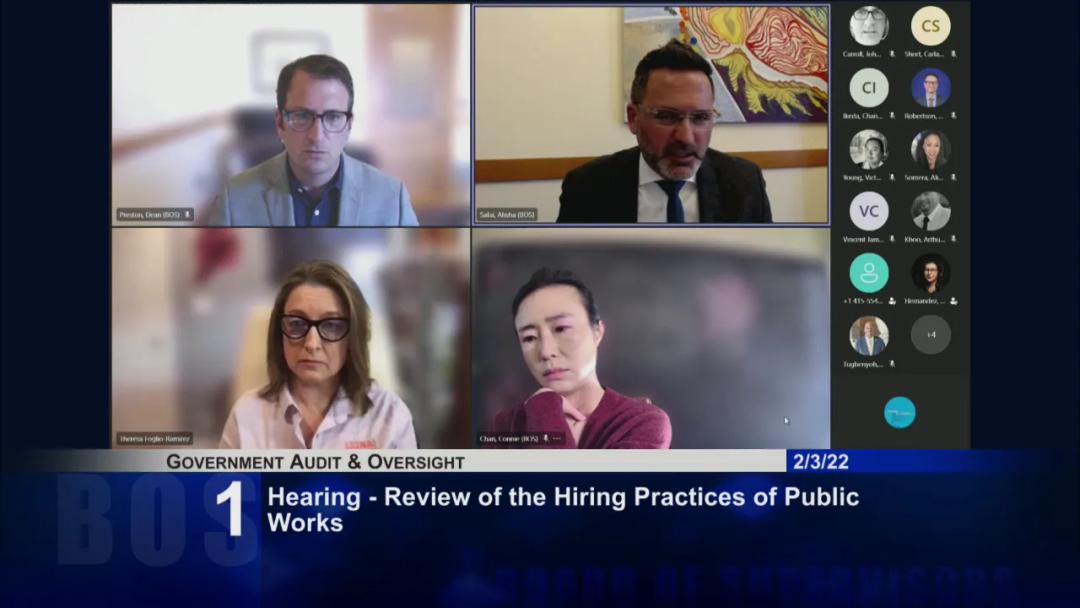
This regular meeting of the Government Audit and Oversight Committee, chaired by Supervisor Dean Preston and joined by Supervisor Raphael Mandelman and Vice Chair Connie Chan (who arrived later), convened remotely on February 3, 2022 at 6:15 PM. The committee heard two items: an update on a Civil Grand Jury report about recycling outreach, and a review of hiring practices at the Department of Public Works (DPW). Key outcomes included adoption of responses to grand jury recommendations and a continued discussion of DPW's vacancy crisis. Public Comments & Testimony - Item 2 (Recycling Report): No public comments were received. - Item 1 (DPW Hiring): Four callers offered public comment: - Sean Smith, a 9916 corridor worker, asked about advancement opportunities from the corridor program to permanent laborer positions, noting he took a significant pay cut during the pandemic. - A caller criticized the meeting as ineffective and called for revamping the civil service system, citing a historical example of rapid hiring under Mayor Brown. - Another caller questioned the timing of hiring a Deputy Director of Operations (salary $200,000) so close to the Prop B split, and the authority of the acting director to make that decision. - David Pilpel suggested a broader citywide hearing on hiring challenges and noted that project-funded positions inflate vacancy rates. Discussion Items - Item 2: Hearing on the 2019–2020 Civil Grand Jury Report – A Recycling Reality Check - The committee heard from Edward Wright (Supervisor Mar’s office) and Kara Gurney (Department of the Environment). They reported that three Civil Grand Jury recommendations (R1, R2, R3) had been implemented by July 1, 2021: - R1: New web pages on sfrecycles.org and Recology’s site, in English, Spanish, and Chinese, showing where blue bin materials go (e.g., pie charts). - R2: Recology updated its mobile app to display similar information. - R3: New web pages and multilingual outreach (virtual and in‑person) that emphasize what does not belong in the blue bin (e.g., garden hoses, plastic bags, batteries) to reduce contamination. - Supervisor Preston read the proposed responses into the record and moved to prepare a motion confirming implementation. The motion passed 2‑0 (Preston and Mandelman aye; Chan absent). A second motion to recommend that motion to the full Board of Supervisors also passed 2‑0. - Item 1: Hearing on Hiring Practices of Public Works – Operations Division - Sponsored by Supervisor Ahsha Safai, the hearing focused on DPW’s high vacancy rate, hiring delays, and the impact on street cleaning, graffiti abatement, and other services. - Presentations from: - Carla Short (Interim DPW Director) – noted that DPW has one of the city’s highest vacancy rates, partly by design for project‑funded positions, but acknowledged the strain on current staff. - Bruce Robertson (DPW Deputy Director) – reported that as of early 2022, the operations bureau had a 33.8% vacancy rate (257 vacant positions), with 45% of those being project‑funded. The overall department vacancy rate had recently dropped to just under 30% (29.8%), down from 35% in December 2021. About 19 permanent laborers were hired in January 2022, and recruitment was underway for 40 corridor workers (9916s). - Chanda Ikeda (City Administrator HR) – explained that COVID‑19 caused hiring freezes, delays in in‑person exams (e.g., the laborer practical test), and a shift in the labor market. She noted that establishing a permanent civil service eligible list for general laborers took about nine months, with an additional three months to hire from that list, totaling about a year. Exempt hires (e.g., 9916s) can move within 90 days. - Teresa Foglio‑Ramirez (Business Agent, Laborers Local 261) – provided historical context on the failed DPW apprenticeship program, blamed management’s lack of accountability, and offered to work with the city on a dispatch agreement (similar to private‑sector hiring hall models) to supply skilled, trained workers while respecting civil service rules. - Mauli Tugbenyo and Anna Biaspa (DHR) – acknowledged the problem and noted they are exploring continuous testing and other strategies used successfully for nurse hiring. - Supervisor Safai, joined by Vice Chair Chan and Supervisor Mandelman, expressed shock that the vacancy rate had been around 30% even before COVID‑19 (data from 2017). They stressed that a fire or police department would not be allowed to operate with such staffing shortages. - Supervisor Safai announced he would form a working group mirroring the nurse‑hiring task force, including DPW, DHR, the City Administrator, and labor unions, to explore expedited hiring, a dispatch agreement, and other reforms. He requested the item be continued to the call of the chair. Key Outcomes - Item 2: The committee voted unanimously (2‑0) to prepare a motion confirming that all three Civil Grand Jury recommendations have been implemented, and to recommend that motion to the full Board of Supervisors. - Item 1: The committee voted 2‑0 (Chan and Preston aye; Mandelman absent) to continue the hearing to the call of the chair, with a commitment to reconvene in three to four months to review progress. Supervisor Safai will lead a working group to reduce hiring time and fill vacancies, focusing on the operations division.

STAFFING 28% · PROCEDURAL 20% · WORKFORCE DEVELOPMENT 16% · WASTE MANAGEMENT 9%
1197
JAN 27, 2022 · SAN FRANCISCO, CALIFORNIA · PUBLIC SAFETY AND NEIGHBORHOOD SERVICES COMMITTEE
Public Safety and Neighborhood Services Committee Meeting – January 27, 2022

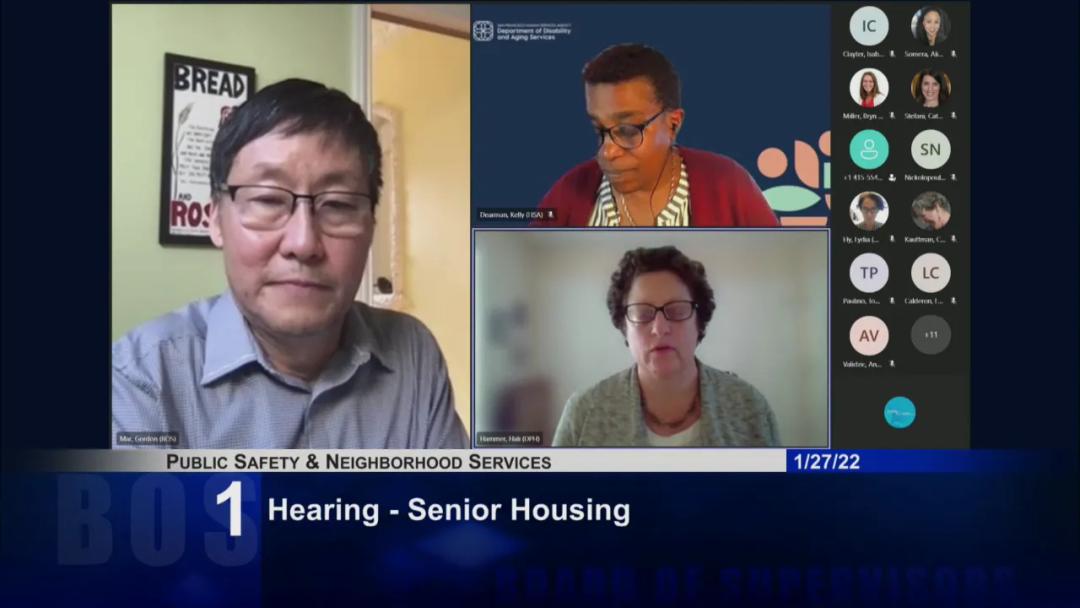
The Public Safety and Neighborhood Services Committee, chaired by Supervisor Gordon Mar and joined by Supervisors Catherine Stefani and Matt Haney, met on January 27, 2022 to consider two agenda items: an ordinance on domestic violence data reporting and a hearing on the continuum of housing needs for seniors and people with disabilities. Consent Calendar - None on this agenda. Public Comments & Testimony - On Item 2 (Domestic Violence Data Reporting): No public callers spoke; the line was empty. - On Item 1 (Senior Housing Hearing): Multiple speakers testified. Eileen Boken criticized MOHCD for not designating the 2550 Irving site as senior housing, calling the decision arbitrary. John Lang, a low-income senior, described vulnerability to eviction due to late rent payments caused by the state COVID-19 rent relief program and stated that the Dahlia housing portal was unhelpful because his income is too low. Francisco de Costa stated that 95% of seniors he helps are frustrated by unaffordable housing options. Ashley Peterson (Open House) urged creation of 100% subsidized senior housing, noting that most clients earn under 20% of AMI and that SROs are dangerous for LGBT seniors. Patrick Lynette Shaw alleged that MOHCD inflates bond-funded housing unit counts and that only four supervisorial districts have received senior housing bond funds. Betty Trainer (Senior and Disability Action) echoed the need for deeply affordable housing for those on Social Security (under $1,000/month). Annie Chung (Self-Help for the Elderly) supported the hearing and emphasized the need for housing affordable to extremely low-income seniors (20-30% AMI) and for residential care facilities. Jessica Lehman (Senior and Disability Action) called for dramatically increased senior operating subsidies and a new disability operating subsidy, plus rental subsidies and in-home supports. Ayle (Institute on Aging, clinical supervisor) noted that seniors ready for discharge from skilled nursing facilities have no housing options. Margaret Graf (Senior Power, D4) shared stories of homeless seniors unable to afford first+last month rent and the lack of affordable skilled nursing for dementia patients. Yessi Kutman (Senior and People with Disability Options) called for housing affordable to people on SSI and for services available in multiple settings. Jen Fuchsioka (Chinatown Community Development Center) summarized a joint letter stating that current affordable housing is unaffordable to most seniors because their median income is below 50% AMI, and that the SOS pilot program needs full funding; she also cited a need for a disability operating subsidy. Sylvia (SDA, age 70) expressed concern about future housing insecurity given her income of just over $1,000/month. Discussion Items - Item 2 – Administrative Code: Domestic Violence Data Reporting (Ordinance 211172): Supervisor Stefani, the sponsor, had no further remarks. Nikita Saini from Supervisor Ronen’s office noted that substantive amendments were previously adopted and required re‑hearing. The committee voted 3‑0 to recommend the ordinance to the full Board with a positive recommendation. - Item 1 – Hearing on Senior Housing (Hearing 211158): - Opening Remarks: Chair Mar called the hearing a first step in understanding the housing and supportive service needs of the aging population. He cited the state’s Master Plan for Aging, the Sunset Forward community planning process, and his personal experience with his mother’s housing journey. He outlined three goals: understand demographic projections, identify housing spectrum needs and gaps, and learn from departmental plans. - Presentations: 1. Planning Department (Maya Small): Seniors are 16% of the population (expected 19% by 2030); 48% are very low income; over half are homeowners. Disabled population is 10%, about half are seniors. Housing types include ADUs, co-housing, and affordable senior housing. Planning is updating the Housing Element with equity focus; Policy 27 supports aging in place and housing types. Sunset Forward is piloting an affordable ADU program. 2. Department of Homelessness and Supportive Housing (Emily Cohen): Half of unhoused population nationally is over 50; 65+ is fastest growing cohort. HSH has 780 permanent supportive housing units designated for older adults (143 opening this year); 45% of adults placed in PSH in past 2 years are over 55. HSH recently made 300 flexible housing subsidies available for 60+ exiting shelter-in-place hotels. A pilot with IHSS services and a roving health service model are being expanded. 3. Mayor’s Office of Housing and Community Development (Sheila Nicolopoulos): MOHCD has 13,000 affordable units for seniors/disabled (10,000 senior units). 58% of the portfolio is occupied by seniors/disabled. Programs include rental counseling, legal assistance, emergency home repair, Dreamkeeper senior rehab (forgivable loans up to $50,000), Home Match shared housing. MOHCD produced 510 senior units in FY 19–20; 900 units in 10 projects are in the pipeline. Limitations: loss of HUD Section 202 funding, limited Section 8 vouchers, state bond allocation difficulties, and ineligibility for some state funds (e.g., Cap & Trade). 4. Department of Public Health (Hallie Hammer): DPH serves many older adults; 46,000 are Medi‑Cal eligible. Programs: Acute Care for the Elderly at ZSFG (1,800 patients), Curry Senior Center (1,200 patients). Behavioral health: 50% of residential treatment residents are over 60. 27 board‑and‑care facilities (163 beds) lost in 5 years, 67 were RCFEs for older adults. COVID‑19 lessons: need to bring services to people. Future: expanding board‑and‑care by 73 beds (Mental Health SF), enhancing dementia care. 5. Department of Disability and Aging Services (Kelly Dearman): DOS administers two rental subsidy programs serving 430 people/year, funds supportive services at public housing and veteran sites, and provides community living fund and IHSS. Challenges: limited resources, lack of affordable facility‑based care, coordination across departments. DOS is conducting the Dignity Fund Needs Assessment and co‑leading the Age‑ and Disability‑Friendly Action Plan (2022–2025). DOS coordinates annual senior/disability affordable housing reports (first released Oct 2021). - Committee Questions and Discussion: - Chair Mar asked Planning about demographic discrepancies (19% vs. 27% senior by 2030) – Maya Small attributed to different age cutoffs (65+ vs. 62+). MOHCD has no specific senior housing production goal; pipeline is opportunistic based on sites and funding. Chair Mar inquired about RCFE and assisted living needs – DPH noted that Mental Health SF RCFE beds are for those with behavioral health conditions, not general dementia. Chair Mar called for a quantified needs assessment across departments. He also raised the issue of senior homeowners wanting to downsize; Planning noted ongoing work to diversify housing types (ADUs, SB9). - Supervisor Stefani expressed appreciation for the hearing and shared her personal experience with her father’s Lewy body dementia, stressing the importance of caring for seniors. Key Outcomes - Item 2 was recommended to the full Board of Supervisors with a positive recommendation on a 3‑0 vote (Supervisors Mar, Stefani, Haney). It is expected to appear on the February 8, 2022 Board agenda. - Item 1 was continued to the call of the Chair on a 2‑0 vote (Supervisor Haney was absent). Chair Mar announced that the Budget and Legislative Analyst’s Office will conduct an analysis of gaps in senior/disabled housing and review promising practices from other cities. He stated his intent to hold a follow‑up hearing after the analysis is complete and to prioritize funding for senior housing (including full funding of the SOS program and creation of a disability operating subsidy) during the upcoming budget process.

AFFORDABLE HOUSING 41% · PUBLIC HEALTH 22% · PUBLIC COMMENT 15% · HOMELESSNESS 5%
1198
JAN 25, 2022 · SAN FRANCISCO, CALIFORNIA · PUBLIC UTILITIES COMMISSION
San Francisco Public Utilities Commission Regular Meeting - January 25, 2022

The San Francisco Public Utilities Commission (SFPUC) held a regular meeting via teleconference on January 25, 2022, chaired by President Moran. Commissioners present: Vice President Jamy, Commissioner Maxwell, and Commissioner Paulson, constituting a quorum. The agenda included consent calendar items, reports on drought, customer programs, capital improvements, retirements, and modifications to the non-potable water ordinance program. Remote Meeting Authorization - The Commission unanimously (4-0) adopted renewed findings under State urgency legislation to continue remote meetings for 30 days and directed the Commission Secretary to agendize a similar resolution at a meeting within the next 30 days. Approval of Minutes - Minutes of the January 7, 2022 Special Budget Meeting were approved 4-0. - Minutes of the January 11, 2022 Regular Meeting were approved 4-0, with amendments to correct roll call and vote records, including adding Commissioner Harrington's attendance and votes. Public Comments & Testimony - Peter Dreckmeier (Tuolumne River Trust) expressed concern that the long-term vulnerability assessment did not answer whether SFPUC could meet Bay-Delta Plan flow requirements without running out of water. He requested analyses using 200 MGD demand, design drought scenarios, and earlier runoff scenarios, citing their own estimate of 237,000 acre-feet shifting to the Tuolumne River. - David Pilpel noted his budget letter, praised retiring Deputy City Attorney John Roddy, and flagged date typos in reports (items 6F and 9C showing 2021 instead of 2022). - Peter Dreckmeier challenged BOSCA's 50% rationing claim, calling it based on unrealistic demand projections (e.g., 265 MGD) and design drought assumptions, and urged the Commission to agendize discussions on drought scenarios. - David Pilpel raised concerns about consent item 11D's public notice, stating the agenda item lacked sufficient detail about adding work from the Tenderloin/Knob Hill sewer project to the New Montgomery contract. - David Pilpel provided technical and procedural comments on item 12, including a typo, lack of page numbers, and strong opposition to delegating rule-making authority to the General Manager. Discussion Items BOSCA Update (Item 7) - Nicole Sandkula, CEO of Bay Area Water Supply & Conservation Agency (BOSCA), stated that BOSCA is pleased with SFPUC's direct involvement and urged prompt participation in negotiations for a voluntary agreement for the Tuolumne River. She noted that the Tuolumne provides 85% of the water supply delivered by the San Francisco regional system, and failure to address the challenge could reduce supply by 90 million gallons per day during drought years, requiring up to 50% rationing. She referenced General Manager Herrera's January 14, 2022 letter to state secretaries expressing commitment to negotiations. Retirements (Item 8) - The Commission recognized John S. Roddy for 41 years of service as Deputy City Attorney advising the SFPUC, and Lisa Diep for 34 years of service, most recently as Customer Service Billing and Collections Manager. A video also honored approximately 30 SFPUC employees who retired during 2020–2021. All commissioners expressed appreciation for their public service and noted the loss of institutional knowledge. Drought Update (Item 9A) - Ellen Levin, Deputy Manager for Water, reported reservoir storage improvements. Hetch Hetchy was relatively high and may approach 300,000 acre-feet as the Mountain Tunnel shuts down. State reservoirs improved, with Don Pedro at 79% of historic capacity. Precipitation in January has been dry, but the forecast from January 26–February 3 looks wet. Water available to the city is 127,000 acre-feet, compared to a goal of 598,000 acre-feet to fill the system by July 1. The service area achieved a 9.2% water use reduction compared to fiscal year 2019-20. - In public comment, Peter Dreckmeier noted that this year's precipitation so far is average (18.67 inches vs. 18.68 inches average) and argued the system is likely to fill, providing an opportunity to leave more water in the Tuolumne River. Power Customer Program Update (Item 9B) - Daniel Young presented an overview of the Power Enterprise's customer programs, including the program development process. He highlighted two new programs: the Low-Income Solar Inverter Replacement Program (launched November 2021) and EV Charge SF (soft launched December 2021), which offers rebates up to $3,600 per charging space for Hetch Hetchy customers installing EV charging infrastructure. Assistant General Manager Barbara Hale noted that past grant applications were denied but they will continue pursuing funds from the infrastructure bill. Water Enterprise Capital Improvement Program Quarterly Report (Item 9C) - Katie Miller reported 36 active projects with a total budget of $2.7 billion, with $801 million (31%) expended. Cost forecasts show regional overruns of $33 million and local overruns of $45 million, attributed to four regional and two local projects. Highlights included progress on the Alameda Creek Watershed Center and the College Hill Reservoir Outlet. Commissioners discussed improving cumulative trend analysis and transparency, and asked for a timeline for a database to track forecast data. Non-Potable Water Ordinance Excess Use Charge Program (Item 12) - Taylor Nakudian presented proposed technical modifications to the 2017 excess use charge program, including renaming it the Non-Potable Water Ordinance Excess Use Charge Program, modifying potable makeup allocation determination, changing reporting requirements, establishing billing methodology with a six-month cumulative basis, clarifying eligibility for suspension/allocation revisions, and authorizing the General Manager to approve future non-material modifications. The Commission approved the item 4-0. Consent Calendar - Item 11A: Authorized the General Manager to execute a Cost Recovery Agreement with the U.S. Bureau of Land Management for $22,106.74. - Item 11B: Approved plans, specifications, and award of Contract WD-2843 for 16-, 12-, and 8-inch ductile iron water main replacement. - Item 11C: Approved a $200,000 increase to the cost contingency and 180-day increase to the duration contingency for Contract WD-2858R. - Item 11D: Severed due to public notice concerns raised by David Pilpel regarding the addition of Tenderloin/Knob Hill sewer work. The item was continued to the next agenda for staff to provide more details. - The remaining consent calendar items were approved 4-0. Key Outcomes - Remote meeting provisions extended for 30 days. - Minutes for the January 7 and January 11 meetings approved. - Consent calendar approved except item 11D, which was continued to the next meeting. - Modifications to the Non-Potable Water Ordinance Excess Use Charge Program approved 4-0. - Commission asserted attorney-client privilege for the closed session and later voted not to disclose discussions. - Staff directed to provide a timeline for the CIP forecast database and to repackage item 11D. Closed Session - The Commission held a closed session item under San Francisco Administrative Code Section 67.1(d) regarding existing litigation: City and County of San Francisco v. Federal Energy Regulatory Commission (Pacific Gas and Electric Company as adverse party). No public comment was received. The Commission unanimously voted to assert attorney-client privilege and, after the closed session, voted unanimously not to disclose discussions. Meeting adjourned.

PROCEDURAL 25% · PERSONNEL MATTERS 17% · PUBLIC COMMENT 16% · WATER RESOURCE MANAGEMENT 15%
1199
JAN 20, 2022 · SAN FRANCISCO, CALIFORNIA · GOVERNMENT AUDIT AND OVERSIGHT COMMITTEE
Government Audit and Oversight Committee Meeting on Mental Health SF, MAGIC Programs, and PUC Audit - January 20, 2022

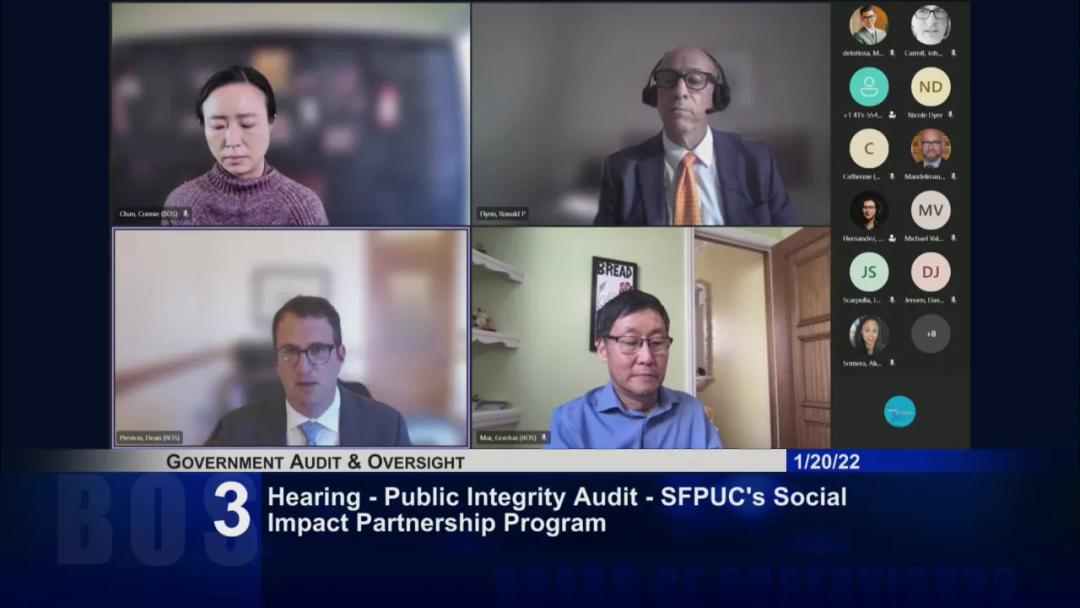
The Government Audit and Oversight Committee of the San Francisco Board of Supervisors met on January 20, 2022, chaired by Supervisor Dean Preston, with Vice Chair Connie Chan and Supervisor Raphael Mandelman. The committee held three hearings and then proceeded to closed session on ten litigation items. Key topics included the implementation of Mental Health SF, a resolution authorizing the Public Defender's MAGIC programs, and a performance audit of the Public Utilities Commission's Social Impact Partnership Program. Public Comments & Testimony - Item 1 (Mental Health SF): No public comments were received. - Item 2 (MAGIC Programs): Multiple callers expressed strong support. Cheryl Davis (Human Rights Commission) praised the programs as a legacy of Jeff Adachi. Monica Walters (Wu Yee Children's Services) highlighted how MAGIC facilitated a Third Street early learning hub. James Fringola (Collective Impact) called the programs a citywide convener. Joy Jackson Morgan (Third Street Youth Center) said MAGIC is the "nexus" of the Bayview community. Other callers from TNM Partners in Early Learning also voiced support. - Item 3 (PUC Audit): Several callers criticized the program. Teresa Foglio Ramirez (Laborers Local 261) stated her union filed a whistleblower complaint in 2019 about pay-to-play corruption. Ali Al Saha alleged steering occurred and called the audit controlled. Eileen Boken (Coalition for San Francisco Neighborhoods) requested further audits. Rudy Gonzalez (San Francisco Building Trades) noted that unions called for the audit in February 2019 and that contractors have lost trust. Discussion Items - Item 1: Hearing on Mental Health SF Implementation – Supervisor Hillary Ronan, the sponsor, reviewed the four components of Mental Health SF and expressed frustration with hiring delays. Dr. Hillary Cunnins (DPH Behavioral Health Director) and Greg Wagner (DPH CFO) presented. They reported that 276 positions were vacant, and the department aimed to hire 200 by March 30, 2022, using an emergency declaration for 79 positions. Key barriers included civil service delays, a national shortage of psychiatrists and clinicians, and insufficient case managers. Wait times for intensive case management exceeded 100 individuals. Supervisor Ronan expressed optimism about the hiring push, but Supervisor Mandelman raised concerns about the lack of long-term beds and facilities. The committee voted unanimously to file the hearing. - Item 2: Resolution Authorizing Public Defender's MAGIC Programs – Public Defender Mano Raju presented the history of B-Magic (Bayview) and Mo-Magic (Fillmore/Western Addition), founded in 2004 and 2006 to prevent youth from entering the criminal justice system. The programs convene over 90 community-based organizations, host annual backpack giveaways, and provide resource guides. The resolution formalizes board authorization for these programs. All committee members co-sponsored. The committee voted unanimously to recommend the resolution to the full board. - Item 3: Hearing on PUC Social Impact Partnership Program Audit – Mark De La Rosa (Controller's Office) and Nicole Dyer (Schroeder & Associates) presented the audit findings. Since 2011, the program had 84 contracts with $22 million in commitments, but only $6.5 million delivered. Seven of 22 expired contracts had unfulfilled commitments totaling $685,000. The audit found inadequate internal controls, lack of documentation, and insufficient enforcement. PUC Chief of Staff Ron Flynn concurred with all seven recommendations and committed to developing rules and regulations, improving transparency, and enforcing contractor commitments. Supervisor Marr questioned the lack of an investigative audit into potential fraud. Supervisor Mandelman noted the program's complexity and potential for abuse. The committee voted unanimously to file the hearing. Key Outcomes - Item 1: Motion to file the hearing passed unanimously (Chair Preston, Vice Chair Chan, Member Mandelman). - Item 2: Motion to recommend the resolution to the full Board of Supervisors passed unanimously. - Item 3: Motion to file the hearing passed unanimously. - Items 4-13 (Closed Session): The committee unanimously recommended all ten litigation settlement ordinances and resolutions to the Board of Supervisors for the February 1, 2022 agenda.

PROCUREMENT 15% · MENTAL HEALTH 12% · COMMUNITY ENGAGEMENT 11% · AUDIT AND COMPLIANCE 11%
1200
JAN 20, 2022 · SAN FRANCISCO, CALIFORNIA · PUBLIC UTILITIES COMMISSION
Special SFPUC Budget Hearing: Power Enterprise & Unfunded Capital Discussion (Jan 20, 2022)

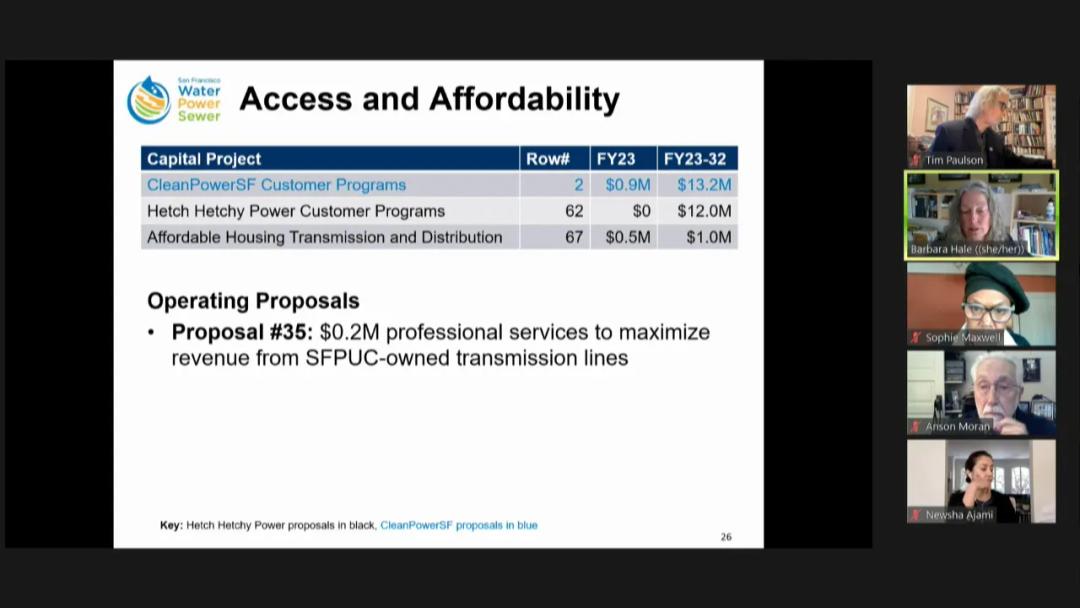
This special meeting of the San Francisco Public Utilities Commission (SFPUC) focused on the third budget hearing for fiscal years 2022-23 and 2023-24. The meeting opened with the unexpected resignation of Commissioner Harrington due to a conflict of interest arising from a PG&E bankruptcy claim. The commission then received a detailed presentation on the summary of budget hearing questions from the previous meeting, covering the 0% rate change for water and wastewater, the capital plan’s unfunded portion, and financial plan details. The second half of the meeting was devoted to the Hetch Hetchy Power Enterprise and CleanPowerSF budget proposals, including operating and capital plans, staffing challenges, and grid acquisition strategies. No consent calendar items were considered. Public Comments & Testimony - David Pilpel (public comment on item 3): Expressed shock at Commissioner Harrington’s resignation and praised his service. Requested the PowerPoint from the September 28, 2021 meeting regarding the rate freeze, and asked for a clear calculation of the fiscal impact of the 0% rate increase combined with lower water/wastewater usage assumptions. He also noted a humorous past incident where his name appeared on a commissioner tracking chart. - Nicole Tank Kulaboska (public comment on item 3): Representing the Bay Area Water Supply and Conservation Agency (BAWSCA), she appreciated the additional detail on the unfunded capital plan but criticized the continued use of financial team-only water sales projections, stating they do not reflect the Urban Water Management Plans or other adopted plans. She also expressed sadness at Commissioner Harrington’s resignation. - David Pilpel (public comment on item 5): Praised the Power team, supported moving Hetch Hetchy power under the power enterprise, advocated for solar generation at the Fun Fet Reservoir South Basin, a new power line from Newark to San Francisco, and a proportional approach to intervening facilities. He supported increasing general use rates to achieve cost of service and default time-of-use rates, and noted a spelling error on page 157. Discussion Items Item 3: Summary of Budget Hearing Questions - Charles Pearl and Laura Bush (Finance staff) presented responses to commissioners’ questions from the previous budget hearings. Key points: - 0% Rate Change for Water/Wastewater: The decision was made last summer to pause rate increases for fiscal 2023, with a projected 5–6% increase in fiscal 2024 to partially catch up. The rationale balanced agency needs, ratepayer affordability, and new General Manager Herrera’s orientation. - Capital Plan Development: The 10-year capital plan totals $9.9 billion, with 13% unfunded ($1.3 billion), mostly in wastewater ($975 million). The unfunded portion reflects an imbalance between available sources and uses beyond fiscal 2023. The agency highlighted challenges: deliverability (some years have 50% more proposed spending than staffing capacity), cost increases (10% due to inflation and scope), and prioritization difficulties. - Financial Plan Details: The 10-year financial plans were presented for water, wastewater, power, and CleanPowerSF. Key metrics: fund balance as a percentage of operating expenses, debt service coverage ratios, and rate increase projections. For water, a 0% retail increase in fiscal 2023, followed by 5–6% increases; wholesale rates projected at 16% increase for fiscal 2023. For wastewater, 0% in fiscal 2023, then 8% in fiscal 2024, averaging 5.8% over 10 years. If the unfunded wastewater portion were funded, additional 5% rate increases over 10 years would be needed. - Affordability: The combined water/wastewater bill is currently 1.6% of median household income, well below the 2.5% goal, but projected to rise to 2% over 20 years. The average monthly bill is expected to increase from $147 (2022) to $212 by 2032, a 45% increase (30% due to inflation, 15% due to capital investments). - Commissioner Questions and Discussion: - Commissioner Maxwell asked about the impact of reducing the biosolids program scope and the difficulties in prioritizing projects. Staff acknowledged that better tools for risk management and criticality assessment are needed. - Commissioner Moran praised the transparency but urged that maintaining infrastructure must remain top priority, and that constraints (like deliverability) should be challenged. - General Manager Herrera reiterated commitment to transparency and rising to the challenge of balancing ratepayer affordability with infrastructure needs. - Commissioner Ajami encouraged cross-enterprise strategic planning, forward-looking risk assessment that incorporates future risks (e.g., demand changes), and a focus on the utility of the future. Item 5: Hetch Hetchy Power Enterprise, including CleanPowerSF - Barbara Hale (AGM for Power) presented the power enterprise budget, highlighting challenges and proposed solutions. - Context: Power serves 385,000 retail electric accounts (70% of San Francisco electricity). Hetch Hetchy (HH) budget $140M, CleanPowerSF (CPSF) $230M. Combined power share of PUC operating budget is 27% ($435M of $1.6B). Purchase of power is 78% of power costs. - Challenges: 1. Staffing Vacancies: 45% vacancy rate in power, due to nationwide shortage of electrical workers/engineers, competition from PG&E, and temporary positions that hinder retention. Proposals include converting temporary to permanent positions and a staff augmentation contract ($3M). 2. Cost of Power: Driven by market conditions, PG&E distribution tariffs, and state mandates. Mitigation includes regulatory advocacy and grid acquisition. 3. Wholesale Distribution Costs: PG&E controls the distribution grid, creating risk for HH customers. The solution is to own the grid through the proposed grid acquisition project and strategic distribution investments. 4. Rate Setting: A cost-of-service rate study is underway, aiming to set rates for HH and CPSF that are competitive and equitable. CPSF rates are currently set with a discount to PG&E, but the study will divorce from PG&E’s PCIA component. 5. Build Imperative: Investment in distribution grid is needed to retain and acquire customers, securing HH’s financial stability. Criteria for investments: functional relevance, economic justification, technical viability, and social responsibility. - Capital Plan: HH 10-year capital plan includes $1.2B in proposed projects. Key items: distribution services retail (grid investments), renewable generation, and the alternative transmission project (grid acquisition). Unfunded portion for power is $105M. Candidate projects (unfunded) include SF Port substation, Oakland Port 25 kV line, and electrification projects. - Operating Proposals: Requests for additional positions (predominantly conversions), $1.8M for services of other departments, $700K for increased insurance costs, $900K for vehicle replacement, and $1M for potential utility field services yard relocation. - Commissioner Questions: - Commissioner Paulson asked about temporary vs. permanent positions. Hale explained that temporary positions are appropriate for finite projects, but persistent workloads like grid acquisition justify conversion. Obstacles to filling permanent positions include market capacity, compensation competitiveness with PG&E, and slow city hiring processes. - Commissioner Maxwell asked about CPSF enrollment (99% of eligible customers enrolled) and the impact of losing unmetered load (street lights, traffic signals) to PG&E. The net revenue loss is minimal, but the general fund would lose $4-5M if those customers move to PG&E rates. The unmetered load is at risk due to a PG&E request to FERC to terminate service. - Commissioner Maxwell also asked about integrating racial equity into recruitment. Hale described efforts to recruit from historically black colleges, use employee networks, and improve inclusion through engagement surveys and buddy systems. Cross-enterprise collaboration on racial equity plans is ongoing. - Commissioner Ajami asked about distributed energy resources and avoiding transmission costs. Hale noted challenges with PG&E’s rules limiting solar exports on non-owned grid, but mentioned CPSF’s community solar program and partnerships with city facilities. Commissioner Ajami encouraged forward-looking alternative financing and rate design. Key Outcomes - Resignation: Commissioner Harrington resigned immediately due to a conflict of interest from a PG&E bankruptcy claim payment. The commission expressed gratitude and regret. - No Formal Votes: No votes were taken; the meeting was informational and a continuation of budget hearings. The budget is scheduled for review and potential approval on February 8, 2022. - Next Steps: - Staff will continue to address unfunded capital plan and deliverability issues, with a goal to present a balanced 10-year plan by the next budget cycle (fiscal 2024). - The cost-of-service rate study for power will be presented in spring 2022, with rate implementation by July 2022. - The commission will receive a detailed financial plan narrative on February 8, 2022. - No meeting continuation was needed; the meeting adjourned without further action.

ELECTRIC SERVICE REGULATION 24% · BUDGET AND FINANCE 13% · PUBLIC UTILITIES 13% · WATER RESOURCE MANAGEMENT 9%
OPENPUBLICA · PUBLIC MEETING INDEXUPDATED DAILY · openpublica.com