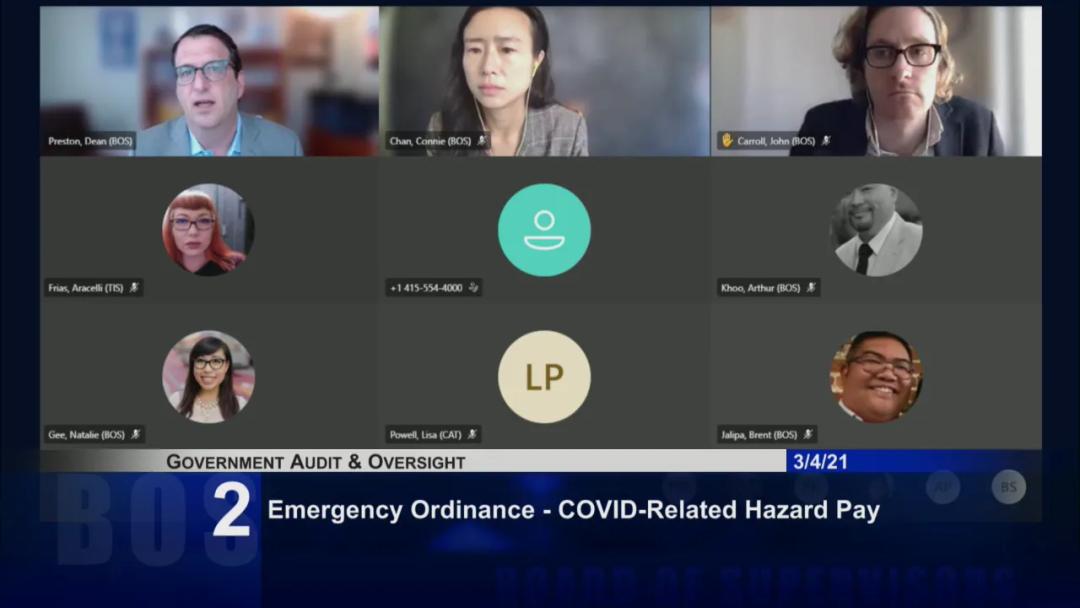
The Government Audit and Oversight Committee met on Thursday, March 4, 2021, at 10:15 AM, chaired by Supervisor Dean Preston. The committee considered two items: an ordinance to strengthen worker protections for grocery, drugstore, restaurant, and delivery workers during COVID‑19 (Item 1), and an emergency ordinance requiring certain grocery and drugstore employers to pay an additional $5 per hour hazard pay (Item 2). Both items were advanced after amendments and public testimony. Public Comments & Testimony - Mike Stone (owner, Molly Stones Markets) opposed Item 2, arguing his independent chain (675 employees, three San Francisco stores) had already provided voluntary pay increases, bonuses, and vaccine access, and that the ordinance would impose undue burden. He noted his company is unionized but had no collective bargaining agreement addressing hazard pay. - Dan Larson (president, UFCW Local 648) expressed strong support for Item 2, stating the ordinance acknowledges the dangerous conditions frontline grocery and pharmacy workers have faced throughout the pandemic and brings them respect and dignity. Discussion Items Item 1 – Ordinance Amending Police Code (Worker Protections) - Abigail Rivamonte Mesa, representing Supervisor Haney (sponsor), presented two non‑substantive amendments: (1) clarifying that employees must be paid their normal rate for additional typing services and that independent contractors must receive no less than the personal services minimum contractual rate; (2) requiring covered entities to retain records for three years. No further presentations were made, as the item had been heard previously. Item 2 – Emergency Ordinance (Hazard Pay) - Natalie G, chief of staff for Board President Walton (sponsor), presented the ordinance and substantive amendments. Key provisions: the $5/hour hazard pay applies to grocery stores and retail pharmacies with at least 20 employees in San Francisco and 500 or more employees worldwide; exempts small/mom‑and‑pop stores and those with collective bargaining agreements providing employer‑initiated hazard pay. The amendments clarified definitions (e.g., “base wage,” “hazard pay,” “wage enhancement”), excluded hospital‑based pharmacies, and set an operative date three days after enactment with termination upon end of the local health emergency or after 61 days, whichever occurs first. Supervisor Chan asked clarifying questions about offsets for existing hazard pay and the waiver provision for union agreements. City Attorney Lisa Powell confirmed that any current employer‑initiated hazard pay offsets the $5 requirement up to a $35/hour cap, and that waivers would require explicit agreement in a collective bargaining side letter. Chair Preston raised a policy concern about not crediting past voluntary hazard pay, but deferred to the sponsor’s structure. Key Outcomes - Item 1: The committee voted unanimously (3‑0) to adopt the two non‑substantive amendments (motion by Chan) and then voted unanimously (3‑0) to refer the amended ordinance as a committee report to the full Board of Supervisors for consideration at its March 16, 2021 meeting (motion by Mandelman). - Item 2: The committee voted unanimously (3‑0) to adopt the substantive amendments presented by President Walton’s office (motion by Chan). It then voted unanimously (3‑0) to refer the amended emergency ordinance to the Board of Supervisors for a committee‑of‑the‑whole hearing on March 9, 2021, pending approval of a motion to sit as a committee of the whole (motion by Mandelman). The meeting adjourned.
Public Meetings - San Francisco, California
Public Meetings - San Francisco, CaliforniaThe Budget and Appropriations Committee, chaired by Supervisor Matt Haney, held a hearing on March 3, 2021, to review the proposed budgets for the Department of Homelessness and Supportive Housing (HSH) and the Mayor’s Office of Housing and Community Development (MOHCD) for fiscal years 2021‑2022 and 2022‑2023. The committee heard presentations from department directors, discussed funding priorities and gaps, and received extensive public comment—particularly on the need to fully fund the “30% rent standard” for supportive housing tenants. Both hearings were filed by unanimous votes. Public Comments & Testimony - On HSH budget (Item 1): Eleven callers provided public comment, with the overwhelming majority urging the committee to fully fund the 30% rent standard (30 Right Now) this fiscal year. Speakers described the policy as a basic fairness issue and noted that over 2,000 supportive housing tenants still pay up to 50% of their income in rent. Several callers criticized the department for not prioritizing this funding and called on the mayor and board to allocate the estimated $6.1 million needed annually. - On MOHCD budget (Item 2): One caller, Deanna Fotos from Dolores Street Community Services, warned against cutting grants to community‑based organizations (CBOs) and emphasized that many CBOs provide essential outreach and tenant rights services that have pivoted during the pandemic. Discussion Items Item 1: Hearing on HSH Budget (FY21‑22 and FY22‑23) - Interim Director Abigail Stewart Kahn presented the department’s budget of $578.5 million for FY21‑22 (a $273.6 million increase from the prior year, largely due to one‑time COVID‑19 response funds). The budget maintains current services and includes $4 million for safe sleeping sites but only $1 million for safe parking, with a $3.5 million gap to operate a new safe parking site. Director Kahn stated that additional Prop C dollars have not yet been allocated in this proposal and will be determined through future conversations with the R City Our Homes committee. - Committee members—Supervisors Safai, Walton, Marr, and Ronan—raised concerns about the lack of funding for safe parking, the high cost of safe sleeping ($16.1 million for 262 slots), and the need to prioritize permanent supportive housing acquisitions. Director Kahn noted that the department is committed to expanding safe parking but requires additional resources to reduce other services. She also highlighted progress on racial equity, including hiring a Chief Equity Officer and publishing a racial equity action plan. - The committee questioned the $6 million gap to implement the 30% rent standard legislation. Director Kahn acknowledged the policy priority but said it would require trade‑offs. - Hard stop at 2:30 PM: The HSH team left promptly for a scheduled internal diversity, equity, and inclusion workshop, prompting Chair Haney to express frustration that the department did not remain for the full hearing. The committee proceeded to public comment and then voted to file the hearing. Item 2: Hearing on MOHCD Budget (FY21‑22 and FY22‑23) - Director Eric Shaw and Deputy Director Benjamin McCloskey presented MOHCD’s proposed budget of $126 million for FY21‑22 (a $71 million decrease from the current year, mainly due to one‑time revenues expiring). The budget includes $3.7 million in general fund reductions, which would likely be applied as a 10% cut to CBO grants. McCloskey explained that only unrestricted general fund dollars—almost exclusively used for CBO contracts—can be cut to meet the mayor’s budget instructions. - Committee members discussed the geographic distribution of community grants, small sites acquisitions (approximately $120 million in available funds, with new guidelines expected in summer 2021), the down payment assistance program, and federal rental assistance. Director Shaw noted that $26 million in direct federal rental aid and an additional $28 million through a state block grant are anticipated, but guidance on usage is still pending. - Multiple supervisors emphasized the need to protect black‑led and black‑serving organizations from cuts and requested detailed data on BMR homeownership by ethnicity and geographic distribution of program dollars. Key Outcomes - Item 1 (HSH budget): Motion to file the hearing passed 4‑0 (Chair Haney, Vice Chair Safai, Members Marr and Walton; Member Ronan absent for the vote). The hearing was filed. - Item 2 (MOHCD budget): Motion to file the hearing passed 4‑0 (Chair Haney, Members Safai, Marr, and Walton; Member Ronan absent for the vote). The hearing was filed. - The committee directed HSH and MOHCD to provide supplemental information in writing, including detailed data on safe parking funding, small sites acquisitions, BMR homeownership ethnicity breakdowns, geographic distribution of grants, and updated guidance on small sites and down payment assistance programs.
The Public Safety and Neighborhood Services Committee met on Thursday, February 25, 2021, at 18:15 UTC (morning local time) to consider five agenda items, including liquor license transfers, a resolution supporting a state constitutional amendment to end involuntary servitude, a resolution urging city support for SFUSD senior class of 2021 activities, and a hearing on criminal justice system gaps and recidivism. The meeting was chaired by Supervisor Gordon Maher, with Vice Chair Catherine Stefani and Member Matt Haney, joined by Supervisors Asha Safai and Hilary Ronen for relevant items. Consent Calendar - Item 1 (Type 20 License Transfer): Transfer of an off-sale beer and wine license to Barbara Jean Grotta, doing business as Grotta Wines at 5299 3rd Street. The SFPD ABC Liaison reported zero letters of protest or support, low crime and saturation area, and no opposition. The committee voted unanimously (3-0) to prepare a resolution finding the transfer serves public convenience and necessity, sending it to the full board with positive recommendation. - Item 2 (Type 21 License Transfer): Transfer of an off-sale general beer, wine, and distilled spirits license to Dakaz Inc., doing business as Mainland Market and Produce at 5601 Geary. The SFPD reported zero letters of protest or support, low crime and saturation area, and no opposition, with a condition to prevent loitering. The applicant, Navid Humanrod, spoke during public comment, stating the store is primarily a grocery (95% groceries, 5% alcohol) and that the license would serve customer convenience. The committee voted unanimously (3-0) to recommend approval. Public Comments & Testimony - Item 2 (Mainland Market): Applicant Navid Humanrod explained the store’s focus on groceries and expressed desire to serve customers efficiently. - Item 4 (Senior Activities): One public commenter urged the committee to meet with students and seniors directly to understand their needs, emphasizing mental health support and food security rather than gift boxes, and called for platforms with psychologists and social workers. - Item 5 (Criminal Justice Hearing): Ron DeCosta criticized the city’s lack of action on quality-of-life issues, noting the closure of the Office of Criminal Justice, delayed treatment beds, and poor jail conditions. Carolyn Gussin (SF Policy Director, Public Defender’s Office) advocated for trauma-informed substance use and mental health services, and urged vaccines for incarcerated people. Roma Guy (Taxpayers for Public Safety) recommended a higher-level structure for collaboration across agencies, including behavioral health, pretrial, and the Office of Equity. Discussion Items - Item 3 (Resolution Supporting ACA 3): Supervisor Haney introduced a resolution supporting Assembly Constitutional Amendment 3, which would remove the phrase “unless for the punishment of a crime” from Article 1, Section 6 of the California Constitution, thereby ending involuntary servitude. Dorsey Nunn (Executive Director, Legal Services for Prisoners with Children) testified, emphasizing the need to dismantle structural racism and the legacy of slavery. He noted that Utah, Colorado, and Nebraska have already removed similar language. The resolution also denounces structural racism. Supervisors Maher and Mar added themselves as co-sponsors. The committee voted unanimously (3-0) to send the resolution to the full board. - Item 4 (SFUSD Senior Class of 2021 Activities): Supervisor Safai presented a resolution urging city departments to support senior-specific activities for the Class of 2021, including funding, resources, and outdoor spaces. Speakers included Nate Ford (SF Rebels basketball), who highlighted the need for videography and recruiting services for student-athletes, costing $300–$800 per tape. Viva Mogey (SFUSD Director of Policy and Planning) requested city support for physically distanced graduations, videographers, and senior gift boxes. Maria Sue (DCYF Director) offered videography and photography resources from community-based organizations. Cheryl Davis (Human Rights Commission) suggested leveraging the Opportunities for All program for internships. Phil Ginsburg (Rec & Park) proposed a surprise: a ticket to ride the SkyStar Wheel for every SFUSD senior, and offered space and staff photographers. The committee amended the resolution to add Rec & Park and other departments, then voted unanimously (3-0) to forward it to the full board. - Item 5 (Criminal Justice System Gaps and Recidivism): Supervisor Safai called a hearing to examine loopholes in the criminal justice system, particularly for individuals on parole, probation, or pretrial diversion, and the role of substance abuse. Presentations were given by: - SFPD: Deputy Chief David Lazar reported that in 2020, 51% of adult arrestees had two or more prior arrests, and 651 arrestees were on parole or probation. He noted a 33% drop in arrests in 2020 (12,807) and an 18% increase in cases discharged to parole/probation. The department will revise its 1994 policy on notifying parole/probation, add double-check verification, and improve communication with the DA’s office. - District Attorney Chesa Boudin: Presented data showing that 56% of arrestees presented to the DA in 2020 had no recent prior arrest; among those with three or more arrests, filing rates increased to 70%. She emphasized the need for better data systems, a multi-agency MOU, and a dedicated fentanyl task force. She noted that the office cannot file charges without sufficient evidence, and that treatment on demand is critical. - Adult Probation: Chief Karen Fletcher reported that 74% of clients have substance use needs, and 37% of total clients are African American, rising to 48% among those rearrested. She highlighted the use of risk-need assessments and individualized treatment plans, but noted that court orders alone do not guarantee compliance. She called for clearer policies on when to file new charges versus motions to revoke. - Sheriff Paul Miyamoto: Provided data on bookings (46,977 total over three years), noting that 51.8% of those on electronic monitoring were rearrested. He described in-custody treatment programs and discharge planning, including partnerships with DPH and community-based organizations. He emphasized the impact of COVID on programming and visitation. - Pretrial Diversion: CEO David Mauro presented safety rates (percentage not rearrested during pretrial), noting that over 51% of clients are homeless and 55% are referred to housing. He highlighted challenges with treatment bed availability and the need for community support hubs. Key Outcomes - Items 1, 2, 3, and 4 were all approved unanimously (3-0) and sent to the full Board of Supervisors for consideration on March 9, 2021. Item 4 was amended to include the Department of Recreation and Parks and other coordinating bodies. - Item 5 was continued to the call of the chair (unanimous vote) to allow follow-up on progress, including the new interagency MOU, the mayor’s announced initiatives, and potential budget discussions. - The committee noted the need for improved data systems, increased treatment bed capacity, and better coordination among agencies to address recidivism and substance abuse. Supervisor Ronen committed to a future hearing on the implementation of Mental Health SF.
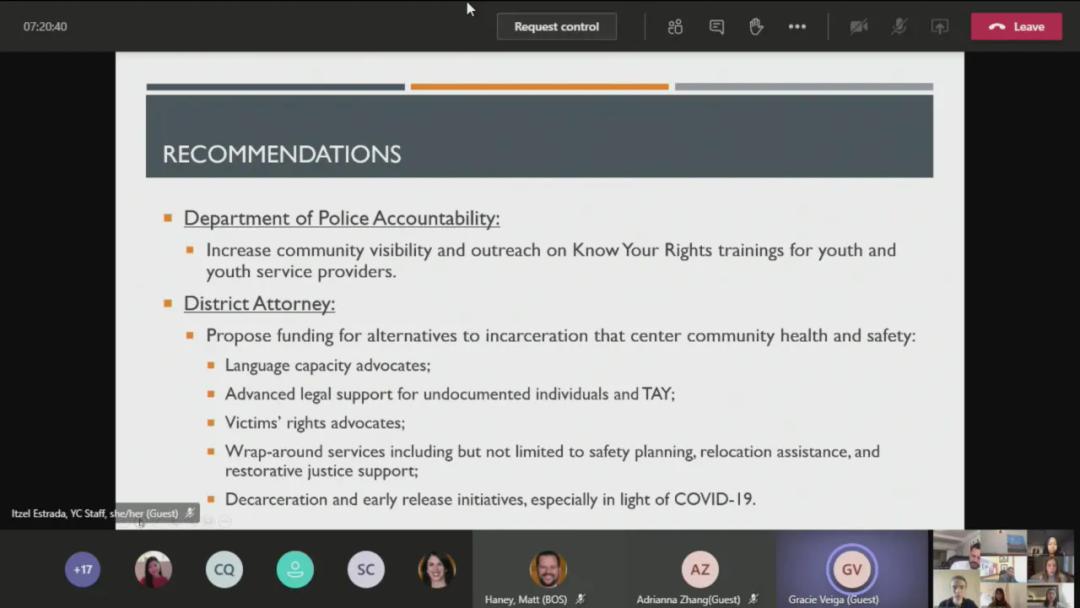
The Budget and Appropriations Committee, chaired by Supervisor Matt Haney, met on February 24, 2021, to consider three major items: the Board of Supervisors' budget process for FY2021-2023, a supplementary appropriation for rent relief and social housing funded by Proposition I revenue, and a hearing on the Youth Commission's budget priorities. The committee also briefly recessed to handle an item from the Budget and Finance Committee. All discussions and votes were conducted remotely due to the COVID-19 pandemic. Consent Calendar - None on this agenda. Public Comments & Testimony - On Item 1 (Budget Process): No public comments were received. - On Item 9 (Prop I Funding): Multiple callers expressed strong support for allocating Prop I funds to rent relief and social housing. Speakers included a Youth Commissioner urging support for social housing on public land, a representative from the Chinatown Community Development Center highlighting the need for innovative affordable housing, and a former Prop I field director emphasizing voter support (58% approval) and the urgency of preventing displacement. - On Item 2 (Youth Commission Priorities): One caller, a behavioral health clinician and member of DPH Must Divest, urged support for the Youth Commission's recommendation to end the MOU between SFDPH and the Sheriff's Department and reallocate funds to health-focused safety strategies. Discussion Items 1. Board of Supervisors Budget Process (Item 1) Chair Haney presented a motion, co-sponsored by all 11 supervisors, establishing goals and a timeline for the FY2021-2023 budget process. Key principles included urgent COVID-19 recovery for vulnerable populations, anti-corruption, and innovation. Supervisor Maher successfully moved an amendment to add "workforce development" to the list of top budget goals (page three, line seven: "small businesses, workforce development, and neighborhood stabilization"). The motion passed unanimously (5-0) and was forwarded to the full Board with a positive recommendation. 2. Prop I Revenue Appropriation (Item 9 – from Budget and Finance Committee) Supervisor Preston presented an ordinance to appropriate $5.7 million from the General Reserve to the Mayor's Office of Housing and Community Development for rent relief (under the Rent Resolution and Relief Fund) and affordable social housing (under the Housing Stability Fund), funded by Proposition I (a transfer tax increase approved by 58% of voters in November 2020). He noted that updated controller projections raised Prop I revenue estimates from $14.4 million to $26.1 million for FY2020-2021, and he proposed amendments to allocate $10.05 million to each fund (instead of the original $5.7 million total). Discussion included the ongoing need for rent relief despite state/federal programs ($54 million anticipated but far below the estimated $196 million+ in back rent), and the importance of investing in social housing. Vice Chair Safai questioned the timing of social housing spending but supported the rent relief portion. The committee accepted the substantive amendments and voted to continue the item to the March 17, 2021 meeting (vote: 4 ayes, with Vice Chair Safai absent). 3. Youth Commission Budget Priorities (Item 2) Youth Commissioners Calvin Quick, Sarah Chung, and others presented the commission's preliminary budget recommendations for FY2021-2023, based on a youth budget town hall and outreach. Key recommendations included: - Funding youth voter outreach and pre-registration (Department of Elections) - Investing in physical/mental health services, closing the digital divide, and supporting GED/college matriculation (Department of Children, Youth and Their Families) - Providing housing and rehabilitative services for youth in the justice system, and closing juvenile hall (Probation Department) - Cutting police funding by at least 50% and reallocating to non-carceral programs (Police Department) - Eliminating sheriffs from hospitals, funding mental health responders, and supporting entrepreneurship for impacted youth (various departments) - Reserving 100 units of permanent supportive housing for transition-age youth, and expanding employment training (Homelessness and Supportive Housing) - Making Muni free for all youth, funding a youth transportation advisory board staff, and improving school-serving bus lines (SFMTA) - Raising Youth Commission staff salaries above 100% AMI and providing stipends for youth seats on boards/commissions (Board of Supervisors). Commissioners requested better integration with the Board, including a dedicated budget staff or controller assistance, and more consistent engagement with appointing supervisors. The hearing was filed (vote: 4 ayes). Key Outcomes - Item 1 (Budget Process): Approved as amended (adding workforce development), forwarded to full Board with positive recommendation (5-0). - Item 9 (Prop I Appropriation): Amendments to increase funding to $10.05 million each for rent relief and social housing were accepted; the item was continued to March 17, 2021 (4-0, with Vice Chair Safai not voting but present). - Item 2 (Youth Commission Priorities): Hearing filed (4-0); no formal action taken.
The San Francisco Port Commission met on February 23, 2021, to address the economic impacts of COVID-19, approve a capital plan and an exclusive negotiation agreement for Piers 38-40, discuss portfolio management strategies, and review legislative priorities. The meeting included reports from the Executive Director, public comments, and unanimous approval of key resolutions. The meeting was adjourned in memory of poet Lawrence Ferlinghetti. Consent Calendar - Resolution 2109: Approved the Port's Ten-Year Capital Plan for Fiscal Years 2022–2031 unanimously (Commissioner Gilman's vote was recorded after the fact). Public Comments & Testimony - Alec Bash (former Port employee) expressed strong support for the Piers 38-40 project, noting it would activate the waterfront and complement existing attractions. - Byron Rhett (retired Port staff) supported the Exclusive Negotiation Agreement (ENA), highlighting potential equity opportunities for Bayview food businesses at Pier 40. - Randall Scott (Fisherman's Wharf Community Benefit District) thanked the Port for tenant support and emphasized investment in the wharf area. - Pete Sitnik (restaurant owner, Water Bar and Epic Steak) requested extension of the percentage rent program beyond April 2021, a longer payback period for deferred rent, and continuation of the shared spaces program. Executive Director’s Report - Elaine Forbes reported that Port revenues have fallen to 50% of pre-pandemic levels, with a projected loss of $50 million in FY2021 and $47 million over FY2022–2023 (a 21% reduction). Staff is working on an economic recovery initiative, including expenditure reductions and revenue enhancements. - The Port received a $1.667 million grant from the California Ocean Protection Council for the Heron's Head Park Shoreline Resilience Project (the largest award in this round). - Equity initiatives include: 10 micro-LBE emergency hardship loans (50% to Black-owned businesses), programming for Black History Month and Women's History Month, and a virtual movie club. - Ming Young was hired as Assistant Deputy Director of Planning and Environment. - No public comment was received on this item. Discussion Items Item 11A: Exclusive Negotiation Agreement for Piers 38-40 - David Beaupre presented the ENA with San Francisco Waterfront Partners III, LLC for a mixed-use development including commercial, retail, maritime, and public access uses. The project aligns with five strategic plan goals. Key terms: two-year ENA with three six-month extensions, transfer provisions requiring commission approval for investors 50% interest (except institutional investors, with ED approval and notification). - Commissioner Gilman requested DEI metrics be developed within 4–6 months. Staff agreed. - Simon Snellgrove and Wayne Perry (developers) expressed excitement and commitment to equity. - Public comment reopened after initial closure; three callers spoke in support. - Resolution 2110 was adopted unanimously. Item 11B: Real Estate and Maritime Portfolio Management Strategies - Rebecca Benissini provided an informational presentation on strategies to address current market conditions. Highlights: - Rent relief: 72 tenants applied (103 agreements), $700,000+ collected via repayment program, $412,000 in LBE loans. - 161 tenants (representing $7.7 million/year in rent) are not in compliance and have not applied for relief. - Proposed expanded authorities: increase mutual termination threshold from $10,000 to $15,000, develop uncollectible balance policy, and adopt leasing tactics (extended build-out, free rent months, tiered rents, blend-and-extend, maritime triple-threat reduction). - Market overview: office rents dropped 7–8%, industrial holding steady, retail/restaurant very difficult, parking revenue shifted to monthly. - Commissioner Wuho emphasized the need for long-term reimagination of space use and recovery triggers in tenant agreements. - Commissioner Gilman requested collection of demographic data on tenants (e.g., small business, minority-owned) to inform equitable policies. - Commissioner Adams noted the importance of reporting and transparency on delegated authority. - President Brandon stressed the need for systems to track delegated actions. - Staff will return with potential action items in future meetings. Item 12A: 2021 Federal and State Legislative Priorities - Boris Celpine presented the Port's priorities: advocate for federal stimulus (American Rescue Plan) including port access to $350 billion state/local recovery funds, secure cruise industry relief, push for climate adaptation funding (e.g., FEMA, Biden infrastructure plan), and obtain a 3x3x3 waiver for Army Corps flood resilience study. - State priorities include tracking SB 45 (climate bond), SB 1 (sea level rise planning), and zero-emission vehicle funding. - Commissioners expressed strong support and willingness to lobby. Vice President Adams urged aggressive pursuit of federal funds given the new administration. - No public comment was received. Key Outcomes - Minutes of the February 9, 2021 meeting were approved. - Consent Calendar: Resolution 2109 (Ten-Year Capital Plan) adopted unanimously. - Resolution 2110: Authorized ENA for Piers 38-40 (unanimous). Staff to return in 4–6 months with DEI metrics. - Item 11B: Staff will incorporate commissioner feedback and bring forward proposed policy changes for approval. - Item 12A: Commissioners will assist with advocacy; staff to update on legislative developments. - New Business: Noted that staff will return in no less than six months on Piers 38-40 DEI program. - Adjournment: The meeting was adjourned at 5:24 p.m. in memory of Lawrence Ferlinghetti, San Francisco's first poet laureate.
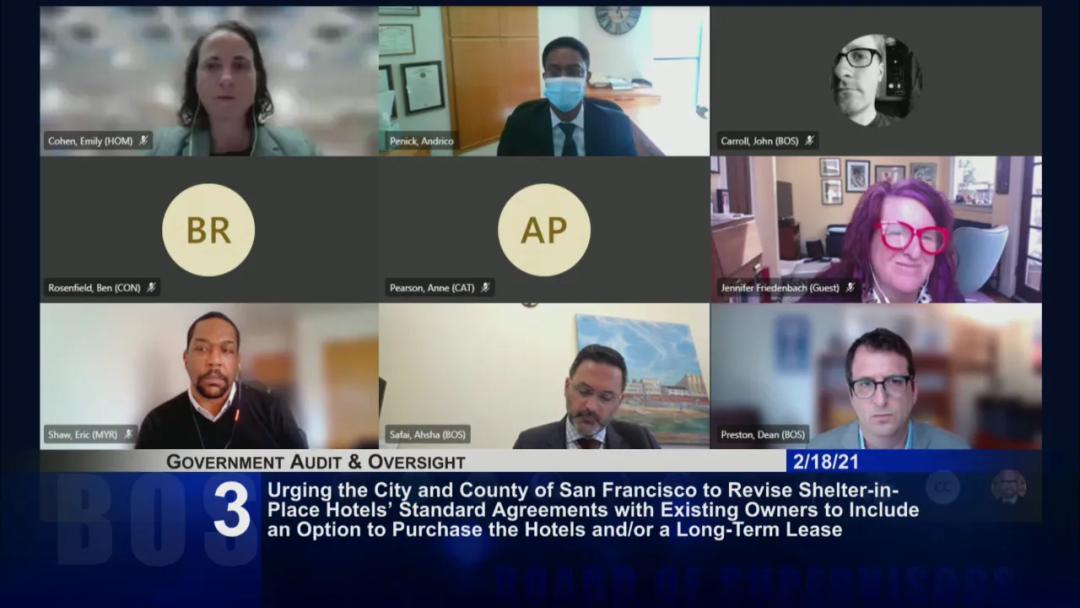
The Government Audit and Oversight Committee met on Thursday, February 18, 2021, at approximately 10:00 AM via video conference due to the COVID-19 health emergency. The committee, chaired by Supervisor Dean Preston and including Vice Chair Connie Chan and Member Supervisor Rafael Mandelman, considered three agenda items: an ordinance codifying protections for residential hotel (SRO) occupants during the pandemic, an ordinance extending worker protections for grocery, drug, restaurant, and on-demand delivery employees, and a resolution urging the acquisition or long-term lease of shelter-in-place hotels for permanent supportive housing. The committee also convened in closed session to discuss six litigation settlement items. Public Comments & Testimony - Item 1 (SRO Protections): Raymond Mormino, Policy Director at Chinatown Community Development Center, expressed strong support for the legislation and thanked Supervisor Peskin’s staff and the Department of Public Health (DPH) for collaboration. - Item 2 (Worker Protections): Over a dozen callers provided testimony, including Sean Smith (SF State student/Jobs with Justice SF), Daniel Menzies (Uber Eats driver), John Lee (former Lyft/Uber driver), Claudia Rabella Lee (former Lyft driver), Tyler (DoorDash driver), Martin Schweichert (Lyft/Uber driver), Sally Okawa (DoorDash/Postmates/Instacart worker), Eddie Hernandez (former Uber software engineer), Kirkas Yanos (Uber/Lyft driver), Barry (DoorDash driver), Lucas Chamberlain (Uber/Doordash/Instacart worker), Sofia Lima (McDonald’s/Carl’s Jr. worker), and Anita (McDonald’s worker, interpreted from Spanish). All urged the committee to pass the ordinance, citing lack of PPE, unpaid cleaning time, and fear of retaliation. - Item 3 (Hotel Acquisition): Rebecca Kang (Tenderloin Housing Clinic) expressed strong support for the resolution, urging the city to expedite the vetting process for hotel purchases. Discussion Items Item 1: Ordinance Amending Administrative Code – Protections for Occupants of Residential Hotels During COVID-19 - Supervisor Peskin presented the ordinance, which would make permanent protections from prior emergency orders. He noted that as of February 18, there had been just over 1,000 COVID-19 cases among SRO residents, 246 hospitalizations, and 11 deaths—remarkably low given the density of SROs. He thanked DPH, SRO collaboratives, and the Department of Building Inspection for their efforts. Supervisor Peskin introduced non-substantive amendments (e.g., striking Section 2, adding a requirement to provide a list of city-approved cleaning services, changing zip code to census tract, adding “to the extent consistent with state and federal laws governing confidentiality of medical information” for outbreak notifications). - Budget and Legislative Analyst (BLA) estimated that if the ordinance had been in effect June–November 2020, costs to the city would range from $3 million to $3.8 million, with 50% FEMA reimbursement; now that FEMA is reimbursing at 100%, costs would be reduced. - Deb Bourne from DPH affirmed collaboration and noted that amendments clarified notification protocols while respecting HIPAA. She confirmed DPH can comply with the amended legislation, with the exception of ongoing tension around HIPAA and notification. - Supervisor Mandelman expressed concern that past DPH non-compliance had been flagged in the BLA report but accepted that the amended version reflected a meeting of the minds. The committee voted unanimously to adopt the amendments and recommend the item to the full Board of Supervisors on March 2, 2021. Item 2: Ordinance Amending Police Code – Grocery Store, Drug Store, Restaurant, and On-Demand Delivery Service Employee Protections - Supervisor Haney presented the ordinance to replace the expiring emergency ordinance (due around March 10–12, 2021). It requires covered entities to provide PPE (face coverings, gloves, hand sanitizer, disinfectant), implement social distancing protocols, disinfect high-touch surfaces (with pay), allow schedule changes under paid sick leave, and prohibit retaliation. Substantive amendments were introduced: changing “employee” to “worker” and “employers” to “covered entity” (to include app-based workers post-Prop 22), adding a notice-to-workers section, and adjusting maximum penalties per the Office of Small Business. - Greg from the Office of Labor Standards reported that initial outreach led to policy adjustments by on-demand delivery services, with two corrective actions (restitution) and no recent complaints. - Deputy City Attorney Pearson confirmed the amendments were substantive, meaning the item could not be voted out that day. The committee voted unanimously to adopt the amendments and continued the item to the next GAO meeting on March 4, 2021. Item 3: Resolution Urging Acquisition or Long-Term Lease of Shelter-in-Place Hotels - Supervisor Safai introduced the resolution, emphasizing the historic opportunity to purchase hotels (using state/federal funds, Prop C, and FEMA reimbursement savings) for permanent supportive housing. He noted that the city already purchased two hotels (Granada and Diva, 344 units) via Project HomeKey. The resolution was amended to clarify that it covers any suitable hotel, not just SIP hotels, and to add “federal” to funding sources. - Presentations: - Jenny Friedenbach (Coalition on Homelessness, Our City Our Home Oversight Committee member) highlighted the confluence of opportunities: 100% FEMA reimbursement ($83 million), 70 hotel owners willing to sell, and Proposition C funds now available after legal ruling. She estimated hotel acquisition costs at $300,000 per room (including rehab), compared to $650,000 for new construction. Over 50 organizations signed a letter supporting acquisition. - Emily Cohen (HSH) reviewed the mayor’s Homeless Recovery Plan goal of 1,500 new PSH units, noting that the Diva and Granada count toward that total. She outlined the Request for Information (RFI) process that yielded 65 responses, currently being vetted. Key acquisition criteria include building size, vacancy, amenities, accessibility, and building code compliance. She noted that the next round of state HomeKey funds ($700 million statewide) may be imminent, with $250 million potentially available in the current fiscal year. - Andriko Penick (Real Estate Division) reported that the real estate market is in flux; some hotel owners are more willing to sell due to the downturn, but the city must be strategic. He stressed the need for confidentiality in negotiations to avoid speculation. - Eric Shaw (MOHCD) explained MOHCD’s role in underwriting, construction oversight, and ensuring nonprofit ownership with 55-year affordability restrictions. He noted capacity challenges but highlighted nonprofit partnership. - Controller Ben Rosenfield stated that FEMA reimbursement could yield $80 million in general fund savings and $20 million in other revenues, but not all are fungible for acquisition. He noted that $189 million in Prop C funds are unallocated in the current year, with $170 million anticipated next year—available for acquisition if prioritized. - Supervisor Mandelman raised concerns about capacity and whether the city is on track for the 1,500-unit goal. Director Penick said the real estate division is taxed but delivering on current assignments. Supervisor Preston inquired about the exemption from transfer taxes (up to 6% for properties over $25 million) for sales to the city or nonprofits, which could incentivize sellers. - Supervisor Safai emphasized that additional resources may be needed for the “strike team” to move quickly. The committee voted unanimously to adopt amendments and recommend the resolution to the full Board of Supervisors. Key Outcomes - Item 1 (SRO Protections): Unanimously (3-0) voted to adopt amendments and recommend the amended ordinance to the Board of Supervisors (March 2, 2021). - Item 2 (Worker Protections): Unanimously (3-0) voted to adopt substantive amendments and continued the item to the March 4, 2021 GAO meeting. - Item 3 (Hotel Acquisition): Unanimously (3-0) voted to adopt non-substantive amendments and recommend the amended resolution to the Board of Supervisors. - Closed Session (Litigation Items): The committee convened in closed session to discuss six settlements (totaling $2,500,000 for Maurice Caldwell, $240,000 for A2Z Development, $85,000 for Benito Taylor, $65,000 for Gayle L. Brownlee, $54,167.32 for SEIU grievance, and up to $190,000,000 for PG&E). After closed session, the committee voted unanimously not to disclose the discussions. All actions taken will appear on the Board of Supervisors’ agenda of March 2, 2021 (unless otherwise noted).
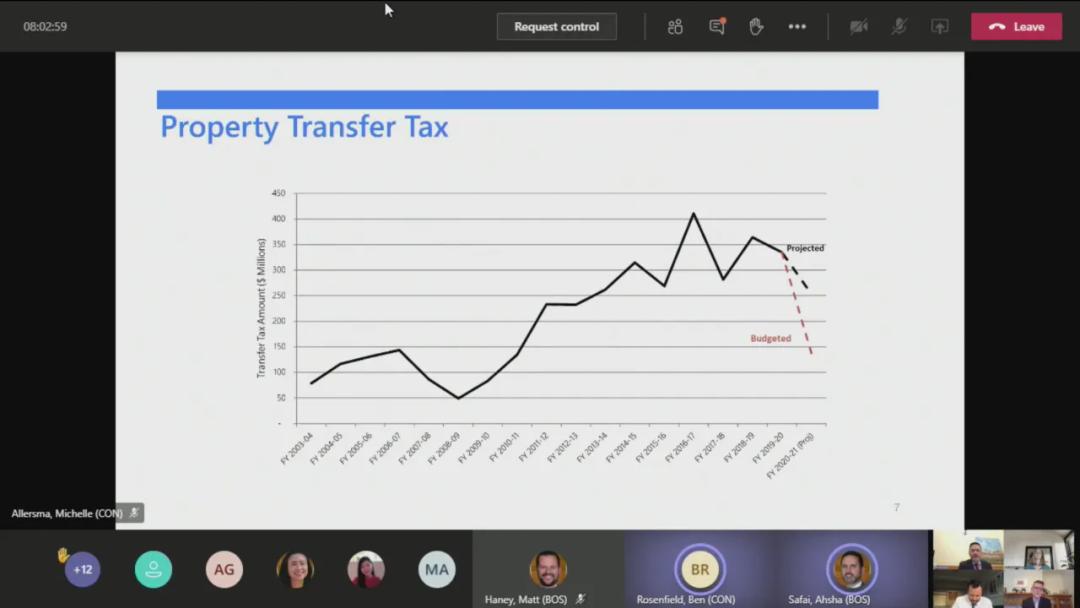
The committee held hearings on the city's economic outlook, five-year finance plan, mayor's budget instructions, six-month budget status report, and an appropriations limit resolution. Key findings included a projected $125 million surplus for the current fiscal year, a $653 million two-year shortfall, and significant economic disparities from COVID-19. Public Comments & Testimony - David Pilpel commented on the six-month report, asking about the availability of the $652 million projection and noting difficulty navigating department budget meetings. - A caller (Jeff Lucas) pointed out an inconsistency in the appropriations limit resolution language, requesting correction of the wording regarding "percentage change in the local assessment role" versus "from 2019." He also noted an error in the calculation of the cost of living factor. Discussion Items - Economic Update (Item 5): Ted Egan (Controller's Office) presented data on employment, migration, rents, and office vacancy. San Francisco lost 175,000 jobs in April 2020, recovered 90,000, with unemployment above 6%. Professional services recovered fully, but restaurants were down 40%. Outmigration saw 35,000 more people moving out than in, mostly to nearby suburbs. Rents fell 27% year-over-year, office vacancy rose above 16%. Supervisors Safai, Ronan, Mar, and Chan discussed impacts on inequality, working-class residents, and the need for a diverse economy. - Five-Year Finance Plan and Mayor's Budget Instructions (Items 1 & 2): Ashley Graffenberger (Mayor's Budget Office) presented a projected two-year shortfall of $653 million for FY22-23, driven by slower revenue recovery, unfunded labor costs, and continued COVID expenses. Departments were asked to propose 7.5% reductions with an additional 2.5% contingency. The mayor emphasized an equity lens, requiring departments to assess the equity impact of proposed changes. - Six-Month Budget Status Report (Item 3): Controller Ben Rosenfield reported a projected $125 million surplus in the current fiscal year, primarily from state and federal actions: $50 million from ERAF, $20–30 million from redevelopment property tax, $50 million from disproportionate share hospital funding, and $30 million from behavioral health reconciliation. Additionally, the COVID response fund showed a $77 million surplus due to FEMA's 100% reimbursement rate. Key uncertainties include the pending federal stimulus (potentially $600 million for San Francisco), FEMA changes, and lagging hotel and sales tax revenues. - Appropriations Limit (Item 4): The controller's office presented the annual Gann limit calculation, resulting in a limit of $8.36 billion for FY2020-21, well above net tax proceeds of $4.6 billion. Voter-approved tax measures added $1.4 billion in capacity. The resolution was forwarded to the full board. Key Outcomes - All hearings were filed or continued: Items 1, 2, and 3 were filed; Item 5 was continued to the call of the chair. - Resolution 210071 (Appropriations Limit) was approved to the full board with a positive recommendation (5-0 vote). Chair Haney noted possible minor wording changes per public comment. - Chair Haney announced a planned special hearing to address the $125 million surplus and other pending proposals in a coordinated process, involving the mayor's office and board colleagues.
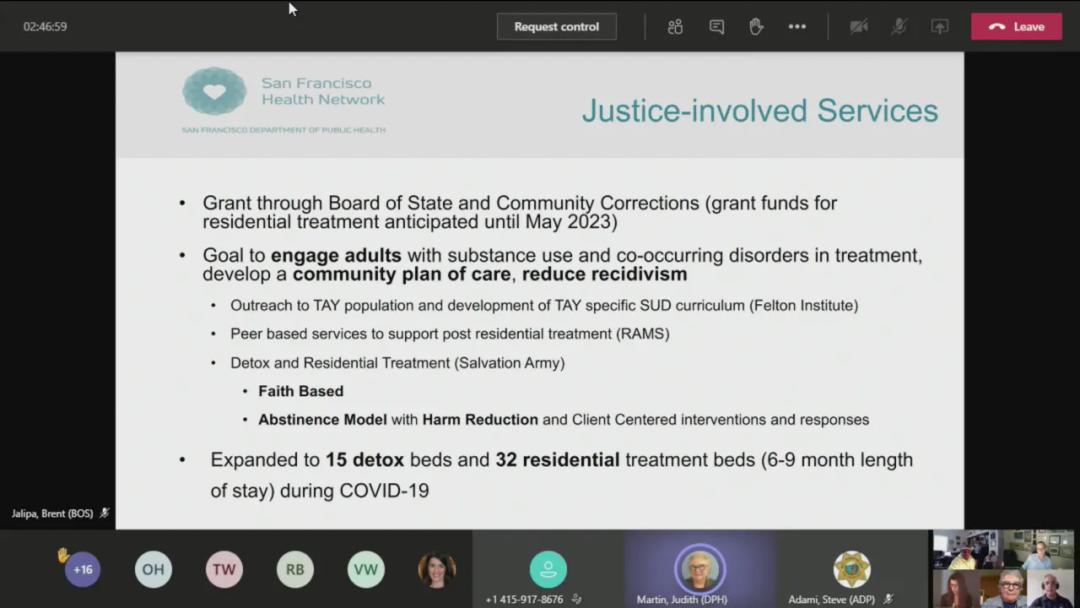
On February 11, 2021, the Public Safety and Neighborhood Services Committee, chaired by Supervisor Gordon Maher and joined by Vice Chair Catherine Stefani and Members Matt Haney and Rafael Mandelman, held a hearing to discuss the findings of the San Francisco Recovery Summit Working Group and a preliminary evaluation of the city's housing conservatorship program. The meeting highlighted the devastating overdose crisis—699 deaths in 2020—and the need to expand treatment options, including abstinence-based and peer-led programs, alongside harm reduction. A second hearing on the housing conservatorship was continued to March 11, 2021. Consent Calendar - No consent calendar items were considered. Public Comments & Testimony - James Daggs (Bayview community member) supported community-centric, black-led programs and criticized the Department of Public Health's (DPH) approach as not working in practice. - Rebecca Jackson (Cameo House) advocated for long-term, abstinence-based programs for homeless women of color, emphasizing the need for culturally specific services. - Malik Washington (Editor, San Francisco Bayview National Black Newspaper) called attention to Cameo House and the importance of black-led recovery programs. - Wesley Saver (Glide) defended harm reduction, stating it is evidence-based and saves lives, and urged against pitting harm reduction against abstinence. - Laura Thomas (San Francisco AIDS Foundation) noted that the 2009 budget cuts eliminated many services, not harm reduction, and called for rebuilding black-led programs. - Taylor Rose Picard (San Francisco AIDS Foundation) stressed that harm reduction builds trust and can lead to treatment, and that people need choices. - Paul Aguilar (fourth-generation San Franciscan) shared his successful recovery through residential treatment after harm reduction, supporting multiple treatment pathways. - JCD (Positive Direction, Bayview) praised peer-led support groups for helping him address underlying issues. Discussion Items - Recovery Summit Working Group Presentation: Steve Adami, Adrian Maldonado, Craig Johnson, Cedric Akbar, and others presented survey data from 422 respondents (current/former drug users). Key findings: 81% began struggling with addiction before age 24; 69% struggled for 10+ years; 74% agreed there is a need for more treatment options, including abstinence-based, faith-based, and social model programs. Recommendations included: expand treatment options (residential, abstinence-based, faith-based, harm reduction, safe consumption sites); extend stays beyond 90 days; fund black-led abstinence-based programs in Bayview; include recovery voices in policy; develop specialized youth programs (ages 16–25); expand paid peer specialists; and increase awareness of available services. The working group emphasized they are not asking to stop harm reduction but to enlarge the solution space. - Dr. Judith Martin (DPH) responded, presenting the DPH's harm reduction framework, medication-assisted treatment (MAT), and efforts to expand access. She noted that 95% of people with substance use disorder do not perceive the need for treatment, and that the city must meet people where they are. She highlighted the importance of buprenorphine (95% protective against fentanyl overdose) and the goal of 90% of people with opioid use disorder on MAT. She acknowledged gaps in residential step-down housing (needs 200–300 more beds) and the need for culturally specific programs. - Committee Questions: Supervisors Stefani, Haney, Mandelman, and Maher questioned DPH's approach. Supervisor Stefani pushed for the inclusion of abstinence-based recovery and criticized the disconnect between DPH's presentation and the lived experience of the working group. Supervisor Haney noted that only two people from shelter-in-place hotels had accessed residential treatment and called for more streamlined entry points. Supervisor Mandelman questioned whether DPH's measure of success (e.g., deaths averted) was adequate given the scale of the crisis, and asked why DPH does not contract with abstinence-only providers. Supervisor Maher inquired about youth-specific programs; DPH described wraparound services and prevention programs. Key Outcomes - Vote on Item 2 (Housing Conservatorship): The committee unanimously voted to continue this hearing to March 11, 2021, to allow the DPH director to attend. - Vote on Item 1 (Recovery Summit Hearing): The committee unanimously voted to continue this hearing to the call of the chair, signaling ongoing discussion. - Next Steps: Supervisor Mandelman and Vice Chair Stefani committed to future hearings on treatment on demand and further collaboration with the Recovery Summit Working Group. Dr. Martin agreed to facilitate a follow-up meeting between DPH and the working group.
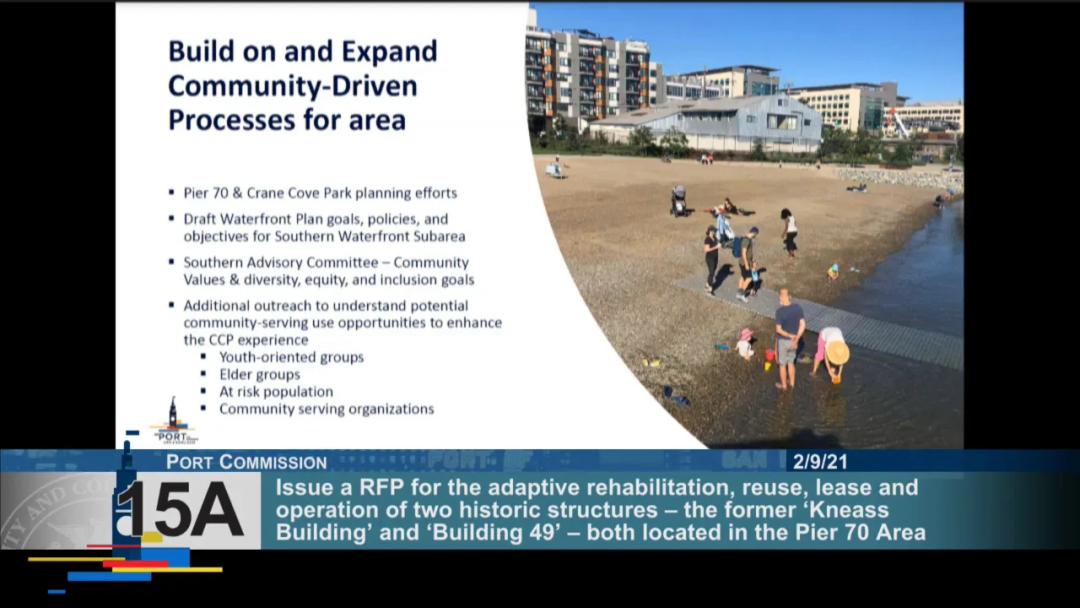
The Port Commission met on February 9, 2021, at 10:15 AM (though the meeting was called to order at 2:00 PM per the transcript). The meeting covered a range of topics including the Executive Director's report, approval of the Ten-Year Capital Plan, updates on the Waterfront Resilience Program's equity efforts, acceptance of donations for shoreline projects, amendments to the Harbor Traffic Code, and authorization to issue an RFP for historic building reuse and enter into an Exclusive Negotiating Agreement for the Piers 30-32 and Seawall Lot 330 development. Consent Calendar - Resolution 2103 (Item 10A): Approved a Declaration of Restrictions for Pier 70 Parcel K North, termination of the DOR upon park dedication, and related actions. Unanimously adopted (Commissioner Burton recused). Public Comments & Testimony - Greek Community Request (Paso Zografos, President, United Hellenic American Societies): Requested permission to raise Greek flags along the Embarcadero and light the Ferry Building in blue and white during Greek Heritage Week. The Executive Director stated port staff would follow up. - Tenant Rent Relief (Pete Sitnik, Managing Partner, Water Bar and Epic): Expressed gratitude for the percentage rent program but urged the Port to extend it through the full year of 2021, noting the impact of the second shutdown. - Piers 30-32 Project Support: - Katie Liddell (scoring panel member) praised the thorough RFP process and Strata TCC's proposal. - Rudy Gonzalez (San Francisco Building and Construction Trades Council) expressed support for the project’s benefits and Strata's track record. - Ellis Rogers (South Park resident) urged moving forward with the ENA. - Marina Saccatano (Maritime Commerce Advisory Committee co-chair) supported the proposal, emphasizing maintaining deep-water berths. - Ellen Jonk (Maritime Commerce Advisory Committee co-chair) endorsed continuing negotiations with Strata, noting compliance with maritime preservation policies. Discussion Items - Executive Director’s Report (Item 9A): Updated on economic reopening (outdoor dining resuming, BCDC licenses), equity initiatives (street naming at Mission Rock celebrating Black women, Black History Month programming), Pier 70 Phase 1 building use change (Building 2 from residential to commercial office, decreasing max residential units from 700 to 588, increasing office from 350k to 464k GSF), and the Port's 2020 Employees and Teams of the Year awards (including responses to Pier 45 fire and Hyde Street Harbor oil spill). - Ten-Year Capital Plan (Item 11A): Presented by Nate Cruz. The plan identifies nearly $4 billion in capital needs over FY2022-2031 ($2B state of good repair, $1.93B enhancements) with funding shortfalls. Staff discussed integration with the five-year CIP and two-year budget. A calendar of upcoming finance items will be provided. - Waterfront Resilience Program Equity Actions (Item 12A): Brad Benson and Carlos Cologne presented on LBE subcontracting progress. Under the CH2M Hill contract, LBE participation reached 9.8% by end of 2020 (exceeding 7.3% projection). The Civic Edge communications contract has 39.2% LBE invoiced. A quarterly reporting structure was established. - Heron’s Head Park Donation (Item 13A): Carol Bach requested authorization to accept $417,000 in beach material from Hanson Aggregates for the shoreline resilience project. The material is a byproduct of Hanson’s sand production. Unanimously adopted as Resolution 2104. - Pier 94 Wetlands Stewardship (Item 13B): Acceptance of over $10,000 in volunteer hours and materials from the San Francisco Conservation Corps, and extension of the license with Golden Gate Audubon Society through 2032. Unanimously adopted as Resolution 2105. - Harbor Traffic Code Amendments (Item 14A): Paul Chausen presented amendments to establish curbside uses (parking, loading) on Port streets in Pier 70 Phase 1. Unanimously adopted as Resolution 2106. - RFP for Historic Buildings at Pier 70 (Item 15A): Authorization to issue an RFP for adaptive reuse of the Kneass Building and Building 49 adjacent to Crane Cove Park. Unanimously adopted as Resolution 2107. - Exclusive Negotiating Agreement for Piers 30-32 (Item 15B): Authorization to enter into an ENA with Strada TCC Partners for a mixed-use project including 850 residential units, commercial, maritime, and public access uses. Key terms include a 4.5-year term, a 4-month initial consultation period with deferred negotiation fee, and transfer provisions. Unanimously adopted as Resolution 2108 (Commissioner Burton recused). Key Outcomes - Votes: All resolutions (2103, 2104, 2105, 2106, 2107, 2108) were adopted unanimously, with Commissioner Burton recused on 10A and 15B. - Directives: The Executive Director will follow up on the Greek community’s request. Staff will prepare a calendar of finance items and return with updates on the Piers 30-32 project in late summer. - Next Steps: The Ten-Year Capital Plan will inform the five-year CIP and two-year capital budget adjustments in March. The Waterfront Resilience Program will report quarterly on LBE performance. The RFP for Pier 70 historic buildings will be released in mid-March with proposals due in late May. ENA negotiations for Piers 30-32 will commence with community and regulatory outreach.
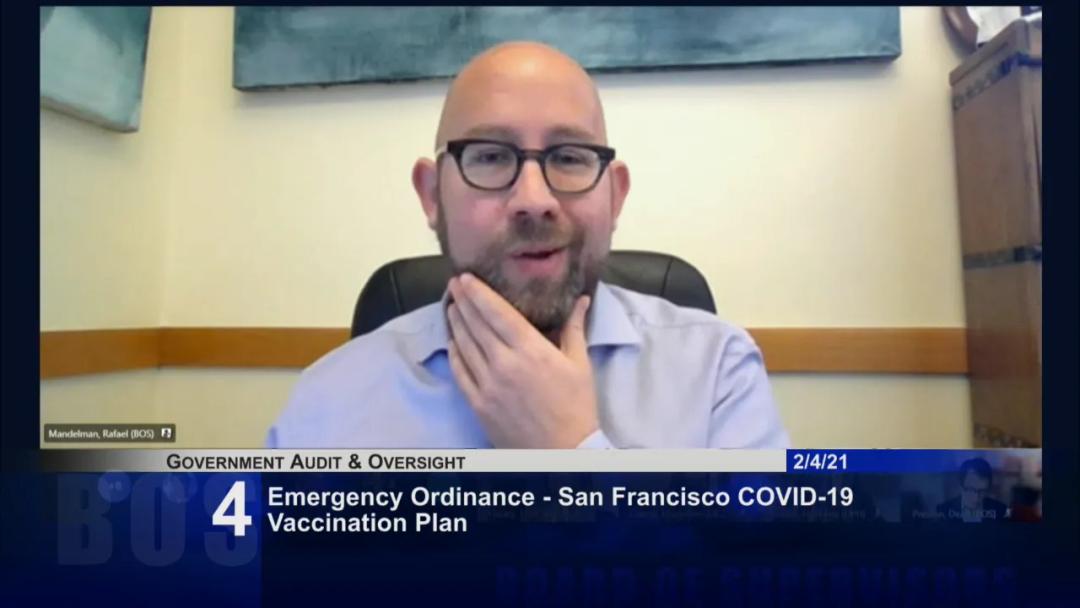
The Government Audit and Oversight Committee of the San Francisco Board of Supervisors met on Thursday, February 4, 2021, at 10:00 AM via remote conference. Chair Dean Preston presided, joined by Vice Chair Connie Chan and Committee Member Raphael Mandelman. The committee considered four agenda items: an ordinance on residential hotel protections during COVID-19, reenactment of the Public Health Emergency Leave ordinance, a hearing on public corruption investigations, and an emergency ordinance on the city's COVID-19 vaccination plan. Key actions included continuances, amendments, and forwarding items to the full Board. Public Comments & Testimony - Item 1 (Residential Hotel Protections): No public comments were received. - Item 2 (Public Health Emergency Leave): No public comments were received during the initial hearing or after amendments were proposed. - Item 3 (Public Corruption Hearing): David Pilpel (public commenter) suggested that large departments like the airport, MTA, PUC, Rec & Park, Port, and DPW could benefit from internal audit functions similar to the PUC's, noting that such units could help prevent corruption. - Item 4 (COVID-19 Vaccination Plan): Multiple callers spoke: - LaShawn Walker (District 10 resident, Mega Black COVID-19 Task Force, SF AIDS Foundation board member) urged the city to be more proactive in advocating for vaccine supply and to prioritize comorbidities and vulnerable populations. She also expressed concern that the SF Produce Market site had been announced but was not yet operational. - A caller (Mr. DeCosta) criticized the city's data and logistics, suggesting FEMA should be consulted and that the city has failed in testing and vaccination planning. - Angela J. (Mega Black COVID-19 Task Force) called for equitable vaccine access without red tape, especially for unhoused Black San Franciscans and those with mobility issues. - John Jacobo (Podco Group, affordable housing developers) requested clarification on the mobile vaccination strategy for seniors in affordable housing facilities, emphasizing the need to protect the most vulnerable. Discussion Items Item 1: Administrative Code – Protections for Occupants of Residential Hotels During COVID-19 Pandemic (File 201388) Supervisor Peskin, the sponsor, requested a continuance to the February 18, 2021 meeting, citing ongoing negotiations between the SRO collaborative, his office, and the Department of Public Health. The committee unanimously voted to continue the item. Item 2: Emergency Ordinance – Public Health Emergency Leave (File 210052) Supervisor Marr, sponsor, presented the reenactment of the ordinance requiring private employers with 500+ employees to provide public health emergency leave. He noted that this was the sixth time the policy was before the committee and the fifth reenactment. After initial unanimous approval as a committee report, Supervisor Marr requested to rescind the vote to offer amendments. The amendments (deemed non-substantive by the Deputy City Attorney) would: 1. Remove the provision requiring leave for employees not scheduled to work. 2. Add an exemption for social enterprise nonprofits (excluding healthcare provider nonprofits). The committee approved the amendments and forwarded the amended ordinance to the full Board as a committee report. Item 3: Hearing – Investigations Into Public Corruption (File 200279) Supervisor Marr, as former chair of the committee, called the hearing to discuss the fourth public integrity review report from the Controller's Office, focusing on ethical standards for contract award processes at the Airport Commission and other commissions/boards. Mark De La Rosa (Acting Director of Audits) and Todd Rydstrom (Deputy Controller) presented findings: - The Controller's Office found no substantial structural problems with the Airport Commission's procurement process, but noted that former Commissioner Linda Creighton allegedly violated communication restrictions by meeting with a potential bidder (Nick Bovis) during a quiet period. - Recommendations included: revising policies to clarify commissioner involvement, annual training on Statements of Incompatible Activities (SIAs), codifying prohibitions on selective assistance, enforcing communication restrictions, and improving transparency through Form 126 reporting. - The report also recommended codifying limitations on commissioner involvement in contract awards, referencing Los Angeles County as an example. - The Controller's Office highlighted that the airport has already strengthened contracting policies and that three more reports are pending (citywide ethics reporting, DBI permit practices, and a final summary). Deputy City Attorney Flynn noted that the City Attorney's Office has been investigating vendor misconduct and will suspend eight vendors in the next two weeks. He confirmed that the airport did not follow the same pattern of corruption seen at DPW and PUC. Committee members discussed the effectiveness of current controls, whether the airport was more corruption-resilient, and the need for consistent SIAs across departments. The item was continued to the call of the chair. Item 4: Emergency Ordinance – San Francisco COVID-19 Vaccination Plan (File 210075) Supervisor Haney, sponsor, introduced the ordinance requiring the Department of Public Health to create a comprehensive vaccination plan and publicly report data on vaccine doses, administration, and demographics. He emphasized the need for transparency, equity, and a clear communication strategy, noting that other counties (e.g., Contra Costa, San Mateo) already provide disaggregated data. Mary Ellen Carroll (COVID Command Director) and Dr. Navina Boba (Deputy Health Officer) presented the city's vaccination strategy: - As of the meeting, over 110,000 doses had been administered in San Francisco, with approximately 80,000 to San Francisco residents. About 9% of the population had received at least one dose. - 62% of the city's allocation had been used; the remaining 38% was earmarked for first-dose appointments or second doses. - A three-pronged strategy includes high-volume sites (City College, Moscone Center South, SF Produce Market), community vaccine access sites, and pharmacies. Together, these sites could serve over 10,000 people per day once supply is available. - The city has ordered full allocations from the state and is on a waiting list for over 30,000 additional doses. - Data transparency efforts are underway, with plans to break down vaccination by race, ethnicity, age, and neighborhood, but the timeline for public release was not specified. - The state's shift to an age-based priority system (65+ and healthcare workers) has created confusion, and the city is awaiting further guidance on essential workers and people with comorbidities. - The city is developing a centralized appointment system and mobile vaccination units for homebound populations. Supervisor Haney and committee members pressed for faster data publication, a unified portal, and better communication with vulnerable communities. The ordinance was forwarded to the full Board as a committee report. Key Outcomes - Item 1: Continued to the February 18, 2021, committee meeting (unanimous vote: 3-0). - Item 2: Original vote to recommend rescinded; amendments adopted (unanimous: 3-0); amended ordinance forwarded to the Board of Supervisors as a committee report for consideration on February 9, 2021 (unanimous: 3-0). - Item 3: Continued to the call of the chair by motion of Chair Preston (unanimous: 3-0). - Item 4: Forwarded to the Board of Supervisors as a committee report for consideration on February 9, 2021 (unanimous: 3-0).