The Public Safety and Neighborhood Services Committee, chaired by Supervisor Gordon Maher, met on March 25, 2021, to consider two liquor license applications, hold a hearing on maximizing Medi-Cal reimbursements for youth mental health services, and advance an ordinance strengthening gun violence restraining orders (GVROs). The meeting lasted from approximately 10:15 a.m. to 12:15 p.m. Consent Calendar - Item 1 (Liquor License – Bar Part-Time, 496 14th Street): The committee voted unanimously to recommend approval of a Type 42 on-sale beer and wine license, finding it would serve public convenience and necessity. The Alcohol Liaison Unit (ALU) recommended conditions on loitering and noise, which the applicant accepted. No public comment was received. (Roll call: 3-0) - Item 2 (Liquor License Transfer – Bloomingdale’s, 845 Market Street): The committee voted unanimously to recommend approval of a Type 21 off-sale general license. ALU conditions included minimum container sizes and multi-unit sales for certain beverages; the applicant agreed. No public comment. (Roll call: 3-0) Public Comments & Testimony - Item 3 (Mental Health Reimbursements): Two callers spoke. The first, representing the Family Resource Center Alliance, expressed strong support for the new Medi-Cal billing project, noting that 26 FRCs are eager to begin claiming on April 1, 2021. The caller emphasized that the new revenue would supplement, not supplant, existing funding. No other callers were heard. - Item 4 (GVRO Ordinance): Two callers, both from Brady United Against Gun Violence, voiced strong support for the proposed ordinance and thanked the committee for its work. No opposition was voiced. Discussion Items Item 3 – Hearing on Reimbursement Practices and Maximizing Funding for Youth Mental Health Services Supervisor Mirna Malgar presented the hearing, highlighting a parallel mental health crisis exacerbated by the pandemic. Key presenters included: - Alex Briscoe (California Children’s Trust): Reported a 104% increase in self-injury and inpatient admissions for suicidal ideation among children since 2007; only 5% of California children receive any mental health care. He explained Medicaid’s “pay-for-diagnosis” model and outlined four funded projects expected to generate $6–10 million in new federal revenue annually: (1) Family Resource Centers time-study claiming starting April 1, (2) a new Medi-Cal benefit for caregiver mental health during well-child visits, (3) San Francisco Unified School District expansion, and (4) administrative activity claiming by the Department of Public Health (DPH). - Drew Morel (DPH, Behavioral Health Services): Noted that a federal waiver (1135) lifted the administrative cost cap from 15% to 30% during the COVID public health emergency, yielding an estimated $2–3 million additional revenue for fiscal year 2019-20. He explained that DPH had stopped claiming “mental health MA” (administrative activities) in 2016 due to new state time-study requirements creating an excessive burden. Current efforts focus on “direct charge” opportunities where staff or contractors are 100% dedicated to eligible activities, avoiding time studies. - Fred Rousseau (Budget and Legislative Analyst): Presented estimates that DPH could recover $3.2 million by shifting administrative costs over the 15% cap into mental health MA, and that contractors could generate $7 million if they claimed 5% of unadministered time. He noted Alameda County increased such claims from $3 million to $17 million annually under similar circumstances and recommended six-month progress reports to the board. - Dr. Farah Arramond (DPH, Children, Youth and Family System of Care): Identified two top needs: (1) three crisis residential beds ($1.1 million) and (2) expanded youth substance use treatment ($2 million). She described ongoing system alignment with the school district, child welfare, and juvenile probation. Discussion focused on the audit risk of time-study-based claims (audits can occur 6–7 years later) and the need for sustained county investment to leverage federal matches. Supervisor Stefani connected the hearing to her prior work on youth substance abuse programming. Item 4 – Ordinance Amending Police Code on Gun Violence Restraining Orders Supervisor Catherine Stefani presented the ordinance, which: (1) requires peace officers to serve and file GVROs no later than three days after issuance, and (2) allows the city to enforce out-of-state GVROs as if issued locally. She noted a minor amendment (adding “in coordination with the city attorney” on page 4, lines 3, 12, 19) and corrected the title accordingly. Commander Raj Baswani and Sergeant Patrick Faye (SFPD) reported on GVRO implementation: in 2020, eight GVROs were obtained; one so far in 2021. They described a case where an escalating neighbor dispute led to a GVRO and firearm seizure. Commander Baswani highlighted a 390% increase in shootings year-to-date (from 10 in 2020 to over 50 in 2021) and noted that most gun violence involves illegal firearms, but GVROs are a critical tool for legally owned firearms in high-risk situations. Training expansion is planned once officers are vaccinated. Supervisor Maher expressed support and asked to be added as a co-sponsor. The committee adopted the amendments and then voted to recommend the ordinance as amended to the full board. (Roll call: 3-0) Key Outcomes - Items 1 and 2 (Liquor Licenses): Both recommended to the full Board of Supervisors for the April 6, 2021 agenda (unanimous). - Item 3 (Mental Health Reimbursements): The hearing was continued to the call of the chair (motion by Chair Maher, unanimous). The committee directed DPH and BLA to continue working with California Children’s Trust and report back on progress within six months. - Item 4 (GVRO Ordinance): The ordinance was approved as amended and recommended to the full Board of Supervisors (unanimous). Supervisor Haney was added as a co-sponsor. Note: Supervisor Haney was excused from 10:47 a.m. to 11:29 a.m. due to a prior commitment.
Public Meetings - San Francisco, California
Public Meetings - San Francisco, CaliforniaThe Budget and Appropriations Committee of the San Francisco Board of Supervisors met on March 24, 2021, chaired by Supervisor Matt Haney, with members President Shamann Walton, Vice Chair Ahsha Safai, and Supervisors Hillary Ronen and Gordon Mar. The agenda included three items: a hearing on updates to the city's economy and financial condition (continued to the call of the chair), a hearing on the Department of Children, Youth and Their Families (DCYF) budget for fiscal years 2021-2022 and 2022-2023, and a hearing on the Office of the City Administrator's budget for the same period. Public Comments & Testimony - Item 1 (Economic Update): No public comment was offered. - Item 2 (DCYF Budget): Four members of the public spoke in support of City College of San Francisco (CCSF), urging the committee to address the college's budget crisis. Speakers included CCSF students and a faculty member who highlighted the potential layoff of 60% of faculty, impacting over 40,000 students, and the importance of CCSF for workforce training, ESL, DSPS, and programs serving immigrant and low-income communities. They requested emergency city assistance and sustained funding for the Workforce Education and Recovery Fund (WERF) and free city college. - Item 3 (City Administrator Budget): Three speakers, all current or former DreamSF Fellows, advocated for continued funding for the DreamSF Fellowship program, specifically to restore a permanent coordinator position. They emphasized the program's unique role in providing professional development and leadership opportunities for undocumented immigrants, and noted that the program has operated without an official coordinator for two years. Discussion Items - Item 1 – Hearing on City Economy and Financial Condition: Chair Haney made a motion to continue this item to the call of the chair, citing no discussion needed. The motion was seconded by Vice Chair Safai and approved unanimously (5-0). - Item 2 – DCYF Budget (FY21-22 and FY22-23): Director Maria Sue presented the budget, which totals $166 million in discretionary funds (excluding $90.5 million for public education and $16.4 million for free city college). The budget is relatively flat, with 67% from the Children and Youth Fund ($111 million), 28% from the general fund ($47 million), and 5% from federal/state grants. The department committed to not cutting nonprofit agency budgets, instead reducing non-personnel services such as technical assistance and evaluation contracts. Director Sue highlighted the Community Hubs initiative (84 sites, serving over 2,000 children with zero COVID outbreaks) and the upcoming Summer Together program aiming to serve 20,000 children with academic recovery. She also discussed the SF Rise initiative for long-term learning recovery. Supervisors praised the department's work, with Supervisor Ronen requesting additional staffing for DCYF to lead SF Rise, and Supervisor Mar emphasizing the need for stronger pathways from high school to City College and full investment in WERF. Supervisor Safai inquired about Summer Together details and the need to extend the hub model permanently. Chair Haney asked about equity prioritization and the reduction in non-personnel services (technical assistance and evaluation). The department noted a $1 million gap in food costs for hubs due to FEMA/ USDA paperwork challenges. - Item 3 – Office of the City Administrator Budget (FY21-22 and FY22-23): City Administrator Carmen Chu presented the budget, noting a proposed $505 million for FY21-22 (up from $472 million current year) and $529 million for FY22-23, with FTE counts roughly flat. She highlighted the office's broad portfolio: public-facing services (311, Animal Care & Control, Office of Civic Engagement & Immigrant Affairs, Grants for the Arts, Office of Cannabis, etc.) and internal services (real estate, fleet, contract administration, digital services). Key challenges identified include COVID-19 response and recovery, convention/tourism decline (impacting $800 million in annual city revenue and 80,000 jobs), digital divide, support for small businesses and arts organizations, and anti-Asian violence. Administrator Chu detailed equity efforts: a 10% reallocation of arts grants to smaller organizations (17 organizations rooted in trans and Black communities saw a 25% funding increase), community ambassador program, and focus on racial equity plans. On oversight, she noted full implementation of controller's public integrity recommendations, strengthened contract administration (OCA) digitization and training, and upcoming work on the DPW transition under Proposition B (including potential sanitation commission). Supervisor Safai asked about digital divide funding (responses on infrastructure, equipment, and training), 311 call resolution (noted the connected worker app and need for better closure), and Grants for the Arts funding timeline. President Walton inquired about the community ambassador program, which faces a slight reduction ($2,000), and Administrator Chu indicated interest in expanding it. Supervisor Ronen raised the need for real estate department capacity to find a secure placement for the juvenile hall closure workgroup, with Real Estate Director Andrico Penick confirming efforts but noting significant renovation needs. Supervisor Mar asked about strengthening OCA's citywide procurement oversight, with OCA acting director Sailaja Golla outlining plans for digitizing compliance workflows. Key Outcomes - Item 1: The hearing on the city's economy and financial condition was continued to the call of the chair (motion carried 5-0). - Item 2: The DCYF budget hearing was filed (motion carried 5-0). The committee expressed strong support for the department and commitment to addressing City College funding and equitable investments. - Item 3: The City Administrator's budget hearing was filed (motion carried 4-0 with Vice Chair Safai absent, but later confirmed as 5-0). The committee noted the need for continued collaboration on digital equity, real estate resources, DPW transition, and oversight improvements.
The Port Commission met on March 23, 2021, from 2:30 PM to 5:49 PM, to address a range of financial, operational, and equity matters. The meeting included tributes to former Commissioner Anne Halsted, discussion of the port's severe revenue losses due to COVID-19, approval of a $68 million bond issuance for the Mission Rock development, extension of a shelter site agreement, and award of a construction contract for Crane Cove Park. Consent Calendar - Approval of Minutes (March 9, 2021): The minutes were adopted unanimously. - Executive Session: The commission voted unanimously to hold a closed session to discuss litigation and attorney-client privileged matters, then reconvened in open session without disclosing any discussions. Public Comments & Testimony - Executive Director’s Report: - Faye Sen (President, Treasure Island Development Authority) paid tribute to Anne Halsted, praising her civic dedication. - Wallace Lee (on behalf of Susan Barkendale) commended the Port Commission for its responsiveness to concerns about the Embarcadero Safe Navigation Center, noting that issues have abated recently. - Bonnie Fisher proposed a citywide dedication event and commemorative plaque for Anne Halsted at the ferry terminal plaza, pledging to raise funds and work with port staff. - Item 10A (Budget Presentation): No public comments were received. - Item 11A (Mission Rock Bonds): No public comments were received. - Item 11B (Shelter MOU): No public comments were received. - Item 12A (Crane Cove Park Contract): No public comments were received. Discussion Items - Executive Director’s Report (Item 9A): - Director Elaine Forbes reported on the one-year anniversary of shelter-in-place, the city's imminent move to the orange tier, and the port's equity initiatives. She noted that the Embarcadero Safe Navigation Center now operates with 88 guests due to social distancing, and that unsheltered homeless counts in the area dropped from 179 (two years ago) to 60. The SS Jeremiah O'Brien returned to Pier 45. Forbes also delivered a tribute to former Commissioner Anne Halsted, who passed away on March 13, 2021. Commissioners and staff added personal remarks, with Commissioner Wuho and Vice President Adams condemning anti-Asian violence and the Boulder shooting. - Fiscal Year 2021-22 Supplemental Budget (Item 10A): - CFO Katie Patruccioni and Finance Director Nate Cruz presented a dire financial outlook: port revenue is down 45% overall, with tourism-dependent tenants down 75%. Unpaid rent has risen from $3.5 million (pre-COVID) to $22 million. A five-year recovery is projected, with total revenue loss exceeding $100 million. The supplemental proposes $12.5 million in operating savings (including a soft hiring freeze and up to five layoffs as a last resort) and a $38.3 million capital defunding to replenish fund balance. Commissioners Wuho and Gilman questioned the $3 million rent increase at Pier One (due to a market reset with master tenant Prologis) and suggested negotiating a delay or reduction. Commissioner Brandon asked about compliance with the port's capital investment and reserve policies; staff acknowledged the policies are not being met and requested a deferral. The presentation will be brought back for a vote at the next meeting. - Mission Rock Community Facilities District Financing (Item 11A): - Project Manager Raven Anderson requested approval to issue up to $68 million in bonds to replace high-cost developer equity (18% return) with low-interest public financing. Phase 1 includes 537 homes (199 below-market-rate), 550,000 sq. ft. of office, retail, and 5.5 acres of parks. The bond would be secured by special taxes; the appraised value of the CFD leasehold has increased from $130 million to $334 million, allowing for the larger issuance. Commissioner Burton asked about bond buyers (institutional investors) and the impact of COVID on office demand; staff noted that the city's general fund is not at risk and that the developer is betting on recovery. Commissioner Wuho supported the issuance, and the resolution passed unanimously. - Amendment to Shelter Site MOU (Item 11B): - Deputy Director Rebecca Benassini presented an amendment to the MOU with the Human Services Agency for a temporary shelter site at Seawall Lot 344 (Backlands). The amendment extends the term to October 31, 2021 (or end of the health emergency) and clarifies that rent is due retroactively, totaling over $900,000. Daryush Kahan from COVID Command reported that 117 of 120 trailers are in use, with 118 guests. 49 guests have exited, 7 to permanent housing, and 6 guests are fully vaccinated. Commissioner Gilman noted that the city is now receiving 100% FEMA reimbursement for such sites. The resolution passed unanimously. - Crane Cove Park Building 49 Contract (Item 12A): - Project Manager Erica Peterson requested authorization to award a $1,879,600 construction contract to Wickman Development and Construction, plus a 10% contingency. The project will complete public restrooms and a shell building for future tenant (e.g., cafe or kayak rental). Bids came in under budget, and the overall park project is within its $36 million budget. The contract includes 35.98% LBE subcontractor participation. The resolution passed unanimously. Key Outcomes - Voted Unanimously: - Approval of March 9, 2021 minutes. - Resolution 21-11: Mission Rock CFD bond issuance (up to $68 million) and related documents, to be forwarded to the Board of Supervisors. - Resolution 21-12: Amended and restated MOU with the Human Services Agency for the shelter site, extending term and confirming rent due. - Resolution 21-13: Award of construction contract for Crane Cove Park Building 49 to Wickman Development. - Directives and Next Steps: - Staff will revisit the Pier One rent negotiation and the Southern Waterfront Beautification Fund allocation in light of commissioner concerns. - A staff report on port policies (capital investment and reserve) will be provided for the April 13, 2021 meeting. - Commissioner Gilman requested a written information report on ferry building vacancies and community access; Commissioner Burton asked for an update on the World Trade Center building; Commissioner Brandon requested an update on backlands maritime planning and a formal naming/dedication policy. - The meeting adjourned at 5:49 PM in memory of Anne Halsted, the victims of the Atlanta shootings, and the Boulder shooting victims.
The San Francisco Board of Supervisors Budget and Appropriations Committee held a special meeting on March 23, 2021, to consider two appropriation ordinances providing COVID-19 relief and housing funding. The meeting had a hard stop at 10 a.m., and public comment was limited to one minute per speaker. Both items were recommended to the full board with positive recommendations. Consent Calendar - None – both agenda items were discussed as regular agenda items and voted on individually. Public Comments & Testimony - No public comments were received on either item. The clerk confirmed no callers were in the queue for both agenda items. Discussion Items - Item 1 (File 201364): Ordinance appropriating $20,100,000 from property tax revenue to the Mayor's Office of Housing and Community Development: $10,050,000 for rent relief under the Rent Resolution and Relief Fund, and $10,050,000 for the acquisition, creation, and operation of affordable social housing under the Housing Stability Fund for FY2020-2021. - Supervisor Preston urged support, thanking the committee for co-sponsorship and highlighting the allocation of Proposition I revenue to rent relief and housing stability funds. - Supervisor Safai asked to be added as a co-sponsor; the chair noted he would also be added. - The Budget Legislative Analyst (Nick Minard) confirmed a report was provided last week. - Item 2 (File 210177): Ordinance appropriating $104,900,000 from property tax revenue to various departments (Office of Economic and Workforce Development, General Services Agency, City Administrator, Arts Commission, Department of Children, Youth and Their Families, Public Health, and General City Responsibility) for relief to small businesses, including those impacted by property crime, grants for the arts, cultural centers, youth learning initiatives, dual enrollment programs, overdose prevention, and family relief struggling due to COVID-19. The ordinance also de-appropriates $28,200,000 in business fee revenue and places $6,520,705 on reserve for FY2020-2021. - Supervisor Marr thanked the chair and staff for consensus building and asked to be added as a co-sponsor. - President Walton thanked the committee and mayor's office for unified work. - The Budget Legislative Analyst (Nick Minard) stated there was no revised report but considered approval a policy matter. - The chair presented two non-substantive amendments: on page 6 line 9, the $1.1 million transfer for cultural districts should read "MOCD" (Mayor's Office of Community Development) instead of "Arts Commission"; on page 8 lines 19-22, the family relief fund transfer should read "OEWD" instead of "OSB". Key Outcomes - Item 1: Motion to recommend to the full board with positive recommendation as a committee report passed 4-0 (Supervisor Ronan absent). The motion was made by Chair Haney, seconded by President Walton. - Item 2: Amendments accepted by unanimous vote of 4-0 (Supervisor Ronan absent). Motion to recommend to the full board as amended as a committee report passed 4-0 (Supervisor Ronan absent). The motion was made by Chair Haney, seconded by Vice Chair Safai. - Both items were scheduled for consideration at the full Board of Supervisors meeting later that day (March 23, 2021, at 2 p.m.).
The Public Safety and Neighborhood Services Committee held a special meeting on Thursday, March 18, 2021, at 12:15 PM, chaired by Supervisor Mar, joined by Vice Chair Catherine Stefani and Committee Member Matt Haney. The sole agenda item was an ordinance amending the Police Code to create a right to reemployment for employees laid off due to the COVID-19 pandemic. The meeting was held remotely due to the COVID-19 health emergency. Public Comments & Testimony - Chevy Fani, Director of Public Policy at the Golden Gate Restaurant Association, called in to express support for Supervisor Mar's amendments. She noted that changing the restaurant threshold to apply to operators with 200 or more employees per location was helpful and thanked the supervisor for listening to industry concerns. - No other public comments were received; the clerk reported reaching the end of the queue with a single caller. Discussion Items - Right to Reemployment Ordinance (Police Code Amendment) – Supervisor Mar summarized the amendments made in the previous week’s meeting (March 11, 2021), highlighting two key changes: 1. Tailoring applicability by industry using definitions from existing worker retention laws, which narrowed the number of affected businesses (particularly restaurants) and set thresholds familiar to employers and the city. 2. Narrowing rehiring requirements to only positions with comparable job duties, pay, benefits, and working conditions that the worker held in the 12 months preceding layoff, removing the requirement to offer jobs that would require training or were not previously held. - Supervisor Mar noted this was the third committee hearing and the 11th vote on the policy in some form, emphasizing that the amendments struck a balance between worker protections and business flexibility. - Vice Chair Stefani thanked Supervisor Mar for the amendments but stated she still had concerns about impacts on seniority issues and women, and would vote no, as she had on previous iterations. - Supervisor Haney did not speak but voted in favor. Key Outcomes - Motion: Supervisor Mar moved to send the ordinance to the full Board of Supervisors as a committee report with a positive recommendation. - Vote: 2-1 in favor (Chair Mar and Supervisor Haney ayes; Vice Chair Stefani no). The item was recommended to the full board for consideration at the April 6, 2021 Board of Supervisors meeting, with a note that it could also be considered at the March 23, 2021 board meeting per a memo from the chair. - The meeting adjourned with no further business.
The Government Audit and Oversight Committee, chaired by Supervisor Dean Preston and joined by Vice Chair Connie Chan and Supervisor Rafael Mandelman (with Supervisor Hillary Ronen also participating), met on Thursday, March 18, 2021. The committee first handled three litigation settlements totaling $244,000, including a case concerning sleep deprivation in jail, and then devoted the bulk of the meeting to a hearing on the economic impacts of commercial landlords’ failure to grant rent relief during the COVID-19 pandemic. The hearing featured presentations from the Budget and Legislative Analyst (BLA), the Office of Economic and Workforce Development (OEWD), the Office of Small Business (OSB), the Small Business Commission, and the Lawyers’ Committee for Civil Rights, followed by extensive public testimony from small business owners. Litigation Items (Agenda Items 2-4) - The committee unanimously recommended approval of three settlements to the full Board of Supervisors for the April 6, 2021 meeting: - Settlement of lawsuit – Jose Poot, Kishawn Norbert, Kenyon Norbert, Marshall Higginbotham, Antoine DeWhitt, Corey Butler, Montrail Brackens, Delon Barker, Javonn Allen – $30,000 - Settlement of lawsuit – Jose Parra – $115,000 - Settlement of unlitigated claim – Sharon Eastman – $99,000 - Chair Preston and Supervisor Ronen expressed concern about sleep-deprivation practices in the Sheriff’s Department highlighted by the first case, and Vice Chair Chan emphasized the need for the newly established Sheriff’s Oversight Commission. Public Comments & Testimony - Callers included small business owners, merchant association leaders, and community advocates from districts including the Castro, Valencia Street, Haight-Ashbury, Japantown, the Mission, and the Richmond. Many reported that landlords refused to negotiate rent reductions, demanded full back rent despite closures, or used legal threats. Several speakers requested an extension of the commercial eviction moratorium, direct legal representation (including litigation defense), a reinstated vacancy tax, a citywide “shop local” campaign, and more oversight of grant funds. Some noted that the moratorium merely deferred debt, and that small businesses were drowning in rent obligations. Testimony highlighted that minority-owned, immigrant, and non-English-speaking businesses were disproportionately affected due to lack of legal sophistication and language barriers. Discussion Items - BLA Report on Unpaid Commercial Rent (Fred Brousseau): Taxable sales fell 48% in Q2 2020, with food/drink services down 67% in Q3. Estimated unpaid retail rent totaled $18.5–39.8 million per month; including office/industrial, $19.1–45 million per month. Over nine months, the cumulative range was $172–404 million. Federal PPP loans ($4.2 billion) were unevenly distributed, favoring professional services over hard-hit retail and hospitality. Only 9.4% of local grant/loan applicants (1,405 of 15,000) received funding. Recommendations included enhancing OEWD and OSB outreach and legal services, especially for underserved businesses. - OEWD Presentation (Diana Ponce de Leon, Manish Goyle): The commercial eviction moratorium was extended to June 30, 2021 (aligned with Governor Newsom’s order). Small businesses (≤$25 million gross receipts) have up to two years to repay back rent and can terminate leases if no agreement is reached. OEWD provides guidance, referrals to legal service providers (13 CBOs, Lawyers’ Committee, Bar Association partnership), and handles 400 referrals annually. Data on vacancies from storefront surveys showed a 3.5% average increase across 24 corridors since 2018, with the largest jumps on Union Street (9%) and others. Business closure data from the Treasurer’s office was noted to be incomplete because tax deferrals delayed reporting; an uptick expected after the April 30 registration deadline. OSB Director DeCondrizi reported a 44% increase in service requests (6,475 businesses served) and 361 real-estate guidance inquiries, with 85% referred to legal services. The legacy business rent stabilization grant has secured 42 leases with 10-year terms, paying $140,000 in first-year obligations and $1.138 million in subsequent years, but half of grant recipients said landlords used the grant to offset unpaid rent rather than reducing it. - Small Business Commission Survey (President Sharky Laguana): 582 responses; 77% lease their space; a large portion reported no rent negotiation; 44% had missed payments. The commission recommended fully funding the rent stabilization grant, expanding legal support, and leveraging the American Rescue Plan. Laguana also described personal experience of dwindling revenue and the difficulty of negotiating with landlords. - Lawyers’ Committee for Civil Rights (Tobias Damler): Many small business tenants face cryptic leases, are unaware of their rights, and cannot afford litigation. Landlords increasingly file civil damages lawsuits that go unanswered. Legal representation in negotiations and litigation is critical. The current network can meet transactional demand but there is a gap in litigation defense. Assistance must include full-scope representation, not just advice. - Supervisor Commentary: Chair Preston criticized the absence of proactive OEWD outreach and the neutral mediator role, calling for clear advocacy on behalf of small businesses. Supervisor Ronen proposed exploring a vacancy tax reinstatement and a shop-local campaign. Supervisor Chan highlighted the need for right-to-counsel legislation for commercial tenants and focused on the challenges of immigrant business owners. Supervisor Mandelman noted the market failure where landlords refuse to negotiate despite high vacancies, and called for stronger penalties for bad actors. All expressed frustration with state-level preemption of local rent control. Key Outcomes - The committee voted unanimously to file the hearing (no further action on this item). - Chair Preston pledged to work with the City Attorney to explore policy reforms that would directly address back rent, potentially including compelled rent reductions or stronger commercial tenant protections. - Supervisors committed to continuing collaboration on legislation to expand legal representation (right to counsel), evaluate the vacancy tax, and develop a citywide “shop local” campaign. - OEWD and OSB were asked to provide better data on the effectiveness of current rent-negotiation assistance and to report back on unmet demand for legal services.
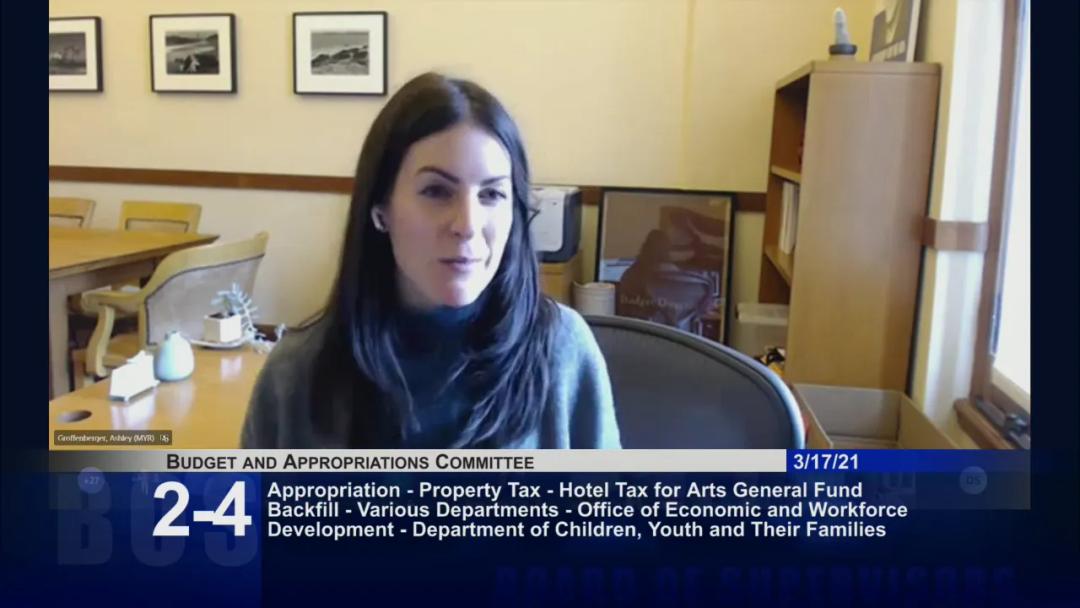
Chair Matt Haney opened the meeting, noting a projected $125 million surplus in the current fiscal year. He outlined a collaborative spending plan with the Mayor's Office, focusing on small businesses, families, tenants, artists, and vulnerable residents. The committee considered five agenda items, with extensive discussion and amendments consolidating many allocations into a single package. Public Comments & Testimony - Item 1 (Prop I rent relief/social housing): Over twenty callers expressed strong support, including representatives from the San Francisco Tenants Union, DSA, and community organizations. Speakers emphasized the urgent need for rent relief to prevent evictions and for social housing to decommodify housing. Many thanked Supervisor Preston and urged approval of the amendment shifting funding from general reserve to property tax. - Item 5 (business fee extension): Two callers from the taxi industry (Chris Sweiss of Yellow Cab, Mark Gruberg of Breed Cab) and a driver (Barry Toronto) supported the extension, citing severe pandemic impacts. They requested the fee waiver or further relief, but appreciated the extension. - Items 2-4 (arts, small business, youth): Numerous callers supported full funding for cultural districts (e.g., Japantown, Leather & LGBTQ, American Indian, Castro, African American, Soma Pilipinas) and arts organizations (San Francisco Opera, Chinese Culture Center). Others endorsed the summer youth program and high school internships. One caller criticized the process as a violation of the Brown Act but still urged support for cultural districts. Discussion Items Item 1 – Appropriation from General Reserve for Rent Relief and Social Housing ($20.1M) Supervisor Preston presented the ordinance, allocating $10.05M to the Rent Resolution and Relief Fund and $10.05M to the Housing Stability Fund, using Prop I transfer tax revenue. He noted a February controller update increased projections to $20.1M. An amendment changed the revenue source from general reserve to property tax (at controller's suggestion). Committee members (Safai, Melgar, Marr, Ronin, Walton, Haney) expressed strong support, highlighting the need to fill gaps in federal/state rent relief and to launch innovative social housing models. Supervisor Safai asked about debt forgiveness criteria; Preston left open tweaks. BLA recommended approval with a report-back on rent relief rules. Public comment was overwhelmingly supportive. The committee voted 5-0 to accept the amendment and continued the item to a special meeting on March 23. Item 5 – Business Registration Fee Extension and Fee Penalty Suspension Amanda Freed (Treasurer's Office) explained the ordinance would extend the business registration fee deadline to November 1, 2021 for most businesses, and suspend late penalties for certain fees. BLA noted a one-time $32M revenue loss. Chair Haney proposed an amendment limiting the full extension to businesses with 2020 gross receipts ≤$25M; larger businesses would get an extension only to June 30. Supervisor Safai supported targeting smaller businesses. The committee voted 5-0 to accept the amendment, then voted 5-0 to send the item to the full board with a positive recommendation. Items 2, 3, 4 (combined discussion) – Arts Backfill, Small Business Relief, Summer Youth Programming - Item 2 (Arts backfill): Ashley Groffenberger (Mayor's Budget Director) presented a $11.2M+ appropriation to backfill hotel tax shortfalls for Grants for the Arts, Arts Impact Endowment, Cultural Centers, and Cultural Equity Endowment. Supervisor Ronin questioned why cultural districts were initially left out; Groffenberger acknowledged a miscommunication and supported adding $1.1M for cultural districts. Deputy City Attorney Pearson clarified Prop E's legal limits. - Item 3 (Small business relief): Diana Ponce de Leon (OEWD) presented a $20M proposal for grants ($12.4M) and loans ($7.3M) targeting storefront businesses, with a survey to pre-qualify applicants. Supervisor Safai asked about a restriction excluding businesses that received $5,000 grants or $20,000 loans; OEWD indicated flexibility. Supervisor Marr introduced an amendment for a $1M fund for small businesses victimized by crime. Supervisor Ronin praised OEWD's work. - Item 4 (Summer youth programming): Director Maria Sue (DCYF) presented the "Summer Together" initiative, a free summer learning program for all SFUSD students, with $15M from the city plus private donations. Supervisors Chan, Ronin, Melgar, Marr, and Safai spoke in support, emphasizing equity, learning loss, and high school internships. Supervisor Marr proposed a $2.7M amendment for a high school internship program with City College credit, funded by expiring ERAF money. BLA noted the $15M would fund about 10,000 slots. After discussion, the committee consolidated all amendments (arts, small business, youth, plus new items for shared spaces, music venues, crime victims, overdose prevention, family relief, and a reserve) into a single amendment to Item 3. Chair Haney listed additions: $2.25M for shared spaces, $3M for music/entertainment venues, $1M for crime victims, $1.6M for overdose prevention (fentanyl outreach/treatment in SROs), $2M for family relief fund, $1.1M cultural districts, $1M hotel tax contingency, $5M for next year's arts shortfall, $15M summer learning, $2.7M high school internships, and a $6.52M reserve. The controller confirmed the total aligns with the $125M surplus minus Item 1. Key Outcomes - Item 1: Amendment (funding source change) approved 5-0. Item continued to special meeting March 23. - Item 5: Amendment (targeted extension) approved 5-0. Item sent to full board with positive recommendation. - Items 2 and 4: Tabled 5-0 after their contents were folded into Item 3. - Item 3: Consolidated amendments approved 5-0. Item continued to special meeting March 23, where the full package will receive a final committee vote before going to the full board. - Reserve: $6,520,705 held in reserve (approximately 5% of total surplus) for contingency and pending priorities. - Next Steps: The committee will reconvene as a special meeting on Tuesday, March 23, 2021, to vote on the amended items and recommend them to the full Board of Supervisors.
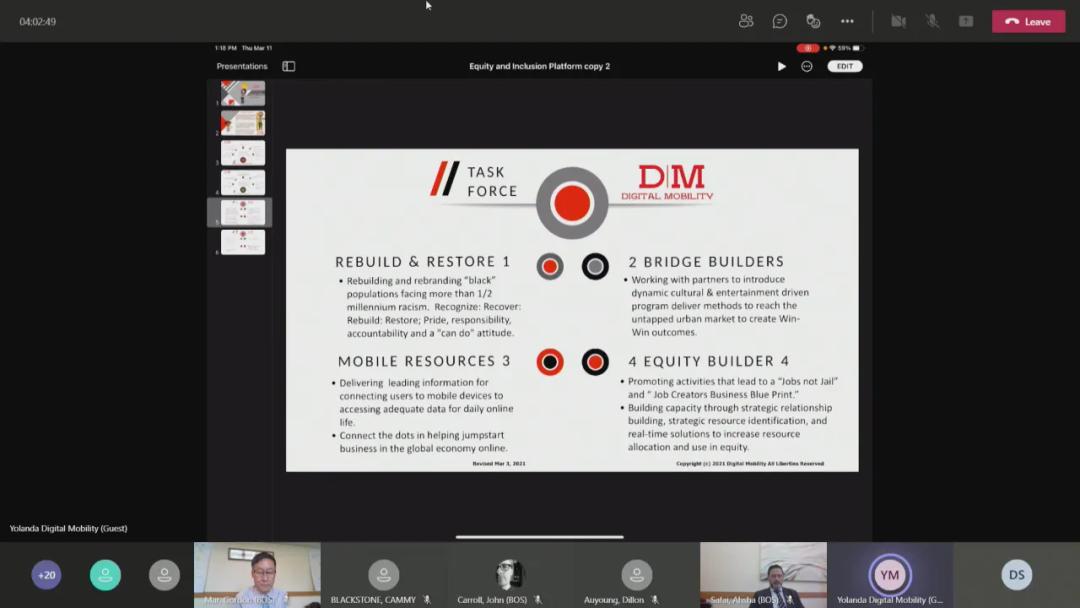
The Public Safety and Neighborhood Services Committee met on March 11, 2021, to consider three agenda items: a hearing on the San Francisco Housing Conservatorship program (SB 1045), an ordinance amending the Police Code to create a right to reemployment for workers laid off due to COVID-19, and a hearing and resolution on closing the digital divide. The committee heard extensive testimony from city officials, private sector representatives, advocates, and members of the public. Votes were taken to adopt amendments and forward legislation to the full Board of Supervisors. Discussion Items Right to Reemployment Following Layoff (Item 2) Chair Gordon Maher presented final substantive amendments to the ordinance, developed in consultation with labor and business stakeholders. The amendments set industry-specific thresholds for covered employers (restaurants, hotels, grocery stores, custodial contractors, event concessions, and formula retail) and narrowed rehiring requirements to positions with comparable job duties, pay, benefits, and working conditions that the worker had previously held within 12 months of layoff. Notification may be made via phone, text, or email. Enforcement is through private right of action, not city penalties. Supervisor Matt Haney asked about notification processes and penalties; Maher clarified. No public comments were received. The committee unanimously adopted the amendments and continued the item to the call of the chair. Housing Conservatorship Preliminary Evaluation (Item 1) Supervisor Rafael Mandelman, sponsor, summarized the history of SB 1045: the city opted in June 2019, but as of early 2021, only one individual had been conserved. Dr. Grant Colfax (DPH Director), Angelica Almeida (DPH), and Jill Nielsen (Office of Public Conservator) presented progress. They reported 140 individuals served in less restrictive treatment options since June 2020; 60 dropped off the pathway. As of late January 2021, 63 individuals had five or more 5150 holds in 12 months, and 16 had eight or more. Of those, seven had received notice of the housing conservatorship pathway. Challenges included narrow eligibility (requiring eight 5150s, not the original three), extensive documentation requirements, and the local ordinance's addition of nine documented offers of voluntary services (state law requires six). The pandemic hindered hospital-based notices. A new outpatient LPS referral pathway had conserved 10 individuals in community settings. Public comment included a parent describing a housed adult son cycling through 5150s, and Jessica Lehman (Senior and Disability Action) opposed expanding conservatorship, emphasizing voluntary housing and noting racial disparities in 5150s. Supervisor Mandelman expressed concern about the gap between public health response and needs of the most vulnerable and said he would file the hearing but invite an update in six months. The committee voted to hear and file the item. Digital Divide Review and Resolution (Items 3 & 4) Supervisor Asha Safai stated that one in eight San Franciscans lacks internet access, and 22,000 SFUSD students have insufficient computer access. Presentations from Verizon, AT&T, Comcast, Digital Mobility, and ten city departments highlighted current efforts and barriers. - Verizon's Rudy Reyes: called for streamlined permitting and a renegotiated master license agreement to deploy 5G citywide; noted 500+ sites in Los Angeles, 400+ in San Jose. - AT&T's Cammy Blackstone: reported 12,000 hotspots provided to SFUSD, $7.5 million in grants to local organizations over 10 years, and a $10/month Access program. - Comcast's Dylan Young: reported over 50,000 Internet Essentials subscribers in San Francisco, 34 community hubs, and 800 laptops. - Digital Mobility's Yolanda Lewis: emphasized the need to include community voice and address historical inequities. - City departments outlined programs: Fiber-to-Housing (7,300 units connected), community hubs serving 2,300 youth, device distribution, and digital literacy training. Supervisor Safai introduced clerical amendments to the resolution, which were adopted. Public comment supported the Fiber-to-Housing program and called for more investment in underserved neighborhoods. The committee voted to forward the resolution to the full board with a positive recommendation and to continue the hearing to the call of the chair. Public Comments & Testimony Members of the public offered comments on both the conservatorship and digital divide items. On conservatorship, speakers urged more voluntary services and cautioned against involuntary measures. On digital equity, commenters requested expanded Fiber-to-Housing and digital literacy training in black and brown communities. Key Outcomes - Item 2 (right to reemployment): Unanimously amended and continued to the call of the chair. - Item 1 (housing conservatorship): Hearing filed unanimously; supervisor to call for a future update. - Items 3 & 4 (digital divide): Hearing continued; resolution amended and forwarded to full board (unanimous). Chair Maher added as co-sponsor.
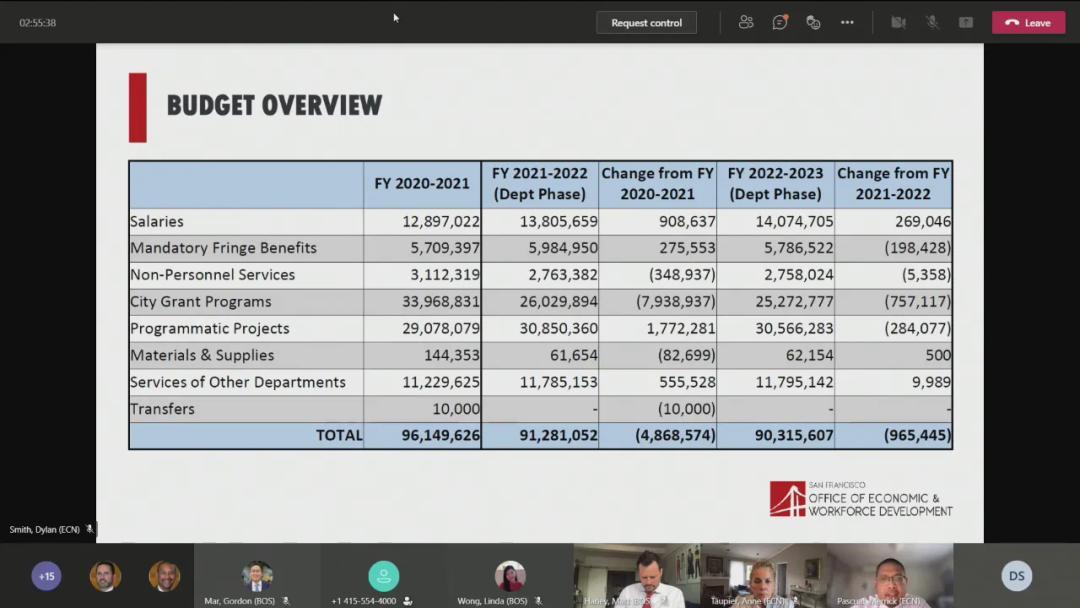
The Budget and Appropriations Committee, chaired by Supervisor Matt Haney, held a hearing on March 10, 2021, to review the Fiscal Years 2021-2022 and 2022-2023 budgets for the Department of Public Health (DPH) and the Office of Economic and Workforce Development (OEWD). The committee heard detailed presentations from department leaders, discussed key priorities including racial equity, behavioral health, COVID-19 response, workforce development, and small business support, and filed both hearings unanimously. DPH Budget Hearing The Department of Public Health, led by Dr. Colfax, presented a base budget of $2.6 billion with over 7,000 FTEs. The department's strategic priorities include racial equity, implementation of CalAIM (a state Medi-Cal program), COVID-19 response, and expanding behavioral health services. DPH met its $59 million general fund reduction target through revenue initiatives, including a $51.6 million release of deferred disproportionate share hospital funds and $24 million from CalAIM changes in year one. No service reductions were proposed. Key discussion points included: - Racial Equity: DPH outlined its racial equity action plan, with $726,000 allocated in the proposed budget for training and workforce policy. President Walton questioned whether this amount was sufficient to affect 7,000 employees, noting it represented a very small fraction of the budget. DPH acknowledged the challenge and committed to providing more detail. - Behavioral Health: Supervisor Ronan inquired about Mental Health SF implementation, noting that $34.4 million was appropriated for FY2021 but spending lagged due to slow rollout. DPH confirmed unspent Prop C funds carry forward. Supervisor Safai raised concerns about the lack of abstinence-based substance abuse treatment options in DPH's RFP process, and DPH agreed to engage with community advocates. - Overdose Crisis: Chair Haney highlighted that 2020 saw over 500 fentanyl deaths, three times the COVID-19 death toll, and called for a comprehensive strategy. DPH committed to returning with specific proposals, citing their new behavioral health director and ongoing naloxone distribution (4,000 reversals in 2020). - COVID-19 Response: DPH reported that vaccine distribution is focused on equity, with higher proportions going to southeastern neighborhoods and Latinx and Black communities among those 65+. However, supply constraints limit current efforts. The department is developing a sustainable COVID-19 infrastructure. - Contracting Oversight: DPH provided an update on reforms following the controller and city attorney's integrity assessment, including updated MOUs with foundations, ethics training, and a new compliance newsletter. OEWD Budget Hearing The Office of Economic and Workforce Development, presented by Acting Director Anne Taupier, CFO Merrick Pasqual, and Workforce Director Joshua Arce, proposed a total budget of $91 million for FY2021-22, a decrease of $4.9 million from the current year. The budget reflects a $3.26 million general fund reduction achieved primarily through the expiration of one-time additions. Key initiatives include: - Workforce Development: A $28.1 million "Building Back Stronger" RFP focusing on equity pilots, neighborhood job centers, and the Dreamkeeper Initiative ($6 million) to address the Black unemployment gap, which stands at 10.7% (2.5 times the city average). The RFP includes multi-year grants and a focus on job readiness collaboratives. - Small Business Support: $24 million in COVID relief delivered to over 1,230 businesses through various funds. An additional $20 million supplemental appropriation is pending Board approval. Supervisor Marr asked about the ongoing loan and grant programs in the base budget; OEWD clarified that most COVID-related programs were temporary. - Economic Recovery: OEWD is pivoting from hospitality training to supporting displaced workers and pilots for emerging industries. The department also highlighted the City EMT pilot program, a partnership with the fire department and City College. - Neighborhood Investment: Supervisor Safai stressed the need for a robust Invest in Neighborhoods strategy to combat storefront vacancies and support business retention. OEWD acknowledged staff redeployment due to COVID and committed to prioritizing neighborhood corridors as part of the recovery. Key Outcomes - Both hearings were filed unanimously by the committee (5-0 votes). - No formal decisions were made, but the committee directed DPH to provide detailed spending data on Mental Health SF and a comprehensive plan to address fentanyl overdoses. - OEWD was asked to provide a full accounting of small business grant and loan programs and to strengthen its neighborhood investment strategy. - The budget process will continue with the mayor's proposed budget expected in the coming months.
The Port Commission met on March 9, 2021, in a regular meeting that included an executive session, public comment, and several informational presentations. Key topics included updates on the port's COVID-19 response, a revised Five-Year Strategic Plan, a second incremental bond issuance for the Mission Rock project, and the Waterfront Resilience Program. The commission also heard public comment from a property owner regarding a title dispute with the port. All votes on consent items and the motion to adjourn were unanimous. The meeting lasted from approximately 2:00 PM to 6:09 PM. Consent Calendar - Roll call established a quorum with all five commissioners present (President Brandon, Vice President Adams, Commissioners Burton, Gilman, and Wuho). - The minutes of the February 23, 2021 meeting were approved unanimously. - The commission voted unanimously to go into executive session and later reconvened with no reportable actions. Public Comments & Testimony - Marie Cole, owner of a Davidson Street property, stated that the port made a claim on a paper street under her land, delaying and potentially killing the sale of the property. She noted she had held a clean title since 1968 and argued the paper street was abandoned in 1917. She requested the commission reach a satisfactory conclusion. No other members of the public commented on non-agenda items or specific agenda items. Discussion Items Executive Director's Report (Item 9A) - Director Elaine Forbes reported that San Francisco moved to the state's red tier, allowing indoor dining and reopening of attractions. Alcatraz will reopen the following week. - At Seawall Lot 337, a fraternal organization administered COVID-19 vaccines to approximately 100 members using port space with a fee waiver. - The port's Micro LBE Emergency Loan Program has approved 12 loans totaling $476,000 out of $1 million; seven loans went to MBEs (including five black-owned businesses) and two to women-owned businesses. - The fourth annual Contract Opportunities Open House will be held virtually on March 18, 2021; 110 RSVPs received as of the meeting. - A petroleum seep at Hyde Street Harbor has been traced to red dye diesel from port tenant Maxim Petroleum. The EPA issued a cleanup order on March 1, 2021. The port removed over 2,500 gallons of oily water since July 2020. Port Support for COVID-19 Response (Item 9B) - Communications Director Randy Casada presented an overview: 75 port staff deployed as disaster service workers; a testing site at Piers 30-32 has administered tens of thousands of tests; a shelter at Seawall Lot 344 housed over 150 vulnerable individuals; emergency food distribution at Seawall Lot 337 serves about 790 families weekly distributing over 41,000 pounds of food; and PPE distribution has provided 1.5 million face masks, 600,000 face shields, and 21,000 gallons of hand sanitizer. - Tenant rent relief measures include deferrals, repayment programs, and forgiveness totaling up to $13.65 million. - Commissioners noted the port's exemplary response and stressed the need for enhanced signage on the waterfront, tourism recovery strategies, and attention to long-term homelessness solutions. Five-Year Strategic Plan Update (Item 9C) - Executive Director Forbes presented an updated plan for 2021–2025 with seven goals: Economic Recovery, Productivity, Equity, Resilience, Sustainability, Evolution, and Engagement. - The plan shifts from "stability" to "economic recovery" given COVID impacts, aiming to return real estate revenues to pre-COVID levels by 2025 and secure external funding. Equity now includes a Racial Equity Action Plan (REAP) with 125 actions to be completed by 2024. Resilience goals include completing a multi-hazard risk assessment and partnering with the Army Corps of Engineers. - Commissioners supported the plan, requested quarterly deep-dives into specific goals, and emphasized embedding equity across all goals. Mission Rock Community Facilities District Bond Financing (Item 10A) - Project Manager Phil Williamson and staff described the first phase of the Mission Rock development (Seawall Lot 337): up to 2.8 million square feet including 1,200 housing units (40% affordable). Phase I infrastructure is 25% complete, with two buildings under construction. - Staff proposed a second issuance of up to $68 million in CFD special tax bonds to replace expensive developer equity (18% return) with lower-cost public debt. The total phase one bond capacity is $111.3 million, based on an updated appraisal of $334 million. - The first bond issuance of $43.3 million is expected to close in April 2021; the second is targeted for summer 2021. - Commissioners asked about interest rate risks (currently 4% expected) and noted the project's 40% affordable housing commitment. Waterfront Resilience Program (Item 11A) - Waterfront Resilience Director Brad Benson presented the Adapt Plan framework, including a draft vision statement, principles, evaluation criteria, and Proposition A funding guidelines. - A youth-produced video highlighted the need for resilience against earthquakes (72% chance of major quake by 2043) and sea level rise. - The program uses $425 million in Proposition A funds for life safety and disaster response along the northern seawall. - Commissioners provided feedback: add "financial" to economic criteria; include LBE opportunities and community health considerations; and clarify geographic distribution in funding guidelines. They agreed not to use numerical scoring, favoring qualitative analysis. - The commission expressed appreciation for the thorough work and requested regular updates. Key Outcomes - The commission unanimously approved the consent calendar (minutes, executive session) and the motion to adjourn. - No formal votes were taken on informational items (9A, 9B, 9C, 10A, 11A), but staff received direction on the strategic plan, bond financing, and resilience program. - Staff will report back on the status of the Embarcadero Navigation Center at the next meeting. - The next commission meeting was noted as April 13, 2021 (not specified, but based on typical schedule).