Browse by city
Date range
Search help

Search titles, summaries, topics and stored transcripts together. Keywords may match separately; put the whole query in double quotes for a phrase. Matching follows word analysis, so punctuation is not exact. Both dates are included. Documents are not searched.

SHOWING 11–20 ENTRIES
11
OCT 6, 2026 · SAN JOSE, CALIFORNIA · CITY COUNCIL
San Jose City Council Meeting - October 6, 2026

The San Jose City Council convened on October 6, 2026, at 10:00 AM (time inferred from 'good morning') and, after roll call establishing quorum, heard extensive public testimony from city employees and union representatives regarding ongoing contract negotiations. No formal agenda or minutes were provided. Over 148 people participated online, with 10 in-person speakers and additional online speakers. The meeting adjourned to closed session without taking any public votes or decisions. Public Comments & Testimony - Ben (unidentified affiliation): Stated that San Jose Public Works employees' average wage of $128,000 per year is near the low-income threshold of $117,700, and questioned why the city's last best and final offer does not reflect the middle-class status these jobs once held. - Francis (senior analyst, Finance Department, IFPTE Local 21): Expressed readiness to strike as a last resort, noting inflation has eroded wages and as a single mother she feels the financial strain. - Unnamed speaker (self-identified as a Sharks fan): Criticized the city for making false promises and prioritizing investments like the Sharks over core services; urged council to show commitment through actions. - Daisy (member of Aspen Local 101, Environmental Services): New employee from out of state, stated cost of living is unaffordable, turnover hurts service quality, and asked for fair contract to retain staff. - Dylan Colman Haley (Public Info Rep, Beautify San Jose): 10-year employee, noted his wife also works for city; described living within dangerous margins and actively seeking jobs elsewhere; urged support to retain talent. - Mary Morris (Senior Environmental Program Manager, Environmental Services Department, IFPTE Local 21, bargaining team member): 27-year employee, said she never expected to need enforcement skills with council; asked for leadership to get a fair contract. - Maria Garcia (Housing Department employee): Reported significant turnover in the housing department, loss of institutional knowledge, and increased workload for remaining staff; noted asset management oversees millions in affordable housing investments. - Cecilia Rios (20-year city employee, now manager): Former library page, said a former coworker left for Santa Clara County due to better pay and manageable workload; county closed an $800 million deficit while retaining staff; asked council to direct city manager to avert a strike. - David Parker (Code Enforcement Inspector, MEF 101, Nigley Park, District Three resident): Nearly 5-year employee and former negotiating team member, described never seeing such a negotiation; members are desperate and leaving; warned council their actions will be remembered in future elections. - Riley (Supervising Environmental Service Specialist, Local 21 Camp chapter bargaining team member): 8-year employee, said his salary is decent relative to colleagues but still insufficient; city's last best and final offer does not keep pace with inflation; strike is last option but will do it. - Catherine Walsh (Environmental Services Specialist, MEF 101, District 6 resident): Moved to San Jose for the job and loves the city but struggles to budget month-to-month; cost of living is untenable; strike is last resort. - Zita (Ira Bethanaz, Economy Intelligence, China Department Crime Analysis Unit): Only breadwinner, noted gas costs over $6/gallon; after three months without a contract, many cannot afford housing and family care; asked for fair contract. - Rob Perrin (Environmental Services Specialist, MEF 101, District 9, 15-year employee): Seeking fair wages, no contingencies, restoration of pensionable pay; stated members voted yes to strike. - Danielle (Planning Department employee, 9-year employee): Noted a cycle of employees staying five years and leaving due to cost of living and rigid work-from-home policy; many plan to leave; asked for fair contract. - Moses Arroyo (25-year employee, voted to strike): Stated city employees provide vital services in housing, environment, public services, and health; requested a contract that supports retention and recognizes contributions. Key Outcomes - No votes or decisions were made during the public session. Mayor Mahan thanked speakers, acknowledged the importance of the workforce, expressed desire for a fair contract that avoids layoffs or service cuts, and adjourned the meeting to closed session for further negotiations. The council did not take any formal action on the contract or strike authorization.
LABOR STANDARDS 66% · PUBLIC WORKS 25% · PROCEDURAL 9%
12
OCT 6, 2026 · SAN JOSE, CALIFORNIA · CITY COUNCIL
San José City Council Meeting - October 6, 2026

The San José City Council met on Tuesday, October 6, 2026, at 1:30 PM (after a Closed Session at 9:30 AM) to consider a range of items including ceremonial proclamations, routine consent calendar items, a city manager report, regulations for personal delivery devices, and two affordable housing developments. The meeting included public comments, extensive council deliberation on the delivery device ordinance, and unanimous approvals on housing items. One councilmember (Ortiz) and one (Candelas) were absent for parts of the meeting. Ceremonial Items - National Arts and Humanities Month: Councilmember Campos presented a proclamation declaring October 2026 as National Arts and Humanities Month, highlighting the role of arts in community life. Shelby Takeda, chair of the San José Arts Commission, accepted the proclamation. - Walk & Roll to School Day: Vice Mayor Foley proclaimed October 7, 2026, as Walk & Roll to School Day, encouraging safe active transportation to schools. DOT staff noted the program has grown to 115 participating schools. - Filipino American History Month: Councilmember Tordillos presented a proclamation declaring October 2026 as Filipino American History Month. Alan Guig, founder and president of SJSU’s Filipino Alumni Network, accepted and announced a Filipino American History Mural unveiling on October 30, 2026. Adjournment Recognition The meeting was adjourned in memory of Paz Richard Rocha Jr., a lifelong San José educator, coach, and athlete. Councilmember Candelas and family members spoke about his legacy. Over 250 people attended his celebration of life. Consent Calendar The Council approved all consent calendar items (2.1–2.15) by a unanimous vote. Items included approval of minutes, final adoption of ordinances, council committee minutes, travel reports, the dissolution of the Bay Area Regional Interoperable Communications Systems Authority, an amendment for criminal justice system access, annexation to Community Facilities District No. 8, master consultant agreements for sewer flow monitoring, free use of the rotunda for two events, retroactive approval of the Golden State Valkyries Flag Raising, authorization of travel for the Mayor's Director of Innovation, and a board appointment to the Arts Commission. Public Comments & Testimony - Item 5.1 – Personal Delivery Devices: - Vignesh Ram (Vice President of Public Policy, Serve Robotics) expressed support, noting the company has completed hundreds of deliveries in San José, serving 34 local businesses (90% small/independent). He emphasized the environmental and congestion benefits. - Jonas Pierce (Coco Robotics) also expressed support, highlighting thousands of deliveries and 38 businesses served, with CO2 savings of approximately 2.5 tons. - Two callers spoke: one skeptical, likening the robots to failed bike-share programs; Jordan Moldow (District 3) expressed cautious optimism but raised concerns about robot weight (350 lbs), speed in bikeways, and the need for per-minute fees for blocking pedestrians. - Open Forum: Two speakers addressed bike lane hazards on Santa Teresa Boulevard and general appreciation for the council's work. Discussion Items - Item 3.1 – City Manager Report (Verbal): City Manager Jennifer Maguire introduced Amber Hewitt as the new Director of the Office of Racial and Social Equity, effective October 25. Dr. Hewitt spoke about her background and commitment to equity. Council welcomed her. - Item 5.1 – Actions Related to Regulation of Personal Delivery Devices: Staff (John Russell, Ramses Madue, Laura Stutchinski) presented a proposed ordinance for sidewalk and bikeway delivery robots. Key provisions: one-year permit, $200 annual permit fee for sidewalk devices, $250 for roadway devices, 5 mph speed limit, 30-minute response for disabled devices, and a two-tier system (sidewalk permit, bikeway pilot). Vice Mayor Foley expressed strong concerns about insufficient disability community outreach, sidewalk congestion, and low fines ($100–$500). Councilmember Kamei raised concerns about device limits and scooter comparisons. Councilmember Tordillos supported the framework, noting that devices are already operating and regulation gives the city leverage. Councilmember Cohen moved approval, citing benefits and safeguards (ability to cancel permits). The motion passed 9–2 (Ortiz and Candelas absent). - Item 8.1 – Affordable Housing at 1510 North 1st Street: Eric Sullivan and Banu San presented a proposal for a $5.7 million loan to rehabilitate the former Comfort Suites into 57 permanent supportive housing units for extremely low-income individuals (30% AMI and below). The Santa Clara County Housing Authority is the developer. Construction is expected to start by year-end and take 12 months. Councilmember Mulcahy moved approval, noting the need for investment in the area. Motion passed unanimously (Candelas absent). - Item 8.2 – Arena Hotel Redevelopment and Homekey Program Transition: Staff explained a plan to convert the Arena Hotel into permanent housing through two phases: converting the existing motel and later building over 200 mixed-income units on the parking lot. The city has selected Episcopal Community Services of San Francisco as developer and will seek state approval to transfer the 30% AMI requirement to an alternative site. Councilmember Mulcahy moved to approve staff's recommendation with additional direction from a memo by Mayor Mahan and himself, requiring a progress report in six months. He noted the site's troubled history. Motion passed unanimously (Candelas absent). Key Outcomes - Personal Delivery Device Ordinance: Approved 9–2. The ordinance adds Chapter 11.91 to the municipal code, establishes permit and fee structures, and creates an administrative citation schedule. A nine-month pilot for bikeway devices will be evaluated. - 1510 North 1st Street Housing: Approved unanimously. A $5.7 million loan commitment was authorized, with appropriation amendments from the Low and Moderate Income Housing Asset Fund. - Arena Hotel Redevelopment: Approved unanimously. Authorized Exclusive Negotiation Agreements with Episcopal Community Services and a backup developer, Propertyworx. Directed the city manager to return in six months with an update on state negotiations. - Civil Service Commission Interview: Deferred to the end of the meeting but not conducted as the meeting adjourned after open forum. General Notes The meeting adjourned at approximately 3:30 PM (estimated from transcript length). All votes were recorded; roll call indicated a quorum of 11 members present at the start.

TECHNOLOGY AND INNOVATION 20% · AFFORDABLE HOUSING 14% · TRANSPORTATION SAFETY 12% · PROCEDURAL 10%
13
OCT 5, 2026 · SAN JOSE, CALIFORNIA · PLANNING COMMISSION
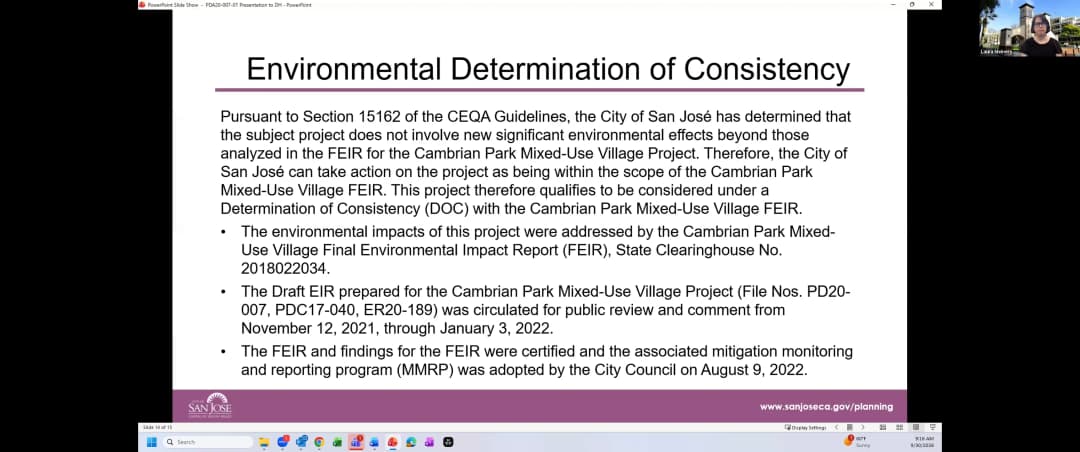
San Jose Planning Director's Hearing - October 5, 2026: Approval of Cambrian Park Mixed Use Village Phasing Plan

Note: The transcript of this hearing states the meeting was held on September 30, 2026, but the provided date is October 5, 2026. This summary uses the given date of October 5, 2026, and notes the discrepancy. The hearing, conducted via Zoom by Hearing Officer Martina Davis, considered a single agenda item: a Plan Development Permit Amendment (PDA 2007-01 and ER26018) for the Cambrian Park Mixed Use Village project. The amendment sought to implement a master plan phasing plan and a state density bonus to adjust the sequencing of development, allowing residential construction to proceed before commercial components. After staff presentation, applicant remarks, and public testimony, the hearing officer approved the amendment, citing legal requirements under the state density bonus law. Public Comments & Testimony - Carl (nearby resident): Expressed full support for the project and urged it to proceed quickly. Expressed mild concern that the sequencing might be a way to avoid building the commercial component in a high-interest-rate environment. - Moria (Todd Way resident): Opposed the amendment, preferring the originally approved order of construction. Stated she would prefer any delay to the project. - Peter (Friends of Cambridge Plaza): Representing a group of about 1,000 members, opposed the amendment as written. Key concerns: the central community park and access to the phase four (mixed-use) building are scheduled too late, and the park should be fully built in phase one. - Nicole Gordillo (Field Representative, North Coast State Carpenters Union, Local 405): Expressed support for the project but urged that strong labor standards (healthcare, livable wages, state-certified apprenticeship programs) be included. Noted that the developer has not yet committed to such standards, and requested the committee ensure the project is built responsibly with these investments. Discussion Items - Staff Presentation (Laura, Planning Staff): Provided detailed background. The original Plan Development Permit (PD 20-007) was approved in November 2022 for a mixed-use village on 18.13 acres at Union and Camden Avenues (Council District 9). The approved development includes: a mixed-use building (ground-floor retail/restaurant, 305 apartments), a hotel, an assisted living facility with 50 senior independent living units, 25 townhouse condos, and 48 single-family homes (total 428 residential units), plus parks/open space and parking. The city had conditioned 50 affordable housing units. The current amendment proposes a phasing plan (Phase 1A: single-family homes; Phase 1B: townhomes; Phase 2: utilities; Phase 3: assisted living; Phase 4: mixed-use building; Phase 5: hotel) and uses the state density bonus law: 28 units affordable to moderate-income (80-120% AMI) and 22 units to very low-income (30-50% AMI). The project qualifies for one incentive: removal of the condition requiring commercial construction before or concurrent with residential. No changes to land use, unit count, or commercial square footage. CEQA: determination of consistency with the final Environmental Impact Report (FEIR) for the Cambrian Park Mixed Use Village Project. Staff recommended approval. - Applicant Presentation (Marc Records, on behalf of owner): Confirmed the project scope is unchanged. Argued the phasing plan creates logical sequencing with proportional infrastructure improvements (on-site and off-site) tied to each phase. Provided timeline: community meeting and park design charrette in 2027, demolition likely end of 2027 or Q1 2028, followed by construction of first phase. Accepted proposed conditions and requested approval. - Hearing Officer Question: Asked why the central community park cannot be built entirely in Phase 1. Applicant responded that construction logistics (lay-down areas, need for ring road, risk of tearing up completed park during later phases) make full park delivery infeasible early; Phase 1 will include a substantial portion of park area, and the remainder will be built when the mixed-use building (Phase 4) is constructed. Key Outcomes - Decision: Hearing Officer Martina Davis approved the Plan Development Permit Amendment (PDA 2007-01) and the determination of consistency with the Cambrian Park Mixed Use Village FEIR (ER26018). The decision was based on the state density bonus law, which requires approval if the amendment (1) reduces the cost of providing affordable units (shown by no longer tying extensive infrastructure costs solely to the first phase), (2) is not contrary to state or federal law, and (3) does not create an imminent public health or safety hazard. The officer stated she was bound to approve under these criteria. - Recommendation: The hearing officer commended the applicant for reaching a labor agreement and encouraged continued use of a skilled and trained workforce throughout the project. - Appeal Rights: The decision is final when the permit is signed and mailed, unless appealed under Title 20 (zoning) or Title 21 (CEQA) of the San Jose Municipal Code.

AFFORDABLE HOUSING 32% · PROCEDURAL 22% · URBAN PLANNING 20% · PUBLIC COMMENT 14%
14
OCT 5, 2026 · SAN JOSE, CALIFORNIA · CITY COUNCIL
San José Transportation and Environment Committee Meeting - October 5, 2026

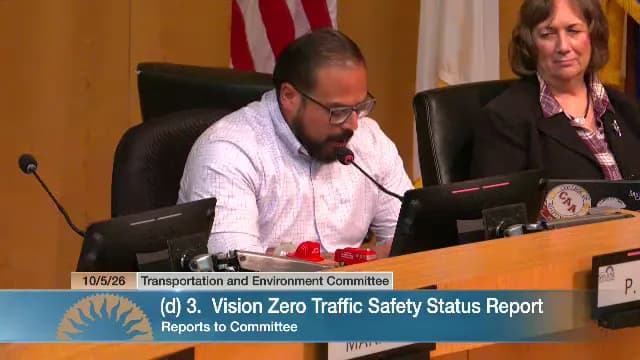
The Transportation and Environment Committee (T&E) met on Monday, October 5, 2026, at 1:30 PM in a hybrid format. The committee reviewed three major reports: a vehicle abatement audit, a city infrastructure strategy semi-annual status report, and the Vision Zero traffic safety status report. All three reports were accepted by the committee. Public comments were heard on several items, and an open forum concluded the meeting. Consent Calendar - No consent calendar items were presented or discussed. Public Comments & Testimony - Item 2 (Infrastructure Strategy): Jordan Muldause (District 3, speaking on own behalf) praised DOT's post-project analysis and urged better public communication of success stories. He also suggested adding projects like Reimagining Santa Clara Street and King Road Complete Streets to the priority list. - Item 3 (Vision Zero): Jordan Muldause (on own behalf) supported keeping Ewart Road open for cyclists, noted that safety is not always the top priority in projects, and called for updating the eight-year-old Complete Street Design Guide. He also requested publishing the KSI heat map online. - Item 3 (Vision Zero): A virtual speaker (Devon, District 3) thanked the committee and urged keeping Ewart Road open as a vital connector, especially during rainy season flooding. - Open Forum: Jordan Muldause (on own behalf) advocated for making transportation and environment a top council priority. Another speaker (District 1 resident, 40-year resident) raised concerns about environmental impacts at Santa Clara Valley Medical Center (water use, pollution, wildlife corridors). A virtual speaker (Brian) commented that driver behavior is worsening and expressed skepticism about change. Discussion Items 1. CC 26-102 Vehicle Abatement Audit Report - Presentation: Joe Royce (City Auditor) presented findings from an audit of the DOT vehicle abatement program. Key statistics: between July 2025 and March 2026, about 10,000 cases (3,650 from SJ 311, 6,350 from proactive patrols). The audit found opportunities to improve timeliness, oversight, and customer service. Three main findings: (1) expediting case closures (e.g., clarifying towing guidelines for expired registration, considering a two-inspection model), (2) improving proactive patrol targeting and performance measures, and (3) enhancing documentation, supervisory oversight, and customer communication (including language translation). Eight recommendations were made. - DOT Response: John Ristow (Director of Transportation) thanked the audit team and concurred with all findings and recommendations. - Committee Discussion: Councilmember Ortiz commended the 98% of cases closed within 14 days and 80% resolved through voluntary compliance. He supported a data-driven approach to proactive patrols and better communication with residents when cases are closed. Chair Cohen noted improvements over the years and discussed the 72-hour parking ordinance; DOT explained they no longer enforce extended parking stay but retain the ordinance for problem vehicles. The three-inspection model was debated: DOT prefers it for cost and efficiency, noting that other cities use different models. The audit's recommendation to expedite towing of severely blighted vehicles (e.g., on jacks, blocks) was emphasized. 2. CC 26-100 City Infrastructure Strategy Semi-Annual Status Report - Presentation: Manuel Pineda (Deputy City Manager) reported that 57% of eight work streams are rated green, 43% yellow, none red. The committee also received a special presentation from DOT on a new data-driven evaluation framework for transportation projects. Zahi Khatab (Acting Deputy Director) and Lamb Cruz (Division Manager) explained that evaluations are integrated from design phase, using before-and-after data (crashes, speeds, volumes, bike/ped counts). Examples: Lee Avenue (fewer speeders, more bicyclists) and Center Road (grant-funded HSIP project). Hillsdale Avenue quick-build project: after two years, total and injury crashes decreased, no KSI crashes, speeds lower. Planned evaluations: 4 quick-builds per year, 13 grant-funded capital projects, 33 speed cameras (with required evaluations), and 4 red light cameras. - Committee Discussion: Vice Mayor Foley praised Hillsdale results and advocated for street narrowing. Councilmember Tordillos supported better publicizing success stories and the iterative evaluation process. Chair Cohen suggested sharing post-project data with council offices. The report was accepted (5-0). 3. CC 26-101 Vision Zero Traffic Safety Status Report - Presentation: Vice Mayor Foley read the names of 22 individuals killed since the last meeting, including Hacinta Rosenda's Reyes (31-year-old mother of two) and others. Lam Cruz presented data: 2025 fatalities decreased 16% (41 vs. 49 in 2024), but 2026 fatalities are up. 58% of KSIs occurred on roads with speed limits ≥35 mph; pedestrians 31%, bicyclists 16%. Speeding and red-light running associated with 32% of KSIs. DUI crashes at highest in 10 years (20% of fatalities). Tools: safer street design, speed management (59 segments lowered), automated enforcement (4 red-light cameras issued 6,500+ violations, 43% reduction in detections; speed cameras to activate December 2026, citations February 2027). BPAC report (Anne Ferris) highlighted trail maintenance, school safety, and keeping Ewart Road open for cyclists. Lieutenant Hatzenbueler (SJPD) reported increased DUI checkpoints (6 to 8), distracted driver enforcement, and school education programs. - Committee Discussion: Councilmember Ortiz expressed frustration over the Ocala/Capital Expressway fatality (county jurisdiction) and asked about interagency coordination. DOT described the process of reviewing incidents with county roads and VTA (construction project). Ortiz noted that residents don't distinguish jurisdictions. Vice Mayor Foley questioned how to meet the 30% fatality reduction goal by 2030 given flat numbers; DOT cited DUI enforcement and infrastructure improvements. Foley asked about red-light camera citation data (violations vs. tickets) and expansion criteria. E-bike safety was discussed: Lieutenant Hatzenbueler noted that e-bikes are increasing KSIs and that SJPD is developing training materials for officers and schools. Trail maintenance coordination (parks department) and Ewart Road closure (temporarily postponed) were also addressed. Chair Cohen requested disaggregated KSI data to see if e-bikes are offsetting improvements elsewhere. The report was accepted (5-0). Key Outcomes - Vehicle Abatement Audit: The committee accepted the audit report (motion by Ortiz, second by Cohen). Vote: 4-0 (Foley absent). The report will be cross-referenced to the October 27, 2026 City Council meeting. DOT will implement the eight recommendations. - City Infrastructure Strategy: The committee accepted the semi-annual status report and the DOT evaluation presentation. Vote: 5-0. - Vision Zero Report: The committee accepted the status report. Vote: 5-0. Next steps include continued implementation of speed cameras, red-light camera program review, DUI enforcement, and e-bike education. DOT will provide disaggregated KSI data (including e-bike involvement) to the committee. - Open Forum: No formal actions taken.

TRANSPORTATION SAFETY 59% · PUBLIC SAFETY 18% · PUBLIC COMMENT 14% · TRANSPORTATION 4%
15
OCT 2, 2026 · SAN JOSE, CALIFORNIA · CITY COUNCIL
City Council Study Session on Infrastructure Financing Tools – October 2, 2026

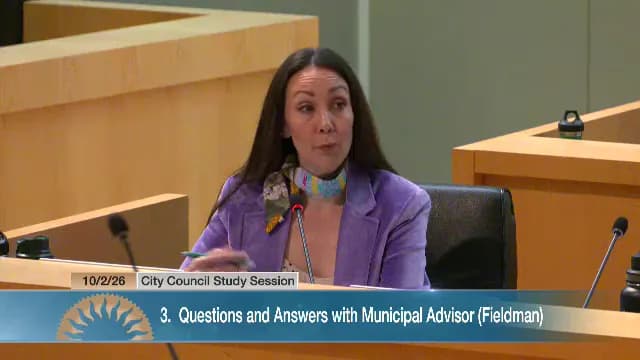
On October 2, 2026, the San José City Council held an informational study session to explore two primary infrastructure financing tools: Enhanced Infrastructure Financing Districts (EIFDs) and Community Facilities Districts (CFDs). The session was led by staff from the City Manager’s Office of Economic Development and Cultural Affairs, Public Works, and the city’s municipal advisory firm Fieldman & Rolapp. The goal was to provide councilmembers with a common understanding of how each tool functions, when each is most effective, and their limitations in financing public infrastructure that supports economic development and private investment. Presentation Overview - CFDs are special tax districts created by property owners or voters (two-thirds approval if more than 12 registered voters reside in the district) to pay for local public infrastructure and services. They can be formed relatively quickly (less than a year) and can issue bonds early. Bonded CFDs fund roads, public parking, parks, water/sewer, flood control, and other horizontal infrastructure. However, San José’s Council Policy 1-14 (last amended in 1993) requires a minimum of $10 million in bonds and 1,000 single-family homes, which may conflict with current Envision 2040 goals for higher density. Staff noted the policy is outdated and could use an update. - EIFDs use future property tax growth (tax increment) to fund public infrastructure without raising new taxes. The city’s share of property tax increment is approximately 13.5% of the 1% property tax levied on the assessed value. School district shares (44%) are statutorily excluded; other taxing entities (county, special districts) may voluntarily opt in. EIFDs require a lengthy formation process (feasibility study, public financing authority, two public hearings, protest period) and take years for assessed value to accrue before bonds can be issued. A hypothetical $10 billion mixed-use development could yield roughly $9 million per year in city increment, generating about $138 million in bond capacity over 30 years at a 5% interest rate. - When to use each tool: CFDs are better suited for early-stage infrastructure needs because they can be bonded quickly against special taxes. EIFDs are a longer-term tool, best layered with CFDs as development progresses. Examples from Sacramento (Aggie Square), West Sacramento, Placentia, Eastern Coachella Valley, and San Francisco (Treasure Island) illustrated varying scales and partnerships. Council Questions and Discussion - Councilmember Casey asked about who bears issuance and compliance costs. Staff clarified that bond issuance costs are paid from bond proceeds, and ongoing administration costs are covered by the special tax revenue; however, those administration costs reduce the capacity available for debt service. He also questioned whether the 13.5% share of increment makes EIFDs worthwhile, noting that a $10 billion project yielding only $138 million in bonded capacity over 30 years seemed modest. - Councilmember Kamei expressed skepticism, stating that these tools may not be appropriate at this time. She suggested going directly to voters for specific infrastructure measures (like Measure T) as a more practical path. She also noted the challenge of using EIFDs for affordable housing since affordable housing does not generate significant property tax return. - Councilmember Tordillos probed the flexibility of using tax increment for housing. He noted that moderate-income housing is listed as an eligible use under Government Code 5398.52 and asked whether mixed-income developments could qualify. Staff clarified that if tax increment is used and bonded for housing, it must be affordable (very low, low, or moderate income), but private developers building market-rate housing within an EIFD without using tax increment bonds are not restricted. Tordillos also raised the potential of using pay-as-you-go models to support projects that are stuck in the pipeline, similar to alternative financing models being explored locally. He emphasized the need to update local CFD regulations and align internal policies so the city can act quickly when large-scale developments (e.g., downtown West, Berryessa) are ready. - Councilmember Mulcahy asked whether staff had modeled specific areas of the city. Staff declined to discuss specific geographies to avoid influencing landowner behavior, but noted they are prepared to dive in when development projects reach sufficient sophistication. He also clarified the Aggie Square example: the city of Sacramento formed a city-only EIFD with partners (UC Davis, Wexford) and layered a CFD. In the Eastern Coachella example, the county committed 20% of its share, not 20% of the whole county increment. - Councilmember Doan asked for a concrete local example where an EIFD would be preferable to a CFD. Staff responded that a CFD could initiate momentum for a broader EIFD project in a complex mixed-use district. He also asked about operating both tools simultaneously and what metrics would measure success after 5–10 years. Staff indicated that at the 45-year sunset of an EIFD, the city would look for assessed value and other revenues exceeding the cost of investment. They noted that developers can benefit from tax-exempt borrowing and prospective reimbursement, which can accelerate project timelines. - Councilmember Cohen asked about county participation in examples and whether the city’s 13.5% share could be increased through state legislation. Staff confirmed that school districts cannot participate by law, and there has been no recent statewide effort to rebalance tax increment ratios. Some project-specific bills have been passed, but generally the ratios are fixed. Public Comment - One speaker (via Zoom) encouraged the council to consider using these financing tools for parks, trails, tree canopy, pedestrianization, and transit-oriented development along the BART corridor and East Santa Clara Street. They noted that 33 miles of trail network remain incomplete and that such investments demonstrably improve property values. Key Takeaways - No formal actions were taken; the session was informational and educational. No votes, resolutions, or directives were adopted. - Staff acknowledged that updating Council Policy 1-14 for bonded CFDs would be a necessary step to align with current density and housing goals. - Councilmembers expressed mixed views: some skeptical of the tools’ value given San José’s low increment share, others interested in using them in combination with other financing mechanisms for mixed-income housing and catalytic infrastructure projects. - Staff highlighted the importance of stress-testing any financing plan against slower growth, lower values, and higher interest rates, and warned that forming an EIFD without a strong partner with a larger share can lead to underperformance (citing cautionary examples from around the state). - The city will need to invest staff time and consultant resources to properly analyze any future proposals; no immediate next steps were identified beyond continuing to monitor market opportunities.

ECONOMIC DEVELOPMENT 54% · MUNICIPAL FINANCE 28% · AFFORDABLE HOUSING 5% · PUBLIC WORKS 4%
16
SEP 30, 2026 · SAN JOSE, CALIFORNIA · CITY COUNCIL
Joint Rules and Open Government Committee Meeting - September 30, 2026

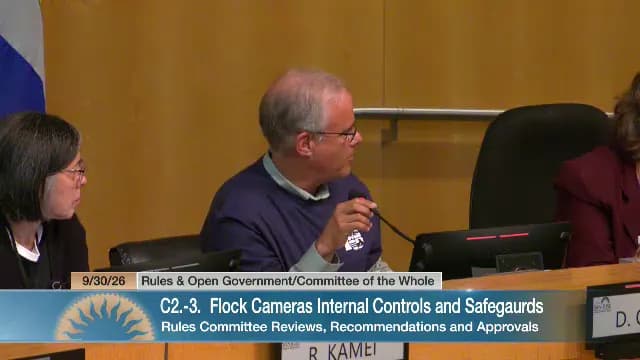
The Rules and Open Government Committee (ROGC) met jointly with the Committee of the Whole on Wednesday, September 30, 2026, at 2:00 PM in a hybrid format. The committee reviewed the final agenda for the October 6 City Council meeting, approved the consent calendar, discussed a memo on Council transparency and non-disclosure agreements, and combined two related items on Automated License Plate Reader (ALPR) data access and safeguards. Extensive public comment was heard, particularly on the ALPR items. All actions were unanimous (5-0). Consent Calendar - The committee approved the consent calendar (7 items) by a 5-0 vote. Items included: receiving the public record (September 17-24, 2026); amending the Public Safety, Finance and Strategic Support Committee work plan to drop a Downtown High-Acuity Referral System status report; reviewing a joint special meeting agenda with the San José/Santa Clara Treatment Plant Advisory Committee; authorizing travel for the Mayor’s Director of Innovation to attend a convening in New York City (October 7-9, 2026); approving free use of the rotunda for the “Conversations for Good 2026” event; approving the District 9 End-of-Term Farewell Celebration as a city council sponsored special event; and retroactively approving the Golden State Valkyries Flag Raising event. Public Comments & Testimony - Item C1 (NDA transparency): Brian spoke in support of transparency, urging that public comments be considered. Virtual speaker Jordan argued the policy should apply to all city staff, not just councilmembers, and requested an immediate scope expansion. The committee did not amend the motion. - Items C2 & C3 (ALPR safeguards): Over 30 speakers testified, most representing organizations such as Siren, Silicon Valley Democratic Socialists of America, Safety Over Surveillance Coalition, Bay Resistance, and community members. Speakers uniformly urged the city to cover all Flock cameras, cancel the contract with Flock, conduct an independent audit, and hold the police chief accountable. Many cited the egregious breach where an SJPD officer used ALPR data to stalk a domestic violence survivor (his cousin) and noted that the police chief had previously assured the council that data was secure despite an open investigation. Several speakers argued that no amount of regulation can prevent intentional abuse and that mass surveillance violates constitutional privacy rights. A few speakers also linked the issue to ICE surveillance and the need for warrants. No speaker supported the current ALPR system. Discussion Items - C1: Council Transparency and Private Non-Disclosure Agreements – Councilmember Kamei noted the importance of looking at neighboring jurisdictions and possibly including leadership staff. The committee approved the workload analysis, directing staff to return with policy options for full council consideration in early 2027. Motion carried 5-0. - C2 & C3: Automated License Plate Reader Data Access and Safeguards – The committee combined the two memos (one from Mayor, Foley, Candelas, Casey; the other from Kamei, Tordillos, Cohen, Mulcahy). Vice Mayor Foley explained that the committee’s role is to send items to staff for workload analysis, not to make final policy decisions; full council will decide on covering cameras, canceling the Flock contract, and independent auditing. Councilmember Duan noted he had initial concerns about a private right of action but acknowledged the Police Officers’ Association had not objected. Councilmember Cohen emphasized the need for multi-factor authentication, criminal penalties for misuse, and independent police auditor oversight. Both memos were directed to staff for a merged workload analysis, to return to the committee in approximately three weeks. Motion carried 5-0. Key Outcomes - Approved the final agenda for the October 6 City Council meeting, moving the Civil Service Commission interview to the end (5-0). - Approved the consent calendar (5-0). - Directed staff to develop policy options on prohibiting councilmember NDAs related to city business, with a return to council in early 2027 (5-0). - Directed staff to merge the two ALPR memos into a single workload analysis and return to the committee within three weeks for further consideration; final policy decisions to be made by the full City Council (5-0). - Adjourned at 2:55 PM.

PRIVACY 43% · PROCEDURAL 21% · PUBLIC COMMENT 18% · PUBLIC SAFETY 10%
17
SEP 29, 2026 · SAN JOSE, CALIFORNIA · CITY COUNCIL
San José City Council Meeting – September 29, 2026

The meeting began with a closed session at 9:30 a.m., followed by public comment on labor negotiations (Agenda Item 3.2). The regular session was scheduled for 1:30 p.m., but the provided transcript only covers the start of the closed session and public comments. No votes or decisions are recorded in the available material. Public Comments & Testimony - Three speakers from IFPTE Local 21 (CAMP and AMSP bargaining units) spoke in favor of including binding grievance arbitration in their next labor contract. Michael Jun, a senior development officer and union president, argued that arbitration provides a neutral third party for dispute resolution, noting other city unions already have this right. Mary Morse, a senior environmental program manager, asked the council to listen to workers who want a fair contract that keeps up with cost of living and inflation, and noted that 5% of wages do not contribute to pensions. Riley Knight, a supervising environmental service specialist and union treasurer, stated that arbitration is a standard union contract provision and that the process cannot create new benefits but resolves disputes fairly. Discussion Items - No discussion items from the regular session are present in the transcript. Key Outcomes - No actions or votes are recorded. The council adjourned to closed session after public comments. Note: The agenda included numerous items (consent calendar, strategic support, public safety, transportation, environmental services, land use, etc.) but no decisions are reflected in the provided transcript. This summary is based solely on the available material.

PROCEDURAL 50% · LABOR STANDARDS 50%
18
SEP 29, 2026 · SAN JOSE, CALIFORNIA · CITY COUNCIL
San José City Council Meeting – September 29, 2026

The San José City Council met on Tuesday, September 29, 2026, in a hybrid meeting starting at 1:30 p.m. (following a 9:30 a.m. closed session). The council approved consent items, land use items, a wastewater financing program, and an elevator replacement project. A major debate centered on proposed parking meter and garage rate increases, culminating in a compromise motion that passed 7-3 after initial motions failed. Consent Calendar - Approved consent calendar (9-0) including: - Approval of council/committee minutes and excused absence requests. - Amendments to airport leases (Jett Pro Line Maintenance, GSA, PrimeFlight Aviation). - Amendment to master consultant agreement with HF&H Consultants ($380,000 to $480,000). - Authorization for Interim Independent Police Auditor travel to Louisville for NACOLE training. - Amendment to grant agreement with San José Public Library Foundation (increase to $1.3 million). - Amendment to tow administrator services agreement (increase to $4,363,076). - First amendment for Race Street/Parkmoor Avenue Safety Improvements project (increase to $660,230). - Grant application for Highway 237 Trail Rail Crossing Improvement Project. - Status report on 2018 Measure T Disaster Preparedness Bond. - Travel authorizations for Mayor Mahan and staff to various events. - $500 grant to California Association of Local Agency Formation Commissions. Public Comments & Testimony - Parking item (5.2): Numerous downtown small business owners, employees, residents, and parking board members spoke in opposition to the rate increases, citing harms to downtown vibrancy, employee affordability, safety in garages, and inadequate prior outreach. A downtown business owner stated he would leave San Jose after 20 years. Some speakers supported a pause and more data. - Moratorium item (3.5): Public comment included support for the moratorium (e.g., from a community member thanking council for protecting public safety) and opposition from a caller criticizing the city's approach to federal immigration enforcement. - Elevator project (5.1): A speaker with mobility issues urged ensuring elevators are accessible for all users. - Wastewater financing (Joint agenda): One speaker praised the collaborative effort; another expressed skepticism about city management. - Open Forum: Speakers raised concerns about a local service provider facing permit issues and noise disturbances at interim housing. Discussion Items - 3.3 – Performance Measures Audit: City Auditor presented audit of Office of Economic Development and Cultural Affairs (OEDCA) with 5 recommendations to improve clarity and documentation. OEDCA accepted all recommendations. Council approved 9-0. - 3.5 – Temporary Moratorium on Detention/Custodial Facilities: Council adopted an interim ordinance establishing a 45-day moratorium (with possible extensions) on applications for detention or custodial facilities on private/public property, to allow study of zoning implications. Motion passed unanimously (9-0). - 5.1 – SJC Terminal Elevator Replacement Project: Awarded contract up to $9,415,000 with 15% contingency. Motion passed unanimously (9-0). - 5.2 – Parking Meter and Garage Rates and Hours: Extensive debate on balancing revenue needs, downtown vibrancy, and equity. Councilmember Tordillos introduced a blue memo with a two-year phased approach vs. staff's five-year plan. Initial motion tied 5-5 (failed). A subsequent motion for a joint council-parking board meeting also failed 5-5. Finally, a compromise motion (items 1A, B, C, F and all of item 2 from the blue memo) passed 7-3. - 6.1 – Household Hazardous Waste Collection Program: Amendment with County of Santa Clara increasing compensation by $4,083,373 to $5,283,373, retroactive to September 2025. Councilmember Cohen questioned the 400% increase; staff cited reduced fee revenue, increased participation, and higher costs. Motion passed unanimously (9-0). Key Outcomes - Parking rates (5.2): Adopted a two-year phased increase (effective October 2026): - Special event garage flat rate range $13–$35 (Market/San Pedro Square, Third Street, Second/San Carlos, Fourth Street, The Globe garages). - Daily garage rate of $1.25 per 15 minutes. - Expanded Downtown Employee Discounted Permit Parking Program: 50% discount off Global Monthly Permit for employees earning ≤50% over minimum wage (excluding gratuities). - Extended 90-minute free parking at Convention Center Garage on non-event days through June 2027. - No extension of meter hours beyond 6 p.m. (existing hours remain). - Directed City Manager to develop a long-term parking and curb management plan, including a return-to-source policy for parking fund revenues, and to provide annual reports to the Downtown Parking Board with utilization data. - Moratorium (3.5): 45-day temporary moratorium on detention/custodial facilities established. - Performance audit (3.3): Accepted with recommendations to improve OEDCA performance measures. - Wastewater financing (Joint): Approved issuance of up to $200 million in subordinate wastewater revenue commercial paper notes (9-0).

PARKING 42% · PUBLIC COMMENT 10% · PROCEDURAL 9% · ECONOMIC DEVELOPMENT 5%
19
SEP 24, 2026 · SAN JOSE, CALIFORNIA · PLANNING COMMISSION
San Jose Planning Director's Hearing - September 24, 2026

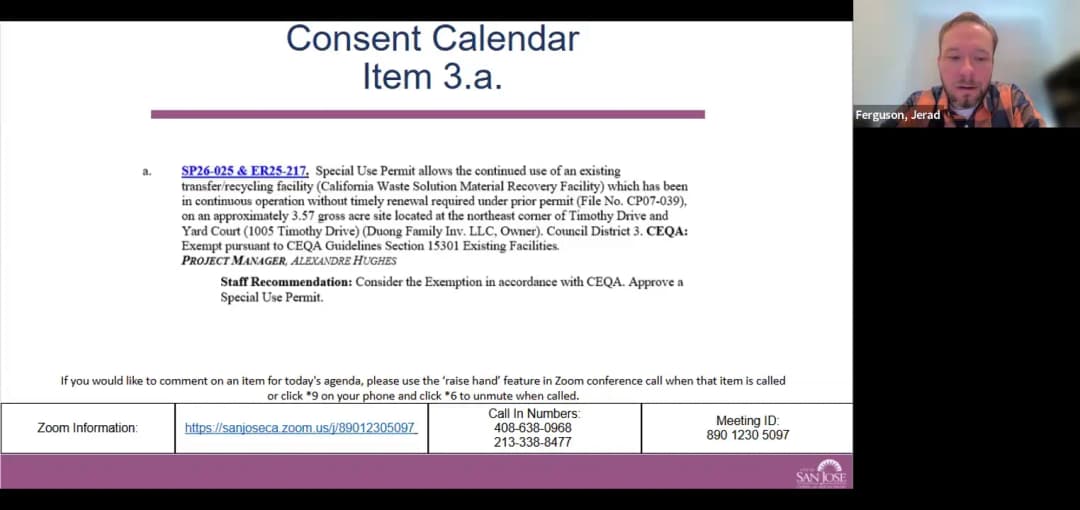
The San Jose Planning Director's Hearing convened on September 24, 2026, via Zoom, with Hearing Officer Jared Ferguson presiding on behalf of Director Christopher Burton. The meeting was brief and consisted solely of the consent calendar; no public hearing items were agendized. Note: The transcript recites the date as September 23, 2026, while the meeting timestamp indicates September 24, 2026 UTC; this summary uses the provided date. Consent Calendar - Item 3a (SP26-025 / ER25-217): Special use permit for continued operation of an existing transfer/recycling facility, California Waste Solution Material Recovery Facility, on an approximately 3.57 gross acre site at 1005 Timothy Drive, Council District 3. - The facility had been in continuous operation without timely renewal under prior permit CP07 39. - CEQA exemption reviewed under CEQA Guidelines Section 15301 for existing facilities; staff recommended considering the exemption and approving the special use permit. - No public comments or requests to remove the item were made; Hearing Officer approved the consent calendar, including this item. Public Comments & Testimony - No members of the public raised hands or requested to speak on the consent item; no testimony was provided. Discussion Items - None. No public hearing items were listed or heard. Key Outcomes - Approved the consent calendar as presented, including the special use permit (SP26-025) and the CEQA exemption determination (ER25-217) for the California Waste Solution Material Recovery Facility. - No appeals or further actions were mentioned; the hearing was concluded after the consent calendar action.

PROCEDURAL 76% · RECYCLING ECONOMY 24%
20
SEP 23, 2026 · SAN JOSE, CALIFORNIA · CITY COUNCIL
City of San José Joint Rules and Open Government Committee and Committee of the Whole Meeting - September 23, 2026

The City of San José held a joint hybrid meeting of the Rules and Open Government Committee and the Committee of the Whole on September 23, 2026, in Council Chambers and virtually. The committee reviewed upcoming City Council agendas, approved routine consent items, and heard public testimony. Roll call showed Vice Mayor Pam Foley and Councilmember Rosemary Kamei present; Chair David Cohen was absent. A quorum was present. Note: The agenda lists the meeting as Wednesday, September 23, 2026, at 2:00 p.m.; the raw transcript's opening announcement says Tuesday, September 29th. This summary uses the supplied meeting date of September 23, 2026. Consent Calendar - Approved the Public Record for September 10-17, 2026, and ordered it received and filed. - Authorized travel and acceptance of travel payments for Mayor Mahan and Mayor's Chief Communications and Public Information Officer Tasha Dean to attend Teach For America's 35th Anniversary Summit on October 3, 2026. Also authorized Mayor's Chief of Staff Sarah Zárate to participate in the Bloomberg Center for Cities at Harvard University Project on Municipal Innovation convening, funded by Bloomberg Philanthropies, October 7-9, 2026. Both items were placed on the September 29, 2026 City Council agenda. - Approved a $500 District 1 San Jose Sharks Community Fund grant to the California Association of Local Agency Formation Commissions (CALAFCO) for its annual CALAFCO Conference on October 21-23, 2026, and leadership development programs; the item was placed on the September 29, 2026 City Council agenda. Public Comments & Testimony - Brian expressed support for raising downtown parking fees, saying downtown remains cheaper than other places even after an increase, but urged the City to listen to people who work downtown and raised a broader policy concern. - A caller opposed the parking fee and enforcement changes, saying half of downtown parking meters do not work, downtown storefronts are empty, and parking in downtown San Jose should be free. - Ruthie asked what item the planning department would bring back on the October 6 agenda related to the August 18 discussion of the General Plan and housing element, sometimes called missing middle, and asked for the specific date and time. - Jordan Moldow, District 3, asked the same question; noted an expected PBCE work plan discussion on October 6; asked staff for the current expected date. Moldow also raised the upcoming item on regulation of personal delivery devices and city right-of-way, said he participated in BPAC and online discussions, and hoped the staff report would summarize what was discussed in VPAC and in public workshops. - A caller criticized repeated agenda deferrals and long evening council meetings, saying the public is frustrated by items being delayed. - During the consent calendar, Brian spoke about the Zogg fire, named Elena McLead, Fayla McLead, Karen King, and Kenneth Lawson as people who died, criticized the utility's and CPUC's handling of the final report, said the utility paid $50 million but that the public ultimately paid it, and objected to such matters being on consent calendars. - A caller urged the City to fight PG&E, saying all politics is local; the presiding officer responded that no PG&E consent item was on this agenda. - In open forum, Brian asked people to drive slower, citing deaths and serious injuries from car accidents and his own experience being hit while walking and biking. - Another caller thanked Councilmember Pam Foley for recognizing the situation on a street identified in the transcript as 'Speak Lane,' called accumulating piles on the street a hazard, asked for weekly cleanups rather than monthly cleanups, and warned that an accident there could create city and taxpayer liability. Discussion Items - Review of the September 29, 2026 final agenda: the committee reviewed a 9:30 a.m. closed session and 1:30 p.m. regular session with no evening meeting. Consent items included a strategic support item on the City Manager's Office of Economic Development and Cultural Affairs audit report; a temporary moratorium and status report on ballot measure T; actions related to San Jose airport terminal elevator replacement; parking meter, garage rates and hours; an agreement with the County of Santa Clara for household hazardous waste collection; no items under sections 7-9; item 10 heard immediately after consent; no other land use; and a joint City of San José Financing Authority agenda. - Review of the October 6, 2026 draft agenda: the committee reviewed a 9:30 a.m. closed session and 1:30 p.m. open session. Consent items were scheduled from page 5 through page 7, with no strategic support or public safety items; a transportation-related item on page 8 covered actions related to regulation of personal delivery devices and city right-of-way. Other items included an affordable housing development at 1510 North First Street, actions related to arena hotel redevelopment and the HomeKey program, and no land use items. - Staff responded that the planning policy prioritization item originally scheduled for October 6 needed two additional weeks for staff capacity and outreach to ACDC, and is currently on the horizon report for October 20. - Vice Mayor Foley moved approval of the October 6 draft agenda and noted that there is no council meeting in two weeks, which is why the item is pushed out further. Key Outcomes - Motion to approve the September 29, 2026 final agenda with the add sheet passed. - Motion to approve the October 6, 2026 draft agenda passed. - Motion to approve the consent calendar passed. - The planning policy prioritization item was moved from October 6 to the October 20 horizon report. - The travel authorization items and CALAFCO grant were placed on the September 29, 2026 City Council agenda. - The transcript records adjournment at 2:14 p.m.

PUBLIC COMMENT 32% · PARKING 26% · PROCEDURAL 11% · TRANSPORTATION 9%
OPENPUBLICA · PUBLIC MEETING INDEXUPDATED DAILY · openpublica.com