Browse by city
Date range
Search help

Search titles, summaries, topics and stored transcripts together. Keywords may match separately; put the whole query in double quotes for a phrase. Matching follows word analysis, so punctuation is not exact. Both dates are included. Documents are not searched.

SHOWING 101–110 ENTRIES
101
APR 21, 2026 · SAN JOSE, CALIFORNIA · PLANNING COMMISSION
San Jose Planning Director Hearing Summary: April 15, 2026

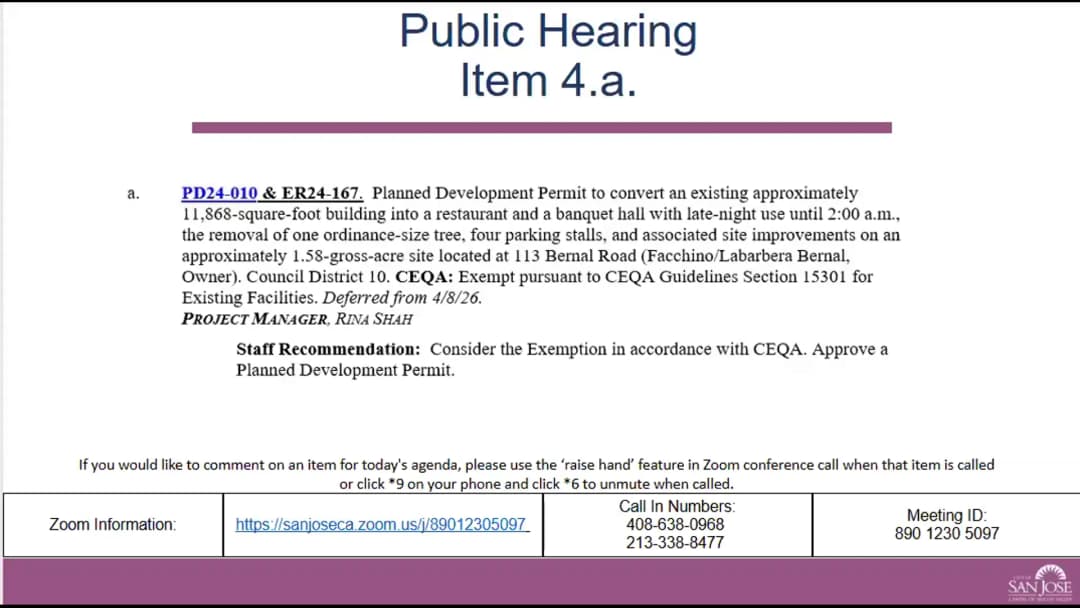
On April 15, 2026, the Planning Director meeting was called to order at 9:00 AM by Hearing Officer Sylvia Doe, acting on behalf of Director Christopher Burton. The meeting was conducted via Zoom, with a consent calendar item and a public hearing item on the agenda. One item was approved on consent, and one public hearing item was approved with conditions after receiving public testimony. Consent Calendar - Item 3A (PD24-011 / ER24-138): Approved on consent. The permit allows construction of an elevated pedestrian entry plaza for a church, removal of an existing front staircase, and removal of three ordinance-sized trees at 4600 Highland Avenue. Staff recommended the CEQA exemption and approval. Two members of the public (Gustavo and Mary Louis) spoke in favor; no opposition was voiced. The item remained on consent and was approved unanimously. Public Comments & Testimony - Item 4A (PD24-010 / ER24-167): A planned development permit to convert an 11,868 square foot building into a restaurant and banquet hall with late-night use until 2 a.m., plus removal of one ordinance-sized tree and four parking stalls at 113 Burnell Road. - Idra Flaxa (neighbor, closest residence 235 feet away): Expressed concern about noise from patrons leaving after 2 a.m., particularly car traffic on Bernal Road, and its impact on sleep for her family (including a newborn expected in late October/early November). She requested the hearing officer consider these concerns before approving. - Jumin (read by Idra Flaxa): A schoolteacher and neighbor stated they had retained legal counsel, arguing the 2 a.m. permit violates San Jose Municipal Code and citing WHO research on health risks of late-night noise. She requested denial of the 2 a.m. request and a 9 p.m. closing time on weekdays and weekends. - Dowwin (neighbor adjacent to Idra): Opposed the 2 a.m. closing due to existing traffic noise and disruption to his family (two children aged 12 and parents aged 70–80), stating it would be a big disruption. Discussion Items - Item 4A – Staff Presentation: Project Manager Rena Shah presented the proposal. The restaurant and banquet hall would operate daily 11 a.m. to 2 a.m., with no exterior modifications or outdoor uses. Four parking stalls would be removed (shopping center retains 1,121 spaces, exceeding the required 956). Traffic impacts were found minimal. A noise consultant, Jacob Bernard, analyzed sound levels and concluded the project would comply with the 55 dBA limit. Conditions include: doors/windows closed after 10 p.m., no loitering, security measures, and no outdoor amplified sound. The project is consistent with General Plan policies and CEQA exempt under Section 15301. - Applicant Remarks: Thornton (architect) noted the building was formerly a Sweet Tomatoes and is under construction for a restaurant permit; new owners Amon and Margit Cooner hope to open in May/June 2026. Outdoor dining was removed due to concerns from other tenants. He clarified most events would be private (weddings) on weekends with 100–200 guests, not the full 600-person capacity. Deliveries would occur weekdays 9 a.m. to 12 p.m. - Hearing Officer Clarifications: The hearing officer noted that restaurants are allowed by right to operate until midnight; the planned development permit is required only for the banquet facility and late-night use (midnight–2 a.m.), allowing the city to impose conditions to mitigate potential noise and security impacts. She acknowledged the residential uses across a six-lane major arterial street and stated that the removal of outdoor activities and strict permit conditions address neighbor concerns. Key Outcomes - Item 4A – Approved: The hearing officer approved the planned development permit (PD24-010) and the CEQA exemption (ER24-167) as recommended by staff, with conditions including: doors and windows closed after 10 p.m., no outdoor amplified sound, security and anti-loitering requirements per San Jose Police Department conditions, and adherence to noise ordinances. The approval allows the restaurant and banquet hall to operate daily from 11 a.m. to 2 a.m. The action is final unless appealed per Titles 20 and 21 of the Municipal Code. The meeting adjourned at 9:45 AM.
LATE NIGHT USES 42% · LAND USE 30% · PROCEDURAL 14% · PUBLIC COMMENT 9%
102
APR 21, 2026 · SAN JOSE, CALIFORNIA · CITY COUNCIL
San Jose City Council Meeting: April 21, 2026 – Data Centers, Living Wage, and Proclamations

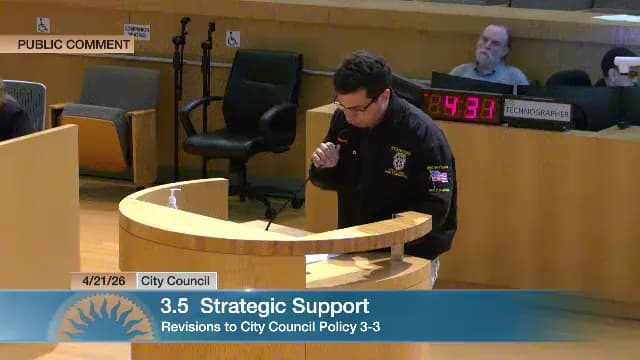
The San Jose City Council met on April 21, 2026, for a regular meeting that began at approximately 1:30 PM. The agenda included ceremonial proclamations, consent calendar items, a pension update, a status report on data centers and the PGE partnership, a revision of the city’s living wage policy, approval of the Connect North San Jose Multimodal Transportation Improvement Plan, establishment of the East Village Business Improvement District, and a grant agreement for shelter-based Medicaid services. The meeting featured extensive public testimony on data centers (both for and against) and on the living wage adjustment, as well as an open forum regarding the Coyote Creek ("Jungle") encampment sweep. Ceremonial Items - Earth Day Proclamation (April 22): The council recognized Earth Day with Councilmember Cohen and Councilmember Kamei. Mani Bukala of Silicon Valley Youth Climate Action accepted the proclamation, highlighting the need for accelerated local climate action, especially given federal setbacks. - National Youth Violence Prevention Week (April 20–24): Councilmember Candelas presented a proclamation to Cora Tomolinas, a longtime advocate, and noted the expansion of the Saturday Night Lights program to eight citywide sites. - Autism Awareness Month: Councilmember Mulcahy recognized Martin Slingstad and Spire Autism for their work in autism acceptance and inclusion. Consent Calendar - Item 2.13 – Microtransit Pilot (Balante): Councilmember Candelas pulled this item to discuss the launch of an on-demand community-based microtransit service in East San Jose. Staff confirmed the service will begin by the end of 2026, following vendor selection and outreach. The pilot will fill transit gaps in areas with limited access. - Item 2.18 – Farm Workers’ Day Resolution: Councilmember Kamei pulled this item, co-authored by Vice Mayor Foley and Councilmember Campos, to align San Jose with the state in recognizing March 31 as Farm Workers’ Day, centering the contributions of women and families. The consent calendar was approved unanimously after public comment with no cards. Public Comments & Testimony - Data Centers (Item 3.4): Nineteen speakers addressed the council. Many residents opposed data center development, citing concerns about water use (especially potable water), air pollution from backup generators, impacts on wildlife (e.g., burrowing owls and bald eagles), increased utility rates, and environmental justice. Speakers from UA Local 393 and the building trades expressed support, emphasizing good-paying construction jobs and the city’s need for revenue. Several speakers requested a moratorium and more community engagement before project approvals. - Living Wage Revision (Item 3.5): Eleven speakers, including representatives from Working Partnerships, Unite Here Local 19, Teamsters, and the South Bay Labor Council, urged the council to adopt the one-time catch-up adjustment to compensate for the zero increase in FY2025–26. Airport workers noted the disparity between the city living wage ($26.73) and the airport living wage (about $6 less), calling for parity. - Open Forum (after agenda items): Fifteen speakers discussed the ongoing sweep of the Coyote Creek (Jungle) encampment. Residents and advocates asked the council to pause abatements until all residents receive housing placements, citing lost belongings, missed sign-ups, and inadequate interim options (e.g., Tent City, not housing). Speakers called for the city to keep its promise to house everyone before clearing the site. Discussion Items - Item 3.1 – City Manager’s Report (Earthquake Preparedness): City Manager Jennifer Maguire reported on the earthquake preparedness campaign (30 Tips in 30 Days), which increased AlertSCC signups by over 3% in under-registered zip codes. Special recognition was given to Ray Reardon for receiving the California Emergency Services Association’s President’s Award. - Item 3.3 – Pension Plan Actuarial Valuations (as of June 30, 2025): Director John Flynn and actuary Bill Hallmark presented the annual update. The combined pension funded ratio improved to 55.1% (up 3 percentage points), with assets of $8.76 billion and unfunded liability of $2.91 billion. The OPEB funded ratio rose to 55.2%. City contributions for UAL reached $336.4 million. Vice Mayor Foley noted the $300+ million annual payment as a constraint on the budget. - Item 3.4 – Data Centers and PGE Partnership Status Report: Deputy City Manager Manuel Pineda and staff presented an informational update. Key points: (1) The city has an implementation agreement with PG&E signed July 2025, with quarterly scoring; (2) 12 projects are in the pipeline (2 energized, 10 to be energized by 2030); (3) Data centers under 100 MW do not require a power plant permit; (4) Up to 2,000 MW of new regional transmission capacity (LS Power projects) is planned between 2028–2034, but not committed to San Jose; (5) Proposed PG&E Rule 30 (pending CPUC) would require customers to pay upfront for types 1–3 grid upgrades; (6) Water use is less than 3% of total city usage, with recycled water prioritized; (7) Environmental review (CEQA) will be conducted per project. Council members expressed concerns about water use, rate impacts, community outreach, and environmental justice, but noted the economic benefits (e.g., $3–7 million annual revenue per 50–99 MW data center). No vote on projects was taken; the council accepted the status report (motion by Councilmember Cohen, seconded, passed unanimously). - Item 3.5 – Living Wage Policy Revision (Council Policy 3.3): Director of Public Works Matt Lesh presented a revision to align the living wage calculation methodology with the airport’s CPI-U method, replacing the outdated vendor-based geographic factor. The change would take effect July 1, 2026, with the current rate of $26.73 unchanged initially. Councilmembers Candelas, Campos, Ortiz, and Casey submitted a memo to include a one-time catch-up adjustment to account for the zero-increase year. Staff confirmed the fiscal impact is minimal (largest contracts already pay above the living wage). The revision and catch-up were adopted unanimously. - Item 5.1 – Connect North San Jose Multimodal Transportation Improvement Plan: The plan recommends 29 projects, including 8 “Big Moves” such as a North First Street transit priority corridor, Montague-First grade separation, Zanker Road bike/pedestrian improvements, and a Sharcot Avenue bicycle priority project with an 880 overcrossing. The plan was shaped by input from over 700 community members. Councilmember Cohen expressed support and noted the importance of the light-rail grade separation. Approved unanimously. - Item 8.1 – East Village Business Improvement District: Approved unanimously to establish a BID for beautification and marketing. - Item 8.2 – CalAIM Grant for Shelter Infrastructure: Eric Nickerson (Assistant City Manager) presented a $1.3 million state grant with matching city funds ($2.6 million total) to build administrative infrastructure for Medicaid (Medi-Cal) billing at three shelter sites: Soroni, Cherry, and Evans Lane. The pilot will run 12–18 months, with potential annual net revenue of $7–9 million if scaled system-wide. Approved unanimously. Key Outcomes - Consent Calendar (including Items 2.13 and 2.18) approved unanimously. - Item 3.3 (Pension update) approved unanimously. - Item 3.4 (Data center status report) accepted unanimously (informational, no project approvals). - Item 3.5 (Living wage revision and catch-up adjustment) adopted unanimously. - Item 5.1 (North San Jose MTIP) approved unanimously. - Item 8.1 (East Village BID) approved unanimously. - Item 8.2 (CalAIM grant) approved unanimously. - Open Forum: No formal action taken; residents’ concerns were heard. Council members indicated they would follow up with staff on the jungle encampment process.

TECHNOLOGY AND INNOVATION 21% · LABOR STANDARDS 12% · PUBLIC COMMENT 11% · CLIMATE AND ENVIRONMENT 10%
103
APR 20, 2026 · SAN JOSE, CALIFORNIA · CITY COUNCIL
San Jose City Council Study Session: From Ideation to Occupancy – Permitting Timelines and Coordination (April 20, 2026)

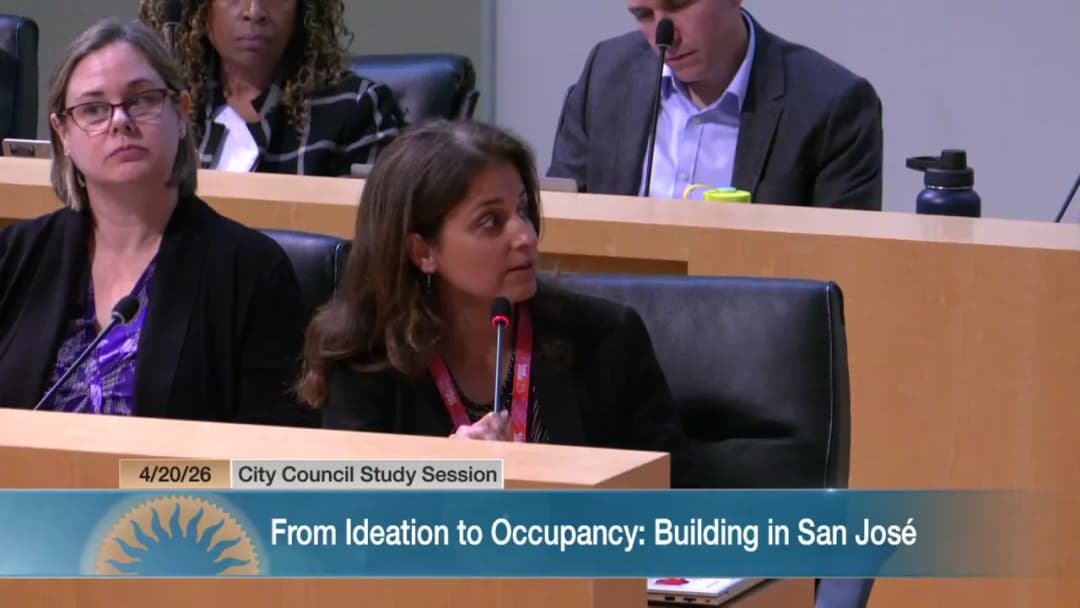
The study session, convened at 1:30 PM by the Vice Mayor, provided a comprehensive overview of the city's development permitting process from ideation through occupancy. Staff from Planning, Building, Public Works, and Fire departments presented on service pathways, time drivers, fees, technology, and continuous improvements. Five external customers—representing industrial, affordable housing, market-rate residential, small business, and commercial development—shared frank feedback on what works well and what creates friction. Councilmembers asked questions and offered direction, particularly on improving comment consistency, expanding ministerial pathways, and strengthening interdepartmental coordination. Consent Calendar - No consent calendar was presented; the entire session was a study session. Public Comments & Testimony - Samita Thakral (Prologis): Stated that early integrated meetings and the development facilitation officer are working well. Noted friction from building permit application appointments being several months out, lengthy comment cycles, and a portal that allows only one representative to upload documents. Suggested adopting regular cross-department review meetings, fixed coordinated response times, a centralized help desk, and flexible land use frameworks for evolving technology. Highlighted a success: a complex project approved in 91 days, half the expected timeline. - Chris Neal (Core Companies): Praised the city's clear messaging on housing priorities and the partner-like leadership in planning. Criticized coordination with Public Works, citing five or six rounds of plan check comments with new issues arising late in the process. Noted challenges with PG&E transformer requirements and a city-mandated redundant fire air replenishment system adding $1.5 million to Gateway Tower. Called for simpler processes, especially for park fee waivers. - Ryan McNamara (Summerhill Homes): Appreciated staff's deep understanding of state housing laws and the flexible inclusionary housing program. Highlighted the ministerial approval process for predictability. Suggested the city adopt weekly check-ins during entitlement and improve the fee schedule with clear examples to avoid missing ancillary fees. - David (Novu Hospitality, small business owner): Praised the SRP program for saving months on projects, but cited gut-wrenching experiences when new plan reviewers reintroduce previously resolved comments. Urged expedited permitting options where applicants pay extra for overtime, similar to health department practices in other cities. - Jennifer Friedman (Overton Moore): Appreciated developer roundtables and staff responsiveness, but stated that responses often lack substance. Criticized CEQA process for taking 19 months on a straightforward project, with a 17-week delay for review of an ISMND that yielded only stylistic comments. Noted a culture of conservatism where staff choose the most time-consuming and expensive options. Cited Fremont's fast approval of a 2.5 million sq ft project as a model. Mentioned $60,000/month carrying costs due to delays. Discussion Items - Permitting Process Overview: Staff (Chris Burton, James Dobson, Lisa Joyner, Manira Sandir, Jay Guerrera, Alex Powell) explained the development continuum, service pathways (from online permits to coordinated review), and the affordable housing streamlined process. Key statistics: over 36,000 permits issued annually, 56 building permit types available for online self-issuance (about 20,000 permits), and 300 professionals across development services. - Affordable Housing Case Study (Gateway Tower): A 15-story, 220-unit project that adhered to a strict schedule and received permits by January 23, 2026, on time. The streamlined pathway relies on shared schedules and state funding deadlines, but is resource-intensive and can delay other projects. - Time Drivers: Manira Sandir outlined three categories of time: required by law/policy, driven by project choices, and time the city can improve. Key strategies to reduce time: early issue identification, parallel reviews, clear comments, standardization, technology investments, and triaged services. - Fees and Requirements: Jay Guerrera noted that city costs represent roughly 10% of total project costs, with fees around 1%. Fees cover staff services; regulatory fees (e.g., inclusionary housing, parks) are policy-driven. Requirements ensure public safety, infrastructure, and community character. - Technology: Alex Powell described the core systems (Amanda, SJpermits.org, SJE plans) and digitization over five years. Future plans include an application wizard, fee estimator, pre-submittal instructions, and eventual AI-assisted prescreening. Currently, 20,000 permits are issued online in under 15 minutes. - Councilmember Questions: Councilmembers Casey, Mulcahy, Candelas, Tordillos, Campos, and Kamei raised concerns about comment consistency, the need for ministerial pathways, interdepartmental coordination, ADU education, PD zoning digitization, fee adequacy, and staffing capacity. Staff acknowledged these challenges and pointed to ongoing work: the development services optimization and realignment initiative, upcoming general plan four-year review, planned updates to CEQA exemption checklists and standardized mitigation packages, and digitization of legacy microfiche plans. Key Outcomes - No formal votes were taken. The session was informational and advisory. - Staff committed to continuing work on the development services optimization and realignment, with a focus on strengthening coordination, improving application quality, and enhancing transparency. - Staff noted that a memo from Councilmembers Campos, Cohen, Kamei, and Casey to expand the ministerial program citywide was submitted earlier in the month and will be subject to council discussion. - Staff confirmed that updated CEQA mitigation packages and tiered environmental documents will be brought to council on May 19, 2026. - The budget process will include discussions on fees and staffing to support improved service delivery.

ENGINEERING AND INFRASTRUCTURE 53% · LAND USE 17% · ECONOMIC DEVELOPMENT 8% · AFFORDABLE HOUSING 7%
104
APR 16, 2026 · SAN JOSE, CALIFORNIA · CITY COUNCIL
Public Safety, Finance, and Strategic Support Committee Meeting - April 16, 2026

The Public Safety, Finance, and Strategic Support Committee met on April 16, 2026, to consider a consent calendar item, the Innovation and Technology Project Status Report, a follow-up audit on police staffing and workload, the Fire Department Annual Operational Report, and the Fire Department Staffing and Recruitment Annual Report. The committee also heard public testimony from residents impacted by encampment sweeps. All motions were approved. Consent Calendar - The committee unanimously approved the bi-monthly financial report for January and February 2026. Discussion Items Innovation and Technology Project Status Report - Chief Information Officer Callan Tolfik, Division Manager Jesse Juarez, and Project Manager Shirley Young presented. The PMO manages large, cross-department projects. Of 24 active projects, 22 were on track (green), one yellow (minor vendor delays), and one red (requiring rebidding). Major launches included a new business tax system (supporting $30 million in annual revenue), a CRM for council offices (9 of 11 offices onboarded), and the SJ Learning Portal (over 150 courses). The IT strategic plan focuses on community engagement, innovation, AI, cybersecurity, and data. Over 800 staff completed baseline AI training with an 85% satisfaction rate. Councilmember Kamei asked about the 70% customer satisfaction metric, requesting industry comparison context. Chair Dwan inquired about integrating 311 with county/state systems and using AI without eliminating jobs. The CIO noted plans to potentially offer the 311 system to other agencies for a fee. The committee accepted the status report. Police Staffing, Expenditure, and Workload Audit Report - City Auditor Joe Royce presented a follow-up to the 2021 audit. In FY24-25, the police budget was $561 million (up from $459 million in FY19-20). Budgeted sworn positions remain lower than 20 years ago, active sworn numbers have declined, and the average response time for priority one calls was 8.1 minutes (target: 6 minutes). Overtime costs reached $72 million, a 53% increase over five years, with 124 sworn staff each working over 1,000 overtime hours. New overtime controls for follow-up and report writing were implemented in February 2026. The report made eight recommendations; Chief Paul Joseph accepted all except a minor point on CSO call types. Councilmember Kamei moved acceptance; Chair Dwan praised the department’s safety record despite staffing challenges. The report was approved. Fire Department Annual Operational Report - Deputy Chief Aaron Fryler and Chief Robert Sapien presented. The department responded to over 111,000 calls in FY24-25. EMS calls account for over 60% of workload. Call volume increased 22% over five years while the city’s population decreased 5%. The response time goal is 8 minutes 80% of the time for priority one emergencies; the department met the county standard (8 minutes 90% of the time) 10 out of 12 months. Late responses concentrate in the urban core, where Battalion 1 handled over 26,000 incidents. Initiatives include closest unit dispatch, telemedicine, community paramedicine, and developing stations 32 and 36. Councilmember Kamei expressed concern that the department was meeting timelines only 64% of the time (based on an unspecified metric) and deferred recruitment questions. The report was accepted. Fire Department Staffing, Recruitment, Hiring, and Bilingual Services Annual Report - Chief Sapien and Administrative Services Deputy Director Athena Treaty presented. The FY24-25 budget authorized 855.48 positions; sworn vacancies averaged 8.01%. Attrition is primarily retirements (75%). The department runs two academies per year (25–30 recruits each). A statewide paramedic shortage has created staffing imbalances. The recruitment budget is $642,000, including $122,000 in overtime for oral boards and events. The department has 151 bilingual sworn staff; field responders meet language needs 95% of the time. Councilmember Kamei asked about rolling eligibility lists and recruitment strategies. Chair Dwan requested clarification on budget breakdown and outreach to the Vietnamese community. The report was accepted. Public Comments & Testimony - Several residents from an encampment near Happy Hollow (“the jungle”) opposed the city’s encampment sweeps, stating that promised housing has not been delivered and that they are being moved to “Tent City” instead. They described lost belongings, lack of communication from caseworkers, and language barriers (Spanish-speakers not receiving responses). They asked that residents be allowed to stay until housing is actually provided and urged councilmembers to meet with them. A separate speaker raised concerns about a construction project on Rosewood Avenue that could block fire truck access on dead-end streets, calling it a preventable engineering oversight. Key Outcomes - Approved the consent calendar (financial report) unanimously. - Accepted the Innovation and Technology Project Status Report. - Accepted the Police Staffing, Expenditure, and Workload Audit Report. - Accepted the Fire Department Annual Operational Report. - Accepted the Fire Department Staffing, Recruitment, Hiring, and Bilingual Services Annual Report. - No action was taken on public comments; the meeting was adjourned.

PUBLIC SAFETY 32% · PERSONNEL MATTERS 27% · TECHNOLOGY AND INNOVATION 20% · HOMELESSNESS 12%
105
APR 15, 2026 · SAN JOSE, CALIFORNIA · CITY COUNCIL
Rules and Open Government Committee Meeting Summary for April 15, 2026

The Rules and Open Government Committee met at 2:00 PM on April 15, 2026, with a quorum present (Candelas absent, Foley present). The committee reviewed upcoming meeting agendas, approved the consent calendar, and discussed three items: alternative financing for affordable housing, a resolution honoring farm workers, and addressing property damage from a golf course. All items were approved. Consent Calendar - The consent calendar included a public record, a VEBA advisory committee appointment, approval of a flag raising and travel request, and retroactive approvals. - Public comment: Brian urged the committee to review links he sent (representing 50 hours of personal research) regarding solutions for unhoused people. - The consent calendar was approved unanimously. Public Comments & Testimony - Brian spoke during the consent calendar and again during open forum. He emphasized the need for transparency and trust in government, referencing post-COVID erosion of trust and the importance of truth in leadership. Discussion Items - Alternative Financing for Affordable Housing (Item C1): Councilmember Todillos presented a memo from Housing Director Eric Sullivan outlining options to combine existing financing tools (e.g., housing production incentives, master lease financing, gap financing, private activity bonds) to produce affordable housing in mixed-income developments. The goal is to increase affordable units at lower per-unit costs and improve long-term fiscal sustainability. The committee approved the memo subject to workload analysis. - Resolution Honoring Farm Workers (Item 2): A resolution to honor the women and families of the farm worker movement and proclaim March 31 as Farm Workers Day was added to the April 21st city council meeting. The committee approved the resolution. - Property Damage from Rancho del Pueblo Golf Course (Item 3): Councilmember Ortiz described ongoing issues of errant golf balls causing property damage and safety concerns for residents adjacent to the city-owned golf course. Staff reported that PRNS is already engaging with the operator (CORSCO) and residents to implement solutions, including golf-proofing a particularly exposed home and clarifying liability protocols. The committee approved the memo without additional workload analysis, as work is already underway. Key Outcomes - April 21st Final Agenda: Approved. - April 28th Agenda: Approved. - Consent Calendar: Approved. - Alternative Financing for Affordable Housing: Approved (motion by Vice Mayor Foley) subject to workload analysis. - Resolution Honoring Farm Workers: Approved. - Property Damage from Rancho del Pueblo Golf Course: Approved (motion by Vice Mayor Foley) without workload analysis, with staff already addressing the issue.

PARKS AND RECREATION 45% · AFFORDABLE HOUSING 22% · PROCEDURAL 16% · ENGINEERING AND INFRASTRUCTURE 10%
106
APR 14, 2026 · SAN JOSE, CALIFORNIA · CITY COUNCIL
San Jose City Council Meeting - April 14, 2026: Proclamations, Housing, VTA, and Infrastructure

The San Jose City Council met on April 14, 2026, at 9:30 AM. The meeting included proclamations, approval of consent calendars, a joint meeting with the San Jose Housing Authority, a transportation policy discussion with VTA, and a contract award for wastewater facility improvements. All votes were unanimous. Proclamations & Recognitions - Displaced Vietnamese American Heritage Month (April): Councilmember Duan proclaimed April as Displaced Vietnamese American Heritage Month, distinguishing it from Black April commemoration. The proclamation honored the full journey of the Vietnamese American community from loss to resilience. - Cambodian Genocide Remembrance Week (April 14-17): Councilmember Ortiz proclaimed the week, marking the 51st anniversary. Nancy Keo spoke on behalf of the Cambodian community, sharing her family's experience and urging vigilance against genocide. - Creekside School Commendation: Councilmember Campos recognized Creekside School for its 20 years serving students with profound autism. Executive Director Megan Cooper and Principal Katie Shepherd spoke about the school's mission and upcoming adult day program. Consent Calendar - Main Consent Calendar: Approved unanimously with no items pulled. Public comment from Brian Darby noted appreciation for the process. - Land Use Consent Calendar (Item 10.1): Approved unanimously with no discussion. Joint Meeting: San Jose City Council & San Jose Housing Authority - Item 1 / 8.1 – MTW Plan & Arena Hotel: Eric Sullivan (Housing Director) presented on the partnership with Santa Clara County Housing Authority: over 2,300 project-based voucher units, 11,000 tenant-based families, $350M invested yearly. The 2027 Moving to Work Plan includes a direct rental assistance pilot. Arena Hotel interim housing would receive $6.4M in housing authority funds. Public comment: Brian Darby supported full-person services; Gervin, a former foster youth, urged approval for youth pathways. Councilmember Campos asked about voucher availability, interim stay length (6 months), and data collection on residents' origin. Approved unanimously. - Reconvene as City Council – Item 8.1 (Arena Hotel): Approved unanimously after discussion. Discussion Items - Item 3.3 – Tax-Exempt Housing Revenue Bonds: Approved unanimously. Brian Darby thanked bond financiers. - Item 5.1 – VTA SB63 Transportation Policy Priorities: VTA and city DOT staff presented a draft local investment plan for the regional revenue measure (SB63). Proposed priorities for San Jose: roadway maintenance (20% of discretionary funds), transit supportive capital (30%) for projects like Diridon station, and transit service/rider experience (50%) to improve frequencies. Public comment: Vincent Ma (Glideways) requested eligibility for the Diridon-Airport connector. Council discussion: Councilmember Campos asked about complete streets integration and safety at transit hubs; she advocated for free youth passes. Councilmember Ortiz criticized VTA's community engagement during Eastridge-BART construction in District 5, stating it hurt trust. Councilmember Kamei emphasized building ridership habits. The staff memo with these priorities was approved unanimously. - Item 6.1 – Master Consultant Agreement with Brown and Caldwell: For owner advisor services on a $240M secondary treatment upgrade at the Regional Wastewater Facility. Contract not-to-exceed $18.9M (under 8% of construction cost). Public comment: Brian Darby stressed the importance of wastewater infrastructure. Councilmember Kamei and Councilmember Collin expressed support. Approved unanimously. Open Forum - Brian Darby questioned public trust in government and referenced House resignations. - Pachuco criticized homelessness programs and raised legal grievances against a former county prosecutor. - Stephanie (District 10 leadership group) raised concerns about street paving quality and equitable distribution of Measure T funds. Key Outcomes - All votes were unanimous: Consent calendars, MTW plan/Arena Hotel, housing revenue bonds, VTA priorities memo, and Brown and Caldwell contract. - Proclamations were issued: Displaced Vietnamese American Heritage Month, Cambodian Genocide Remembrance Week, and commendation for Creekside School. - Council directed staff to work with VTA to advance transportation priorities, including exploring youth transit passes and ensuring complete streets integration. - The meeting adjourned at 3:00 PM.

PROCEDURAL 35% · TRANSPORTATION 28% · ENGINEERING AND INFRASTRUCTURE 11% · AFFORDABLE HOUSING 9%
107
APR 13, 2026 · SAN JOSE, CALIFORNIA · CITY COUNCIL
San Jose Study Session on Deferred Maintenance and Infrastructure Backlog, April 13, 2026

The San Jose City Council held a study session on April 13, 2026, to review the Deferred Maintenance and Infrastructure Backlog (DMIB) report. The session, chaired by the Vice Mayor, featured presentations from Public Works Director Matt and Budget Director Jim Shannon, highlighting a $2.6 billion one-time backlog and $259 million annual ongoing need to prevent further deterioration. Councilmembers discussed funding challenges, equitable prioritization, and potential strategies including new revenue sources, asset sales, and public-private partnerships. Consent Calendar No consent calendar items were discussed. Public Comments & Testimony No members of the public spoke during the session. Presentation Overview - Deferred Maintenance and Infrastructure Backlog (DMIB): The current report identifies $2.6 billion in one-time unfunded needs and $259 million annually to maintain assets at current conditions. Key categories: storm sewer ($900M, up from $100M due to completed master plan), parks ($650M), city facilities ($570.9M), transportation ($500M), and cultural facilities ($20M). - Why Backlog Grows: Underfunding preventive maintenance is often a short-term trade-off to preserve services, but leads to higher costs when assets fail. Many funding sources are dedicated but difficult to increase (e.g., construction taxes, Transient Occupancy Tax) or rely on the limited general fund. - Critical Projects: City Hall water intrusion ($45M), elevator modernization (31 of 70 elevators, $800k–$1M each), HVAC upgrades, backup generators, EV charging infrastructure, and storm outfall repairs (400 outfalls). Council Discussion and Questions - Councilmember Ortiz asked about equitable distribution of backlog across districts and whether new parks add to maintenance burden. Staff acknowledged no district-level breakdown currently but committed to improving reporting. Parks Director John Cisrelli confirmed new parks increase future capital rehabilitation needs; day-to-day maintenance is funded through operating budgets. - Councilmember Mulcahy questioned the city’s real estate portfolio strategy, suggesting selling underutilized assets or using public-private partnerships to offload capital obligations. Staff noted ongoing property sales but no active review for this specific purpose. Councilmember requested adding asset evaluation to the strategy list. - Councilmember Tordillos expressed concern that new downtown sports and entertainment investments could exacerbate the maintenance backlog and supported reviewing ownership of cultural facilities. - Councilmember Duana asked about reducing project costs (noting 40% soft costs for Public Works projects) and why critical repairs like the Alma Senior Center HVAC were delayed. Staff explained that soft costs include necessary project delivery and that prioritization often forces deferrals due to limited funding. The HVAC replacement is funded through CNC and park trust funds, but if insufficient, emergency funding may require general fund. - Councilmember Vacancies (others) also discussed polling results for potential revenue measures. Assistant City Manager Lee Wilcox reported that a parks parcel tax and infrastructure bond are 15–16 points below the two-thirds threshold, making 2026 unviable; focus will shift to 2028 with enhanced community engagement. Key Outcomes - No formal votes were taken; the session was informational. - Staff will bring forward a proposed budget in May 2026 containing initial funding for the City Hall water intrusion project and other critical items, with a potential financing strategy to follow. - The city will continue developing a citywide stormwater property-based assessment fee and evaluate a general obligation bond for 2028. - Council directed staff to incorporate asset sales and public-private partnerships as explicit strategies for addressing the backlog. - Staff committed to improving DMIB reporting, including district-level breakdowns and more consistent data across departments.

ENGINEERING AND INFRASTRUCTURE 44% · MUNICIPAL FINANCE 33% · PARKS AND RECREATION 22% · COMMUNITY ENGAGEMENT 1%
108
APR 13, 2026 · SAN JOSE, CALIFORNIA · CITY COUNCIL
San Jose Transportation and Environment Committee Meeting - April 13, 2026

This meeting of the Transportation and Environment Committee featured updates on the city's bike plan and trail network, the municipal fleet management program, and the San Jose Clean Energy programs roadmap. The committee accepted all three staff reports, with votes ranging from 4-0 to 5-0, and forwarded the clean energy roadmap to full council for May 19, 2026. Bike Plan 2025 and Trail Network Update - Staff from the Department of Transportation (DOT) and Parks, Recreation and Neighborhood Services (PRNS) presented the annual update. The existing bikeway network is 491 miles, with a plan to reach 550 miles (350 protected bikeways, 100 bike boulevards). In 2025, the city added 7.5 miles of new bikeway, including 6 miles of protected bikeways. Notable projects include the downtown Better Bikeways concrete phase, River Oaks protected bikeway, and a Bay Wheels expansion to the east side using grant funding. The trail network now includes 100 miles of planned and completed trails, with 2 miles completed in the previous year (connecting Barriessa BART to Watson Park and near Vietnamese Gardens to Tully). Encampment removal along the Guadalupe River Trail doubled trail usage. Upcoming projects include the Five Wounds Trail (master plan), Coyote Creek Trail design, Lower Silver Creek Trail feasibility, and Guadalupe River Trail extension. A comprehensive trail assessment is done annually. - Vice Mayor Foley thanked staff and announced a $1 million federal earmark from Congressman Panetta for the Guadalupe River Trail. Councilmember Campos raised concerns about insufficient outreach on the Silicon Valley Bike Boulevard changes in District 2, noting that residents felt unheard; DOT acknowledged the need for broader engagement. Councilmember Tredia's reported positive feedback from a resident about the Alma bike lane and encouraged support for state legislation on automated enforcement of bike lane blocking. Chair Cohen commended proactive bike lane improvements alongside paving and noted ongoing challenges with east-west connectivity and trail flooding under highways (e.g., Penitentiary Creek Trail under 680). - Motion to accept the report carried 5-0. Infrastructure Report on City Fleet Management Program - Public Works staff presented an overview of the city's fleet: approximately 3,100 units (38% public safety). Alternative fuel vehicles make up 53% of the fleet, with all-electric at just under 13%. Key challenges include staffing (43 mechanics for 3,100 assets, 61% deficient per industry standards), a backlog of 1,500 preventive maintenance work orders, and procurement delays (2 FTEs handle 250-300 procurements annually; a fire apparatus spec takes 300 hours). The general fund provides $1.5 million annually, purchasing only 6-14 vehicles. Electric equivalents cost 200-300% more. Rental vehicle costs are $3 million per year. The California Air Resources Board (CARB) Advanced Clean Fleets regulation requires 100% zero-emission purchases for medium- and heavy-duty vehicles by 2030, but availability is limited (e.g., Ford stopped F-150 Lightning production). A $12 million federal grant for charging infrastructure was awarded in January 2025 but later frozen and rescinded. Staff are pursuing grants, rent-to-own, and charging-as-a-service models. - Chair Cohen questioned the feasibility of meeting the 2030 mandate given vehicle availability and infrastructure needs. She also asked about achieving 100% light-duty EV by 2030, noting the city's carbon neutrality goal. Staff acknowledged the difficulty and the need for significant investment in vehicles and charging. Councilmember Ortiz was absent during the vote. - Motion to accept the report carried 4-0 (with Ortiz absent). Clean Energy Roadmap Status Report - The Energy Department presented the annual programs roadmap for San Jose Clean Energy (SJCE). Key context: the Power Charge Indifference Adjustment (PCIA) fee will cost customers $132 million in 2026, offset by $108 million from financial reserves. Staff recommend maintaining a stable $10 million program budget for fiscal year 2026-27 to avoid fluctuations. Currently, 12 customer programs and 3 workforce development programs are offered. In 2025, programs saved customers $29.4 million in lifetime savings and avoided 46,000 metric tons of CO2. New proposals include free technical assistance for commercial customers (with a restaurant track) and a pilot portable heat pump program for renters. A five-year roadmap (2026-2031) was developed based on surveys and stakeholder input, identifying 23 potential programs focused on affordability, EV/heat pump adoption, and demand flexibility. - Chair Cohen asked about expanding programs if PCIA decreases and noted increasing demand as gas appliances are phased out. She also inquired about community solar options; staff mentioned the existing Solar Access Program (community solar for income-qualified customers, 20% bill discount) and interest in balcony solar legislation. Councilmember Campos asked about alternative uses of surplus credits (e.g., gift cards) and whether that could be discussed at the May 19 council meeting; staff indicated that would be appropriate and noted that surpluses are typically allocated to reserves, rate reductions, or program expansions. - Motion to accept the report and forward it to full council for the May 19, 2026 meeting carried (unanimous).

CLIMATE AND ENVIRONMENT 32% · ENGINEERING AND INFRASTRUCTURE 26% · TRANSPORTATION 21% · PARKS AND RECREATION 7%
109
APR 9, 2026 · SAN JOSE, CALIFORNIA · CITY COUNCIL
Neighborhood Services and Education Committee Meeting - April 9, 2026

This meeting of the Neighborhood Services and Education Committee (NSC) covered four major agenda items: a status report on the Children and Youth Services Master Plan, an annual report on the San Jose Youth Empowerment Alliance (including BEST, SSIG, and Youth Intervention Services), the Code Enforcement Annual Report, and a status report on the Library Facilities and Customer Experience Plan. The committee heard extensive public testimony from youth participants in the intervention and employment programs, all of whom expressed strong support and urged continued funding. All reports were accepted unanimously by the committee. Public Comments & Testimony - Twelve youth participants and alumni spoke in support of youth programs. Josué Peña (Youth Intervention Program) stated he graduated early and obtained a job with help from his mentor. Perla (Female Intervention Program and SJ Works) said the program helped her realize her potential and start a business as a lash artist. Lynn (Silver Creek High School, Female Intervention) reported improved grades and a job through SJ Works. Rain (San Jose Works) learned job skills and felt prepared for the future. Ashley Tamayo (Youth Intervention) reported improved grades, attendance, and family relationships, and a job through SJ Works. Alissa Marie (Clean Slate) expressed that the tattoo removal program gave her a second chance and helped her present a professional appearance as a behavior technician. Lisse Castanela (Clean Slate, 7-year participant) said the program gave her confidence and a second chance; she graduated from SFSU and is a mother. Danica Cote (Clean Slate) credited the program with maintaining a 4.0 GPA, sobriety from fentanyl, and professional growth. Irania (Clean Slate) stated the program supported her as a survivor of domestic violence and single mother, helping remove tattoos that were barriers to jobs. Antonio Sotello (Clean Slate) said the program is giving him a second chance after incarceration from age 16 to 23. Connie Bustillo (Clean Slate, former Youth Intervention employee) said the program helped her leave behind her past and pursue goals of becoming a county employee and foster parent. Ray (alumni and staff of Youth Intervention and Clean Slate) shared his personal journey from gang involvement to becoming a mentor, and said the Clean Slate program gave him a "clean start" and freedom. Several speakers specifically urged the committee to "continue prioritizing funding for youth programs." Discussion Items 1. Children and Youth Services Master Plan Status Report – Andrea Flores Shelton (Assistant Director, PRNS) reported that two pilot sites (Somos Mayfair/Grail in Mayfair/Poco Way and Catholic Charities in Seven Trees/Santee) are in their first year of implementation, with $400,000 each in 18-month contracts running through December 2026. A lessons-learned report will come in fall 2026. She noted that the county awarded child care expansion grants (500 applicants, 53 awarded, half in San Jose) using ARPA dollars. Councilmember Candelas expressed full support for investing in youth and asked about funding for the next fiscal year, referencing a March budget message proposing $500,000 subject to an MBA, and possible use of opioid funds. Councilmember Campos asked about the city's timeline for taking a more active leadership role and formalizing cross-system coordination; staff indicated that details would be in the upcoming manager's budget addendum. Councilmember Candelas also raised concerns about potential county budget cuts affecting the safety net, with staff noting proposed reductions to programs like the Community Prosecution Unit and Neighborhood Services Unit/Probation. Angel Rios (Deputy City Manager) added that an interagency subcommittee estimated nearly $100 million in proposed safety net cuts, and that the city must be creative in prioritizing. The committee voted unanimously to accept the report. 2. San Jose Youth Empowerment Alliance, Safe Summer Initiative Grant, and Youth Intervention Services Annual Report – Olympia Williams (Deputy Director) presented that the programs served more than 13,000 youth and families, delivering over 460,000 hours of service. Key outcomes: 3 out of 4 priority schools saw reductions in chronic absenteeism (5-7 percentage points); the most serious school-based incidents declined by 11%; juvenile arrests decreased by 5%; 92% of BEST participants reported having a trusted adult; 90% of school administrators credited the Safe School Campus Initiative for campus safety; San Jose Works completions increased by 5%; Clean Slate tattoo removal expanded from 604 to 804 clients; Youth Intervention Services expanded to support 3,572 high-risk youth. Future plans include a data-driven approach, a new no-wrong-door framework, and a summer leadership academy. Councilmember Ortiz (Chair) shared his personal experience as a former participant in Clean Slate and the Safe Schools program, emphasizing the transformative impact. Councilmember Campos thanked staff and highlighted the importance of healing and mental health. Councilmember Candelas stressed that these programs are critical public safety investments and urged that they be protected from budget cuts. Councilmember Casey noted the need to serve high-need pockets across the city. Councilmember Duan praised the courage of speakers. The committee voted unanimously to accept the report. 3. Code Enforcement Annual Report – Rachel Roberts (Deputy Director) reported that in FY 2425, the division opened 7,800 new cases and closed 7,300, issued 727 citations, inspected over 1,700 multiple housing buildings (8,200+ units, resolving 8,389 violations), and opened/resolved over 3,300 general code cases. 61% of cases were closed within standard timelines (below 65% target). Active cases stood at 4,300, far above the 2,800 goal. The division implemented a transformation work plan with four themes, achieving 45% of key results. New tools include the Chronic Offender Resolution and Enforcement Pilot Program, updated escalating enforcement policy, and Fresh Desk help desk. Administrative penalties were increased to up to $20,000 per violation (total up to $500,000). A code enforcement case management system (CODEX) is under development with delays. The tobacco retail license moratorium work plan is delayed due to staffing vacancies. Councilmember Casey questioned the amount of manual effort and the technology roadmap, asking about AI integration; staff said CODEX will be a framework that can be built upon. Councilmember Ortiz (Chair) expressed concerns about the gap between active cases and the goal, the 61% closure rate, and whether penalty increases are outpacing system fixes. Staff responded that the age case triage project has reduced inactive cases from 1,216 to 893, and that the chronic offender pilot aims to address repeat violators. Councilmember Ortiz also noted that fine revenue goes to the general fund, not code enforcement. The committee voted unanimously to accept the staff report. 4. Library Facilities and Customer Experience Plan Status Report – Jill Bourne (City Librarian) reported that the plan was developed with community input (nearly 3,000 survey responses, 180 partners). Key finding: libraries are trusted and heavily used but undersized. Currently, 11 of 24 locations are over 20 years old; 20 branches do not meet the city's general plan goal of 0.59 sq ft per capita. Only one branch exceeds 0.75 sq ft per capita. The plan proposes three investment scenarios: renew/sustain (interior realignments), grow on site (expansions), and co-locate/build new in development projects. Don Copin (CEO, San Jose Public Library Foundation) spoke in support, urging adoption. Councilmember Candelas asked about next steps and funding strategies; staff said adoption allows work on funding options (public, co-location, potential ballot measures) and noted that staffing is also a concern. Councilmember Ortiz noted the need for facility upgrades, referencing the Alum Rock Roberto Cruz Library. The committee voted unanimously to accept the staff recommendation, moving the plan to full council. Key Outcomes - All four reports were accepted by the committee unanimously: the Children and Youth Services Master Plan Status Report, the Youth Empowerment Alliance annual report, the Code Enforcement Annual Report, and the Library Facilities and Customer Experience Plan status report. The library plan will be forwarded to the full City Council for consideration in May 2026. No other votes or directives were taken.

YOUTH SERVICES 51% · CODE ENFORCEMENT 22% · LIBRARY FACILITIES 9% · MUNICIPAL FINANCE 6%
110
APR 8, 2026 · SAN JOSE, CALIFORNIA · PLANNING COMMISSION
Planning Director Hearing on Tree Removal and Permits - April 8, 2026

This meeting of the San José Planning Director Hearing, conducted by Hearing Officer Martina Davis, addressed a deferral, two consent calendar items, and a contested live tree removal permit. The hearing focused on a proposal to remove 20 Canary Island pine trees from a multifamily common area, with extensive debate over fire risk, cone hazards, and replacement species. Deferral - Item PD24010/ER24167 – A plan development permit to convert an existing building into a restaurant/banquet hall with late-night use at 113 Burnout Road was deferred to the April 15, 2026 director’s hearing. Two public speakers confirmed the deferral process; the item was not heard on the merits. Consent Calendar - SP2307/ER23042 – Special use permit for demolition and construction of a three-story mixed-use building (15,438 sq ft) with restaurant, adult daycare, office, and five affordable housing units at South Bascomb Avenue and Jewel Drive. Approved with infill exemption (CEQA 15332). - SP25031/ER254254 – Special use permit to demolish two non-conforming structures and build a 400 sq ft pump house for a community pool at 1434 Gurloch Drive. Approved as accessory structure (CEQA 15303). Both items were approved without public comment. Public Hearing: Live Tree Removal Permit (TR25479) Staff Report (Jason Lee): The proposal sought removal of 20 ordinance-sized Canary Island pines from the Millbrook and River Oaks common area (479 Mill River Lane). After consultation with the city arborist and city forester, staff revised their recommendation: no longer approve removal of trees 252, 254–258, and 260 due to lack of fire authority mandate, absence from mapped fire hazard zones, and presence of fire breaks (levee, trail, open space). Staff recommended approval of 13 trees, including tree 251 (within 5 ft of a building) and those with high cone damage or proximity issues. Applicant Position (Eamon Carly with HOA, supported by arborist Sarah McMahon): Argued that fire risk should be evaluated on site-specific conditions, not zone maps. Cited recent fires along Coyote Creek corridor and scientific literature on ember spread (Tubbs Fire, Camp Fire, Marshall Fire). Claimed the levee and trail do not act as effective fire breaks. Emphasized proactive risk reduction is consistent with CalFire principles. Also argued that trees 252, 254–258, and 260 pose threats from falling pine cones (documented damage to car windows) and that trees 256–258 are too close together to prune safely without destabilizing them. Tree 260 is adjacent to dying tree 259 (approved for removal); removal of 259 would likely damage 260. Public Comments: - Steve (resident): Supported the applicant’s position and asked about bird nesting restrictions during removal. Requested appropriate replacement species. - Stephen Yang: Opposed removal of trees 252, 254–258, and 260. Cited defensible space standards (pruning, not removal) and argued over-clearing increases fire risk. Noted that a court ruling (Santiago County vs. California Chapel Institution) ruled against wholesale tree removal based on fire risk. Emphasized that the trees are popular in the neighborhood. - Shani Kleinhouse (Santa Clara Valley Bird Alliance): Thanked staff for considering precedent-setting impacts. Warned that removing trees based on fear would have profound regional effects on climate resilience. Requested a pre-removal bird nesting survey. Applicant Rebuttal (Eamon Carly): Clarified that fire risk was not the only reason for removal of each disputed tree. Detailed: - Tree 252: at a high-traffic walkway junction, drops many pine cones – health/safety threat. - Trees 254–255: over a grass recreation area – cone hazard. - Trees 256–258: only 12 ft and 9 ft apart; removal of one would destabilize the others; leaning toward patios; tree 258 blocks a redwood. - Tree 260: at a walkway junction near approved removal of tree 259; removal of 259 would destabilize 260; also a cone hazard. Key Outcomes Hearing Officer Martina Davis deliberated and applied high-fire-hazard standards (even though the site is not mapped as such) due to site-specific conditions (adjacent creek, grass, history of fires). She approved removal of all 20 trees based on the following findings: - Trees 250, 252, 253, 254, 255: Approved due to high cone damage risk (unusually prolific cone production causing property damage and risk to public safety in active outdoor areas). - Trees 256, 257, 258: Approved due to inability to maintain 10-ft canopy separation (required for fire defensibility) and risk of destabilization if only one is removed. - Trees 259 (poor health) and 260: Approved because removal of 259 (already recommended) would irreparably damage 260; both are companion trees. - Tree 251: Within 5 feet of a building (approved as unsuitable). - Trees 261–269: Already deemed clear removal due to proximity to structures (not contested). Condition: The permit includes a condition to comply with all state and federal laws regarding nesting birds (Migratory Bird Treaty Act). The applicant must do due diligence (e.g., a pre-removal survey) to avoid disturbing active nests; no pre-approval of survey report is required, but the applicant must be able to demonstrate compliance if questioned. The decision is appealable to the Planning Commission.

PARKS AND RECREATION 34% · CLIMATE AND ENVIRONMENT 22% · ENGINEERING AND INFRASTRUCTURE 16% · PROCEDURAL 15%
OPENPUBLICA · PUBLIC MEETING INDEXUPDATED DAILY · openpublica.com