Browse by city
Date range
Search help

Search titles, summaries, topics and stored transcripts together. Keywords may match separately; put the whole query in double quotes for a phrase. Matching follows word analysis, so punctuation is not exact. Both dates are included. Documents are not searched.

SHOWING 91–100 ENTRIES
91
MAY 6, 2026 · SAN JOSE, CALIFORNIA · PLANNING COMMISSION
San Jose Planning Commission Study Session on 2026-2027 Mid-Biennial Capital Budget and CIP - May 6, 2026

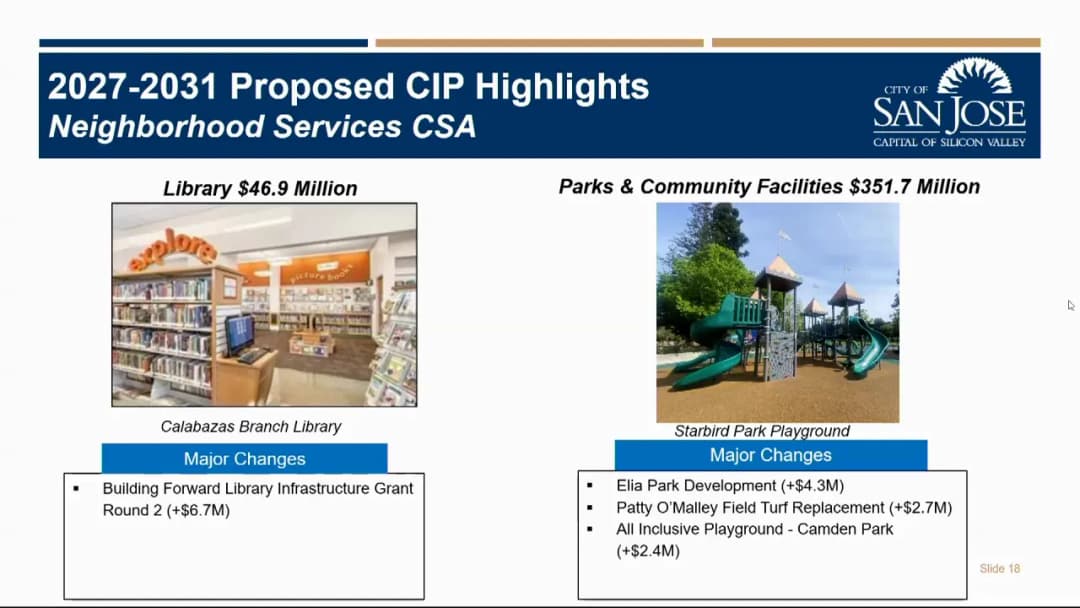
On May 6, 2026, the City of San Jose Planning Commission held a study session to review the proposed 2026-2027 mid-biennial capital budget update and the 2027-2031 Capital Improvement Program (CIP). The session began at approximately 1:00 PM with Vice Chair Lisa Bickford presiding. Commissioners present included Barroso, Cantrell, Cow, Casey, Escobar, Oliverio, and Bandal (who arrived late); Commissioners Rosario, DeWin, and Young were absent or not yet present. Staff from the City Manager's Budget Office, Public Works, and other departments presented an overview of the $3.3 billion five-year CIP, with $1.2 billion budgeted for fiscal year 2026-27. Presentation Overview Jennifer Tell, Capital Budget Manager, provided an overview of the capital budget, noting that the five-year CIP total of $3.3 billion represents a decrease from prior large CIPs due to the exhaustion of Measure T bond funds anticipated in fiscal year 2028-29. The largest funding sources are revenue from other agencies ($738 million), contributions/loans/transfers, and financing proceeds ($521 million, down 40% from the last adopted CIP). The airport deferred the $200 million short-term parking garage project and the Terminal C expansion pending sustained passenger growth. The water pollution control program is the largest at approximately $1 billion over five years, driven by upcoming regulatory changes from a new San Francisco Bay permit effective 2034. The traffic capital program includes $877 million for pavement maintenance, a speed safety system pilot (speed cameras), EV charging stations, and enhanced curb management. Public Works Deputy Director Sal Kumar highlighted major project changes, including a temporary HVAC system for the Emergency Operations Center and fire training center, completion of green stormwater infrastructure projects, and emphasis on maintenance for parks and libraries. Discussion and Questions Commissioners asked detailed questions about airport revenue projections, sewer system capacity, the rebudgeting process, and integration of the CIP with the operating budget. Commissioner Casey inquired about the drop in airport capital spending after 2028; staff responded that larger projects are deferred until passenger numbers recover and that alternative revenue sources are being explored. Commissioner Cantrell questioned the rebudgeting practice for general fund capital projects, noting it may lead to unnecessary cuts; staff explained it is a long-standing accounting practice and that nearly all capital funds are rebudgeted. Commissioner Casey also asked about the water pollution control program's $1 billion cost allocation; staff clarified that San Jose's share is about 60% based on flow. Commissioner Cow asked for clarification on the $1.2 billion versus $3.3 billion totals and the accuracy of revenue projections; staff noted that assumptions vary by funding source and are updated annually. Commissioner Bandal asked about post-project evaluations; staff indicated that Public Works conducts lessons-learned reviews upon project completion and that the Transportation Department performs before-and-after studies for major roadway changes, citing the Hillsdale corridor where bicycle/pedestrian use increased and crashes decreased. Commissioner Oliverio's written questions submitted earlier were summarized by staff, covering topics such as modeling of capital spending, tracking of funding sources, and the impact of delays on project costs. Key Outcomes The Planning Commission unanimously approved a motion (8-0, with Commissioners Rosario, DeWin, and Young absent) to recommend to the City Council the adoption of the 2026-2027 proposed mid-biennial capital budget update and the 2027-2031 CIP, and to transmit a memorandum with comments, including a finding of consistency with the Envision San Jose 2040 General Plan. The vote was conducted by roll call: Barroso (yes), Bandal (yes), Cantrell (yes), Cow (yes), Casey (yes), Escobar (yes), Oliverio (yes), and Bickford (yes).
MUNICIPAL FINANCE 49% · ENGINEERING AND INFRASTRUCTURE 32% · PROCEDURAL 10% · TRANSPORTATION SAFETY 9%
92
MAY 6, 2026 · SAN JOSE, CALIFORNIA · CITY COUNCIL
Rules and Government Oversight Committee Meeting - May 6, 2026

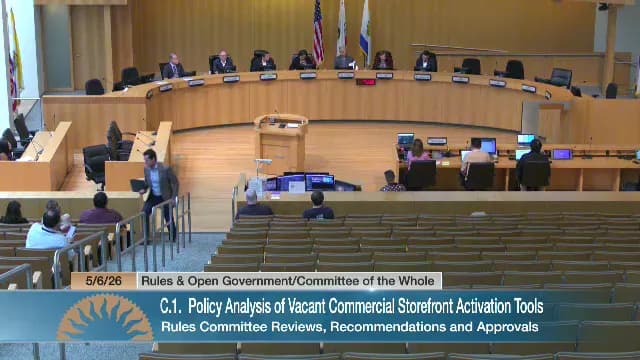
The Rules and Government Oversight Committee met on May 6, 2026, to review and approve the council agendas for May 12 and May 19, 2026, handle a consent calendar item, and discuss two action items: a policy analysis of vacant commercial storefront activation tools and a prefab housing structures memorandum. Public comment was heard on multiple items. Consent Calendar - The consent calendar contained one item, which the committee approved unanimously (5-0). One commenter thanked the city auditors for their work. Public Comments & Testimony - On the consent calendar: A speaker expressed appreciation for the auditors' work in keeping the city on track. - On the vacant storefront activation item: An unidentified speaker encouraged the city to partner with San Jose State University’s civil engineering program to activate storefronts and provide opportunities for students. - On the same item: Jordan Moldow (District 3) expressed support for reducing hurdles to filling vacant storefronts. He suggested exploring dual‑use spaces (e.g., a coffee shop by day, bar by night) and allowing Business Improvement Districts (BIDs) to collectively rent and activate storefronts. He also asked about the status of a prior initiative to reduce red tape for activating vacant parking lots with food trucks. - On the prefab housing item: Ryan submitted an email with a detailed attachment (approximately 70 pages) listing contacts and organizations that provide manufactured housing, compiled from multiple memos, and expressed hope it would be of use. - During open forum: Brian requested that the city establish a special day of remembrance for crime victims, noting the loss of security and the economic hardships victims face. - Also during open forum: Jordan Moldow (District 3) expressed support for a proposed slight increase in downtown parking meter fees, arguing that higher rates during peak times could increase turnover, make parking easier to find, and generate additional revenue. He suggested the city explore a dynamic pricing pilot based on demand. Discussion Items - Item 1: Policy Analysis of Vacant Commercial Storefront Activation Tools – Councilmember McKay expressed support for the memo, describing it as an economic development tool that would reduce blight, support small businesses, and improve public safety and neighborhood cleanliness. Councilmember Duan voiced support, citing the lengthy current permit process (six months to three years). Vice Mayor moved to approve the memo subject to workload analysis, with a plan to return in one to two weeks for further evaluation before sending it to the full council. The motion carried unanimously (5-0). - Item 2: Prefab Factory‑Produced Housing Structures – Staff reported that the memo, previously sent to workload analysis, has been fully green‑lighted and work is underway. Councilmember Kamei asked whether the analysis would include height criteria; staff confirmed that criteria are being developed. The committee approved the item with a unanimous vote (5-0). Key Outcomes - Approved the council agenda for May 12, 2026 (5-0). The agenda included a closed session, regular session, public hearing on the operating and capital budgets, an amendment to the airport master plan, solid waste services rate discussion, and a major events status report (with item 8.2 deferred to June 2). No land use items. - Approved the council agenda for May 19, 2026 (5-0) after a first review. This agenda included a closed session, regular session, cancellation of the evening session, citywide customer experience transformation status report, San José Clean Energy program status report (item 5.1 deferred to June 2), and one land use item on environmental review policy. - Approved the consent calendar item (5-0). - Approved the vacant storefront activation memo subject to workload analysis (5-0). - Approved the prefab housing structures memo as green‑lighted (5-0). - Meeting adjourned at 2:15 p.m.

PROCEDURAL 45% · ECONOMIC DEVELOPMENT 26% · PARKING 12% · PUBLIC COMMENT 10%
93
MAY 5, 2026 · SAN JOSE, CALIFORNIA · CITY COUNCIL
San Jose City Council Meeting - May 5, 2026: Proclamations, Billboards, Library Plan, and Park Approvals

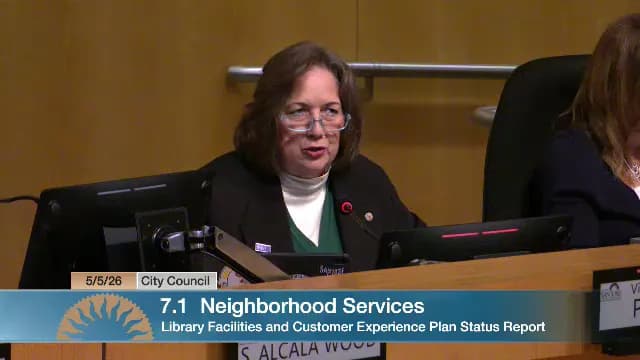
Opening Ceremonies and Proclamations The meeting was called to order at 1:30 p.m. with 9 council members present (Mayor Mahan absent). After the pledge and an invocation by Father Hugo Rojas of Our Lady of Guadalupe Church, three proclamations were presented: Cinco de Mayo (by Councilmember Ortiz), National Fallen Firefighters Weekend (by Councilmember Duan), and National Foster Care Awareness Month (by Councilmember Campos). David Polanco, President of the United Lowrider Council, noted the Cinco de Mayo parade and festival grew to include 150 artists and two stages, with the parade route at capacity. Lauren Salcicia of Child Advocates of Silicon Valley reported that 7 in 10 foster children in Santa Clara County are Latino, and over 150 children are on a waiting list for a CASA volunteer. Consent Calendar - Item 3.3: A requested item was dropped from the agenda by unanimous vote. - Closed Session: Canceled. - Item 2.9 (Clear Channel Billboard Modifications): Pulled from consent by Councilmember Mulcahy (recused due to a lease conflict). Public speakers Brian, John Miller, Jason Hemp, Les Levitt, and Paul Loynham opposed the modifications, arguing they constitute a "bait and switch" by increasing sign size and height beyond original approvals, citing safety, environmental, and health risks. Staff confirmed the changes still comply with Council Policy 6-4 (max 1,200 sq. ft.; proposed 1,000 sq. ft.) and the lease agreement includes a 6:1 removal ratio for static billboards and a minimum annual guarantee of $6.8 million over 10 years. The motion to accept staff recommendation passed 9-0 (Mulcahy recused). - Remainder of Consent Calendar: Approved unanimously without discussion. Discussion Items 7.1 Library Facilities and Customer Experience Plan City Librarian Jill Bourne and consultant Margaret Sullivan presented a plan based on nearly 3,000 survey responses and 180 community partners. Key statistics: Libraries see over 10,000 visitors daily, loan 23,000 items, and have 635,000 cardholders. 45% of branches (11 of 24) are more than 20 years old. The plan proposes three investment scenarios (renew, grow on site, co-locate) and identifies a need for up to 400,000 additional square feet to meet best-practice benchmarks (0.75 sq. ft. per capita). Public speakers—including Duan Coffin (CEO of San Jose Public Library Foundation) and Kat Cloud (Chief Development Officer)—urged adoption, highlighting inequities in District 4 (Berriessa and Alviso are the smallest branches). Councilmembers Collins, Casey, Kamei, Tordillos, and Foley discussed co-location with housing or other city services, especially in North San Jose where population growth is expected. The motion to accept the report passed unanimously. 7.2 Park Master Plans, Amended Turnkey Agreement, and Park Naming (Communications Hill) Staff presented plans for two new parks in the Communications Hill development: a 1-acre dog park (Phase 3) and a 1.7-acre park with a lawn, walking loop, and cornhole (Phase 4). The developer will dedicate and construct both parks (by June 2028 and December 2029). Park naming: Staff recommended "Communications Hill Dog Park" for Phase 3 and "Azevedo Park" (after Manuel T. Azevedo) for Phase 4. Public speakers Brian and Jose commented generally. Councilmember Duan moved approval, praising the community outreach. A question about maintenance was answered with reference to standard budget allocation. Motion passed unanimously. 8.1 Final Public Hearing and Approval of FY 26-27 Annual Action Plan (HUD) No public comment or council discussion. Approved unanimously. Key Outcomes - Item 2.9 (Clear Channel): Approved 9-0, allowing increased billboard size and height under modified lease terms. - Library Facilities and Customer Experience Plan: Adopted unanimously, guiding future renovations, expansions, and co-location strategies. - Communications Hill Parks: Master plans, amended turnkey agreement, and park names (Communications Hill Dog Park and Azevedo Park) approved unanimously. - HUD Annual Action Plan: Approved unanimously. - Adjournment: The meeting adjourned at 3:01 p.m.

PARKS AND RECREATION 35% · LAND USE 19% · PROCEDURAL 15% · LIBRARY FACILITIES 8%
94
MAY 4, 2026 · SAN JOSE, CALIFORNIA · PLANNING COMMISSION
Planning Director Hearing on Affordable Housing Special Use Permit - May 4, 2026

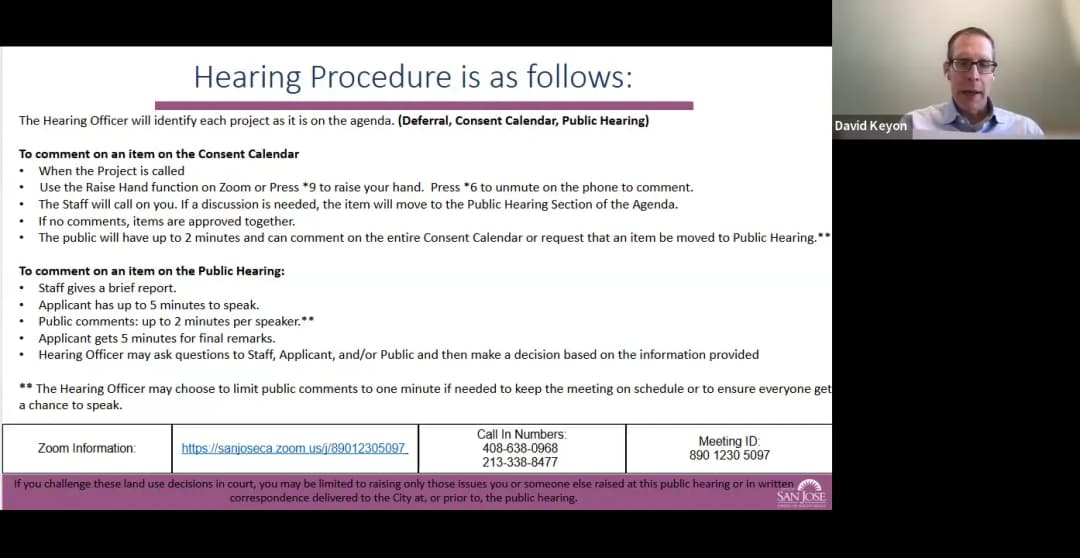
This special planning director hearing, presided over by Hearing Officer David Keen on behalf of the Director of Planning, Building, and Code Enforcement, was held via Zoom on May 4, 2026. The sole agenda item was a special use permit amendment (SPA 20-012-01) and environmental determination of consistency (EER 25-249) for site B of the Blossom Hill Station project at 605 Blossom Hill Road. The amendment proposed modifications to an existing affordable housing building, including reductions in parking, amenity space, and building height, an increase in bike parking, changes to exterior finishes, removal of 32 trees, and other site improvements. Note: The meeting transcript indicates the hearing occurred on April 29, 2026, but the official meeting date is stated as May 4, 2026; this discrepancy is noted. Consent Calendar Item 3A was initially placed on the consent calendar but was moved to the public hearing portion after a member of the public, Lillian, expressed a desire to speak against the tree removals. Public Comments & Testimony - Lillian (public commenter): Expressed strong objection to the removal of over 30 trees (reported as 32 trees in the project description). She noted she lives in an EAH Housing senior complex and stated her general opposition to tree removal for development, citing San Jose's designation as Tree City USA and the need to preserve green spaces. She acknowledged that the project has been approved but felt compelled to object to the environmental impact of uprooting trees. Discussion Items - Staff Report (Jacqueline Guerrero, Planning Project Manager): Provided an overview of the proposed changes, confirming the project is consistent with the general plan and zoning. Staff conducted public outreach per council policy and noticed the hearing. The environmental document is a determination of consistency with the previously adopted Blossom Hill Station Mixed-Use Project EIR (August 9, 2022). Staff recommended approval. - Applicant's Representative (Daniel Ryan, Director of Real Estate Development, EAH Housing): Stated the project will create 89 very needed affordable housing units. The amendments are consistent with the adopted EIR, and any tree removal was already considered in that EIR. Replacement trees will be planted as part of the application. - Hearing Officer Deliberation: Hearing Officer Keen clarified with staff that the trees to be removed are parking lot trees, not from a riparian or wild area, and that the number of trees to be removed has not increased from the original project. He discussed the city's general plan policy of densification within urban areas, which leads to redevelopment of parking lots and removal of landscaping trees, with offset replanting ratios to maintain canopy. He found the project consistent with these policies. Key Outcomes - Decision: The hearing officer approved item 3A, the special use permit amendment (SPA 20-012-01) and the determination of consistency (EER 25-249). The motion passed without objection. The hearing was adjourned at 9:16 a.m. - Key changes approved: Reduction in vehicle parking from 51 to 44 spaces, increase in bike parking from 75 to 89 spaces, reduction in amenity space from 14,000 to approximately 11,500 square feet, reduction in building height from 70 to 63 feet, removal of 32 trees (with replacement planting), and other minor modifications. The project will construct a five-story building with 89 affordable units, trail improvements to Kanoas Creek, relocation of a bus stop, and partial demolition of an existing parking lot. - Date discrepancy: The transcript lists the hearing date as April 29, 2026, while the official meeting date provided is May 4, 2026.

PROCEDURAL 45% · AFFORDABLE HOUSING 36% · PARKS AND RECREATION 19%
95
MAY 4, 2026 · SAN JOSE, CALIFORNIA · PLANNING COMMISSION
San Jose Historic Landmarks Commission Meeting - May 4, 2026

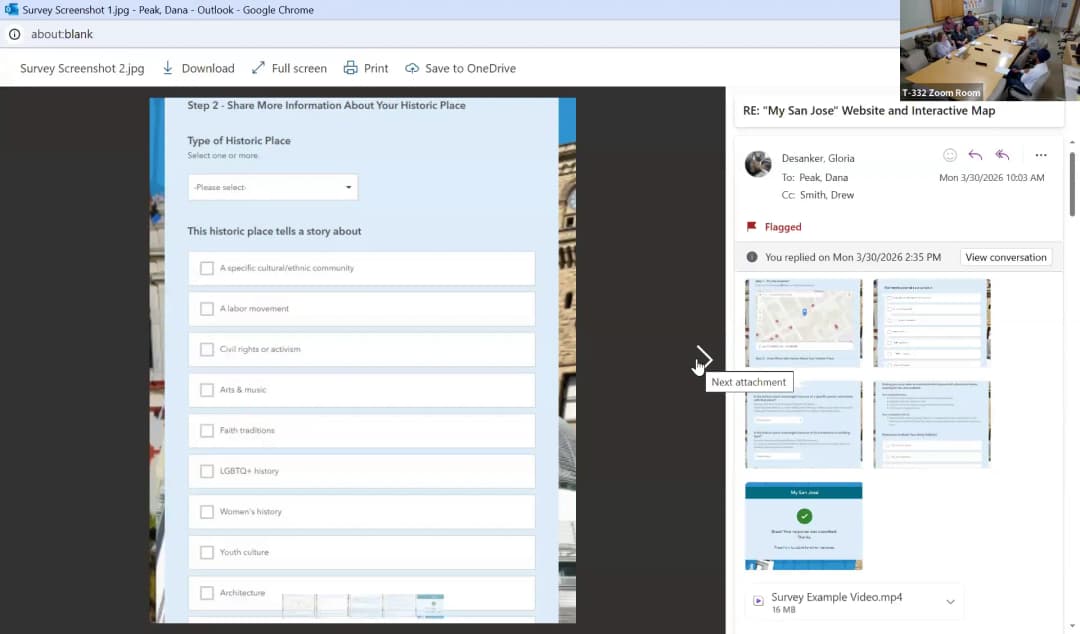
The Historic Landmarks Commission met on May 4, 2026, to review the Certified Local Government (CLG) annual report, hear public comments, and receive updates on state legislation and an interactive historic preservation website. The meeting included discussion on the commission's role and challenges. Consent Calendar - No items. Public Comments & Testimony - A member of the public reported on the successful relocation and affordable housing outcome of the Palace Hotel apartments, noting that four units are now affordable for 30% AMI households and that the city's voucher program added 197 units, totaling 201 affordable units. The speaker praised the collaboration with Habitat for Humanity and the preservation of the building's exterior. - Commissioner Arnold (speaking under open forum) reported on attending a National Trust for Historic Preservation meeting in Los Angeles focused on African American churches, including the historical significance of First AME Church of San Jose, and discussed plans for preservation grants. Discussion Items - Certified Local Government (CLG) Annual Report (2024-2025): Staff presented the annual report for the period October 1, 2024 to September 30, 2025. Highlights included adopting the San Jose Eichler neighborhood objective design standards, adding two properties to the historic resources inventory, and holding the annual retreat. Commissioners discussed concerns about the city council's perceived lack of support for historic preservation, with some expressing frustration that the commission is being excluded from land use discussions. Staff assured that the city remains a certified local government as long as it maintains a commission, ordinance, and inventory. The commission voted to accept the report. - Update on SB 79 and Historic Resources: Staff reported on analysis requested by Councilmember Mulcahy regarding SB 79 (upzoning near transit) and its interaction with AB 130 (CEQA exemption). Key conclusions: CEQA cannot be relied upon to protect historic resources; AB 130 prohibits demolition of historic resources but lacks a clear definition of demolition. Staff proposed developing a more restrictive definition of demolition for historic resources, with a timeline to return in December 2026. Also, a budget item is proposed to clean up the historic resources inventory. - Update on My San Jose Interactive Website for Historic Preservation Month: Staff presented a draft survey tool for the public to identify historic places. The survey will be launched on or before May 5, 2026, in conjunction with a proclamation by Councilmember Mulcahy's office. Commissioners provided feedback on categories (e.g., adding schools, engineering structures) and raised concerns about intellectual property rights and ADA accessibility for uploaded documents. Key Outcomes - The commission unanimously (Commissioners Cohen and Chair Royer voting yes; others absent) accepted the Certified Local Government program annual report for the 2024-2025 reporting period. - The commission approved the action minutes of the March 4, 2026 meeting. - Staff will bring back a definition of demolition for historic resources by December 2026. - The My San Jose website will launch in early May 2026, with adjustments based on commissioner feedback.

HISTORIC PRESERVATION 80% · PROCEDURAL 10% · COMMUNITY ENGAGEMENT 5% · AFFORDABLE HOUSING 3%
96
APR 29, 2026 · SAN JOSE, CALIFORNIA · CITY COUNCIL
San Jose Rules and Open Government Committee Meeting - April 29, 2026

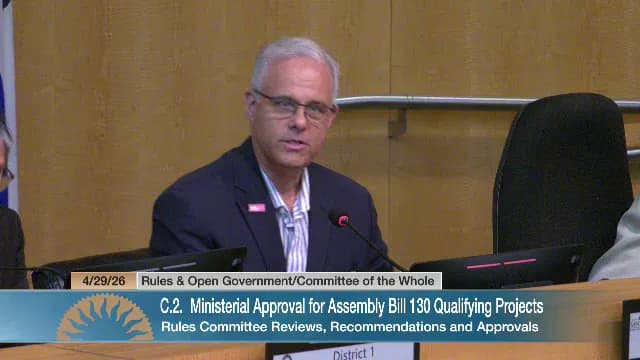
The San Jose Rules and Open Government Committee met on April 29, 2026, to review upcoming council meeting agendas, approve a consent calendar, and consider several action items including a revolving door waiver request, a proposal to expand ministerial approvals for housing, and alternative financing for affordable housing. The committee also received public comments on parks naming, encampment closures, and modular housing research. All votes were unanimous 5-0. Meeting Agenda Reviews - The committee reviewed the agenda for the next Tuesday’s council meeting (noticed for May 5, 2026), which includes a closed session at 9:30 a.m., regular session at 1:30 p.m., consent items, a library facilities and customer experience plan status report, approval of a park master plan and turnkey park land agreement for two city-chartered parks, and a public hearing on the annual action plan for HUD. The committee approved the agenda review 5-0. - The committee also reviewed the agenda for the May 12, 2026 council meeting, which includes a public hearing on proposed budgets, an amendment to the airport master plan, republic services solid waste service rates, a 2026 major event status report, and a recommended deferral. No land use items. The committee approved the review 5-0. Consent Calendar - The committee approved three consent items unanimously (5-0). Prior to the vote, a public commenter (Brian) raised concerns about the closure of an encampment known as “the jungle,” stating that unhoused individuals report not feeling connected to services or receiving requested assistance, and that many lack transportation options. He urged the committee to look into the matter. Public Comments & Testimony - Brian (public comment on agenda review and consent) spoke in favor of naming parks after people rather than things, citing the need to avoid future renaming controversies. He referenced a letter from the Parks Commission that supported this approach. - Brian (on consent) expressed concerns about the closing of “the jungle” encampment, noting that unhoused residents and daily visitors report a disconnect from services and a lack of transportation (e.g., no bus passes). He encouraged the committee to investigate further. - Ryan (public comment on action item 3 – alternative financing for affordable housing) thanked the city and staff for their efforts and voiced support for the alternative financing work plan, offering to help offload some of the workload. - Ryan (open forum) presented a seven-page report generated using AI that analyzed modular housing companies worldwide, ranking them A–D based on criteria relevant to California and San Jose. He stated he spent 25–30 hours verifying the information and offered the analysis to city staff to save them time. Discussion Items - Revolving Door Waiver Request (Diana Alanis): The committee considered a request from Diana Alanis, former community relations director for Councilmembers Duan and Davis, to waive the remaining 11 months of the city’s one-year revolving door policy. Ms. Alanis now works for Canyon Snow Consulting representing LS Power on energy and climate issues. She stated she did not work on LS Power matters while at the city. Staff explained the ordinance and the committee’s role in making a recommendation to the City Council. Councilmember Duan moved to grant the waiver, praising Ms. Alanis’s integrity. Vice Mayor Foley expressed concern about the frequent granting of exemptions, noting that two council members had waited 12 months before lobbying. She supported moving the waiver forward but called for a firmer policy. Councilmember Kamei agreed, questioning the purpose of a policy if exemptions are routinely granted. Chair Cohen noted that this request came only one month after separation, which is earlier than typical, and suggested a broader discussion on the policy’s purpose. The committee voted 5-0 to recommend the waiver to the City Council for final determination on May 5, 2026. - Ministerial Approval for AB 130 Qualifying Projects: Councilmember Tordillos presented a memo co-authored with Councilmembers Kamei, Cohen, and Campos, proposing to expand the city’s ministerial approval process citywide, aligned with the eligibility criteria of AB 130. The memo highlighted a 10–30% reduction in development costs needed for feasibility and a demonstrated 50% reduction in permitting time from existing ministerial approvals. The committee approved a motion (5-0) to forward the memo for workload analysis, with the expectation of returning to the Rules Committee in one to two weeks before moving to the full City Council. - Alternative Financing for Affordable Housing: Staff reported that a workload analysis had been completed and gave a green light; the item is part of the existing community and economic development work plan and is already underway. The committee voted 5-0 to approve moving forward. Key Outcomes - Approved agenda reviews for the May 5 and May 12, 2026 council meetings (5-0). - Approved consent calendar (5-0). - Recommended approval of revolving door waiver for Diana Alanis to the City Council; will be heard on May 5, 2026 (5-0). - Approved ministerial approval memo for workload analysis, to return to Rules Committee in 1–2 weeks (5-0). - Approved alternative financing for affordable housing as already underway (5-0).

PERSONNEL MATTERS 33% · PROCEDURAL 25% · LAND USE 12% · AFFORDABLE HOUSING 12%
97
APR 28, 2026 · SAN JOSE, CALIFORNIA · CITY COUNCIL
San Jose City Council Meeting - April 28, 2026: Budget, Housing, and Public Safety

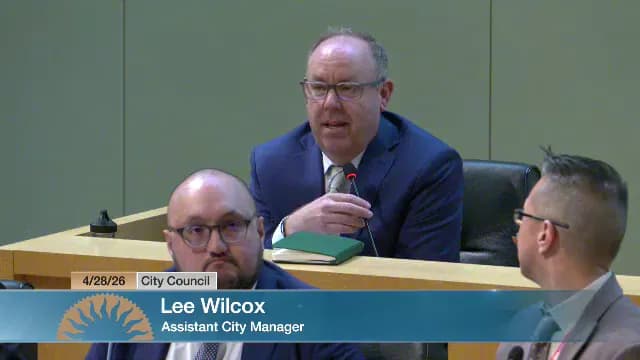
This meeting of the San Jose City Council on April 28, 2026, began with an invocation by the Youth Science Institute, followed by ceremonial proclamations for Black April (April 30), May Day (May 1), and the Autism Society. The council then addressed a consent calendar, several major discussion items including a police staffing audit, intergovernmental relations report, and a builders' remedy housing project, and concluded with public forum. Consent Calendar - 2.5 Travel Report (Mulcahy): Councilmember Mulcahy presented a report on a trip to Paris for the 10th anniversary Civic Commons learning journey, highlighting Paris's greening, mobility, and governance alignment. No vote needed as it was informational. - 2.10 Rent Increase for Permanent Supportive Housing (Item pulled by Candelas): Item authorized the city to negotiate rent increases on vacant units in permanent supportive housing (PSH) to stabilize financially distressed projects. Multiple speakers (Jordan, Laila, John, Drusy, Philip) opposed the item being on consent without proper community input through HCDC. Councilmember Candelas clarified that the change applies only to vacant units and will not affect current tenants, and that relocation costs would be covered. The item was approved unanimously (1 absent). Public Comments & Testimony - On item 2.10 (Consent): Speakers expressed concern that the rent increase would make PSH unaffordable and that the item bypassed the standard HCDC process. One speaker noted that people in PSH already struggle to pay rent and that the change could push them back onto the streets. - On item 7.1 (Bill Key Park): Several speakers (Brenda, Jerry, Kelly, Connie, Lena) spoke in support of naming the park after Bill Key, a Chinese American businessman and community leader. They highlighted his efforts to save the Heinlenville Chinatown temple and his contributions to San Jose. No opposition was voiced. - On item 3.3 (Police Audit): Public comments included complaints about long response times (e.g., 7 hours for one call) and underfunding of police. One speaker requested more foot patrols in underserved areas and criticized overtime being used for revenue-generating speed traps. - On item 10.2 (Camden Ave Development): Some residents (Thomas, Susan) opposed the project, citing loss of baseball fields, soil contamination concerns, and the cost of relocating fields. They argued the EIR did not properly address issues. The Union School District Board President spoke in support, noting the district's low funding and the need for additional revenue. Discussion Items - 7.1 Park Master Plan & Naming (Bill Key Park): Staff presented a master plan for a 1.2-acre park at Rinconada Drive, funded by Measure T, including green stormwater infrastructure, play equipment, and pollinator gardens. The recommended name "Bill Key Park" received the highest community survey score. Councilmember Kamei and others spoke in favor, praising Bill Key's legacy. The item was approved unanimously (1 absent). - 3.3 Police Staffing, Expenditures, and Workload Audit (Follow-up): City Auditor Joe Royce presented findings: average response time for priority 1 calls was 8.1 minutes (target 6 minutes); sworn officer numbers have declined; overtime costs reached $72 million in FY 24-25, a 53% increase over 5 years; 124 officers worked over 1,000 hours overtime. Chief Paul Joseph agreed with recommendations and noted the department is half the national average size (1 officer per 1,000 population vs. 2.2). Councilmembers discussed the need to balance safety with budget constraints, and Councilmember Campos moved to accept the report with additional monitoring recommendations. The motion passed unanimously (1 absent). - 3.4 Spring 2026 Intergovernmental Relations Report: Director Emily Lamb and team reported on federal and state advocacy, including $16 million in earmarks for 8 projects, opposition to proposed federal rules on homeless services, and state bills (SB 1375 on Diridon Station; AB 1941 on metal theft). Discussion centered on e-bike safety (memoranda by Mayor and Councilmembers Candelas, Foley) and single-stairwell housing (bill likely stalled). Councilmember Duan opposed single-stairwells citing fire safety; Councilmember Tordillos argued they can be safe. The report was accepted and positions reaffirmed unanimously (1 absent). - 3.5 Amendments to City Council Policy 1-16 (Multifamily Housing): No public comment; motion passed unanimously (1 absent). - 10.2 Site Development Permit – Camden Avenue / Singletree Way (Builder's Remedy Project): Staff presented a 108-unit condominium project on the former Cinnabar Elementary School site, with 8 units for extremely low-income households. The project required a statement of overriding considerations for greenhouse gas and VMT impacts. The applicant (Orville Power, Mono Investments) noted the site was already zoned for housing and that the builder's remedy allowed up to 667 units but they chose 108 to fit the neighborhood. The Union School District supported the project for revenue. Opposition cited loss of community fields and soil issues. Councilmember Casey moved to approve staff recommendation. Vote passed unanimously (Councilmember Cohen recused). Key Outcomes - Consent Calendar: Approved unanimously except for item 2.10 which was approved after clarification (motion passed unanimously, 1 absent). - Bill Key Park (7.1): Motion to approve master plan and name passed unanimously (1 absent). - Police Audit (3.3): Motion to accept the audit report and city administration's response passed unanimously (1 absent). - IGR Report (3.4): Memorandum on e-bike safety (Foley) and councilmembers' memo were adopted; report accepted and legislative positions reaffirmed unanimously (1 absent). - Policy 1-16 Amendments (3.5): Approved unanimously (1 absent). - Camden Avenue Project (10.2): Motion to certify EIR, approve site permit, and tentative map passed unanimously (Councilmember Cohen recused; 1 absent overall).

PUBLIC SAFETY 20% · AFFORDABLE HOUSING 17% · TRANSPORTATION SAFETY 15% · PARKS AND RECREATION 10%
98
APR 27, 2026 · SAN JOSE, CALIFORNIA · CITY COUNCIL
Community Economic Development Committee Meeting – April 27, 2026

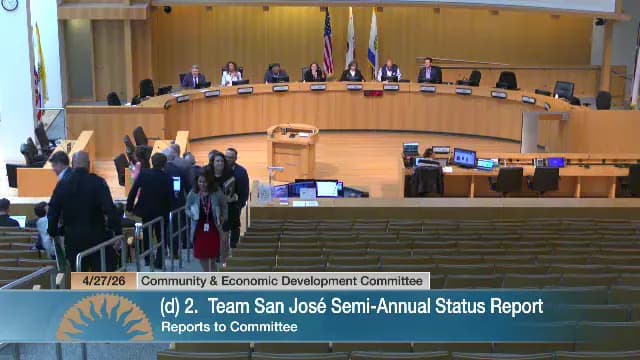
The Community Economic Development Committee met on April 27, 2026, to receive and discuss four major reports: the citywide planning activities semi-annual status report, the Team San Jose semi-annual status report, the 2026 major events status report, and the economic strategy work plan annual report. All reports were accepted by the committee. Public Comments & Testimony - Lillian Koenig, representing herself but also as a District 3 representative on the Senior Commission, expressed concern about the inclusion of seniors in planning efforts. She noted that she was unaware of task force open houses and emphasized the importance of seniors as stakeholders. She asked how senior data is tracked in housing and middle housing discussions. Discussion Items - Citywide Planning Activities Semi-Annual Status Report: Presented by Manira Sandhir (Deputy Director for Planning, PBCE), Martina Davis, and Jared Ferguson. They reviewed work completed since the last update, including the five-year development forecast, general plan four-year review progress (three task force meetings remaining, open houses scheduled), housing element work (SB 79 analysis, zoning code updates), ordinance and policy updates (SB 79 industrial hub exclusion, vape shop zoning), urban village plans (Alum Rock East, Five Wounds, Saratoga), and transit-oriented communities work. They highlighted that current workload exceeds staffing capacity at 126%, with mandatory items comprising 90% of capacity. A fee study was directed to address funding. Councilmembers discussed capacity constraints, state unfunded mandates, the need for better prioritization, and concerns about engagement (e.g., open house format, use of planning commission as task force). Councilmember Ortiz raised issues about lack of diverse input and the choice of Viva Calle for an open house in East San Jose. Councilmember Casey noted frustration in her district about the four-year review and perception of going beyond state mandates. Staff explained the interactive open house format and the balance between state requirements and local control. A motion to accept the report passed. - Team San Jose Semi-Annual Status Report: Presented by John LaFortune (CEO), Ihab (CFO), Ben Roshke (VP of Research), Matthew Martinicci (VP of Sales), and Laura Shimeluski (VP of Marketing). Mid-year results showed overachievement in direct visitor spending ($5M over budget), future hotel room nights (up 17,000), theater occupancy (up 5%), gross operating revenues ($562,000 over budget), and customer satisfaction (up 5%). Super Bowl 60 drove February to be the best February ever for hotel revenue, with 21% occupancy growth driven by transient demand. NVIDIA GTC and March Madness contributed to the second-best March on record. The sales team booked 12 citywide events (140% increase), 58,394 room nights, and launched a first-in-the-nation citywide hotel contract. Marketing campaigns generated $22M incremental revenue and 33,000 hotel rooms. Councilmembers praised the report, discussed the importance of transient capture, the need for ROI data on SJ26 investments, and requested future reports include actualized versus booked data. A motion to accept the report passed. - 2026 Major Events Status Report: Presented by Team San Jose and John Poach (Sports Authority). Recapped Super Bowl 60 activations: Invisible Skies project (2,000 attendees), drone shows (7,500 people), concerts by Kaylani (12,000 attendees) and Dom Dala (15,000 tickets sold), fanfest at San Pedro Square (48,000 unique visitors). March Madness had 46,500 tickets sold, a free concert with DJ Diesel (3,700 attendees), and strong hotel occupancy. Staff highlighted successful public-private collaboration, safety coordination (72 agencies in EOC), and lessons learned. Councilmember Kamei noted the importance of FIFA outreach for the upcoming six-week event, expressed disappointment that a requested memo on outreach was not yet provided, and requested targeted community engagement. Deputy City Manager Rosalind Huey confirmed a supplemental memo would be issued before the May 12 City Council meeting, detailing outreach plans including partnerships with IPEN and rapid response networks. A motion to accept the report and refer it to City Council passed. - Economic Strategy Work Plan Annual Report: Presented by Jen Baker (Director, Office of Economic Development and Cultural Affairs). The report covered the first nine months of the FY 2025-2027 work plan, with five objectives and 22 goals. 8 goals complete, 12 on track, 2 needing attention (over 90% progressing). Highlights: 3,573 jobs added/supported/retained, sales tax revenue up $9M, key company investments (Rose Batteries, Netgear, Lucid Motors, Equinix), five business improvement districts established ($760,000 annually), downtown foot traffic up 9.3% and 6.6%, 535 event days (exceeding annual goal). Challenges remain in office recovery and daytime downtown activity. Looking ahead, staff will develop a 3-5 year business development strategy, support BID capacity, advance the east side revitalization framework, and build on SJ26 momentum. Councilmember Mulcahy asked about retaining industrial properties and creating an inventory of underutilized sites for redevelopment. A motion to accept the report passed unanimously. Key Outcomes - Citywide Planning Activities Report: Accepted by committee. Further fee study and prioritization will be addressed in budget process. - Team San Jose Report: Accepted by committee. - 2026 Major Events Report: Accepted and referred to the full City Council. Supplemental memo on FIFA outreach to be provided by May 12. - Economic Strategy Work Plan Report: Accepted unanimously. Staff to continue developing business development strategy and inventory of industrial opportunity sites. - The meeting adjourned at 3:28 PM.

ECONOMIC DEVELOPMENT 48% · LAND USE 17% · COMMUNITY ENGAGEMENT 14% · MUNICIPAL FINANCE 8%
99
APR 22, 2026 · SAN JOSE, CALIFORNIA · PLANNING COMMISSION
San Jose Planning Commission Meeting - April 22, 2026: Airport Master Plan and Environmental Review Handbook

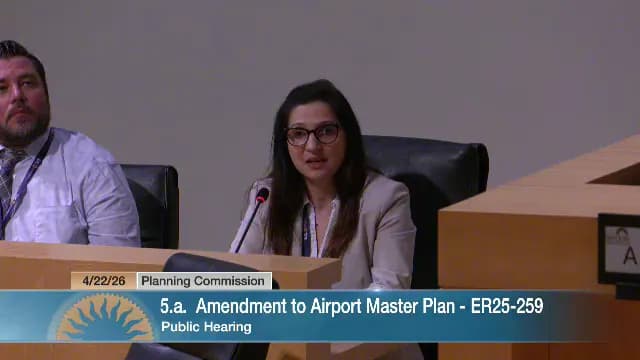
The San Jose Planning Commission, chaired by Carlos Rosario, met on April 22, 2026, to consider two major items: an amendment to the San Jose Mineta International Airport Master Plan and a new Environmental Review Policy. The commission also approved the consent calendar and heard public testimony. Both items were recommended to the City Council for approval in unanimous 9-0 votes. Consent Calendar - The consent calendar was approved unanimously (9-0, with Commissioners Wynne and Young absent). No specific items were discussed. Public Comments & Testimony - Item 5A - Airport Master Plan Amendment: Two members of the public spoke. Jim Stallman (Saratoga resident) and Betsy Megus (Santa Clara resident, bicycle/pedestrian advisory committees member) urged the commission to preserve bicycle and pedestrian access via Ewart Road to the airport, noting a planned closure on May 1, 2026, as part of the Guadalupe River Trail Plan. The City Attorney clarified that the closure was not part of this agenda but was approved by the City Council on April 14, 2026. The chair directed speakers to contact the Department of Transportation, bicycle advocacy groups, and their council representatives. - Item 5B - Environmental Review Handbook: Dasha Leeds, Conservation Coordinator for the Sierra Club Loma Prieta chapter, raised three concerns: (1) the threshold of significance for wildlife movement in the handbook could improperly imply such impacts are limited to areas outside the Urban Growth Boundary, overlooking important corridors like creeks and Coyote Valley; (2) the handbook should require analysis of biological impacts of artificial light at night, especially near sensitive areas; (3) the standard permit conditions for nesting birds should explicitly address indirect disturbances from construction noise and lighting, not just direct disturbances. Staff acknowledged the comments and stated they would revise the handbook before the City Council hearing. Discussion Items - Item 5A - Amendment to the Airport Master Plan (ER25259): - Staff from the Department of Aviation (John Wilson, Patrick Hanson, Patricia Singh) and PBCE (Nuna Wynn) presented. The amendment updates aviation demand forecasts (2037 horizon), revises capital projects, and adds potential vertiport sites for advanced air mobility. Key forecast changes: passenger demand reduced by 26% (from 22.5 million to 16.75 million), passenger aircraft operations reduced by 20% (from 184,000 to 147,000). General aviation and air taxi operations are expected to grow (36% and 49% increases, respectively). The amendment also adds an air traffic control tower replacement (FAA-funded) and taxiway improvements. An addendum to the 2020 EIR found no new significant impacts. - Commissioners asked about forecast certainty, risk management, and capital prioritization. Patricia Singh stated the passenger volume forecast is the least certain; the airport uses a consultant (cost $200,000) and models various scenarios. Large projects like Terminal C and parking garage expansion would be deferred if demand is insufficient. Commissioner Oliverio questioned the business model and demand creation; staff noted they work with airlines on incentives but regionally face reduced business travel due to remote work. Commissioner Bondal inquired about historical peaks in 2018-2019 and international routes; staff cited a confluence of factors including airline competition. Commissioner Cantrell expressed concern about a potential "demand death loop." - The commission recommended council approval (9-0). - Item 5B - Environmental Review Policy (Environmental Review Handbook and Standard Permit Conditions): - Staff from PBCE (Court Hitchens and David Keon) presented a policy that consolidates environmental review requirements, standardizes thresholds of significance, and adopts Standard Permit Conditions (SPCs) to streamline CEQA and NEPA processes. The handbook is organized into eight sections; Section 4 details thresholds for impacts like construction noise (using FTA standards) and shade/shadow. The SPCs address common resource areas (air quality, noise, biological resources, etc.) and reduce the need for technical studies for typical urban projects. Staff also proposed amending Title 21 to eliminate mailing hard copies of environmental appeal staff reports (still available online). - Public comments were addressed: staff stated they will revise the handbook to clarify that wildlife movement impacts can occur within the city, especially in areas like Coyote Valley, and will consider input on artificial lighting and bird buffers. - Commissioner Cantrell sought assurance that riparian corridors within the city remain protected; staff confirmed existing policies (e.g., Riparian Corridor and Bird Safe Design Policy) still apply. Vice Chair Bickford asked about the noticing change; staff clarified that postcards are still sent and hard copies can be requested. - The commission recommended council approval (9-0), with staff to finalize revisions before the May 19, 2026 City Council hearing. Key Outcomes - Airport Master Plan Amendment: Recommended to City Council for approval (9-0). The amendment reduces passenger forecasts significantly and updates capital projects. Next steps: City Council hearing on May 19, 2026. - Environmental Review Policy: Recommended to City Council for approval (9-0). Includes adoption of the Environmental Review Handbook and Standard Permit Conditions, and a Title 21 amendment for noticing. Staff will incorporate public comments before the May 19, 2026 hearing. - General Plan 4-Year Review: Outreach continues; next meeting scheduled for April 23, 2026, at Southside Community Center. A special meeting on the 2026-2031 Capital Improvement Program is set for May 6, 2026.

CLIMATE AND ENVIRONMENT 26% · PROCEDURAL 19% · ENGINEERING AND INFRASTRUCTURE 18% · TECHNOLOGY AND INNOVATION 14%
100
APR 22, 2026 · SAN JOSE, CALIFORNIA · CITY COUNCIL
Rules Committee Meeting - April 22, 2026: Agendas, Youth Priority, Employment Lands, Modular Housing

The committee met on April 22, 2026, at 2:00 PM. Roll call confirmed Councilmembers Candela, Duane Foley, and Cohen (absent), with a quorum present. The meeting reviewed final agendas for April 28 and May 5, approved consent calendar items, discussed three memoranda, and heard public comments on the 2040 General Plan update. Consent Calendar - Approved the final agenda for April 28 with a friendly amendment to move the Bill Key park naming item (item 7) immediately after the consent calendar. Motion passed. - Approved the draft agenda for May 5. Motion passed. - Approved the consent calendar after a public comment from Ryan, who criticized PG&E’s rate increase and the CPUC’s handling of the ZOG fire, noting the victims (Faye McLeod, Karen King, Kenneth Wilson, and a fourth). No other discussion. Motion passed. Public Comments & Testimony - Ryan: Expressed opposition to PG&E’s rate increase and criticized the CPUC for not holding PG&E accountable for the ZOG fire. He shared a personal story of being burned as a child and said the victims’ names were not acknowledged. - Chris Tisdill (Alpha X / Apex Homes): Expressed support for modular construction, describing his company’s $2 million investment in a closed wall panel system and pre-sales of 100 ADUs. He highlighted benefits: reduced costs, faster timelines, quality control, and local job creation. - Brian: Expressed frustration with lack of accountability and transparency, referencing three resignations from the House of Representatives, a park/school renaming, and a councilmember’s guilty plea. He urged officials to speak truth about any knowledge of abuse. - Larry Ames (park and community advocate): Urged robust public engagement on the 2040 General Plan update, warning that ministerial approvals could harm quality of life. He emphasized the need for supporting infrastructure, preservation of historic structures and school lands, and protecting neighborhood business districts from data centers and warehouses. - Brenda: Criticized insufficient outreach about the 2040 General Plan, specifically the proposal to exceed SB9/10 requirements by allowing more units on single-family lots by right without hearings. She called for much more outreach to all neighborhoods. - David Hyindell (All District Leadership Group): Stated the city appears to be going beyond state mandates, allowing up to 10–15 units on a single lot without review. He urged broader outreach, noting only four meetings planned (one at Viva Calle), with most districts not represented. - Doug Andre (District 1): Supported more inclusive outreach, noting the nearest meeting was a 25-minute drive from his home. - Sandra Delvin: Expressed concern over permanent changes to single-family neighborhoods, noting that four meetings exclude districts with the most single-family homes. Called for better communication highlighting the extent of proposed changes (e.g., 14–15 units next door). - Doris Livsey (Murdoch Neighborhood Association, District 1 Leadership): Said people are unaware of the General Plan changes; requested public meetings (including Zoom) and better council member publicity. - Unnamed speaker (Corey neighborhood): Echoed requests for better outreach, suggesting postcards that clearly explain the scale of changes, similar to the agrihood plan process. Discussion Items - Item C1 – Identification of Priority Neighborhoods (Councilmember Campos): Proposed aligning the next set of priority neighborhoods with the Youth Empowerment Alliance’s work for a $500,000 expenditure. Councilmember Duan moved approval, emphasizing investment in youth. Councilmember Candelas asked about workload analysis; administration confirmed no analysis needed because it is part of a manager’s budget addendum. Motion passed. - Item C2 – Attracting Investment in Employment Lands (Councilmember Candelas): Sought to intentionally market large vacant industrial/commercial parcels (e.g., in District 8) for economic development, job creation, and tax revenue. Councilmember Duan supported, noting only 13% of land is industrial and need for well-paying jobs. Administration confirmed no workload analysis needed as work is in progress. Motion passed. - Item C4 – Prefab/Factory-Produced Housing Structures (Councilmember Ortiz): Explored modular construction to deliver housing faster and cheaper while maintaining strong labor standards. Discussed potential for local manufacturing and job creation. Public comment from Chris Tisdill supported the approach. Councilmember Foley moved approval subject to workload analysis. Motion passed. - Item C3 was deferred to the next meeting due to the absence of Councilmember Tordillos; public comment taken under open forum. Key Outcomes - Approved agendas for April 28 and May 5 and the consent calendar (all unanimous). - Approved the priority neighborhoods memorandum (Item C1) without workload analysis, directing the administration to proceed. - Approved the employment lands memorandum (Item C2) as part of existing work program. - Approved the prefab housing referral (Item C4) subject to workload analysis; expects return to committee. - Deferred Item C3 to April 28. - Heard extensive public comment urging broader and more transparent outreach for the 2040 General Plan update; no specific council action taken on that topic during the meeting.

COMMUNITY ENGAGEMENT 24% · YOUTH SERVICES 18% · ECONOMIC DEVELOPMENT 18% · HOUSING 17%
OPENPUBLICA · PUBLIC MEETING INDEXUPDATED DAILY · openpublica.com