Browse by city
Date range
Search help

Search titles, summaries, topics and stored transcripts together. Keywords may match separately; put the whole query in double quotes for a phrase. Matching follows word analysis, so punctuation is not exact. Both dates are included. Documents are not searched.

SHOWING 111–120 ENTRIES
111
APR 8, 2026 · SAN JOSE, CALIFORNIA · PLANNING COMMISSION
San Jose Planning Commission Meeting - April 8, 2026

The San Jose Planning Commission convened on April 8, 2026, at approximately 6:30 PM. The meeting was brief, with no public hearing items on the agenda. The commission approved the consent calendar unanimously, received a report from the City Council, and discussed updates on a previously heard project. The meeting adjourned at around 6:42 PM. Consent Calendar - The consent calendar was approved unanimously by a vote of 10-0. Items included: - Approval of the action minutes from the March 25, 2026 meeting. - CP24-026 and ER24-181: Conditional use permit for a four-story, approximately 125,000 square foot mini storage building and two vehicle gates. - CP25-012 and ER25-077: Conditional use permit to convert an existing approximately 107,000 square foot building into a warehouse for electric vehicle passenger delivery, retail indoor sale of EV passenger vehicles, a service center, and incidental office space. Public Comments & Testimony - No members of the public spoke during the non-agendized public comment period. Discussion Items - City Council Report (March 24, 2026 meeting): Staff reported that the City Council adopted Ordinance 31316 related to Senate Bill 79 and local measures, adopted outstanding audit recommendations, approved residential incentive tax promise ordinances for the Bank of Italy development, Gateway Tower, and El Paseo de Saratoga, and adopted the Housing Catalyst Team work plan and annual progress report on housing element implementation. - Update on Gardner Avenue Project: A commissioner inquired about the status of the 1295 Gardner Avenue project (a 12-unit development). Staff confirmed that an appeal (including an environmental appeal) was received and will go directly to the City Council. - Upcoming Meetings & Outreach: Staff noted the next Planning Commission meeting on April 22, 2026, several open houses for the General Plan four-year review (through early May), a City Council comprehensive permit study session on April 28, and the City Council hearing on the Camden Builders Remedy Project also on April 28. Key Outcomes - The consent calendar was approved unanimously. - No deferrals, removals, or referrals were made from the consent calendar. - The Gardner Avenue project appeal will be heard by the City Council. - The meeting adjourned without further action.

PROCEDURAL 100%
112
APR 8, 2026 · SAN JOSE, CALIFORNIA · CITY COUNCIL
Committee Meeting Summary: April 8, 2026 – Agenda Review and Consent Calendar

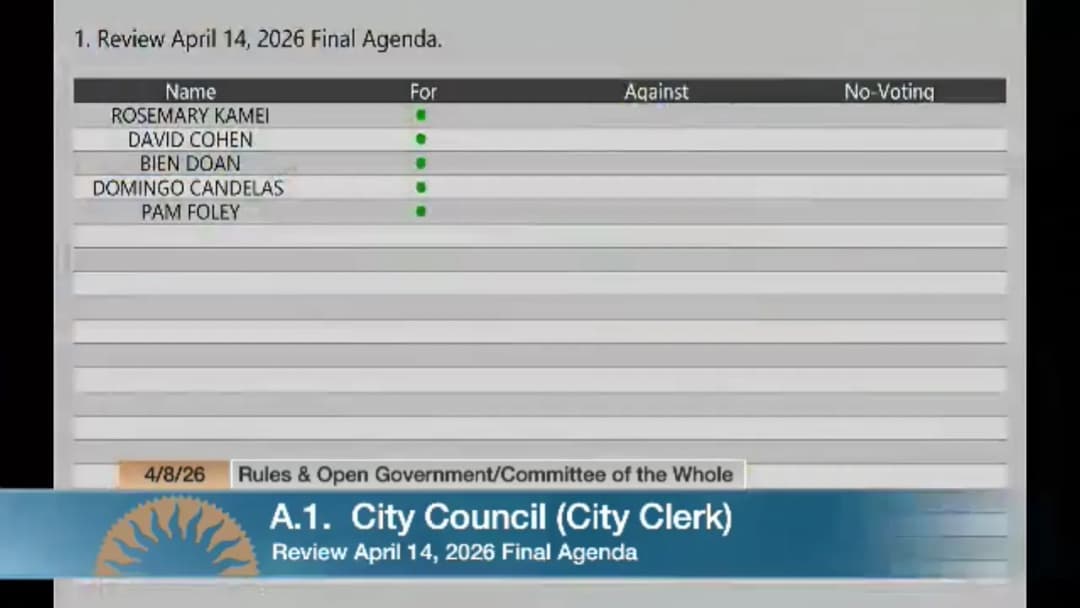
This was a brief committee meeting held on April 8, 2026, at 2:00 PM, focusing on reviewing upcoming council agendas, approving a consent calendar, and receiving public comment. The committee also opened a forum for public input on housing policies and communication. Consent Calendar - The committee approved four consent calendar items unanimously (5-0) after a brief public question. Public Comments & Testimony - Ryan/Public Speaker: Thanked the committee for their work, noting a perceived disconnect between the public and the committee’s efforts on interim housing. Expressed support for agenda item 8.1, highlighting the value of on-site social work and security services. Recommended better advertising of these services to reduce public criticism. - Brian/Public Speaker: Asked a procedural question about the disposition of public records, seeking clarification on how they are posted and referenced. Later, during open forum, described spending 4-5 hours researching what other cities are doing regarding housing costs. Noted that the city provides far more services than the public realizes, and suggested publishing a brief summary to counter misconceptions about high per-unit costs. Also mentioned a previous matter about bus passes, expressing empathy for both the committee and those seeking help. Discussion Items - Review of Next Week’s Council Meeting (April 15, 2026): The committee reviewed the agenda for April 15, which included a 9:30 AM closed session and 1:30 PM open session, with the evening session canceled. The review was conducted by visually scrolling through the agenda due to one member losing their voice. The committee noted a housing authority item and a special agenda item to be heard jointly with item 8.1. A motion to approve carried 5-0. - Review of April 21, 2026 Council Agenda: The committee reviewed the agenda for April 21, which also had a 9:30 AM closed session and 1:30 PM open session, beginning on page five with no land use items. No public comment was received, and the review was approved 5-0. - Open Forum: One speaker (Brian) addressed the committee, providing a research report on other cities’ housing approaches and reiterating the need for better public communication about the full scope of services provided. Key Outcomes - The committee voted 5-0 to approve the review of the April 15 council agenda. - The committee voted 5-0 to approve the review of the April 21 council agenda. - The committee voted 5-0 to approve the consent calendar containing four items. - The meeting adjourned at 2:06 PM.

PROCEDURAL 79% · HOUSING 21%
113
APR 7, 2026 · SAN JOSE, CALIFORNIA · CITY COUNCIL
San Jose City Council Meeting - April 7, 2026

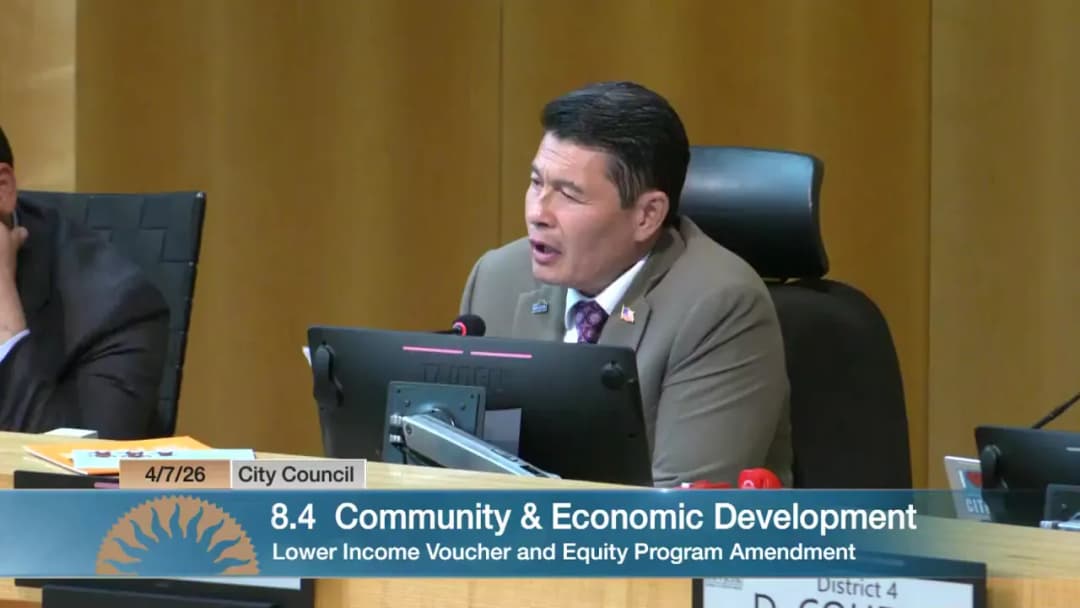
The San Jose City Council met on April 7, 2026, beginning at 9:45 AM with roll call, Pledge of Allegiance, and an invocation by the Piedmont Hills High School Orchestra. The meeting included three ceremonial proclamations: April as Month of the Young Child (highlighting a capacity gap of 39,000 licensed childcare spaces for 57,000 children under five), Cambodian New Year (April 14–16), and Autism Awareness Month (noting 1 in 22 Californians diagnosed with autism and the first flag raising on City Hall Plaza). The council then proceeded through the consent calendar, a city manager report, and major agenda items including the GovAI Coalition nonprofit, a long-duration energy storage agreement, the Story Road Business Improvement District, a loan for VTA Capital Station affordable housing, and an amendment to the Lower Income Voucher and Equity (LIVE) program. Public comments addressed various items as well as open forum topics. Consent Calendar - Unanimously approved without pulled items. Public comment by Brian Darby offered equipment to the Morgan Autism Center. Public Comments & Testimony - Item 8.1 (Story Road BID): Paul Fam (business owner) expressed full support, stating the BID would sustain community work and bring economic vitality. Tim Muting (Phase Three Communication) emphasized the value of a cleaner, safer corridor. Vu Din (Bon Mi Oven owner) highlighted successful events like the night market (20,000 attendees) and support for the BID as a sustainable path forward. - Item 8.2 (VTA Housing Loan): Jason spoke briefly, linking the VTA site to broader concerns about bus passes and isolation. Sean criticized the project but acknowledged the loan seemed like a good idea, then raised issues about lack of bus passes at the VTA Cerone site. - Item 8.4 (LIVE Amendment): Sean opposed the amendment, arguing SJPD officers earn high salaries and that unhoused people need housing more urgently, and criticized the VTA Cerone site for lacking transit passes and support services. - Open Forum: Multiple speakers raised concerns about the upcoming sweep of the Jungle homeless encampment (starting April 15). They requested clear information on placements, bus passes for residents moved to the VTA site, access for observers, and better communication from council members. A petition with signatures was presented. Discussion Items GovAI Coalition Establishment (Item 3.3) - Staff (CIO Calet Dolphic, City Privacy and AI Officer Albert Glee, Public Information Manager Chelsea Palacio) presented the coalition’s growth to 3,000 members from 900+ agencies across seven countries. They requested approval to establish the coalition as a nonprofit corporation, funded by a Packard Foundation grant, to enable external funding and long-term sustainability. The coalition provides free resources (AI policy templates, vendor registry, training) and hosts an annual summit in San Jose (upcoming Dec 9–11, 2026, expected 700 attendees). - Council discussion: Mayor Mahan praised San Jose’s leadership and emphasized workforce upskilling. Councilmember Ortiz supported AI exploration but voiced concerns about unintended consequences for workers and protected groups; she noted that employment decisions and guardrails would be handled in bargaining. Councilmember Kamei and others expressed confidence in the coalition’s people-first approach. The council voted unanimously to adopt the resolution. Willow Rock Energy Storage Agreement (Item 6.1) - Director Lori Mitchell and Principal Power Resource Specialist Phil Cornish presented a power purchase agreement with Hydrostore for advanced compressed air storage in Kern County. The 20-year fixed-price contract ($4M/year, $80M total) covers resource adequacy and energy, with no payment if the facility fails to deliver. Efficiency is 60–65% (vs. 80–85% for lithium-ion), but the facility has a 50-year lifespan. The project is expected online by June 2030. - Council questions: Councilmember Cohen noted excitement for technology diversification and lower environmental impact despite lower efficiency. Vice Mayor Foley confirmed no financial commitment until delivery and asked about developer confidence; Mitchell noted risk is mitigated by a power purchase agreement structure. Councilmember Tordillos inquired about cost competitiveness; Mitchell responded that current market conditions make this competitive with lithium-ion. The council voted unanimously to approve. Story Road Business Improvement District (Item 8.1) - Public hearing held; no written protests received. Three business owners spoke in support. Councilmember Campos (district) praised the effort; Councilmember Candelas asked about future BID plans; Director Jen Baker named Evergreen, Kaye Willow, Alum Rock Village, and Winchester Row as next neighborhoods. The council voted unanimously to establish the BID and levy assessments for FY 2026-27. VTA Capital Station Affordable Housing (Item 8.2) - Housing Director Eric Sullivan and Deputy Director Banu San presented a $8.4 million city loan (approx. 5% of total project cost) for a 200-unit development with 104 family units. The project leverages $19 in other funding per city dollar, with 71 project-based vouchers (51 for permanent supportive housing). Construction is expected to start November 2026 (24-month timeline). - Councilmember Campos expressed excitement but noted concerns from Vista Park neighbors about construction and parking; she requested a neighborhood meeting with VTA and city partners. The council voted unanimously to approve the loan. LIVE Program Amendment (Item 8.4) - Councilmembers Casey, Ortiz, Cohen, and Candelas introduced a memo to create a preference for San Jose Police Department personnel within the LIVE program (80–110% AMI units). The preference would apply when units open, with no specific set-aside. Council debate: Vice Mayor Foley opposed on fairness grounds and fair housing principles. Councilmember Tordillos opposed, arguing the program was not designed for police recruitment and that a down payment assistance program would be more effective. Councilmember Kamei opposed, preferring an open program. Councilmember Duan opposed, advocating for including fire and teachers. Councilmember Cohen supported, noting the policy is limited and does not reserve units. Councilmember Casey defended the preference as responsive to public safety needs. The motion passed 6–5 (voting in favor: Casey, Ortiz, Cohen, Candelas, Mahan, and one other? The transcript: Mahan is mayor, usually votes. The final tally: six in favor, five against: Kamei, Duan, Foley, Tordillos, Campos. So that matches. Key Outcomes - Consent Calendar: Unanimously approved. - GovAI Coalition Establishment: Resolution adopted unanimously (Item 3.3). - Willow Rock Energy Storage Agreement: Contract approved unanimously (Item 6.1). - San Diego Community Power Resource Adequacy Trade: Approved unanimously (Item 6.2). - Story Road Business Improvement District: Ordinance and resolution adopted unanimously (Item 8.1). - VTA Capital Station Affordable Housing Loan: $8.4 million loan commitment approved unanimously (Item 8.2). - FY 2526 Annual Action Plan Amendment: Approved unanimously (Item 8.3). - LIVE Program Amendment: Motion to create SJPD preference passed 6–5 (Item 8.4). - Open Forum: Comments received; no council action.

TECHNOLOGY AND INNOVATION 22% · AFFORDABLE HOUSING 19% · CLIMATE AND ENVIRONMENT 8% · ECONOMIC DEVELOPMENT 7%
114
APR 6, 2026 · SAN JOSE, CALIFORNIA · PLANNING COMMISSION
San José Planning Director's Hearing - April 6, 2026: Daycare Expansion and Tentative Map Extension Approved

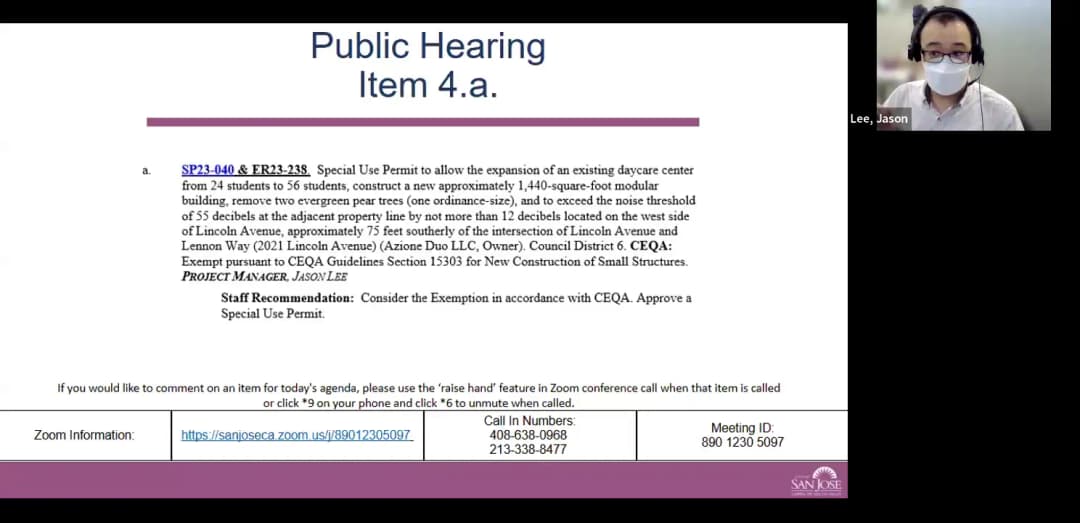
Note: The meeting was called to order on April 1, 2026, but the summary uses the date provided in the instruction (April 6, 2026). There is a discrepancy in the address for the daycare project: the staff presentation listed 2221 Lincoln Avenue, while the applicant and the hearing officer later referred to 2021 Lincoln Avenue. Hearing Officer Jared Ferguson presided over the meeting, which included a consent calendar item and one public hearing item. All actions were approved. Consent Calendar - Item 3A (TE20-029, ER26-003): Approved a 24-month extension of a previously approved vesting tentative map to reconfigure seven lots into 11 lots, allowing up to 58 residential condominium units (41 townhouse units and 17 ADUs) on approximately 1.87 gross acres at 2323–2391 Moore Park Avenue (Council District 6). The CEQA determination of consistency with the Moore Park Avenue Multifamily Residential Project Initial Study Mitigated Negative Declaration was also approved. No public comment was received, and the item passed without discussion. Public Comments & Testimony - Support with conditions: Mike and Emma Rock, neighbors of the daycare for 54 years, expressed appreciation for the proposed eight‑foot fence and indicated they could support the project if conditions regarding sound, sight, and smell are abided by. They voiced concerns about traffic on Lennon Way and parking. - Opposition: Sam San Filippo, managing partner of AMSNC LLC, manages the adjacent retail establishment. He opposed the expansion, citing frequent use of his parking lot by daycare parents for pickup/drop‑off, which creates liability and affects retail customers. He requested an additional parking and traffic review. - Opposition: A neighbor at 1152 (unidentified by full name) opposed, alleging broken promises from the original 1991 approval (small mom‑and‑pop, no driveway on Lennon). He argued the expansion would double capacity, increase accidents, and that no assurances exist against a future driveway on Lennon. - Written opposition: Stephen Yupp emailed during the hearing requesting denial, citing no covenants against a future driveway on Lennon Way and proposing the building be moved along the back fence to block that possibility. Discussion Item: Special Use Permit for Daycare Expansion (Item 4A) - SP23-040 and ER23-238: A special use permit to expand an existing daycare from 24 to 56 students, construct a 1,440‑square‑foot modular building, remove two evergreen pear trees (one ordinance‑size), and exceed the noise threshold at the adjacent property line by up to 12 decibels (to 67 dB Lmax). The site is at 2221/2021 Lincoln Avenue (Council District 6). - Staff presentation (Jason Lee): The project complies with general plan, zoning, design guidelines, and CEQA (Class 3 exemption). Staff recommended approval with two additional conditions: (1) modification of Condition 6a to limit weekday hours and allow up to eight after‑hours or weekend events per year with neighbor notification; (2) new Condition 7c requiring an eight‑foot wood fence along portions of the play area directly bordering residential uses. Condition 6d remains, allowing future fence/wall height increases up to nine feet if more noise attenuation is needed. Condition 6c requires the daycare to adjust operations if vehicles queue onto Lincoln Avenue. The local transportation analysis found adequate parking and that the project does not require off‑street parking for parents. - Applicant testimony (Kathy Jellick, Action Day Schools): Expressed personal connection to the neighborhood and emphasized the need for infant care. Asserted noise and traffic impacts would not meaningfully increase. In response to public comments, she committed to sending notices to staff and parents about not using adjacent parking lots and confirmed no driveway on Lennon is planned. - Hearing officer deliberation: Acknowledged the importance of child‑care facilities embedded in neighborhoods. Noted that the city approves only the number of students, not age groups (state‑licensed). Emphasized that any future driveway on Lennon would require a separate permit with additional LTA review. Key Outcomes - Approved: SP23-040 and ER23-238 for the daycare expansion at 2021 Lincoln Avenue, with the additional conditions as presented by staff (modified Condition 6a, new Condition 7c, and retention of Condition 6d). The CEQA exemption was also approved. - Consent calendar approved: The vesting tentative map extension (Item 3A) was approved as presented. - Next steps: The permit decisions become final when signed and mailed, subject to appeal per Titles 20 and 21 of the San José Municipal Code.

CHILD CARE 72% · LAND USE 10% · PROCEDURAL 9% · PARKING 5%
115
APR 1, 2026 · SAN JOSE, CALIFORNIA · PLANNING COMMISSION
General Plan Four-Year Review Task Force Meeting – April 1, 2026

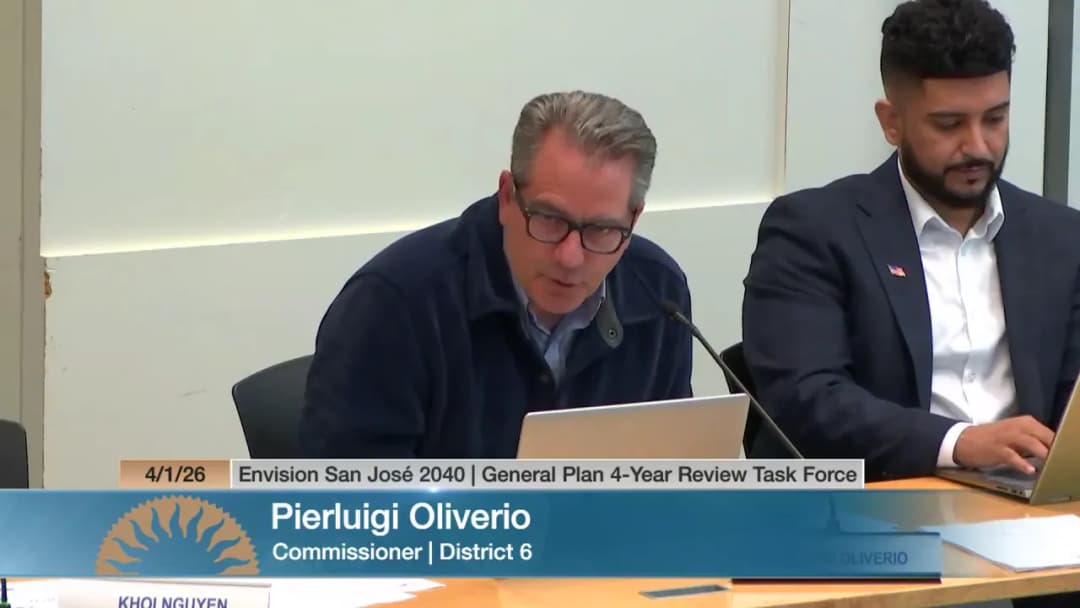
This was the fifth meeting of the 2025-2026 General Plan four-year review, with the Planning Commission serving as the task force. Staff presented updates on public outreach, residential capacity strategies, and the jobs-to-employed-resident ratio. The discussion focused on modifying residential land use designations, evaluating growth areas, and reviewing targeted general plan amendments. Public comment addressed VTA transit-oriented development sites, adaptive reuse of faith and school sites, downtown West boundaries, and missing middle housing. Public Comments & Testimony - Rob Swork (BTA, principal planner) expressed general support for increasing residential capacity but urged the city to consider further intensification near frequent bus corridors. He also noted that VTA's request to change designations on the Cerone and Santa Teresa TOD sites was not addressed in the staff report and called it a missed opportunity. - Brent Van Brocklin (VTA, TOD team) focused on the Cerone and Santa Teresa sites (over 60 acres combined), emphasizing they are the two largest developable properties in VTA's TOD portfolio. He urged the task force to recommend that city staff and VTA jointly develop a mixed-use zoning concept for these sites and bring forward options by the June 3rd meeting. - Alison Cingalani (Silicon Valley at Home, Director of Policy) spoke on behalf of a community partnership evaluating adaptive reuse of faith and school sites for affordable and mixed-income housing. She noted that many such sites lie outside designated growth areas and should be part of the citywide housing conversation. Her team is assembling a site-specific database to share in May. - Kathy Sutherland (S+NI, Strong Stakeholders Plus Neighborhoods Initiative) requested that five bifurcated blocks in the downtown West area be removed from the downtown designation, citing concerns about incompatible development adjacent to single-family homes. She provided photographic evidence of the boundary issues. - Greg Carlson (Concerned Corey Neighbors) expressed support for development but urged reasonable density and integrity in planning, specifically referencing the potential impact of a four- to eight-story building on Winchester Boulevard during commute traffic. - Solomon Oh (local builder focusing on missing middle housing) encouraged the task force to continue adjusting constraints to unlock underutilized sites, noting that more viable projects can increase housing supply without fundamentally changing neighborhood character. Discussion Items - Residential Capacity Strategies: Staff reviewed four strategies from the January task force meeting. Key updates included: (1) for growth areas near high-frequency bus corridors, staff analyzed half-mile, third-mile, and quarter-mile walksheds and created tier two growth areas south of downtown; (2) for missing middle housing, staff recommended increasing the residential neighborhood (RN) density to 32 dwelling units per acre (du/ac) and adjusting mixed-use neighborhood (MUN) to 20–50 du/ac and urban residential (UR) to 50–95 du/ac to maintain a clear density hierarchy; (3) for residential neighborhood flexibility, the proposed density increase to 32 du/ac was supported; (4) for targeted general plan amendments, staff evaluated mixed-use commercial (MUC) and public/quasi-public (PQP) sites. - Growth Areas: Staff recommended not proceeding with tier one or tier two growth areas because the proposed citywide RN density increase to 32 du/ac would achieve similar densities without the need for new growth areas. Task force members raised equity concerns, noting that tier two areas are in lower-resource communities, while tier one areas are in higher-income areas. - SB 79 Impact: Discussion centered on whether SB 79 (allowing higher density near transit) would generate realistic capacity. Staff noted that theoretical capacity is high but may not translate to redevelopment due to small lot sizes, existing uses, and HCD's strict methodology. Staff cautioned against over-reliance on SB 79, while some commissioners argued the city should maximize its potential. Staff will return with additional analysis on SB 79 capacity. - Jobs-to-Employed Resident Ratio (J2ER): Staff recommended maintaining the current target of 1.1 jobs per employed resident, noting that the observed ratio has averaged 0.82 since 2011. Increasing residential capacity alone does not guarantee proportional employed resident growth. Commissioners debated the aspirational nature of the target, with some supporting its retention for fiscal and land preservation reasons, while others questioned its feasibility given the trend of converting commercial land to residential. - VTA TOD Sites: Staff acknowledged VTA's request for mixed-use designations on the Cerone and Santa Teresa sites, explaining that the request came only a few weeks before the meeting and could not be included in the current agenda. Staff will meet with VTA and report back at a future meeting. - Downtown West Bifurcated Blocks: Commissioner Young requested that staff evaluate the request to remove five bifurcated blocks from the downtown West designation. Staff agreed to research the history and return with analysis. Key Outcomes - Residential Designation Changes: The task force will continue to consider modifying RN to 32 du/ac, MUN to 20–50 du/ac, and UR to 50–95 du/ac, with proportionate height changes. Further discussion on missing middle housing will occur at the May task force meeting. - Growth Areas: Staff's recommendation not to proceed with tier one or tier two growth areas will be revisited based on task force feedback. No formal vote was taken. - Targeted GP Amendments: Staff will evaluate MUC sites on a case-by-case basis and present findings on June 3, 2026. No change to PQP sites is recommended for now, but staff will consider streamlining processes for faith institutions at a future meeting. - J2ER Ratio: The task force did not recommend changing the 1.1 target; staff will maintain it for now. - Next Steps: The next task force meeting is scheduled for May 20, 2026, with additional meetings on June 3 and June 17 as needed. The final recommendation will go to the planning commission on June 24, then to city council for preliminary approval in August 2026, with a final vote on general plan amendments in December 2027.

LAND USE 60% · HOUSING 21% · PROCEDURAL 7% · PUBLIC COMMENT 4%
116
APR 1, 2026 · SAN JOSE, CALIFORNIA · CITY COUNCIL
Rules & Government Open Government Committee Meeting - April 1, 2026

The Rules and Government Open Government Committee met on April 1, 2026, at 2:00 PM to review council agendas, approve consent items, and discuss two action items: an emergency interim housing siting policy and the Al Fresco 2.0 program. All votes were unanimous (4-0) with members Candelas, Foley, Cohen present, and one absent. Consent Calendar - Approved the final review of the council meeting agenda for April 7, 2026, including consent items, establishment of the governing AI coalition, Willow Rock Long Duration Energy Storage Agreement, San Diego Community Power Resource Adequacy Trade, Story Road Business Improvement District, a loan commitment for VTA's Capital Station Affordable Housing Development, and amendments to the annual action plan and lower income voucher and equity program. - Approved the first review of the council agenda for April 14, 2026, including items on multifamily housing bonds, transportation priorities for VTA under SB63, a consultant agreement with Brown and Caldwell, and an agreement with Santa Clara County Housing Authority. - Approved four consent items with no items pulled. Public Comments & Testimony - Brian (public comment on consent): Suggested using AI to harvest non-private information from public emails to generate automated responses, citing lack of timely responses. He also raised concerns about upcoming budget cuts affecting people with disabilities and mental health issues. - Jordan Moldale (District 3) (on Al Fresco 2.0): Expressed strong support for the Al Fresco program, citing positive outdoor dining experiences in San Francisco. Questioned whether parklets are included, noted cost barriers like cinder block requirements, and urged studying other municipalities' "by right" approaches. - Brian (during open forum): Proposed a day of recognition for crime victims, sharing personal experiences of being victimized. Also reiterated concerns about budget cuts and their impact on vulnerable populations. - Jordan Moldale (District 3) (during open forum): Questioned existing rules that require standing committee work referrals to go through the Rules Committee instead of directly to council, suggesting a rule change to streamline the process. Discussion Items - Emergency Interim Housing Siting Policy (Item 1): Received a green light from workload analysis; can proceed under existing housing department capacity. Approved unanimously. - Al Fresco 2.0 (Item 2): Also green-lit by workload analysis. Vice Mayor Foley expressed concern that the policy is limited to downtown, urban villages, and business improvement districts, excluding small businesses in other parts of the city (e.g., District 9). She suggested a potential memo to address this. The item was approved unanimously. Key Outcomes - All votes were 4-0 in favor, with no opposition or abstentions. - The emergency interim housing siting policy and Al Fresco 2.0 program will proceed to council for further consideration. - For Al Fresco 2.0, Vice Mayor Foley indicated she may submit a memo to expand eligibility to all areas of the city. - No formal action was taken on public comments, but they were received and acknowledged.

PUBLIC COMMENT 52% · PROCEDURAL 41% · LAND USE 7%
117
MAR 27, 2026 · SAN JOSE, CALIFORNIA · PLANNING COMMISSION
San Jose Planning Director Hearing - March 27, 2026: Builders Remedy, Density Bonus, and Tree Removal

Note: The transcript of this meeting indicates the date as March 25, 2026, but the provided metadata specifies March 27, 2026. This summary uses the latter date as instructed, but notes the discrepancy. This hearing, presided over by Hearing Officer Martina Davis on behalf of the Director of Planning, Building and Code Enforcement, considered three items: a 60‑unit builders’ remedy project, a 12‑unit density bonus project, and a live tree removal permit. Public testimony was heard on each item, and decisions were rendered or continued. Public Comments & Testimony - Item 1 (1175‑1199 Saratoga Ave): - Lillian Koenig expressed concern about the removal of 22 trees (18 ordinance‑sized) and questioned the project’s alignment with the city’s climate sustainability plan. She noted that developers often replace trees with smaller ones that take years to mature. - Scott, a 25‑year neighborhood resident, raised safety concerns about the driveway entrance off Saratoga Avenue, citing congestion after the road was narrowed from three to two lanes. He also asked about parking spaces per unit and overflow parking, noting that many families have two or more vehicles. - Item 2 (1295 Kirtner Ave): - Christine Wynne, local resident, objected to the lack of a traffic study, stating that the project (using national ITE data) ignores the presence of seven schools within 1.5 miles. She noted that a child bicyclist was hit at the intersection on December 3, 2025, and three children have been hit since 2022. She questioned why the developer receives 14 waivers. - Doug Doll (on behalf of Cantia Roach, across the street) echoed safety concerns, especially regarding the driveway’s proximity to the corner and the difficulty of making left turns onto Cottle Avenue during peak school traffic. - Janet Donbro, the current homeowner, expressed support for the project, describing it as well‑thought‑out and providing middle‑income housing. She noted that if not this project, the site would likely be developed with four or five “monster homes.” - Multiple additional speakers (iPhone, Adam Kaspczyk, Seth Wheatley, Ron Stern, Amy, Jennifer McClenaghan, Jamie, Kathy, Daniel, Gorman/Kathy Beman) all voiced strong opposition, citing traffic congestion, safety risks (including a fatal accident involving a construction worker), height incompatibility with the single‑story neighborhood, loss of privacy, dust during construction, and the perceived threat of a lawsuit from the developer’s law firm (Cox, Castle & Nicholson). Many questioned whether the affordable units would truly serve low‑income residents and whether the project was a “done deal” before the hearing. - Item 3 (479 Mill River Lane – tree removal): - Shani Kleinhouse (Santa Clara Valley Bird Alliance) asked that trees 254 and 255 be retained, noting they do not drop debris on structures or walkways, and requested native replacement trees. - Stephen Yang (resident of unit 518) supported removal of interior trees but requested a phased removal for perimeter trees (250‑260, 254‑255, 256‑258) due to lower risk and their value as privacy screens and wildlife habitat. - Martin (neighboring complex resident) noted that the arborist report rated risk as high for some trees but moderate for seven and low for three, and suggested more extreme pruning instead of removal. - Steve Stolper (resident of 476 Mill River Lane) supported removal of at least 17 trees but criticized the replacement plan for including highly flammable Australian species and exotic Asian species, urging a native‑species revision. Discussion Items Item 1 – Builders’ Remedy Project (60 condos, 1175‑1199 Saratoga Ave) - Staff (Alec Katienza) presented the project: 60 residential condominiums in nine three‑story buildings, demolition of two office buildings, removal of 22 trees (18 ordinance‑sized). The project was submitted under the Housing Accountability Act (HAA) builders’ remedy because the city lacked a certified housing element at the time of application (submitted September 11, 2023; housing element certified January 2024). The applicant invoked AB 1893 in May 2025. The project provides 13% low‑income units (8 units) and requests one incentive/concession to eliminate the TDM requirement. CEQA exemption under AB 130 (Public Resources Code 21080.66) was applied. Staff concluded no specific adverse impacts to public health or safety and recommended approval. - Applicant Mark Conroe (OICC Ventures) emphasized that the project uses state law to lower density (from a possible 240 units to 60) and to fit the neighborhood context of one‑story homes with three‑story buildings. He showed site plans, noting muted materials and common areas. He responded to tree concerns by noting that 104 replacement trees would be planted, and to traffic concerns by stating a new median would prevent left turns (right‑in/right‑out only) and the number of curb cuts would be reduced from four/five to two. Parking is two spaces per unit plus guest parking. - Hearing Officer Davis commended the applicant for conforming to city design standards without waivers and found no health or safety impacts. She approved the site development permit and tentative map, and considered the CEQA statutory exemption. Item 2 – Density Bonus Project (12 units, 1295 Kirtner Ave) - Staff (Jacqueline Guerrero) presented the project: 8 condominium units on separate lots and 4 condominium units on two lots, totaling 12 units on a 0.65‑acre site (zoned R1, allowed 6 units). The applicant uses state density bonus law to get a 100% density bonus by providing one very low‑income and one moderate‑income unit. The project requests one incentive (allowing two‑family dwelling use in R1) and 14 waivers related to height, FAR, open space, parking, etc. Staff noted that under the HAA, the city cannot force rezoning, so the analysis defaults to construction costs. The project also includes a shift of the north building 2.38 feet westward to increase buffer. CEQA class 32 infill exemption applies. Staff recommended approval. - Applicant Tom Wilson (City Connect Partners) stated that the project provides backyards (18‑foot setbacks), 44 new trees, parking of two cars per unit (plus two in driveways), and 42 on‑site parking spots total. He noted that construction would be scheduled during school vacations to minimize disruption. - Hearing Officer Davis acknowledged neighborhood concerns about traffic but noted that under CEQA, traffic congestion is not an environmental issue; the project generates only 5 AM and 6 PM trips per ITE standards. She found no direct health or safety impacts from the waivers and stated that the city cannot legally require a traffic study for this project size. She approved the site development permit and tentative map, and considered the CEQA exemption. She reminded the public that the decision can be appealed. Item 3 – Live Tree Removal Permit (20 Canary Island pines, 479 Mill River Lane) - Staff (Jason Lee) presented four buckets of findings for removal of 20 ordinance‑sized trees: 1. Five trees (262‑266) – unsuitable due to proximity (<5 ft) to multifamily dwellings. 2. One tree (259) – poor condition, danger of falling. 3. Six trees (250, 253, 261, 267‑269) – health and safety risk from falling pine cones (up to 3 lbs). 4. Eight trees (251, 254‑258, 260) – fire risk (within 100 ft of structures, dense vegetation, defensible space concerns). Replacement: 40 24‑inch box trees (equivalent to 80 15‑gallon trees) or in‑lieu fee. Staff recommended approval. - Applicant Eamon Curley (HOA board member) emphasized that the removals are about risk mitigation – falling cones have struck residents and damaged property, and fire risk is a serious concern given multiple fires in the adjacent Coyote Creek corridor. He noted that the HOA has a duty to act. - Hearing Officer Davis expressed difficulty with the fire‑risk findings, noting that the 100‑foot defensible space recommendation is a best practice, not a code requirement, and that approving based on species alone could set a precedent across the city. She decided to continue the item to the April 8, 2026 hearing to obtain an opinion from the city arborist, specifically on the fire‑risk trees (those not already covered by other findings). She noted that the trees with clear health/safety or proximity issues could likely be approved, but the entire application must be decided together; thus the continuation applies to the whole permit. No re‑noticing is required. Key Outcomes - Item 1 (Saratoga Ave): Approved. Site development permit and tentative map granted; CEQA statutory exemption (AB 130) considered. The project may proceed subject to conditions. - Item 2 (Kirtner Ave): Approved. Site development permit and tentative map granted; CEQA infill exemption considered. The decision is appealable. - Item 3 (Mill River Lane tree removal): Continued to the hearing of April 8, 2026. Staff will consult with the city arborist regarding the fire‑risk findings for trees 251, 254‑258, and 260. No other findings are affected. The applicant and public are invited to return on that date.

LAND USE 37% · CODE ENFORCEMENT 17% · TRANSPORTATION SAFETY 12% · PROCEDURAL 9%
118
MAR 25, 2026 · SAN JOSE, CALIFORNIA · PLANNING COMMISSION
San Jose Planning Commission Meeting on Camden Avenue Builder's Remedy Project - March 25, 2026

This meeting of the San Jose Planning Commission on March 25, 2026, focused primarily on a builder's remedy project proposing 108 residential condos on Camden Avenue, requiring a statement of overriding considerations due to significant and unavoidable environmental impacts. The commission also approved the consent calendar and deferred one item. Consent Calendar - The consent calendar, containing routine items, was approved by a unanimous roll call vote of 11-0. Public Comments & Testimony - Richard Bennett (landlord of adjacent property) opposed the project, citing noise, dust, loss of views, and overbuilding in the area. He noted that 480 housing units are already under construction nearby. - Thomas Hislap (longtime resident) argued that the EIR's environmentally superior alternative of 87 units should be chosen, and raised concerns about dust, wildlife impacts, unverified plans for moving baseball fields, and lack of environmental review for the land exchange. - Susan Seffle (resident) echoed Hislap's concerns, stating that the EIR has deficiencies and that the commission should not proceed until all issues are addressed. - Zoila Rollins (resident) raised safety concerns about emergency access, infrastructure, and the proximity of a PG&E plant, noting that a child was recently hit on Blossom Hill Road. - Doug Benton (resident) expressed concern about traffic safety at the intersection of Park Crest and Blossom Hill near Dartmouth Middle School, stating that the City Code requires safe vehicle circulation and that the EIR did not adequately address this intersection. - Donna Smith (resident) described the narrow two-lane Singletree Way with parking on both sides, warning that increased traffic from 108 units would create a dangerous blind intersection for children and emergency vehicles. Discussion Items - Builder's Remedy Project (5A): Staff presented a proposal for 108 residential condos (74.4% extremely low-income) on a former school site, requiring an EIR with a statement of overriding considerations for greenhouse gas and VMT impacts. The project includes a traffic signal at Camden and Singletree, pedestrian and transit improvements, and a land exchange with the Union School District. The applicant, Orville Power, gave a brief presentation highlighting the benefits: new baseball fields at Dartmouth, $2.4 million in traffic improvements, and 243 parking spaces. - Commissioners questioned staff and the Union School District superintendent about emergency access, traffic analysis, VMT mitigation, school district finances, and construction impacts. The superintendent stated the district is the lowest-funded in Santa Clara County and expects $1.6 million in ongoing annual revenue from this and another project. Staff confirmed that the project meets all objective health and safety standards and that the benefits outweigh the unavoidable environmental impacts. - Commissioner Young noted that the fire department thoroughly reviews site plans and that the project is a win-win-win for children, traffic safety, the school district, and housing needs. Commissioner Casey expressed support for the project, emphasizing the need for affordable housing in the area. Commissioner Barroso abstained due to a conflict of interest (his wife works for the school district). Key Outcomes - Motion to approve staff recommendations (adopt the EIR including the statement of overriding considerations, approve the vesting tentative map, and approve the site development permit) passed with 9 votes in favor, 1 abstention (Commissioner Barroso), and 1 absence (Commissioner Oliverio). - The item on the consent calendar was approved unanimously. - One item was dropped from the agenda due to missing technical analysis; no date certain was set for return.

HOUSING 27% · TRANSPORTATION 17% · PROCEDURAL 12% · ENGINEERING AND INFRASTRUCTURE 11%
119
MAR 25, 2026 · SAN JOSE, CALIFORNIA · CITY COUNCIL
San Jose City Council Rules Committee Meeting Summary - March 25, 2026

The San Jose City Council Rules Committee met on March 25, 2026, starting at 2:00 PM and adjourning at 2:17 PM. Roll call established a quorum with Councilmembers Candeles, Duan, Fully, Come, and Cohen present. No meeting was scheduled for the following week. Consent Calendar – April 7th Council Agenda Preview - The committee reviewed the agenda for the April 7, 2026 council meeting, which includes a 9:30 AM closed session and 1:30 PM open session. Consent items start on page 5 and include items on pages 5–6. Notable items in section 3 (government AI coalition creation as a nonprofit), section 6 (Willow Rock Long Duration Energy Storage Agreement, San Diego Community Power Resource Adequacy Trade), and section 8 (establishment of the Story Road Business Improvement District, loan commitment for VTA Capital Station, and second amendment to the annual action plan). - No public comment was received. - The motion to approve the agenda review passed 5-0. Consent Calendar – Current Meeting - Seven items on the consent agenda were approved unanimously with a 5-0 vote. No public comment was offered. Public Comments & Testimony - On the Lower-Income Voucher and Equity Program (police preference item): Huascar Castro of Working Partnerships expressed support for the memo authored by Councilmembers Casey, Cohen, Ortiz, and Candelas. Castro praised the innovative financing approach and the effort to create housing opportunities for public safety workers, while noting legal barriers to preferences that would need to be addressed. - Open Forum: A member of the public (D1/D9) spoke in remembrance of Bambi Larson, a woman murdered seven years ago near the speaker's home. The speaker criticized the city's handling of the incident and requested a moment of silence. The committee acknowledged the comment but did not take action. Discussion Items - Initiating Process for Public Assets Named for Cesar Chavez: Councilmember Tees introduced a memo directing staff to inventory all public assets bearing Cesar Chavez's name and develop a community-driven process to evaluate them. Tees emphasized the need to center survivors and accountability, and that the process does not predetermine outcomes. Councilmember Candeles supported the effort, highlighting the importance of community involvement and naming organizations such as La Raza Historical Society and NAACP. Councilmember Duan acknowledged the pain for farm workers and victims. Vice Mayor Foley noted the city manager had already started work after news broke and advocated for a thoughtful, broad outreach process. The item moved forward without a workload analysis (work already underway). Motion to advance to full council passed 5-0. - Clarification on Lower-Income Voucher and Equity Program (Police Preference): The committee considered a memo responding to a previous council discussion. The memo proposed a preference for San Jose Police Department officers (up to 50 of 200+ units) rather than a set-aside, allowing any qualifying low-income voucher holder to rent unfilled units. Councilmember Duan suggested a friendly amendment to include San Jose Fire Department and teachers, but the chair deferred that discussion to the full council on April 7th, advising that a separate memo be submitted. Councilmember Kamei asked legal counsel (Assistant City Attorney Kevin Fisher) whether a citywide employee preference would be defensible; Fisher indicated it likely would be if not discriminatory toward a protected class. Vice Mayor Foley expressed concern about fairness, arguing all city employees deserve access and that occupation-based preferences could create protected-class issues (e.g., a woman losing to a man simply because he is a police officer). Councilmember Kamei agreed with Foley. The motion to forward the item to the full council passed 5-0. Key Outcomes - The committee voted 5-0 to approve the preview of the April 7th council agenda. - The consent agenda for the current meeting was approved 5-0. - The Cesar Chavez asset evaluation item was approved 5-0 and will go to the full council for further action. - The lower-income voucher program police preference memo was approved 5-0 to be placed on the April 7th council agenda, with the scope to be debated then.

AFFORDABLE HOUSING 39% · PROCEDURAL 22% · HISTORIC PRESERVATION 14% · PUBLIC COMMENT 10%
120
MAR 24, 2026 · SAN JOSE, CALIFORNIA · CITY COUNCIL
San Jose City Council Meeting - March 24, 2026

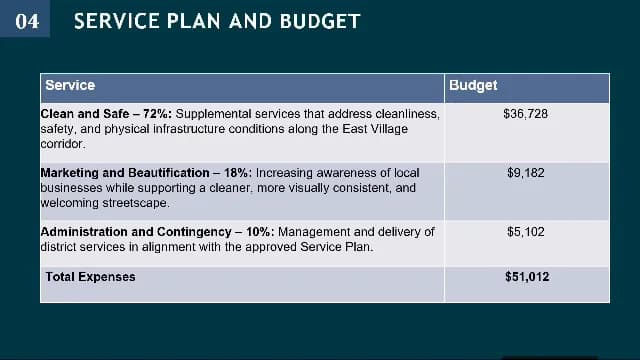
The San Jose City Council met on March 24, 2026, to address a wide range of items including proclamations, consent calendar approvals, a major debate on the city's investment policy regarding companies with ties to ICE, and approvals for franchise, audit reports, wastewater facility updates, business improvement districts, and housing incentive programs. Public comment was limited to one minute per speaker due to high attendance. Proclamations & Recognitions - The meeting opened with the Pledge of Allegiance and an invocation by the Silicon Valley Gay Men's Chorus, who performed a song. Councilmember Tordillos highlighted the chorus's history and contributions. - Councilmember Ortiz presented a proclamation recognizing Dr. Ernesto Galarza Day, honoring his labor rights advocacy and role in ending the Bracero program. Representatives from La Rasa Historical Society and La Rasa Roundtable spoke. - Councilmember Duan recognized the 65th anniversary of Happy Hollow Park and Zoo, joined by Danny the Dragon. Park Director John Ciswell noted over 400,000 annual visitors and upcoming events. Consent Calendar - Councilmember Kamei pulled item 2.13 (Declaration of city's commitment to opposing the coercion of institutions of higher education) for brief discussion, expressing gratitude for support. The entire consent calendar, including this item, was then approved unanimously. Public Comments & Testimony - Item 3.3 – Investment Policy Annual Review: Over 60 public comment cards were submitted. Speakers were split: - Support for divestment from companies tied to ICE (Alphabet, Amazon, Microsoft, Caterpillar, Honeywell): Many residents (e.g., Joan Simon, John DeRoyan, Ethan Pham, Musa from CAIR, Dasha Leeds) urged the council to adopt an ethical investment policy, citing ICE's impact on immigrant communities and calling for stopping investment in companies that facilitate what they termed "genocide" or "terror." Some linked ICE tactics to Israeli military training. - Opposition to divestment: Several speakers (e.g., Tamar Katz, Shonda Whitkin, Daniel Klein, Jonathan Engelman, David Riewer, Yaron Marks) argued that divestment would cost the city $3-5 million annually, violate fiduciary duty, and drag the city into foreign policy issues. They emphasized the city's budget deficit and the risk of rising anti-Semitism. - Item 3.4 – LS Power Franchise: Three speakers raised concerns about environmental review for data centers powered by the transmission lines, asking for more community input. - Item 6.1 – Audit Report: Two speakers (Valentina Martinchik and a volunteer) questioned animal shelter data and alleged that improvements were not real, citing issues with record-keeping and staff training. - Item 8.1 – East Village BID: Two business owners (Chris Patterson Simmons and Caleb Barosco) expressed strong support, citing improved cleanliness, safety, and momentum. - Open Forum: Two speakers discussed San Jose Unified school closures and safety concerns for children crossing major roads. Discussion Items - Item 3.3 – City Investment Policy Annual Review: Councilmember Cohen served as pro tem after recusals. The underlying staff recommendation was to adopt the updated investment policy (primary dealer list update). Councilmembers Ortiz and Kamei introduced a memo to implement "scenario two": allow existing investments in Alphabet, Amazon, and Microsoft to mature, but prohibit new investments in these companies due to their ties to ICE. Councilmember Casey offered a substitute motion to accept staff's recommendation, arguing the memo lacked definitions and was unworkable. Councilmember Candelas suggested a friendly amendment to include an analysis of other cities' actions. After debate: - The substitute motion (staff recommendation) failed 3-5. - The original motion (Ortiz/Kamei memo) failed 4-4 (tie). - A third motion (staff recommendation with directive to analyze other cities' practices) passed unanimously 8-0. - Item 3.4 – Grant of Franchise to LS Power Grid California: Councilmember Campos moved approval. Councilmembers praised the collaboration with PG&E and Open Space Authority to avoid impacts on Coyote Valley. Motion passed unanimously. - Item 3.5 – Status of Open Audit Recommendations: City Auditor Joe Royce presented the report, noting 57 recommendations closed in the last six months, with 88 open items (lowest in 10 years). Progress on priority recommendations was highlighted. Councilmember Kamei moved acceptance; motion passed unanimously. - Item 6.1 – Wastewater Facility Capital Improvement Program Update: Staff presented the status of the $1.2 billion program, with $1.2 billion spent and similar amounts planned for the next decade. The focus remains on rehabilitation, meeting permit requirements, and managing rate impacts. Councilmember Candelas moved acceptance; motion passed unanimously. - Item 8.1 – East Village Business Improvement District: Staff presented the proposed BID covering East Santa Clara Street and adjacent residential streets. The assessment would generate an estimated $51,031 in the first year. Councilmember Tordillos moved approval; motion passed unanimously. - Item 8.2 – Downtown Residential Incentive Program for Gateway Tower and Bank of Italy: Staff requested fee and tax waivers for two projects: Gateway Tower (220 affordable units) and Bank of Italy conversion (109 market-rate units). Both qualify under the program. Councilmember Tordillos moved approval; motion passed 9-0 (Campos absent). - Item 8.3 – Multifamily Housing Incentive Program for El Paseo: The project (772 units, including 39 affordable) would receive waivers and pay $13 million in IHO fees for a separate affordable project. Councilmember Kamei moved approval; motion passed unanimously. - Items 8.4 & 8.5 – Housing Catalyst Team Status Report and General Plan Housing Element Progress Report: Staff presented progress on housing element implementation, noting 103 projects (31,000 units) in the pipeline, but many infeasible due to market conditions. The annual progress report shows San Jose performing better than peer cities but still behind RHNA targets. Councilmembers discussed comparisons to San Diego and Sacramento, and the need for continued policy work. Both items were approved unanimously. Key Outcomes - Investment Policy: Council adopted the updated policy and directed staff to analyze how other cities have handled ICE-related divestment, to be reported back. The directive allows existing investments in Alphabet, Amazon, and Microsoft to mature while prohibiting new ones, contingent on staff implementation guidance. - LS Power Franchise: Approved unanimously. - Audit Report: Accepted unanimously. - Wastewater Capital Update: Accepted unanimously. - East Village BID: Resolution of intention approved unanimously, with public hearing scheduled for June. - Gateway Tower and Bank of Italy: Approved for downtown incentive program. - El Paseo: Approved for multifamily incentive program. - Housing Element Progress: Reports accepted unanimously.

MUNICIPAL FINANCE 36% · ENGINEERING AND INFRASTRUCTURE 10% · HOUSING 10% · PROCEDURAL 9%
OPENPUBLICA · PUBLIC MEETING INDEXUPDATED DAILY · openpublica.com