Browse by city
Date range
Search help

Search titles, summaries, topics and stored transcripts together. Keywords may match separately; put the whole query in double quotes for a phrase. Matching follows word analysis, so punctuation is not exact. Both dates are included. Documents are not searched.

SHOWING 121–130 ENTRIES
121
MAR 18, 2026 · SAN JOSE, CALIFORNIA · CITY COUNCIL
San Jose Rules Committee Meeting: Al Fresco Program & Higher Ed Resolution (2026-03-18)

The San Jose Rules and Open Government Committee met on March 18, 2026, to consider two action items: a memo to modernize and make permanent the Al Fresco outdoor dining program, and a resolution supporting local universities against federal coercion. The committee also approved a consent calendar and heard public comment on procedural improvements. All votes were 5-0. Consent Calendar - The committee unanimously approved (5-0) five consent items after hearing one public comment. Public Comments & Testimony - Brian (public comment on consent calendar): Requested the city create guidelines for submitting detailed public comments and consider using AI to respond to emails, noting that long letters (10–12 pages) may not be read. Also suggested partnering with San Jose State students for projects. - Michaela Akin (SJSU student, on higher education resolution): Expressed strong support for the resolution, describing how reductions in federal funding threats to research grants and visa pressures harm students of color, international students, and LGBTQ students. She stated students should not have to choose between education and safety. - Casey (Executive Director of Financial Aid, Santa Clara University): Expressed support for the resolution, explaining that federal financial aid is foundational for working families and first-generation students. Highlighted specific research projects (frugal lab mobile app for homeless, healthcare, AI ethics) that depend on merit-based federal grants. - Tom Adams (retired environmental lawyer, Crimson Courage): Supported the resolution, arguing the Trump administration is attacking academic freedom through exorbitant demands and extortionate lawsuits (e.g., $1 billion suit against UCLA). He tied Silicon Valley's innovation economy to university research freedom. - Brian (open forum): Commented on allegations against Cesar Chavez, urging accountability for abuse survivors and encouraging other victims to come forward. Discussion Items - Al Fresco Program Modernization (Memo by Councilmembers Otis & Kamei): Councilmember Kamei described the program as a lifeline for small businesses during COVID-19. The memo aims to make outdoor dining permanent, activate public spaces, drive foot traffic, simplify design standards, and support economic recovery, especially during a tough budget year. No public comment was offered. The committee referred the item for workload analysis and to return in two weeks. - Resolution on Higher Education (Memo by Councilmembers Kamei & Cohen): Councilmember Kamei proposed the resolution to stand in solidarity with local universities (Stanford, Santa Clara, San Jose State) against federal administration attempts to coerce them, citing threats to academic freedom, research funding, and the economic/innovation contributions of these institutions. Four speakers offered public comment (see above). The committee voted to move the resolution to the city council agenda. Key Outcomes - Consent calendar: Approved 5-0. - Al Fresco program memo: Referred for workload analysis, with direction to return to the rules committee in approximately two weeks for further consideration (motion carried 5-0). - Higher education resolution: Approved for placement on the next city council meeting agenda (motion carried 5-0). - Next meeting: No meeting scheduled for March 31, 2026. - The committee adjourned at 2:19 PM.
PENDING LITIGATION 35% · PROCEDURAL 26% · ECONOMIC DEVELOPMENT 24% · COMMUNITY ENGAGEMENT 7%
122
MAR 17, 2026 · SAN JOSE, CALIFORNIA · PLANNING COMMISSION
Planning Director's Hearing Approves Off-Sale Alcohol Permit at Silver Creek Valley Place on March 17, 2026

Note: The transcript of this meeting incorrectly dates it as March 11, 2026; however, the meeting was held on March 17, 2026, per official records. The hearing, presided over by Hearing Officer John 2 on behalf of the Director of Planning, Building and Code Enforcement, considered a single public hearing item: a Plan Development Permit (PD 25-023) and associated environmental review (ER25-210) to allow off-sale of beer and wine (Type 20 ABC license) within an existing convenience store (Loop Neighborhood Market) at 5801 Silver Creek Valley Place. After staff presentation, applicant testimony, and public comment, the hearing officer approved the permit. Public Comments & Testimony - Michael Ospring, representing the Coyote Creek Neighborhood Association, urged denial. He argued the location is uniquely unsuitable because it shares a parking lot with the San Jose VA Medical Center (serving veterans with PTSD and substance use disorders), sits across from Shady Oaks Park and the Coyote Creek Trail, and poses traffic and public safety risks. He contended the city's 500‑foot proximity analysis incorrectly classified the VA clinic as a medical office and noted the trail is only 178 feet away via a crosswalk, not the 400 feet cited by staff. He also stated that alcohol‑related blight exists 1,800 feet away at Monterey Plaza. - Victor Velasquez, also representing the Coyote Creek Neighborhood Association, opposed the permit, citing decades of public health research linking alcohol availability to increased violence, property crime, and adolescent alcohol consumption. He emphasized the proximity to the park, youth, and the VA facility, and argued the alcohol sales add no value to the community. Discussion Items - Staff Report: Project manager Jason Lee presented the project, noting the site is in a Planned Development district requiring a PD permit (equivalent to a conditional use permit in the CG zone). Key findings included no other off‑sale alcohol outlets within 1,000 feet, compliance with location requirements (500 feet from schools, childcare, etc., except residential zones at 150 feet), and that the nearest residential parcel is 40 feet away across Silver Creek Valley Place. The closest path of travel from the Coyote Creek Trail to the store entrance is approximately 400 feet. The police department was neutral. Operational conditions proposed: alcohol sales limited to 6 a.m. – 11 p.m., confined to 221 square feet (7% of floor area), no outdoor displays, video surveillance, and a store operator point‑of‑contact at all times. The project was found exempt from CEQA under Section 15301(a) (existing facilities). - Applicant Testimony: Steve Rawlings (representative for AU Energy, owner of Loop Market) and Regional Manager Jaden Ivanis described the company’s 150+ store experience, training programs (five full‑time trainers, five loss prevention specialists), use of “mystery shopper” audits, mandatory ID checks for all customers (including those over 60), and age‑verification technology at point‑of‑sale. They noted a meeting with Mr. Ospring and a community meeting, and pledged responsible operation. They emphasized the 11 p.m. closing time (vs. 2 a.m. allowed for some licenses). - Hearing Officer’s Deliberation: Hearing Officer John 2 acknowledged the public concerns and referenced the city’s adopted council policy for off‑sale alcohol, which requires a more rigorous process. He noted that the site is not in a high‑crime area or an overconcentrated census tract, and that the permit includes robust conditions (limited hours, limited floor area, no spirits). He reasoned that although studies correlate alcohol availability with harm, the conditions and ability to enforce or revoke the permit mitigate those risks, and that the city encourages commercial uses near residences to reduce vehicle trips. He concluded all findings could be made and approved the permit. Key Outcomes - Decision: The hearing officer approved Plan Development Permit PD 25‑023 and the associated environmental exemption (ER25‑210). - Conditions of Approval: Alcohol sales are limited to beer and wine (no spirits), 6 a.m. – 11 p.m., within a maximum of 221 square feet (7% of tenant space). No alcohol displays or advertisements are permitted outside the store. The operator must maintain a point‑of‑contact, video surveillance, and policies to address loitering and panhandling. - Environmental: The project is exempt under CEQA Guidelines Section 15301(a) for existing facilities. - Next Steps: The permit becomes final when signed and mailed, unless appealed under Title 20 or Title 21 of the San José Municipal Code. The hearing officer encouraged continued communication between the applicant and the community to address any future issues.

CANNABIS REGULATION 41% · PUBLIC COMMENT 35% · PROCEDURAL 11% · LATE NIGHT USES 8%
123
MAR 17, 2026 · SAN JOSE, CALIFORNIA · CITY COUNCIL
San Jose City Council Meeting: Budget Message, SB 79, and Child Care Report (March 17, 2026)

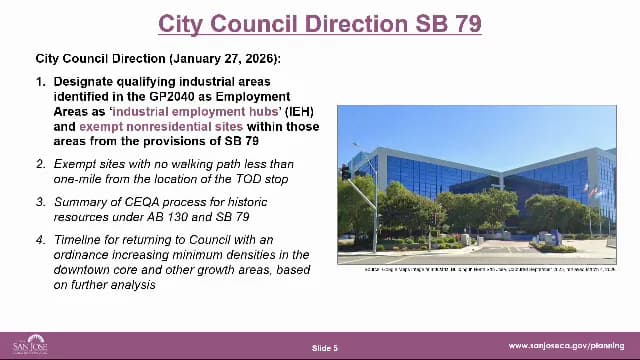
The San Jose City Council met on March 17, 2026, in a lengthy afternoon and evening session to address several major items, including a status report on child care policy, implementation of Senate Bill 79 (industrial ordinance and historic resources), and the approval of the Mayor's March Budget Message for fiscal year 2026-2027. The meeting began with ceremonial items and a unanimous consent calendar. A significant portion was dedicated to public comment on the budget, with 186 speakers registered. The council voted 8-3 to approve the Mayor's budget message as amended, and also approved the SB 79 industrial ordinance and a substitute motion on historic resources. Consent Calendar - All consent calendar items were approved unanimously without discussion or pull. Public Comments & Testimony - On Child Care (Item 3.4): No public comment was taken; speakers were redirected to the budget item (3.3). - On Land Use (Items 10.2 and 10.3): Speakers included Brent Triana (neighborhood association), Tronic Crichton (VTA senior planner), Ben Leach (Preservation Action Council), Jimmy Kogura (Japantown representative), Brent Van Brocklin (VTA TOD project manager), Mary Ang (Opportunities for Change), and Mike Sodergren (Preservation Action Council). They expressed support for protecting historic resources and asked the council to consider mixed-use development on VTA sites while maintaining employment hubs. - On the Budget Message (Item 3.3): Over 150 speakers addressed the council, many representing community organizations, neighborhood associations, and advocacy groups. Key themes included support for public safety, homelessness reduction, housing production, youth investment, child care, senior services, immigrant defense funding, and prevention programs. Multiple speakers supported the mayor's budget priorities, while others called for increased funding for the Children and Youth Services Master Plan, the Family Friends and Neighbors (FFN) program, and the rapid response network. The public comment period lasted from approximately 10:15 AM to late afternoon, with each speaker limited to 45 seconds. Discussion Items - Child Care Policy Opportunities Status Report (Item 3.4): Staff presented an overview of city efforts, including a brief survey of other jurisdictions (San Francisco, Santa Cruz, Oakland, Seattle, etc.) and current San Jose programs (Recreation Preschool, FFN network, boost program, co-location in affordable housing). Councilmember Campos moved to accept the report, noting the importance of child care for workforce participation. Councilmember Casey expressed concern about "mission creep" and regional funding, while Councilmembers Kamei, Tordillos, Ortiz, and Duane supported the report and emphasized child care's role in economic development and family stability. The motion passed unanimously. - SB 79 Implementation (Items 10.2 and 10.3): Staff presented jointly on the amendment to Title 20 (Industrial Employment Hub Exclusion) and analysis of SB 79/AB 130 impacts on historic resources. For Item 10.2, the council voted to designate five industrial employment hubs (North San Jose, Berryessa, Lundy-Milpitas, East Gish-Mayberry, Monterey Business Corridor, Old Edenvale) to exempt qualifying industrial lands from SB 79's residential streamlining. The ordinance will take effect April 23, 2026, before SB 79's July 1 implementation. For Item 10.3, staff discussed risks to historic resources under the combined laws. Councilmember Mulcahy proposed a delayed effectuation ordinance for historic districts and conservation areas. Councilmember Tordillos offered a substitute motion (with Cohen, Campos, Kameh) to adopt staff recommendations (narrower definition of demolition) and direct a workload analysis for a future historic resources survey. The substitute motion passed 10-1, with Mulcahy voting no. - FY 2026-2027 Mayor's March Budget Message (Item 3.3): Mayor Mahan presented the budget message, outlining a $56 million shortfall for the coming year and a projected additional $28 million deficit. Priorities include public safety, homelessness reduction (2,000 shelter placements, 1,000 new since early 2025, unsheltered homelessness down over 20%), housing production, economic revitalization, and fiscal discipline. He acknowledged 63 unique pieces of direction from council memos and issued a reconciliation memo incorporating several items. Councilmembers Condelas, Ortiz, Campos, Cohen, Kamei, Tordillos, Duane, and Mulcahy debated amendments. Vice Mayor Foley made a substitute motion to approve the mayor's budget message and reconciliation memo, which was seconded by Councilmember Kamei. Friendly amendments from Councilmember Condelas (including analysis of opioid settlement funds for the Children and Youth Master Plan and exploring code enforcement modernization) and Councilmember Cohen (exploring opioid settlement funds for the Children and Youth Master Plan with paramedicine precedence) were accepted. The motion passed 8-3, with Councilmembers Duan, Condelas, and Campos voting no. Key Outcomes - Consent Calendar: Unanimously approved. - Child Care Report: Accepted unanimously; staff directed to continue work. - SB 79 Industrial Ordinance (10.2): Passed unanimously; will be submitted to HCD and take effect April 23, 2026. - Historic Resources and SB 79 (10.3): Substitute motion passed 10-1, adopting staff recommendations (narrower demolition definition for historic resources) and directing a workload analysis for a future historic resources survey. A delayed effectuation ordinance was not approved. - Budget Message (3.3): Approved 8-3, including the mayor's original message and reconciliation memo. The city manager will prepare the proposed budget for May study sessions, with a final vote in June.

MUNICIPAL FINANCE 13% · PUBLIC COMMENT 12% · HOMELESSNESS 10% · CHILD CARE 7%
124
MAR 11, 2026 · SAN JOSE, CALIFORNIA · PLANNING COMMISSION
San Jose Planning Commission Meeting – March 11, 2026: Builder's Remedy Appeal and SB 79 Zoning Update

This meeting of the San Jose Planning Commission, held on March 11, 2026, from approximately 7:00 PM to 8:49 PM, addressed two primary agenda items: an appeal of a site development permit for a builder's remedy project at 940 Willow Street, and a proposed zoning ordinance update to implement Senate Bill 79 (SB 79), which mandates increased housing density near transit. The commission denied the appeal, upholding the director's approval of the Willow Street project, and approved the SB 79 zoning amendments. Consent Calendar - The consent calendar was approved unanimously (10-0-1, with Commissioner Cantrell absent) without discussion or public comment. Public Comments & Testimony - 940 Willow Street Project (Appeal) - Several neighbors spoke in opposition, citing concerns about sewer capacity, infrastructure adequacy, narrow streets, flood zones, and emergency vehicle access. One speaker, Jeff Ewell, provided a detailed technical analysis arguing the city's sewer study was flawed, noting a lack of data on a 19-foot connecting pipe and using a smooth-pipe friction coefficient for an 80-year-old clay pipe. He requested a continuance for further study. - Supporters, including Alex Shore of Catalyze Silicon Valley, acknowledged the project qualifies under builder's remedy and praised the 30% affordable housing, but criticized community engagement (scored 2 out of 5). Other supporters cited the need for housing investment. - Appellant David Fox (former Campbell planning commissioner) requested four practical design changes (landscape buffer, downward-facing lighting, adequate tree soil, flat roofs) but emphasized he did not seek project denial. - SB 79 Zoning Update - A resident (Robert Werk?) asked the commission to restore 32 acres of housing element land near Santa Teresa Light Rail that had been swapped for industrial use in 2014, claiming the change caused neighborhood harm. - Rob Swerk, Principal Planner at VTA, expressed concern that the proposed industrial exemption would prevent mixed-use development at VTA's Santa Teresa and Sirona transit-oriented development sites, and urged the city to continue working with VTA to allow residential on those sites. - A speaker (Mike Sodergren) supported staff's recommendation to preserve employment lands, emphasizing the need to protect industrial land for jobs. Discussion Items - Appeal of 940 Willow Street (Builder's Remedy) - Staff presented the project: a 7-story mixed-use building with 126 units (15% very low-income, 15% moderate-income), 1,262 sq ft commercial, at 940 Willow Street. The project qualifies under builder's remedy because the application was submitted before the city's housing element was certified (June 2023 vs. January 2024). The city must treat it as consistent with general plan and zoning; denial can only be based on specific adverse impacts to public health and safety. - Staff recommended denying the appeal and upholding the director's December 3, 2025 approval. - Applicant's counsel Dan Goleb argued the appeal seeks to impose conditions that would effectively disapprove the project, which state law prohibits. He noted the appeal focuses on design standards, but the project already complies or has waivers under density bonus law. - Commissioners questioned staff on sewer capacity (modeling showed adequate capacity), parking (no minimum; TDM plan in place), fire safety (variance granted for fire-rated walls and sprinklers), and community engagement. Developer Chris Breeze stated he was accessible and had received many calls, but the most vocal opponents were immediate neighbors. - After discussion, Vice Chair Bickford made a motion to deny the appeal and uphold the director's decision. The motion passed 10-0-1 (Commissioner Cantrell absent). - SB 79 Zoning Code Update (PP25-006) - Staff presented the proposed amendments to implement SB 79, which allows housing on sites zoned residential, mixed-use, or commercial within ½ mile of transit stops. The city has 56 qualifying stops. The ordinance exempts certain industrial employment hubs (totaling 2,051 parcels, 4,448 acres) from SB 79 provisions to preserve land for jobs. Exempted areas include North San Jose, Barriessa International Business Park, Lundy Milpitas Bart, East Gish/Maybury, Monterey Business Corridor, and Old Edenville areas. - Staff noted the timeline: City Council hearing on March 17, second reading March 24, HCD submission March 25, with SB 79 effective July 1, 2026. - Commissioners expressed support for preserving employment lands. Commissioner Bandal highlighted the need to protect industrial land given San Jose's role as a bedroom community for neighboring cities. - Commissioner Oliverio moved to approve the staff recommendation, seconded by Commissioner Casey. The motion passed 10-0-1 (Commissioner Cantrell absent). Key Outcomes - 940 Willow Street Appeal: Denied; the director's approval of the site development permit is upheld. The planning commission's decision is final with no further appeal available. - SB 79 Ordinance: Approved as recommended by staff. The ordinance will now proceed to City Council for adoption on March 17 and 24, with submission to HCD by March 25. - Deferral: Public hearing item 5B (appeal of special use permit for recycling facility SP24-029) was deferred to the March 25, 2026 planning commission meeting upon staff request due to newly received documents. - Next Steps: The March 25 meeting will include another builder's remedy project with an EIR and the deferred item. The April 8 meeting also has pending items.

LAND USE 24% · PROCEDURAL 16% · HOUSING 13% · PUBLIC SAFETY 11%
125
MAR 11, 2026 · SAN JOSE, CALIFORNIA · CITY COUNCIL
San Jose Rules Committee: EIH Policy & Development Costs – March 11, 2026

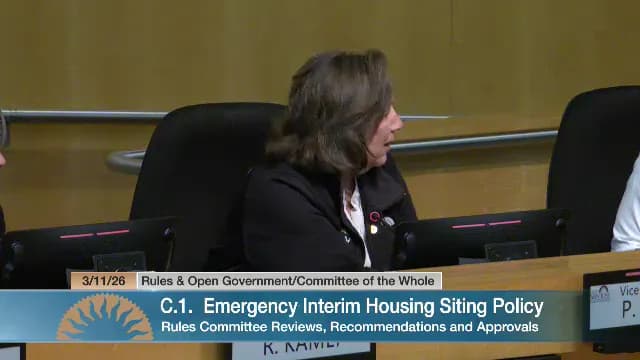
The Rules and Open Government Committee of the San Jose City Council met on March 11, 2026, at 2:00 PM. The meeting was called to order by the Chair with a quorum present: Councilmembers Candelas, Duane, and Foley were present; Councilmember Going was absent. The committee reviewed and approved agendas for March 17 and March 24, approved a consent calendar, and discussed two items: an emergency interim housing (EIH) siting policy memo and the cost of residential development in San Jose. Public comment was offered on the EIH item only. Agenda Approval - March 17, 2026 agenda: Approved 4-0 (one absent) with a motion to move item 3.3 to the end of the agenda. The agenda included ceremonial items, consent items (pages 4–6), strategic support items (FY 2026-27 and child care opportunities 3.4), land use items 10.2 and 10.3 on page 8, no public safety, transportation, environmental, neighborhood services, or land use consent items, and an ad sheet. - March 24, 2026 agenda: Approved 4-0 (one absent). The agenda included closed session at 9:30 AM, regular session at 1:30 PM, consent items (pages 4–7), strategic supports (pages 7–8), no public safety or transportation, environmental services item six on page 9, no neighborhood services or community and economic development, continuing on pages 10–12 ending on page 13, and no land use consent. Consent Calendar Approved 4-0 (one absent). The consent calendar included: - Monthly report of activities - Approval of Asian American Pacific Islander Month Festival 2026 - Approval of Wepa Salsa Festival - Approval of Greek flag raising - Approval of dumpster days in council district nine - Approval of autism awareness month flag raising sponsored by district six Discussion Item 1: Emergency Interim Housing (EIH) Siting Policy Councilmember Campos, co-author of the memo, explained that the memo seeks to codify previously approved council policy language around geographical equity of EIHs, ensuring council moves forward on that already-approved policy. The item was sent for a workload analysis. Public Comments: - Alan Wadd, president of the VEP neighborhood association representing Carson, Vista Park, and Parkview in District 2, expressed support for the memo. He argued that homelessness is a citywide challenge and responsibility must be shared citywide; for too long the lack of a formal policy has allowed facilities to cluster in certain areas like District 2, placing disproportionate impacts on specific neighborhoods. He stated that codifying equitable distribution ensures fairness and builds trust, and is not about opposing housing solutions. - Lori, a 23-year resident of District 6 speaking on behalf of Showing Up for Racial Justice Santa Clara County, supported moving the memo to council. She said equitable distribution of EIH is an opportunity for all residents to care for vulnerable neighbors, and that having safe places near where people live is important. She also noted that equitable distribution can help reduce long-standing segregation in housing policy and build community bridges. She added that her perspective also includes affordable housing in equitable distribution. Committee Discussion: - Councilmember Candelas appreciated the equity approach but noted the city faces a $56 million deficit and the administration has repeatedly stated it is not in expansion mode due to $95 million in annual operating costs for the 2,100 existing EIH spaces. She expressed hope that the workload analysis balances trade-offs with the Mayor's March budget message. - Vice Mayor Foley (co-author) clarified the council has already decided not to move forward with any more EIHs at this time; the memo says if and when that decision is made in the future, the city should look at districts that do not have EIHs. She noted that District 9 recently opened an EIH facility on Valley Water-owned land, while Districts 3, 6, 2, and 7 have had their share of EIHs and emergency housing. - Councilmember Duane emphasized that Districts 2 and 7 tend to bear the larger brunt of unsheltered residents. He argued that to be fair and equitable, other districts should bear the burden as well because homelessness is a city, county, state, and nationwide problem. Vote: The motion to send the memo to workload analysis passed 4-0 (one absent). Discussion Item 2: Cost of Residential Development in San Jose This item had been seen the previous week and the administration had greenlit it. There was no public comment and no discussion. A motion to approve was made and seconded, and passed 4-0 (one absent). Open Forum No public comment was offered. Key Outcomes - March 17 and March 24 agendas approved (both 4-0). - Consent calendar approved (4-0). - EIH siting policy memo referred for workload analysis (4-0). - Cost of residential development item approved (4-0). - The meeting adjourned at 2:14 PM.

HOMELESSNESS 45% · PROCEDURAL 24% · AFFORDABLE HOUSING 19% · HOUSING 12%
126
MAR 10, 2026 · SAN JOSE, CALIFORNIA · CITY COUNCIL
San Jose City Council Meeting - March 10, 2026: Focus Areas, ALPRs, and Police Overtime

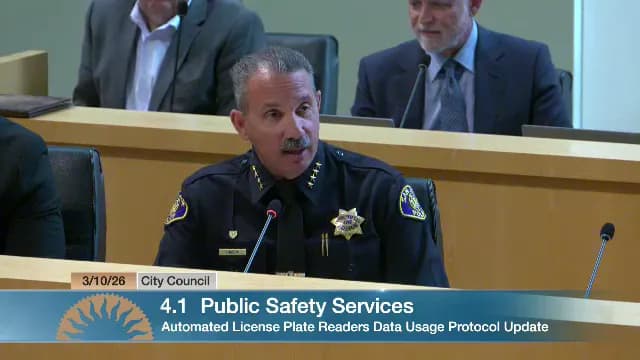
Opening Ceremonies & Proclamations - Invocation: The meeting began with an invocation and performance by San Jose Taiko, celebrating the group's 53-year history and its role in designating Japantown as a California Cultural District. - Proclamation: Councilmember Ortiz presented a proclamation recognizing the 28th Annual Mexica New Year celebration hosted by Calpuli Tonaleke at Aprush Park, highlighting themes of unity and indigenous cultural tradition. Consent Calendar - Councilmember Condelas pulled Item 2.9, regarding a $492,000 budget amendment for the Welch Park Neighborhood Center restroom remodel. Director of Public Works Matt Lash explained that the cost increase was due to unexpected issues found during construction, including a crushed sewer line and mold abatement. The consent calendar was approved unanimously with Mayor Mahan absent. City Council Focus Area Status Report (FY 25-26 Q2) Staff presented a comprehensive update on the five council focus areas. Key highlights included: - Increasing Community Safety: Resident safety perception increased year-over-year (2% city, 2% neighborhood, 5% downtown). Crimes against persons decreased 13%. KSI traffic collisions increased 34%. County budget shortfalls are impacting crisis response programs like PERT. - Reducing Unsheltered Homelessness: The city exceeded its goal, delivering 707 planned shelter units (goal of 705). CalAIM billing is off-track due to complexity. Standardizing operations and leveraging state/federal funding are key priorities. - Clean Up Our Neighborhoods: Resident perception of citywide cleanliness hit 52% (up from 33%). Graffiti arrests led to the seizure of weapons and explosives. The junk pickup program for multifamily complexes expanded usage significantly. - Building More Housing: The Multifamily Housing Incentive Program moved 1,444 units from entitlement to construction. Affordable housing permit reviews are exceeding timelines. - Growing Our Economy: 31,000 jobs added since 2020. The Super Bowl event at San Pedro Square drew 48,000 attendees. The city is exploring streamlined permitting for small businesses. - Public Comment & Council Discussion: Lori Catcher (SURJ) urged the city to "stop criminalizing people who are homeless." Ted Scarlet shared his experience of becoming homeless after a car accident, stating the system is "completely broke." Councilmembers discussed the cost of functional zero (over $500M) and the need for creativity. The report was accepted unanimously. Automated License Plate Readers (ALPR) Data Usage Protocol Update Chief Paul Joseph presented a proposal to amend the ALPR policy. - Proposed Changes: Reduce data retention from one year to 30 days, add stricter access controls (command-level approval required for external queries), prohibit placement near reproductive health and religious facilities, and increase audits to quarterly. The Chief stated, "The impact of these cameras on our public safety efforts is unquestioned." - Public Testimony (Nearly 100 speakers): - Supporters: Residents, business owners, and neighborhood leaders argued the cameras are vital crime-fighting tools for an understaffed department, citing specific solved crimes in every district. They expressed trust in SJPD. - Opponents: Community advocates (SIREN, SURJ, Working Partnerships USA, ACLU) argued the system is invasive mass surveillance. Speakers raised concerns about data vulnerability (hacking), potential misuse by immigration enforcement, chilling effects on civil liberties, and the company Flock's track record. Many called for terminating the contract and for Mayor Mahan to recuse himself. - Council Action & Memos: - Councilmember Condelas introduced a memo adding foreign consulates to prohibited locations, directing the city manager to explore alternative vendors, and requiring breach reporting. - Councilmember Ortiz introduced a memo focusing on facilities providing gender-affirming care. - Councilmember Casey expressed concern about reducing retention to 30 days, sharing examples of homicides solved with 2-6 months of data. The city attorney clarified the Levine Act did not apply and recusal was not required. - Key Outcomes: - The council voted unanimously (10-0) to approve the Chief's updated policy alongside the new guardrails. - Data retention was reduced by 92% to 30 days. - Prohibited camera locations were expanded. - An RFP process for alternative vendors was directed. Police Department Overtime Spending Budget Director Jim Shannon presented a plan to address $16.5 million in overtime overspend in FY 24-25. - Strategy: The plan includes stricter overtime controls, redeployment of personnel (resulting in $8 million in annual savings), and shifting positions to the base budget. - Specific Changes: The plan reduces the Traffic Enforcement Unit and School Liaison Program, and ends SJPD's policing contract at the Berryessa BART station (where the city was reimbursing only half the cost). - Council Discussion: Councilmembers expressed disappointment over cuts to traffic enforcement and school liaisons but supported the fiscal responsibility. Mental health crisis calls will be handled by the MCAT team and the county's mobile crisis response team following the county's elimination of PERT. - Outcome: The motion was approved unanimously. Open Forum - Raymond Goans criticized the city and police handling of a mental health crisis call where an individual was killed. - A speaker raised concerns about the mayor's association with the Hindu American Foundation. - Ted Scarlet pleaded for housing assistance.

PUBLIC SAFETY 45% · TECHNOLOGY AND INNOVATION 23% · PROCEDURAL 5% · HOMELESSNESS 5%
127
MAR 6, 2026 · SAN JOSE, CALIFORNIA · PLANNING COMMISSION
San Jose Historic Landmarks Commission Meeting - March 6, 2026

The Historic Landmarks Commission (HLC) of San Jose convened on March 6, 2026. The meeting included a report on Historic Preservation Month 2026, an extensive informational presentation and public discussion on the Five Wounds Trail and Coyote Creek Trestle, and an Open Forum addressing the potential impacts of state housing legislation (SB 79) on historic resources. Commissioners and the public expressed strong sentiment for exploring the preservation of the historic Coyote Creek Trestle. The Commission approved the action minutes from the previous meeting. Public Comments & Testimony - Five Wounds Trail and Coyote Creek Trestle (Item 6A): - Keith Ball (Save Our Trails): Strongly urged the Commission to save the trestle and designate it as a city landmark, arguing it is both viable and desirable. He stated that a consultant report showed preserving the historic trestle while building a modern steel bridge nearby has significantly lower construction costs and takes 10 months less than the city’s preferred option. - Bruce Victorine (D7 Leadership Group / Save Our Trails VP): Read a letter from the D7 Leadership Group stating their vote to support preservation. They advocated for Option 3, which preserves the trestle as a landmark (closed to public use) while building an adjacent modern bridge for the trail, emphasizing the trestle's connection to the history of railroads and canneries in the Valley of Heart's Delight. - Ben Leach (Preservation Action Council of San Jose): Expressed full support for the preservation coalition. He argued that preservation is an opportunity, not an impediment, and that activating the trail would inherently reduce vandalism and fire risks, changing the reality on the ground. - Bill Rankin (Save Our Trails President): Expressed support for preserving the trestle for its historical role in developing the fruit cocktail industry, while acknowledging that a new, safe bridge is needed for the trail. - Additional Speaker (trestle advocate): Discussed the failed Willow Glen Trestle preservation effort. He proposed building a new bridge 50 feet to the east of the existing trestle, arguing it would be a shorter span, cheaper, and would leave the historic structure untouched and visible for safety monitoring. - Open Forum (Item 7): - Mike (Preservation Action Council): Urged the Commission to support the Planning Director and Councilmember liaison in their efforts to include an historic preservation exemption in the city’s implementation of SB 79. He emphasized that the city should not leave the historic exemption on the table. He also requested the Commission consider having a formal representative speak at City Council or Planning Commission meetings on items where the HLC holds a unanimous position. Discussion Items - Historic Preservation Month 2026 (Item 5A): - Staff presented plans for Historic Preservation Month in May 2026. Activities will include a City Council proclamation and the launch of a new consolidated web page for existing story maps (Alviso, Martha Gardens, Evergreen, and additions). The centerpiece will be a digital community storytelling project called "My San Jose," an interactive GIS program that allows residents to place a point anywhere on a map of the city and upload photos and stories about what they find significant, aiming to crowdsource community memories and identify new historic perspectives. - Five Wounds Trail and Coyote Creek Trestle (Item 6A): - Project Update (Liz Sewell, Trail Manager): Staff provided a status report on the master plan (begun July 2025) and environmental review process. Four studies of the trestle were conducted between 2022 and 2023 (historic evaluation, structural, fire/security, floodplain/hydrology). The historic evaluation showed the trestle appears eligible for listing. - Challenges Identified: The trestle faces ongoing deterioration, arson (approximately two fires per month), and vandalism. The creosote preservative is highly flammable and releases dense smoke. Annual maintenance and emergency response costs are approximately $125,000. - Comparative Analysis: Staff contacted owners of several retrofitted trestles (MKT Trail in Texas, Tommy Thompson Trail in Washington, Iron Horse Trail in Alameda) and reported that these structures continued to experience major fires and high maintenance costs after retrofit, informing the city’s analysis. - Cost Estimates: Retrofit/rehabilitation is estimated at $11.28 million with $125,000 per year in maintenance. Building a new bridge is estimated at $11.69 million with $10,000 per year in maintenance. Preserving the old trestle while building a new bridge has unknown additional costs, and siting a bridge further east faces complications related to landfill abutments and environmental impacts. - Status and Next Steps: Staff emphasized that no final decision has been made and the EIR has not yet begun. A community scoping meeting for the EIR is anticipated for Summer 2026. Staff stated the data is currently pointing toward removing and replacing the trestle (Option B/C), but the EIR will evaluate alternatives. - Commissioner Deliberation: - Commissioner Camuso expressed strong skepticism of the city’s cost projections and motives, drawing parallels to the historic neglect and eventual demolition of the Montgomery Hotel and Willow Glen Trestle. She questioned the listed maintenance costs, the risk of creosote, and the lack of proactive mitigation efforts (e.g., sprinklers, fences). She urged the EIR to formally consider the tourism and economic benefits of preserving the structure. - Commissioner Golandari noted the trestle is eligible for three levels of historic nomination (National Register, California Register, San Jose Landmark). He asked detailed questions regarding the EIR process and confirmed with staff that the Draft EIR will ideally be brought back to the HLC for formal comment and a potential vote. - Commissioners generally agreed that the overwhelming community support for preservation should be a significant factor in the upcoming environmental analysis. They requested the city provide a more detailed breakdown of cost estimates and explore the feasibility of preservation grants to supplement the VTA Measure B trail funding. Key Outcomes - Action Minutes Approved: The Commission unanimously approved the action minutes from the December 3, 2025 meeting. - Five Wounds Trail / Trestle: No formal action was taken; the item was informational. Staff assured the Commission that public comments from the meeting will be incorporated into the EIR process documentation. The HLC requests the Draft EIR be agendized for commission review and formal comment when completed. - SB 79 / Historic Exemptions: Staff will report back on the outcome of the March 17th City Council meeting regarding the city’s SB 79 implementation strategy, specifically whether the historic resources exemption will be pursued. The Commission expressed support for including historic resources in the city's response. - Procedural Discussion: Commissioners expressed interest in having a formal HLC representative speak at City Council or Planning Commission meetings on critical preservation issues and in reviewing development project referrals earlier in the process (before staff reports are finalized) when possible.

HISTORIC PRESERVATION 57% · PARKS AND RECREATION 14% · PUBLIC COMMENT 11% · PROCEDURAL 7%
128
MAR 6, 2026 · SAN JOSE, CALIFORNIA · PLANNING COMMISSION
Planning Director Hearing March 6, 2026: 620 N 6th St Retail-to-Residential Conversion

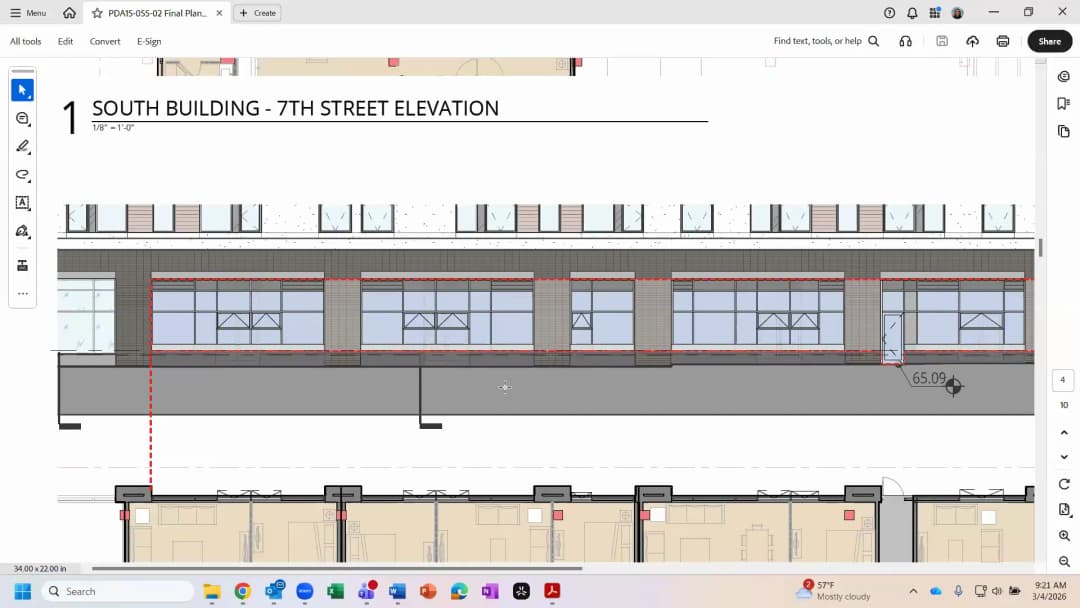
Note on date discrepancy: The transcribed meeting records indicate the hearing occurred on March 4, 2026, but the provided instructions specify the meeting date as March 6, 2026. This summary uses the instructed date. This hearing, conducted via Zoom by Hearing Officer Sylvia Doe on behalf of the Director of Planning, Building, and Code Enforcement, considered a single agenda item: a plan development permit amendment (PDA 15-055-02) to convert approximately 14,500 square feet of ground-floor retail space into 11 residential units at 620 North 6th Street, near the intersection of 6th and Jackson Streets in the Japan Town neighborhood. The item was originally on the consent calendar but was moved to a public hearing after a member of the public requested to speak. Consent Calendar - Item 3A (PDA 15-055-02 and ER25-101) was the only consent calendar item. It was moved to the public hearing portion following a request for public comment. Public Comments & Testimony - Jordan, a Japan Town resident living adjacent to the project, expressed disappointment in the reduction of commercial space, noting the original development agreement promised a mixed-use vision. He acknowledged the need for housing but argued that 11 units is modest compared to the loss of retail, and suggested that the current vacant retail spaces might attract tenants if built out. He also noted the economic uncertainty and potential for future market improvement. Discussion Items - Staff Report (Laura Miners, Planning Project Manager): The amendment would convert 14,500 sq ft of ground-floor retail (from the existing 18,000 sq ft) into 11 residential units, resulting in 230 total units and 3,500 sq ft of retained retail. Minor exterior modifications include extended Saturday construction hours (8 a.m. to 5 p.m.) limited to interior and minor exterior work. The site is a 1.69-acre lot with a six-story building. Entrances to the new units would be from the parking garage, not the street, due to flood zone constraints. Staff recommended approval based on an addendum to the 2008 Japan Town Corporation Yard Redevelopment Project EIR. - Applicant (Sean M., Shea Company): Described the conversion as a last resort after five years of unsuccessful leasing efforts (including food hall, performing arts center, medical office, childcare). He stated that mixed-use retail is often overbuilt and that the market is unlikely to shift. He detailed design challenges: flood zone requirements force floor elevations 1.5–2 feet higher, making street-level residential entrances impractical. The existing storefront windows will be replaced with operable windows meeting residential code, mimicking the retail look. Privacy will be provided by dual window treatments (sheer and dark roller shades). The 11 units will average 1,100 sq ft, designed for larger families, with upgraded finishes, side-by-side laundry, and sound-dampening ceilings. - Hearing Officer Questions: The hearing officer asked about preservation of transparent storefront windows and unit design. The applicant confirmed windows will be operable but designed to match the retail aesthetic. The three retained commercial suites include one currently leased to a pet grooming business (soon to open), and two others that could be combined for a cafe or restaurant. The hearing officer also asked about the development agreement; staff clarified it called for 16,000–24,000 sq ft of commercial, but the loss is offset by the upcoming Tyco project adding more commercial space on the block. Key Outcomes - Decision: The plan development permit amendment was approved by Hearing Officer Sylvia Doe. - Basis for Approval: The project is consistent with the Transit Residential General Plan land use designation and the Plan Development Zoning District. The conversion still preserves 3,500 sq ft of retail at the prominent intersection, maintaining opportunities for future businesses and adding 11 housing units within walking distance to transit. The density of 136 dwelling units per acre is within the allowable range. - Environmental Review: The addendum to the Japan Town Corporation Yard Redevelopment Project Final EIR was adopted, finding no new significant impacts. - Next Steps: The permit is appealable under Title 20 and Title 21 of the Municipal Code. The hearing adjourned at 9:32 a.m. (per transcript).

LAND USE 69% · PROCEDURAL 19% · ECONOMIC DEVELOPMENT 9% · AFFORDABLE HOUSING 3%
129
MAR 4, 2026 · SAN JOSE, CALIFORNIA · PLANNING COMMISSION
San Jose Planning Commission General Plan Task Force Meeting on Small Multifamily Housing - March 4, 2026

The Planning Commission, serving as the General Plan Task Force, held its fourth meeting of the 25-26 General Plan four-year review on March 4, 2026. The meeting focused on the staff proposal to allow small multifamily housing (missing middle) citywide by increasing density from 8 to 32 units per acre in the Residential Neighborhood land use designation. Public comment was moved before task force discussion per a commissioner request. The meeting began at approximately 2:45 PM and adjourned at 8:27 PM. Public Comments & Testimony - Robert Wood (Chair, Housing Committee, San Jose State California Faculty Association) expressed appreciation for commissioners who advocated for more housing and supported the 32 units per acre proposal. He urged a comprehensive revision of the General Plan and cautioned that the urban villages process may be too slow. He noted the need for more city planning resources. - Gia Lee (local real estate developer/builder) strongly supported the ministerial process for small multifamily housing but urged an interim ordinance to allow projects to move forward immediately, citing delays from subdivision requirements. He proposed an interim density cap of 19.8 units per acre (based on SB 1123 threshold) to test standards without waiting for full General Plan amendment. - Kale Anderson (student) inquired about youth outreach specifics and the composition of focus groups for underrepresented populations. - Teresa Dow (San Jose YIMBY) expressed excitement about the density increase, encouraged a bolder 40 units per acre to meet RHNA obligations, and asked the city to consider using public/quasi-public land and partnering with school districts for affordable housing. - Regina Celestin Williams thanked staff for thoughtful work, supported the citywide approach to allow multifamily in high-opportunity areas, and also encouraged 40 units per acre for financial viability and housing variety. - Robert Swerk (Principal Planner, VTA) supported the recommended strategy, noting it aligns with VTA goals of transit ridership and reduced VMT. He mentioned VTA staff met with city staff to discuss growth areas around bus transit corridors. - Stephanie Yi (local developer, speaking for a firm with over 300 units in San Jose) strongly urged ministerial approval, noting that current projects take a long time to get permits. She requested expedited processing (e.g., pre-approved plans, concurrent review of parcel maps and building permits) to reduce construction costs. - Mani Bekele (Policy Officer, Silicon Valley Youth Climate Action, District 3 resident) highlighted climate benefits of denser housing near transit to reduce car dependence and greenhouse gas emissions. He urged coordination with the Climate Smart San Jose team to meet carbon neutrality by 2030. - Lisa Chapontier (San Jose Team, California Donut Economics Coalition) supported missing middle housing for its equity benefits, noting historical redlining, and called for policies like form-based codes and affordability requirements to ensure common good. - Cyrus Jahanian (City Connect Partners) thanked staff for the presentation and asked how density bonus law and design standards would interact with the new zoning. He noted that density bonus law allows concessions and waivers in exchange for affordable units. - Lindy Hayes (Corey neighborhood resident) asked the city attorney about the precedence of CC&Rs (limiting single-family homes to 25 feet height) versus state law and zoning changes. The city attorney responded that state law and local zoning typically trump CC&Rs, but recommended consulting real estate counsel for her specific situation. - Sandra Ruby Hu (local builder) recommended impact fee reductions for smaller projects, switching from a per-unit fee structure to a square footage-based structure, and fee deferral to temporary certificate of occupancy to help projects pencil out. - Ken Hittleman (Winchester Orchard Neighborhood Association) advocated for higher densities along Winchester Boulevard but not extending into R1 neighborhoods behind. He asked for specifics on buffer zones. Staff clarified that the citywide proposal eliminates the need for buffer zones. - Chris Gian Greco (Vice President, Winchester Orchard Neighborhood Association) expressed concern about the impact of growth on existing residential neighborhoods, noting that neighborhoods like Corey and Winchester Orchard have already been impacted by urban village projects. He requested protections for single-family neighborhoods. Discussion Items - Staff Presentation: Cora McNaughton presented the staff recommendation to increase density from 8 to 32 units per acre in the Residential Neighborhood land use designation, allow multifamily use in single-family zoning, and create a ministerial permit process. The proposal would apply citywide, replacing the earlier idea of buffer zones around urban villages. Staff noted that 32 units per acre would allow at least 4 units on a typical 6,000 sq ft parcel, with the possibility of additional ADUs. The presentation included examples from other cities (Sacramento, Berkeley) and a discussion of existing state laws (SB 9, SB 1123) that already allow similar densities but with complex processes. - Outreach Update: Ruth Guento announced that the team has met with District 1 leadership group, contracted with Winter Consulting for outreach, and is planning open houses in April and May. The Office of Racial and Social Equity is hosting four focus groups: two with the disability community, one with youth, and one with a diverse lived experience group. - Task Force Discussion: - Commissioner Bondal praised the memo and presentation, asked about financial feasibility of 32 units/acre, and requested staff to explore 40 units/acre. He noted that the city's inclusionary housing ordinance does not apply to these small projects, but replacement requirements may apply under state law. - Commissioner Barroso asked about parking: the city removed parking minimums in 2023, but most projects still include parking. He recommended considering a parking minimum for these projects to avoid spillover on streets. Staff will return with data on parking provided in recent SB 9 projects. - Commissioner Casey questioned whether simply increasing density would unlock development without also addressing process barriers like subdivision requirements. Staff noted that the ministerial process would simplify and speed up approvals. - Commissioner Young strongly supported the citywide approach, calling it fair and courageous. He emphasized the urgency of the housing crisis and noted that 44% of San Jose units are renter-occupied. He argued that existing homeowners should accept more density to allow workers to live in the city. - Commissioner Cantrell urged better outreach to all district leadership groups and the All District Leadership Group to ensure residents are informed before final decisions. - Vice Chair Bickford supported looking at a higher density number (e.g., 40) and suggested a sliding scale based on parcel size (lower density for small parcels, higher for larger parcels) to avoid extreme density on a single acre. He also asked about the feasibility of an interim ordinance to allow projects to proceed while the General Plan amendment is underway. Staff noted legal and environmental review challenges but will explore options for the second meeting. - Commissioner Burroughs echoed the sliding scale idea and asked staff to consider different density tiers by parcel size. - Commissioner Casey asked about the interplay of SB 330 replacement requirements with SB 9 and SB 1123. Staff clarified that SB 330 requires replacement of demolished rent-restricted or low-income-occupied units, and SB 9/1123 have additional anti-displacement restrictions. - Commissioner Bandal requested that the practice of having public comment before task force discussion be made permanent for future meetings. Key Outcomes - Task Force Direction: The task force directed staff to: 1. Return with a refined proposal that includes analysis of a density of 40 units per acre (instead of 32) and a sliding scale based on parcel size. 2. Provide data on parking provided in recent SB 9 and small multifamily projects post-2023 parking reform. 3. Explore the feasibility of an interim ordinance to allow early ministerial approvals while the General Plan amendment is in process. 4. Investigate financial feasibility and potential displacement impacts of the proposed changes. 5. Bring back a more detailed concept for the second meeting on this topic on May 20, 2026. - Next Steps: Public outreach events will be held in April and May. The task force will receive a refined proposal at the May 20 meeting. The overall General Plan four-year review is expected to conclude by June 17, 2026.

HOUSING 45% · LAND USE 21% · PUBLIC COMMENT 10% · COMMUNITY ENGAGEMENT 8%
130
MAR 4, 2026 · SAN JOSE, CALIFORNIA · CITY COUNCIL
San Jose City Council Meeting - March 4, 2026: Agenda Review and Development Cost Memo

The City Council met on March 4, 2026, at 2:01 PM to review the agendas for the March 10 and March 17 meetings, approve a consent item, and discuss a memo on the cost of residential development. The meeting adjourned at 2:09 PM. Consent Calendar - The council approved a single consent item with a 5-0 vote. No details on the item were provided in the transcript. Public Comments & Testimony - Brian Darby submitted a petition expressing concerns about a perceived national movement away from quality of life policing and asked the council to read the petition. - During open forum, Brian Darby presented a 45-page analysis of homeless services across 30 cities, hoping it would assist San Jose staff. Discussion Items - Memo on Cost of Residential Development in San Jose: Councilmember recommended a workload analysis to gather data for informed decision-making. Councilmember Kamei flagged the state fire marshal’s report on single stairwells and requested that it be integrated into the analysis. Councilmember Mark May noted pending legislation on single stairwells and supported a comprehensive approach. The item was moved for referral to administration for a workload analysis. Key Outcomes - The council voted 5-0 to refer the cost of residential development study for a workload analysis, with a target completion toward the end of 2026. - The council approved the agenda for the March 10 and March 17 meetings, with the timing of the March budget message to be decided later.

PROCEDURAL 41% · HOUSING 34% · HOMELESSNESS 14% · PUBLIC COMMENT 11%
OPENPUBLICA · PUBLIC MEETING INDEXUPDATED DAILY · openpublica.com