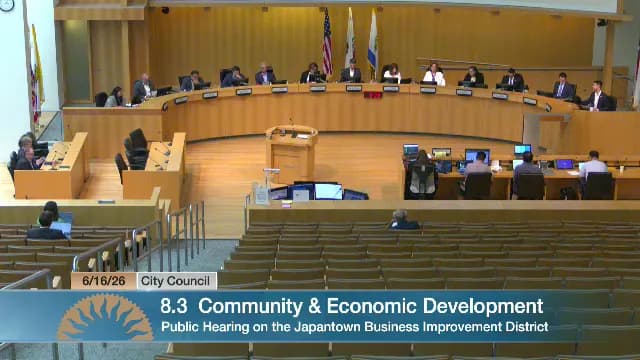
The San Jose City Council met on June 16, 2026, to approve labor agreements, oppose a statewide ballot measure that would retroactively lower the threshold for local tax increases, adopt business improvement district budgets, and fund interim housing sites. The meeting included ceremonial proclamations for Myositis Awareness Month, the San Jose Sports Authority's 35th anniversary, and Juneteenth. Ceremonial Items - Myositis Awareness Month: Councilmember Cohen recognized Myositis Awareness Month, noting the disease affects 50,000–75,000 people in the U.S., with 70% of patients being women. Patient advocate Shauna Nielsen spoke about her journey and the need for research funding. - San Jose Sports Authority 35th Anniversary: Vice Mayor Foley and Councilmember Mulcahy honored the Sports Authority for bringing major events (FIFA World Cup, Super Bowl 60, NCAA basketball) to San Jose. Executive Director John Poach accepted the commendation. - Juneteenth Proclamation: Councilmember Tordillos introduced LaVere Foster of the African American Community Services Agency, who accepted the proclamation recognizing Juneteenth celebrations. Consent Calendar - Item 2.7: Councilmember Campos pulled this item to register a no vote. The item was approved 10–1 (Campos dissenting). - Item 2.10 (Urban Catalyst Property Acquisition): Mayor Mahan and Councilmembers Ortiz and Mulcahy recused themselves due to campaign contributions. The council approved the acquisition of a South First Street parcel at a 60% discount from its 2019 purchase price, linked to an incentive for the Gifford Apartments project. Three public speakers (Kathy Sutherland, Rebecca Spitz, Richard Mason) opposed linking the two projects, citing concerns about community engagement and rushed approval. Eric Sullivan, Director of Housing, clarified the linkage does not limit community input. The motion passed 8–0 (3 recused). - The remainder of the consent calendar passed unanimously. Labor Agreements (Items 3.5–3.8) - City Manager Jennifer Maguire presented tentative three-year agreements (July 1, 2026–June 30, 2029) with three bargaining units: San Jose Police Dispatchers Association (SJPDA), Association of Building, Mechanical and Electrical Inspectors (ABMEI), and Association of Legal Professionals (ALP). Each agreement includes wage increases and enhancements to the city's AI policy. The council also approved comparable compensation changes for unrepresented employees (Unit 99, Units 81/82). - Public comment on Item 3.8: Chris (no affiliation stated) criticized the city's $5.5 billion budget and urged restraint in spending. Councilmember Duan requested delaying the unionization discussion for Unit 99 but was advised it is a separate matter. - All four items passed unanimously. Discussion Item: Opposition to Local Taxpayer Protection Act (Item 3.9) - The council debated a memo opposing a statewide ballot measure that would require a two-thirds vote for local special taxes and retroactively invalidate existing taxes. Public comment was split: opponents (Enrique Navarro, Elizabeth Briarly, and others) argued the measure enhances taxpayer power; supporters (Jordan, Lena from Open Space Authority) emphasized the retroactive harm. - Council discussion highlighted the potential loss of $98–$130 million annually from Measure E (real estate transfer tax) and the construction and conveyance tax. Budget Director Jim Shannon said losing Measure E would eliminate the interim housing program and homeless prevention funding. The motion to oppose the measure passed 9–2 (Councilmembers Dewan and Casey dissenting). Councilmember Casey argued for taxpayer protections; Councilmember Cohen and Vice Mayor Foley stressed the retroactive damage. Business Improvement Districts (Items 8.1–8.4) - The council held public hearings and unanimously approved annual budgets and assessments for the Alum Rock Santa Clara Street, Downtown, Japan Town, and Alameda Business Improvement Districts for FY 2026-2027. No written protests were received. Interim Housing Sites (Item 8.5) - Eric Sullivan, Director of Housing, presented the funding plan for 22 interim housing sites with approximately 2,200 beds and 2,500 individuals served. Key metrics: 900 pets, average occupancy 90%, overall turnover rate 40%. The plan includes $69 million in services contracts and $79 million total all-in costs, funded by Measure E, HAF, general fund, and state sources. A transition of operator for the LifeMoves HomeKey site was also approved. - Public comment: Elmer Martinez Saballos of LifeMoves thanked the council and supported the investments. - Councilmember Campos noted the ongoing general fund exposure and asked about permanent housing exits. Sullivan clarified that transitions from safe parking and motels to interim housing are tracked separately from exits to permanent housing. The item passed unanimously. Open Forum - Jim Gray (Akron Way resident) complained about a motorhome illegally parked for months and a parking ticket for a minor curb infraction. He was referred to his council office. No other comments. Key Outcomes - Approved labor agreements with SJPDA, ABMEI, and ALP for FY 2026-2029, plus compensation changes for unrepresented employees. - Opposed the Local Taxpayer Protection Act (ballot measure) by a 9–2 vote, citing retroactive revenue loss of $98–$130 million annually. - Approved Urban Catalyst property acquisition (8–0) with an incentive for the Gifford Apartments project. - Approved FY 2026-2027 budgets and assessments for four business improvement districts. - Approved $69–$79 million in contracts for interim housing sites and operator transition for LifeMoves. - No changes to the printed agenda; closed session report noted evaluation continued to next Tuesday.
Public Meetings - San Jose, California
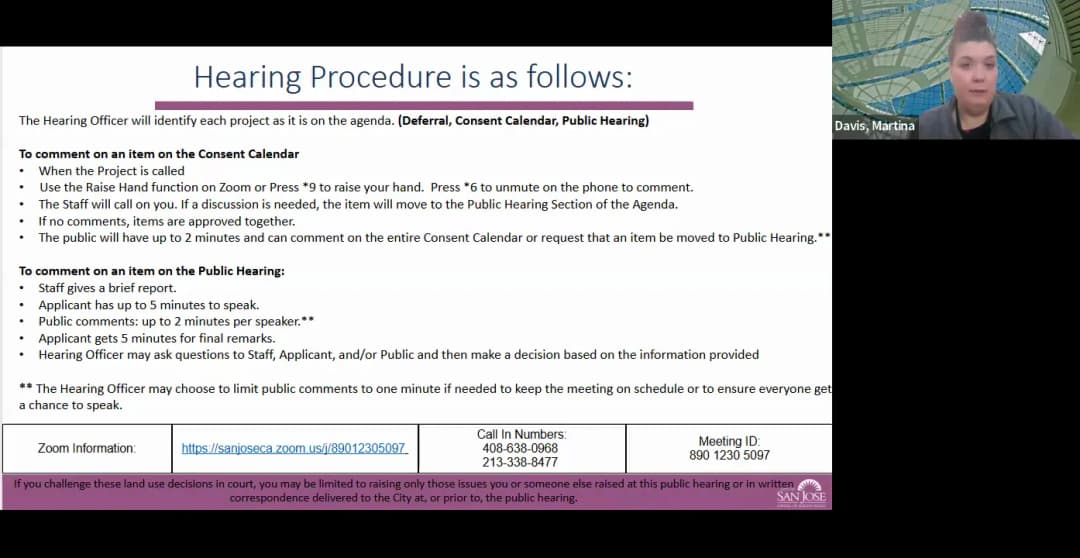
Public Meetings - San Jose, CaliforniaThe Planning Director Hearing, delegated by Director Christopher Burton, was called to order by Hearing Officer Martina Davis on June 15, 2026, via Zoom conference. The agenda consisted of two consent calendar items and no public hearing items. No members of the public requested to speak, and all permits were approved. Consent Calendar - Site Development Permit (H25003/ER2502) for a 968 square foot second-story addition to an existing 1,782 square foot duplex at 488 and 490 Dolma Drive, resulting in a 2,750 square foot duplex on a 0.14 gross acre lot. The project was found exempt from CEQA under Guidelines Section 15301 (existing facilities). Staff recommended approval; the hearing officer approved the permit and exemption. - Plan Development Permit (PD25005/ER25053) for construction of an approximately 1,117 square foot detached accessory structure (pergola) in the rear yard of an existing single-family home at 5735 La Seine Place on a 0.38 gross acre lot. The project was found exempt from CEQA under Guidelines Section 15303 (new construction or conversion of small structures). Staff recommended approval; the hearing officer approved the permit and exemption. Public Comments & Testimony - No members of the public expressed a desire to speak on any agenda item during the call for comments. Discussion Items - No items were deferred or moved from the consent calendar to the public hearing portion. The hearing proceeded with the consent calendar vote only. Key Outcomes - The consent calendar was approved in a single action, granting both permits and adopting the associated CEQA exemptions. The hearing officer noted that the planning director’s actions are final unless appealed per Title 20 and Title 21 of the San José Municipal Code.
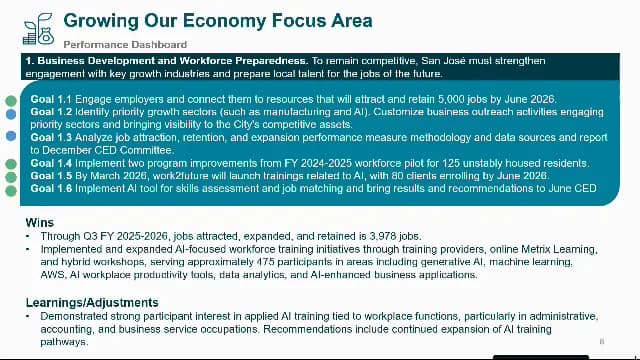
The Community and Economic Development Committee met on June 15, 2026, from 1:30 PM to 2:51 PM. The committee reviewed three major items: the Housing Department Loan Portfolio Audit Report, the Building More Housing Focus Area Status Report, and the Growing Our Economy Focus Area Status Report. All reports were accepted unanimously without public comment. Housing Loan Portfolio Audit Report City Auditor Joe Royce presented findings from an audit of the affordable multifamily housing loan portfolio, which totals over $745 million across roughly 220 properties and nearly 25,000 units. Key findings included that the asset management team had not completed all annual reviews or inspections in recent years due to vacancies, unclear expectations, and insufficient software tools. A limited sample of 878 units across 10 properties revealed that 110 units (13%) had tenants with incomes above the cap for their unit type, and 48 units (5%) had tenants earning 140% or more of the income cap. The audit recommended developing a strategic plan, strengthening software, updating procedures, and establishing a risk rating system for compliance. Housing Director Eric Sullivan accepted the findings, noting the department is now fully staffed and plans concurrent implementation of recommendations. Committee members discussed the city's limited enforcement position (not first position) and risks of distressed properties. The motion to accept the report and refer it to the August 18, 2026 City Council meeting passed unanimously. Building More Housing Focus Area Status Report Jared Ferguson (Principal Planner) and Eric Sullivan provided a Q3 2026 update on the Building More Housing focus area. Since the multifamily housing incentive program launched in December 2024, 2,216 units have moved from entitlement to construction. However, overall production still falls short of goals. Of 10 fiscal year goals, 7 are complete, 2 on track, and 1 off track. Off-track goals include expanding ministerial approval into downtown due to added work from state legislation. Completed milestones include analysis of development services timeliness, updated fee estimator, environmental standard permit conditions, and analysis of AB 130/131 streamlining. Next steps include the 2026-2027 focus area work plan, a fall annual report, and a December 2026 status update. The committee accepted the report without referral. Growing Our Economy Focus Area Status Report Director Jen Baker, Erica Graffo, and Deputy Director Bloggy Lollege presented the Q3 update. Highlights included 3,978 jobs attracted/retained, 342 AI workshop participants, and 289 AI course completions. Placements occurred at major firms like Google, Apple, and Amazon. Infrastructure progress: two of three PG&E energization projects completed; the Stack Data Center delayed to August. LS Power permits issued early. Downtown saw six new ground-floor businesses, including Poppy & Claro and West Coast Community Bank, and beautification projects like the former Greyhound bus station. Three new Business Improvement Districts (BIDs) formed (Alum Rock, Alameda, Story Road), with a fourth (East Village) in process. Small business startup grants: 450 lottery entrants, 30 selected. Sports and entertainment events: 622 event days (128% of goal), 1.95 million attendees. Entertainment zone policies were activated for Super Bowl and World Cup. Committee discussion focused on BID support, streamlining restaurant permitting with the county health department, and capturing institutional knowledge from major events. The report was accepted unanimously. Key Outcomes - Motion 1: Accepted the Housing Loan Portfolio Audit Report and referred it to the August 18, 2026 City Council meeting (passed unanimously). - Motion 2: Accepted the Building More Housing Focus Area Status Report (passed unanimously). - Motion 3: Accepted the Growing Our Economy Focus Area Status Report (passed unanimously). - No public comments were received on any agenda item.
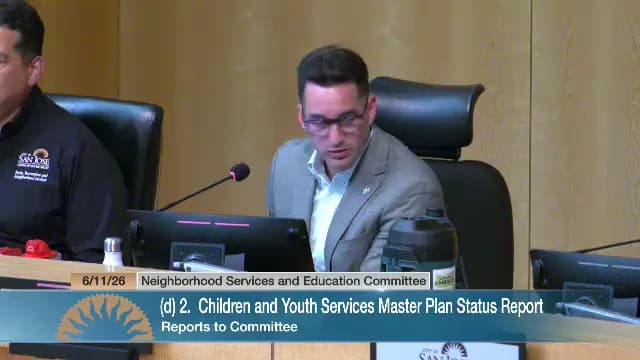
On June 11, 2026, the San Jose Neighborhood Services and Education Committee (NSE) convened with Vice Chair Duan presiding (Chair Ortiz absent) and Councilmembers Casey and Couples present, forming a quorum. The committee received updates from the Youth Commission, the Children and Youth Services Master Plan, the "Cleaning Up Our Neighborhoods" focus area, and the "Reducing Unsheltered Homelessness" focus area. All reports were accepted unanimously. Youth Commission Annual Work Plan Report (2025-2026) - Commissioners Naya Pradeep Kumar (District 2, Vice Chair), Anushka Deshmuk (District 1), and another commissioner from District 10 presented the Youth Commission's annual report. Key highlights: - The commission represents approximately 248,000 youth in San Jose. - A survey of 653 youth found that only 6.6% strongly agreed that city government reflects youth priorities, while 26.5% somewhat agreed; strong disagreement declined to 3.8% from 6.4% in 2023-2024. - Top issue priorities (scale 1-5): Violence and safety (4.3), housing affordability (4.29, introduced this year), meaningful jobs (4.12). Mental health declined. - Youth career aspirations: healthcare/medical (28%), STEM/tech (21%), creative/arts (11%), undecided (11%). - Academic performance was both the top area where youth excel (37%) and struggle (26%); only 3% said they excel in mental health/well-being while 13% struggle. - Commissioners and YAC members volunteered 740 service hours; YAC applications increased 17.2% to 275; 90%+ rated program satisfaction 4 or 5 out of 5. - Commissioners suggested improvements: council members attend YAC meetings regularly, and simplify the commission application form (currently using a general commission form with questions about property ownership and taxes). - Councilmember Campos moved to accept the report; vote was unanimous. Children and Youth Services Master Plan Status Report - Andrea Flores Shelton (Assistant Director, PRNS) reported that on June 9, 2026, the City Council adopted the Mayor's June Budget Message including MBA 14, which supports the Children and Youth Services Master Plan 2.0 strategy. The focus will be on three areas along the child development continuum: childcare access and kindergarten readiness, third-grade reading/chronic absenteeism, and A-G college readiness with workforce development. Staff will return to council in October 2026 with a logic model and metrics. - Councilmember Campos questioned how to connect youth with meaningful jobs, especially with Fortune 500 companies. Angel Rios (PRNS) noted partnerships with Applied Materials and a focus on building a pipeline from early education to college/career, emphasizing the class of 2040. He highlighted a partnership with San Jose State University to increase underrepresented students in STEM. - Councilmember Duan emphasized education as a tool against adversity. The report was accepted unanimously. City Council Focus Area: Cleaning Up Our Neighborhoods - Angel Rios presented on behalf of the focus area team, including Rachel Roberts (Code Enforcement), Dan North (Environmental Services), Anthony Kilmer (SJPD), Peter Hamilton, and Andrea Flores Shelton. - Key metrics: Resident perception of citywide cleanliness improved from 34% (two years ago) to 54% currently; neighborhood cleanliness perception rose from 66% to 77%. - Blight on private property (Code Enforcement): Launched the Chronic Offender Resolution and Enforcement (CORE) pilot program with 15 cases. Implemented revised escalated enforcement policy in September 2025, resulting in 30% more cases reaching citation stage, 11% more compliance orders, and 30% more appeals hearings. CodeX system replacement delayed; fine study completed with Guide House; recommendations for fine amendments planned for September 2026. Downtown vacant building working group expanded. - Graffiti: Graffiti volume decreased notably in 2024-2025. Lieutenant Kilmer reported that in Q3 2026, two temporarily assigned detectives investigated 14 cases, executed 60 search warrants, and made two arrests (one repeat offender). Effective May 9, 2026, detectives were reassigned, and the graffiti detail no longer has assigned detectives. - Illegal Dumping: Over 5,000 tons collected last fiscal year; tonnage increased. Enforcement: 112 cases referred to code enforcement, 18 warning letters, 16 citations. Fines escalate: $2,500 first violation, $5,000 second, $10,000 subsequent. One vehicle seizure warrant issued. Education: door hangers, school stewardship program at six schools. Multifamily junk pickup tonnage up 30% year-over-year. Beautify SJ optimization plan included in 2026-2027 budget. Abandoned shopping cart pilot collected 734 carts. - Councilmember Duan asked about evidence gathering; Rachel Roberts confirmed that video or mail in debris can lead to citations. Councilmember Candelles asked about camera deployment; Olympia Williams explained they use data and coordinate with council offices. The report was accepted unanimously. City Council Focus Area: Reducing Unsheltered Homelessness - Eric Solomon (Housing Director) presented, joined by Andrea Flores Shelton. He noted that the June 9 council vote tasked the administration with coming back in September 2026 for revisions to this focus area. - The shelter system now has 22 sites, 2,202 beds, serving over 2,500 individuals and 630 pets. The last site opened (Ceroni). The Taylor Street Navigation Center will be phased out. A standardized operations document ("Missions to Continue Occupancy Plan") will be rolled out by July 2026. Outreach is divided into quadrants with downtown initiatives. - No-return zones established along 26 miles of waterways and around interim housing sites. Funding relies on HAP (state), Measure E, and local sources; HAP funding remains uncertain. A CalAIM grant of $2.4 million (with $1.2 million city match) for three pilot sites is at risk due to federal decisions. - Lessons learned: shelter activation required coordination across six departments; need for standardization; improved data collection via HMIS and GIS geo-tagging. The department will release revised dashboards in July 2026. - Councilmember Duan questioned sustainability: the system is funded for three years assuming continued HAP, but without new funding, the city cannot expand. Councilmember Campos asked about upstream prevention and support for vulnerable populations, particularly youth homelessness and mentorship for individuals cycling through shelters. She suggested a small pilot with 15 known individuals who repeatedly return to homelessness. Eric Solomon confirmed they are actively working with 15 such individuals in downtown, collaborating with the DA's office, public defender, and county behavioral health, and plan to pilot new interventions by October 2026. - The report was accepted unanimously. Key Outcomes - All four reports were accepted unanimously by the committee. - The Youth Commission's suggestions (council member attendance at YAC meetings, simplified application form) will be considered. - The Children and Youth Services Master Plan 2.0 will return to council in October 2026 with a logic model. - The Cleaning Up Our Neighborhoods focus area will provide a final report in fall 2026 and return to this committee in December 2026. - The Reducing Unsheltered Homelessness focus area will return to council in September 2026 with proposed revisions.
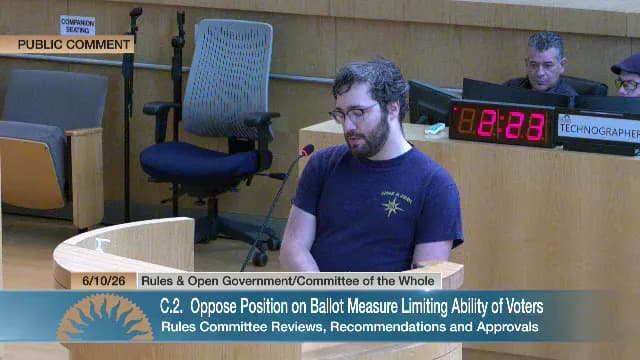
The Rules and Open Government Committee met on June 10, 2026, at 2:00 p.m. to review upcoming council agendas, approve consent items, and discuss two action items: the development of data center standards and a memo opposing a state ballot measure that would restrict local revenue-raising authority. The committee heard public testimony on multiple items and voted unanimously on all agenda items. Consent Calendar - Final review of the June 16 council agenda: Consent items spanned pages 5–21, with items 3.3 (budget actions) and 3.4 (appropriation ordinance) heard separately. Additional items included labor contracts (SJ PDA, ABMEI, ALP), compensation changes for Unit 99 and unrepresented employees, business improvement district public hearings (Alum Rock, Downtown, Japan Town, The Alameda), a grant agreement for multiple interim housing sites, and one land use consent item. No public comment. Motion carried 5-0. - Review of the June 23 council agenda (last meeting of the fiscal year): Consent items on pages 5–12. Discussion items included a ranked-choice voting ballot measure, large-format advertising signs at SJC, Willow Keys Corridor improvements, a long-term power purchase agreement with Shell Energy, an amendment to the City of Milpitas animal care services agreement, grant agreements for homelessness projects, and three land use consent items. No public comment. Motion carried 5-0. - Committee consent calendar: Seven items, including committee work plans. One public speaker (Jordan Moldale, District 3) requested that the semi-annual Vision Zero report be spaced evenly (every six months) and suggested creating a council focus area within Transportation and Environment (TNE) for Vision Zero and the environment, citing the link between transportation and cost of living. Motion carried 5-0. Public Comments & Testimony - Jordan Moldale (District 3) : Commented on committee work plans (Vision Zero report timing, council focus area). Also spoke on the data center standards item, supporting a letter from the Sierra Club and other groups, and questioned whether data center tax revenue compares favorably with alternative industrial uses. Called for an Environmental Impact Report (EIR). - Dasha Leeds (Sierra Club Loma Prieta Chapter) : Urged the city to pause in-progress data center proposals to allow time for the standards to be developed with robust community engagement, rather than creating standards in a vacuum that could lead to streamlining without adequate protections. - Marcus (Alviso) : Expressed concern about undocumented water and energy usage by data centers, supporting the proposed standards and asking for proper studies before projects proceed. Noted community concerns about lack of disclosure. - Public comment on ballot measure opposition: A speaker supported the committee's opposition but urged more proactive steps, such as authorizing the city attorney to engage in lawsuits or sign amicus briefs, and supporting ACA 13 (a related state measure). - Alina (Open Forum) : Requested a public study session on cumulative public health impacts of data centers on air quality, water, noise, and heat. Noted that the recently ground-broken Microsoft data center will have 224 natural gas generators in a district already exceeding EPA air quality standards, and cited over 2,200 signatures on a petition (ILoveSanJose.org) for such a study. Discussion Items - Data Center Standards Memo (Action Item 1) : The committee considered a staff analysis and direction to formalize data center standards. Deputy City Manager Manuel Pineda answered questions about the timeline (standards expected back to council by December 2026), environmental analysis per project (water use, generators, electricity), cumulative impacts, and outreach. Councilmember Kamei emphasized uniform standards for prevailing wage, skilled labor, and robust community outreach (multiple languages, not just mailers). Councilmember Duan asked about water system types (closed-loop, open-loop, recycled water) and ensuring public access to information. Staff confirmed they are creating a dedicated website page for large-load customers. The committee voted 5-0 to approve the memo, directing staff to proceed with standards development and enhanced outreach. - Opposition to State Ballot Measure (Action Item 2) : Councilmember Cohen explained the measure would make it very difficult for cities to raise local revenue and would invalidate previously passed measures, including Measure E (a significant budget hit). The committee voted 5-0 to adopt an official opposition position and to join the coalition led by the League of California Cities. A public commenter suggested also authorizing legal action, but the motion passed as presented. Key Outcomes - Consent calendar approvals: All three consent items (June 16 agenda, June 23 agenda, committee consent) passed unanimously (5-0 each). - Data center standards: Motion carried 5-0. Staff will develop formal standards with public engagement and return to council by December 2026. A centralized webpage for large-load customer projects will be created. - Ballot measure opposition: Motion carried 5-0. The city will officially oppose the measure and collaborate with the League of California Cities. - No further action: The committee did not schedule a public study session on data center health impacts as requested by Alina during open forum; the meeting adjourned at 2:26 p.m.
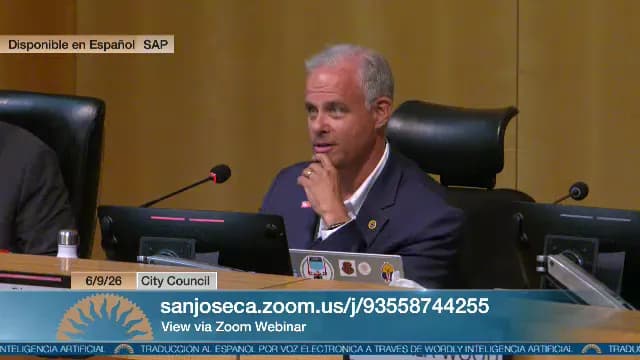
The San Jose City Council met on June 9, 2026, to adopt the June Budget Message for FY 2026-2027, approve the operating and capital budgets and fee schedule, and address several other items including ceremonial proclamations, a memorial, and discussions on wastewater security, FIFA World Cup preparations, and card room regulations. The meeting began at approximately 9:45 AM and included public comment on multiple items. The council unanimously approved the consent calendar, the wastewater security construction award, the budget message with the mayor's reconciliation memo, and the operating/capital budgets after amendments. Key votes were all unanimous. Ceremonial Items and Memorial - The meeting opened with the Pledge of Allegiance and an invocation by Leslie Osborne, co-founder of Bay FC and U.S. women's national team legend. She highlighted the economic impact of women's sports and San Jose's role as a World Cup host city. - Proclamations were presented: America's 250th Independence Day (July 4, 2026), Philippines Independence Day (June 12), and Portuguese Heritage Month (June). - The council adjourned the meeting in memory of Rod Diridon Sr., a former Santa Clara County supervisor and transportation visionary. His wife Gloria and son Rod Jr. spoke, emphasizing his role in building the region's "civic backbone." Consent Calendar - The consent calendar was approved unanimously with no items pulled. One speaker commented on an absence item (not on consent) and another on a housing subsidy reporting item. Public Comments & Testimony - On Consent Calendar: Lillian Koenig asked about the summary of "public subsidy reporting" in consent item 2.8, requesting policy analysis for senior affordability. - On Mayor's Budget Message: Ten speakers addressed the budget, the majority urging full $1 million funding for immigration legal defense services. Speakers included representatives from Somos Mayfair, Guiamigos de Guadalupe, CSO San Jose, and residents. They thanked councilmembers Campos, Ortiz, Candelas, Casey, and the mayor for supporting the full allocation. One speaker expressed concern about a proposed EEP (Enhanced Enforcement Program) team for unhoused people, arguing it would criminalize homelessness. Another supported the business tax modernization study. - On Item 3.4 (Card Room Regulation): Sean from Casino Matrix spoke in favor of the memo directing continued discussions on Title 16, arguing the division of gaming is duplicative of state regulation. He stated the division's enforcement is limited to regulatory matters like chip color and felt type, not criminal investigation. Discussion Items - Item 6.1 – Actions Related to 9885 Regional Wastewater Facilities Security: Councilmember Candelas summarized that the item upgrades security perimeter cameras and card readers at the regional wastewater facility. The TPAC committee recommended approval. The motion passed unanimously. - Item 3.1 – Report of the City Manager: City Manager Jennifer McGuire reported on FIFA World Cup preparations starting June 11, 2026. She highlighted the SJ 26 strategic plan, collaborations with multiple departments and partners, and citywide events including watch parties in every district. She thanked staff and council for their support. - Item 3.2 – Mayor's June Budget Message for FY 2026-2027: Mayor Mahan presented the budget, which closes a $50.3 million structural shortfall and addresses a projected $26.8 million shortfall next year. The budget preserves core services, library hours, and park maintenance. It includes a net reduction of 85 roles (mostly vacant). The mayor's reconciliation memo incorporated 67 of 78 council budget documents. Key elements: $1 million for immigration services (allocated through the county procurement process), funding for the California Room (one-year bridge), a study session on cost of living drivers (instead of a new focus area), a $50,000 grant to the San Jose Police Foundation, and direction to apply for a SAFER grant. Councilmembers debated affordability, business tax modernization, and the California Room. Councilmember Ortiz advocated for a new focus area on cost of living; the mayor recommended an analysis first. The vice mayor moved the mayor's memo. After discussion, the motion passed unanimously. - Item 3.4 – Approval of 2026-2027 Operating/Capital Budgets and Schedule of Fees and Charges: Councilmember Casey introduced a memo to direct continued conversations between the San Jose Police Department and card rooms on Title 16 regulations and fees. The city attorney noted that reducing local oversight could undermine arguments against state Attorney General regulations. Police Chief stated that last year's fee reductions and elimination of six regulations were significant and that the department prefers more time to evaluate impacts. Councilmember Cohen offered a friendly amendment to fold the analysis into next year's budget cycle (spring 2027) rather than fall 2026, which was accepted. The item and memo were then approved unanimously. (Note: The council initially voted only on the memo; Councilmember Kamei caught that the underlying item 3.4 still needed a vote, which was then taken and passed unanimously.) Key Outcomes - Consent Calendar: Approved unanimously. - Item 6.1 (Wastewater Security): Approved unanimously. - Item 3.2 (Mayor's Budget Message): Approved unanimously with the reconciliation memo. Key directives include: - Adoption of the June Budget Message. - One-time funding for the California Room (bridge to identify sustainable model). - $1 million for immigration legal services (allocated via county procurement, with a reserve strategy). - Direction to return in fall 2026 with an analysis of cost of living drivers (to inform future focus area updates). - $50,000 to San Jose Police Foundation for Major Award Summary. - Application for SAFER grant with conditions. - Item 3.4 (Operating/Capital Budgets and Fees): Approved unanimously with an amendment to bring forward analysis on card room fees and regulations as part of next year's budget process (spring 2027). The council directed ongoing discussions between staff and card rooms. - Open Forum: Two speakers addressed: one on senior affordable housing and sustainable communities grants, and another criticizing the mayor's characterization of homelessness reduction statistics.
This Planning Director hearing, presided over by Hearing Officer Sylvia Doe on behalf of Planning Director Christopher Burton, considered several routine permits and one major public hearing item: a 61-unit townhome development proposed under the state's Builder's Remedy provision of the Housing Accountability Act. The hearing took place via Zoom and concluded with the approval of all consent calendar items and the contested project. Consent Calendar - Item 3A (File H25-023): Site development permit on Doyle Road – approved. - Item 3B (File SF25-010): Single-family house permit on Co. Avenue – approved. - Item 3C (File SP25-022): Special use permit on North First Street – approved. Public Comments & Testimony - No members of the public spoke on any agenda item. Discussion Items - Item 4A – 1655 Berriessa Road (Block I, Facino District) – Site Development Permit (H24-017) and Vesting Tentative Map (T2407). - Staff project manager Jason Lee presented the application: a 61-unit townhome development on 2.21 gross acres, with 8 units reserved for low-income households (13% of total). The project qualifies for Builder's Remedy because a preliminary application (SB 330) was submitted on October 13, 2023, before the city’s housing element was certified as substantially compliant on January 29, 2024. The formal application was submitted March 28, 2024, and AB 1893 was invoked April 24, 2025. - The project proposes a density of approximately 28.9 dwelling units per acre, well below the maximum 80 du/acre allowed for Builder's Remedy projects. The site is zoned for transit employment center and CPPD planned development, which do not permit housing, but under the Housing Accountability Act, the city must treat the project as consistent with the general plan and zoning. - Staff reviewed the project against objective health and safety standards and found no specific adverse impacts. The project also seeks one concession and eight waivers under state density bonus law. - The environmental review used an addendum to the 2023 Berriessa Road Mixed-Use Development FEIR, concluding no new significant impacts. Comment letters from VTA opposed the loss of commercial space and requested higher density residential or retention of commercial; PGE had no utility conflicts; tribal nations provided recommendations already addressed in prior mitigation. - Applicant representative Eric Schaenauer expressed gratitude to staff, reserved time for questions (none posed), and made no substantive opening or closing remarks beyond thanks. Key Outcomes - Hearing Officer Sylvia Doe adopted the addendum to the 2023 Berriessa Road Mixed Use Development Final Environmental Impact Report and Addenda thereto under CEQA. - Approved Site Development Permit H24-017 and Vesting Tentative Map T2407 for the 61-unit townhome project. - The hearing officer stated that state law (HAA) limits the city’s authority to deny a qualifying Builder's Remedy project and that no specific adverse public health or safety impacts were identified, making approval mandatory. - The meeting adjourned at 9:21 a.m.
The San Jose City Council held a final public hearing on the proposed 2026-2027 operating and capital budgets, and the 2026-2027 proposed fees and charges. The meeting opened with Mayor Matt Mahan providing context: the city faces a $50.3 million structural shortfall for the current year and a projected $28 million structural shortfall next year, even after balancing this year's budget. The city also has a deferred maintenance and infrastructure backlog of $2.6 billion. The mayor noted that $5 million in ongoing savings had been identified in homelessness services and beautification, with an additional $20 million in ongoing savings in homelessness programs. He also highlighted that the June budget message allocates $1 million for immigration services ($500,000 immediately deployable, $500,000 reserved for a ramp-up in enforcement), and that Measure A (transient occupancy tax update) appeared to have passed, easing budget pressures. The hearing was limited to public comment; no council deliberation or vote occurred. Over 125 speaker cards were submitted, and each speaker was allotted one minute. The council will incorporate feedback into final deliberations and a vote scheduled for the following day. Public Comments & Testimony - City Peace Project supporters: Numerous youth, staff, and executive director Danny Sanchez spoke in strong support of the mayor's budget and requested continued funding for the City Peace Project, which provides mentorship and violence prevention in schools. Speakers shared personal stories of transformation, describing how the program helped them avoid violence, improve grades, and graduate. - Immigrant services advocates: Multiple speakers from Amigos de Guadalupe, community organizations, and rapid response network volunteers urged the council to allocate the full $1 million for immigration services immediately, rather than holding $500,000 in reserve. They argued that ICE enforcement is already happening daily, with detentions straining resources, and that waiting for a crisis would be harmful. Some speakers noted that Santa Clara County faces three times more detentions than neighboring counties. - California Room supporters: Many speakers, including historians, librarians, researchers, and community members, urged the council to maintain full public access to the California Room at the Dr. Martin Luther King, Jr. Library. They supported a memo by Councilmembers Kamei, Tordillos, and Cohen to provide one-time funding for continued open access, warning that an appointment-only model would reduce annual users from 5,000 to under 250. - Children and Youth Services Master Plan supporters: Representatives from Grail Family Services and child care providers asked the council to maintain $1 million in funding for the Mayfair, Poco Way, and Seven Trees/Santee pilot projects, which connect families with resources for child care, health, and economic mobility. - Older adult services advocates: Speakers from senior service organizations and individuals supported maintaining $300,000 for the Older Adult Health and Wellness Grant Program, which funds legal assistance, healthcare navigation, and social connection for seniors. - Fire Station 32 proponents: Speakers from District 7 urged the council to fully open Fire Station 32, noting that Station 26 is the 15th busiest in the U.S. and that Station 32 would become the busiest once operational. They argued that voter-approved Measure T funds were already invested and that the station would improve response times in underserved areas. - Business tax study opponents: Several business representatives, including from the Silicon Valley Leadership Group, San Jose Silicon Valley Chamber of Commerce, and small business owners, opposed funding a study (MBA 7) for a potential business tax increase, citing high existing costs and the risk of driving businesses away. - Critics of homeless outreach reductions: Some speakers expressed concern about proposed cuts to homeless outreach and the creation of an Enhanced Engagement Program (EEP) working with police, arguing it would criminalize homelessness rather than provide housing and services. - General budget supporters: Many residents expressed support for the mayor's budget message, praising progress on homelessness, public safety, blight reduction, and economic development, and urged the council to approve the budget as presented. Key Outcomes - No formal votes or decisions were made during the public hearing. The council will deliberate and vote on the final budget on June 9, 2026. - The council heard extensive public testimony on multiple priority areas: immigration services, youth programs, historic preservation (California Room), senior services, homelessness prevention, public safety (fire stations), business taxes, and park noise issues (pickleball courts at Cataldi Park). - The mayor and city clerk managed the hearing with a one-minute per speaker limit due to high turnout, and asked the audience to refrain from applause or disruption to expedite proceedings.
The Transportation and Environment Committee met on June 8, 2026, from 1:30 PM to 3:26 PM, chaired by Councilmember Cohen. The committee discussed three major reports: the Community Forest Management Plan and Urban Forestry Annual Report, the Vision Zero Traffic Safety Status Report, and the Move San José Annual Report. Public comments and a report from the Bicycle and Pedestrian Advisory Committee (BPAC) were also heard. Public Comments & Testimony - Tara (Our City Forest): Expressed support for the city's urban forestry goals, noting that Our City Forest (OCF) planted 1,765 trees this fiscal year (about 300 city-funded) and engaged 2,500 volunteers. Raised concerns about federal funding uncertainty due to cuts to AmeriCorps and urged continued partnership. - Jordan Moldow (District 3 Resident): Commended staff for managing the invasive shot hole borer infestation, noting many yellow (low-infestation) dots compared to red (removed) trees in his neighborhood. Highlighted the role of trees in active transportation and requested more street tree planting along bike corridors. - Jeff Englander (District 1 Resident, BPAC member, rehab physician): Thanked DOT for lowering the speed limit near Prospect High School and advocated for 20 mph limits around all schools and libraries. Emphasized that severe injuries are as important as fatalities. - Jordan Moldow (BPAC Chair): Presented BPAC's recommendations, including faster delivery of quick-build projects, holistic school safety treatments (daylighting, no-turn-on-red), lower school speed limits, trail underpass cleanup prioritized as a transportation issue, and permanent bike access on Ewart Road near the airport. Discussion Items 1. Community Forest Management Plan & Urban Forestry Annual Report Presented by John Ristow (Director of Transportation), Jennifer Sagan (Deputy Director), and Sarah Davis (City Forester). - Sustainability: Updated the approved street tree list to prioritize species that survive today and in future climates. Planted over 2,000 trees this fiscal year (city funding: 300 from Our City Forest, rest via contractors). Pruned over 4,000 street trees. Reduced the pruning cycle from 30 years to 11 years, aiming for 7 years. - Equity: Used a national Tree Equity Score to target planting in disadvantaged neighborhoods. A federal grant (Inflation Reduction Act Community Forest Investment Project) provides free trees and three years of watering in designated blue areas (goal: 2,800 new trees, plus pruning 5,000 existing trees). Workforce development partnerships with Our City Forest and San Jose Conservation Corps engaged 2,500 volunteers at 57 events. - Pest Management: The invasive shot hole borer fungus threatens one in five street and private property trees. Surveyed infestations (yellow dots) and removed heavily infested trees (red dots). Treated 90 trees as sentinel traps to limit spread. Progress is slower than in Southern California, allowing a measured response. - Councilmember Ortiz noted the May 2026 civil grand jury report questioning whether the 2,000-tree annual goal will meet the 20% canopy target by 2051. Director Ristow stated a formal response is due in August and that the goal came from the adopted plan. Ortiz also requested district-level canopy goals; staff agreed to provide census-tract targets. Staff discussed conversion rates for tree requests and barriers like cost of a garden hose. - Vice Mayor Foley requested a link for residents to request free trees and thanked staff for saving trees during a pavement project in her district. - Councilmember Cohen asked about the in-lieu fee reserve: 73% has been spent, with half returned to the district where fees were generated and half pooled for citywide use. Noted that tree mortality is accounted for (contractors replace until success). Asked about the goal to reduce the pruning cycle to 7 years: funded through general operating funds, with operational efficiency gains. On the borer, only street trees are treated; private trees are the owner's responsibility, and treating all 310,000 susceptible trees citywide is not feasible. 2. Vision Zero Traffic Safety Status Report Presented by Jim Bittner (Acting Division Manager), with Vice Mayor Foley reading the names of 23 individuals killed in traffic crashes since the last report. - Trends: Traffic fatalities peaked at 65 in 2022, declined to 41 in 2025 (37% decrease), the lowest since 2012. However, DUI-related fatalities rose to over 20% of all fatalities in 2025-2026. Speeding and red-light running contribute to about one-third of all KSI (killed or severely injured) crashes. - New Tools: Launched a new Vision Zero website (visionzerosj.org) with two interactive crash data dashboards (all crashes and KSI crashes). Created a dedicated email (visionzero@sanjoseca.gov). - Projects: Completed 470 Vision Zero projects this fiscal year, including a roundabout at Daniel Malan/Neiman and a traffic signal at Branham/King's Park. Quick-build safety improvements completed on Jackson, Meridian, Camden, Blossom Hill, and Tenth Street. 53 pedestrian safety and traffic calming projects completed. Before-and-after evaluations underway for five corridors. - School Safety: 38 school access and circulation studies done; 138 high-visibility school crosswalks installed this year (nearly 1,500 total). The Walk and Roll program held 57 safety education events and distributed 774 bike helmets. - Enforcement: Red-light camera pilot at four intersections issued 5,000 citations in the first four months. Speed safety camera pilot vendor selected; installation of 33 cameras expected by September 2026. - Grant Applications: Submitted five grants totaling $2 million; two Measure B bike/ped planning grants awarded. - BPAC Recommendations (Jordan Moldow): Urged faster quick-build delivery with public dashboards; holistic school safety treatments; reduced school speed limits; treating trail underpass cleanup as a transportation priority; supporting bike access on Ewart Road and around the airport. BPAC also supports a linear park with transit lanes on Santa Clara Street. - Discussion: Vice Mayor Foley asked about addressing impaired driving beyond infrastructure. Staff noted coordination with CHP and SJPD for increased DUI checkpoints and education. On school speed limits, staff explained that a 20 mph pilot 15 years ago showed minimal effect, and implementing citywide would be cumbersome (250 schools). Councilmember Campos asked about microtransit (see next item). 3. Move San José Annual Report Presented by Jessica Zank (Deputy Director), Ramses Madou (Division Manager), and Wilson Tam (Planning Manager). - Overview: The Move San José plan (adopted 2022) uses data-driven Key Performance Indicators to prioritize over 500 planned projects. A new Decision Support System (AI-powered) helps evaluate projects on a level playing field. - Environmental Progress: Transportation accounts for 50% of city emissions. Electric vehicle registrations are up 18% per year, with about 80,000 EVs registered. Vehicle miles traveled (VMT) is decreasing in the short term but increasing long term due to return-to-office policies. - Multimodal Access & Equity: Only 40% of jobs reachable by car within 30 minutes are also reachable by transit within 30 minutes. Transit signal priority saved up to 3 minutes (20% improvement) on frequent routes. One-third of all trips in San Jose are under 2 miles, presenting opportunities for walking, biking, and micromobility. Bike share will expand with 32 new stations, mostly in East San Jose, starting late 2026. - Councilmember Ortiz asked about e-bike/e-scooter usage patterns. Staff noted current data limitations but expect better analysis as the system expands. - Councilmember Campos asked about microtransit. Staff announced the upcoming Palenda on-demand shuttle pilot, launching by end of 2026 in Districts 5 and 7 (funded by VTA's Measure B Innovative Transit grant). The service aims to provide last-mile connections. Staff emphasized the need for marketing and proving ridership to secure sustained funding. - Councilmember Cohen questioned why some areas have better transit/ car ratios (e.g., North San Jose showing darker blue) and suggested exploring shared parking to reduce parking requirements. Staff agreed and noted a future position to study such topics. - Public Comment (Jordan Moldow): Praised concrete protected bike lanes on 3rd/4th Street for encouraging new bike commuters. Urged state-level advocacy for speed limiters in cars. Noted that biking can be faster than driving when accounting for parking access time. Key Outcomes - Community Forest Management Plan: Accepted unanimously (5-0). Staff to provide formal response to civil grand jury report in August 2026. - Vision Zero Traffic Safety Status Report: Accepted unanimously (5-0). Item 4 of the agenda was postponed to the August 12, 2026 meeting. - Move San José Annual Report: Accepted (4-0, with one absent). The committee directed staff to continue developing the Palenda microtransit pilot and to explore improved transit connectivity and parking utilization. - Meeting Adjourned at 3:26 PM.
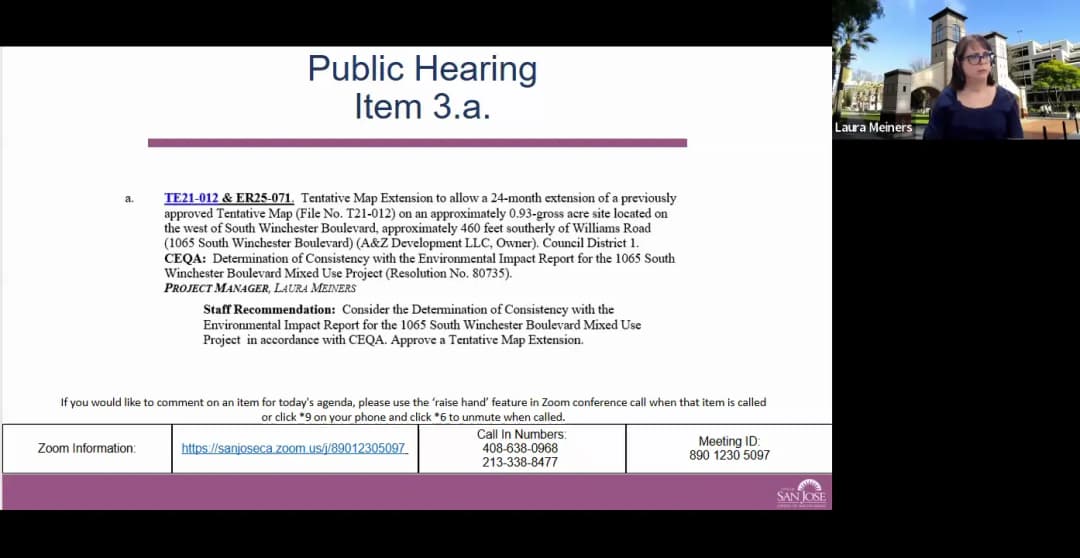
The Planning Director's Hearing convened on June 3, 2026, at approximately 9:00 AM via Zoom, presided over by Hearing Officer John 2. The sole agenda item was a 24-month extension of a previously approved tentative map for a mixed-use development at 1065 South Winchester Boulevard. A member of the public raised concerns about tree removals, leading to the item being moved from the consent calendar to a public hearing. The hearing officer approved the extension, noting the scope was limited to the map extension. Consent Calendar - Item 3A (File T21-012 and ER25-071): A 24-month extension of a previously approved tentative map for a 0.93-gross-acre site at 1065 South Winchester Boulevard. The original project included up to 70 residential condominiums, up to nine commercial condominiums, and one common area. Staff recommended approval, citing compliance with all applicable policies. A public comment prompted the hearing officer to move the item to the public hearing portion. Public Comments & Testimony - Lillian (District 3 resident): Commented on the removal of 30 ordinance-sized trees and 19 non-ordinance-sized trees (total 49 trees) as part of the underlying project (SP 21-006). She questioned how the removal conforms with CEQA and city climate adaptation goals, noting that replacement trees would take decades to mature. She requested a response from the applicant or staff. Discussion Items - Staff Response (Laura Miners, Planning Project Manager): Clarified that the current item is only a tentative map extension and does not revisit tree removal approvals, which were part of the previously approved Special Use Permit (SP 21-006). She stated that 106 replacement trees (15-gallon size) or 53 trees (24-inch box size) are required, and CEQA staff had determined no further environmental review was needed because tree removals with sufficient replacement do not cause significant impacts. - Hearing Officer's Remarks: Acknowledged the public's concerns about tree preservation vs. infill development. He noted that the original EIR disclosed tree removals and replacement ratios, and that the city's urban growth boundary encourages infill. He emphasized that the current action only concerns the map extension, not the tree removal itself. Key Outcomes - Vote/Decision: The hearing officer approved Item 3A (File T21-012) – the 24-month extension of the tentative map for 1065 South Winchester Boulevard. No formal tally was taken; the hearing officer stated the approval after closing public comment. - Meeting Adjournment: The hearing adjourned at 9:12 AM.