Browse by city
Date range
Search help

Search titles, summaries, topics and stored transcripts together. Keywords may match separately; put the whole query in double quotes for a phrase. Matching follows word analysis, so punctuation is not exact. Both dates are included. Documents are not searched.

SHOWING 71–80 ENTRIES
71
JUN 3, 2026 · SAN JOSE, CALIFORNIA · PLANNING COMMISSION
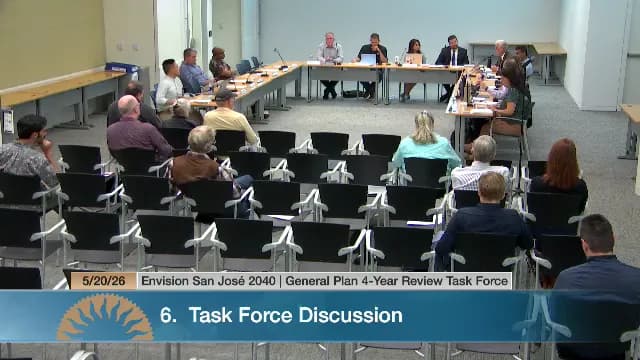
San Jose Planning Commission General Plan 4-Year Review Meeting – June 3, 2026

The Planning Commission, serving as the task force for the seventh of eight meetings of the 2025–2026 General Plan 4-Year Review, heard updates on outreach efforts, residential capacity analyses, and site-specific recommendations along the Winchester Boulevard and Alameda corridors, as well as a review of the Mixed-Use Commercial (MUC) designation. The meeting included extensive public testimony and commissioner discussion, with no formal votes taken; staff will incorporate feedback into recommendations for the final task force meeting on June 17 and the Planning Commission meeting on June 24. Public Comments & Testimony - Liana Allah (third-generation resident, Cory neighborhood) opposed large multi-story apartments on North Winchester, citing traffic, parking, and safety concerns. - Greg Carlson (Concerned Quarry Neighbors) questioned the compatibility of structures over four stories on Winchester and suggested a Willow Glen–style model with tree-lined streets, bike lanes, and controlled traffic. - Ken Hindleman (Cory neighborhood) argued that the Winchester corridor should not be singled out for urban residential density; he recommended Mixed-Use Neighborhood (MUN) zoning instead, citing state density bonus provisions that could further increase density and worsen congestion. - Rob Swerk (Principal Planner, VTA) reported that VTA owns about 20 TOD sites in San Jose, with potential for over 6,000 housing units (including 2,400 affordable). He highlighted recent groundbreaking and ribbon-cuttings at BART and light rail stations, and requested continued collaboration on Cerroni and Santa Teresa sites. - Benjamin White (resident whose parcel faces Winchester) opposed the proposed 85-foot height limit, concerned it could be exceeded through state bonuses; he also noted that increased density alone does not guarantee affordability. - Alison Cingalani (Director of Policy, SV@home) urged the task force to recommend expanding permitted uses on all PQP school lands citywide (except high fire risk areas), citing a 27% drop in public elementary school enrollment (nearly 18,000 students) over the past decade and the need for school districts to leverage land for affordable housing and community uses. - Kelly Arardi (Director of Entitlements, VCI) supported staff’s recommendation for Urban Residential (UR) with 85-foot height limits on parcels near Valley Fair, acknowledging the influence of SB 79 and the importance of local planning discretion. - Kevin Golden (Valley Fair resident for 50+ years) opposed the 85-foot buildings on Winchester, referencing past community opposition to the 826 North Winchester proposal and arguing such density harms existing neighborhoods. Discussion Items - Outreach Update (Ruth Cueto, Deputy Director of Planning): Staff conducted four in-person open houses in April–May 2026, using plain-language boards, mapping exhibits, and interactive activities. They worked with Winter Consulting and two CBOs (Vietnamese Volunteer Foundation, Los Amigos de Guadalupe) to engage underrepresented communities. An online platform received about 260 comments in multiple languages. Additionally, the Office of Racial and Social Equity held focus groups with the disability community and the San José for All advisory group. Presentations were made to the Youth Commission and neighborhood groups (Almaden Valley Community Association, District 6 Leadership Group, etc.). Staff also met with VTA to discuss TOD potential at Cerroni and Santa Teresa sites; the Cerroni site will be folded into the North San Jose Housing 2.0 work plan. - Residential Capacity Analysis – SB 79 Impact on Neighborhood Community Commercial (NCC) Sites (Sanhita Ghosha, Supervising Planner): Staff evaluated SB 79 (effective July 1, 2026) on 1,243 NCC parcels (745 acres) within ½ mile of transit stops. Using criteria from the 6-cycle Housing Element (parcel size, existing use, FAR ≤0.2), they narrowed to non-residential parcels of 0.5–2.0 acres (vacant, parking, underutilized). Potential unit yield: about 1,900–6,600 units at minimum density of 30 du/ac and medium density of 100 du/ac. For comparison, all non-residential NCC parcels in that size range could yield up to 18,800 units. Staff noted this is a theoretical estimate and actual production will vary. - Winchester Boulevard Corridor (Laura Moore, Planner): Staff conducted a site-by-site analysis of 20 NCC sites between Newhall and Forest Avenue. The corridor has very low commercial vacancy (0.6% over 10 years) but two long-vacant locations. Recommendations: change land use designations on five sites with existing residential to match density (Mixed-Use Neighborhood or Residential Neighborhood); for commercial/office sites between Forest and Fernwood (including 826 N. Winchester), change to Urban Residential with 85-foot max height (consistent with Valley Fair Urban Village Plan, which allows up to 85 ft, versus UR’s normal 135 ft). Public feedback showed mixed support, with emphasis on moderate density, preserving commercial space, and addressing traffic. - Alameda Corridor (Laura Moore): Analysis of 73 NCC sites between I-880 and Pershing Avenue. Buildings are mostly pre-1981, many historically designated. Office vacancy rates are low (6.6% last 5 years, 3.1% over 5–10 years) versus citywide 13.8% and 9.2%, respectively. Limited infill opportunities. Staff recommended increasing density at 1860 The Alameda (Rose Garden Inn) to Urban Residential, and designating only the parking lot portion of the YMCA site (1541 The Alameda) for Urban Residential. - Mixed-Use Commercial (MUC) Designation Analysis (David Fall, Planner): Citywide, 779 MUC parcels (218 acres), median size 6,000 sq ft. 56% of acreage is in designated growth areas. Staff categorized MUC parcels into three groups: within urban villages (41% of acreage), corridor-based sites outside urban villages (e.g., Keyes St., S. First St. – very low vacancy 0.27%), and dispersed isolated parcels (larger, median 0.78 acres). Key findings: MUC has not delivered mixed-use as intended due to small parcel sizes and state density bonus loopholes allowing waiver of commercial requirements. Staff recommended a site-by-site approach for considering redesignation to residential, prioritizing larger parcels, transit access, and underutilization while preserving viable commercial corridors. - Task Force Discussion: Commissioners generally supported staff’s analysis but expressed concerns about specific Winchester recommendations. - Commissioner Bandal proposed changing the six Winchester parcels recommended for UR to Mixed-Use Neighborhood (MUN) instead, arguing that preserving thriving commercial uses is important and that the UR designation could undermine community support. Staff noted that UR would yield 295 units, while MUN would yield 155 units. - Commissioner Oliverio questioned the feasibility of redeveloping rent-controlled sites and the cost implications of height increases. He also inquired about “by right” approvals for small businesses, which staff said is outside the current scope. - Commissioner Cao asked for a visual GIS tool to see parcels; staff said they would explore adding an SB 79 layer to an existing mapping tool. - Commissioner Young supported staff’s approach, emphasizing the critical need for housing capacity and warning that without change, affordability will worsen. He noted the task force’s role is advisory to the City Council. - Commissioner Casey found the staff recommendation reasonable given walkability to Valley Fair/Santana Row, though he acknowledged traffic concerns. - Commissioner Cantrell felt the community’s willingness to accept moderate density should be honored, and that MUN might be a compromise. - Commissioner Escobar remarked that the community had shown a willingness to compromise in the past and felt changing to UR was a “betrayal” of that trust. - Commissioner Nguyen shared her personal story of relying on rent control to stay in San Jose, underscoring the need for housing production. - Commissioner Oliverio also raised concerns about the city’s data center permits and the lack of housing for workers. - No formal motion was made; staff confirmed they will capture all comments and present refined recommendations at the June 17 task force meeting and the June 24 Planning Commission meeting, where a vote will occur. Key Outcomes - No votes were taken at this meeting. The task force will meet again on June 17, 2026, for further discussion, and the Planning Commission will hold a final meeting on June 24, 2026, to adopt recommendations to the City Council. - Staff direction: To consider commissioner comments, particularly the request by Commissioner Bandal to substitute Mixed-Use Neighborhood for Urban Residential on six Winchester parcels, and to prepare a final recommendation package. - Next steps: Staff will develop a GIS visualization of SB 79–impacted parcels, refine capacity numbers, and incorporate public feedback. The June 24 meeting will use a consent-calendar style for efficiency. - Pending items: Review of the online open house summary (260+ comments) and further work on PQP school lands, as urged by SV@home.

LAND USE 75% · AFFORDABLE HOUSING 12% · COMMUNITY ENGAGEMENT 6% · PROCEDURAL 2%
72
JUN 3, 2026 · SAN JOSE, CALIFORNIA · CITY COUNCIL
Rules and Open Government Committee Meeting - June 3, 2026

The meeting was called to order at 2:00 PM with members Candelas and Cohen present; Duan joined later; Foley absent. A quorum was established. The committee reviewed upcoming agendas, approved agenda modifications, and handled consent items. Consent Calendar - The committee unanimously approved two consent items (4-0). No public comment. Discussion Items - Review of Agenda for Tuesday, June 9, 2026: The committee discussed the upcoming full council meeting agenda, including a 9:30 AM closed session and 1:30 PM regular session. Consent items spanned pages 5–7. Notable items: section 3.3 (Mayor's June Budget Message) and section 3.4 (Approval of Operating Capital Budgets), and section 6.1 (Security System Upgrade for the Regional Wastewater Facility). A motion was made and seconded to move item 6.1 to be heard after consent and before budget discussions. The motion included an ad sheet for item 3.3, which required a sunshine waiver (the rules committee can approve the waiver). The motion carried 4-0. - Review of Agenda for Tuesday, June 16, 2026: The committee reviewed a second agenda with a 9:30 AM closed session and 1:30 PM regular session, plus recommended cancellation of the evening session. Consent items spanned pages 5–17. Items included: approval of budget action items (to be heard before consent), the annual appropriation ordinance (also before consent), terms and agreements with SJPDA, ABMEI, and ALP, compensation and benefit changes for unit 99 and other unrepresented employees, public hearings on the Alamrock/Santa Clara Street Business Improvement District, Downtown Business Improvement District, Japan Town Business District, and Alameda Business District, actions related to grant agreements for multiple interim housing sites, and one land use consent item. No public comment. The motion to adopt the agenda as presented carried 4-0. Key Outcomes - The committee approved the modified order of the June 9 agenda (moving item 6.1 after consent) and included the ad sheet for the budget message. - The committee approved the June 16 agenda as presented. - The consent calendar for the current meeting (June 3) was approved unanimously (4-0). - The meeting adjourned at 2:05 PM. No public comments were made during the meeting.

PROCEDURAL 100%
73
JUN 2, 2026 · SAN JOSE, CALIFORNIA · CITY COUNCIL
San Jose City Council Meeting – June 2, 2026: Budget, Rates, Remote Participation, and Community Proclamations

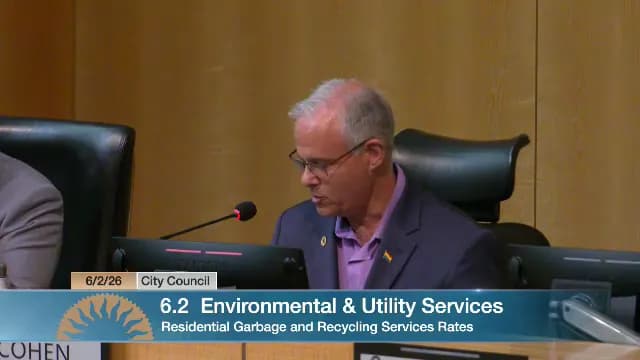
On June 2, 2026, the San Jose City Council convened at 1:30 p.m. for a regular meeting that included ceremonial proclamations, a consent calendar, public hearings on utility rate increases, and discussions on reinstating remote public participation. The meeting also featured updates on business improvement districts, affordable housing grants, and open forum comments. The council took several votes, with most items passing on split votes. Ceremonial Items - Jewish American Heritage Month (May): The council recognized May as Jewish American Heritage Month, accepting a proclamation from Julia Mates of the Jewish Community Relations Council (JCRC). The proclamation highlighted Jewish contributions and committed to combating rising anti-Semitism. - Pride Month (June): Vice Mayor Foley, Councilmember Tordillos, and Councilmember Cohen proclaimed June as Pride Month, marking the 25th year of the city’s celebration. Renee Johnson, Board President of the Rainbow Chamber of Commerce, accepted the proclamation and emphasized the economic impact of the LGBTQ+ community. - National Gun Violence Awareness Month (June): Councilmember Ortiz presented a proclamation to Nancy of New Hope for Youth, who spoke about gun violence prevention efforts, including workshops at Overfelt High School and one-on-one youth sessions on accountability. Consent Calendar - The council approved the consent calendar unanimously (motion passed with no dissenting votes). Notable items included: - A grant from the Barrier Host Committee for the World Cup matches, supporting police and fire departments. - Renewal of bids and investments in the 911 call center. Public Comments & Testimony - Consent Calendar: Brian Darby praised the improved agenda formatting and thanked staff. - Item 3.3 (Remote Participation): Two speakers: - Brian Darby supported the reinstatement but urged action against disruptive remote commenters. - Jordan Muldau (District 3) supported the memo but opposed the proposed default speaking time reduction to 60 seconds, suggesting 90 seconds or flexible time based on speaker volume. Also urged extending remote participation to all city bodies, including advisory committees. - Item 6.1 (Sewer Rates): Michael Thomas, a homeowner, argued the rate increase was illegal because no current cost-of-service study supported the rates. He noted a flagging 1970s–1990s underlying data and a missed Public Records Act deadline by the city. - Item 6.2 (Garbage & Recycling Rates): - Michael Thomas again stated no cost-of-service study existed and Prop 218 requirements had not been met. - Gloria Perez Fort (Christopher neighborhood) cited a 52% rate increase over six years (from $35.89 in FY19-20 to $54.51 in FY25-26), far exceeding her Social Security COLA of 2.8%. She argued council members had voted for all rate increases since 2015. - Item 8.1 (East Village BID): Anne Marie Lang expressed support, noting her family’s 50-year business history in San Jose and emphasizing the need for continued investment. - Item 8.2 (Tolly Road East Ridge BID): Christina Bowie (board chair) and a second speaker highlighted beautification, debris removal, and activation efforts despite limited resources, asking for continued support. - Item 8.3 (Monterey Corridor BID): Dave Luhan (Executive Secretary) reported on clean and safe initiatives, including three mobile security cameras, mural beautification, and RV/encampment abatement; expressed support for the mayor’s proposed budget. - Open Forum: - First speaker referenced a tsunami anecdote, criticizing “magic thinking” and urging reliance on data. - Jim Gray (Akron Way) complained about an illegally parked motorhome blocking a narrow street and inadequate signage. - Carmen Brammer (Global Majority Consulting, D8 constituent) criticized the council for not reaching out to the Black community after the Supreme Court’s April 29 ruling on the Voting Rights Act, expressing hurt and anger. Discussion Items - 3.3 Reinstating Remote Participation & Amendments to Council Policy 0-37: - Councilmember Candelas (lead author) explained the urgency due to SB 707 (mandating remote participation by July 1, 2026), moving it up to allow remote comments during the upcoming budget hearings. The memo also proposed reducing default speaking time to 60 seconds, a measure that drew opposition from public commenter Jordan Muldau. - Vice Mayor Foley supported the memo but raised safety concerns about hate speech, asking about advisory committees. City Clerk staff noted Policy 0-04 (boards and commissions) would be updated in August/September with optional remote participation provisions. Foley requested outreach to the Bicycle Pedestrian Advisory Committee. - The council voted unanimously to approve the memo. - 5.1 Affordable Housing Grant (Round 9 AHSC): - Councilmember Campos moved to accept $14 million in grant funding (including $6 million to the city) for affordable housing improvements. He stressed the need for continued city investment and looked forward to using Measure E revenue for permanent housing. Motion passed unanimously. - 6.1 Sewer Service & Use Charge Rates: - City Clerk reported 1,633 valid written protests (plus one speaker) – less than 1% of customers – allowing council to proceed. - After public comment, Councilmember Kamei moved to approve. Motion passed 9-2, with Ortiz and Casey voting no. - 6.2 Residential Garbage & Recycling Rates (Single-Family and Multifamily): - City Clerk reported 1,333 written protests plus three speakers – less than 1% of customers. - Staff (Judy Erlinson, deputy director) explained that 90% of rates are driven by contractor costs tied to a modified CPI (labor, fuel). Free junk pickup adds $12 million (5% of $207 million total). Recycling contamination decreased to 41% but only partly offsets costs. - Councilmember Duan opposed, arguing a 7% increase exceeds residents’ cost-of-living and asking why neighboring cities (e.g., Palo Alto) have lower single-family rates. Staff responded that San Jose offers “cutting-edge” services like unlimited junk pickup, and multifamily rates are low compared to peers. - Councilmember Cohen noted the council has limited discretion due to long-term contracts. If rates were not increased, the city could be out of compliance or have to absorb costs from fund balance, which has been depleted. - Mayor Mahan raised the possibility of long-term policy work on cost efficiency. - Motion to approve passed 8-3, with Ortiz, Duan, and Casey voting no. - 6.3 Municipal Water System Rates: - City Clerk reported 202 written protests – less than 1% of customers. No recycled water protests. - Motion to approve passed 7-4, with Ortiz, Duan, Candelas, and Casey voting no. - 6.4 Water Shortage Contingency Plan and Urban Water Management Plan (2025): - Combined public hearings, no opposition. Motion to approve passed unanimously. - 8.1 Establishment of East Village Business Improvement District: - No written protests. After public comment (Anne Marie Lang in support), Councilmember Tordillos moved approval. Unanimous. - 8.2 Tolly Road East Ridge BID Annual Budget and Levy: - No written protests. Motion passed unanimously. - 8.3 Monterey Corridor BID Annual Budget and Levy: - No written protests. Motion passed unanimously. - Successor Agency to the Redevelopment Agency – Administrative Budget & ROPS (FY26-27): - No public comment. Motion passed unanimously. Key Outcomes - Votes recorded: - 6.1 Sewer rates: Approved 9-2 (Ortiz, Casey no). - 6.2 Garbage rates: Approved 8-3 (Ortiz, Duan, Casey no). - 6.3 Water rates: Approved 7-4 (Ortiz, Duan, Candelas, Casey no). - All other items passed unanimously. - Policy: Remote participation reinstated for public comments (effective before budget hearings); speaking time default reduced to 60 seconds, with staff to report back on advisory committee remote options by August/September via Policy 0-04 updates. - Referral: Mayor Mahan suggested long-term policy work on garbage rate cost efficiency and equity, inviting colleagues to collaborate with staff. - Next steps: Budget hearings next Monday (June 8, 2026) will include remote participation.

MUNICIPAL FINANCE 28% · PROCEDURAL 16% · MISCELLANEOUS 14% · COMMUNITY ENGAGEMENT 11%
74
MAY 27, 2026 · SAN JOSE, CALIFORNIA · PLANNING COMMISSION
San Jose Historic Landmark Commission Meeting - May 27, 2026

The meeting covered two major agenda items: a request to rescind the city landmark designation for the Southern Pacific Switching Tower at 725 Chestnut Street (destroyed by fire and removed), and an application for landmark designation and a Mills Act contract for 647 South 6th Street, a Neoclassical Revival house designed by Wolf and Mackenzie. Commissioners also heard public comments about the proposed closure of the California Room at the San Jose Public Library and updates on historic preservation month events. Public Comments & Testimony - Sally Zarnowitz (Preservation Action Council of San Jose) announced historic preservation month activities, including a proclamation at City Council on May 12, 2026, the release of the Endangered Eight list, and a members-only opening at the warehouse on May 28, 2026. She also noted state legislation (SB 79 and the proposed California Affordable Act) that could affect historic properties. - Edward Salm (Chair, Chef and Hansa Park Neighborhood Association; PACSJ advocacy committee) urged opposition to the proposed closure of the California Room to public access, citing a budget cut of $388,159 (2.9 FTE) and 5,442 visits in 2025. He argued that only 10–12% of archives are digitized and closure would severely limit access to city history, especially for research on historic properties. Discussion Items - HL26001 – Rescission of Landmark Designation for 725 Chestnut Street: The applicant, Union Pacific Railroad (represented by Sherry Jackman), presented history of the Southern Pacific Switching Tower, which was designated in 1993, donated to Santa Clara County for preservation, but suffered vandalism and arson, was badly burned in 1995, and ultimately removed for public safety. The site is now contaminated with chlorinated solvents and subject to a voluntary cleanup agreement. Because the structure no longer exists, the site cannot meet any of the eight landmark criteria. A similar preserved tower (Santa Clara Tower) exists elsewhere. Commissioners voted unanimously to rescind the designation. - HL25001 / MA2501 – Landmark Designation and Mills Act Contract for 647 South 6th Street: Staff recommended designation based on five criteria (architectural style, association with Wolf and Mackenzie, integrity). Owner William Wang expressed commitment to preservation and described foundation replacement and interior systems upgrades. Commissioners discussed the 10-year work plan, particularly the front porch tiling which Commissioner Cohen found inappropriate. After debate, the commission amended the motion to require removal of tile cladding on the porch sides and replacement with wood, while retaining the tile on the floor. The plaque requirement was swapped for concrete step repairs. The motion passed with all present voting yes. Key Outcomes - Rescission of landmark for 725 Chestnut Street: Motion to adopt resolution rescinding the city landmark designation passed unanimously (5 ayes: Vice Chair Gondright, Commissioners Bainlaw, Caluso, Cohen, Kagura; Chair Royer and Commissioner Arnold absent). - Landmark designation and Mills Act contract for 647 South 6th Street: Motion to recommend to City Council approval of the landmark designation and Mills Act contract, with amendments to the 10-year work plan (remove tile cladding on porch sides, replace with wood; remove plaque item and add repair of concrete front steps) passed unanimously. - Future meetings: The next regular meeting scheduled for June 3, 2026, was noted as cancelled. The Design Review Subcommittee will meet May 21, 2026. The commission also approved action minutes from the April 1, 2026 meeting.

HISTORIC PRESERVATION 87% · PROCEDURAL 5% · MUNICIPAL FINANCE 4% · CODE ENFORCEMENT 3%
75
MAY 27, 2026 · SAN JOSE, CALIFORNIA · PLANNING COMMISSION
Planning Commission Study Session on 2025 General Plan Annual Performance Review – May 27, 2026

The San José Planning Commission held a special study session on May 27, 2026, to receive the 2025 General Plan Annual Performance Review Report. The presentation covered progress under the Envision San José 2040 General Plan’s 12 major strategies, including land use, housing, transportation, sustainability, and fiscal health. No action was taken; the session was informational. Discussion Items - Staff Presentation: Supervising Planner Sanjita Kochan, planner Laura Maurer, and planner David Fong presented highlights from the report. Key data points included: - Community Planning: 34 community meetings held in FY 2024-25 (24 virtual, 8 in-person, 2 hybrid) with 1,002 attendees. Fewer meetings and attendance than pre-pandemic levels. - Growth Areas (Focus Growth): 79% of residential, 87% of commercial, and 91% of industrial building permits issued in designated growth areas since FY 2011-12. - Residential Permits: 525 multifamily units permitted in FY 2024-25 (lowest since adoption), but 1,659 multifamily units permitted in the first six months of FY 2025-26. 508 ADUs permitted (slight decrease). - Commercial/Industrial Permits: 1.2 million sq ft of commercial and 1.7 million sq ft of industrial permitted in FY 2024-25. Industrial near record levels; 93% in growth areas. - Urban Villages: 16 urban village plans adopted; none completed in FY 2024-25. Five Wounds and other plans in progress. 11,975 residential units and 9.5 million sq ft of commercial permitted in urban villages since adoption. - Downtown: Office vacancy rate decreased to 29% (from 31% prior year). 113 downtown events with over 2 million attendees. - Population & Jobs: Population 979,000 as of Dec 2025 (up 9,500 since 2011). 57,000 new jobs added since 2011. San José has the lowest jobs-per-resident ratio among surrounding cities (below 1.0). - Transportation: 7.4 miles of new on-street bikeways installed; 32.8 miles upgraded. Transit signal priority at 671 signals. East Ridge to BART connector under construction. - Sustainability: San José on track to meet 2050 climate goals but slightly behind 2030 carbon neutrality. Transportation accounts for 51% of GHG emissions, buildings 29%. - Parks & Trails: 5 new parks opened; 2 miles of new trails added. 79% of residents within a 10-minute walk of a park. 3.2 acres of recreational land per 1,000 residents (goal 3.5). - Safety & Vision Zero: 2025 Vision Zero Action Plan adopted targeting 30% reduction in fatalities by 2030. Speed safety cameras installed at 33 locations. - Four-Year Review: Third four-year review began summer 2025, focusing on residential capacity, missing middle housing, urban village process, and jobs ratio. Hearings expected end of 2027. - Commissioner Questions & Discussion: - Commissioners inquired about the gap between entitlements and building permits, the number of projects behind square-footage figures, and the impact of work-from-home on jobs data. Staff clarified that building permits reflect actual construction, while entitlements are approvals that may not proceed. Staff committed to providing additional data on project counts. - Discussion on remote work: Commissioners noted that work-from-home is not captured in traditional job counts (tied to business location). Director Chris Burton noted challenges in balancing housing and employment land preservation, and the need to adapt metrics for evolving work patterns. - Commissioners asked about specific projects (e.g., zero-emissions neighborhood pilot) and forward-looking projections. Staff outlined ongoing work to track entitlement expiration and improve development forecasting. Key Outcomes - No votes or formal actions were taken. The presentation was received as informational. - Staff agreed to follow up on several data requests, including the number of projects behind commercial/industrial permit figures and a map of the zero-emissions neighborhood pilot. - The next steps for the General Plan include the ongoing four-year review and a future Tri-Elements update (safety, open space, environmental justice).

LAND USE 49% · ECONOMIC DEVELOPMENT 19% · COMMUNITY ENGAGEMENT 12% · TRANSPORTATION SAFETY 7%
76
MAY 27, 2026 · SAN JOSE, CALIFORNIA · CITY COUNCIL
San José Rules Committee Meeting Summary - May 27, 2026

The Rules and Open Government Committee met on May 27, 2026, at 10:00 a.m. to review upcoming council meeting agendas and discuss two memos: ranked choice voting for council vacancies and uniform standards for data center development. The committee approved both agenda items and both discussion items unanimously (5-0). Consent Calendar - Agenda Review for June 2, 2026: The committee approved the agenda (including reinstatement of remote participation, public hearings on sidewalk liens, affordable housing grants, sewer and garbage rates, water management plans, and business improvement districts) with a 5-0 vote after public comment. No additional changes were made. - Agenda Review for June 9, 2026: The committee approved the consent agenda (covering the mayor’s budget message, approval of operating/capital budgets, fees and charges, and wastewater facility security) with a 5-0 vote. No public comment. - Consent Calendar Items: Two items were approved unanimously—including a donation-related item—after a public comment from Brian about donating computers to the library. Public Comments & Testimony - On the June 2 Agenda: A speaker thanked the committee for reinstating remote participation, noted the effort of advocacy, and apologized for harassment directed at Councilmember Cohen, urging accountability. - On Consent Items: Brian requested assistance donating several computers, noting difficulty reaching city offices. - On Ranked Choice Voting for Vacancies (C1): - Gabby Chavez Lopez (Latina Coalition of Silicon Valley) expressed strong support, citing cost savings (the D3 runoff alone cost $1.5 million) and increased voter choice for communities of color. - Tom Sharon (California Ranked Choice Voting Coalition) supported the measure, emphasizing that implementation costs are less than a single runoff and provide long-term savings. - Vicky Muller Alveira (South San Jose resident) supported the reform, arguing it gives voters more voice and increases engagement. - Jordan Muldell (District 3) supported but suggested the proposal should apply to all council elections, not just special elections, to reduce confusion. - On Data Center Uniform Standards (C2): - Brian urged strong guardrails, expressing concern about corporations replacing people. - Vanessa Tapia (South Bay Labor Council) supported standards that include strong labor standards (PLAs, SB 887) alongside environmental protections. - Dasha Leeds (Sierra Club Loma Prieta) expressed distrust due to lack of public transparency, citing 34 data center projects in the pipeline, absence of community engagement, and requested six specific safeguards (quantitative thresholds, public dashboard, suspension of new agreements, cumulative environmental review, stakeholder process). - Emmanuel (IBW Local 332) supported labor-friendly regulations and noted data centers can be built with air cooling to reduce water use. - Jordan Muldell supported the memo but called for a programmatic EIR to assess cumulative impacts of 30+ data centers. - Doug Block (Silicon Valley MEPS) supported the memo, noted San Jose was first U.S. city to require workforce agreements on data centers, and urged adoption of SB 887’s labor and community benefit language. - Alina (Santa Clara University) questioned the city’s water usage assumptions, noted lack of public data post-operation, and challenged the financial projections (Santa Clara: $750,000 per data center vs. San Jose’s projected $7 million). Also warned of property value loss. - Christopher Pop (IBEW 332) supported strong labor standards to ensure living wages and prevent a race to the bottom. Discussion Items - C1: Ranked Choice Voting for Council Vacancies - Chair Cohen introduced the memo (co-authored with Councilmembers Kamei, Kehi, and Tordillos) to place a charter amendment on the November ballot allowing the council to use ranked choice voting in special elections to fill vacancies. The current charter prohibits this option. - Vice Mayor Foley expressed support but raised concern about cost to place it on the ballot ($600,000); staff confirmed funding is already in the elections appropriation. Foley made a motion to approve; it was seconded. - Councilmember Kamei supported, noting past vacancies have been costly to both city and candidates. - Assistant City Attorney Kevin Fisher confirmed that if approved, the city attorney’s office would bring a draft resolution and charter measure to the full council by June 23. The deadline for November ballot is August 7. - The motion carried 5-0. - C2: Data Center Uniform Standards - Councilmember Candelas introduced the memo (co-authored with Chair Cohen, Mayor, and Councilmember Ortiz) seeking a workload analysis to develop uniform standards addressing environmental concerns (water, energy, air quality) and labor standards. - Chair Cohen noted the intent is to codify standards that are guardrails, not overly prescriptive, to allow for technological improvements. - Councilmember Kamei asked whether the standards would be council policy or administrative; staff clarified that either path requires similar work, and that the TNE committee has already begun discussions. Final standards would come back to council for review. - The committee approved the motion (5-0) to request a workload analysis and return to the committee in two weeks (likely June 10) to move forward to full council. Key Outcomes - C1 (Ranked Choice Voting): Approved 5-0. The item will go to the full council on June 23 with a draft resolution and charter amendment for the November ballot. - C2 (Data Center Standards): Approved 5-0. Staff will present a workload analysis at the next rules committee meeting (estimated two weeks), after which the item will advance to council for further discussion and adoption of standards. - The meeting adjourned at 2:45 p.m.

PROCEDURAL 58% · CLIMATE AND ENVIRONMENT 14% · LABOR STANDARDS 13% · TECHNOLOGY AND INNOVATION 10%
77
MAY 26, 2026 · SAN JOSE, CALIFORNIA · PLANNING COMMISSION
San José Director Hearing – May 26, 2026 (Planning Permits)

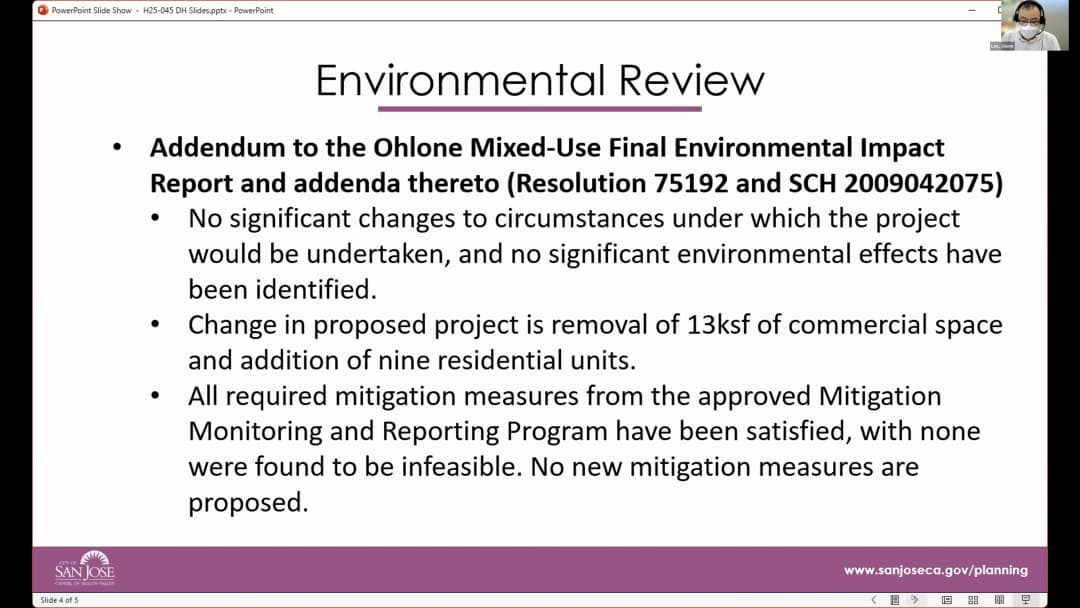
The Director's hearing was convened on May 26, 2026, via Zoom to consider planning permits and environmental determinations. The hearing officer (Christopher Burton) presided. The meeting included a consent calendar with three items and one public hearing item for a major affordable housing development. No deferrals were requested, and no public testimony was offered. Consent Calendar - Item 3A (PD25-034 / ER25-194): Planned development permit for paving, landscaping, removal of one ordinance-size palm tree, creation of 30 EV truck parking stalls, 10 train/truck storage stalls with chargers, a 3,200 sq ft maintenance building, and a 6,420 sq ft trash enclosure at 4553–4653 North First Street. Environmental review: addendum to the El Bizo Hotel Mitigated Negative Declaration. Approved. - Item 3B (SPC25-034 / ER25-194? Actually file H25034 and ER25202): Site development permit for three 7-foot vehicular gates and one 7-foot pedestrian gate, removal of one non‑ordinance-size tree at 5.35-acre site on Great Oaks Boulevard. CEQA exempt per Section 15301. Approved. - Item 3C (SPC26-008 / ER26-044): Special use permit for demolition of a metal canopy (previously demolished without permits) at 1851 South 7th Street. CEQA exempt per Section 15301. Approved. Public Comments & Testimony No members of the public requested to speak on any consent calendar or public hearing item. The hearing officer closed the public hearing after no hands were raised. Discussion Items Item 4A – 860 West San Carlos Street (H25045 / ER26016) Staff presented a site development permit for a 100% affordable, seven‑story, 272‑unit multifamily residential building. The project is located on an approximately 2.17‑acre site at the southwest corner of West San Carlos Street and Sunol Street. It includes the removal of 14 trees (9 ordinance‑size, 5 non‑ordinance‑size) and construction of a garage with two levels of parking accessed from the future Swenson Drive. The applicant seeks three state density bonus law concessions and two waivers: - Concession 1: Waive ground‑floor private open space/street access requirement for residential units facing a street. - Concession 2: Waive high‑quality material requirement on the ground floor facing West San Carlos Street. - Concession 3: Waive private open space requirement. - Waiver 1: Exceed floor area ratio cap in the Midtown Specific Plan. - Waiver 2: Waive street wall recess requirement. Additionally, two citywide design exceptions are requested for the building entrance location and garage entrance flare‑out. The project is 100% affordable: 55 units reserved for very low‑income households (≤50% AMI) and 217 units for low‑income households (≤80% AMI). Staff confirmed the project meets all applicable standards and that an addendum to the Olone Mixed Use Final Environmental Impact Report was prepared, finding no new significant impacts. A community meeting was held on March 30, 2026, with 15 attendees. The hearing officer approved the site development permit and the CEQA addendum. Key Outcomes - Consent Calendar Items (3A–3C): Approved in one motion; no public comment. - Public Hearing Item 4A: The site development permit for 860 West San Carlos Street (272 affordable units) was approved along with the CEQA addendum. The decision is final unless appealed per Title 20 of the Municipal Code. The meeting adjourned at 9:21 a.m.

AFFORDABLE HOUSING 65% · PROCEDURAL 20% · LAND USE 15%
78
MAY 20, 2026 · SAN JOSE, CALIFORNIA · PLANNING COMMISSION
General Plan Task Force Meeting on Missing Middle Housing – May 20, 2026

The sixth meeting of the General Plan Task Force for the 4-Year Review focused on the proposed missing middle housing policy, which would increase allowed density in residential neighborhood (RN) parcels from 8 to 32 units per acre. Staff presented outreach results, development standards, and a recommendation for a streamlined permitting process. Public comment was divided, and task force members debated density levels, parking, and the inclusion of public/quasi-public (PQP) sites. No formal vote was taken, but staff will incorporate feedback and present a policy framework to the Planning Commission on June 24 and to City Council on August 18. Public Comments & Testimony - Alison Cingalani (SV@Home): Expressed support for increasing residential capacity citywide and highlighted adaptive reuse opportunities on faith and public school sites (PQP), noting roughly 500 eligible sites. Urged the task force to consider general plan changes to allow housing on those sites. - Lori Droste (Spur): Supported staff’s missing middle framework but encouraged a bolder density (e.g., 70 du/acre as in Berkeley) and recommended flexibility on parking, setbacks, and FAR to avoid hindering development. - Sandra D. (public): Raised concerns that higher density may not improve affordability (citing a 2021 city study), could reduce homeownership and generational wealth, and would strain city services (police, fire). Also worried about deed restrictions not being discovered in ministerial approvals. - David Hindel (All District Leadership Group): Opposed citywide elimination of single-family zoning, arguing that SB 79 areas alone could meet state requirements. Warned that residents may be surprised by large, parkingless buildings on adjacent lots. - Robert Wood (SJSU Faculty Union Housing Committee): Endorsed the missing middle approach but argued it is insufficient without addressing growth areas that produce zero housing and the 100+ square miles where housing is illegal. Urged a comprehensive view. - Larry Ames: Appreciated that riparian, historic, flood, and fire zones would remain discretionary or ineligible. Noted that the report lacked mention of park infrastructure fees and called for collecting fees to maintain parks as density increases. - Greg Carlson (Concern Quarry Neighbors): Advocated for common-sense development approvals, especially along the Winchester corridor, and asked for consideration of neighborhood integrity for the westerly boundary of the Alameda. - Sarah Shahanian (developer): Praised the effort to simplify housing law but cited five-month delays for appeal hearings as a major cost burden. Requested faster timelines for frivolous appeals and support for ministerial permits to reduce holding costs. Discussion Items - Outreach Summary: Ruth reported that staff spoke with 832 residents through three open houses (April–May) and an ongoing virtual open house. Activities at events included trade-off exercises on height vs. parcel coverage and priorities such as affordability (32%), renter protection (27%), tree canopy (26%), and historic preservation (15%). Multilingual staff were present, and materials were available in Spanish, Chinese, and Vietnamese. - Missing Middle Housing Proposal (Cora McNaughton): Staff recommended increasing RN density to 32 du/acre, up from 8 du/acre, which would allow 2–6 primary units on 84% of RN parcels (3,000–8,000 sq ft). Theoretical capacity at 32 du/acre is 1.2 million units (vs. 557,000 under SB 9). The proposal includes ministerial permitting for most projects, a 35-foot/3-story height limit, flexible setbacks, FAR, and parcel coverage adjustments. Parking minimums were eliminated citywide in 2023; average parking provided in recent small multifamily projects is 1.6 spaces/unit. For historic properties, discretionary review or a historic report would be required. SB 79 exemption at 40 du/acre was discussed but staff favored 32 du/acre as a balance. - Density Debate: Commissioners expressed support for 32 du/acre as a reasonable starting point (Young, Barros, Bandal), while Commissioner Cantrell and Cow leaned toward 40 du/acre to maximize potential. Staff noted that actual built densities in recent projects averaged 18 du/acre, and that further economic modeling would be part of future implementation. - Parking: Commissioner Bandal proposed a hybrid approach (parking minimums in high-VMT areas, none in transit-rich zones), but state law preempts minimums within half-mile of high-quality transit. Commissioner Cantrell strongly opposed any return to parking minimums, arguing that parking consumes space that could be used for housing and that the city’s elimination of minimums should stand. - PQP Sites: Several task force members (Young, Oliverio, Cantrell) urged revisiting PQP sites for housing, but staff reiterated that their recommendation is not to include PQP in this cycle due to SB 79 and the complexity of evaluating land for institutional vs. residential use. A future meeting may address it. - Financial Feasibility: Commissioner Casey and others questioned whether the density increase alone would spur development, given capital gaps and utility connection costs. Staff acknowledged that the market will adapt over time, similar to the ADU ramp-up. Commissioner Cantrell suggested partnering with CDFIs or credit unions for loan products, and Commissioner Young called for collaboration with OED for economic modeling. Key Outcomes - Direction for Staff: The task force broadly supported the recommendation to increase RN density to 32 du/acre, with a strong preference for ministerial permitting to reduce delays and costs. Staff will incorporate feedback and present a policy framework to the Planning Commission on June 24, 2026, and to City Council on August 18, 2026. - Next Steps: The next task force meeting is June 3 (residential capacity), followed by June 17 (final meeting on urban village strategy and environmental review). The task force will vote on recommendations at the June 17 meeting. - No Formal Vote: No motions or votes were taken during this meeting. The discussion will inform staff’s final recommendations.

LAND USE 46% · AFFORDABLE HOUSING 31% · PROCEDURAL 7% · PARKING 6%
79
MAY 20, 2026 · SAN JOSE, CALIFORNIA · CITY COUNCIL
Rules and Open Government Committee Joint Meeting – May 20, 2026

The Rules and Open Government Committee held a brief joint meeting at 2:00 PM on May 20, 2026. The agenda included the cancellation of the May 26 meeting, approval of the June 2 draft agenda, consent calendar items, and deferral of a policy analysis. Public comment addressed meeting decorum and traffic safety. The meeting adjourned at 2:07 PM. Consent Calendar - The committee approved three consent calendar items without discussion or public comment. The motion passed unanimously. Public Comments & Testimony - Brian (member of the public) spoke during the agenda review about public meeting decorum. He requested that the committee reciprocate public engagement by documenting and responding to letters and phone calls, noting that the current decorum policy mentions the possibility of arrest without equivalent expectations for city responsiveness. He urged a balanced agreement between the public and the dais. - Brian spoke again during open forum. He first honored Memorial Day by reading about Medal of Honor recipients. He then raised traffic safety concerns, citing California road statistics: 3,800–4,500 fatalities per year, 200,000–250,000 injuries, and $6 billion in direct costs (with much higher total social costs). He noted that state and local governments control traffic safety policies and urged the committee to regularly ask what is being done to address dangerous driving, including red‑light running and unsafe conditions near bus stops. Discussion Items - Deferral of policy analysis on vacant commercial storefront activation tools (Item C): The committee voted unanimously to defer this item. No public comment was offered. Key Outcomes - Approval of May 26 meeting cancellation and June 2 draft agenda: The committee approved the proposed cancellation and the draft agenda for the next regular meeting. A member of the public (Brian) provided comment on decorum before the vote. - Consent calendar approval: Three items were approved without objection. - Deferral of policy analysis: The committee voted to defer the item on vacant storefront activation tools.

TRANSPORTATION SAFETY 52% · PROCEDURAL 48%
80
MAY 19, 2026 · SAN JOSE, CALIFORNIA · CITY COUNCIL
San Jose City Council Meeting May 19, 2026: Proclamations, Customer Experience, CEQA Streamlining

The San Jose City Council met on May 19, 2026, to consider ceremonial proclamations, a consent calendar, a city manager report, and several major discussion items. Key actions included adopting a customer experience transformation work plan, approving new clean energy programs, and streamlining environmental review processes. The meeting also featured public comment on a variety of topics. Ceremonial Items - World Neurofibromatosis Awareness Day: Proclaimed by Councilmember Casey. Summer, a constituent, shared her son Miles’ diagnosis with NF1 and called for awareness and research. - Older Americans Month: Proclaimed by Vice Mayor Foley (who humorously suggested “Vibrant Adults Month”). Maria de Leon from the Senior Citizens Commission accepted and promoted the annual Color Walk on June 5, 2026, at Lake Cunningham. - Affordable Housing Month: Proclaimed by Councilmember Campos. Regina Celestin Williams, Executive Director of SB at Home, spoke about the need for deeply affordable housing and a movement to end housing insecurity. - Adjournment in Memory of Tony Allen Santos: Tony Santos (1948-2026), a Vietnam War veteran and Alviso community leader, was honored. His brother, Valley Water Board Director Richard Santos, delivered an emotional tribute criticizing the city’s neglect of Alviso and calling for equal services. Consent Calendar - Item 2.9 – Seeds of Peace Monument: Councilmember Mulcahy recused himself due to a business relationship with donor Diane Brandenburg. Public comment was taken from Diane Brandenburg, Kimberly Mulcahy, and Matt Breaker (Rotary Club). The item approved unanimously. - Remaining Consent Items (including Item 2.16 – Youth Conservation Corps Grant): Mayor Mahan highlighted a $4.5 million state grant for the Resilience Corps, which will employ 38 youth in learning pathways and 52 in climate change work. The consent calendar passed unanimously. City Manager Report - Wildfire Awareness Month: Fire Chief Robert Sapien’s team conducted door-to-door outreach to nearly 7,000 homes in wildland-urban interface areas, distributed multilingual materials, and launched the Genesis Protect app. The campaign received a CAPIO award of distinction. The Fire Department was recognized with applause. Discussion Items - 3.3 – Citywide Customer Experience Transformation: Staff presented a multi-year plan to improve service delivery across 20+ departments using a shared technology platform, streamlined workflows, and performance metrics. Council discussed the need for better non-emergency reporting, community engagement, baseline metrics, and in-house capacity. A motion to accept the report passed unanimously. - 6.1 – San Jose Clean Energy Programs Roadmap: Staff recommended continuing 12 existing programs and adding two new ones: free technical assistance for commercial electrification (with a restaurant track) and a pilot for low/no-cost portable heat pumps for income-qualified renters. Councilmember Cohen moved adoption, noting the renter pilot’s importance. Passed unanimously (11-0). - 10.2 – Environmental Review Policy: Staff presented the Environmental Review Handbook and standard permit conditions to streamline CEQA/NEPA reviews, implementing 2022 audit recommendations. Councilmember Campos introduced a joint memo directing further work on thresholds and exemptions for common projects (e.g., construction noise, daycare operations). The motion, including staff’s supplemental memo, passed unanimously. Open Forum - Rick Rio: Urged the city to fence and designate the former Arco station at 510 East Santa Clara as abandoned, citing health and safety concerns ahead of the World Cup. - Elena Churchill: Requested help resolving a warrant issue and reclaiming commissary funds from the Santa Clara County jail. - Religious speaker: Delivered a message invoking scripture and calling for repentance from leaders. - Speaker on legal defense: Questioned the city’s use of public resources to defend a councilmember in a personal defamation lawsuit. - Van Lee and another speaker: Raised concerns about the unauthorized replacement of Little Saigon banners (removing the yellow flag) without community consultation, asking about funding and the status of previously donated banners. Key Outcomes - All three discussion items (Customer Experience, Clean Energy, Environmental Review) were approved unanimously. The CEQA streamlining motion included a directive to report back on further reforms at a future CED committee meeting. - The consent calendar, including the Seeds of Peace Monument donation, passed unanimously.

TECHNOLOGY AND INNOVATION 33% · CLIMATE AND ENVIRONMENT 23% · COMMUNITY ENGAGEMENT 15% · PROCEDURAL 11%
OPENPUBLICA · PUBLIC MEETING INDEXUPDATED DAILY · openpublica.com