Browse by city
Date range
Search help

Search titles, summaries, topics and stored transcripts together. Keywords may match separately; put the whole query in double quotes for a phrase. Matching follows word analysis, so punctuation is not exact. Both dates are included. Documents are not searched.

SHOWING 71–80 ENTRIES
71
MAR 16, 2026 · ALAMEDA, CALIFORNIA · CITY COUNCIL
Alameda Public Utilities Board Meeting - March 16, 2026

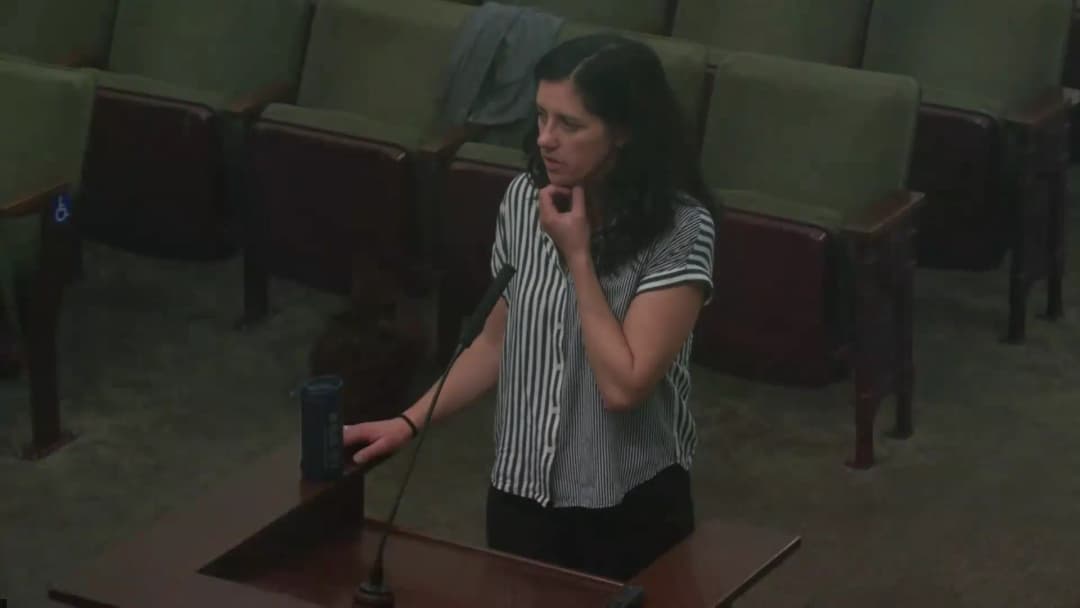
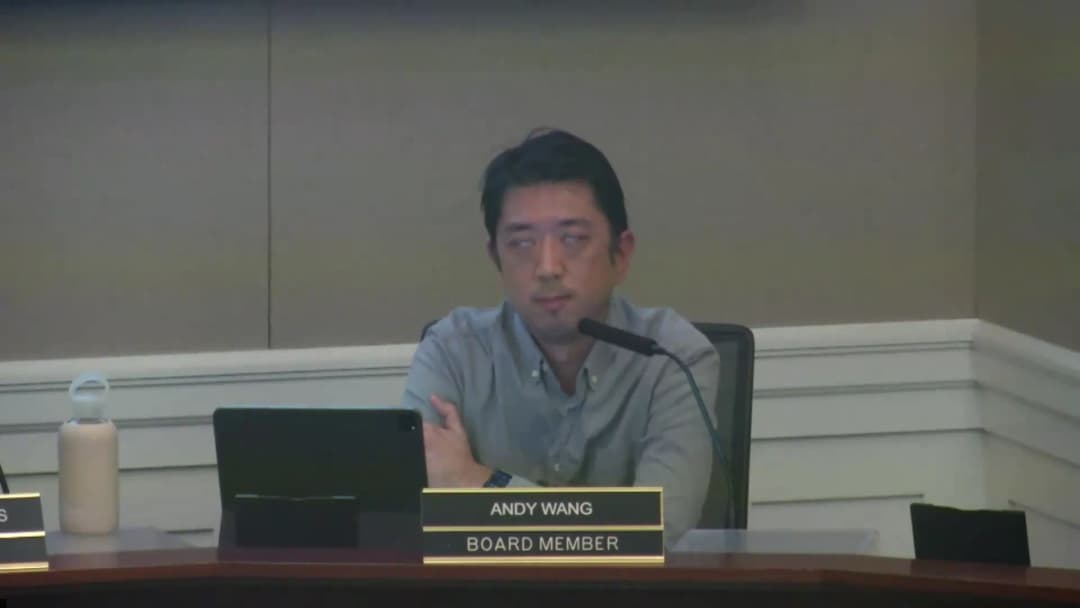
The Alameda Public Utilities Board (PUB) held its regular meeting on March 16, 2026 at 6:00 PM. The meeting included public comments, discussion and approval of a low-income program definition, a presentation of customer survey results for the strategic plan, a review of the 10-year financial pro forma, and approval of a new commercial heat pump pool heater rebate pilot program. The board also received updates on staffing vacancies and general manager communications. Consent Calendar - Approved the balance of the consent calendar (routine items) with one item removed. - Item 4E removed by Commissioner Hunter: "Approve Alameda Municipal Power’s Definition of Low Income for Programs Funded through Low Carbon Fuel Standard Credit Proceeds" – discussed separately and then approved. Public Comments & Testimony - Yung Chen (Alameda resident, solar/battery owner): Spoke on behalf of 11 residents who support reviewing AMP’s policy that prevents residential batteries from being charged from the grid. She requested the board evaluate a pilot program allowing limited grid charging with safeguards, citing potential peak demand reduction benefits (e.g., 0.8–1 MWh of peak reduction across 100 homes). She acknowledged concerns about rate equity and reliability. Not on the agenda, so board could not discuss. - Kevin Good (Sun’s Free Solar): Representing a local solar contractor, he urged AMP to allow UL-listed meter collars (automatic transfer switches) which most other California utilities permit. He noted that AMP’s 2022 review is outdated and that meter collars reduce installation costs by $4,500+ (part and labor). He submitted documentation. Not on agenda, no board discussion. Discussion Items 4E – Definition of Low Income for LCFS Programs - Staff (Jared Wanitas, Customer Resources Supervisor) presented a new localized low-income definition for equity programs funded by Low Carbon Fuel Standard (LCFS) credits, based on Alameda-specific demographics. - Commissioner Hunter asked clarifying questions: the definition applies to new EV charger rebates and multifamily technical assistance, but not the existing Energy Assistance Program (EAP). Staff explained that EAP uses public benefits funds with stricter eligibility. Hunter also inquired about including community gathering places and suggested consulting the CPUC’s Disadvantaged Communities Advisory Group for future refinement. - Motion to approve item 4E passed unanimously. 5A – Strategic Plan Revisit: Community Outreach Survey Results - Catherine from Great Blue Research presented qualitative and quantitative survey results from 700 customers and three focus groups. - Key findings: - Reliability and affordability are AMP’s top strengths (95% positive for reliability). - Customer priorities: 1 keeping rates affordable (41.8% as top priority), 2 upgrading aging infrastructure (18.2%), 3 maintaining reliability (12.4%). - 75% of customers support infrastructure investments even if rates increase; 39.2% prefer expanding clean energy over keeping costs low (nearly a tie). - Underrepresented groups (lower-income, renters) were included via focus groups; affordability was even more critical for them. - Opportunities: improve digital platforms (website/app), better communicate rate increase justifications, and educate on clean energy portfolio. - Commissioners DeVries and Hunter questioned the framing of a trade-off between affordability and clean energy, noting AMP already delivers both. They praised the outreach and suggested future focus on commercial customers. - No action required; information only. Staff will conduct additional stakeholder outreach before the strategic plan workshop in April. 5B – Summary of 10-Year Financial Pro Forma Analysis - Acting AGM Harbottle presented the financial forecast for FY27–FY36. - Key assumptions: 3% rate increases per year, drawing down operating reserves to the 145-day target, and capital spending of $22.7M in FY27 (half for system reliability/asset replacement, including substation transformer upgrades, undergrounding, and PGE fiber project). - Public comment from Javier Gonzalez (retired resident) asked about capital drivers. Assistant GM Lee responded in detail, noting system reliability, undergrounding, and long-lead procurement. - Commissioners commented: - Hunter: Pleased with 3% increases but suggested reviewing reserve targets (e.g., whether 145 days is appropriate). - DeVries: Appreciated the 10-year outlook and capital reserve. Advised buying a spare transformer and sequential replacement. - Chair McKenna: Raised concerns about snowpack (48% of normal) potentially increasing power costs; staff acknowledged but noted NCPA hydro is somewhat resilient. - No action; information only. 5C – Approval of Commercial Heat Pump Pool Heater Rebate Program - Staff (Jared Wanitas) proposed a pilot program offering rebates for commercial/multifamily (4+ units) electric heat pump pool heaters, replacing natural gas or in new construction. - Program details: - Budget: $400,000 per year for three years (total $1.2M). - Rebate calculation: Sum of three components: 15¢ per pound of CO2 displaced, 10¢ per gallon of pool water, plus 20% of incremental cost to electrify. Maximum rebate: $400,000 or 30% of project cost (whichever lower). - 48 existing commercial pools identified as potential participants. - Cannot stack with other AMP rebates for the same measure, but can combine with state/federal funding (subject to other program rules). - Commissioner DeVries asked about payback period (estimated 10–12 years). - Commissioner Hunter questioned rebate stacking and new construction vs retrofit equity; staff confirmed the three-component formula aims for fairness. She recommended adding a net-of-other-grants clause to prevent exceeding project costs. - Motion to approve passed unanimously. Key Outcomes - Approved item 4E (Low-Income Definition) – unanimous vote (4 yes). - Approved item 5C (Commercial Heat Pump Pool Heater Rebate Program) – unanimous vote. - No votes on items 5A and 5B (information only). - Staff will present the draft Strategic Plan at the April board meeting, along with the FY27 budget and rate proposal.
PUBLIC ENGAGEMENT 22% · TECHNOLOGY AND INNOVATION 20% · FISCAL SUSTAINABILITY 8% · PROCEDURAL 7%
72
MAR 12, 2026 · ALAMEDA, CALIFORNIA · CITY COUNCIL
Alameda Climate Action & Resiliency Plan Update & Commission Engagement Discussion - March 12, 2026

The Commission on Persons with Disabilities met on March 12, 2026, to receive the city's 2025 Climate Action and Resiliency Plan (CARP) annual report, discuss engagement with other city boards and commissions, plan community outreach activities, and receive updates on city accessibility initiatives. Key topics included greenhouse gas emissions progress, electric vehicle charging infrastructure, sea level rise adaptation, and a proposed "Alameda for All" sensory/cognitive accessibility framework. Consent Calendar - Minutes from the January 14, 2026 meeting were approved unanimously. Discussion Items - Climate Action and Resiliency Plan (CARP) 2025 Annual Report: Sustainability & Resilience Manager Danielle Miller presented the annual report. Key points: - City goals: 50% reduction in greenhouse gas emissions below 2005 levels by 2030; net-zero emissions by 2045. - 2022 inventory showed emissions reduced 29% since 2005; on track for 2030 target. - Over half of emissions come from cars; about one-third from natural gas in buildings. - AMP's 2020 transition to 100% clean electricity was a major driver of reductions. - Current metrics: 61 of 70 target miles of bikeway; 11% of registered vehicles are electric; average indoor water use at 43 gallons per person per day (target 42); natural gas consumption at 14.7 million therms. - 2025 accomplishments: first public curbside EV chargers deployed (Everett Commons), three new public chargers at Bohol Circle Immigrant Park, 55 e-bike and 47 used EV rebates through AMP, new heat pump replacement requirements for single-family homes, and adoption of a zero waste implementation plan. - 2026 plans: updating the GHG inventory for 2024, continuing public charger deployment, exploring cost-effectiveness studies for non-residential heat pump requirements, and advancing sea level rise adaptation planning (Bay Farm Island project received grant funding for 60% design; estuary project and South Shore Beach area projects still seeking funding). - A sea level rise planning fair held in September 2025 drew 150 attendees. - Commissioners asked about metric selection, comparison to other communities, EV charging costs (40 cents per kWh via the It's Electric company), partnerships with transit agencies, and food waste reduction programs. Miller noted the city is exploring nature-based adaptation solutions (e.g., levees with habitat and trails) and is working to meet state food waste diversion requirements under SB 1383. - Commission Engagement with Other City Boards and Commissions: Commissioners discussed a new standing agenda item to monitor other city bodies (Parks & Recreation, Transportation, Public Utilities, Social Services/Human Relations, Library Board, Planning Board, and others) for accessibility-related issues. They agreed to volunteer to track agendas/minutes and report back at the next meeting. Specific interests included Parks & Rec (beach access, bridge conditions), Public Utilities, Social Services, and the Library Board. No formal delegation was assigned; participation would be as residents. - Community Outreach Planning: Staff reported an email to ARPD about tabling at the Spring Shindig (April 18th) and discussions with the library for a Disability Pride Month event in July, possibly a screening of the film "Crip Camp" followed by a Q&A. Commissioners also discussed creating an interactive "Accessibility Community Wall" for community events and potentially tabling at the Home Electrification Fair (May 2nd, combined with the Alameda Bike Festival). - "Alameda for All" Framework: Commissioner Kenadler presented a draft framework for small-scale pilots to improve sensory, cognitive, and communication accessibility in public spaces (e.g., sensory kits at the library, communication boards at parks, quiet areas). The framework emphasizes inclusive design, predictable environments, clear communication, and flexible spaces. Commissioners expressed interest and agreed to follow up at a future meeting pending guidance from the city clerk's office on formal next steps. - Police Department Engagement: Commissioners discussed the relevance of police training on disability (autism, sensory overload, hearing impairments), the existence of a voluntary registry for families, and the possibility of a future presentation to the commission on these efforts. - Staff Communications: Staff reported on the Gibbons sidewalks and trees plan (117 liquid amber trees assessed along the corridor; 5 posted for removal; community meetings held), progress on digital accessibility compliance (April 24, 2026 deadline), and a new opportunity for commissioners to be featured in an ADA newsletter or on the Island Beats podcast to share lived experiences with disability and city accessibility initiatives. Key Outcomes - The CARP annual report was accepted as informational; it will be presented to City Council on March 17, 2026 for adoption. - Commissioners will monitor other city board/commission agendas and report back by the next meeting (May 13, 2026). - Staff will follow up on tabling opportunities at the Spring Shindig (April 18) and Home Electrification Fair (May 2). - The "Alameda for All" framework will be agendized for further discussion pending guidance from the city clerk. - The meeting was adjourned.

COMMUNITY ENGAGEMENT 23% · RENEWABLE ENERGY 17% · DISABILITY RIGHTS 15% · PARKS AND RECREATION 11%
73
MAR 12, 2026 · ALAMEDA, CALIFORNIA · CITY COUNCIL
Alameda Planning Board Meeting – March 12, 2026: Housing Element Annual Progress Report Review

The Alameda Planning Board met on March 12, 2026, to review the city’s 2025 annual progress report on the General Plan and Housing Element. The meeting included a consent calendar, public comments, and extensive board deliberation on housing production, pipeline projects, and potential policy adjustments to accelerate development. Consent Calendar - 4A – Draft Meeting Minutes (February 23, 2026): Approved with one abstention. - 4B – Del Monte Development Agreement Annual Report: Approved with one abstention. - 4C – Alameda Point Site A Development Agreement Update: Board member Hom asked about Block 11’s status; staff confirmed an economic force majeure extension applies to all of Site A. Approved after motion and second, no opposition. - 4D – Boat Works Development Agreement Annual Report: Approved with no opposition. Public Comments & Testimony - Reverend Sophia DeWitt (East Bay Housing Organizations, resident at 1580 Buena Vista Ave): Expressed appreciation for the city’s efforts but noted that permitted units remain far below RHNA goals, especially for low‑income households. Urged continued focus on housing for the lowest income residents. - Sean Murphy (Pacific Development, Alameda Marina): Highlighted the Foundry project (260‑unit apartment building) as the island’s only shovel‑ready project, noting that delays would harm housing production. Emphasized the project’s $10 million in impact fees and readiness to start construction in summer 2026. Discussion Items - Alameda 2040 General Plan & Housing Element Annual Progress Report (2025): - Staff presentation by Tristan Swear covered the report’s contents: RHNA cycle (2023‑2031), 22 housing programs, and 2025 permitting statistics. - Key data: In 2025, 65 building permits issued (down from 243 in 2024). ADUs accounted for 52 units; staff clarified that ABAG’s methodology assigns affordability breakdowns to ADUs (30% very low, 30% low, 30% moderate, 10% above moderate). - Staff explained the lag between applications, permits, and completions: 2024’s 243 permits resulted in 234 units finaled in 2025; 2025’s 65 permits reflect only 80 applications received in 2024. Applications in 2025 increased to 143, suggesting a potential uptick in future permits. - Board member questions and comments: - Board member Louise: Requested clarification that the North Housing project includes two manager units (total 109). Asked about the Mariner Square timeline; staff noted financing difficulties. Asked about South Shore, Foundry, and Block 11; staff confirmed no formal 2025 actions for those projects. Suggested tracking moderate‑income unit occupancy and adding a legend to tables. - Board member Hom: Questioned program 22 (mid‑cycle review) and asked about staff’s ongoing ordinance amendments (ADU condo conversion, short‑term rentals, inclusionary housing). Noted that the inclusionary housing ordinance is expected to return to the board in April. Requested clearer explanation of ADU affordability table. - Board member Wayne: Asked about short‑term rental ordinance timing; staff projected a study session later in 2026. Noted that the “R” in the permit table (rental) is a default for ADUs, not actual rental data. Called for more aggressive policy action beyond day‑to‑day streamlining. - Board member Sahaba: Asked why no SB 330 applications were received; staff cited economic conditions. Asked for early 2026 insights; staff expects continued slow pace but not a boom. - Board member Deweys: Recommended a nexus study or feasibility analysis of impact fees relative to neighboring cities. Suggested adding pipeline summaries to the report so council sees stalled projects. Supported the motion with requested edits. - Board members Wang and Hom advocated for temporary fee reductions, phased impact fees, and stronger city‑developer partnerships to finance projects. Key Outcomes - Motion to accept the annual progress report (with amendments: clarify manager units, add table legends, fix page numbers, and expand program 22 discussion to include potential housing‑facilitation measures). - Motion passed with majority approval (no opposition noted; two board members absent). - The corrected report will be presented to City Council on March 16, 2026 (the following Tuesday) and submitted to HCD by the April 1 deadline. - Staff will continue work on inclusionary housing (targeting April board workshop) and short‑term rental ordinance (study session later in 2026). - Board members expressed interest in exploring temporary fee waivers or reductions, similar to measures in San Jose, Oakland, and Redwood City, to spur stalled projects.

AFFORDABLE HOUSING 62% · HOUSING 14% · PUBLIC COMMENT 12% · PROCEDURAL 8%
74
MAR 9, 2026 · ALAMEDA, CALIFORNIA · CITY COUNCIL
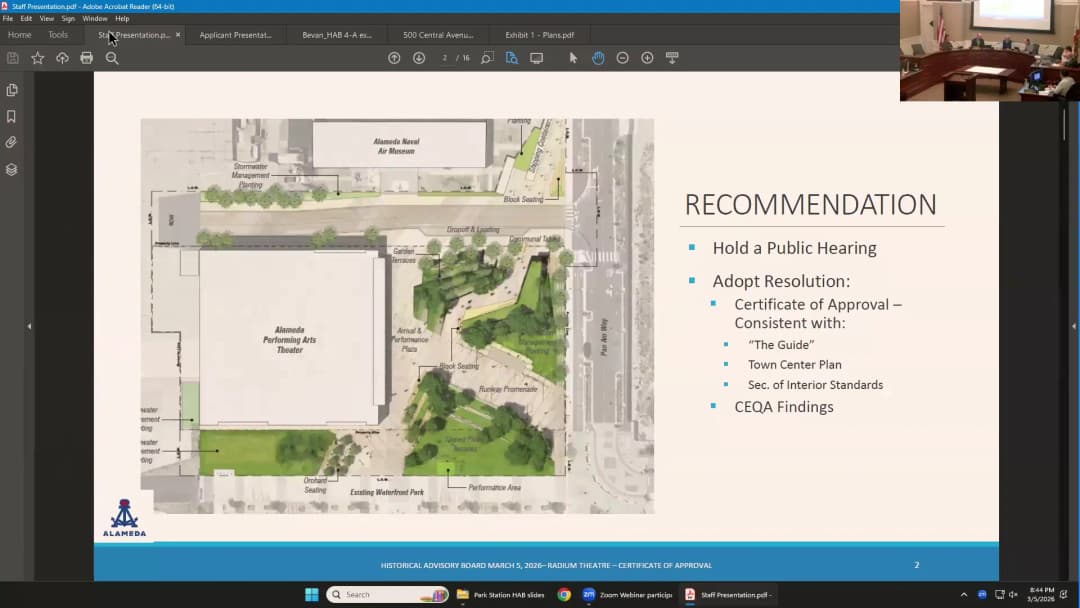
Historical Advisory Board Meeting, March 5, 2026: Radium Theater, Adaptive Reuse Presentations

The Alameda Historical Advisory Board (HAB) held a meeting on March 5, 2026, to consider a Certificate of Approval for the Radium Theater Performing Arts Center, discuss several adaptive reuse projects, and conduct routine business. The meeting included public comment, staff presentations, applicant presentations, board deliberation, and votes. Consent Calendar - The board unanimously approved the minutes from the previous month's meeting. Public Comments & Testimony - Todd Hickman (online, non-agenda): Commended the board for attempting to focus on Certificate of Approvals and CEQA compliance, but stated that the board is "far from compliance" generally on all matters related to CEQA and certificates of approval. He referenced written comments detailing applicable laws. - Todd Hickman (online, on item 4A): Expressed support for the Radium Theater project but argued that it "does not appear to comply with CEQA at this time" and that it would significantly alter the historic district. He criticized staff presenter Brian McGuire's use of the word "sort of" and urged the board to follow the law. - Shelby Sheehan (online, then in person): Stated she loves the project but argued it degrades the historic district, violates the Secretary of Interior Standards, does not comply with the Alameda EIR or the Site A plan, and violates the public trust doctrine. She submitted a 20-plus page written comment with legal citations and urged the Board to require further environmental review. She was repeatedly called out of order for interrupting the meeting. - Tara Pilbro (in person, Executive Director of West End Arts District and Radium board member): Expressed strong support for the project, describing it as transformative for Alameda's arts ecosystem and a catalyst for the revitalization of Alameda Point. She noted that cultural programs have already brought life to the area. - Nick Winkworth (in person, West End resident): Expressed strong support, calling the project "the keystone project" that will drive vibrancy and realize the potential of Alameda Point. He voiced disappointment in the slow pace of development and noted that historic buildings are decaying. - Ben Mikus (in person, architect, West End resident, Radium board member): Expressed strong support, highlighting that the shifted theater location created a quarter acre of additional public open space, cleared the 40-foot view corridor in front of Building 77, and aligned with the new property lines. He stated the project is the first installment of infill development that preserves public open space along the waterfront. - Ben Mikus (later in meeting, on 500 Central Ave): Praised Claire Slattery's work at Improv Central, calling it a "beacon" visible from blocks away and transformative for the community. Discussion Items 4A – Radium Theater Performing Arts Center Certificate of Approval Staff Presentation (Brian McGuire, Planner II): - The project has been in development for several years, with previous workshops and a joint subcommittee in summer 2024. The current request is for a Certificate of Approval before the project goes to the Planning Board for a development plan and to the City Council for a ground lease and purchase option. - The site is zoned Alameda Point Waterfront Town Center and lies within the NAS Alameda Historic District (National Register, 2013). Key character-defining features include orthogonal layout, wide open paved spaces (taxiways), and views. - Staff's analysis concluded the project is consistent with the Secretary of Interior Standards for Rehabilitation (especially Standard 9), the adopted infill design guidelines, and the Cultural Landscape Report. The project preserves the majority of panoramic views and east-west axes. - The project includes a new north-south roadway to break up the mega-block scale, an interim parking area (approx. 160 spaces) on the taxiway, and an arrival plaza. - Staff recommended holding a public hearing and adopting the draft resolution issuing the Certificate of Approval, with CEQA findings based on the Alameda Point EIR. Applicant Presentation (Christopher Seiwald, Michael, Tim Kirby): - The applicant presented the evolution of the design from May 2024 to the current plan, emphasizing responsiveness to HAB feedback. - The theater was shifted west to preserve a 40-foot view corridor centered on Building 77 (Naval Air Museum). The new design opens up that view and creates a shared plaza between the theater and the museum. - The building is 50 feet at its highest (theater fly tower), with flanking areas at 35-43 feet. The design draws inspiration from the streamlined moderne architecture of the hangars, with a fluted concrete exterior and a large canopy referencing hangar doors. - Landscape design incorporates runway-inspired patterns, terracing for sea level rise, stormwater management, and integration of historic artifacts (e.g., propeller, anchors, runway lights). - The project includes a new 26-foot-wide roadway with 13-foot lanes, drop-off zones, and street trees designed to slow traffic and prioritize pedestrians. Board Deliberation: - Board members discussed the view corridor, the relationship of the new building to the Naval Air Museum, and the importance of the connection between the museum and the new theater. - Concerns were raised about the missed opportunity to better integrate the main entry to the Naval Air Museum and to create cohesion between the new landscaping and the existing waterfront park. - Board members expressed general support for the project's design and its role as a catalyst for further development. They appreciated the applicant's responsiveness to previous feedback. - The architectural materials (precast concrete, stainless steel fly tower) and lighting were discussed as opportunities to make the building a beacon. 4B – Adaptive Reuse Presentations 500 Central Ave – Improv Central (Claire Slattery): - The 1886 building was originally transported by barge and served as a neighborhood store. It is part of the historic Fifth Street Station. - Slattery adapted the ground floor into Improv Central, a community space for improvisation workshops (not performances). She utilized the City's Facade Grant Program ($7,000, later increased) to fund exterior improvements: metal canopies, gooseneck lighting, channel letter signage, and painting. - The project was featured by the city as a model for the grant program. The space has welcomed over 400 unique customers in five months and won second place in an Alameda Post contest for best arts organization. 1200 Park Street – Park Station / Southie Restaurant (Ryan Norman, on behalf of owner): - The property originally housed a car storage garage (1922), then a factory (owner patented a price tag system), and later a tire shop (Big O Tires). A 1990 historic inventory found no character-defining features meriting recommendation for the National Register. - The adaptive reuse converted the site into a restaurant (Southie) and a taphouse (Park Station), connected by a new restroom building and an outdoor dining area that replaced a parking lot. - Changes included new metal canopies replacing canvas awnings, painted signage, glass roll-up doors, a green wall, and a fence with a radiused corner to improve sightlines and landscaping. - The project was noted for activating a key commercial corner and integrating the site with the surrounding neighborhood. Key Outcomes - Motion to approve Certificate of Approval for the Radium Theater Performing Arts Center was made, seconded, and carried (unanimous: 4-0). The resolution was approved with a minor amendment to language regarding the view corridor to more accurately describe the reduction in visibility of Building 77. - The board did not take formal action on the adaptive reuse presentations; they were informational and received positively.

HISTORIC PRESERVATION 54% · ARTS AND CULTURE 10% · ENGINEERING AND INFRASTRUCTURE 9% · PUBLIC COMMENT 7%
75
MAR 4, 2026 · ALAMEDA, CALIFORNIA · CITY COUNCIL
Alameda City Council Meeting and Joint Session – March 3, 2026

The Alameda City Council met on Tuesday, March 3, 2026, convening first in closed session to interview candidates for the city manager position (no decision was made), then holding a regular meeting and a joint meeting with the successor agency to the Community Improvement Commission. The council introduced an ordinance updating sidewalk repair procedures, authorized a new lease for a downtown restaurant, and adopted mid-year budget adjustments for fiscal year 2526. Public comment included speeches on national politics, student-led sanctuary and youth voting rights demands, housing production concerns, a local native history project, and a track coach’s plea for field access. Proclamations & Special Orders - Mayor Marilyn Ezzy Ashcraft proclaimed March 2026 as Women's History Month, highlighting local women leaders such as Sustainability Manager Danielle Miller, Food Bank Executive Director Teal Hardin, Library storytime events, and the Australian women's national soccer team coming to Alameda for FIFA 2026. Consent Calendar - The council approved the consent calendar by unanimous vote (4-0, with Councilmember Daysog recusing himself from item 5D regarding a landscape and lighting district near his home). Public Comments & Testimony - Brian Kennedy expressed support for the Trump administration’s women appointees, second Amendment rights, and criticized sanctuary cities, asking how Alamedans can find information on federal funds potentially withheld from sanctuary jurisdictions. - Rohan Sarno read a letter from hundreds of Alameda students who walked out of school on Friday, calling on the council to: (1) convert the sanctuary city resolution into an ordinance, adopt a written policy of non-cooperation with ICE, designate all city property as ICE-free zones, and cancel the Flock contract; and (2) support a charter amendment expanding voting rights to 16- and 17-year-olds in school board elections. - Mitch Ball (written copy submitted) stated that the housing element report showed less than 10% of regional housing need targets were permitted last year. He argued that impact fee calculations based on outdated projections (4,600 units over 27 years instead of 5,353 over 8 years) exacerbate the housing crisis. - Gabriel Duncan (Alameda Native History Project) reported on a new acorn-leaching machine that uses 10–12 gallons of water (down from 240–480 gallons), upcoming acorn processing workshops at the library, and harvest training opportunities. - Paula Rainey urged support for the People's Arms Embargo (contacting Supervisor Lena Tam) and full adoption of the Alameda County Ethical Investment Plan, noting that weapons parts pass through Oakland Airport en route to Gaza. - Coach Ralph Walker (Don Grant/Alameda Youth Track Club) stated he was denied use of the new Alameda College track despite a prior superintendent’s confirmation. He pledged to protest for community access. - Zach Thayer spoke about a commercial lease and referenced various court cases and filings. - One additional speaker made brief, disjointed references to international tribunals and a noted case numbers. Discussion Items - Ordinance on Sidewalk Repair Procedures (7A): Public Works Director Aaron Smith presented a revised ordinance codifying the city's sidewalk pilot program. Key changes from January 6 version: removal of the lien process (replaced by a collections policy adopted earlier), reliance on the collections policy with opportunities for financial assistance and payment plans, and a report back after two full years of implementation (February 2027). Councilmember Daysog noted the absence of a “meet and confer” clause in the ordinance but accepted that the collections policy already includes outreach. The council introduced the ordinance unanimously (5-0). - Lease for Historic Alameda Theater Complex (7B): Management Analyst Annie Cox presented a 36-month lease (with one 36-month renewal option) for the restaurant space at 2319 Central Avenue to Playhouse LLC dba Director's Cut/Project Burger. Monthly rent is $5,865 ($3.17/sq ft) with 3% annual increases, plus one month of rent credit. The tenant has invested over $60,000 in improvements and remains in good standing. Council voted unanimously (5-0) to authorize the interim city manager to execute the lease. City Manager Communications - Interim City Manager Adam Politzer reported no updates. Council Communications & Reports - Vice Mayor Michelle Pryor: Attended screening of “The Apology” documentary at the Alameda Theater (nearly full house), relating the history of Russell City and eminent domain abuses. Also attended League of California Cities board meeting and Metropolitan Transportation Commission meeting, where a policy for transit-oriented communities with renter protections passed. Attended the East Bay Division legislators dinner. - Councilmember Jensen: Reported no items. - Councilmember Bowler: Attended joint Alameda USD-City Council meeting and welcomed the Australian women's national soccer team. - Councilmember Daysog: Attended a Zoom meeting on tree planning along Fernside Avenue; of 117 trees, 5 are in poor condition, 88 good, 24 fair; discussed root-caused sidewalk heaving. Key Outcomes - Closed Session: No decision on city manager appointment; no vote taken. - Sidewalk Ordinance (7A): Introduced on first reading (unanimous 5-0); second reading scheduled for March 17, 2026; effective 30 days later. - Theater Lease (7B): Unanimously authorized execution of 36-month lease with Playhouse LLC. - Mid-Year Budget Adjustments (Joint Session item 3A): Adopted resolutions amending the fiscal year 2526 budget and approving workforce changes (4–1, Councilmember Daysog dissenting, reiterating his objection to frozen police officer positions at 72 vs. historical 88).

PROCEDURAL 26% · BUDGET 16% · PUBLIC COMMENT 13% · INFRASTRUCTURE 8%
76
MAR 3, 2026 · ALAMEDA, CALIFORNIA · CITY COUNCIL
Alameda Social Service Human Relations Board Meeting – March 3, 2026

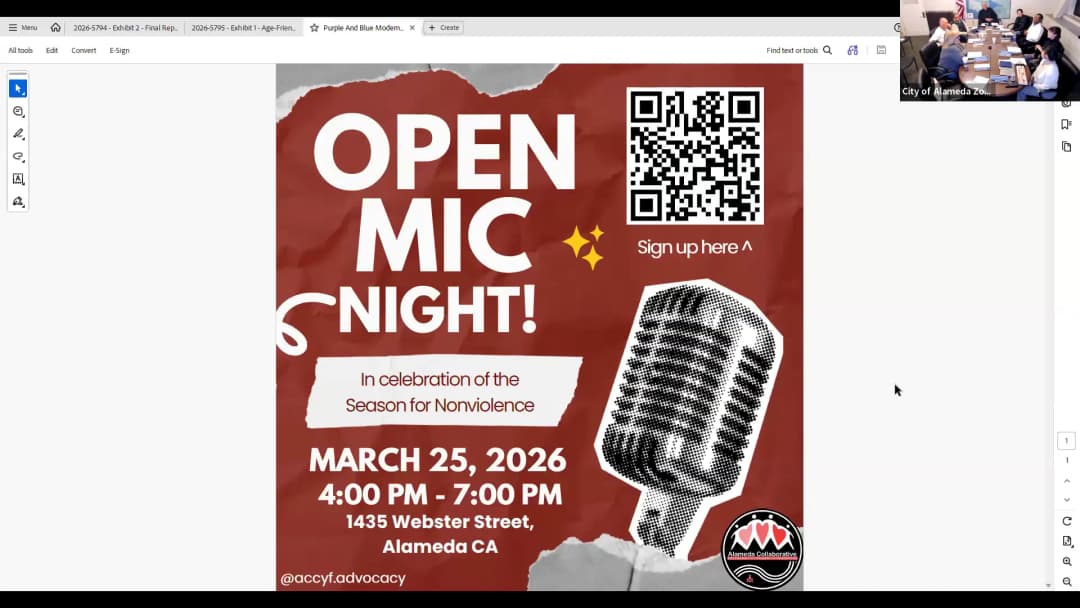
The Social Service Human Relations Board (SSHRB) met on March 3, 2026, to receive presentations on mental health outreach, the final report of the Road Home five-year plan, review an age-friendly cities survey draft, hear work group updates, and discuss committee assignments. Key actions included approval of meeting minutes. Consent Calendar - The board approved the minutes from the January 15, 2026 meeting by voice vote (motion by Gerald Bryant, second by Samantha Green). Presentations and Discussion Items Mental Health and Outreach Presentation (Item 4A) - Raul Sideno, Engagement Specialist Supervisor, presented on the importance of mental health for both clients and outreach workers. He noted that 1 in 5 U.S. adults experience a mental illness each year, 1 in 20 experience serious mental illness, and 1 in 7 youth aged 6–17 experience a mental health disorder. 50% of all lifetime mental illness begins by age 14, and 75% by age 24. Suicide is the second leading cause of death among people aged 10–24. - Sideno described the outreach team’s work engaging individuals who are homeless or at risk, building trust through persistence, and connecting them to resources such as housing, food, and mental health services. He emphasized that “people may forget what you said, but they’ll never forget how you made them feel” and the need for staff to protect their own mental health through stretch breaks, team support, and disconnecting from technology. - Board members asked about rental and mortgage assistance, data tracking via HMIS, and the impact of limited funding ($25,000 per year for prevention). Simone Falls (Housing & Human Services Division Manager) noted the program prioritizes those who would be homeless tomorrow if no intervention occurs. - The presentation concluded with a video on the importance of safe relationships for mental and physical health. Final Report on the Road Home Plan (Item 4B) - Simone Falls presented the final report of the five‑year Road Home Strategic Plan (2021–2025) to prevent and respond to homelessness. Key accomplishments included: - Opening four shelters (three year‑round, one seasonal) and the Dignity Village program (individual units with private restrooms, on‑site kitchen and laundry, and case management). - Launching an internal outreach team and a new day center (expanding from 18 to 30 beds in late summer 2026). - Housing outcomes from Dignity Village: 5 housed in 2023, 20 in 2024, and 23 in 2025 after Operation Dignity became the operator in late 2024. - Offering therapy services through Alameda Family Services at all shelter programs. - Establishing a Homeless Flex Fund ($50,000) and a combined $75,000 per year for flexible funding. - Increasing data capacity by using HMIS to track outreach data. - Affordable housing: 82 low‑to‑moderate income homes for sale and 182 affordable rental units were produced between 2021 and 2025, with over 800 additional units expected by 2029. The inclusionary housing ordinance requires below‑market‑rate (BMR) units in developments of 10+ units. - A new five‑year plan is being developed; a community survey is open until March 11, 2026. Board members are invited to participate. - Board members inquired about where permanently housed clients go and about aftercare programs. Falls noted that Operation Dignity provides six months of monthly case management after move‑in. Age‑Friendly Cities Survey Draft (Item 4C) - The Road Home Work Group (led by Gerald Bryant) presented a draft survey based on the AARP/World Health Organization age‑friendly cities model, adapted for Alameda. The survey collects data on social activities, daily living, and services for all ages, especially seniors 55+. - Board discussion focused on survey length (eight pages), the placement of open‑ended questions (moved to the end), and whether to include explanatory text in parentheses. Consensus favored shortening the survey, moving demographic questions to the end, and using a digital format to avoid overwhelming respondents. - Bryant noted the survey will be disseminated in both paper and digital (SurveyMonkey) formats. Work Group Reports (Item 4D) - Domestic Violence Task Force (Gerald Bryant): The most recent meeting was very successful, with attendance by the mayor, city manager, and three police department representatives. The task force continues to hold quarterly meetings. - United Against Hate / Season of Nonviolence (Gerald Bryant): The group is preparing an Open Mic Night on March 25, 2026 at the Healing Gardens (Webster and Taylor). Students are leading the event, and judges are needed. The speech contest will focus on all ages. - Road Home Stakeholder Meeting (Samantha Green): A stakeholder meeting was held earlier in February, led by Simone Falls and staff. Major themes included the need for more affordable housing, expanding shelter options, and reducing administrative barriers. Attendees included service providers and individuals with lived experience of homelessness. Staff Communications (Item 5) - Iessia (Program Manager) provided a semi‑annual status report: - BMR rental housing guidelines were updated in February 2026 to improve clarity on income changes. - The FY 26‑27 CDBG application period closed; three applications were received for economic development and capital improvement. Recommendations will go to City Council in May 2026. - The 2026 Point‑in‑Time Count occurred January 22, with 41 volunteers and care packages assembled by local scout troops and a church basketball team. - Simone Falls noted that new service providers have been brought on: Restorative Pathways will oversee the Emergency Supportive Housing program, and Urban Alchemy will manage the day center/safe parking/emergency shelter program. Board Communications (Item 6) - Gerald Bryant reported: - The K Avenue respite center and senior housing project is nearing completion; temporary certificate of occupancy expected in late February, with move‑in by April. - The Rise Up Alameda guaranteed basic income study has concluded. Stories from participants will be compiled into a video presentation. - Scott Mead announced a collaboration with UC Berkeley graduate students to design an intergenerational volunteer program for Alameda. Key Outcomes - Approved minutes from the January 15, 2026 meeting (voice vote). - Staff will revise the age‑friendly cities survey draft (shorten, move open‑ended questions to end, remove some explanatory text) and bring back a revised version. - Board members Chantal Carter and Robbie Kreitz expressed interest in joining the Domestic Violence Work Group and the United Against Hate Work Group; decisions will be finalized via email. - The Road Home five‑year plan survey is open through March 11, 2026; a new five‑year plan is expected to be presented to City Council by the end of the fiscal year. - The next SSHRB meeting is scheduled for April 2026.

HOMELESSNESS 31% · MENTAL HEALTH AWARENESS 15% · PUBLIC ENGAGEMENT 14% · AFFORDABLE HOUSING 12%
77
FEB 26, 2026 · ALAMEDA, CALIFORNIA · CITY COUNCIL
Alameda Transportation Commission Meeting – February 26, 2026

The Alameda Transportation Commission met on February 26, 2026, to review the 2025 annual report and 2026 work plan, hear updates on key transportation projects and safety data, and address public comments on rail preservation, traffic calming, and bike lane enforcement. The commission unanimously endorsed the annual report and work plan. Consent Calendar - The draft minutes of the January 28, 2026 meeting were approved with a revision requested by Commissioner Noctigall to clarify a statement about the Otis school and the need for a completed low-stress bike network. The motion passed unanimously. Public Comments & Testimony - William Morrison urged the commission to consider preserving rail corridors, noting the high cost of re-establishing rail if removed, and cautioned against focusing exclusively on bicycle and pedestrian infrastructure at the expense of automobiles. - Jim Strelo criticized the city for overreacting to a small number of traffic incidents, questioning the need for major intersection redesigns and the duration of construction projects. He also called for better public education on traffic safety. - Christy Cannon reported vehicles frequently driving in bike lanes on the West End (including delivery trucks and a fire truck) and expressed concern about safety for cyclists and pedestrians. She also praised the city's street cleaner for properly using the bike lane. Staff Communications - Lisa Foster, Transportation Planning Manager, announced that Gail Payne is leaving the city, reducing transportation planning staffing by one-third. She highlighted the city’s award of gold-level Bicycle Friendly Community status. Upcoming events: Transportation 101 and Clipper Card events on March 6 and April 3. Construction updates: Clement/Tilden project continues; Webster tube closures will be overnight (10 p.m.–5 a.m.) starting April, avoiding single-lane daytime closures; Posey tube closures will require continuous single-lane closures, to be minimized. SF Bay Ferry announced new South San Francisco service. - Commissioner comments expressed gratitude for Gail Payne’s contributions. Discussion Items - 2025 Annual Report and 2026 Work Plan Presentation - Key 2025 accomplishments: 1.5 miles of all-ages bikeways, 25 curb ramp upgrades, 79 intersection safety improvements, 125,000 water shuttle riders, 225,000 free bus passes for older adults and people with disabilities, first neighborhood greenway segment on Pacific Avenue, citywide mobile parking payment, over 8,000 sidewalk repairs, and the Alameda Bike Festival. - Safety data: One traffic fatality (pedestrian at Ralph Appezzato Memorial Parkway) and eight severe injuries. Rolling five-year averages show pedestrian trends improving, but bicyclist and motor vehicle severe injuries increased. Alameda’s rate of fatalities and severe injuries is lower than Alameda County and state averages. Police issued 72% more moving violation citations and warnings in 2025 compared to 2024. - Active transportation measures: 61.3 miles of bikeways total, 41% low-stress. 18 of 18 public schools enrolled in Safe Routes to School. Three bike/ped counters showed 5–14% year-over-year increases in bike counts. - 2026 priorities: Completion of Central Avenue improvements (spring), Clement/Tilden project, repaving of Fernside and San Jose with interim safety improvements (including buffered bike lanes, painted bulb-outs), 100 new bike racks (200 parking spaces). Oakland Alameda Access Project (OAP) updates: Webster tube work limited to overnight closures; Posey tube single-lane closures planned for 2027; 55-hour weekend full closures of both tubes for superstructure work (avoiding first weekend of each month). - Equity Priority Areas: Defined using BCDC social vulnerability maps; 30% of city roadways fall within these areas. 11% of intersection safety improvements were in equity areas; no bikeway corridors in 2025, but future projects expected to change that. - Commissioner Discussion: - Commissioner Derrick Abrams emphasized the need for hard infrastructure (e.g., metal posts, concrete barriers) to improve safety, citing recent fatal crashes on Ralph Appezzato Parkway. Staff noted a fatal crash response program is underway for that corridor. - Commissioner Kim asked about normalizing crash data by trip volume; staff explained lack of denominator data but noted qualitative comparisons. Commissioner Gloin questioned the state-level increase in fatalities; staff noted Alameda has been counter-trend. - Commissioner Noctigall and others discussed bike detection at signalized intersections; Scott Wickstrom explained the city is moving toward video detection and encouraged submitting C Click Fix reports for intersections where bikes are not detected. - Commissioner Noctigall asked about branding for neighborhood greenways; staff are considering signage to discourage through traffic. - Commissioner Derrick Abrams raised concerns about bike theft and the need for secure bike lockers; staff noted lockers are 10x more expensive than standard racks but plans to relocate and refurbish existing lockers. 134 locker spaces currently exist. - Commissioner Gloin asked about the cost difference between bike racks and lockers; staff estimated at least 10 times more for lockers. - Chair White Sea acknowledged the near-completion of the Cross Alameda Trail and ongoing fine-tuning. - Commissioner Kim questioned the pipeline of future projects; Scott Wickstrom outlined paving plans for 2027–2028 including Ralph Appezzato Parkway and Atlantic Avenue. - Commissioner Derrick Abrams urged early planning for north-south corridors (Webster, Park Street) and suggested strategic community conversations. Key Outcomes - The commission unanimously endorsed the Transportation 2025 Annual Report and 2026 Work Plan (motion by Chair White Sea, seconded by Commissioner Gloin). - The commission approved the revised minutes from January 28, 2026. - No additional commissioner communications. - Meeting adjourned at 8:19 p.m.

ACTIVE TRANSPORTATION 28% · TRAFFIC SAFETY 20% · TRANSPORTATION SAFETY 14% · ENGINEERING AND INFRASTRUCTURE 14%
78
FEB 24, 2026 · ALAMEDA, CALIFORNIA · CITY COUNCIL
City of Alameda AC Transit ILC Meeting – February 24, 2026

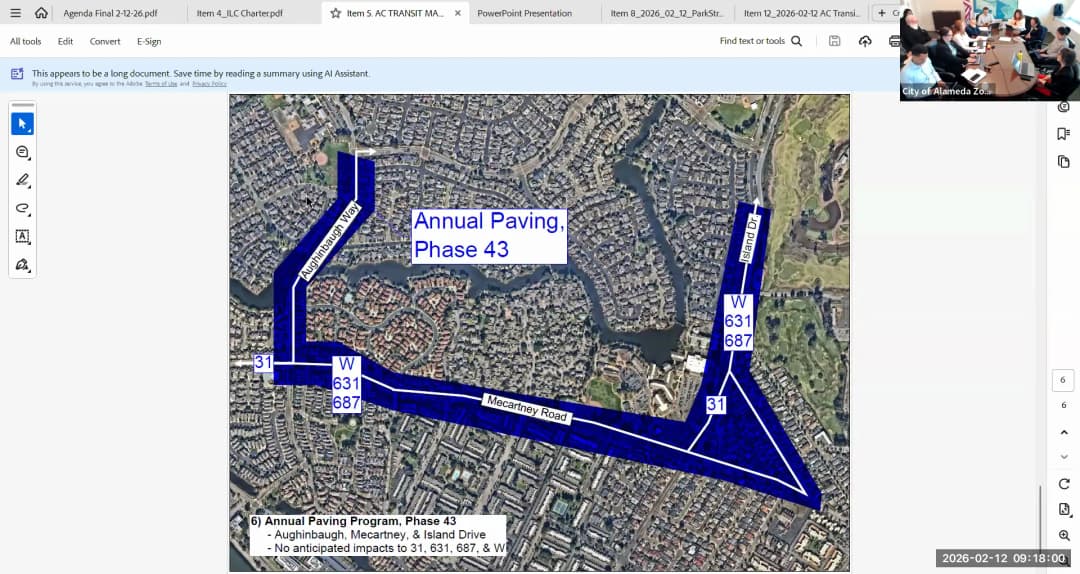
The City of Alameda AC Transit Interagency Liaison Committee (ILC) held a hybrid meeting on February 24, 2026, to discuss updates on ILC restructuring, ongoing construction projects, service changes, supplementary school bus services, the Park Street Transit Signal Priority (TSP) project, the free bus pass pilot program, the Transportation Management Association (TMA), the Oakland Alameda Access Project, and ridership performance. The meeting included representatives from the City of Alameda, AC Transit, and the Alameda Unified School District, along with one public comment. Public Comments & Testimony - Christina from Community Action for Sustainable Alameda (CASO) expressed excitement about the projects, praised coordination between AC Transit and Alameda, and recommended improving communication with transit riders by posting information at libraries and using QR codes at bus stops. She also suggested including information about the Oakland Alameda Access Project in rider communications. Discussion Items 1. Update on ILC Restructuring Robert Del Rosari (AC Transit) provided an update on ILC meeting parameters approved by the AC Transit board in October 2025. Key changes: meetings will now occur three times per year (instead of four), with a 90-minute time limit. The City of Alameda will continue to have its own separate meeting (not joint with Oakland/Piedmont), per feedback. Remote participation options remain under exploration. 2. Ongoing Construction Projects in Alameda Brendan Christelier (City of Alameda Public Works) presented an overview of six projectsaffecting AC Transit routes. Central Avenue project is ahead of schedule, finishing late spring/early summer 2026; current intersection closure at Pacific/Maine/Central has rerouted buses. The sanitary sewer replacement project on multiple streets will not close lanes. Shoreline outfalls work is off-road with no transit impact. The Clement/Tilden project (Fernside closure late March–June 2026) will require rerouting; a bus stop has been demolished and will be rebuilt September–November 2026. Lincoln Park pathway lighting will not impede traffic. Annual painting program will involve striping/signage with flaggers. Upcoming temporary bus stop upgrades on Starjill are expected to go to bid in the next month or two. Brendan confirmed that GPS apps (Waze, Google Maps) are updated via email notifications for construction. 3. Summary of February 2026 Service Change in Alameda Crystal Wayne (AC Transit) outlined changes effective February 1, 2026, addressing overcrowding and reliability following the August 2025 realign. Line 19 now terminates at Fruitvale BART; minor schedule adjustments were made to Lines 30, 31, and 96. Line O received an additional morning weekday trip to San Francisco and an afternoon trip to Fruitvale BART to alleviate overcrowding. Robert Del Rosari explained that improved operator availability (service operated above 98%) allowed these additions. Vice Mayor Pryor noted that the O and W buses sometimes arrive simultaneously and suggested staggering schedules; staff agreed to review. 4. Update on Supplementary Service to Schools Sean Deslajone (AC Transit) explained that supplementary services are additional buses on school days to meet capacity at bell times. In Alameda, nine trips serve about 300 riders daily (30–35 passengers per trip). Schools with coordinated service include Alameda High, Island High, NCNL Junior Senior High, and Lincoln Middle School. The ACTC student transit pass program provides free passes to qualifying 6th–12th graders (free/reduced lunch). Susan Davis (Alameda Unified School District) asked about bell schedule coordination; Sean noted that schools generally respond well, but new principals or changes due to Senate Bill (requiring high schools to start by 8:30 a.m.) may affect flexibility. Susan offered to help if issues arise. 5. Park Street Transit Signal Priority and Signal Optimization Project Maria Henderson (AC Transit), Will Blueler (AC Transit), and Ryan Dole (Kimley-Horn) presented. The project extends TSP from Central Avenue to Otis Drive, adds wireless interconnect, and upgrades the controller at Park Street and San Jose Avenue. Construction will occur spring–summer 2026, with final tuning fall 2026. Half-day lane closures (8:30 a.m.–3 p.m.) are expected; traffic will be maintained. Sidewalk detours will be provided at San Jose Avenue. Benefits include improved transit reliability, reduced delays, and minimal impact on other modes. Pre- and post-project evaluations will be conducted. Will noted a previous TSP project on Webster Street reduced travel times by 28%. The project website is available in English, Spanish, and Chinese. Christina (public comment) suggested posting information at libraries. 6. Free Bus Pass Pilot Program for Seniors and People with Disabilities Liz Escobar (City of Alameda) reported that from July through December 2025, nearly 116,000 rides were recorded (approx. 19,300/month). Current enrollment is 730 members (a 24% decrease after deactivating non-renewed cards and adding 30 from the waitlist). About 35 remain on the waitlist. Liz shared a story of an 85-year-old resident who received her pass after a year on the waitlist, emphasizing the program’s importance. A mid-year budget request for $7,000 per fiscal year aims to cover a rate increase and clear the waitlist. Vice Mayor Pryor noted potential regional funding from ACTC discretionary funds. 7. Transportation Management Association (TMA) Update Michael Hara (TMA President) and Arsh Singh Hothi (TMA General Manager) reported that the Easy Pass program now has 2,886 passes (up 314 since April 2025), driven by new housing and employers at Alameda Point. Partners APC and Building Futures described the pass as a lifeline for marginalized residents. The program enables residents to access transit for groceries, healthcare, and social activities. 8. Oakland Alameda Access Project (OAAP) Lisa Foster (City of Alameda) provided an update on the Webster Tube closure plans. Originally proposed as continuous single lane closures, the plan was changed to overnight single lane closures only (10 p.m.–5 a.m., no weekend closures). AC Transit is developing detour schedules for an April 2026 service change to accommodate the closures, using existing detour routes via Park Street Bridge. The earlier end time (5 a.m. instead of 6 a.m.) was achieved through city advocacy and benefits AC Transit’s morning service. 9. AC Transit Ridership and Customer Complaints Crystal Wayne presented performance data for September–December 2025 (post-realign). Line 19 ridership increased 14% year-over-year; Transbay Line W increased 6%; Lines 51A, 96, and O decreased slightly. On-time performance remains a challenge (defined as 1 minute early to 5 minutes late). Customer complaints focused on late buses, canceled trips, and Line O overcrowding (addressed by February service changes). Key Outcomes - No formal votes were taken. The committee received updates and provided feedback on all items. - Next ILC meetings are scheduled for June 11, 2026, and October 8, 2026. - Staff will review potential schedule adjustments for Lines O and W to improve staggering. - The free bus pass pilot program waitlist will be evaluated after receiving updated ridership data. - AC Transit will work with Caltrans and ACTC on detour schedules for the OAAP Webster Tube closures.

ENGINEERING AND INFRASTRUCTURE 52% · EQUITY IN TRANSPORTATION 14% · DISABILITY RIGHTS 10% · PROCEDURAL 9%
79
FEB 24, 2026 · ALAMEDA, CALIFORNIA · PLANNING BOARD
Alameda Planning Board Meeting - February 24, 2026: Annual Reports and Park Station Use Permit Hearing

Note: The meeting was called to order on Monday, February 23, 2026 (per transcript), but the instruction specifies February 24, 2026. This summary uses the instructed date. The Alameda Planning Board met to review annual reports from the Planning, Building and Transportation Department and to conduct a public hearing on a use permit modification for Park Station tavern at 1200 Park Street. The board also approved consent calendar items and heard public comments on both agenda items. Consent Calendar - Approved draft meeting minutes from December 8, 2025, with one abstention. Public Comments & Testimony - Item 5A – Annual Reports: One public comment from Mitchell Ball, who described the housing production numbers as “objectively disastrous.” He proposed reducing impact fees to enable construction, citing legal precedent (Nolan-Dolan test) and urged more proactive steps to address the housing crisis. - Item 5B – Park Station Use Permit: Over 20 speakers testified, both in support and opposition. Supporters included Kathy Weber (Executive Director, Downtown Alameda Business Association), Scott Warner, Reed Watley (professional musician), Emily Grunt (PTA president), and others. They highlighted the venue’s community benefits, cultural contributions, support for local schools, careful management, and the positive activation of a formerly derelict space. Opponents included nearby residents such as Jeff Robus (1115 Park Street), Ann Rabbit (993 Park Street), Betsy Matheson (1185 Park Avenue), John Legg, and others. They testified about noise disturbances (music clearly audible inside homes with windows closed, documented violations of the 85 dB limit and 8 p.m. curfew), parking challenges (streets filled with patrons’ cars from 4 p.m. on weekdays and all day weekends), lack of proactive outreach, and concerns about the proposed expansion. Several suggested conditions such as a locked decibel meter, monitoring data accessible to the city, and no expansion until compliance is demonstrated. Discussion Items - 5A Annual Reports: Staff presented comprehensive updates: permit center metrics (8,500 phone calls, 20,000 emails, 4,500 permits processed, 30,000 inspections); code enforcement (506 cases opened, 1,000 inspections); housing production (only 65 new dwelling units permitted in 2025, with 52 ADUs, far below the RHNA target of 5,353 units over eight years); climate action (meeting 2030 goals for GHG reduction, EV charger deployments, sea level rise planning, with a $55 million BRIC grant canceled); and transportation (1.5 miles of bikeways, 25 ADA curb ramps, 8,000 sidewalk repairs, 125,000 water shuttle riders, 225,000 bus pass rides). The General Plan and Housing Element annual report was not yet ready. After clarifying questions about ADU counting, federal funding risks, and data gaps, board member Dewey moved to accept the reports but strike the General Plan and Housing Element from the acceptance until the full report is available. The motion passed. - 5B Park Station Use Permit: Staff reviewed the six-month operational history. The current permit allows three outdoor music events per month on Fridays (4–8 p.m.) and Saturdays (2–8 p.m.) with a maximum of 85 dB. Two violations occurred: one for exceeding 85 dB and another for playing past 8 p.m. Drums were identified as a frequent cause of exceedances. The applicant proposed increasing events to 10 per month with extended hours (Fri 4–9 p.m., Sat 2–9 p.m., Sun 2–7 p.m.), and initially requested 90 dB but rescinded to 85. Staff recommended an option with unlimited events on Fridays and Saturdays (three-hour limit) plus conditions: drum dampeners, a sound meter, and a requirement to return to the board after three violations. Board deliberation explored noise measurement standards, the need for technical advice, and balancing neighborhood concerns against business vitality. The applicant suggested measuring at 100 feet from the stage rather than at adjacent residential property lines, noting that the current 65-foot measurement at the wash house was unfair. Several board members supported hiring an acoustical consultant, but cost concerns led to a simpler interim solution. Vice President Arisa raised the idea of a phased approach. Key Outcomes - Item 5A: The board voted to accept the annual reports for the climate action and resiliency plan, active transportation plan, Vision Zero action plan, and transportation choices plan, but removed the General Plan and Housing Element from the acceptance. Those reports will be brought back for separate review on March 23, 2026. Board members expressed a desire for a more proactive city role in facilitating housing construction. - Item 5B: The board approved a motion (all in favor) modifying the use permit as follows: - Increase the number of outdoor music events from 3 to 4 per month. - All other current conditions remain (events on Fridays 4–8 p.m. and Saturdays 2–8 p.m., no Sundays, maximum 85 dB). - Noise measurements shall be taken at 100 feet from the stage (rather than at the receiving property line) as an interim standard. - The applicant must return to the board for a follow-up review in three months (approximately May 2026) with a report on noise mitigation efforts (e.g., sound curtains, drum dampeners). City staff will concurrently study best practices for noise measurement to inform future policy. - If three violations occur at any time, the use permit will automatically come back for additional board review. - The board also directed city staff to explore a residential parking permit program for the affected neighborhood and to address bike lane striping issues on Park Street to discourage illegal parking.

ARTS AND CULTURE 38% · ENGINEERING AND INFRASTRUCTURE 14% · PROCEDURAL 9% · AFFORDABLE HOUSING 9%
80
FEB 23, 2026 · ALAMEDA, CALIFORNIA · CITY COUNCIL
Alameda Recreation and Parks Commission Meeting - February 23, 2026

The Alameda Recreation and Parks Commission met on February 23, 2026, to discuss updates on the Jim's on the Course restaurant, a director's report on upcoming events and projects, and a review of proposed rate increases for the Corrica Park South Course. The meeting included public comment and commissioner discussion, with no votes taken on the rate proposal. Consent Calendar - Approval of the April 28th minutes was moved and carried unanimously. Public Comments & Testimony - Pete Casino spoke during public comment on the proposed rate increases for the South Course. He argued that the comparison with other courses omitted discount plans offered by Monarch Bay and Metropolitan, and that Greenway does not offer discounted green fees. He stated the increase is not justified until the course improves. Discussion Items - Jim's on the Course Restaurant Update (Item 5B): Tom Janikos, representative of Jim's on the Course, reported on recent improvements including larger 5x5 meter umbrellas, covered front patio, additional seating, fire pits, and planned removable plexiglass wind barriers on the bar side to mitigate strong winds. He noted $15,000 in plumbing repairs. Commissioners asked about feedback from golfers and potential overflow from the driving range. - Recreation and Parks Director Report (Item 5C): The director provided updates on community events: coastal cleanup on February 14 and March 14 at 10 a.m. at Seaplane Lagoon, winter warming shelters open through April 30, storytelling and drumming festival on March 14 from 12-3 p.m. at Mastic Senior Center, spring shin day on April 18 at Alameda Point Gym, and President's Day office closure on February 16. Summer activity guides will be mailed soon with registration opening February 18. Construction updates: Estuary Park (5-acre extension, completion end of 2026), Cityview Skate Park (100% construction documents, construction in summer). Highlights: annual rose planting on January 17 with 50 attendees, family snowball dance party with 150 party goers. Staff promotions: Catherine Frazier to gardener and Raymond Rivera to Maintenance Worker 2. The director also discussed coordination with Caltrans regarding Posey Tube closures to avoid impacting major events. - Corrica Park South Course Proposed Rate Increases (Item 5D): The proposal includes raising the resident rate from $50 to $56 (Monday-Thursday) and the senior resident rate from $36 to $41 (Monday-Thursday). Public comment and commissioners expressed concerns: lack of discount plans compared to other courses, high practice facility costs, need for course improvements, and lack of financial data from Greenway. Commissioners suggested considering membership discount cards and lower rates for youth. No vote was taken; the item was for review and comment only. Key Outcomes - The commission unanimously approved the April 28th minutes. - No action was taken on the proposed rate increases; the item was for review and comment only. - The next regular meeting is scheduled for March 10, 2026, but may be canceled if no agenda items are identified two weeks prior.

PARKS AND RECREATION 83% · PROCEDURAL 6% · FISCAL SUSTAINABILITY 6% · ENGINEERING AND INFRASTRUCTURE 5%
OPENPUBLICA · PUBLIC MEETING INDEXUPDATED DAILY · openpublica.com