Browse by city
Date range
Search help

Search titles, summaries, topics and stored transcripts together. Keywords may match separately; put the whole query in double quotes for a phrase. Matching follows word analysis, so punctuation is not exact. Both dates are included. Documents are not searched.

SHOWING 1211–1220 ENTRIES
1211
OCT 22, 2026 · MONTGOMERY COUNTY, MARYLAND · COUNTY COUNCIL & COMMITTEES
Montgomery County HHS Committee Annual Priorities Meeting – October 22, 2026

The Health and Human Services (HHS) Committee held its second day of annual priority meetings with HHS boards, committees, and commissions on October 22, 2026, from 9:30 a.m. to 11:30 a.m. virtually. Chaired by Councilmember Laurie-Anne Sayles, with members Andrew Friedson and Dawn Luedtke, the committee heard from three panels covering health care access, juvenile justice, community health, children and youth, foster care, childcare, social services, health equity, and substance use. Discussions emphasized coordination, workforce sustainability, communication gaps, and equity. Discussion Items Panel 1: Health Care Access, Juvenile Justice, and Community Health - Dr. Catherine Kelly (Montgomery Cares Advisory Board) presented five priorities: - Increase provider reimbursement to $175 per encounter (70% of care cost) to stabilize clinics reduce ER visits. - Achieve payment parity between Care for Kids and Montgomery Cares for pediatric and adult care. - Expand the East County dental pilot (currently serving 300 residents) to upcounty, targeting an additional 150 residents. - Develop an integrated behavioral health respite and substance use stabilization program for homeless individuals with complex needs. - Fund two bilingual social workers for the Montgomery Perinatal Program to reduce barriers for high-risk pregnant women. - Frederick Hawkins (Commission on Juvenile Justice) outlined six priorities: diversion programs, delinquency prevention (mentoring, leadership, out-of-school time), coordination between DJS and HHS, reducing school exclusion, improving behavioral health services, and state legislative advocacy. He noted the commission is exploring data on school suspensions and arrests. - Donna Collie (Commission on Health) focused on three areas: behavioral health (workforce shortage projected at 32,800 additional workers needed in MD by 2028), communication and engagement (citing 98.2% school vaccination compliance as a successful outreach example), and nutrition (food insecurity as a chronic disease driver). She called for strengthening navigation and coordination across programs. Panel 2: Children, Youth, and Family Supports - Marie Lenise Cruz-Weiss (Commission on Children and Youth) identified two priorities: juvenile crime/safety and school-based mental health services. She highlighted that youth often don't know about available programs and emphasized the need for trauma-informed, culturally competent adults. She noted a youth roundtable is being planned to gather direct input. - Melin Edson (Citizens Review Panel for Children) presented two focus areas for FY27: support for older foster youth (18–21) reluctant to engage in service planning, and mentoring for those aging out. The panel reviews monthly data on child welfare calls, investigations, foster care placements, and resource homes. - Dr. Ramona Johnson (Commission on Childcare) reported refreshed membership after pandemic challenges. Priorities include onboarding new commissioners, assessing childcare funding streams, and reviewing MCPS community use of public facilities policies to support stable after-school care. She cited low pay for early childhood educators and expensive childcare as key issues, noting that many providers leave for paraeducator roles. Panel 3: Social Services, Health Equity, and Substance Use - Larnice McCoy Moore (Board of Social Services) reviewed accomplishments (marketing campaign for resource parents) and priorities: reduce barriers for foster parent recruitment, raise awareness of social services, collaborate with other BCCs, and advocate on emerging issues. The board has almost full membership with a mentoring program for new members. - Dr. Wang (Asian American Health Initiative) reported serving 32,000 individuals through 33 community organizations over four years. Priorities: building capacity of CBOs for behavioral health and senior wellness, and developing a data system to capture disaggregated AAPI data. He noted challenges with language diversity (20+ languages) and limited English proficiency (26%). - Chair Mitchell (Alcohol and Other Drug Addiction Advisory Council) highlighted all 16 seats filled after recruitment. Priorities: increase outreach and education (e.g., naloxone access, prevention across lifespan), reduce stigma, update county code for stigmatizing language, and improve treatment/recovery access. She noted a 49% reduction in overdose fatalities but 83 deaths in the last year, with rising concerns for youth and adults over 50. She called for better coordination with MCPS and other bodies. - Jackie Williams (African American Health Program) presented two priorities: sustain the SMILE program for black maternal health (severe maternal morbidity 54% higher for black women; nationally 44.8 vs 14.2 deaths per 100,000) and support displaced federal workers through hiring preference (Bill 10-25E) and visible job announcements. She reported over 100 SMILE clients, many with advanced maternal age (35+) and chronic conditions. Key Outcomes - Chair Sales directed follow-up on several items: establishing quarterly meetings with the HHS director (last held 2 years ago), improving communication from BCCs to the public, exploring internship programs with Montgomery College for social media outreach, and better coordination across BCCs to avoid silos. - Councilmember Friedson reiterated support for phased-in reimbursement parity and promised to follow up on data from the Montgomery Cares board and best practices for black maternal health. - Councilmember Luedtke flagged the state’s bed capacity crisis, delays in psychiatric evaluations, and the Handle with Care program (state dashboard available). She requested further details from AODAC on reducing opioid prescribing for those under 25. - The committee emphasized the need to translate existing resources into measurable resident outcomes, especially in behavioral health, food security, and foster care transitions. - No formal votes were taken; the meeting concluded with thanks to all participants and a commitment to incorporate priorities into budget and policy deliberations.
PUBLIC HEALTH 23% · MENTAL HEALTH AWARENESS 14% · COMMUNITY ENGAGEMENT 9% · YOUTH PROGRAMS 9%
1212
OCT 22, 2026 · RICHMOND, VIRGINIA · CITY COUNCIL
Finance and Economic Development Standing Committee Meeting - October 22, 2026

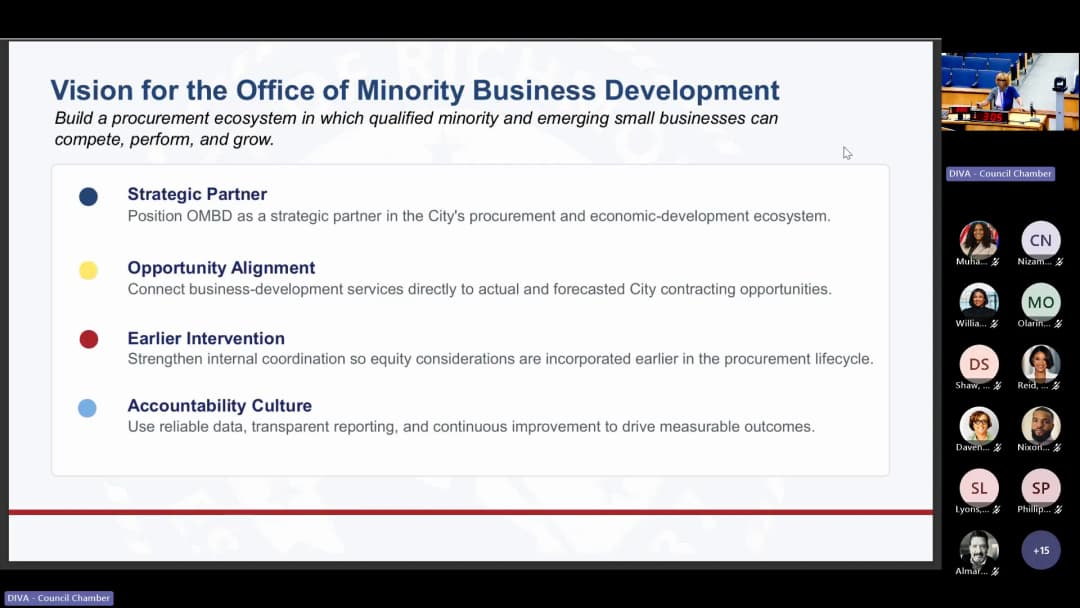
The Finance and Economic Development Standing Committee met on October 22, 2026, to consider several ordinances and resolutions, receive a vacancy report, and hear presentations on minority business development and economic development strategies. The meeting included public hearings, committee discussion, and votes on items related to retirement cost-of-living adjustments, education funding, employee homeownership assistance, tax relief for seniors and disabled persons, and a tax amnesty resolution. The committee also heard updates on implementation of a disparity study and an economic development overview. Consent Calendar - The minutes from the September 16, 2026 Finance and Economic Development Standing Committee meeting were approved without amendment. Public Comments & Testimony - No members of the public spoke during the open public comment period for items not on the agenda. Public hearings were held individually per agenda item. Discussion Items Board Vacancy Report - Council Management Analyst Pamela Nichols presented the vacancy report covering current and projected vacancies through February 2027. - Economic Development Authority Board of Directors: The committee agreed to continue applications to the January 2027 meeting. - Participatory Budgeting Steering Commission: Two vacancies exist for residents south of the James River; applications were received from Samuel Jones and Kawisi Powell. The committee decided to continue these vacancies to seek broader citywide representation. One vacancy for a resident with a disability was filled by reappointing Daisy Weaver. - Richmond Retirement System: One vacancy for a city resident was filled by reappointing Daisy Weaver. - The committee voted unanimously to forward the recommended appointments to council. Ordinance 2026-297 – Cost of Living Adjustments for Richmond Retirement System (RRS) - Council Policy Analyst Maria Garnett provided background: RRS retirees have only received three ad hoc COLAs and four one-time supplements since 2006 due to low funded status. Reforms in 2023-2024 improved funded status to about 92% as of June 30, 2026. The proposed policy ties annual supplements or COLAs to CPI-U, with a supplement of up to 5% when funded status is at least 85% but less than 95%, and a COLA of up to 2% when funded status is at least 95%. The full cost of a COLA could be spread over 10 years. - Deputy Director of Finance Michael Lynn requested a continuance pending completion of an actuarial cost report expected by the end of the month, and proposed forming a working group to review scenarios and bring recommendations to the November 18 committee meeting. - Several council members expressed support for the ordinance but wanted the cost information. Councilmember Trammell opposed the continuance, citing retirees' long wait. A motion to forward to council contingent upon the report was approved (Vice Chair Jones and Chair Robertson voting aye). Ordinance 2026-300 – Additional Funding for Richmond Public Schools - The ordinance increases anticipated revenues from the Greater Richmond Convention Center Authority by $4.7 million and appropriates those funds to the FY 2026-27 general fund budget and school budget. No public comments. The committee voted unanimously to forward to council. Ordinance 2026-301 – Employee First-Time Home Buyers Assistance Program Expansion - Council Policy Analyst Whitney Brown explained the ordinance expands eligibility to owners of deed-restricted or limited-equity homes purchasing their first unrestricted market-rate residence. Speakers Laura Lafayette (Richmond Association of Realtors), Chelsea Balestino (Maggie Walker Community Land Trust), Monica Rose (realtor and resident), and HR Director Tranesa Martin expressed support, noting the restriction on equity accumulation for CLT homeowners. The committee voted unanimously to forward to council; several council members added their names as co-patrons. Ordinance 2026-302 – Real Estate Tax Relief for Elderly and Disabled Persons - This ordinance increases the maximum qualifying income from $70,000 to $75,000, adjusts income brackets for higher relief levels, and moves the application deadline from December 31 to June 30. Finance Director Letitia Shelton described the current application process and outreach efforts. Councilmember Trammell raised concerns about outreach, certification letters, and the burden on seniors. Chair Robertson noted the ordinance addresses eligibility gaps but acknowledged need for better outreach processes. The committee voted unanimously to forward to council; several members added themselves as co-patrons. Resolution 2026-R041 – Support for Removing State Cap on Employee Homeownership Grants - The resolution expresses council support for the General Assembly removing the statutory maximum on local employee homeownership grants and encourages reevaluation of the city's program. No public comments. The committee voted unanimously to forward to council. Resolution 2026-R042 – Tax Amnesty Program Implementation Plan - Council liaison Amy Robbins requested a continuance to the next committee meeting so that Councilmember Lynch could present. The committee voted to continue to the November 18, 2026 meeting. Presentation: Disparity Study Implementation Update - Pat Foster, Director of Minority Business Development, presented an update on implementing recommendations from the 2023 disparity study. Current MBE participation stands at 4.14% of city spend, compared to a 3.47% baseline from the study and a target of 17-20%. She outlined completed and in-progress recommendations, including strengthened use of B2G Now software for compliance monitoring. Chair Robertson expressed concern that progress is insufficient and requested a clearer strategic plan with measurable goals linked to budget categories. She asked that future budget documents identify total spend by category and set participation targets. Foster agreed to provide more detailed data and a plan. Presentation: Richmond Economic Development Overview - Director Rogers presented an overview of economic development efforts, highlighting regional growth (population projected to rise from 244,000 to 267,000 by 2034), major attraction projects (Eli Lilly, Lego, Iron Mountain in the region; CoStar, Hallion, VPM in the city), and real estate development activity. She described a four-phase corridor strategy (precursor activation, interim activation, catalytic activation, permanent activation) using Broad Street as an example. Future focuses include the central business district, Southside corridor (Hull Street), a biotech strategy, and strategic disposition of surplus city land. Chair Robertson emphasized the need for a long-term, institutionally consistent economic development strategy that transcends election cycles. The committee expressed appreciation and requested continued collaboration. Key Outcomes - Approved minutes of September 16, 2026 meeting. - Forwarded board vacancy recommendations to council: reappointments for Daisy Weaver (RRS and PBSC disability seat) and continuation of PBSC south-of-James vacancies. - Ordinance 2026-297 (RRS COLA policy) forwarded to council contingent upon receipt of actuarial cost report. - Ordinance 2026-300 (RPS additional funding) forwarded to council. - Ordinance 2026-301 (employee home buyer assistance expansion) forwarded to council. - Ordinance 2026-302 (tax relief for elderly/disabled) forwarded to council. - Resolution 2026-R041 (support for removing state cap) forwarded to council. - Resolution 2026-R042 (tax amnesty plan) continued to November 18, 2026 committee meeting. - Committee expressed need for a detailed strategic plan from the Office of Minority Business Development tying spend categories to participation goals. - Economic Development Director committed to developing a long-term corridor strategy with consultant support.

ECONOMIC DEVELOPMENT 34% · MINORITY BUSINESS 19% · PENSION FUNDING 11% · TAX RELIEF 10%
1213
OCT 22, 2026 · PRINCE GEORGES COUNTY, MARYLAND · COUNTY COUNCIL & BOARDS
Transportation, Infrastructure, Energy and Environment Committee Summary: October 22, 2026

The Transportation, Infrastructure, Energy and Environment (TIEE) Committee of the Prince George's County Council met on October 22, 2026, at 10:00 AM to consider two legislative resolutions and receive a staff briefing on fund deficits. The committee voted favorably to recommend a resolution on Water and Sewer Plan amendments (CR-097-2026) and a resolution on Energy Infrastructure Planning (CR-098-2026). Additionally, the committee received a comprehensive briefing from the Department of Environment (DoE) and the Department of Public Works and Transportation (DPW&T) on structural deficits in the County's Stormwater Management and Solid Waste Management funds. Discussion Items Water and Sewer Plan Amendments (CR-097-2026) The committee reviewed the June 2026 cycle of amendments to the 2018 Water and Sewer Plan. The legislation included two applications for water and sewer category changes and one water withdrawal appropriation. - Application 26W05 (4110 Ryan Road) sought a change from category five to three for a single-family home; the County Executive and Planning Board recommended approval. - Application 26W06 (7809 Kroom Road) sought a change from category five to four for 10 single-family homes. The County Executive recommended retaining category five due to environmental concerns including mapped Marlborough clay and floodplain issues, a stance which the applicant is disputing. - The Lake Presidential Golf Course irrigation well replacement (26WWP01) was discussed. Council Members Olson and Harrison raised concerns about the impact on local aquifers (shifting from the Patuxent to the Tapsico aquifer), the cause of the original well's failure, and the requested withdrawal of up to 95,000 gallons per day. Staff indicated that the Maryland Department of the Environment (MDE) would conduct an extensive study and hold a public hearing, and that the applicant's geologist suggested the final permitted withdrawal would likely be lower. Council Member Hunter requested additional written documentation on these details before the full Council vote. Briefing on Deficits in Stormwater and Solid Waste Management Funds (BR 10222026) Representatives from DoE (Rushane Jones, Jeff DeHan) and DPW&T (Joanna Smith) presented on the structural deficits affecting the county's stormwater and solid waste enterprise funds. - Key findings: The Clean Water Act fee has not been increased since its establishment in 2015. The stormwater management ad valorem property tax has not been increased since the program was taken over from WSSC in 1987, 38 years prior. Fee collections do not grow with property values. The county manages over 800 miles of stormwater pipes, 900 facilities, five aging pump stations, and 21 classified dams. 67% of stormwater infrastructure has exceeded its service life. Current annual spending of roughly $11 million meets less than 3% of infrastructure needs. The county's rates are the lowest among comparable jurisdictions in Maryland. - Council Member Harrison described the presentation as "sobering" and "depressing," questioning how to address a "40-year hole." - Council Member Adams recommended implementing budget reserves to anticipate and save for future infrastructure costs proactively, rather than operating crisis-to-crisis. - Chair Dernoga acknowledged the political difficulty of raising fees and taxes. He proposed exploring a shift in revenue from the Park and Planning tax surplus (the result of a 1 cent increase in 2015 for the SARC center) to address the fund deficits, suggesting this could be done without increasing the overall tax burden on residents. This proposal generated broad discussion among committee members about the need for political will and bold action. Energy Infrastructure Planning Resolution (CR-098-2026) The committee considered a resolution sponsored by Council Member Adams-Stafford directing the Maryland-National Capital Park and Planning Commission (M-NCPPC) to study the benefits and challenges of master planning for utility use. The committee reviewed a second draft containing amendments negotiated since the resolution was held at a previous meeting. - Key amendments included: adding the DoE and the County Energy Manager as joint study participants; shifting the scope from "energy intensive" industries to "new industries"; clarifying electric vehicle infrastructure needs; referencing state battery storage goals (3,000 MW by 2033); setting a report deadline of October 31, 2027 to inform the next General Plan (Plan 2050); and expanding consultation entities to include the MD PSC, Office of People's Council, higher education institutions, and utilities serving the county. Council Member Adams requested the addition of Washington Gas to the consultation list. - Kathina Schoelers, Acting Deputy Director of the M-NCPPC Planning Department, stated the department was not the expert in this area but was committed to the effort. She requested that the study be integrated into the General Plan development process, citing concerns over the feasibility of the October 2027 deadline due to RFP and contracting requirements. The sponsor and committee members agreed to work with the Planning Department on refinements before the full Council vote. Key Outcomes - CR-097-2026 (Water and Sewer Plan): A motion by Council Member Harrison, seconded by Council Member Hunter, to recommend favorable approval carried by a vote of 4-0. (Note: There is a discrepancy between the official minutes, which record Council Member Adams as abstaining, and the raw transcript, which records the Council Member responding "Absolutely" to the roll call vote.) - CR-098-2026 (Energy Infrastructure Planning): A motion by Vice Chair Olson, seconded by Council Member Adams, to recommend favorable approval with amendments carried by a vote of 4-0. Council Member Harrison was absent. - Briefing on Fund Deficits: The briefing was held and discussion encouraged. No formal vote was taken. The committee directed staff to continue working with the administration on solutions for the FY28 budget process. - Adjournment: The meeting was adjourned following a motion by Council Member Adams, seconded by Vice Chair Olson.

WATER AND WASTEWATER MANAGEMENT 36% · ENERGY MANAGEMENT 22% · BUDGET EQUITY ANALYSIS 8% · PROCEDURAL 6%
1214
OCT 22, 2026 · HILLSBOROUGH COUNTY, FLORIDA · HILLSBOROUGH COUNTY ARCHIVE VIEW PAGE
Environmental Protection Commission Meeting – October 22, 2026

The Environmental Protection Commission (EPC) of Hillsborough County held its regular meeting on Thursday, October 22, 2026, at 2:30 PM. The commission approved the consent agenda, authorized $929,126 in Pollution Recovery Fund grants for 11 environmental projects, received the 2026 annual report, and recognized outgoing Commissioner Cameron Cepeda. All votes were unanimous (6-0). Consent Calendar - Motion to approve the consent agenda passed 6-0. Discussion Items - Pollution Recovery Fund (PRF) Grant Applications (Item 9A): Chris Pratt, EPC staff, presented 11 recommended projects totaling $929,126. Since 1987, the PRF has provided over $9 million for environmental projects in Hillsborough County, funded solely by enforcement penalties. The recommended projects included: flood monitoring sensors by USF ($100,000), real-time water quality stations ($100,000), avian blood parasite diversity study ($97,097), GIS-based stormwater pollution prevention ($86,369), PFAS bioaccumulation study ($99,478), Tampa Bay cleanups by Keep Tampa Bay Beautiful ($40,450), floating wetlands on the Hillsborough River ($97,783), wetland restoration at Learning Gate Community School ($90,000), seagrass restoration near Apollo Beach ($99,000), a framework for hypereutrophic lake remediation ($85,449), and mangroves/substrate restoration in Ruskin ($33,500). The commission approved all 11 projects (6-0). - 2026 Annual Report: The executive director presented the annual report, highlighting EPC’s achievements: over 2,000 authorizations, 3,700 field inspections, compliance assistance in over 1,000 cases, water quality monitoring at 261 stations (over 50 years of data), 15 delegated environmental programs, and a 93% customer satisfaction rating. The report noted that EPC staff has been reduced by 18% since 2000 while population grew 57%. Commissioner Boles raised concerns about urban service area expansion and Lake Thanona Sassa pollution, urging EPC to engage proactively with the planning commission. The report was received (6-0). - Recognition of Commissioner Cameron Cepeda: Staff and commissioners honored outgoing Commissioner Cepeda for her service since 2022, her work as chaplain leading invocations, and her contributions to the board. Gifts and cards were presented. - Other Updates: Staff reported on recent engagements (FLARA conference, wetland workshop, volunteer cleanups collecting 23 bags of trash), new attorney Marie O’Donnell, and four interns from the University of South Florida. Key Outcomes - Consent agenda approved (6-0). - 2026 Pollution Recovery Fund grants approved: 11 projects, $929,126 total (6-0). - 2026 annual report received (6-0). - The next EPC meeting is scheduled for December 17, 2026; if no action items arise, it may be deferred to 2027.

ENVIRONMENTAL PROTECTION 52% · PROCEDURAL 20% · WATER AND WASTEWATER MANAGEMENT 9% · PUBLIC ENGAGEMENT 6%
1215
OCT 22, 2026 · NEW ALBANY, INDIANA · CITY COUNCIL & BOARDS
Sewer Board Meeting - October 22, 2026

The Sewer Board met on October 22, 2026 at 2:15 PM UTC. The meeting covered approval of minutes, a resolution for fund transfer to cover a UV project cost overage, scheduling of the upcoming budget process, a monthly financial report, and an operational update from the utility manager. Routine approvals for minutes and claims were handled, and the board approved the requested fund transfer. Consent Calendar - Minutes – A motion was made and seconded to approve the minutes from the previous meeting. All members voted aye; minutes approved. - Claims – Claims for the period October 8–21, 2026 totaling $965,726.61 (including a new bond payment of $211,000 and insurance payments) were presented. A motion and second were made; all voted aye; claims approved. Public Comments & Testimony - No members of the public signed up to speak. Discussion Items - Resolution for Transfer of Funds (UV Project Overrun) – The board reviewed a resolution to transfer $141,824.91 from the operating account to the UV project and installation fund. The overage was attributed to engineering costs, not the contractor, and the transfer was needed to bring the project fund out of a negative balance before year-end. A motion to approve was seconded and passed unanimously by voice vote. - Budget Workshop and Vote Scheduling – The board discussed setting a budget workshop for November 12, 2026 following the regular meeting, with a vote on the budget planned for November 25, 2026. One board member noted they would be out of the country during Thanksgiving week (Nov 25) and requested that a copy of the draft budget be emailed ahead for review. The schedule remains as proposed, with the absent member to provide feedback electronically. - Financial Report – The monthly billing for the previous month was $1,229,000, approximately $25,000 above the average but within budget. The finance officer described the revenue as “amazingly stable.” - Utility Report (Mike) – - July compliance summary: full compliance. - Temple lining project completed: 615 feet of 12-inch pipe and 195 feet of 10-inch pipe; camera inspection confirmed success. - Bar screen welding at the plant completed under a previously approved change order; reinstallation planned for the following week. - Oak Street 24-inch sewer main replacement ongoing; water main conflicts (with Indiana American Water) have caused delays. Contractor Dan Christian is coordinating moving the water main. Work expected to resume next week. - Public Works force main construction (670 feet of 24-inch ductile iron) to begin next week, following a pre-construction meeting held today. Key Outcomes - Approved resolution to transfer $141,824.91 for the UV project fund (unanimous). - Approved claims totaling $965,726.61 (unanimous). - Budget workshop scheduled for November 12, 2026; budget vote anticipated on November 25, 2026, subject to possible rescheduling due to one member's absence.

PROCEDURAL 51% · ENGINEERING AND INFRASTRUCTURE 23% · BUDGET EQUITY ANALYSIS 20% · WATER AND WASTEWATER MANAGEMENT 6%
1216
OCT 22, 2026 · WALNUT CREEK, CALIFORNIA · CITY COUNCIL
Joint Planning Commission/Design Review Commission Study Session on General Plan 2050 Existing Conditions - October 22, 2026

The Planning Commission and Design Review Commission met jointly on October 22, 2026, beginning at 6:00 p.m. in the Third Floor Conference Room at 1666 N. Main Street, Walnut Creek, for a study session on the General Plan Update Existing Conditions Report. Staff from the Community Development Department and consultants from Alta Planning and Design presented existing conditions, draft vision and guiding values, and community feedback. The meeting was informational: no formal decision or recommendation was made on the General Plan. The commissions did adopt the 2027 meeting calendar on the consent calendar. Consent Calendar - The commissions unanimously approved the consent calendar item adopting the 2027 Planning Commission and Design Review Commission meeting dates. - Roll call resulted in all present commissioners voting yes; the motion passed. Public Comments & Testimony - Rochelle Fortier, a Walnut Creek resident, urged the 2050 General Plan to retain or carry forward the current General Plan’s environmental integrity sections, specifically Goal 26 and Policy 26.6 on protecting nature in development and urban wildlife habitat. - Rosalie Howarth, speaking for the Mount Diablo Bird Alliance, described the deteriorating nature lake/pond at Heather Farm Park — choked with invasive reeds, silted, too warm for migrating ducks, and littered with fishing line and hooks — and asked for a specific General Plan goal for its remediation under open space and conservation. - Michael Vecchio, a 32-year resident, Walk Bike Walnut Creek member, and former city transportation employee, supported a Civic Park master plan and asked the General Plan to study an east-west bicycle/pedestrian connection from the Iron Horse Trail to downtown, BART, and businesses north of Ygnacio Valley Road. Discussion Items - Staff and consultants presented the General Plan 2050 update process, noting the draft vision statement and seven guiding values, the September 24 community workshop, meetings with about 40 community organizations, and the online feedback hub open through October 25, 2026. - Existing conditions findings included: Walnut Creek’s population was about 71,000 in 2025, up about 4% over 10 years, with households up about 7%; the 25–34 age group grew 31%; residential uses cover about 55% of city land, parks/open space about 27%, commercial/office/industrial about 6%, public/institutional about 7%, and vacant land less than 1%. - Housing and jobs data showed very strong residential demand, about 20% office vacancy in Walnut Creek compared with 18% countywide, and the 2023–2031 RHNA cycle requiring capacity for 5,800 housing units. Population forecasts ranged from about 6,000–7,000 new residents by 2050 to a high extrapolation of about 34,000 over three RHNA cycles. Job growth scenarios included a baseline of about 8,500 additional jobs by 2045 and an optimistic scenario of about 21,000. - Healthy Communities analysis under SB 1000 identified one healthy community priority area south of downtown along I-680, where lower-income areas face higher diesel particulate matter, traffic, and groundwater threats. - Community feedback themes included preserving Walnut Creek’s identity and regional destination role, maintaining infrastructure and services, managing neighborhood change, increasing housing choice and affordability, promoting infill, supporting downtown and Shadelands economic vitality, and adapting to changing retail and office markets. - Commissioner questions and comments touched on benchmark cities, walksheds/bikesheds, housing capacity and three-dimensional building form, Concord Naval Weapons Station regional impacts, annexation of county islands, underground utilities, homelessness data and measurable goals, fiscal impacts of changing industries, Measure A restrictions on healthcare uses, the gig economy and flexible land uses, parcel intensity in Shadelands and downtown, design review authority and process, and the federal HR 1 law’s potential effects on healthcare jobs and services. - Several commissioners emphasized connectivity and human-scale mobility, preserving biodiversity and urban wildlife, exploring faith-based affordable housing sites, and using clear visual/graphic presentation in the General Plan document. Key Outcomes - No formal General Plan action was taken; the study session was for input only. - The commissions voted unanimously to adopt the 2027 meeting calendar. - Input from the public and commissioners will inform the General Plan update; the draft vision and guiding values are scheduled to go to the City Council for confirmation later in 2026. - The public was reminded that the virtual workshop and questionnaire remain open at Walnut Creek2050.com through October 25, 2026. - The meeting adjourned at 8:21 p.m.

GENERAL PLAN UPDATE 39% · HOUSING 10% · ECONOMIC DEVELOPMENT 9% · COMMUNITY ENGAGEMENT 5%
1217
OCT 22, 2026 · MOUNTAIN VIEW, CALIFORNIA · CITY COUNCIL
Performing Arts Committee Regular Meeting – October 22, 2026

The City of Mountain View Performing Arts Committee met on October 22, 2026. (The official printed agenda listed the meeting date as October 21, 2026, but the provided timestamp for the meeting is October 22). All members were present: Chair Donegan, Vice Chair Finway, and members Garcia, Irina Kron, and James. The committee reviewed the Q1 Impact Report, discussed plans for the MVCPA 35th Anniversary and Make Music Day, and strategized community outreach. Public Comments & Testimony - No members of the public addressed the committee during the Oral Communications portion of the meeting. Discussion Items Minutes Approval - The committee reviewed the minutes from September 16, 2026. A discussion was held regarding a missing meeting email and a date correction for the upcoming CPA Gallery Talk. A motion was made to amend the date for the next Gallery Talk from November 24 to November 4 and to approve the minutes with that correction. The motion passed unanimously. FY 2026-27 Q1 Impact Report - Performing Arts Manager Theresa Yvonne presented the report. Total tickets sold for July, August, and September 2026 was 4,394, with an overall house occupancy rate of 50%. Ancillary spending from attendees averaged $176,826. - A committee member noted the lower attendance for some groups, specifically Peninsula Youth Theater's 38% house, which was attributed to the July timeframe and the recent floor redo at the Center. - The committee requested that future reports include a notation for first-time or new performing groups to track the impact of outreach goals. Staff confirmed this addition is feasible. Council Neighborhoods Committee (CNC) Meetings - The committee discussed participating in CNC meetings to increase awareness of the Mountain View Center for the Performing Arts. Members proposed setting up information tables with brochures and event schedules. - It was decided to add CNC participation as a standing agenda item and revisit the specific schedule and outreach strategy for 2027 in January. Make Music Day Ad-hoc Subcommittee Update - The subcommittee reported on a meeting with Make Music Day chapter lead Matt Fox. A key takeaway was to reframe the event as a "celebration of music" rather than a large-scale festival to manage scope and logistics. - Members discussed starting with a small goal of 5–10 hosts, leveraging existing events (e.g., open mic nights, Music on Castro, library programming). - The subcommittee will create a briefing document outlining potential hosts, resources, and a formal "ask" strategy for business owners. A new subcommittee for the next term is expected to be formed in January, with the current subcommittee continuing until then. MVCPA 35th Anniversary Event - Staff provided an update on the 35th Anniversary celebration scheduled for Saturday, January 16, 2027, from 4:00 PM to 8:00 PM. The event is free and open to the public. - Features will include rotating 20-minute performances on the main stage and 30-minute sets on a second stage, roving entertainment (face painter, balloon maker, juggler), food (cupcakes, cake popsicles), a historical timeline exhibit of the facility, and a library reading corner. - Committee members requested electronic and physical flyers for distribution and recommended coordinating with other city committee liaisons to promote the event. Marketing is planned to launch actively after Thanksgiving. Committee/Staff Announcements, Updates, and Requests - A member reported that the email notification issue preventing some members from receiving agendas has been resolved. - Members shared experiences attending recent community events, including Dracula at the Center. - The committee discussed holding a special meeting in early December to continue planning for Make Music Day, the Art & Wine Festival, CNC outreach, and the 35th Anniversary. A tentative date of December 2, 2026, at 6:30 PM was proposed. - The group briefly discussed changing the regular meeting time from 6:15 PM to 6:30 PM and agreed to place this item on a future agenda. - An update was given on committee member recruitment, noting that applications are now processed through a new GovNI system. Key Outcomes - Approved the September 16, 2026 meeting minutes with a corrected Gallery Talk date (November 4). - Staff will add a notation for new performers in future Q1 Impact Reports. - The Make Music Day subcommittee will provide a written briefing document at the November 18 meeting. - Planning for the MVCPA 35th Anniversary (January 16, 2027) is advancing; promotional materials were formally requested by the committee. - A special meeting was tentatively scheduled for December 2, 2026, at 6:30 PM to discuss Art & Wine Festival, Make Music Day, CNC outreach, and 35th anniversary distribution. - The committee will consider changing the standard meeting time to 6:30 PM at a future meeting.

ARTS AND CULTURE 41% · COMMUNITY ENGAGEMENT 23% · PROCEDURAL 16% · PUBLIC ENGAGEMENT 9%
1218
OCT 22, 2026 · CLEVELAND, OHIO · CITY COUNCIL MEETINGS
Cleveland City Council Public Hearing on Ethics in Government - October 22, 2026

On October 22, 2026, the Cleveland City Council Operations Committee held a public hearing to discuss ethics in government, focusing on the distinction between helping constituents and bribery. The hearing featured expert testimony from four professors and included remarks from council members. No legislation was considered, and no votes were taken. Discussion Items - Opening Remarks (Councilman Chris Harsh, Chair): Harsh set the context by noting Cleveland's 28% poverty rate (over 100,000 people) and the ethical tension between alleviating suffering and avoiding political corruption. He referenced a recent promise by President Trump (Sept. 9, 2026) to give $5,000 to every American if the Republican Party wins, and Ohio Senator Bernie Moreno's pledge to draft legislation, as a national example raising the question: when is helping a bribe? He introduced four experts: Professor Rabinovich Fox (Case Western, history), Professor Kelly Coble (Baldwin Wallace, ethics), Professor Abigail Moncrief (CSU Law, law/policy), and Professor Jeremy Bendick-Keemer (Case Western, philosophy). - Professor Rabinovich Fox – History of Corruption: She discussed how corruption is ingrained in U.S. government, from George Washington buying alcohol for votes (1758, $8,000 today) to the spoils system and Tammany Hall. The Pendleton Act (1883) reformed federal civil service, but local governments remained vulnerable. She argued that corruption can be curtailed through transparent, independent systems based on clear rules and public oversight. - Professor Kelly Coble – Ethical Distinction (Helping vs. Buying Votes): Coble applied Kantian deontology to the gift card issue. He argued that helping constituents is not equivalent to buying votes, even if re-election is a motive. The key is a transparent process: in Cleveland, council members allocate funds, but the Department of Community Development contracts nonprofits to distribute cards. Problems from the June 2025 Auditor's letter (1,500 missing/incomplete eligibility forms, 88 cards to out-of-Cleveland addresses, and staff distributing cards) reflect process failures, not corruption. He suggested better communication and proportionate safeguards to avoid the appearance of impropriety. - Professor Abigail Moncrief – Legal Perspectives: Moncrief (utilitarian) explained that federal and state laws (18 USC §597, Ohio Rev. Code §3599.01) prohibit exchanging money for votes, but enforcement is difficult because motivation (public policy vs. personal gain) is subjective. She noted that prosecuting bribery is rare, and recent presidential immunity expansions make it harder. She argued that food card programs are likely legal and that law departments often overreach to avoid the appearance of impropriety. She emphasized that all three branches must cooperate for law to be effective, and ultimately voters must decide. - Professor Jeremy Bendick-Keemer – Ethics and Democratic Trust: He urged a focus on the public good and dignity of citizens. He argued that ethical discretion requires clear intention toward public good and raising citizens to a level where they can participate in governance. He warned that the current national climate of cynicism undermines trust, and recommended that council members tell the story of their work to build trust, including acknowledging systemic racism and historical injustices. - Council President Blaine Griffin: He stressed that council members are closest to constituents and need discretionary dollars to address unique ward needs (e.g., speed tables, cameras, the Myers supermarket). He asked: "Who is government supposed to serve?" and questioned whether council-set rules are sufficient. Professors responded that government should serve everyone, with priority to those in need (utilitarian/Rawlsian views) and that rules need to be clear and trustworthy. - Councilman Dean Palencick (14 terms): He highlighted the equity fund he created 26 years ago (now $1 million per ward) and regretted the lack of documentation. He noted skyrocketing constituent needs (roofs, hot water tanks, food) and criticized insufficient enforcement of existing laws (health, building codes). He agreed that most council members act ethically. - Councilman Conwell: He argued that gift cards are no different from ribbon cuttings or championing projects—all are part of council members' jobs. He accused critics of dehumanizing African American communities, citing historical racism (e.g., Woodrow Wilson firing Black civil servants after the Pendleton Act). Professor Fox agreed Wilson was one of the worst presidents and acknowledged systemic racism. - Councilwoman Stephanie House Jones: She read the Cleveland Charter's first power: "May define, prohibit, abate, suppress, and prevent all things detrimental to the health, morals, comfort, safety, convenience, and welfare of the inhabitants of the city." She argued that the law department misinterpreted the auditor's letter (which only said elected officials should not assist with distribution, not that they cannot attend events). She noted 2025 municipal voter turnout was 9-27% by ward (18% for mayor), refuting the idea that gift cards buy votes. She cited a $71,000 needed yearly for a single parent with one child, while the average household income is $56,000, calling $25 or $50 gift cards insufficient but necessary. - Councilman Slife, Jones, Shaw, Starr: Slife urged distinguishing cynicism from corruption and asked about accountability. Shaw criticized the law department and noted that millions are given to billionaires while small gift cards are scrutinized. Starr requested a future hearing in Ward 5, where 71% of residents live near/in poverty and 52,000 households earn under $25,000. He objected to singling out any ward. Key Outcomes - Consensus: All participants agreed that food gift cards are a legitimate and ethical tool to help constituents, provided a transparent process is followed. - Criticism of Law Department: Several council members expressed frustration that the law department overinterpreted the auditor's guidance, creating unnecessary barriers and misrepresenting the word "assist." - Next Steps: Councilman Starr requested that a future operations committee hearing on ethics be held in Ward 5 to include community input. The chair (Harsh) agreed to consider the request. - No formal votes or legislation were taken; the hearing was purely informational.

MORAL CLAIMS 21% · PUBLIC HEALTH AWARENESS 21% · PUBLIC ENGAGEMENT 15% · ETHICS IN GOVERNMENT 13%
1219
OCT 22, 2026 · LEHI, UTAH · MEETING PORTAL
Lehi Planning Commission Meeting Summary – 2026-10-22

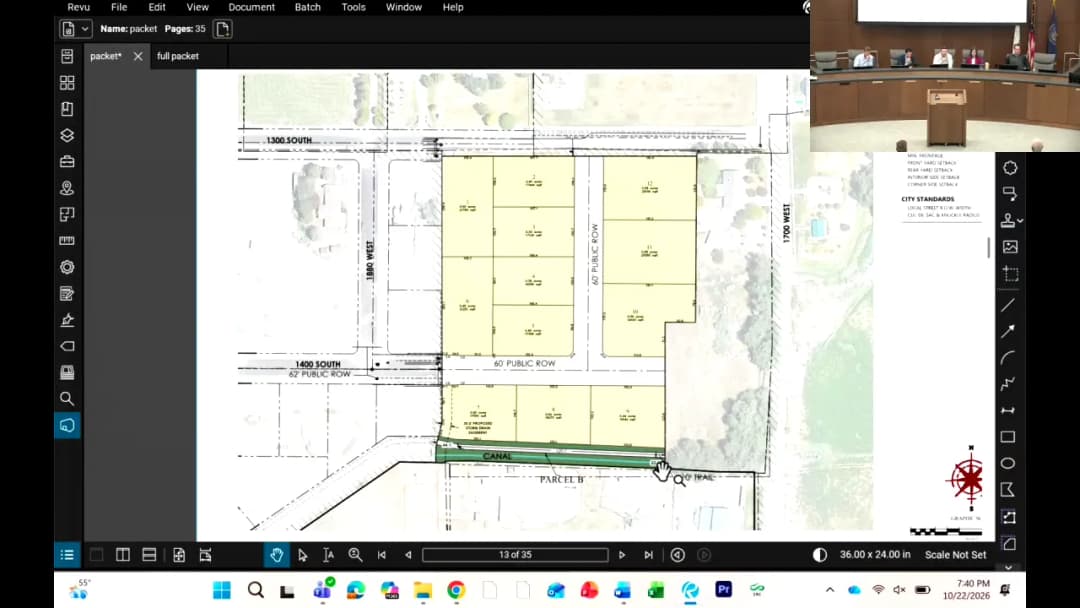
The Lehi Planning Commission met on 2026-10-22 at 7:00 PM in the Lehi City Council Chambers, 131 N. 100 E., Lehi, UT. It held public hearings and took action on five regular agenda items: a three-lot preliminary subdivision, an eight-foot fence request, a zone change, an updated 12-lot concept with bonus-density request, and a Development Code definitions cleanup. All items received affirmative votes or positive recommendations. Consent Calendar - The chair acknowledged the consent agenda but moved directly to the regular agenda; no consent items were discussed or voted on in the available transcript. Public Comments & Testimony - 3.1 Karren Estates – No public speakers. - 3.2 Lee fence – Applicant Janica Lee spoke in support. She said a north neighbor's security floodlights shine over her existing 6-foot fence into her backyard/deck, and the neighbor's cat regularly jumps the fence and defecates in her vegetable garden; she cited toxoplasmosis concerns. She also said a south neighbor's elevated porch is about 4.25 feet high, so anyone over about 2 feet tall can see over the existing fence. She asked that the two sides of the fence request be considered independently. - 3.3 Jarvis Zone Change – Nearby resident Spencer expressed concerns about stormwater and drainage in the neighborhood, particularly a large storm drain along the subdivision line, and asked for careful engineering review. He also asked that lots not go below the 8,000-square-foot minimum and asked that the new project not connect to the private driveway/courtyard at his end. - 3.4 Clark Meadows – Staff summarized online comments. Commenters strongly preferred the earlier 10-lot layout over the requested 12-lot density increase, said the developer had already received concessions, argued smaller lots would undermine R-1-22 standards and neighborhood privacy/views, raised concerns about Lehi's agricultural character, trail connections, and traffic access. Dan Logan, who lives at the corner of 1700 West and 1300 South, asked whether the existing home on the property would be demolished and requested a new plot map. - 3.5 Chapter 39 Definitions – No public speakers. Discussion Items - 3.1 Karren Estates Plat A Preliminary 3-Lot Subdivision – Staff said the proposal would split the existing lot at 105 South 500 West into lots from approximately 8,600 to 13,400 square feet, consistent with the 8,000-square-foot minimum. The agenda names the project “Karren Estates”; the transcript's staff presentation refers to “Cairn Estates.” The commission approved the preliminary plat, finding it met the Development Code and including all DRC comments. - 3.2 Lee 8-Foot Fence – Staff explained that Chapter 12 requires fences to drop to 3 feet within the first 15 feet of the property for safety, and an exception cannot waive that requirement. The request came to the commission partly because there is no grade change and no written justification. Commission discussion clarified the fence could be 8 feet after the first 15 feet unless it is built to the curb/sidewalk, in which case the first 15 feet must be 3 feet or lower. The commission approved the 8-foot fence with the condition that the applicant keep the fence at or below 3 feet within 15 feet of the curb and may go up to 8 feet after that point, plus DRC comments. - 3.3 Jarvis Zone Change – Staff described the request by JDJ Investments LLC to change 1.89 acres at approximately 1840 North 2300 West from A-5 to R-1-8. Applicant Josh Jarvis said the property is under contract, not yet owned. A commissioner questioned whether a non-owner can request a zone change; staff said the owner/city administration was aware and the sale may have already closed. Public comment raised drainage concerns; staff said the city's standard requires each lot to retain stormwater on site and most neighborhood drainage issues appeared to be in private lots/common areas rather than the public storm drain system. The commission recommended approval with findings that the change would have a positive effect on the surrounding area, is consistent with the General Plan, and is compatible with nearby properties, plus DRC comments. Staff said the item would go to City Council on November 10, 2026. - 3.4 Clark Meadows Updated 12-Lot Concept – Staff said Matt Loveland is requesting two lots of bonus density in lieu of reimbursement for project improvements, with an exception to the 22,000-square-foot minimum lot size; proposed lots range from over 16,000 to just over 25,000 square feet. The R-1-22 zone's overall density cap is 1.75 units per acre. The developer would dedicate a canal parcel and extend city trail improvements; South Creek to the west previously received a similar density-in-lieu arrangement. City engineering staff said the trade-off was favorable because the city would otherwise fund the trail/channel improvements. Applicant Matt Loveland said the project changed from an approved 11-lot plan to a 12-lot plan after review showed eligibility for the second bonus lot. He confirmed lot 1 faces north and lot 6 faces south and said the existing home would be torn down. Staff clarified the trail connection is required regardless; the 428 feet of trail and parcel B acquisition/improvement would otherwise be a city obligation. The commission recommended approval with findings that the concept is consistent with the Development Code and General Plan, plus DRC comments. Staff said it would also be on the November 10, 2026 City Council meeting. - 3.5 Development Code Update, Chapter 39 Definitions – Staff described the proposal to move all definitions scattered through the Development Code into one chapter, with redlined revisions and removal of outdated, redundant, or unused terms. Staff described it as cleanup rather than substantive policy change. No public comments were heard. The commission recommended approval, finding the amendment conforms to the General Plan. No opposition was voiced. City Business - Staff announced that a new code compliance officer with about nine years of code-enforcement experience had been selected, filling the vacancy created when Caden moved to the planner position. - The commission was told there will be a work session on the first Thursday in November, and only one regular meeting in both November and December. Key Outcomes - Approved the Karren Estates preliminary subdivision (3.1). - Approved Janica Lee's 8-foot fence with a 3-foot/15-foot-from-the-curb condition and DRC comments (3.2). - Recommended City Council approval of the Jarvis zone change (3.3). - Recommended City Council approval of the Clark Meadows 12-lot bonus-density concept (3.4). - Recommended City Council approval of the Chapter 39 definitions update (3.5). - The scheduled City Council date for items 3.3 and 3.4 was stated as November 10, 2026.

SUBDIVISION APPROVAL 26% · SIGN REGULATIONS 20% · CODE ENFORCEMENT 16% · ZONING REGULATIONS 14%
1220
OCT 22, 2026 · KIRKLAND, WASHINGTON · PLANNING COMMISSION
Kirkland Planning Commission Study Session on Neighborhood Commercial Code Amendments - October 22, 2026

The Kirkland Planning Commission held a study session on October 22, 2026, to continue developing the framework for a potential new neighborhood commercial allowance. The meeting was largely a working session to build a baseline 'Tier 1' model, asking the question: 'What regulation would work for most neighborhood commercial uses in most locations with decent actors?' Topics covering use types, scale, operational limits, and location criteria were systematically addressed to provide clear direction for staff to draft code amendments. A companion list of 'bike rack' outlier issues was established for future consideration. Public Comments & Testimony No members of the public appeared in person or virtually to provide testimony during the designated public comment period at the start of the meeting. Staff reviewed written public comment themes received prior to the meeting. These comments indicated strong support for the existing home occupation system, concern about the potential impact of new neighborhood commercial allowances on neighborhood character, and a preference for targeted location-based allowances over a citywide approach. Enforcement capability and the management of external traffic were recurring themes. Discussion Items Home Occupation Refinements: Staff reviewed proposed changes to home occupation regulations, primarily focused on removing 'hard to observe' standards (such as the 500 square foot limit) to improve enforceability for code enforcement. The commission reached a consensus to remove the specific 500-square-foot limit for home occupations, with Commissioner Bunyall and Chair Jacobson noting it was impractical and easily weaponized against neighbors. The commission supported retaining the requirement that the business owner resides on the property. It was agreed the primary distinction between a home occupation and a new neighborhood commercial use should be the level of customer openness and nuisance potential rather than a rigid square footage cap. Neighborhood Commercial Purpose & Allowed Uses: The commission affirmed the project's core purposes: facilitating convenience, ensuring compatible integration, promoting walkability, and creating community gathering spaces. Commissioner Reiser successfully added the goal of educating the public on the positive role of small businesses. The commission decided to combine the previously separated Tier 1 and Tier 2 allowed use lists into a single unified list encompassing retail, personal services, and crafts. A modification process will be included for uses that meet the overarching intent but are not explicitly listed. Auto-related uses, age-restricted products, and wholesale trade remain prohibited. Residential Connection & Scale: A significant debate centered on whether neighborhood commercial must be tied to a residential use on site. Commissioner Rutherford strongly advocated for requiring a resident with a direct connection to the business (someone with 'skin in the game'), a position supported by Commissioners Bunyall and Reiser. Chair Jacobson and Vice Chair Day favored ensuring a residential component exists on the property (a dwelling unit) without regulating the relationship between the resident and the business owner, arguing operational standards were better suited to addressing concerns. Staff was directed to explore both framing options and research how peer cities approach the issue. On scale, the commission settled on 500 square feet of customer-facing space as the baseline for Tier 1, applicable citywide. Operational Standards & Design: The commission generally supported an 8 a.m. to 8 p.m. hours of operation limit for the baseline and requiring customer queuing to occur on private property. A proposed 50-foot setback for outdoor food and beverage service was criticized by Commissioner Reiser as eliminating most standard Kirkland lots. The commission asked staff to return with a less restrictive alternative, such as a 15-foot setback paired with enhanced screening. Regarding parking, the commission supported staff's recommendation not to allow customer parking on the business's private property, relying instead on available on-street parking within 600 feet. Tier 2 Framework & Alcohol: The commission supported a Tier 2 allowance of up to 1,200 square feet within a quarter-mile radius of parks, schools, and medium-to-high density zones, generally aligning with the staff memo. Commissioner Rutherford suggested an alternative limiting tier 2 allowances to streets immediately fronting these public amenities. After extensive debate on alcohol, the commission supported allowing alcohol sales for on-site consumption (in restaurants/cafes) and for products manufactured on-site. The commission stood firmly against allowing a standalone off-sale liquor store as a neighborhood commercial use, with Commissioner Reiser asking, 'Do we really need to have it in the neighborhoods?' Pilot Program: The commission declined to pursue a formal pilot program for the new code. Commissioner Reiser stated he did not foresee a 'mad dash' of applications, and Chair Jacobson expressed a reluctance to add automatic legislative check-in milestones to the work program. Key Outcomes - Decision on Home Occupations: The 500 sq ft limit will be removed, focusing enforcement on observable impacts like noise and traffic. The owner-residency requirement remains. - Decision on N.C. Use List: Tier 1 and Tier 2 use lists are merged into one comprehensive list subject to a modification process. - Decision on N.C. Tier 1 Scale: 500 sq ft of customer-facing space, allowed citywide. - Decision on N.C. Tier 2 Scale & Location: Up to 1,200 sq ft, restricted to within 0.25 miles (or potentially adjacent to) designated activity zones. - Decision on Alcohol in N.C.: Allowed for on-site consumption and on-site manufacturing. Standalone off-sale liquor stores are prohibited. - Decision on Residential Connection: Deferred for more information. Staff will provide draft options for the December meeting on how to codify a requirement for a residential component vs. a specific resident connection to the business. - Directive to Staff: Begin drafting code amendments reflecting the commission’s direction for review at the December 10, 2026, study session. - Next Steps: Public hearing on the draft code anticipated in early 2027. The commission will formally vote on a residency connection requirement at a future meeting.

HOME OCCUPATION 24% · PLANNING AND ZONING 22% · NEIGHBORHOOD PLANNING 7% · LAND USE 7%
OPENPUBLICA · PUBLIC MEETING INDEXUPDATED DAILY · openpublica.com