Browse by city
Date range
Search help

Search titles, summaries, topics and stored transcripts together. Keywords may match separately; put the whole query in double quotes for a phrase. Matching follows word analysis, so punctuation is not exact. Both dates are included. Documents are not searched.

SHOWING 2741–2750 ENTRIES
2741
OCT 8, 2026 · WASHINGTON, DISTRICT OF COLUMBIA · COUNCIL OF THE DISTRICT OF COLUMBIA
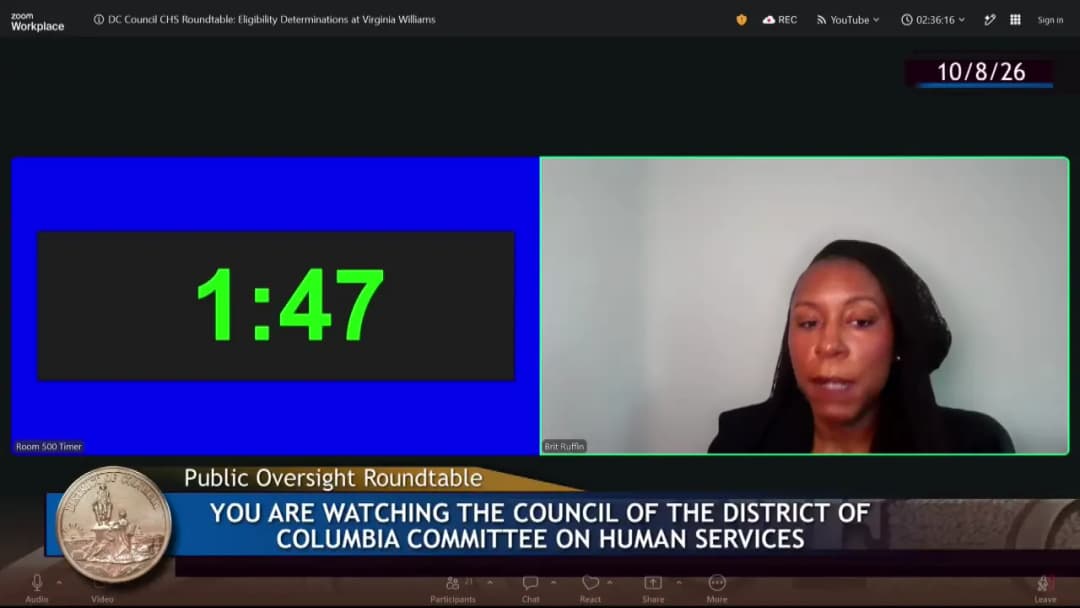
Oversight Roundtable on Eligibility Determination at Virginia Williams Family Resource Center – October 8, 2026

The Committee on Human Services, chaired by Councilmember Matt Freeman (Ward 3), held an oversight roundtable on the eligibility determination process at the Virginia Williams Family Resource Center, operated by the Department of Human Services (DHS). The meeting examined barriers families face when accessing homeless services, including documentation requirements, the Homelessness Prevention Program (HPP), and treatment of domestic violence survivors. Chairperson Freeman expressed disappointment that DHS failed to provide requested documents, including eligibility scripts, citing operational concerns. Councilmember Trayon White also offered opening remarks emphasizing the need for equitable services. Public Comments & Testimony - Domestic Violence Survivors and Advocates: Multiple witnesses from the DC Coalition Against Domestic Violence (Michaela Deming, Dawn Dalton, Teresa Poor) testified that survivors face barriers including ID requirements, lack of trauma-informed care, inappropriate diversion to unsafe living situations, and failure to properly screen for domestic violence. They reported that only 4% of families seeking services at Virginia Williams were referred to DASH (domestic violence services) in FY26, and that DHS has not implemented past recommendations. Jasmine Ferguson (Community Family Life Services) noted that her transitional housing program does not receive referrals from Virginia Williams and that the SPADAT assessment tool is not used effectively to connect clients to housing. - Families and Legal Advocates: Lejuan Brooks (Washington Legal Clinic for the Homeless) described families being asked for impossible documentation (e.g., former landlord letters, friend's lease) and denied shelter despite having no safe place to stay. He noted that legal services are no longer on-site at Virginia Williams, and that the clinic's flyers were removed from the building security desk. Tamika Kennedy, Monique Jackson, Charmaine Brown, and Jasmine Waters shared personal stories of repeated denials due to lack of documents, being told to stay with unsafe relatives, or having to prove homelessness by showing vehicles. Ms. Kennedy was only placed after advocacy from the Legal Clinic. McKenna Osborne (Children's Law Center) raised concerns about HPP operating as a shelter denial without appeal rights, lack of transparency and regulations, and that 50% of HPP participants return to Virginia Williams within two years. - Additional Virtual Witnesses: Shoney Jones (Family Voices DC) stated HPP is misused as a barrier, funding is limited to three months (six if leaving DC), and that a public data dashboard is needed. Joanny Enriquez (DC SAFE) stressed the need for safety-centered diversion and consistency. Robin Swanson (Volunteer Legal Advocates) highlighted that survivors often do not self-identify and that intake scripts remain secret, preventing verification of trauma-informed screening. Other witnesses (Tamisha Lawrence, Michael Campbell, Keisha Briscoe, Dineta Lewis, Britt Ruffin, Charisse Lew) testified to being denied shelter despite having no safe place, being asked for multiple contacts, and experiencing hostile treatment. Charisse Lew (Washington Legal Clinic) called the 75% shelter denial rate unlawful and urged amendment of the Homeless Services Reform Act (HSRA). Discussion Items - Director Pierre's Testimony: DHS Director Rachel Pierre stated that eligibility follows HSRA criteria (residency, family definition, homelessness). She emphasized prevention and diversion, noting that shelter is a last resort. She reported that in FY26, 4,672 assessments were completed, with 52% referred to HPP and 14% entering shelter. She stated that interim eligibility is used when documents are lacking, and that staff are trained to serve families with compassion. Director Pierre noted that HPP regulations are in development and should be published next year. - Documentation and Interim Eligibility: Chairperson Freeman pressed on why families are denied for lack of documents when HSRA prohibits denial solely for inability to prove residency or homelessness. Director Pierre responded that interim eligibility is available and that staff have flexibility to verify through data systems. She acknowledged that customer service issues may occur and that she would review cases. - HPP Transparency and Effectiveness: Councilmembers questioned the high rate of HPP referrals and lack of appeal rights. Director Pierre argued that HPP prevents homelessness and that only 2.5% of HPP families return to shelter. She stated that shelter is provided if a family has no safe place to stay. The committee discussed the need for clear HPP regulations and data on outcomes. - Domestic Violence Training and Screening: Witnesses and Councilmember White raised concerns about DHS staff training on domestic violence. Director Pierre stated that DASH provides monthly training and that the assessment form (FAM) was developed with DASH input. She denied cuts to DASH training funding and noted that a co-located DASH team is available. She agreed to review the percentage of DV identifications dropping from 10% to 4%. - Access to Legal Services: Brooks and others requested a reinstated presence of the Washington Legal Clinic at Virginia Williams. Director Pierre explained that the lease restricts non-provider organizations and that space is limited, but the clinic's information is included in denial notices and she is open to continued meetings. - Data and Transparency: Chairperson Freeman suggested a public dashboard similar to DOB's, and Director Pierre said she would explore the idea. The committee also discussed publishing HPP regulations, providing definitions of safe housing, and tracking outcomes by intervention type. Key Outcomes - DHS committed to providing outstanding documents, including the evidence-based assessment tool (WestAT), following the hearing. - DHS will work to publish HPP regulations within the next year, including eligibility criteria and transparency measures. - Director Pierre agreed to review individual cases mentioned in testimony and to improve customer service training. - The committee will follow up on proposals for a public data dashboard and a consumer advisory group. - No formal votes were taken; the record will remain open until 5 p.m. on Thursday, October 22, 2026 for written testimony.
HOMELESSNESS 58% · DOMESTIC VIOLENCE SERVICES 13% · PUBLIC ENGAGEMENT 7% · PUBLIC BENEFITS 6%
2742
OCT 8, 2026 · FORT WORTH, TEXAS · CITY COUNCIL
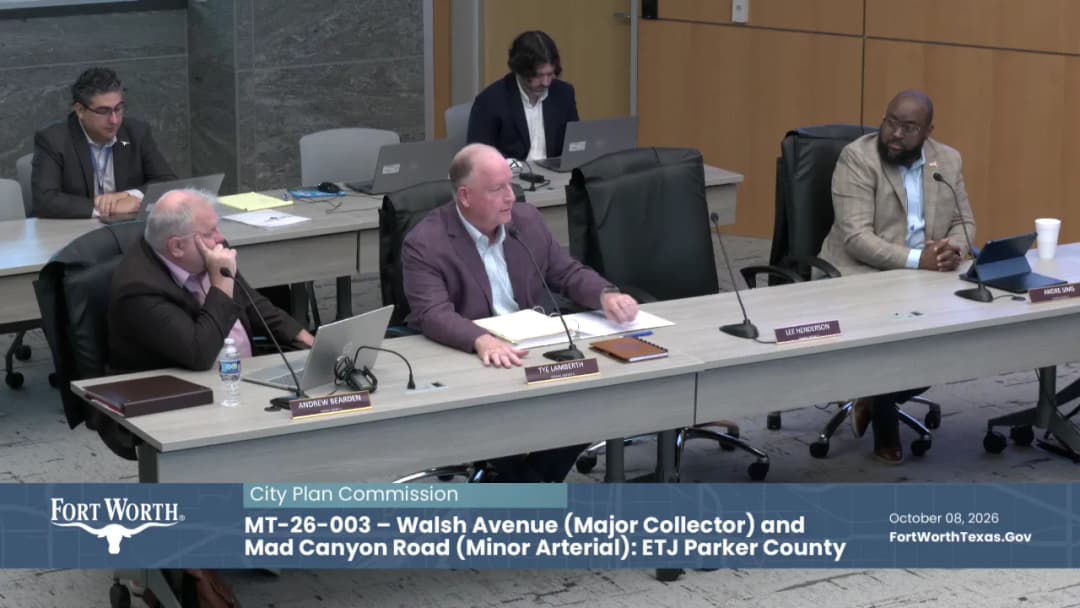
October 8, 2026 Fort Worth City Plan Commission Meeting

The Fort Worth City Plan Commission met on October 8, 2026, at 9:00 AM with seven of eleven members present, achieving a quorum. The commission reviewed and acted on multiple land development cases, including subdivision waivers, street vacations, alignment changes to the Master Thoroughfare Plan, and an urban corridor plan. All recommendations will be forwarded to the City Council. Consent Calendar - The commission approved the previous meeting's minutes and received staff reports. Public Comments & Testimony - Travis Clegg (Westwood Professional Services), representing applicant Stand Ridge for the Walsh Ranch MTP case, stated that the existing alignment would cut through a major building on their recently annexed property and requested approval to move the roadway to the property line. He expressed willingness to continue discussions with adjacent landowners. - Odysse Lee (Barrett Hampton Brown Engineers), representing the Boswell interests (adjacent 787-acre property), requested a tabling or continuance of the Walsh Ranch case. He stated that the proposed change was received only a week prior and that Boswell had not had adequate time to evaluate its impact on their development plans. He noted that Boswell supports the applicant's overall development but wants to be involved in road alignment decisions. - Sam Franklin (Morphic Development), applicant for the Marine Creek Parkway alignment change, explained that the change was needed to avoid a stormwater outfall and improve intersection safety, and that adjacent landowners and public works had provided letters of support. Discussion Items - VA 26-005 – Vacation of Sand Shell Boulevard Right‑of‑Way and Waiver Request: The applicant requested withdrawal of the case to avoid triggering a follow-up hearing. The commission voted unanimously to withdraw the item. - FS 26189 – Harmon Heritage Edition Waiver Request: The applicant sought a waiver to allow a cul‑de‑sac in an industrial district. Staff noted the unique circumstances of the lot configuration. The commission initially deferred the item to clarify the applicable code section; after clarification, the waiver and the final plat were conditionally approved unanimously. - PP 2301 – Nance Ranch Revision Waiver Request: A waiver was requested for block‑face length in a large residential subdivision. Staff recommended approval, citing mitigation through alley access. The commission approved the waiver and plat unanimously. - MT 26003 – Walsh Ranch MTP Alignment Change: The applicant requested a minor realignment of Mad Canyon Road (Major Collector) and Walsh Ranch Road (Minor Arterial) to move the intersection away from a gas well site and onto their property line. The Boswell interests asked for a continuance. After debate, the motion to continue failed 4‑3, and the motion to recommend approval to City Council failed 2‑5, resulting in a recommendation of denial being forwarded to council. - MT 26004 – Marine Creek Parkway MTP Alignment Change: An alignment change was recommended to avoid a stormwater outfall and create a safer intersection. The commission unanimously approved recommending the change to City Council. - McCart Avenue Hub Transportation Technology Corridor Project: Staff presented a 10‑mile corridor study from I‑20 to Future County Road 920. The plan addresses safety, multimodal connectivity, and economic development, informed by over 580 survey responses and extensive stakeholder outreach. The commission unanimously voted to recommend adoption by the City Council. - Panther Island Form‑Based Code Amendment: Staff and TRWD representatives presented an update that consolidates nine subdistricts into two (Panther Island Core and Panther Island Edge), reduces maximum block lengths from 400 to 300 feet, sets new building height ranges, and adds waterfront standards and a signage chapter. The commission unanimously recommended adoption by the City Council. Key Outcomes - VA 26-005: Withdrawn (7‑0). - FS 26189: Waiver granted and final plat conditionally approved (7‑0). - PP 2301: Waiver granted (7‑0). - MT 26003 (Walsh Ranch): Continuance motion failed (4‑3); approval motion failed (2‑5); thus a recommendation of denial proceeds to City Council. - MT 26004 (Marine Creek): Recommendation to approve alignment change (7‑0). - McCart Corridor: Recommendation to adopt the project (7‑0). - Panther Island Code: Recommendation to adopt the amended form‑based code (7‑0). The meeting concluded; future meetings will be held in the council chambers.

LAND USE PLANNING 44% · PROCEDURAL 16% · TRANSPORTATION 12% · ZONING 8%
2743
OCT 8, 2026 · BOSTON, MASSACHUSETTS · CITY COUNCIL
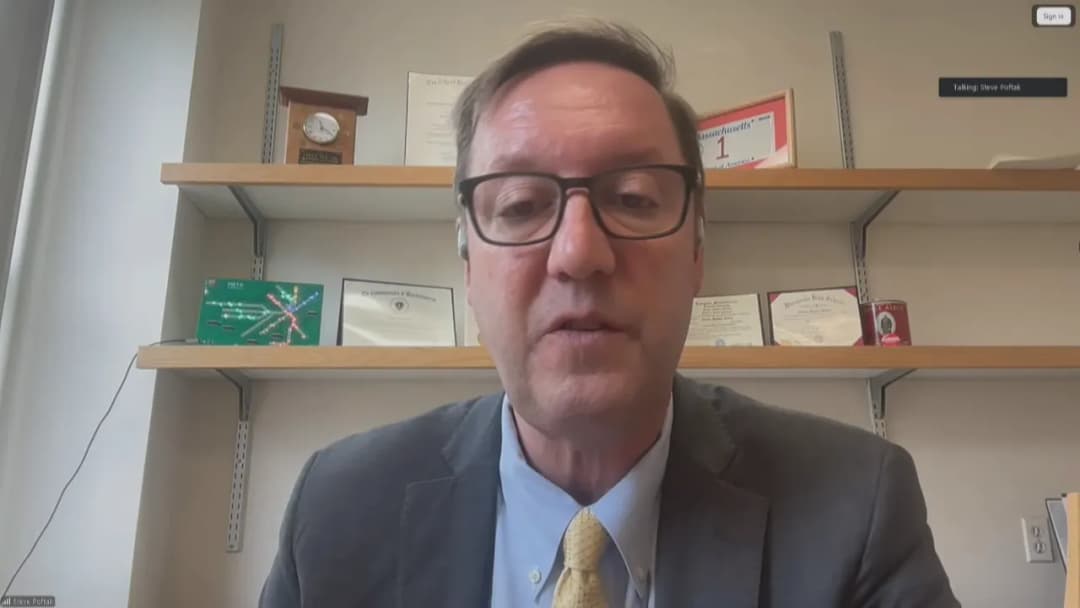
Government Operations Committee Hearing on Quarterly Revenue Reports Ordinance – October 8, 2026

Boston City Council’s Government Operations Committee convened virtually on October 8, 2026, at 10:01 AM to hear testimony on Docket 1099, an ordinance requiring quarterly revenue reports to be provided to the City Council. The hearing was chaired by the Committee Chair and included remarks from Councillors Warrell, Louis Jeanne, Flynn, and Culpepper. The ordinance was sponsored by Councillors Warrell, Culpepper, and Mejia and referred to the committee on May 29, 2026. The meeting was conducted virtually via Zoom under Chapter 2 of the Acts of 2025, which modifies open meeting law requirements. Consent Calendar - No consent calendar was presented at this hearing. Public Comments & Testimony - No public testimony was given during this hearing. Discussion Items - Ordinance Purpose (Docket 1099): The ordinance would require the administration to provide quarterly revenue reports to the Boston City Council, similar to existing quarterly expenditure reports. It was sponsored by Councilors Warrell, Culpepper, and Mejia and referred to the committee on May 29, 2026. - Councilor Warrell (Sponsor): Argued the ordinance is a basic transparency measure to codify quarterly revenue reporting, which currently exists

FISCAL SUSTAINABILITY 35% · PUBLIC ENGAGEMENT 34% · BUDGET EQUITY ANALYSIS 14% · DATA MANAGEMENT 11%
2744
OCT 8, 2026 · PRINCE GEORGES COUNTY, MARYLAND · COUNTY COUNCIL & BOARDS
Prince George's County TIEE Committee Meeting Summary for October 8, 2026

The Transportation, Infrastructure, Energy, and Environment (TIEE) Committee of the Prince George's County Council met on Thursday, October 8, 2026, at 10:09 AM. Chair Thomas Dernoga presided, with Vice Chair Eric Olson and Council Members Timothy Adams, Sydney Harrison, and Danielle Hunter present. The meeting was adjourned at 12:24 PM. The agenda included a briefing on the WSSC Water FY 2028 preliminary proposed budget and action on two resolutions concerning energy infrastructure planning and climate action leadership. Discussion Items WSSC Water FY 2028 Preliminary Proposed Budget Briefing - Presentation: WSSC Water General Manager/CEO Kishia Powell, along with CFO Munetsi Musara, Chief Engineer Alan Wong, and Director Priscilla To, presented the utility's preliminary budget. The presentation framed the budget around a refreshed vision across four pillars: workforce, infrastructure, innovation, and community trust. - Budget Overview: The FY 2028 operating budget is primarily supported by rate revenue (93%). The capital improvement program (CIP) is proposed at $742.8 million for FY 2028 and $4.71 billion over six years. The utility is proposing a 7% rate enhancement as a base case, significantly lower than the 11.7% recommended by a cost-of-service study, in an effort to manage customer impact. - Key Cost Drivers: The presentation highlighted significant cost pressures, including aging infrastructure, electrical system obsolescence at the Potomac Water Filtration Plant, rising personnel and healthcare costs, increased overtime and paving restoration costs due to a higher number of main breaks (planning for 2,300 in FY 2028 compared to a historical estimate of 1,800), and external factors like regional sewage disposal cost increases. - Customer Assistance: WSSC highlighted its commitment to affordability, maintaining $10.64 million in customer assistance programs and noting that since 2023, $32 million in assistance has been provided to nearly 81,000 customers. - Council Questions and Discussion: Council members raised questions about rate comparisons with other jurisdictions, the root causes of overtime costs, utility coordination with PEPCO on grid reliability, plans for data center water consumption, and opportunities for solar and bioenergy generation on WSSC property. Council Member Hunter requested better marketing of assistance programs for residents. Council Member Adams stressed the importance of protecting vulnerable and fixed-income residents. Council Member Dernoga requested a district-by-district breakdown of assistance program utilization. Discussion also centered on the recent Potomac Water Filtration Plant power outage and the urgent need for electrical system upgrades. CR-098-2026: Energy Infrastructure Planning for Better Utility Bills - Purpose: This resolution directs the Maryland-National Capital Park and Planning Commission (M-NCPPC) to study the benefits and challenges of master planning for utility use and to provide a report to the county council with recommendations. - Stakeholder Testimony (Maryland Clean Energy Center - MCEC): MCEC Executive Director Kathy Magruder, joined by Keith Wang, Ben Rupert, and Damian Trasada, expressed strong support for the resolution's objective of strategic energy planning. They provided an overview of their financing capabilities, including the Maryland Clean Energy Capital (MCAP) program, the Climate Catalytic Capital (C3) Fund, and the Jane E. Lawton Conservation Loan Program. MCEC offered to serve as a financing and technical assistance partner to the county. Council members requested MCEC pursue formal engagements with Bowie State University and Prince George's County government. - Stakeholder Testimony (M-NCPPC Planning Department): Planning Department staff stated they are in strong support of an energy infrastructure master plan but expressed reservations about being named the lead agency for the study. They indicated they lack specific engineering and utility expertise, would require an outside consultant, and the work is not in their current approved work program, meaning it could not begin before the next fiscal year without displacing other commitments. - Outcome: Council members noted the lack of a report date and misalignment of agency roles. A motion was made by Council Member Harrison, seconded by Council Member Hunter, to hold the resolution in committee until October 22, 2026, to allow time for the sponsor and stakeholders to amend the bill. The motion carried unanimously (5-0). CR-101-2026: Climate Action Leadership and Engagement by All County Agencies - Purpose: This resolution, sponsored by Council Member Ivey, mandates a unified, whole-of-government approach to climate change mitigation. It requires all county agencies to participate in the Interagency Climate Committee (ICC), adopt emission reduction targets into their core goals, and provide standardized biannual progress reports. - Department of the Environment (DOE) Testimony: Deputy Director Coley, Christopher Akmabola, and Danielle Miller Wagner presented an update on the ICC, which has been meeting monthly since May 2025. They reported it has facilitated collaboration on tree planting, heat pumps, and grant applications. Regarding electric vehicle (EV) charging, they stated that while current county building chargers are primarily for the county fleet, plans are in place to expand public access, and an application for a $16.5 million state grant for community EV infrastructure is in progress. - Amendments and Discussion: Council members raised a concern, prompted by a communication from a former Sierra Club member, that controversial but crucial elements of the county's Climate Action Plan, specifically related to land use and tree conservation, were being deprioritized in practice. An amendment was proposed to explicitly require these priority areas to be integrated into the ICC's work. - Outcome: A motion was made by Chair Dernoga, seconded by Council Member Adams, to favorably recommend the resolution with the described amendments. The motion carried unanimously (5-0). Key Outcomes - WSSC Water Briefing: The briefing was received as part of the FY 2028 Spending Affordability Process. No formal vote was taken on the budget or proposed rate structure. The county council is scheduled to adopt resolutions on WSSC spending limits by the end of October. - CR-098-2026 (Energy Infrastructure Planning): Held in Committee (5-0). Re-referred for amendments and further discussion at the October 22, 2026 meeting. - CR-101-2026 (Climate Action Leadership): Favorably recommended to the full council with amendments (5-0). The amendments aim to ensure land use and tree conservation are prioritized in the work of the Interagency Climate Committee. - Next Scheduled Meeting: October 22, 2026.

WATER AND WASTEWATER MANAGEMENT 32% · ENERGY MANAGEMENT 28% · PROCEDURAL 9% · PUBLIC WORKS 9%
2745
OCT 8, 2026 · MONTGOMERY COUNTY, MARYLAND · COUNTY COUNCIL & COMMITTEES
Montgomery County Government Operations and Fiscal Policy Committee Reviews Bills 32-26 and 33-26, October 8, 2026

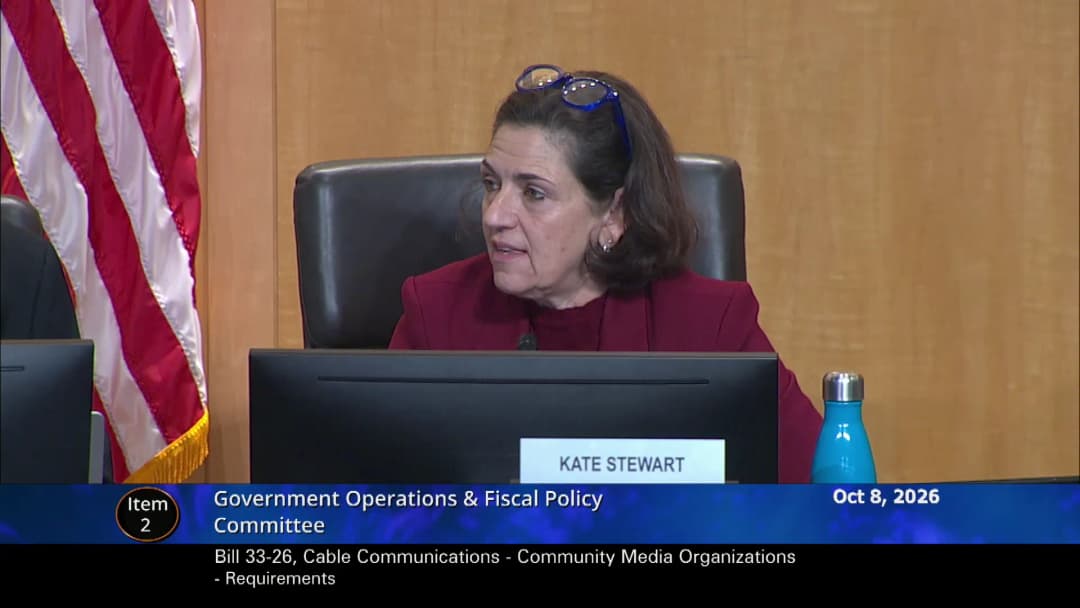
The Montgomery County Council's Government Operations and Fiscal Policy (GO) Committee met on October 8, 2026, for a scheduled 9:30 a.m. to 12:30 p.m. session in Room 3CHR. The committee reviewed two bills: Expedited Bill 32-26 on expanded survivor benefits and Bill 33-26 on community media organization contracting requirements. Both bills received unanimous favorable recommendations to the full council. Expedited Bill 32-26 - Employees' Retirement System: Survivor Benefits for Line-of-Duty Deaths - Councilmember Katz, the lead on the bill, expressed strong support, saying the change 'should have been done a long time ago' and that families of employees who give their lives in county service deserve all survivor benefits. He noted all councilmembers co-sponsored the legislation. - Councilmember Luedtke (referred to as 'Lukey' in the transcript) said the bill extends the HERO Act work from 2025 to additional retirement groups and thanked MCGEO for working with the council on timing, respecting collective bargaining. - Staff explained that Expedited Bill 32-26 expands the HERO Act (Council Bill 35-25, enacted 2025), which increased survivor benefits for police officers and firefighters killed in the line of duty, to retirement Groups E and J: correctional facility employees, emergency communications personnel, correctional officers, and sworn deputy sheriffs. - Staff presented an amendment to align the bill with Bill 21-26, recently enacted in conformance with MCGEO collective bargaining agreements, by removing certain age requirements for retirement eligibility. The committee adopted the amendment without objection. - Councilmember Evans called the bill a 'no-brainer' and expressed full support. - The committee voted unanimously to recommend the bill favorably to the full council. Bill 33-26 - Cable Communications: Community Media Organization Requirements - Chair Stewart provided context that the bill amends Section 8A-32 of the County Code, which enables the county to contract with one or more community media organizations using cable TV special revenue funds or other funds designated for community media. She clarified that the bill does not affect nonprofits that are not defined as community media organizations. - She said the legislation follows the 2023 OLO report, addresses drastically dwindling cable funds, and reflects work with TEBS, MCM, Montgomery College, and MCPS to update county code and align with other county entities and national practices. - Staff summarized current bill provisions: a contracting community media organization must adopt a racial equity and social justice statement, board members must file financial disclosure statements, the board must include up to seven voting residents, with at least one member nominated by the county council and one by the county executive, and the organization must comply with the Open Meetings Act and the Maryland Public Information Act as originally drafted. - Staff noted the county has contracted with MCM since 2004 and that the packet inadvertently included a 2024 production services contract rather than the 2004 contract; staff said the correct contract would be added to the packet. - MCM's executive officer, Ms. White, submitted recommendations and analysis on the legislation. MCM board members and partner organizations were present in the audience. - The committee adopted amendments to require county-nominated board members to have experience in administration or financial management of a nonprofit media organization or governmental entity and to bar them from holding elected office while serving. The committee also removed the Maryland Public Information Act compliance requirement while retaining Open Meetings Act compliance. - The committee adopted an amendment, requested through the MCM board chair, changing the board residency requirement from 'up to seven voting members who must be residents' to 'a majority of voting members must be residents' because MCM's current board has 13 members and its bylaws allow 15. - The committee adopted a supplemental editorial independence amendment requiring bylaws to address board responsibilities, prohibit board members from exercising editorial control over news, ensure independent and unbiased news coverage free from pre-publication review by charitable donors, government interference, or political influence, and establish an editorial independence policy aligned with industry standards. During discussion, the phrase 'financial donors' was changed to 'charitable donors' to avoid conflicting with county contracts for collaborative production work. - Councilmember Evans voiced support, saying the goal was good governance and to set MCM up for success, not to interfere with MCM's operations or mission. - The committee voted unanimously to recommend the bill favorably to the full council as amended. Key Outcomes - Expedited Bill 32-26: The committee unanimously recommended favorable action to the full council, with the technical alignment amendment. - Bill 33-26: The committee unanimously recommended favorable action to the full council as amended, including amendments on board qualifications, board size/residency, removal of MPIA compliance, and editorial independence provisions. - Staff will supplement the Bill 33-26 packet with the correct 2004 contract. - Chair Stewart thanked Susan Madden, who is retiring from Montgomery College, and recognized TEBS, MCM, Montgomery College, and MCPS for their collaboration before adjourning the meeting.

PUBLIC ENGAGEMENT 49% · PUBLIC INFORMATION ACT 12% · PERSONNEL MATTERS 11% · COMMUNITY ENGAGEMENT 10%
2746
OCT 8, 2026 · OLYMPIA, WASHINGTON · CITY COUNCIL & COMMISSIONS
Olympia Planning Commission Meeting: CAO & Parking Reforms (October 8, 2026)

The Olympia Planning Commission met on October 8, 2026, at 6:30 p.m. in Room 207 and online. Chair Greg Quetin presided. The meeting concluded at 9:02 p.m. Key agenda items included a public hearing on the Critical Area Ordinance (CAO) update and a briefing on proposed Minimum Parking Requirements code amendments. The Commission also discussed a comment letter on the 2027-2032 Capital Facilities Plan (CFP). Consent Calendar - The meeting agenda was approved as submitted. - Minutes from the September 12, 2026 Planning Commission Retreat were approved with abstentions from Commissioners Aaron Sauerhoff and Jessica Grubb. - Minutes from the September 21, 2026 Planning Commission Meeting were approved unanimously. Public Comments & Testimony - No members of the public provided comment during the general public comment period. - A public hearing for the Critical Area Ordinance Update opened and closed at 6:47 p.m. with no speakers. Discussion Items - Critical Area Ordinance (CAO) Update (26-0767): Current Planning Manager Kernan Lien presented proposed amendments, representing the final step of the 2045 Comprehensive Plan update. Key changes included updated wetland buffers based on the Department of Ecology's preferred option, consolidated geologically hazardous reviews, and modifications to non-conforming use provisions. Agency comments from Ecology, WDFW, and DNR, received shortly before the meeting, were described as generally supportive with no expected substantive changes. - Minimum Parking Requirements Code Amendments (26-0770): Associate Planner Casey Schaufler briefed the Commission on amendments driven by the state's Parking Reform and Modernization Act (PRMA), which must be implemented by January 27, 2027. Staff proposed going beyond state law by eliminating all parking minimums and establishing parking maximums (e.g., 4 spaces per 1,000 sq ft for commercial, 2 spaces per unit for residential). The proposal streamlines parking use types from over 30 to 4 (Residential, Commercial, Industrial, Institutional/Public). Commissioners discussed bicycle parking standards (minimum 2, maximum 12 for commercial), the implication that ADA spaces can only be required if parking is provided, potential spillover into residential neighborhoods, and ensuring existing parking is not perpetually preserved. Commissioners requested a side-by-side comparison of state law requirements versus the city's voluntary proposed changes to inform their decision. Key Outcomes - Critical Area Ordinance: Commissioner Taellious moved, seconded by Vice Chair Garcia, to recommend City Council adopt the CAO amendments as drafted. The motion passed unanimously. - Minimum Parking Requirements: The Commission did not vote but indicated general support for the direction. Staff will refine the draft, including incorporating bicycle parking best practices from the Association of Pedestrian and Bicycle Professionals (APBP), and present a revised draft at a public hearing tentatively scheduled for October 19 or November 2, 2026. - Capital Facilities Plan Comment Letter: The Commission reviewed and approved a comment letter on the 2027-2032 CFP. The letter addresses recurring concerns about funding and the need for clearly defined levels of service tied to comprehensive plan goals. Staff will explore future briefings from the finance team. - Reports: Vice Chair Garcia informed the Commission about the annual 'Week Without Driving' events occurring from October 1st to 8th.

PARKING MANAGEMENT 41% · LAND USE PLANNING 18% · PROCEDURAL 8% · CAPITAL FACILITIES PLANNING 7%
2747
OCT 8, 2026 · MONTGOMERY COUNTY, MARYLAND · COUNTY COUNCIL & COMMITTEES
Economic Development Committee Work Session on Urban Districts and Placemaking Organizations - October 8, 2026

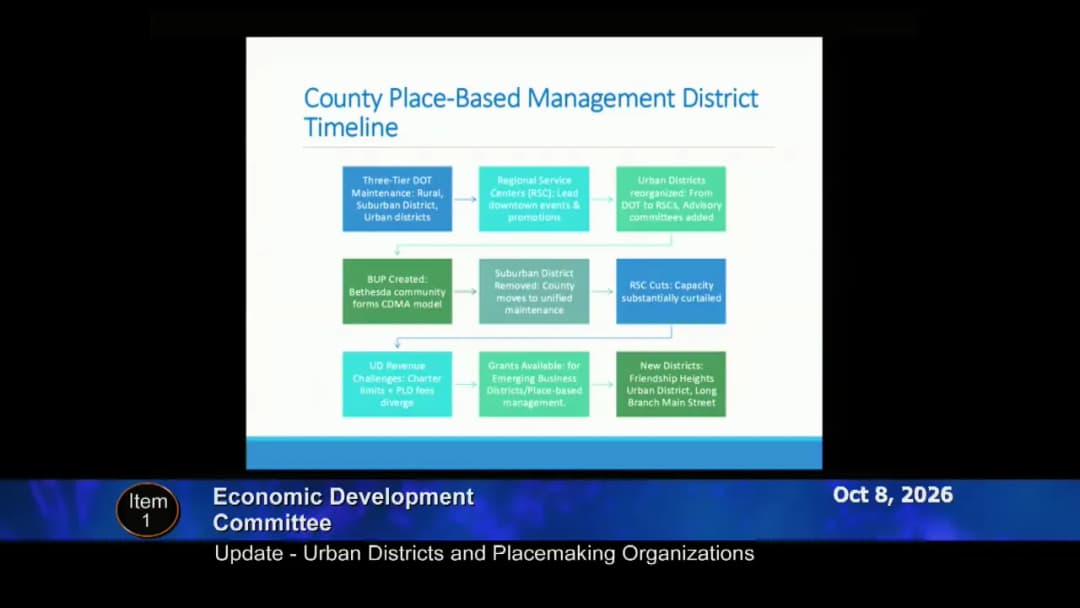
The Montgomery County Council’s Economic Development Committee (ECON) held a work session on October 8, 2026, from 9:30 a.m. to 12:30 p.m. to discuss the modernization of urban districts and placemaking organizations. Chair Natali Fani-González emphasized the need for countywide pride and equitable support across all districts, including emerging ones. The session included presentations from county staff, representatives from urban districts, main streets, business improvement districts, and regional service center directors. Discussions focused on funding models, transitioning to community-led models, and ensuring sustainable, locally owned placemaking efforts. Consent Calendar - No consent calendar items were considered. Public Comments & Testimony - No separate public testimony segment was held; invited speakers presented as part of the agenda. Discussion Items Staff Presentation on Urban Districts and Placemaking Ken Hartman-Espada, Assistant Chief Administrative Officer, provided a historical overview of the county’s urban districts (Bethesda, Silver Spring, Wheaton, and Friendship Heights) and alternative models such as main streets (e.g., Long Branch, Tacoma Park) and business improvement districts (e.g., Pike District Partnership). He noted that the parking lot district revenue, historically used to supplement urban districts, has declined, leading to greater reliance on the general fund. He proposed considering a transition of county-run urban districts (Wheaton and Silver Spring) to community-led models, with the county retaining heavy maintenance responsibilities. He stressed that any transition must be community-driven and locally funded. Placemaking Organization Presentations Representatives from several organizations described their work and challenges: - Martin Smith (Creative Wheaton) – Newly formed nonprofit pursuing Maryland Main Street designation; focused on arts-driven economic development and small business advocacy. - Paula Ross (Gaithersburg Germantown Up County Chamber) – Leading efforts to establish an urban district in Germantown Town Center; called for clarity on county investment and implementation of master plans. - Laura Barclay (Main Street Tacoma) – Reported distributing $352,000 in grants to local businesses, leveraging $5 million in private investment; urged creation of operational grants and shared data tools (e.g., Placer AI). - Teresa Cameron (Pike District Partnership) – Organized around committees for events, placemaking, transportation, and economic development; exploring feasibility of a business improvement district or urban district. - Chris Gillis (Montgomery Housing Partnership / Long Branch Main Street) – Emphasized that place-based management takes time; requested moving established programs to base budget to free competitive grants for emerging districts. Reported $1.5 million in capital investment and acquiring first commercial property. - Natalie Avery (Friendship Heights Alliance) – Cross-jurisdictional organization formed in 2022; highlighted 400 events, 75 planter gardens, 7 murals, and a net fiscal benefit analysis. Advocated for more housing near transit to support retail. Regional Directors’ Perspectives - TJ Dant (Bethesda/Chevy Chase) – Noted small team managing Bethesda and Friendship Heights urban districts; highlighted partnerships with Bethesda Urban Partnership (BUP) and others. - Jeff Burton (Bethesda Urban Partnership) – Described BUP as a national model; runs programs without additional county funds (e.g., Bethesda Circulator, art prizes, capital reserve of $2 million). Emphasized that strong county connection enables efficiency. - Nadia Kuth (Mid-County/Wheaton) – Stated that 95% of Wheaton’s urban district funding now comes from the general fund; supports clean and safe teams, events, and partnerships. - Jacob Newman (Silver Spring) – Noted challenges from pandemic, federal workforce layoffs, and immigration enforcement impacts (40% revenue decline reported by some businesses). Highlighted upcoming Purple Line implementation and anti-displacement work. - Jaru Bande (East County) – Described placemaking with minimal funding; requested resources for White Oak, Burtonsville, and other commercial centers. - Ruben Rosario (Up County) – Noted staffing constraints and need for sidewalk, landscaping, and safety improvements in Germantown; timing crucial with ongoing sector plan amendment. Councilmember Discussion - Vice President Marilyn Balcombe questioned who implements master plans, noting the lack of nexus between impact taxes and infrastructure. She argued for equitable baseline services across the county, noting urban districts have received over $10 million each in general fund transfers while emerging districts get little. - Councilmember Evan Glass highlighted the link between density, housing, and small business viability. He urged rethinking funding mechanisms, including property owner contributions, and noted the symbiotic relationship between placemaking organizations and chambers of commerce. - Councilmember Laurie-Anne Sayles called for clearer metrics to evaluate return on investment, a matrix of resources across organizations, and clarification on the role of advocacy (vs. lobbying) for nonprofits using taxpayer funds. She supported including Visit Montgomery in future coordination. - Chair Fani-González announced she will convene a face-to-face meeting of all the placemaking organizations and regional directors before the end of the year to exchange ideas and develop recommendations for the incoming administration. Key Outcomes - No formal votes were taken; the session served as a discussion and information-gathering exercise. - Chair Fani-González directed the placemaking organizations and regional directors to meet together before the end of 2026 to share best practices and develop recommendations for transitioning urban districts and supporting emerging districts. - Staff and councilmembers acknowledged the need to: (1) identify sustainable, locally controlled funding sources; (2) establish baseline service levels and equitable support across the county; (3) develop standardized metrics to measure economic development ROI; and (4) clarify the distinction between advocacy and lobbying for organizations receiving public funds. - The council will continue discussions as part of the broader economic development strategic plan.

ECONOMIC DEVELOPMENT 70% · URBAN PLANNING 12% · PUBLIC ENGAGEMENT 6% · COMMUNITY ENGAGEMENT 2%
2748
OCT 8, 2026 · NEW ALBANY, INDIANA · CITY COUNCIL & BOARDS
New Albany Sewer Board Meeting - October 8, 2026

Note: The formal agenda listed the meeting start time as 9:15 AM EDT, differing slightly from the scheduled UTC timestamp associated with these records. The New Albany Sewer Board convened on Thursday, October 8, 2026, at New Albany City Hall. The board unanimously approved a series of engineering contracts for the ongoing campus modernization project, along with routine approvals of minutes and vendor claims. Discussions included the city's budget timeline, the financial health of the utility, and a sewer easement for a major development. Consent Calendar - Minutes: The minutes from the September 24, 2026, regular meeting were approved unanimously. - Claims: A claims docket totaling $249,657.28 for the period of September 24 to October 7, 2026, was approved unanimously. Public Comments & Testimony - No members of the public offered comments. Discussion Items - Engineering Contracts for Campus Modernization: Staff presented four contracts. A master agreement with Clark Dietz (task order basis), an architectural/engineering agreement with Tower Pinkster (not to exceed $27,000), a surveying agreement with Foresight (not to exceed $23,600), and a geotechnical agreement with SME (not to exceed $16,600) to analyze the old tank basin and support road design. Staff discussed the need for soil testing and potential road and sidewalk improvements at the main entrance. - Budget and Financial Planning: Linda, a city official, informed the board that the city council would hold the third and final reading of the city budget on October 15. The board agreed to wait for this process to conclude before holding a dedicated workshop for the Sewer Board's 2027 budget. - Sewer Easement for Pageant Development: Scott Hannon of Heritage Engineering presented an easement request for the Pageant development, which he described as “hundreds of units.” He stated capacity had been previously certified. The board deferred approval, directing staff to review the easement and present it to the Board of Public Works and Safety. - Financial Report: Ed presented the financial report, stating the utility is operating within budget, generating positive cash flow of roughly $100,000 per month, and has accumulated over $700,000 for the year. Key Outcomes - Contracts Approved (4): The four engineering contracts for the campus modernization project were approved unanimously. - Claims Approved: Claims totaling $249,657.28 were approved. - Budget Workshop Pending: A Sewer Board budget workshop will be scheduled after the city council’s final reading on October 15. - Easement Deferred: The Pageant sewer easement was deferred for further staff review and a subsequent presentation to the Board of Public Works and Safety.

ENGINEERING AND INFRASTRUCTURE 47% · PROCEDURAL 43% · FISCAL SUSTAINABILITY 10%
2749
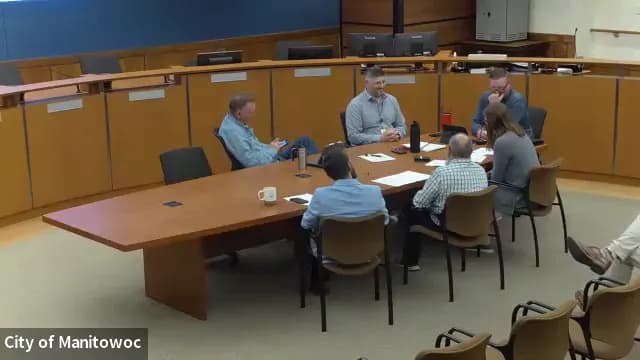
OCT 8, 2026 · MANITOWOC, WISCONSIN · COMMON COUNCIL & COMMITTEES
Board of Public Works Meeting - October 8, 2026

Note: The meeting agenda and minutes indicate the actual meeting date was October 7, 2026, but the user-specified date for this summary is October 8, 2026. The Board of Public Works met on the specified date to consider a contract for tree planting, multiple change orders, and a series of pay estimates for various engineering and public works projects. All actions were approved unanimously by the members present. Discussion Items - Agreement 26-05 – Tree Planting at Various Parks: The Board approved a $18,750 contract with Lakeland Landscape, Inc. for tree planting at city parks. The motion passed with a 6-0 vote (Ayes: Koski, Alfred, Nycz, Norell, Reckelberg, Swokowski; Absent: Nickels, Beeman). - Change Orders: Four change orders were presented and approved unanimously (7-0): - Gorman & Company, CO 1 & Final for 2026 Supplemental Remediation at Former Mirro Site (WO-26-11): $0.00 to finalize quantities. During the meeting, the chair initially read the change amount as $67,059.76, but the minutes clarify the contract change is $0.00 and 0 days. City representative Adam explained the change reallocates funds for contaminated waste disposal discovered on-site, with no cost to the city. - Visu-Sewer, Inc., CO 1 & Final for 2026 Re-Lining Sewers (WU-26-7): a decrease of $6,504.00. - Alfson Excavating LLC, CO 1 & Final for 2026 Sanitary & Storm Sewer Construction (WU-26-08): an increase of $15,651.89. - Northeast Asphalt, Inc., CO 1 & Final for 2026 Asphalt Paving Program (WS-26-4): a decrease of $3,867.08. - Pay Estimates for Various Engineering/Public Works Projects: Eleven pay estimates were presented and approved unanimously (7-0). Notable amounts include: - 5th Pocket Skateparks, Inc., Manitowoc Skatepark Expansion, Est. 3: $92,850.00 - 5th Pocket Skateparks, Inc., Manitowoc Skatepark Expansion, Est. 4 & Final: $4,959.00 - Foth Infrastructure & Environmental, LLC, Sanitary Sewer Master Plan, Est. 2: $27,274.70 - Ayres Associates, Inc., STH 42 Sanitary Sewer Replacement, Est. 10: $1,021.77 - RA Smith, Franklin Street Reconstruction, Est. 7: $16,951.74 - Seiler Bros Construction, Inc., 2026 Complaints Remove & Replace Sidewalks, Est. 3: $3,319.57 - Northeast Asphalt, Inc., Asphalt Paving I, Est. 3 & Final: $2,802.70 - Gorman and Company, 2026 Supplemental Environmental Remediation at Former Mirro Site, Est. 1 & Final: $145,011.19 - Visu Sewer, 2026 Re-Lining Sewer Project, Est. 2 & Final: $9,013.65 - Alfson Excavating, Sanitary Sewer Relay Project, Est. 3 & Final: $20,644.98 - Scott Construction, Inc., Seal Coat Program, Est. 1 & Final: $136,345.40 - Contractor's Payroll Affidavits: None were submitted. Key Outcomes - All five motions (Agreement, Change Orders, Pay Estimates, and Adjournment) carried unanimously with either 6-0 or 7-0 votes. - The meeting was adjourned at 4:05 p.m. following a motion by Nycz, seconded by Beeman.

PUBLIC WORKS 100%
2750
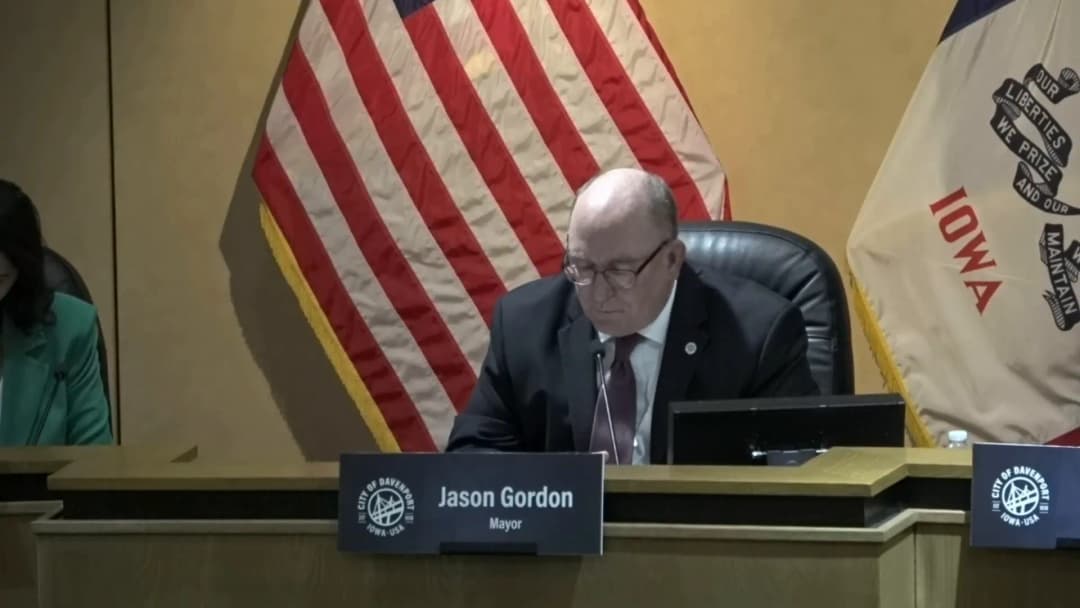
OCT 8, 2026 · DAVENPORT, IOWA · CITY COUNCIL
2026-10-07 Davenport City Council Special Meeting: Second Ward Appointment

A special meeting of the Davenport City Council was called to order on Wednesday, October 7, 2026, to consider a single agenda item: a resolution approving an appointment to fill the vacancy in the Second Ward city council seat. Council members discussed the candidate pool and ultimately voted on the appointment. Consent Calendar - No consent calendar items were listed or considered during this special meeting. Public Comments & Testimony - No public comments or testimony were provided during this meeting. Discussion Items - Appointment to Fill Second Ward Vacancy: Council members discussed the appointment process and candidate qualifications. The mayor stated he was excited by the quality and quantity of candidates (six total), and prioritized the ability to

PERSONNEL MATTERS 84% · PROCEDURAL 16%
OPENPUBLICA · PUBLIC MEETING INDEXUPDATED DAILY · openpublica.com