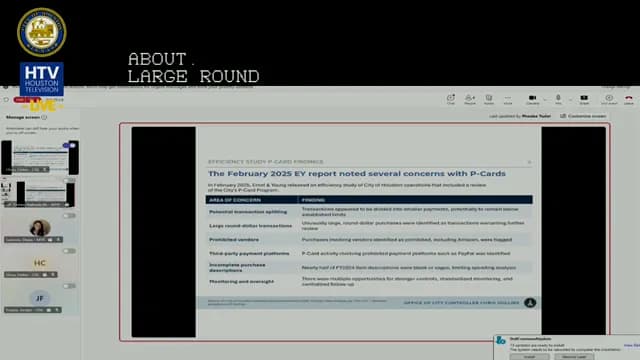
The Budget Fiscal Affairs Committee, chaired by Councilmember Sally Alcorn, convened on November 2nd, 2026, to discuss a packed agenda including the quarterly financial report, upcoming financial transactions, departmental overtime projections, the parks open space ordinance, P-card expenditure trends, and an audit division update. The meeting included multiple presentations, public testimony, and robust councilmember questions. Public Comments & Testimony - Jack Velinski spoke on budget matters, urging the city to increase revenue through tax rate adjustments rather than deferring maintenance. He noted that deferred maintenance was projected to grow from $750 million to $1.5 billion over five years, and argued that underspending now costs the city more later. - Beth Martin (Environment Texas) expressed strong support for the proposed open space ordinance changes and fee increase, citing Houston's 69th place in the Trust for Public Lands 2026 Park Score rankings and the need for reliable park funding. - Phoebe Tudor (virtual, former Parks Board member and Herman Park Conservancy supporter) spoke in favor of the plan, calling parks "an important part of a beautiful city" and urging continued annual increases. - Justin Schultz (President/CEO, Houston Parks Board) highlighted that the city spends $64 per capita on parks versus $128 in Dallas and a national average near $192, and argued the fee increase is essential to leverage private and philanthropic contributions. - Adrian Moschenberg (Oak Forest/Garden Oaks resident) supported the fee increase, arguing that developers profit from proximity to parks and should contribute more, noting that many new developments market themselves using nearby city parks. Quarterly Financial Report - Deputy Controller Will Jones presented the financial report for the period ending September 30, 2026. The general fund is projected to end FY27 with a fund balance of $36 million (11.7% of expenditures less debt service and pay-as-you-go), which is $45.5 million lower than the finance department's projection due to lower revenue estimates. The fund balance is approximately $109.5 million above the city's target of holding 7.5% of expenditures (excluding debt service and pay-as-you-go). - Enterprise funds (aviation, combined utility system, CNE, stormwater) show no changes from the adopted budget. The city's commercial paper and bonds remain within the 20% variable-rate threshold. - The quarterly investment report shows $7.12 billion in the city's investment pool, $818 million higher than last year, yielding 4.085% (up from 4.008% last quarter). The Fitch rating remains AAA. - The city's two swap positions had a net receipt of $552,000 for FY26, with a fair value of negative $32 million (improvement of $50 million from prior quarter). - For the Houston economy: total non-farm employment stood at 3.495 million in August, up 1.2% year-over-year; unemployment rate 5% (unchanged from August 2025); average oil price $97/barrel in September (up 16% month-over-month, 52% year-over-year); single-family home sales down 5.7% compared to September 2025; median home price down 0.3%. - Director Debowski noted that projected overages in categories like food, travel, and office supplies are offset by savings elsewhere. She confirmed that the right-of-way fee will be implemented as anticipated. Budget transfers for crisis call diversion and crisis intervention programs are for operational purposes only and do not affect final adopted numbers. Upcoming Financial Transactions - Director Melissa Debowski presented upcoming transactions. For the Combined Utility System: a Texas Water Development Board (TWDB) State Revolving Fund (SRF) loan application for up to $76 million to finance the North Belt Wastewater Treatment Plant improvements (expected interest rate reduction of up to 35% below benchmark); and a Water Infrastructure Finance and Innovation Act (WIFIA) loan application for the Eastwater Purification Plant (entire project $4 billion), with terms to be finalized and brought to council in calendar year 2027. - For Houston Airport System: a commercial paper expansion from $350 million to $425 million (increase of $75 million) to support capital improvements. The selection of TD Bank was questioned by Councilmember Ramirez regarding legal troubles and anti-money laundering issues; Director Debowski noted the legal department evaluates such factors and Canada is not a prohibited country under state or local law. - For Convention Entertainment Facilities: a new note purchase facility for liquidity (up to $175 million) following the modernization of the master bond ordinance. Both the airport and convention entertainment items are expected before council in December/January. - The cap on right-of-way transfers from water bill revenues was set at 9.5%. Quarterly Updates on Projected Departmental Overage Related to Overtime - Police (HPD): Director Debowski and Chief Harden reported that HPD overtime is trending favorably. The FY27 adopted overtime budget was increased to $21 million based on a five-year historical average. Through Q1, actual overtime is $6.7 million. Attrition is under cadet additions; cadet classes total 218, and the department projects adding approximately 158 classified officers this year, similar to last year. Chief Harden confirmed qualification standards have not been lowered. Overtime spikes in July 2026 were attributed to World Cup and July 4th celebrations, with about 32% of overtime reimbursed by airport and Metro. Councilmember Plexinger noted that year-over-year comparisons are not apples-to-apples due to World Cup. - Fire (HFD): Chief Tom Munoz reported significant improvements. The FY27 adopted overtime budget is $52.6 million (up $9 million from FY26 to better reflect actuals). The first quarter shows a 17% decrease in overtime hours compared to the same period last year, attributed to increased staffing. The department is averaging 844 members per shift (up from 817 in FY26). Brownouts (units out of service) dropped from 1,112 in FY25 to 113 in FY26, and to just 1 in Q1 FY27. Cadet versus attrition numbers showed positive net gain of 102 in FY25, 163 in FY26, and a projected 242 in FY27. Chief Munoz noted the department is focusing on paramedic training (from 25 to 200 annually) to reduce burnout. He confirmed minimum staffing of 4 per apparatus is a contractual obligation and NFPA standard, but acknowledged the challenge of using pumpers/ladder trucks for EMS calls and mentioned exploring "squads" and other vehicles (like the "Scorpion") for blocking and alternative responses. Parks & Open Space Ordinance Update - Director Kenneth Allen presented the annual report for Chapter 42 (Parks and Private Parks Ordinance). Since inception in 2007, total revenue collected is $104.3 million, total spent is $44.5 million, remaining fund balance is $59.9 million (of which $42.5 million is obligated; $17.4 million unobligated). The fund has supported 114 playground updates, 26 tennis court improvements, 9 pavilion renovations, and acquisition of 114 acres of parkland (64 acres via direct investment of $14 million, 50 acres from developer dedication). - The department recommends increasing the fee-in-lieu from $700 to $900 per dwelling unit (the state maximum is $1,296; CPI-adjusted would be $1,113; appraised value-based would be $1,400). Chair Alcorn noted this is a "modest, gradual approach" and expects annual increases until the maximum is reached. - The Planning Commission on October 29th supported the recommendation and set a public hearing for November 12th. Implementation is targeted for January 1, 2027. Councilmembers Martinez, Ramirez, and others expressed support, emphasizing the need for ongoing revenue for park maintenance and equity. Chair Alcorn noted that park user fees, many unchanged for decades, may also be adjusted gradually. P Card Expenditure Trends and Insights - Deputy Controller Will Jones presented an analysis of the city's purchasing card program. The city spends an average of $24.4 million annually via P-cards, with $122 million spent over the last five years. The general fund accounts for $8.9 million of annual spend; top departments are public works, fleet, fire, airport, parks, police, and health. - A key observation: clothing category spending increased 61% in FY25 and another 19% in FY26, with 75% concentrated in the fire department due to use of P-cards for the clothing voucher program (on a contract with Galls). Effective this year, such purchases have been moved to purchase orders for better oversight. - Other issues noted: 83 occurrences of exceeding the $10,000 monthly limit (49 unique card holders); potential split transactions; use of prohibited third-party payment platforms (PayPal, Venmo) in a small number of transactions; and inconsistent general ledger coding. The procurement team (Jed) is consolidating P-card coordinator functions and conducting monthly monitoring. Audit Division Update - Deputy Director Jennifer Pierce reported on the audit division's work. Since the last update, four FY26 engagements have been completed; six more are in reporting or field work, due by January. The FY27 plan includes audits of the water utility, SAP segregation of duties, grant management, and HUD grant compliance, plus six follow-up audits. - Open findings review: Of 211 open audit findings, 148 (70%) are ready for follow-up, 29 are in follow-up now, and 34 are still being remediated. The FY27 plan includes six follow-up audits to address the backlog. - Follow-up audit of HITS: Reviewed 20 open findings from 2012 (SAP security), 2018 (cloud governance, IT processes). Nine are fully implemented and closed; eleven remain open. Five of six SAP security findings from 2012 remain open, including controls over powerful accounts, locking high-risk transaction codes, and logging changes to protection tables. This is one reason SAP segregation of duties is on the FY27 plan. Other open items include backup restoration testing, cloud governance responsibility chart, and vendor risk assessments. - Follow-up audit of Library Cash Handling and Building Security (2020/2023): Two findings closed (security cameras at libraries installed, separated employees removed from badging system). Three remain open: two contract security officers lacked required 16 hours of annual training; three of 15 daily activity logs not provided; one exterior door with security deficiencies. - Main report: Audit of the City's Hiring Process: The audit asked whether hiring followed rules, key controls worked, timeliness compared to peers, and if records support decisions. Key findings: - Average time to fill a position improved from 114 business days in FY24 to 42 days in Q3 FY26 (72 days faster, within HR's target). However, this improvement occurred during a hiring freeze that reduced volume 45%, so sustainability is untested. - High-risk findings: (1) No single citywide hiring procedure – requirements scattered across 20 administrative procedures, executive orders, and policies. (2) Documentation supporting key hiring controls is incomplete or not retained – 8 of 17 controls tested had exception rates of 75% or higher; more than half of hires lacked evidence of minimum qualifications checks; 47% lacked background check documentation. - Medium-risk finding: Access to the applicant tracking system (NeoGov) is not adequately controlled – 72 separated employees still had active access; 72 users could both initiate and approve hiring actions. The risk is partially mitigated by single sign-on (terminated employees' global accounts cut off), but the system access should be cleaned. - Posting waivers: Of 906 posting waivers, 752 (83%) were for non-executive positions, contrary to policy. Of sampled waivers, 90% lacked approved waiver with justification for non-executive hires. HR agreed with all findings and committed corrective actions by June 2027, including consolidating procedures, implementing a hiring package checklist, new background check vendor (brought in August), and quarterly access reviews. Key Outcomes - Next steps on open space ordinance: The Planning Commission will hold a public hearing on November 12, 2026; the fee increase from $700 to $900 per unit is expected to go before City Council and be effective January 1, 2027. - No votes taken during the committee meeting; items are to proceed to council for action (e.g., TWDB loan resolution, CUS bond items, airport commercial paper, convention entertainment credit, and parks ordinance amendments). - Overtime monitoring continues: The committee will continue to track HPD and HFD overtime, with the next quarterly update expected. Fire department improvements in reducing brownouts and increasing staffing were commended. - Audit follow-ups: HR is to implement corrective actions by June 2027; the audit division will verify through follow-up audits. The SAP segregation of duties audit is scheduled for FY27. - Next committee meeting: Tuesday, December 1, 2026, at 10 a.m. The meeting was adjourned at 1:13 p.m.
The Public Meeting Index
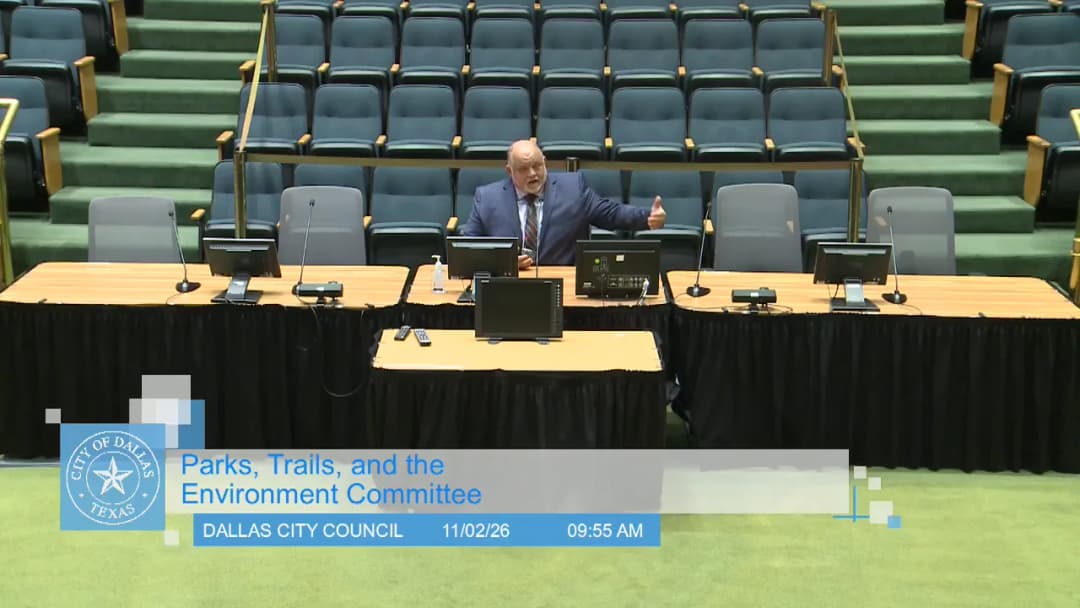
The Public Meeting IndexThe Parks, Trails & Environment Committee met on November 2, 2026, from 9:13 a.m. to 11:35 a.m. The committee approved the October 5, 2026, minutes and received briefings on solar canopies for fleet management, conservation management and tree inventory, and a proposed third amendment to the city’s Materials Recovery Facility contract with FCC Environmental Services. A scheduled grant-application briefing was postponed; the December forecast includes a CCAP implementation update and a park planning and design update. Consent Calendar - Approved the October 5, 2026, Parks, Trails, and Environment Committee meeting minutes; all members present voted in favor. Solar Canopies for Fleet Management - Vincent Olsen, Director of Equipment and Fleet Management, reported that the city has 17 solar canopies, each with two charging pedestals, for 34 chargers total. All 17 canopies are currently off-grid/pure solar, though some are grid-ready. Each canopy can reach up to six vehicles but has four charging cords, stores about 260–265 miles of range, tracks the sun for roughly 25% more daily energy, is rated for 160 mph winds, and is relocatable. Olsen said 10 departments are actively using off-grid charging and that the canopies provided about $12,000 in avoided fuel expense and offset 3,800 gallons, based on kilowatt-hours converted at a blended $3-per-gallon fuel rate. - Olsen estimated canopy costs at $67,000–$80,000 each and payback at about 8–10 years under full use. He said the city is at roughly 8–10% of its CCAP goal of 100% light-duty EV fleet by 2040 and that about 1,700–1,800 vehicles fall within the CCAP light-duty definition. - Committee members raised utilization and oversight concerns. One member noted that solar chargers make up about 30% of the city’s chargers but deliver only about 7% of reported utilization, and that only about 12 megawatt-hours had been used against a potential 450–500 megawatt-hours per year. Olsen acknowledged the gap, citing delayed vehicle deliveries and the need for a culture/practice change, and said capacity for current vehicles is being met largely through fast chargers. Members asked for cost-effectiveness metrics, better driver training/sequencing, and protocols to use solar charging. - A member asked about emergency cutoff switches; Olsen said they exist but are not reachable from the ground and would require a ladder, which the member called a safety concern. Olsen said plug-in hybrids can use the chargers, the city does not own Teslas, and medium-duty electric trucks are pending. - The committee requested a progress update in about three months and asked that a future briefing include utilization and cost metrics plus a strategic, budget-linked plan from the city manager’s office for meeting the CCAP fleet goal. Conservation Management and Tree Inventory - Brett Johnson, Superintendent of Environmental Quality, and Sean Johnson, Deputy Director of Dallas Park and Recreation, presented on invasive species management and the tree inventory. Johnson said there is no silver bullet for invasive privet and that management requires multiple tools: volunteers, mechanical removal, grazing goats, herbicide, and prescribed fire. In 2025–26, volunteers cleared about 5 acres of privet through 22 projects; one acre of privet can require about 21 dump-truck loads of debris, so 5 acres represented about 105 loads. - Operation Goat involved six projects and about 150 acres total, including about 23 acres at White Rock. Herds ranged from 265 to 1,000 goats. Johnson said goats mainly open visibility and access by clearing vegetation up to about 4.5 feet tall; follow-up treatment is critical, with three to five growing seasons and two to three treatment types often needed. He said prescribed fire is effective but difficult in Dallas because of smoke-sensitive targets such as highways, hospitals, schools, and elder-care centers; Plano, Arlington, and Fort Worth use it. - The tree inventory covered 23,500 trees across 57 parks, with 6,440 trees around White Rock Lake (about 25% of the inventory). White Rock’s inventoried trees were valued at more than $20 million, or about $3,154 per tree; the most valuable tree was a multi-stem live oak valued at just under $29,000. The inventory identified 343 ash trees at White Rock and about 1,400 ash trees in maintained parks. Johnson said emerald ash borer is in year three or four in Dallas, 12 of 13 monitoring traps tested positive, and the city could lose over 90% of untreated ash trees within three to six years and 99% by year 10. About 6% of inventoried trees were flagged as likely needing removal, while about 94% were in good-to-fair condition. - Council Member Blair said District 8 was not shown in the presentation and raised concerns about clear-cutting and loss of native trees, especially along the Trinity River. Johnson said about 600 trees were inventoried in District 8, that 8,656 trees in parks/trails crossing council districts still need classification, and that DWU had inventoried over 200,000 trees in the Great Trinity Forest and floodway management areas. Members asked for district-level data, cost per acre by treatment method, hauling costs, follow-up funding, and a proactive emerald ash borer/replanting plan. Recycling Contract Amendment - Cliff Gillespie, Director of Sanitation, presented the proposed third amendment to the Materials Recovery Facility develop, operate, and manage contract with FCC Environmental Services Texas, LLC and FCC, S.A. The facility at McCommas Bluff Landfill has been operated by FCC since 2017; the city pays no processing fee and currently receives about $1.3 million annually, primarily host fees from FCC’s processing of other customers’ recyclables. FCC reported processing costs up about 33% from 2020 to 2025 and operating losses per ton in seven of the last nine years. Staff and an independent consultant reviewed the financial information. Gillespie said Dallas may have the only remaining municipal recycling contract in the country that produces net revenue rather than net expense. - The amendment would temporarily modify revenue sharing, reduce host fees, and adjust recycling education contributions for an initial three years, with two one-year renewal options, and restore terms if market conditions improve. It is expected to reduce sanitation revenue by about $1 million annually; staff said this is already included in the current and next year budgets with no residential sanitation rate impact. The city would continue receiving recycling processing at no cost, and the contract term through 2034 would remain unchanged. Staff recommended approval for the November 10, 2026, City Council agenda. - A committee member criticized the process, saying the revenue loss was built into the budget before the committee/Council acted and that it felt like staff had predetermined the outcome. Gillespie took responsibility for not bringing it forward sooner and said if the amendment fails, the current arrangement continues; commercial landfill revenue above budget has offset the loss. He said rebidding today could cost the city $3–$5 million per year and would likely be passed to ratepayers. FCC Vice President Andrea Rodriguez said FCC has raised fees to other customers and dropped unprofitable contracts, and that the host fee of about $20 per ton makes it harder to compete for outside material; she said non-city volumes are profitable at current rates. Members asked for line-item detail, a long-term plan, and clarity on recycling education and contamination. - Gillespie said there are no hard CCAP recycling percentages, but the 2022 local solid waste management plan targets reducing landfilled material by 35% by 2030—with the city currently at about 20% diversion—and 45% by 2040, with composting as a next diversion opportunity. Key Outcomes - October 5, 2026, committee minutes approved. - No committee vote was recorded on the FCC recycling contract amendment; staff recommendation is to approve it at the November 10, 2026, City Council meeting. - Committee requested a solar-canopy progress update in about three months, including utilization, cost-effectiveness, and a city manager’s office strategic plan tied to the CCAP fleet goal. - Conservation staff were asked to return with district-level treatment and cost data, hauling and follow-up funding details, and an emerald ash borer/replanting plan. - The grant application and acceptance process briefing was postponed; the December forecast includes a CCAP report/implementation update and a park planning and design update. The committee welcomed Assistant Manager Elena Siokin and thanked Assistant Manager Liz Sedeo.
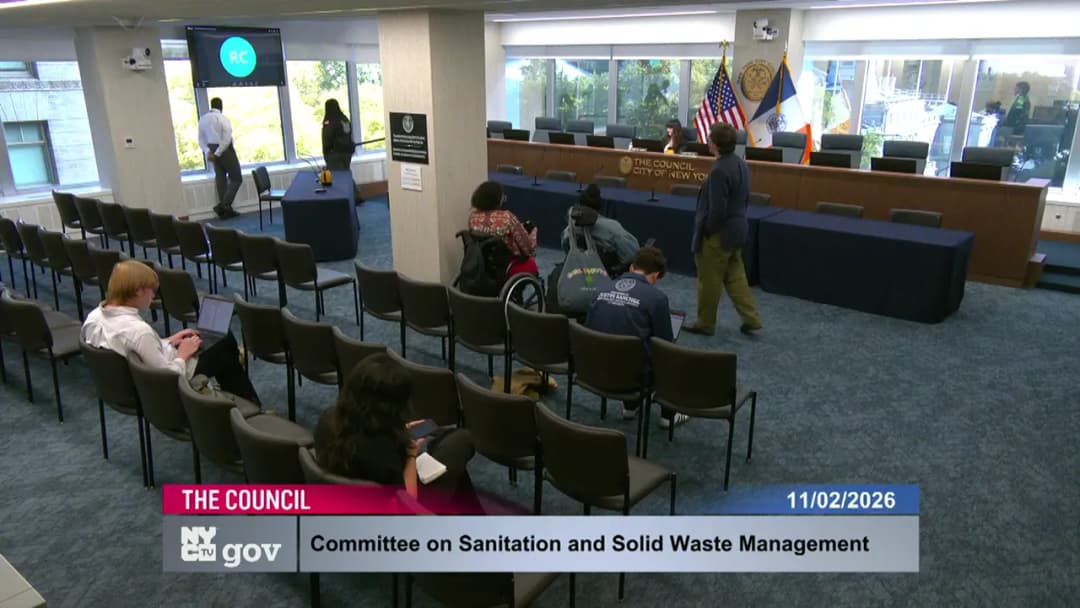
The New York City Council Committee on Sanitation and Solid Waste Management, chaired by Justin E. Sanchez, held a hearing on November 2, 2026, to review the City's snow removal and winter storm response plans and to discuss Introduction 1042-2026, which would require the publication and visualization of snow plowing operations data. Chair Sanchez opened the hearing by acknowledging a recent tragic death of a constituent involving a sanitation truck in his district and thanking the Commissioner for their proactive outreach. Department of Sanitation (DSNY) officials, including the Commissioner, fielded questions on new prioritization strategies, equipment, enforcement, and interagency coordination. Multiple members of the public testified regarding disability access and environmental justice concerns. Public Comments & Testimony - Iman Ramawi Doster (New York Lawyers for the Public Interest): Stressed the severe difficulties disabled New Yorkers face during snowstorms. Proposed assessing fines for non-compliant property owners, eliminating fines for seniors and disabled people unable to clear snow, prioritizing curb cuts and crosswalks, and establishing a DSNY alert system. Argued the lack of accessible streets is a violation of rights. - Elizabeth Valdez (Brooklyn Center for Independence of the Disabled): A wheelchair user, described being trapped by impassable snow. Supported the intent of Int. 1042 but urged it be amended to specifically track and resolve barriers impacting people with disabilities. Called on the city to take ultimate responsibility for sidewalk and curb cut clearance. - Mary Arnold: Criticized DSNY's waste-by-rail program, citing stench, rats, failure to achieve diversion goals, climate impacts, and environmental injustice. Asserted the program violates state environmental conservation law due to defective, non-leak-proof containers. Discussion Items - Snow Removal Prioritization and Strategy: The Commissioner outlined a new plan to prioritize clearing approximately 20,000 corners based on proximity to transit (within 200 feet), top-tier DOT crosswalk rankings, accessible pedestrian indicators, and neighborhoods with high populations of seniors and people with disabilities. Councilmember Restler urged the department to consider more aggressive timelines and learn from cities like Montreal, and raised chronic issues with DOT's failure to clear BQE bridges and overpasses, suggesting DSNY take over that responsibility. - Bike Lane and Street Infrastructure Clearing: The Commissioner clarified that DSNY treats bike lanes simultaneously with roadways, contradicting outdated 311 language. He stated 47 plow units are dedicated to bike lanes and that the department is planning proactively with DOT for new bike infrastructure. Councilmembers also discussed the impact of permanent street dining sheds on snow removal routes and the need for adequate turning radii for plow vehicles. - Property Owner Responsibilities and Enforcement: Councilmember Thomas-Henry highlighted confusion over alleyway garbage service and fines. The Commissioner committed to proactive mailer and text notifications when alley service is suspended for snow events. Councilmembers questioned the adequacy of current fines ($100-$250). The Commissioner noted over 19,000 violations were issued last winter and that the city can theoretically bill property owners for the cost of city-led shoveling, though it is administratively burdensome. - Data Transparency (Int. 1042-2026): Councilmember Hankerson, the bill's sponsor, questioned why residents cannot access historical GPS plowing data from the Plow NYC website. The Commissioner affirmed the technological feasibility of the bill's goals but stated development resources are needed to build out the functionality. - Fleet Capacity and Equipment: The Commissioner reported the average age of collection trucks is 5.1 years, with 12% of salt spreaders beyond their 12-year service life. The department has 26 snow melters (13 operated last year) and is proactively ordering new equipment through requirements and emergency contracts. A councilmember noted discrepancies in equipment allocation in Bronx Community Districts 1, 2, and 3, which the Commissioner attributed to the smaller geographic size and less hilly terrain of those districts. - ADA Compliance and Disability Access: Councilmember Hanif questioned whether the practice of delegating sidewalk clearance to property owners satisfies the city's ADA obligations. The Commissioner maintained that property owner responsibility remains but expressed openness to a roundtable discussion with the Mayor's Office for People with Disabilities (MOPD) and disability advocates to hear direct input on prioritizing assets and improving communication. Key Outcomes - The committee heard testimony and filed Oversight T2026-2596 on the City's Snow Removal and Winter Storm Response. - The committee held a hearing on Introduction 1042-2026 (Plow Data Transparency) and laid it over for future consideration. - The Commissioner committed to updating 311 guidance to reflect the current policy of clearing bike lanes simultaneously with roadways. - DSNY will explore scheduling a roundtable with MOPD and disability advocates. - The department agreed to improve communication strategies regarding alley service suspensions for snow events.
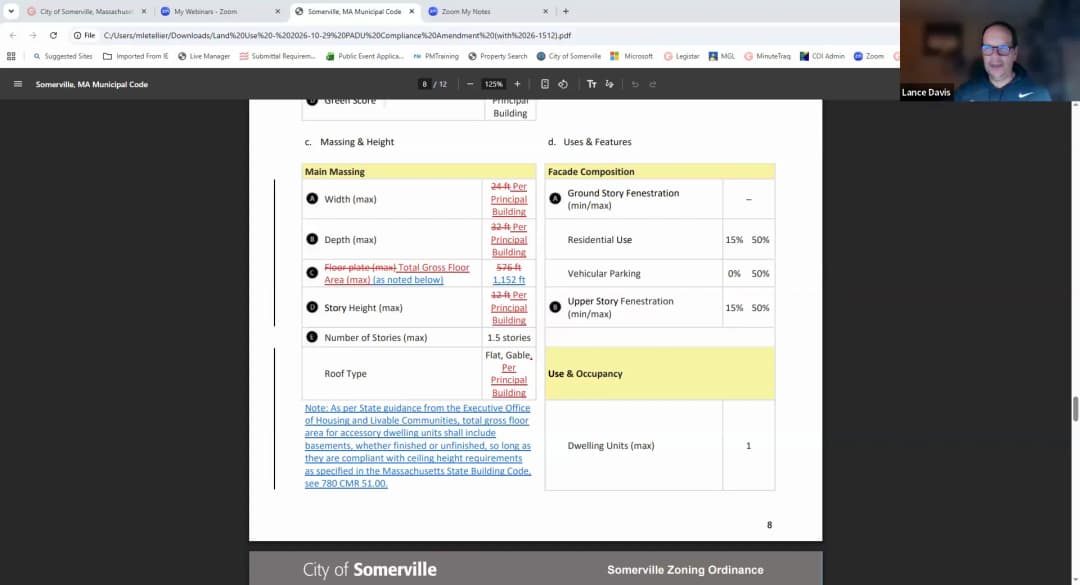
The Somerville Land Use Committee convened on October 31, 2026, at 4:15 PM to discuss a proposed amendment to the city's zoning ordinance regarding Protected Accessory Dwelling Units (ADUs), also known as backyard cottages. The primary aim was to align local regulations with state law while addressing concerns about the scale of newly constructed units. The meeting included an in-depth review of the proposed zoning text amendment and resulted in a unanimous committee recommendation to advance the item. Opening & Housekeeping - Roll Call: All councilors were present (Councilors Davis, Klingon, Said, McLaughlin, and Ewan Campin), establishing a quorum. The meeting was conducted via remote participation. - Items Withdrawn: Councilor Link's related item on ground floor entrances (Item 4) was withdrawn, with its content folded into the primary item (Item 26-1336) before the committee. - Minutes: Approval of minutes from previous meetings (items 26-15-17 and 26-157) was tabled for a vote at the end of the meeting. - Public Comment Period: The public hearing for this item was opened previously; the comment period remains open until noon the following day (November 1, 2026). Discussion Items - Amendment Overview: The proposed amendment (document "Land Use 2026 10 29 PADU compliance amendment") aimed to bring Somerville's zoning for ADUs into compliance with a recent state law. Key changes included setting a maximum gross floor area and limiting the number of stories. - Maximum Gross Floor Area: The amendment proposed a maximum total gross floor area of 1,152 square feet. This figure was derived from the previous allowance of two floors at 576 square feet each (representing a 24 ft by 24 ft footprint). This significantly reduces the potential square footage compared to what developers could build under previous interpretations. - Maximum Stories and State Law Conflict: The amendment set a maximum of 1.5 stories for an ADU. This directly conflicted with state guidance, which requires the number of stories to match the principal building on the lot (e.g., allowing a three-story ADU if the main house is a triple-decker). - The Chair argued that providing a more permissive square footage allowance (1,152 sq ft vs. the state's baseline of 900 sq ft) allows the city to enforce its own dimensional standards like the 1.5 story limit. - Director Dan Bartman stated this approach relies on a legal interpretation. The state has no direct enforcement mechanism, but a developer could challenge the local regulation. If a developer opts to use the state's baseline 900 square foot allowance, they could likely claim the right to match the principal building's full height. - The committee generally favored the Chair's argument, believing the increased square footage is a sufficient incentive for developers to accept the 1.5 story limit. - Basement Regulation and Enforcement: The amendment included language stating that basements (finished or unfinished) count toward the total gross floor area calculation, based on state guidance from the Executive Office of Housing and Livable Communities (EOHLC). - Councilor Davis raised concerns about a potential loophole where a developer builds a basement just under the ceiling height threshold (6 ft 8 in) and just under the grade threshold for counting as a story (5 ft in zoning, 6 ft in the updated building code), then finishes it illegally later. - Analyst Samantha Carr explained that enforcement for illegal finishing relies on building permits and public reporting. Director Bartman noted that adjusting the grade threshold would be a larger policy decision affecting all structures. - Garages and Ancillary Spaces: - Councilor Klingon inquired whether a garage could be built as part of the ADU structure. - Analyst Carr stated that garages, crawl spaces, and attics are explicitly excluded from gross floor area calculations per state CMR guidelines and would be treated as accessory structures. This could allow a developer to build a garage with living space above, potentially reaching the height of a three-story principal building. - Floor Plate Flexibility: The committee discussed whether to retain a specific maximum floor plate per story (576 sq ft) or just regulate total gross floor area. Councilors and staff leaned towards regulating only the total GFA to allow for more design flexibility (e.g., a larger first floor and a smaller second floor). Key Outcomes - Amendment Adopted: The committee unanimously voted to replace the original item language with the proposed amendment attachment, creating the new working version of the item. - Recommendation of Approval: The committee voted unanimously (5-0) to recommend approval of the item as amended. - Voting Yes: Councilors Davis, Klingon, Said, McLaughlin, and Ewan Campin. - Next Steps: The recommendation will be forwarded to the full City Council. No final action can be taken until the committee receives and considers a recommendation from the Planning Board. - Adjournment: After unanimously approving the previously tabled minutes, the meeting was adjourned.
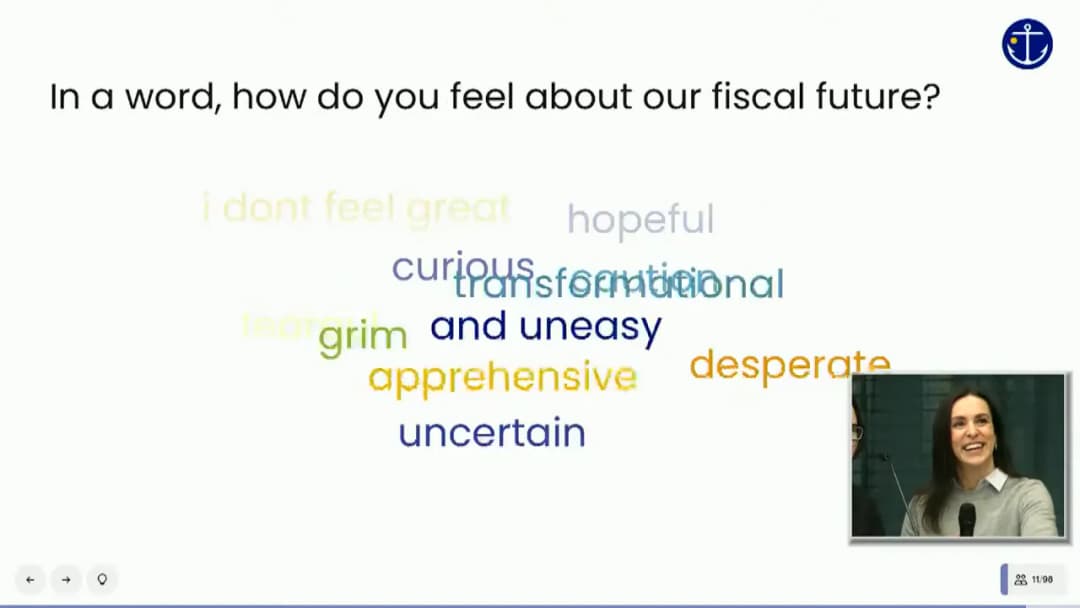
On October 30, 2026, Anchorage municipal hosts closed a Fiscal Future community workshop with reflection, interactive polls, and next-step announcements. Participants had grappled with scenarios and options for the municipality's fiscal future; no formal votes were taken. No agenda or minutes were available, so this summary is based solely on the raw transcript. Discussion Items - Wrap-up and reflection: The session ended a little early after the main scenario discussions. Attendees were reminded to submit Menti responses, and a final word-cloud poll asked for one-word feelings about the fiscal future. Responses included 'don't feel great,' 'bleak,' 'potential,' 'fearful,' 'determined,' 'motivated,' 'hopeful,' and 'woof.' The host identified the top four feelings as determined, apprehensive, motivated, and hopeful. - Last audience question: The host read the final question of the day: 'What can the average person do to help their neighbor understand these issues?' The rest of the wrap-up answered this by urging attendees to take materials, host conversations, correct misinformation, and share what they learned. - Calls to continue the work: The host emphasized that the conversation is not over, that the municipality has agency to change its structure, shape, and operations, and that 'no one is coming to save us' — but Anchorage has what it needs to build a thriving future. The host also framed the work as trying to give people 40–50 years from now a better starting point. - Participant engagement: Attendees were asked to raise their hands if they learned something new, learned from someone in their group, met someone new, had a better handle on what is happening at the Municipality, felt better equipped to talk about the fiscal present, were willing to host a 'Fiscal Future in a Folder' event, and were ready to keep working on the issue. Many hands were raised, and the host encouraged attendees to sign up. - Comment about oil taxes: One Menti comment raised oil taxes again. The host responded that this is 'other people's decisions to make' and reminded attendees to vote by Tuesday, November 3, at 8 p.m. - FY27 budget process: The host announced that the fiscal year 2027 municipal budget will be on the agenda for public hearing on Wednesday, November 4, in the Assembly Chambers at the Loussac Library. The meeting starts at 5 p.m., and budget testimony is expected after 6:30 p.m. People can testify in person, sign up to receive a phone call from the clerk at least 24 hours in advance, or email comments to assembly@anchorageak.gov. The Assembly will vote on the FY27 budget at its meeting on November 17. - Spring Fiscal Future summit: The host mentioned a planned summit in the spring, focused on building solutions and the structural adjustments needed for the municipality's future. Attendees were asked whether they would return and whether they would bring a friend; responses appeared strongly supportive. - Thanks and materials: Thanks were given to the Legislative Services staff — Claire, Allie, Jen, Noah, and new budget analyst Molly — as well as the mayor's team, including Nolan Clauda, Ona Brouse, and other department staff. Attendees were directed to the Assembly website, the Assembly email newsletter, and printed packets to stay involved. Key Outcomes - No formal votes or motions occurred during this wrap-up session. - The next public engagement opportunity is the FY27 municipal budget public hearing on November 4, 2026. - The Assembly is scheduled to vote on the FY27 municipal budget on November 17, 2026. - Menti questions and audience feedback from the workshop will be used to inform the next phases of the Fiscal Future project.
The Public Protection Committee met on October 30, 2026, with Chair Elisa Márquez and Supervisor Nate Miley present. The agenda covered an update on the CARES Navigation Center, the 2025–2026 Annual Military Equipment Report, and a proposed resolution urging the Governor to commute all California death sentences. Note: The agenda and transcript identify the meeting date as October 22, 2026, while the provided metadata states October 30, 2026; this summary uses the metadata date. Public Comments & Testimony - On Item 1 (CARES), Richard Spiegelman, chair of the Interfaith Coalition for Justice in Our Jails, said the program had a difficult start but appeared to be improving; he expressed concern about its cost relative to pretrial services and asked CARES to define 'recidivism' and the period it covers. - Shamima Abdullah, speaking as a provider and community member associated with Bayer Community Services, described the pretrial expansion program’s success in connecting people to housing and treatment and urged supervisors to preserve it; the chair ruled that topic was more appropriate for general public comment under Item 4. - Danielle Drake, executive director of Hella Help, shared personal experience with homelessness, foster care, and being shot in 2025, and asked supervisors to weigh community-wide benefits of services. - On Item 2 (military equipment), multiple speakers urged the Sheriff’s Office to ban or eliminate scattershot/multi-projectile munitions. Richard Spiegelman asked about special precautions for minors, elderly people, and pregnant people. Madeline Stacy cited AB 481’s requirements, noted the increase in glass-breaking munitions from 24 to 70, and said the absence of formal complaints did not mean there were no concerns. John Lindsay Pollen called for elimination of DefTech 6064, stating the Sheriff’s Office possessed 340 rubber-baton multi-projectile munitions, up from 43. Myrna Schwartz credited sheriff engagement but said no policy explicitly prohibited firing such munitions at people with mental illness, minors, or non-English speakers. Bob Britton, speaking for ICJ/Faith in Action East Bay, noted an increase from 125 to 410 scattershot munitions and from 43 to 340 rubber-baton rounds, and cited opposition from Amnesty International and the UN Special Rapporteur. Ariana detailed other available munitions and asked the Sheriff’s Office to reduce scattershot inventory to zero and adopt a specific use policy. Kari Malki of Restore Oakland argued the county should not invest in deadly weapons during a budget crunch. William Sands, a photojournalist and founder of Shot in the Eye Squad, testified that a 'less lethal' projectile cost him 75% of the vision in his right eye in 2020. Scott Mason of the Omega Research Foundation said multi-projectile ammunition is inherently inaccurate and indiscriminate and fails UN accuracy guidance. - No testimony is captured in the transcript for Item 3 or for the general public comment period (Item 4). Discussion Items - Item 1: CARES Navigation Center Update. L.D. Louis, Assistant District Attorney, presented. CARES (Community Assessment Referral and Engagement Services) is a point-of-arrest diversion program launched in Oakland in February 2021 and expanded to Hayward; it is open seven days a week, 12 hours a day, with two locations and two mobile teams, and has served nearly 500 clients since 2021. Eligibility is limited to low-level misdemeanor/wobbler offenses, excluding registrable sex offenses, domestic violence, DUI, and felony/non-sitable warrants. Clients receive respite, peer support, clinician assessments, multidisciplinary review, risk reduction plans, and connection to services. Partners include La Familia (Hayward) and Uncuff Project (Oakland). Reported cohort 2 recidivism was 7%, compared with a countywide recidivism rate of about 25%. The program is 100% grant-funded; the current grant expires March 2028, and the presenter requested Board support for future funding. - Item 2: Military Equipment Report. Lt. Gustavo Mora presented the AB 481–required 2025–2026 annual report covering September 1, 2025 to August 31, 2026. Key statistics include 1,201 equipment uses (1,032 drone uses), 6,825 employee training hours, $62,096 in outside training costs, and no complaints or policy violations. Equipment purchases totaled $85,656.08, reduced to a net $69,656 after a $16,000 reimbursement. The department removed FN303 launchers and associated projectiles, is removing DefTech 1087 munitions, and proposes reducing approved drone quantities from 258 to 97 (possessing 92), with a proposed acquisition of 122 drones, 50 rifles, and 500 projectiles. The VXR shatter is requested as a glass-breaking replacement munition; the lieutenant stated it is not intended for use on people. A community meeting was held October 12 at Cherryland Community Center, with 2 attendees in person, 6 watching live, and 115 watching the recording. He also reported that 53% of drone activity was in response to calls, 47% was planned operations, 263 drone flights supported search warrants, and routine drone video is retained for 60 days. The lieutenant answered community questions on drone video retention, race tracking, search warrants, and DFR calls. - Item 3: Resolution on Commuting Death Sentences. The agenda listed this action item, with Brenda Gomez as presenter, but the provided transcript does not include discussion, public comment, or a vote on this item. Key Outcomes - The CARES update was informational; no vote was taken. Supervisor Miley said he supports the program but raised the need to identify $650,000 for the final quarter of FY 2027–28 and to plan for sustainability beyond March 2028. - The Committee voted unanimously (Supervisor Miley yes; Supervisor Márquez aye) to advance the Military Equipment Report to the full Board of Supervisors on November 17, 2026, as a set matter. The motion included adding public questions raised at the meeting and beginning a separate conversation with the Sheriff’s Office about possible use-of-force policy for certain equipment. - Supervisor Miley requested a breakdown of the 1,201 equipment uses by unincorporated area, jail, and mutual aid for the Board report. - No action is recorded for the death penalty resolution in the provided transcript. - The next Public Protection Committee meeting was announced for Thursday, November 19, 2026, at 3:00 p.m.
The Radnor Township Zoning Hearing Board met at 7:00 p.m. on October 30, 2026, to hear a sign variance appeal, act on an extension request, and begin a long special exception application from Waverly Heights. Minutes were not available. The agenda and transcript header identify the meeting as October 15, 2026, conflicting with the October 30, 2026 date supplied for this summary. Administrative Announcements - The zoning officer warned about fraudulent invoices falsely claiming to be from Radnor Township boards and commissions. The township will never request payment by wire transfer; official emails end in @radnor.org. Recipients should contact the Community Development and Engineering Department and should not pay. Consent Calendar - Appeal 3240 – N Wayne LLC, 118-120 N Wayne Avenue: The applicant requested a one-year extension of prior zoning approval through December 1, 2027. The representative said the project is still in land development and is being redesigned to remove the third-floor residential component. The board noted the earlier approval covered parking and loading relief, not residential use. No objections were raised, and the one-year extension was granted. Public Comments & Testimony - Attorney Mark Danick was granted party status for four neighboring couples; additional nearby residents also requested and received party status. The board explained that party status carries duties, requires contact forms, and is not an opportunity for argument or audience outbursts. - Residents raised concerns about traffic, school-dismissal overlaps, narrow and winding roads, the low railroad bridge clearance, lack of sidewalks, pedestrian and runner safety, elderly drivers, stormwater runoff, water pressure and utility capacity, wildlife, trees, property boundaries, construction impacts, lighting/noise, and ambulance calls. - A Main Line Classical Academy representative was granted party status and asked about the realigned western driveway, stormwater runoff toward the academy's parking lot and building, and 15-minute peak traffic intervals during school dismissal. The board asked him to submit a letter of authorization from the academy. Discussion Items - Appeal 3274 – Expedite The Diehl LLC, 363 West Lancaster Avenue: The applicant sought a variance from § 280-120(C)(2) to allow two wall signs on the south and east elevations at 17 feet 8¼ inches above grade, where 15 feet is the maximum. Each sign would be 41.99 square feet; the south sign is about 75 feet from Lancaster Avenue. The agenda lists the sign locations as south and east elevations, although the chair's initial reading said north and east. Board members challenged the request as a self-created hardship because the parapet was added voluntarily and there was no documented roof-equipment or fall-protection requirement. One board member said the application had no weight and was misguided, but the board agreed to continue the case so the applicant could provide existing sign dimensions and a stronger hardship justification. The applicant waived the statutory decision deadline. The case was continued to November 19, 2026. - Appeal 3275 – Waverly Heights, 452 S Roberts Road: The applicant amended its application to withdraw all requested variances and to seek only a special exception under § 280-68B for a life care residence. The township appeared with automatic party status and had sent a letter citing support for the special exception. No final decision was made. - Applicant's case: Mark Heil, Vice President of Campus Development, testified that Waverly Senior Services is the equitable owner of the 43-acre former Haverford School property. The proposal includes 200 independent living units and 25 assisted living units, with no skilled-nursing component. Applicants must be at least 60; Waverly's average entry age is about 82. The priority list has more than 700 households, about 238 from Radnor. Radnor's comprehensive plan shows a 37% increase in adults aged 55–74 since 2000. Amenities would be limited to residents and guests; a perimeter walking trail was initially considered but dropped after neighbor concerns. - Civil engineering: Chris Pelinas testified that the revised plan meets PI district bulk requirements, including 38-foot building height, building lengths under 160 feet, 225 units versus a 576-unit maximum density, 15% required open space, 64% pervious/green area versus the 55% requirement (down from roughly 88% existing), and 496 parking spaces versus 495 required. Stormwater facilities are conceptual; no geotechnical investigation or utility-capacity assessment has been completed. - Traffic engineering: John Urick testified that South Roberts Road carries about 2,300 vehicles per day. Preliminary trip estimates were 743 daily trips using Radnor's ordinance rate, 811 or 547 using ITE data, and 1,114 based on Waverly's Gladwin counts. Peak-hour estimates were about 100 trips in the morning and 96 in the afternoon. A comprehensive traffic study, including counts and 12 off-site intersections, has not yet been completed. The western driveway would be aligned with Main Line Classical Academy's driveway as a safety improvement. Waverly estimated that roughly 25% of Gladwin staff use public transit, and shuttle service is planned. Board members and residents questioned approving a special exception before actual traffic data and mitigation are known. - EMS substation: Applicant's counsel stated that the EMS substation discussed in connection with the property is not part of the zoning application and is a permitted use; the township would separately inform the community. - Continuation: With two witnesses still to testify and the time about 10:56 p.m., the board continued the hearing to November 24, 2026, at 7:00 p.m., without re-advertising. The applicant was asked to provide advance notice of witnesses and any missing documents. Key Outcomes - Appeal 3240: One-year extension granted through December 1, 2027. - Appeal 3274: Continued to November 19, 2026; the applicant waived the statutory decision deadline. - Appeal 3275: Amended to a special exception only; continued to November 24, 2026, at 7:00 p.m. No vote was taken on the special exception. - Party status granted to neighboring residents and counsel; Main Line Classical Academy must submit a letter of authorization.
The Radnor Township Zoning Hearing Board held a televised public hearing on three appeals: 3276 (Brennan patio impervious coverage), 3277 (Serve Holdings parking variances for 105 N. Aberdeen Ave), and 3278 (Ciarrochi front patio and stairs). Zoning Officer Megan Donovan warned of fraudulent invoices claiming to be from township boards and commissions, stating that the township will never request payment by wire transfer and that official emails end in @Radnor.org. The agenda lists Tuesday, October 20, 2026, at 7:00 PM; this summary uses the provided meeting date of October 30, 2026. No minutes were available, and no adjournment time was stated. Announcements - Zoning Officer Megan Donovan warned of a potential scam involving fraudulent invoices claiming to be from Radnor Township boards and commissions. She said Radnor Township will never request payment via wire transfer, official township email addresses end in @Radnor.org, recipients should not make payments, and suspicious invoices should be reported to the Community and Development Department. Public Comments & Testimony - Appeal 3276: Lawrence A. Palmer, 404 Lancaster Avenue, with 404 Associates, said his property is directly behind 407 Midland Avenue and stated opposition to the variance. He said that when his commercial office property sought additional parking about 20 years ago, it was denied because of stormwater concerns; he objected that the applicants had basically put another house in their backyard and now wanted to go further. The applicants responded that they were not going further and were only seeking to retain the patio. - Appeal 3277: Joseph Parente, 31 Luella Court, spoke in support of Serve Holdings. He said he and his wife moved about a year ago for Wayne's walkability and saw the CERV Foundation as a unique community-involvement opportunity. He noted vacant commercial space in the area and said many neighbors supported the project but would not all speak at the hearing. - Appeal 3277: Bruce Grossman, managing member of the general partner of Lancaster Wayne Associates LP, testified in opposition. He described the Wayne Square shopping center east of and behind the subject property and expressed concern that the coffee-shop use would cause overflow parking onto Wayne Square's lot, require policing and towing, and create loading conflicts near the Aberdeen Avenue entrance and exit. He said the center has adequate parking for its tenants and that the applicant had not been granted parking rights there. Discussion Items - Appeal 3276 – Brennan, 407 Midland Ave (R-2): Applicants Jennifer and Edward Brennan sought a variance from §280-20(F) to permit 30.86% impervious coverage where 30% is the maximum, to retain an existing approximately 158-square-foot stone patio at the rear of the principal dwelling. Edward Brennan testified that the board had previously granted relief for an accessory structure, that engineering led them to shrink the structure back to setback compliance and eliminate that need, and that they agreed to remove 526 square feet of existing impervious surface, including parts of the driveway, walkways, concrete steps, a concrete pad, and the patio, bringing coverage to about 29.9% without the patio. They argued retaining the patio would result in 30.86%, the minimum relief sought; the approved stormwater design included capacity for the patio; and there would be no stormwater impact. They also cited the historical and architectural value of the stone and egress from dining-room doors. Board members described the less-than-1% exceedance as de minimis and noted the historic home. - Appeal 3277 – Serve Holdings LLC, 105 N. Aberdeen Ave (C-2): The applicant sought variances from §280-103(B) to permit 8 parking spaces where 16 are required and from §280-4(B) to allow 8-foot-6-inch stall width for three spaces where 9-foot-6-inch width is required. Counsel David Falcone said the property historically had commercial, office, and retail use and that the proposal is a coffee shop on the first floor, gathering and workspace on the second floor, and office on the third floor for the CERV Foundation. William Yo described the foundation's volunteer-focused mission and said the coffee shop would help community members gather and perform small service acts. Architect Dan Ciolino testified that the lot is 7,238 square feet versus a 20,000-square-foot C-2 minimum and has 45 feet of frontage versus 100 feet required; the building is about 1,236 square feet; parking calculations yielded 16 required spaces, based on 36 seats plus 2 employees for the coffee use and 894 square feet of office space; and 8 on-site spaces are proposed after removing one existing space to create an ADA space. He said the three front spaces would be narrowed to 8 feet 6 inches to create a 3-foot safe egress path, that existing rear spaces are nonconforming, and that about six off-site public parking spaces exist on N. Aberdeen. Falcone argued the undersized lot creates a dimensional hardship and that the variances are the minimum necessary. - Appeal 3277 – Party status and opposition: Fred Fromhold appeared for Lancaster Wayne Associates LP and requested party status, which was granted without objection. Bruce Grossman testified about overflow parking and loading concerns. Board members questioned parking calculations, fire hydrant proximity, street parking, and whether the parking variance would run with the land; counsel confirmed it would run with the land. Board discussion was mixed: one member called the request a lot to squeeze in but concluded the hardship burden was met because the lot is roughly half the required size and frontage and nearly any permitted commercial use would need relief; another member said the applicant was trying to fit a square peg into a round hole and that the hardship was self-imposed by the chosen program. The motion to grant both variances was made and seconded; the transcript records votes of Aye, No, Aye, with no formal tally announced. - Appeal 3278 – Ciarrochi, 621 Heather Lane (R-1): The agenda described the request as Zoning Code 280-145 dimensional variance, while at the hearing the board described it as a special exception under §280-1072 to expand an existing nonconforming front entry patio within the front-yard setback, plus variances from §§280-15C and 280-17C to construct stairs within the required front-yard setback extending toward the township-owned right-of-way of Heather Lane. Steve Ciarrochi testified that the existing patio and steps are crumbling and pulling away; that the existing steps make a 90-degree turn onto a sloped driveway, which he called unsafe, and that his wife had fallen there; and that the proposal would replace the 12-foot by 4-foot patio with a 20-foot by 6-foot patio and redesign the steps to descend toward the street with one jog for safety and aesthetics. He said about 14 of roughly 45 homes in the neighborhood have walkways to the street, Heather Lane is a cul-de-sac or oval with one entrance, and guests park on the street. Contractor Brian Walders testified that the project was designed by Marshall Sabatini's firm, that the applicants discovered the existing front-yard conditions were nonconforming, and that a proposed four-foot-deep pent roof over part of the patio did not require relief. The board noted that both the special exception and variances were needed because stairs extending into the right-of-way are not permitted. Key Outcomes - Appeal 3276: Motion to grant the dimensional variance from §280-20(F) to permit 30.86% impervious coverage carried; board members voiced support and described the less-than-1% exceedance as de minimis. - Appeal 3277: Motion to grant both parking variances was made and seconded. The transcript records Aye, No, Aye, with no formal vote tally announced; the applicant thanked the board after the vote. - Appeal 3278: Motion to approve the special exception under §280-1072 and variances from §§280-15C and 280-17C carried; the transcript records four ayes. - Party status: Lancaster Wayne Associates LP was granted party status in Appeal 3277 without objection. - Next meeting: The agenda states the next ZHB meeting is November 19, 2026, and applications for that meeting were due by October 20, 2026.
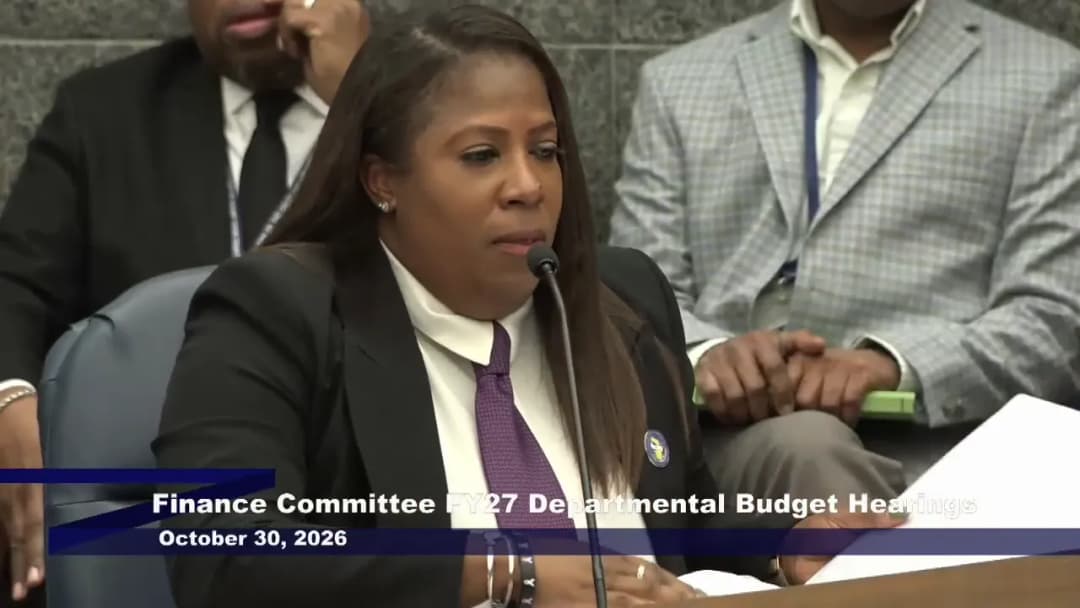
On October 30, 2026, the Cook County Board of Commissioners held a budget hearing for the Clerk of the Circuit Court's Office. Clerk Sparopolis presented the fiscal year 2027 budget request and highlighted modernization efforts, including digital data exchange, an upgraded self-represented litigant center (serving approximately 10,000 people since 2026), a second annual Second Chance Summit, and the expansion of online services. The hearing focused on the office's financial needs, staffing challenges, and statutory obligations. Discussion Items - Budget Overview: The Clerk requested a corporate fund budget of $129.7 million for FY27, a $7.6 million (6.2%) increase over the FY26 approved $122 million. This increase absorbs approximately $11.1 million in cost increases, including $4 million in salary step and COLA increases ($4 million for step increases and cost-of-living adjustments), increased employee benefits, and the loss of a $3.18 million transportation-related home rule tax credit. Non-personnel expenditure increases were only about $874,000. Total staffing decreases from 1,405 to 1,387 full-time positions (a reduction of 18 FTEs). Special purpose fund requests included: Court Administrative Fund ($1.14 million, +73% mainly for Tyler contract, step increases, COLA, and indirect costs), Electronic Citation Fund ($1.13 million, slight decrease), Court Document Storage Fund ($10 million, +$1.6 million due to Tyler contract, step increases, COLA, and $87,000 in increased indirect costs), and another unnamed fund (+$2.38 million attributable to Tyler contract, step increases, COLA, and $1.5 million in increased indirect costs). Salary and wages increase by $6.7 million (1.8%) despite workforce reduction. Contractual services decrease by $177,000 (6.2%), supplies and materials by $205,000 (35.7%), operation and maintenance increase by $678,000 (8.6%), and rental and leasing decrease by $233,000 (62.9%). The Clerk emphasized the office is absorbing increased costs while reducing staff and discretionary spending. - Data Requests and Staffing Needs: The Clerk noted over 700 data requests last year, requiring additional MIS staff (requested 3 positions at mid-year). The office is overextended with court clerks and needs at least 4 more positions for courtroom expansion (new domestic violence and stalking no-contact courtrooms). Additionally, a Clean Slate Act mandate requires expunging cases dating back to 1970, requiring staff to retrieve paper files from a warehouse; the Clerk estimated needing 10 additional staff for this effort. Commissioners expressed support for additional funding to upgrade the data system to better run reports and manage tech. - Second Chance Summit: Commissioner Degden asked for data on the most recent summit. David Moses reported 784 cases were handled, close to 200 participants attended, 110 pre-registered with necessary documents (petitions prepared by legal team), 35 showed with rap sheets (received direction), and about 60 walk-ins received packets with next steps. The Commissioner requested packets be distributed to all commissioners. The Clerk agreed to develop a one-pager. - EMET System: Commissioner asked about the new EMET system integration with the clerk's office. Ramesh (MIS CIO) stated coordination with the sheriff's office and IT is ongoing, with no open items on the clerk's side. - Inspector General: Commissioner noted the budget includes an Inspector General line for the clerk's office (Kate McKay present). The office has its own IG who issues public reports on its website. - Rental Equipment Decrease: Commissioner asked about the large drop in rental of office/data processing equipment. CFO Honey Hill explained it is due to a capital refresh program; the office received $2 million previously and still has $1 million leftover, so additional refreshing is not needed. - Orders of Protection Warrants: Commissioner Britton asked about the process for electronic service of warrants. David Moses explained the judge orders the warrant, the clerk prepares, scans, and emails it to the arresting agency (Chicago police, suburban districts, etc.). Key Outcomes - No formal votes were taken during the hearing. The hearing served as a review of the budget request and an opportunity for commissioners to ask questions. - The board announced that final approval and adoption of the FY27 budget is scheduled for November 19, 2026. The budget amendment system is open; all proposed amendments must be submitted by 12:00 PM on November 5, 2026, and must be budget-neutral. Only germane amendments will be considered on November 19. Submission deadline will be strictly enforced.
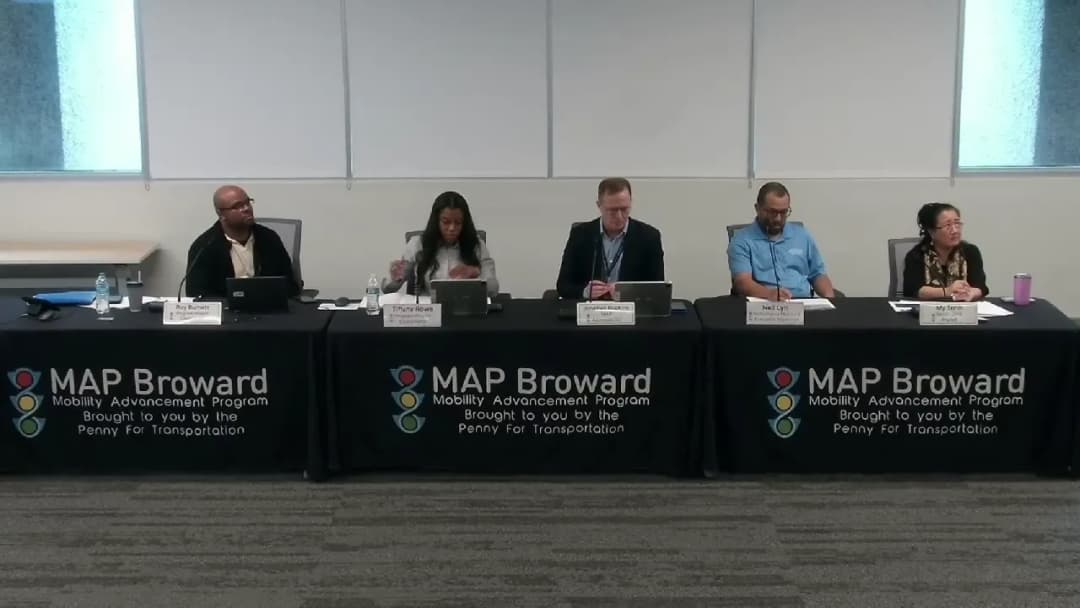
Discrepancy Note: The agenda listed the meeting start time as 1:30 PM local time, while the accompanying metadata specifies a UTC timestamp of 2026-10-30 18:45:00+00:00. No minutes from the meeting were available. The Independent Transportation Surtax Oversight Board held a virtual workshop to review best practices in performance metrics dashboards used by peer transportation surtax programs. MAP Administrator Jonathan Hopkins facilitated the session. The Performance Metrics and Evaluation Team, led by Tiffany Rowe, presented research findings to inform the development of MAP's next-generation public dashboard. Discussion Items - Performance Dashboard Peer Review: Tiffany Rowe presented research on 18 voter-approved transportation measures across nine states. Six key insights were identified: organizing dashboards around the voter promise, leading with an interactive map, providing budget versus spending transparency, listing targets alongside progress, separating outputs (what was built) from impacts (system-level changes), and building layers of detail from overviews to individual projects. - Peer Program Spotlights: Detailed analyses of three peer programs were shared: - Seattle (Move Seattle Levy): A $930 million, 9-year program noted for separating project delivery outputs in its main dashboard from system impacts in a separate dashboard called "Moving the Needle." - Phoenix (Transportation 2050): A $16.5 billion, 35-year sales-tax program, identified as the most comparable to MAP in scale and tax structure. It uses a narrative, story-based website rather than a traditional dashboard, supported by detailed formal reports. - Columbus (Link Us): An $8 billion program by the Central Ohio Transit Authority, highlighted for its one-screen program snapshot and consistent tri-annual progress reports tied to service changes. - MAP Dashboard Concept Design: A conceptual mock-up was presented incorporating the six insights into a single-screen interface with categories, map, budget tracker, progress bars, outputs vs. impacts, and navigational links. Board Feedback & Positions - Chair Pennant Wallace expressed strong support for the presentation and the direction of the work. He specifically advocated for the inclusion of impact metrics beyond the strict voter promise, such as safety improvements, job creation, economic impact, and minority business (CBE) participation. He also requested that the dashboard highlight matching funds and the growth of the initial investment, calling these "added value" metrics that tell a fuller story. - Vice Chair Ray praised the presentation as a "Rosetta Stone" that provides a clear macro-level understanding of the program's impact. He inquired whether the dashboard would replace the existing project-level tool or be a new platform. Staff clarified the existing dashboard would remain, with new segments added through a minimum viable product (MVP) approach over several years. - Board Member Ardal commended the peer benchmarking effort and suggested exploring how future board meetings could be aligned with the voter promise categories, proposing meetings be structured around the ballot measure's investment themes. - Board Member Ken Ortner stated the presentation was "excellent" and helped him better understand the program's purposes and public reporting goals. - Board Member Kuhlman raised significant concerns regarding the Third Amendment. He reported cities had been told they could no longer request new major capital projects, calling this "disturbing" and "not right." He requested a detailed spreadsheet of all committed funds. - Staff Response: Nathaniel and Jonathan Hopkins clarified the situation arises from a backlog of previously programmed major capital projects. The proportion of funding allocated to cities remains consistent, and the maintenance-focused items were specifically requested by the cities through the BCCMA. New capital project solicitations are expected after the current five-year plan ends in 2032. Key Outcomes - General Concurrence: Board members expressed general support for the proposed dashboard design, particularly its organization around the voter promise and its separation of outputs and impacts. - Dashboard Timeline: A fully-featured dashboard is not expected in 2027. An MVP will be released, refined with public and board feedback, and enhanced with features over several years. - Performance Audit Integration: The board and staff agreed to integrate findings from the upcoming performance audit into the dashboard recommendations. Audit results are anticipated for the December 10, 2026 meeting. - Meeting Structure Proposal: Staff proposed organizing the 2027 meeting calendar around the seven ballot measure categories, to be discussed and shaped further at the December meeting. - Follow-Up on City Funding: Staff will prepare a detailed financial spreadsheet and hold one-on-one briefings with board members, particularly Chair Kuhlman, to explain the city funding backlog, the Third Amendment, and the timeline for future capital project cycles.