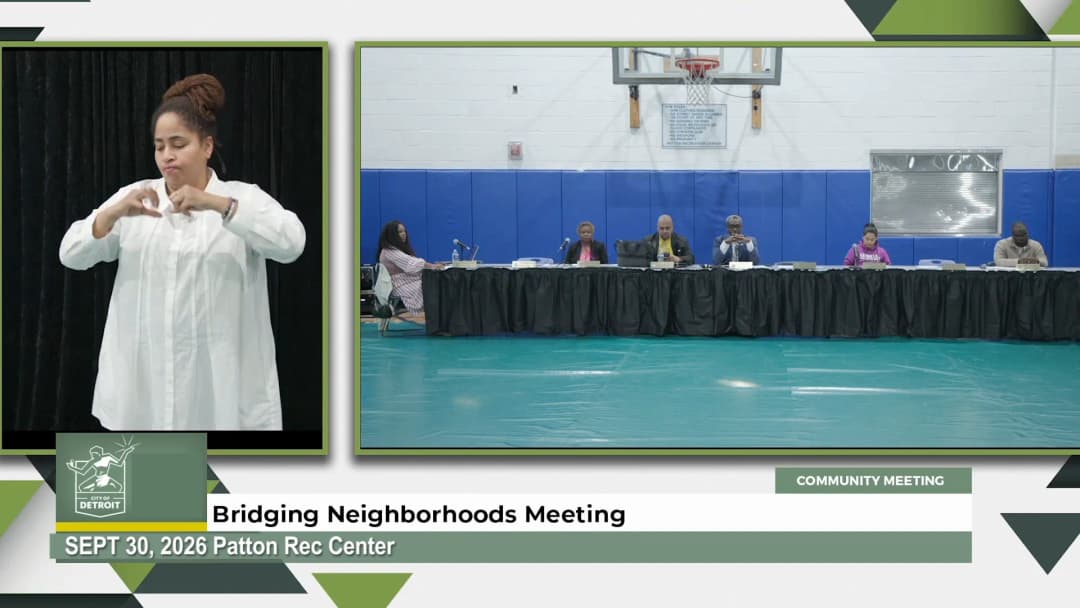
The Detroit City Council held its second statutory public hearing for the Bridging Neighborhoods project at Patton Park. The hearing included a presentation by Director Rico Razo on the program's history, investments, and proposed amendments to the 2017 resolution, followed by public comment. Council members also responded to earlier general public comments on various neighborhood issues. General Public Comments & Testimony (Before Presentation) - Jose Guzman raised concerns about truck traffic on Central Avenue and requested enforcement of truck routes. - Simone (unstated affiliation) advocated for more truck parking, better air quality engagement, and stronger tree protection policies. - Unnamed resident (69-year Delray resident) criticized contractor work quality, reported shootings and break-ins, and requested more attention to Delray. - Springdale Woodmere Block Club / Friends of Patton Park expressed disappointment that community engagement on the Renaissance Center demolition began after demolition started, and raised concerns about water contamination from demolition near the Detroit River. - Delray resident requested better street lighting, addressed sewage odors, poor sidewalks, and asked if leftover bridge funds could be used for house repairs. - Resident inquired about a roof repair program that ended September 22, 2026, asking for it to be reopened. - Online caller Ronald Foster criticized low voter turnout (25% overall, 10% in some districts) and urged accountability for elected officials and better public education. - Councilmember Santiago Romero responded to each issue: noted a new truck enforcement unit, committed to air quality advocacy, urged residents to report specific contractor issues, and pledged to look into Delray shootings and roof repair programs. Councilmember Waters promised a memo to increase police patrols in Delray and reiterated the need to bar bad contractors. President Tate added that Renaissance Center demolition will be enclosed (deconstruction method) to control dust. Presentation by Director Rico Razo Director Razo detailed the Bridging Neighborhoods program, created from $32.6 million in community benefits from the Gordie Howe International Bridge project. Key investments to date: - Home Swap Program: $20 million spent; 79 households relocated to fully renovated homes (112 homes renovated across the city). - I-75 Environmental Mitigation Program: $7.6 million spent; 174 households received insulation, noise-reducing windows, central air, and upgraded filters. - Additional projects: Strategic Neighborhood Fund, Michigan Central CBA, Stellantis phase 2/3, Ossian Sweet Historic Block, Joe Lewis Greenway pilot, seawall repairs in Jefferson Chalmers, and MDOT-funded air conditioning/tree program. Proposed Resolution Amendments (to the 2017 resolution): 1. Expand eligible home swap to include duplexes and already rehabbed homes. 2. Expand home repair/indoor air quality improvements to owner-occupied homes directly affected by the bridge expansion within expanded boundaries (south of Fort, between Rouge River and Clark Street, west of Clark Street/north of Ford Street/south of I-75). 3. Resume the I-75 environmental mitigation program for the area 300 feet south of I-75 service drive between Clark and Springwells Streets. 4. Update resolution to reflect the program now under the Department of Human Homeless and Family Services (interim director Chelsea Neblett). Proposed Allocations: - Home repair/indoor air quality: $2.46 million (estimated 110 homes) - I-75 environmental mitigation south of I-75: $540,000 (estimated 12 homes) - Home swap: $1 million (estimated 6 homes) Public Comments on the Hearing (After Presentation) - Jose Guzman expressed satisfaction with the program, having been a past participant. - Simone Sagalak (Southwest Community Benefit Coalition) thanked the city for keeping money in the community and supported the proposal as presented. - Michael Christopher thanked council and expressed support for the community-focused approach. - Virginia Gorardo asked about home repair eligibility for her home (north of I-75). Director Razo informed her of potential qualification under the new boundary and noted biannual citywide critical home repair application periods (next in February 2027). - John Ricks asked about meeting the 2017 resolution requirement for one hearing north and one south of I-75 (Director Razo confirmed both were held), the availability of amendments online (not yet, but they will be published when the resolution goes to council), and what was done for renters (Director Razo noted rental units were included in environmental mitigation and MDOT programs). - Maria Gomez asked if her new home purchase qualifies (Director Razo explained that eligibility requires residency since June 23, 2017). - Anne Burns (Springdale Woodmere, Friends of Patton Park) supported the grants but requested inclusion of corridors from Lafayette to I-75 and Carbon Works, and called for cumulative effects protections, downzoning of vacated industrial parcels, and requiring businesses to move below Ford Street via land swaps. - Online caller Ronald Foster asked whether the city would seek additional funds from the Windsor-Detroit Bridge Authority and advocated for community involvement in writing program language. Director Razo responded that the team seeks other funding opportunities but could not promise future bridge authority funds. Discussion Items - Councilmember Santiago Romero noted that language allowing program changes without council approval had been removed from the resolution, as previously requested. - Councilmember Pro Tem Young asked about partnerships with environmental protection for carbon capture, vegetation, or sound walls. Director Razo clarified that current programs focus on indoor air quality and noise mitigation, not those technologies, but would consider if funding allowed. Key Outcomes - The proposed amendments to the Bridging Neighborhoods 2017 resolution were formally presented for public feedback. - Next steps: The city law department will finalize the amended resolution, which will then go before City Council’s Neighborhood and Community Services Committee and then to a full council vote. Target: late October/early November 2026. - If approved, program implementation (outreach, standing up services) is expected to begin in early 2027. - Councilmember Santiago Romero emphasized that no changes to the program can occur without council approval after passage. - The meeting was adjourned with no objections.
The Public Meeting Index
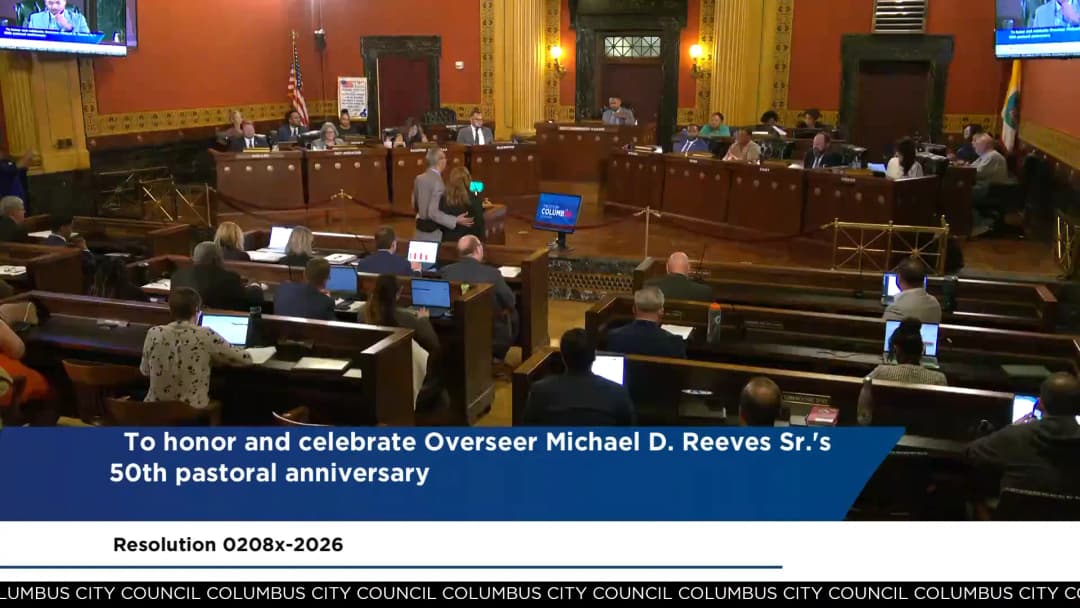
The Public Meeting IndexThe Columbus City Council convened on September 30, 2026, for a regular meeting that included multiple resolutions, ordinances, and a subsequent zoning committee hearing to consider an administrative appeal of a downtown commission decision. Key topics included storm damage remediation, downtown safety and development, immigrant support, energy-efficient home repairs, and a detailed quasi-judicial appeal regarding a demolition permit for properties on South High Street. No public comments were made during the regular session. Consent Calendar - A series of routine approvals and unanimous actions were approved, including resolutions of expression, finance and governance ordinances, economic development ordinances, public service and transportation items, neighborhoods recreation and parks ordinances, health human services and equity items, public safety and criminal justice, housing homelessness and building, public utilities and sustainability, and appointments. Councilmember Green abstained from ordinance 2459-2026. Public Comments & Testimony - There were no speakers during the public comment period of the regular council meeting. Discussion Items - Storm Damage Remediation (Ordinance 2461-2026): Councilmember DeAkaur presented legislation authorizing $2.5 million for mitigation and remediation at Barrack Community Center, Bush Park, Berliner Park, and the Fran Ryan Center following an EF1 tornado on August 11. Councilmember Dorrens criticized the mayor for using the disaster as a political prop and delaying the capital budget process. The city's real estate office confirmed insurance claims filed for Berliner and Barrack (deductible $250,000), with FEMA reimbursement pending. Barrack is expected to reopen in spring 2027. Councilmember Rosa de Padilla noted that funds for Barrack were already being addressed and that the capital budget process is separate. - Economic Development Grant (Ordinance 2538-2026): A $2 million grant to Downtown Columbus Inc. (DCI) was authorized, with $500,000 from the housing business tax incentive fund for Safer Downtown's homeless outreach and $1.5 million for downtown strategic plan implementation. Robin Davis, Executive Director of Safer Downtown, reported 26 full-time ambassadors, 36,000 calls answered, and 126 people moved off the street via homeless outreach. DCI also raised $1.2 million in private funds. - Immigrant and Refugee Support (Ordinance 2237-2026): Councilmember Rosa de Padilla introduced a $213,000 grant split equally among CRIS, Jewish Family Services, and ETSS for case management, legal services, mental health, and resource coordination. She emphasized the importance of supporting families facing federal uncertainty. - Energy Efficient Home Repair Program (Ordinance 2757-2026): Councilmember Weish moved to amend the income cap from 200% of federal poverty level to 100% of area median income (approx. $110,000 for a family of four). The program, administered by MORPC, provides weatherization and home repairs to low-to-moderate income homeowners who often fall through gaps in existing programs. The amendment was approved unanimously. - Arttober Resolution (0225X2026): Councilmember Rosa de Padilla presented a resolution recognizing October 2026 as Arttober, celebrating Columbus's creative community. Mitch Maniaci of GCAC noted the arts generate $2.1 billion in annual economic activity and support 22,000 jobs. The resolution passed. - Nationwide Children's Hospital Marathon Resolution (0227X2026): Councilmember Dorrens presented a resolution honoring the marathon and half marathon. Race Director Darius Blackford reported that the event has raised over $15 million since 2012, with a record-setting pace to raise $1.5 million this year. The resolution passed. - Pastoral Anniversary Resolution: Council President Harden recognized Overseer Michael Reeves for his 50th pastoral anniversary at Corinthian Missionary Baptist Church. The resolution was adopted. - LGBTQ+ Commission Code Amendments (Ordinance 2622-2026): The council amended city code to clarify the commission's enabling provisions, allowing committees and chairs to be set by bylaws rather than code. Passed unanimously. Key Outcomes - Consent Agenda: Approved with Councilmember Green abstaining on ordinance 2459-2026. - Storm Damage Ordinance (2461-2026): Passed (all in favor). - Economic Development Grant (2538-2026): Passed (Councilmember Green abstained). - Immigrant Support Ordinance (2237-2026): Passed. - Energy Efficient Home Repair Ordinance (2757-2026): Amended and passed. - Arttober Resolution (0225X2026): Adopted. - Marathon Resolution (0227X2026): Adopted. - Pastoral Anniversary Resolution: Adopted. - LGBTQ+ Commission Ordinance (2622-2026): Passed. - Other ordinances (bond anticipation notes, WIC contract, film permits, public utilities items) all passed as noted. Zoning Committee: Administrative Appeal (Case COA 2600161) The zoning committee heard oral arguments on an appeal by Town High Plaza, LLC of a downtown commission's 3-3 tie vote denying a certificate of appropriateness for demolition of buildings at 171-191 South High Street and 200 Wall Street. The appellant proposes to demolish the unsafe, fire-damaged buildings and leave a grass-seeded, maintained lot while pursuing redevelopment. The downtown commission historically rejects such "vacant lot" plans, arguing the design guidelines require a productive replacement use. - Appellant's Position (Kevin Dunn): The city code (Section 3359.23) provides a second alternative for demolition when no replacement structure is proposed: a maintenance plan. The submitted plan includes capping utilities, grading, seeding, and ongoing maintenance. The commission's refusal to even review the plan on its merits violates the code. The buildings are unsafe (city unsafe building orders since 2019) and the owner cannot get environmental assessments without demolition. - City's Position (Josh Cartier): The downtown commission has discretion to interpret its guidelines, which disfavor vacant lots. The applicant declined an offer from Vice Chair Maniaci to consider a public art installation or walkway. A vacant lot has no design element, and the commission's decision should be affirmed. Other processes (court order or emergency order) can still lead to demolition if safety is formally determined. - Council Deliberation: Councilmembers asked about the definition of a maintenance plan, the commission's discretion, and whether intentional neglect played a role. No immediate vote was taken; the committee will issue a written decision later.
The Internal Operations Standing Committee met on September 30, 2026, chaired by Councilmember Angela Whitfield Callaway, with Councilmembers Scott Benson and Renata Miller present. The committee addressed a range of items including settlement approvals, contract extensions, personnel matters, and public comments. Several items were deferred for further review. Meeting Opening and Minutes Approval - Roll call confirmed attendance: Callaway (President), Benson, and Miller. - During approval of the minutes, Benson requested that interview acknowledgments (including names and start times) be included in the minutes; the chair agreed to have edits submitted before the end of the meeting. - The meeting opened with a prayer led by Benson, referencing Proverbs 14:31. Public Comments - Adrian Tines complained about her landlord on West Grand Boulevard, alleging he called her mentally ill and used military-grade surveillance technology. She stated she has contacted police, state police, and the FBI. - Dr. Denise Darnell (Michigan Education Justice Coalition) opposed the federal voucher program, urging Governor Whitmer to opt out to protect public school funding. She highlighted potential cuts to Title I, IDEA, and nutrition programs. - The Rattler alleged ballot fraud in Detroit elections, specifically referencing an international absentee ballot issue, and demanded investigations of election officials. - Betty A. Varner (President, Soda Elsewhere Block Association) thanked the council for supporting a mini-market in her food-desert community. She requested assistance with a $1,500 land-use hearing fee and playground equipment. - Owner Papa questioned the $925,000 Herman Kiefer settlement, citing scripture and demanding accountability. - William M. Davis called for restoration of city retiree pensions, noting that pensions were cut and healthcare taken. He encouraged voter turnout. - Cunningham shared personal religious experiences and urged unity and mutual support. - Ronald Foster commented on community social dynamics and encouraged mutual cooperation. - Sydney Dara urged listeners to vote against the constitutional convention, support Democratic candidates, and take action against “fascism.” Unfinished Business - 5.1 Settlement (Sherry Ware v. Mary Lou Engelman/DPD, $60,000): Callaway criticized the employee’s driving record and city vehicle use. Miller moved to defer for one week; Benson withdrew his approval motion. The item was deferred one week without objection. - 5.2 Settlement (Mandy Mitchell v. City of Detroit): Approved without objection. - 5.3 Settlement (Virginia Park LLC/Herman Kiefer, $925,000): Law Department explained the bankruptcy and settlement terms. Callaway and Miller expressed frustration and called for better terms. Miller moved to defer two weeks, approved without objection. - 5.4 Contract extension (Floyd E. Allen & Associates): Law Department requested a one-week deferral; approved. - 5.5 HR classification (Deputy Director of Cable Communications): Discussion noted the commission no longer exists; deferred one week. - 5.6 Tenants Rights Commission ordinance: Deferred three weeks. New Business - 6.1 Contract (Post-arraignment legal defense): Approved, with a request for performance data from Miller. - 6.2 Contract (Election logistics system): Approved. - 6.3 Settlement (Brandon Owens v. Officer Christopher Jones, $300,000): Approved. - 6.4 Settlement (Brian Diaz v. City of Detroit, $14,000,000 total): Approved. Benson discussed the importance of investing in DDOT drivers and noted the person was terminated. - 6.5 Settlement (First Choice Met LLC, $10,000): Approved. - 6.6 Settlement (Fuqua Peak v. Julius Burks, $20,000): Approved. - 6.7 Settlement (Patrick Donald Gaughan, $25,000): Approved. - 6.8 Settlement (Larry Hinton, $90,000): Approved. - 6.9 Settlement (Northland Radiology, $9,000): Approved. - 6.10 Settlement (Vega Sleason, $27,500): Approved (related to 6.9 but separate). - 6.11 Settlement (Daryl LaFord, $125,000): Approved. - 6.12 Settlement (Muhammad Abdus Salam Muhammad, $210,000): Deferred one week for additional details. - 6.13 Charitable gaming license (Michigan Science Center): Date error noted; moved to end of agenda and later approved. - 6.14 2027 benefit rates: Approved. Benefits Manager Ayana Jackson detailed negotiations resulting in below-market increases; the BCN plan sees no employee rate change. - 6.15 Labor agreement (AFSCME Local 925, 21 employees): Approved. - 6.16 Property assessment board certification costs: Deferred one week. Members' Reports - Miller announced she will serve as ringmaster at the Universal Soul Circus on Friday at 7 p.m. in District 5. - Callaway announced a coffee and conversation event on October 12 at House of Prayer and Praise, and a district webinar on October 19. She also reminded residents about free lead testing. Key Outcomes - Multiple settlements and contracts approved as noted above. - Deferrals: 5.1 (1 week), 5.3 (2 weeks), 5.4 (1 week), 5.5 (1 week), 5.6 (3 weeks), 6.12 (1 week), 6.16 (1 week). - Callaway emphasized the need for a city vehicle usage policy reform and noted she would contact DDOT about random drug testing.
The Budget, Finance, and Audit (BFA) Standing Committee of the Detroit City Council met on Wednesday, September 30, 2026, at 4:00 PM UTC. The meeting included public comment, a detailed review of the Detroit Water and Sewerage Department (DWSD) and Great Lakes Water Authority (GLWA) financials, budget implementation discussions on public safety, consideration of several contracts and reports, and action on multiple agenda items. Consent Calendar - Approval of Minutes: The minutes from the September 23, 2026, meeting were approved unanimously. - Receipt and Filing of Reports: The following items were received and filed without objection: 7.2 (Risk Management Council Annual Report), 7.6 (LPD Report on DWSD/GLWA), and 8.1 (Office of the Auditor General External Quality Review). - Removal of Duplicate: Item 7.11 was removed as a duplicate. Public Comments & Testimony - The Rattler (prisoner number 29647039): Called for Councilmember McCampbell to summon Gina Avery Walker, Director of the Detroit Department of Elections, to explain how council-allocated funds to the elections department have been spent. Expressed distrust of the election process. - Cunningham: Thanked council members for support, requested prayers and donations for a replacement outreach vehicle, and praised the disability task force. Noted past negativity from the previous council. - Betty A. Varner (President, Souda Ellsworth Black Association): Thanked council for supporting a mini market in the community (a food desert). Urged the administration to provide funding for the Gratiot corridor and requested a $1,500 fee waiver for a land use hearing needed to obtain playground equipment. - William M. Davis (former DWSD employee): Strongly opposed the GLWA lease agreement (item 7.6), arguing it gave the city less power, control, and flexibility, and no rent increases. Called for renegotiation to get a more equitable return, referencing the city's bankruptcy and former Mayor Coleman Young's warnings. - Ronald Foster: Criticized the city's budget direction and policies, particularly GLWA, which he called a “waste dump for the state.” Expressed concern over council members’ personal agendas and lack of independence from the former mayor's influence. - Zoom User (Mr. Smith): Expressed disappointment with Councilmember McCampbell, reported seeing multiple EPU vehicles before his phone was taken, and called for forensic audits of city departments. Complained about the Detroit Land Bank’s unmaintained properties and nuisance abatement selectively enforced. Criticized a contractor and raised concerns about corruption. Rejected an offer of friendship from Jerry Ashford. Discussion Items 1. DWSD/GLWA Financial Review and Update (Item 7.6) The Legislative Policy Division (LPD) presented its annual high-level financial review of DWSD and GLWA. Key points: - GLWA was created in 2016 via a 40-year lease with a flat $50 million annual payment to DWSD ($27.5M sewer, $22.5M water). - DWSD's FY 2025 audited financials: Water fund operating income $5M, capital grants $53M; Sewer disposal fund operating income $19M, capital grants $16M. - GLWA's FY 2025 audited financials: Water fund operating income $31M; Sewer fund operating income $54M, capital grants $37M. - LPD expressed concern about project delays negatively impacting service delivery. - DWSD Deputy Director Sam Smalley and CFO Istacker Raman presented the department's strategic priorities: green infrastructure, fair rates, infrastructure strengthening, public health, and customer experience. - DWSD has replaced over 17,000 lead service lines (can do 250/week with funding), aims to replace 70,000 lines at a cost of $700M. Self-financing would require 15% annual rate increases; bonding would require 5.5%. - The average age of water mains is 93 years; DWSD replaces about 13.6 miles per year, aiming to reach 30 miles per year. - DWSD is cleaning 600 miles of sewer annually (every 4.5 years) and 8,000 of 90,000 catch basins. - DWSD received $175M federal grant for alley sewer repairs (9,000 connections). - The water board building needs at least $30M in repairs; a decision on whether to invest or relocate is expected by end of 2026. - Lifeline H2O affordability program currently protects 4,700 customers; full funding for all eligible (up to 30,000) would require $18M. - Council members asked about renegotiating the GLWA lease (DWSD does not recommend it), water main break costs ($15-20K per break), contractor penalties, and the building's market value. Concerns were raised about affordability and the impact of federal grant freezes. 2. Fiscal Year 2027 Budget Implementation Discussion 3: Public Safety (Item 130) The committee reviewed four shared priority items: - DPD Truck Traffic Enforcement Unit Pilot: Item 2 (Member Santiago Romero) – $550,000 for a pilot in District 6 with citywide rollout. Commander Ian Sedry reported the unit is being built; two officers will be dedicated daily. Training is underway with launch expected in Q4 2026. Residents can report violations via SeeClickFix or local precincts. Education efforts with trucking companies are ongoing. - Citizens Blight Patrol: Item 3 (Member Callaway) – $50,000 to roll over and create a separate cost center for blight patrol, modeled after Citizens Radio Patrol. Lieutenant Delisha Anderson reported that the standard operating procedure (SOP) and ordinance are with the legal department for review. The program will be citywide; rollout expected in Q2 2027. About 50 people have signed up. - Executive Protection for City Clerk: Item 4 – Two DPD officers assigned to the City Clerk with same level of training as mayor’s detail. First Assistant Chief Hayes confirmed the detail is budgeted for primary, general, and special elections, and can be activated for rallies or other events at the clerk’s request. - DFD Capital Investment Study: Item 49 (Member Benson) – $500,000 for a capital investment study of fire facilities. Deputy Commissioner Hillman reported an RFP is being developed with OCP and should be released shortly. Contract award expected by January 2027, with analysis complete by FY28 Q3. The study will include response capabilities per NFPA/ISO standards and stakeholder input. 3. Unfinished Business: Car Wash Contracts (Item 7.1) The committee discussed a contract for vehicle washing services that was sent back from formal session because it lacked east-side locations. Councilmember Waters and Vice Chair Johnson stressed the need for equitable distribution. OCP’s Raymond Green said they are actively working with three potential east-side vendors but the process takes months (due to treasury clearance, financials, etc.). Current contracts have about 1 year 10 months remaining. The committee agreed to bring the item back in one week with an update on east-side locations. 4. Risk Management Council Annual Report (Item 7.2) Risk Manager Larry Foley presented the annual report. Key highlights: - The city spends $3.2M annually on insurance premiums ($2.5M on property insurance). An RFP for a new broker is underway. - Litigated auto payouts (2019-2025) total $50M across DPD, DFD, and DDOT. A single catastrophic loss can spike yearly results. - The risk management committee is focusing on driver hiring, training, and accident investigation to reduce losses. - Pollution legal liability claim (from residential demolitions) has been submitted to the insurer; process is ongoing. - Workers’ compensation claims have decreased significantly with Comp One as administrator. - The report was received and filed. 5. Fiscal Year 2027 One-Month Financial Report (Item 7.3) Deputy Budget Director Matt Spath and Treasurer Valerie Gowley presented the July 2026 financial report. Notable items: - The city received the GFOA Certificate of Achievement for the 8th straight year and the Distinguished Budget Award for the 4th straight year. - July variances: $3.7M unfavorable in other revenues (timing), $11.4M unfavorable in professional contractual services (timing of invoices). These are expected to smooth out. - The budget includes $22.5M in continuing appropriations from FY26 unspent balances (subject to audit finalization). - Employee count: Police dropped 58 (school crossing guards on summer break); Fire increased 37 (student firefighters). - Income tax: Partnerships saw a spike ($7.8M) due to state cleanup of misapplied payments; a corresponding reduction in corporate tax is expected next month. - Cash position: $1.4B total general ledger cash, down $386M from prior year (due to use of retiree protection trust fund, capital project proceeds, and ARPA dollars). - Accounts payable: Three invoices over 61 days are being resolved. - The item was brought back for one week to allow OCFO to address a question about an unpaid invoice. 6. Other Unfinished and New Business - 7.4 (Data Center Tax Revenue Impact): Brought back in three weeks. - 7.5 (Claims Ordinance Amendment): Law Department requested one-week bring back; committee approved. - 7.7 (Property Tax Legislation Analysis): Brought back in three weeks (Member Waters). - 7.8 (Grant Opportunities for Community Organizations): Brought back in one week; Member Waters noted she had not received the memo. - 7.9 (Data Center Tax Revenue Impact Analysis): Brought back in three weeks. - 7.10 (Grant Applications Report): Brought back in three weeks. - 8.2 (NEZ Certificate for 3436 Cochrane): Approved and sent to formal. Developer Sean Tidwell (King & Cocker) proposed a 21-unit apartment building with 19 parking spaces, six units at 80% AMI and nine at 120% AMI. Total development cost $8M. Over 80% Detroit-based contractors. First ground-up development for the team. - 8.3 (Budget Implementation Follow-up): Brought back in three weeks. - 8.4 (Montif Branch Capital Improvements): Brought back in three weeks (Vice Chair Johnson). Key Outcomes - Approved and Sent to Formal Session: Item 8.2 (NEZ for 3436 Cochrane). - Received and Filed: Items 7.2, 7.6, 8.1. - Brought Back in One Week: Items 7.1 (car wash contracts – for update on east-side locations), 7.3 (financial report – to answer invoice question), 7.5 (claims ordinance amendment), 7.8 (grant opportunities memo). - Brought Back in Three Weeks: Items 7.4, 7.7, 7.9, 7.10, 8.3, 8.4. - Removed: Item 7.11 (duplicate). - Public Safety Budget Items: All four items are on track. DPD truck enforcement pilot launching Q4 2026; blight patrol rollout Q2 2027; executive protection for City Clerk is operational; DFD capital study RFP to be released shortly. - DWSD/GLWA: No action taken; report received and filed. Council members expressed ongoing concerns about affordability, the fixed $50M lease payment, and the need for state/federal funding for lead service line replacement and affordability programs. - Risk Management: Report received; focus on reducing auto losses through driver safety initiatives.
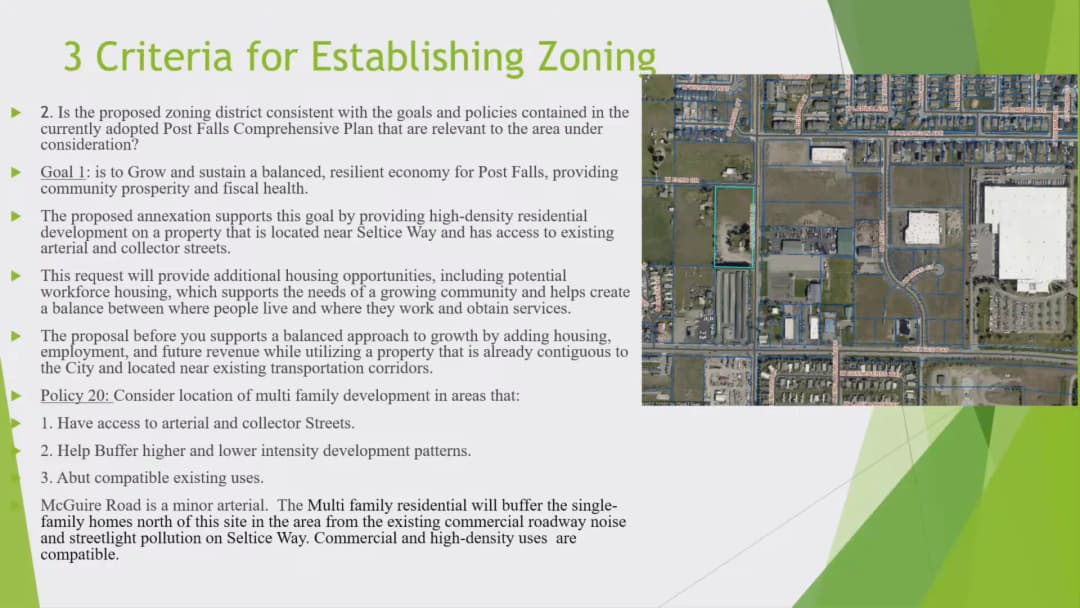
The Post Falls Planning and Zoning Commission met on September 30, 2026, to consider two zoning recommendations: the Kruger Annexation (ANX-26-5) requesting R3 high-density residential zoning on 4.49 acres, and the Immaculate Conception Chapel Zone Change (ZC-26-2) requesting a change from SC4 to SC5 on 4.44 acres. The commission heard public testimony, reviewed staff presentations, and voted to forward both recommendations to the city council. Public Comments & Testimony - Shannon Stuckey (opposition): Expressed opposition to R3 density at the entrance to the neighborhood, citing traffic increases and concerns that apartments bring transient populations. Characterized the proposal as prioritizing fast money over responsible growth. - Glenn Whipple (opposition): Opposed the annexation and R3 zoning. Stated he and his wife have lived on Echo Drive for 40 years and chose the area for its rural character, small farm properties, and low traffic. Argued the city’s rapid expansion is outpacing infrastructure and that existing apartment vacancies show no need for additional high-density housing at this rural intersection. Noted safety and congestion concerns on Echo Drive and Maguire Road. - Debbie Vaca (opposition): Opposed the proposal, stating the area is quiet with no walkable amenities or public transit. Called the future land use map outdated and inconsistent. Raised concerns that Echo Drive is narrow and the Maguire Road intersection cannot handle more traffic. Argued annexations should be carefully considered rather than approved simply for profit. Discussion Items Kruger Annexation (ANX-26-5) – R3 Zoning Recommendation - Staff presentation (Ethan Porter): The 4.49-acre property is contiguous to the city, currently outside city limits. The future land use map designates it as high-density residential, and the West Prairie Focus Area anticipates higher densities near commercial corridors and arterials. The implementing zoning is R3. Staff found the proposal consistent with the comprehensive plan and no adverse service impacts were identified. City engineer Rob Paulus provided traffic analysis: Maguire Road currently meets level of service standards. Under a 2045 no-build scenario, it would operate at level of service C (meeting standards). Long-term plans include widening Maguire Road to four or five lanes, with signals/roundabouts at key intersections, funded by developer and impact fees. - Applicant (Stephanie Blaylock, Fairdis): Representing Daniel and Beverly Kruger. Emphasized that R3 zoning is consistent with the future land use map and West Prairie Focus Area. The property’s location near Celte Sway and arterial/collector streets makes it appropriate for higher-density housing. Annexation would provide right-of-way along Maguire Road and Echo Drive, improve pedestrian connectivity, expand the city’s tax base, and offer potential workforce housing. The proposed multifamily development would serve as a buffer between commercial uses to the south and single-family residential to the north. - Commissioner discussion: Commissioner Wilhelm noted the previous denial of annexation in 2023. Commissioners reviewed the three approval criteria and found the proposed R3 zoning consistent with the comprehensive plan, compatible with surrounding uses, and no adverse service impacts. One commissioner questioned traffic modeling and density but acknowledged the area’s specific high-density residential designation on the comp plan. Commissioner Kerry expressed opposition (voted no). Immaculate Conception Chapel Zone Change (ZC-26-2) – SC4 to SC5 - Staff presentation (Ethan Porter): The property is a 4.44-acre block between Fifth and Fourth Avenues and Lincoln and Idaho Streets. Current zoning is SC4; proposed is SC5, which allows higher intensity uses (e.g., hotels, taller buildings, greater density). The surrounding area is already primarily SC5, and the request follows the pattern of development in the city center. The church plans to eventually sell the property for redevelopment, which would add to the city tax base. - Applicant (Father Urego): Representing the church. Stated the property has been there for 50 years (moved from across the street). The church is not currently developing but sees the zone change as a win-win for the city and the church, enabling future redevelopment in a location already served by grid streets, sewer, and water. Emphasized the church’s long-term commitment to Post Falls. - Commissioner discussion: Commissioners noted the SC5 zoning is consistent with the future land use map and the pattern of higher-intensity development along Fourth Street. The change would encourage redevelopment in the city center, utilize existing infrastructure, and eventually bring property onto the tax rolls. Some commissioners expressed a personal preference for CCS (community commercial services) but found SC5 acceptable. No adverse impacts were identified. Unanimous support. Key Outcomes - Kruger Annexation (ANX-26-5): Motion to recommend approval of R3 zoning (6-1; Commissioner Kerry opposed). The recommendation will be forwarded to the city council, which will make the final decision on annexation and zoning. - Immaculate Conception Chapel Zone Change (ZC-26-2): Motion to recommend approval of SC5 zoning (7-0). The recommendation will be forwarded to the city council. - Administrative & Commissioner Comments: Staff noted four public hearings are scheduled for the October meeting. Commissioner Wilhelm requested the annual school attendance letter from the school district for use in future land use decisions. A special city council workshop on starter home subdivisions was mentioned for Thursday (date not specified).
The Committees on Consumer and Worker Protection, Transportation and Infrastructure, and Public Safety held a joint oversight hearing on micromobility in New York City, examining regulation, accountability, and safety. The hearing considered a record 23 bills and resolutions aimed at improving safety for pedestrians, cyclists, and delivery workers, including measures on e-bike classification, point-of-sale enforcement, delivery app licensing, crash reporting, and infrastructure improvements. All introductions were heard and laid over by committee; the oversight was filed. Public Comments & Testimony - Numerous victims and family members testified about being struck by e-bikes or e-scooters, describing severe injuries and lack of accountability. Many called for passage of Priscilla's Law (Intro 802) requiring licensing and registration of e-vehicles. - Representatives from Transportation Alternatives, RPA, Open Plans, and other advocacy groups supported bills that ban high-speed devices, regulate delivery apps, and improve infrastructure, while opposing excessive enforcement and e-bike licensing. - Workers' Justice Project and dozens of delivery workers testified against bills that would increase NYPD enforcement, confiscate bikes, or ban class 3 e-bikes without a funded transition plan. They highlighted pressure from delivery apps, unsafe working conditions, and unjust deactivations. - Uber and Lyft representatives (via written testimony and in person) opposed certain liability and tracking bills, while supporting some safety measures. - Disability rights advocates stressed the need for accessible infrastructure and data collection on crashes involving people with disabilities. - Community groups like Good Neighbors of Park Slope urged citywide rules-of-the-road education campaigns. Discussion Items - Administration Testimony: DOT Commissioner Mike Flynn, DCWP Commissioner Sam Levine, and NYPD officials testified, outlining enforcement efforts, point-of-sale inspections, and support for many bills with suggested amendments. They expressed concerns about sidewalk detection technology, dynamometer feasibility, and potential unintended consequences for workers. - Councilmember Questions: Speaker Adrienne Adams and committee chairs pressed agencies on lack of enforcement of existing laws (e.g., vest requirements), age verification for Citi Bike, and data on collisions involving illegal devices. There was extensive debate on banning class 3 e-bikes, with some councilmembers arguing 20 mph is plenty, while others worried about impacts on delivery workers. - Trade-in Program: Chair Abreu's Intro 985-A was discussed as a way to transition users to slower devices, but DOT cited resource constraints and lessons from a pilot program. - Delivery App Accountability: Multiple bills (e.g., Intro 950, Intro 1069) would license delivery services and require trip-level data to study safety. Administration supported the intent but suggested placing data oversight with DOT. Key Outcomes - All 23 introductions and resolutions were heard and laid over by committee; no votes were taken. The oversight (T2026-2311) was filed. - The administration committed to enforcing existing micromobility laws, including the vest requirement, and to providing written data on enforcement and collisions. - Speaker Menon announced a forthcoming bill mandating age verification for Citi Bike. A Vision Zero hearing is scheduled for October 27, 2026, focusing on car and truck safety. - Several councilmembers emphasized the need for a balanced approach that protects delivery workers while getting high-speed illegal devices off streets.
The San Antonio City Council held a B Session on September 30, 2026, to discuss two major items: a proposed four-year rate adjustment plan for the San Antonio Water System (SOS) and a request from Timberwood Villas for an impact fee exemption to connect to SOS sewer service. No formal votes were taken; the rate plan will be considered by the SOS Board on October 6 and the City Council on October 8. The Timberwood Villas matter remained unresolved, with multiple options discussed. Public Comments & Testimony - No public speakers were recorded during the session; the public comment period was opened but not detailed in the transcript. Discussion Items SOS Rate Adjustment Proposal (2027–2030) - Robert Puente, SOS President, and Cecilia, CFO, presented an updated rate plan following Council feedback from June 2026. Key changes included: - $11 million in expense reductions, elimination of 20 vacant positions, and $1.2 million in service cuts. - Reduction of the five-year capital program from $3.2 billion to $2.6 billion (a $600 million reduction) while restoring 77 water main replacement miles. - Proposed rate increases starting January 2027: 6.9% in 2027, 6.5% in 2028, then minimums of 4.5% in 2029 and 4% in 2030, leading to a cumulative residential bill increase of 23.7% over four years (from $56.68/month to $70.13/month for average use of 6,625 gallons). - Enhanced affordability programs: no rate increase for customers enrolled in assistance programs, $550,000 annually for customer programs, automatic enrollment pilot in Districts 1, 2, and 5, and expansion to more districts. - Troy, city financial officer, affirmed the plan is reasonable and manages risk within the proposed ranges. - Council members (Alderete Gavito, Mesa González, Mungía, Galván, Cor, and others) expressed appreciation for the collaborative process and cost reductions but stressed the need for the lowest possible rates. Councilmember Cor requested a list of projects with contractor compliance issues, and Councilmember Galván sought data on residential vs. commercial water use and conservation goals. Councilmember Mungía raised concerns about long-term affordability and data center water use. Timberwood Villas Impact Fee Exemption - The council considered a request from Timberwood Villas, a 75-home subdivision with a failing communal septic system located in the Edwards Aquifer recharge zone. The homeowners association requested an exemption from SOS impact fees totaling $415,575 to connect to SOS wastewater service. The county had allocated $2 million in federal ARPA funds toward the total project cost of $2 million, but the impact fee remained uncovered. - SOS offered a five-year, interest-free payment plan for the fees, but the homeowners sought full exemption, citing public health risks and potential aquifer contamination. - Council member Spears strongly supported the exemption, arguing the failing system threatens the aquifer and that the city has a history of granting such exemptions. Other council members (Villagran, Mungía, Cor, Castillo, and White) expressed reluctance, noting that the county (not the city) should bear the cost, that the homes are outside city limits, and that granting the exemption could set a precedent for other unserved areas. Council member Villagran argued the county should pay, while Council member White suggested early annexation as a possible condition for support. - SOS representatives clarified that the impact fee is required by state law (Chapter 395) and that any exemption beyond the city's existing program (which has limits) would require council action. Options discussed included early annexation (possible by petition), a payment plan, or the council using its authority to waive the fees either now or after a policy review. Impact Fee Policy Review - SOS announced plans to begin a comprehensive impact fee study in 2027, with a committee formed in 2028 to update fee structures every five years. Some council members requested that new criteria for exemptions be considered for small subdivisions in environmentally sensitive areas, including Timberwood-like cases. Key Outcomes - No votes were taken during the B Session. The SOS rate plan will proceed to a public hearing and vote on October 6 (SOS Board) and October 8 (City Council). - The Timberwood Villas impact fee exemption request was left unresolved. Council directed staff to explore early annexation options for the subdivision and to report back. SOS reiterated the availability of a five-year payment plan. - Council members indicated that any future impact fee policy changes should address affordability and public health concerns, with a focus on unserved communities near the aquifer.
The San Antonio City Council held a special work session on September 30, 2026, to receive a briefing on the proposed 2027 Bond Program. City staff recommended a $442 million bond program based on a moderately conservative financial forecast. The council was deeply divided on the bond's size, priorities, and fiscal risk, with strong debate between pursuing a $1+ billion program to address deferred infrastructure needs and sticking with the safer $442 million recommendation to avoid a property tax increase. Discussion Items - Bond Capacity & Fiscal Risk: Staff presented the $442M recommendation as fiscally prudent, maintaining the tax rate. A backup scenario for a $1 billion bond was presented, which would require either a $0.21 debt service tax rate increase or sustained growth in property values. City Manager Eric cautioned against overextending given the uncertain economy and obligations to existing bondholders. - Priorities, Equity, and Project Allocation: A major focus was addressing inequities in infrastructure, particularly failing streets (nearly 9% citywide, estimated $744M to fix completely) and drainage in older districts. Councilmembers from Districts 1-5 advocated heavily for greater investment in their areas, citing historical underfunding compared to the north side. The definition of "citywide" projects was debated, with some arguing it dilutes resources for neighborhoods. - Stormwater Fee Increase: Staff proposed increasing the stormwater fee to generate $175M for drainage projects (approximately a $10/year increase on the average residential bill over time). Supporters like Councilman McKee Rodriguez saw it as a clear way to fund drainage debt; opponents like Councilman Viagran and Councilwoman Vito worried about compounding utility costs for residents. - Sports & Entertainment District Projects: The city's ask for this area was significantly reduced from an initial $220-250M to $35M, leveraging an 80/20 match from TxDOT for projects like Durango Street improvements. Councilmembers debated whether this should be a separate proposition or if PFC/TIRZ funds could cover it. - Affordable Housing: A $150 million housing bond was proposed to align with SHIP goals. Councilwoman Corr asked staff to explore alternative mechanisms to achieve housing goals outside the bond program. - Community Input Process & Timeline: Staff sought feedback on the bond committee format versus town hall meetings. The consensus leaned heavily towards a May 2027 election date. Councilmember Positions - Support for $1 Billion+ Program: Councilmembers Viagran (D3), Mungia (D4), Galvan (D6), Castillo (D5), and Mesa Gonzalez (D9) advocated for a $1B+ bond. They argued it was necessary to address a $5.8B need, avoid further deferring critical projects in underserved areas, and maintain the city's competitive momentum. They expressed trust in the voters to approve a larger package. - Support for $442 Million Program: Councilmembers White (D10) and Vito (D7) strongly supported the staff recommendation. They emphasized the burden placed on residents by recent property tax and utility increases, the risk of a failed bond election, and the need for fiscal restraint. Councilwoman Corr (D1) was open to a higher number but required concrete "worst case" tax impact numbers to make a decision. - Conditional and Compromise Positions: Councilman McKee Rodriguez (D2) laid out specific options including using a stormwater fee increase and creating a targeted "F Street" bond. Mayor Jones facilitated the discussion, urging staff to provide detailed financial risk analysis and clear definitions of funding mechanisms ahead of the next session. Key Outcomes - No formal vote was taken. The session served to provide direction to staff. - Next Work Session: Staff will return with detailed analysis and options on October 14, 2026. - Staff to Deliver Updated Analysis: - Updated project list with staff recommendations. - "Worst case" tax impact analysis for bond programs at $442M, $750M, and $1B levels. - Identification of projects eligible for funding via PFCs or TIRZs. - A refined definition of "citywide" vs. "regional" vs. "district" projects. - Analysis of potential savings from ending the Midtown and Inner City TIRZs early. - Historical bond funding allocation by council district. - Operations & Maintenance (O&M) cost projections for proposed new facilities. - Timeline Direction: The target for the public bond vote is May 2027.
This briefing covered two major items: the San Antonio Water System's (SAWS) proposed four-year rate adjustment plan and a request to waive wastewater impact fees for the Villas at Timberwood, a 75-home neighborhood in Bexar County. Council members heard presentations from SAWS and city staff, discussed affordability, capital investments, and public health concerns, and provided feedback ahead of an October 8 vote. Discussion Items SAWS Rate Adjustment Proposal - SAWS presented a revised rate plan for 2027–2030, shifting implementation to January 1, 2027, and reducing the minimum cumulative four-year residential impact from 26.1% to 23.7%. The average monthly residential bill would increase from $56.68 to $70.13 at the minimum adjustments. - Key changes from the June proposal: lowered minimum adjustments in 2029 and 2030 by 1% each; maintained 77 miles of water main replacement (restored after an initial reduction to 40 miles); expanded the Uplift affordability program eligibility from 125% to 150% of the federal poverty level, with a goal of 29% enrollment increase by 2030; added $550,000 annually for direct customer assistance programs; and launched an auto-enrollment pilot in Districts 1, 2, and 5. - The five-year capital program was reduced from $3.2 billion to $2.6 billion, with wastewater treatment as the top priority. SAWS also commissioned an independent capital efficiency study (Phase 1 completed), which found strong performance but identified opportunities in governance, communication, and stakeholder engagement. - City CFO Troy Elliott confirmed that staff reviewed the proposal and recommends approval, noting that the reduced minimums introduce more risk but are achievable. Any rate above the minimums in 2029–2030 would require additional council review. - Council members expressed general support for the revised plan but pushed for further affordability measures. Several members praised improved transparency and the restored water main funding. Councilwoman Alarete Gavito asked for even lower rates, citing cumulative burdens from other entities. Councilwoman Corr requested detailed bill impact data (e.g., 25th/75th percentiles) and stressed better communication on capital projects like the Hildebrand closure. Villas at Timberwood Impact Fee Waiver - The Villas at Timberwood is a 75-home HOA in the ETJ (to be annexed in 2032) with a failing communal septic system over the Edwards Aquifer contributing zone. Bexar County has committed $2 million in ARPA funds for a new wastewater main to connect to SAWS. The remaining $415,575 in wastewater impact fees ($5,541 per EDU) would be waived if council approves. - SAWS and city staff explained that the current fee waiver program does not cover this project because it is outside city limits, but council has the authority to issue waivers. SAWS also offered a five-year payment plan (approx. $92/month per home). - Councilwoman Spears (District 9) strongly supported the waiver, citing public health risks to the aquifer, the urgency of spending ARPA funds by year-end, and the residents' financial burden. She noted similar waivers were granted in December 2025. - Councilwoman Alarete Gavito opposed, arguing the county should pay the full cost and that city residents face similar issues. Councilman Mungia raised concerns about unknowns (settlement amount, history). Councilman Castillo emphasized the need for a broader policy to address unconnected properties within city limits. - Mayor Jones stated he does not support the waiver, suggesting the county cover the fees or council members use carry-forward funds. He expressed interest in exploring early annexation or a payment plan. - SAWS board chair noted that a policy review on impact fee waivers for health/safety and aquifer protection is underway, with a timeline for board action by December. Key Outcomes - No formal vote was taken on either item. The rate plan will be considered by the SAWS board on October 6 and then by city council on October 8. The impact fee waiver remains pending; council members expressed divergent views, and further discussion is expected before any decision. - SAWS and city staff committed to providing additional data requested by council members, including district-level bill impact analyses and a plan for improved community engagement on capital projects. - Councilwoman Corr requested a list of projects where contractors had to redo work; SAWS agreed to provide that information.
The San Antonio City Council held a meeting on September 30, 2026, at 10:05 a.m. to discuss the process for the 2027 bond program. City Manager Eric Walsh and Director of Capital Improvement Mike Shannon presented an overview of the bond capacity, community needs inventory, and financing options. The council debated the size of the bond package, with some members advocating for a $1 billion bond and others supporting the staff recommendation of $442 million to avoid property tax increases. The meeting concluded with a directive to staff to provide further details for the next session on October 14, 2026. Discussion Items - 2027 Bond Program Overview – City Manager Eric Walsh introduced the bond process, emphasizing the goal of following a program of over $200 million in property tax cuts. The total community needs inventory identified $5.8 billion in potential projects across 304 projects, but the estimated bond capacity is only $442 million. Walsh stressed that community input will be critical. - Capacity and Financing Scenarios – Mike Shannon reviewed the bond capacity, noting that the current conservative estimate allows for $442 million. He presented two possible bond sizes: $1 billion (which would require a property tax rate increase) and a continuation of the $442 million plan. Two financial scenarios were shown: one assuming a flat assessment growth (0% in 2028) requiring a 21-cent tax rate increase in 2028, and another with optimistic growth that could avoid the tax hike. Shannon explained that the $1 billion option would be outside the city’s moderately conservative approach. - Council Member Positions – Several council members expressed clear positions: - Councilwoman Viagran: Strongly supported a $1 billion bond, stating, “I don’t want less than $1 billion for the bonds.” She argued that the city should take the opportunity to invest and that voters would support it. - Councilman Munguia: Also advocated for a $1 billion bond, emphasizing that the need is massive and delaying projects only increases costs. He highlighted the inequitable distribution of past bond funds. - Councilman White: Opposed any increase beyond $442 million, warning against putting citizens at risk of a significant tax hike. He said, “We need to live within our means.” - Councilman Rodriguez (Micki): Supported $442 million initially but floated three options: a $442 million bond, a $744 million bond focused on streets and sidewalks, or a $1 billion bond. He expressed openness to negotiation. - Councilwoman Galván: Supported increasing the stormwater fee and a larger bond, calling it a transformational generational investment. She requested more detail on the combined impact of a larger bond and fee increase. - Councilwoman Alderete Gavito: Agreed with the staff’s $442 million recommendation, stating it is not time to raise taxes. She expressed concerns about a potential bond failure. - Councilwoman Castillo: Emphasized that underinvestment in historic districts is a choice and that bond funds must address equity in Districts 1-5. - Councilwoman Mesa González: Favored a $1 billion bond and supported the May 2027 election date. She requested a breakdown of projects by council district. - Councilman Corps: Noted the inequity in past bond allocations, citing District 1’s 7% share versus District 10’s 12% in the 2022 bond. He wanted to see the worst-case scenario for a $1 billion bond. Key Outcomes - Decision on Bond Size Deferred – The council did not reach a consensus on the bond amount. Staff will return on October 14, 2026, with more detailed recommendations, including project lists, potential impacts of a $1 billion bond on residents, and an equity analysis. - Election Date – The council’s current timeline aims for a May 2027 ballot, as preferred by most members. Staff will continue to refine the schedule. - Housing Bond – Staff, led by Veronica, will provide an analysis of how $150 million or $75 million in housing bond money would meet the city’s affordable housing goals. This will be presented at the October 14 meeting. - Stormwater Fee – Several council members expressed interest in increasing the stormwater fee to fund drainage projects. Staff will assess the feasibility and impact. - Community Engagement – The city will hold further town hall meetings, with the next one in the district of one council member scheduled for October 2026. - Project List Refinement – Staff will remove projects already completed or no longer viable from the potential list, and will clearly mark which projects from the 2022 bond are still pending.