Browse by city
Date range
Search help

Search titles, summaries, topics and stored transcripts together. Keywords may match separately; put the whole query in double quotes for a phrase. Matching follows word analysis, so punctuation is not exact. Both dates are included. Documents are not searched.

SHOWING 3881–3890 ENTRIES
3881
SEP 30, 2026 · NEW YORK CITY, NEW YORK · CITY COUNCIL
Joint Micromobility Oversight Hearing and 23-Bill Package – September 30, 2026

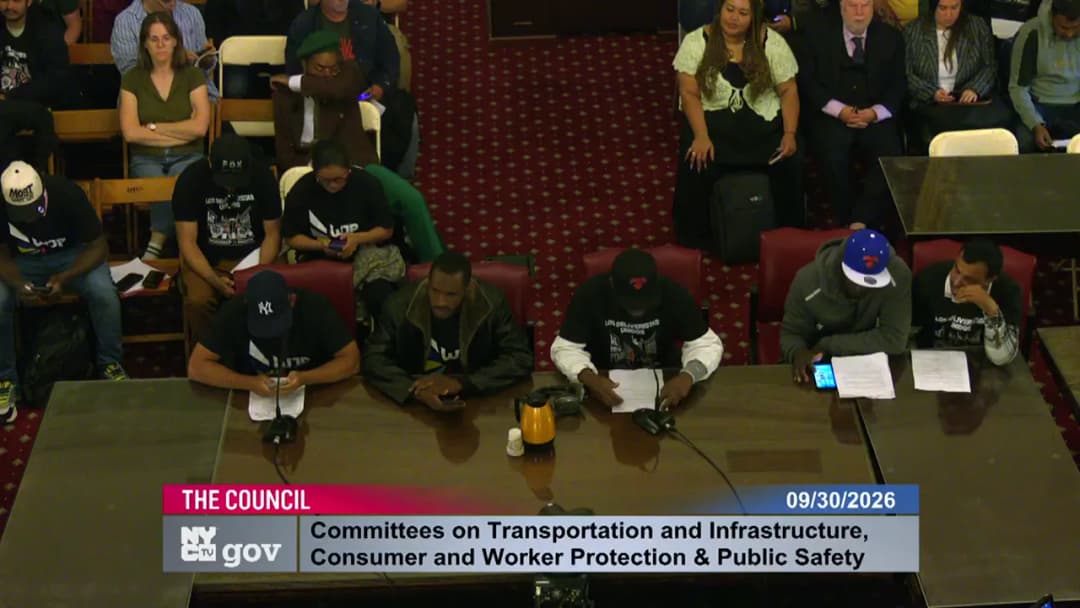
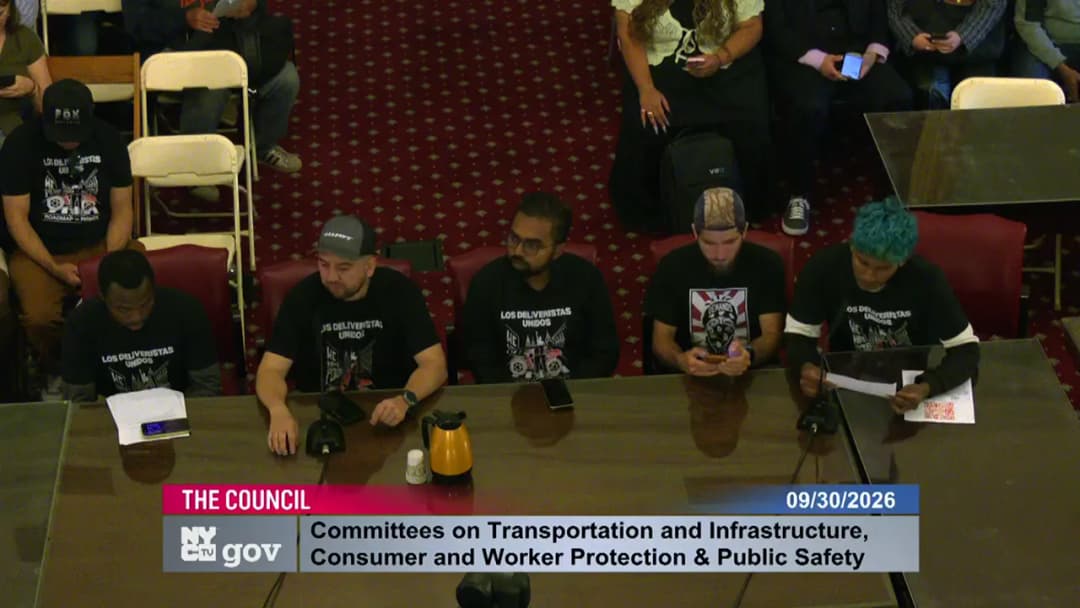
The New York City Council’s Committees on Public Safety, Transportation and Infrastructure, and Consumer and Worker Protection held a historic joint hearing on Wednesday, September 30, 2026, from 10:00 AM to well into the evening. The hearing examined micromobility regulation, accountability, and safety in New York City, and considered a record 23 pieces of legislation and two resolutions. No votes were taken; all bills were heard and laid over or filed, with the oversight item filed. Public Comments & Testimony - Victims of e-bike and e-scooter crashes, members of the Electric Vehicle Safety Alliance (EVSA), and senior citizens testified in support of stricter accountability measures, particularly the licensing and registration of all e-vehicles (Priscilla’s Law, Intro 802, which was not on the agenda). They described severe injuries, hit‑and‑runs, and the inability to identify riders. Multiple speakers called for a ban on class‑3 e‑bikes and for removing motorized devices from parks. - Delivery workers and immigrant advocacy groups (Workers Justice Project, Los Deliveristas Unidos, New York Immigration Coalition) opposed bills that they said would lead to increased NYPD enforcement, bike confiscation, and unjust deactivation by app companies. They argued that the real problem is unsafe infrastructure and aggressive delivery algorithms. They supported licensing of delivery apps and safe transition programs. - Transportation Alternatives, StreetsPAC, Open Plans, RPA, and environmental groups supported a comprehensive approach that includes banning class‑3 e‑bikes, a trade‑in program, dynamometer testing, and holding delivery apps accountable. They emphasized that “20 is plenty” and that infrastructure improvements are essential. - Representatives of Lime, JOCO, PopWheels, Upway, and VEO described their safety technologies (geofencing, speed limiters, UL‑certified batteries) and urged the Council to use proven solutions rather than broad bans. - Uber’s representative opposed liability insurance mandates and worker tracking, but supported banning dangerous delivery time practices. - Community boards and disability rights advocates stressed the need for accessible infrastructure and inclusion of disabled New Yorkers in policy design. Discussion Items - Oversight – Micromobility Safety (T2026‑2395) The hearing began with opening remarks from Majority Leader Abreu, Speaker Adams, Committee Chairs Epstein and Feliz, and multiple councilmembers. They described recent fatal crashes involving high‑speed illegal e‑bikes, the 31.7% increase in e‑bike collisions over the prior year, and the need for a comprehensive approach combining enforcement, education, infrastructure, and app accountability. - 20+ Bills Introduced and Heard - Int 0078 (retention of delivery data) – Supported by agencies, but recommended placement with DOT. - Int 0095 (moped retailer ownership info) – Supported. - Int 0110 (commercial delivery safety for all two‑wheeled devices) – Supported. - Int 0214 (rules of the road display on bike‑share) – Supported. - Int 0244 (ban sale/rental of class‑3 e‑bikes) – Supported by DOT and DCWP with concerns about enforcement; opposed by delivery worker groups. - Int 0389 (moped registration verification by delivery apps) – Supported with worker protection amendments. - Int 0787 (NYPD reporting on targeted traffic enforcement) – Supported but NYPD noted operational challenges. - Int 0950 (licensing delivery services) – Supported, targeted at large app companies. - Int 0985‑A (trade‑in program for powered bicycles) – Supported but DOT noted high cost; amendments proposed. - Int 0986 (dynamometer testing of micromobility devices) – Supported in concept; practical and equity concerns raised. - Int 0988 (ban misleading ads of DMV‑registrable vehicles as e‑bikes) – Supported, but needs to cover illegal devices not DMV‑registrable. - Int 0989 (bike‑share safety reporting) – Supported. - Int 0994 (liability insurance for delivery apps) – Supported by agencies and some advocates; opposed by Uber. - Int 1004 (pedestrian safety signage) – Supported but concerns about effectiveness. - Int 1021 (annual safety report from delivery apps) – Supported; recommended placement with DOT. - Int 1052 (crash data on micromobility devices) – Supported. - Int 1066 (traffic calming in bike lanes at 50 intersections) – Supported. - Int 1069 (study of safe delivery times) – Supported; recommended placement with DOT. - T2026‑2570 (safe delivery time standards) – Heard as pre‑considered; no formal position. - T2026‑2590 (sidewalk riding detection on share systems) – Supported in intent; technology readiness questioned. - T2026‑2361 (ban operation of class‑3 e‑bikes) – Opposed by DCWP and many advocates due to equity and enforcement concerns; DOT neutral pending analysis. - T2026‑2587 (tracking unsafe traffic behavior of delivery workers) – Opposed by DCWP and worker advocates as intrusive and prone to misuse. - Res 0043 (support for State Commercial E‑Bike Licensing Act) – No formal vote; opposed by some advocates. - Res 0044 (increased penalties for leaving e‑scooter accident scene) – Supported. - Agency Testimony - DOT Commissioner Mike Flynn Stressed the need to remove illegal high‑speed devices, improve infrastructure, and hold delivery apps accountable. Supported many bills but expressed concerns about resources and implementation. - DCWP Commissioner Sam Levine Emphasized worker protections, enforcement of deactivation protections (Local Law 34), and the need for balanced regulation. Supported bills that target corporations, not workers. - NYPD Chief O’Bay and Deputy Chief Thomas Alps Described enforcement initiatives: 15 high‑visibility corridors, point‑of‑sale sweeps, ghost plate operations, and data‑driven deployment. Reported over 10,000 e‑bike moving summonses and 10,000 moped seizures year‑to‑date. Acknowledged challenges in identifying illegal devices without technology. Key Outcomes - No bills were passed. All introductions and resolutions were heard and laid over; the oversight was filed. The Council will consider amendments and further action in the coming weeks. - Speaker Adams announced that the Council will release legislation mandating age verification for bike‑share in the coming weeks. - Majority Leader Abreu committed to a separate hearing on October 27, 2026, focused on Vision Zero and dangers from cars and trucks. - DOT and DCWP agreed to work with the Council on revising several bills, including those on data reporting, trade‑in programs, and delivery app licensing. - NYPD agreed to provide additional data on enforcement, collisions, and seizures, and to examine training on existing laws (e.g., delivery worker vest requirement). - The administration expressed openness to increasing penalties for first‑time violations of e‑bike sale laws and to exploring dynamometer technology, subject to piloting and further study. - The hearing concluded with a clear split between advocates of strong enforcement and registration (victims and safety alliances) and advocates of worker‑friendly, infrastructure‑centered reforms (delivery workers, immigrant rights groups).
TRANSPORTATION SAFETY 45% · DELIVERY WORKER RIGHTS 22% · PUBLIC SAFETY 17% · PROCEDURAL 5%
3882
SEP 30, 2026 · NEW YORK CITY, NEW YORK · CITY COUNCIL
Oversight Hearing on Emergency Response in Rockaways and Isolated Communities – September 30, 2026

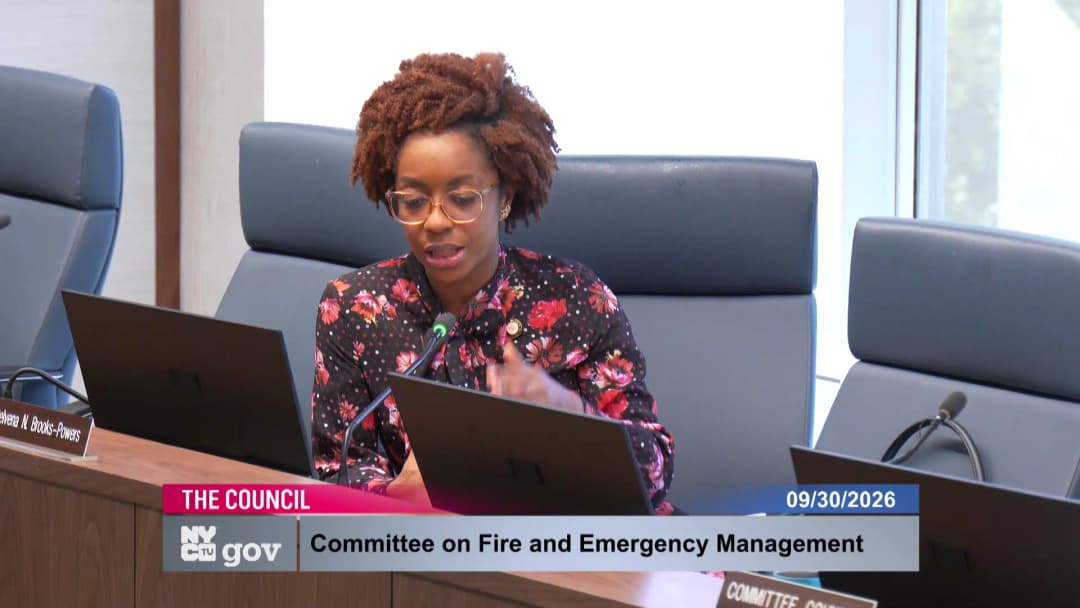
The New York City Council’s Committee on Fire and Emergency Management, chaired by Joann Ariola, held an oversight hearing to examine emergency response challenges in the Rockaways and other geographically isolated communities. The hearing highlighted a July 25, 2026 double homicide and fire in Far Rockaway that displaced 22 adults and 7 children, as well as recent nor’easter flooding. EMS staffing shortages, 911 dispatch delays, and infrastructure deficits were central concerns. The committee heard testimony from NYC Emergency Management Commissioner Christina Farrell, FDNY EMS Chief Paul Mayano, and FDNY Fire Operations Assistant Chief John Soraco, along with public testimony. Public Comments & Testimony - Chowdhury Hassan Mahmood (FDNY Bureau of Enterprise Technology employee, via Zoom): Called for an independent audit of FDNY’s dispatch systems (FireCAD and EMS CAD), citing a sole-source contract with Accenture and elimination of internal quality assurance. Urged the committee to establish a protected channel for FDNY tech employees to report failures without fear of retaliation. - Christopher Leon Johnson (in person): Stressed that the Rockaways are geographically isolated (requiring travel through Nassau County) and need dedicated resources, including a dedicated OEM unit, levy improvements similar to FDR Drive, and better communication about train bridge lifts on the Broad Channel line. Called for more capital funding and collaboration with state and federal officials. Discussion Items - Commissioner Farrell (NYCEM): Reported that the Emergency Operations Center was activated 183 days so far in 2026, and the flash flood plan 90 days. During the September 27-29 nor’easter, NYCEM tracked the system for four days, activated 450 flood sensors in real time, sent 32 Notify NYC messages, and reached more than 200,000 people through 39 community partners. Notify NYC now has over 1.65 million subscribers. 51 flood barrier kits and 24 pump kits were delivered to Rockaways and Howard Beach. She noted that geographic isolation is a factor in hurricane evacuation zone designations, and that the strengthening communities program (including the Far Rockaway Arverne Nonprofit Coalition) and CERT program are active in the area. - Councilmember Selvena Brooks-Powers (district includes Far Rockaway): Described the July 25 incident – a fire and double homicide that left a family trapped upstairs. She emphasized that the response felt scattered and that Red Cross resources were limited, with no backup if Red Cross cannot respond. She also raised concerns about the lack of a trauma hospital on the peninsula, outdated evacuation routes, and the need for trauma-informed mental health support for displaced families. She advocated for at least one of the 10 newly funded citywide incident coordinators to be designated for Southeast Queens/Rockaways. - Chief Paul Mayano (EMS): Reported that EMS is approximately 400 members below headcount. A 14-year-old cardiac patient showing stroke symptoms at St. Francis Prep High School on September 28 waited 37 minutes for an ambulance; the parents drove him to the hospital after no ambulance arrived. During that hour, 911 received 274 EMS calls (100 above normal average). The call was never triaged by an EMS dispatcher due to high volume, remaining coded as “unknown” (low priority). He acknowledged that no system exists to notify callers of delays. He defended that mutual aid was not requested because sustained system capacity did not fall below 25% for 24 hours (last such occasion was during COVID). He noted that a recent change to the CAD system now automatically routes returning ambulances back to the peninsula for high-acuity calls. - Chief John Soraco (Fire Operations): Said that FDNY has six engines and three trucks on the Rockaway peninsula, with all units “must-fill” to maintain coverage. Fire response times in the 47th Battalion are among the best citywide. For the nor’easter, an extra fifth firefighter was added to each engine on the peninsula. He stated that FDNY coordinates road design changes with DOT and local firehouses. - Councilmember Joann Ariola (Chair): Questioned the disconnect between the July 25 crime scene and the lack of coordinated multi-agency response. She highlighted a significant EMS staffing deficit and questioned why mutual aid was not requested proactively when the department lost 25% of its workforce to a promotional ceremony. She criticized the 911 dispatch system for failing to triage critical calls, calling the situation a “dispatch abyss” that has persisted across administrations. She also noted geographic disparities in response times in areas like Breezy Point. - Public Advocate Jumaane Williams: Emphasized that geographically isolated communities face overlapping risks from climate emergencies and single-access routes. He cited data showing that traffic density, staffing shortages, and high call volumes inflate response times beyond physical distance. He called for increased EMS pay to improve retention and renewed the need for a trauma hospital in the Rockaways. - Councilmember Phil Wong: Arrived late; no substantive questions recorded. Key Outcomes - The oversight hearing was held and filed by the committee, meaning no legislative action was taken but the record will inform future work. - Chair Ariola committed to being a “squeaky wheel” to press for more resources for EMS, FDNY, and NYCEM. - Commissioner Farrell agreed to follow up on several points: exploring trauma-informed mental health support for displaced families, coordinating with DEP on flood town halls in Rosedale, and providing details on the strengthening communities program funding (currently through Hurricane Ida disaster recovery money). - Councilmember Brooks-Powers will seek a dedicated citywide incident coordinator for Southeast Queens and will push for updated evacuation routes on the Rockaway Peninsula. - The committee acknowledged the urgency of addressing EMS staffing shortages, 911 dispatch system improvements, and the need for a trauma hospital in the Rockaways. - Public testimony will be included in the official record; written testimony can be submitted within 72 hours.

EMERGENCY SERVICES 67% · PUBLIC SAFETY 23% · PROCEDURAL 4% · MENTAL HEALTH AWARENESS 2%
3883
SEP 30, 2026 · NEW YORK CITY, NEW YORK · CITY COUNCIL
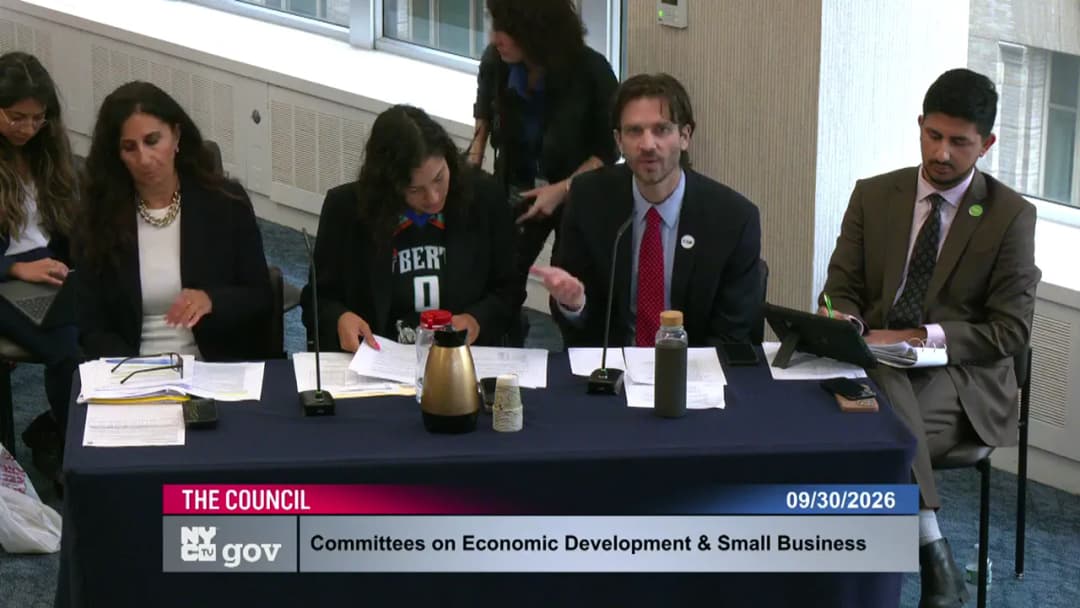
Oversight Hearing on the Economic Impact of the 2026 FIFA World Cup (September 30, 2026)

On Wednesday, September 30, 2026, the New York City Council's Committees on Economic Development and Small Business held a joint oversight hearing to evaluate the economic impact of the 2026 FIFA World Cup. Chaired by Virginia Maloney (Economic Development) and Chanel Thomas Henry (Small Business), the hearing examined the city's return on investment, the distribution of economic benefits, and lessons for future mega-events like the 2028 Olympics. A resolution (Res 0655-2026) calling on FIFA to provide a $1 million "legacy contribution" for hosting was also discussed. Public Comments & Testimony - Megan Wiley (Hotel and Gaming Trades Council): Testified that union hotel workers were pivotal, contributing to $650 million in direct accommodation spending. She argued the World Cup proved the city does not need to compromise labor standards for economic growth, citing a new contract providing a 50% wage increase over eight years ratified during the tournament. - Jessica Walker (Manhattan Chamber of Commerce): Reported domestic visitor spending up 8.3% in Manhattan but noted neighborhood-level disparities, with areas tied to competing nations seeing a 5-8% drop. She recommended a funded five-borough tourism initiative, a standing mega-event playbook, and reforms to street event permitting. - Jeffrey LeFrancois (NYC Bid Association): Stated that Business Improvement Districts (BIDs) faced severe obstacles from the Street Activity Permit Office (SAPO), citing uncertain and late approvals that caused some activations to move to other cities. He called for the creation of a designated interagency coordinator and early engagement with BIDs for future events. - Vijay Dandapani (Hotel Association of NYC): Reported that hotel bookings were far behind projections for most of the tournament, with a last-minute surge from Argentine and Spanish visitors adding $74 million. He attributed broader declines to federal policies (tariffs, visa restrictions) and geopolitical tensions discouraging international travel. Discussion Items - Economic Impact vs. Local Benefit: The administration reported a $2 billion total economic impact for NYC within a $3.5 billion regional impact. Councilmembers critically questioned who benefited, noting visitor spending increased 19% in Brooklyn and 6% in Queens, while the Bronx and Staten Island were absent from primary credit card data. Chair Maloney noted the Council's finance division analysis suggested the city's investment exceeded the tax revenue generated. - City Investment & Return on Investment (ROI): The city's total investment was estimated at roughly $90 million ($35 million via EDC/Host Committee, $4.5 million for NYC Tourism, $50.2 million for NYPD). Councilmember Maloney highlighted that the Council's finance team estimated city tax revenue at roughly $60 million, while the Comptroller's office estimated $55 million, implying a net cost to the city. The administration stated they are still evaluating the total cost. - Distribution of the "Five Borough Winner Special": Data revealed the program reached 1,000 local food and beverage businesses: 569 in Manhattan, 182 in Brooklyn, 152 in Queens, 33 in the Bronx, and 22 in Staten Island. Councilmember Morano pressed the administration on why a live dashboard was not used to monitor and rebalance participation during the event, calling for this to be a lesson for future events. - Workforce and Equity Inclusion: Councilmember Banks questioned whether NYCHA residents were specifically targeted for employment or contracting. The administration could not provide specific data on NYCHA inclusion, MWBE contract breakdowns, or total value of local business contracts, committing to follow up. - Permitting Barriers and Infrastructure Planning: Substantial discussion was focused on the SAPO permitting process, which BIDs and local businesses found unpredictable and damaging to planning. Concerns were also raised about truck delivery restrictions in Midtown without adequate business notification, and the rapid implementation of infrastructure projects (bus/bike lanes) without community input. - Discrepancy on the FIFA Legacy Contribution: Resolution 0655-2026, introduced by the chairs, asserts that FIFA has not paid New York City the $1 million "legacy contribution" promised for hosting the tournament. However, Alex Lazary, CEO of the Host Committee, testified that FIFA did provide $1 million for legacy, which was invested in mini-pitches. He noted a potential second $1 million payment from FIFA that has not yet been received, contradicting the premise of the resolution as presented. - Planning for 2028 Olympics: Chair Maloney stated that lessons from the World Cup must shape the approach for the nine Olympic soccer matches in Queens in 2028. The administration committed to applying these lessons, while NYC Tourism noted it currently lacks the funding to mount a similar marketing campaign for the 2028 games. Key Outcomes - The oversight hearing was held and filed by the Committee on Economic Development. - Resolution 0655-2026, calling on FIFA to provide a $1 million legacy contribution, was laid over by the committee. A factual discrepancy was noted in testimony regarding whether this specific payment had already been made. - The administration committed to sharing further breakdowns of economic impact by sector, a post-event survey of small businesses, and specific data on NYCHA inclusion, MWBE spending, and permitting denials, though no specific timeline was provided. - Multiple councilmembers called for the creation of a formal "mega-event playbook" ahead of the 2028 Olympics with specific recommendations to streamline the SAPO process, engage BIDs and chambers from day one, and implement real-time data tracking for equitable distribution of programs across the five boroughs.

TOURISM 46% · ECONOMIC DEVELOPMENT 29% · PUBLIC SAFETY 5% · SMALL BUSINESS 4%
3884
SEP 30, 2026 · NEW YORK CITY, NEW YORK · CITY COUNCIL
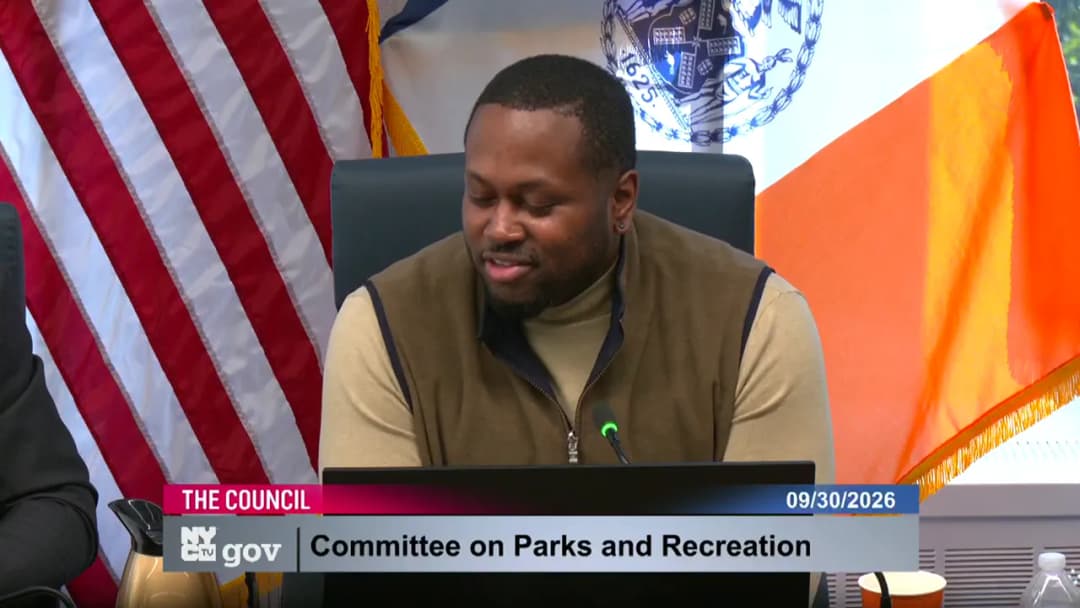
NYC Parks Committee Hearing on Permitting Process and Edgemere Avenue Renaming – September 30, 2026

The Committee on Parks and Recreation, chaired by Ty Hankerson, held an oversight hearing on the Parks Department's events permitting process and considered Intro 0927-2026, a bill to rename Shorefront Parkway to Edgemere Avenue in Queens. The hearing featured testimony from Parks Department officials, council members, and two public witnesses. Key topics included permit complexity, fees, staffing, training, enforcement, and the need for a more user-friendly system. Consent Calendar - No items were listed on the consent calendar. Public Comments & Testimony - Christopher Leon Johnson urged the council to involve the Office of Emergency Management (OEM) in permitting, proposed a reward system for reporting unsafe events, and called for higher bonds and insurance requirements for large events like basketball tournaments. He expressed frustration with political interference and permit abuse. - Heather Lubav, Executive Director of City Parks Foundation, praised recent improvements by Parks but noted remaining rigidity. She requested accounting for scale and investment (e.g., longer lead times for large free concerts), more flexible and transparent permitting (e.g., reforming Central Park date

PARKS AND RECREATION 56% · PUBLIC ENGAGEMENT 26% · PUBLIC SAFETY 5% · PROCEDURAL 5%
3885
SEP 30, 2026 · NEW YORK CITY, NEW YORK · CITY COUNCIL
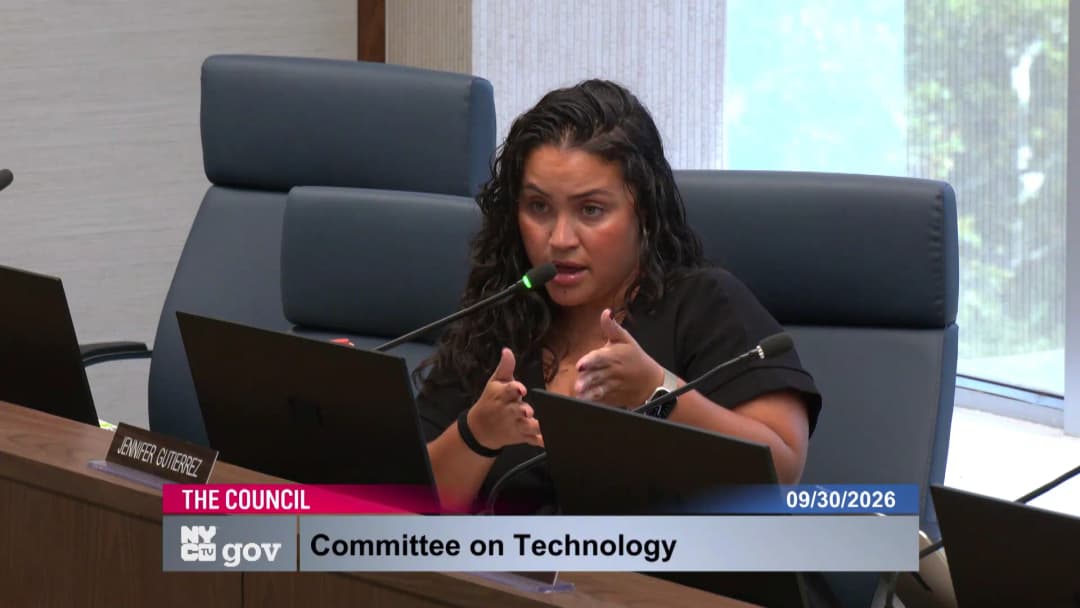
Committee on Technology Hearing on NYC's 311 System – September 30, 2026

The New York City Council Committee on Technology, chaired by Councilmember Carmen N. De La Rosa, held an oversight hearing on Wednesday, September 30, 2026, at 1:00 PM to examine the performance and modernization of NYC's 311 system. The committee considered three bills: Int 0173 (requiring GPS coordinates for 311 complaints), Int 0669 (referring non-emergency traffic complaints to the NYPD Transportation Bureau), and Int 0800 (requiring 311 to redirect service requests to the appropriate agency). All three introductions were heard and laid over by the committee. Opening Remarks - Chair De La Rosa opened the hearing, emphasizing that 311 handles millions of interactions annually in over 175 languages and plays a crucial role in government accessibility. She noted that more than 15 additional bills related to 311 are pending, signaling the council's commitment to improving the system. - Councilmember Dinowitz spoke in support of his bill, Int 0173, citing multiple constituent cases where GPS coordinates would have prevented misdirected service requests (e.g., a missing hydrant repaired at the wrong location, lights on an overpass unreported due to no address). He argued that precise GPS location is essential for effective quality-of-life reporting. - Councilmember Schulman initially described her bill as related to conditions in city jails, but later clarified that Int 0800 (the agenda item) is a different bill—her incarceration-related bill will be heard in another committee. For Int 0800, she emphasized accountability and transparency in tracking complaints. - Chair De La Rosa read a statement from Deputy Speaker Dr. Nantasha Williams supporting Int 0669, noting that residents in Southeast Queens frequently report chronic traffic issues and that the bill would ensure non-emergency traffic complaints reach the NYPD Transportation Bureau. Agency Testimony - Deputy Commissioner Joe Morris Rowe of NYC 311 testified: He reported a 93% customer satisfaction rating from an independent third-party survey (CFI Group), with 90% of respondents likely to recommend 311. The budgeted headcount for call center representatives is 248, with 53 vacancies. The starting salary is $40,600 per year. Overflow calls are handled by a contracted vendor, King Teleservices Inc., under a contract expiring February 28, 2027. - On Int 0173 (GPS), Morris Rowe stated that 311 currently collects latitude/longitude from the app or entered addresses, and they are exploring a pin-drop geolocation system to provide more precise coordinates. He expressed openness to working with the council on implementation. - On Int 0669 (traffic complaints), he noted that currently non-emergency traffic calls generate service requests routed to the appropriate NYPD precinct, but he urged the council to discuss routing changes directly with NYPD, as the department believes many calls should go through 911. - On Int 0800 (redirecting requests), Morris Rowe acknowledged that about 1% of service requests go through a reassignment process (e.g., street cave-ins initially assigned to DOT then reassessed). He confirmed that 311 is working on solutions to improve customer experience for such cases. Discussion Topics - Staffing & Operations: Chair De La Rosa and Councilmembers questioned the number of call center representatives, vacancies (53), use of overflow vendor, and pay disparity. Morris Rowe noted the vendor is paid by production hour rate, and the contract is under a new RFP. - Service Request Resolution: Councilmembers Dinowitz and Riley raised concerns that agencies close 311 tickets without fixing the underlying issue. Morris Rowe described the Resolution Satisfaction (RSAT) survey and the availability of service-level agreements on open data, but acknowledged the gap between customer and agency perspectives. - Language Access: Councilmember Gutiérrez noted the 311 mobile app is English-only for native functions, though the mobile website supports Google Translate. Only Spanish bilingual operators exist for other languages; a third-party interpretation service is used. - Artificial Intelligence: Morris Rowe discussed the Smart Select feature on the app that uses AI to categorize complaints from photos or text, built with an MWBE vendor. He emphasized AI is intended to augment, not replace, call center representatives. - Privacy & Data: Councilmember Gutiérrez asked about data retention policies, sharing with third parties, and encryption. Morris Rowe stated that 311 does not sell or share personal information, but agreed to follow up on retention policies and user data deletion requests. He confirmed the privacy policy was recently strengthened. - 911 Integration & Emergency Routing: Councilmember Gutiérrez asked about the protocol for transferring calls to 911 in emergencies. Morris Rowe described a

TECHNOLOGY AND INNOVATION 54% · PUBLIC SAFETY 15% · PUBLIC ENGAGEMENT 13% · DATA PRIVACY AND SECURITY 6%
3886
SEP 30, 2026 · NEW YORK CITY, NEW YORK · CITY COUNCIL
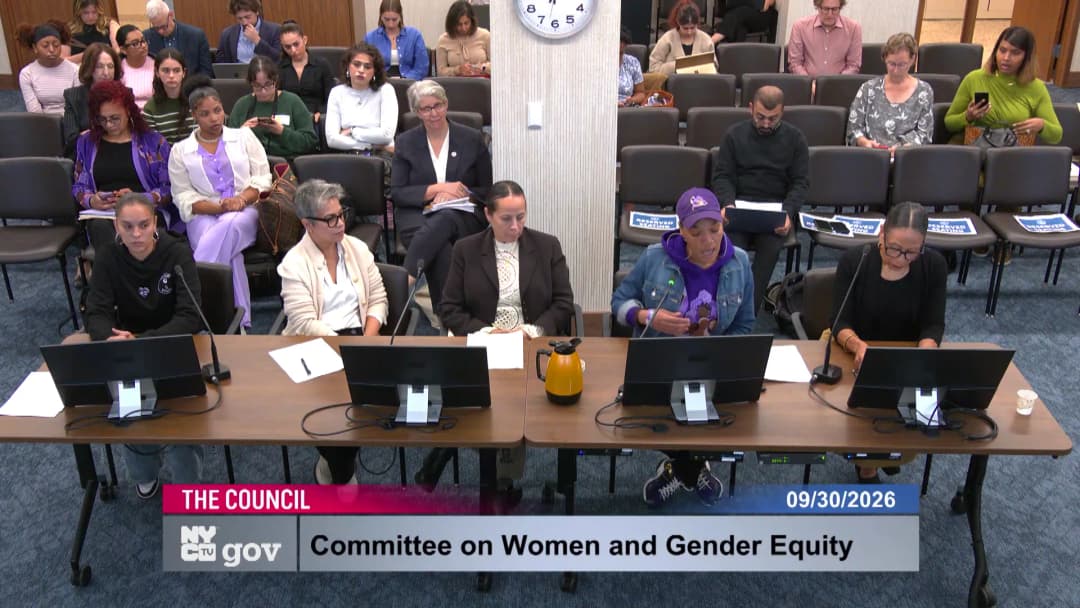
New York City Council Committee on Women and Gender Equity Hearing – September 30, 2026

Date: September 30, 2026 Location: 250 Broadway, 8th Floor, Hearing Room 3 Chaired by: Councilmember Amanda C. Farías Members Present: Shirley Aldebol, Jennifer Gutiérrez, Kayla Santosuosso (Lynn C. Schulman absent) Other Council Members Attending: Speaker Adrienne Menin The Committee on Women and Gender Equity held a full-day oversight hearing and legislative session examining the proposed restructuring of the Mayor's Office to End Domestic and Gender-Based Violence (NGBV) under the new Office of Community Safety (OCS), and considered four pieces of legislation. Councilmembers heard extensive testimony from city officials, service providers, advocates, and survivors, with deep concerns raised about the reorganization's impact on survivor services, leadership downgrades, and lack of community consultation. No votes were taken on any legislation; all items were laid over. Public Comments & Testimony Dozens of individuals and organizational representatives testified, the majority expressing strong opposition to or deep reservations about the restructuring. Key themes included: - Loss of independent leadership: Multiple speakers, including Judy Kluger (Sanctuary for Families), Liz Roberts (Safe Horizon), and Taina Bien-Aime (Coalition Against Trafficking in Women), argued that subsuming NGBV under OCS diminishes its visibility, authority, and direct access to the mayor. They urged restoring a standalone office with a commissioner. - Lack of survivor and provider input: Survivor-led organizations (Sisters in Purple, Voices of Women, etc.) and advisory council members (Stephanie Woodbine, Iman Gadd) emphasized that the restructuring was announced without meaningful consultation with survivors or frontline providers, contradicting trauma-informed principles. - Concerns about leadership downgrades: Speakers noted that the NGBV commissioner role would become an executive director, and multiple deputy commissioner titles could change, potentially affecting recruitment and retention of specialized staff. - Risk of diluting gender-based violence work: Providers and survivors warned that folding NGBV into a general community safety framework could obscure the distinct needs, confidentiality protections, and safety planning required for domestic and gender-based violence. - Call for survivor-centered policymaking: Many witnesses demanded that survivors be paid and included as equal partners in shaping policies, not just consulted after decisions are made. - Data and funding concerns: Several speakers called for expanded flexible funding (e.g., DOVE funds), increased investment in culturally specific organizations, and preservation of programs like CVAP (crime victims assistance at precincts). Liz Roberts (Safe Horizon) warned that the new CVAP RFP reduces precinct-based funding while adding requirements, threatening coverage. - A few speakers supported the restructuring: A representative from KAFSC (Korean American Family Service Center) expressed cautious optimism, noting that a coordinated community safety model could better reach immigrant survivors who face multiple barriers. - One speaker was removed for making off-topic remarks regarding religion. Discussion Items Oversight: Restructure of NGBV under the Office of Community Safety Chair Farías opened the hearing by noting the painful context of recent sexual violence allegations and the need to ensure the restructuring strengthens, not diminishes, survivor support. Speaker Menin questioned Commissioner Delaney Brumsey (OCS) and Commissioner Salone Sethy (NGBV) about resources, staff vacancies, and the signal sent by eliminating a standalone commissioner. Commissioner Brumsey testified that NGBV received a $15.7 million increase in FY27 (the largest since 2018), bringing the total NGBV budget to $89.1 million, and that NGBV would remain a distinct entity within OCS with dedicated leadership. She stated that the transition creates opportunities for better coordination with gun violence prevention, mental health, and crisis response. Commissioner Sethy noted that 59 of 79 staff lines are filled and that hiring is underway after lifting freezes. Councilmembers Aldebol, Gutiérrez, and Santosuosso pressed for details on title changes, salary equity, contracting capacity, and how community-based organizations will maintain access. The commissioners acknowledged “missteps” in early communication and pledged continued engagement, including quarterly advisory council meetings with Deputy Mayor Francois. Int 0295-2026 – Endometriosis and PMOS Screening Program The committee considered a local law (amended version 295-A) requiring the Department of Health and Mental Hygiene to establish a menstrual health program for screening, referrals, and education on endometriosis and polyendocrine metabolic ovarian syndrome (PMOS). Chair Farías read a statement from sponsor Councilmember Lewis, citing CDC data that 6.2% of women ages 20-49 have been diagnosed with endometriosis and 8.7% with PCOS (now termed PMOS). The bill was amended by the committee and then laid over. Int 1079-2026 – Hotline Reporting for Gender-Based Violence Survivors This bill, sponsored by Chair Farías, would require NGBV to report anonymous high-level data on calls to the city's hotline for survivors. The administration expressed support with suggested adjustments. The bill had a hearing and was laid over. Res 0441-2026 – International Day for the Elimination of Violence Against Women A resolution declaring November 25 as the “International Day for the Elimination of Violence Against Women” in honor of the Mirabal sisters. It had a hearing and was laid over. Res 0637-2026 – Lactation Consultation Insurance Coverage A resolution co-sponsored by Councilmember Santosuosso and Chair Farías calling on the state to require insurers to cover lactation consultation and counseling without restrictions. Councilmember Santosuosso, speaking as a nursing mother, emphasized the importance of removing financial barriers. The resolution had a hearing and was laid over. Key Outcomes - No votes were taken on any agenda item; all legislation and resolutions were laid over by committee. - The oversight hearing on the NGBV restructuring was filed by committee, meaning no further action is planned at this time. - The committee heard an amendment to Int 0295 (adopting the new terminology PMOS and expanding scope) and adopted the amendment, then laid over the bill. - Chair Farías committed to elevating issues raised during testimony—including state-level statute of limitations reform, family court custody challenges, and expanded flexible funding—to relevant partners. - The administration pledged continued quarterly advisory council meetings with Deputy Mayor Francois and site visits to family justice centers. - Providers and survivors were invited to submit written testimony within 72 hours. Note: The meeting agenda listed five items; the minutes also reflect Item T2026-2461 (oversight) and T2026-2583 (a local law on hotline reporting, which appears to correspond to Int 1079-2026). The transcript confirms all items were discussed but not voted.

DOMESTIC VIOLENCE 57% · PUBLIC SAFETY 14% · GENDER BASED VIOLENCE 12% · PUBLIC ENGAGEMENT 6%
3887
SEP 30, 2026 · NEW YORK CITY, NEW YORK · CITY COUNCIL
Joint Council Hearing on 2026 FIFA World Cup Economic Impact, September 30, 2026

The New York City Council's Committees on Economic Development and Small Business held a joint oversight hearing on September 30, 2026, to assess the economic impact of the 2026 FIFA World Cup. Chaired by Councilmember Virginia Maloney (Economic Development) and Councilmember Shanel Thomas-Henry (Small Business), the hearing examined the city's investment, the actual returns, distribution of benefits, and lessons for future mega-events like the 2028 Olympics. City officials, the host committee, and public witnesses testified, with a focus on whether the event generated net benefits for New Yorkers and small businesses. Public Comments & Testimony - Megan Wiley (Political Director, Hotel and Gaming Trades Council) – Representing nearly 40,000 hospitality workers, she praised the World Cup's success, citing $3.3 billion regional impact and $650 million in accommodation spending. She highlighted that hotel workers secured a new eight-year contract with average wage increases over 50%, employer-paid family healthcare, and new housing and child care benefits, emphasizing that the city did not have to sacrifice workers' rights for economic growth. - Jessica Walker (President & CEO, Manhattan Chamber of Commerce) – Representing 125,000 businesses, she said the World Cup generated $2 billion in economic activity and 12,000 jobs, with sports bar foot traffic up 16%. However, she noted benefits stayed largely in the core: domestic visits to Washington Heights, Inwood, and East Harlem fell 5–8%. She made five recommendations: a funded five-borough tourism initiative, addressing that 55% of New Jersey Airbnb guests looked at NYC first, creating a standing mega-event playbook, relaxing late-night restrictions, and implementing a single-window sliding-fee street event permit. - Jeffrey LeFrancois (President, Meatpacking District BID; Co-chair, NYC BID Association) – Representing 78 BIDs, he acknowledged the World Cup's success but criticized the SAPO permitting process for being slow and unpredictable, with permits sometimes issued only 24 hours before events, causing lost revenue and deterring sponsors. He recommended streamlining permitting, designating an interagency coordinator, engaging BIDs early, and supporting public viewing events. - Vijay Dandapani (President & CEO, Hotel Association of New York City) – Testified that hotel bookings initially lagged projections, but a last-minute influx from visa-free Spain and rapid visa processing for Argentina added $74 million in hotel revenue from the final match. He warned that federal policies (e.g., tariffs, travel bans) threaten the industry's 388,000 jobs and $79 billion economic activity, and called on the council to examine federal impacts and position NYC as a welcoming destination. Discussion Items - City Officials Testimony – World Cup Czar Maya Honda reported the tournament generated approximately $2 billion in economic activity for NYC (regional total: $3.5 billion), supported 12,000 jobs, and attracted 1.134 million out-of-region visitors. She highlighted initiatives: 100+ free watch parties, 1,000 affordable tickets, 24/7 soccer fields, $26 meal deals, and a small business toolkit reaching 56,000 New Yorkers. NYC Tourism CMO Nancy Mamana detailed a $4.5 million marketing investment that influenced 164,000 visitors (44% to Brooklyn, 40% to Queens, 49% to Manhattan, 13% to Staten Island, 24% to Bronx) and generated $147 million in direct visitor spend. - Host Committee Testimony – Alex Lazary, CEO of the FIFA World Cup 2026 NY-NJ Host Committee, reported 645,000 match attendees, 98% stadium entry before kickoff, and stadium clearance under 2.5 hours. He confirmed a $200 million host committee budget, $10 million spent with NYC vendors (including 36 MWBEs), and 180 public viewing licenses. On legacy, he revealed FIFA provided $1 million for mini pitches, but an additional promised $1 million has not been received, relating to Resolution 655. - Cost vs. Revenue Analysis – The council's finance division estimated the city spent roughly $90 million (including $35 million passed to host committee, $4.5 million to tourism, $50.2 million to NYPD). Projected city tax revenue was $60 million per council finance and $55 million per the Comptroller's office, suggesting a net loss. Officials said a final analysis is pending, with a small business survey to launch within a week. - Permitting and Coordination Issues – Multiple councilmembers raised concerns about SAPO permitting delays and restrictions on block parties and local events during the tournament. Administration officials acknowledged challenges and said lessons would be applied to the 2028 Olympics. NYC Tourism reported its budget remains flat at $23 million and not resourced for 2028. Key Outcomes - Resolution 655 (sponsored by Chair Thomas-Henry and Chair Maloney) calling on FIFA to provide the promised $1 million legacy contribution was heard and laid over by the committee. - Findings on Economic Impact – The administration's headline figure of $2 billion in NYC economic activity was challenged by council members who noted potential displacement of regular tourists and that the analysis does not break down small business share. The council's finance division projected a net cost to the city. - Commitments to Future Events – Officials agreed to apply lessons to the 2028 Olympics, including earlier planning, improved permitting, and a dashboard for tracking business participation. They committed to sharing additional data, including sector breakdowns and survey results. - Ongoing Data Collection – The city will conduct a post-mortem survey of small businesses and CBOs, and Tourism Economics will release further breakdowns by sector and zip code.

ECONOMIC DEVELOPMENT 57% · PUBLIC TRANSPORTATION 9% · PUBLIC ENGAGEMENT 9% · TOURISM 8%
3888
SEP 30, 2026 · NEW YORK CITY, NEW YORK · CITY COUNCIL
New York City Council Joint Committees Hold Oversight and Consider 23 Micromobility Bills on September 30, 2026

On Wednesday, September 30, 2026, beginning at 10:00 AM, the New York City Council Committees on Transportation and Infrastructure, Consumer and Worker Protection, and Public Safety held a joint oversight hearing on micromobility regulation, accountability, and safety. Chaired by Councilmember Shaun Abreu, the hearing addressed a record 23 bills and two resolutions aimed at improving safety for pedestrians, cyclists, and delivery workers amid a surge in e-bike and e-scooter use. The session included testimony from administration officials (DOT, DCWP, NYPD), advocates, industry representatives, and members of the public. All bills were heard and laid over; one bill (Int 0985) was amended. The oversight was filed. Public Comments & Testimony - Victims and pedestrian advocates (EVSA, EFSV, several individuals) shared harrowing accounts of being struck by e-bikes or e-scooters, often with no rider accountability due to lack of identification. Many called for the passage of Priscilla’s Law (Intro 0802), which would require license plates and registration for all e-vehicles, arguing that the current bill package does not address rider identification and enforcement gaps. - Delivery workers and worker advocacy groups (Workers Justice Project, Los Deliveristas Unidos, CUNY study) opposed bills that would increase police enforcement, confiscations, or deactivation risks (e.g., Int 2361, 2587, 986). They highlighted that 53% of delivery workers report work-related injuries and that app companies (Uber, DoorDash, Grubhub) incentivize unsafe riding through algorithmic pressure and unrealistic delivery times. They called for stronger deactivation protections (including temporary lockouts), safe infrastructure, and regulated delivery time standards rather than punitive measures targeting workers. - Transportation Alternatives, StreetsPAC, and other advocacy groups supported a multi-pronged approach: banning sale/rental of Class 3 e-bikes (Int 244), trade-in programs (Int 985), delivery app licensing (Int 950), and better infrastructure. They opposed licensing e-bikes as ineffective and urged focusing on illegal high-speed devices and car violence. - Industry representatives (JOCO, Upway, Lime, Veo, Uber) offered varied positions. Uber opposed liability insurance (Int 994) and worker tracking (preconsidered 2587) but supported banning unreasonable delivery time practices. JOCO endorsed sidewalk detection technology and dynamometers. Lime emphasized safety of regulated shared scooters. Upway supported banning sales of Class 3 e-bikes and deceptive advertising. - Central Park Conservancy and disability advocates called for zero tolerance for illegal devices in parks, better data collection on crashes involving people with disabilities, and inclusive street design. - Borough President Antonio Reynoso argued that 95% of pedestrian fatalities are caused by cars, not e-bikes, and urged the council to focus on infrastructure and street design rather than punitive enforcement. Discussion Items - Oversight of Micromobility Safety: Chair Abreu opened with statistics – e-bike collisions up 31.7% over the previous year, 17 e-bike riders killed in 2026, 10 hit-and-run deaths in two months – and noted that illegal high-speed devices are often sold and operated dangerously. He emphasized a need for enforcement, infrastructure, and accountability for delivery apps. - Administration Testimony: DOT Commissioner Mike Flynn described efforts to issue cease-and-desist letters to retailers, expand protected bike lanes, and launch battery-swap programs. He supported several bills (e.g., Int 78, 95, 244, 950, 985, 988, 989, 994, 1004, 1021, 1052, 1066) but noted concerns about resources and implementation for dynamometers (Int 986), sidewalk detection technology (preconsidered 2590), and a Class 3 use ban (preconsidered 2361). DCWP Commissioner Sam Levine reported nearly 1,000 inspections and 460+ summonses for illegal micromobility devices in 2026, and $131.5 million in enforcement against DoorDash for worker law violations. He supported bills increasing app accountability but worried about unintended consequences for workers (e.g., preconsidered 2587, 2361). NYPD Chief of Transportation O’Bay reported year-to-date enforcement statistics: 10,905 moving summonses for e-bikes, 640 for stand-up scooters, 18,716 for mopeds; and seizures of 10,000 mopeds and 1,206 e-bikes. He discussed targeted enforcement on 15 high-visibility corridors and point-of-sale inspections. - Councilmember Questions: Speaker Adrienne Menin pressed agencies on lack of enforcement of existing vest and helmet laws. Councilmembers Brewer, Epstein, Feliz, Abreu, Hanif, Hudson, Wong, and others questioned about data collection on crashes, equitable enforcement, age verification for bike share, infrastructure design (e.g., Northern Boulevard micromobility lane, daylighting), and the need to hold delivery apps responsible for unsafe scheduling. Councilmember Abreu demonstrated the difficulty of distinguishing legal from illegal e-bikes and argued for dynamometers to improve field enforcement accuracy. - Bills Heard: All 23 introductions and 2 resolutions were discussed, with the administration offering support, concerns, or suggestions for amendments. Notable positions: Admin supported Int 244 (ban sale of Class 3) but had concerns about a use ban (preconsidered 2361); supported Int 985 (trade-in) but called for a more targeted approach; supported Int 988 (prohibit advertisement) but suggested expanding to illegal devices; supported Int 1069 (safe delivery time study) but preferred data oversight by DOT. Int 0985 was amended by committee. Key Outcomes - All introductions and resolutions were heard and laid over – no final votes were taken. The committees will continue to work on refinements. - Int 0985 (trade-in program) was amended by the committee during the hearing. - Oversight T2026-2310 was filed by committee. - Several councilmembers committed to follow-up meetings with agencies on specific district requests (e.g., micromobility lane on Northern Boulevard, data on high-crash corridors). - The administration agreed to provide written responses on outstanding data requests (e.g., detailed crash data by precinct, enforcement breakdowns, and feasibility of age verification for City Bike). - The next hearing on Vision Zero and car-related street safety is scheduled for October 27, 2026.

TRANSPORTATION SAFETY 51% · PUBLIC SAFETY 24% · PROCEDURAL 8% · PUBLIC ENGAGEMENT 3%
3889
SEP 30, 2026 · NEW YORK CITY, NEW YORK · CITY COUNCIL
New York City Council Environmental Protection Committee Hearing on Coastal Resilience and Related Legislation - September 30, 2026

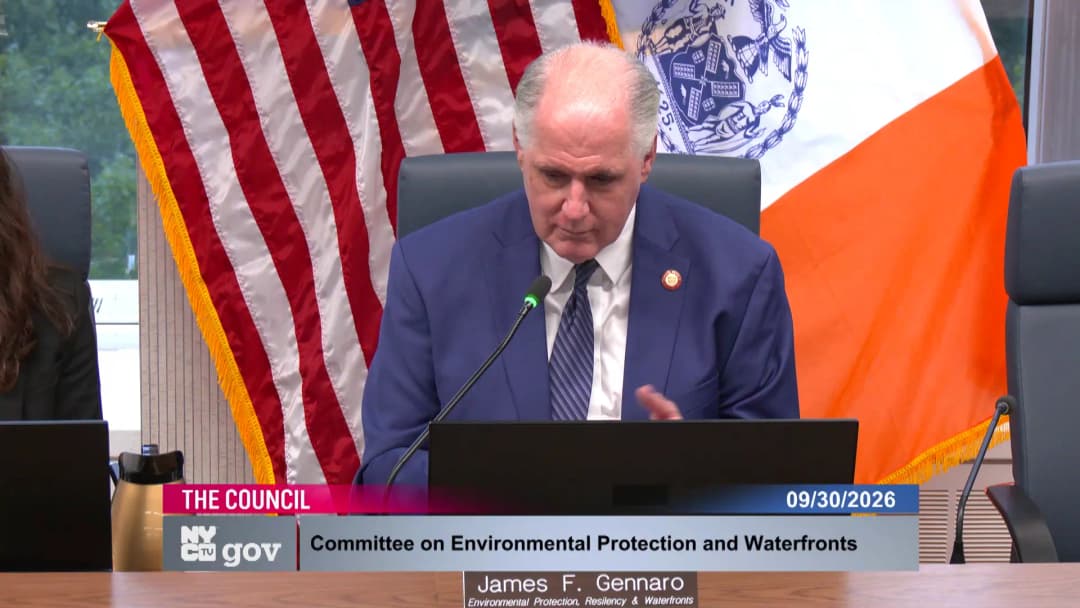
The Committee on Environmental Protection and Waterfronts, chaired by James F. Gennaro, held an oversight hearing on coastal resilience on Wednesday, September 30, 2026, at 1:00 PM. The hearing addressed the city's response to a recent nor'easter that caused coastal flooding and one fatality, and considered three pieces of legislation: Int. 0343-2026 (solar permit fees), Int. 0931-2026 (mobile drinking fountains), and Int. 0936-2026 (establishing a Department of Coastal Protection). Committee members present were Chair Gennaro and Council Member Sanchez; Council Members Epstein, Hanks, and Restler were absent. Council Member Avilés also attended. All three introductions were heard and laid over by the committee. Oversight – Coastal Resilience - Chair Gennaro opened by noting the recent nor'easter that caused coastal flooding, strong winds, and heavy rains, leading to the tragic death of NYCHA maintenance worker Leighton Brown. He expressed condolences and discussed the importance of preparing for sea level rise and storm surge, citing projections from the New York City Panel on Climate Change (NPCC) of 6–12 inches of sea level rise by the 2030s, 1–2 feet by the 2050s, and 2–5.5 feet by 2100. - Deputy Commissioner Beth DeFalco of the Department of Environmental Protection (DEP) testified about the city's coastal resilience work. She noted that DEP created the Bureau of Coastal Resilience (BCR) in 2023, and that the administration invested $43.2 million to expand BCR from 6 to 75 employees. BCR oversees 16 active infrastructure projects, including the $1.46 billion Eastside Coastal Resiliency Project, the $388 million Brooklyn Bridge Montgomery Coastal Resiliency Project, the $2.4 billion Staten Island Seawall, the $228 million Seaport Coastal Resiliency Project, and the $208 million Red Hook Coastal Resiliency Project. She emphasized the need for a coordinated citywide approach and sustainable funding, noting that fully protecting the coastline could cost $1–2 billion annually over 20–30 years. Public Comments & Testimony - Waterfront Alliance (via representative): Expressed strong support for building on the capacity of DEP's Bureau of Coastal Resilience rather than creating a new department. Recommended the committee hold another oversight hearing next spring and urged a future hearing on groundwater flood risk (Int. 0662). - Riverkeeper (Brianna Kilkenny): Opposed the creation of a new department (Int. 0936), arguing that BCR benefits from DEP's expertise and job training pipeline. Supported codifying BCR within DEP and praised the $43 million investment. - New York League of Conservation Voters (Caitlin Philotoro): Supported the intent of Int. 0936 but preferred codifying BCR within DEP. Supported Int. 0931 but recommended a cost-benefit analysis comparing mobile fountains to permanent water fountains. Also called for more funding for MOCEJ and DEP staffing. - Elizabeth Cortez (remote, personal capacity): Supported Int. 0931 with a feasible implementation plan and adequate resources, emphasizing the need to prioritize high-vulnerability neighborhoods, citing health department data on heat-related mortality disparities. Discussion Items - Int. 0343-2026 – Solar permit fee waiver: DEP deferred to DOB. DOB representatives (Wendy Wan and Jill Herbeck) explained that crane permits cost $150–$250, and that solar panel installations often do not require crane permits. DOB noted a decline in solar permit filings from about 9,400 in 2024 to 3,300 so far in 2026, coinciding with the expiration of federal tax credits. The committee discussed barriers to solar adoption. - Int. 0931-2026 – Mobile drinking fountain program: DEP expressed concerns about staffing and costs, noting that deploying fountains would require two people per station and could pull personnel from critical water supply duties during heat emergencies. DEP currently has only 9 fountains, used for emergencies. Council Member Epstein, the bill's sponsor, participated and acknowledged the need to tailor the bill. DEP suggested collaboration with other agencies and exploring expanded cooling stations. - Int. 0936-2026 – Establishment of a Department of Coastal Protection: DEP testified that they share the goal of accountability and coordination but urged caution against fragmenting the existing structure. They noted that creating a new department could disrupt the work of the newly expanded BCR. Chair Gennaro pressed for details on the comprehensive vision and coordination, and DEP explained ongoing planning efforts like the RISE (Resilient Infrastructure for Shoreline Edges) project, due by end of 2026, and a comprehensive coastal resilience plan expected in 2–3 years. Council Member Avilés raised concerns about community engagement, development pressures, and industrial waterfront uses. Chair Gennaro expressed a desire to move forward with the bill, while DEP asked for flexibility and more time. - Community engagement and development coordination: Council Member Avilés noted that Red Hook residents were surprised by the creation of BCR and stressed the need for meaningful community input. She also questioned how BCR coordinates with other city agencies on development and land use in flood-prone areas. DEP acknowledged challenges and stated they are working to improve outreach, particularly through flooding town halls. Key Outcomes - Hearings held and all three introductions (Int. 0343-2026, Int. 0931-2026, Int. 0936-2026) were laid over by the committee – no vote taken. The committee will continue to work on the legislation. - Oversight hearing on coastal resilience was filed – no formal action beyond receiving testimony. - Chair Gennaro committed to advancing Int. 0936 and expressed willingness to work with stakeholders on amendments, including possibly codifying BCR within DEP rather than creating a new department. - Public testimony will be submitted within 72 hours for the record. - Committee dedicated the hearing to the memory of Leighton Brown, the NYCHA employee killed during the storm, and observed a moment of silence.

ENVIRONMENTAL PROTECTION 44% · ENGINEERING AND INFRASTRUCTURE 13% · PROCEDURAL 11% · PUBLIC HEALTH 7%
3890
SEP 29, 2026 · NAMPA, IDAHO · PUBLIC MEETINGS
Nampa Planning & Zoning Commission Meeting - September 29, 2026

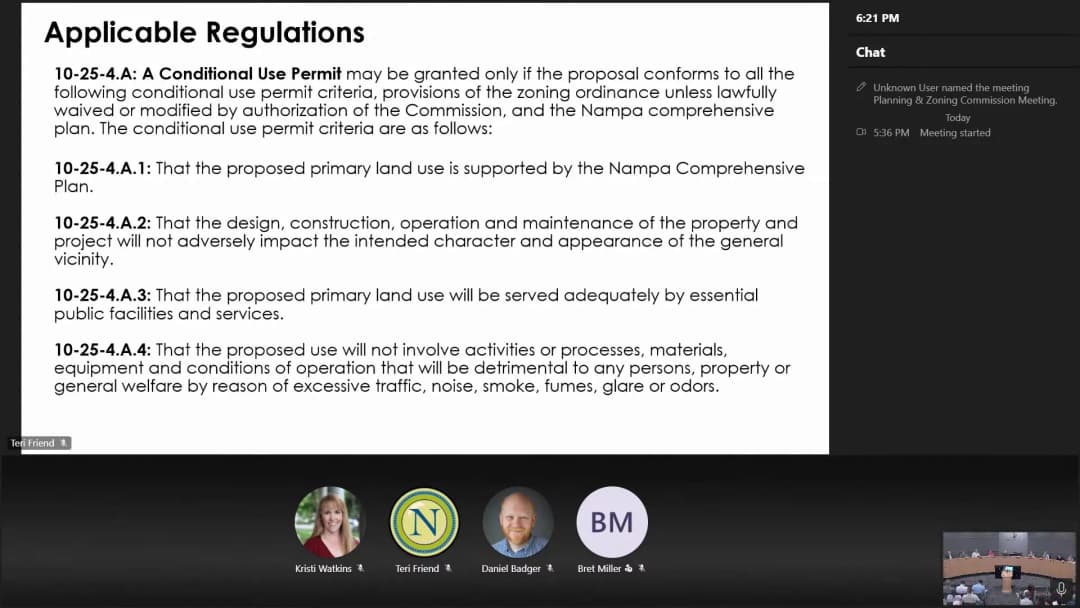
The Nampa Planning and Zoning Commission met on September 29, 2026, to consider three public hearing items: an annexation for light industrial zoning, a conditional use permit for an expanded in-home daycare, and a major subdivision proposal for 487 homes at the northeast corner of Amity Avenue and Happy Valley Road (Brayburn Creek). The commission also approved the consent agenda and received updates on recent City Council actions. Consent Calendar - The commission approved the consent agenda, which included a correction to the minutes from a previous meeting: the vote on the 111 South Side Boulevard project was recorded as 6-0 in the minutes but was actually 4-2. The corrected version was accepted. Annexation & Zoning to IL – 17501 North Side Boulevard - Applicant: Michael Spiers representing Nampa Logistics Center LLC. Request to annex 1.69 acres and zone IL (Light Industrial). Consistent with surrounding industrial uses and Nampa 2040 Comp Plan. - Staff Report: Candice Fry presented. No public comments received. Conditions of approval recommended. - Public Testimony: None. - Commission Deliberation: The item was straightforward; motion to recommend approval with correction of street name (North Side, not Canada). Approved unanimously. Conditional Use Permit for In-Home Daycare Expansion – 1495 North Fishing Creek Avenue - Applicant: Tato Almasi (via interpreter). Request to increase in-home daycare from 6 to up to 12 children in RS-6 zone. - Staff Report: Terry Friend presented. Conditions include building permit, fire inspection, state licensing. Public correspondence: none. - Public Testimony: One person expressed concerns about employee ratio and lack of playground equipment. Applicant clarified they have two staff, take children to parks, and have a large backyard. - Commission Deliberation: Commissioners noted the applicant already runs a daycare with six children, has adequate staff, and provides a needed service. Motion to approve with conditions. Approved unanimously. Brayburn Creek – Annexation, Zoning, and Preliminary Plat – 0 Amity Avenue & 324 South Happy Valley Road - Applicant: Jeff Bauer (Toll Brothers) presented a plan for 487 single-family homes on 138 acres. Mixed zoning (RS4, RS6, RS7). Density 3.5 units/acre (low end of medium density). Proposed amenities: pool, pickleball, pathways, 28 acres open space. Traffic mitigations include widening Happy Valley and Amity, roundabout improvements. Impact fees $6M. - Staff Report: Christy Watkins presented. Staff analysis found compliance with comp plan and codes. Conditions of approval recommended. Issues raised: airport compatibility, traffic congestion, water capacity, police staffing. - Public Testimony (14 signed up, plus additional): - Opposition: Many residents cited severe traffic congestion on Happy Valley and Amity, especially near Columbia High School. Concerns about airport safety, bird strikes, and potential loss of FAA grants. Concerns about loss of farmland, infrastructure strain, and police/fire resources. Some questioned the need for more housing when interest rates are high. - Support: The landowner family (Brandy Cranick, Travis Cranick) expressed emotional difficulty in selling but noted farming is no longer viable due to traffic and costs. They hope to continue farming elsewhere. Nearby residents supported the development for its quality (Toll Brothers) and expected road improvements. Some argued development is inevitable and this plan is better than alternatives. - Specific Requests: Brian Ertz (adjacent property owner) objected to the proximity of a collector road (12 feet from his structure) and lack of buffer. Others asked for crosswalks and traffic calming. - Applicant Rebuttal: Jeff Bauer clarified the road is entirely on their property; they can add a privacy fence. Traffic engineer Sonia Delight explained roundabout improvements to address existing congestion. They agreed to a crosswalk analysis. Airport compatibility: the property is not in the airport planning area per comp plan and master plan; residential use is allowed. - Commission Deliberation: Extensive discussion on traffic, airport grants, and crosswalk. Staff confirmed water capacity and that the airport grant area is not affected. Commissioners expressed concerns but were satisfied with staff analysis. Motion to recommend approval with two additional conditions: (1) a warrant analysis for a crosswalk connecting the development to Columbia High School, and (2) a privacy fence along the northern boundary. Motion carried (7-0, with two commissioners recused). Key Outcomes - Consent Agenda: Approved with correction of the vote tally for 111 South Side Boulevard. - Item 1 (Annexation - Nampa Logistics Center): Recommended approval to City Council (unanimous). - Item 2 (Daycare CUP): Approved (unanimous). - Item 3 (Brayburn Creek): Recommended approval to City Council with added conditions (7-0). The recommendation will be considered by City Council at a future meeting.

LAND USE PLANNING 26% · AIRPORT MANAGEMENT 13% · TRANSPORTATION SAFETY 12% · PUBLIC SAFETY 10%
OPENPUBLICA · PUBLIC MEETING INDEXUPDATED DAILY · openpublica.com