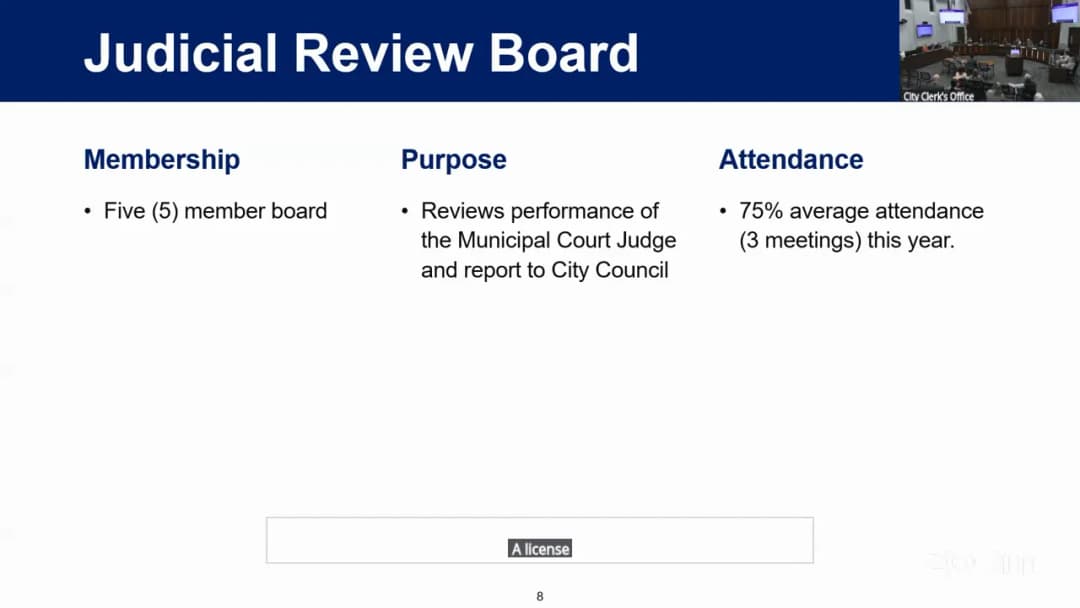
The Greeley City Council held a work session on Tuesday, October 27, 2026, from 6:00 to 6:33 p.m. Mayor Pro Tem presided, with six council members present and one excused. The session included councilmember reports, the 2026 triennial review of boards and commissions, and the 2026 third-quarter financial update. Because this was a work session, no formal action was taken; council members expressed consensus for staff direction. Reports from Mayor and Councilmembers - Councilmember Ryan Roth reported attending Clearview Library Board interviews, a High Plains Housing Authority community tour, and the Women's Place mural dedication. - Councilmember Johnny Olson said he spent time walking in Ward 3 and that roughly nine out of ten community conversations were appreciative of the council's work. - Councilmember Deb DeBoutez highlighted the Speak Up Greeley data center information and survey, and asked staff to consider a similar survey or listening session on Flock cameras and license plate readers, citing gaps in information. She also announced office hours on November 4 with Greeley Water Day. - Councilmember Craig Huddleston reported attending the first annual Lulag Green Chili Cook Off and announced office hours for October 28 at Zoe's on 10th. - The Mayor Pro Tem reported that Project Connect's wrap-up showed the city's numbers exceeded the county's, shared a story about a navigator assisting a person in crisis, and noted Councilmember Brian Rudy will serve as chair elect. 2026 Triennial Review of Boards and Commissions - Deputy City Clerk Middleton explained that the Home Rule Charter requires council to review advisory groups every three years. The boards under review were the Parks and Recreation Advisory Board, Judicial Review Board, Human Relations Commission, and Museum Advisory Board. - The Museum Advisory Board discussion was deferred to a later date to allow staff and the board to refine its work plan; reauthorization is still needed by the end of the year. - Board details presented: Parks and Recreation Advisory Board has 10 members and averages 97% attendance; Judicial Review Board has 5 members and averages 75% attendance; Human Relations Commission has 12 members and averages 79% attendance. - Judicial Review Board member Rashid answered questions about vacancies and attendance, noting the board needs a business leader and a licensed attorney, that staff is recruiting through CNE, and that proposed bylaws would address non-attendance but only council can remove members. - Councilmembers discussed whether council liaisons should attend boards and commissions more regularly; staff said every board has a staff liaison, and councilmember attendance at least quarterly would be welcomed. 2026 Third Quarter Financial Update - Finance staff reported that retail spending continues to increase, inflation is at 3.9%, Weld County unemployment is around 4.4%, and short-term interest rates are volatile and projected to increase by another quarter percent by the end of 2026. - For the first eight months of 2026, sales tax collections grew at 3.9%, below the revised budget of 5.6%; food tax revenue was below prior-year actuals because of price increases and consumer behavior changes. - The city holds $4.8 million in revenue stabilization funds and currently projects no general fund carryover for 2026. As of September 30, cash and investments totaled $426 million, compared with a $200 million adopted budget and a $360 million year-end forecast. - Interest earnings reached $10.8 million and are projected to exceed the 2026 budget by $7 million. - New construction revenues are estimated to exceed the 2026 budget by $9.6 million across the three main categories by year end. One-time oil and gas revenues are projected to exceed budget by $2.5 million, while severance taxes were considerably lower than projected and federal mineral lease taxes met budget. - Across all city funds, resources are projected to be $13 million above the 2026 budget. The general fund is currently projected at a $0.2 million decline, with operational savings expected to make the number positive by year end. - Grant expenditures for the first nine months of 2026 are estimated at $9 million, mostly federal. The city has 49 submitted grant applications and 84 active grant awards. - In response to council questions, staff said roughly one-third of the sales tax growth is inflation-related and two-thirds is actual growth, and that future budgets use a 10-year historical average of about 5.5% annual sales and use tax growth. Council asked for a breakdown of federal and state funding risks; staff agreed to provide it. Councilmember Olson noted that certain federal pass-through transit funds have not decreased in about 20 years. Scheduling and Adjournment - City Manager McBroom announced no additional meetings or events. Council was reminded there will be no council meeting on November 3 because of the election. The meeting adjourned at 6:33 p.m. Key Outcomes - Council gave consensus to reauthorize the Parks and Recreation Advisory Board, Judicial Review Board, and Human Relations Commission for three years; the Museum Advisory Board was deferred to a later date. - The accompanying ordinance is tentatively scheduled for first reading on November 17 and second reading and public hearing on December 1, subject to change because of the museum board deferral. - Staff will provide additional detail on federal- and state-funded grant risks and will consider more regular councilmember attendance at boards and commissions.
The Public Meeting Index
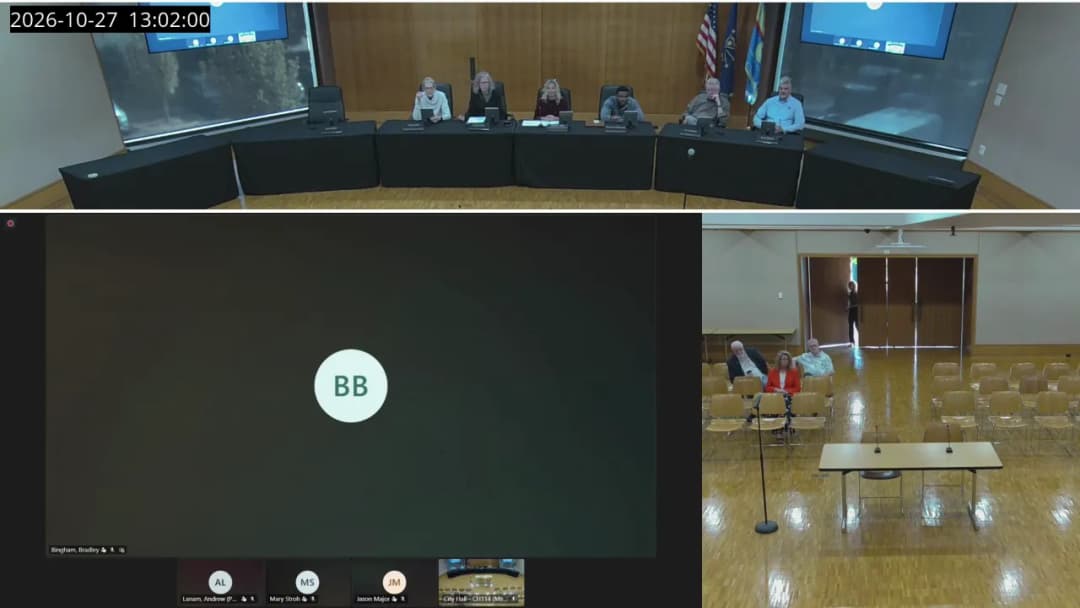
The Public Meeting IndexThe Columbus Redevelopment Commission held a special meeting on October 27, 2026, with a single action item: Resolution 22-2026 authorizing pre-approval of claims disbursement for the 6th and Washington Street Mixed-Use Project. The meeting included roll call, a presentation by attorney Brad Bingham, discussion, and unanimous approval. Discussion Items - Resolution 22-2026 – Pre-approval of Claims Disbursement for 6th and Washington Street Mixed-Use Project: Brad Bingham (Barnes & Thornburg) explained the need for the resolution. The city's forgivable loan to Flarity and Collins was scheduled to close simultaneously with their construction loan from State Bank. To allow an initial draw on the forgivable loan at closing, the resolution permits the CRC treasurer (the city controller) to disburse funds prior to the next regular CRC meeting. Disbursements will follow a standard process: the developer submits a draw request to State Bank, which reviews and certifies it; the city has 10 days to review and approve. Key Outcomes - The commission unanimously approved Resolution 22-2026, authorizing pre-approval of claims disbursement for the 6th and Washington Street Mixed-Use Project. The motion was made by a commissioner, seconded by Cindy Bold, and passed with all aye votes. - The meeting adjourned following a unanimous vote to adjourn; a motion to adjourn was made by a commissioner, seconded by Scott Ballard.
The Committee on Council Processes met for about one hour on October 27, 2026, with a 6:30 p.m. special council session limiting the agenda. No agenda or minutes were provided; this summary relies on the raw transcript. Participants included committee members, City Clerk Nicole Bolden, Council Attorney Jake Rossman, Chief Deputy Clerk Sophia McDowell, and Deputy Clerk Crossley online. The raw transcript opens with “Monday, October 26, 2026” and says “Wilmington,” but the system-provided meeting date is October 27, 2026, and the agenda items reference Bloomington. Discussion covered the proposed removal process for council-appointed board and commission members, an update on Bloomington Public Transportation Board expansion, and continued Title II code review. No formal votes were taken; decisions were by consensus. Discussion Items - Bloomington Public Transportation Board expansion update: Councilmember Stoutburgh said there was no new update. Research was still in progress, and a pros-and-cons discussion could not be placed on the October board agenda. The item was deferred. - Proposed removal process: Council Attorney Rossman presented a draft nine- or ten-step process, noting that current ordinance 2025 allows removal “for cause” but does not prescribe a procedure. The draft covered informal and formal complaints, review and verification of claims by council staff and legal, optional staff screenings, formal notice with specific code/rule violations and a logical nexus to diminished ability to perform duties or disrupted proceedings, recusal considerations, and a floor motion for due-process notice. - Clerk Bolden said the proposal duplicated a process already administered by the board/commission staff position under her office and shifted work onto council staff; she said the committee had previously agreed to develop this with the clerk’s office. Deputy Clerk Crossley recommended removing step 3 or clearly assigning responsibility for screenings, and said the existing process could be outlined and streamlined while continuing to involve the council attorney. - Councilmembers generally agreed that Clerk Bolden, Deputy Clerk Crossley, and Council Attorney Rossman should jointly prepare a second draft. One councilmember emphasized that the council attorney should remain closely involved in removals. The committee also discussed whether a commission itself could censure a member under Robert’s Rules; Rossman agreed to research that option for the next meeting. - Title II review – committee of the whole: The committee examined committee-of-the-whole provisions and questioned what “freedom of committee procedures” adds, noted the section has not been used as written, and observed that committee of the whole is now used mainly for budget discussions where no vote is taken. Members decided to check Robert’s Rules and the prior code context before proposing changes. One councilmember also recalled former council member Steve Bolin’s caution that these provisions were written that way for a reason. - Title II review – scheduling committee meetings: The committee agreed to remove the scheduling-committee-meetings section from city code and move it into council rules of procedure instead of leaving it in code. Public Comments & Testimony - A speaker involved in the HPC removal matter said they generally supported the memo and the standard the council adopted in 2023 in the Alexander matter, but argued that no council member should serve as both prosecutor and judge. They called for a real hearing with access to the full file, the right to question accusers, and the right to counsel; for the vote threshold and quorum to be stated; and for the vote to be by the full council. They also said the current removal should be dismissed and restarted under any newly adopted process, and that this was their first opportunity to speak after others had been heard. - Eric Oz said the removal-for-cause process should be formal, precise, rigorous, cautious, and not easy, and that it should be aligned with legal and constitutional authority. He argued that removal authority belongs to the appointing branch, in this case the council, and that the clerk’s office role is supportive and non-authoritative. He recommended a uniform removal process developed in collaboration with the executive branch. - Jeff Richardson, a former council member, urged more welcoming and deeper public dialogue, including panel discussions and longer formats rather than the three- or five-minute comment limits. He said the current process can feel like one-upmanship and diminishes everyone involved. - Terry, a public commenter, praised the council’s recent deliberative sessions as beneficial to democratic governance and public trust, asked how the council will evaluate and learn from them, and noted that the city no longer has a public engagement director, though the position still exists and the mayor’s office reportedly intends to hire someone. Key Outcomes - No action was taken on Bloomington Public Transportation Board expansion; the update was deferred. - The proposed removal process was not adopted. The committee directed the clerk’s office and council attorney to prepare a second draft, clarify who conducts screenings, and return it at the next meeting. - The removal currently before the council is expected to continue moving forward without restarting while the formal process is drafted. - Council Attorney Rossman will provide more information on formal censure options at the next meeting. - Title II review will continue; committee-scheduling language will be moved from code to council rules of procedure. - The next meeting was set for Monday, November 16, 2026, at 5:30 p.m.
This special session was convened to consider Resolution 2026-23, which would increase the Public Safety Answering Point (PSAP) rate and the overall Public Safety Local Income Tax rate to fully fund dispatch operations, as recommended by the Monroe County Local Income Tax Council's PS Lit Committee. The resolution failed after extensive discussion and public testimony. Public Comments & Testimony - Kevin Keel opposed the resolution, arguing that the projected funding gap does not by itself justify a tax increase without a formal plan for reserves, equipment, and staffing. He noted that actual spending has differed from budget due to recruitment challenges and that the county holds significant dispatch reserves. He urged the council to take more time to develop a combined financial forecast and reserve targets. - Eric Oz raised multiple material questions about the lack of required annual meetings, the late creation of a dedicated PSAP fund (April 2025), gaps in revenue tracking, and compliance of the interlocal agreement. He recommended not increasing the PSAP rate until these issues are transparently addressed, and called for an immediate meeting of the PS Lit committee. Discussion Items - Financial Presentation: Controller Jeff McKim presented updated financials for the city's PSAP fund, showing a projected year-end balance of about $1 million for 2026, and a deficit budget of $4.8 million against $4 million in projected revenue (from the county) for 2027, leaving reserves nearly exhausted. He noted that the county's PSAP reserves ($3.26 million) and 911 reserves ($2.7 million) could be used, but that major technology replacements (e.g., $2.3 million for radios) are imminent. - Interlocal Agreement Concerns: Council members discovered that the 2018 interlocal agreement requires an annual joint work session between city and county councils before September 1, which apparently has not been held in recent years. The agreement also requires the city and county to cover budget shortfalls equally after reserves are exhausted. - Rate Impact: An increase would cost approximately $37 per year for a household with $100,000 adjusted gross income (71 cents per week). - Alternative Funding: Some council members suggested using General Fund dollars or a General Obligation bond for capital equipment, rather than a tax increase. - Timing: The county must also adopt the increase by November 1 for collection to start January 1, 2027; a later adoption would delay collection. Amendment - Councilmember Stasberg introduced an amendment to correct a rounding error (changing 0.287 to 0.2869) and fix a formatting issue in Section 1, Item 5. The amendment passed unanimously on a voice vote (no roll call recorded). Key Outcomes - Resolution 2026-23 Failed: After discussion and public comment, the resolution was put to a roll call vote. Councilmembers Piedmont Smith, Daily, and Stasberg voted no; no yes votes were recorded. The motion did not pass. - Next Steps: Council acknowledged the need to revise the interlocal agreement, schedule a joint meeting with the county, and develop a comprehensive funding plan for dispatch operations. A special Plan Commission session was announced for Wednesday, and a Fiscal Committee meeting for Friday.
The Corpus Christi City Council met on Tuesday, October 27, 2026, at 11:30 a.m. in Council Chambers. The meeting opened with an invocation by Pastor Steve Lopez of Koinonia Church and pledges led by Kayleen Avila, a senior at Por Vida Academy. The agenda included a Flags for Heroes update, public comment, a consent agenda, separate consideration of four pulled items, executive session on four legal matters, and post-executive session action on a judgment and a water-line reimbursement dispute. City Manager's Comments - Flags for Heroes - City Manager Peter Zanoni reported that the annual Flags for Heroes event will take place Saturday, November 7 through Sunday, November 15, 2026, with about 1,800 flags displayed along Ocean Drive and at Doddridge, Ropes, Oleander, and Cole parks. - The city is a major sponsor and sponsors 80 flags; council members and city departments nominate heroes. - Alan Wilson, Rotary Club of Corpus Christi Flags for Heroes chairman, said the event began eight years ago with 350 flags, grew to 660 in its first year, and has now grown to 1,800 flags. He described related events including a dedication ceremony at First Baptist Church and a Veterans Day 'honk for your heroes' drive along Ocean Drive. Consent Agenda - The council approved the consent agenda by one motion after pulling items 5, 6, 9, and 13 for separate consideration. - Approved the October 13, 2026 regular meeting minutes. - Approved a $17,830,308 grant from the U.S. Department of War, Office of Local Defense Community Cooperation, under the FY 2026 Defense Community Infrastructure Program, for the Leopard Street and Up River Road Water Line Replacement Project, with a $7,641,561 cash match from the Water Capital Fund and an FY 2027 Capital Budget amendment. - Approved Zoning Case No. ZN9401 for Texas Store Properties, LLC at or near 2060 Tuloso Road, adopting the alternative ON/SP Neighborhood Office District with Special Permit recommended by staff and Planning Commission in lieu of denial. - Approved a one-year supply agreement with ACT Pipe and Supply, Inc. for manhole covers, risers, and accessories for Corpus Christi Water, not to exceed $246,465.95, with a potential amount of $739,397.85 if options are exercised. - Approved a one-year supply agreement with ACT Pipe and Supply, Inc. for fire hydrants, not to exceed $340,376.00, with a potential amount of $1,021,128.00 if options are exercised. - Approved an interlocal agreement with Texas A&M University-Kingsville for health district workforce development, leadership training, organizational assessment, technical assistance, and evaluation services, not to exceed $140,004.00. - Approved a $6,677,961.03 FEMA Hazard Mitigation Grant Program grant for the La Volla Creek Drainage Improvement Project, with a $2,206,332.91 cash match from the Storm Water Capital Fund. - Approved an ordinance adjusting speed limits on SH 286, US 181, and SH 361, and removing portions of state highway demolished during the Harbor Bridge Project. Public Comments & Testimony - Ajit David said the city does not have a desalination plant today because of past decisions and said he opposed a proposal that would have handed water authority to the Port of Corpus Christi. - Dale Switala opposed the Inner Harbor desalination project, saying it is about five blocks from his residential neighborhood, lacks permits for Gulf discharge, and would leave no water for homes. He cited campaign donations to the Coastal Bend Coalition from Valero Services, Exxon Mobil, Gulf Coast Ventures, Coke Industries, Sunir LNG, and Occidental Petroleum, and thanked the council for voting against the project. - Sean Merritt, speaking via WebEx, alleged that Mayor Guajardo engaged in electioneering at polling locations, displayed photos and videos, referenced an assault case, and said he would serve as a poll watcher. His time expired during the comment. - Christina McKay, District 1, complained that the city changed its camera coverage so council members and staff receive high-quality individual shots while community speakers receive a low-quality wide shot; she asked the council to restore equal high-quality production and respond in writing. - Eli McKay, District 1, called for less division, fearmongering, and AI-generated campaign content, and urged respect and privacy for candidates and neighbors. - Linda McLinchek, London Ranch Estates, requested reimbursement for 1.2 miles of off-site water line her company installed, saying the city uses the line and has refused to pay. She said the company has been in business 25 years, built over 650 homes, and generates $4.8 million in tax revenue per year, plus almost $1 million from London Ranch. - Brenda Simmons, District 1, supported the McLinchecks and asked the council to grant the reimbursement. - Douglas Ellison, District 2, supported reimbursement, said the line cost more than $1 million, and accused the city of using the pipeline without payment; he also made political accusations and asked council members to attend a settlement meeting. Discussion Items - Item 9 - Longyards Corpus Christi, LLC lease: Councilwoman Paxson questioned the 12-to-18-month repair timeline and lease costs. Staff said the Asset Management heavy-equipment maintenance building burned on March 18, the rebuild requires design and bidding, and the Holly Road location was the best available option. Councilman Cano called the monthly cost outrageous; staff said the rate was on par for the market and the lease is an interim solution. The item was approved. - Item 13 - Texan Stores airport lease: Councilwoman Paxson questioned the fuel flowage fee reduction from an original 2 cents per gallon to a tiered rate beginning around half a cent, and the absence of a time-based escalation. Aviation Director Richard McCurley explained that the tenant renegotiated after its $10 million loan terms, the new fee is volume-based and can rise to about 1.3 cents per gallon, land rent is near fair market value, and fuel revenue is projected at about $37,000 minimum per month. The 40-year lease with one additional 10-year option for up to 8 acres or 348,480 square feet at Corpus Christi International Airport was approved. - Item 5 - Evangeline Laguna, LP groundwater rights lease: Councilman Cano pulled the item to vote no, saying the city should not keep spending before adequate studies are done. Councilman Scott said he was uncomfortable because he had been told the item was not a 'today conversation' but then it appeared on the agenda. Nick Winkelman, Chief Operating Officer of Corpus Christi Water, said the two existing wells are each permitted for 1,500 gallons per minute and are expected to produce about 3-4 million gallons per day; the initial $1,000,000 payment works out to 80 cents per thousand gallons; and the lease will provide groundwater data for the contested case. Council members supporting the item described it as part of water-supply diversification. The item was approved. - Item 6 - Formosa Plastics raw water sales contract: Councilman Hernandez moved approval, saying the contract adds about 2.2 million gallons per day. The council approved the temporary untreated raw water sales contract authorizing the city to purchase up to 10,000 acre-feet from Lake Texana in calendar year 2027 at $900 per acre-foot, with a take-or-pay quantity of 2,500 acre-feet and up to two one-year mutual extensions. Executive Session The council entered executive session on items 14-17 under Texas Government Code § 551.071 to consult with attorneys concerning: the Maria Calderon v. City of Corpus Christi judgment; Ajit David and Elevate QOF litigation and related ordinances and agreements; the SOAH/PUC outside city ratepayers appeal; and LM & JM Investments LLC, Unified Development Code water and wastewater trust fund provisions, and reimbursement agreements. Key Outcomes - Consent agenda items 2-4, 7-8, and 10-12 were adopted by one vote; items 5, 6, 9, and 13 were considered separately and approved. - Item 9 was approved: amended and restated lease with Longyards Corpus Christi, LLC, not to exceed $213,000, with a potential amount of $423,000 if options are exercised. - Item 13 was approved: 40-year Texan Stores lease with one additional 10-year option for up to 8 acres or 348,480 square feet at Corpus Christi International Airport. - Item 5 was approved: groundwater rights lease with Evangeline Laguna, LP, with an initial payment of $1,000,000 for a one-year term with automatic renewals. - Item 6 was approved: temporary untreated raw water sales contract with Formosa Plastics Corporation, up to 10,000 acre-feet from Lake Texana in 2027 at $900 per acre-foot, with a 2,500 acre-foot take-or-pay quantity. - Council authorized payment of $250,000 for the judgment in Maria Calderon v. City of Corpus Christi; the motion carried with one abstention. - Council opened public comment on item 17 and directed staff to arrange a meeting within a week among City Manager Zanoni, staff, and Doug Allison regarding the London Ranch water line reimbursement dispute, with a full briefing to council afterward. - City Manager Zanoni committed to provide a Seven C's water project contract update or briefing at the November 10, 2026 council meeting and to follow up on floating solar panel research with the Bureau of Reclamation and Texas Parks and Wildlife. - Several council members asked staff to revisit the public-comment camera coverage decision as a full council matter.
The Joint Economic Development and Climate Change and Sustainability Committees met on October 27, 2026, to consider two resolutions: the Community Solar Contract Summary Disclosure Form and a Payment-in-Lieu-of-Taxes (PILOT) agreement for the Omni Hotel project. Both items were approved unanimously. Discussion Items - Community Solar Contract Summary Disclosure Form (R-26-464): The committee considered a resolution approving a standardized disclosure form for community solar subscriptions to promote transparency. The form was presented as a routine procedural step. The motion to approve passed with 3 yeas and 0 nays. - Omni Hotel PILOT Agreement (R-26-463): The Office of Economic Development and representatives of the Convention Center Headquarters Hotel project team presented the proposed Payment-in-Lieu-of-Taxes agreement. The presentation highlighted the project's economic benefits and described the approval as a procedural step in the process. The committee voted 3-0 to approve the resolution. Key Outcomes - Resolution approving the Community Solar Contract Summary Disclosure Form (R-26-464) passed unanimously (3-0). - Resolution authorizing the Omni Hotel PILOT agreement (R-26-463) passed unanimously (3-0). - Both items were placed on the consent agenda for the next full City Council meeting.
On October 27, 2026, the Finance and Business Committee met at the City & County Building, Room 391, with Chair Chris Hinds presiding and staff member Anne Wallace present. The committee advanced 19 improvement district budget items, approved a Downtown Denver Development Authority funding agreement for the Barth Hotel, heard an informational briefing on the Business Impact Opportunity (BIO) Fund, and approved five consent items. Attendance records list 6 present (Gonzales-Gutierrez, Hinds, Kashmann, Sawyer, Watson, and Alvidrez) and 2 absent (Gilmore, Romero Campbell); the agenda member list did not include Alvidrez. All votes on action items were 5-0, with the two absent members not voting. Action Items 2027 Improvement District Plans and Budgets (26-1586 through 26-1604) - Dennis Wegienek (Department of Finance) presented the annual review of 19 district items: 12 Business Improvement Districts (BIDs), 6 General Improvement Districts (GIDs), and the Denver Tourism Improvement District (TID). - Highlights included: Ballpark GID holding its mill levy at 5 mills; Broadway Denver GID beginning mill-based collections at 8.96 mills after first-year assessments; RiNo GID planning one-time capital projects such as 35th Street improvements, pedestrian lighting, tree installations, a HAWK signal near Mission Ballroom, and trash/recycling/lighting/banner improvements; and the TID projecting about $11.8 million in revenues and expenditures for 2027. - Councilmember Sawyer moved and Councilmember Watson seconded a block motion to approve the 19 items for filing. It carried 5-0. Barth Hotel DDDA Funding Agreement (26-1608) - Dawnna Wilder (Department of Finance) presented a proposed funding agreement between the City and the Denver Downtown Development Authority for the Barth Hotel at 1514 17th Street, Council District 10. - The project will convert 62 units into 50 affordable senior housing units at 30-50% AMI. Total project cost is estimated at just over $22 million; the DDDA will fund up to $6 million, anticipated to reduce to $4 million once awarded tax credits are applied. The loan carries 2% interest over a 40-year term. - The building was built in 1882, is federally and state registered as historic, and is a designated Denver landmark. Planned work includes adding kitchens and private restrooms to each unit, air conditioning, new elevators, new mechanical systems, and new plumbing. - Susan Powers, the developer, said units will be about 350-400 square feet, rents around $1,000 per month, and the project will preserve historic doors and restore terrazzo in the lobby. - Councilmember Sawyer and Councilmember Kashmann voiced strong support for the project. The motion by Watson, seconded by Sawyer, was approved for filing 5-0. Briefing: Business Impact Opportunity (BIO) Fund Update (26-1615) - Adeeb Khan and Martin Gonzalez (Denver Economic Development and Opportunity) and Becky Simon (Department of Transportation and Infrastructure) provided the briefing; Rachel Lyons, DEDO program manager, also answered questions. - The BIO Fund began in 2019 for businesses affected by I-70 construction, expanded during the COVID-19 pandemic and for 16th Street construction and encampment impacts, and currently supports businesses along the Colfax BRT corridor. - Total program funding since 2019 is $32 million. Over 85% came from federal sources such as the CARES Act, while about $4.675 million, or 14%, came from the General Fund. - During Colfax BRT: three 2025 rounds supported 100 businesses on East and West Colfax, and three 2026 rounds supported 88 businesses. Every eligible business that applied received funding. - Reported outcomes include: 95% of East Colfax BRT grant recipients are still open; new business openings have nearly offset closures; 76% of surveyed businesses reported stabilized employee counts; and two-thirds of business owners found the grant helpful or extremely helpful in staying open. - The average grant is about $12,500; larger businesses generally receive $15,000 and smaller businesses $7,500 if they have under $100,000 in annual revenue. Most businesses qualify for the full $15,000. - Councilmember Sawyer said legislation coming November 10 would put the BIO Fund into the Denver Revised Municipal Code, create a dedicated special revenue fund, and offer tools including grants, technical assistance, and potential tax assistance. She noted the fund currently exists only as a program and should not disappear. - Councilmember Alvidrez raised contractor-caused harm and asked about Federal Boulevard BRT. Presenters responded that current BIO Fund dollars are not slated for Federal Boulevard and that HUD/NERSA CDBG funding cannot be used for stabilization grants. Alvidrez said she and Councilmember Watson are urging state support because Federal Boulevard is a state project. - Councilmember Kashmann praised the program but said it needs more money, argued Denver should raise taxes for a variety of priorities, and described current grants as small relative to the losses businesses take. - Councilmember Watson praised the program's ripple effects and encouraged customer-activation efforts such as corridor parties during construction. Consent Calendar - 26-1585: Contract with Eckerd Youth Alternatives, Inc. (Eckerd Connects) for $5,266,409 through 6-30-2027 for citywide workforce development services under Denver's Workforce Innovation and Opportunity Act funding and other federal/state revenue-funded initiatives. Approved by consent. - 26-1605: Authorized issuance and sale of up to $27,000,000 in Multifamily Housing Revenue Bonds (Link and Pin Apartments), Series 2027A and 2027B (Taxable), including award of up to $19,400,000 of the city's private activity bond volume cap, for an affordable multifamily rental housing facility. Approved by consent. - 26-1609: Contract to buy and sell 3940 S. Narcissus Way with Nii Yemofio and Breanna Tomlin-Yemofio for $710,000 in the Hampden South Neighborhood, Council District 4. Approved by consent. - 26-1610: Revocable license agreement with The Gathering Place for a maximum contract amount of $20, approximately October 1-December 31, 2026, to operate a micro-community shelter at 1375 N. Elati Street in the Civic Center Neighborhood, Council District 10. Approved by consent. - 26-1611: Supplemental appropriation of $7,670,500 in the Denver Arts and Venues Special Revenue Fund. Approved by consent. Key Outcomes - Block district budget motion (26-1586 through 26-1604): approved for filing 5-0, with Gilmore and Romero Campbell absent. - Barth Hotel funding agreement (26-1608): approved for filing 5-0. - Consent items 26-1585, 26-1605, 26-1609, 26-1610, and 26-1611: approved by consent. - The BIO Fund briefing was informational; a related council ordinance is expected on November 10, 2026. - Legislative schedule noted: Mayor-Council next week; BID and TID first reading on November 9; BID and TID second reading and GID public hearings on November 16; and a referenced statutory budget approval deadline of December 5.
The Vineland City Council held its regular meeting on Tuesday, October 27, 2026, at 5:30 PM. The meeting included a Pledge of Allegiance led by Winslow Elementary School safety patrol students, approval of previous meeting minutes, public hearings on several ordinances, first readings of new ordinances, and a consent agenda of resolutions. The most significant discussion centered on Ordinance No. 2026-70, which would amend Chapter 425 on recycling operations and junkyards. Public testimony highlighted procedural and substantive objections, while police supported certain provisions. The public hearing on this ordinance was continued to November 10, 2026. Consent Calendar - Approved minutes of the Pre-Meeting Conference and Regular Meeting of October 13, 2026, and the Work Session of October 20, 2026. (Unanimous vote) - Adopted Resolution No. 2026-533 authorizing a closed executive session on litigation matters. (Unanimous) - All items on the consent agenda (Resolutions 2026-517 through 2026-532 and 2026-534, plus communications from the Mayor regarding appointments) were approved by a single motion. (Unanimous) Public Comments & Testimony - Jeffrey Kantowitz (attorney for Honest Lookup LLC, a property owner affected by the proposed ordinance) argued that the entire process for Ordinance 2026-70 was legally flawed. He claimed the planning board’s consistency review failed to identify inconsistencies with the master plan (e.g., a three-acre minimum lot size in the I-4 district vs. the proposed 10-acre requirement) and that the re-examination report cannot serve as the basis for consistency. He also noted that limiting licenses from eight to five and increasing lot sizes would hinder economic development. He urged the council to vote down the ordinance and restart the process. - Craig Rancap (professional planner working with Mr. Kantowitz) raised three substantive issues: (1) increasing lot sizes to 10 acres would make at least three of five existing licenses non-conforming, (2) there was no analysis justifying the reduction of licenses from eight to five, and (3) the auto salvage business (his client’s) would be effectively banned because none of the five outstanding licenses are held by auto salvage operators. He also reiterated that the consistency review was flawed, citing court cases that require direct comparison to master plan elements, not re-examination reports. - Ryan Madden (detective with Vineland Police Department) spoke in favor of the police-related provisions in the ordinance, which would require scrap metal and car part sellers to provide identification and track transactions (similar to pawn shop requirements). He noted that such a system would aid investigations into thefts, including over $200,000 worth of stolen Verizon wires this year and catalytic converter thefts. He urged the council to approve that portion of the ordinance. - Chris Stockney (professional planner with Artheon, who prepared the planning board report) defended the planning board’s finding that the ordinance is substantially consistent with the master plan. He stated that the council has authority to regulate land uses and that the planning board’s resolution was properly adopted. He did not address the specific planning objections raised by the prior speakers. - The council’s engineer, Ryan Hadley, was scheduled to testify but had a family emergency. The public hearing was continued to allow his testimony at a later date. Discussion Items - Ordinance No. 2026-70 (Recycling Operations and Junkyards): Public hearing opened, extensive testimony heard. No council discussion recorded during the meeting beyond the motion to continue the hearing. - Ordinance No. 2026-71 (Classification and Compensation Plans – various titles): Public hearing closed and adopted unanimously. - Ordinance No. 2026-72 (Water tank maintenance and logo placement agreement with Utility Services Company): Public hearing closed and adopted unanimously. - Ordinance No. 2026-73 (Legal representation for armed security officers): Public hearing closed and adopted unanimously. - Ordinance No. 2026-74 (Bond ordinance for Howard Pagliughi Park improvements, $1,180,000): Public hearing closed and adopted unanimously. - Ordinance No. 2026-75 (Bond ordinance for Joseph E. Romano Sports Complex improvements, $716,000): Public hearing closed and adopted unanimously. - First Readings: Ordinance Nos. 2026-76 (Purchasing Agent titles), 2026-77 (Purchase of joint interest in land from Vineland Development Corporation), 2026-78 (Municipal Parks Superintendent titles), 2026-79 (Vineyards Redevelopment Plan), and 2026-80 (Vineland Municipal Animal Services) were each introduced and passed for first reading with public hearings scheduled for November 10, 2026. Key Outcomes - Public Hearing Continued: Ordinance No. 2026-70 was continued to Tuesday, November 10, 2026, at 5:30 PM, to allow additional testimony from the city engineer. - Six Ordinances Adopted on Final Reading: Ordinances 2026-71 through 2026-75 were all adopted unanimously (5-0) after public hearings. - Five Ordinances Introduced on First Reading: Ordinances 2026-76 through 2026-80 passed their first readings unanimously; public hearings set for November 10, 2026. - Consent Agenda Approved: All listed resolutions (including several change orders, contracts, tax cancellations, budget insertions, and appointments) were approved en bloc without separate discussion.
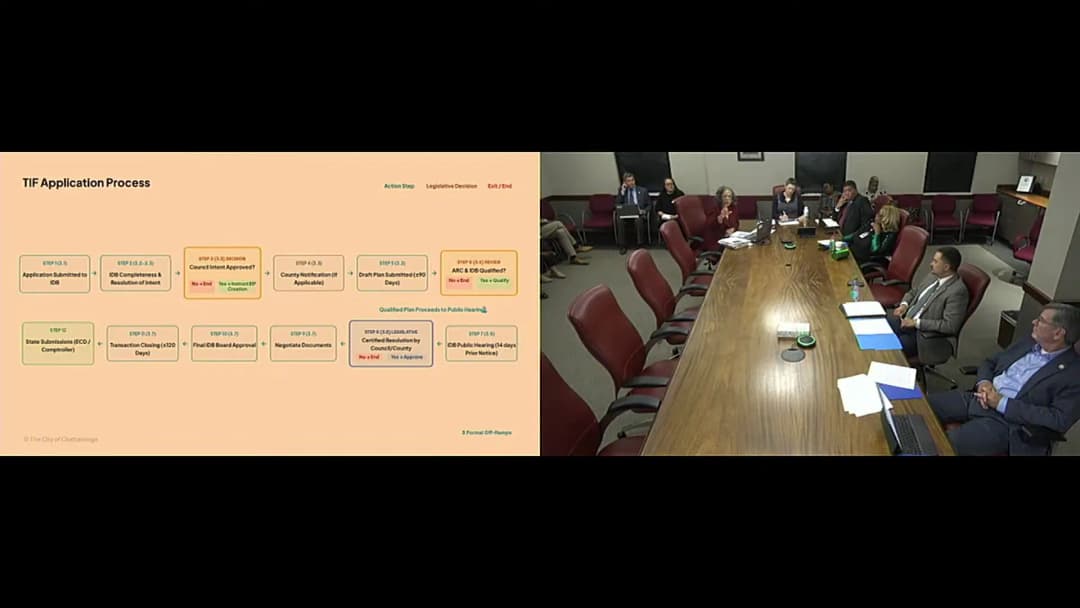
The Chattanooga City Council’s Economic Development Committee convened at approximately 1:21 PM ET on October 27, 2026, to discuss significant reforms to the city’s Tax Increment Financing (TIF) policies and debate a proposed clawback settlement with Nippon Paint. Administration staff presented a detailed review of the current TIF application process, policy recommendations from external audits, and a new software platform for managing incentives. The committee expressed strong opposition to the proposed Nippon Paint settlement, directing staff to renegotiate a more aggressive deal before a full council vote. Consent Calendar - The committee voted to approve the minutes from its previous meeting without objection. Public Comments & Testimony - No public testified directly, but council members extensively represented community interests during their discussions. Chairman Davis advocated for preserving public input mechanisms during the TIF process, citing the Northgate TIF as an example where early community engagement built trust. Councilwomen Clark and Hill emphasized the need for community benefits to address the unfulfilled economic promises from the Nippon Paint project. Discussion Items TIF Policy Review and Reform Proposals Administration staff (Sharita) provided a comprehensive overview of current TIF policies, detailing the standard 12-step, 6-to-12-month approval process involving the Industrial Development Board (IDB), City Council, and County Commission. A key proposal was the elimination of the Application Review Committee (Step 6), which staff stated adds roughly five weeks to the timeline and duplicates review work now managed by a new $44,000 Civic Service software platform funded by the IDB. Additional recommendations from a county auditor audit and a site selector analysis (comparing Chattanooga to Knoxville, Greenville, Louisville, and Tulsa) were reviewed, including potential changes to the $8,000 application fee and the 15% cap on infrastructure reimbursement for projects. - Councilman Elliott supported streamlining the process and requested staff identify which specific recommendations from the competitive study the administration does not support. He expressed interest in exploring Municipal Utility Districts. - Councilman Henderson opposed reducing or waiving the $8,000 application fee and supported incorporating workforce development and job training requirements into TIF agreements. He acknowledged the inherent tension between transparency and efficiency in government. - Councilwoman Clark requested exploration of using TIFs for vertical infrastructure improvements (such as grocery stores or housing) rather than strictly public infrastructure, noting the current policy limits TIFs to infrastructure and that other cities successfully use TIFs for vertical purposes. - Councilwoman Hill asked for clarity on which external recommendations the administration opposes and urged thoughtful consideration of public engagement mechanisms if the Application Review Committee is removed. Nippon Paint Clawback Negotiation Staff reviewed the Nippon Paint land donation deal from 2018, where the city donated 29 acres of land (valued at $1.157 million) in exchange for a commitment to create 150 jobs with an average salary of $47,070 and $60 million in capital investment by 2027. The city fulfilled its obligations, including the land donation, a $900,000 road extension, and sewer relocation, totaling approximately $4 million in investment. Nippon Paint built one 270,000-square-foot facility, invested $52 million, and employed 30–35 people in testing and chemistry roles, but failed to construct two additional buildings or create the promised jobs, citing the downturn in the electric vehicle market. The proposed clawback settlement requires Nippon to repay the $1.157 million land value and return 10 acres of the donated land. - Vice Chair Elliott strongly criticized the settlement, declaring it a “very weak” deal and stating he would not support it. He argued the city should reclaim all 29 acres and lease the land, emphasizing the significant collateral damage to the community from lost jobs and economic impact. - Councilwoman Clark echoed Elliott’s concerns, stating the clawback must reflect the full economic damage, not just the initial land value. She requested the city attorney present a stronger argument to the full council. - Councilwoman Hill suggested exploring community benefits or contributions from Nippon for the East Chattanooga community to compensate for the unfulfilled job promises. - Staff argued the settlement was a balanced compromise that recoups costs, returns developable land, keeps a still-operating facility on the tax rolls (32 current employees), and demonstrates the city’s ability to enforce agreements without being overly punitive. - Council consensus: The committee rejected the proposed terms and directed staff and legal counsel to renegotiate a significantly stronger clawback agreement before the full City Council vote scheduled for the following week. Key Outcomes - TIF Policy Changes: The committee advanced the proposal to eliminate the Application Review Committee to shorten approval timelines. Staff will provide a list of specific policy recommendations they oppose. Future meetings will explore TIFs for vertical infrastructure and the establishment of Municipal Utility Districts. - Nippon Paint Settlement: The committee formally rejected the proposed clawback terms (repayment of $1.157 million and return of 10 acres). Staff and the city attorney were directed to pursue a stronger settlement for the full council vote the following week. - Minutes: Approved.
The Powell Development Corporation (PDC) met on October 27, 2026. The board approved previous minutes, voided inactive facade and business-retention grant agreements, approved its mission/vision and goals, and reviewed the proposed 2027 operational budget and a ChargePoint rate analysis. Final action on the budget and EV charging rates was deferred to the November meeting. Call to Order, Roll Call, and Approval of Minutes - Roll call was taken; Steve Larity, Sean Keller, and Tim Wilson were absent. - The board unanimously approved the minutes of the September 22, 2026 PDC meeting and the September 22, 2026 PDC Planning Retreat. Treasurer's Report - September revenues were $2,856, including bank interest and ChargePoint revenue; total September expenses were $10,410. - Significant expenses included audit fees related to the 2025 engagement and an Ohio Auditor of State invoice of roughly $1,700.59. - September net income was a loss of $7,554; the available bank balance at September month-end was $296,000, and outstanding items had cleared by October. - Discussion noted a sharp drop in valet usage, with 47 cars parked in September, and a plan to review valet and year-end expenditure line items. Old Business - Facade grant agreements voided: The board unanimously voided three unpaid facade grant agreements after staff explained that the projects had changed or would not proceed: 36 N. Liberty/Cohiba ($25,000), 22 S. Liberty/Espresso 22 ($12,500), and 5 S. Liberty/Kraft House 5 ($22,500). The agenda listed the first property as 35 N. Liberty; staff clarified that the correct address is 36 N. Liberty. - Nocterra performance-based grant voided: The board unanimously voided the second-year component of Nocterra's Business Retention and Expansion grant, which had authorized up to $25,000 for distribution-network legal expenses. Nocterra is no longer operational; the first-year payout had been $23,855 and was used for a delivery vehicle. - Mission, vision, and goals: The board unanimously approved the proposed mission and vision statement and the related 2027 goals. Proposed 2027 Operational Budget - Staff reviewed a proposed 2027 budget with revenues of roughly $598,000, including a $400,000 CIP funding line, $25,000 tourism-budget carryover, $20,000 ChargePoint revenue, $10,000 interest, and a new $10,000 sponsorship line. - Expense projections included increased charging-station utility costs of about $45,000 and $24,000 in rent for an additional CoHatch office space; no valet program or strategic-land line was budgeted. - Board members asked for clearer year-to-date operating-surplus presentation, discussed whether to add a strategic land-acquisition placeholder, and suggested a larger marketing/communications budget for the planned new staff position. - The board decided to table formal action and consider a revised draft in November. ChargePoint Rate Analysis - Staff reported that the Murphy Park and City Hall charging program is not break-even and presented a recommended rate structure change from per-minute to per-kilowatt-hour pricing at 46 cents per kWh. - Comparable central Ohio fast-charger rates ranged from 26 to 51 cents per kWh. No formal action was taken; the board will revisit the issue at the next meeting. Reports and Committee Updates - City Council/City Manager: Council's 2027 budget will be presented at the Wednesday council meeting because Election Day displaces the usual Tuesday meeting. The report highlighted a $61 million five-year capital improvement program, three new full-time equivalent staff positions, record police staffing with 12-hour shifts, population growth from roughly 13,000 in 2020 to about 18,000, and regulatory work on e-bikes and massage-parlor/human-trafficking issues. - Economic Development: Staff reported strong 2026 year-to-date activity: 43 new businesses or startups, a 126% increase; 818 full-time equivalents; $64.42 million in new payroll; and more than $208 million in capital investment. The report also cited 196 business retention/expansion interactions, 20 retained or expanded businesses, and an estimated $1.3 million in annual new income tax for the city. - School Report: Materials were included in the packet; no oral presentation was made. - Chamber of Commerce/BRE: The Chamber executive director reported nearly 380 member businesses, 20 Saturdays of farmers markets, a fall street market, a Taste of Powell event with about 1,600 tasting tickets, and a sold-out Women in Business luncheon. The Chamber is planning around member feedback from 11 listening sessions and will hold a board retreat. - Downtown Merchants Committee: Staff are restructuring the committee, and the committee discussed the upcoming Village Green master plan workshop on November 12 at 6 p.m. It was noted that many older plans exist, but implementation requires funding and continued public process. - Remaining reports from the convention/tourism, entrepreneurialism, and real estate committees were not delivered because those members were not present. Key Outcomes - Unanimously approved: September meeting and retreat minutes; voiding three facade grant agreements; voiding the Nocterra grant; mission/vision statement and 2027 goals. - Deferred to November: 2027 operational budget approval and ChargePoint rate-structure decision. - Upcoming dates mentioned: Village Green master plan workshop November 12; Mayor's office hours November 16, 4-6 p.m.; a revised budget and EV charging discussion at the next PDC meeting. - The meeting was adjourned.