The Anchorage Assembly convened for a work session focusing on the preparation of the 2026 Assembly Work Plan, the finalization of 2025 accomplishments, and a detailed discussion on parliamentary procedures, social media policies, and pending legislative items. The meeting featured updates from the Mayor's Office, Legislative Services, and various Assembly members regarding public safety, housing initiatives, and administrative reforms. A joint meeting with the Native Village of Aklutna was scheduled to follow immediately. Consent Calendar - No items were placed on the Consent Calendar; the Chair noted that the agenda was adjusted to prioritize discussion items over routine approvals to allow for deeper dives into complex work plan topics. Public Comments & Testimony - Public Safety Commission Advisory: Communications were received regarding a group intending to attend the upcoming Tuesday meeting to demand action on the Public Safety Commission. Members noted that the community desires the commission to have a meaningful role in accountability, specifically regarding subpoena power, though the Assembly leadership expressed skepticism regarding the feasibility of granting subpoena powers. Discussion Items - 2025 Accomplishments & 2026 Goals: - Member Positions on Credit: Members debated how to attribute success in the 2025 accomplishments report. One member argued against explicitly crediting the Mayor for joint projects to ensure the Assembly acknowledges its own role in driving priorities, while another member suggested the Assembly has a significant role in almost all administered projects and should feel comfortable claiming ownership of collaborative successes. - Housing and Homelessness: The Assembly discussed the opening of 34 tiny homes for recovery residences and the need to better articulate the Assembly's role in funding and land allocation for these projects. Members also requested updates on the Alaska Center for Treatment progress. - Enforcement Accountability: A strong position was expressed by members that the Assembly must prioritize "goddamn enforcement" of existing laws to combat the perception of city decline due to non-enforcement by major retailers and lack of APD response. - Infrastructure Planning: Members highlighted the need for the Assembly to develop its own long-range infrastructure planning tools to guide investments despite the technical control held by state bureaucrats and departments. - Rules Committee and Parliamentary Procedure: - Robert's Rules Clarification: Chair clarified Robert's Rules citations regarding speaking to motives and addressing remarks to the chair. The Chair corrected a previous citation error regarding Rule 43:44, noting that Chapter 43 ends at 40, and confirmed that no rule prevents members from presenting views of third parties if speaking on their constituents' experience. The purpose of addressing the chair is to prevent ad hominem attacks and maintain decorum. - Mayor's Voting Powers: Confirmation was provided that the Mayor may make motions and introduce legislation but cannot vote, with the veto power remaining exclusive to the Mayor. - Social Media and Public Records: - Official vs. Personal Accounts: Legal staff explained the Supreme Court's test for distinguishing between personal and official social media accounts. The Assembly discussed the risks of using municipal resources for partisan social media advertising. A majority expressed a preference for a "bright line rule" to avoid the complexity of fact-specific legal tests, though some members argued for the First Amendment rights to take stances on legislation via personal accounts. - Archiving Records: Staff noted that if members choose to use municipal funds for social media, an "Archive Social" tool must be integrated to ensure records are preserved under public records laws. - Legislative Updates: - TISDO (Transit Supportive Development Overlay): Member Martinez provided an update on the TISDO process, confirming that public meetings are currently being hosted by the Mayor's consultants and that members will continue independent community conversations. A version of TISDO is anticipated by April. - Public Records Amendment: Member introduced an update to address delays in public records production, responding to administrative resistance regarding the need for new staffing positions. - Alarm System and CWA: Proposed amendments to fix alarm false-alarm penalties (allowing waivers if a crime was averted) and a one-line removal to mandate triennial reviews of the Community Workforce Agreement. - Marijuana Code: An omnibus update to the marijuana ordinance is expected soon, addressing transfer of locations and short-term rental monitoring. Key Outcomes - Work Plan Direction: The Assembly agreed to consolidate 2025 accomplishments and 2026 goals into a single document without separating items into "Assembly Driven" vs. "Assembly Involved" categories, deeming the distinction too fluid. - Prioritization Vote: The Assembly voted against prioritizing the 2026 goals, agreeing to keep the list as a "laundry list" to reflect the collective commitment of all members. - Next Steps: - A work session on TISDO and a briefing on the Grants Audit are requested for January. - The 2026 Work Plan will be reviewed by the Assembly in the January Rules Committee meeting prior to final approval in February. - Legislative Services will finalize the Robert's Rules handout and clarify the Mayor/Manager participation protocols in writing. - The Joint Meeting with the Native Village of Aklutna is scheduled to convene immediately following the adjournment of this session.
Public Meetings - Anchorage, Alaska
Public Meetings - Anchorage, AlaskaThis work session was convened to hold the confirmation hearing for Mayor France's nominee, Terry Amitam, for the position of Port Director for the Municipality of Anchorage. The session featured opening remarks from the Mayor, an introductory statement by the nominee, and a Q&A session with the City Council regarding his qualifications, leadership philosophy, and strategic approach to the Port's operations and the Port Modernization Program (PAMP). The session concluded with a scheduled follow-up for a final action vote. Discussion Items - Nominee Qualifications and Background - Mayor France (Administrator): Expressed "extreme pleasure" in introducing Mr. Amitam, highlighting his 23 years of private sector experience in freight, logistics, and budget management, and his direct work with carriers and terminal operators in Alaska. - Terry Amitam (Nominee): Stated that his upbringing around infrastructure projects like the Trans-Alaska Pipeline shaped his understanding of the port's importance. He described his background in solving logistical problems for shippers across the state. - Leadership Philosophy and Challenges - Member Anna Burley: Asked about leadership philosophy and top challenges. - Terry Amitam (Nominee): Expressed that his philosophy is rooted in "consensus building" and surrounding himself with smarter individuals for data-driven decisions. Regarding challenges, he identified a "real lack of confidence" in the Port regarding management, operations, and communication among the public and the Assembly as the primary issue to address. He noted the need for increased transparency and immediate accountability. - Member Christopher Constant: Raised the issue of building a business case for the port and the perception that Anchorage residents are solely responsible for the costs. - Terry Amitam (Nominee): Argued that the "crux of the issue" is a lack of statewide understanding of the Port's importance. He stated that the city should not be solely responsible for funding, and a key goal is to communicate the value to all Alaskans to justify federal funding relief. - Strategic Initiatives (Funding, Military, and Staffing) - Member Christopher Constant: Inquired about securing funding from the Department of Defense (DOD) since civilian ports typically do not receive DOD funding, and noted the potential for competing ports. - Terry Amitam (Nominee): Expressed surprise that a "designated strategic port" is not currently receiving a DOD role, stating he will investigate this immediately. He affirmed his commitment to seeking all federal funding resources (DOT, DOD, etc.) to alleviate costs for Anchorage residents. - Member Anna Burley: Suggested the potential need for a consultant to assist the Assembly with project stewardship and succession planning for the aging Port staff (mid-50s average age). - Terry Amitam (Nominee): Acknowledged the importance of staff succession planning but noted his own recent arrival. - Union Relations: When asked about labor relations, the nominee stated he is "absolutely for" unions and not against them, though he noted his previous experience did not involve direct union relationships. He recommended meeting with the Building Trades Council. Key Outcomes - Nominee Stance on PAMP Fees: The nominee agreed with the sentiment that the Port Modernization Program (PAMP) fee burden should not fall solely on Anchorage residents and aims to build a broader case for state and federal support. - Next Steps: The Council scheduled a follow-up meeting for the upcoming Tuesday for a formal confirmation action. Members noted this usually involves a performance action and optional symbolic swearing-in for the nominee and family. - Staff Engagement Plan: The nominee committed to attending safety meetings with longshoremen and initiating tours and meet-and-greets with the workforce to build operational relationships.
The Committee on Economic, Community, and Development (CEDC) convened on December 11, 2025, to receive departmental updates, discuss planning initiatives, and review code change proposals. The meeting featured significant personnel transitions, including the departing leadership of Planning, Development, and Public Works. Key topics included the replacement of the permitting software system with a cloud-based solution, a comprehensive rezoning of 9,000 acres to "parks and recreation" status, downtown speed limit reductions, and a critical review of the 2024 Building Code Change series regarding elevator controller placement. Consent Calendar - No specific consent calendar items were voted on as a separate block during this transcript; routine reports were accepted and discussed under their respective agenda items. Public Comments & Testimony - Representatives from the National Elevator Industry (NEI), Otis, Schindler, and TK Elevator: These industry representatives expressed strong concern that Code Change Number 22, as currently drafted, contains ambiguous language that could be misinterpreted to restrict the installation of machine-room-less (MRL) elevator configurations that have been safely used in Anchorage for decades. They argued that the current language lacks clarity and creates unnecessary risk for delays and customer turnover. Consequently, they petitioned the committee to remand Code Change Number 22 back to city staff for further discussion and clarification before final adoption. Discussion Items - Departing Leadership & Departmental Status: Lance Wooler (Director of Planning, Development, and Public Works) announced this was his final meeting, expressing gratitude for his team's mentorship and the collaborative support of the assembly members. He noted his upcoming return to City Hall to assist with finance. Director Kent Colha (Public Works) and Director Craig Soule (Development Services) echoed sentiments of appreciation for Wooler's leadership. - Software System Replacement: - Project Description: The department is seeking to replace the current on-premises permitting software (Infor) with a cloud-based solution (proposals include Bluebeam and SmartGov) to facilitate online permitting, payments, and plan review coordination. The system is expected to be live in 2027. - Positions: Staff and the assembly expressed support for modernizing the system to improve user-friendliness and remove bugs in the legacy system. - Planning Department Updates: - Rezoning Projects: The department is utilizing a new abbreviated rezone process to move 6 properties from lower to higher density housing districts and is proposing the rezoning of approximately 9,000 acres of existing park properties to "parks and recreation" status to add legal protection. - Position on Valuation: When asked if rezoning to park status impacts property values, the Planning Director stated it is a "guess" but expressed the position that it would likely improve neighborhood value due to the added layer of security for green spaces, noting the properties are already dedicated parks. - Legacy Code Cleanup: The department is preparing to present clean-up projects for old Title 21 zoning districts and a wetlands management plan update to accommodate recent Supreme Court rulings (Sackett decision) to the Planning and Zoning Commission by April. - Public Works Updates: - Infrastructure Projects: The department is working to lower downtown speed limits to 20 mph by Spring 2026 and is addressing railroad crossing updates required by the Federal Railroad Administration (FRA) to maintain quiet zones. The cost for these crossing updates is estimated to be a couple hundred thousand dollars, paid by the municipality. - Vision Zero & Pedestrian Safety: The department is struggling to fill a vacant Vision Zero Coordinator position. They are also planning to install 10–20 new post-mounted speed feedback signs and upgrading Audible Pedestrian Signals (APS) on Lake Otis. - City Hall Maintenance: With the pending purchase of City Hall, the Public Works maintenance team will assume responsibility for existing contracts (custodial, snow plowing, etc.) and plans to re-advertise them in the long term. - Real Estate & Economic Development (ACDA): - Micro-units: The launch of 32 micro-unit housing units was celebrated, with the final 8 units expected within a week. - Fireweed Flats: An RFI has been issued for a minimum of 24 housing units. An RFP for the Denali View RV resort is in final stages, targeting a Spring 2026 groundbreaking. - Modular Housing: Four modular capsule units arriving from China are being inspected for potential deployment at the Fireweed lot. - H3 Faith Group: Demolition of the H3 Faith Group building has commenced. - 2024 Building Code Change Series (Code Change Number 22): - Proposal Description: The proposal seeks to delete and revise language restricting the location of elevator controllers, intending to require them be located outside the hoistway for safety. - Positions: While Building Staff and the Building Board supported the change for safety reasons, the elevator industry stakeholders argued the current language is too broad and ambiguous. City staff acknowledged the request for time, stating they are willing to revisit the language with industry stakeholders to ensure clarity while maintaining the intent of the safety requirement, aiming to finalize the update for January presentation to the Assembly. Key Outcomes - Software Vendor Selection: The department will await the appropriation of projected unexpended funds (available after December 16) to execute a contract for vendor selection (Bluebeam or SmartGov). - Code Change Number 22: The committee effectively agreed to request a remand of Code Change Number 22 back to city staff for further alignment with industry stakeholders to clarify language, though the safety intent to move controllers outside the hoistway remains. - Parkland Rezoning: The proposal to rezone 9,000 acres of existing park properties to "parks and recreation" status was presented for future Assembly consideration in January. - Speed Limit Reduction: The goal to implement 20 mph speed limits in downtown Anchorage by Spring 2026 was confirmed. - Railroad Crossing Costs: The municipality confirmed it will bear the cost (estimated $200,000+) for necessary infrastructure updates at railroad crossings to comply with Federal Railroad Administration requirements. - Acquisition of City Hall: The sale of City Hall is in the final closing stages. - Personnel Transition: Lance Wooler's tenure in his current role concluded; Mr. Dole is acknowledged as the incoming leadership for the affected departments.
This meeting of the Anchorage Urban Design Commission, held on December 10, 2025, commenced at 6:30 p.m. with a roll call establishing a quorum. The commission approved the minutes from September 24, 2025, and proceeded to a public hearing regarding Case 2025-0142, the Major Site Plan Review for 2026 Town Square Park Improvements. Following presentation and public testimony, the commission voted unanimously to approve the project. Consent Calendar - The minutes from September 24, 2025, were approved unanimously on a motion by Commissioner Lenny and second by Commissioner Claus. - No items were placed on the consent agenda. - No unfinished business was identified. Public Comments & Testimony - Commissioner Sullivan: Expressed strong support for safety improvements regarding clear visibility and wide walkways. However, the speaker voiced concern that the current design lacks sufficient elements to create a vibrant, year-round winter atmosphere. Commissioner Sullivan stated a desire for permanent infrastructure to bring business and "eyes on the park" to the downtown area, specifically noting the loneliness of the park in winter and the desire for year-round activity to counter safety fears. - Commissioner Lenning: Expressed support for the plan, specifically commending the extensive public outreach. The commissioner raised concerns about sound carry due to the lowered topography but accepted the proposed tree buffer solution. Commissioner Lenning clarified that the intent to eliminate evergreen trees was for safety reasons. The speaker raised questions about whether the planting beds would be reduced in number or size, and clarified that the project does not include paving in the rights-of-way for ADA compliance. Commissioner Lenning expressed support for preserving the existing donor bricks via a digital tribute. - Commissioner Collis: Stated support for the layout, noting it would be easier to maintain. The commissioner inquired about the garden bed size, confirming the intent to maintain the existing square footage based on horticulture capacity. Commissioner Collis raised a question regarding the permanent nature of the string lighting versus seasonal lighting. The speaker suggested that future policy changes might be necessary regarding permanent public sanitation facilities and commended the use of portable restrooms over permanent green space usage. - Chris Beck (Advisory Group Member): Expressed a fundamental concern that the design effectively converts the park into a "plaza" which may not be sufficient to overcome the challenge of a space that is "dead 90% of the time." Speaker Beck argued that the current plan does not provide enough reasons for year-round use. The speaker stated that the only way to ensure success is to allow for enclosed, permanent buildings, change the city charter to permit them, and bring year-round businesses (like coffee shops) onto the site. Position: The speaker warned that without permanent structures and charter changes to enable year-round activity, the project will not adequately activate the space. - Project Team (Tanya Hong, Una Martin, Lauren Bisha): Stated that the site plan aligns with the 2019 Master Plan. The team explained that permanent buildings are prohibited by the Anchorage Charter and that utility lines cannot cross property lines without a complex resubdivision process. They confirmed that lighting (including string lighting) is planned for Phase 2 via the 2026 bond and that vendor areas will be used for events but not as permanent structures. Discussion Items - Safety and Visibility: The commission discussed how lowering the topography (removing mounds to 42 inches) and removing evergreen trees improves sightlines. Commissioner Lenning asked about sound mitigation; the team explained that deciduous trees along the perimeter will be used to dampen sound from busy streets while maintaining visibility. - Winter Activation and Business: Commissioners discussed the lack of winter activity. Commissioner Sullivan asked about bringing in permanent businesses; staff reiterated that the current charter prohibits permanent buildings, and moving this would require a citizen vote. Commissioner Sullivan noted that current businesses across the street do not integrate with the park. - Restrooms and Bike Storage: Commissioner Sullivan inquired about permanent restrooms. Staff confirmed that the charter forbids permanent buildings, so portable restrooms will be used with a maintenance contract. Regarding bike lockers, the team explained that flat grading is required for lockers, which conflicts with the current budget and grading philosophy, so they are evaluating feasibility. - Planting Beds and Drainage: Commissioner Collis asked if planting beds would be reduced. The project manager stated the square footage will remain equal to current greenhouse capacity. Regarding drainage, the team confirmed the inclusion of a rain garden and landscape depressions to manage stormwater. - Donor Bricks and Memorials: The team explained that incorporating existing donor bricks into a vertical structure is not cost-effective due to the size; instead, they will be returned to donors, with a digital tribute and interpretive signage created. Memorials for the park founders (Shirley Brundage and Avis Couples) will include plaques and boulders. - F Street and Vendor Areas: The commission clarified that the F Street Plaza is intended for temporary vendor tents and events, not permanent structures. The team confirmed that vendor trucks will be electric to mitigate air quality concerns. - Cooperative Use Agreements: The team explained that the "Kobuk" (Kobuk Theater) area would have a cooperative use agreement allowing them to bring their own seating, but it would remain public space. - Sunset of the UDC: The Planning Director noted that the commission may be sunsetting pending a vote by the Assembly. Commissioners expressed sadness and gratitude for their service, with the Planning Director inviting them to serve on other boards like the Planning and Zoning Commission. Key Outcomes - Approval: Case 2025-0142 (2026 Town Square Park Improvements) was approved by a unanimous vote (7-0-0). - Conditions of Approval: The approval is subject to conditions one, two, and three as outlined in the staff report. - Findings of Fact: Commissioner Lenning stated that the project meets all four approval criteria under AMC 21.03.180F, including consistency with the 2019 Master Plan, compliance with design standards, mitigation of adverse impacts, and alignment with the Comprehensive Plan goals for safety, accessibility, and civic involvement. - Next Steps: The project moves forward with the 2025 bond funding for Phase 1 (demolition, site improvements, electrical). Phase 2 lighting and string lighting are contingent on the 2026 bond. The Planning Department will manage the implementation of portable restrooms and evaluate bike locker feasibility. - Institutional Change: The commission acknowledged the potential sunset of the Urban Design Commission, pending Assembly action, and conveyed final sentiments of gratitude to the community and staff before adjourning at 7:34 p.m.
The Anchorage Childcare Early Education (ACE) Board convened on December 10, 2025, to review progress, approve the strategic plan, and discuss future programming. Key agenda items included the introduction of new Health Department staff, a detailed update on the proposed sales tax measure, the executive director search process, and the renewal of administrative contracts. The board concluded with the election of officers and member comments reflecting on the year's achievements. Consent Calendar - Minutes Approval: The board unanimously approved the minutes from the October 2nd meeting upon motion by Jessie and second by Kevin. Public Comments & Testimony - Carlos de la Torre: The new Senior Grant and Contract Administrator at the Health Department introduced himself, highlighting his background in conservation, the Peace Corps, and tribal partnerships. He expressed a commitment to equity, cultural integration, and efficient grant processing for the ACE fund. - Community Sentiment: Throughout the discussion on the sales tax, members of the public (via testimony referenced by speakers) expressed a need for child care and early education to be treated as a public good with structural, ongoing investment rather than one-time fixes. Discussion Items Sales Tax Proposal Update (Bill & Austin) - Proposal Structure: The Mayor's office introduced a proposed sales tax measure designed to address high property taxes, declining state support, and workforce outmigration. The distribution would be: 1% for property tax relief, and the remaining portion split between child care and housing. - Child Care Allocation: Bill clarified that the final bucket (approx. $60 million) would go to child care/early education. He noted that for the first three years of ramp-up, there is currently no hardwired split between housing and child care funds; the housing fund ($50M) aims to be capitalized during this window, after which the marijuana tax stream moves to housing while the sales tax remains child care-exclusive. - Board Concerns: - Austin and Jesse: Expressed concerns that the current draft allows for flexibility that could result in child care funding dropping to zero if revenues are not sufficient to fund the housing capitalization bucket. Austin noted they previously believed a 50/50 split was intended for the first few years, but the current draft lacks hardwiring. - Kevin (Economist): Challenged the definition of "regressive" vs. "progressive," noting the tax's progressivity depends on how funds are spent. He questioned the magnitude of the impact, asking what $60 million translates to per child and for tangible outcomes. - Resolution of Discussion: Austin proposed a middle ground where the hiring committee would provide the full board with candidate resumes and a recommendation prior to the final hiring decision, with an option for board members to meet finalists individually before any offer is made. Executive Director Search - Status Update: The hiring committee has screened 30 candidates, rated the top seven, and interviewed four. Three more interviews are scheduled for November 10th, with a final decision expected by November 18th. - Process Clarification: The board discussed the appropriate level of board involvement in the final hiring decision. While some wanted a public meeting to meet candidates, legal counsel advised against it due to confidentiality and potential candidate discouragement. The consensus was to provide the full board with candidate materials and a recommendation, allowing for optional individual meetings with candidates for those who wish it. Strategic Plan Approval - Updates: Erin and Austin presented the updated strategic plan incorporating public survey feedback and assembly recommendations. Key changes included defining terms like "stabilize" and "thriving," adding workforce development to strategies, and explicitly addressing the need for baseline data collection. - Outcome: The board unanimously approved the strategic plan, moving it from framework to implementation planning with quarterly milestones. 2026 Program Administration - Contract Renewal: Austin proposed continuing the administrative contracts with Thread (operational assistance) and Alaska Family Services (child care subsidies) for 2026, citing positive public feedback on their ease of use. - Board Feedback: Members expressed support for continuity to avoid the inefficiency of restarting the contracting process. Kevin abstained from the vote due to his role as President of Thread's board. The motion to renew the contracts passed. Key Outcomes - Strategic Plan: The ACE strategic plan was unanimously approved, with next steps involving quarterly milestone planning starting November 12th. - Contract Renewals: The board voted to support continuing administrative contracts with Thread and Alaska Family Services for 2026. Kevin abstained; all other voting members supported. - Executive Director Process: The board agreed to a modified hiring process where candidate resumes and hiring committee recommendations will be shared privately with the board before the final offer, with opportunities for board members to meet candidates individually. - Sales Tax Strategy: The board expressed strong support for the proposed sales tax but requested that the administration clarify the funding split mechanics to ensure child care funding remains sufficient during the capitalization window. - Officers: A motion was made to nominate Trevor for Chair and Jesse for Vice Chair, with nominations to be finalized in December. - Next Steps: Jesse is scheduled to present on ASD programs in January; the board will meet again in early December to finalize the new Executive Director. }
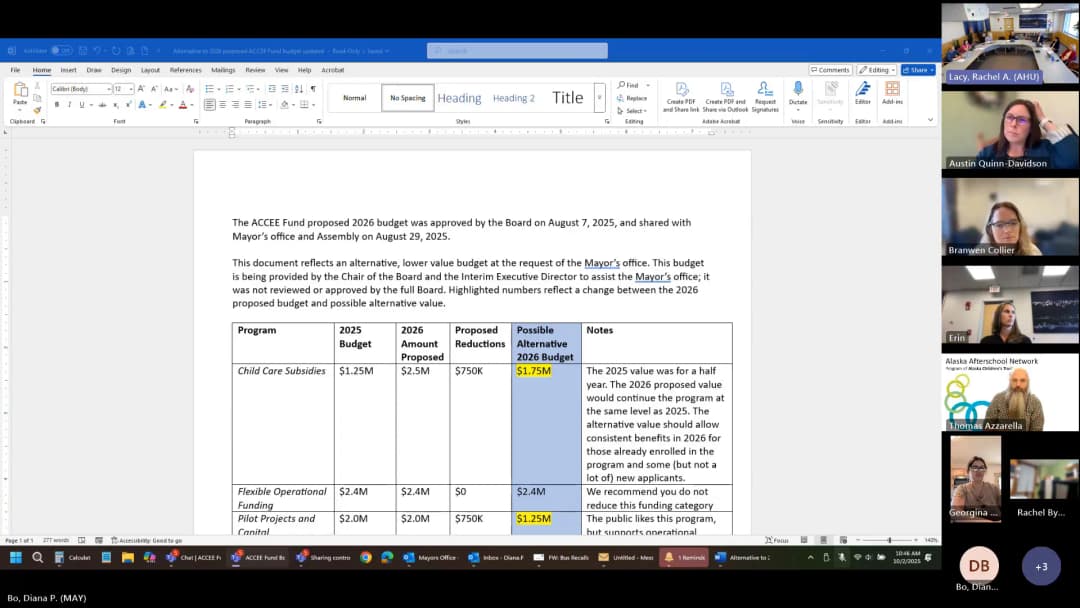
The Anchorage Child Care Board convened to review operational updates, discuss the 2026 budget proposal involving the Mayor's Office, and present a draft strategic plan for public and board feedback. The meeting focused on the Executive Director search status, the reallocation of $2 million in Alcohol Tax funds to the Anchorage School District (ASD) due to municipal budget constraints, and the development of a three-year strategic plan. Consent Calendar - Unanimously approved the minutes from the September 4th and 5th strategic planning session and the August 7th board meeting. - Added approval of the August 7th minutes to the agenda mid-meeting following a Board Member request. Public Comments & Testimony - No members of the public provided testimony during the open comment period. Discussion Items - Executive Director Search: - Staff reported 30 applicants met minimum requirements as of the October 30th closing. An interview committee (Chair, Jesse, Khalil, and administration members) is reviewing applications using a weighted matrix. The timeline targets top 10 candidates by end of October, top 2-3 for second interviews, and a final hire by mid-December. - Board members confirmed compliance with open meeting laws, limiting the committee to three board members to avoid constituting a quorum during preliminary reviews. Suggestions were made to consult the Municipality attorney regarding executive session protocols. - 2026 Budget and Mayor's Office Collaboration: - Staff discussed a meeting with the Mayor's Office, where a request to return $2 million from the Alcohol Tax to the ASD (originally intended for the ACE fund) was denied. The Mayor's Office indicated the funds were needed for homeless services and year-round shelter, limiting flexibility to move funds. - Positions: Board members Chuck and Kevin expressed concern and opposition regarding the outcome, stating it conflicts with voter intent for "additional resources" and that shifting funds undermines future trust when asking for new taxes. Staff (Trevor and Austin) expressed understanding of the mayor's position and concern about the municipality's long-term underfunding and structural financial issues, noting the $2 million shift is not new money but a reallocation to meet existing homeless shelter priorities. - Staff detailed budget adjustments: reduction of childcare stipend funding by $750,000 (to $1.75M), reduction of pilot/capital funding to $1.25M, and the Mayor's proposal to move $100,000 from retention bonuses to a startup fund. Community safety funding was discussed, with roughly $15 million in the Alcohol Tax bucket, including $7 million for shelter. - Communication Support: - Admin proposed utilizing the Municipality's existing contract with Thompson & Co. (approx. $96,000 remaining) for graphic design and communication strategy services. Board members expressed support for this cost-effective approach to improve public engagement and reporting. - Operational Funding Update: - Linda and Jen from Thread reported $2,305,448 paid to 198 programs. They explained the flat-rate formula for non-relative providers versus licensed centers. - Positions: Board member Jesse expressed concern that the current bonus structure (paying a flat amount for any one of five bonus categories) does not sufficiently incentivize specific priorities like infant care or special needs care, advocating for per-category bonuses in future contracts. - Pilot Projects and Capital: - 17 of 20 approved projects are under contract. Three projects totaling roughly $300,000 remain undue to insurance and response delays. Staff indicated it is unlikely these will be completed by year-end without flexible payment terms or waivers. - Strategic Plan Review: - A draft strategic plan was presented featuring a Purpose Statement, Core Values (child and family centered, strategic, collaborative, fair, transparent), and a Vision Statement. Five strategic initiatives were outlined. - Positions: Board members Trevor, Chuck, and Jessica raised concerns that the Vision Statement lacks quantifiable metrics and measurable outcomes. They argued that the definition of "stabilized" and "positive impact" must be clearly defined with baseline data to satisfy the Assembly and public. Jesse suggested integrating broader workforce and policy themes into the initiatives. - Staff agreed that the plan is a living document and committed to adding specific data collection and measurement steps to the implementation phase. Key Outcomes - Minutes approved unanimously. - Board acknowledged the budget adjustments and the $2 million reallocation to ASD, though expressed disagreement with the outcome relative to voter intent while acknowledging the municipal fiscal reality. - Board approved in principle the use of the existing Thompson & Co. contract for communication support, pending final confirmation of capacity. - Board agreed to review the draft Strategic Plan via email by October 22nd and expects to approve a final version at the next meeting on November 6th. - Staff committed to presenting a more detailed implementation plan with specific milestones and metrics following the board review. - Meeting adjourned early, approximately 30 minutes ahead of the scheduled noon end time.
The Planning and Zoning Commission convened on December 8, 2025, to approve meeting minutes, the consent agenda, and two major public hearing cases regarding parkland rezoning and comprehensive plan amendments. The commission also discussed recent assembly actions and welcomed new member Alma Abaza. Consent Calendar - The minutes from the prior meeting were approved by Commissioner Pullis (moved) and Commissioner Krishna (seconded). Commissioner Abaza deferred approval due to non-attendance at the previous meeting. - The consent agenda was unanimously approved following a motion by Commissioner Pullis and a second by Commissioner Ron. Public Comments & Testimony - Stephen Callahan testified as an individual, expressing concerns regarding potential conflicts between rezoning to Parks and Recreation (PR) District rules and existing structures like churches (e.g., near William B. Lyons Park). He questioned if PR zoning would mandate landscaping standards (L2) that conflict with existing religious assemblies and noted that smaller parks with amenities might be better served by PLI zoning. He suggested that changing current zoning could unnecessarily complicate approval processes for future improvements like picnic shelters. - Commissioner Ron offered a public comment remarking on the quote "Without open space, kids will play in the street," expressing that their perspective is that the community should strive to be safe for children to play in streets, noting this would be addressed further at an AMATS meeting. Discussion Items - Case 2025-0131 (Zoning Map Amendment): Staff presented a proposal to rezone over 9,000 acres and 749 parcels within the Anchorage Bowl from various residential zones (R1, R2M) to the Parks and Recreation (PR) district. The proposal aims to implement Action 84 of the 2040 Land Use Plan by aligning zoning with dedicated and designated park lands. Commissioners questioned the distinction between PLI and PR districts and the inclusion of privately owned parcels. - Parks & Recreation Department: Taylor Keegan, Superintendent, testified in support of the proposal but formally requested the reinstatement of 19 parcels in the Chester Creek Greenbelt (misidentified as Campbell Creek in documents) that were removed due to planned master planning. These parcels are dedicated parkland protected by the Land, Water and Conservation Fund (LWCF). Commissioner Pullis corroborated the presence of utilities (water/sewer) in the area, validating the staff's decision to defer the rezone until the master plan is complete. - Commissioner Position: Commissioner Krishna expressed support for the motion but stated she would not support amending the motion tonight to reinstate the Chester Creek parcels, suggesting they be handled in a separate action following the master plan. - Case 2025-0146 (Comprehensive Plan Amendment): Staff presented a land use map amendment to correct designation errors for four residential properties and change the classification of 74 existing park parcels (282 acres) from residential/zoning categories to "park or natural area" or "compact mixed residential low/urban residential high" to align with the 2040 plan. - Title 21 Updates: The Director noted that temporary use ordinances (AO 2025-128) regarding shelter units (recovery residences) were recently adopted by the Assembly without P&Z review. The Director committed to providing brief monthly updates on Assembly actions. Commissioner Ron accepted an invitation to represent the commission on the AMATS advisory council. - New Member Introduction: Alma Abaza was welcomed to the commission. She identified her background as a civil engineer and expressed her goal to improve her planning knowledge. Key Outcomes - Case 2025-0131 Approval: The motion to recommend approval of the zoning map amendment passed unanimously (Motion by Commissioner Pullis, Seconded by Commissioner Krishna, Vote: All Yes). The commission noted the request to review the Chester Creek parcels separately pending the master plan. - Case 2025-0146 Approval: The motion to recommend approval of the comprehensive plan amendment passed unanimously (Motion by Commissioner Pullis, Seconded by Commissioner Eber, Vote: All Yes). - Meeting Adjournment: The meeting was adjourned after a motion by Commissioner Abaza and a second by Commissioner Ron.
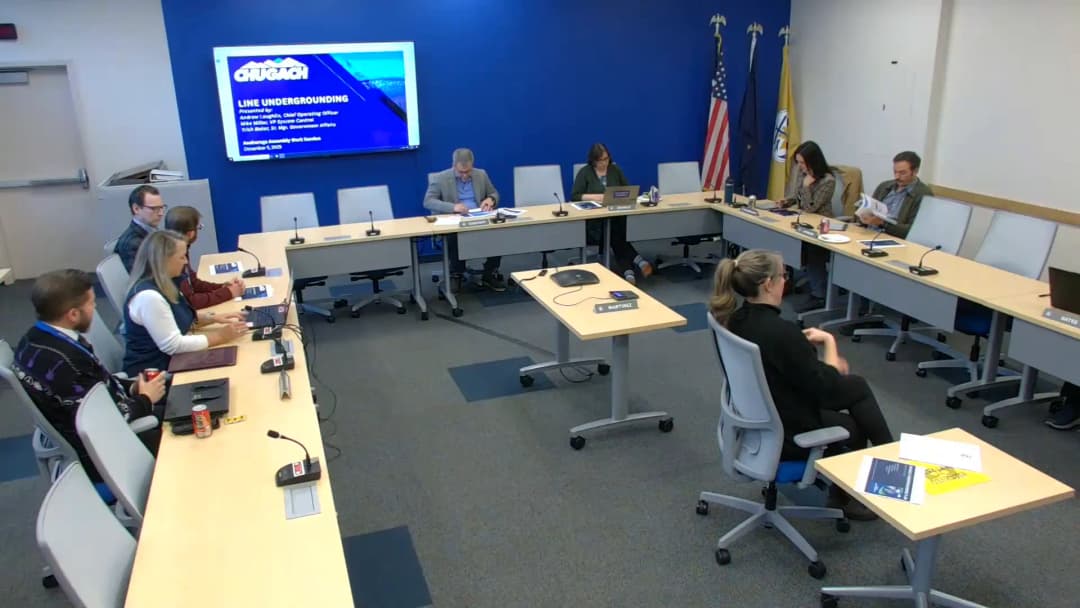
This work session focused on reviewing the five-year undergrounding plan for the Municipality of Anchorage, presented by Chugach Electric, and discussed the ongoing challenges regarding unremoved utility poles left behind after power line undergrounding. Council members expressed significant concern that legacy telecommunications and other utility poles remain in public rights-of-way, creating safety hazards for pedestrians, with one Member noting that people are forced to walk in the street due to these obstacles. Representatives from Chugach Electric, GCI, and Alaska Communications discussed the prioritization criteria, funding mechanisms, and the lack of legal requirements for non-power utilities to participate in undergrounding. The session concluded with a directive to form a collaborative working group to address safety-specific prioritization and potential code changes. Consent Calendar - No routine approvals or unanimous actions were taken during this work session. Public Comments & Testimony - Council Member Anna (Position: Critical/Safety Concern): Expressed that the current condition of utility poles in sidewalks poses a fundamental safety threat, stating people are "dying on our streets" because they must walk in the roadway to avoid poles. Highlighted a specific 12-year-old incident on Gamble Street where wheelchair users cannot navigate a six-foot sidewalk due to pole remnants. - Council Member Aaron (Position: Collaborative/Pro-Efficiency): Stressed the need for better coordination between municipalities and utilities to avoid "tragedy of the commons" scenarios where no single entity owns the problem. Expressed willingness to explore alternative mechanisms to relocate poles where full undergrounding is not immediately feasible. - Council Member Chris Constantine (Position: Critical/Pro-Transparency): Noted that the current process lacks a prioritization mechanism for critical safety issues that fall outside the standard five-year plan timeline. Expressed frustration that safety hazards remain unresolved for decades simply because the utility poles remain after power lines are buried. - Trish Baker (Chugach Electric, Position: Informative): Explained that safety is the number one criterion for Chugach's undergrounding selection, but noted that other utilities (telecom) are not legally required to remove their infrastructure after Chugach removes power lines. - Heather Kavanaugh (Alaska Communications, Position: Supportive): Stated that ACS supports the undergrounding program and has historically exceeded regulatory requirements. Expressed a willingness to collaborate and remove poles if informed of public safety issues, though noted economic constraints compared to undergrounding. - Todd Schmolly and Lewis Manga (GCI, Position: Supportive/Economic Reality): Acknowledged the desire to participate but highlighted the significant cost difference between overhead construction ($40/foot) and undergrounding ($100/foot). Expressed a need for collaboration to identify cost-effective solutions. Discussion Items - Selection Criteria and Prioritization: Chugach Electric outlined their prioritization framework: 1. Safety (code compliance), 2. Relocation dependencies (DOT projects), 3. Load growth, 4. Reliability (tree outages), and 5. Target areas. Council members questioned why specific high-traffic or pedestrian-heavy areas (e.g., Fireweed Drive) were not prioritized over lower-traffic residential subdivisions (e.g., Tinigan Park). - Coordination with Road Projects: Members expressed frustration over "missed opportunities" where road repaving (e.g., Forest Park Drive) occurred without coordination to underground utilities, resulting in double excavation and road deterioration. Chugach representatives explained that coordination typically happens at the 35-65% design phase of road projects, but gaps in communication or lack of conflicts identified at that stage lead to missed timing. - The "Stub Pole" Problem: Council members emphasized that while Chugach undergrades power lines, telecom poles often remain. Chugach explained that joint use agreements give telecom providers a window to remove their equipment after Chugach acts, but if they do not, the poles (often deemed "ownerless" by Chugach) remain. No mechanism currently exists for the municipality to force removal of non-power utility poles without a full corridor undergrounding. - Land Rights and Project Delays: Discussion revealed that the Gamble Street project (listed for 2026) has been in planning since 2010/2019 due to land rights negotiations for pad-mounted equipment in commercial zones. Similarly, the Carlock Street project remains incomplete due to inability to secure easements from private commercial property owners. - Cost and Feasibility of Relocation: Telecom representatives noted that simply relocating existing overhead poles is cheaper ($40/ft) than undergrounding ($100/ft), suggesting it as an alternative for critical safety locations where full undergrounding is unaffordable or logistically impossible. - Code and Legislative Solutions: Council Members discussed the need to update municipal code (Title 21) to mandate telecom participation in undergrounding. Legal staff indicated that while they have explored this previously (citing a 2017/2018 RCA complaint resolution), the issue now requires a new economic analysis to determine the cost of a "100-year plan" that includes mandatory telecom undergrounding. Key Outcomes - Action Item 1: Deputy Municipal Manager Mark Spafford volunteered to convene a working group including Chugach Electric, GCI, ACS, the Municipality of Anchorage, and DOT to address utility pole safety and coordination. - Action Item 2: Council members to provide a list of specific high-priority safety locations (e.g., Gamble Street) to staff for tracking and prioritization. - Action Item 3: Staff to prepare a briefing for the Infrastructure Enterprise Utility Oversight Committee regarding strategies to update municipal code and funding models to require telecom undergrounding. - Action Item 4: Staff to commission an economic analysis comparing the long-term costs of maintaining the current "stub pole" system versus the cost of requiring telecom undergrounding under a revised 100-year plan. - Referral: The issue of pedestrian safety due to utility poles was referred to the Transportation Committee and Infrastructure Enterprise Committee for further deliberation on prioritization mechanisms.
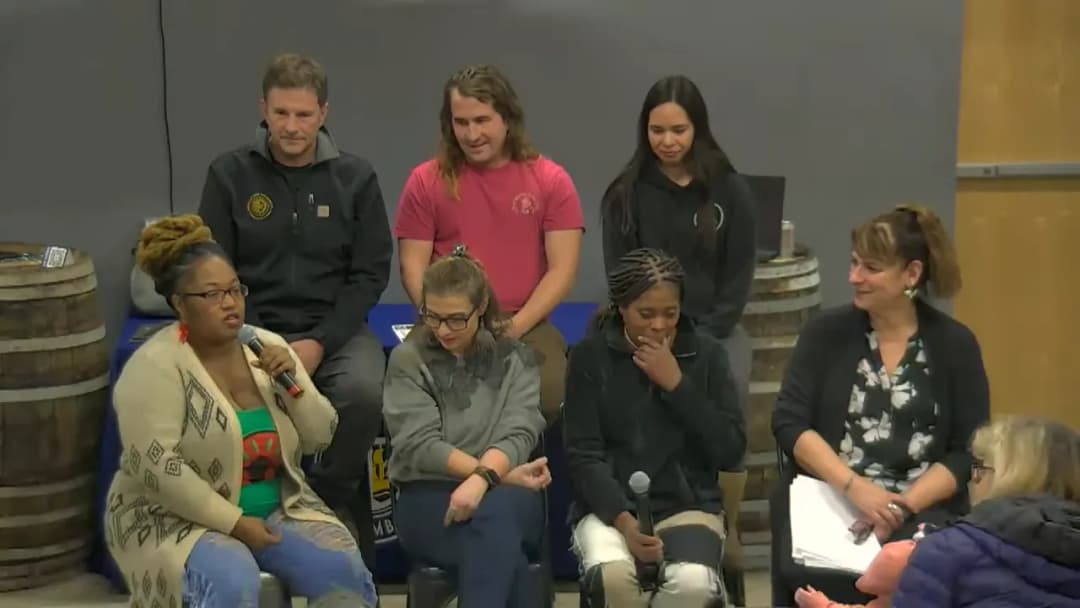
The Anchorage Assembly's "City Nerd Night" event brought together seven local business owners and community leaders to share their experiences on the theme of "doing business" in Alaska. The evening highlighted the unique challenges of operating in Anchorage, including seasonality, high freight costs, and labor shortages, while celebrating the resilience, community collaboration, and family-centric values that drive local entrepreneurship. Presenters ranged from a window screen manufacturer to a university professor turned restaurant owner, a craft brewery president, and a small business development advisor, all emphasizing the importance of supporting one another to navigate the state's economic landscape. Consent Calendar - No formal consent items were voted on during this community presentation event; the session focused on open dialogue and shared storytelling rather than legislative approvals. Public Comments & Testimony - Audience Engagement: Attendees participated actively by submitting questions on note cards during a designated break, which were collected by hosts Jennifer and Claire and addressed in the final Q&A session. - Speaker Positions: While not public commenters in the legislative sense, the seven presenters collectively expressed positions of strong advocacy for community collaboration, the necessity of inclusive workplaces for families and children, and the critical need for stable government support regarding healthcare, housing, and immigrant worker treatment. Discussion Items - Challenges of Seasonality and Logistics: Multiple speakers discussed the extreme impact of Alaska's seasons on revenue. Melissa (Quality Screens) noted that 80% of her business revenue occurs between April and September, while Lee (Midnight Sun Brewing) reported a 70% decline in sales between January and June. Evan (Turnigan Ceramics) highlighted that winter is their peak season, whereas summer is their most challenging period, forcing them to innovate with summer camps and tourist offerings. - Labor and Workforce: Zainab (Turkish Delight) argued that ethnic restaurants face a shortage of native-born American workers, forcing them to hire immigrants and refugees who often require significant assistance with logistics, language, and licensing. Jasmine (Moja Coworking) emphasized the generational disconnect where families do not understand Western business definitions, creating a barrier to entry for diverse entrepreneurs. - Permitting and Regulation: Zainab described the permitting process as the "ninth circle of hell," citing excessive redundancy and certification requirements. Conversely, Lee offered a contrasting position, stating that Anchorage's permitting office is significantly faster and more accessible than those in major cities like Los Angeles or Seattle, though he acknowledged challenges remain. - Community and Collaboration: Jasmine and Lee both expressed full support for the "rising tide lifts all boats" philosophy. Lee detailed how local brewers borrow equipment and ingredients to survive supply chain issues. Jasmine advocated for a return to a "village mentality" in business to support underrepresented communities. - Economic Data and Outlook: Angie (Small Business Development Center) presented data indicating a shift in small business challenges from "finding customers" in 2024 to "cost of goods, inflation, and political uncertainty" in early 2025. She noted that 36% of businesses are now seeking capital, primarily to navigate overhead and supply chains rather than for expansion. Key Outcomes - Consensus on Values: The presenters collectively reinforced that successful local businesses rely on family involvement, community connection, and the ability to adapt to the unique Alaskan environment (seasonality, geography). - Call for Government Action: During the Q&A, presenters identified specific areas where government intervention is needed: - Paid Maternity Leave: Lee expressed strong support for a state-wide paid maternity leave policy to improve retention and family stability. - Immigrant Worker Protections: Zainab and others voiced opposition to the intimidation of immigrant workers, calling for a more welcoming environment for student workers and refugees. - Healthcare and Housing: Angie and audience members highlighted that access to affordable health insurance and stable housing are pivotal to retaining employees and keeping businesses operational. - Next Steps: The Anchorage Assembly announced a future City Nerd Night event in February in partnership with the Anchorage Museum for Design Week, encouraging community members to submit pitches for future presentations via an open call through the new year.
The Anchorage Planning Board convened on December 3, 2025, to consider Case S12864, a request by property owner David Hudson to remove Plat Note Number 2 from Plat 96-101 (Glenview Estates). The note currently prohibits direct vehicular access from subdivision lots to frontage roads, specifically Hilltop Drive, Wooded Hollow Circle, and Leprechaun Drive. Staff recommended approval, citing traffic and right-of-way agency acceptance, while public testimony presented significant concerns regarding safety, traffic volume, and precedent. The board deliberated on whether substantive changes to the subdivision justified meeting the criteria for removal versus maintaining the original restriction. Consent Calendar - Minutes from the previous meeting were approved by a motion from Mr. Merka, seconded by Mr. Cross, with no corrections offered. - The consent calendar was approved unanimously without any items pulled for discussion. - Informational items regarding abbreviated plan action summaries (10/14/25 and 11/3/25) were noted. Public Comments & Testimony - David Hudson (Petitioner): Expressed that the request is for a secondary use to park a 40-foot motorhome and a 20-foot trailer, avoiding a driveway over his septic field. He stated he has obtained permits and that the road is maintained by Eagle River Road Board. He noted concerns about neighbor conduct but emphasized safety and compliance. - Ryan Johnson (Surveyor, petitioner's representative): Stated that topography and original platting (a proposed road loop that was never built) result in significantly less traffic on Hilltop Drive than originally envisioned. He argued only three lots would realistically qualify for similar access due to topography and street layout. - Timothy Jones: Opposed the removal. He stated that the original plat note was established because residents were promised no access to back roads. He recalled a previous denial in 2001 for Lot 7 and highlighted safety concerns regarding a school bus stop and parked cars at the bottom of the hill. - Tony Jones: Opposed the removal. As a nurse and long-time resident, he emphasized the safety risk for children walking to a school bus stop and a park at the bottom of the hill. He noted personal experience with a vehicle flip on the steep road and expressed concern that traffic volume would increase if one lot is granted access. - Lori Newswander: Opposed the removal. She argued it would set a precedent for up to six or seven additional driveways, creating potential safety issues. She noted that Lot 4 already has a horseshoe driveway and ample parking, suggesting the access is unnecessary. - Rebecca Kitchen: Expressed general support for the petitioner, noting her own location at the top of the hill and lack of access to the road in question. She countered safety concerns by stating that a construction company already brings large equipment down the road near the park. Discussion Items - Staff Analysis & Conditions: Staff confirmed that Conditions A, B, and C for removal were met, relying on agency feedback from Traffic and Right-of-Way. They noted the road is 60 feet wide, paved, and has capacity not yet maxed out. - Mr. Jones (Board Member): Expressed concern that Condition A (substantive change) was not met, arguing that paving the road was not the sole reason for the original plat note and that the road conditions were similar in 1996. He questioned whether the change in traffic load justifies removal. - Ms. Mills (Board Member): Initially raised the issue of community engagement (which was not required for plat removal) and suggested a modification to the note rather than full removal to address seasonal use concerns. She later shifted her position after reviewing agency assurances and the specific topography. - Mr. Merka (Board Member): Expressed empathy for the petitioner regarding the motorhome but stated he could not vote for removal because he felt the criteria were not met. He noted the board cannot predict future owners' intentions. - Mr. Cross (Board Member): Argued that the road was originally designed to connect into a larger loop that was never built, reducing traffic significantly. He viewed the request as reasonable secondary use and countered that the road capacity supports the minor traffic increase. - Ms. Bryan (Board Member): Supported the motion to remove, emphasizing reliance on municipal traffic experts. She argued that if future traffic increases, future petitions can be denied, but current evidence supports approval. - Discrepancy in Dates: The transcript opening states the date as "December 3rd, 2025," while the system prompt instruction mentions "2025-12-04." The board minutes within the transcript explicitly reference December 3rd. Key Outcomes - Motion: Mr. Cross moved to approve the removal of Plat Note Number 2 from Plat 96-101 for Case S12864, subject to recording a resolution with the State of Alaska Recorders Office. - Vote: The motion was seconded by Ms. Bryan. - Tally: - In Favor: Ms. Bryan, Mr. Cross, Mr. Merka (who initially voiced doubts but voted yes due to being "relieved" to let the petitioner go), Ms. Mills (who changed her mind to support), and Ms. Ploy (seconded the motion). - Against: Mr. Jones (voted against, stating he does not believe the criteria were met). - Result: The motion passed. The board approved the removal of the plat note. - Next Steps: A resolution recording the removal of the plat note must be filed with the State of Alaska Recorders Office against the property. - Adjournment: The meeting was adjourned following the vote.