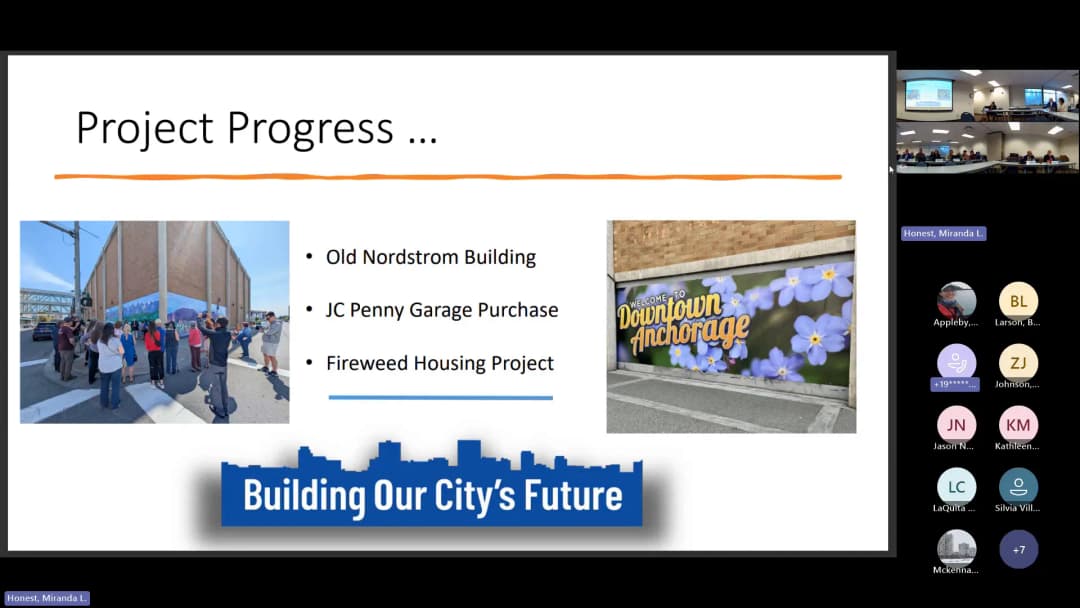
Note: The transcript opens with "October 6th meeting," but the provided metadata indicates the meeting occurred on 2025-10-08. This summary uses the supplied date. The Planning and Zoning Commission held a public hearing and deliberated on two related cases: a Transit Supportive Development Overlay (TISDO) ordinance (Case 2025-0030) and an amendment to the 2020 Comprehensive Plan and 2040 Land Use Plan (Case 2025-0034). After extensive public testimony and commission discussion, the commission voted to recommend approval of both items. However, the mayor's office subsequently announced a pause on the ordinance to convene further collaborative community conversations. Consent Calendar - Minutes for the September 8th and September 15th meetings were approved unanimously. - Commissioner Eber disclosed she was absent from those meetings and would abstain from voting on the consent agenda. - Commissioner Ron disclosed that his spouse authored a letter to the editor referenced in a staff memo, but stated he did not believe it constituted a conflict. Public Comments & Testimony Approximately 30 speakers testified, both in person and by phone. Key points included: - Lizzy Newell (Abbott Loop Community Council President, testifying as an individual): Expressed support for TISDO, noting concerns about vacant industrial-zoned land on bus routes and the need for pedestrian access improvements. - Jason Norris (individual, economist): Strongly supported TISDO, arguing opponents lack good-faith counter-proposals. He stated that the market has shown demand with over 100 units in planned projects, and that the step-down height concept could address height transition concerns. - Crystal Biter (individual, small business owner): Supported TISDO, noting that version six includes her lot on Lakeshore Drive. She stated that 80% lot coverage is important for efficiency and that she and her partner represent 24 units ready to build. - Polly Sliz (Rogers Park resident): Opposed the process, citing lack of awareness among neighbors (96 of 104 at a community meeting voted to slow down). She requested a legitimate pause and more community engagement. - John Isaac (Turnagain Community Council board): Supported TISDO in concept but raised concerns about on-site parking impacts, based on experiences with Fire Island Bakery and Rusty Goat. He advocated for phased, targeted development and collaborative workshops. - Jacob Powell (North Star resident, community council president): Strongly supported TISDO, calling it a long-planned policy. He stated Anchorage faces a fiscal cliff and needs housing infill to maintain infrastructure, and criticized opponents for offering no alternatives. - Jody Olson (Rogers Park): Opposed TISDO, citing real parking issues from her experience in Santa Barbara. She suggested focusing density on large vacant lots like the former tire shop near City Market. - Anna Bosan (South Addition resident): Supported TISDO, noting 30% of the population does not drive, and that parking is a separate right-of-way management issue. She expressed disappointment in the pause. - Martin Bethki (Rogers Park, long-time resident): Opposed TISDO, arguing it would create slum lords and destroy neighborhood character. He said R1 neighborhoods are for single-family homes. - Alexa Dobson (Fairview homeowner): Expressed disappointment with the scaled-back version, calling it "diet TISDO." She urged commissioners to consider long-term investment over fear. - Ramsey Nassar (College Village homeowner): Opposed TISDO, citing concerns about building heights, setbacks, parking, and property values. He stated snow clearance is already hazardous. - Nancy Tees (South Anchorage): Stated she supports TISDO in principle but criticized the process and lack of data on density targets and transit funding. She urged deferral until more analysis is done. - Tim Alderson (Rabbit Creek Community Council chair): Opposed the current version, calling it "half-baked" and driven by developer timelines. He requested a data-informed, phased approach with direct notification of affected property owners. - Kevin Frank (University Park): Supported the pause, saying the process felt rushed and many property owners remain unaware. - Esther Furman (North Star): Supported focusing density on arterials like Fireweed with step-down heights, but opposed applying the same standards to residential streets. Discussion Items Staff Presentation: Daniel McKenna Foster (Long Range Planning) presented the history of the TISDO concept since the 2001 and 2017 comprehensive plans. He detailed the evolution from version one (initially 75-foot heights, mixed use) to version six (40-foot heights, residential only, 70% lot coverage, expanded map). He noted that the overlay now covers about 20% of the Anchorage bowl. Foster emphasized that TISDO does not change fire, building, or safety codes, and that concurrent municipal efforts (right-of-way management, design standards update, Vision Zero) would complement the overlay. Mayor's Office Statement: Graham Downey, Deputy Chief of Staff, stated that the administration would put the TISDO ordinance on pause after tonight's meeting to convene collaborative community conversations on how to achieve 10,000 homes in 10 years. He asked the commission for a recommendation and specific guidance to inform that process. Commission Discussion: - Commissioner Gardner asked about the role of the PZC in the pause process; Downey clarified that the commission's recommendation would help shape the public process. - Commissioner Winchester moved to approve Case 2025-0030 with the original map boundaries (as in AO 2025-35 S1) minus downtown. The motion was seconded by Commissioner Gardner. - Commissioner Winchester stated he could not support the current version (version six) as it seemed rushed. - Commissioner Ron supported the concept but not version six; he advocated for including elements from earlier versions (step-down heights, mixed use) and recommended a more inclusive map. - Commissioner Krishna expressed uncertainty about transit data and the impact on neighborhoods like Mountain View. She requested more analysis on density thresholds and transit viability. - Commissioner Gardner supported moving forward with version six, acknowledging imperfections but preferring progress over delay. - Commissioner Eber did not support version six as written but appreciated the pause. - Commissioner Pullis supported the motion with the understanding that further work would be done by the administration. - Commissioner Ron revised his position, stating he would vote yes for the motion but wanted specific recommendations recorded: support for version six boundaries, re-inclusion of non-residential uses, step-down height transitions, and data-driven lot coverage standards. - The commission discussed the need for guiding principles for the map and design standards. Key Outcomes - Case 2025-0030 (TISDO Overlay): Motion passed with Commissioner Strike voting no and others voting yes. The commission recommended approval of the overlay as presented in version six, with commissioner comments to be incorporated into further public process. - Case 2025-0034 (Comprehensive Plan Amendment): Motion passed unanimously, recommending approval of the updates to the 2020 and 2040 plans to align with the TISDO overlay. - Pause Announced: The mayor's office will hold the ordinance for additional collaborative community engagement before sending it to the Assembly. - Commissioner Recognition: Commissioners Winchester and Strike were thanked for their service as they concluded their terms. - No Further Actions on Title 21 or other items were taken.
Public Meetings - Anchorage, Alaska
Public Meetings - Anchorage, AlaskaThe Anchorage Assembly held a regular business meeting on October 7, 2025 (local time) called to order at 5:01 PM AKDT. The meeting included the mayor's report, budget introduction, committee updates, public testimony, and action on multiple ordinances and resolutions. While the provided UTC timestamp indicates October 8, the transcript confirms the local meeting date as October 7. The meeting adjourned at approximately 7:15 PM. Consent Calendar - Filipino American History Month Resolution (AR 2025-303): Recognized October 2025 as Filipino American History Month. Approved unanimously via consent. - Other consent items (bids, reports, introductions) were approved without objection after polling of specific items. Public Comments & Testimony - First Speaker (Mr. Whitaker): Criticized the city for 49 homeless deaths last year, stating it is unacceptable given $60 billion in state funds. Accused the mayor of crisis management and enriching Mark Begich and business partner. Urged building shelters (estimating $7.5 million per facility) instead of paying those contractors. Time expired; speaker became disruptive. - Jeff Jesse (Lower Hillside): Apologized for unresolved performing arts center (PAC) alcohol issue. Stated ACPA proposed 97.8% of theaters be wet with only 43 dry seats. Requested a work session to set a maximum wet seat percentage similar to other public venues (Sullivan Arena, Alaska Airlines Center). - Will Walker Spinard (audience participation): Expressed disappointment at the indefinite postponement of the Democracy Innovations for Better Public Meetings project. Argued it would have helped engage underrepresented communities and fight cynicism toward government. - Lisa Bricker (District 1): Raised concerns about APD's new license plate recognition technology. Claimed Chief Case did not mention it at a September 3 community council meeting. Criticized lack of public input and oversight, and that the technology is already in use without finalized policies. - Jason Norris (South Anchorage): Spoke in support of the transit-supported development overlay (upcoming before assembly). Reported that Planning and Zoning Commission heard it for the third time the previous night and recommended passage, with roughly 50-50 public testimony split. Urged the assembly to consider it. - Jamie Lopez (East Anchorage): Addressed the Democracy Innovations project's work session, detailing a past incident at a Mountain View Community Council meeting where he was removed. Argued that three-minute public comment limits stifle real debate. - Kim Verrite (West Side, Huntigen Park): Asked the assembly to pause on the Tisto (presumably a development/housing issue), stating many residents are unaware of what is happening. Discussion Items - Democracy Innovations for Better Public Meetings Project (AR 2025-271): After debate, a motion to postpone indefinitely was made by Member Voland. Members expressed concerns that the project was predetermined, community-council-centric, and advanced an outside agenda. The motion carried 9-3, postponing the resolution indefinitely. - Room Tax Allocation Formula (AR 2025-270): An amendment by Chair Constant stripped specific allocation language and directed the administration to negotiate a fair deal with the tourism promotion nonprofit. The amendment was adopted; the amended resolution passed 12-0. - Comprehensive Plan Amendment Procedures (AO 2025-49): Postponed indefinitely by a 12-0 vote. - Public Records Request Procedures (AO 2025-59): Continued to November 18, 2025, by unanimous consent. - Credit/Debit Card Processing Fees (AO 2025-83): Postponed indefinitely after discussions with industry. - Boards and Commissions Reauthorization (AO 2025-77): Amended to reduce sunset audits by one (Rivera amendment) and to extend one commission for transition before repeal (Brawley amendment). Both amendments adopted; the ordinance passed 12-0. - Dangerous Building Code Abatement Liens (AO 2025-103): Approved 12-0, giving the municipality explicit authority to foreclose on liens for dangerous buildings. - Girdwood Commercial District Use Change (AO 2025-104): Allowed office and retail uses on three parcels in the GC10 district. Passed 12-0 after discussion about spot zoning. Key Outcomes - Filipino American History Month recognized via resolution (unanimous consent). - Democracy Innovations project postponed indefinitely (9-3). - Room tax formula resolution passed as amended (12-0). - Three ordinances postponed or continued: Comprehensive plan amendment (indefinite), public records (to Nov 18), credit card fees (indefinite). - Boards and commissions reauthorization passed with amendments (12-0). - Dangerous building liens and Girdwood use change both passed (12-0 each). - Public hearings on the 2026 budget were announced for October 21 and November 4, 2025. The proposed budget is largely flat with continued investments.
The Anchorage Assembly met on October 3, 2025, at an unspecified time to conduct a single agenda item: a legal briefing from the Municipality of Anchorage Department of Law. The meeting began with a brief apology from the presiding member for the inability to secure a quorum at a prior attempt. The assembly then received a foundation for entering executive session from the municipal attorney, citing AMC 2.30.036A1 and 5, which permit closed sessions for discussion of pending litigation and confidential legal advice protected by attorney-client privilege. A motion to enter executive session was made, seconded, and approved without objection. A roll call of assembly members and legal staff was taken before convening into the closed session. Discussion Items - Legal Briefing Foundation: The municipal attorney explained that the executive session was appropriate under municipal code to discuss specific pending legal matters and confidential legal advice. - Motion to Enter Executive Session: Assembly member Brawley moved to enter executive session, seconded by member Bond. No further discussion occurred before the motion was put to a vote. Key Outcomes - The assembly voted unanimously (no objections) to enter executive session, with the motion approved by voice vote. - After the motion passed, all non-essential personnel were asked to leave the room, and a roll call of attendees was conducted for the record prior to starting the executive session recording. The transcript ends before the substantive legal briefing begins.
On Friday, October 3, 2025, from 1:16 PM to approximately 2:15 PM, the Anchorage Municipal Assembly held a work session to discuss AO 2025-93 and its substitute version 93S. The proposed ordinance would amend municipal code to require residential rental property owners to provide financial relocation assistance to tenants following a notice to vacate and make failure to comply a misdemeanor offense. Assembly members George Martinez, Aaron Baldwin Day, Zach Johnson, Jared Gerker, Anna Brawley, Christopher Constant, Daniel Bulland, and Silvers were present, joined by code enforcement staff and municipal attorneys. Discussion Items - Current Enforcement Challenges: Scott Campbell, Chief of Inspections, explained that the municipality has limited tools to compel negligent landlords after years of code enforcement. Since 2022, only two notices to vacate were issued for legally occupied units due to life-safety hazards like lack of heat, standing water, and exposed electrical panels. Existing fines and liens are often ineffective because owners let penalties accrue without paying, and collection requires lengthy litigation. - Relocation Assistance Mechanism: The ordinance would allow the municipality to advance relocation costs to tenants if an owner fails to pay, then recoup those funds from the owner. Sponsors Zach Johnson and Aaron Baldwin Day argued this provides a meaningful consequence for bad actors and protects vulnerable tenants. Several members questioned whether the municipality could effectively collect from out-of-state LLCs, with attorney Quincy Arms noting that criminal prosecution would require the principal actor to be in Anchorage. - Amendment 1 (Unforeseen Circumstances): Sponsored by George Martinez, this amendment would expand the ordinance’s exception beyond natural disasters (earthquake, tsunami, windstorm, wildfire) to include any unforeseen, non-negligent circumstance affecting the owner’s ability to maintain the property. Some members expressed concern this could be too broad and allow bad actors to exploit loopholes. Martinez countered that the test of long-term negligence would still apply. - Amendment 6 (Removal of Illegal Activity Exception): Sponsored by Member Silvers, this amendment would remove the exception under which relocation assistance is not provided if a tenant’s illegal activity caused the violation. Silvers argued the policy is already broad and could unfairly penalize tenants not responsible for the damage. Code enforcement stated they have never issued a notice to vacate based on mold alone, and complaints are almost always from tenants, not landlords. - Proposal for Annual Reporting: Member Silvers suggested requiring a yearly report to the assembly detailing when the notice to vacate is used, relocation fees required, and steps taken before issuing the notice. Sponsors agreed to include this. - Housing Stock Context: Code enforcement warned that over 80% of Anchorage’s multifamily housing (five units or more) was built before 1984, often without inspections or qualified labor. Many buildings are nearing the end of their useful life, and without investment, hundreds could become uninhabitable within a decade. Key Outcomes - The work session concluded without a vote. The assembly will reconvene for a special meeting after a short break. - Sponsors agreed to incorporate a requirement for an annual report on the use of the notice to vacate and relocation assistance. - Further discussion on amendments, particularly Amendment 1, is expected at the next meeting.
The Anchorage Assembly held a work session on October 3, 2025, to discuss two ordinances aimed at increasing housing flexibility and addressing zoning code barriers. The ordinances are AO 2025-94, which amends non-conformity rules to allow easier reconstruction and rehabilitation of non-conforming structures, and AO 2025-112, which updates regulations for relocatable dwelling units (RDUs), mobile homes, and manufactured home parks. Planning staff presented details, and Assembly members raised questions about foundations, setbacks, and potential unintended consequences. No votes were taken; the session was informational with planned further work on amendments. Discussion Items AO 2025-112 – Relocatable Dwelling Units (RDUs) - Staff described the ordinance as addressing confusion over terms like mobile homes, tiny homes, and modular homes by introducing a new category: "relocatable dwelling unit" (RDU). The ordinance would allow older mobile homes to be repaired or replaced with other safe housing, permit RDUs on foundations in more zones, reduce minimum lot sizes in existing parks, and expand allowable uses in public lands (PLI) zones. A key change: originally, RDUs as accessory dwelling units (ADUs) could be without a foundation, but building code concerns led to a requirement for a foundation. Staff noted that if a primary structure burns down, an unfounded ADU could become the main unit without a foundation, creating safety issues. - Assembly Member Brawley connected this to the need for uniform terminology to track progress toward the city's goal of 10,000 new units. Assembly Member Martinez asked about why foundations are required, and staff clarified it relates to both building code and property assessment. Assembly Member Baldwin Day inquired about the potential for faith communities to use RDUs for transitional housing; staff acknowledged that the use table changes open that possibility but additional work is needed. - Staff noted that the ordinance originated from a 2023 feasibility report on new mobile home parks, which found new parks infeasible due to high infrastructure costs. Instead, the focus shifted to repairing existing units. The ordinance was recommended for approval by the Planning and Zoning Commission on June 9, 2025. AO 2025-94 – Non-Conforming Structures - Staff explained that the current non-conformities code requires properties to gradually come into conformity with current zoning. The ordinance raises the threshold for triggering full conformity from 10% of property value (or structure value) to 50%, making it easier to make small repairs without major upgrades. For example, a $100,000 house with $40,000 in repairs would not be required to fix other non-conformities. - Assembly Member Brawley provided background on her proposed amendments, noting that non-conformities, especially setback encroachments, are a major barrier to building ADUs. She reported that in 2020-2024, several dozen ADUs were not built due to failing to get non-conforming determinations in time. She explored historical codes, finding that 20-foot front setbacks date back to 1946. Her amendments aimed to: 1. Add a purpose statement balancing conformity with practical realities. 2. Allow foundations existing before 2014 (the date of the Title 21 rewrite) to be considered conforming. 3. Allow a waiver for as-built surveys for small setbacks if staff can verify using aerial imagery from before 1968. - Staff provided feedback: Amendment 1 might be redundant; Amendment 2 could legalize a wide range of pre-2014 non-conformities, including serious encroachments, and would allow rebuilding in the same location if a structure is destroyed; Amendment 3 is problematic because aerial imagery lacks precision and may not exist for some years (e.g., before 1990). Staff noted that the planning director plans to meet with Brawley to work through the amendments. - Assembly Members expressed concerns about unintended consequences. Assembly Member Constant asked about non-conformities on public rights-of-way, and staff confirmed that zoning cannot legalize encroachments onto public land. Assembly Member Johnson questioned the distinction between non-conformities that are life-safety issues vs. aesthetic preferences. Staff replied that it varies case-by-case. - Staff mentioned a new policy from the director that merely notes non-conformities during investigations without requiring immediate fixes, shifting away from enforcement unless triggered by property sale or major changes. Key Outcomes - No formal votes were taken. The work session was informational. - Assembly Member Brawley will continue working with the planning director to refine her amendments before the next meeting (scheduled for October 21, 2025). - Staff will circulate a memo from Building Services regarding the foundation requirement for RDUs. - Both ordinances are expected to move forward; the Assembly will receive updated language on the amendments at a future date.
Note: The transcript indicates the meeting was called to order on Thursday, October 2, 2025, at 9:01 a.m. However, the user-provided date for this summary is October 3, 2025. This discrepancy is noted. The committee received updates from municipal departments, discussed a proposed permanent 1% sales tax (Penny for Progress), reviewed the optional third-party building review program, considered an ordinance to allow foreclosure on dangerous building liens, and heard a presentation on zoning changes for relocatable dwelling units (formerly mobile homes). No votes were taken; public hearing on the sales tax is scheduled for October 21, 2025, and the third-party review issue will be revisited at the next meeting. Public Comments & Testimony - Mike Grant (member of the Ingarish Community Council) expressed support for a sales tax, saying he wants to “put skin in the game” and pay more in taxes as a community member. He suggested repurposing warehouse space (e.g., Northway Mall) and the previous administration’s tent to manufacture relocatable dwelling units locally. He also asked whether the proposed sales tax would exempt women’s hygiene products (a “pink tax” concern). - Heather Harris (interim CEO/president of AEDC) thanked the committee and noted alignment between the Penny for Progress proposal and AEDC’s perspective, stating she looks forward to the conversation. Discussion Items - Penny for Progress (AO 2025-96) – A proposed permanent 1% sales tax, structured as a charter amendment, would generate an estimated $60 million annually. Revenue would be split into three permanent buckets: infrastructure investment fund (roads, sidewalks, snow removal), workforce housing trust, and behavioral health stabilization. The tax would have no transaction cap, only state-mandated exemptions, and a citizen oversight committee. The ordinance requires a supermajority (8 votes) to place it on the ballot. Chair presented the proposal, emphasizing stackable ROI, preemptive resiliency, and shared equity. Member Brawley asked about economic effects, the committee’s role, and whether a coalition is forming. Chair confirmed meetings with stakeholders and that the proposal is not a sales pitch but a straightforward framework. - Third-Party Review System (AO 2023-136) – Member Brawley, the sponsor, noted that the option for commercial third-party review will sunset December 31, 2025, unless extended. Daniel King (Development Services) reported that from June 2024 to June 2025, only 8 of nearly 700 commercial permits used third-party review (all structural only). For residential, 62% of new buildings used third-party structural review. Three of the required 24 audits were completed due to staffing shortages; results showed 2 passes, 2 corrections, and 2 fails. King noted a conflict of interest when reviewers are hired by owners/contractors. Member Voland asked if the department supports the program; King said he supports a version that controls bad actors but noted audits have been delayed. The committee agreed to continue discussion at the next meeting. - Dangerous Property Foreclosure Fees – Quincy Arms (Legal) and Scott Campbell (Code Enforcement) presented an ordinance that would allow the municipality to foreclose on liens for dangerous building abatement costs (e.g., boarding up) using Alaska statutes. This tool already exists for vacant/abandoned properties. The ordinance is up for public hearing on Tuesday, October 7, 2025. - Relocatable Dwelling Units (AO 2025-12112) – Daniel Foster (Long-Range Planning) presented an ordinance to rename and update zoning for mobile/manufactured homes (now “relocatable dwelling units” or RDUs). Key changes: allow RDUs with foundations in all residential zones, replace old mobile homes with any safe housing in mobile home parks, reduce lot sizes in existing parks, and expand uses in PLI (public lands) zones. The ordinance stems from a 2023 feasibility study that found new mobile home parks are not financially viable. The planning and zoning commission recommended approval; the ordinance will be introduced next week with a work session. Key Outcomes - Penny for Progress will have a public hearing on October 21, 2025. - The third-party review discussion will be added to the next committee meeting agenda; staff will provide a memo on department recommendations. - The dangerous property foreclosure ordinance is scheduled for public hearing on October 7, 2025 (Tuesday). - The relocatable dwelling unit ordinance will be introduced on October 7, 2025, with a work session to follow. - No votes were taken on any items.
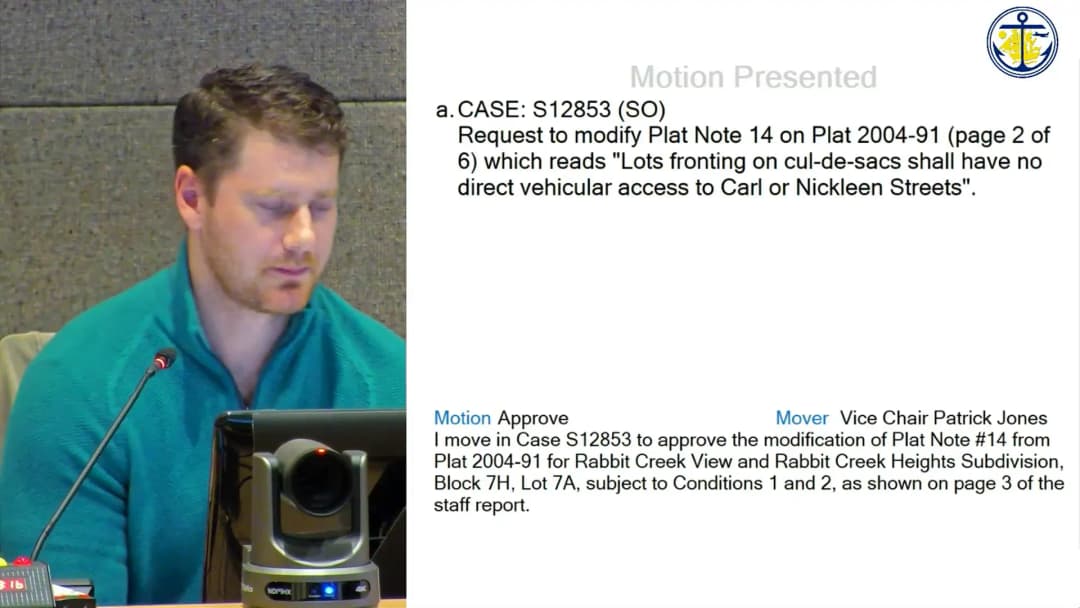
[Note: The transcript indicates the meeting was called to order on October 1, 2025, creating a date discrepancy with the provided date of October 2, 2025. This summary uses the provided date.] The Anchorage Planning Board met on October 2, 2025, to consider one public hearing case, S12853, regarding a plat note modification for a lot in the Rabbit Creek subdivision. The board unanimously approved the modification. The meeting also included routine consent calendar approvals and farewells to outgoing board members. Consent Calendar - Minutes of the previous meeting were approved. - The consent agenda was approved, including abbreviated plat action summaries dated 7/7/25, 7/14/25, 7/21/25, 8/2/25, 9/15/25, and 9/22/25. Public Comments & Testimony - No members of the public testified in person. Written public comments were included in the staff packet, but no opposition was voiced at the meeting. The board noted that a neighbor had expressed concerns about parking on Suzanne Circle, but the petitioner addressed these by stating visitors would park on-site. Discussion Items - Case S12853 – Modification of Plat Note 14 (Rabbit Creek View and Rabbit Creek Heights Subdivision, Block 7H, Lot 7A): - The petitioner, Rusty Allen, requested modification of a plat note that prohibited direct vehicle access to Carl Street from lots fronting on the cul-de-sac (Cold de Sachs). The modification would allow access to Carl Street from the corner lot at Suzanne Circle and Carl Street. - Staff reported that the original 1970 plat envisioned Carl Street as a collector, but traffic volumes are lower than anticipated, and the street remains a 24-foot gravel road. Access from Suzanne Circle would require a driveway with slopes exceeding 20%, while the proposed access from Carl Street is at a shallower grade. An existing culvert and partial driveway are already in place. - The petitioner stated he purchased the lot assuming the existing driveway was permitted, but discovered the plat note restriction. He plans to build a house with on-site parking and a turnaround to avoid backing onto Carl Street. - Board members questioned the slope difference and referenced a similar driveway across the street. Staff confirmed that the cross-street driveway likely predates the plat note. - Board members expressed support, noting that the modification would allow safer access and that the board has set a precedent for similar cases. They also noted that the modification would not negatively impact traffic or safety. Key Outcomes - Motion: Mr. Jones moved to approve the modification of plat note 14 subject to conditions 1 and 2 as listed on page 3 of the staff report. Mr. Cross seconded. - Vote: The motion passed unanimously. (The chair noted all members present voted in favor.) - Next Steps: The petitioner can proceed with permitting. The board will need to adopt a resolution at a special meeting on October 14, 2025, to formalize the decision. - Board Member Departures: The chair noted that Kyle Merka, Brenda Butler, and Brandi Pennington were leaving the board. The board thanked them for their service.
The Assembly Public Health and Safety Committee met on Wednesday, October 1, 2025, from 11:00 a.m. to 12:30 p.m. The meeting included presentations on the municipal crisis response dashboard, tsunami warning system improvements, Red Cross services, a real-time crime center policy, and an update on microunits for recovery residents. Public comment was heard on homelessness and crisis response. Public Comments & Testimony - Jamie Lopez, an Anchorage resident, expressed concern about the data quality for crisis response, noting that police data may be skewed because people in crisis may not identify with police. He criticized the lack of housing as winter approaches and warned of predictable negative outcomes, including outdoor deaths. He urged the committee to reevaluate the approach and provide more support outside of reactive crisis calls. Discussion Items - Crisis Response Dashboard Presentation: Thea Agnew Ben, Special Assistant to the Mayor, along with Ben Matheson (data analyst) and Brendan Bapp (Chief Innovation Officer), presented a first draft of a crisis metrics dashboard. They outlined the "Crisis Now" framework (someone to call, someone to respond, a place to go) and the work of the Crisis Response Work Group. Key statistics: Approximately 20,000 calls per month to APD, with about 2,000 coded as mental health responses. The mobile crisis team (MCT) and mobile intervention team (MIT) have increased encounters. In August 2025, MCT encountered 412 unique individuals and MIT 156. The Safety Center had 579 admissions in January and 553 in June, with a high proportion of one-time users (60% over five years). The dashboard aims to provide regular updates on outputs (calls, encounters, transports) and eventually outcomes. Committee members asked about the classification of calls, the increase in mental health calls, and the distinction between crime and crisis. The speaker noted that the dashboard is still in development and relies on improving data definitions. - Emergency Management and Red Cross Presentation: Amanda Looch (Emergency Management Director) introduced Bridget Baibota (Red Cross Community Disaster Program Manager) and Dave Snyder (National Tsunami Warning Center). Bridget Baibota reported that the Red Cross assists about two calls per day in Alaska, assisting 289 homes (778 clients) statewide in FY25, with 94 households (220 clients) in Anchorage. The Home Fire Campaign has installed 3 million smoke alarms nationwide, saving 2,046 lives (31% children). Red Cross is 90% volunteers and 90 cents of every dollar goes to operations. Dave Snyder explained changes to tsunami alerting zones to reduce over-alerting for Anchorage. He noted that the system is not designed for inside waters like Cook Inlet, and that they have shifted breakpoints to avoid unnecessary alerts for lower-magnitude earthquakes in the Sand Point area. This reduces over-alerting but does not fix the underlying technology limitations. He acknowledged that over-alerting can lead to desensitization. - Real-Time Crime Center (RTCC) Policy Presentation: The Police Chief presented the RTCC policy, which is one of three new policies following Assembly approval. The policy is described as very restrictive, with a 14-day retention for city-owned camera footage not related to crime. Private cameras are accessed only with owner permission, and the city does not retain the feed unless evidence is extracted. The RTCC will provide real-time information to active incidents, coordinate large-scale events, and use existing technology (body cameras, traffic cameras, ALPRs, drones). Prohibited uses include predictive analytics and monitoring based on individual characteristics. Access to the RTCC is limited to assigned personnel; external law enforcement requests must be approved by the Chief. Quarterly reviews and annual reports will be conducted. Committee members asked about the distinction between public records and private camera feeds, and the Chief clarified that only city-owned footage is public record, and private feeds viewed in real time are not captured. The policy also includes protections for constitutionally protected activities, requiring a credible threat or organizer request for monitoring. - Microunits for Recovery Residents Update: Director Kimberly Rash (Health Department) provided an update. An information session was held on September 30, 2025. An RFP for a community behavioral health provider is posted with proposals due October 15, 2025. The project is funded by opioid settlement funds and will provide outpatient SUD treatment, medication-assisted treatment, peer support, and wraparound services at the former Golden Lion and other locations. The provider will partner with outreach teams. The timeline for bringing a provider to the Assembly is likely November 2025. Key Outcomes - No formal votes were taken as this was a committee meeting. The committee received presentations and will continue to review the RTCC policy and other items. The crisis dashboard will be updated regularly and shared with the crisis response work group. The tsunami warning zone changes are already in effect. The RFP for the microunits provider is open until October 15. The committee expressed interest in receiving further data on crisis calls and housing status.
On September 26, 2025, the Anchorage Assembly held a work session to discuss the substitute version (S1) of AR2025-271, a resolution supporting a grant application with the National Civic League to improve public meetings. The session included presentations from the Municipal Clerk’s Office and Legislative Services on past engagement efforts, followed by extensive debate over the project’s scope—whether to focus broadly on government meetings or narrowly on community councils. No votes were taken, but a further substitute (S2) restoring $5,000 in funding was announced. Presentations from Clerk's Office and Legislative Services - The Clerk (Jamie) detailed ongoing improvements: the public portal for legislative documents (launched June 2021), an email distribution list for agendas, and the FormStack comment system built in-house. The Clerk noted that the municipality does not post meetings on social media due to records retention costs and staffing burdens. - Claire Ross (Legislative Services Director) outlined communications work since 2021: updated website, e-newsletters after each meeting, press releases, Muni 101 curriculum for youth, and “City Nerd Night” events. A summer pilot program tracked over 200 constituents on a single topic (AO 2025-74), delivering five nonpartisan email updates through the legislative process. This capacity will end when the temporary constituent relations aide leaves on October 3. - Ross noted future plans: a Civic Square info booth at Loussac Library, best-practice coordination across departments, and more interactive events (e.g., participatory budgeting) in partnership with the Federation of Community Councils (FCC) and the National Civic League, but cited limited staff capacity as a barrier. Discussion of AR2025-271 and Substitute Versions - Mr. Vulan (sponsor of S1) expressed concerns that the project’s original framing (based on a website stating “bad public meetings damage public trust”) was inaccurate and undermined recent improvements. He proposed focusing the project on strengthening community council outreach and inclusiveness, especially for renters, younger residents, and BIPOC communities, and on updating the municipal code governing community councils (Title 24). He indicated an S2 version would restore the $5,000 grant funding. - Chair Constant read excerpts from the municipal charter (Section 801) and code (Chapter 24), arguing that community councils are the existing vehicle for citizen participation, but noted their membership often does not reflect the broader neighborhood. He supported narrowing the project to community councils to address underrepresentation. - Ms. Brawley (co-sponsor of original version) emphasized that the National Civic League grant is specifically for “government meetings where policy decisions are made,” so community councils (advisory only) may not fully comply. She noted she was not involved in scheduling this work session and will bring an S3 version working with the project leads (FCC and YWCA). - Miss Baldwin Day (co-sponsor of original version) clarified that the project website and survey are not final—they are scaffolds to be co-developed with local partners. She questioned why the S1 constrained the project to community councils rather than allowing it to also explore innovative participatory methods that legislative services lacks capacity for. Chair Constant responded that the original framing “was a train wreck” and that community councils are the key source of dysfunction. - Mr. Silvers criticized the website’s bias, stating it “already reached conclusions.” Mr. Gerker asked about systemic barriers to participation, noting no rules bar anyone; Mr. Vulan and Chair Constant countered that socioeconomic factors (e.g., work schedules, internet access) create de facto barriers. - Ariana Blizzy (FCC Executive Director) clarified that the FCC is a nonprofit, not a regulatory body, and that community councils operate independently under assembly oversight. Jesse Lavoy (YWCA) confirmed that the National Civic League indicated S1 does not comply with grant terms because it lacks both government participation and funding. Key Outcomes - No formal decisions or votes were taken. - An S2 version (restoring $5,000 in funding) and an S3 version are expected to be introduced. - The project scope remains contested: original sponsors favor a broad focus on all public meetings; S1 sponsors (Vulan, Constant) favor narrowing to community councils and code reform. - The Clerk and Legislative Services were asked to continue collaborating with the National Civic League and provide educational materials if directed. - The meeting ran approximately 15 minutes overtime; further discussion is anticipated.
A joint meeting of the Anchorage Assembly and the Anchorage School District (ASD) was held on September 26, 2025, to discuss financial updates, capital planning, and mutual concerns. The meeting covered ASD's FY26 budget results, the FY27 outlook, a right-sizing initiative, school-based health centers, and potential regulatory changes affecting local funding. The assembly and school board expressed shared concerns about state funding and collaboration on child care and transportation. Consent Calendar - Minutes of Previous Meetings: Approved without objection by both bodies. - Agenda: Approved as amended, with items C and D (Assembly task force on public safety advisory commission and ASD bus barn location) moved before other items, per member Rivera's request. Public Comments & Testimony - Caroline Storm, Executive Director of the Coalition for Education Equity, urged rejection of a "scarcity mindset" regarding state funding, noting Alaska's resource wealth. She also offered pro bono architectural services to assist ASD with code compliance for housing different occupancies in school buildings. - A second speaker (name not provided) discussed a private organization's pilot program to get fourth graders back into swimming pools, with potential funding through Senator Lisa Murkowski's office, emphasizing the need for low-income access to swim lessons. Discussion Items - ASD FY26 Budget Update and FY27 Outlook: Chief Financial Officer Andy Ratley presented the final budget report. Key points: - The legislature passed HB 57, providing a $700 per-student base student allocation (BSA) increase and a $48 per-pupil transportation increase, both overridden after a veto. - Despite the increase, ASD made significant reductions: 136 permanent and contracted positions cut (87 school-based, including teachers, principals, librarians, nurses; 18 from special programs; 31 from administration), plus millions in cuts to supplies, equipment, and maintenance. - Enrollment declined by 850 students (650 fewer than projected), with a potential revenue loss of $4–6 million pending the October OASIS count. - For FY27, ASD projects a $75 million deficit, with additional needs for capital equipment, curriculum (social studies materials over 20 years old), and meeting state class-size targets (K-6: 23, 7-12: 30), which would cost an extra $26 million. - A state regulatory change under consideration by the Board of Education could limit local contributions for transportation, student nutrition, and pre-K, potentially costing ASD $15 million or more. The district urged the assembly to advocate for delaying this regulation. - Right Sizing ASD: Superintendent Dr. Bryant and Mr. Anderson presented updates on school consolidations and repurposing. Highlights: - Consolidation of Nunaka Valley Elementary into Baxter Elementary resulted in Baxter nearly reaching 400 students (from under 200), gaining teachers and resources. - Alaska Native Cultural Charter School moved into the Lake Hood facility, allowing it to add students from its waitlist. - Abbot Loop Elementary closure data showed displaced students maintaining academic growth. - ASD plans to use closed schools for commercial child care, partnering with Thread and the municipality. A pilot with Kids Core International (Head Start) at Fairview Elementary will reserve 17% of slots for ASD employees and similar priority for municipal employees. An ITB for child care operators is expected in spring 2026. - A recommended list of schools for closure/repurposing and boundary changes will be announced on October 7. - School-Based Health Centers: Presented by Alison Cecil (ASD Student Support) and Heather Ireland (Anchorage School-Based Health Centers). The centers provide physical exams, sports physicals, and urgent care at five high schools (Clark, Bartlett, Begich, East, and West—new this year) plus pop-up clinics. Utilization has grown 50% since 2018, with about 25% of students uninsured. The program operates on a $200,000–$250,000 budget, supported by a $750,000 municipal grant, billing revenue, and donations. Mental health services are integrated through community partners. The district noted that the proposed state regulation could threaten municipal funding for such programs. - Other Matters: - Assembly Task Force to Reimagine the Public Safety Advisory Commission: Member Rivera reported that the task force is in phase two, with meetings through November to recommend a new commission structure. School Board President Jacobs is the designated liaison. - ASD Bus Barn Location: Member Rivera noted that the mayor's office is not currently pursuing relocation, but interest remains in reviving the topic for future development. Key Outcomes - No formal votes were taken on substantive items. The meeting was informational. - Agenda and minutes approved unanimously. - Next meeting scheduled for December 5, 2025, at 10 a.m., hosted by Anchorage School District. - Directives and requests: - Assembly member Donley requested an agenda item on school resource officer (SRO) staffing for the next meeting, citing understaffing and the chief's reluctance to fill vacancies. - ASD Superintendent urged the assembly to advocate for delaying the state's local contribution regulation and to support a sensible fiscal plan, warning of a "fiscal cliff" equivalent to a $700 per-student cut. - Multiple members expressed appreciation for the budget transparency and pledged to continue public education on fiscal challenges.