Browse by city
Date range
Search help

Search titles, summaries, topics and stored transcripts together. Keywords may match separately; put the whole query in double quotes for a phrase. Matching follows word analysis, so punctuation is not exact. Both dates are included. Documents are not searched.

SHOWING 41–50 ENTRIES
41
MAY 7, 2026 · BLOOMINGTON, INDIANA · CITY COUNCIL
Bloomington City Council Meeting – May 7, 2026: Hopewell PUD Approved, Cottage Grove Delayed

The Bloomington City Council met at 6:03 PM on May 7, 2026 (the transcript references May 6, creating a date discrepancy). The meeting featured a report from Canopy Bloomington, extensive deliberation and final approval of the Hopewell Planned Unit Development (Ordinance 2026-06), and the introduction of several other ordinances, including the Cottage Grove Conservation District. Canopy Bloomington Report - Executive Director Ava Hartman reported on 2025 accomplishments: 1,400 volunteer hours, 300 active volunteers, engagement with 1,500 households across five neighborhoods, and planting 256 trees. In spring 2026 alone, 248 trees were planted. The organization also runs a youth tree tender program, partners with the city on the Cool Corridor program, and hosted 18 educational events. Councilmember Osari asked about volunteer pipelines; Hartman noted student groups from IU are a major source. Public Comments & Testimony - Zach Muller spoke about dangerous conditions at the intersection of Morningside Drive and Smith Road. He reported that during a recent presentation, 23 vehicles ran the stop sign, a child was struck six months ago, and a dead cat was found in the crosswalk. He urged for enforcement and safety measures. - Paul Rousseau read excerpts from a speech by Canadian NDP leader Avi Lewis, advocating for public ownership, taxing corporations, and investing in social programs. He did not address Bloomington-specific issues. - Several residents spoke during the Cottage Grove discussion (see below). Hopewell PUD (Ordinance 2026-06) Discussion and Approval of Reasonable Conditions - The council first voted to hear the ordinance ahead of other first readings. A motion to reconsider and withdraw Reasonable Condition 6 (all-electric construction) passed 9-0 after Councilmember Flaherty explained it was better as a written commitment due to state law concerns. - Written Commitment 1 (energy efficiency and electrification) was adopted 9-0. Director Killian Hansen explained that a HERS score of 65 is aggressive for small homes and added cost. Councilmember Flaherty expressed dissatisfaction with the target but supported it. - Three affordability-focused reasonable conditions (4, 15, 16) were merged into Reasonable Condition 17 after extensive debate. The final version set at least 35% of dwelling units as permanently affordable (with a goal of 50%), with 15% reserved for households ≤90% AMI and 20% for ≤120% AMI. Councilmember Piedmont Smith introduced the compromise, which included a six-month reporting requirement for five years. The condition passed 6-3 (Rahlo, Ruff, Stasberg dissenting). - Final adoption of the PUD ordinance with all reasonable conditions and written commitments passed 9-0. Key Issues Raised - Mayor Thompson and Controller McKim warned that high affordability requirements could require public subsidies beyond the RDC’s capacity. - Councilmember Stasberg expressed concern about the lack of a detailed implementation plan for affordability mechanisms. - Councilmember Flaherty noted that the PUD was not code-compliant when submitted, contributing to delays. Cottage Grove Conservation District (Ordinance 2026-07) – First Reading - Presentation: Noah Sandweiss outlined the proposed district of 122 properties, noting its significance for early 20th-century architecture and history (workers’ housing for Showers Furniture and limestone industry). Regulation would be less stringent than a historic district, focusing on demolition, moving, and new construction visible from public ways. - Public Comments: Testimony was split. Dr. John Butler and many neighbors supported designation as a way to preserve affordable housing and character. Jordan Evans (Old Northeast Neighborhood Association) opposed, citing lack of consultation and potential rent increases. Several homeowners and renters argued that the protections prevent demolition of naturally occurring affordable housing. - Council Discussion: Councilmember Stasberg noted that 29% of owners live outside Bloomington and 13% out of state. Councilmember Flaherty raised concerns about burdens on non-contributing structures. A motion to postpone the vote to May 20 passed 5-4. The ordinance will be heard again at the next regular meeting. Technical Corrections Ordinances (First Readings) - The council introduced four ordinances (2026-08, 09, 10, 11) to amend the Unified Development Ordinance with technical corrections. They were read by title and synopsis and passed first readings unanimously (9-0) without substantive discussion. Resolution 2026-05 (Failed) - Councilmember Flaherty attempted to introduce a resolution but the motion failed on a roll-call vote (no recorded tally, several members voted no). Key Outcomes - Approved: Ordinance 2026-06 (Hopewell PUD) with 9-0 final vote; reasonable conditions and written commitment as amended. - Postponed: Ordinance 2026-07 (Cottage Grove Conservation District) to May 20, 2026, after a 5-4 vote. - Introduced and Passed First Readings: Ordinances 2026-08 through 2026-11 (UDO technical corrections). - Failed: Introduction of Resolution 2026-05. - Miscellaneous: A motion to submit an outside counsel memo to the minutes was withdrawn after discussion about attorney-client privilege. Councilmember Rosenbarger announced a forthcoming ordinance to create pedestrian zones on Kirkwood Avenue, possibly voted on May 20. Next Regular Meeting: May 20, 2026, at 6:30 PM.
AFFORDABLE HOUSING 43% · HISTORIC PRESERVATION 18% · PROCEDURAL 13% · PUBLIC ENGAGEMENT 10%
42
APR 27, 2026 · BLOOMINGTON, INDIANA · CITY COUNCIL
Bloomington Special Fiscal Committee Meeting - April 27, 2026

Note: The transcript begins by calling the meeting to order on Friday, April 24, 2026, but the provided timestamp indicates the meeting took place on April 27, 2026. This summary uses the official timestamp date. The special fiscal committee met to receive updates from City Controller Jeff McKim on quarterly financial reports, state reporting and the 2024 audit, and a preview of bonding strategy. Council members discussed interfund transfers, the growing general fund subsidy for sanitation, the REDI financial plan, and potential bond issuances for capital maintenance. One member of the public commented on financial transparency. Public Comments & Testimony - Kevin Keel, a resident of Bloomington, retired CPA, and IT auditor, thanked the city for publishing the 2024 Annual Comprehensive Financial Report (ACFR) but raised specific concerns about transparency. He noted a material variance in the general fund budget-to-actual schedule (page 75 of the ACFR, page 94 of the PDF) between the 2023 and 2024 reports, stating that the 2023 report contained an error that appeared corrected in 2024, yet no narrative explained the line-item variances. He also criticized Table 12 (legal debt margin) for lacking the clarity and detail found in the REDI consultants' presentation, pointing to Fort Wayne's more transparent presentation as a benchmark. He urged the controller's office to provide explanatory narratives and adopt a more comprehensive debt margin table in future reports. Discussion Items - Controller’s Quarterly Reports (Budget & Revenue Performance): Controller McKim presented budget expenditure and revenue performance reports for the first quarter of 2026, comparing budgeted vs. actual amounts at two levels of detail (fund/department and category/program). He noted that the reports focus on the most significant funds, as selected with Councilmember Stasberg, and can be expanded. - Interfund Transfers Report: McKim explained that 64% of the controller's office budget in the general fund was already spent because it consists largely of interfund transfers ($1,452,500), not operational costs. The full list of 2026 transfers included: $500,000 to the alternative transportation fund (sidewalks), $250,000 to the fiber connectivity fund (part of a $1M commitment for low-income neighborhoods), $500,000 to the Jack Hopkins fund, and nearly $1.6 million to the sanitation fund (a general fund subsidy). Council members questioned the timing of the sanitation transfer (made at the beginning of the year) and the sustainability of the subsidy. Councilmember Stasberg noted that the subsidy increased significantly this year and that she requested various rate and service change proposals from sanitation late last year, including reducing recycling pickup frequency, but has not received updates. Councilmember Piedmont-Smith added that the city remains hostage to external landfill costs and suggested exploring reopening the county landfill. - REDI Financial Plan: McKim provided the REDI financial plan update through December 31, 2025 (packet page 22-23). He highlighted that the plan includes estimates of SEA1 property tax impacts (projected $560,000 loss by 2030, described as “real but modest”) and reflects the shift in local income tax (LIT) restructuring from 2028 to 2029, as well as a recommendation to move capital expenses from operating funds to bonding. Council members noted large surplus variations in 2023 actuals and asked for actual cash balance reports going forward. - State Reporting & 2024 Audit: McKim announced that the 2024 ACFR and audit were approved by the State Board of Accounts. The financial statements received an unmodified opinion. The single audit of federal grants also received unmodified opinions, but two compliance findings were reported in the ARPA program: a material weakness related to procurement rule enforcement (corrective action plan in place) and a significant deficiency due to an un-reviewed quarterly ARPA report submission (corrected in mid-2025). Both findings did not lead to a qualified opinion. A meeting with the auditor was scheduled immediately following the committee meeting. - Bonding Strategy Preview: McKim outlined the two broad categories of bonds: general obligation (GO) bonds, which come with a new property tax rate (current total rate 0.0868, or 8.68 cents), and revenue bonds, which are serviced by existing revenue streams (e.g., LIT, TIF, user fees). He noted that the “public safety” bond for Showers West and fire facilities is actually a general revenue bond paid from economic development LIT; as that LIT fund phases out by 2029, the city must pay from other sources. He flagged potential upcoming bond requests: a GO bond for parks maintenance (not new parks), a GO bond for city asset maintenance, and possible TIF revenue bonds for the Summit PDB project and for police station construction. Councilmember Sgambelluri asked about alternative lower-cost options for a public works facility (suggesting using existing empty space), and Councilmember Piedmont-Smith raised the idea of contingency plans for departmental spending cuts before raising tax rates. McKim noted the administration is not proposing new positions and is preparing for the 2029 fiscal cliff. Key Outcomes - No formal votes were taken. - Future reports requested: Controller McKim agreed to provide a cash balance report for the same funds in the quarterly reports, and to include transfers categorized by quarter in future interfund transfer reports. - Sanitation subsidy follow-up: Councilmember Stasberg will contact Public Works Director Adam Wason, Lisa, and Vergin to schedule a presentation on sanitation rate options and cost-reduction proposals for a future meeting (possibly in one month). - Next meeting: Scheduled for May 8, 2026, to continue discussions on elected official salary guiding principles using updated comparison data. - Bond strategy: Further detailed discussions with bond counsel and financial advisor are expected before any formal proposals come to the committee.

FISCAL SUSTAINABILITY 38% · BUDGET EQUITY ANALYSIS 16% · PUBLIC WORKS 15% · PROCEDURAL 14%
43
APR 23, 2026 · BLOOMINGTON, INDIANA · CITY COUNCIL
Bloomington City Council Meeting - April 22, 2026

The Bloomington Common Council held its regularly scheduled meeting on April 22, 2026, from approximately 6:30 PM to 11:30 PM. The agenda included reports from the police chief on the Flock surveillance system, several resolutions, and an ordinance for the Hopewell South planned unit development. Key decisions included the cancellation of Flock contracts, passage of a resolution supporting the county's decision against the North Park jail site, and approval of a new tax increment financing district for the Summit development. The Hopewell ordinance was postponed to the next meeting. Public Comments & Testimony - Flock Surveillance System: Multiple residents (Sam Dixon, Chris Doran, Kevin Keogh, Bryce Green, Rebecca Stoops, Maria Bull, C4th Breeze, Seth Butler, Miles, Haley Tokes) spoke against mass surveillance, expressing distrust of the mayor and police chief, citing data privacy concerns, and urging the council to ban all license plate readers and not replace Flock with another vendor. Several speakers noted the psychological impact of being constantly watched. - Jail Location Resolution: Several speakers supported the resolution (Seth Mutchler, Jeff Richardson, C4th Breeze, Zach Mueller, Haley Tokes) arguing for a centrally located jail, cost savings from renovation, and the need to invest in prevention rather than expansion. County Commissioner Jody Madeira and Commissioner Julie Thomas opposed the resolution, warning that it would force the county into a costly lawsuit and delay necessary jail construction. County Council President Jennifer Crossley urged specific commitments from the city on expedited permitting. - Hopewell PUD (Ordinance 2026-06): Paul Rousseau spoke in favor of a community land trust for permanent affordability. Wendy Goodlett (Habitat for Humanity) cautioned that permanent affordability restrictions could limit equity building and that increasing supply is the most effective way to drive down costs. - General Public Comments: Topics included road maintenance complaints, support for the land swap between the CIB and RDC (to preserve Seminary Square apartments and enable a convention center hotel), intersection safety, and the need for a physical copy of the Unified Development Ordinance at the public library. Discussion Items - Flock Report (Chief Mike Deakoff): Chief Deakoff presented details on the Bloomington Police Department's use of Flock Safety cameras (11 LPR cameras, 4 downtown video cameras, 4 mobile trailers). He noted that the LPR contract was not renewed and expires this weekend, and other contracts are being terminated. He emphasized that data is not shared with the national Flock network and that access is tightly controlled. Council members questioned the sole-source procurement process, effectiveness metrics, and data security. The council voted to suspend rules for public comment (9-0). - Councilmember Reports: Councilmember Daly and others expressed disappointment with the RDC's vote to open the Bunger-Robertson property for bids, supporting a land swap with the CIB to secure the Seminary Square apartments for affordable housing and a hotel site for the convention center. Councilmember Piedmont-Smith reported on several housing conferences and expressed opposition to the Iran war. Councilmember Rosenberger highlighted the walkability of Seminary Square and the need for an equitable swap. - Resolution 2026-07 (Jail Location): Sponsored by Councilmembers Zulik, Daly, and Piedmont-Smith, this resolution supports the Monroe County Council's decision not to fund the North Park jail site and commits the city to expedited zoning and permitting for a jail within city limits. Councilmembers argued that North Park is too remote, expensive, and would harm low-income residents. The resolution passed 9-0 after extensive public comment and debate. - Resolution 2026-08 (Summit EDA/TIF): This resolution authorizes the formation of the Summit District Economic Development Area and the Shasta Meadows allocation area (a residential TIF). The TIF will capture property tax increments to fund critical infrastructure (Sudbury, Adams, Vanguard roads, and intersections) needed for the 4,000-unit development. Council members debated the precedent of using public funds for infrastructure, but ultimately passed the resolution 9-0. - Ordinance 2026-06 (Hopewell South PUD): The council considered several reasonable conditions. Conditions 8, 9, 10, 12, and 14 were adopted (all 9-0) after amendments, addressing sidewalk widths, tree plots, and lane design speeds. Condition 4 (permanent affordability) was postponed to May 6. The entire ordinance was then postponed to the May 6 meeting (vote 7-2). Key Outcomes - Flock Contracts: The LPR contract is not renewed and will end; other contracts are being terminated. Cameras will be physically disconnected. The council expressed support for ending mass surveillance and will explore alternatives. - Resolution 2026-07 (Jail Location): Adopted unanimously (9-0). The council stands with the county council against North Park and commits to expedited permitting for a city-center jail. - Resolution 2026-08 (Summit EDA/TIF): Adopted 9-0. The RDC will proceed with public hearings and a confirmatory resolution. - Ordinance 2026-06 (Hopewell): Reasonable conditions 8, 9, 10, 12, and 14 adopted. Condition 4 and the full ordinance postponed to May 6, 2026. - Appointments: Reynard Cross (Historic Preservation Commission) and Rebecca Payne (Commission on Sustainability and Resilience) appointed unanimously. - Next Meetings: Regular council meeting on May 6, 2026 (Wednesday) at 6:30 PM. Fiscal committee meeting on April 24 at 8:30 AM.

PUBLIC SAFETY 14% · PUBLIC ENGAGEMENT 13% · ECONOMIC DEVELOPMENT 12% · PROCEDURAL 10%
44
APR 16, 2026 · BLOOMINGTON, INDIANA · CITY COUNCIL
Joint City Council and RDC Working Session on Hopewell South PUD - April 16, 2026

The Bloomington City Council and the Bloomington Redevelopment Commission (RDC) held a joint working session on April 16, 2026, to discuss the reasonable conditions for the Hopewell South Planned Unit Development (PUD). The session focused on potential trade-offs associated with each condition, including impacts on housing supply, affordability, accessibility, and sustainability. No formal votes were taken; the meeting was intended to facilitate discussion in advance of a potential final vote on April 22, 2026. Public Comments & Testimony - No public comments were made. The meeting was a working session between the council and RDC. Discussion Items Reasonable Condition 6 (Electrification) - Councilmember Flaherty, the sponsor, proposed shifting this condition from a requirement to a written commitment, citing state preemption concerns and a preference for voluntary measures. He noted that the administration had previously agreed to all-electric development. - Councilmember Rosenberger expressed concern about litigation risk from state-level lobbying but supported electrification if done cost-effectively. - Allie from Flintlock Labs stated that offering gas as a utility is not necessary and that the RDC could decide as a developer to exclude gas, which is common. She noted that making electrification a statutory requirement carries higher legal risk. - Consensus emerged to pursue a written commitment rather than a condition in the PUD ordinance. Reasonable Condition 7 (Energy Efficiency) - Councilmember Flaherty explained the intent to exceed base code, referencing the UDO’s sustainable development incentives. He expressed flexibility, suggesting a later model energy code (e.g., 2021 IECC) or a HERS rating as alternatives. - Councilmember Rosenberger cautioned that LEED certification adds cost and that Indiana’s energy code is a minimum standard; additional requirements could jeopardize affordability. - Anna from Flintlock noted that HERS ratings add $1,000–$3,000 per unit for modeling and blower door tests, but with only 16 unique plans, digital modeling could cost under $20,000 total. She recommended using pre-approved plans with energy-efficient designs (e.g., ducts inside envelope, exterior rigid insulation) and requiring ENERGY STAR appliances. - Councilmember Rollo suggested using the Department of Energy’s Home Energy Score as a simpler, lower-cost tool. Discussion concluded that digital modeling of plans and requiring ENERGY STAR appliances could achieve efficiency without excessive cost. Reasonable Conditions 8, 9, 10 (Sidewalk Widths and Tree Plots) - Councilmember Flaherty (sponsor) clarified that conditions 8 (6-ft sidewalk minimum) and 9 (8-ft pedestrian paths on block 9) did not intend to widen right-of-way beyond what is needed for the sidewalk itself. He argued that 6-ft sidewalks provide meaningful pedestrian comfort and safety compared to 4- or 5-ft. Condition 10 required a tree plot on Wiley Street. - Allie from Flintlock presented trade-offs: - 6-ft sidewalks: achievable on most streets with minimal unit loss; may require swapping unit types on Jackson Street. - 8-ft internal sidewalks on block 10 would cost 2 units (including 3 accessible units). On block 9, 8-ft is dimensionally possible without losing units. - Tree plot on Wiley: would require removing existing mature trees, which provide immediate character and shade. The PUD currently has a monolithic sidewalk there to preserve trees. - Councilmember Rosenberger raised concerns that the city requires tree plots and 6-ft sidewalks from other developers, and allowing the RDC an exception sets a bad precedent for safety and consistency. - RDC Commissioner McRae highlighted the value of existing trees for neighborhood character. Councilmember Stasberg noted that preserved trees would be in the right-of-way and would become city street trees, but maintenance responsibility was unclear. - Councilmember Flaherty proposed tree plots wherever physically possible (including Wiley), with the city engineer adjudicating feasibility. He withdrew condition 11 (lane width) after discussion with the fire chief determined it is not feasible at this stage. Reasonable Condition 12 (Rogers Street) - Councilmember Flaherty clarified that the planned cross-section (10-ft drive lane, 5-ft bike lane, 5-ft tree plot, 10-ft sidewalk) fits within the already planned 31-ft right-of-way from centerline. The PUD currently shows a 5-ft sidewalk; updating to 10-ft matches the general urban street typology. This will bring the sidewalk close to the existing 714 building but is feasible. No parking is proposed on this block. Reasonable Condition 13 (Short-Term Rentals) - Councilmember Flaherty suggested this condition would be better suited as a voluntary written commitment due to state preemption issues. No further discussion. Reasonable Condition 4 (Permanent Affordability) - Councilmember Stasberg, co-sponsor, advocated for 50% of units to be permanently affordable, with 15% at or below 90% AMI and 35% at or below 120% AMI. She argued that using city tax dollars should benefit multiple generations, not just first buyers. - RDC Director Anna Hansen stated that the administration has committed to 25% permanent affordability but needs flexibility because final costs depend on other reasonable conditions. She emphasized that silent second mortgages and right-of-first-refusal (as used by Habitat for Humanity) are effective tools, while deed restrictions are difficult to enforce and secure mortgages against. - Councilmember Dattilo questioned whether 50% is feasible; he noted the PUD’s own text says at least 50% of homes will be “naturally affordable” at or below 100% AMI. He stressed that permanent affordability maximizes taxpayer benefit over time. - Councilmember Zulik pointed out that condition 5 (which included similar affordability mechanisms) failed on April 1, but she supports silent second mortgages and right of first refusal. - RDC Commissioner Cassidy broke the issue into three components: percentage of affordable units, duration (e.g., 50 or 99 years), and equity-sharing mechanism. He noted agreement on at least 25% at 90% AMI to meet current UDO standards. - Councilmember Ruff emphasized the complexity of pricing lots and ensuring naturally affordable units remain affordable, urging careful deliberation rather than rushing. - The group agreed to continue refining the affordability condition, with councilmembers to provide updated language by April 17 for potential final action on April 22. Key Outcomes - Electrification (RC6): Shift to a voluntary written commitment from the RDC rather than a PUD condition. - Energy Efficiency (RC7): Use pre-approved plans with digital modeling and require ENERGY STAR appliances; no mandatory HERS rating or blower-door test on every unit. - Sidewalks and Tree Plots (RC8-10): 6-ft sidewalks minimum sitewide; 8-ft internal sidewalks on block 9 where feasible; tree plots required wherever physically possible, with city engineer determination; condition 11 (lane width) withdrawn; condition 12 (Rogers Street) updated to 10-ft sidewalk within existing right-of-way. - Short-Term Rentals (RC13): Convert to written commitment. - Permanent Affordability (RC4): Target of at least 25% of units permanently affordable, with a preference for silent second mortgages and right-of-first-refusal mechanisms. Councilmembers to propose updated language by April 17 for final consideration on April 22. - Next Steps: Councilmember Flaherty will email updated reasonable conditions by April 17; final PUD vote possible on April 22.

AFFORDABLE HOUSING 40% · TRANSPORTATION SAFETY 18% · ENVIRONMENTAL PROTECTION 9% · ENGINEERING AND INFRASTRUCTURE 7%
45
APR 9, 2026 · BLOOMINGTON, INDIANA · CITY COUNCIL
Bloomington Interview Committee Meeting – April 9, 2026

The Interview Committee of the Bloomington City Council met on April 9, 2026, to conduct interviews for appointments to the Historic Preservation Commission and the Commission on Sustainability and Resilience. The committee also discussed concerns regarding a Bloomington Transit board member's residency and received liaison updates. Historic Preservation Commission Appointments - The committee learned that applicant Sarah Brinkman had declined to attend, effectively withdrawing from consideration. Council members clarified the term status of incumbent Matt Austin, noting an interim appointment that expired January 31, 2026, with a 90-day buffer until April 30, 2026. - Council member Zulu reported that former mayoral appointees Reynard Cross and Sam DeSolar were not reappointed by Mayor Thompson. DeSolar declined a council non‑voting seat, but Cross expressed interest. - The committee voted unanimously to invite Cassie Shelton (after confirming she lives within city limits) and James Hutchison (a new applicant with a background in history and park interpretation) to interview for the Historic Preservation Commission. - The committee also voted unanimously to appoint Reynard Cross to seat C2 of the Historic Preservation Commission, filling a vacancy when his previous mayor‑appointed term ended. Concerns Regarding Bloomington Transit Board Member - Council member Zulu raised a concern that James McLeary, President of the Bloomington Transit Board, may reside in Florida and declared Florida residency for tax purposes while receiving a stipend from BT. McLeary was described as anti‑transit and focused on microtransit. Council members agreed the mayor should investigate where McLeary declares his primary residence, noting the contrast with a county resident recently denied representation on another board. Liaison Updates - Council members reported on their liaison roles: one member needed to contact the new chair of the Blue Arts Commission; another noted the RDC (Redevelopment Commission?) is holding frequent executive sessions, limiting visibility into their activities. Interview and Recommendation for Commission on Sustainability and Resilience - The committee interviewed Rebecca Payne for seat C3 of the Commission on Sustainability and Resilience. Payne shared her background in urban planning and public health, her current role as a health educator with Purdue Extension in Lawrence County, and her motivation to serve based on civic engagement and concern for her children’s future. She identified climate denial and political polarity as major threats to sustainability, and suggested Bloomington could focus on electric vehicle incentives and solar panel adoption. She emphasized equity and inclusion, noting that the most vulnerable populations (including the elderly) are often left behind. - Council member Roller, who serves on the commission, explained that the commission meets the second Tuesday of the month from 6:00 to 7:30 p.m., has active subcommittees on waste reduction, transportation, and housing, and has recently worked on topics like toxic chemicals, local food, and chicken ordinances. - The committee voted unanimously to recommend Rebecca Payne’s appointment to the full council for seat C3. Key Outcomes - Cassie Shelton and James Hutchison invited to interview for the Historic Preservation Commission on April 15, 2026 (before the council’s deliberation session). - Reynard Cross appointed to Historic Preservation Commission seat C2 (voice vote: unanimous). - Rebecca Payne recommended for appointment to Commission on Sustainability and Resilience seat C3 (voice vote: unanimous). - The committee will raise the Bloomington Transit board member residency issue with Mayor Thompson. - The next regularly scheduled committee meeting is April 22, 2026.

SUSTAINABLE DEVELOPMENT 33% · HISTORIC PRESERVATION 18% · COMMUNITY ENGAGEMENT 11% · PROCEDURAL 9%
46
APR 2, 2026 · BLOOMINGTON, INDIANA · CITY COUNCIL
Bloomington Common Council Regular Session - April 2, 2026

The Bloomington Common Council held a regular session on April 2, 2026, beginning at 7:07 p.m. The meeting included approval of minutes, reports from council members and commissions, extended public comment, and extensive deliberation on Ordinance 2026-06 (the Hopewell PUD). The council postponed final action on the PUD to the April 22, 2026 meeting. Consent Calendar - Approved the minutes of the December 17, 2025 regular session as resubmitted (unanimous). Public Comments & Testimony - Claudia Brink (resident) spoke in support of modular housing, citing 15% cost savings, year-round construction, compliance with Indiana code, stability (2x6 supports), a local builder who has built 96 modular homes, and environmental benefits. - Joe Davis (530 S. Washington St.) complained that city employees removed his cooking firewood and composted leaves from his front yard during the Brighton Bloomington Project. He demanded return of materials or threatened criminal proceedings. - Kevin Keogh (online) urged the council to ask external auditors about the 15-month delay in the FY2024 audit, including factors such as audit readiness, fee increases, and impacts on bondholders. He also raised concerns about a fully paid $95,000 contract with incomplete deliverables. - Paul Russo criticized the city's lack of enforcement against distracted driving after a 10-year-old girl was struck by a driver running a stop sign while on a cell phone. He argued that traffic enforcement, not just engineering, is needed. - Emily (Trailview resident, last name not given) spoke about the benefits of living in Trailview (affordable, safe, close-knit) and urged that Hopewell’s planning prioritize affordability for those who need it most. Discussion Items Report from the Dr. Martin Luther King Jr. Birthday Celebration Commission - James Sanders presented the 2025 annual report: the 32nd annual commemoration had over 200 attendees and raised over $9,000 in sponsorships, involving 16 community partners. Other accomplishments included a Black Inventors trivia game at 10 community events, 40 Days of Peace volunteer service, and Remembrance Day activities. Future plans include supporting the NAACP’s Freedom Schools Project, creating educational materials on King’s six principles, and a six-part community conversation series. Two commission seats are vacant; Sanders invited applications. Committee on Council Processes - Councilmember Pete Mosswith reported proposed standard procedures for discussion at first reading of legislation (following passage of Ordinance 2026-05). He also presented a proposal to require each piece of legislation to have a council member sponsor. After discussion, the council voted 8-1 (Rallo dissenting) to continue work on the sponsor requirement. Hiring Committee - Discussion on the job description for the Council Administrator/Attorney. HR Director Dr. Paychek clarified changes to the supporting memo but not the description. Councilmember Stousberg noted that “non-essential secondary” should read “secondary.” A motion to empower the hiring committee to make HR-recommended changes passed 9-0. A second motion authorized the committee to contract with external vendors for up to $50,000 and a maximum hourly rate of $400, also passing 9-0. Hopewell PUD (Ordinance 2026-06) - Mayor Kelly Thompson offered to hold multiple meetings throughout April to finalize details, urging the council not to vote that evening and targeting a final decision by the May 6 meeting. - Council attorney Clark Kirkman (Clark Quinn) provided legal guidance on the council’s authority to impose reasonable conditions under IC 36-7-4-1512, distinguishing the Misty Woods case and noting that conditions must meet a “rational nexus” and “rough proportionality” standard. - Assistant City Attorney Dana Kerr, representing the RDC, argued that changes to text, drawings, or exhibits that substantially alter the PUD constitute amendments and cannot be unilaterally imposed. He proposed that conditions altering the PUD be sent back to the RDC for approval. - Reasonable Condition 4 (50% permanent affordability, with 15% at ≤90% AMI and 35% at ≤120% AMI) was discussed at length. Sponsors Councilmembers Rosenbarger and Stousberg defended it. Objections from the petitioner and public speakers (including Nate Ferrara, Chris Turnsey, Ben Barranco, John Zodie, John Fernandez) argued it could make the project financially infeasible or limit lender flexibility. The council did not vote on this condition but used it as a basis for further negotiation. - Reasonable Condition 11 (narrowing lanes to 15 feet, with potential fire code exceptions) was debated. Fire Chief Roger Kerr stated that 20-foot clearance is required, but exceptions exist (e.g., sprinklers, 150-foot hose reach, mountable curbs). Councilmember Flarity proposed alternative designs. Director of Housing and Neighborhood Development Shawn Hittle defended the design team’s choices, stating that PUDs allow deviations from code. After public comments, the council concluded that further discussion was needed. Key Outcomes - Motion to continue work on council sponsor requirement passed 8-1 (Councilmember Rallo opposed). - Motion to empower hiring committee to amend job description passed 9-0. - Motion to authorize external counsel (up to $50,000, $400/hr) passed 9-0. - Motion to remove Drew Heron from the Historic Preservation Commission passed 9-0. - Motion to postpone Ordinance 2026-06 (Hopewell PUD) to the April 22, 2026 regular meeting passed (voice vote). The council will use its April 15 deliberation session to continue discussions. - The council did not vote on any individual reasonable condition; they served as a basis for future negotiation. - The meeting adjourned shortly after 10:35 p.m. after a final public comment period.

AFFORDABLE HOUSING 32% · PROCEDURAL 14% · ENGINEERING AND INFRASTRUCTURE 13% · ZONING REGULATIONS 9%
47
MAR 30, 2026 · BLOOMINGTON, INDIANA · CITY COUNCIL
Special Finance Committee Meeting on Audit Updates, Budget Priorities, and Elected Salaries - March 30, 2026

The Special Finance Committee met on March 30, 2026 to receive updates from the Controller on financial reporting, refine the budget priorities letter, and begin discussion on elected official salaries. The meeting included public comments and deliberation on actionable outcomes. Consent Calendar - Approved the agenda unanimously. Public Comments & Testimony - Kevin Keo expressed frustration about errors in the ACFR tables regarding the constitutional debt limit calculation and requested a documented audit trail for corrections. He urged the council to view elected positions as fiduciaries rather than jobs and suggested using the city's median income as a base for salary setting. - Eric Hose requested that PDF reports be made accessible (WCAG 2.1 AA) and asked for verification of material misstatements in the 2021 and 2022 ACFR reports concerning long-range debt. He also requested publication of the READi long-range report. - Steph (Chamber of Commerce) emphasized the importance of the committee's work for the city's fiscal health and economic growth. She supported outcome-based budgeting with measurable results, especially for the housing fund and homeless response, and cautioned against platitudes. Discussion Items - Controller Update on Financial Reporting: Controller Jeff McKim reported that the Annual Financial Report (AFR) was submitted on February 27, 2026, and can be amended. The Annual Comprehensive Financial Report (ACFR) for 2024 is nearly complete, with an exit conference scheduled for April 2, 2026; Council member Pete Montsmith will attend. The 2025 ACFR is on track to meet the September 30 deadline. McKim acknowledged that the 2022 ACFR table for the constitutional debt limit omitted dividing the net assessed value by three (an error in the formula), but the city never exceeded the limit; the error was corrected in the 2023 report. He stated that the error may have been in an unaudited portion. - Budget Priorities Letter Refinement: Council members reviewed a draft memo from the chair summarizing priorities based on previous deliberations. Changes include referencing city plans as guiding principles, a ranked list from council member voting (with hyperlinks to source data), and rewording of priority 6 to "inclusive and strong local economy" and 7 to "expansion of options other than uniform police officers for nonviolent offenses" with recognition of existing programs. Discussion centered on how budget presentations can support these priorities: Council members requested departmental goals, clearer revenue source information (including inter-fund transfers), and a balance between quantitative breakdowns and narrative. The committee agreed to have staff develop presentation templates and invite department heads (e.g., Anna for housing funds) to future meetings. Public commenter Steph reiterated the value of outcome-based budgeting. - Elected Official Salaries: Due to time constraints, the committee held a preliminary discussion. Council members Matt and Dave expressed interest in continuing the framework from previous years (using guiding principles and duties analysis) but incorporating peer city comparisons. They noted challenges with timing (salaries must be set before the election cycle) and the appearance of self-dealing. The committee agreed to explore a multi-factor approach and continue the discussion at future meetings, aiming for adoption before year end. Public commenter Kevin Keo urged using the city's median income as a reference and stressed the fiduciary nature of the positions. Key Outcomes - The controller will explore options for PDF accessibility (WCAG 2.1 AA), consider maintaining a change log for corrections to financial reports, and publish the READi long-range report when finalized (after December 31, 2026 financials close). - The budget priorities letter will be updated with hyperlinks to referenced plans, a clarified ranking process (including point values from council voting), and presented to the full council for approval at its next meeting on April 1, 2026. - The committee will schedule future meetings to workshop budget presentation templates and invite relevant department heads (e.g., Anna for housing programs, directors for climate/resilience) to discuss specific funds and outcomes. - The elected salary discussion will continue with the goal of developing a framework that incorporates peer analysis, guiding principles, and a multi-factor approach, with a timeline for adoption before the end of 2026 to inform potential candidates.

BUDGET EQUITY ANALYSIS 34% · PERSONNEL MATTERS 19% · FISCAL SUSTAINABILITY 16% · PUBLIC ENGAGEMENT 15%
48
MAR 27, 2026 · BLOOMINGTON, INDIANA · BOARD OF ZONING APPEALS
Bloomington Board of Zoning Appeals Meeting Summary - March 27, 2026

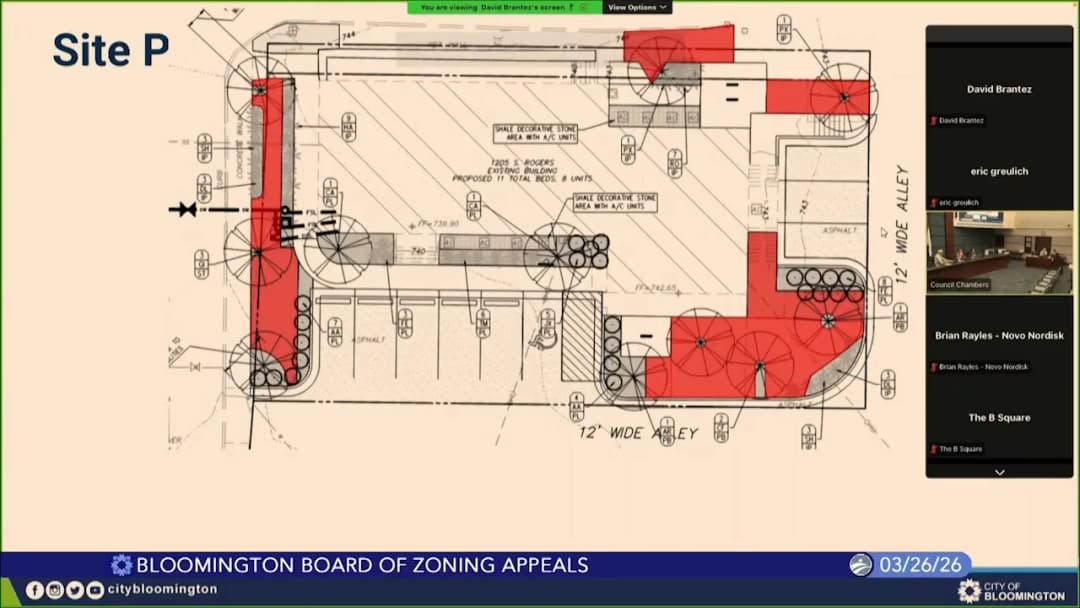
Note: The transcript of the meeting states it was called to order on Thursday, March 26, 2026, but the provided meeting timestamp is March 27, 2026. This summary uses the March 27 date as instructed. The Bloomington Board of Zoning Appeals (BZA) met on March 27, 2026, to hear five petitions. The meeting began with roll call (members Ballard, Burrell, Throckmorton present) and approval of the minutes from February 26, 2026. Staff announced a change in agenda packet format to comply with accessibility standards, with links to staff reports, staff exhibits, and third-party exhibits. A discussion about incorporating an expedited agenda and potential time limit adjustments was deferred to the next meeting. One petition was continued. Consent Calendar - Minutes Approval: The minutes of the February 26, 2026 meeting were approved unanimously (3-0). - Continuance: Petition ZR 2026-02-0004 (508 North Lincoln) was continued to the April 23, 2026 meeting by a unanimous vote. Public Comments & Testimony - 1205 South Rogers Street (Administrative Appeal and Variance): Casey Green, a certified pesticide applicator and member of MC Iris, spoke via Zoom on both petitions. She expressed concern about replacing grass with stone, noting that bare dirt or turf can act as impervious surfaces regarding runoff and fertilizer pollution. She suggested drought-tolerant landscaping alternatives such as buffalo grass or native plants, and cautioned against invasive ivy. - Convention Center Signs: Randy Cassidy spoke in person in support of the signage package, emphasizing the importance of clear wayfinding for visitors and community safety. Discussion Items 1. ZR 2026-01-0001 – 618 West Howe Street (Variances) - Petition: Request for variances from rear setback and maximum impervious surface coverage for a single-family home in an R3 district. The project includes raising a shed roof and adding a second-floor addition with a patio. - Staff Report: David Brents presented, noting the proposed impervious coverage of 52.9% exceeds the allowed 45%, but is within the range for a minimum lot size. Staff recommended approval. - Petitioner: Kevin Potter, structural engineer, offered no additional presentation but answered questions. - Decision: No public comments. The board voted unanimously (3-0) to approve both variances. 2. ZR 2026-02-0006 – 1205 South Rogers Street (Administrative Appeal) - Petition: Appeal of staff’s determination that the decorative stone installed (1.5-inch river rock) did not meet the standard of washed stone 2 inches or larger. - Staff Report: Staff argued the stone was smaller than the typical 2-2.5 inch standard used elsewhere, raising concerns about washout and aesthetic value. - Petitioner: Josh Alley stated the stone was purchased as decorative river rock, matches stone used in nearby developments, and that he was unaware of the size requirement. He emphasized his efforts to improve the property and difficulty growing grass. - Board Discussion: Members noted the lack of a formal definition in the UDO and the ambiguity of staff’s standard. Chair Ballard and member Throckmorton expressed that the ambiguity justified granting the appeal to avoid financial burden. - Decision: Motion to approve the appeal passed unanimously (3-0), meaning the stone is considered decorative. 3. ZR 2026-02-0005 – 1205 South Rogers Street (Variance for Impervious Surface, Landscape, Ground Cover) - Petition: Three variances to allow stone ground cover beyond permitted areas, resulting in 92% impervious coverage (up from approved 69%) and reduced landscape area. - Staff Report: Staff recommended denial, finding no hardship and noting the stone is impervious per UDO definition (gravel). The stone replaced grass in areas where grass failed; all shrubs and trees remain. - Petitioner: Josh Alley argued the stone is pervious, he tried to grow grass three times, and that the stone matches other properties. He said he did not think he was violating the code. - Public Comment: Casey Green provided environmental commentary. - Board Discussion: Members concluded that the UDO is clear on impervious surface definitions and that lack of knowledge does not constitute hardship. They denied all three variances, but noted petitioner would work with staff to bring the site into compliance, possibly reusing the approved decorative stone in allowed areas. - Decision: Motion to deny all three variances passed unanimously (3-0). 4. ZR 2026-03-0008 – 1320 South Rogers Street (Conditional Use in Floodplain) - Petition: Conditional use approval to allow driveways and structures within the floodplain for a five-building contractor’s yard on a 6.42-acre parcel in the Thompson Planned Unit Development. - Staff Report: Eric presented that the development avoids the floodway, buildings are elevated two feet above the 100-year flood elevation, and compensatory storage ponds offset fill. Staff recommended approval with conditions. - Petitioner: Dylan Reynolds, civil engineer, explained the project and compliance with floodplain regulations. - Decision: No public comments. Board approved unanimously (3-0). 5. ZR 2026-03-0009 – Convention Center Campus (Sign Variances) - Petition: Variances for three types of signage: freestanding directional signs, double-sided light pole signs, and a ground-mounted monument sign with digital reader board. Needed due to location in public right-of-way, sign dimensions, and electronic component restrictions. - Staff Report: Jackie Scanlan recommended approval with conditions: the monument sign height not exceed 6 feet (reduced from proposed 7’5”), and the digital proportion reduced accordingly. - Petitioner: Sarah Hempstead explained the signage aims to improve safety, unify the campus, and aid wayfinding. - Public Comment: Randy Cassidy supported. - Board Discussion: Members supported the request, noting the unique nature of the convention center campus. - Decision: Motion to approve with conditions passed unanimously (3-0). Key Outcomes - Minutes approved (3-0). - Continuance granted for ZR 2026-02-0004 (508 North Lincoln) to April 23, 2026. - Variances approved for 618 West Howe Street (ZR 2026-01-0001). - Administrative appeal granted for decorative stone at 1205 South Rogers Street (ZR 2026-02-0006). - Variances denied for impervious surface, landscape area, and ground cover at 1205 South Rogers Street (ZR 2026-02-0005). Petitioner directed to work with city for compliance. - Conditional use approved for 1320 South Rogers Street (ZR 2026-03-0008). - Sign variances approved for convention center campus (ZR 2026-03-0009) with conditions: monument sign height limited to 6 feet and digital portion proportionally reduced. Additionally, staff announced upcoming changes to the agenda format and expedited agenda procedures. Board members discussed potential revisions to public comment time (suggesting 3 minutes) and the need for an executive session to address decorum and public behavior, to be scheduled.

ZONING REGULATIONS 71% · PROCEDURAL 11% · ENGINEERING AND INFRASTRUCTURE 6% · SIGNAGE REGULATIONS 6%
49
MAR 26, 2026 · BLOOMINGTON, INDIANA · CITY COUNCIL
Bloomington Common Council Regular Session – March 26, 2026

The Bloomington Common Council met on March 26, 2026, to address a full agenda including approval of prior meeting minutes, reports from council members and city commissions, a presentation on the Parks and Recreation master plan, and the second reading of Ordinance 2026-06 concerning the Hopewell South planned unit development (PUD). A significant portion of the meeting was devoted to debating and voting on proposed reasonable conditions for the PUD, amid conflicting legal opinions from the corporation counsel and council members over the council's authority to impose such conditions. The meeting concluded with the postponement of both Ordinance 2026-06 and Resolution 2026-05 to the April 1, 2026 meeting. Consent Calendar - Approved minutes from the September 24, 2025 Committee of the Whole meeting by a unanimous vote. - Approved the 2026 funding recommendations from the Pedestrian Safety Committee (formerly the Sidewalk Committee) unanimously. - Approved a job description for the Council Attorney and Director of Common Council Office, and authorized the hiring committee to contract with external vendors or temporary legal counsel. Reports and Presentations - Council Member Report (Councilmember Sasper): Presented a draft priorities memo for budget discussions, based on a prior deliberation session and council survey. Discussion included rewording item 7 to "additional options other than uniformed police officers" for nonviolent issues. - Council Member Report (Councilmember Piedmont Smith): Announced a waste reduction grant opportunity (deadline May 17) and ongoing work on a community-wide public safety plan. - Parks and Recreation Director Tim Street: Presented highlights from the master plan process, including a statistically valid community survey (405 respondents, margin of error <5%). Key findings: 90% support for parks; top priorities are trails (75%), open space (61%), park/trail amenities (60%). Draft goals focus on community impact, critical investment, financial sustainability, and strong staff. - Human Rights Commission: Chair Emma Williams reported 18 discrimination investigations and 83 inquiries in 2025, with an uptick in LGBTQ+ cases. Commission strategic goals for 2026 include expanding education and outreach. - Commission on Hispanic and Latina Affairs: Chair Claudia presented efforts in access (workshops, FAFSA support), partnerships (mental health forum), and belonging (community events). Future plans include a Latino Recognition Award. Public Comments & Testimony - Multiple community members spoke during public comment periods: - Christopher MG (Chamber of Commerce) promoted upcoming workshops and volunteer opportunities. - Matt Caldy announced the Environmental Commission's EcoHeroes art contest (theme: nature at night). - Christopher advocated for city-grown food. - Brianna, a social work student and survivor of childhood hoarding, requested guidance on city resources for families in hoarding situations. - A citizen delivered a critique of capitalism and urged democratic economic priorities. - During the Hopewell PUD discussion, several speakers addressed the permanent affordability conditions: - Ryan Langley (loan officer) warned that deed restrictions can limit financing options. - Ryan Still (Summit Hill CDC) encouraged flexible affordability mechanisms. - Sarah Wolford (Habitat for Humanity) shared local success with silent second mortgages and right of first refusal. - Paul Russo questioned the lack of permanent affordability given city land ownership. - Aaron Comforti (McDoel Gardens resident) supported more permanently affordable units and density. Discussion Items Ordinance 2026-06: Hopewell South PUD - Initial Presentation: Mayor Carrie Thompson urged the council to approve the PUD as certified by the Plan Commission, emphasizing it as a community-driven project focused on affordability and walkability. Corporation Counsel Margie Rice then provided legal analysis: only 4 of the 13 proposed reasonable conditions (RCs) were consistent with the certified PUD (RCs 1, 2, 5, 6); the remaining 9 constituted impermissible amendments under Indiana law and case law (Misty Woods). She stated the RDC (petitioner) had not agreed to those amendments and therefore they could not be imposed. - Council Debate: Councilmembers raised conflicting legal interpretations: - Councilmember Flaherty cited past PUD approvals (2016–2024) where similar reasonable conditions were imposed with petitioner agreement, arguing that the council has authority under IC 36-7-4-1512 to impose reasonable conditions. He noted that in Misty Woods, the petitioner's acquiescence was deemed agreement. - Councilmember Stasberg questioned how the RDC's position could be known without a formal vote, and proposed postponing to resolve the legal dispute. - Councilmember Rosenbarger suggested the council should seek independent legal counsel. - Proposed Reasonable Conditions Voting: - RC 1 (Stasberg): Update allowed use table to reflect residential project goals. Passed unanimously. - RC 2 (Stasberg): Require a rational phasing plan. Passed unanimously. - RC 6 (Flaherty): All-electric buildings (space/water heating, cooking). Passed 9-0. - RC 5 (Zulik): Permanent affordability for 15% of units at 120% AMI, using silent second mortgages or right of first refusal. Failed 6-3 (Stasberg, Piedmont Smith, Rahlo, Rough, Rosenbarger, Flaherty opposed; Zulik, Sorry?, Daly in favor – actual tally from transcript: "Stasberg no, Piedmont Smith no, Zulik yes, sorry? yes, Daly yes, Rahlo no, rough no, Rosenbarger no, Clarity no" – that's 3 yes, 6 no). - Motion to Postpone: Councilmember Rahlo moved to postpone the entire ordinance until April 1, 2026. After debate citing need for legal clarity on remaining RCs and desire for greater permanent affordability (RC 4 still on table), the motion carried 6-3 (Piedmont Smith, Rahlo, Rough, Rosenbarger, Flaherty, Stasberg in favor; Zulik, Sorry?, Daly opposed). Resolution 2026-05: UDO Amendments for Sustainability and Housing Affordability - Councilmember Flaherty presented the resolution, which would direct the Plan Commission to propose amendments to reduce minimum lot sizes/widths, add building electrification incentives, and eliminate minimum parking requirements. He noted the resolution initiates a process, not final policy. - A motion to postpone to April 1 was made and carried 9-0 (with support from the sponsor to allow more time for review). Key Outcomes - Minutes approved (unanimous). - Pedestrian Safety Committee funding recommendations approved (unanimous). - Council Attorney job description approved (unanimous). - Hiring committee authorized to contract with external vendors/temporary legal counsel (unanimous). - Appointment: Carrie Champion appointed to Historic Preservation Commission (unanimous). - Removal process initiated: A final letter will be sent to Drew Heron before potential removal from Historic Preservation Commission (unanimous). - Hopewell South PUD (Ordinance 2026-06) postponed to April 1, 2026 (vote 6-3). - Resolution 2026-05 postponed to April 1, 2026 (vote 9-0). - Next meeting scheduled for April 1, 2026; also noted fiscal committee meeting on the Friday prior and hiring committee meeting on the following Thursday.

AFFORDABLE HOUSING 23% · PROCEDURAL 16% · ZONING REGULATIONS 15% · PUBLIC ENGAGEMENT 9%
50
MAR 16, 2026 · BLOOMINGTON, INDIANA · CITY COUNCIL
Fiscal Special District Committee Meeting - March 16, 2026

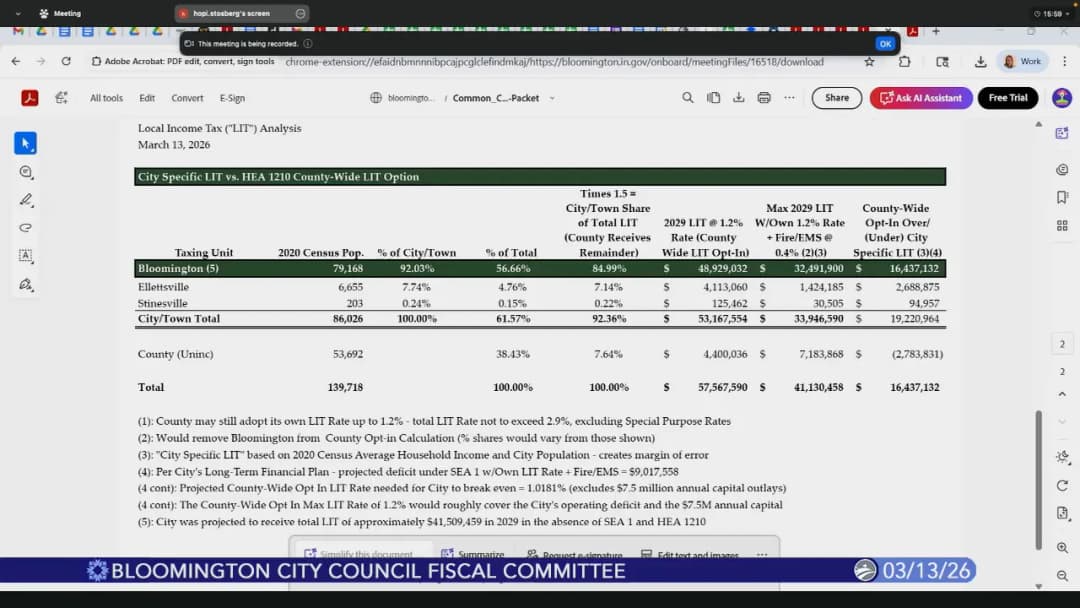
The Fiscal Special District Committee of Bloomington, Indiana met to review the city's long-term financial outlook, the impact of recent state legislation on local income tax, debt capacity, and property tax options. Participants included City Controller Jeff McCamin, Sophia McDowell, and financial advisors Justin Chang and Tim Sugar from Reedy Financial Group. One public commenter raised concerns about delayed financial reporting. Note: The transcript states the meeting was called to order on March 13, while the provided meeting date is March 16, 2026. Consent Calendar - Agenda approval: The committee unanimously approved the agenda as modified, combining agenda items 2 and 3 (Indiana General Assembly updates) into a single presentation, Q&A, and public comment period. No calendaring updates were offered. Public Comments & Testimony - Kevin Keo, a member of the public, expressed concern that the city has not published its 2024 Annual Comprehensive Financial Report (ACFR) as of March 13, 2026, nearly 15 months after the fiscal year ended. He noted that the 2023 federal single audit had a qualified opinion and a material internal control weakness. He cited the 2016 general obligation bond's continuing disclosure agreement, which sets a 180-day benchmark (June 30) for annual reporting, and stated that State Board of Accounts requires a 90-day audit window, meaning the city should have books ready by April 1. He argued that delays could lead to higher interest rates, SEC 15C2-12 notices of failure to file, enforcement actions, and reputational damage. He asked when the 2024 financial statements were delivered to auditors and what the delays might cost taxpayers. Discussion Items - Financial Outlook and Deficit: Tim Sugar reported that the city's five-year plan projects a roughly $3 million general fund deficit in the near term due to Senate Enrolled Act 1 (SEA 1) and budget choices. Once SEA 1 and House Enrolled Act 1210 (HEA 1210) are fully implemented (around 2032), the operating deficit could reach about $9 million, plus about $7.5 million in annual capital outlays, totaling a potential $16.5 million deficit. - Local Income Tax (LIT) and HEA 1210: Justin Chang and Tim Sugar explained that HEA 1210 now allows any city or town to opt into a countywide municipal services local income tax rate, with a formula based on population multiplied by 1.5. If Bloomington opts in at the maximum 1.2% rate, the projected 2029 LIT revenue would be approximately $48.9 million, compared to $41.5 million without the opt-in—a $7 million increase that would nearly cover the general fund deficit. If the city instead imposed its own LIT rate, the projected revenue would be around $32 million (including the 0.4% fire/EMS share). The county and cities can form a task force to set the rate unanimously by October 1, 2026; otherwise, the city may opt in by October 1, 2028, but would be locked into the rate for three years. - Debt Capacity: The city has roughly $97 million in remaining constitutional debt limit across general obligation, park, and redevelopment districts. The city currently has three general obligation bonds and three park district bonds, with no redevelopment district bonds. The current debt rates are 0.053 and 0.0338 (likely per $100 assessed value). Issuing bonds could fund capital outlays, but petition-remonstrance thresholds and project-size referendums apply. - Property Tax Rate Considerations: The city's current total debt rate is 84 cents per $100 assessed value, lower than comparable communities like Lafayette and Noblesville (around $1.00). Increasing the rate to $1.00 would generate about $8.2 million in additional levy, potentially covering deficits. This could be phased in over several years. Key Outcomes - The committee unanimously approved the amended agenda. - No binding decisions were made on LIT, debt issuance, or property taxes. - Next steps include further committee discussions, preparation of a draft letter, and exploring cooperative conversations with county partners about the LIT task force. - Jeff McCamin responded to the public commenter: he stated that property tax-backed bonds are secure and short-term bonds are unlikely to be affected by reporting delays, though longer-term bonds could be. He noted the city is in regular communication with auditors and provided a timeline report at a previous meeting.

FISCAL SUSTAINABILITY 68% · PUBLIC WORKS 19% · PROCEDURAL 6% · PUBLIC ENGAGEMENT 5%
OPENPUBLICA · PUBLIC MEETING INDEXUPDATED DAILY · openpublica.com