Browse by city
Date range
Search help

Search titles, summaries, topics and stored transcripts together. Keywords may match separately; put the whole query in double quotes for a phrase. Matching follows word analysis, so punctuation is not exact. Both dates are included. Documents are not searched.

SHOWING 51–60 ENTRIES
51
MAR 12, 2026 · BLOOMINGTON, INDIANA · CITY COUNCIL
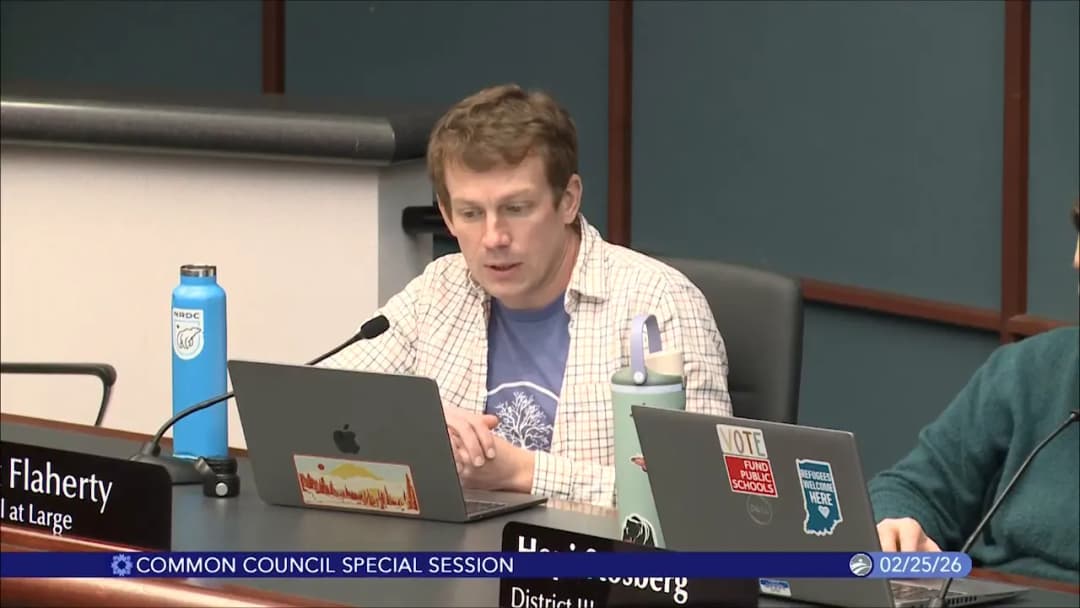
Bloomington Common Council Special Session on Council Staff Structure - March 12, 2026

The Bloomington Common Council held a special session on March 12, 2026, to discuss restructuring the council's legal and administrative staff. The hiring committee presented four options for reorganizing the three existing staff lines (attorney, deputy attorney, legal researcher). Council members debated the merits of each option, focusing on the separation of administrative and legal functions and whether to house an administrator in the clerk's office or within the council's office. No votes were taken; the hiring committee will continue discussions on March 17, 2026. Discussion Items - Option 1 (Status Quo): Keep the current three positions unchanged. - Option 2: Replace the legal researcher with a full-time administrator housed in the clerk's office, leaving two full-time attorneys. - Option 3: Split the legal researcher role into two part-time positions—one administrator in the clerk's office and one legal researcher in the council's office. - Option 4: Reallocate administrative duties within the existing three positions, placing more administrative burden on the deputy attorney. - Councilmember Rallo expressed support for keeping all staff in-house and adding a fourth FTE for administration, citing concerns about autonomy and potential conflicts if an administrator is under the clerk. - Councilmember Flaherty favored Option 2, arguing that attorneys should focus on legal work and that administrative demands have increased. - Councilmember Rosenbarger advocated for two full-time attorneys and an additional administrative FTE, aligning with a variation of Option 4. - Councilmember Ruff opposed major changes, preferring to hire using current job descriptions and adjust later with input from the new attorney. - Councilmember Stasberg noted the current attorney job description is primarily legal and suggested using it for the next hire before restructuring. - Councilmember Zulik highlighted the need to clarify whether the council can hire non-attorney staff, referencing state code. Key Outcomes - No decisions or votes were made. - The hiring committee will reconvene on Tuesday, March 17, 2026, at 5:00 PM to further discuss job descriptions and bring a proposal to the full council. - The council will continue to deliberate on the appropriate staff structure.

PERSONNEL MATTERS 71% · PUBLIC ENGAGEMENT 19% · PROCEDURAL 10%
52
MAR 12, 2026 · BLOOMINGTON, INDIANA · CITY COUNCIL
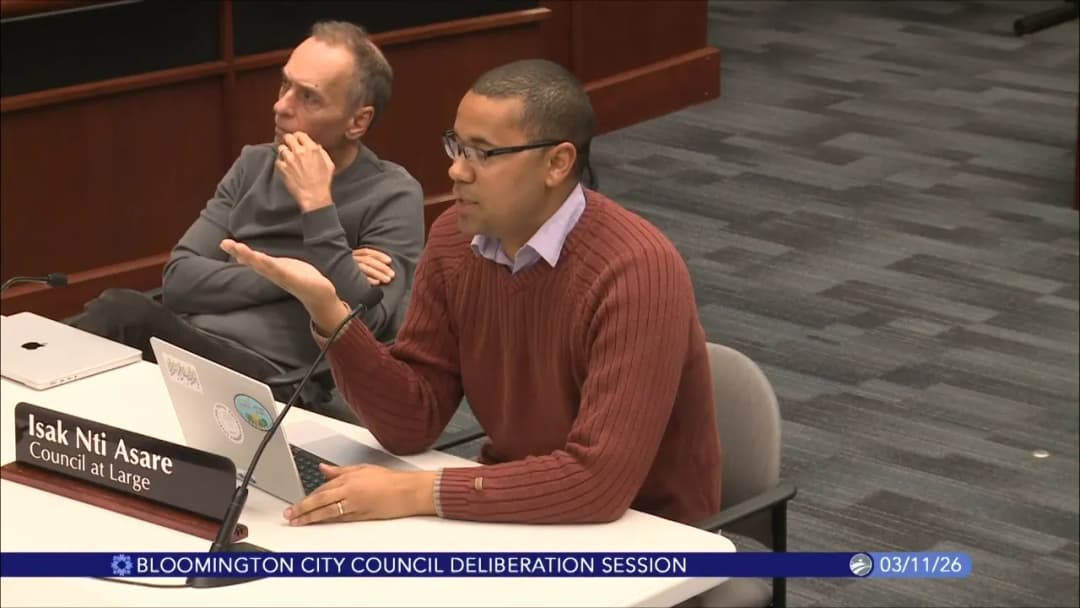
Bloomington City Council Deliberation Session on 2027 Budget Priorities – March 12, 2026

Note: The transcript indicates the meeting began at 6:30 PM on March 11, 2026, but the official meeting date provided is March 12, 2026. This summary follows the provided date. Councilmember Stasberg led the deliberation session to develop shared priorities for the 2027 budget, building on a December 2025 session and a February 2026 survey of council members. The session focused on refining 13 top priorities that emerged from the survey, discussing how to rank them, and aligning them with measurable, actionable outcomes. Key themes included the role of local government, measurability of outcomes, and the need to tie priorities to existing city plans. Public Comments & Testimony - Christopher (Greater Bloomington Chamber of Commerce): Emphasized the importance of investing in assets (transportation, economic development, arts, community centers) to save money long-term. Supported an "ounce of prevention" approach to homelessness and urged careful spending given state tax changes (SB 1). Also suggested reviewing potential budget cuts. - Kevin Keog: Raised concerns about the city's late publication of the Annual Comprehensive Financial Report (ACFR) and the Single Audit Report. Noted that a material weakness in internal controls over federal grant compliance was identified for FY2023, which has not been publicly deliberated or remediated. Warned that bond covenant violations could harm the city's credit and increase borrowing costs. Formally requested that audit remediation and internal control strengthening be a 2027 priority, with an ACFR publication deadline of June 30 and full transparency. - Paul Russo: Thanked the council for acknowledging that the transportation system is inequitable and expressed daily experience of that inequity. Discussion Items Process and Ranking of Priorities - Councilmember Stasberg presented the 13 top priorities, compiled from a February survey with points allocated by council members. She explained the methodology: items were grouped by category (e.g., high-performing government, housing, public safety), but the final list was de-bucketed for ranking. The list is not in order of importance. - Councilmember Sari asked whether to rank by buckets or individual items. Councilmember Flaherty proposed a second survey where each council member would assign points (e.g., 100) across the 13 items to produce a averaged ranking, arguing that simple discussion would not yield consensus. - Councilmember Asari noted that the list mixes broad concepts (e.g., "implement existing plans") with specific outcomes (e.g., "reduce income inequality"), making direct comparison difficult. He suggested that items like "implement existing plans" and "develop plans where none exist" are more philosophical/operational approaches, not discrete budget priorities. - Councilmember Zulik said she frames priorities based on meeting basic needs (food, shelter, water, safety). - Councilmember Flaherty cautioned that the current city planning infrastructure is not well-suited to outcome-based budgeting. He offered to lead work on a more coherent framework with near, mid, and long-term outcomes and lag measures. - Councilmember Rollo supported the list as a rubric for questioning department directors, noting that maintenance (e.g., road repaving) is measurable and a good example of a city-driven priority. Specific Priorities and Measurability - Councilmember Stasberg suggested using three questions from Controller McKim and Deputy Mayor Knapp: Is the outcome driven by local government? Is it measurable? Is the funding allocation measurable? The group applied these to each item. - Making homelessness brief, rare, and non‑repeating (Item 4): Controller McKim confirmed it is measurable and city-driven, citing ongoing work with Heading Home. Sub‑bullets (e.g., job/wage growth, mental health services) were kept as examples, not an exhaustive list. - Increase housing diversity within neighborhoods (Item 5): Considered partially measurable, likely requiring legislation and staff time. Councilmember Flaherty argued it is cheap to do and should be done in 2026, not 2027. Others noted it may already be in progress via the administration (e.g., RD permitting). - Reduce systemic inequities (Item 6): Broadly supported. Councilmember Flaherty gave examples (utility bill discounts via general fund) and noted the city lacks an equity definition. Councilmember Zulik mentioned measuring public engagement demographics. - Vibrant and resilient economy (Item 7): Councilmember Rosenberger flagged that "vibrant" and "resilient" are vague. Councilmember Rollo suggested measuring locally owned businesses and wealth recirculation instead of GDP. Councilmember Stasberg agreed to clarify the term before the next survey. - Create vibrant third places/neighborhood hubs (Item 8): Measurable via event attendance, distribution of events, and zoning for hubs. - Options other than uniformed police for nonviolent issues (Item 9): Considered clearly measurable and city-driven. - Zero traffic fatalities/serious injuries by 2039 (Item 10): Already in city plans. Councilmember Flaherty suggested a future deliberation on clearing pedestrian networks after snowfall. - Strengthen food security networks (Item 11): Partially city-driven, measurable. - Air quality and carbon emission reduction (Item 12): Partially city-driven (fleet, incentives), measurable. - Waste reduction (Item 13): City-driven and measurable. - Crime reduced: Councilmember Zulik noted this overlaps with other items (public safety in other categories). Council agreed to omit it from the ranked list but retain it as implicitly covered. Guidance for Administration and Next Steps - Controller McKim stated that the current list is difficult to operationalize without more concrete, measurable sub‑goals. He stressed the need to distinguish between city-driven outcomes and those requiring external partnerships. - Councilmember Stasberg proposed that items like "implement existing plans" and "develop plans where none exist" be moved to a philosophy paragraph in the letter, not ranked in a survey. Most agreed, though with debate about "maintain city assets"—some saw it as a capital improvement/expensive item, others as a measurable maintenance goal. Councilmember Rollo strongly defended "maintenance" as a quantifiable priority (e.g., miles of road paved). - Councilmember Asari suggested that the council adopt a "do our plans" philosophy and refer to specific plan goals (e.g., Climate Action Plan 6.2.8) in budget presentations. - Councilmember Stasberg committed to drafting a new survey within days, aiming for council approval of a priority letter at the March 25 regular session or at the latest the first meeting in April. - Councilmember President Asari floated the idea of issuing a resolution instead of a letter to allow public comment and a clear vote. Key Outcomes - No formal votes taken; the session was deliberative and directed toward producing a final priority list. - Council will conduct a follow-up survey where each member will allocate points across the 13 items (with two items moved to philosophy paragraph) to generate an average ranking. - The letter/resolution to the mayor will include: - A philosophy paragraph emphasizing implementation of existing plans and development of plans where none exist (especially in public safety). - A ranked list of the remaining priorities (likely 10 items), with sub‑bullets as examples, not exhaustive. - Requests for budget presentations to show how each department's spending aligns with these priorities and to reference specific plan goals. - Councilmember Flaherty offered to lead a future deliberation session on a coherent outcome-based budgeting framework. - Councilmember Daly will coordinate scheduling of future deliberation sessions. - Controller McKim will work to provide more granular budget presentations that tag expenditures to council priorities and include measurable metrics where possible. - Public safety plan development was identified as a needed priority, potentially via consultant or in-house work, to be discussed further.

BUDGET EQUITY ANALYSIS 19% · FISCAL SUSTAINABILITY 17% · PUBLIC ENGAGEMENT 14% · PUBLIC WORKS 10%
53
MAR 5, 2026 · BLOOMINGTON, INDIANA · CITY COUNCIL
Bloomington Common Council Meeting - March 5, 2026: Hopewell PUD, Flock Cameras Resolution, and City Reports

This meeting of the Bloomington Common Council included approval of minutes from 2025 meetings, reports from city officials, a first reading discussion of the Hopewell Planned Unit Development (PUD), a resolution on transparency for automated license plate reader (ALPR) technology, and public comment on both topics. The council voted to postpone the Hopewell PUD to a later date and unanimously adopted the ALPR transparency resolution. Consent Calendar - Approval of Minutes: Minutes from July 30, November 5, December 3, December 10, and December 15, 2025 were approved as amended (9-0). The December 3 and December 10 minutes had corrections: a note explaining why a motion failed (needed two-thirds majority) and a typo fix, respectively. Public Comments & Testimony - Non-Agenda Public Comment (First Session): Paul Rousseau commented on the Indiana Avenue safety improvements project, criticizing the proposed two-way bicycle lanes as unsafe and urging the city to consider alternative approaches like enforcement and education. - Public Comment on Hopewell PUD: Over 30 minutes of public comment (extended by 15 minutes) with 15 speakers. Most speakers expressed strong support, including representatives from Heading Home of South Central Indiana, the Monroe County Community School Corporation (superintendent), the Greater Bloomington Chamber of Commerce, Cook Group (talent attraction), the local Builders Association, and the Community Foundation. Supporters cited the urgent need for affordable housing, workforce retention, and the PUD as a model for future development. A few speakers raised concerns about affordability mechanisms, HOA costs, and the appropriateness of using a PUD process rather than broader zoning code changes. One speaker noted the displacement of residents from nearby Seminary Point apartments. - Public Comment on ALPR Resolution (Flock Cameras): Approximately 20 speakers spoke, nearly all urging the council to go beyond transparency and terminate the Flock contract. Speakers cited security vulnerabilities, civil liberties concerns, potential ICE collaboration, and the technology's threat to immigrant communities. A few speakers shared personal experiences of being falsely flagged by Flock cameras. The mayor was noted to be absent during this discussion. Discussion Items - Controller's Report: Jeff McKim provided an update on the 2024 Annual Comprehensive Financial Report (ACFR) and audits. He explained the transition to GAAP reporting, progress on audits (2022 issued Oct 2024, 2023 issued July 2025), and his goal to complete the 2024 audit and restore a sustainable annual cadence by the September 2026 deadline. No questions were asked. - Planning Director's Report on HB 1001 and UDO Amendments: David Hittle summarized House Enrolled Act 1001 (formerly HB 1001), which requires a public hearing in 2026 to evaluate zoning ordinances for promoting housing development, and annual housing reporting. He outlined a proposed working group of staff, council, and plan commissioners to draft UDO amendments for housing attainability, with a timeline for public meetings in May and July, and plan commission and council consideration in August/September 2025. - First Reading of Ordinance 2026-06 (Hopewell PUD): The council discussed the proposed rezoning of a 6.3-acre property to a Planned Unit Development for nearly 100 homes, with affordable homeownership options starting at $83,500. Mayor Thompson and Flintlock Labs presented the project's goals: workforce housing, local builder participation, and a model for UDO changes. Council members questioned affordability mechanisms, accessibility, use table alignment, and the delegation of final plan approval to staff. The petitioner expressed openness to reasonable conditions, including all-electric buildings and aligning uses with the project's intent. A motion to postpone to the next regular session (March 25) passed 6-3. - Resolution 2026-04 (ALPR Transparency): Councilmember Asari introduced the resolution, which requires the chief of police and mayor's office to brief the council on the city's ALPR program, including scope, cost, retention policies, and data sharing, and imposes a pause on expansion until the briefing. An amendment establishing a six-week deadline for the briefing was adopted 8-0. The resolution states the council's intent to consider an ordinance for durable rules. Following public comment and council discussion, the resolution was adopted unanimously (9-0). Key Outcomes - Minutes Approved: 9-0 vote to approve minutes from five 2025 meetings as amended. - Appointments Approved: Joe Throckmorton to BZA, Katarina Koch to BUEA, Carl Geyser and Justin Meschter to Environmental Commission, Graham McKean to Utility Service Board – all approved 9-0. - Hopewell PUD Postponed: Ordinance 2026-06 moved to second reading and discussion scheduled for March 25, 2026 (vote 6-3). - ALPR Transparency Resolution Adopted: Resolution 2026-04 passed unanimously 9-0, with a six-week deadline for the administration to provide a public briefing. The resolution also calls for a pause on ALPR program expansion and signals intent to pursue a binding ordinance. - Special Session Scheduled: A special session of the council will be held on March 11, 2026, at 5:45 p.m. for hiring committee deliberations.

AFFORDABLE HOUSING 23% · TECHNOLOGY AND INNOVATION 17% · PROCEDURAL 16% · PUBLIC SAFETY 13%
54
MAR 3, 2026 · BLOOMINGTON, INDIANA · CITY COUNCIL
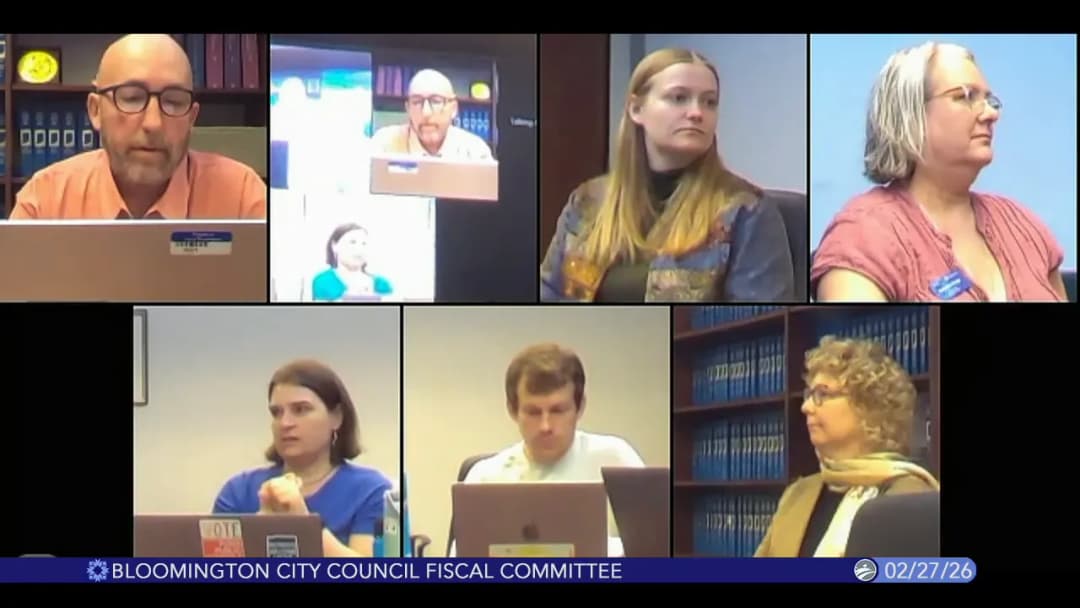
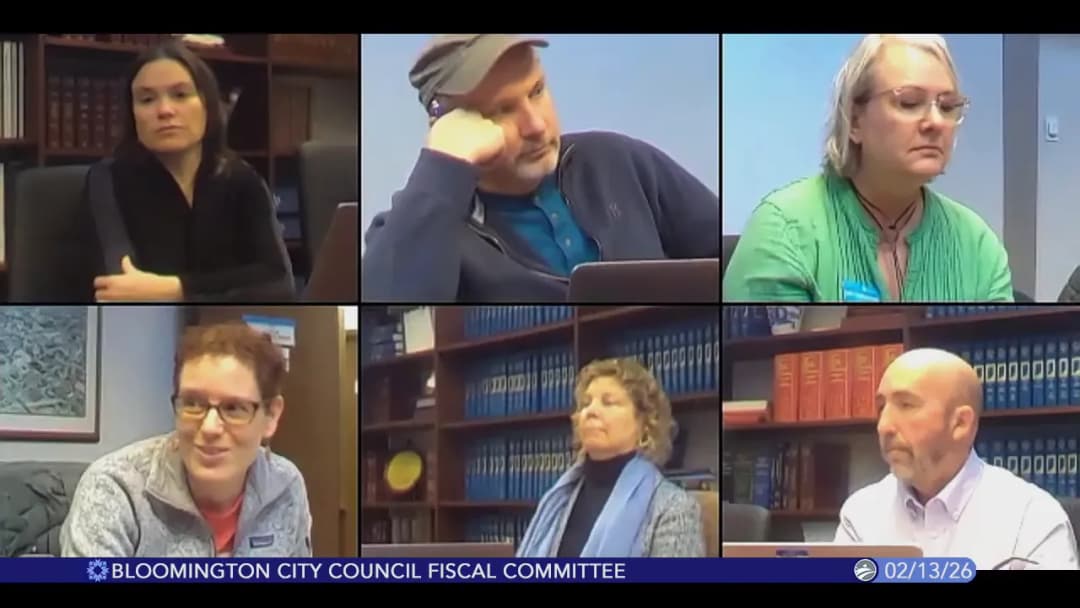
Bloomington Fiscal Committee Meeting - March 3, 2026: Budget Priority Outcomes and Deliberation Planning

The Bloomington Fiscal Committee held a special meeting on March 3, 2026, to review and refine priority outcome data for the upcoming 2027 budget, plan for a full council deliberation session, and hear public comment. The meeting was led by Council President Hopi Stoffsburg (District 3), with Council Member Pete Mark Smith (District 1), City Controller Jeff McKim, and Council Member Lisa Lane present. The discussion focused on grouping similar outcomes, evaluating measurability and budget relevance, and scheduling future committee work. Consent Calendar - The agenda was approved unanimously on a motion. Public Comments & Testimony - Kevin Keo raised concerns about the intersection of housing affordability, property assessment mechanics, and levy policy. He requested that the committee: (1) request a five-year assessed value growth comparison by property class, (2) review levy growth alongside general fund expenditure and fund balance trends, and (3) schedule a public presentation in 2027 explaining redistribution effects within Indiana's levy-driven system. He emphasized the need for consistent assessment methodology to avoid disproportionate pressure on naturally occurring affordable housing. Discussion Items - Outcome Prioritization and Grouping: Staff presented data from the December meeting and a Google Forms survey to identify and rank council priorities. Members discussed combining overlapping outcomes (e.g., "make homelessness brief, rare, and non-repeating" appeared under both housing and public safety; waste reduction and composting were merged). Council Member Lane suggested that outcomes should be evaluated using four criteria: government-driven, measurable, with measurable funding allocation, and important to both council and administration. - Challenges with Outcome-Based Budgeting: Controller McKim noted that many city plans lack consistent SMART outcomes, making it difficult to translate priorities into budget decisions. He suggested starting with a small number of well-defined, measurable goals. Council Member Smith highlighted the zero-sum nature of staff time and the need to prioritize staff resource allocation. The group agreed that discrete funding allocations (e.g., social services fund) are easier to measure, but policy-driven outcomes relying on staff time are also legitimate. - Public Safety Planning: Council Member Stoffsburg reported a conversation with the mayor about developing a public safety plan. Members agreed that a deliberation session on public safety should include city staff who work in public safety and use small group discussions modeled after the housing sessions. The goal would be to define specific, measurable public safety outcomes. - Grouping Downtown-Related Outcomes: The committee discussed whether to nest downtown vitality items under economic development or community health. Controller McKim cautioned against lumping all downtown items under one bucket, as they may have different budget implications. Members decided to keep the outcome list focused on specific outcomes rather than broad categories. - Calendar and Next Steps: The committee reviewed its meeting schedule (alternating between council-focused and controller-focused meetings every other week). Next meeting is March 13, 2026, focusing on administrative reports. Staff will produce a draft document consolidating grouped outcomes and distributing it by Monday/Tuesday of the following week for member feedback. The document will include guiding questions for the full council deliberation session. Key Outcomes - Staff (Ms. Stoffsburg) will produce a draft outcome grouping document by early next week for committee review. - The full council deliberation session will be a roundtable discussion with all nine council members, the controller, and public comment. It will focus on refining top priority outcomes and linking them to budget implications. - The committee will schedule a discussion on the elected official salary ordinance before the end of the year; deadlines for budget adoption are November 1 (overall budget) and end of year (elected official salaries). Controller McKim will provide the official DLGF budget calendar at the next meeting. - No formal votes were taken on priority outcomes; the group reached consensus on the process for further refinement.

PROCEDURAL 37% · FISCAL SUSTAINABILITY 26% · PUBLIC SAFETY 15% · HOUSING DEVELOPMENT 9%
55
FEB 27, 2026 · BLOOMINGTON, INDIANA · BOARD OF ZONING APPEALS
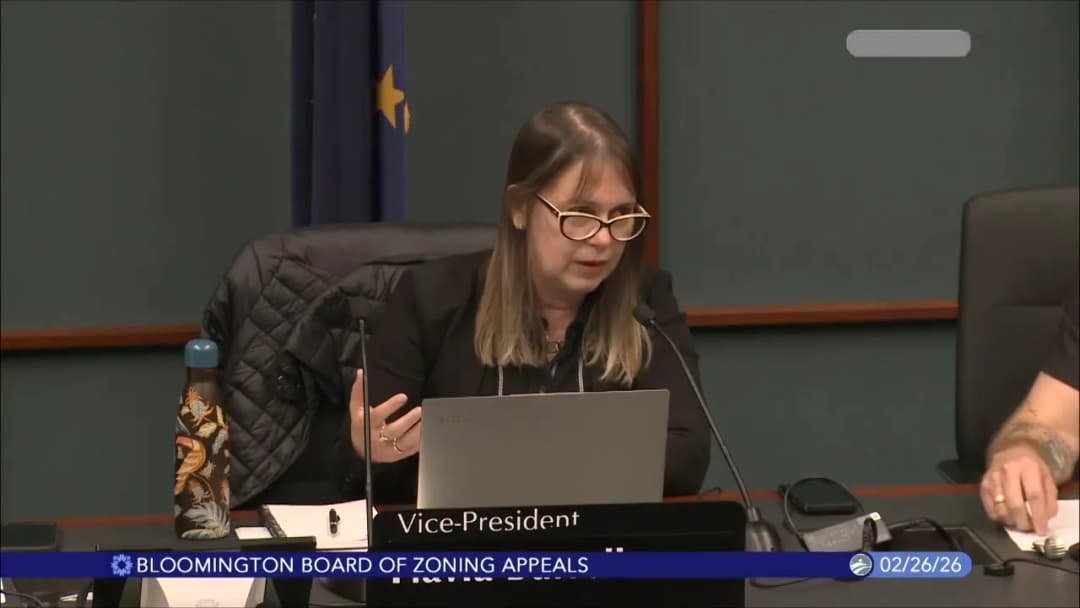
City of Bloomington Board of Zoning Appeals Meeting Summary - February 27, 2026

This meeting of the Board of Zoning Appeals (BZA) convened on February 26, 2026, and continued into the early hours of February 27, 2026, addressing a lengthy agenda including old business, staff reports, and multiple variance and conditional use petitions. The board considered seven major items, heard extensive public testimony, and made decisions on each. Consent Calendar - Approval of Minutes: The board approved the minutes of the previous meeting by a unanimous roll call vote (Ballard, Burrell, Fernandez, Throckmorton all yes). Old Business: Lamar Advertising Lawsuit Settlement - Presentation: Corporation Counsel Margie Rice informed the board of a settlement agreement regarding a lawsuit filed against the BZA on October 18, 2022, related to a Lamar Advertising digital billboard. The settlement had been negotiated in executive session. The board voted unanimously (4-0) to delegate authority to the chair to execute the settlement agreement. The chair thanked the legal department for their work. Staff Discussion: Expedited Agenda Proposal - Presentation: Senior Zoning Planner Jamie Crinley introduced a proposal for an expedited agenda to handle routine variance cases more efficiently. Items would have shorter time limits and be placed at the top of the agenda when staff recommends approval and no opposition is expected. The board expressed support and noted it would require a vote on rule changes in March. No action was taken. Petition: ZR 2025-12-0114 – Paul Pruitt & Keith Klein (North Grove Subdivision) - Staff Report: The petitioners requested seven variances for an 18-lot subdivision at 2511 North Dunn Street (R2 zoning). The variances sought were: minimum lot area (reduce from 7,200 to 5,000 sq ft), minimum lot width (60 ft to 50 ft), side building setback (8 ft to 5 ft), tree canopy preservation (retain 60% but only 36% retained), tree protection fencing, and riparian buffer disturbance in intermediate and fringe zones. Staff recommended approving the four environmental-related variances with conditions and denying the three dimensional variances because a by-right sustainable development incentive path exists in the UDO. - Public Comments: Neighbors presented a petition with 236 signatures opposing the variances. Concerns included stormwater runoff, traffic safety, loss of maturing trees (many planted by former owner/botanist John Sinclair), incompatibility with neighborhood character, and emergency access. Speakers requested denial of all variances. - Petitioner Response: The petitioners argued that additional city requirements (road extension, water line) added $300,000 in costs, making 15 lots necessary for affordability. They emphasized tree preservation efforts and a remediation plan with 70 new trees. - Board Discussion: Board members questioned staff about the sustainable development incentive and the practicality difficulties. The board ultimately found no factual basis to overturn staff's recommendation on the dimensional variances. - Vote: The board voted 4-0 to adopt staff's proposed findings: approve variances for tree canopy preservation, tree protection fencing, and riparian buffer disturbance (with eight conditions); deny variances for minimum lot area, lot width, and side setback. Petition: ZR 2025-12-0115 – Value Built Inc. - Staff Report: Petition for a variance from tree preservation standards to construct a triplex at 614 North Grant Street (RH zone). The property has dense closed canopy covering most of the lot; the petitioner proposed removing 11 trees and planting 9 new ones. Staff recommended approval with a condition to plant nine large-canopy trees and inspect within six weeks of occupancy. - Public Comments: One speaker (Amy Butler) argued the tree removal is significant and the area is already a tree desert; she requested denial. Another speaker (James Ford) raised concerns about parking and long-term tree survival. - Petitioner Response: The petitioner noted that the brick sidewalk removal is required by UDO, and additional street trees will be planted. He was open to the condition. - Board Discussion: The board briefly discussed enforcement of replacement tree survival, acknowledging staffing constraints. - Vote: The board voted 4-0 to approve the variance with the condition as recommended. Petition: ZR 2025-12-0116 – H E Reynolds LLC (Eric Maston) - Staff Report: Request for a conditional use permit to allow a duplex at 508 East Henderson Street (R3 zone). The proposed six-bedroom duplex would have one off-street parking space (a 13x50 ft driveway). Staff found the proposal met use-specific standards and recommended approval with conditions. - Public Comments: Multiple neighbors opposed the project, citing incompatibility with the neighborhood (especially the Allen Street Greenway), parking overflow, pedestrian safety, and roof design inconsistency. Some speakers supported duplexes in general but felt this design was inappropriate. - Petitioner Response: The petitioner stated he was open to adding a turnaround to avoid backing onto Henderson Street. - Board Discussion: The board debated whether the proposal met comprehensive plan goals and noted the conditional use criteria require judgment. Concerns about parking were partially alleviated by the petitioner's willingness to add a turnaround. The board found no alternative findings to deny and noted that the design met UDO standards. - Vote: The board voted 4-0 to approve the conditional use with the two staff conditions plus a third condition requiring the petitioner to work with staff to design a turnaround so vehicles do not back out onto the arterial street. Petition: ZR 2025-12-0117 – Rusty Wampler - Staff Report: Request for a conditional use permit to convert an existing single-family home at 105 East Driscoll Street into a duplex (R3 zone). The exterior changes were minimal; the proposal met all use-specific standards. Staff recommended approval with conditions. - Public Comments: Two speakers from the Bryan Park neighborhood expressed strong support, praising the adaptive reuse of a historic kit house and the respectful design. - Petitioner Response: The petitioner expressed gratitude for neighborhood support. - Vote: The board voted 4-0 to approve the conditional use with the conditions. Petition: ZR 2025-12-0119 – Monroe County School Corporation (Bloomington High School North) - Staff Report: Request for a variance from electric vehicle (EV) charging station requirements for a new 268-space parking lot. The UDO requires 11 EV stations; staff recommended a condition requiring at least three. The project aims to expand athletic facilities and relocate an existing parking lot. - Public Comments: Council member Hope Stosberg (as a resident) supported the school's request, noting that the parking lot would be lightly used for charging. - Petitioner Response: The school corporation argued that 11 or even three stations would require significant infrastructure costs (at least $50,000 for three), ongoing billing costs, and raise equity concerns. They noted their already substantial investment in 44 electric buses and solar panels. They requested zero EV stations. - Board Discussion: Some members favored requiring at least some stations to promote EV adoption; others argued the cost burden on the school system was not justified. The board debated whether a condition of zero could be supported by findings of fact. Ultimately, the majority supported three stations. - Vote: The board voted 4-0 to approve the variance with the staff condition requiring a minimum of three EV charging stations. Petition: ZR 2026-02-0002 – JC Bank (Administrative Appeal) - Staff Report: The applicant appealed a staff determination denying two wall signs on an architectural feature above the main roof line on the north side of the bank building at 3002 East Third Street. Staff determined the signs were prohibited roof signs under UDO section 20.04.100. No staff recommendation was made due to the appeal nature. - Public Comments: None. - Petitioner Response: The bank argued that the architectural feature (a wing) is part of the building with its own roof and usable interior space; the signs were on a wall, not a roof. They noted prior informal discussions with staff did not flag the issue and that similar signs exist on nearby buildings. - Board Discussion: The board recognized the unique structure and the previous approval of similar signs. The building's interior space under the wing made the determination ambiguous. - Vote: The board voted 4-0 to uphold the appeal, allowing the signs as proposed. Key Outcomes - Vote Summary: All decisions were unanimous (4-0) unless noted. The board approved: delegation of settlement authority; variances for North Grove (partial); variance for 614 Grant; conditional use for 508 Henderson (with added turnaround condition); conditional use for 105 Driscoll; variance for school corporation (with 3 EV station condition); and the administrative appeal for JC Bank signs. No items were denied. - Next Steps: The expedited agenda proposal will be brought for a vote in March. The Lamar settlement will be finalized with chair's signature. Petitioners for approved items must comply with conditions (e.g., tree planting, turnaround design, EV station installation).

ZONING REGULATIONS 34% · PROCEDURAL 12% · PUBLIC SAFETY 8% · HISTORIC PRESERVATION 7%
56
FEB 27, 2026 · BLOOMINGTON, INDIANA · CITY COUNCIL
Bloomington City Council Special Session – Hiring Committee Establishment (February 27, 2026)

This special session of the Bloomington City Council was held on February 27, 2026 (though the transcript repeatedly states it is Wednesday, February 25; a discrepancy exists between the provided date and the transcript). The council met to discuss and approve a draft charge for an ad hoc hiring committee responsible for recruiting and recommending candidates to fill vacant council legal and administrative roles, and to appoint members to that committee. Discussion Items - Draft Charge Overview: Council President presented a draft charge outlining the committee's scope: evaluate and recommend a new office structure (e.g., whether to separate attorney and administrator roles), draft job descriptions, manage recruiting, and present at least two qualified candidates per open role to the full council. The charge also included provisions for council-wide engagement and record-keeping. - Scope of Hiring: Councilmember Stasberg argued that the committee should only hire the supervising attorney, not all positions, because council lacks detailed knowledge of staff duties. Councilmember Flarity noted that under item three, job descriptions would be subject to full council approval, so the committee could not unilaterally expand hiring. The President confirmed this intent. - Supervision of Current Staff: Councilmember Piedmont Smith raised concerns that under the draft, current staff (two fellows and a part-time researcher) would report to the committee – a public body. The President agreed this was problematic and suggested designating a single liaison (e.g., the committee chair) instead. Councilmember Stasberg cautioned that one person could be overburdened. Clerk Bolden offered that her office could temporarily help supervise staff, as done previously, to ensure continuity. - Use of a Consulting Firm: Councilmember Rosenbarger proposed hiring an external consultant with expertise in organizational structure to lead the process, noting the complexity. The President agreed this could be brought as an option under the first deliverable. - Confidentiality Concerns: Councilmember Rosenbarger expressed worry about leaks of confidential information (e.g., resumes) given the lack of trust among members. The President acknowledged this and committed to providing data protection training for the committee. Key Outcomes - Motion and Vote: Councilmember Stasberg moved to authorize the ad hoc hiring committee to complete items 1, 2, 3, 4, 6, and 7 of the draft charge (excluding the supervision item and authority/limitations), and to research and bring a recommendation for temporary or external legal support. The motion was seconded by Councilmember Daly and passed unanimously (all present voting yes). - Committee Appointments: The President appointed Councilmembers Piedmont Smith, Zulik, herself, and Rollo to the committee. A separate vote on these four appointments passed 6-2 (Councilmembers Piedmont Smith and Rosenbarger voted no). - Liaison to Current Staff: The proposed appointment of Councilmember Daly as the liaison to current staff was postponed for a vote at the next meeting. - Next Steps: The President will chair the committee temporarily, circulate revisions to the charge, and schedule an executive session next Wednesday (either 5:30 or 6 PM) before the regular council meeting. Note on Date: The user-provided meeting date is February 27, 2026; however, the transcript repeatedly references "Wednesday 25th" and a 5 PM start time. This discrepancy is flagged for accuracy.

PERSONNEL MATTERS 65% · PROCEDURAL 30% · PUBLIC ENGAGEMENT 5%
57
FEB 17, 2026 · BLOOMINGTON, INDIANA · CITY COUNCIL
Bloomington City Council Appointments Committee Meeting – February 17, 2026

This meeting of the Bloomington City Council Appointments Committee focused on interviewing candidates for the Bloomington Arts Commission and the Commission on the Status of Children and Youth, making appointment recommendations, and discussing board governance issues. The committee also addressed the non-reappointment of a current commissioner and a recent conflict-of-interest incident. Discussion Items - Bloomington Arts Commission Interviews – The committee interviewed two candidates: Becca and Austin. Becca is a lifelong Bloomington resident studying arts administration, has experience as a grant reviewer for the NEA and the Indiana Arts Commission, and expressed interest in the public art subcommittee. Austin moved to Bloomington 13–14 years ago, works at Secretly, has received an arts grant, and emphasized representing artists outside the mainstream. Both were asked about their ability to provide stability after the recent departure of the city’s public art director. Both committed to the 5‑hour monthly requirement and expressed willingness to serve. - Arts Commission Deliberation and Appointments – The committee discussed the strengths of each candidate. Austin was noted for his music and production background and his perspective as a young person; Becca was praised for her grant‑review experience and connections. The committee voted to appoint Austin White to seat C5 and to reappoint Gerard Penovic to seat C4. They also decided to recommend Becca (Rebecca Full) to the mayor for a separate appointment. The committee noted that Holly (the former public art director) had recommended Austin before leaving. - Commission on the Status of Children and Youth Interviews – Two candidates were interviewed. The first candidate (male) runs the Banneker Community Center, has extensive youth‑work experience, and highlighted the disconnect between the university and the city, as well as duplicate nonprofit efforts. The second candidate (female, last name Alvarez) is a program director at the Boys & Girls Club on Lincoln Street, emphasized providing a voice for families and youth, and discussed the impact of social media and screen time on children’s attention and self‑esteem. Both committed to the third‑Tuesday 5:30 PM meeting time. - Children and Youth Commission Deliberation – The committee favored the female candidate because the male candidate is a city employee (Parks & Recreation), which could present a conflict of interest. They voted to appoint Alvarez to seat C1 and will communicate to the mayor that the male candidate is a strong candidate for a mayoral appointment. They also noted that another applicant, Matthew Lucas, withdrew his application. - Governance and Board Issues – The committee discussed a recent incident involving commissioner Matt Austin, who had a conflict of interest (proposal involving his sister) and acted hostile toward staff. The committee decided not to reappoint him. They also discussed restrictions on the Environmental Commission, which was told that only one member could attend a subcommittee meeting and that formal notice was required. Council members expressed concern that boards and commissions are becoming less able to provide independent input. - Other Applicants – The committee has three remaining applicants for the Commission on the Status of Children and Youth (Sarah Brinkman, Maria Arstead, Rebecca Payne) and will consult with Councilmember Julius before making further recommendations. Key Outcomes - Appointed Austin White to the Bloomington Arts Commission (seat C5). - Reappointed Gerard Penovic to the Bloomington Arts Commission (seat C4). - Recommended Rebecca Full to the mayor for a separate arts commission appointment. - Appointed Alvarez (first name not given) to the Commission on the Status of Children and Youth (council seat C1). - Decided not to reappoint Matt Austin due to lack of follow‑through and a conflict‑of‑interest incident. - Will communicate to the mayor that the male candidate from Banneker is a strong candidate for a mayoral appointment. - Will follow up with Councilmember Julius on remaining applicants for the children and youth commission.

ARTS AND CULTURE 30% · YOUTH PROGRAMS 18% · PERSONNEL MATTERS 14% · COMMUNITY ENGAGEMENT 13%
58
FEB 17, 2026 · BLOOMINGTON, INDIANA · CITY COUNCIL
Special Fiscal Committee Meeting – February 17, 2026

The Special Fiscal Committee met to review the 2025 year-end financial report, discuss the December deliberation session on council priorities, and plan future meetings. The committee heard public testimony urging timely publication of the Annual Comprehensive Financial Report (ACFR) and considered process improvements for outcome-based budgeting. Public Comments & Testimony - Kevin Keo, a resident, advocated for the city to formally prioritize timely completion of the ACFR. He noted the 2024 ACFR was due September 30, 2025, and remains unpublished as of February 14, 2026—nearly 14 months after year-end. Keo urged the committee to direct the administration to publish the ACFR within six months of year-end and to pursue the Government Finance Officers Association (GFOA) Certificate of Achievement for Excellence in Financial Reporting. He emphasized that timely audited financial information strengthens budgets, improves decision-making, and builds public trust. Discussion Items - 2025 Year-End Financial Report (Controller Jeff) - Revenue: Actual vs. budget comparisons were presented for selected funds. Key differences included a supplemental local income tax (LIT) distribution of $1.3 million in the general fund and $1.7 million in the economic development LIT fund. A large revenue deficit in the police/public safety LIT fund was explained by the creation of a separate PSAP (dispatch) fund in 2025, which redirected revenue originally budgeted in public safety LIT. Council members asked about negative revenue in ITS and the need for a comprehensive diagram showing revenue sources for each fund, including inter-fund transfers. The controller agreed to provide further detail on inter-fund transfers and revenue sources. - Expenditures: Differences between adopted/amended budgets and actual spending were shown. Unexpended balances included HR salary adjustments and a large unspent balance in public safety LIT (partly due to the PSAP transition). Council members discussed the administration’s approach to unspent appropriations; the controller noted that under the current administration, unspent funds revert to the controller’s office and are not routinely reallocated to other purposes. A council member noted that in the prior administration there was an annual reversion appropriation process. - Property Taxes & LIT: The controller showed that property tax revenues are expected to decrease in 2026 due to SEA 1 (tax deduction changes), and that the city has four LIT rates (certified shares, public safety, economic development, and PSAP). Several council members requested a more detailed report on how LIT is currently spent and a discussion on priorities for its use, noting that economic development LIT funds for public transportation expire soon. - Debt: The controller provided a 2026 debt service summary but deferred a deeper discussion on debt capacity to a future meeting with the municipal advisor. - ACFR Status: The controller reported that the 2024 ACFR is still in progress, likely a few weeks from completion. He explained that audits must be done sequentially by year; the city had to complete 2022 and 2023 audits before 2024 could begin. The 2025 annual financial report (AFR) is expected to be completed by February 24 and submitted by March 1, 2026. Council members asked about late fees or penalties; none exist. - December Deliberation Session Follow-Up (Councilmember Isabel) - The committee reviewed the results of the December session, where council members ranked outcomes in three categories: high-performing government, housing/homelessness, and economic development. Rankings were scored (3 for first, 2 for second, 1 for third); the highest possible score was 27 per category. The group discussed whether to finish the activity for the remaining four outcome areas (public safety, transportation, etc.) and how best to collect input from all council members. - The controller and mayoral representative suggested narrowing the list of priorities to about 10 that are trackable and reportable, rather than pursuing a full priority-based budgeting process. Council members emphasized the value of outcome‑based (not program‑based) framing and noted that many priorities require policy changes, not just funding. There was consensus to continue the exercise and to combine it with a discussion on the long‑term structure for aligning outcomes with budgets. - A proposal emerged to collect virtual feedback (e.g., via Google Form) from council members on additional outcomes for the remaining categories, then hold a March deliberation session to process the results and discuss structural questions. The committee agreed to pursue this approach, with a target date of March 11 for the deliberation session. Key Outcomes - Next Meetings Scheduled: - February 27, 8:30–9:30 a.m. – Focus on council deliberation data and preparations for the March session. - March 13, 8:30–9:30 a.m. – Focus on controller reports (debt, funds, etc.). - The committee tentatively agreed to meet biweekly on Friday mornings through summer recess, alternating between council‑priority topics and controller‑led financial reports. - ACFR Process: The controller committed to completing the 2024 ACFR within weeks and to staying current going forward. The committee took no formal action on Mr. Keo’s request but acknowledged the importance of timeliness; the controller noted the sequential audit constraint. - Council Priority Setting: The committee will collect individual council member input on outcomes for the remaining categories (by virtual form, ensuring compliance with open‑door law) before the March 11 deliberation session. The controller and mayoral representative will review the existing outcome lists to identify which items are trackable via budget data. - Future Agenda Topics: Council members requested a retrospective review of shared agreements from the 2024 budget negotiation to assess what was accomplished and what was delayed. The committee also discussed developing a formal synthesis document of council priorities to be considered for adoption at a regular council meeting.

BUDGET EQUITY ANALYSIS 55% · PUBLIC RECORDS 23% · PUBLIC ENGAGEMENT 10% · PROCEDURAL 7%
59
FEB 5, 2026 · BLOOMINGTON, INDIANA · CITY COUNCIL
Bloomington Common Council Regular Meeting - February 4, 2026

The Bloomington Common Council held its regular session on February 4, 2026, at 5:30 PM. The meeting included reports from council members, a presentation and public discussion on the Kirkwood Avenue outdoor dining program for 2026, appointments to boards and commissions, first readings of two ordinances, adoption of a resolution renaming a council committee, and final adoption of an ordinance amending the unified development ordinance (UDO) regarding affordable housing incentives and payment-in-lieu provisions. Consent Calendar - Minutes from August 6, 2025, September 30, 2025, and October 8, 2025, were approved unanimously (9-0). Reports & Statements - Councilmember Zulik reminded colleagues of the new council liaison program for boards and commissions, effective January 1, 2026. Expectations include reaching out to chairs at least three times per year and attending at least one meeting. - Councilmember Stasberg announced one-on-one constituent meeting appointments available on second Tuesdays, and noted ongoing INDOT tree removal along 10th Street, particularly at the 10th and Pete Ellis intersection, with continued conversation between INDOT and the city. - Councilmember Piedmont Smith stated opposition to the city’s contract with Flock Security for license plate cameras, citing distrust in the company and concerns over personal liberties in a national context of "creeping fascism." - Councilmember Stasberg gave a statement expressing solidarity with children and youth affected by ICE detention and enforcement actions, highlighting the case of five-year-old Liam Ramos and protests by local high school students. - Councilmember Zulik acknowledged the passing of Representative Lee Hamilton earlier that day, noting his influence and the community's loss. Public Comments & Testimony On Kirkwood Outdoor Dining Program (special public comment period) - Adam Martinez argued that the 8% decline in visits could be due to broader economic factors, not street closures. He supported pedestrianization, citing examples like Seattle's Pike Place, and urged bold progressive action. - Nathan Petrie said he learned of the proposal only two days prior, expressed disappointment, and noted that the 2025 closure improved safety for drop-offs at the Kirkwood/Dunn intersection. - Matt Gleason challenged the economic rationale and questioned the removal of shade infrastructure as hostile architecture. He supported keeping Kirkwood closed to traffic for public space. - Greg Alexander attributed issues to delivery drivers and urged against prioritizing cars. He expressed skepticism about a proposed corridor study, citing past studies that were ignored. - Bob Castello (President of Kirkwood Community Association) expressed disappointment that the 2025 compromise was undone. He criticized the lack of prior communication from the city and noted business owners had invested based on multi-year certainty. - Galen Cassidy (Co-owner of Uptown Cafe) acknowledged difficulties but urged a compromise approach and reiterated the need for infrastructure investment. - Talisha Kopik (Downtown Bloomington Inc.) thanked all involved and suggested focusing on major event weekends for safety. - Chris Ramsey (Greater Bloomington Chamber of Commerce) said survey data was split, but noted under-activation on most blocks and proposed using proceeds from RDC property sale for permanent infrastructure. - Colin Nielsen (online) urged continuing the program for another year to gather more data before making a final decision. General Public Comment (non-agenda topics) - Susan Brackney urged the council to plan for scenarios involving federal overreach (ICE, polling places) and questioned the Flock Security contract. - Chris Drumjee (Chamber of Commerce) spoke about leveraging local momentum (IU championship) and advocated for marketing, streamlining permitting, and population growth. - Greg Alexander criticized the city's snow removal for sidewalks, calling it ineffective. He also noted a transportation fatality downtown in October 2025 and urged staff to report on transportation deaths. - Paul Rousseau (online) echoed sidewalk snow removal concerns, stating two classes of citizens emerged (car vs. pedestrian). He described overwhelmed enforcement with only seven compliance officers and $50 fines inadequate. - Vicky Vinker (Mayor of Palo Alto, CA, through sibling city program) congratulated Bloomington on the IU national championship and announced a planned delegation visit in fall 2026. Discussion Items Kirkwood Avenue Outdoor Dining Program 2026 - Jane Cooper Smith (Director of Economic and Sustainable Development) and Chaz Modinger (Special Projects Manager) presented the administration's recommendation to keep Kirkwood Avenue open to vehicles year-round in 2026, shift to an enhanced parklet program, and focus on micro-activation and a long-term corridor study. They cited an 8% decline in average daily visits despite more event days, economic concerns from retailers, infrastructure limitations, staff capacity, public safety issues, and accessibility challenges. Estimated $80,000 annual loss in parking revenue versus $17,500 in program fees. - Council Discussion: Multiple council members expressed disappointment, noting that Ordinance 2025-02 was intended to provide multi-year stability. Councilmember Flaherty argued that using the engineer's authority for non-engineering reasons violated the spirit of the ordinance. Councilmember Rosenbarger said the decision seemed pre-determined before community outreach. Councilmember Stasberg noted the community had assumed the closure would continue. Councilmember Piedmont Smith supported the staff work but agreed the ordinance's intent was not being followed. - No formal council action was taken on the Kirkwood program; the discussion was informational. Appointments to Boards and Commissions - Team A (Councilmember Stasberg): Moved to reappoint/appoint positions for 6 commissions. One reappointment (Joe Throckmorton to BZA) was pulled for separate vote due to concerns raised by Councilmember Flaherty about delays in a conditional use case in 2025. The remaining appointments from all three teams (Team A, B, C) were approved 9-0. The BZA reappointment was tabled for further due diligence after a new applicant appeared. - Historic Preservation Commission mayor appointments: Approved 9-0. Councilmember Zulik thanked outgoing chair Sam DeSolar for his service. Legislation - First Readings - Ordinance 2026-04: Amends Title II to consolidate and amend boards and commissions provisions, rename the Commission on Sustainability to Commission on Sustainability and Resilience. Introduced by voice vote. - Ordinance 2026-05: Amends Title II to allow debate and amendment of ordinances at first reading and clarify readings/voting procedures. Introduced by voice vote. Resolution 2026-03 – Rename Sidewalk Standing Committee to Pedestrian Safety Standing Committee - Sponsored by Councilmembers Piedmont Smith and Stasberg. Renamed to reflect broader scope. Adopted (vote tally not explicitly stated, but motion carried with 8-0, with one councilmember absent? The roll call listed 8 votes; likely 8-0). Ordinance 2026-01 – UDO Amendments on Affordable Housing Incentives and Payment-in-Lieu - Presentation: Assistant Director Jackie Scanlin explained the ordinance increases impervious surface coverage maximum for owner-occupied projects using affordability incentives (to 80% across R1-R4), increases coverage for tier-two affordability (to 90%), and adjusts payment-in-lieu amounts. She noted a nexus study will be conducted to better value in-lieu payments. - Council Discussion: Councilmembers raised concerns about stormwater, environmental impacts, and the history of payment-in-lieu policies. Councilmember Rosenbarger noted the ordinance doesn't change minimum lot sizes, limiting impact. Councilmember Stasberg defended the tiered approach as necessary for subdivisions. - Amendment (sponsored by Rallo and Ruff): Replaced the uniform 80% coverage with tiered increases: R1 from 30% to 40%, R2 from 40% to 50%, R3 from 45% to 60%, R4 from 50% to 65%. After debate, the amendment passed 6-2 (Stasberg and Zulik opposed). - Public Comment: Matt Caldy (Environmental Commission Planning Committee) read a statement opposing high impervious coverage due to stormwater, heat island, and tree canopy concerns. Heidi Brown and Jamie Scholl also spoke against high coverage. - Final Vote: Ordinance 2026-01 as amended passed 6-2 (Rosenbarger and Flaherty opposed, Stasberg and Piedmont Smith favored). Council Schedule & Calendar - Councilmember Stasberg announced a Fiscal Committee meeting on February 13, 2026. - Attorney Lanor noted a proposed executive session on February 18 is no longer possible; rescheduling to March. - Councilmember Zulik reminded that amendments must be submitted by seven days after first reading if two weeks between meetings, or by Monday at noon if one week between. Key Outcomes - Minutes of three previous meetings approved unanimously. - Kirkwood Program: No formal vote; council expressed intent to continue engagement. Administration plans to have city engineer temporarily suspend the Kirkwood closure portion of the program via Ordinance 2025-02 Section 7. - Appointments: 9-0 approval of board/commission appointments from Teams A, B, and C (with BZA reappointment pulled). Historic Preservation Commission appointments approved 9-0. - Resolution 2026-03 adopted (8-0) renaming Sidewalk Committee to Pedestrian Safety Standing Committee. - Ordinance 2026-01 adopted as amended (6-2). The amendment tiers impervious surface coverage increases. Payment-in-lieu provisions updated, with a nexus study pending. - Ordinance 2026-04 and 2026-05 introduced for first reading.

PUBLIC ENGAGEMENT 21% · AFFORDABLE HOUSING 20% · PROCEDURAL 13% · ZONING REGULATIONS 10%
60
JAN 28, 2026 · BLOOMINGTON, INDIANA · BOARD OF ZONING APPEALS
Bloomington Board of Zoning Appeals Meeting – January 28, 2026

Note: The meeting transcript and roll call indicate the meeting occurred on January 22, 2026, but the provided meeting date is January 28, 2026. This summary uses the given date and notes the discrepancy. The Bloomington Board of Zoning Appeals held its first meeting of 2026. Members present: Ballard, Sinca, and Rock Morton. John was absent. The board approved the previous meeting’s minutes, continued several petitions to a later date (correcting the agenda-scheduled date), and elected officers for 2026. No petitions were heard for final action. Consent Calendar - Approval of Minutes: Unanimously approved the minutes of December 18, 2025. - Continuation of Petitions: The board continued the following petitions to the February 26, 2026 meeting (after noting the agenda incorrectly listed February 19): ZR 2025-12-0114 (Paul Pruitt and Keith Klein, 2511 North Dunn Street), ZR 2025-12-0116 (HE Rentals LLC, 1004 South Henderson Street), ZR 2025-12-0117 (Rusty Wampler, 105 East Frisco Drive), and ZR 2025-12-0119 (Monroe County School Corporation, 3901 North Kinser Pike, continued due to incomplete public notice). - Continuation of Docketed Petition: The board voted unanimously to continue ZR 2025-12-0115 (Value Built Inc., 614 North Grand Street) to February 26, 2026, because the petition must first be reviewed by the Historic Preservation Commission before the Board of Zoning Appeals can hear it. Discussion Items - Removal of Prior Petitions: Staff reported that an administrative appeal had been filed to preserve legal rights but was resolved, rendering the appeal moot. Another petition was removed because the applicant did not submit a complete application for public notification; if refiled, it will be placed on the regular agenda cycle. Key Outcomes - Election of Officers for 2026: The board elected Bill Brock Morton as President and Flavia Brown as Vice President. Both votes were unanimous. - Next Meeting: Confirmed for February 26, 2026, in the regular chambers. - Adjournment: The meeting adjourned without further business.

PROCEDURAL 93% · HISTORIC PRESERVATION 7%
OPENPUBLICA · PUBLIC MEETING INDEXUPDATED DAILY · openpublica.com