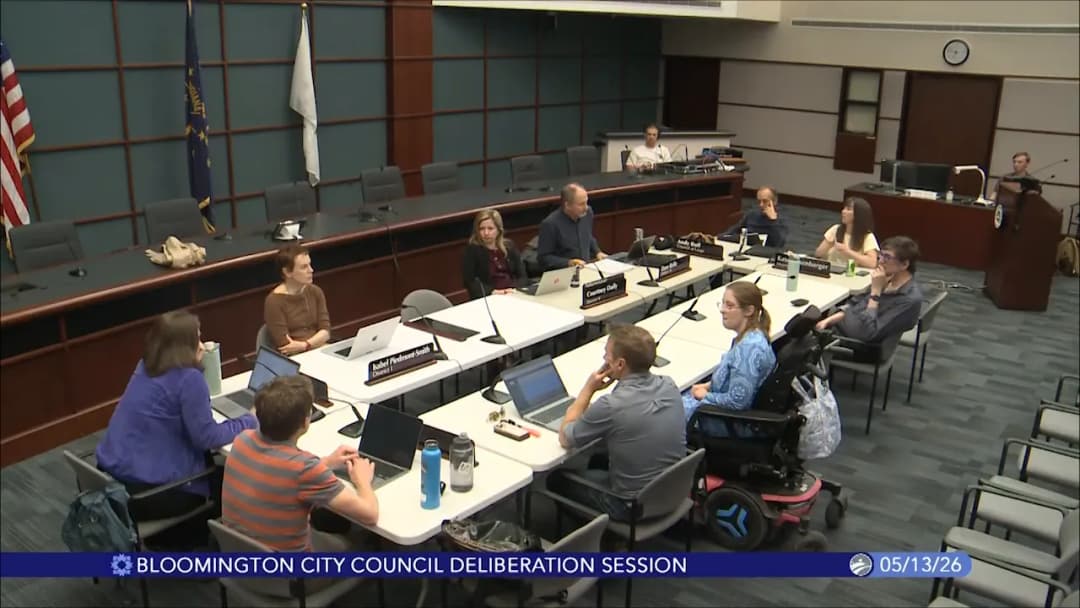
The Bloomington Board of Zoning Appeals (BZA) convened on Thursday, July 24, 2026, at 6:28 PM local time to hear three expedited petitions, three regular petitions, and one continuance. The meeting covered conditional uses, variances for driveway width, impervious surface, sidewalk installation, build-to line, and sign standards. The board also addressed a public notification defect and received public testimony. Consent Calendar - Minutes from the June 25, 2026 meeting were approved by a vote of 3-0-1 (Smith abstained). Public Comments & Testimony - Leo Pilachowski (adjacent property owner at 720 South High Street) notified the board that the required public notice sign for 716 South High Street was not visible 21 days prior to the hearing. He stated he did not object to hearing the petition but wanted the defect noted to preserve his rights. - Jennifer Long (online) expressed concerns about flood impacts from the multi-use path project at 2101 East Covenant Drive and 1213 South High Street. She requested a no-rise certification, drainage studies, and mitigation measures. She later emailed her full comments. - Leo Pilachowski also spoke on the 716 South High Street variance, asking that any required shrubs be planted at least 5 feet inside the property line to avoid blocking the vision clearance triangle. - Pamela Hurt (adjacent resident) spoke on the 1219 West East Branch Road petition, voicing concerns about setbacks, utility lines, potential flooding, and whether the home would be rental or owner-occupied. Discussion Items Expedited Agenda - ZR 2026-06-0032 (2101 East Covenant Drive / 1213 South High Street) – Conditional use for development within the floodway and floodway fringe as part of the High Street Multi-Use Path Project. Staff found all criteria met. Petitioner Neil Copper (Engineering) stated the project is a priority in the city’s transportation plan and uses federal funding. Approved 4-0 with condition requiring floodplain development and site development permits. - ZR 2026-06-029 (120 South Walnut Street) – Variance from sign standards to allow a 13-square-foot wall sign on the second floor for a tenant (Merchant Bank) due to historic architectural elements on the first floor. Staff recommended approval. Approved 4-0 with condition that approval applies to current and future users of the tenant space. Regular Agenda - ZR 2026-06-025 (716 South High Street) – Variances from driveway width (max 18 ft) and impervious surface coverage (max 40% in R2 zoning). The property currently has 55% impervious surface. Petitioner Carly Swift proposed a parking/turnaround area for safety on busy High Street. Staff recommended a 20x20 ft pad with six shrubs. After debate, board approved a modified motion: maximum 20 ft width, 360 sq ft, two parking spaces, no shrubbery. Vote: 3-1 (Throckmorton dissenting). - ZR 2026-06-027 (1219 West East Branch Road) – Variances from required sidewalk installation and front build-to line (15 ft) for a new single-family home. Staff recommended approving the build-to line variance (due to a water main easement) but denying the sidewalk variance. Petitioner Sable Byers noted the payment-in-lieu committee does not meet until September 28, 2026. Public comment raised concerns. Board approved the build-to line variance and denied the sidewalk variance, requiring sidewalks on both frontages per staff conditions. Vote: 4-0. - ZR 2026-06-030 (3430 West Third Street) – Variance from drive-through sign standards in MC zoning (max height 5 ft, max sign area 12 sq ft) to allow a 71-inch-tall, 20-sq-ft electronic message center. Staff recommended denial, noting the UDO now allows drive-through signs and the petitioner could comply with existing standards. Petitioner Christina Blackwell (Crew Car Wash) argued the sign is operational, not advertising. Denied 3-1 (Cosinko dissenting). Key Outcomes - ZR 2026-06-0032: Approved (4-0). Conditional use granted for floodway development with permits required. - ZR 2026-06-029: Approved (4-0). Variance for wall sign on second floor. - ZR 2026-06-025: Approved as amended (3-1). Variances for driveway width and impervious surface, limited to 360 sq ft, 20 ft width, 2 parking spaces, no landscaping required. - ZR 2026-06-027: Approved (4-0). Build-to line variance granted; sidewalk variance denied (sidewalks required). - ZR 2026-06-030: Denied (3-1). Sign variance not granted. - Continuances: ZR 2026-07-003 (530 South Washington Street) continued to August 27, 2026; ZR 2026-05-022 and ZR 2026-07-05 (412 East Wiley Street) continued.
Public Meetings - Bloomington, Indiana
Public Meetings - Bloomington, IndianaThe Bloomington City Council met on July 23, 2026. The raw transcript opens with a reference to "Wednesday, July 22nd," but the meeting date used here is 2026-07-23 as provided. The council received reports and human rights awards, held first and second readings, tabled one resolution, authorized Bloomington Housing Authority bonds, and failed to override the mayor's veto of the carless Kirkwood ordinance. No minutes were presented for approval, so there was no consent calendar. Council Reports & Mayor's Presentation - Councilmember Stasberg reported on summer travel to Belize, saying infrastructure differences such as "sleeping policemen" speed bumps showed that communities adapt to different tools and that success can look many ways. - Councilmember Piedmont Smith expressed dismay that a land swap between the city redevelopment commission–owned College Square site and the CIB-owned Seminary Point site appeared to have fallen through because the two bodies issued requests for proposals on different timelines. - The council president (also transcribed as Councilmember Zulik/Asari) expressed concern about the Bloomingtonian's Facebook page being taken down by an AI bot without process, welcomed its reinstatement, and encouraged community support for local journalism. He also reported a suspected hate crime at People's Market's greenhouse, stated opposition to all forms of violence, and called for policy and economic responses. - Emma Williams, chair of the Bloomington and Monroe County Human Rights Commission, presented the 2026 Human Rights Awards: Melanie Davis received the individual award for LGBTQ+ advocacy, including founding the Front Door LGBTIQ Center; Mother Hubbard's Cupboard received the organizational award for food access and dignity. Public Comments & Testimony (First Period) - County Commissioner Madeira and County Commissioner President Julie Thomas requested the council's support for an expedited combined jail/justice facility (transcribed as "GL facility") on the Hopewell property. They said the county cannot wait for a full plan commission and city council review because that would add at least nine months. They asked for referral to the city's redevelopment commission, copies of geotechnical studies, and said they are open to purchasing the property or a land swap involving the Thompson property. - Chris Remgie, of the Greater Bloomington Chamber of Commerce, said the city's audit of development review and permitting confirmed members' experiences: excessive review times, poor coordination, conflicting comments, inconsistent code interpretations, and a culture of mistrust where reviewers acted as "gatekeepers rather than collaborators." He said the city appears appropriately staffed, called for improved coordination and a "path to yes," and welcomed new plan department leader Lynn Coyne. He cited an example of a small business facing $130,000–150,000 in exterior/site costs for adaptive reuse. - Megan Betts, of Mother Hubbard's Cupboard, invited the council to summer programs, including kids' garden, kids' cook, fermentation and sourdough workshops, and garden work days. First Reading: Fire Merit Commission Ordinance (2026-15) - Ordinance 2026-15 amends Title II of the Bloomington Municipal Code to delineate duties between the Board of Public Safety and the statutorily created City of Bloomington Fire Merit Commission. Attorney Allen explained that state law changed to add merit board systems for police and fire, the police department opted to continue with the Board of Public Safety, and the fire department adopted the merit system, so the code needed updating. - Wes Martin, president of Local 586 PAC (the firefighters union), spoke in support, saying the union welcomes additional oversight over promotions and disciplinary action. - The council advanced the ordinance to second reading at the July 29, 2026 meeting with no opposing votes. Resolution 2026-12: Alcohol Permit District Rules – Tabled - Resolution 2026-12 would establish rules, procedures, and public interest guidelines for alcoholic beverage permits where the city has authority, discretion, or influence. After introduction, a councilmember moved to table the resolution indefinitely. The motion passed 8-0. Resolution 2026-13: Bloomington Housing Authority Bond Authorization (Second Reading) - Nathan Ferrera, executive director of the Bloomington Housing Authority (BHA), and Chris Cashman, bond attorney from Ice Miller, presented the resolution. It authorizes BHA to issue up to $100 million in bonds to acquire five properties from Hometown Group: Woodland Springs, Basswood, North Crest, Kingston Manor, and Summit Point, totaling 924 units of workforce housing. - The resolution synopsis states rents are at or below 100% of area median income; Ferrera clarified that the target is an average of 100% AMI with a ceiling of 140% AMI. The bonds are authorized with interest not exceeding 9% and a maximum term of 45 years, but the authority is modeling interest around 4.75%–6.75% and a 10-year term. BHA plans to assume roughly $65 million in existing Fannie Mae debt, with a purchase price around $72 million, which could make the actual bond issuance about $32 million. - The bonds are payable solely from project revenues and surplus BHA funds, are not city obligations, and do not count against the city's bond limit. Ferrera said approximately $9 million in capital expenditures will address code violations, roofs, exteriors, and staircases; renovations may take up to two years. He projected about $1 million in annual revenue after construction and said future LITEC or RAD conversions could create deeper affordability. - Councilmembers asked about repayment timelines, risks, displacement, property tax exemption, due diligence, and why city council approval is required. Ferrera said appraisals and final pro formas are still in progress and that if the deal does not cash flow, there is no path forward. Legal counsel advised that the resolution sets outside parameters to allow flexibility when marketing the bonds. A councilmember raised concern about language saying bonds "shall be payable from the proceeds of bonds"; counsel said it should be read conjunctively and could be revised to say "in part." - Public comment included Mary Morgan, BHA board member and executive director of Heading Home of South Central Indiana, who voiced full-throated support. Randy Cassidy, a citizen, questioned the loss of about $830,943 per year in property tax revenue if the properties become tax-exempt. Kevin Keogh, an online commenter and CPA, urged the council not to "fly blind" without an independent appraisal, multi-year operating proformas, and an independent risk assessment, saying "Good intentions do not pay off bonds. Sound math does." - The resolution was adopted on an 8-0 roll call vote. Second Reading: Carless Kirkwood Ordinance 2026-12 (Veto Override) - Co-sponsors Councilmember Rosenbarger and Councilmember Daly presented Ordinance 2026-12, which would codify a seasonal carless schedule for specific blocks of Kirkwood Avenue and give businesses predictability to invest in outdoor infrastructure. The council considered an override of the mayor's veto. - Councilmember Rosenbarger cited public support data, including 90% of respondents to pop-up "puffball" surveys during Safety Week favoring permanent or seasonal car-free Kirkwood. She said the Sustainability Commission recommended unanimously and the Transportation Commission recommended 5-1, though she initially said the Transportation Commission vote was unanimous. She also described Indiana's Creating Places matching grant program as a low-cost way to activate public spaces. She acknowledged the ordinance did not appear to have enough votes to override the veto. - Councilmember Daly said the sponsors agreed to press pause after the veto but brought the ordinance forward after continued community outreach; he voted yes and said work would continue. - Councilmember Flaherty strongly supported the proposal, arguing it is a "street conversion" rather than a street closure, that pedestrian zones improve accessibility when designed properly, and that the best data show overwhelming support. He noted Kirkwood is part of the high-injury network for vulnerable road users and said the council should lead on the issue. - Councilmember Zulik (Asari) urged colleagues to support the ordinance, saying inaction erodes confidence in local government and that the ordinance could be amended over the next year. - Councilmember Stasberg voted no, saying success depends on administration and city department buy-in, and suggested starting with a smaller pilot block. - Councilmember Rallo said he had supported the measure previously but was reversing his vote to no, calling for collaborative deliberation sessions and more community input rather than an adversarial veto override. - Councilmember Ruff voted no, saying he had heard significant opposition from businesses and residents, was not convinced of the sustainability or safety benefits, and believed the burden of proof had not been met. - Councilmember Piedmont Smith voted no, citing limited city budgets, state revenue cuts, and the need for dedicated funding such as parking meter revenue before committing to ongoing activation costs. - Public comment: All Russell said the issue is not over and appreciated the mayor's listening session. Steve Volan, a Transportation Commission member, corrected the commission vote to 5-1 and argued that parking meter rate adjustments could generate significant revenue for a downtown circulator or Kirkwood activation. Buff Brown, online, urged a yes vote, said "This will work, and the earlier you start the better," and criticized council members he called "establishment Democrats" for blocking change. - The veto override failed on a 4-4 roll call vote. Voting yes: Councilmember Flaherty, Councilmember Zulik (Asari), Councilmember Daly, and Councilmember Rosenbarger. Voting no: Councilmember Stasberg, Councilmember Piedmont Smith, Councilmember Rallo, and Councilmember Ruff. The mayor's veto therefore stands. Key Outcomes - The 2026 Human Rights Awards were presented to Melanie Davis and Mother Hubbard's Cupboard. - Ordinance 2026-15 (Fire Merit Commission) was introduced and advanced to second reading on July 29, 2026. - Resolution 2026-12 (alcohol permit districts) was tabled indefinitely by an 8-0 vote. - Resolution 2026-13 (BHA bond authorization) was adopted by an 8-0 vote, authorizing up to $100 million in bonds for the acquisition of 924 housing units. - Ordinance 2026-12 (carless Kirkwood) failed to override the mayor's veto on a 4-4 vote; the veto stands. - The county commissioners' request regarding the Hopewell justice facility was received during public comment; no formal council vote was taken on the request itself.
The Board of Zoning Appeals (BZA) held its regular monthly meeting on July 10, 2026. The board approved multiple variance petitions, including one after-the-fact variance for vegetation removal on a slope, and discussed court-ordered findings for a prior conditional use case, which was continued to the August meeting. Consent Calendar - Approval of minutes from April and May 2026 was stricken from the agenda due to unavailability. Public Comments & Testimony - VAR-26-21 (Chamness, Eco Area 2, 15% slope encroachment): Petitioner Charles Chamness and his wife Bridget testified, expressing regret for removing trees without knowledge of slope restrictions. They described their stewardship of the 80-acre property, including enrollment of 77 acres in the Indiana Classified Forest Program and efforts to remove invasives. The petitioners asked the board to weigh the good-faith error against their conservation record. Scott Pardeaux, a neighbor and surveyor, spoke in favor, stating that the tree removal was done responsibly with a forestry mulcher and that no soil disturbance occurred. No members of the public spoke against the petition. - For all other variance petitions, no members of the public expressed opposition. Discussion Items - VAR-25-52A (Donovan, Buildable Area in Special Flood Hazard Area): Staff recommended approval with a condition requiring as-built elevations of the gravel parking area. Petitioner Stephen Donovan agreed to the condition. The board approved unanimously. - VAR-26-19 (Sullivan, Maximum Impervious Cover): Staff recommended approval with no conditions. The board approved unanimously, citing demonstrated practical difficulties. - VAR-26-21 (Chamness, Eco Area 2, 15% Slope Encroachment): This was an after-the-fact variance for removal of vegetation on slopes over 15%. Staff recommended denial, noting that the removal was injurious to public health and safety. However, after testimony from the petitioners and their surveyor, the board discussed the unique circumstances. Board member Skip Daily noted that the land had been previously logged and that the petitioners showed integrity. A motion to approve with an added condition to stabilize slopes passed 4-0. - VAR-26-22 A-D (Upchurch, Multiple Variances): Four variances for height, one-acre contiguous buildable area, 15% slope encroachment, and residential density. Staff recommended approval. The board approved unanimously. - VAR-26-23 (Ola Varieta, Residential Density Maximum): Staff recommended approval. The board approved 3-0 (Margaret Clements absent). - VAR-26-24 (McBride, Front Yard Setback): Staff recommended approval. The board approved 3-0. - Court-Ordered Findings for Bedford Recycling CDU-21-3: The trial court remanded the case for findings on two issues: (1) whether Republic Services is an abutting property owner requiring notice, and (2) whether Bedford Recycling submitted proof that certified mail notices were delivered or returned undeliverable. Staff attorney Schilling explained that the record lacks sufficient evidence to determine either issue. The board discussed the difficulty of making findings on an incomplete record. After discussion, the board voted to continue the matter to the August 5, 2026 meeting to allow members to review the record. Key Outcomes - VAR-25-52A (Donovan): Approved 4-0 with condition to provide as-built elevations. - VAR-26-19 (Sullivan): Approved 4-0. - VAR-26-21 (Chamness): Approved 4-0 with condition to stabilize slopes to prevent erosion. - VAR-26-22 A-D (Upchurch): Approved 4-0. - VAR-26-23 (Ola Varieta): Approved 3-0. - VAR-26-24 (McBride): Approved 3-0. - Bedford Recycling CDU-21-3: Continued to the August 5, 2026 meeting for further review and vote on findings.
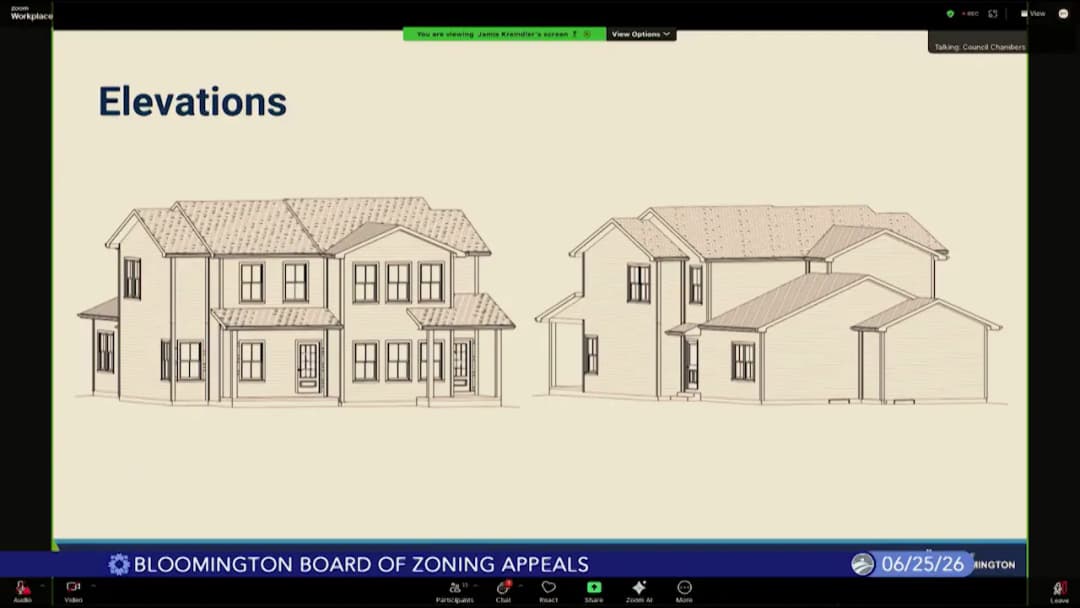
The Bloomington Board of Zoning Appeals (BZA) met on June 26, 2026 (per meeting metadata; the raw transcript references "June 20th" – a date discrepancy is noted). The board approved the minutes from May 28, 2026, and considered three petitions: a variance for ten freestanding signs at the Novo Nordisk campus on South Patterson Drive, a variance for increased wall signage at Crumble Cookies on South College Mall Road, and a conditional use application for a duplex at 412 East Wiley Street. The first two petitions were approved unanimously; the third was continued to a future meeting. Consent Calendar - Minutes of May 28, 2026: Approved unanimously (Burrell, Fernandez, Kazinko all yes). ZR 2026-05-0020 – 1300 South Patterson Drive (Novo Nordisk Sign Variance) - Request: A variance from UDO sign standards to allow 10 freestanding signs instead of the permitted 4 on a large manufacturing campus (part of the Thompson PUD). The property has 3,000–4,000 linear feet of road frontage and multiple access points. - Staff Report: Staff recommended approval with three conditions, including landscaping around perimeter signs and reducing the height of an internal south parking area sign from 7 feet 6 inches to 6 feet. Staff found no threat to public health/safety/welfare, no adverse impact on adjacent properties, and that practical difficulties were peculiar to the property's size and multiple frontages. - Petitioner: Kenton Pardu of Pledge Hogreaker Cooper James, representing Novo Nordisk, and Brian Rails. They supported the staff conditions and stated the signage is needed to direct trucks and employees, prevent safety hazards from trucks backing onto public rights-of-way, and clarify public vs. private roads. - Public Comment: None. - Board Action: Motion to adopt staff findings and approve with conditions passed unanimously (Burrell, Fernandez, Kazinko yes). ZR 2026-05-002 – 1155 South College Mall Road (Crumble Cookies Sign Variance) - Request: A variance to increase the wall sign allowance for a multi-tenant center. The tenant space is 27 feet wide, allowing 40.5 square feet of wall signage. Crumble proposed two new wall signs (front and rear elevations), each about 40 square feet, for a total of 79.74 square feet – exceeding the allowance by 39.24 square feet. The petition number is transcribed as "ZR 2026-05-002." - Staff Report: Staff recommended denial. A 2021 permit allowed only one 40.5-square-foot sign, although plans showed two signs. Staff found no peculiar condition of the property and stated the UDO contemplates this scenario. - Petitioner: Thomas Hopkins, Sign Solutions, representing Crumble. He said they are rebranding and replacing existing signs of nearly identical size; the signs have been in place for five years without safety issues. - Public Comment: Betty Rosenagle spoke in support, saying the signs help people find the business and the objections lacked "common sense." - Board Discussion: Board members questioned staff on whether a reface of the existing signs would be acceptable (staff said yes if the cabinet remains). Board member Burrell moved to amend finding 2 to state "adverse impacts ... are not found" and amend finding 3 to state strict application "will result in practical difficulties" (deleting "not" from the original finding), citing the building elevation and landscaping along College Mall Road making UDO-compliant signage ineffective. The board approved the amended findings and the variance. - Board Action: Motion to adopt amended findings and approve variance passed unanimously (Burrell, Fernandez, Kazinko yes). ZR 2026-05-0023 – 412 East Wiley Street (Duplex Conditional Use) - Request: Conditional use approval for a two-story duplex with two 3-bedroom, 3-bath units (6 bedrooms, 6 baths total) in an R3 residential zoned neighborhood (Bryan Park). The lot currently has a single-story single-family home. Infrastructure includes an unbuilt right-of-way for South Palmer Avenue; the alley to the south is unimproved. The plan includes 4 parking spaces (the maximum allowed), a 9-foot driveway off East Wiley, and street trees. The property is not historic; no closed canopy was found. - Staff Report: Staff recommended approval with two conditions. Staff found the proposal consistent with UDO design standards: roof pitch, porch width/depth, setback, and parking access similar to surrounding properties; the single-story block face had no other duplex within 150 feet. The petitioner met with neighborhood associations jointly on May 7, 2026, and revised the plan to add a 6-foot privacy fence. - Petitioner: Kevin Spicer. He noted he sought to avoid any variances, including not requesting additional parking and keeping the 15-foot setback (closer than existing homes) to remain code compliant. - Public Comment: Many residents opposed the petition: - Jane St. John (408 East Wiley) said the duplex is not similar in shape/size to the single-story homes on the block and is "disproportionate and oversized." - John Lawrence presented an exhibit of the seven homes on the block face, arguing the 2-story duplex fails UDO 20.03.030 B3C2 (similar in general shape, size, and design) and read a proposed finding of fact into the record. - Jan Sorby argued the UDO's design standards are not a simple checklist and that the setback should match the block's established pattern rather than the minimum. - Corey Gerhardt (two doors from the site) said the street is too narrow for parking on both sides and staff's on-street parking statements were misleading. - A resident cited a letter from Councilwoman Piedmont Smith recommending denial, noting the street's 22.5-foot pavement width and insufficient 12-foot travel lanes with parking. - Julie Vonderschmidt called it a "predatory demolition project" designed as high-density rental, inconsistent with affordable homeownership. - Jody Adkins (401 East Dodge) expressed concern about parking overflow blocking the dead-end easement behind her home and access for utility companies. - Kim Vint referenced past approvals of similar duplexes that worsened parking/traffic. - Sarah St. John Wolford (Housing Solutions Director, Habitat for Humanity) seconded concerns about homeownership opportunity. - Andrew Ruff argued approval would undermine trust in government and the conditional use process. - Tatiana Moir cited pedestrian safety on the narrow street. - Kyle Parker, a Bryan Park resident, said he loves the neighborhood and worries about cumulative impacts of duplexes. - Board Discussion: Burrell expressed concerns about scale and infrastructure; Fernandez noted the code allows 3 bedrooms per unit. Staff clarified the building's 15-foot setback is from the property line, not edge of pavement, and the block face is defined from Dunn to Grant along the south side of Wiley. A motion to approve with staff findings failed (Burrell yes; Fernandez no; Kazinko no). - Board Action: Burrell then moved to continue the petition to the next BZA meeting to allow the petitioner and staff to discuss scaling back the unit size and to have the full board present. Fernandez seconded. The motion passed unanimously (Burrell, Fernandez, Kazinko yes). The petitioner is expected to return with possible design changes. Key Outcomes - Approved unanimously: ZR 2026-05-0020 (Novo Nordisk sign variance) with three conditions. - Approved unanimously: ZR 2026-05-002 (Crumble Cookies sign variance) with amended findings. - Continued unanimously: ZR 2026-05-0023 (412 East Wiley duplex) to a future BZA meeting; the petitioner will work with staff on possible revisions (e.g., reducing unit size/bedrooms) and the board will include additional members.
The Bloomington Common Council held a marathon regular meeting on June 11, 2026, covering the 2025 tax abatement compliance report, a resolution on existential AI risk, a controversial ordinance to make carless Kirkwood seasonal and permanent, and several other items. The meeting included extensive public comment and multiple votes, including a split 5-4 decision on Kirkwood. Reports and Presentations - Tax Abatement Compliance Report and PILOTs: Director Jane Cooper Smith and Assistant Director Andrea Delarosa presented the 2025 Tax Abatement Compliance Report (unanimously approved by the Economic Development Commission on June 2, 2026) and information on active PILOT agreements. - Economic impact: New real and personal property investment increased assessed value from $164 million to $203 million. Projects reported 1,938 total jobs and $152 million in salaries. While some projects fell short on job targets, several exceeded wage projections (e.g., Catalant's average full-time wages around $81,000). - Affordable housing outcomes: New Urban Station provides 15 affordable units (tenants' average AMI 41.75%, average rent $815/month); Southern Knoll has 31 units at 28% AMI and 94% occupancy; Union at Crescent is a 146-unit mixed-income development with 102 units committed at ≤60% AMI, where property management reverted to the Annex Group in March 2025, $1 million was spent on capital improvements, and staff recommended substantial compliance. - Other projects: Retreat at Switchard (64-unit affordable housing, with units reserved for Stone Belt clients), Woolery Mill (historic redevelopment with $4.3 million invested; 60 jobs created), and Catalant/Novo Nordisk (1,867 employees; staff recommended compliance for resolutions 1506/1904 and substantial compliance for 2206 with continued monitoring). - Active PILOTs: Evergreen Village (115-unit care facility), Country View (206 affordable apartments, active and compliant), Cambridge Square (153 units; interiors completed, stair repairs ongoing), and Henderson Court (150 units; interiors completed, remaining exterior work). Council Committee Reports - Hiring Committee (Councilmember Zulik): Received five applications for the council attorney position; interviews will occur over the break. Councilmembers Flaherty and Rosenbarger were appointed as alternates to maintain quorum. - Fiscal Committee (Councilmember Stasberg): Provided a written summary of the committee's activities, including meetings every two weeks alternating administrative and council-related topics. Public Comments & Testimony - First period: No speakers. - Resolution 2026-10 (AI): Jamie Scholl spoke in support, describing her son's experience and urging oversight. Another speaker expressed anti-AI and anti-government sentiments. Paul Rousseau spoke in favor, calling for democratic control and a decentralized collective response from city councils. - Ordinance 2026-12 (Carless Kirkwood): More than a dozen speakers commented both for and against. Supporters included Zach Amberman, Ted Pauly, Claire Woods, Joan Middendorf, Alex York, Tessa Donahue, and the Yoder family (via email), who cited safety, community, and third places. Opponents included Hart Martel (34-year merchant), Chris Firmgy (Chamber of Commerce), Chris Durbaum, Carol Canfield, John Santos, Paul Gillard (former Kirkwood restaurant owner), and a business manager, who cited accessibility, loss of parking, business viability, and lack of funding. Hilary Martell expressed nuanced concerns about creating a true pedestrian mall without significant investment. Jamie Scholl read Facebook comments illustrating community concerns about accessibility and business impact. - Resolution 2026-09 (Mitigation Plan): No public comment. - Ordinance 2026-13 (Utility Loans): No public comment. - Resolution 2026-11 (Jack Hopkins): Carol Canfield spoke against funding Planned Parenthood; Joan Middendorf spoke in support of Planned Parenthood. - Resolution 2026-12 (Alcohol Permits): Steve Volan, Aubrey Williams (Heartwork Brewing), Galen Cassidy (Uptown Cafe), and Christopher MG (Chamber of Commerce) all supported the resolution with suggestions; Williams asked for a waiver for local producers. - Ordinance 2026-14 (Sponsorship): No public comment. - Final comment: Jamie Scholl discussed food resilience and the need to strengthen local food systems. Discussion Items - Resolution 2026-10 (Existential Risk of AI): Councilmember Rallo presented extensively, including a video from economist Peter Berizen and remote testimony from Dr. Anthony Geary of the Future of Life Institute. Council discussed the local relevance and the mayor's stance. Passed unanimously. - Ordinance 2026-12 (Carless Kirkwood): Sponsors introduced amendment one (removing alleys, changing whereas clauses, setting effective date of April 21, 2027), which passed unanimously. Transportation Commission Chair Steve Volan reported a 5-1 positive recommendation after rejecting staff's negative recommendation. Council debated funding, accessibility, and business impacts. Final passage was 5-4 (Rallo, Rosenbarger, Flaherty, Asari, and Daly voting yes; Ruff, Stasberg, Piedmont Smith, and Zulik voting no). - Resolution 2026-09 (Multi-hazard Mitigation Plan): Presented by Jamie Nevil of Monroe County Emergency Management. Councilmembers raised concerns about errors and representation. Passed unanimously. - Ordinance 2026-13 (Loans Between Utilities): Adopted after an amendment by Councilmember Stasberg to clarify the code language; both amendment and ordinance passed unanimously. - Resolution 2026-11 (Jack Hopkins Social Services): Councilmember Daly presented the committee's recommendation to allocate $499,995.63 to 35 agencies (two agencies denied). Council discussed operational expenses and Planned Parenthood funding. Passed unanimously. - Resolution 2026-12 (Alcohol Permit Districts): Councilmember Asari presented; much discussion centered on discretionary criteria, living wage requirements, and the 60% food revenue threshold. After public comment, the council voted to postpone consideration to the July 22, 2026 meeting (unanimous). - Ordinance 2026-14 (Councilmember Sponsorship of Legislation): Sponsored by Councilmember Piedmont Smith; discussion addressed transparency and process. Passed on a roll call vote, with Councilmembers Asari and Rosenbarger voting no. Key Outcomes - Approved the 2025 Tax Abatement Compliance Report (unanimous). - Adopted Resolution 2026-10 on AI existential risk (unanimous). - Adopted Ordinance 2026-12 as amended, codifying seasonal carless Kirkwood (5-4). - Adopted Resolution 2026-09 (Multi-hazard Mitigation Plan) (unanimous). - Adopted Ordinance 2026-13 as amended (unanimous). - Adopted Resolution 2026-11 (Jack Hopkins funding) (unanimous). - Postponed Resolution 2026-12 (alcohol permit districts) to July 22, 2026. - Adopted Ordinance 2026-14 (council sponsorship requirement) (7-2). - No consent calendar, minutes approval, or board appointments occurred.
The Bloomington Common Council met on Thursday, June 4, 2026, at 4:54 PM. The meeting included reports from council members and commissions, first and second readings of ordinances, and extensive public comment. Key topics included a letter to the Redevelopment Commission regarding the College Square site, a proposal for a seasonal carless Kirkwood Avenue, and a new requirement for councilmember sponsorship of legislation. Reports from Council Members - Councilmember Piedmont Smith read a letter to the Redevelopment Commission (RDC) signed by a majority of council members. The letter clarifies that the council is not opposed to the RDC disposing of the College Square site for less than the $6,895,000 purchase price if significant public benefit is gained, such as affordable housing. It recommends considering a land swap with the Capital Improvement Board (CIB) to exchange College Square for Seminary Point property, enabling preservation of affordable housing and allowing a convention center hotel. Councilmember Piedmont Smith noted that the vision requires a full land swap to preserve Seminary Point as affordable housing, commercial property, and community space. - Councilmember Stasberg recognized June as Pride Month and encouraged involvement with Bloomington Pride. She also raised constituent concerns about affordable housing, livable communities, and traffic enforcement. - Councilmember Zulik echoed Pride Month remarks, reminding that the first pride celebration was a riot and encouraging “good trouble.” Reports from Commissions - Commission on Aging (Chair Dana Thompson): Presented highlights including updated senior resource guides (medical and non-medical), a “Senior Living 101” seminar, and efforts to make Bloomington a dementia-friendly community. The commission plans to continue the seminar, offer dementia-friendly training to city offices, and launch a project highlighting older artists. Transportation and accessibility were identified as key gaps for older adults. - Commission on the Status of Women (Commissioner Cece Swalline and City Liaison Marissa Parr Scott): Presented the 2025 annual report, noting the Women’s History Month Luncheon, the third annual women’s market (30 vendors, hundreds of attendees), and the Young Women’s Leadership Summit. The commission focuses on legislation, community partnerships, and communication. They collaborate with MCCSC for the summit. Monitoring state legislation affecting women is a priority. Public Comments & Testimony - On the College Square letter: - Bryce Green (Bloomington DSA and Bloomington Homes for All) thanked the council and urged continued pressure on the RDC and CIB to act quickly before lease deadlines (August 31st) force tenants and businesses to leave Seminary Point. - Barry Herbers (neighborhood resident) expressed support for preserving Seminary Point’s affordability and community feel. - Matthew (therapist and Homes for All member) highlighted that the land serves households at 30–40% AMI and includes flourishing businesses. He noted that negotiations between RDC and CIB have not occurred publicly and stressed urgency. - On Ordinance 2026-14 (sponsorship): - A member of the public expressed concern that the sponsorship requirement would create a barrier to public access to the council agenda, reduce transparency, and disincentivize public discourse. - Dave Askins (B Square Bulletin) asked seven questions, including whether the proposal would restrict resident-drafted ordinances, whether it addresses the real problem (administration lack of clarity), and why alternative solutions (e.g., earlier posting of materials) were not considered. - Zach Amberman spoke in favor, calling it uncontroversial and a way for the council to assert authority. - On Ordinance 2026-12 (carless Kirkwood): - Jim Norring (Downtown Bloomington Inc. board president, business owner) opposed the closure, stating downtown businesses are “pretty overwhelmingly against this.” He mentioned a four-year revitalization plan being developed with the city. - Zach Amberman (Vice Chair, Commission on Sustainability and Resilience) read recommendations in favor of permanent year-round closure, citing success in other cities (Charlottesville, Boulder, Burlington). He urged studying those cities and reframing the program as public space and sustainable transportation, not just outdoor dining. - Hillary Martell (co-owner of Hartzell’s Ice Cream) opposed closure, citing lack of parking downtown, especially during IU sessions, and that last summer’s experiment resulted in unused picnic tables and underutilized space. She argued it benefits only a few restaurants. - Chris Stirbaum (online) noted historical failures of pedestrian malls (400 attempts, only a dozen left) and said Bloomington lacks the density and parking turnover needed for success. - Paul Rousseau (online) supported continued momentum for a seasonal car-free Kirkwood, saying it enables street events and that parking concerns are overblown given proximity to campus. - Christer MG (Greater Bloomington Chamber of Commerce) cautioned that a 7.5-month closure is not a pilot. He urged a cost-benefit analysis, funding plan, and daily management before codification, noting other city assets (e.g., Bryan Park pool, Frank Southern Ice Arena, Winslow Sports Park) need investment. Discussion Items - Letter to Redevelopment Commission (College Square): After councilmember presentations, a motion to allow public comment passed 8-0. Council members debated the letter, with some supporting the land swap to preserve affordable housing, others (e.g., Councilmember Flaherty) expressing concerns about setting a precedent for additional public subsidy to the convention center. The letter was approved unanimously (8-0) after a motion and roll call vote. - Ordinance 2026-13 (Loans Between Utilities): First reading. Director of Utilities Catherine Zager presented the ordinance to create cash reserve funds allowing loans between water and wastewater utilities, following Indiana Code. The immediate need is a loan from wastewater to water (estimated up to $4 million) to cover a deficit while awaiting a water rate case decision. Council members asked about interest rate (none intended), risk of subsidy, and oversight (by the Utility Service Board). Attorney Chris Wheeler (via Zoom) clarified the language mirrors the statute. The ordinance was moved to second reading on June 10, 2026 (8-0). - Ordinance 2026-14 (Councilmember Sponsorship of Legislation): First reading. Sponsored by Councilmember Piedmont Smith, the ordinance would require every proposed ordinance or resolution (except budget and appropriation ordinances) to be sponsored by a council member. Reasoning: improves communication, prevents confusion, and follows practices in other legislative bodies. Councilmember Rallo noted sponsorship does not necessarily imply support for final passage. The ordinance was moved to second reading on June 10, 2026 (6-2-1, with Councilmembers Rallo and Ruff voting no, Councilmember Rosenbarger abstaining). - Ordinance 2026-12 (Carless Kirkwood): Second reading and discussion. The ordinance would codify seasonal closure of Kirkwood Avenue to vehicular traffic. Sponsors Councilmembers Rosenbarger and Daly presented the benefits: predictability for businesses, alignment with upcoming convention center expansion and IU events, and transformation of downtown. Councilmembers raised concerns: feasibility of immediate implementation (some support starting in 2027), cost of infrastructure (ADA features, shade, seating), impact on parking and accessibility (e.g., Stone Belt’s bus access to library), and the need for a comprehensive plan. Councilmember Zulik noted that downtown businesses are overwhelmingly opposed. Deputy Mayor Matt Knapp cautioned that successful pedestrian malls in other cities have larger budgets, more police officers, and less student populations; 89% of such projects fail. Director of Planning and Transportation Andrew Sibor noted the ordinance raises two questions: whether to close Kirkwood and whether this is the right mechanism (traffic ordinance vs. use of street ordinance). The Transportation Commission will meet on June 8 to provide a recommendation. The council voted to postpone the ordinance to the next regular meeting on June 10, 2026 (7-1, Councilmember Ruff voting no). - Resolution 2026-09: A motion to introduce the resolution failed after Councilmember Stasberg objected to its late addition (120 pages added the day before). The roll call resulted in a 2-7 vote (only “yes” votes from Zulik and Sorry? Councilmember Zulik and another? Actually transcript says: Piedmont Smith no, Zurich yes, Sorry? yes, others no. So 2 yes, rest no. Motion did not carry.) Key Outcomes - Letter to RDC (College Square): Approved 8-0. The council will send the letter urging the RDC to consider a land swap with CIB to preserve Seminary Point as affordable housing, even if it means selling College Square at less than the purchase price. - Ordinance 2026-13 (Loans Between Utilities): Moved to second reading on June 10, 2026 (8-0). - Ordinance 2026-14 (Councilmember Sponsorship): Moved to second reading on June 10, 2026 (6-2-1). - Ordinance 2026-12 (Carless Kirkwood): Postponed to the next regular meeting on June 10, 2026 (7-1). The Transportation Commission will provide a recommendation on June 8 at 7 p.m. - Resolution 2026-09: Failed introduction due to insufficient votes. - Future Schedule: A fiscal committee meeting is set for June 12 to discuss sanitation rates. A special joint session with the county council may be scheduled. A hiring committee meeting will be arranged before the council’s summer recess.
The Board of Zoning Appeals (BZA) convened on May 29, 2026, at approximately 6:44 PM to consider a consent calendar, four expedited petitions, and seven regular petitions. The meeting included public comments, staff presentations, petitioner testimony, and board deliberations. Votes were taken on all items, with the board approving most requests except one denial. The meeting lasted until approximately 9:21 PM. Consent Calendar - Minutes Approval: The board approved the minutes from the March 26, 2026 meeting unanimously (3-0). - Amended Rules and Procedures: The board approved the amended rules and procedures, incorporating the expedited agenda process, unanimously (3-0). - Staff Acknowledgement: Staff recognized former board member Tim Ballard for his service. Expedited Petitions (Unanimous Approvals) ZR 2026-23-007 – 613 North Street - Request: Variance from front and side building setback standards to allow replacement of a mobile home on an existing pad. - Petitioner: Stacy and Mike Renard. They stated they cleaned up the property, removed over 200 syringes, and intend to provide affordable housing (Section 8). - Staff Recommendation: Approval with condition that the variance is for the currently placed structure and does not allow further encroachment. - Outcome: Approved unanimously (3-0). ZR 2026-04-0014 – 122 North Roosevelt Street - Request: Conditional use for a duplex and variance from front building setback to accommodate an addition. - Petitioner: Daniel Gutierrez. He noted positive feedback from the neighborhood association. - Staff Recommendation: Approval with three conditions: rental units must be registered and inspected, and front trees must be maintained. - Outcome: Approved unanimously (3-0). ZR 2026-04-0019 – 402 West 6th Street - Request: Five variances from architectural and dimensional standards to construct two outdoor sauna buildings. - Petitioner: Emerson Orante. He deferred to staff presentation. - Staff Recommendation: Approval with three conditions. - Board Comment: Member Fernandez appreciated the petitioner's investment in a unique downtown site. - Outcome: Approved unanimously (3-0). ZR 2026-04-0016 – Peterson Drive (Allen Street to Fairview Street) - Request: Conditional use and variance for road resurfacing and sidewalk improvements within floodplain and riparian buffer. - Petitioner: Kendall Canook (City Engineering). The project is part of a $4 million maintenance program. - Staff Recommendation: Approval with one condition. - Outcome: Approved unanimously (3-0). Regular Petitions ZR 2026-02-004 – 508 North Lincoln Street (Denied) - Request: Variance from front building setback to allow a deck that was installed without a permit. - Staff Recommendation: Denial, finding no peculiar hardship; the deck was not consistent with the block face. - Petitioner: Tina Sones. She acknowledged the deck was built without permission but hoped for approval. - Public Comment: James Ford (neighbor) opposed, calling the deck a "magnet for activity" and a "caricature." - Discussion: Board members questioned consistency with neighborhood. Motion to deny and adopt staff findings passed unanimously (3-0). ZR 2026-03-010 – 1017 West 9th Street (Approved with Conditions) - Request: Variance from tree preservation standards; petitioner cleared all trees from the lot and sought to avoid planting replacement trees. - Staff Recommendation: Denial; 80% canopy coverage required, remediated with nine trees. - Petitioner: Dondra O'Plyman and Fiona Taggart. They apologized for the clearing and stated they plan to build a home with landscaping. - Public Comment: Kari Bennett (Habitat for Humanity) supported the project, noting the lot is one of few without a home. Joan Mindorf (online) supported a conditional approval. - Board Discussion: Frustration with zoning conflicts between permitted uses and tree preservation. Motion to approve with alternative findings and condition: petitioner must submit a remediation plan with at least three large canopy trees for staff approval. Passed unanimously (3-0). ZR 2026-03-001 – 250 South Pete Ellis Drive (Approved with Amended Findings) - Request: Two variances: (1) maximum parking spaces (requested 8 instead of allowed 3, plus ADA), (2) driveway width (requested 25.8 ft tapering to 12 ft instead of max 12 ft for one-way). - Staff Recommendation: Deny driveway width; approve up to 6 parking spaces (7 including ADA). - Petitioner: Jonathan Woker (McBride Dale Clarion) and Dave Cayman (property owner). Argued employee needs (up to 8 employees) and safety concerns with alternative plan. They presented a parking study. - Public Comment: Tom Orman, Brian Waltz, Dave Harstad spoke in favor, citing site constraints and redevelopment challenges. - Board Discussion: Member Fernandez proposed amending findings to approve 8 parking spaces and the driveway width, citing practical difficulties and safety issues. The motion passed unanimously (3-0) with amended conditions. CR 2026-03-0012 – 516 South Woodlawn Avenue (Administrative Appeal – Approved) - Request: Appeal of staff determination that a back portion of lot 30 is not a separate lot of record. - Petitioner: Chris Bomba (Charles Lane LLC) and attorney Bill Beggs. Argued the lot was subdivided in 1911, has separate tax IDs, and has been treated as separate. They cited the Elkins case. - Staff: Eric Grewake and Assistant City Attorney Adina Casimian argued the lot was never legally subdivided; the back half was always combined with the adjacent lot. They stated no building permit had been issued. - Board Deliberation: Members struggled with legal complexity. Motion to approve the appeal (siding with petitioner) passed 3-0, meaning the board considered the back lot a separate lot of record. ZR 2026-03-013 – 2408 Shadow Grove Court (Approved with Conditions) - Request: After-the-fact variances for steep slope, riparian buffer, and ground cover standards related to storm damage work (retaining walls, riprap, rock ground cover). - Staff Recommendation: Approval with five conditions, including removal of rock in the right-of-way. - Petitioner: Represented by attorney (name not provided). Noted the work was done to address drainage issues without prior permits. - Public Comment: Penny Given (online) raised concerns about notification, propriety of work, and enforcement. - Outcome: Approved unanimously (3-0) with staff conditions. ZR 2026-05-0021 – 410 Highland Avenue (Administrative Appeal – Approved) - Request: Appeal of staff determination that a gravel driveway/parking area exceeded allowed dimensions and had been removed and re-established. - Petitioner: Michael D. Cookman (representing owner). He asserted the gravel area had existed for decades and only needed fresh gravel; he scraped grass and added gravel, not creating a new area. - Staff: Argued that photos showed the area had become overgrown and was used for parking on grass, leading to tickets; then gravel was added, exceeding the 20x20 ft pad allowance. - Board Discussion: Member Fernandez questioned whether vegetation overgrowth constitutes removal of use. Motion to approve the appeal passed unanimously (3-0), allowing the gravel area to remain. ZR 2026-04-0017 – 2660 East 2nd Street (Approved with Amended Finding) - Request: Variance from sign standards to allow an off-premise sign (approximately 12” x 120”) on the north side of a multi-tenant building for a business located on the lower level rear. - Staff Recommendation: Denial, citing no peculiar hardship; the business has other sign options (wall sign on their space and freestanding sign panel). - Petitioner: Layla (online). She explained the rear location lacks visibility and the sign on the north side would help customers find them. - Board Discussion: Member Fernandez noted the unique configuration of the building and proposed amending the third finding to reflect practical difficulties. Motion to approve passed unanimously (3-0). Key Outcomes - Approved: All expedited petitions, ZR 2026-03-010 (with conditions), ZR 2026-03-001 (with amended findings), CR 2026-03-0012 (appeal granted), ZR 2026-03-013 (with conditions), ZR 2026-05-0021 (appeal granted), and ZR 2026-04-0017 (with amended finding). - Denied: ZR 2026-02-004 (508 North Lincoln Street deck variance). - No Public Comment: Several items had no public comment. - Next Steps: Staff will update records and work with petitioners on conditions. Some items, like the tree remediation plan for 1017 W 9th St, require further staff review.
Note: The transcript begins with the mayor stating it is Wednesday, May 20, but the instructions specify the meeting date as 2026-05-21. This discrepancy is noted. The Common Council met on May 21, 2026, beginning at approximately 5:38 PM. The meeting included reports from two commissions, first reading of an ordinance to codify a seasonal carless Kirkwood Avenue, and second readings and votes on several resolutions and ordinances related to housing affordability, sustainability, and historic preservation. Reports from Council Members - Councilmember Stasberg noted that May 21 is the last day of school for MCCSC students, congratulating students, teachers, and staff. She also announced open office hours on Saturday, May 30, at the farmers market. - Councilmember P. Mutt Smith reported on land purchased for the convention center expansion, now being deeded to the Capital Improvement Board (CIB). She noted a coalition (Bloomington Homes for All and DSA Housing Working Group) is seeking to preserve and expand affordable housing and commercial space at Seminary Point. Smith mentioned extending leases until the end of August for tenants, and that a land swap with the RDC’s College Square site has been proposed. She will work with colleagues to send a unified message to the RDC. - Councilmember Flaherty gave a follow-up on the snow removal deliberation session, highlighting that city-owned properties (e.g., College Square) also had sidewalk clearing gaps. He noted that the RDC lease puts snow removal responsibility on the tenant, but city code assigns it to the property owner. He suggested enforcement improvements. - Councilmember Zulik reminded council members to check in with their assigned board/commission liaisons as per Resolution 2025-15. - Councilmember Rallo raised concerns about infrastructure conditions, loss of owner-occupied housing to rentals, and the proliferation of data centers (citing a county pause on AI data centers until July). Commission Reports Commission on the Status of Black Males (James Sanders) Presented the 2025 annual report. Key programs: Outstanding Leaders of Tomorrow Awards (4 recipients), Black Barbershop Health Initiative (health screenings at Juneteenth, over 100 participants), National Million Father March (40+ volunteers at Fairview Elementary), Black Male Youth Summit (67 students), and Winter Wonderland (holiday event for over 100 families). The commission is now at full membership. Plans for 2026 include expanding partnerships and sustaining signature programs. Councilmember P. Mutt Smith asked about Winter Wonderland and resources; Sanders noted a budget and donations support events. Commission on the Status of Children and Youth (Aaron Reynolds Nylen) Presented 2025 highlights: SWAGGE Awards (Students Who Act Generously Grow and Earn Respect) – largest ever with 179 attendees and 23 nominations; Read for the Record (120+ shared reading experiences); participation in Million Father March and Winter Wonderland. For 2026, priorities include establishing a teen liaison and continuing partnerships. The commission secured nearly $4,000 in additional sponsorships. Councilmember Rallo asked if resources are a barrier; Nylen said funding limits, especially for SWAGGA, which operates on about $2,000 annually. Public Comments & Testimony (First Session) No members of the public signed up to speak. Discussion Items Ordinance 2026-12 – Carless Kirkwood (First Reading) Sponsored by Councilmembers Daly and Rosenbarger. This ordinance amends Title 15 to codify the seasonal closure of specific blocks of Kirkwood Avenue to vehicular traffic from April through November, making it a permanent city standard rather than a year-to-year pilot. It also includes an alley between Fourth and Kirkwood east of Walnut that is already closed. The city engineer may temporarily reopen the street in emergencies for up to 90 days. Discussion included: - Legal authority: Council Attorney Allen stated initial reading suggests council has authority, but the administration may have a differing viewpoint. A legal memo was requested. - Timeline: Sponsors hope to implement partially this season; Director Cooper Smith noted current parklet investments and programming plans, expressing concern about immediate full closure. - Accessibility: Councilmember Zulik raised issues with First Christian Church and Stone Belt access via Kirkwood; outreach to the Council for Community Accessibility is ongoing. - Public comment: Several speakers supported the ordinance, arguing it enhances quality of place and encourages investment. Others opposed, citing loss of parking, library access, and lack of infrastructure. The Chamber of Commerce urged careful planning before permanent closure. - The Transportation Commission will discuss the ordinance as an agenda item on June 8, with potential recommendation. - The motion to move to second reading on June 3 passed 9-0. Resolution 2026-05 – UDO Amendments for Sustainability and Affordability (Second Reading) Councilmember Flaherty presented a resolution directing the Plan Commission to consider amendments to the Unified Development Ordinance (UDO) regarding: 1) reduction of minimum lot widths, areas, and setbacks; 2) sustainability incentives for building electrification; and 3) elimination of minimum parking requirements. An amendment (1a) corrected a code citation and bifurcated the plan commission process (60 days for public hearing, then 60 days to vote). Discussion focused on policy aims to enable smaller homes, reduce housing costs, and promote electrification. Public comment: One speaker opposed, citing potential negative impacts on neighborhood character and parking. Another supported, urging comprehensive reform. The resolution passed 9-0. Resolution 2026-06 – Framework for Long-term Housing Affordability (Second Reading) Councilmember Zulik’s resolution directs the Housing and Neighborhood Development (HAND) department to develop a legally permissible framework for ensuring long-term affordability of city-supported housing units, including silent second mortgages, rights of first refusal, and shared equity mechanisms. HAND must present findings within 120 days. Councilmember Stasberg expressed frustration with HAND’s past performance and voted no; others supported as a needed step. The resolution passed 7-2. Ordinance 2026-07 – Cottage Grove Conservation District (Second Reading) Ordinance designates the Cottage Grove neighborhood (122 properties) as a conservation district under Title 8. The neighborhood features homes from the pre- and post-WWI era, folk Victorian, Queen Anne, and Craftsman styles, many built by Showers Furniture employees. Extensive public debate: supporters emphasized preservation of naturally occurring affordable housing, neighborhood character, and walkability; opponents argued it restricts density and affordability, imposes burdens on property owners, and limits development near campus. Councilmember Stasberg raised concerns about the eventual transition to a historic district and guideline adoption process. The ordinance passed 7-1. Ordinances 2026-08 through 2026-11 – UDO Technical Amendments (Second Reading) Planning Services Manager Mr. Grulich presented four ordinances containing numerous technical corrections and procedural changes, including: - Replacement of the determinate sidewalk variance process with a payment-in-lieu option (funds go to the Alternative Transportation Fund; Transportation Commission approves). - Recalculation of parking lot landscaping requirements to align with county standards. - Removal of the standardized business ordinance language (deemed unenforceable). All four ordinances passed unanimously (7-0 each). Key Outcomes - Ordinance 2026-12 (Carless Kirkwood) moved to second reading on June 3, 2026, after first reading and public comment. - Resolution 2026-05 (UDO sustainability/affordability) adopted 9-0, directing Plan Commission to prepare amendments. - Resolution 2026-06 (Housing affordability framework) adopted 7-2. - Ordinance 2026-07 (Cottage Grove Conservation District) adopted 7-1. - Ordinances 2026-08 through 2026-11 (UDO technical amendments) all adopted 7-0. - The council adjourned after clearing its agenda.
The Bloomington City Council held a special deliberation session on May 14, 2026, organized by Councilmember Flaherty, to explore opportunities for improving pedestrian safety and accessibility following snow events. The meeting included councilmembers, invited guests (Tim Street, Director of Parks and Recreation; Casey Carino, Council for Community Accessibility member; Steve Bolin, Transportation Commission Chair), and public commenters. Discussions covered city policies, constituent feedback, departmental operations, enforcement challenges, and potential policy, budgetary, and operational solutions. Public Comments & Testimony - James Ford (resident): Highlighted alley snow clearance gaps, tenant responsibility versus owner liability (lease clauses shifting duty), repeat offenders relying on annual warnings, and suggested a volunteer neighborhood coordinator for HND reporting. - Zach Amberman (resident): Reported that his large apartment building never cleared sidewalks during major storm; advocated for fines per unit rather than per property, and higher fines for apartment buildings and HOAs to deter noncompliance. - Retired plow driver: Expressed appreciation for city street department workers, complimented a police officer for giving him a warning instead of a ticket, and deferred further complaints to another time. Discussion Items - Review of City Goals and Policies: Councilmember Flaherty summarized relevant comprehensive plan goals (improving accessible pedestrian networks) and Bloomington Municipal Code Section 6.07 (property owner duty to clear sidewalks within 24 hours, 36-inch clearance generally, 54 inches downtown, enforcement by HND with fines starting at $50, escalating to $150 per year). Noted that city entities are also responsible; jurisdiction over Indiana University sidewalks was unclear. - Constituent Feedback from Councilmembers: - Councilmember Daily: Complaints about monolithic sidewalks where plows push snow back onto cleared paths; concerns about equipment types and citation rates. - Councilmember Piedmont-Smith: Suggestions to increase fines (currently $50 is cheaper than hiring contractors), eliminate annual warning reset for commercial repeat offenders, and improve awareness of responsibilities. - Councilmember Rosenbarker: Danger of pushing pedestrians into streets, curb ramp blockages by plows, and private/commercial properties dumping snow onto pedestrian connections. - Councilmember Rallo: Bus stop inaccessibility, unclear responsibility for stops, need for an official signal when 24-hour clock starts. - Casey Carino (CCA): Feedback that city plow drivers often pile snow into accessible parking spaces; requested that accessible spots be cleared first. - Departmental Feedback: - Parks and Recreation (Tim Street): Parks clears trails and facilities (B-line as top priority). Challenges with monolithic snow and order-of-operations issues. Positive feedback on B-line clearance. Noted difficulty in tracking linear feet cleared; suggested possible GIS tracking. - Housing and Neighborhood Development (HND): Enforcement is complaint-based, limited by staffing and the 24-hour window. Reported 275 complaints and 307 citations (discrepancy with 400+ U reports). Snow often melts before citations issued. Warnings issued first, though not explicitly in code. - Public Works (via written responses): Spent over $700K on snow removal; piloted clearing monolithic sidewalks on College/Walnut corridor and downtown curb ramps (limited effectiveness). Challenges with equipment for protected bike lanes, vendor availability, and staff overtime. Multi-use path responsibilities may be unclear to residents. - Planning and Transportation: Director Hiddle noted use of high-injury network for prioritization; monolithic sidewalks remain a costly challenge. - Workshopping Solutions: Councilmembers and guests discussed multiple strategies: - Policy/Code Changes: Revise fine structure (higher fines for commercial properties, per-linear-foot or per-unit basis); eliminate annual reset for repeat offenders; clarify owner responsibility regardless of lease language; require clearance to trash bins and alley access. - Budget/Operations: Increase funding for equipment (smaller plows, snowblowers), explore mutual aid with other cities or IU, create a sidewalk operations plan, allocate staff for proactive enforcement on high-injury network. - Operational/Community: Leverage neighborhood associations and small grants for snowblowers; expand Snow Buddies program; develop a volunteer coordination system; consider city-operated sidewalk clearing (like Syracuse pilot); improve communication on snow event triggers and responsibilities. Key Outcomes - Councilmembers expressed intent to pursue code amendments, particularly regarding fine schedules and enforcement processes, with interest from Hopie Stasberg and Kate Rosenbarker. - Councilmember Flaherty will follow up with department heads (HND, Public Works, Planning) and Bloomington Transit to clarify gaps and explore operational changes. - Transportation Commission and Council for Community Accessibility will be engaged in further deliberation. - Aim to have actionable changes (code updates, budget requests, operational adjustments) ready for the next winter season, with iterative progress through the 2026 budget cycle. - No formal votes were taken; the session was a fact-finding and ideation workshop to guide future council action.
The committee met on May 12, 2026, from approximately 2:23 PM to discuss employee transportation benefits, the elected official compensation framework, budget scheduling, and future meeting plans. Discussions included refining guiding principles for compensation, collecting comparative data from other cities, and addressing equity concerns in parking benefits. A public commenter opposed market-based benchmarking for council salaries. Public Comments & Testimony - Kevin Keo spoke during public comment, opposing the use of market-rate benchmarking for council compensation. He argued that in a one-party-dominant political environment, professionalizing the council could deepen the divide between government and citizens. He urged the committee to reject HR-style benchmarking and instead use median income as a reference, keeping compensation as a modest stipend and emphasizing fiduciary duty over a paycheck. Discussion Items - Employee Parking/Transportation Benefits: The committee discussed redesigning the existing sustainable commuter incentive (currently a taxable $4/day up to $500/year) into a broader transportation benefit options program. Key points included equity concerns for employees without alternative commute options (e.g., those living in the county), the difficulty of quantifying the value of free parking, and the administrative burden of time-tracking. Suggestions included offering a one-time annual opt-out of parking passes in exchange for a cash benefit (e.g., $500), making the program simpler and more accessible. Tax implications were noted, and references were made to similar programs at Indiana University (Anna Dragovich) and best practices (Jeff Jackson). The program’s goal was framed as both an HR benefit and a TDM policy, with a focus on equity. - Elected Official Compensation Framework: Councilmember Isabel presented revised guiding principles for salary setting, separating the document into values (accessibility of public service, quality community service) and process (informed decisions based on relevant objective data, transparency, consistency). The committee expressed approval. Councilmembers Obi and Dave reported progress on narrowing the list of comparison cities (second-class Indiana cities plus others like Tippecanoe County, Ellisville, and Indiana state legislators). They plan to collect data on regular meetings, committee assignments, and other responsibilities, adjusting for per-meeting compensation. A question was raised about whether self-directed work (e.g., legislative creation) should be factored in, and how to handle uneven committee assignments across council members. Further research is needed. - Budget and Scheduling: Controller Jeff Jackson noted that all departments submitted their first budget cuts. The next committee meetings are scheduled for May 22 (likely an administrative presentation) and June 12 (discussion of sanitation rates). The committee agreed to maintain a twice-monthly meeting schedule and take a summer recess from June 12 to July 24, with the first meeting back on July 24. The break will allow time for comparative city research. Key Outcomes - The revised guiding principles for council compensation (presented by Isabel) were accepted by the committee without edits or objections. - The committee directed Obi and Dave to continue collecting salary and meeting data from comparison cities, with results to be reported after summer recess. - The employee transportation benefit program will be further explored, with recommendations to simplify administration (e.g., moving away from time-tracking to a one-time annual option). Future conversations may include input from Anna Dragovich and Jeff Jackson. - The meeting schedule was set: May 22 and June 12 sessions, followed by a summer break until July 24. The May 22 meeting will address a financial plan update (possibly from the administration), and June 12 will cover sanitation rates. - Public comment on the compensation framework was heard; no formal action was taken in response.