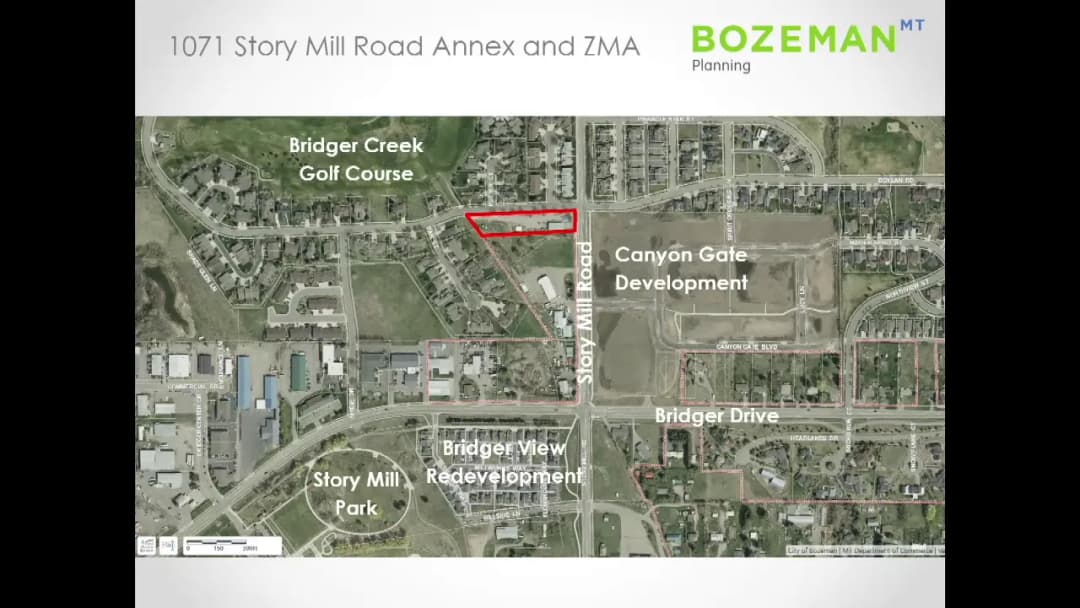
The Bozeman Community Development Board met on Monday, January 26, 2026, at 6:00 PM. The meeting focused on a single action item: an annexation and zone map amendment request for 1.173 acres at 1071 Story Mill Road. The board also received an economic and market update for Q2 2025 and approved the minutes from previous meetings. Consent Calendar - Approval of Minutes: The board approved the minutes from November 17, 2025, and December 15, 2025, with a correction to the November 17 minutes: the motion summary for units in RA was changed from "four units per acre" to "four units per parcel." The motion carried 6-0. Public Comments & Testimony - No public comments were made during the meeting, either in person or via video conference. Discussion Items - Annexation and Zone Map Amendment (Application 25525): Planner Tom Rogers presented the proposal to annex 1.173 acres owned by Bridger Creek Golf Course at 1071 Story Mill Road and establish an initial zoning designation of R-1 (low-density residential). The applicant, Joseph D'Angelo (architect with 45 Architecture) and property owner Dane Gamble, explained the parcel is used for golf course maintenance and employee facilities. Board members discussed the appropriateness of R-1 versus R-3 (which would convert to RB under the new Unified Development Code effective February 1, 2026). Some members suggested RB might offer more future flexibility for multi-unit dwellings, but the applicant indicated R-1/RA meets their needs. Staff confirmed the application satisfies all review criteria. The board voted 6-0 to recommend approval with contingencies for completing processing. - FYI/Discussions – 2025 Q2 Economic and Market Update: Community Development Manager Chris Saunders transmitted the report, noting it typically lags due to data collection cycles. Key points discussed included: - The report shows an 18.7% housing vacancy rate, a 16-year high, attributed to a surge in apartment construction coming online. - Single-family detached units are forecast to account for 42–45% of needed housing, yet few R-1 annexations have been seen recently. - Board member Jason Delmue questioned about the mismatch between zoning densities and actual built densities, leading to discussion of the new UDC’s minimum density requirements. Key Outcomes - Vote on Annexation and Zoning: The board voted 6-0 (all members present in favor) to recommend approval of the 1071 Story Mill Road Zone Map Amendment (R-1 initial zoning) to the City Commission, which will consider the annexation on February 10, 2026. - Schedule Change: Due to Presidents’ Day, the regular meeting originally scheduled for February 17, 2026, will move to February 23, 2026. - New Board Members: Eric Bonnett (architect and part-time university instructor) and Lauren Mitro (architect working remotely for a Hawaii firm) joined the board, replacing Courtney Johnson who stepped down.
Public Meetings - Bozeman, Montana
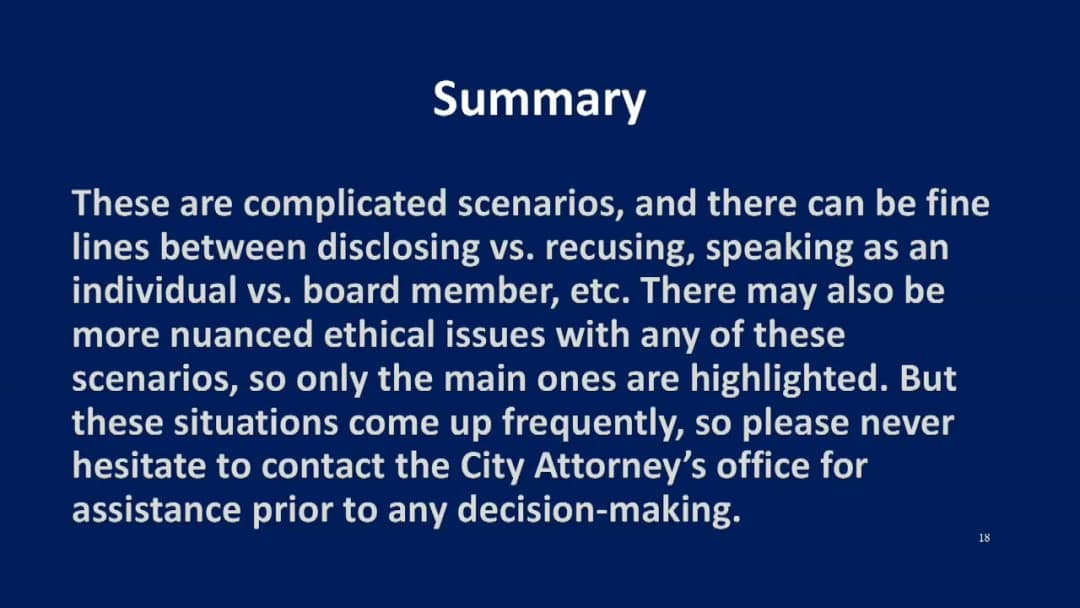
Public Meetings - Bozeman, MontanaThe Urban Parks and Forestry Board convened on January 22, 2026, for a meeting that included board member introductions, approval of meeting minutes, and an annual ethics training session. The training focused on the city's code of ethical conduct, using hypothetical scenarios to discuss conflicts of interest, disclosure, and proper use of public office. No public comments were received, and no binding decisions were made beyond routine approvals. Consent Calendar - Approval of Minutes: The board approved the minutes from the December 18, 2025 meeting by a roll call vote. Motion by Terry Lumsden, second by Steve Lowry. All present members voted yes: Terry Lumsden, Steve Lowry, Sally Schrank, Joe Cartwright, Paige Lasowski (with spelling clarification), and Matthew Courton. Members who were absent were allowed to abstain; the minutes were approved. Public Comments & Testimony - No public comments were offered, either in person or online. Discussion Items - Board Introductions: Each board member and staff introduced themselves, sharing their background, connection to Bozeman, and perspective on parks and urban forestry. Members highlighted experience in health care, real estate development, accounting, conservation, outdoor industry, and community engagement. Mayor Joy Morrison and Commissioner Alison Sweeney also introduced themselves and thanked outgoing and incoming members. - Ethics Training: Led by staff member Jess (covering for the usual liaison), the board reviewed ethics policies and discussed five scenarios involving potential conflicts of interest, private gain, improper communication, nepotism, and fair decision-making. Key points included: - A board member with a restaurant benefitting from a hotel project must disclose the indirect financial interest and recuse themselves. - A board member cannot speak on behalf of the board unless authorized by a vote; individuals must clarify they are speaking as private citizens. - A board chair who owns a hotel cannot use agenda-setting power to suppress a competitor's proposal; such applications must be considered by the board. - A board member using their professional expertise to impose unstated criteria on projects is acting improperly; decisions must be based on codified requirements. - A board member whose relative works for a contractor must disclose the relationship at the meeting and abstain from voting. The discussion emphasized that the city code requires annual ethics training and that board members should err on the side of full disclosure and seek guidance from staff or the city attorney when in doubt. Key Outcomes - Approval of Minutes: The December 18, 2025 minutes were approved unanimously. - Completion of Annual Ethics Training: All board members participated in the required ethics training, which addressed conflict of interest, disclosure, impartiality, and public perception. No formal action was taken; the training was informational.
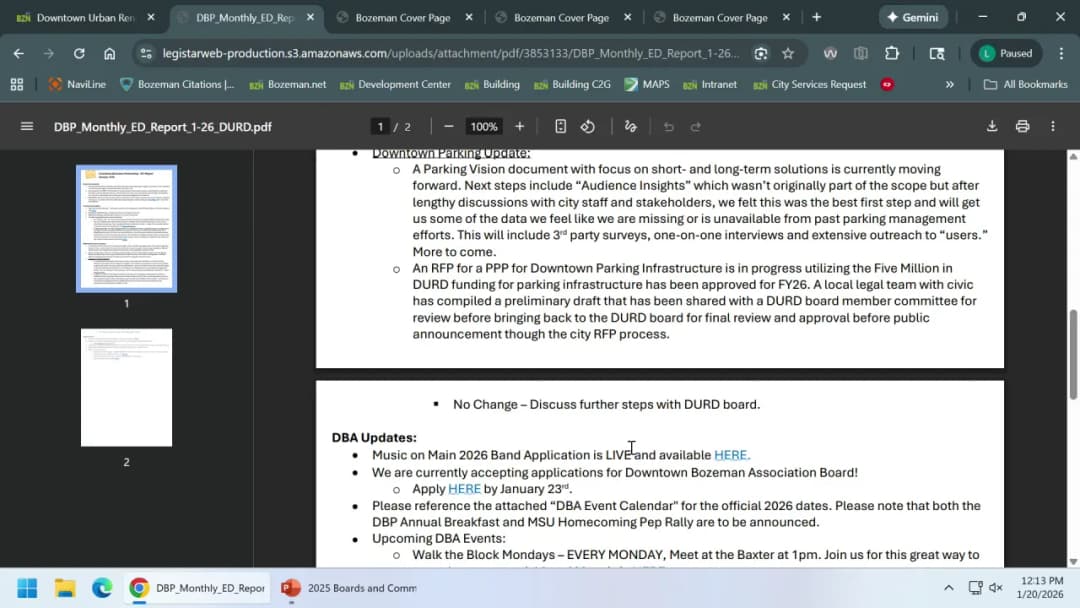
Note: The meeting was held on the date provided (2026-01-21), but the transcript begins with the chair stating "Wednesday, January twenty second." This discrepancy is recorded for accuracy. The Downtown Bozeman Business Improvement District (BID) Board convened to discuss the controversial B3 zoning height limit, receive updates on downtown parking, and complete annual ethics training. Key speakers included Deputy Mayor Douglas Fisher, BID Executive Director (ED) Ellie (last name not given), and public commenter Mr. Webster (South Central Association of Neighbors). Public Comments & Testimony - Mr. Webster (South Central Association of Neighbors) expressed concerns about the B3 90-foot height limit in the Unified Development Code (UDC), stating it did not receive proper public notice. He raised questions about parking impacts and the potential loss of affordable housing funding (a proposed $1 million donation if building above 70 feet). He urged the board to pause implementation and foster community dialogue. Discussion Items - Deputy Mayor Douglas Fisher provided a detailed history of the B3 height issue: the original UDC draft allowed 90 feet, the city commission switched to 70 feet on December 2 (late at night after a six-hour meeting), then reverted to 90 feet at second reading. He stated that options to pause the UDC are extremely limited—only a court can do so—and that the commission majority prefers to let the code take effect February 1, gather issues over a few months, and then address them legislatively. He noted the B3C (Main Street core) is separate and capped at 60 feet. - Board member Susan (first name not given) questioned the lack of a parking plan alongside increased density, emphasizing that parking discussions have been ongoing for years without resolution. She suggested linking height bonuses to parking or affordable housing contributions (e.g., a million-dollar donation to affordable housing, or parking SID funds). - Board member Eric Bowman expressed support for height (90 feet), stating "Retail follows rooftops" and that height contributes to a vibrant downtown. He opposed linking height to affordable housing, calling it a "red herring," and argued parking standards should be independent of height. - Board member Eric Nelson (appeared to agree with Bowman) said, "I'm not afraid of the height" and suggested staying the course with 90 feet, since it had been in UDC drafts from the beginning and the issue only arose at the last minute. - Board member Alina (last name not given) echoed concerns about parking and affordable housing, but noted the aesthetic impact of buildings without setbacks. She supported exploring a variance system or parking SID model (referencing a $100,000 payment in the 1980s for a parking garage). - Board member Mark (last name not given) emphasized the need for a parking plan "yesterday" and said affordable housing and parking are not directly linked to height, but the city must address them holistically. Ethics Training - The board completed annual ethics training led by staff (likely Elena). Scenarios covered conflicts of interest, misuse of public office, nepotism, and representing the board without authorization. Key takeaways: board members must disclose potential conflicts on the record, cannot speak on behalf of the board unless authorized, and should recuse themselves when necessary. The training concluded with a reminder to contact the city attorney's office (Greg Sullivan) with questions. Executive Director (ED) Report - ED Ellie reported: - Holiday decorations (spiders) sustained wind damage; insurance will cover repairs. Replacement of garland and bows is next priority. - A temporary maintenance employee (Russ) has been hired to assist. - Parking Plan Update: Ellie provided an update on the downtown parking vision plan developed with Indigo West (funded by the Urban Renewal District). A data dashboard (parking occupancy, citations) is being built, but data collection is still limited (Monday–Friday only, started October). The plan is on track for release in summer/fall 2026. A working group (including BID, URD, DBA, and city staff) is engaged. The board agreed to delay publishing an RFP for a public-private parking partnership until July to explore a potential federal building site (proposed for a parking garage) – decision expected by June. - Budget: The first draft of the FY27 budget (assessment rate) will be reviewed at the February board meeting. Key Outcomes - No formal votes were taken; the discussion was informational. - The board expressed general support for letting the UDC (with 90-foot B3 height) take effect on February 1, with a plan to review impacts in a few months. - The parking vision plan will continue with stakeholder interviews (audience insight step) and release expected summer/fall 2026. - The RFP for additional parking supply was delayed until at least July 2026 pending a decision on the federal building site. - The ED will prioritize finding a new city commission liaison (likely Jen Magic replaces Douglas Fisher). - The next meeting (February) will include FY27 budget discussions.
The Bozeman Historic Preservation Advisory Board (HPAB) met on Wednesday, January 21, 2026, at 6:00 pm in a hybrid format. The meeting included approval of previous minutes, public comments on the B3 height limit, annual ethics training, and a detailed update on two major preservation projects: the Local Landmark Program and the Neighborhood Conservation Overlay District (NCOD) Design Guidelines. No formal votes were taken except for the consent item. Consent Calendar - Approval of Minutes (October 15, 2025): Motion by James Webster, seconded by Ashley Wilson. Approved 4–0 (Chelsea Holling, Allyson Brekke, James Webster, Ashley Wilson in favor). Public Comments & Testimony Three members of the public spoke during the non‑agenda public comment period. All addressed the proposed 90‑foot maximum building height in the B3 zoning district and expressed opposition to its implementation without affordable housing requirements. - Daniel Carty (resident across from B3): Stated that the 90‑foot height limit degrades the historical character and sense of place. He argued the city is “giving away the extra height in exchange for nothing,” citing the city’s 2025 Q2 Economic and Market Update which reported a 44.2% vacancy rate among 1,900 units built in 2024–2025 compared to 9.2% for existing units. He urged the board to recommend that the extra 20 feet (from 70 to 90 feet) be granted only in exchange for on‑site affordable housing or cash in lieu under the city’s affordable housing ordinance. - Danielle Nickolas (resident, Cooper Park Historic District): Seconded Mr. Carty’s comments. - Marcia Kaveny: Also seconded Mr. Carty’s comments and agreed with his points. Discussion Items 1. Disclosures & Liaison Update - James Webster disclosed his involvement with the Bonton Centennial Downzoning (successfully concluded in December 2025) and his role as chair of the newly formed SCAN neighborhood (South Central Association of Neighbors). He also distributed a letter from the Bozeman Hotel Owners Association (authored by David Losef and John Anston) arguing for rolling back the 90‑foot height in B3 to 60 or 70 feet, citing aesthetic and historic preservation concerns. - Chair Holling welcomed new commission liaison Commissioner Sweeney, who replaced Commissioner Magic. 2. City Ethics Training (F.1) - Rebecca Harbage, Deputy Director of Community Development, presented the annual ethics training covering the 2025 calendar year. The training included a series of scenarios involving conflicts of interest, disclosure, recusal, and perception of impropriety. Key takeaways: - Board members must verbally disclose any potential conflicts at the start of a meeting; financial disclosure forms alone are insufficient. - Public officials may not use their position for private gain, must discharge duties impartially, and should avoid even the appearance of a conflict. - When in doubt, over‑disclose; better to disclose and possibly recuse than to risk an ethical violation. - Board members speaking as private citizens must clearly state they do not represent the board. - No questions were formally answered by the city attorney, but Ms. Harbage encouraged members to contact Greg Sullivan for legal advice. 3. Historic Preservation Project Update – Local Landmark Program & NCOD Design Guidelines (F.2) - Sarah Rosenberg, Preservation Planner, provided an extensive update on two concurrent projects: - Local Landmark Program (consultant: Community Planning Collaborative): Phase 2 (drafting code amendments) is underway. HPAB will receive concept presentations on three topics: (1) the local landmark program itself (criteria, categories, nomination process), (2) code standards (e.g., certificate of appropriateness criteria, demolition review, deviation process), and (3) the review process (application submittal through decision‑making). The first concept discussion is scheduled for the March 31 HPAB meeting. The code language will be shared in full before adoption. - NCOD Design Guidelines Update (consultant: Lakota Group): Kicked off in November 2025. The guidelines (last updated in 2006/2015) will be revised to address new construction, improve clarity, add visual examples, and align with the Secretary of the Interior Standards. Lakota will visit Bozeman in April 2026 for community engagement. A community engagement plan will be presented to HPAB in February and to the City Commission in March. - Both projects are intended to move forward in tandem, with adoption targeted by the end of 2026. The NCOD boundary remains unchanged. The design guidelines apply only to the NCOD, not to future local landmarks. - Discussion: - Members raised concerns about approving development under outdated guidelines while the update is pending; staff acknowledged the challenge but noted no moratorium is planned. - Ashley Wilson suggested using Preservation Month (May) to boost community engagement for the design guidelines. - Allyson Brekke asked about tracking implementation issues with the new Unified Development Code (UDC); staff indicated a formal tracking process is being developed. - Commissioner Sweeney requested that staff provide a longer‑term schedule (beyond spring) to help members plan attendance. - A quorum issue was noted for February; staff will consider rescheduling if needed. Virtual attendance is now allowed for up to four times per year, but three members must be physically present. Key Outcomes - No votes were taken on substantive matters other than the consent minutes. - Ethics training was completed for 2025; a 2026 training will be scheduled later. - Next Meetings and Milestones: - February 2026: Presentation of community engagement plan for design guidelines; introduction of Lakota Group (virtual). - March 31, 2026 (special date): HPAB will discuss concepts for the Local Landmark Program. - April 2026: Lakota Group in‑person visit and community engagement; HPAB meeting on code standards concepts. - May 20, 2026: HPAB meeting on review process concepts. - Staff will compile and share recordings of past HPAB meetings (particularly from 2024) for newer members. - Board vacancy: One at‑large seat; applications are being reviewed. Interviews will be conducted by staff, the board chair, and the commission liaison, who will make a recommendation to the City Commission.
The Bozeman Downtown Partnership Board met on January 20, 2026, to discuss parking strategies, future projects, and the fiscal year 2027 work plan. The meeting began with routine updates and a lengthy discussion on the potential federal building site for a parking garage, a blight study, and the status of the parking RFP. No public comments were received. The board deferred ethics training to February. Consent Calendar - No consent calendar items were presented. The board deferred approval of previous minutes (not formally approved since July) to a later batch. Public Comments & Testimony - No public comments were offered in person or online. Discussion Items - Parking RFP and Federal Building Site: Executive Director Ellie reported that the parking RFP, initially drafted with $5 million allocated, was put on hold pending the UDC approval. Recently, discussions revived about the federal building as a potential site. The GSA had a full staff changeover and considered selling the property; now Senator Danes is exploring a congressional appropriation, with a decision expected by June 1, 2026. Board members discussed whether to wait for the federal site or proceed with an open-ended RFP. Concerns included blight requirements (the federal building is not in the Downtown URD), the need for a private partner due to insufficient funds, and timeline uncertainties. The consensus was to: (1) conduct a 90-day blight study to determine if the site can be added to the URD, (2) finalize the RFP language with city legal, considering an open-ended or renewable format, and (3) wait for the June 1 decision before releasing the RFP. The board also noted the possibility of using the 1.7 million from the fire station project (currently expected to have a certificate of occupancy by October 2027) if that project fails. The paid parking pilot on College Street was mentioned as a potential future management tool. - Future Projects and Finance Report: Ellie outlined upcoming projects: Babcock curb and pedestrian safety improvements (city seeking partnership, estimated $100,000 per intersection), Fifth and Main lighting phase two, infrastructure grants for downtown developments (e.g., Bozeman Hotel, Empire site), and a shared use parking program requiring external help. The board acknowledged the need for a SILD (Special Improvement Lighting District) to cover rising utility costs for pedestrian lights. The parking vision plan is progressing with audience insights and a new dashboard collecting Monday-Friday data. - Ethics Training: Deferred to the February board meeting to allow more time for other discussions. - Other Updates: Executive Director’s report covered staff changes (Susan Seibert retired, Casey Miller hired), reminder to shuffle walkways, upcoming city commission meeting on January 27, and UDC outreach. New liaison Mayor Joey is expected to join in February or March. Key Outcomes - Blight Study: Directed staff to initiate a 90-day blight study for the federal building site to evaluate feasibility of expanding the Downtown URD. - Parking RFP: Staff will work with city legal to finalize the RFP, exploring an open-ended or renewable format, and will consult with stakeholders. The RFP will not be released until after the June 1 decision on the federal building. - Deferred Decisions: The board will revisit the parking RFP and budget priorities after the blight study and June 1 date. Ethics training postponed to February. - Project Updates: Staff will continue to develop cost estimates for Babcock curb extensions, Fifth and Main lighting phase two, and the shared use parking program. The board expressed support for partnering with the city on infrastructure projects when feasible.
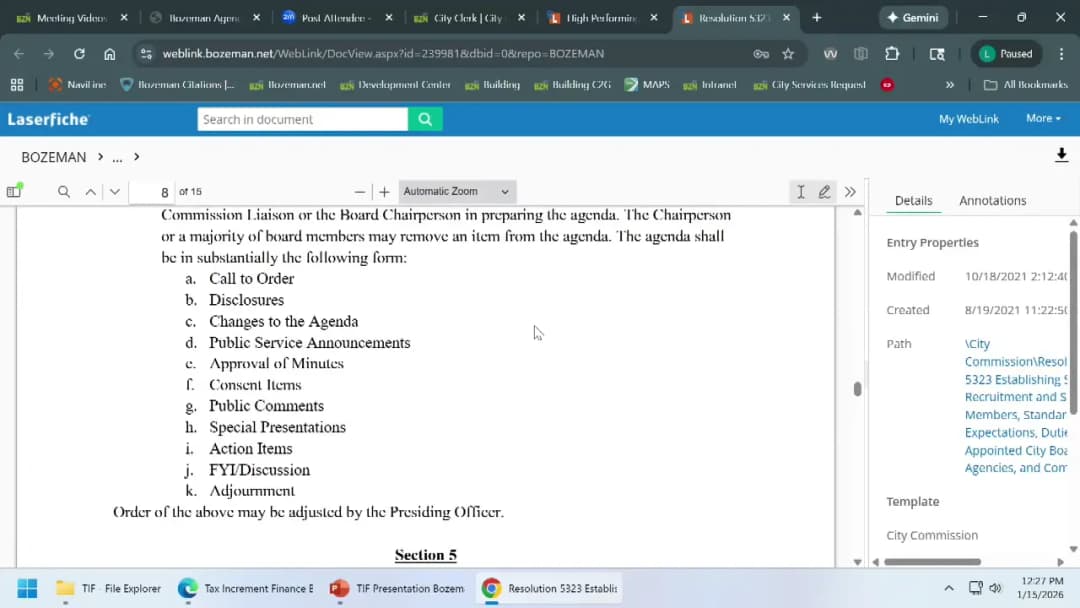
The newly formed Tax Increment Finance (TIF) Advisory Board held its first meeting on January 15, 2026, at 7:00 PM. The session focused on board member introductions, a review of board norms and procedures presented by Deputy City Clerk Alex Newby, and a comprehensive TIF 101 presentation led by Rural Program Manager David Fine. No public comments were received, and no action items were voted on. The board’s primary role is to advise the City Commission on five tax increment districts: Midtown, Northeast, South Bozeman Technology District, North Park, and Polyard. Discussion Items - Board Member Introductions and Norms: Chair Natalie Van Diesen led introductions. Board members included David Fine (staff), Brian Dyer, Lori Madsen, Susan Frazier, Julian (last name not given), Scott McFarland (County Commission), Britt Fontenot (Economic Development Director), Mary Matson Bateson, and Alex Newby. Alex Newby reviewed board norms, including decorum, one-body-one-voice rule, attendance expectations, remote participation procedures, and the requirement that boards do not direct staff. The board will follow Robert’s Rules of Order (loosely) and Resolution 5323. - Tax Increment Finance (TIF) 101 Presentation: David Fine presented an overview of TIF mechanisms. He explained that Bozeman has six TIF districts; the downtown district operates separately until 2032, while the board advises on five others. TIF is a tax diversion, not a new tax, used to address infrastructure deficiencies and blight. Funds are spent within districts on eligible costs per state law (MCA 7-15-4288). Recent projects include Midtown streetscape, South Bozeman Innovation Campus, Northeast District road reconstruction, and a sewer upgrade on Mendonhall. David noted that the board will soon engage in work plan and budget development for the districts, with the next three meetings dedicated to that effort. He also discussed the use of “but-for” analyses to ensure TIF assistance is necessary and the importance of private investment ratios. - Future Work and Project Pipeline: David mentioned one pending TIF application from Altos Photonics, a job-creating project in the Northeast District. He noted that development activity has slowed due to high interest rates and construction costs, but some projects are still being planned. Chair Van Diesen emphasized efficient meetings (targeting 1.5 hours) and collaborative discussions. The next regular meeting is scheduled for the third Thursday of February, with a potential special meeting in March if needed due to spring break. Key Outcomes - No votes or formal decisions were taken. The meeting was informational and procedural, setting the stage for future work plan and budget discussions. - The board received a scheduling note: the March regular meeting may conflict with spring break; a special meeting will be arranged if necessary.
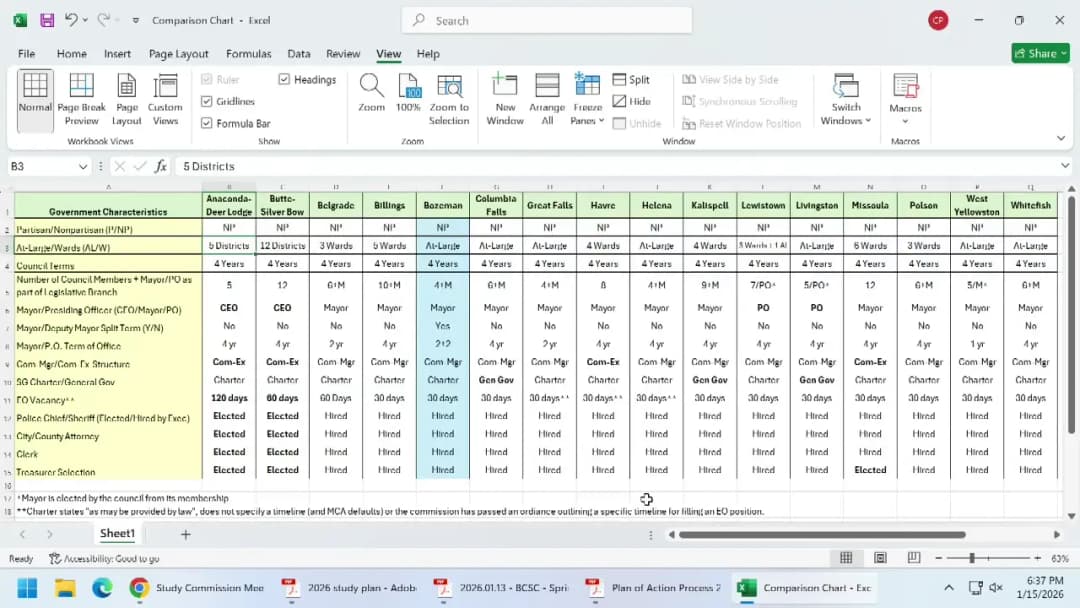
The Bozeman Study Commission met on January 15, 2026, from 4:00 PM to approximately 7:09 PM in the Commission Room at City Hall, 121 North Rouse. Chair Carson Taylor presided. The meeting included a learning session on governing body structure facilitated by Dan Clark, Executive Director of the Local Government Center at MSU Extension, and a presentation from Working Ventures on communication action plan survey results. Key decisions were made on drafting the final report and discussion of potential charter changes. Consent Calendar - Claims Review and Approval (D.1): A motion to approve payment of claims (BCSC Invoice 4, December 2025) passed 5-0. (Motion by Becky Franks, seconded by Jan Strout.) Public Comments & Testimony - Commission Deanna Campbell submitted a written statement for the record addressing uncertainties and ambiguities in the survey data, cautioning against acting prematurely. Discussion Items F.1 – Determine Who Will Draft the City Study Commission Report - The Commission discussed assigning two members to co-draft the initial report, due by May 18, 2026. Becky Franks and Barb Cestero volunteered, citing their writing experience with policy and bylaws. Deanna Campbell expressed willingness to contribute but noted the importance of balance in perspectives. A motion to assign Becky Franks and Barb Cestero as co-drafters carried 4-0 (with one abstention). (Motion by Jan Strout, seconded by Becky Franks.) G.1 – Working Ventures: Communication Action Plan - Stan Odenthal of Working Ventures presented preliminary results from the city employee survey (174 responses, with 2 more added during the meeting, out of 524 total employees – 498 full-time, 26 part-time). Key findings include: - Employees showed strong support for the status quo: 72% favored the city manager retaining full executive authority (current form), compared to 18.9% for reduced powers and 5.5% for mayor as executive. - 72% of employees opposed electing additional officials (e.g., city clerk, treasurer, attorney), compared to a more even split in the community survey. - 53.4% of employees said the commission should not expand beyond five members (vs. 41.7% in the community survey). - Employees ranked accountability and efficient administration as top leadership qualities, while the community ranked accountable leadership first and democratic representation higher. - On geographic representation, employees were divided: 23 strongly disagreed, 20 disagreed, 45 neutral, 45 agreed, and 31 strongly agreed with prioritizing district-based representation. - The Commission reviewed draft surveys for current and past city commissioners (since 2015) and advisory board members (since 2021). Questions addressed hours per week, full-time status, stipend fairness, and role clarity. Commissioners suggested reducing “unsure” options and adding an “other volunteer service” choice for question 28. Surveys will be sent out for 10-11 day windows. - Anna from Working Ventures outlined the Spring 2026 communication strategy (1/8-page ads in the Chronicle bi-weekly, social media campaigns, posters). Budget and saturation levels are pending approval. G.2 – Learning Session on Governing Body: Size, Terms, Duties, Mayor System, and Other Elected Offices - Dan Clark facilitated a discussion using a comparison chart of 14 Montana municipalities. Key points include: - Commission size: Montana cities average 7.2 members (including mayor). Research suggests 5-7 is a “sweet spot,” but gains up to 12 are minimal. Bozeman has 5 commissioners plus a mayor—on the low end. Butte (12) is considering downsizing due to low engagement. - At-large vs. wards: Bozeman, Great Falls, and Helena are the only large cities with at-large elections. Most others use wards. Clark noted wards can lead to hyper-local focus and resource allocation conflicts. Historical note: Bozeman eliminated wards in 1929 after adopting the city manager form. - Mayor term and deputy mayor: Bozeman’s unique “2+2” deputy mayor system (first two years as deputy, last two as mayor) is widely criticized. Clark shared an anecdote that it was added as a political bargaining chip. Most cities have 4-year mayor terms. Clark advised that if changed, a transition plan is needed, and no elected official can lose office due to a charter change. - Duties of commissioners: Clark recommended keeping the charter broad (like a constitution) and letting policies define specifics. However, Commission members noted public dissatisfaction with lack of transparency and representation may warrant more specific charter language. - Full-time vs. part-time: Clark said Montana municipalities do not typically classify commissioners as full- or part-time. Stipends vary (Bozeman’s is the highest, $34-$40k/year). Clark noted that low pay can limit demographic diversity. - Vacancy: Most charters follow state law (30 days to appoint). Missoula mandates 120 days; Butte and Belgrade require 60 days. Appointed officials serve until the next election (max 2 years). The cost of a special election is $105,000. - Term limits: Clark advised caution, as state law may prohibit them, and recommended legal counsel review. Key Outcomes - Report drafting: Becky Franks and Barb Cestero appointed as co-drafters of the City Study Commission Report (motion carried 4-0). - Next Meeting (Jan 28, 2026): The Commission will discuss potential charter changes including: Deputy Mayor, number of commissioners, partisan/nonpartisan elections, other elected offices, vacancy timeline, and duties of commissioners. Commissioners agreed that wards/districts will be discussed later (Feb-March). - Requests for information: - Commissioner Jan Strout requested cost estimates for 5 full-time city commissioners. - Commissioner Strout requested average median income (AMI) for Gallatin County. - The Commission requested Dan Clark and Mike Maas investigate other commissions with full-time work and their job descriptions, as well as Gallatin County Commissioner salaries and job descriptions. - Future Meeting Date: The July 2 meeting may be moved to late June to avoid holiday conflicts; Mike Maas will check feasibility. - Legal Opinion: Dan Clark recommended the Commission seek a formal opinion from City Attorney Greg Sullivan on how many charter changes can be proposed on a single ballot (referencing MCA 7-3-150 and 7-3-151).
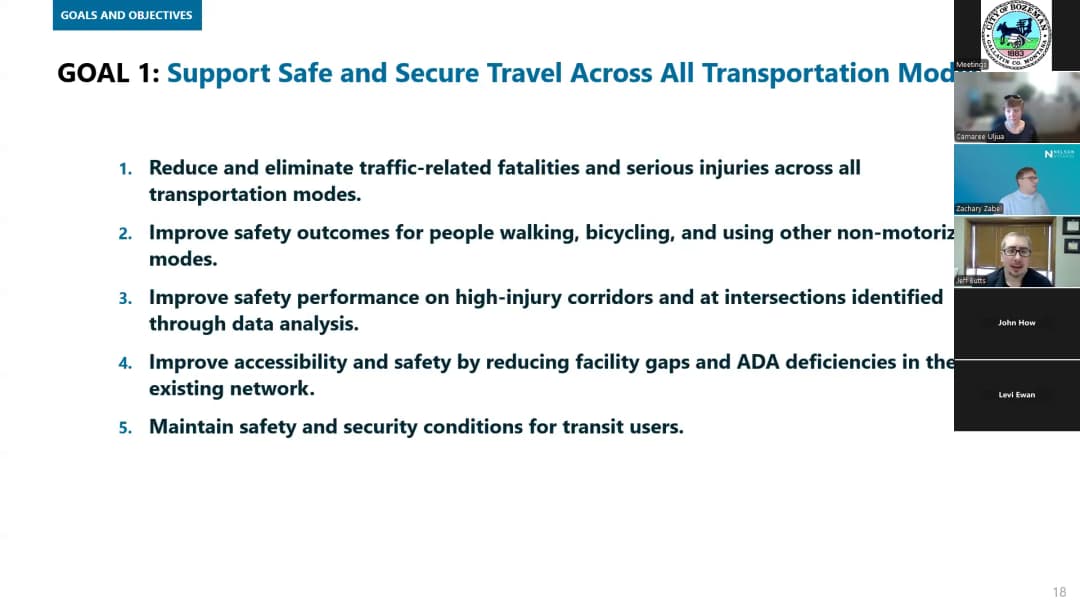
The Transportation Technical Advisory Committee (TTAC) of the Gallatin Valley Metropolitan Planning Organization (MPO) held its first meeting of 2026 on January 14, 2026. The committee elected a chair and vice chair, and discussed the draft goals and objectives for the Long-Range Transportation Plan (LRTP). The meeting included a presentation from consultants and extensive member feedback on the draft vision statement, goals, and objectives. Consent Calendar - Approval of Previous Minutes: The minutes from the previous meeting were approved by a vote of 7 (Camera Yulia, Beth Clarkson, Billy Beer, Todd Wilson, John Howe, Chris Saunders, John O'Callion). Public Comments & Testimony - Public Comment on LRTP Goals and Objectives: Marilee, a public commenter, provided three suggestions: 1. Include working with legislators to improve supportive safety laws. 2. Memorialize the directives and past motions from prior committees (TCC and PTS) that worked on the same area. 3. Add language about prioritizing projects based on need (e.g., safety) rather than popularity. Discussion Items - Election of Chair and Vice Chair: The committee nominated and unanimously elected Nick Ross as Chair and Camera Iuli as Vice Chair for a one-year term. The motion passed 9-0. - Long-Range Transportation Plan (LRTP) Draft Goals and Objectives: - Presentation: Consultants Zachary and Chris Johnson presented the draft vision statement, five goals, and associated objectives, which were developed from extensive public engagement (surveys, listening sessions, farmers market, virtual meetings) and technical review. - Draft Vision Statement (2050): "In 2050, Gallatin Valley's transportation system provides safe, reliable, and multimodal connectivity that supports people, goods, and communities as the region grows. The system is well-maintained, fiscally sustainable, and designed to strengthen human-centered connections across the region." - Goal 1: Safe and Secure Travel – Members discussed: - Chris Saunders suggested modifying language to use per-capita metrics (e.g., "reduce per capita traffic related fatalities and serious injuries") to better account for population growth. - John O'Callion noted that for walking and biking, perception of safety is important and hard to capture with hard statistics. - Jeff (staff) acknowledged the challenge of measuring security for non-motorized modes. - Goal 2: Reliable and Well-Maintained System – Members discussed: - Chris Saunders questioned the limitation of Objective 5 (improving sidewalks and pathways) to only downtown and activity centers, noting that older neighborhoods in Belgrade lack sidewalks entirely. - Billy Beer agreed, noting that pre-1980s Belgrade neighborhoods are missing sidewalks and lack connectivity. - Camera Iuli suggested modifying Objective 5 to "improve condition and continuity of sidewalks and pathways by closing gaps, prioritizing downtowns and activity centers." - It was suggested that closing gaps should be a separate objective. - Todd Wilson noted that Objective 5 seemed to leave out transit, especially first/last mile connections to bus stops. He also pointed out that MDT policy sometimes prevents placing a bus stop if the area is not accessible (e.g., lack of sidewalk coherence). - The group agreed to add a new objective for closing gaps and to broaden Objective 5 to include transit access. - Goal 3: Expand Mobility Choices – Members discussed: - Billy Beer proposed changing "street network connectivity" to include pathway connectivity as well. - Jeff suggested modifying the wording to: "improve street network and pathway connectivity to support more direct multimodal travel." - Chris Saunders questioned the phrase "affordable travel options," suggesting it was vague and could mean anything. He proposed replacing it with explicit modes: transit, walking, and bicycling. - Chris Saunders also suggested rephrasing "non-single occupant vehicle modes" to something more accessible like "multi-occupant" or "non-drive alone." - Goal 4: Enhance Health and Quality of Life – Members discussed: - Chris Saunders raised a conflict between Objectives 4 and 5: reducing environmental impacts might increase travel distances and thus emissions. - Jeff acknowledged the conflict and said it would be handled on a case-by-case basis. - Chris Saunders suggested adding a per-capita metric to Objective 5 (reduce air emissions). - Catherine King (via chat) proposed expanding Objective 6 (improve emergency preparedness and coordination) to include planning and management/response. - Jeff clarified that emergency management is separate from transportation’s role (emergency support function). The group discussed adding language on emergency preparedness and response coordination. - Camera Iuli suggested adding "resilience" to Goal 2 ("ensure a reliable, resilient, and well-maintained transportation system"). The group supported this. - Goal 5: Coordinate Transportation and Land Use – Members discussed: - Chris Saunders suggested replacing "accommodate" with "balance" in Objective 5 (seasonal/tourism travel demand) to better reflect weighing the needs of permanent residents versus visitors. - The group agreed to reword that objective to reflect balancing tourism and local needs. Key Outcomes - Elections: Nick Ross elected Chair, Camera Iuli elected Vice Chair for 2026. Vote: 9-0. - LRTP Goals and Objectives: The committee will revise the draft goals and objectives based on the feedback received and present a revised version at a future meeting. No formal vote was taken on adoption at this meeting. - Next Steps: Staff will revise the goals and objectives, work on the evaluation framework, land use projections, and revenue projections. The next TAC meeting will include the refined draft.
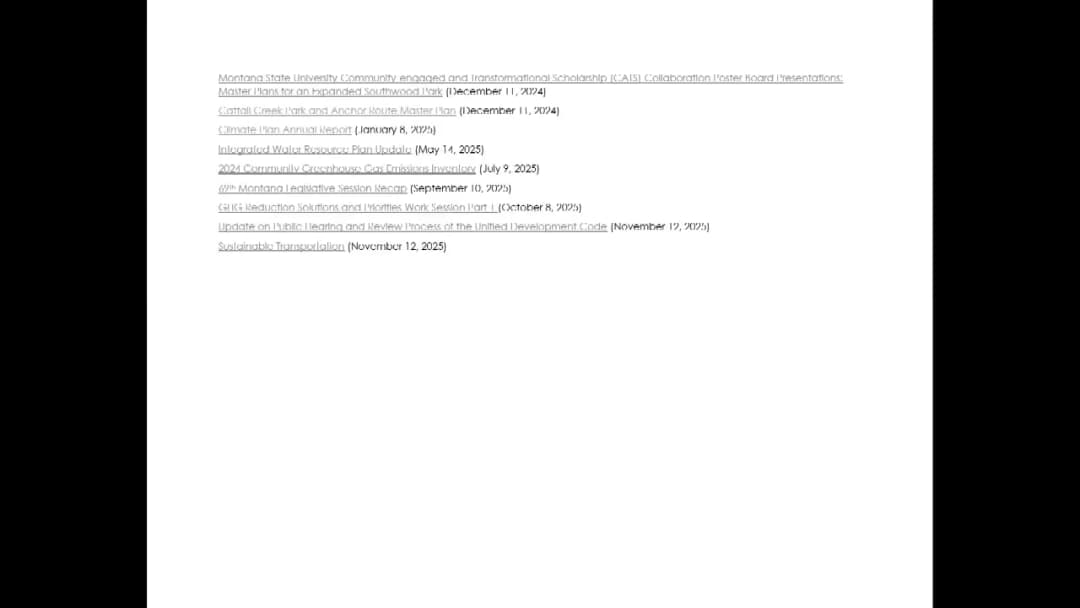
The Sustainability Advisory Board held its regular meeting on January 14, 2026. The meeting featured new member introductions, a detailed presentation on the City's Integrated Water Resource Plan (IWERP) update, the annual ethics training, and a comprehensive discussion on the board's future work plan. Consent Calendar - The board approved the minutes from the November 12, 2025 meeting. The motion carried with votes from members Nick, Kendra, Brooke, and Erin. The roll call inadvertently skipped Isabel and Jesse before being corrected. Public Comments & Testimony - Public Comment on Non-Agenda Items: None. - Public Comment on Work Plan: Catherine Barry from the Gallatin Watershed Council addressed the board. She highlighted the shared priorities between the Council and the board regarding water stewardship. - She recommended the board adopt a water-focused work plan item, such as watershed resiliency. - She identified specific opportunities for board capacity and expertise, including providing input on the IWERP update, the creation of an on-site mitigation manual for stream impacts, the development of a wetland inventory and tracking system, and updating wetland and watercourse setbacks to reflect the best available science. - She noted these items have current momentum and some are not yet formally led by city staff, presenting an opportunity for the board to push them forward. - Online Public Comment: None. Discussion Items 1. Special Presentation: Integrated Water Resource Plan (IWERP) Update - Board member Brooke presented an update on the IWERP, for which she is the board's liaison to the Water Advisory Committee (WAC). - Project Description: The IWERP update replaces the 2013 plan and focuses on securing enough water volume for Bozeman's future population under projected growth and climate change scenarios. It is a 10-year plan addressing 30-to-50-year needs. - Process: The WAC consists of a Technical Advisory Subcommittee (TAC) and a Public Advisory Subcommittee (PAC). The PAC met four times in Fall 2025 to develop screening criteria and begin evaluating roughly 80 alternatives. - Alternative Examples: Included acquiring more water rights, dredging Hyalite Reservoir, raising dam heights, building new storage, water reuse systems ("purple pipe"), and cloud seeding. Brooke emphasized conservation measures are the "top priority" while supply expansion provides long-term redundancy. - Board Requests & Positions: - Isabel Friedman requested data on the city's largest water users, fastest-growing sectors, and coordination with Gallatin County. Brooke replied that residential irrigation is the largest use and confirmed active county coordination. - Jesse Wees requested specifics on the climate and development assumptions used. - A discussion on enforcement of mandatory no-watering days followed. Natalie Meyer clarified the city has metering technology but enforcement relies primarily on citizen reports and warnings. - Next Steps: Brooke will return with the requested data and present another update in the spring. 2. Annual Ethics Training - Staff liaison Natalie Meyer led the annual mandatory ethics training, emphasizing that board members are public officials who must avoid using their positions for private benefit. - Scenarios Exercised: 1. Conflict of Interest: A member disclosed a conflict on a form but did not recuse from a vote. Conclusion: Must disclose at the meeting and abstain if a conflict exists. 2. Speaking as a Board Member: A member wrote to the commission and media as a board representative against the majority. Conclusion: Must clarify they speak as an individual, not the board. 3. Gatekeeping Power: A chair withheld a competitor's application from the agenda. Conclusion: This is misuse of position. 4. Impartiality & Employment: A member only supported projects benefiting their employer's programs. Conclusion: Decisions must rely on published board criteria. 5. Nepotism: A member disclosed a family relationship to the chair privately but not publicly, and voted. Conclusion: Disclosure must be made publicly at the meeting, and recusal is advised. - Members were reminded they can consult the city attorney, Greg Sullivan, on ethical questions. 3. 2024-2025 Work Plan Review and Future Priorities - Natalie Meyer reviewed progress on the existing two-year work plan: - Local Food System: Sustainable events guide completed but not yet implemented due to staffing capacity. - Composting Services: Pilot program rolled out successfully; approximately 1,700 participants have signed up. - EV Charging: Project pivoted to installing city fleet infrastructure (Public Safety Center, shops complex) to capture expiring federal incentives; a community-wide plan remains a future goal. - Green Power Program: Negotiations with Northwestern Energy for a renewable rate option are ongoing. The board will likely re-engage on this in 2026. - Extreme Heat/Wildfire Smoke: Outreach materials developed. - Energy Efficiency & Electrification: Solar projects at the library and water reclamation facility progressing; contractor training for heat pumps identified as a key need. - Urban Tree Canopy: Baseline land cover dataset completed. - Engineering/Water Standards: Stormwater plan adopted; wetland code updated. - Board Discussion on Future Work Plan: - Members expressed a desire for a more action-oriented role in implementing work items, potentially through dedicated work sessions. - Isabel Friedman suggested prioritizing housing and energy affordability as a climate resilience topic, noting its intersection with previous board discussions. - Jesse Wees raised the topics of growing noise and air pollution (airport, train traffic) and increased litter, asking if the board could take on an educational or advocacy role. - Brooke recommended a standalone water resilience work plan item given the IWERP momentum. - Members supported including multimodal transportation and bike infrastructure safety as a topic. - Erin suggested revitalizing a sustainability recognition/awards program. - Members broadly agreed on the need to enhance outreach and marketing for existing programs (e.g., composting, Engage Bozeman website). - Natalie noted the City Commission is currently setting its goals, from which the board's work plan will be derived. She will bring a proposed structure for the new work plan to the next meeting. Key Outcomes - Meeting Opened: The January 14, 2026 meeting was called to order. - Minutes Approved: The November 12, 2025 meeting minutes were approved. - Ethics Training Completed: The board fulfilled its 2025 annual ethics training requirement. - IWERP Follow-up Directed: Board member Brooke will provide requested data and a further update in the spring. - Future Work Plan Direction: The board provided extensive guidance for its next two-year work plan. Staff will draft a proposal incorporating the new priorities for discussion at the next monthly meeting.