Browse by city
Date range
Search help

Search titles, summaries, topics and stored transcripts together. Keywords may match separately; put the whole query in double quotes for a phrase. Matching follows word analysis, so punctuation is not exact. Both dates are included. Documents are not searched.

SHOWING 11–20 ENTRIES
11
FEB 4, 2026 · BRATTLEBORO, VERMONT · SELECTBOARD
Brattleboro Select Board Regular Meeting – February 4, 2026

The Brattleboro Select Board met on Tuesday, February 3, 2026 (agenda continued into early February 4) to discuss First Amendment rights and media recording of public safety incidents, hear reports on housing, cultural planning, and a long-term financial projection, and manage routine business. The meeting featured extensive public comment and legal analysis of filming in public and private spaces. Consent Calendar - Approved unanimously (5-0) a 10-item consent agenda including: certificate of highway mileage for 2026; tobacco endorsement permits for two Walgreens; liquor license renewals for Midnights on High Street, Spring Marina, Halo Hollow (75 Elliott St.), and Saffron Restaurant (889 Putney Rd.); Certificate of No Appeal for the 2025 grand list; contract with Stantec ($75,800) for sidewalk design on Fairgrounds Road; contract with Southern Vermont Solar ($186,340) for photovoltaic array at Brooks Memorial Library; and a parade permit for the Asian Cultural Center of Vermont's February 8th event. Public Comments & Testimony - Jenna Seymour (Town Meeting Member, Planning Commission member) stated she speaks only as an individual, not for the Planning Commission, emphasizing transparency. - Ivan Hennessy asked when the walk signal call button at Latchis Hotel will be repaired and about rust on the South Stairwell railing at the Transportation Center. - Sue Belleville inquired whether the tax payment drop box will be collected on Presidents' Day. Town Manager John responded it will not be picked up on the holiday but first thing Tuesday, February 17. - Wally Blight defended Brattleboro Common Sense (BCS), saying the organization helped him when he was down and out, and criticized the town's opposition to it. - Ken Vay urged residents to vote, noting only 29% turnout last year, and tied it to the America 250 celebration and principles of representation. - Randy Blodgett invited participation in America 250 events and announced his candidacy for a one-year Select Board seat. - Rusty Sage urged the board not to restrict First Amendment rights, noting the value of media filming at emergency scenes. - Mark Coaster argued that the town should not infringe on freedom of the press, recalling Brattleboro's history. - Akhil Srivastiana (Bratboro Pulse) stated that cities like Seattle and New York regulate commercial filming without banning speech, and that harassment (e.g., following, intimidation) is already prohibited. - Martha Bernbaum described a New Year's Eve truck fire where a person (Hank) filmed on her private property without permission, tripping over a fire hose, and asked for better scene security. - Pierre Landry opposed any local ordinance limiting recording, trusting officers to manage scenes. - Hank Poitres (Planet Hank) denied harassment, claimed he follows police protocols, and asserted his First Amendment right to film in public; he stated he left when asked. - Marta (Bernbaum again) argued that she could not trespass Hank ahead of an emergency and that signs for hunting do not cover general trespass. - Dr. Jessica Dolan pointed out that First Amendment rights are not absolute, and constant negative filming harms community mental health and business. - Angela O'Bray questioned the line between filming public officials and harassing private citizens in public (e.g., medical emergencies), and asked about training on limits. - Jackie Reese warned that restricting filming could hinder accountability for police and ICE, and reminded that filming minors helped locate Liam Ramos. - Carly Sheckering asked about liability from a YouTuber who may have interfered with scenes; chiefs responded they handle each situation. - Gemma Seymour clarified 13 VSA 3705 regarding trespass into dwellings, noting affirmative notice is required. - Carol asked the town to publicly state that such filming is not okay, even if legally permitted. - Randy Blodgett asked about housing mix targets; Planning Director Sue Fillion said they’ve not been managing by type. Discussion Items Media Recording and First Amendment - Town Attorney Bob and Hannah presented a memo explaining that the First Amendment protects the right to record public officials in public places; buffer zone laws have been struck down. Police Chief Hardy and Fire Chief Simons described scene management: they allow filming as long as it does not interfere, and they ask individuals to step back if necessary. Private property owners must give notice (verbal or posted) to trespass. The town attorney advised against passing any ordinance restricting recording, citing First Amendment and preemption issues. Board members (Oscar, Amanda, Isaac, Liz) expressed empathy but concluded they cannot constitutionally restrict recording, though they emphasized that existing laws against stalking and interference still apply. No motion was made. Green Mountain Power Undergrounding Projects - Tim Jones and Don Mills (GMP) presented three projects for 2026 (Stockwell Drive, Stark Road, Marlborough Road) and the main Hamilton Road undergrounding, similar to the Ames Hill Road project. They thanked the town for partnership and noted the two-year program ends September 30, 2026. The town will work out specifics with Public Works Director Dan Tyler. No board action required, only appreciation. Equalization Study Results - Assessor Jennifer Burnell explained that Brattleboro's 2025 Common Level of Appraisal (CLA) is 64.94%, with a state adjustment factor of 70.33%, yielding a 92.34% state adjustment for education tax rates. Projected homestead rate is 1.997, non-homestead 1.843, pending school district and state rates. She noted Act 183 changed how the adjustment is calculated. Housing Action Plan Update - Planning Director Sue Fillion reported 125 housing permits issued in 2025, 105 units in multi-unit buildings (70 at Chalet, 28 at Winston Prouty Phase 1). Net gain after losses: 77 units. Since the plan began, 221 units have been permitted. Upcoming projects include redevelopment of Melrose Terrace (21 senior units) and Holton Home (21 affordable apartments). The town may face choices due to reduced federal funding for Community Development Block Grants (VCDP). A public hearing on a proposed 13-unit project at 33 Oak Street is scheduled for February 17. The CHIP program (tax increment financing) was introduced as a potential tool for infrastructure investment. Plug-and-play solar was also discussed as a cost-saving initiative for low-income households. Collaborative Cultural Plan for Southeastern Vermont - Sue Fillion presented the plan, developed with Rockingham and Wilmington using a $45,000 grant (matched by $5,000 per town). Goals: support artists and cultural organizations, enhance the region's brand as a creative hub, and strengthen the creative sector. Challenges include lack of a single owner, funding cuts, and organizational capacity. Next steps include sessions at the May Southeast Vermont Economic Development Summit and continued collaboration with partners like BDCC and DBA. Long-Term Financial Projection - Town Manager John presented a five-year projection (FY28–FY32) for the general fund, based on FY27 approved budget. Key assumptions: 4.9% average annual property tax increase (from $20.9M to $26M), no growth in grand list, no new staff, 2.2% capital investment, health care at 12%, retirement at 10%, workers' comp at 15%. Projection relies on new revenue sources: a local option fuel tax and state revenue sharing (policy actions needed). The model is publicly available as a spreadsheet for community use. Board members noted the projection is optimistic but valuable for planning, and emphasized advocating at the state level for revenue sharing and fuel tax. Key Outcomes - No action on media recording policy; board agreed existing laws suffice and no local ordinance will be pursued. - No formal action on Green Mountain Power projects; staff will continue working with GMP. - Accepted the equalization study report for information. - Noted progress on housing action plan; upcoming public hearings on 33 Oak Street and Winston Prouty development agreement on February 17. - Endorsed the cultural plan as a resource; implementation will remain collaborative. - Received the long-term financial projection; board will use it to inform future policy and budget decisions, and will revisit it regularly. - Meeting adjourned after over three hours, with thanks to staff and public participants. Note: The meeting was officially warned for Tuesday, February 3, 2026, but the provided timestamp (2026-02-04T21:52:04+00:00) indicates the meeting extended into February 4. All voting and decisions occurred on February 3.
PUBLIC SAFETY 20% · FISCAL SUSTAINABILITY 11% · PUBLIC ENGAGEMENT 10% · ECONOMIC DEVELOPMENT 10%
12
JAN 28, 2026 · BRATTLEBORO, VERMONT · SELECTBOARD
Brattleboro Select Board Meeting – January 27, 2026

The Brattleboro Select Board held a regular meeting on Tuesday, January 27, 2026, beginning at approximately 6:30 PM. The meeting covered a wide range of topics including a storm response appreciation, a proposal to move a liquor and tobacco agenda item, two charter petition hearings (Australian ballot and open town meeting), an open meeting law refresher, adoption of the revised FY27 budget, a town audit update, and a lengthy debate on the human services funding article for the annual town meeting warning. The meeting concluded with a vote on the town meeting warnings and adjournment just before 11 PM to avoid parking towing. Agenda Adjustments - Item B (liquor and tobacco authority and process) was moved to the February 5, 2026 meeting by a 4-0 vote due to the absence of Cassandra Holloway. Chair's Remarks - Chair thanked the community, all town departments, and partner organizations for their collaboration during the winter storm (January 24-26, 2026), noting no cold‑weather injuries or fatalities, and that shelters had extra beds available. Town Manager's Remarks - John Potter reminded that snow removal from streets and uncovered lots would begin at 11 PM; vehicles must be moved or risk towing. Business license renewals due March 15, 2026. 2026 dog licenses due April 1. Absentee ballots for March 3 town meeting will be mailed around February 11. He also thanked Bonnie Batchelder, Melissa Cole, and Pete Lynch for rapid budget work. Select Board Member Comments - One member announced a fundraiser for Ukraine at Saxons River Distillery on February 5 (5-7 PM) with a Lithuanian ambassador. Another acknowledged the death of Alex Predi, killed by federal agents, and noted a vigil in Brattleboro. Public Participation - Ivan Hennessey (Brattleboro) requested that the town forgive parking tickets issued during the storm when people parked at the Transportation Center to comply with the parking ban. - Eric asked if select board emails were working; Chair confirmed they were. - David Minor (Chair of Human Services Committee) criticized the board’s decision to eliminate human services funding, noting that 63% of voters in a March 2025 advisory vote supported 1% or more funding for human services. - Kate Barry (local business owner) expressed concern about “Planet Hank” filming police and medical crises, requesting a journalistic ordinance to establish a safe perimeter, review of police media policy, and prioritization of victim privacy. She submitted a formal letter. - Police Chief Hardy defended the department, stating that filming by individuals is legally protected and that accusations of departmental bias are misleading. - Hank (self‑identified as Brattleboro News) defended his First Amendment rights, offering copies of the Constitution, and argued that any ordinance limiting filming would be unprecedented and an abuse of authority. - Steve Peterson supported Hank’s reporting as providing valuable transparency, and also argued that the previous advisory vote on human services funding should not bind the board without full context of budget tradeoffs. - Dick (resident) thanked petition filers, noted three candidates for a three‑year seat and five for two two‑year seats, and criticized the board’s acrimony during the budget process. - Angela (via Zoom) criticized the board’s process on the emergency zoning ordinance (passed just before Christmas) and the complete elimination of the human services budget, stating that the board’s actions felt dehumanizing and that public records requests did not support stated complaints. - Frick (District 9 rep) argued that the zero human services budget usurped the power of Representative Town Meeting (RTM) and expected town meeting to restore funding. Charter Petition Hearings (First of Two) The board held the first public hearing on two charter petitions related to the future of Representative Town Meeting (RTM). Petition 1 – Australian Ballot (Secret Ballot): - Presented by Tom Franks and Randy Bloodett. They argued that Australian ballot allows every voter to participate, reduces barriers (location, schedule, duration, physical, language, personality, coercion), and increases participation. They cited data showing 81% of Vermont towns over 5,000 use Australian ballot for all voting; only Brattleboro and Middlebury do not. They noted that 31 towns have adopted Australian ballot in the last three years. A video featuring local residents supported the change. Petition 2 – Open Town Meeting (if RTM is discontinued): - Presented by Millicent Cooley (via Zoom). She argued that open town meeting preserves face‑to‑face debate and the ability to amend articles, which is lost with Australian ballot. She noted that open town meeting is the default under Vermont law if RTM is ended. Public Testimony on Charter: - Gemma Seymour (District 8 RTM) questioned the legality of the petitions, citing charter provisions, but the town attorney confirmed the petitions were duly filed and vetted. - Neil Banders (West Brattleboro) confessed he did not consult his constituents as an RTM member and favored Australian ballot for one‑person‑one‑vote. - Tim (resident) argued that Australian ballot includes seniors, working parents, and people with disabilities who cannot attend long meetings. - Dina Chadwick (District 9 RTM, candidate for select board) supported Australian ballot to bring power back to the people. - Ken Faye (District 8 RTM) noted that only 30% voted in the last contentious election and that RTM provides representation without requiring everyone to attend. - Steve Patterson argued that open town meeting is vulnerable to last‑minute legal threats and that Australian ballot avoids such tactics. - Ivan Hennessey raised a concern that with Australian ballot, if a separate article (e.g., human services) is voted down, it is simply not funded; the town attorney confirmed that would be binding. - Janet Therese (West Brattleboro) said RTM does not represent the population, citing the safety ordinance and human services votes as examples. - Nell Mayo (District 8) defended RTM as ensuring a quorum and allowing amendments, while Australian ballot removes the ability to amend. - Jackie Reese (District 9) argued that 3,600 voters (30% turnout) is more representative than 120 RTM members. - Dick (resident) noted that RTM has become dominated by one‑issue candidates and that open town meeting might also decline in attendance. - Robin (resident) warned that Australian ballot reduces voter power to a yes/no without feedback, potentially causing repeated budget rejections. - Heidi Fisher (District 7 RTM) expressed concern that a yes/no vote lacks nuance and understanding of the full budget. - Sue Bell (Brattleboro) shared personal experience of being unable to attend open town meeting in Guilford due to childcare, and later physical pain as an RTM member, strongly supporting Australian ballot. - Bob Ozer and Ken Faye echoed concerns about the lack of amendment ability and the risk of repeated budget votes. - Gary (resident) asked for informational sessions so voters understand the pros and cons of each system. Closing Statements: - Millicent Cooley argued that face‑to‑face meetings allow immediate challenge of misinformation, while Australian ballot is vulnerable to social media manipulation. - Randy Bloodett emphasized that the petition is about giving every voter a say, and urged everyone to vote regardless of preference. Open Meeting Law Refresher - The town attorney and assistant attorney presented a slideshow on open meeting law requirements: meetings must be public, agendas posted, minutes taken; a quorum of three members discussing town business constitutes a meeting. Serial communications (e.g., email chains among a quorum) are prohibited except for scheduling. Consequences include a $500 fine for knowing violations and potential civil litigation. Board members asked about serial conversations, Front Porch Forum posts, and asynchronous electronic meetings; the attorney clarified that asynchronous meetings are not currently allowed under the law. Revised FY27 General Fund Budget - Town Manager John Potter presented a revised budget incorporating changes from the January 22 meeting: restoration of recycling/compost, elimination of the finance clerk half‑position, and zeroing human services funding. The revised budget total was $27,408,400, with a property tax increase of $1,244,592 (6.3% over FY26). - Pete Lynch explained that deferring the automated recycling pickup for five months (to December 2026) saved $100,000, reducing the solid waste put‑back to $600,102. - Public comments: Heidi Fisher asked if carts could be deferred longer; Pete Lynch said further delay is possible but under negotiation. Dick praised the finance director’s work and suggested a stipend for Pete Lynch. David Lovembach noted the savings may shift costs to next year. Millicent Cooley raised a discrepancy in revenue figures between the budget and finance report; John Potter explained the difference is due to timing (revenues updated through January 22 vs. November 30). - A motion to approve the revised budget passed 4-1 (Isaac opposed). Town Audit Update - Town Manager Potter reported that after three rounds of RFPs, the town received one proposal from an auditor to cover FY25, FY26, and FY27 audits. The auditor can start in late April/early May, allowing the FY25 audit to be completed by the end of the fiscal year. The contract will be brought for approval. The FY25 financial statements will be drafted as unaudited but will be audited later. The cost is higher than previous years. 2026 Town Meeting Warning and RTM Warning - The board discussed two versions (A and B) of the Representative Town Meeting warning, particularly the placement of the human services funding article. Version A placed the human services article after the general budget vote; version B placed it before. - Peter moved to accept version A but strike Article 6 (the separate human services article), arguing that human services funding should be discussed within the general budget to allow a holistic conversation. He stated he would honor the will of the town meeting if it amended the budget to include human services. - After extensive debate, the motion failed (2-3, with one abstention). - Amanda then moved to accept version A as presented (with Article 6 after the budget). The motion passed 3-1-1 (Peter abstained, Isaac opposed). - The warnings for the March 3, 2026 Australian ballot and March 21, 2026 RTM were adopted. November 2025 Finance Report - Town Manager Potter presented the five‑month financial report. General fund revenues were at 44% of budget (ahead of the 42% of the year completed), expenditures at 39%. EMS revenue was projected to exceed budget by $400,000. Worker’s comp and utility costs are expected to exceed budget. Fire and police overtime are offset by underspending on salaries. The parking fund is in the black by $16,000. The report was accepted without a formal vote. Key Outcomes - Item B (liquor/tobacco) moved to February 5, 2026, by a 4-0 vote. - Revised FY27 budget approved (including deferral of automated recycling pickup) by a vote of 4-1 (Isaac opposed). - Town meeting warnings adopted (Version A for RTM) by a vote of 3-1-1 (Peter abstained, Isaac opposed). - Town audit contract to be brought for approval; auditor found for FY25-27. - Next steps: The second charter petition hearing will be held on February 5, 2026. The board will also discuss the liquor/tobacco item on that date. The March 3 town meeting and March 21 RTM will proceed as warned.

BUDGET EQUITY ANALYSIS 37% · PUBLIC ENGAGEMENT 21% · PROCEDURAL 11% · LEGAL INTERPRETATION 10%
13
JAN 23, 2026 · BRATTLEBORO, VERMONT · SELECTBOARD
Brattleboro Select Board Special Meeting - January 23, 2026: Budget Adoption, Police Leadership Transition, and Solid Waste Debate

This special meeting of the Brattleboro Select Board began on Thursday, January 22, 2026 and extended into the early hours of Friday, January 23, 2026 (the date provided in metadata). The board addressed multiple high‑profile items including the transition of police leadership, a revised FY27 budget that ultimately passed with a 6.2% property tax increase after contentious debate over solid waste services and human services funding, and the addition of a separate town meeting article on human services. The meeting also included public comments on winter shelter, nuclear waste, and bicycle parking. Consent Calendar - Final change order for the Pleasant Valley Water Treatment Facility Upgrade Project approved, completing the $14 million project. - Final settlement with Kingsbury Companies ratified. - Appointments: Nicholas Whalen and Sally Cruz Nix to the Small Business Assistance Program Loan Review Committee. Public Comments & Testimony - Gemma Seymour (District 8) requested that town staff ensure snow and ice removal from bicycle parking areas, citing danger and disability access issues. - Kate O'Connor spoke against Vermont bill H601, which would allow spent nuclear fuel from other locations to be stored at the former Vermont Yankee site in Vernon, urging the board to contact legislators. - Abby Manukin (District 8) criticized the board for not mentioning a homelessness vigil and action day held earlier, and urged the town to open an emergency shelter during extreme cold and expected 12–18 inches of snow. - Randy Blodgett (District 7) asked about a planned bill regarding fuel use tax. - Dick expressed support for Chief Hardy and the new chief, and raised concerns about shelter capacity and staffing for the upcoming cold weather. - Darren Mark (online) strongly opposed eliminating curbside recycling and compost, arguing it would shift costs to households, increase traffic and pollution, and hurt seniors and non‑drivers. - Tom Franks asked for clarity on the savings from discontinuing recycling and compost, noting a discrepancy in figures. - David Lovenbach (District 9) observed that eliminating curbside services could reduce recycling/composting rates and increase trash tipping fees, but might also eliminate town tipping fees for those streams. - Jim argued that cutting solid waste funding is irresponsible, would lead to illegal dumping and inequity, and that waste management is a core responsibility. - Susan Dalvell prioritized emergency services over solid waste, saying police and fire budgets should not be cut. - Eric supported the solid waste cuts as low‑hanging fruit and suggested the town should either do all three streams municipally or none, noting the grocery cart issue. - Bethany Marks noted Brattleboro’s pioneering curbside compost program and urged the board to consider data before cutting. - Gemma Seymour (second round) emphasized that municipal waste management should be a department, not reliant on private entrepreneurship. - Nell Mayo and others commented on the human services debate, urging a separate article and warning against consolidating power. Discussion Items - Police Leadership Transition: Town Manager John Potter announced that Chief Norma Hardy will retire on March 30, 2026. He praised her work on the Bratt Unit, community resource officer, and HCRS police liaison program. Assistant Chief Jeremy Evans will be appointed as the 25th Police Chief, and Captain Adam Pettlock will be promoted to Assistant Chief, both effective March 30. Board members expressed gratitude and confidence in the new leadership. - Tax Exemption Requests: Three nonprofits—New England Center for Circus Arts (NECA), American Legion (Post 5) Little League field, and Family Garden child care—requested renewal of municipal property tax exemptions (they continue to pay the school portion). NECA’s director described a near‑bankruptcy averted by new leadership; the Legion representative, Tom Costello, highlighted community services; and Family Garden noted 82% of families receive financial assistance. The board voted unanimously to place an article on the Representative Town Meeting warning to approve these exemptions. - FY27 Budget & Solid Waste: Town Manager John Potter presented a revised budget aiming for a 4.7% property tax increase, but a surprise $178,000 increase in workers’ compensation and liability insurance (46% rise) raised that figure. To offset, staff proposed eliminating curbside recycling and compost collection saving $577,682, and instead subsidizing Brattleboro residents’ transfer station passes ($30/year per person). Solid Waste Superintendent Pete Lynch detailed the plan, which would reduce staff by 2.5 positions and maintain trash collection. Public comments were sharply divided: many residents opposed cuts, citing equity and environmental concerns; others supported the savings. - Board votes: - Motion to restore recycling and compost passed 4‑1 (Amanda dissenting). - Motion to add part‑time finance clerk failed 3‑2 (Isaac, Oscar, and ?? voting no). - Motion to add part‑time (20 hrs/wk) Parks & Rec clerk passed 3‑2 (Amanda, Peter in favor; Oscar, Isaac dissenting). - Motion to zero out human services funding (from $250,000 to $0) passed 3‑2 (Peter, Amanda, and one other aye; Oscar, Isaac no). - Final budget approval motion (as amended: restore recycling/compost, no finance clerk, zero human services) passed 3‑2 (Amanda and Isaac voting no). The estimated property tax increase is 6.2% (down from an earlier 7.7%). - Town Meeting Warning: The board reviewed draft articles for the annual Representative Town Meeting (RTM) and ballot election. Key change: human services will now be a separate Article 7 (before the budget article 8) with a default amount of $0, allowing RTM to decide the figure. This addition was guided by board member Peter’s motion, with some members arguing it preserves the town’s ability to deliberate. Key Outcomes - Police leadership transition announced with specific dates and appointments. - Tax exemption article for NECA, American Legion Little League, and Family Garden placed on RTM warning. - FY27 General Fund Budget and Capital Plan approved with three amendments: (1) restore curbside recycling and compost, (2) remove part‑time finance clerk, (3) zero out human services funding. The municipal tax rate increase is approximately 6.2%. - New separate article added to the RTM warrant to let voters decide on human services funding (default zero). - Consent calendar approved without discussion. - Next steps: The board will receive a finalized budget document and vote on the RTM warning at their next meeting on Tuesday, January 27, 2026.

BUDGET EQUITY ANALYSIS 37% · PROCEDURAL 17% · HUMAN SERVICES 14% · ENVIRONMENTAL PROTECTION 9%
14
JAN 7, 2026 · BRATTLEBORO, VERMONT · SELECTBOARD
Brattleboro Select Board Meeting January 6, 2026 Summary

The Brattleboro Select Board convened on Tuesday, January 6, 2026, following an executive session, to address routine business, public comments, and critical policy matters regarding the town's homeless response and fire department infrastructure. The meeting was highlighted by a detailed presentation on the town's encampment removal approach, significant public testimony advocating for humane solutions and designated camping spaces, and a debate over the funding source for an urgent fire department HVAC replacement. Consent Calendar - Items included the approval of minutes from December 16 and December 22, the naming of 805 Western Av as the Whetstone Food Forest, a $13,100 proposal for the Church Street retaining wall, a tobacco substitute permit for a store at 69 Elliott St, a parade permit for a homelessness awareness action day, a $5,000 forestry grant application, a $37,600 wastewater pump replacement, a $46,000 Sunset Lake Dam engineering evaluation, and a $45,000 small business loan for India Masala House. - Item G (HVAC rooftop unit replacement at the Central Fire Station) was requested to be removed from the consent agenda by multiple speakers including Kate O'Connor, Ivan Hennessey, Randy Blodgett, Eric Karen, and Trish Twining. The board voted 3-2 to remove the item for full discussion due to concerns regarding the use of the fire engine replacement fund for non-fire engine expenses and the lack of a long-term capital plan for HVAC maintenance. - The consent agenda as amended was subsequently approved unanimously (5-0). Public Comments & Testimony - Seth Agabe (Caller): Expressed concern that the increasing prevalence of AI could lead to massive unemployment (projecting 120+ unemployed Brattleboro residents per million unemployed in the US), which would drastically increase homeless populations beyond the town's current capacity to manage. - Steve Zalozny: Stated that while he felt compassion for the homeless, he previously allowed encampments on his own property until they caused theft and sanitary issues for neighbors; he noted that the current town process provides a necessary legal framework that he lacked fifteen years ago. - Ivan Hennessey: Strongly opposed the notion that homeless people can simply "move away" if treated unpleasantly, characterizing this as a fantasy based on the false assumption that unhoused individuals are mobile; he warned against policies that operate on cruelty or the assumption that people will die rather than remain. - Dick DeGray: Requested specific data on the financial cost of cleanup efforts and asked for clarification on public restroom availability; expressed deep appreciation for the difficult work performed by public works and fire staff. - Gemma Seymour: Criticized the tendency of officials to focus on legal authority rather than the ethical question of whether actions "should" be taken; advocated for classifying camping violations as civil rather than criminal offenses and suggested designating specific public lands for encampments. - Jane Congleton: Expressed horror at the recent zoning ordinance changes regarding 69 Elliott St, described the space as life-saving for many, and raised concerns about the isolation and criminalization of the unhoused, including fears of involuntary hospitalization advocated by national figures. - Andy Davis: Expressed hope that the Select Board would work collaboratively with the operators at 69A to make their "third space" work rather than trying to force them out of existence. - Steve Peterson: Expressed full support for the recent decisions regarding 69A, calling the program noble and critical for the future, while urging that economic growth be managed intelligently to avoid negatively impacting local businesses. - Tom Grasso: Expressed gratitude for the Select Board's support of the police, fire, and social services, arguing that cutting these fundamental programs would destroy the social fabric of the town. - Veronica Wheeler: Asked the recurring question regarding where homeless individuals can actually go given the lack of shelter space. - Laura Chapman: Volunteered on the Groundworks board and advocated for the immediate installation of lockers, bathrooms, and trash receptacles, questioning why hotel beds in the state-approved program are not being utilized locally when they are not full. - Jessica Radboard (ACLU of Vermont): Asked the board to table the motion to adopt the current encampment response policy to allow time for a detailed review of local case law and specific feedback on civil rights compliance, citing Grant Pass v. Johnson and the lack of alternative camping spaces as critical factors. - Abby Manukin: Expressed strong support for the ACLU's request to table the motion, emphasizing the need for designated legal camping areas until affordable housing is available. - Cecil: Suggested expanding outreach efforts beyond downtown, noting that unhoused individuals in West Brattleboro and near hotels are often overlooked. - Heidi Fisher: Noted the absence of discussion regarding the responsibility of unhoused individuals to assist in cleaning their encampments. Discussion Items Encampment Removal Policy Presentation (Town Health Officer Chuck, Assistant Chief, Superintendent Pachico): - Presentation Overview: The town officials presented a review of the existing encampment approachment policy developed three years prior. They outlined a four-zone system (Zone 1 being immediate removal for life-threatening hazards, Zones 2-4 involving notice periods or monitoring) based on criteria including waste, fire hazards, and access to emergency services. - Personal Property: Officials stated that personal belongings are stored at the Department of Public Works for 14 days. They explained that sorting through items saturated with blood, needles, or feces poses significant health risks to staff, often resulting in the disposal of the tent and its contents to ensure safety. - Collaboration: The presentation emphasized the collaborative nature of the response, involving Groundworks, the Fire Department, Police, and DPW to conduct welfare checks and connect individuals with services before removal. - Board & Public Deliberation: - Isaac: Expressed appreciation for the collaborative effort but sought clarification on planned process improvements for storing belongings and agreed that the motion should be reviewed further after receiving feedback from the ACLU and Planning Commission. - Peter: Acknowledged the difficulty of the situation but argued that as a Select Board member, his responsibility is to maintain town safety and policy, while as a citizen he wishes for better social services. He supported the motion to adopt the policy but noted the 69A project was a "misguided good" that missed the mark. - Amanda: Expressed deep concern regarding the legal implications raised by the ACLU and the lack of financial grants to support the municipality's costs; she stated she was not ready to vote on the motion tonight and preferred to table it for further review and negotiation. - Bob (Council): Stated his comfort with the legal sufficiency of the current policy, noting it already adheres to the protections (notice, property retrieval, outreach) required by recent case law, though he agreed it could be amended if the ACLU provides new suggestions. - Vote: The board voted 3-2 to table the motion to formally adopt the policy, deferring the decision until feedback from the ACLU and other stakeholders is received. Fire Department HVAC Unit Replacement (Chief Jay): - Issue: The fire station's rooftop HVAC unit (installed 2017) failed catastrophically, releasing carbon monoxide and rendering the office area uninhabitable. The unit is unsafe and cannot be repaired as the manufacturer no longer provides parts. - Proposal: The Fire Department requests to contract Control Technologies Inc. as a sole provider (due to emergency status and existing automation integration) to replace the unit for $43,355. - Funding: The Chief proposed using funds from the FY26 Fire Engine Replacement Capital Fund (having a balance of $110k after a previous ambulance purchase), with the intent to replenish the fund in the FY27 budget. - Debate: - Kate O'Connor & Heidi Fisher: Supported the removal from the consent agenda for transparency; Heidi noted the emergency justification for skipping the bidding process. - Dick DeGray: Expressed concern that funds were being drawn from a capital replacement fund for an item that could arguably be covered by operational funds or unassigned fund balance, arguing that taxpayer money is being shifted to future years unnecessarily when other funds are available. - Chief Jay: Defended the use of the capital fund, stating that operational funds were already stretched thin (overtime over budget, vacancies leading to savings) and a $43k expense would severely impact daily operations. - Resolution: The board discussed the financial mechanics, with the Town Manager noting that using unassigned fund balance now versus capital funds later results in the same bottom line. The board accepted the Chief's plan to replenish the fund later. - Vote: The motion to approve the fire department to proceed with the replacement using the Fire Engine Replacement Capital Fund was approved unanimously (5-0). Key Outcomes - Adoption of Encampment Policy: The motion to formally adopt the town's encampment response approach was tabled 3-2. The board will wait to consider the motion until after receiving legal feedback from the ACLU of Vermont and the Planning Commission. - HVAC Replacement Approval: The Select Board approved (5-0) the sole-source contract with Control Technologies Inc. for the Central Fire Station rooftop unit replacement at a cost of $43,355, to be funded from the FY26 Fire Engine Replacement Capital Fund. - Fire Station Status: The fire department's office space remains cold and unsafe due to the HVAC failure; the new unit is expected to be installed within several weeks pending the approval. - Adjournment: The meeting was adjourned after the HVAC vote, with a decision made to pause the budget discussion and resume on Tuesday, January 13th. Other pending items (trash bag motion, budget) will be addressed at the next meeting. The board also acknowledged the upcoming fire on December 27 at Samuel Elliott Apartments, directing residents to make donations to Brattleboro Housing Opportunities Inc. for displaced families.

HOMELESSNESS 50% · PUBLIC SAFETY 17% · PROCEDURAL 9% · PUBLIC ENGAGEMENT 7%
15
DEC 23, 2025 · BRATTLEBORO, VERMONT · SELECTBOARD
Brattleboro Special Select Board Meeting - December 22, 2025

The Brattleboro Select Board convened a special meeting on December 22, 2025, to discuss an interim zoning bylaw proposal that would reclassify "social services or charitable assistance" from a permitted use to a conditional use in several central zoning districts. The meeting followed a public hearing where planning staff presented the regulatory framework, and 28 members of the public offered testimony. While support was expressed regarding the need for orderly land use and community safety, significant opposition was raised concerning the bypassing of the Planning Commission, the timing of the meeting during the holidays, the use of the "emergency" classification, and concerns that the policy disproportionately targets the specific organization 69A while imposing undue burdens on social service providers. Consent Calendar - Approval of Minutes: The Select Board unanimously approved the minutes from the December 2, 2025, meeting (5-0). - Errors and Omissions Certificate: The Select Board unanimously approved the consent agenda to file the errors and omissions certificate to the state for the grand list (5-0). Public Comments & Testimony - Opposition to Process and Timing: Multiple speakers (Abby Manukin, Marta Gossage, Gemma Seymour, Alex Fisher, Fred Brunig, Kate Traskis, and others) expressed strong opposition to the procedure, noting that the Planning Commission requested a deferment until January 2026, which the Select Board proceeded to ignore. Several speakers described the scheduling of a special meeting during the Christmas/Hanukkah holiday week as inappropriate and "mean-spirited." - Perceived Targeting of 69A: Many speakers (Robin Morgan, Alan Schwartz, Red Durkin, Bob Oser, John King, and others) argued that despite claims that the bylaw is not directed at one entity, the "emergency" was triggered specifically by complaints regarding 69A. They expressed concern that this broadens a specific issue into a blanket restriction on all similar uses. - Arguments Against Zoning Restrictions: Speakers including Andy Davis, Sue Belleville (opposition to restrictions), Diana Cluett, and Mae Morris argued that social service organizations are vital, and that adding conditional use hurdles creates excessive bureaucracy, cost, and uncertainty for already resource-strained nonprofits. They emphasized that the core issue is homelessness and addiction, which zoning cannot solve. - Support for Conditional Use Review: Speakers including Sue Phillips (Board Chair), Peter (Board Member), and Gemma (District 8 Rep) argued that the change is necessary to ensure organizations can operate harmoniously with neighbors, citing a high volume of complaints (137 total, 92 police calls) and a lack of cooperative engagement from the specific organization in question. They stressed this applies to all social services, not just one, to ensure good neighborliness and safety. - Clarification on Status of 69A: Caitlin Bacombe of 69A submitted a written statement and had another read, clarifying that 69A is a community art space (LLC, not a 501(c)(3)) and a "third space" for social practice, not officially a social assistance agency, though it serves many homeless neighbors. She argued the organization has been misrepresented as a charity. - Planning Commission Position: Tom Mossakowski, Chair of the Planning Commission, voiced concern that the process was rushed and recommended deferring the decision to allow them to review the amendment properly in January 2026. Discussion Items - Regulatory Explanation: Town Planner presented that the bylaw would move "social services or charitable assistance" (defined as establishments providing social assistance directly to individuals, excluding residential services) from permitted to conditional use in Urban Center, Village Center, Neighborhood Center, Mixed-Use, and Institutional districts. This requires Development Review Board (DRB) approval based on criteria such as compatibility, character of the area, traffic, and safety. - Enforcement and Exceptions: The Board and staff clarified that existing permitted uses are grandfathered unless they move locations, but new applications would require conditional use permits. Town Attorney and Planning Staff confirmed the Select Board has the legal authority under 24 VSA § 4415 to adopt interim zoning without Planning Commission approval, though they noted the Planning Commission is typically consulted. - Proposed Substitute Motion (Table): Isaac Evans Franz moved a substitute motion to "defer action" on the interim bylaw until after the Planning Commission reviews it in January and after Town Meeting. The Chair ruled this was a motion to table. Isaac argued this was necessary to respect the Planning Commission's process and community sentiment. Board Members Oscar and Amanda supported the main motion; Isaac and Peter initially expressed hesitation but ultimately voted against the table motion to proceed with the vote on the bylaw. - Procedural Debate: A debate ensued regarding the definition of "social service," the specificity of the "character" criteria in the zoning bylaws, and whether the Select Board bypassed proper protocol by not deferring to the Planning Commission. Key Outcomes - Adoption of Interim Bylaw: The Select Board voted 3 to 2 to adopt the interim zoning bylaw reclassifying "social services or charitable assistance" from a permitted use to a conditional use in the specified zoning districts. - Votes in Favor: Amanda, Peter, Sue. - Votes Against: Oscar, Isaac. - Motion to Adjourn: The meeting was adjourned unanimously (5-0) following comments regarding the uncomfortable temperature in the meeting room and apologies for the conditions. - Next Steps: The interim bylaw is in effect immediately (with a 150-day window for applications to be processed under new rules), pending potential formal adoption or further review. 69A and other potential applicants in the urban center district are now required to seek conditional use permits if they move or establish new locations in these districts. The Planning Commission may still review the matter in January despite the vote.

PLANNING AND DEVELOPMENT 33% · HOMELESSNESS 27% · PROCEDURAL 13% · COMMUNITY ENGAGEMENT 8%
16
DEC 18, 2025 · BRATTLEBORO, VERMONT · SELECTBOARD
Brattleboro Select Board Meeting Summary - December 16, 2025

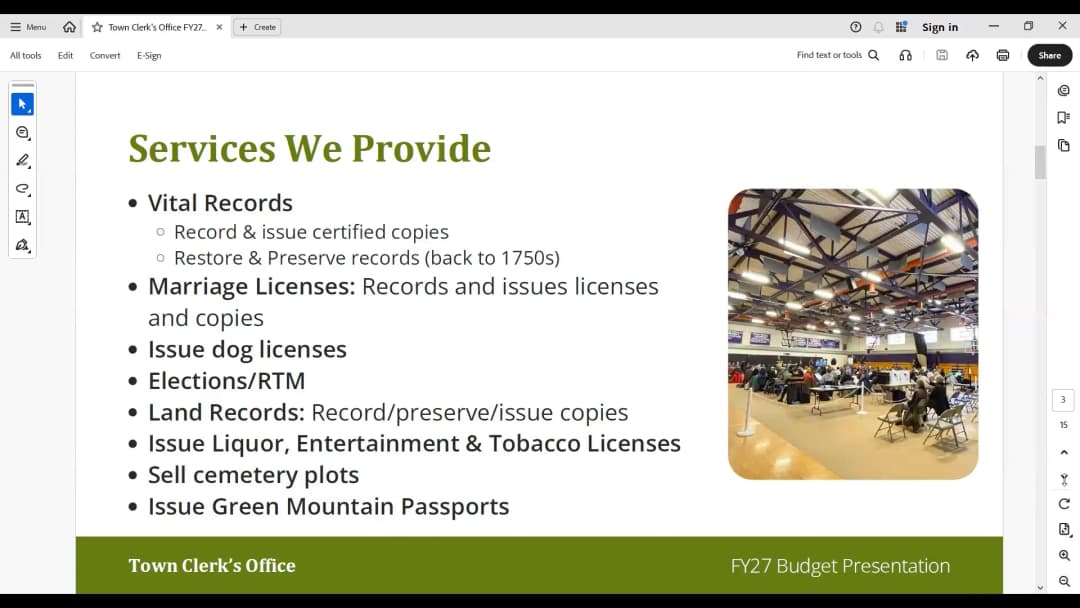
The Brattleboro Select Board convened on December 16, 2025, to conduct regular business, including a reconsideration vote on a previous bag pricing decision, budget presentations for all town departments, and the approval of consent agenda items. The meeting featured updates from the Town Manager regarding the $1.7 million disaster recovery grant and retirement announcements for Town Clerk Carol Cologne and Fire Department Officer. Board members provided guidance on town-owned land development, emphasizing the need to balance financial needs with environmental conservation and housing goals. The budget presentations highlighted significant restructuring of personnel costs and benefits, with ongoing discussions about filling the vacant full-time Finance Director position. Consent Calendar - Unanimous Approval: The Select Board voted 5-0 to approve the consent agenda, which included: - Authorization for the Town to partner with the Wyndham Regional Commission on an EPA Brownfields assessment grant. - Approval of a first and third-class liquor license for India Masala House. - Approval of a tobacco license and endorsement permit for Max Convenience Store (Circle K). - Contract renewal with Waste Zero for pay-as-you-throw services (clarified as separate from the bag pricing reconsideration). - Authorization to participate in Phase One of the Municipal Investment Fund. Public Comments & Testimony - Ivan Hennessy (District 8): Expressed strong opposition to the November 18th meeting's procedure, characterizing a police officer's presentation without time limits as an "irregularity" and a "public attack" rather than public comments. - Ken Fay (District 8): Expressed full support for the library and human services, arguing they are vital for democracy and community assistance; urged the board to avoid cuts to these entities during budget deliberations. - John DeGray: Asked for an update on the sidewalk easement at 142 Green Mountain Avenue (status: in review by the railroad); commended the Fire Department for Holiday lighting. - Rick (District 9): Supported high-density building as the most efficient housing model; noted that parcels purchased for watershed protection in remote areas should likely be retained for conservation rather than sold for development. - Dick DeGray: Opposed including the Harmony parking lot in any potential sale or development, stating it is essential to downtown vitality; advocated that any sale agreements for developable land must include strict timelines for development completion (1-2 years). Discussion Items - Reconsideration of Bag Pricing: The Board voted 5-0 to reconsider the tiered pricing system for trash bags adopted on December 2nd, which involved adding 15 and 10 cents to bag costs. This discussion is scheduled for the January 6th meeting. - Town-Owned Land Inventory: Town Planner Sue Fillion presented an interactive map of town properties categorized as "In-Use," "Partial," and "Vacant." Board members engaged in a strategic discussion: - Peter: Expressed a desire to sell saleable vacant land to return it to the grand list and bolster the rainy day fund; questioned the feasibility of developing remote 32-43 acre parcels for housing. - Amanda: Supported the initiative to restore reserves and increase housing stock but pushed back on the idea of selling the Harmony parking lot, noting its historical use for development options. - Isaac: Emphasized the need for a comprehensive strategy that simultaneously restores financial reserves, protects the environment, and expands affordable housing. - Consensus: No immediate action or vote was taken; the Board directed the Planning Department to continue feasibility analysis and return with specific recommendations on which parcels to pursue for transfer or development. - Department Budgets (FY27): - Human Resources & Finance: Director Sally Kruznick explained the merger of the two departments. The board discussed the use of stipends for acting roles (e.g., Managing Finance without a Director) versus permanent salary increases. Oscar and Amanda raised questions about the recruitment strategy for a full-time Finance Director, noting the current salary range ($100k-$109k base, up to $145k total comp) may be insufficient to attract talent, especially given the need for OpenGov proficiency. - Town Clerk: Clerk Hillary Francis presented a budget showing zero new revenue streams (e.g., DMV or hunting licenses were deemed cost-prohibitive). She testified that approving third-class liquor licenses currently costs the town more than the revenue generated (state takes $1,095, town takes $0). - Planning: Sue Fillion presented a budget maintaining 3.5 FTEs, noting a 40% apparent increase driven by shifting benefits into department lines. Highlights included 75 new housing units issued in 2025 and a $1.7M grant for the Detman Road Bridge. - Assessment: Assessor Jennifer Burnell discussed the ongoing reappraisal process and confirmed the town had no tax sales in 2025. - Town Manager: John provided a summary of the overall budget, highlighting a 16.5% increase in revenue projections and the continued reliance on a skeleton staff in the Town Manager's office (2 FTEs) due to unfilled Assistant Town Manager and IT Coordinator positions. Key Outcomes - Motion to Reconsider (Bog Pricing): Passed (5-0). The decision made on December 2nd regarding the tiered bag pricing will be formally reopened and debated at the January 6th meeting. - Budget Approval: The Board moved forward with the presentation of the FY27 budget components. No final vote was taken; the budget is scheduled for further deliberation and voting in January meetings (6th and 20th). - Adjournment: The meeting was adjourned at 8:05 PM with a 5-0 vote. - Administrative Updates: The Board was notified of the approval process for town land sales (statutory notice required, town meeting not mandatory unless board elects). It was noted that the state extended the period for tax sales by one year, impacting the town's ability to foreclose on arrears."

FISCAL SUSTAINABILITY 20% · PERSONNEL MATTERS 14% · AFFORDABLE HOUSING 13% · PROCEDURAL 10%
17
DEC 3, 2025 · BRATTLEBORO, VERMONT · SELECTBOARD
Brattleboro Select Board Meeting Summary (Dec 2, 2025)

The Brattleboro Select Board convened a regular meeting to address a wide range of town business, including the approval of a new liquor license, presentations on departmental budgets for FY27, and a pivotal vote to place a question on the March 2026 ballot regarding the discontinuance of the Representative Town Meeting. The meeting also featured significant public testimony and board deliberation concerning the permitting process for social assistance organizations, ultimately resulting in the convening of a public hearing for an interim zoning bylaw. Consent Calendar - Approvals: The Select Board unanimously approved meeting minutes from November 4, 12, and 18 (5-0). - Item Removal: Item B (Liquor and Tobacco License for JK Grocery Store LLC) was pulled from the consent agenda by a 4-1 vote at the request of Board Member Amanda to allow for further discussion before the regular business vote. Public Comments & Testimony - Trash Bag Fee Criticism: Eric Karen expressed strong opposition to the board's previous motion to implement a fee on trash bags to fund free bags for eligible residents. He characterized the approach as "town government overstepping its mandate" and "financially irresponsible" during a town financial crisis. - RTM Utilization: Kurt Gimes (Brattleboro Common Sense) warned of a potential budget referendum and argued that the Select Board is overworked because it does not sufficiently utilize the Representative Town Meeting (RTM) as a source of ideas and commentary as mandated by the town charter. - Social Assistance Concerns: Marta expressed confusion over the haste of the zoning discussion, stating that complaints regarding 69A were mostly unverified word-of-mouth and that the organization provides legitimate art and social services. She opposed moving to zoning changes without concrete, substantiated investigations. - Downtown Safety & NIMBYism: Isaac and Peter discussed the necessity of zoning controls to protect public safety and downtown business interests against perceived issues at social service locations, with Peter emphasizing the need for "better neighbors" and risk management. - Emergent Situation Debate: Ivan Hennessey argued that there was no emergent situation justifying the interim zoning bylaw and suggested the underlying concern was the visibility of poverty in downtown. Bob Ozer questioned the definition of "emergency" and suggested private dialogue over emergency declarations. Discussion Items - Liquor & Tobacco License (JK Grocery Store LLC): The board discussed an application for a second-class liquor and tobacco license. Board Member Amanda expressed concern about the impact of liquor and tobacco sales on downtown atmosphere and high poverty areas, questioning the board's authority to deny the license based on policy rather than statutory grounds. Town Clerk Hilary Francis clarified that the board could not attach conditions to this specific license but could theoretically pass an ordinance to restrict such sales in the future. The board voted to approve the license (5-0) after confirming statutory compliance. - Brattleboro Department of Public Works Budget: The Department presented an FY27 proposal highlighting significant cost increases due to benefits reallocation and the new compost collection program. Key discussions focused on the capital program cuts; staff noted that $870,000 in requested capital projects (sidewalks, retaining walls, bicycle infrastructure) had been removed from the current budget. Oscar and Kate O'Connor advocated for finding the funds to include these items in the general budget now rather than deferring them, arguing that delay increases costs and risks infrastructure failure. Isaac sought clarification on the discrepancy between the operational budget increase (25%) and the overall department increase (57.8%) cited in other materials, which was attributed to the inclusion of transferred benefit costs. - Recreation and Parks Budget: Director Carol Lalott presented an FY27 budget showing a 40% increase, largely driven by benefits reallocation ($330,554) and a request for one new full-time park maintenance position to address increased responsibilities. Isaac and Oscar raised concerns about the leaking pool infrastructure, suggesting the conversation regarding its replacement should not be delayed until the following December, while Peter noted the difficulty of replacing aging vehicles versus the risk of maintenance costs. Amanda and Oscar commended the department's ability to maintain affordability and low fees despite rising costs. - Library Budget: Star Latronica presented the FY27 library budget, noting a request for $25,000 to hire as-needed substitute staff to ensure safety compliance and open hours when full-time staff are absent. She detailed the library's role in community connection, economic development, and public safety. Board members appreciated the library's high operational hours and digital services but sought to understand the specific impact of reducing the substitute budget. Key Outcomes - Budget Assessment Tax: Moved to place an item on the 2026 Representative Town Meeting warning to authorize the collection of a $80,000 assessment on downtown properties to fund the Downtown Brattleboro Alliance (5-0). - Health Insurance Switch: Approved the town's switch of medical plan provider from Blue Cross Blue Shield to Cigna for calendar year 2026. This change is projected to result in a cost savings of approximately $434,000 compared to the BCBS renewal (5-0). - RTM Discontinuance Vote: Moved to direct staff to prepare an article for the March 3, 2026, annual town meeting ballot asking voters if they would discontinue the Representative Town Meeting. The board agreed that if the vote passes, the town will transition to an Open Town Meeting in April (5-0). - Interim Zoning Bylaw Hearing: Moved to convene a public hearing on December 22, 2025, to discuss an interim zoning bylaw that would change "social assistance and charitable service" uses from permitted to conditional uses. This motion passed by a 3-2 vote. - Budget Status: The FY28 month-to-date budget report confirmed a general fund surplus of $12.3M and a utilities fund surplus of $622k as of October, though the board noted rising utility costs and overtime expenses in public safety. Adjournment - The meeting was adjourned at approximately 11:00 PM after all agenda items were addressed. The board scheduled a follow-up meeting for the following Tuesday to continue budget deliberations.

BUDGET EQUITY ANALYSIS 16% · ENGINEERING AND INFRASTRUCTURE 11% · PROCEDURAL 10% · PUBLIC ENGAGEMENT 10%
18
NOV 21, 2025 · BRATTLEBORO, VERMONT · SELECTBOARD
Brattleboro Select Board Special Meeting Summary - November 20, 2025

A special meeting of the Brattleboro Select Board was convened on November 20, 2025, to discuss departmental staffing updates and provide a comprehensive briefing on the upcoming town-wide property reappraisal process scheduled for completion in 2027. Board members and public attendees addressed procedural questions regarding the finance committee and received detailed clarification from the town assessor and the project management team from New England Municipal Consultants regarding valuation methods, data collection protocols, and the statutory timeline for the 2027 grand list. Consent Calendar - The meeting was officially warned and called to order by the Chair. Public Comments & Testimony - Audrey Garfield (Resident): Expressed inquiry regarding the status and schedule of the Finance Committee's upcoming briefing to the Select Board and sought clarification on how to join the distribution list for meeting notices. David Lubmark confirmed the committee meets regularly and provided the next meeting date as November 24th, encouraging residents to contact Jessica Stickler for updates. - David Lubmark (District 9): Asked for clarification on whether the entire town's property data would be public prior to the formal grievance process. Ryan Silvestri confirmed the database would be published online for public filtering and analysis, though physical booklets would be discontinued due to cost. - Aaron Smith (Resident): Inquired about how building conditions (e.g., ISO ratings, flood zones, and interior updates) influence assessments. He noted his property is an outlier in a flood zone compared to his neighbors. - Jen Smith (Resident): Asked about the source of phone numbers used for scheduling and whether the town would announce specific neighborhood canvassing dates. Ryan explained that the team will rely on door-knocking and pre-sent letters rather than cold calls to ensure security and avoid copycats, though specific daily schedules will not be announced. - Heidi: Clarified that while data collection begins December 1, 2025, no tax bills will reflect changes based on the new values until Fiscal Year 2027. She also confirmed that field teams will remove shoes and provided instructions for identifying official town badges and photo IDs online. - Oscar: Asked if residents waiting for the informational letter could set up appointments if they heard the team was arriving early; Ryan confirmed the team would reschedule if an appointment was already made. Discussion Items - Reappraisal Overview: Ryan Silvestri (NEMC Project Manager) and Jennifer Burnell (Town Assessor) presented the background for the 2027 reappraisal, noting the previous appraisal was in 2010. Ryan emphasized that the goal is to build a new database from scratch to achieve full 100% fair market value using sales data from April 1, 2024, to April 1, 2027. - Valuation Methods: Silvestri explained that residential properties will use a cost approach backed by sales, while commercial properties will use a hybrid of sales and income approaches. He clarified that farms are valued as residential based on highest and best use, with significant functional obsolescence applied to agricultural buildings. He also stated that non-profits and exempt properties (like hospitals and schools) will be assessed at fair market value to ensure accuracy for insurance and outside scrutiny, even if the tax is deferred. - Interior Inspections: The board and public discussed the necessity of interior inspections to accurately assess depreciation and condition. Silvestri stated that while interior visits are the 'gold standard' for equity (allowing value to be placed on specific rooms like kitchens and bathrooms), the team will not force entry; exterior observations will be used if owners decline. He specified that teams typically look at kitchens, bathrooms, and basements. - Flood Zones and Outliers: Aaron Smith raised concerns about his property's unique position in a flood zone. Silvestri acknowledged that while mass appraisal satisfies the average (inter-quartile range), outlier properties like Smith's may require individual adjustments and a specific visit to the informational hearing to reconcile value differences with neighbors. - Sales Data Sources: Silvestri confirmed that only sales within Brattleboro will be used to set market values, excluding sales from adjoining communities. He also clarified that list prices are ignored in favor of actual transaction prices. - Current Use Programs: The interaction between reappraisal and the current use program was clarified; land is valued uniformly first, and then current use subsidies are applied downstream. Silvestri warned against backloading excess acreage values before the subsidy calculation. - Informational Hearings: A four-level appeal process was outlined, starting with informational hearings before the formal grievance. During this stage, the contractor can still modify values based on taxpayer feedback. Comps (comparable sales) will be available for review during these hearings, particularly for outlier properties. - Security and Identification: It was clarified that contractors have no direct access to the town's phone database and must rely on door knocking or letters. However, their photos and badges are available on the town website's reappraisal project page to allow residents to verify their identity. Key Outcomes - Meeting Adjournment: The meeting was unanimously adjourned at the conclusion of the presentation (Vote: 3-0). - Action Plan for Residency:Residents are directed to monitor the town website for the project page to view team photos and contact the assessor's office at 8:30 AM to 5:00 PM to verify any unsolicited visitors or to schedule appointments. - Schedule Confirmation: Field data collection for the reappraisal is scheduled to begin on December 1, 2025. - Budget Constraint Note: The Finance Department will close daily from 12:00 to 1:00 PM for foreseeable lunch breaks due to staffing constraints. - Tone of Engagement: The board and contractors emphasized a commitment to transparency and acting in the community's best interests, stating they will be present in the community full-time for approximately 16-17 months.

BUDGET EQUITY ANALYSIS 39% · PROPERTY TAX ASSESSMENT 35% · PROCEDURAL 20% · PUBLIC ENGAGEMENT 3%
19
NOV 20, 2025 · BRATTLEBORO, VERMONT · SELECTBOARD
Brattleboro Select Board Meeting Summary - November 18, 2025

The Brattleboro Select Board convened its regular meeting on Tuesday, November 18, 2025, at 6:15 p.m. to address a solid waste management plan, a fireworks contract, public safety issues regarding trespass orders, and departmental budgets for the police and fire departments. The meeting featured extensive public testimony on the affordability of solid waste program fee increases and the staffing models for emergency services, alongside debates on the legality of trespass orders issued on public property. Select board member Amanda Evans Franz expressed concern over the composting implementation costs, leading to a failed motion to delay it, while Isaac Evans and other board members supported the comprehensive solid waste contract. The board also addressed allegations of police overreach in issuing trespass orders, with police leadership defending their practices as necessary for safety and not based on mere presence. Finally, the department budgets were presented, with significant debate and public support for transitioning the fire department to a four-platoon, 42-hour work week model. Consent Calendar - Routine Approvals: - Approved minutes from October 16 and October 21, 2025 (5-0 vote). - Approved the consent agenda items: (1) First and third class liquor license and outside consumption permit for Marigold LLC; (2) Rescheduling of public hearing and site visit for Bittersweet Lane to Class 3 Town Highway to January 20, 2026; (3) Reclassification of Gulf Road segment (Wikipedia Hills) from Class 3 to Class 4 Town Highway. Corrections to typos regarding "Melrose Street" and "Bittersweet Lane" in the backup materials were noted and addressed before approval. (5-0 vote). Public Comments & Testimony - Solid Waste Program (Affordability and Model): - Randy Bladgett (District 7): Expressed strong opposition to the proposed contract, arguing for multiple haulers to create competition and reduce costs. He stated the town should not be in the rubbish collection business and labeled the contract a "hostage-taking situation" by Casella, arguing for efficiency and lower taxes. - Susan (District 8): Opposed the contract, stating the town should focus on infrastructure repairs. She described the bag price increase (doubling fees) and the built-in annual increases as "cruel" and "mean," arguing that the town should not be in the waste management business and taxpayers should be responsible for their own rubbish. - Amanda Evans Franz: Expressed a desire to "put a pin" in the municipal compost curbside plan for the time being due to budget constraints and the high cost of implementation. She suggested a delay until January 2026 to examine alternatives like self-hauling or collaboration with the Windham Solid Waste District. - Peter: Expressed support for the current contract and municipal composting, stating that removing compost would be going backward and the savings "isn't worth the juice" of losing the service. - Isaac Evans: Supported the solid waste contract, noting the $1.3 million savings over three years. He proposed an amendment to the pay-as-you-throw bag fee increase to add a small surcharge (10 cents on yellow, 15 cents on purple) to create a dedicated fund for subsidizing low-income residents, arguing for immediate action to ensure dignity and equity. - Heidi Fisher (District 7): Expressed support for the sentiment of Isaac's amendment but argued against the implementation logistics, stating it would be a "huge undertaking" for staff to manage eligibility and distribution. She suggested alternative community-based donation models. - Marta Gosich (District 9): Expressed support for the amendment, fearing that affordability issues would incentivize illegal dumping. She suggested using EBT/SNAP verification at the point of sale as a simple implementation method. - Ivan Hennessy (District 8): Expressed support for the amendment, viewing it as a necessary "pilot program" to implement equity measures now rather than delaying action indefinitely. - Lisa Marie (69A): Shared accounts of residents being trespassed for checking on friends or sleeping on benches, and for having their property taken or not being properly informed of where they are trespassed. She expressed concern that verbal trespasses are common and that misinformation regarding property storage exists. - Bob Nealed: Expressed gratitude for police services but questioned the bodycam policies and the authority for public property trespassing. He asked about the validity of reports regarding tent slashing. - Fire Department Support: Multiple speakers, including Chris Duby (Professional Firefighters of Vermont), Jamal Cunningham (former union president), Alex Morren (former firefighter), and Charles Hugot (former firefighter), strongly supported the transition to a four-platoon, 42-hour work week. They argued the current 56-hour schedule causes fatigue, burnout, poor mental health, and recruitment/retention issues. They stated that a 56-hour schedule is unsustainable and that the 42-hour model is standard and necessary for safety. Discussion Items - Solid Waste Management Plan: - Staff presented a proposal to maintain pay-as-you-throw trash collection (with fees rising from $2 to $4.50 for yellow bags and $3 to $6.75 for purple bags), transition recycling to an automated cart-based system managed by the town, and implement municipal compost collection via DPW. The contract with Casella for trash and recycling includes a $1.025 million first-year cost with 4.5% annual increases. The proposal aims to save the town $1.3 million over three years compared to previous iterations. - Debate centered on the affordability of the fee increases for low-income residents and the municipalization of composting. Amanda Evans Franz moved to strike the composting portion from the implementation motion, citing budget concerns. The motion to strike composting failed (1-4 vote). Isaac Evans moved to amend the bag fee increase to include a surcharge for a low-income subsidy fund; this amendment passed (4-1 vote). - Fireworks Contract: - Recreation Director Caroline presented a request to renew a $20,000 contract with North Star Fireworks for the July 4, 2026 display. She noted that costs have risen due to tariffs and insurance, and many other companies were either unavailable or had minimums above $20,000. She emphasized that community donations via the "Brattleboro Goes Fourth" committee cover about $700-$800 of the cost. - Isaac Evans expressed a desire to save the money and noted other communities are considering alternatives. Amanda Evans Franz noted the impact on wildlife and pets but was not prepared to vote to cancel without alternatives. - Public Safety Update (Trespass Orders): - Follow-up to Select Board Member Isaac Evans' previous comments regarding claims that police were issuing trespass orders for merely being in public spaces. Chief Hardy and the Police Department presented data and testimony clarifying that trespasses are typically issued for illegal behavior, not mere occupancy. Chief Hardy stated that verbal trespasses are rare and that the vast majority of trespass orders (69 total this year) were issued at private property requests. Of the 45 on public property, 23 are currently active. The department emphasized that they attempt to resolve issues through conversation before issuing orders. - Town Attorney Hannah Clarice clarified the legal authority, stating that police can issue trespass orders on behalf of public property owners if the individual is engaging in unlawful disorderly conduct. She noted that while some locations have specific signage, the authority stems from the property owner's right to control access. - Police Department Budget (FY27): - The department presented a budget emphasizing staffing recovery (from 14 sworn officers to 30), increased overtime costs due to court appearances and training, and capital needs for vehicles and security cameras. The department highlighted the success of the Brattleboro Resource Assistance Team (BRAT) and HCRS liaisons in reducing officer workload. - Public speakers, including Elizabeth Bridgewater (Windham and Windsor Housing Trust) and George Karabakis (HCRS), strongly supported the budget, praising the community policing model and the collaboration between the police and social services. - Fire Department Budget (FY27): - Chief Simons presented a budget proposing a transition from a 3-platoon (56-hour work week) to a 4-platoon (42-hour work week) model, requiring the addition of two firefighter/EMT positions. The department cited health and safety benefits, recruitment/retention improvements, and alignment with NFPA standards. Overtime is projected to increase significantly in the proposal as it includes current overtime costs before the new shift pattern is fully implemented. - Speakers supporting the 42-hour week emphasized work-life balance and safety, while some public comments questioned the financial assumptions regarding EMS revenue reimbursement. Key Outcomes - Solid Waste: - Motion 1 (Solid Waste Implementation): Approved 4-1. The board approved the implementation of the solid waste system including pay-as-you-throw trash, automated recycling, and curbside compost pickup. - Motion 2 (Casella Contract): Approved 4-1. The board approved a 42-month contract with Casella for trash and recycling collection. - Motion 3 (Pay-As-You-Throw Fees): Approved 4-1 (with modification). The board approved the fee increase to $4.60 for yellow bags and $6.90 for purple bags, and authorized a fund created by surcharges (10 cents/15 cents) to subsidize low-income residents. - Fireworks: - Contract Approval: Approved 4-1. The board authorized the $20,000 contract with North Star Fireworks for the 2026 Independence Day display. - Budgets: - Police & Fire: The board received presentations for the FY27 budgets for both departments but did not vote on final approval during this meeting. Negotiations for union contracts are ongoing for both departments. - Procedural: The meeting adjourned at approximately 11:15 p.m. with a 5-0 vote to adjourn. - Next Meeting: A special meeting regarding town-wide reappraisal is scheduled for Thursday, November 20, 2025, at 6:15 p.m.

PUBLIC SAFETY 28% · BUDGET EQUITY ANALYSIS 15% · PROCEDURAL 9% · WATER AND WASTEWATER MANAGEMENT 7%
20
NOV 13, 2025 · BRATTLEBORO, VERMONT · SELECTBOARD
Brattleboro Select Board Special Budget Listening Session - Nov 12, 2025

The Brattleboro Select Board convened a special listening session to gather public input on the proposed FY27 town budget, estimated at $27 million. Town Manager John Potter addressed prior concerns regarding salary line accounting to reassure residents that no improper payments were distributed. The meeting featured extensive public testimony focused on fiscal responsibility, rising health care costs, the management of solid waste services, and the allocation of funds for human services. Speakers emphasized a perceived financial crisis, with many calling for a level-funded budget, reductions in non-essential services, or the elimination of the town's solid waste contract. Consent Calendar - No routine business was conducted as this was a special budget listening session. Public Comments & Testimony General Concerns & Fiscal Crisis - Kate O'Connor (Resident): Expressed that the town is in a "financial crisis," citing deficits in FY24 and FY25, a 10.8% tax increase in FY26, and the depletion of the unassigned fund balance. She expressed full support for transparency in personnel accounting but urged the board to be cautious, noting that the proposed 4.4% tax increase is likely inaccurate and will be higher. - Eric Karen (Resident): Stated full agreement with the notion of a financial crisis and expressed opposition to any tax increase, advocating for a level-funded budget through careful negotiation with department heads. - Randy Blodge (RTM Rep, District 7): Highlighted the town's economic hardship, noting Brattleboro is in the top five US tax jurisdictions. He opposed the current budget's assumptions on revenues (EMS, sales tax) and called for a "zero this budget out with real numbers" approach. - Hugh Barber (Resident): Expressed strong concern that the current spending pace is "unsustainable" and would double the budget to $46 million in eight years. He advocated for a level-funded budget and suggested the board reduce the budget to honor the constituents who elect them. - Jackie Pinger (Resident): Expressed nervousness regarding the upcoming revaluation and the potential for property tax spikes to push residents out of town. Health Insurance & Personnel - Richard Davis (Resident): Expressed frustration that health care price increases of 19% are "out of control" and noted he could not provide a reasonable range for tax increases given the uncertainty. - Robert Ozer (Resident): Noted conflicting data on Blue Cross Blue Shield premiums (VLCT citing 4.4% vs. town negotiation at 19%). He supported a serious look at self-insurance options. - Frick Sprite (District 9 Rep): Expressed opposition to the Town Manager's previous explanation of health insurance options as "disingenuous" and called for a serious look at self-insurance, potentially with other communities. - Kate O'Connor: Noted personnel makes up 66% of the budget and expressed concern over adding 6.75 new equivalents in FY27 without a plan to control costs. Solid Waste & Public Works - Pierre Landry (District 1 Rep): Expressed full support for eliminating curbside compost pickup and adopting the model of other Vermont towns where households contract their own waste removal. - Susan Velva (District 8 Rep): Stated she is a "strong opponent" to renewing or entering the solid waste contract, arguing the $1.9 million budget should be redirected to essential infrastructure. - Aaron Smith (District 7 Rep): Argued that trash and leaf collection should be personal responsibilities to foster competition and lower costs, suggesting the town level-fund the budget. - Ivan Hennessy (District 8 Rep): Expressed opposition to the idea that individuals contracting waste is cheaper, arguing it removes money from local circulation and ultimately costs property owners (and indirectly renters) more. - Neil Manders (RTM Rep, District 7): Suggested the town could do without solid waste collection and proposed community-run dumpsters, noting the complexity of the current two-year process. - Oscar (Select Board): Clarified that the proposed solid waste plan is driven by the goal of saving $1.3 million over three years compared to the April proposal, though public sentiment appears mixed. Human Services & Emergency Services - Ken Faye (RTM Rep, District 8): Expressed support for increasing the human services budget, proposing an increase to 2% of the total budget. - Lisa Marie (Resident): Expressed support for keeping the "brat team" (mental health crisis team) and advocated for public toilets to address hygiene issues on sidewalks. - Becky Sit (Resident): Expressed support for the current composting improvements but agreed that police and fire departments must be leaned on to become "leaner and more affordable." - Andrew Davis (District 9 Rep): Expressed concern about the RTM's power to potentially change the human services budget by over $400,000 in March, arguing the Select Board should retain the authority to set the budget level. - David Spencer (Resident): Expressed support for maintaining the current budget level while acknowledging the need for hard decisions and explaining the timeline for efficiency to residents. - Mr. DeGray (Resident): Supported keeping the human services budget at 2% based on historical precedent but expressed concern about the selective budget presentation process. - Marilyn (Resident): Expressed deep concern that the town is cutting human services to fund police, stating that the cost of preventing homelessness is far less than the cost of addressing the consequences (e.g., encampment dismantling). Procedural & Charter Issues - Frick Sprite: Asked for clarification on the charter review process; confirmed it will not go to a public vote immediately but must be deliberated by the RTM first. - Randy Blodge: Clarified that the charter commission process involves educational meetings before any vote is considered. - Caitlin Babcom & Liz (Residents): Expressed frustration and anger regarding the lack of accessible budget questions and the eviction notice given to "69A" shelter services. Liz, identifying as autistic, expressed that police actions against homeless individuals on public property are illegal, stating police "cannot legally trespass people" without a designated area. Discussion Items - Town Manager John Potter: Addressed a specific accusation regarding salary lines from a previous meeting, clarifying that certain benefits (travel, clothing, opt-outs) were historically recorded in salary object codes and will be revamped in the FY27 budget for clearer departmental tracking. He assured the board that no employees received improper payments. - Select Board Oscar: Clarified that the solid waste proposal aims to save money and noted the Select Board cannot disclose contract negotiation details until a final decision is ready. - Select Board Member: Responded to a question about the revaluation (reappraisal), confirming it is scheduled for 2027 and that the tax amount only changes via the budget process, not the revaluation itself, though the spread of taxes across the community may shift. - Select Board Member: Rebutted the idea that human services are being cut to fund police, stating that 400,000 fewer dollars are not being taken out of human services to go to police, and highlighted efforts to secure state aid for needle cleanup, rooms and meals tax reestablishment, and revenue sharing. Key Outcomes - Public Sentiment on Tax Increase: The majority of speakers expressed strong opposition to any tax rate increase, with many advocating for a "level-funded" budget. - Solid Waste Service: There is no consensus; while the board proposes the contract to save $1.3 million, numerous public witnesses expressed a desire to eliminate the service or return to private contracts. - Charter Review: Confirmed that charter commission questions will not be on the immediate ballot but will be referred to the Representative Town Meeting (RTM) for thorough deliberation before any public vote. - Human Services Budget: Disagreement exists on the fixed 1% vs. 2% increase, with some calling for zero increase and others supporting a 2% historical average or a specific dollar cap. - Next Steps: The Select Board will continue to receive input at the next meeting on Tuesday and will pursue state aid requests regarding needle cleanup and revenue sharing.

BUDGET EQUITY ANALYSIS 27% · FISCAL SUSTAINABILITY 15% · SOLID WASTE MANAGEMENT 11% · PROCEDURAL 9%
OPENPUBLICA · PUBLIC MEETING INDEXUPDATED DAILY · openpublica.com