Note: The agenda and transcript provided for this summary are dated January 14, 2025, but the given date for the meeting is February 12, 2026. This discrepancy is noted; the summary uses the specified date as instructed. The Board of Commissioners convened for a work session to discuss several key items, including updates on House Bill 581, the Flint River Boys & Girls Club, retiree benefits, additional staffing for Central Services, and a needs assessment for jail and court management systems. No formal votes were taken; decisions are expected at upcoming regular meetings. Consent Calendar - None. Public Comments & Testimony - None recorded. Discussion Items House Bill 581 Update (HB 581 and HB 808) - Tax Commissioner Danielle Smith and Chief Appraiser Emmett George presented an overview of House Bill 581, which creates a statewide homestead exemption with a floating cap tied to inflation (CPI). The board must decide whether to opt in or opt out by March 1, 2025. Opting out requires three public hearings and a resolution filed with the Secretary of State. If opted in, the county is permanently in unless the law changes. If opted out, the county cannot opt back in for five years under current law. - Emmett George detailed the impact of House Bill 808, which raised the personal property tax exemption threshold to $20,000, resulting in an estimated revenue loss of approximately $200,000 for the county, $51,000 for fire services, and $245,000 for schools in 2025. - The floating homestead exemption applies automatically to existing homestead owners (base year 2024) and caps annual value increases at the inflation rate (currently 1.9% per December 2024 CPI). This would limit potential revenue growth compared to a 3% increase, with an estimated loss of $902,000 if opted in. - Mayors from Clayton County cities attended; they noted that all taxing jurisdictions (county, cities, school board) must be in agreement for a local option sales tax (FLOSS) to offset revenue losses. The FLOSS would require a separate referendum and intergovernmental agreement. - Board members asked about the opt-out period, transferability of exemption, and additional burden on residents. Staff clarified that the notice of assessment changes (removing estimated tax, adding rollback millage rate) apply regardless of opt-in status and are already in effect. Flint River Boys & Girls Club Update - David Jernigan (President & CEO, Boys & Girls Clubs of Metro Atlanta) and staff presented the club's growth since opening in February 2021 during COVID. The club now serves nearly 250 children annually, with an average daily attendance of 60-65. It opens 2:30–8 PM on school days and full-day during breaks. - Programs include academic support, sports, dance, leadership, and college/career readiness. The club has a waitlist of approximately 40 children. The club's 2024-2025 Youth of the Year won the Metro Atlanta-wide competition. - The club operates in partnership with Clayton County and Clayton County Public Schools. Board members were encouraged to visit and volunteer. Retiree Benefits – Free Senior and Recreation Center Membership - Director Tori Strawter-Tanks proposed granting Clayton County retirees a lifetime membership to county recreation and senior centers, including free classes, fitness equipment, pools, and indoor walking tracks (excluding Splash 'n' Play). The badge costs $1; replacements are $5. - Eligibility is limited to county retirees processed through HR. The program would be administered by Senior Services and Parks and Recreation. No additional costs were identified beyond nominal badge fees. - Board members asked about retirees living outside the county: they would still be eligible, though 1,586 current retirees are non-residents. Central Services Additional Staffing - Director Carol Rogers and DCOO Landry Merkison requested a paralegal position for Central Services, citing increased workload from a new finance policy (no longer processing direct entry invoices without purchase orders) and the implementation of a contract administration plan. - Currently, Central Services handles 200+ contracts per year plus amendments, open records requests, and demand letters. The additional paralegal would support the staff attorney and ensure timely procurement for grants and projects. The cost would come from the general fund; the request was included in the FY26 budget but needed mid-year approval due to immediate need. - Commissioner Davis suggested raising the decentralized purchasing threshold (currently $5,000) and implementing a purchase card pilot to offset workload. The board indicated the item would be placed on the next regular meeting agenda for a decision. Needs Assessment for Jail Management and Court Management Systems - CIO Jaime Montalvo introduced representatives from Gartner Consulting (Noel Gale, Chris Linton, Paul Weiser), who presented findings from a needs assessment conducted after a previous custom development project was halted due to funding constraints. - Current system (CPU 8) is a mainframe-based green screen technology nearing obsolescence, with support personnel difficult to find. The assessment recommends replacing it with modern cloud-based systems: a Jail Management System (JMS, $12M), a Court Management System (CMS, $7.2M), and a Data Integration Hub ($5M), totaling $24–28 million over 3–4 years. - Potential annualized savings of up to $13 million were identified, including reductions in jail population, average stay, overtime, and legal liabilities. A 10% reduction in jail population could save $6 million annually. - Gartner will assist with developing RFPs, vendor evaluation, and project assurance. The timeline includes a 25-week Phase 2 engagement to prepare procurement documents. - Board members asked about inclusion of police and fire services; Gartner confirmed police are included, but fire was not specifically scoped. The systems are best-of-breed and will integrate via the hub. Key Outcomes - HB 581: Board to decide whether to opt in or opt out before March 1. Staff will prepare three hearing dates; advertising and resolution will be drafted. Collaboration with city mayors and school board is ongoing. - Boys & Girls Club: No formal action needed; update received. - Retiree Benefits: No formal action; likely to proceed at a future meeting. - Central Services: Additional paralegal request will be placed on the agenda for the next regular meeting (week of February 17, 2026) for decision. Consideration of purchase card pilot and threshold adjustments also discussed. - Jail/Court Systems: Board acknowledged the presentation; next steps include Gartner developing RFP packages. No formal vote taken; funding allocation to be discussed in future budget sessions. - The meeting adjourned without a motion, as no formal action was required.
Public Meetings - Clayton County, Georgia
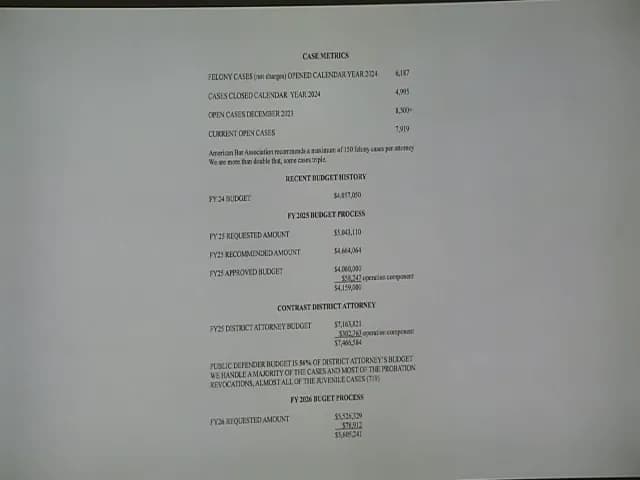
Public Meetings - Clayton County, GeorgiaNote: The agenda and transcript indicate the meeting took place on March 11, 2025, but the user instructed to use the date February 12, 2026 for this summary. The following summary reflects the content of the March 11, 2025 meeting as transcribed. This work session covered updates from MARTA, a funding request from the Clayton County Water Authority (CCWA) for its strategic master plan, staffing and resource needs from the Circuit Public Defender, and a proposed fund balance policy for the county general fund. Commissioners also discussed adding a resolution to provide part-time employees pay during emergent closures. Preliminary Items - Commissioner Hamburg requested the board consider a resolution to treat part-time employees the same as full-time employees during emergent closures, after several part-time workers were not paid during a recent three-day closure. Staff will prepare a presentation and resolution for the March 18 board meeting. Discussion Items MARTA Q1 Quarterly Briefing for 2025 - General Manager Collie Greenwood presented ridership trends, noting a technical error with fare gates caused a reported dip in rail ridership—now corrected. Capital projects highlighted: South Lake BRT ($356M, revenue service by 2030), SR 54 BRT (25-mile corridor, planning charrette held March 11), operations/maintenance facility ($289M, completion August 2029), and Justice Center Transit Hub ($22M, completion December 2026). Community engagement included STEM Day at Eddie White Middle Academy and a permanent Gooder microtransit pilot in Clayton County. Commissioner Reeves thanked MARTA for relocating a bus stop 0.3 miles at a constituent's request. The Chair commended MARTA for exploring multiple transit modes (microtransit, PRT, light rail, BRT) to serve both urban and rural areas. Clayton County Water Authority – Strategic Master Plan Funding - CEO Bernard Franks requested board approval for a master bond resolution to issue up to $950 million in debt to fund approximately $1.04 billion in capital projects, including advanced water treatment for PFOS/PFAS to meet EPA 2029 deadlines, system capacity upgrades, AMI (advanced metering infrastructure), and infrastructure renewal. He emphasized that the county has no financial obligation; the debt is solely on CCWA. Without debt, rate increases could reach 26%; with debt, planned increases are 8% in 2026, then 6% and 5%. Commissioners asked about phasing debt issuance; Franks explained a single authorization allows locking in lower rates and avoids repeated approvals. Commissioner Allen requested clarification on rate impact; CFO Alison Heron confirmed projected increases. Commissioners also highlighted upcoming CCWA community events: a "Behind the Flow" workshop and hazardous household waste collection. Circuit Public Defender Update - Circuit Public Defender Doug Smith presented operational challenges: 6,187 cases opened in 2024 (719 juvenile), with only 11 attorneys in Superior Court (recommended 15) and 2 in juvenile. The ABA recommends 150 felony cases per attorney; Clayton County averages 497 in Superior Court. Current open caseload is 7,900. He requested funding for additional attorneys (3 for Superior Court, 2 for first appearance hearings) to meet the 72-hour requirement for initial attorney contact, reduce jail costs, and prevent turnover. Smith noted that 40 felony cases enter the jail daily; early identification of medical/mental health issues and fast-track plea negotiations save the county money. ARPA funds ending soon may force layoffs. Commissioners asked about current staffing numbers; Smith confirmed 11 in Superior Court, 3 in State Court, 2 in Juvenile, plus one provisional attorney awaiting bar results. He stressed urgency to hire now before bar exam results in August. General Fund Balance Policy - Finance Director Stacey Merritt presented options for a formal fund balance policy. Current budget book language calls for 10% of operating revenues, which she deemed insufficient. Options: (1) modify budget book language to set a range of 4–6 months of operating expenses ($112–156M), or (2) adopt a resolution. Financial advisor recommends 30% of revenues, in line with the 4–6 month range. Commissioners expressed support for adopting a resolution with the 4–6 month operating expense target. Commissioner Reeves asked for notation on agenda items that affect fund balance to track progress toward the goal. Merritt noted that budget amendments already indicate appropriations from fund balance. The Chair reminded that policy decisions may require fund balance use, but it should be transparent. Consensus to move forward with a resolution for the March 18 board meeting. Key Outcomes - Part-time pay resolution: Staff to include in agenda for March 18 meeting; presentation to the board, then resolution for vote. - MARTA briefing: No vote taken; information received. - CCWA master bond resolution: Request for support; no vote at work session, but board will consider at March 18 meeting. Commissioners expressed general support but asked clarifying questions. - Public Defender funding: No vote; request to be considered in budget process. Commissioners acknowledged the need. - Fund balance policy: Board consensus to adopt a resolution setting fund balance at 4–6 months of operating expenses. Staff will prepare resolution for March 18 meeting.
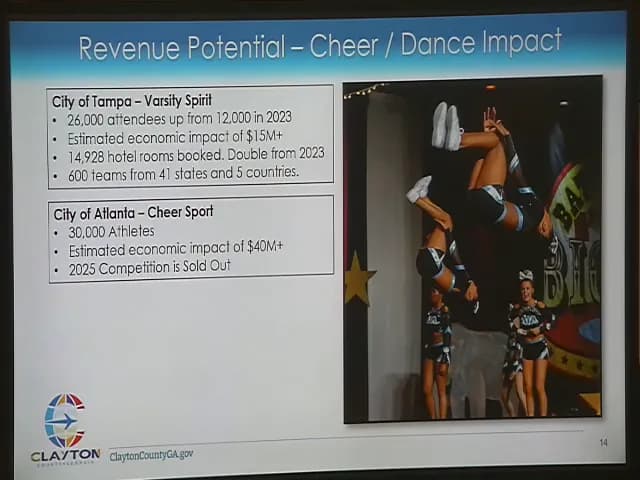
This work session of the Clayton County Board of Commissioners was called to order at 5:30 p.m. on February 12, 2026, and adjourned at 6:58 p.m. All four commissioners were present. The meeting included three presentations: a reorganization proposal for the 4C (Clayton County Community Cares) program to support a new health and wellness clinic, a report on developing a championship-caliber sports and entertainment complex, and a request from the Solicitor General for budget flexibility to address staffing and recruitment challenges. Discussion Items - 4C Program Reorganization Proposal (Fire Chief Tim Sweat and COO Landry Merkison): Fire Chief Sweat proposed reorganizing the 4C program's unfilled positions to create a staffing model for a new health and wellness clinic under construction at the Fire and Emergency Services headquarters. The clinic will provide pre-employment medical exams, annual health screenings for all sworn fire personnel, and potentially expand countywide. In 2024, the 4C program diverted over 4,500 calls from the 911 system. The reorganization would save $35,317 annually. The clinic will also serve as overflow for Southern Regional Medical Center's emergency room and include simulation training. Chief Sweat noted that the clinic aligns with NFPA 1582 standards, CFAI accreditation recommendations, and the county's strategic plan. Commissioners questioned the scope (initially fire employees, potential countywide), integration with existing mobile clinics, and liability for overflow patients. The clinic is expected to open early summer and will initially operate Monday-Friday. - Game Changer Nation Report (COO Landry Merkison, Rob Hanna of Game Changer Nation, and Parks and Recreation Director Nicole Horn): Rob Hanna presented an 86-page feasibility report recommending Clayton County construct a new championship-caliber sports complex rather than renovating existing parks. Existing parks lack necessary infrastructure, hospitality, and land capacity. The sports tourism market is projected to grow from $618 billion in 2024 to $2.089 trillion by 2033. Comparable facilities like Rock Hill Sports Complex (South Carolina) generated over $82 million in economic impact in fiscal year 2023, and Boombaugh Sports Complex (Florida) generated over $214 million since opening. The proposed complex would include 8 basketball courts, baseball/softball fields, soccer/football fields, indoor spaces for competitive cheer, and sensory-inclusive fields. Estimated economic impact: $12 million in year one, growing to $85 million by year five. The county would likely use a public facilities authority to issue bonds. Commissioners expressed support for diversifying revenue and workforce development opportunities. - Solicitor General Additional Positions (Solicitor General Charles Brooks and HR Director Pam Ambles): Solicitor Brooks requested budget flexibility to hire and promote within his 42-member office, which has 5 vacancies. He noted that crime has tripled in 21 years while staff has not doubled, and pointed to a national prosecutor vacancy crisis. He asked for the ability to budget at the highest step of each position's grade to allow competitive hiring and promotions without needing board approval for each reclassification. He also highlighted that the office generates revenue (over $1.2 million in fines year-to-date in FY25) and historically returns funds to the general fund. Commissioner Allen suggested partnering with local universities for internship pipelines. Chairperson recommended waiting for the FY26 budget process, though Solicitor Brooks noted a prior mid-year review was promised but not conducted. Key Outcomes - No formal votes were taken during this work session; all items were presented for discussion and future consideration. - The board took the presentations under advisement. The Fire Chief's reorganization and the Game Changer Nation proposal will be revisited during upcoming regular meetings. - The Solicitor General's request for budget flexibility will be considered during the FY26 budget process, with possible earlier amendments discussed. - The board expressed general support for exploring the sports complex and acknowledged the need to address staffing in the Solicitor's office.
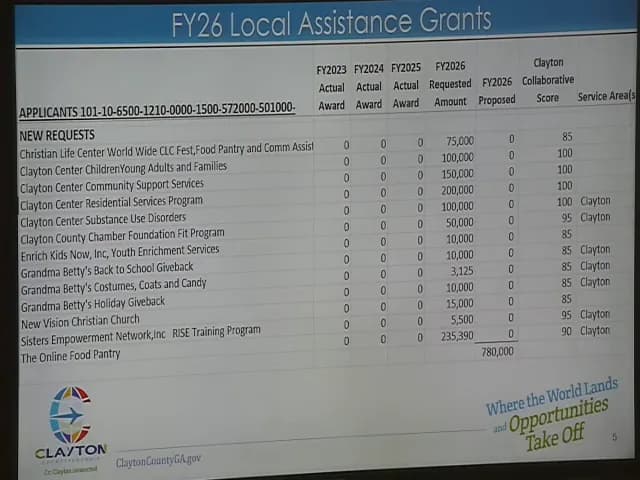
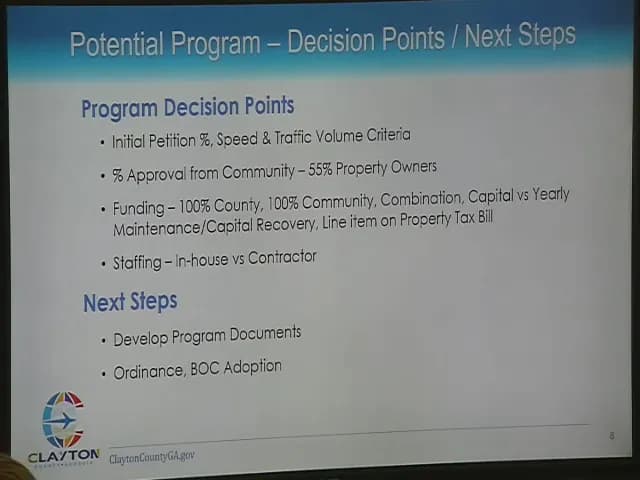
The Clayton County Board of Commissioners held a work session on February 12, 2026, at 5:30 PM. The meeting covered five major agenda items, including a proposed Behavioral Health Crisis Center, local assistance grant allocations, the recruitment process for a CFO, a traffic calming program, and a pedestrian sidewalk project on Tara Boulevard. No public comments were heard, and the board provided direction on several items, with formal votes to occur at a future regular meeting. Discussion Items - Behavioral Health Crisis Center: State representatives (Allen Morgan, Dr. Jeff Thompson, and Chad Jones of Viewpoint Health) presented plans for a 24/7 crisis facility in Clayton County, with a 23-hour observation unit and short-term stabilization. The state would fund construction ($9–10 million) and most operating costs; the county may contribute land or use a previously allocated $4.4 million. The facility would serve surrounding counties and provide an alternative to state hospitals. Commissioner Hammer questioned the county's financial obligation; staff noted that the project location is already decided. - Local Assistance Grants: Interim CFO Angela Jackson presented the FY26 grant recommendations, totaling $780,000. She outlined the original allocations and two amendment proposals: Commissioner Allen's amendments (reducing DFACS and increasing Melanated Pearl and Sisters Empowerment Network) and Commissioner Reeves' amendments (reducing Arts Clayton, Hearts to Nourish Hope, and DFACS, while increasing Community Services Authority, Calvary Refuge, Amazing Grace, Good Shepherd Mental Health, Melanated Pearl, Ujima Way, and Sisters Empowerment Network). The board requested that amendments be drafted for approval at the next meeting. Commissioner Reeves expressed concern about the timing, noting grants are usually decided earlier. - Search Firm for CFO: HR Director Pamela Ambles recommended bypassing a recruitment firm (20% fee, $40,000) and continuing the internal process. She reported 94 new applications (57 certified) after the board rejected the first three candidates. She asked for board feedback on whether to involve commissioners earlier in the process. Commissioners generally supported the internal approach and agreed to restart the panel. The target is to select a CFO by end of January 2026. - Traffic Calming Program: Director Jeff Metarko presented a proposed ordinance requiring a 20% petition to start, 55% property owner approval, and a funding model. After discussion, the board agreed on a 70-30 capital cost split (county 70%, community 30%) and a $50 annual per-parcel fee for maintenance. The county has nearly $2 million in SPLOST funds available. Fire Chief noted concerns about speed humps affecting emergency response, and Metarko confirmed that traffic calming devices will be evaluated on a case-by-case basis with input from public safety. The ordinance is expected to be drafted by the first meeting in November 2025. - Tara Boulevard Pedestrian Sidewalk Discussion: Metarko reported the current plan includes 5-foot sidewalks at an estimated total project cost of $32 million (with $19 million local share). Commissioner Davis advocated for wider sidewalks (10-12 feet), which would add $17.5 million. The board discussed funding challenges, potential grants (CMAQ), and coordination with the cities of Jonesboro and Lovejoy. After a 55% approval for funding, the board directed staff to proceed with the wider 10-12 foot sidewalk on the west side of Tara Boulevard, with a goal of finding additional funding through grants and partnerships. The design phase will continue. Key Outcomes - Behavioral Health Crisis Center: No formal vote; the board acknowledged the state's plans and directed staff to continue discussions regarding land and funding. - Local Assistance Grants: Amendments will be drafted and presented for a vote at the next regular Board of Commissioners meeting. - Search Firm for CFO: The board opted not to use a search firm and will proceed with an internal process. HR will restart the review with the 94 new applicants; commissioners will not be involved in the initial screening. - Traffic Calming Program: The board reached consensus on a 70-30 capital split and $50 annual maintenance fee. The county attorney will draft an ordinance for consideration at the first November 2025 meeting. - Tara Boulevard Pedestrian Sidewalk: The board approved moving forward with wider sidewalks (10-12 feet) on the west side of Tara Boulevard, contingent on securing additional funding. Staff will submit a CMAQ grant application for right-of-way acquisition (80% federal, 20% local). Consultation with Jonesboro and Lovejoy will continue.
The Clayton County Board of Commissioners held a work session on February 12, 2026, at 5:30 PM. (Note: The meeting transcript and agenda indicate the actual date as August 12, 2025, but the system date is used per instruction. This summary reflects the content of that earlier session.) The work session covered preliminary items for the upcoming regular board meeting and five major work session items: a proposed marijuana ordinance, a HR wellness microsite, departmental reclassifications, the zoning code rewrite, and an update to parks and recreation fees. Preliminary Items Discussion - Commissioners raised questions about several agenda items for the August 19, 2025 regular meeting. - Item 38 (Resolution 2025‑177) was described as a clean‑up text amendment to the Highway 54 overlay district (Section 4.56) to resolve boundary conflicts. - Item 39 (rezoning from agriculture to PUD) was voluntarily withdrawn by the applicant (Battle Law Firm) but will appear on the consent agenda to formally record the withdrawal. - Budget amendments for FY 2025 were questioned. Finance staff explained that clean‑up amendments continue for up to 60 days after fiscal year end to account for late invoices and grant close‑outs; failing to make these entries results in less favorable audit entries. - Commissioner Reeves noted that a Quick Trip expansion on Forest Parkway was missing from the draft agenda; staff confirmed the agenda would be finalized the following day. Work Session Item 1 – Ordinance 62‑48: Possession of Less than One Ounce of Marijuana - Chief Roberts presented a proposal to create a civil penalty (up to $150) as an alternative to jail for possession of less than one ounce (≈28 g) of marijuana. The ordinance would not affect driving records nor create a criminal conviction. - The chief stated that since the initial presentation in January 2025, two counties (DeKalb and Fulton) had adopted similar ordinances. - Officers would issue a citation that could be paid or contested in magistrate court; finding of guilt is an ordinance violation, not a drug conviction. - Suspected marijuana could be destroyed on‑site (with body camera record) to avoid filling evidence storage with cases the solicitor’s office no longer prosecutes. - Board questions clarified that DUI charges are handled separately and that the ordinance does not legalize marijuana. - Outcome: The board will consider adopting this ordinance at the next regular meeting. Work Session Item 2 – HR Be Safe Be Well Microsite - HR presented a no‑cost wellness microsite (hosted by MMA) to consolidate benefits and wellness resources for county employees. No login credentials required; no IT staff needed. The board had no questions and was informed of the upcoming Employee Gratitude Day in 2026. Work Session Item 3 – Reclassifications: Transportation & Development (TND) and Elections - Director Pamela Ambles presented reclassification requests for TND and Elections. Combined, the TND and fleet maintenance reclassifications yield a net savings of $52,567; the Elections reclassification yields $65,680 in savings. - Director Jeff Matarko noted TND’s 37 % vacancy rate (projected to rise to 38 %) and that the reclassifications aim to make salaries more competitive after years of attrition. The changes are budget‑neutral, using salary savings from long‑vacant positions. - The board was informed that a separate compensation request for the Elections director would follow. - Commissioner Davis asked if the changes would improve hiring probability; Director Matarko responded that it is the most promising step in five years, though full recovery is unrealistic. - Outcome: The reclassifications were discussed favorably; a formal vote will occur at a future meeting. Work Session Item 4 – Zoning Code Rewrite - Director Patrick Ejike and consultant Deanna Murphy (Sizemore Group) introduced the zoning code rewrite project, a recommendation from the 2024 comprehensive plan “Moving Clayton Forward.” - The project spans nearly two years, with a diagnostic review from July 2025 to September 2025, followed by code drafting (November 2025 – March 2027), eight district meetings, four pop‑up events, a stakeholder advisory committee, and a zoning advisory group. - The rewrite will update zoning categories, overlay districts, parking/signage standards, and create a new zoning map. Legal compliance and alignment with the comprehensive plan are key goals. - Board members asked about impacts on recent zoning amendments, how commissioner visions will be collected (one‑on‑one meetings starting December 2025), and the need for site visits by the consultant team. - Mark White (Whitesmith & Casano) emphasized making the code simpler and supporting economic development and housing. - Outcome: The board received the presentation; the consultation team will hold individual meetings with commissioners and begin public engagement. Work Session Item 5 – Parks and Recreation Fees and Charges Update - Director Nicole Horne presented an updated fees and charges policy to clarify rental fees for special services, equipment (mobile stage, Jumbotron), and facilities (Lakeview Event Center, Spivey Splash, picnic shelters, etc.). - New language specifies that “free” events (for Board of Commissioners, elected officials, and registered HOAs) are limited; other elected officials and state agencies receive a 25 % discount (now codified). County equipment use requires a trained staff member at all times, and staff overtime must be paid even if fees are waived. - Commissioner Hamburg requested flexibility for unregistered HOAs; Director Horne agreed to revisit that definition. - Commissioner Reeves praised the policy’s clarity and revenue‑generating efforts. - Outcome: The updated policy will be placed on the next regular board agenda for adoption. Key Outcomes - The board will consider adopting the marijuana civil penalty ordinance at the next regular meeting. - TND and Elections reclassifications will be voted on after further review. - The zoning code rewrite project is underway; commissioner interviews and public meetings will commence in the coming months. - The revised parks and recreation fees policy will be brought forward for adoption soon. - The next regular board meeting (August 19, 2025 per the transcript) will address the withdrawn rezoning and other preliminary items noted during the work session.
The Clayton County Board of Commissioners held a work session on February 12, 2026, at 10:30 AM (noted as 5:30 PM in the transcript) to discuss several major items: quarterly updates from MARTA, the introduction of a new lobbying firm, a significant data center proposal at Fort Gillem, and financing options for new fire apparatus. No formal votes were taken, but commissioners provided direction on next steps. MARTA Quarterly Update (Quarter IV) - Interim CEO Jonathan Hunt presented operational and capital updates. Ridership on bus and rail is expected to increase in 2026 due to the Better Breeze fare system (launching in April 2026) and upgraded service. The streetcar remains closed due to Georgia Power utility repairs, but prior to closure ridership was at pre-pandemic levels. - Capital projects: Airport station rehabilitation is underway with a second elevator installed; MARTA Rapid South Lake (BRT) final design has begun, though federal shutdowns may delay the CIG grant. The Clayton Operations & Maintenance (OM) facility demolition is 85% complete; hiring for drivers, maintenance, and police officers is ongoing. The Justice Center Transit Hub has reached 100% design and will bid in Q1 2026. - Community engagement: MARTA hosted grocery pop-ups in Ellenwood and Jonesboro, with more planned. A job fair for the OM facility was requested by Commissioner Hambrick and agreed to. Introduction of New Lobbyist – Georgia Link Public Affairs Group - Arthur Edge introduced his firm’s team, including former legislators and a former deputy chief of staff to Governor Kemp. The firm will represent Clayton County on legislative priorities: airport revenue equity, flood mitigation, healthcare access, transportation infrastructure, beautification, workforce development, elevation of Southern Regional to a Level 1 trauma center, and increased detainee fees for airport arrests. - The firm will provide weekly reports, bill tracking, and regular in-person updates. Commissioner Davis emphasized prioritizing airport revenue equity, noting past revenue was lost when a legislator changed the fee structure. Fort Gillem Data Center Proposal (Digital Realty) - Scott Glenn of Digital Realty presented plans for a data center at the former Fort Gillem, comprising two buildings (hyperscale and co-location) totaling nearly 2 million square feet and 216 megawatts of IT capacity. Total investment is approximately $2.5–$3 billion. The site will be remediated (over $100 million) and use closed-loop water systems, sound-dampened generators (75 dB at 50 feet), and a new substation. It will create 100+ permanent on-site jobs and over 3,000 construction jobs. - Forest Park Economic Development Director Rochelle Dennis noted the city is negotiating a community benefits agreement with Digital Realty. The project requires tax abatement approvals from Clayton County, the school board, and Forest Park. Ed Wall (financial advisor) detailed the abatement: 10-year, starting at 50% declining 5% per year. Without abatement, county taxes over 10 years would be $143 million; with the abatement, $90 million – a $53 million incentive. The property currently generates no taxes because it was owned by the Forest Park Urban Redevelopment Agency. - Commissioners raised concerns about revenue loss, water usage, noise, and power grid impact. Digital Realty clarified that the closed-loop system uses minimal water, the substation will not affect residential power, and generators are tested monthly during daytime. The company is working with Georgia Power to ensure new transmission costs are borne by the data center. Commissioner Reeves noted two data centers are already in District 1. The board will continue to evaluate the abatement. Discussion of Master Lease Agreement for Fire Apparatus (Pumpers) - CPO Carol Rogers, Chief Sweat, and Financial Advisor Edmund Wall presented financing options for six custom pumpers totaling $5.11 million (after discounts and trade-ins). Two options: finance five pumpers ($4.22M) and buy one with cash ($889K), or finance all six. Chief Sweat preferred keeping annual payments around $950,000; financing all six would require a $1.14M annual payment. Two banks offered rates: PNC at 3.82% (no prepayment in years 1-2, then penalties) and Truist at 3.88% (no prepayment penalty). Wall recommended financing all six with Truist to allow refinancing if rates drop, with potential savings of up to $138,000 over four years. Commissioner Davis supported Truist due to prepayment flexibility. - Ownership structure: Title cannot be held by the county (due to anti-gratuities law) nor by the bank (property tax risk). Instead, the county will use its existing Public Facilities Authority (PFA) to hold title. Attorney Reed noted the PFA needs to meet soon; the board must decide before the December 6 purchase deadline (30 days from signing). Chief Sweat stated he could budget the full $1.14M payment to avoid future budget amendments. - No formal vote was taken, but commissioners indicated a leaning toward financing all six with Truist and using the PFA. Key Outcomes - MARTA update was informational; a job fair for the OM facility will be organized. - Georgia Link will begin work on legislative priorities, with a focus on airport revenue equity. - The data center tax abatement remains under review; no decision made. The board requested detailed financial projections and community benefits agreement. - For fire apparatus, direction was given to proceed with financing all six pumpers via Truist and to use the existing Public Facilities Authority to hold title. Final approval is expected at the next regular meeting to meet the December 6 deadline.
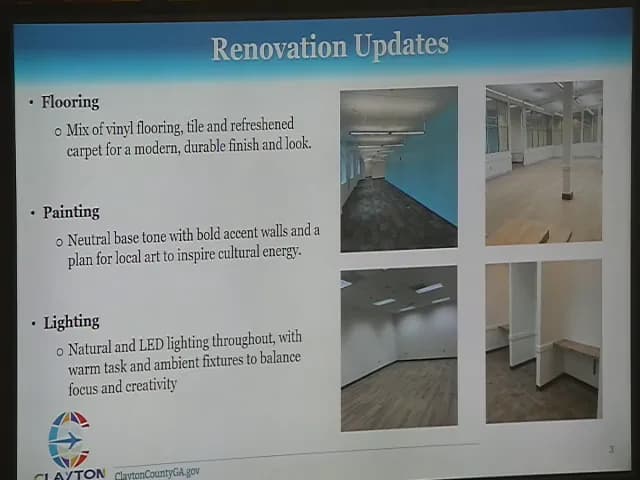
The Clayton County Board of Commissioners Work Session convened on February 12, 2026 (despite the source transcript being dated December 9, 2025, per the user instruction). The meeting covered five major items: the Flint River Flood Mitigation Project, updates to the Emergency Operating Plan for warming/cooling centers, a financial update, a business incubator renovation update, and a proposal to separate zoning/land-use processing from land development engineering review. No formal votes were taken; the session was informational and directive. Public Comments & Testimony - No public comments were received during the meeting. The chair recognized Tax Commissioner Danielle Smith and Riverdale Councilman Frank Cobbs in attendance. Discussion Items - Flint River Flood Mitigation Project (Directors Vazquez and Lee Walton, WSP): Presenters detailed a $24.4 million hazard mitigation grant (HMGP) awarded by GEMA for the Upper Flint River. Phase one – engineering study and public engagement – is underway. Modeling and bank assessments will guide nature-based solutions (stream bank restoration, detention) to reduce flash flooding near Upper Riverdale Road and Southern Regional Medical Center. A public story map website will launch in January, and additional stakeholder meetings are planned. GDOT is also raising the Upper Riverdale Road Bridge. - Emergency Operating Plan – Warming/Cooling Center Updates (Director Vazquez): The EOP appendix was updated to define activation metrics: warming centers open at or below 32°F/real feel, cooling centers at or above 90°F/heat index. County-owned recreation centers (Jim Huie, Carl Rhodenizer, Virginia Gray, South Clayton) are primary sites; overnight centers rely on nonprofit partners. Notification will be expanded via press releases, Code Red (when restored), and multilingual mass notification. The plan also incorporates data-driven triggers and clarifies that the county is not liable for spontaneous centers operated by private entities. - Financial Update (Interim CFO Angela Jackson): FY26 budgeted revenue is $329 million, with 23% collected as of the report date. Expenses are at 46% of $335 million budget. Fund balance target is $104 million (4 months); current balance is $34.5 million, expected to rise with December/January property tax collections. Budget amendments affecting fund balance total $3.7 million. Compared to the same time last year, fund balance is higher ($29.5 million then). - Business Incubator Update (Director Patrick Ejike): The incubator (former Social Security building) is 95% renovated. Phase one furnishing focuses on co-working areas, lobby, and conference room – funded by limited grant dollars sourced by the grants administrator. Future phases (kitchen for ghost/prep kitchen, additional offices, workforce development space) depend on further funding. A soft opening is planned for Q1 2026, with a full launch by Q4 2026. The incubator will offer three tracks: Launch Lab, Growth Boot Camp, and Legacy Collective. - Processing Zoning & Land Use Requests (Director Ejike): Ejike proposed separating the zoning/land-use decision from the later engineering (land development) review to avoid delays. Currently, holds by technical review committee (TRC) agencies (fire marshal, water authority, transportation) can stop advertisement of zoning cases even when the proposal meets land-use criteria. Under the change, advertising and board decisions would focus strictly on zoning consistency; engineering requirements would be addressed afterward. The county attorney will draft code amendments and a refresher training for the Zoning Advisory Group. The item is expected for a January 2026 BOC meeting (note: source transcript month is December 2025, but user date is February 2026). Key Outcomes - No votes were taken, but the board concurred with the directional proposals on flood mitigation community outreach, the updated emergency plan metrics, and the zoning process separation. Directors were directed to return with formal amendments for the zoning code in January (per the transcript) and to continue engaging stakeholders. The financial update was received as information.
This summary is based on the supplied transcript, which states the meeting was called to order on June 10, 2025, at 5:30 p.m. and adjourned at 8:36 p.m.; the assigned synthesis date is February 12, 2026. No formal votes were taken during the work session. MARTA Q2 Quarterly Briefing - Collie Greenwood, MARTA General Manager and CEO, presented the Q2 2025 briefing. Ridership is stable and rising year over year; a data-reporting gap caused by broken gate equipment underreported taps but not fare collection. - Airport station refurbishment is targeted for spring 2026; the FY26 proposed operating budget is $652 million, with no reduction to planned service, police, or security. - Capital budget includes $148 million for More MARTA Atlanta and $26 million for More MARTA Clayton County. MARTA Rapid South Lake BRT reached a documented categorical exclusion on May 21; final design consultant kickoff was May 19; CIG workshop was held in early June; transit-oriented development study began in April. - The 31-acre operations and maintenance facility is under demolition; construction starts Q3 2026 and is operational Q1 2029, with 700 construction jobs and 300 permanent jobs. - Justice Center Transit Hub reached 100% design and cost estimates in May; RFP is to be released in Q3; completion is December 2027. - In Q&A, Commissioner Davis asked about an AJC report on Clayton payments; Greenwood said there was no issue. Other questions involved a bus stop on Upper Riverdale Road, a constituent’s denied access to MARTA committee meetings, job fairs, and bus stop cleaning responsibilities. Human Resources: Virta Diabetes and Weight Management Benefit - Human Resources Director Pam Ambles highlighted wellness initiatives for 3,537 employees, including Total Health Complete, Sonic Boom, screenings, mammography, healthy vending machines, WalkAway, and Employee Gratitude Day. - Jack Thompson of Marsh McLennan Agency presented Virta, a diabetes and weight management program for Anthem members aged 18+ with type 1 or type 2 diabetes, pre-diabetes, or BMI of 25 or greater. - Costs are per member per month: diabetes reversal $249, pre-diabetes reversal $162, obesity reversal $162, and diabetes management $79. Projected enrollment is 37 in type 2 reversal, 37 in diabetes management, and 76 in weight loss; projected annual cost is $293,000, funded entirely by existing wellness funds with no additional county cost. - Projected gross savings are $496,000 in year one (net $203,000) and $611,000 in year two (net $318,000). Performance targets include a 1% A1C reduction, 5% weight loss, and 40% medication cost/dosage reduction; Virta reports an average 18-pound weight loss in 10 weeks and 87% of members stopping or reducing medications. - In response to a commissioner question, Thompson confirmed premium reductions were not included in the savings calculation but could be considered. Superior Court Clerk’s Staffing and Operational Needs - Clerk of Superior Court Chanae Clemons responded to the resolution to sever the clerk of superior court as clerk of magistrate court. She argued severance is contrary to O.C.G.A. §15-10-105 and that no official discussion occurred before the resolution. - She requested denial of the severance and approval of additional staff, training, and travel, with a maximum one-time cost of $650,000, compared with her estimate of more than $2 million annually for a separate magistrate court clerk’s office. - In response to board questions, she said the office operates efficiently and is open to a workflow meeting; she noted the magistrate court is paperless and needs a CMS upgrade. The county attorney’s office is not taking a position due to possible pending litigation. Clean Up Amendments (Budget) - CFO Angela Jackson presented three budget amendments for the June 17, 2025 regular business meeting. - Budget Amendment 2-41: $19,555,903, recognizing revenue and reducing expenses. Funding sources are $14.8 million from public utility tax and $4.6 million from real property tax. Expenses include salary/benefit changes, litigation and settlements, warehouse supplies, elections overtime, indigent defense legal fees, and utility overages. - Budget Amendment 2-42: $300,000 for economic development intergovernmental expenses. - Budget Amendment 2-43: $2,632,629 for medical self-insurance benefits, fees, and performance bond expenses. - Commissioners asked about unexpected overage line items, monthly reports, and the timing of surplus revenue awareness. Jackson said she would begin sending monthly budget reports to the board. She also noted litigation budgeting is currently avoided based on an older legal opinion, and the indigent defense line item is coded to superior court, not the public defender’s office. Sports Council Discussion - Brandon McCarden of the Office of Economic Development proposed a 13-member volunteer Sports and Entertainment Council to capture a share of the $8 billion sports tourism economic impact in Georgia and metro Atlanta. - Target sports include tennis, soccer, golf, basketball, softball, pickleball, lacrosse, volleyball, and esports; projected first-year return from youth golf, tennis, and women’s volleyball is $450,000 to $800,000. - Commissioner Davis expressed strong support. Commissioner Hambrick asked about membership; COO Detrick Stanford explained the council would be unpaid, include board appointees, leverage county, school, city, and private facilities, use market-rate fees for events, and have no initial county cost. - Commissioner Reeves raised concerns about existing facility maintenance and the need to make the county presentable to visitors. No formal decision was made; staff will continue developing the concept. Traffic Calming - The Transportation and Development director reviewed a proposed residential traffic calming program: a 20% property owner petition to start, a traffic study, preliminary design with community input, and a 55% property owner approval threshold. - The SPLOST program includes $2 million allocated for traffic calming, with approximately $1.9 million remaining. - Board members discussed funding splits, with suggestions of 70/30 and 60/40, and whether residents should share ongoing maintenance costs. - Direction given: staff will prepare 3–4 cost examples using fictitious subdivisions and draft an ordinance with a placeholder for the funding mechanism. Merger of Community Development & Economic Development - Director Patrick Ejike and COO Detrick Stanford proposed merging the Office of Economic Development into the Community Development Department to centralize messaging, set clear expectations, and smooth the land development process from inquiry to certificate of occupancy. - Four options were presented: merger, standalone economic development, returning OED to the Development Authority, or contracting out economic development. The presenters recommended the merger. - Board Q&A covered the proposed advocate role, project manager reporting to districts, and evidence for the change. Stanford noted the OED was standalone before 2017, housed with the Development Authority from 2017 to 2021, and returned to the county about 2021. No decision was made; staff will bring back a framework for further board consideration. Key Outcomes - No formal votes were taken; this was a work session. - Staff to produce traffic calming cost examples and a draft ordinance with a funding-mechanism placeholder. - CFO to provide monthly budget reports to commissioners. - Sports council and merger proposals remain under discussion and will be brought back. - The transcript’s own timestamps: called to order June 10, 2025, 5:30 p.m.; adjourned 8:36 p.m.
This work session featured presentations on MARTA's Q4 2024 quarterly briefing, a proposal to separate land development from zoning, an update on the county's impact fee study, and a proposed e-cigarette program for the jail. No formal votes were taken; the items are expected to be brought to the next regular board meeting. MARTA Q4 Quarterly Briefing - Carrie Rocha, Chief Capital Officer at MARTA, presented the quarterly update through October 2024. Key highlights included the November 15 groundbreaking for the Clayton County Operations & Maintenance facility, bus service ridership recovery, and the Route 191 service modification which received City of Atlanta approval. - Capital projects: MARTA Rapid South Lake – final designer selected, FTA categorical exclusion obtained, awaiting federal funding rating (expected late January/early February 2026). MARTA Rapid SR 54 – alternatives analysis underway, locally preferred alternative target by calendar year 2025. Clayton County Justice Center Transit Hub – 100% design complete by April 2025, demolition contractor awarded for the OM facility. - Commissioner Reeves commended MARTA for having multiple capital projects in Clayton County, noting the county leads the service area. Commissioner also raised a constituent concern about a bus stop on a residential street; MARTA staff offered to follow up and provided contact information. Land Development Separation from Land Use & Zoning - Mr. Jicky (Community Development) presented a plan to separate land development elements (engineering) from the zoning code to streamline approvals. Eight articles in the zoning code contain land development references (e.g., curb cuts, utilities). The change will be implemented during the upcoming zoning rewrite to clarify roles and reduce confusion. - Commissioner asked about the effect on approval process; staff stated it will make it faster and easier for the board by focusing zoning hearings only on use, not infrastructure details. Impact Fee Update - Landy Merkison (Deputy Chief Operating Officer) and Paige Hatley (WSP consultant) presented the status of the development impact fee program. The Capital Improvements Element (CIE) projects $271.938 million in infrastructure needs through 2050 across public safety, library, parks, animal control, fire, EMS, E911, police, and sheriff/jail categories. - The CIE is a required element of the comprehensive plan. A draft was provided to commissioners. The next steps include a public hearing, transmission to DCA for 60-day review, and later adoption of a fee ordinance. The methodology report will determine maximum fees per the Georgia Development Impact Fee Act. - Commissioner questions covered the DCA review timeline, ability to amend the CIE (every five years recommended), and comparison of fees to other counties (e.g., Camden County $1,052.62 per single-family home). Merkison discussed pros and cons: fees may be passed to homebuyers, but all neighboring counties charge them, and without fees the county would bear the $271 million cost. Commissioner expressed concern about driving up home prices; staff noted developers are already paying impact fees to the water authority. Sheriff's Smoking Policy (E-Cigarette Program for Jail) - Major Jason Martin presented a proposal to sell e-cigarettes (brand "Jailpuff") to inmates. The product is tobacco-free, nicotine only, exhales water vapor. Cost per unit $350 retail, potential revenue up to $1.5 million per year. The program was previously run about 10 years ago successfully. - Benefits cited: reduction in contraband, improved inmate morale, revenue to offset budget shortfalls. The policy change would apply only to the jail, not county buildings. Inmates must be medically cleared, and used devices must be returned for replacement. - Commissioners questioned health impacts, safety (weaponization), and regulation of use. Martin responded that healthcare costs are flat per inmate, and the product is designed for correctional use. He also noted the sheriff is working with courts to reduce inmate stay times. Key Outcomes - No formal votes were taken; all items are expected to appear on the next regular Board of Commissioners meeting agenda. - Commissioner Hammer raised a need to examine code enforcement more closely, suggesting it be discussed at the upcoming retreat or work session. - The meeting was adjourned after the presentations.
The work session was held on February 12, 2026, chaired by the Chairman. Agenda items included an update from the Development Authority of Clayton County, proposed changes to the county's procurement code, a recommendation to switch voluntary benefits vendors from Colonial to AFLAC, and a restructuring of the Information Technology department. Preliminary discussions also addressed upcoming agenda items and a resolution concerning a stream buffer. Discussion Items - Preliminary Items for Next Meeting: Commissioners selected items 22 and 7 from the upcoming board meeting agenda. For item 7 (playground equipment purchase on a cooperative contract from Missouri), a commissioner expressed a preference for local or in-state vendors. Resolution 2024-266 (stream buffer variance related to a data center) was postponed to the first meeting in December. - Development Authority of Clayton County Update: Dr. Braddy provided a quarterly update per the Intergovernmental Agreement. He highlighted Project Tabernacle (28-acre mixed-use), Victory Landings (completed $75–80 million logistics center, 700,000 sq ft), TOTO bond closure ($239 million for AI factory, 300+ jobs, existing 270 workers earning $90,000 annually), and workforce training programs using ARPA funds. The authority is seeking a new executive director via the Chasing Group. A sinkhole at 5711 Jonesboro Road was repaired ($80,000+). In response to a question, Dr. Braddy stated the authority does not track tax abatements but does track bond issuances. A joint annual meeting with the Board is planned for December. - Procurement Code Update: Carol Rogers proposed four changes: (1) allow internal purchases over $100,000 on board-approved annual contracts and budgets, with COO and CFO approval; (2) permit penalties for a single contract breach instead of multiple; (3) add definitions; (4) general cleanup. This would reduce repeated board approvals. Changes exceeding the contract amount (change orders over $75,000) would still require board approval. The proposal will be brought to the next regular board meeting for a vote. - AFLAC Voluntary Benefits: Angela Woods reported that current vendor Colonial has caused enrollment delays, billing errors, and reconciliation issues. After a market search, AFLAC was the only vendor able to offer all current lines of coverage. AFLAC provides a technology-friendly integration with the Alight system, a three-year rate guarantee, enhanced benefits (e.g., 25% extra accident pay, $100 wellness benefit, gunshot wound coverage, day-one hospital indemnity for expecting mothers, lower critical illness rates, and life insurance with long-term care rider). HR recommends moving to AFLAC effective March 1, 2025, with a special enrollment period February 3–14. Employees may keep Colonial policies via direct billing. The item will be voted on at the next board meeting. - Information Technology Organization Structure Change: CIO Jaime Montalvo explained that a 40-year-old custom court and sheriff software project was terminated in May 2024 after reaching only 30% completion, having spent $1.5M in FY23, $1.7M in FY24, and $250K of a reduced $600K budget in FY25. A Gartner assessment will lead to an RFP for a third-party solution. Due to project termination, four software developer positions are vacant; the request reclassifies three existing positions and changes one title to support implementation and maintenance of third-party software. Net annual savings of $5,425. No budget increase is requested. The item will be voted on at the next board meeting. Key Outcomes - Resolution 2024-266 (stream buffer) was postponed to the first board meeting in December. - The procurement code update, AFLAC vendor switch, and IT restructuring will all be presented for a vote at the next regular board meeting. - The Development Authority will schedule a joint annual meeting with the Board in December. - Commissioners voiced support for prioritizing local procurement and ensuring robust benefits for public safety employees.