Browse by city
Date range
Search help

Search titles, summaries, topics and stored transcripts together. Keywords may match separately; put the whole query in double quotes for a phrase. Matching follows word analysis, so punctuation is not exact. Both dates are included. Documents are not searched.

SHOWING 41–47 ENTRIES
41
DEC 8, 2025 · COLUMBUS, OHIO · CITY COUNCIL
Columbus City Council Meeting Summary - December 8, 2025

This regular meeting of the Columbus City Council, held on December 8, 2025, commenced with the national anthem, pledge, and prayer, featuring remarks from the incoming Council President and special announcements regarding community events. A significant portion of the evening was dedicated to the formal seating of the newly appointed Columbus LGBTQ+ Affairs Commission, followed by emotional tributes to Councilmember Otto Beatty for his final meeting and his landmark passage of accessory dwelling unit (ADU) legislation. The council proceeded to approve a comprehensive consent calendar and voted on multiple first and second reading ordinances covering economic development, infrastructure, public safety, housing, and urban planning. Consent Calendar - Approved 38 items, including resolutions of expression, various ordinances for economic development, public service, housing, and public utilities, and numerous mayoral appointments. - Councilmember Banks abstained from the vote on Ordinance 3287-2025. - Second reading waivers were granted for several pending emergency and standard ordinances. Public Comments & Testimony - Anthony Meyer (German Village Society): Expressed strong opposition to passing Ordinance 3314-2025 without further co-authoring, arguing that passing flawed legislation under the assumption of future amendment is irresponsible and exposes historic neighborhoods to risk; urged the council to pause and collaborate with legal counsel and preservationists first. - Robert Kaplan (German Village Resident): Stated that while accessibility is essential, the concerns regarding historic damage are valid, citing past court rulings and property damage; urged the council to utilize the removed emergency status to finalize language before passing the law to prevent future litigation. - Anthony Harkey (German Village Commission): Clarified that the commission is not against accessibility but against a "cookie-cutter" approach; argued that the ordinance's scope is overkill and that a comprehensive plan is needed rather than just replacing curb ramps to ensure true accessibility in narrow historic streets. - Robert Jackson (German Village Resident): Expressed opposition to the narrative of "irreparable damage" by the city; presented evidence (Google Maps history) suggesting that alleged damage to foundations and sidewalks was either pre-existing or the result of repairs, challenging the necessity for strict oversight. - Michael Wyman (Clintonville Area Commissioner): Requested that the council table Ordinance 3360-2025 (parking infrastructure); argued that the current code fails to enforce ADA handicapped parking requirements on private property and demanded legislation incorporating these federal standards and an enforcement mechanism. - Nathaniel Wilkins: Suggested expanding resources to actively locate unsheltered individuals on specific corridors like Morris Road, noting the lack of clear information on where to find warming center staff or drivers. Discussion Items - LGBTQ+ Affairs Commission Seatings: Council President Harden and Chair Jasmine Roberts Cruz highlighted the commission's role in advising on policies affecting LGBTQ+ residents amidst increased state-level hostility; Councilmember Rosa de Padilla praised the move as a courageous step to build a more inclusive table. - Ordinance 3314-2025 (Right-of-Way): Chair Dorn discussed the necessity of clarifying city authority to work in historic district right-of-ways post-court ruling; emphasized that preservation and modernization are not opposing forces and promised future co-authoring of amendments with preservationists. - Nationwide Arena Renovation (Ordinances 3343, 3344, 3345): Council President Harden defended the $400 million renovation plan as an investment in a public asset rather than a bailout; Councilmember Green expressed frustration over the equity of funding an arena while human services face budget cuts, noting that the council cannot make binary choices but must fund both; the legislation was amended to add guardrails regarding state funding and community benefits agreements. - Councilmember Beatty's Farewell: Multiple colleagues praised Beatty's diligence, preparedness, and the transformative nature of his ADU legislation; Councilmember Banks specifically noted Beatty's high standards set for staff preparation. Key Outcomes - LGBTQ+ Commission: Formally seated and recognized the members of the Columbus LGBTQ+ Affairs Commission, including Chair Jasmine Roberts Cruz. - Councilmember Beatty: Received a resolution honoring his service, specifically framing the accessory dwelling unit legislation he championed; received a standing ovation. - Ordinance 3314-2025: Passed to clarify that the City is not required to obtain a Certificate of Appropriateness for work in the public right-of-way within historic districts. - Nationwide Arena Package: - Ordinance 3343-2025 (Admissions Tax Increase) passed. - Ordinance 3344-2025 (Casino Tax Revenue Shift) passed with amendments. - Ordinance 3345-2025 (Operating Agreement) referred back to committee for further editing. - Winter Warming Services: Passed Ordinance 3349-2025 authorizing a $2 million expenditure to Community Shelter Board for winter warming services and extreme weather shelter support. - Liquor Permit Objections: Objections to renewal raised for six establishments, including Speedways at Stelzer Road and South High Street, Westland Shell Car Wash, Buckeye Supermarket, True North Energy, and VP at Sullivan Avenue; resolutions to object passed. - Employee Benefits: Approved a series of ordinances (e.g., 3195, 3367, 3369, 3370, 3372, 3374, 3375, 3376) to fund and contract employee insurance programs (medical, dental, vision, life, short-term disability) for the 2026 fiscal year. - Zoning and Public Safety: Passed multiple rezoning and variance ordinances (e.g., dispensary on East Powell Road, multi-unit residential on Rathmill Road) and safety contracts for fire department and municipal court equipment. - Adjournment: Meeting recessed for zoning committee, reconvened, and concluded with final votes on housing and public utility ordinances.
ECONOMIC DEVELOPMENT 14% · HISTORIC PRESERVATION 9% · PUBLIC SAFETY 8% · PROCEDURAL 7%
42
DEC 2, 2025 · COLUMBUS, OHIO · CITY COUNCIL
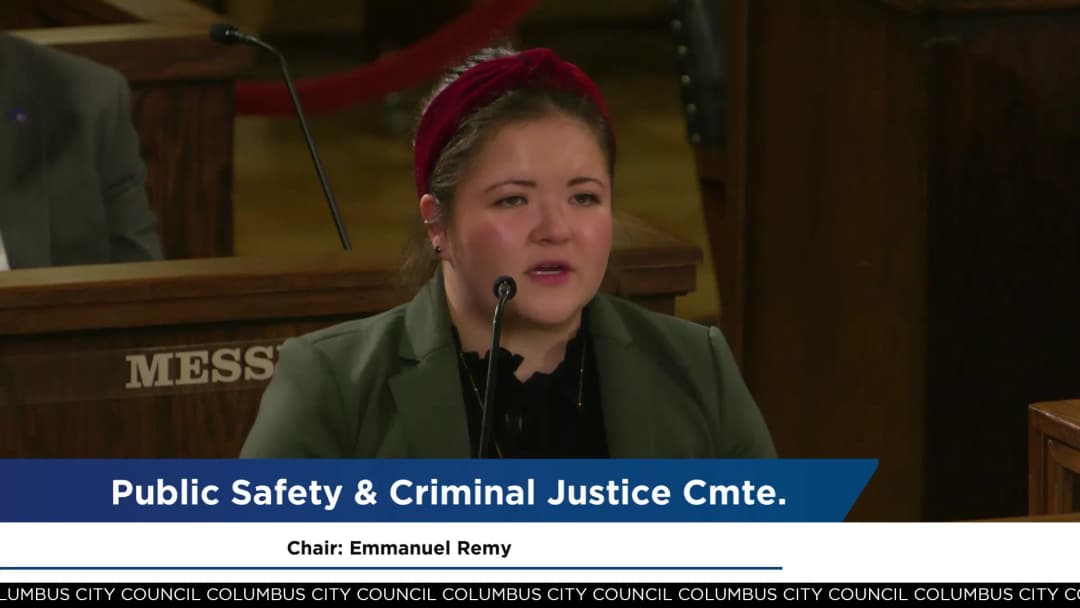
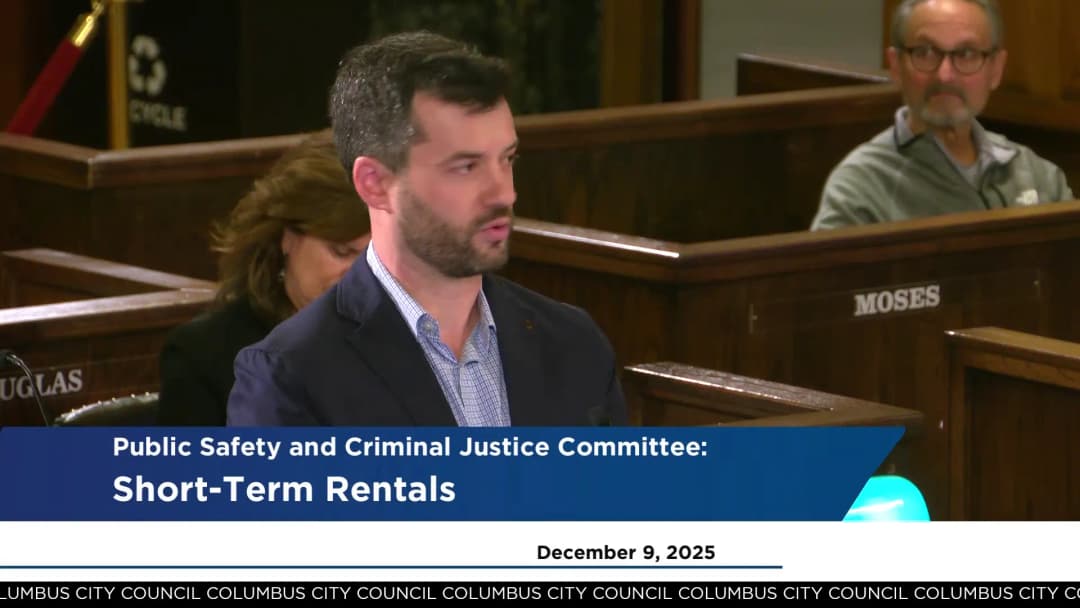
2025-12-02 Columbus Public Safety Committee Hearing on Short-Term Rentals

The Public Safety and Criminal Justice Committee, chaired by Councilmember Emmanuel Reemy, held an exploratory and informational hearing to review current policies, procedures, and community concerns regarding short-term rental (STR) regulations in Columbus. City staff from the Division of Police, Building and Zoning Services, City Council, and the Auditor's Office presented current enforcement challenges, permitting processes, comparative legislation from other municipalities, and tax collection mechanisms. The committee explicitly stated that no language changes are currently being considered, with future improvements to be identified in partnership with the community. Consent Calendar - No routine consent calendar items discussed during this session. Public Comments & Testimony - Dave Doctor: Expressed full support for requiring STR license numbers to be displayed on rentals for consumer transparency. He advocated for a mandatory contact person who must respond within a reasonable timeframe (e.g., one hour or 45 minutes). He supported lowering the occupancy limit from three people per bedroom to two, citing residential neighborhood suitability, and suggested a penalty or strike system for noise violations. He also questioned the efficacy of current 311/911 reporting regarding unlicensed units. He supported the implementation of quiet hours before 10:00 PM. - Susan Summerfield: Expressed concern regarding the proliferation of business-like STRs in residential zones, specifically citing a property she described as an "eyesore" that sleeps 16 people despite being a four-bedroom unit. She argued that these properties are extractive and lack the maintenance standards of commercial bed and breakfasts. She stated a position that such properties should adhere to safety requirements similar to commercial bed and breakfasts, including sprinkler systems and proper maintenance, noting her neighbor received homeowner tax exemptions under false pretenses. - Nat Shepard (Representing a Co-hosting Business): Stated full support for legislative changes requiring platforms (Airbnb/VRBO) to collect and remit excise taxes directly. He argued against mandatory physical neighbor notifications in high-density areas, suggesting it would be redundant for owners managing multiple units. He expressed support for streamlining renewal processes (e.g., multi-year licenses or lifetime licenses with online annual renewal) and proposed adjusting occupancy limits to allow four people in a one-bedroom unit while reducing limits for large multi-bedroom properties. He raised concerns that large multifamily buildings operating as STRs effectively function as hotels without corresponding regulations. He noted that current market analysis suggests 3,100 active properties, indicating potential revenue loss due to unlicensed operations. - Roy Lowenstein (Zoning Chair, Near East Area Commission): Expressed strong support for limitations on STR proliferation and increased safety regulations in residential areas. He advocated for capping the number of STRs by census tract, zip code, or block face to prioritize long-term residents over transient guests. He argued that current regulations lack safety inspections, minimum kitchen/bath requirements, and off-street parking mandates compared to rooming houses or congregate housing. Discussion Items - Deputy Chief Smith Weir (Columbus Division of Police): Highlighted that the lack of immediate owner contact is a critical barrier in resolving late-night incidents, including domestic disturbances, altercations, and large-scale parties. He detailed that the Division of Police currently utilizes 2,273 Agent Authorization Letters to legally trespass and remove unauthorized individuals when owners are unavailable. He expressed a position that requiring these letters as a condition of the permitting process would be a responsible measure to empower officers to act immediately without waiting for owner consent. - Tony Celebris (Deputy Director, Department of Building and Zoning): Reported that there are currently 1,535 STR licenses in Columbus, with a growing segment of non-primary residence (investment) units. He outlined the current application process, which includes background checks for owners and agents, a 24-hour local contact requirement, and fees ranging from $75 to $150. He confirmed that licenses can be suspended for felonies within the last seven years or for three or more calls for service within a 12-month period. He expressed a position that moving toward platform-based license verification before listing would be beneficial to prevent unvetted operations. He noted that code enforcement officers investigate complaints via 311 within 48 hours. - Kevin McCain (Senior Policy Advisor, Columbus City Council): Presenting comparative research, he noted that other municipalities vary on who is responsible for neighbor notification (owner vs. city), timing (pre-approval vs. post-approval), and verification methods (certified mail, neighbor signatures, or hand delivery). He highlighted that cities like Austin, TX, have the city handle notification, while Portland, OR, requires notification every two years during renewal. He stated there is currently no draft language for neighbor notifications. - Rashida Hansard (Director of Income Tax, Auditor's Office): Confirmed that a 5.1% excise tax is currently collected by hosts and remitted to the city. She stated that 98-99% of taxes are filed electronically via the CRISP platform. She detailed the revenue allocation: 2.39% to the Convention and Visitors Bureau, 1.68% to Cultural Services, 60% to the Emergency Human Services Fund, and 0.43% to the Affordable Housing Trust. She noted there are approximately 1,600 STR accounts in the system, with 1,200 currently active. Key Outcomes - The committee confirmed that the hearing was informational only, with no current intent to change the Columbus City Code. - Staff proposed reviewing the mandatory inclusion of Agent Authorization Letters as a condition of the new permitting process to facilitate faster police response. - Staff and public commenters identified market saturation and unlicensed operations as key issues, with a consensus expressed in favor of potential legislative changes to require platforms to collect taxes and verify licenses prior to listing. - Committee members directed staff to continue working in partnership with the community in the new year to identify improvements to ordinances and policies. - No specific votes, tallies, or formal directives were issued during this session.

ZONING AND LAND USE 32% · SHORT TERM RENTALS 32% · PUBLIC SAFETY 29% · ECONOMIC DEVELOPMENT 5%
43
DEC 1, 2025 · COLUMBUS, OHIO · CITY COUNCIL
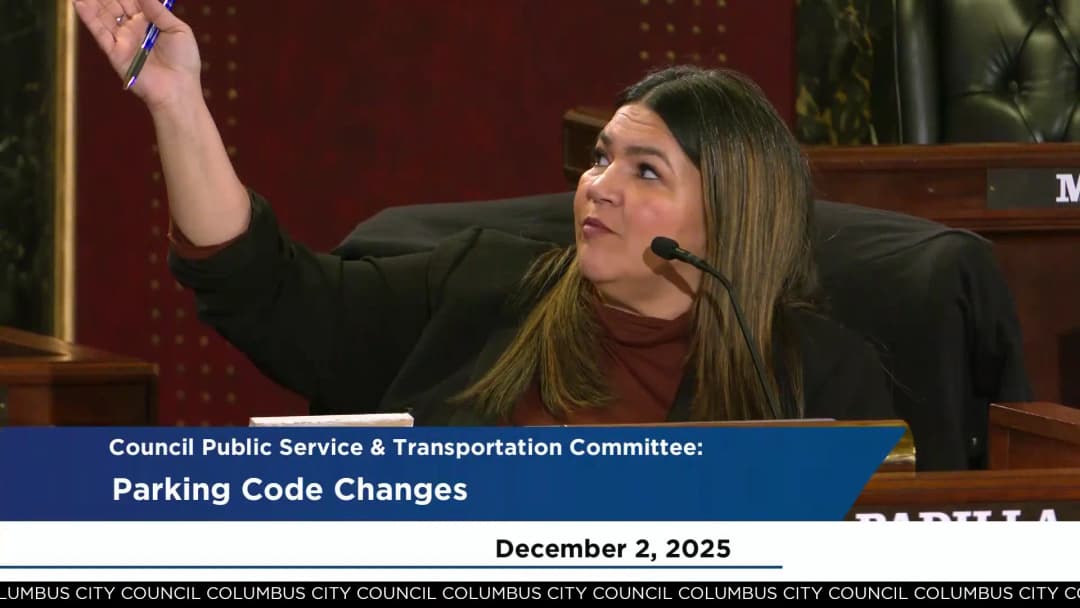
City Code Chapter 2150 Code Change Hearing - December 1, 2025

On a snowy Tuesday, the Columbus City Council held a code change hearing to discuss proposed modernization of City Code Chapter 2150, which governs parking infractions, penalties, and enforcement procedures. The Department of Public Service (DPS) presented a comprehensive plan to simplify the appeals process, introduce a tiered fine structure, extend response times from 10 to 30 days, and add new violations for safety and mobility issues like bike lane parking. The goal is to align the code with current safety standards, the upcoming Link Us Bus Rapid Transit (BRT) initiative, and strategic mobility goals while maintaining a user-friendly system. Consent Calendar - Routine administrative approvals were not explicitly detailed in the transcript; the meeting proceeded directly to the code change presentation. Public Comments & Testimony - Asileen Rodriguez, Senior Director of Regional Strategic Partnerships at Central Ohio Transit Authority (CODA): - Position: Expressed full support for the proposed code changes. - Stated Reasons: Argued that clarifying enforcement around bus-only lanes is critical for the success of the Link Us mobility initiative and future Bus Rapid Transit (BRT) corridors. Stated that clear lanes are essential for maintaining travel time savings, reliability, and safety for hundreds of riders. Advocated for the code update as a necessary step to ensure the public has predictability and to support the transition from a car-centric city to one with diverse mobility options. - Written Testimony: Councilmember Beatty acknowledged four pieces of written testimony received prior to the meeting, all of which were expressed in favor of the changes, with specific focus on improving safety for cyclists and preventing the misuse of bike lanes and shared-use paths. Discussion Items - Modernization and Strategic Goals (Justin Goodwin & Amanda Ford): - Proposal: DPS presented a proposal to replace the outdated, wordy code (last updated over a decade ago) with a modernized version that clarifies definitions and simplifies the appeals process. - Key Changes: Proposed shifting from a 10-day to a 30-day response window before penalties are assessed. Introduced a tiered payment structure with discounts for those paying within the first seven days to incentivize early payment. - Revenue Structure: Clarified that parking operations and citations fund the self-sustaining "Mobility Enterprise Fund," reinvested directly into staff, technology, and infrastructure rather than the city's general fund. - Tiered Fine Structure and Safety Violations: - Proposal: Shifted from inconsistent fine amounts to a category-based tiered system where higher fines mirror the severity of safety risks. - Specifics: Safety violations (e.g., blocking a crosswalk, parking in a bike lane or bus lane) will carry the highest fines, capped at $100 (except handicapped violations at $500). Management violations (e.g., meter non-payment) have lower fines. Some fines may decrease with early payment options. - New Safety and Mobility Violations: - Proposal: Removed the exemption allowing loading and delivery in bike lanes to prevent cyclists from being forced into traffic lanes (specifically citing issues on East Broad Street). - Proposal: Added a new infraction for parking or stopping in a bus lane to prepare for future BRT infrastructure. - Position: Speakers emphasized these changes are proactive measures to support the "Link Us" initiative and ensure future transit reliability. - "Failure to Display" Registration Violation Reform: - Proposal: Split the current single violation into two distinct categories: failure to display a handicap placard and failure to display a valid vehicle registration. - Position: DPS expressed concern over a cycle of accumulation where residents receive multiple tickets for a single registration lapse due to mail delays or bureaucratic holds. Proposed a new administrative approach: issuing a warning ticket (no fine) within 30 days of expiry, followed by a standard ticket only after another 30 days if unregistered, rather than stacking fines. The fine for this specific violation was proposed to drop from $50 to $30 and not escalate. - Concerns Raised: Council members discussed the unintended burden on residents and the need to avoid punitive accumulation of costs that could lead to vehicle impoundment for minor administrative oversights. - Enforcement and Logistics: - Implementation Timeline: Council members noted that while code changes are expected to pass in December, the new ticket structure involving paper stock updates for Columbus Police will not take effect until April 2026. Public education campaigns will commence in early 2026. - Language Access: Council members raised the need for translation services and accessibility information regarding the new process. DPS acknowledged the current limitation of English-only paper tickets and agreed to explore solutions (e.g., QR codes, updated ticket design) during the implementation phase. - Reporting and Scope: - Inquiries: Council members requested clarification on reporting violations in residential areas and the "72-hour rule" regarding abandoned vehicles. DPS confirmed that 311 is the primary reporting channel and that resources are focused on high-demand core areas, deferring to Public Safety for deep residential areas where enforcement is less frequent. Key Outcomes - Vote Schedule: The Council is scheduled to bring the amendments for a First Reading on December 8, 2025, and a verbal vote for Second Reading and Adoption on December 15, 2025. - Effective Date: If adopted, the code changes are set to go into effect in January 2026, with the new fine structure and citation procedures for police and enforcement staff expected to be operational by April 2026. - Directives: The Department of Public Service is directed to finalize internal training for Columbus Police Department, coordinate with payment vendors (e.g., Park Mobile), and develop a public education campaign to inform residents of the new 30-day response window, tiered payment options, and new safety violations. - Strategic Alignment: The proposed changes explicitly support the City's "Link Us" mobility initiative, "Bike Plus" plan, and "Vision Zero" safety goals.

TRANSPORTATION SAFETY 75% · PUBLIC SAFETY 19% · EQUITY IN TRANSPORTATION 3% · FISCAL SUSTAINABILITY 2%
44
DEC 1, 2025 · COLUMBUS, OHIO · CITY COUNCIL
Columbus City Council Hearing: Right of Way COA Process (2025-12-01)

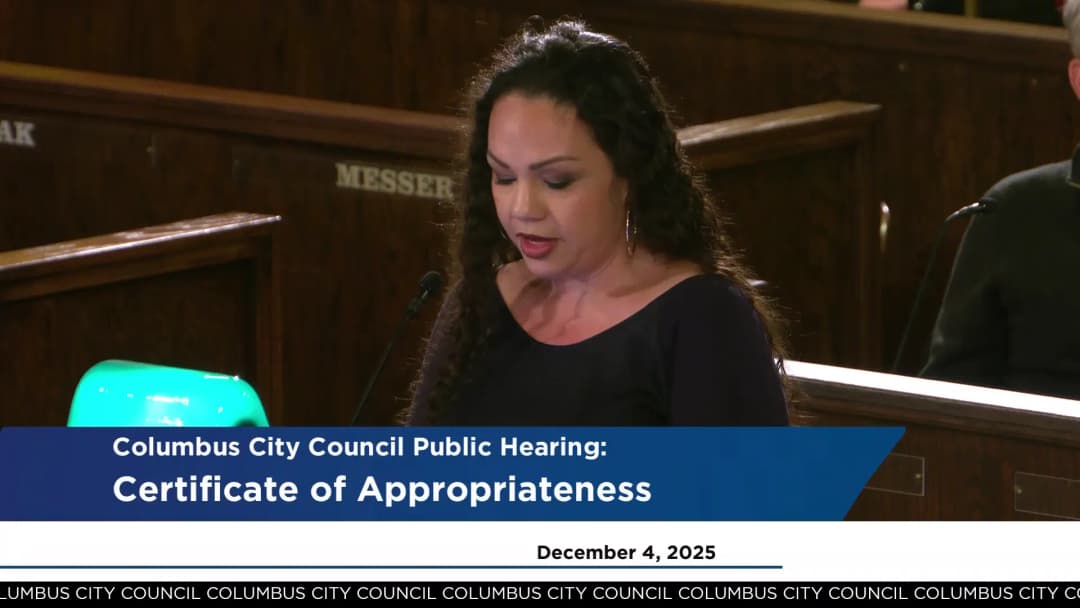
On December 1, 2025, the Columbus City Council held a public hearing to discuss proposed amendments to the Columbus City Code regarding the Certificate of Appropriateness (COA) process for work performed by the city within the public right of way. The legislation seeks to clarify that the city is not required to obtain a COA from historic commissions (such as the German Village Commission) for work in the right of way, a move prompted by a court-ordered preliminary injunction stemming from a lawsuit filed by the German Village Society. The council emphasized the dual mandate of preserving historic character and maintaining safe, accessible public infrastructure, acknowledging the complexity of balancing these goals. The hearing featured presentations from city legal counsel, the Department of Public Service, and the Planning Division, followed by extensive public testimony. Consent Calendar - No routine approvals or unanimous actions were recorded in this specific transcript segment; the meeting proceeded directly to hearing items. Public Comments & Testimony Support for the Legislation / Emphasis on Accessibility and Speed: - Robert Jackson: Expressed full support for ADA compliance and accessibility, stating he is "100% committed to historical preservation and restoration" but arguing that the lawsuit claims of "irreparable harm" lack objective evidence. He emphasized that the ADA mandates safety features to prevent accidents for all users and noted that the current legal hold effectively excludes people with disabilities from neighborhood events for up to 18 months. - Steve Holt: As an Orientation Mobility Specialist with Pilot Dogs, stated he has witnessed individuals feel "trapped" in their homes due to lack of curb cuts. He expressed strong support for making ramps possible so those with disabilities can travel safely and independently. - Brian Zolo: A student of Steve Holt and a resident with hearing aids, shared personal challenges navigating intersections due to traffic noise and signal placement, and expressed a desire to work with the city to improve safety for pedestrians. - Nicole Carter: As a mom of an autistic child and a resident using a mobility scooter, stated that curb ramps are "lifelines," not cosmetic. She argued that accessibility and history are not in conflict and that delaying work forces people into unsafe conditions. - Janae Miller: Spoke as a person with visual impairments, describing the danger of uneven sidewalks and the lack of detectable warnings. She characterized the opposition to the change as "vanity" regarding aesthetics over safety, asserting that safety must come first. - Belinda Spinosi: A disability advocate and Victorian Village resident, argued that historic bricks and sandstone curbs are effectively imprisoning seniors and those with disabilities. She stated that the current situation prevents people from participating in community life and urged the council to prioritize humanity over aesthetics. - Anthony Meyer: While supporting accessibility, he clarified that the German Village Society does not oppose ADA ramps but opposes the removal of the COA check and balance mechanism that prevents damage to private properties and historic assets. Opposition to the Legislation / Emphasis on Preservation and Accountability: - Jack Decker: President of the Short North Civic Association expressed strong opposition to any action that weakens the historic preservation code. He suggested a "concept review" process as a middle ground rather than a total exemption for the city. - Michael Gallagher: Chair of the Historic Preservation Committee at the German Village Society clarified that the society is not against ADA ramps but opposes exempting the city from the same preservation rules applied to homeowners. He argued that the removal of 150-year-old sandstone curbs is "irreversible" and that the city should be held to higher standards, not lower ones. - Lisa Stein: A resident with a husband formerly on the German Village Commission, detailed specific instances of damage caused by contractors without review, including the destruction of salvageable sandstone, pouring of concrete cheek walls against private foundations, and flooding issues. She argued that the COA process is essential guardrails to prevent negligent work. - Robert Kaplan: A German Village resident opposed the legislation due to specific instances where contractors jackhammered historic materials without notice, damaging private foundations. He argued that the COA process prevents avoidable harm and ensures accessibility and preservation can coexist. - Courtney Thrane: Executive Director of the German Village Society, argued that historic materials are vital for climate resiliency, fiscal risk management, and tourism revenue. She urged the council to require the COA review process, noting that other cities successfully balance these demands. - Anthony Hartke: Chair of the German Village Commission, stated that the city has been keeping commissions "at arm's length." He emphasized that the setting (sidewalks, curbs, streets) is a critical part of historic preservation and requested that the city actively involve commissions in the planning process, particularly to differentiate between emergency repairs and planned projects. - Joe Motel (Columbus Landmarks advocate): Warned against a "death by a thousand cuts" approach where city departments ignore laws protecting architectural character. He argued that allowing exceptions undermines protections for all 18 historic districts and 66 individual properties. Discussion Items - Legal Context (Joshua Carti, Assistant City Attorney): Explained that a lawsuit filed by the German Village Society resulted in a preliminary injunction preventing the city from altering sidewalks or curbs without a COA. The court interpreted existing code to require a COA for city work in the right of way, a stance the city argues contradicts 20-30 years of practice and federal obligations (ADA). The proposed legislation aims to clarify the code to restore the city's ability to perform work without this delay. - Right of Way Definition (Joshua Carti & Randy Trager): Defined the right of way to include roadways, sidewalks, and underground utilities under city control. Clarified that the legislation applies to the right of way, not city-owned structures, which would still require a COA. The definition impacts all historic and design review districts (e.g., East Franklinton, Downtown). - Impact on Operations and Costs (Randy Trager, James Young, Jim Pike, Drew Williams): - Delays and Costs: Stated that without the code change, the city faces 1-3 day delays per permit for routine work and potentially 6 times higher costs for specific materials (e.g., sandstone vs. concrete corners). Contractors may file delay claims or cancel contracts if the city cannot proceed, potentially halting 55 ADA ramps in German Village for a decade. - Material Alternatives: Explained that while the city prefers sandstone curbs, the cost is significantly higher, and custom fabrication for every corner is impractical. Detected warning surfaces must be visible (concrete border or cast iron) to meet federal ADA standards for visual and tactile detection. - Workload: Drew Williams presented data showing high activity in German Village (452 311s, 597 work orders since 2024), noting that many issues involve curbs or sidewalks, and the current bottleneck affects all city work orders. - Process and Oversight (Mark Dravillis, Planning Division): Clarified that the COA process is primarily for structures, but the right of way is integral to the district's character. Noted that staff reviews are delegated by commissions but can take months for complex projects. Confirmed that other cities similarly focus COAs on structures, not infrastructure maintenance in the right of way. - Emergency vs. Planned Work (Anthony Hartke, Randy Trager): The Council and Commission Chair discussed the distinction between emergency repairs (e.g., water main breaks) and planned ADA projects. Hartke suggested a "COA after the fact" for emergencies to ensure materials are salvaged and replaced correctly, while Trager noted that even emergency contractors often destroy historic materials they should have removed carefully first. Key Outcomes - Hearing Concluded: The Chair concluded the hearing, acknowledging the emotional intensity and the shared goal of preserving Columbus's neighborhoods while ensuring accessibility. - Legislative Status: The proposed code change remains on the agenda. It is scheduled for a "first read" on December 8, 2025, with a potential vote on December 15, 2025. - Continued Engagement: Council members invited residents, departments, and commissions to submit additional pictures, testimony, and feedback before the next steps. The council acknowledged the need to refine the process to better involve historic commissions in future planning and to ensure contractor accountability for material preservation. - No Final Vote: No vote was taken during this transcript; the matter was adjourned for further deliberation and public input.

HISTORIC PRESERVATION 47% · DISABILITY RIGHTS 12% · ENGINEERING AND INFRASTRUCTURE 11% · ACCESSIBILITY 9%
45
NOV 7, 2025 · COLUMBUS, OHIO · COUNCIL COMMITTEES
Public Utilities & Sustainability Committee Hearing (Nov 7, 2025)

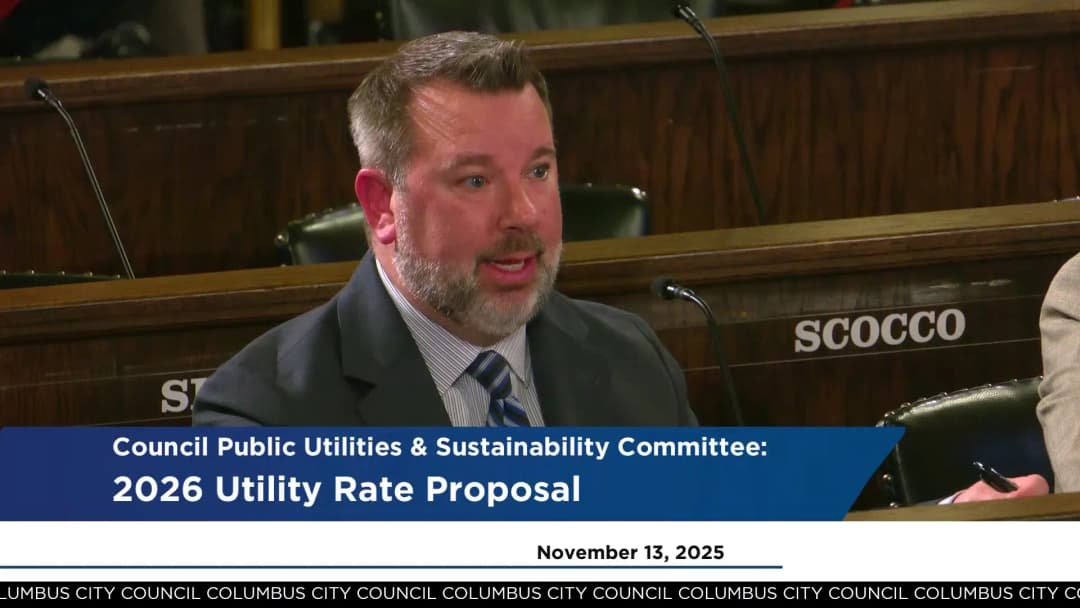
The Public Utilities and Sustainability Committee convened on November 7, 2025, to discuss three primary agenda items: an update to the City of Columbus Climate Action Plan, the status of the Community Choice Aggregation (CCA) program, and proposed utility rate adjustments for 2026. The meeting featured presentations from city department heads and external stakeholders regarding climate goals, energy market challenges, and infrastructure financing. Consent Calendar - No consent calendar items were discussed or presented; the hearing proceeded directly to the agenda items. Public Comments & Testimony - Shelley Douglas (Executive Director, Green Columbus): Expressed full support for the Climate Action Plan and Urban Forestry Master Plan but voiced strong concern and opposition regarding the lack of funding for implementation. She argued that the Department of Records and Parks faces budget cuts despite the need to double tree planting to meet the 40% canopy goal by 2050. Position: Urged Council to prioritize funding for tree planting in Parks, Rec Centers, and schools, stating that vulnerable residents are currently suffering from heat without tree cover. - Ryan Holmes (Quasi Lowe, Deputy Director, Columbus Stand Up): Expressed opposition to any additional rate hikes amidst an affordability crisis. Position: Urged Council to consider the impact on working-class families and to use their authority carefully when contracting with large data centers that consume significant utilities. Highlighted grassroots advocacy efforts regarding electricity costs. - Douglas Lumpkin: Expressed skepticism and concern regarding the timing of the rate increases so soon after a bond package passed. Position: Questioned the connection between the bond package and current rate hikes, arguing that residents cannot bear future infrastructure costs immediately without clearer justification and that loan programs should be prioritized over bonds to minimize interest costs. - Joe Motil (Written Testimony): Expressed confusion and questioned the necessity of building new capacity during drought conditions where current restrictions have not been applied. Position: Sought clarification on why investment is required now if current demand is not at maximum capacity. Discussion Items - Climate Action Plan Update: - Brooke White (Sustainable Columbus) presented the 2025 update, reaffirming goals to reduce greenhouse gases by 45% by 2030 and 100% by 2050. She outlined strategies leaning into residential and commercial energy efficiency and expanding urban tree canopy. - Councilmember Weich: Expressed strong support for tree canopy, calling himself the "Lorax of Council." Position: Demanded a dedicated budget line item for tree expansion, stating it is unacceptable to mandate canopy growth without funding the capacity to achieve it. Noted that residents highlighted heat and air quality as top concerns during engagement. - Councilmember Beatty: Expressed gratitude for the work and acknowledged the alignment with city strategic goals. - Barriers Discussed: Speakers identified federal/state policy changes, fluctuating funding availability, and the difficulty of incentivizing private residents as major barriers to achieving goals. - Community Choice Aggregation (CCA) Program: - Aaron Schmerz Schneider (Treyva Energy) reported the program is 100% renewable and meeting savings goals. However, he noted rising costs due to natural gas prices (30% increase), plant retirements, AI/data center load growth, and federal tax incentive phase-outs. - Market Analysis: The speaker explained that natural gas comprises 45% of the regional base load, driving wholesale power prices. He noted the timeline for new projects has extended from 4 years to 7 years due to grid operator backlogs. - Progress: The program is currently 30% in-state renewable (goal is 60%), with the remainder covered by national Renewable Energy Certificates (RECs). - Councilmember Bangston: Asked for clarification on savings goals (confirmed met) and the definition of clean energy in the grid mix (clarified that the 45% natural gas refers to the broad 13-state grid, not the 100% CCA project). - 2026 Utility Rate Proposals: - Recommendations: The Utility Advisory Board (UAB) unanimously recommended an 18% increase in the water rate, 8% in sanitary sewer, and 2% in stormwater. This results in an average residential bill increase of $10.50/month ($126/year). - Justification: Deputy Director Lee explained the increases are necessary for the $2.3 billion Home Road Water Plant transmission line project (completion 2033) and to address aging infrastructure. - Commercial Rates: The Department proposed transitioning from a declining block rate to a uniform rate to ensure large users (e.g., data centers, breweries) pay their fair share of capacity costs. A one-year transition is proposed to avoid "rate shock," with a move toward an inclining block rate planned for 2027. - Affordability: The Department proposed increasing low-income discounts from 25% to 30% in 2026, with a goal to reach 40% by 2028. They noted that over 105,000 residents in Franklin County could be eligible, but the enrollment goal for 2026 is 17,000 (doubling current participation). - Bond Package Clarification: Councilmember Lumpkin questioned why bond funds ($500M) were not used for the water plant to offset rate hikes. Director Lee clarified that using loans (3% interest) is significantly cheaper than bonds (approx. 5% interest), and using bonds for this project would likely require a higher rate increase (potentially 20-25%) to cover the interest differential. - Data Centers: Councilmember Harden asked if data centers are driving growth. The Director stated that while they have peak demands, the primary driver is general residential and regional population growth (projected 3 million by 2050). - Affordability Concerns: Councilmember Harden expressed concern regarding "adjustment shock" for residents facing food and cost-of-living crises. Position: Emphasized the need to aggressively market assistance programs, noting that 70,000+ eligible residents are missing out on savings. Key Outcomes - Adoption of Rate Adjustments: The Utility Advisory Board recommended, and the committee is prepared to deliberate on, the following effective January 1, 2026: Water +18%, Sanitary Sewer +8%, Stormwater +2%. - Commercial Rate Structure: The Department will proceed with a one-year transition to a uniform commercial rate in 2026 before moving to an inclining block rate in 2027. - Low-Income Assistance: The rate proposal includes a commitment to increase low-income discounts to 30% in 2026 and 40% by 2028, with a target to double enrollment to 17,000 participants. - Climate and CCA Goals: The committee acknowledged the 2025 Climate Action Plan update aligns with 45% reduction by 2030 and 100% by 2050. The CCA program continues to operate at 100% renewable status with cumulative savings near $60 million. - Action Item: The City Council is invited to connect with community organizations (e.g., Green Columbus, Columbus Stand Up, Impact Community Action) to improve outreach to eligible low-income residents.

WATER AND WASTEWATER MANAGEMENT 48% · ENVIRONMENTAL PROTECTION 17% · PUBLIC ENGAGEMENT 12% · ENERGY MANAGEMENT 9%
46
OCT 27, 2025 · COLUMBUS, OHIO · CITY COUNCIL
Second Hearing on Proposed City Rental Registry (Oct 27, 2025)

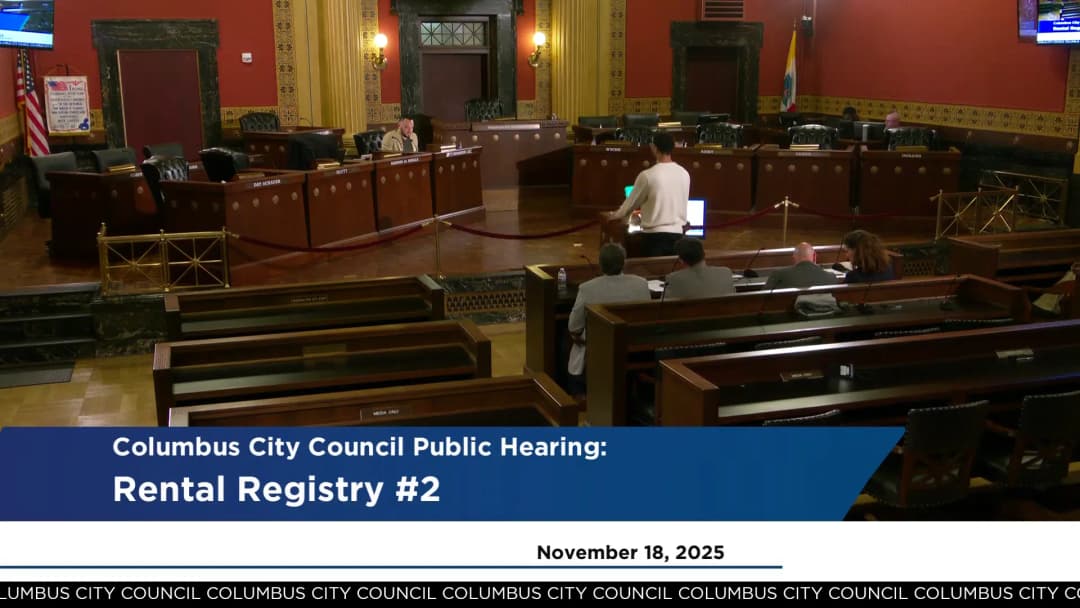
Councilmember Bankston convened the second hearing on the proposed creation of a city-wide rental registry for residential units in Columbus. The Department of Building and Zoning and the Department of Development presented a revised framework based on feedback received during the initial September 16th hearing and ongoing stakeholder engagement. Councilmember Bankston emphasized that no legislation or predetermined outcome currently exists, and the city remains in the stakeholder engagement phase while finalizing the program's budget and details. Consent Calendar - [None] Public Comments & Testimony - Opposition to the Registry: - Steve Glatman (Columbus Apartment Association): Expressed full opposition to the separate city registry, arguing it is duplicative of the county registry and unnecessary. He stated the proposed $20 per unit fee is excessive and not tied to documented costs. He positioned the net "too wide," arguing the policy penalizes responsible owners who receive orders for minor issues but comply quickly, rather than focusing solely on non-compliance or unresolved orders. He questioned the lack of a specific budget and the fairness of requiring compliant landlords to subsidize program operations. - Deb Krantz (Central Ohio Real Estate Entrepreneurs, individual landlord): Expressed strong opposition, stating the regulation makes Columbus less attractive for small investors. She positioned the proposal as adding unnecessary bureaucracy and costs that will be passed to tenants through rent increases. She urged the council to improve the existing county registry enforcement rather than creating a duplicate city system. - Mamadou Samuel Diofa (Real Estate Agent/Investor): Opposed the proposal based on experiences in Cleveland, arguing it creates bureaucratic obstacles for small investors trying to build wealth. He expressed concern that costs will rise and lead to higher rents, making it harder for residents to create wealth. - Christopher Jackson (601 West Companies): Stated strong opposition, arguing the registry adds bureaucracy that undermines affordability and duplicates existing enforcement tools. He positioned the initiative as failing to address root causes like aging infrastructure and called for investment and collaboration rather than increased penalties. - Daryl Jacobs (Solo Landlord): Expressed opposition to blanket fees, arguing they disproportionately burden "mom and pop" landlords compared to commercial owners. He requested that the city not demonize landlords and ensure small operators are included in future discussions. - Rosalyn Bay (Housing Provider): Opposed the initiative, arguing that adding costs to landlords inevitably increases rents and harms affordability. She positioned the majority of landlords as responsible individuals owning few properties to subsidize their retirement and requested that the city stop collectively punishing this group. - Dimitri Hotsifotinos (Willis Law Firm, representing Oakwood Management, Harbor Group, etc.): Expressed strong opposition to the fees and conditional inspection mechanisms. He argued the registry is legally preempted in many cases and poses an invasion of privacy for tenants of large compliant properties. He positioned the current proposal as a potential burden on 99% of compliant landlords and suggested the city should rely on existing county data and code enforcement rather than a new registry with mandatory fees. - Support for the Registry: - Daisy Chamberlain (BRED Organization): Expressed support for the original concept of proactive inspections but opposed the current revised proposal's reliance solely on self-attestation. She demanded clear outcome measures and insisted on proactive inspections for a representative sample of units to protect renters from retaliation and ensure safety. - Beth Fetzer Rice (Home for Families): Expressed full support for the registry as a critical tool to shift from reaction to prevention. She argued it protects families from negligent landlords and prevents the cycle of properties being sold to new owners to evade accountability, citing specific cases like Colonial Village and Latitude. - Aaron Sink (Local Landlord): Expressed support for targeting the "one percent" of bad actors more aggressively. While acknowledging the burden on good landlords, he argued for deeper penalties or special assessments for persistent non-compliers (e.g., vacant properties with unrepaired damage) rather than just the registry itself. - Remington Lyman (Reefco Real Estate): Correction: The transcript indicates Remington Lyman spoke in OPPOSITION, not support. He argued the registry adds fees and bureaucracy without fixing properties, would drive out small owners, and increase rents. He opposed self-attestation as ineffective against bad actors. - Michael Edwards (Legal Aid): Expressed support for the general goal of tenant protection but criticized the exclusive reliance on self-attestation. He proposed three options: random sampling of self-attested units, rolling inspections, or mandatory third-party inspections, arguing that affidavits alone are insufficient for safety. He also opposed the current "local operator" rule if it allows out-of-state operators to handle emergencies. - Nathaniel Wilkins: Expressed full support for the registry and advocated for significantly harsher penalties for bad actors, including jail time and increased fees. Discussion Items - Revisions to the Framework: Director Messer and Deputy Director Jones detailed changes made based on feedback. The new "conditional registration" status is triggered by 5 code orders (for 100 units or less) or 10 orders (for over 100 units) in a rolling 12-month period, targeting approximately 1% of properties. Conditional registrants must pay an additional fee and submit to third-party inspections and remediation plans. - Fees and Costs: The proposed fee was revised down to $20 per unit with a $3,000 maximum (previously $40/unit, $5,000 max). Conditional registrants pay an extra $250 fee plus $20/unit. Deputy Director Jones clarified that fees are restricted to program costs (software, staff, enforcement) and cannot go into the general fund. - Inspection Models: The revised proposal eliminates mandatory independent inspections for the 99% of non-conditional properties, allowing them to self-attest that major critical systems are working. Third-party inspections are reserved for the conditional tier. - Local Operator Requirements: The city clarified that properties with 10 or fewer units do not need a formal local operator but must identify an emergency contact. Owners must identify a local operator within a 100-mile radius, though Ohio real estate license holders are exempt from the distance requirement due to state licensure accountability. - County Registry Comparison: Staff and Councilmembers clarified that the city registry is not duplicative because the county registry lacks enforcement authority, has limited data collection capabilities (no emergency contacts for care/control), and operates under a different statute that precludes municipal enforcement mechanisms. - Transfers of Ownership: A key change ensures that remediation plans and conditional status are inherited by new owners, preventing owners from evading accountability by transferring properties to new LLCs. - Compliance Rates: Staff cited Cleveland's compliance rate at approximately 60% and projected lower initial compliance for small landlords (25%) but hoped for higher rates for large complexes (75%). Key Outcomes - No Final Decision Made: Councilmember Bankston confirmed no draft legislation or final budget is ready for a vote. - Continuation of the Process: The council committed to a third hearing near the top of next year to review further revisions and potential draft legislation. - Ongoing Dialogue: The council reaffirmed its commitment to continuing stakeholder engagement and listening to feedback from both proponents and opponents to strike a balance between tenant safety and landlord burden. - Acknowledgment of Discrepancies: The council acknowledged the significant disagreement between the city's view of the "bad actor" threshold (orders vs. violations) and the landlords' view that the policy unfairly targets them, agreeing that more data correlation is needed to bridge the gap. - Timeline Adjustment: Councilmember Bankston acknowledged he will not meet his original aggressive timeline due to the complexity of the feedback but committed to getting the policy "right" before implementation.

AFFORDABLE HOUSING 43% · ZONING AND LAND USE 13% · PUBLIC SAFETY 12% · PUBLIC ENGAGEMENT 7%
47
AUG 5, 2025 · COLUMBUS, OHIO · CITY COUNCIL
Columbus City Hall Labor Day Event: Panel on Black Women in Labor – August 5, 2025

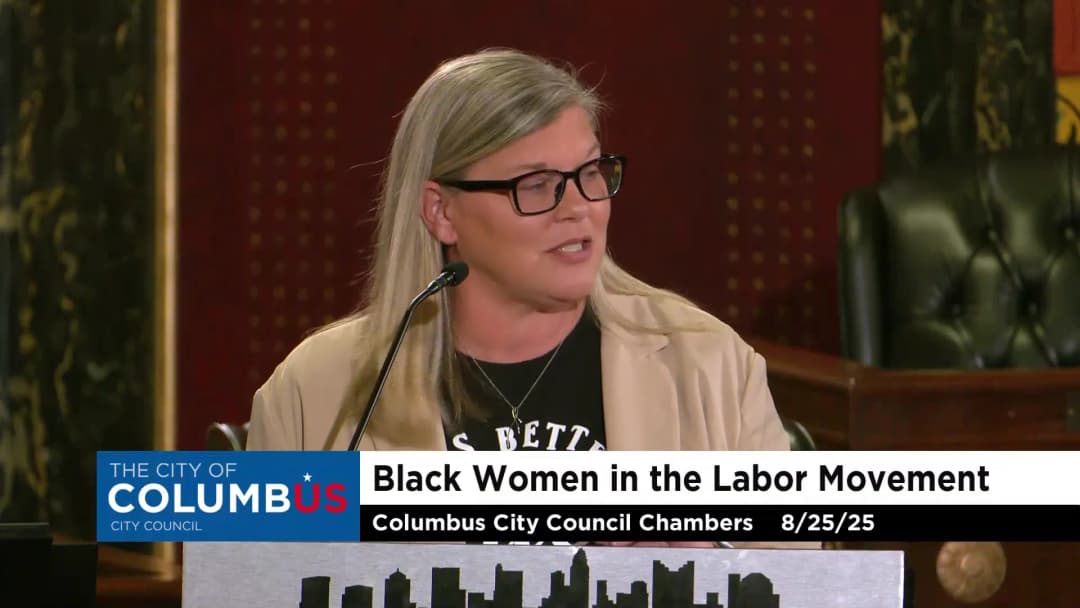
On August 5, 2025, Columbus City Council President Pro Tem Rob Dorans welcomed attendees to the second annual Labor Day event at City Hall. The event featured a panel discussion moderated by Jamie Shoemaker, Executive Director of the Central Labor Council, focusing on the experiences of Black women in the labor movement. The discussion highlighted the importance of unions in providing economic stability, dignity, and a collective voice for workers. Opening Remarks - Rob Dorans introduced the event by emphasizing the value of organized labor, sharing his personal story as a third-generation union member. He noted that Black women are one of the most common demographics of union members, challenging stereotypes. - Jamie Shoemaker introduced the panel, citing Bureau of Labor Statistics data showing Black women's unemployment rate around 6%, underscoring the relevance of the discussion. Panelist Introductions Panelists represented diverse union backgrounds: - Lisa Ann Ball – Community Education and Racial Justice Manager at Kaleidoscope Youth Center, founding member of Kaleidoscope Workers Union. - Cheryl Harris – Field Coordinator for the Ohio Federation of Teachers. - Yanela Sims – Ohio State Director and Recording Secretary for SEIU Local One. - Marcella Seals – Member of Ohio Local 132 Columbus Cement Masons. Discussion Highlights - Impact of Union Membership: Panelists shared how unions provided stability, voice, and a sense of pride. Lisa Ann Ball noted that union membership allowed her to be "unapologetically me." Yanela Sims described it as life-changing. - Solidarity in the Workplace: Panelists described solidarity as embracing individual differences, uplifting all voices, and recognizing that all workers contribute equally. - Opportunities for the Next Generation: Panelists emphasized mentoring youth, especially Black women, through education about unions and hands-on experience. Marcella Seals encouraged trades training as an alternative to college debt. - Challenges for Black Women in Construction: Marcella Seals shared her experience as a Black woman in construction, having to prove her competence on job sites. - Unionization in Nonprofits: Lisa Ann Ball explained how unionizing improved communication and employee support at Kaleidoscope Youth Center, ultimately benefiting clients. - Proudest Union Moments: Panelists recalled moments of strength, including solidarity during bargaining, ratification victories, and when others recognized their leadership potential. Public Questions and Responses - Question from Ginger Cunningham (former union organizer): Reflected on her organizing experience in the 1970s and acknowledged the panelists' contributions. - Question from Alicia Norman (community engagement manager, Dipped Custom Prints): Asked how artists and creative small businesses can protect their labor. Yanela Sims advised contacting unions for information and conversations. Panelists also noted that organizers in the audience might help. - Question from State Representative Meredith Lawson Rowe: Asked about protecting jobs from AI. Responses noted that AI cannot replace tasks requiring human creativity, compassion, or complex judgment. Panelists stressed proactive planning, retraining, and collective bargaining to integrate AI without job loss. - Question from Imani Mixton (media professional from Detroit): Asked about mentorship opportunities through unions. Panelists encouraged reaching out to admired individuals, being open to mentors of all backgrounds, and using union networks. - Question from an audience member (burnout restoration consultant): Asked how to promote equitable policies without using the "union" label. Panelists suggested educating employers on benefits of organized workforce (stability, retention, better service). Closing Jamie Shoemaker thanked panelists, attendees, and Councilman Dorans's staff for organizing the event. Additional elected officials recognized included State Representatives Latina Humphrey and Meredith Lawson Rowe, City Attorney Klein, Judge Carly Edelstein, and Councilmembers Chris Weich, Beatty, and Reemy. Key Outcomes - The event served as a community celebration and educational forum on labor issues, particularly the role of Black women in unions. - No formal votes or decisions were made; the meeting was a panel discussion and Q&A.

WORKFORCE DEVELOPMENT 50% · LABOR DAY CELEBRATION 28% · TECHNOLOGY AND INNOVATION 7% · COMMUNITY ENGAGEMENT 4%
← PREVIOUS
01…0405
OPENPUBLICA · PUBLIC MEETING INDEXUPDATED DAILY · openpublica.com