Browse by city
Date range
Search help

Search titles, summaries, topics and stored transcripts together. Keywords may match separately; put the whole query in double quotes for a phrase. Matching follows word analysis, so punctuation is not exact. Both dates are included. Documents are not searched.

SHOWING 11–20 ENTRIES
11
NEWOCT 29, 2026 · COOK COUNTY, ILLINOIS · BOARD OF COMMISSIONERS
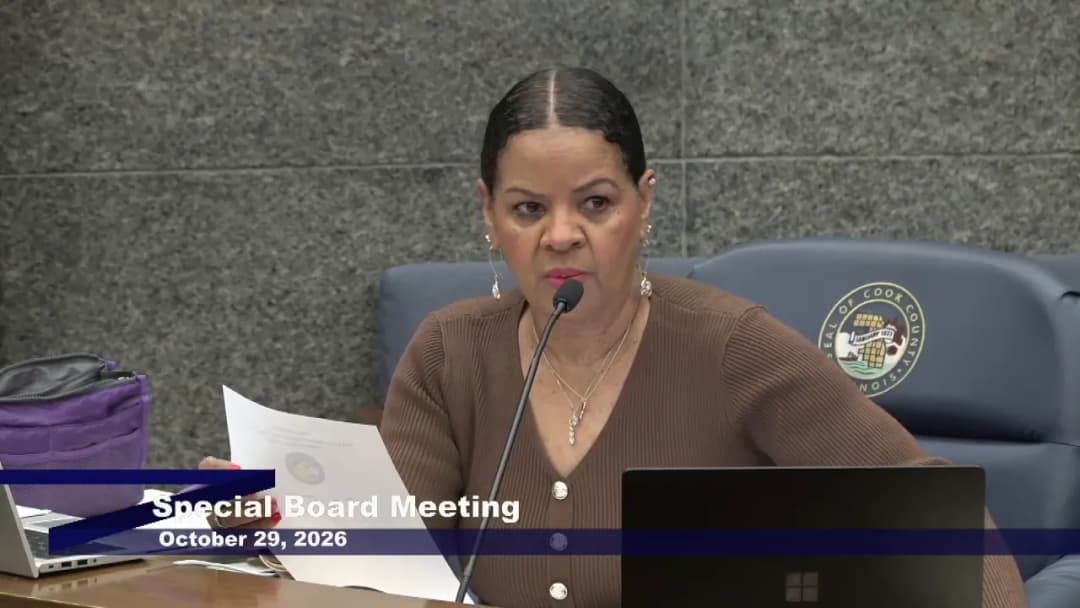
Cook County Board of Commissioners Special Meeting - October 29, 2026

The Cook County Board of Commissioners held a special meeting on Thursday, October 29, 2026, at 9:30 a.m. at 118 North Clark Street, Room 567, Chicago, Illinois. The clerk confirmed a quorum was present. The board approved two transfer-of-funds items for the 12th District and adjourned. Public Comments & Testimony - The clerk called the names of late-registered public speakers, including Andre Thomas, Jason Perry, Charla Luella, and Latanya Simmons. None responded, so no public comments were made. Committee Items - Item 26-2665 – Proposed Transfer of Funds, 12th District: Sponsored by Commissioner Bridget Degnan. The Finance Committee recommended approval. A motion to concur with that recommendation carried by voice vote with no opposition noted. Suspension of Rules / New Items - The board voted to suspend the rules, as required, to take up the Finance Committee item. - The board then voted to suspend the rules again to take up new items. - Item 26-2709 – Transfer of Funds: Approved by voice vote. Commissioner Britton was added to the roll call for this vote. Key Outcomes - Approved item 26-2665 (proposed transfer of funds for the 12th District). - Approved item 26-2709 (transfer of funds). - Suspended rules on two occasions to permit the above actions. - Motion to adjourn passed.

PROCEDURAL 87% · BUDGET EQUITY ANALYSIS 13%
12
NEWOCT 28, 2026 · COOK COUNTY, ILLINOIS · BOARD OF COMMISSIONERS
Cook County Finance Committee Holds FY2027 Capital Budget Hearing on October 28, 2026

On October 28, 2026, the Cook County Finance Committee, chaired by Chairman Daly, held a hearing to review the proposed FY2027 Capital Budget. Chief Financial Officer Angela Manning Hardeman presented the budget alongside Chief Jamie Myers (Bureau of Asset Management), Acting Superintendent Tara Orban (Department of Transportation and Highways), and Chief Information Officer Tom Lynch (Bureau of Technology). The combined capital plan includes a $240.1 million Capital Improvement Program (CIP), $180 million for transportation and highways, and capital equipment projects funded largely by debt (57.3%). Commissioners explored the budget's alignment with the county's six policy roadmap pillars. Discussion Items - Capital Budget Overview: CFO Hardeman stated the county received Fitch credit upgrades (A to A+ for GO and sales tax bonds). The debt strategy targets 2% annual growth, capped at $400 million. Commissioner Lauber questioned refinancing opportunities; Hardeman confirmed two refinancings in FY26 saved $12 million, recommending an annual review due to market volatility. Hardeman also confirmed escrowed resources from the road builders case are kept segregated. - Capital Improvement Program and Facilities (BAM): Chief Jamie Myers reported the FY27 CIP request is $240.1 million. The county achieved a 57% carbon emissions reduction (end of 2024), exceeding the 45% target, and is adopting a new goal of 50% reduction by 2034. Key projects include the DOC Enhanced Visitation Center (opening end of FY27), the new Medical Examiner's Office design, Boardroom completion (substantial completion expected the following week), and 18 solar installations by end of 2027. Commissioner Nayer questioned the low energy-specific allocation (2.3%) in the corporate portfolio. Myers explained energy projects compete with life safety and accessibility, with progress tracked by an annual benchmark report. Director of Capital Planning Earl Manning stated ADA work is embedded in most projects and agreed to adjust the budget presentation. Commissioner Nayer also flagged spending jumps between FY27 and FY28 (e.g., Public Safety from $81M to $278M). Manning explained this reflects a shift from design to construction phases. Commissioner Degnan inquired about solar deployment, the warehouse study (draft finalizing), and bird-friendly windows (already part of green standards). Commissioner Marita raised concerns about courthouse security camera quality; Myers committed to a follow-up discussion on upgrades. - Transportation and Highways (DOTH): Acting Superintendent Tara Orban presented the $285.5 million program, including 20 miles of road rehab. The Invest in Cook program awarded $8.3M to 36 projects in the previous cycle, leveraging $3 for every $1 county investment. The FY27 budget includes $8.5M for the 11th round. $68.8M in pass-through grants supports the program. Commissioner Lauber requested a breakdown of the 43 high-need communities receiving awards. Commissioner Degnan asked about the impact of the federal administration on funding; Orban stated the landscape remains stable. Commissioner Reid requested a status update on PACE dial-a-ride funding; Orban committed to following up. - Technology and Capital Equipment (BOT): CIO Tom Lynch presented the capital equipment plan. Key projects include an electronic warrant management system, a new Public Defender case management system, a Grants Management System RFP, ADA digital accessibility compliance (April 2027 deadline), and $2.8 million for a Gen AI platform. Lynch reported the retirement of hundreds of legacy mainframes across elected offices, enabling real-time data sharing. The County Clerk's system is expected to go live by end of calendar year 2026. On the Tyler Technologies system, renewal options are being exercised in November 2026 to maintain stability while the county explores alternatives. Lynch stated the Gen AI platform will be a county-controlled AWS platform to protect data. Commissioner Degnan emphasized the importance of carefully evaluating AI vendors' ethics. Commissioner Vasquez stated the county should set aside budget dollars to build an alternative to Tyler. Commissioners discussed implementing domestic violence task force recommendations on courtroom technology; Lynch noted a complex RFP for courtroom tech enhancements is underway. Key Outcomes - The hearing served as a budget review; no formal vote was taken. - BAM will adjust budget documentation to better capture ADA spending. (Commissioner Nayer) - DOTH will provide the list of 43 high-need communities and follow up on PACE funding. (Commissioners Lauber, Reid) - BAM will discuss upgrading courthouse security camera systems and resume ICE/US Marshal presence notices to commissioners. (Commissioner Marita) - The Boardroom renovation is scheduled for substantial completion within days of the hearing. - The county will explore alternatives to the Tyler Technologies system via an RFP while exercising renewal options for continuity.

TECHNOLOGY AND INNOVATION 19% · CAPITAL PLANNING 14% · PUBLIC SAFETY 12% · DATA SHARING 9%
13
NEWOCT 28, 2026 · COOK COUNTY, ILLINOIS · BOARD OF COMMISSIONERS
Cook County Board of Commissioners Budget Hearing: Cook County Health FY2027 Budget – October 28, 2026

On October 28, 2026, the Cook County Board of Commissioners held a budget hearing for the Cook County Health (CCH) proposed Fiscal Year 2027 budget. The CCH Board Chair, Raul Garza, CEO Dr. McKaitis, Interim CFO Scott Spencer, and other health system leaders presented a $4.7 billion budget facing severe financial pressure from federal Medicaid cuts and policy changes (HR 1), projected to leave 330,000 Illinois residents uninsured. The budget relies on an additional $40 million in county support to close the gap and preserve access to care. Discussion Items - Federal Policy Impact on CCH Budget: Chair Garza highlighted the impact of HR 1, which drastically reduces federal Medicaid funding. CCH projects a $138 million decline in patient care revenue and a $100 million increase in charity care, reaching a total of $485 million in charity care costs. Dr. McKaitis stated that over the past three years, CCH has eliminated approximately $315 million in expenses and reduced agency FTEs by 53% (from 1,366 to 637) to prepare for federal cuts. - County Support and Financial Sustainability: The proposed budget includes a $40 million increase in direct Cook County support, reflecting President Preckwinkle's commitment. Chair Garza noted that direct county funding has fallen from supporting one-quarter of the CCH budget in 2013 to less than 5% in the proposed FY2027 budget. Commissioners acknowledged the tight fiscal environment but praised CCH leadership for protecting services and workforce. - Uncompensated Care and Coverage Losses: Commissioner Trevor expressed concern that the $100 million charity care estimate might be too low given the scale of federal changes. Commissioner Lowry queried the rise of uninsured patients from area hospital closures (e.g., South Side, Roseland, Trinity). Dr. McKaitis reported the uninsured rate in CCH's patient mix rose from 20% to 25% in January 2026 following the end of the enhanced ACA tax subsidy. - CERMAC Health Services (Correctional Health): Commissioner Lowry raised concerns about a net decrease of 15 FTEs in CERMAC health services. Manny Estrada (COO) and Dr. Nutter clarified that while the budgeted FTE line decreased, actual staffing increased as the department filled 40+ vacancies and realigned positions, reducing vacancies to just six. The reduction was in mental health positions, offset by increased direct patient care staff. - Behavioral Health and ARPA Programs: Several ARPA-funded programs were sunset or reduced in the FY2027 budget. Commissioner Aguilar noted the Healthy Workers Initiative was cut from $3 million to $1.5 million. Commissioner Morrison commended CCH for retaining a net increase of 50 behavioral health positions post-ARPA. Dr. Nutter stated that the behavioral health program at the JTDC (Juvenile Detention Center) sees only 63% of patients receiving individualized counseling, which Commissioner Degnan criticized as insufficient, demanding 100% access for detained youth. - Health Plan Services (County Care): Aaron Galiner discussed investments in community outreach, text messaging, and data flows to prepare members for redetermination. Commissioner Aguilar inquired about the CareLink charity care program, confirming it is handled by the same financial counseling team. - Provident Hospital Services: Dr. McKaitis explained the temporary closure of the Medical ICU at Provident due to an average daily census of one patient, while the Emergency Room remains open. He highlighted a 15-16% improvement over budget in operating room performance and a plan to expand outpatient access by 40% through consolidation. - Workforce and Settlement (Guidehouse): Commissioner Degnan inquired about the Guidehouse labor settlement hiring. CCH reported that of the 135 new PIDs allocated in FY2026, 72 have been filled, with 106 offers made. An additional 25 positions will be added via a technical amendment in FY2027. - Maternal Health and OB/GYN: Commissioner Degnan raised concerns about cuts to OB/GYN FTEs on budget pages G106 and G112. Dr. McKaitis clarified the positions were repurposed for insourcing, but the overall OB/GYN coverage is expanding through a partnership with the University of Illinois, growing from 6 to 13 providers, supported by a $3 million increase in medical consultation funding. - Public Health and Operations: Dr. Joshi (CCDPH) noted the Department is essentially flat year-over-year in FTEs, with changes being reclassifications. Dr. McKaitis highlighted an increase in annual wellness visits to 41% (up from 4%) and a 50% year-over-year increase in quality outcomes under value-based care contracts. Key Outcomes - The FY2027 CCH budget is presented without cuts to patient care services, maintaining a flat FTE count and avoiding any layoffs or clinic closures. - The budget relies on $40 million in additional county support to help offset a projected $138 million decline in patient revenue and $100 million increase in charity care. - CCH will continue its multi-year cost reduction strategy, having achieved over $300 million in cumulative savings and reducing agency reliance by 53%. - A technical amendment is planned to add the final 25 positions related to the Guidehouse labor settlement, totaling 160 positions. - CCH leaders acknowledged that FY2027 is a temporary reprieve and that future fiscal years may require increasingly difficult measures including workforce reductions or health center closures if federal funding shortfalls persist. - Commissioners and CCH leaders agreed to strengthen state-level advocacy to protect programs like the Health Benefits for Immigrant Seniors (HBIS) and negotiate broader reforms for charity care distribution among private health systems.

PUBLIC HEALTH 52% · MEDICAID/INSURANCE 14% · MENTAL HEALTH AWARENESS 11% · BEHAVIORAL HEALTH 7%
14
NEWOCT 28, 2026 · COOK COUNTY, ILLINOIS · BOARD OF COMMISSIONERS
Finance Committee Meeting - October 28, 2026

This meeting of the Finance Committee focused on the Public Administrator's office budget and performance. The Public Administrator, Louie, presented an overview of office operations, finances, and achievements, followed by questions from committee members. Discussion Items - Public Administrator Presentation: Louie reported that the office has 15 full-time staff (a 20% reduction from 2016), has conducted 909 investigations year-to-date, and has generated $2.7 million in fees and court costs (140% of FY26 target). The office returned $28 million to heirs/beneficiaries and assisted in recovering $3.2 million from nursing home wrongful death actions. The FY27 budget is $2.1 million (increase of $171,000). The office closed 40 properties last year, generating $11.5 million in sales, and currently manages 39 properties. - Chair Lauer asked about the complaint process and requested an FAQ document; the Public Administrator agreed to provide it. - Commissioner Dick inquired about a shift of two FTEs from general administration to estate administration. General Counsel Leah Jacobowski explained it was a right-sizing of job classifications. Commissioner Dick suggested condensing the categories for FY28, and the Public Administrator agreed to discuss with the budget office. - Another commissioner asked about probate case targets (target 370; 396 reported in Q1/Q2) and average closure time. The Public Administrator noted that complexity and court approval cause delays and that they aim to close many by year-end. - Additional question: about investigator caseload—900 investigations per year across 4 FTEs. Key Outcomes - No formal votes or decisions were recorded. - The Public Administrator committed to providing an FAQ document to committee members. - A recommendation was made to condense general administration and estate administration employee categories for FY28.

PUBLIC ADMINISTRATION 76% · PROCEDURAL 14% · PROPERTY MANAGEMENT 10%
15
OCT 28, 2026 · COOK COUNTY, ILLINOIS · BOARD OF COMMISSIONERS
Cook County Board Budget Hearing for Office of the Chief Judge - October 28, 2026

The Office of the Chief Judge presented its fiscal year 2027 budget to the Cook County Board, outlining a $386.5 million general fund request (a $24.5 million increase from FY26) and highlighting progress in staffing, operations, and services across the circuit court. Chief Judge Beach emphasized efficiency, transparency, and fairness, and fielded questions from commissioners on domestic violence courthouse hours, interpreter services, electronic monitoring, juvenile detention, and other initiatives. Budget Overview - Total FY27 general fund: $386.5 million, a $24.5 million increase from FY26, largely in salaries, benefits, and additional FTEs. - Anticipated revenues: $2,450,000 from the Office of the Public Guardian (up $50,000), $80,680,967 in reimbursements from the AOIC and Office of Statewide Pretrial Services (up $4.5 million), and approximately $18 million in grants (down $1.7 million). Staffing and Personnel Improvements - Non-judicial staff vacancies reduced by over 57% across the circuit court. - New leadership positions created: Trial Court Administrator (Justice Leroy Martin) and Ombudsperson (Veronica Claudio). - Juvenile services leadership overhauled: Director Sarah Hemeter, JTDC Superintendent Mac McGee, Chief Juvenile Probation Officer Melissa Spooner. - Interpreter services: All full-time Spanish interpreter vacancies filled for the first time in years; budget includes new FTEs for two Russian and two Arabic interpreters. Certification requirement relaxed but must be obtained within 18 months of hire. - JTDC youth detention specialist vacancies reduced from 32 (June 2025) to 8 (October 2026), resulting in a 20% decrease in overtime spending. Juvenile Services and JTDC - The Chief Judge described changes at the Juvenile Temporary Detention Center (JTDC) including a new laundry process, progress toward PRIA safety standards, and a pre-evaluation by the John Howard Association (final report expected February 2027). - Programming funds were secured through overtime savings, shifting from reliance on external volunteers. - The SORA Center shelter care contract with Heartland ends November 30, 2026; the OCJ is in conversations with multiple alternative providers. - An independent assessment by the Annie Casey Foundation (Catalyze Justice) is underway, examining safety, security, programming, and youth and staff perspectives. An initial visit found no safety issues. Domestic Violence Courthouse - Commissioner Daly asked about recommendations from the domestic violence committee. Chief Judge Beach detailed new extended hours: in-person at the courthouse until 6 p.m. (currently 4:30), supplemented by fully remote hours until midnight, Monday through Friday, with existing remote hours on weekends. The change requires additional judges and court administrators, but the Chief Judge noted such resources are a zero-sum game across divisions. - An RFP for after-hours advocacy resulted in Family Rescue joining the existing network. - The shift to stalking no-contact orders from 555 West Harrison to the Daly Center was also noted. Electronic Monitoring and Probation - Commissioner Bridge asked about the transition of electronic monitoring (EM) from the Sheriff’s office. The Sheriff still handles about 100 cases; the transfer has begun and is expected to be mostly complete by the end of FY27. Chief Judge Beach expressed interest in eventually moving all EM to the state's Office of Statewide Pretrial Services (OSPS), as done in over 80 other counties. - OSPS funding increased by $4.5 million, offsetting a $3.7 million reduction in other grant resources. - Adult Probation initiatives: increased cognitive behavioral interventions (over 170 referrals in FY26), a partnership with Chestnut Health Systems for substance use treatment screening (200+ screened, 100+ eligible), distribution of over 2,000 Narcan kits and 8,600 one-day venture passes, and expanded partner intervention programs. - Commissioner Treter asked about a shift in FTEs under home confinement; Chief Probation Officer Megan Volker explained it reflects contractual titles due to new hires, not a reduction in positions. Other Initiatives - Jury utilization in the First Municipal District improved from 13% (January 2026) to 69% (mid-October 2026) while reducing the number of judges assigned, achieved through data analysis. - Pro se assistance desks expanded, particularly at the Markham Courthouse. - The OCJ is exploring digitization of court documents to expedite jail release times, but the Chief Judge noted that judges typically issue orders on the bench and that delays often stem from the clerk’s key-punching process. An EMIT pilot program is being developed to automate the order system. - The Empower app for domestic violence survivors saw a 197% increase in uptake since January, and the Chief Judge is working with advocates and the State’s Attorney’s office to further expand use. Commissioner Questions and Responses - Commissioner Day: Followed up on domestic violence courthouse hours and interpreter services. The Chief Judge noted the challenges of judge allocation but committed to using data to reallocate resources. On interpreters, he cited technology allowing remote interpretation to reduce burdens and mentioned a pipeline committee. - Commissioner Bridge: Asked about EM transition and caseload increases due to new charging decisions by the State’s Attorney. The Chief Judge confirmed an increase in detention hearings, which extend court hours. He also confirmed that the board has no authority over circuit court judges. - Commissioner Kevin Morrison: Expressed appreciation and had no questions. - Commissioner Hagler: Thanked the Chief Judge for addressing EM concerns. - Commissioner Morita: Praised language access improvements at the Skokie Courthouse and the first ADA courtroom, and noted the courthouse’s community role. - Commissioner Vasquez: Asked about the JTDC independent review (scope to be finalized in December, includes safety, staffing, programming, and external perspectives) and digitization of court documents to speed jail releases. The Chief Judge invited her to observe first appearance court and discussed the EMIT pilot. He also noted no data is currently collected on remote appearances, but tracking will begin. - Commissioner Nye (in closing): Noted previous discussions and asked about the Empower app. The Chief Judge reported the 197% uptake increase and upcoming collaboration with the State’s Attorney. Key Outcomes - No formal votes were taken during the hearing. - The Chief Judge committed to: - Further updates on domestic violence courthouse hours and implementation timeline. - Sharing final JTDC assessment reports from the John Howard Association and Annie Casey Foundation. - Continuing the EM transition from the Sheriff and exploring a shift to OSPS. - Working with commissioners on data-driven resource allocation. - Commissioners expressed support for the Chief Judge’s efforts and requested ongoing communication on these initiatives.

COURT REPORTING 18% · CRIMINAL JUSTICE 16% · PERSONNEL MATTERS 15% · JUVENILE JUSTICE 13%
16
OCT 28, 2026 · COOK COUNTY, ILLINOIS · BOARD OF COMMISSIONERS
Cook County Land Bank Fiscal Year 2027 Budget Hearing - October 28, 2026

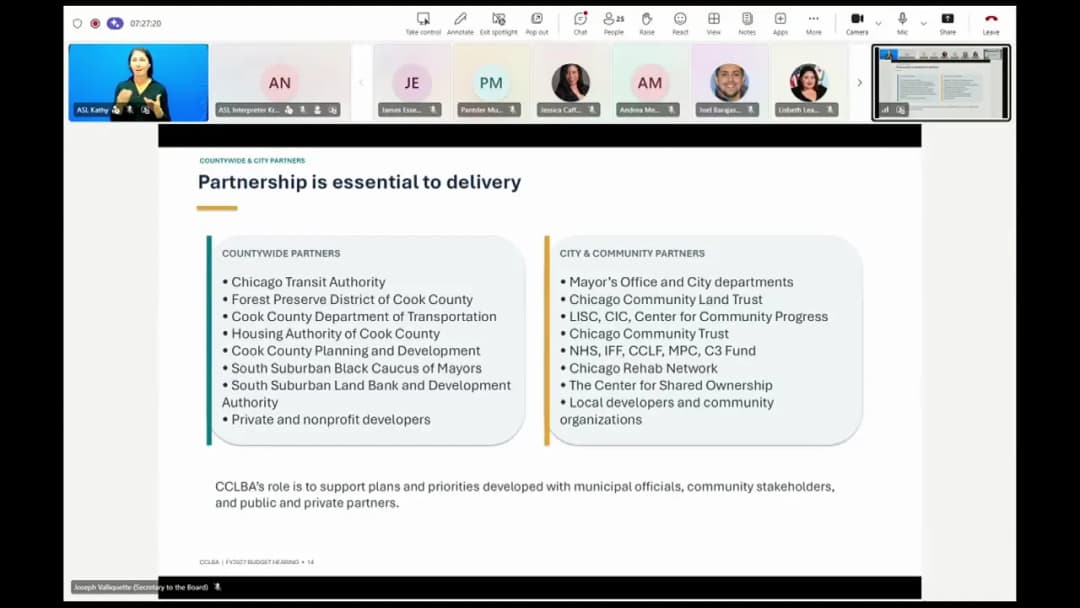
Executive Director Jessica Caffrey presented the Cook County Land Bank's proposed FY2027 budget of $14.5 million, a $652,000 reduction from the previous year. The hearing covered the land bank's achievements, revenue trends, and plans to address over 38,000 long-term tax-delinquent properties. Commissioners asked questions about inventory, partnerships, affordable housing, and new reactivation initiatives. Discussion Items - Budget Overview: The FY2027 total appropriation is $14.5 million (down from $15.2 million in FY2026). Cook County's appropriation adjustment decreased from $3.5 million to $2.6 million, based on a three-year rolling average of penalties and fines. Equity funds from FY2026 are carried over and will be spent down in FY2027. The IDA (Illinois Housing Development Authority) strong communities grant of $750,000 is pending, so it is budgeted at $0. The property maintenance line (landscaping, snow removal, board-ups) remains consistent year-over-year at about $6.5 million for 1,800+ properties. - Operational Impact (2013–present): Since 2013, the land bank has acquired over 5,000 parcels, sold over 3,500, and rehabbed over 2,600 across 76 municipalities and 61 Chicago neighborhoods. This generated $38.5 million in property tax revenue, $330 million in community wealth, and $38 million in delinquent taxes redeemed through notice actions. A 10-year economic impact report estimated $1.8 billion in total economic impact, with a 77-cent benefit per $1 of public-private spending. - Revenue & Sales: Primary revenue sources are traditional property sales, municipal sales, land banking agreements, and tax reimbursements. As of October 27, 2026, revenue stood at $7.32 million, in line with FY2024 ($7.29 million). FY2025 was the strongest year since 2018 at $9.64 million. FY2027 revenue is budgeted conservatively at $7 million, slightly below the three-year average of $8.08 million. Sales depend on market conditions and closing timings; inventory consists of very low-valued properties. - Developer Network & Vendors: The land bank works with over 1,400 unique developers (small, local contractors often working in their own neighborhoods) and 19 vendors for property preservation. Each sale includes a rehab requirement, deed restriction, and soft second mortgage. Annual developer recognition events cover the west side, south side, south suburbs, and west suburbs. - Inventory & Acquisition Strategy: Current active inventory is about 1,800 properties. The annual acquisition volume is constrained by budget (the largest expense is property preservation). The land bank acquires properties for market viability, community strategy, municipal requests, long-term tax delinquency, and to align with public investments (e.g., City of Chicago's Missing Middle program). The goal is to keep inventory stable around 2,000 properties. - FY2027 Commitments: Minimum targets: 300 acquisitions, 500 dispositions (which reduces inventory and holding costs), $30 million in community wealth, 80% of homes going to homeownership, 90% of acquisitions in priority/low-to-moderate-income areas, 30 purchase assistance grants, a 15% reduction in age inventory (properties held over two years), and four community outreach events. In FY2026, the land bank sold 302 age-inventory properties (18.82% of that category), exceeding the 15% goal. - Opportunity – Over 38,000 Long-Term Tax-Delinquent Properties: There are more than 38,000 properties left unsold from 2021/2022 tax sales. Recent state laws (2023 and 2026) ended mandatory scavenger sales and addressed the Tyler v. Hennepin Supreme Court decision. The county, under President Preckwinkle, is developing a new reactivation mechanism with the Civic Consulting Alliance (CCA). The land bank will not hold 38,000 properties; most will pass through an auction process. For FY2027, the implementation phase is within the budget request. Requirements: auction system with clear rules, technology to track tens of thousands of parcels, legal capacity for deeds, and agreements with municipalities, the city, the clerk, the treasurer, and the president's office. A pilot program is planned before full-scale operations. The added costs at full scale (auction, legal, technology, holding costs) will be brought back to the board later. - Partnership Examples: (1) Rebuild 2.0 with Chicago Department of Housing: transferred 33 vacant homes in Englewood and Roseland; community lenders (Chicago Community Loan Fund, Greenwood Archer Capital) financed local developers; homes sold to owner-occupants with a $20 million IDA grant. (2) Austin Hope Center: vacant lots became a 25,000 sq ft facility with pediatric care, mental health services, youth programs, and community space, developed by Stone Community Development Group and Chicago Neighborhood Initiatives. The land bank is also closing on homes in Roseland with the Hope Center Foundation. - Commissioner Questions: - Commissioner (unidentified): Asked about the ratio of land bank to city-owned lots and whether the land bank can get a share of the 38,000 properties. Caffrey explained that the land bank only takes inventory it can afford to maintain (around 2,000 active properties). The 38,000 are not yet in inventory; the new process will assemble them. Collaboration with the city through joint RFPs is being explored. - Commissioner Dagner: Praised the land bank's charrettes and asked about a $1.25 million reduction in professional services on page E6. Daniel Taylor clarified that the reduction includes carryover equity funds from FY2026; the professional services line actually decreased from $450,000 to $404,000. - Commissioner (another): Asked for clarification on the 38,765 properties – not all are vacant. Caffrey stated that 60% of the 38,000 are vacant land (no structures). The land bank does not take occupied residential properties; a separate pilot program (with Bureau of Economic Development) aims to keep 100 families in their homes. Discussed the new auction process: after the auction, if no bid meets the total taxes/debt, the property can go into land bank inventory and be sold without surplus equity concerns. Surplus equity would be returned to former owners when required. Legal details are still being worked out with judges and CCA. - Commissioner (same): Asked about FY2027 goals – they appear to be new goals. Caffrey confirmed they are new; previous goals were met except acquisition targets (due to a 75-step deed process). Also noted that the IDA grant of $562,000 (state) has been fully expended; the pending $750,000 for FY2027 is not yet announced. - Commissioner (8th District): Commented on the website's improved user-friendliness and asked for more suburban/south suburban community partners. Caffrey noted existing partnership with South Suburban Land Bank and willingness to do more. The commissioner also requested that the 8th district be considered for future acquisitions, especially in its lower-income south end. Caffrey agreed to meet and discuss tax-delinquent areas. - Other commissioners: Expressed appreciation for the land bank's work and staff responsiveness. Commissioner noted enforcement follow-through by land bank staff on developer maintenance. Key Outcomes - The board did not take a vote on the FY2027 budget request ($14.5 million) during the hearing. The meeting was recessed until 9:30 AM the following day (October 29, 2026) for a finance committee with the Cook County Sheriff and a board meeting at 9:30 AM. - Several commissioners requested follow-up meetings with the land bank to discuss district-specific properties, affordable housing strategies, and partnerships. - The land bank will continue working with CCA and judges to finalize the auction and reactivation program, with a pilot expected to inform full-scale operations.

PROPERTY MANAGEMENT 34% · ZONING AND LAND USE 30% · AFFORDABLE HOUSING 18% · PUBLIC ADMINISTRATION 11%
17
OCT 27, 2026 · COOK COUNTY, ILLINOIS · BOARD OF COMMISSIONERS
2026-10-27 Cook County Board Committee Meeting: Assessor's Office 2027 Budget and Property Tax Reform Presentation

Meeting Overview On October 27, 2026, the Cook County Board Committee heard a presentation from Assessor Fritz Kagey and Chief of Staff Scott Smith on the office's 2027 budget and ongoing property tax reform efforts, including closing the commercial valuation gap and improving taxpayer services. Discussion Items - Commercial Valuation Gap: Assessor Kagey reported that his office took three key steps: sending data packets to the Board of Review for commercial appeals, defending assessments at Board of Review hearings, and agreeing on a shared methodology for calculating tax rates and capitalization rates. These steps have reduced the shift of tax burden to homeowners. - Impact Examples: In Elk Grove Township, the median residential tax bill increased only 7% in 2025 (down from 24% in 2022), and homeowners' share of the property tax base remained at 41% in 2025 rather than jumping as it did in 2022. In the North Suburbs overall, the median residential bill increase dropped from 16% in 2022 to 7% in 2025. - Outreach and Exemptions: The office held 226 outreach events (87 in Spanish), issued over 1 million homeowner exemptions, 380,000 senior exemptions, more than 100,000 senior freeze exemptions, and 15,000 exemptions for veterans with disabilities. The Affordable Housing Special Assessment Program preserved more than 16,500 affordable housing units across 1,600 projects. - 2027 Budget: The proposed budget increases 11% overall, but the general fund allocation only rises 3%. Full-time staff remains flat, and 20 FTEs were shifted from general fund to special purpose funds. The office projects fewer than 10 vacancies by year-end. Key costs include postage, graphics, and advertising for state-mandated newspaper publication of assessment notices. - Questions and Discussion: - Commissioner Lowry asked about commercial vacancy downtown. Kagey noted office vacancy is high (pushing into the high 20s, with about 50 million sq ft vacant downtown), but assessments have been accurate per IDOR sales ratio studies. Vacancy shifts burden to remaining tenants. - Commissioner Britton praised the tax methodology agreement with the Board of Review and discussed the need for PTAB reform, annual reassessments, and automatic renewal of the senior freeze. Kagey supported these, highlighting that 40% of workshop attendees in Chicago were entitled to exemptions but hadn't received them. - Commissioner Morrison asked about analyst positions moved to special purpose funds. Scott Smith confirmed no job losses; positions were shifted to ease general fund burden. - Commissioner Trevor asked about feasibility of annual reassessments. Kagey said it requires better commercial data, reduced appeals, and improved taxpayer services, possibly more outreach staff. - Commissioner Aguilar asked about senior freeze vs. appeals. Kagey explained automatic renewal would dramatically reduce senior appeals and certificates of error. - Commissioner Vasquez asked about certificates of error backlog. Kagey and Smith reported a significant backlog (about half a year), but the office is working overtime and expects to complete assessment appeals for the South Suburbs by December 2026. Tyler Technologies implementation caused a six-month pause, but processing has resumed. Key Outcomes - The committee received the Assessor's 2027 budget presentation and will consider it further. - Several commissioners expressed support for pursuing state legislation on automatic renewal of the senior freeze (Senate Bill sponsored by Senator Cervantes) and on commercial data modernization. - The Assessor emphasized that ongoing collaboration with the Board of Review and continued oversight (e.g., annual sales ratio studies) are critical to reducing homeowners' tax burden. - No formal votes were taken during this committee hearing.

PROPERTY MANAGEMENT 68% · TECHNOLOGY AND INNOVATION 10% · TAX POLICY 8% · COMMUNITY ENGAGEMENT 4%
18
OCT 27, 2026 · COOK COUNTY, ILLINOIS · BOARD OF COMMISSIONERS
Cook County Board FY27 Budget Briefing: Secretary's Office and Archives Update, October 27, 2026

On October 27, 2026, the Cook County Board of Commissioners convened to review the proposed FY27 budget and operations of the Secretary to the Board, Lynn Turner, and her team. The meeting, officially timestamped for 6:00 PM, featured morning greetings from presenters, reflecting a scheduling discrepancy in the source materials. The presentation highlighted the office's legislative support and records management roles, alongside a proposed budget increase from $2.4 million to $2.7 million (described as an increase of 'slightly' or approximately $275,000). Discussion Items - Secretary's Office Budget Presentation (Lynn Turner): Secretary Turner presented the FY27 budget proposal of $2.7 million, an increase of roughly $275,000 over the previous $2.4 million budget. She attributed the increase primarily to a 13% rise in the Granicus software contract, new boardroom enhancements, the purchase of specialty papers, and an RFP for photography services. Turner expressed gratitude to her team and partners (BOA, Sheriff, BOT), stating they 'run a very lean operation.' - Office of the Secretary Responsibilities (Brandy): A staff member, Brandy, formally read the office's key responsibilities into the record. These duties include preparing meeting notices, agendas, and consent calendars; maintaining official records such as voting records, minutes, and transcripts; managing the board's administrative budget and assisting commissioners with office budgets; coordinating public hearings and budget meetings; acting as a parliamentary resource; maintaining the public website and streaming services; drafting resolutions and ordinances; and handling certain lobbying functions for the President's office. - Cook County Historic Archives and Records Office (Cairo) Update (Victoria): Victoria, Manager of Archives, provided an update. A recent Iron Mountain inventory and condition report indicates that the archival collections are in critical condition and require immediate attention. Cairo is planning a physical move from the 10th floor and 3M storage to the 4th floor in 2027, with packing beginning in December 2026. The office is developing a digital archive to improve public accessibility. A public exhibition, 'Declaration 1776, the Big Bang of Modern Democracy,' is scheduled to run from November 30th to January 8th. Victoria reported significant social media growth: over 55,600 views, 472 new followers, and a 90% increase in follower count between September 27th and October 26th. - Commissioner and Chairman Feedback: - The Chairman and multiple commissioners expressed strong appreciation for the Secretary's office, citing its daily support, guidance, and meeting logistics management. - Commissioner Lowry praised the office's role in helping the board close a $500 million budget gap and lauded staff for their work on the podcast, the new boardroom planning, and historical archiving. - Commissioner Trish Murphy engaged in a detailed line of questioning. She inquired about the professional services line item increase (confirmed to be driven by the Granicus contract and boardroom enhancements). She also asked about interpretation services; staff confirmed the new boardroom includes a dedicated booth for language interpretation and a camera for ASL interpreters, and that Spanish and ASL interpreters are always connected online via the Language Line contract. - On the new boardroom timeline, Asset Management has not yet handed over the space. The Secretary's office originally estimated a six-week testing period for the new equipment, but this has been reduced as staff await full training manuals. The transition will be expedited as soon as materials are received. - Staff confirmed that new commissioner desks will include tablets for electronic voting and a keyboard, though electronic voting will be rolled out after commissioners become comfortable with the initial setup. Key Outcomes - The FY27 budget increase for the Secretary's office, totaling approximately $275,000, was presented and discussed. No formal vote was taken during this presentation. The budget office is expected to follow up with more detail the following day. - The archives office (Cairo) will relocate to the 4th floor in 2027, with packing beginning in December 2026. The critical condition of its collections was formally noted, underscoring the need for stabilization. - The timeline for occupying the new boardroom depends on the handover from Asset Management and the receipt of training manuals. Staff committed to an expedited testing phase. - New electronic voting hardware (tablets and keyboards) has been ordered for commissioner desks. Implementation will follow an initial familiarization period. - Enhanced interpretation capabilities (dedicated booth for language, camera for ASL, continuous Spanish/ASL online access) are confirmed for the new boardroom.

TECHNOLOGY AND INNOVATION 39% · HISTORIC PRESERVATION 22% · PROCEDURAL 14% · BUDGET EQUITY ANALYSIS 14%
19
OCT 27, 2026 · COOK COUNTY, ILLINOIS · BOARD OF COMMISSIONERS
FY2027 Budget Presentation for Offices Under the President – Cook County Board of Commissioners Budget Committee – October 27, 2026

The meeting was called to order by the committee chair. Lynetta Haynes Turner, Chief of Staff to Cook County Board President Toni Preckwinkle, presented the fiscal year 2027 budget for offices under the president (OUP). The presentation highlighted the county's fiscal responsibility, equity investments, and the impact of programs supported by the OUP budget. Commissioners expressed appreciation for the administration's transparency and difficult decisions, and raised questions on specific programs and budget line items. Consent Calendar - No consent calendar items were noted in the transcript. Public Comments & Testimony - No public comments were made; only commissioners and county staff spoke. Discussion Items - Budget Overview: Lynetta Haynes Turner presented the FY2027 general fund budget for OUP as $338.8 million, an increase of $54.2 million driven by planned ARPA reserve allocations. Personnel services account for 65.5% of the budget. The budget supports 2,118 positions, a net decrease of 33 positions across all funds. - Community Safety: Gun homicides in Cook County have fallen by 50% since 2021. Through the Government Alliance for Safer Communities (GASC), over $350 million has been invested in community-based violence intervention, including $110 million from Cook County. An additional $20 million was committed for summer 2025 programming, and $5 million for domestic violence intervention via the Justice Advisory Council. - Housing & Homelessness: In FY2026, the Department of Planning and Development supported more than 350 units of affordable/supportive housing. A modular homes pilot is underway in Humboldt Park and Chicago Heights. The county provided over 400,000 nights of shelter and served 3,400 individuals. Cook County Legal Aid for Housing and Debt (CLAAD) has served 134,000 residents and provided 100,000 free legal consultations; evictions placed with the sheriff are down 10,000 (20%) compared to pre-pandemic levels. - Disaster Relief: The county passed a $15 million storm relief program providing up to $2,000 per household for residents affected by 2025 storms. Over $8 million was committed for debris removal; more than 450,000 cubic yards of debris were collected. Federal disaster assistance was denied despite surpassing FEMA thresholds; the county will appeal. - Build Up Cook: With $30.5 million in ARPA funding, dozens of infrastructure projects have been completed. A next phase in FY2027 will focus on capacity building and technical expertise for under-resourced communities. - Economic Development: The Access to Capital initiative awarded $2.4 million to five community financial institutions. The Small Business Source program continues with $6.5 million in FY2027, serving 106,000 small businesses (with 40-45% repeat clients). - Guaranteed Income Program: The $12.5 million allocation includes carryover. The next iteration will target specific constituencies, with a rollout scheduled for the first quarter of FY2027. Commissioner briefings will be held in the coming month. - Domestic Violence & CVI Grants: Commissioner Miller advocated for increased suburban funding. Avik Das, Director of Justice Advisory Council, stated that approximately 30% of post-ARPA grants will target suburban organizations, with specific tracks for domestic violence and community violence intervention. Commissioner Miller asked for a higher percentage, noting under-resourced south suburban courthouses. The $49.6 million CVI allocation includes $20 million in new funding for FY2027; existing grants are on two-year cycles. - Bureau of Asset Management (BAM): Commissioner Moore questioned reductions in facility maintenance from $6.4 million to $5.2 million (18% cut) and the creation of a new $450,000 emergency repair reserve. Jamie Myers explained that the cuts did not affect maintenance of good repair, and the reserve allows faster emergency response. Commissioner Moore also noted increased spending on engineering consultants (from $380,000 to $445,000) and overtime (from $2.1 million to $2.5 million, a 21.4% increase). He expressed concern about reliance on outside consultants (three firms: JLL, Ardmore Roderick, STV, with about 20-25 consultants each) versus hiring permanent trades staff. Chief of Staff Turner stated the administration stands behind BAM's budget decisions and will provide detailed follow-up. Key Outcomes - No formal votes were taken during the presentation; it was a budget hearing for discussion and Q&A. - Commissioners expected follow-up information on BAM line items, including specific cuts, consulting contracts, overtime causes, and project director caseloads. - The storm relief program will launch in December 2026; commissioner briefings will be held prior. - The guaranteed income program will begin in the first quarter of FY2027; commissioner briefings are scheduled. - The video presentation was unable to play; Chief of Staff noted it would be sent to commissioners later. - The meeting concluded with plans for subsequent hearings (Chief Judge and Assessor).

ENGINEERING AND INFRASTRUCTURE 19% · PROCEDURAL 14% · ECONOMIC DEVELOPMENT 14% · PUBLIC SAFETY 7%
20
OCT 27, 2026 · COOK COUNTY, ILLINOIS · BOARD OF COMMISSIONERS
Cook County Finance Committee FY2027 Budget Presentation - October 27, 2026

The Cook County Board Finance Committee met on October 27, 2026, to receive the FY2027 executive budget recommendation from the Bureau of Finance. No agenda or minutes were provided with the transcript. Staff presented a balanced budget plan for a $550.7 million preliminary gap using one-time measures, targeted vacancy reductions, and expense savings without tax increases or layoffs, and commissioners then asked questions and offered comments. Discussion Items - Opening presentation: CFO Angela described a historically large $550 million preliminary gap, said the budget was balanced without tax increases or layoffs, and credited intentional reserve use, smart investing, department reductions, and stricter vacancy management. She thanked Bureau of Finance staff. - Historical and economic context: Deputy CFO Dean noted pension reform, a $1.36 billion reduction in DAP principal, six credit-rating upgrades in five years, full spending of ARPA funds, and over 70 percent of ARPA funds committed to community programs. More than 60 percent of general fund revenues are economically sensitive; forecasters project real GDP growth just above 2 percent with elevated inflation. Aggregate revenues are projected to grow about 1 percent annually after 2028, while expenses grow about 2 percent, worsening projected deficits. - Fiscal pressures: The road builders litigation restricts about $258 million in transportation-related taxes annually, and HR1 federal Medicaid changes beginning October 2026 are expected to reduce enrollment, increase the uninsured population, and raise uncompensated care. Without action, staff projected the unassigned fund balance would fall below the county floor in 2028 and turn negative by 2029. - FY2027 totals: The proposed budget is $9.69 billion, a 4.2 percent decrease from FY2026. The preliminary gap was $336 million in the general fund and $214.7 million in the health enterprise fund, totaling $550.7 million. The budget is balanced without tax increases or layoffs. Health care and public safety are about 72 percent of operating costs. The county will contribute $629.9 million to pensions, with the funded ratio projected at 73.3 percent by 2030. - Budget growth and staffing: The total budget grew 100.8 percent over ten years, a 7.2 percent compound annual growth rate, with underlying core growth about 4.5 percent. General fund headcount is down 478 since 2017. The FY2027 plan reduces general fund positions by 50.7 FTEs through vacancies and long-term leave positions only, with no layoffs; health enterprise staffing stays flat at 7,761 FTEs. - Gap context: The county faced a $487 million deficit in 2011; the 2027 preliminary gap is about 7 percent of the combined general fund and health enterprise fund budget, compared with almost 21 percent in 2011. - General fund gap closure: Staff identified $46.3 million in payroll and overtime reductions and $34.7 million in non-personnel reductions, about $76 million total. Sales tax was reforecast $35 million higher, and other fees and taxes were reforecast higher than June projections. One-time measures included $88 million in ARPA interest and $61.2 million from the ARPA sustainability reserve. The transcript gives conflicting figures for the pension stabilization fund: the CFO earlier mentioned an $18 million transfer, while the gap-closure summary listed $80 million from that fund. - General fund detail: The general fund budget is $2.75 billion. Sales tax is the largest revenue source at $1.55 billion, or 56.4 percent. Salaries, wages, fringe benefits, and overtime are 66 percent of the general fund budget; pension contributions add 13.7 percent, making nearly 80 percent personnel-related. State's attorney and chief judge FTE increases were described as internal shifts from terminated grants or externally supported positions, not new positions. Requested positions were not fully funded in the state's attorney's office, public defender's office, veteran assistance commission, and inspector general. - Health enterprise fund: The FY2027 health fund budget is $4.7 billion, with CountyCare about 64 percent of funding. Per-member-per-month revenue declines by nearly $400 million, offset by patient service revenue, directed payments, supplemental funding, and a $40 million increase in the county property tax allocation, bringing total property tax support to $208 million. CountyCare claims are about $2.8 billion, or 58 percent of expenses; salaries and wages are $876 million. CCH continues a multi-year cost-cutting strategy with more than $300 million in cumulative savings, assumes a $100 million increase in charity or uncompensated care, and reduces reliance on contract labor. - Special purpose funds: The county administers about 44 special purpose funds. The equity fund has about $50 million in unallocated reserve and proposes about $69 million in FY2027 allocations, including $3 million for the Stronger Together behavioral health grant program and increased community violence intervention investment, with no new revenue added. The opioid fund has collected about $45 million in settlements and plans about $11.5 million in FY2027 for sheriff overdose prevention, CCH public health overdose prevention, a flexible housing pool, and opioid treatment and harm reduction grants. A new modular home special purpose fund will be funded by program income. Commissioner Questions and Comments - Chairman Daly asked about $9.6 million in additional city TIF funding. The CFO said the amount is not yet declared or known, will be one-time money, will not be used to add FTEs, and the President wants to use it to replenish funds used to stopgap the FY2027 budget. - The Vice Chair praised the budget as a moral document and said the gap was closed without putting the burden on Cook County residents. - Commissioner Brut asked about the expected increase in uncompensated care. The CFO said the budget assumes $100 million in additional uncompensated care due to HR1, with more detail expected from Cook County Health on Wednesday. Commissioner Brut urged other hospital systems to step up and not shift uninsured patients to the county. - Commissioner Miller asked about equity fund community violence intervention spending. Kanako explained the FY2027 figure is higher because of $20 million in new commitment plus anticipated carryover; FY2028-29 figures assume the FY2027 budget is expended and a continued $20 million commitment. - Commissioner Aguilar asked about pending state reimbursements. The CFO said reimbursements are largely PMPM contributions, AOIC reimbursements, and grants; none are significantly behind schedule and they are included in the budget. - Commissioner Trevor asked for the FY2026 uncompensated care comparison; the CFO did not have it available and said it would be provided before Cook County Health appears. Trevor also asked about reserve drawdowns: the pension stabilization use was reported as 9 percent of that fund, and the ARPA sustainability reserve use was over half of the $159 million fund. - Commissioner Scott asked what would happen to road builders funds if litigation is unfavorable; staff deferred the question to county counsel. - Commissioner Fask expressed concern that the public defender's office is losing two FTEs, calling it the lowest-funded criminal justice partner with high caseloads, and said larger offices should be asked to do more with less. Kanako clarified the two-position reduction was an agreed arrangement involving the public defender's office and human resources, though the office had hoped for more positions in its original request. Key Outcomes - No formal vote was recorded in the transcribed portion of the Finance Committee session. - The Bureau of Finance completed its FY2027 budget presentation, stating that the general fund and health enterprise fund are balanced without tax increases or layoffs. - Staff committed to provide additional data on 2026 uncompensated care before the Cook County Health presentation on Wednesday. - Questions about road builders litigation were deferred to county counsel, and the county is awaiting the city's final decision on additional TIF funding. - Committee members generally praised the finance team and said further budget review would continue in the coming days.

BUDGET EQUITY ANALYSIS 40% · FISCAL SUSTAINABILITY 26% · PUBLIC HEALTH 12% · PROCEDURAL 9%
OPENPUBLICA · PUBLIC MEETING INDEXUPDATED DAILY · openpublica.com