Browse by city
Date range
Search help

Search titles, summaries, topics and stored transcripts together. Keywords may match separately; put the whole query in double quotes for a phrase. Matching follows word analysis, so punctuation is not exact. Both dates are included. Documents are not searched.

SHOWING 181–190 ENTRIES
181
MAR 3, 2026 · DENVER, COLORADO · COUNCIL COMMITTEES
Denver Community Planning & Housing Committee Meeting - March 3, 2026

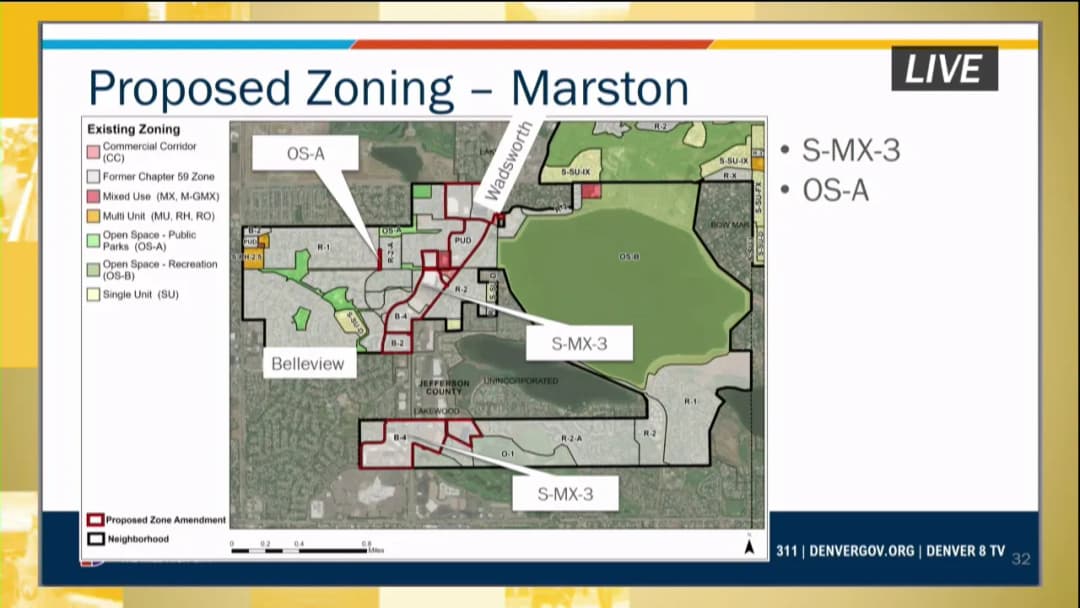
The Community Planning and Housing Committee of the Denver City Council met on March 3, 2026, at 1:30 PM to consider three rezoning items. The committee approved two map amendments and forwarded a large legislative rezoning to the full council. Chair Sarah Parady presided, with 8 members present. Consent Calendar - No consent items were considered. Public Comments & Testimony - For the first item (3601 N Monaco Street), staff reported that two neighbors supported the rezoning, one opposed, and several did not respond. A letter of support from the Northeast Park Hill Coalition was submitted. - For the second item (2625 East 3rd Avenue), staff noted one letter of support from the Cherry Creek North Association, five comments in opposition (two from the same individual) citing height, traffic, and buffering concerns, and four comments in support. - For the legislative rezoning (Far Southwest Area Plan), staff reported two emails from gas station workers concerned about a flavor ban (separate from rezoning), an email from an industrial property owner concerned about market viability, and a concern from a Bear Valley property owner about the drive-through restriction. Discussion Items - 26-0206 (3601 N Monaco Street Parkway): Joe Green from Community Planning and Development (CPD) presented a rezoning request from E-SU-Dx (single-unit, 6,000 sq ft minimum lot) to E-TU-C (two-unit, 5,500 sq ft minimum lot) on a vacant 6,000 sq ft lot in Northeast Park Hill (Council District 8). Staff recommended denial, finding the rezoning would depart from the existing zoning pattern (E-SU-Dx) without sufficient neighborhood input or plan guidance to establish a new pattern. The Planning Board voted unanimously to recommend approval, noting the Park Hill Neighborhood Plan supports a mix of housing types and that duplexes were historically considered single-family under R2 zoning. Councilmember Lewis questioned why the existing built environment (eight duplexes on the block) was not considered. Chair Parady noted the plan's language about protecting single-family character could include duplexes, as evidenced by the 2010 downzoning from R3 to R2. The committee voted 7-0 to approve. - 26-0207 (2625 East 3rd Avenue): Will Prince from CPD presented a rezoning from CCN with Conditions to C-CCN-4 on a 19,000 sq ft commercial site in Cherry Creek (Council District 5). The property is currently office and retail; the applicant seeks to redevelop as mixed-use condominiums. The existing condition (a 29-ft buffer for a potential dance studio expansion) would be removed under the new zoning. Caitlin Quander (applicant's counsel) described a signed community benefits agreement with the neighborhood association including enhanced landscaping, restricted commercial uses, and no upper-story balconies on the north side to buffer the protected residential district. Staff recommended approval. The committee voted 7-0 to approve. - 26-0208 (Far Southwest Area Plan Legislative Rezoning): Libby Glick from CPD presented a large-scale rezoning covering properties in Council District 2 (Harvey Park, Harvey Park South, College View, South Platte, Bear Valley, Fort Logan, Marston). The proposal rezones old-code and commercial corridor properties to new suburban mixed-use districts (S-MX-3A, S-MX-12A, S-MX-3), industrial properties to I-A (light industrial, no residential), and one park to OS-A. The rezoning implements the Far Southwest Area Plan (adopted December 2025) by promoting pedestrian-friendly design, limiting drive-throughs on Federal/Evans/Sheridan, and preserving industrial land along the river. Staff noted capacity constraints prevented inclusion of old-code residential properties. Councilmember Flynn, the applicant and district councilmember, expressed full support. The committee voted 7-0 to forward to the full council. Key Outcomes - 26-0206: Approved 7-0 to rezone 3601 N Monaco Street from E-SU-Dx to E-TU-C. - 26-0207: Approved 7-0 to rezone 2625 East 3rd Avenue from CCN with Conditions to C-CCN-4. - 26-0208: Approved 7-0 to forward the Far Southwest Area Plan legislative rezoning to the full City Council for a public hearing scheduled for mid-April 2026.
LAND USE ZONING 76% · COMMUNITY PLANNING 20% · PROCEDURAL 4%
182
MAR 3, 2026 · DENVER, COLORADO · COUNCIL COMMITTEES
Denver Parks and Rec Vendor Contracting Process Briefing - March 3, 2026 Committee Meeting

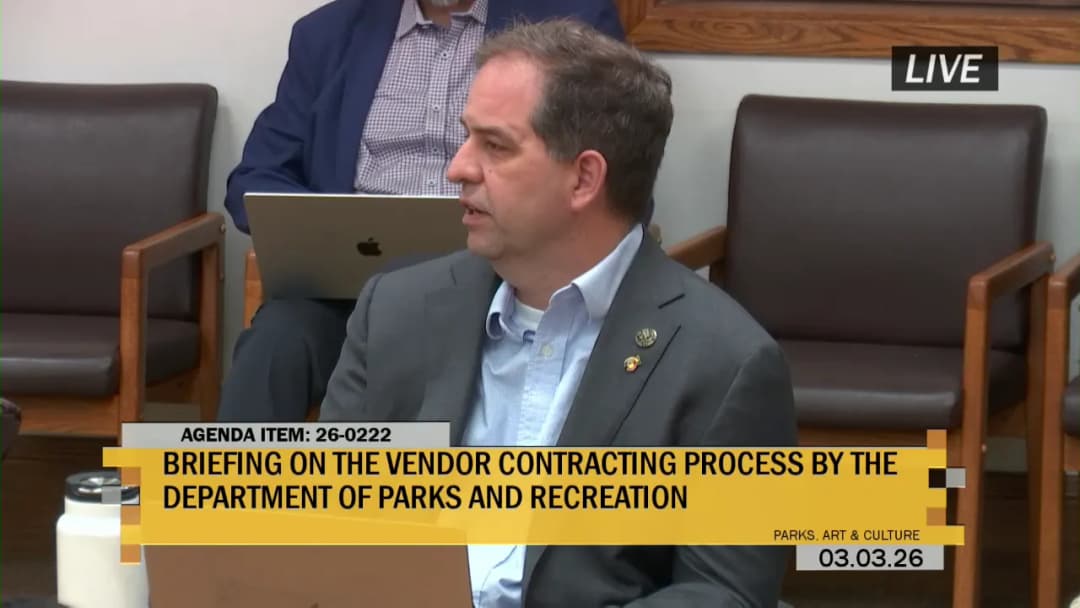
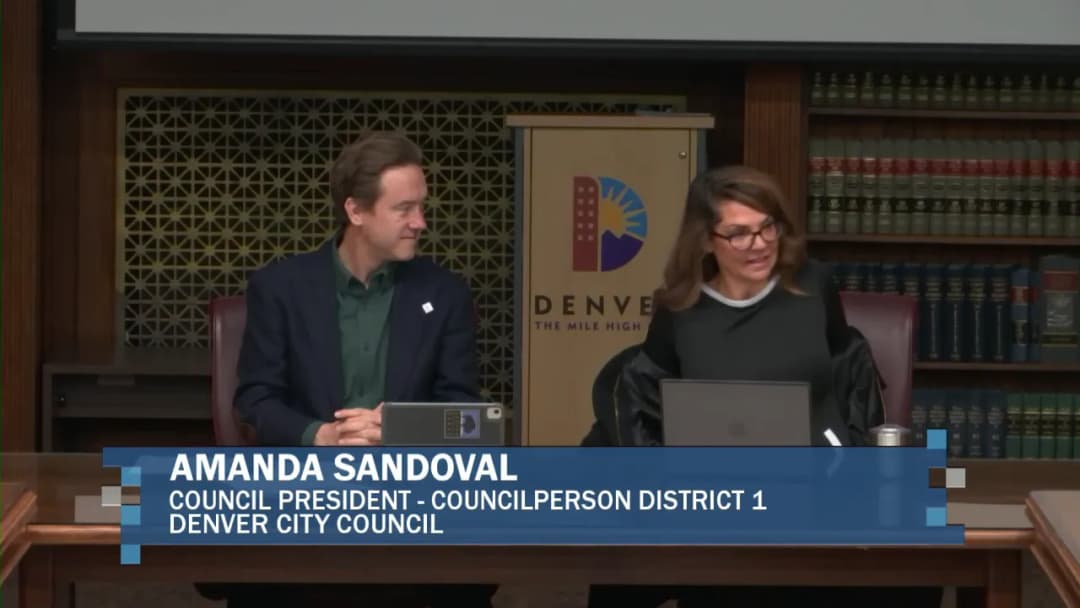
The Parks, Art and Culture Committee of Denver City Council met on Tuesday, March 3, 2026, at 10:30 AM for a briefing by the Department of Parks and Recreation on its vendor contracting process. Director Jolon Clark presented an overview of the department's approximately 600 contracts, ranging from 30-day permits to 99-year leases, covering lease agreements, concession agreements, professional services, and park use. The discussion focused on how the department decides to contract out services versus provide them in-house, the balance between individual and community benefit, and the communication and decision-making processes that have led to recent controversies. Discussion Items Presentation on Vendor Contracting Process - Director Clark explained the decision-making matrix for contracts: alignment with the “Game Plan for a Healthy City” strategic plan, equity lens using the equity map, operational/programmatic needs, and internal expertise/capacity. Contracts are reviewed at renewal or expiration, with priority given to internal park use, direct park enhancement, and nonprofit programming before allowing for-profit concessions or nonprofit office space in park buildings. - Examples highlighted included the College View Recreation Center (formerly run by a nonprofit, now operated by the city), the Fleming Mansion (nonprofit office space that is being vacated), and for-profit concession agreements at golf courses. Director Clark noted that when contracts end, the department re-evaluates based on charter requirements. Councilmember Questions and Concerns - Councilwoman Gilmore asked about the Greenway Foundation lease, asserted that Director Clark had a conflict of interest due to past employment with the foundation’s former CEO (Jeff Shoemaker), and alleged that Council President Sandoval received a scholarship from Shoemaker for her master’s degree. She challenged the decision to remove vendors such as Birdseed Collective from the Global Rec Center and the Wash Park boat vendor, questioning whether community outreach occurred and whether return-on-investment documents would be shared. She accused the department of “commodifying parks” and expressed distrust from the American Indian Cultural Embassy community. - Councilwoman Gonzales-Gutierrez echoed concerns about lack of community outreach regarding Birdseed Collective’s displacement and requested documentation of the process. - Councilman Watson raised concerns about communication to affected groups (e.g., pool access for nonprofits, Birdseed Collective). He emphasized that while he understood the operational rationale, the pre-communication was poor, leaving partners unaware of contract endings. He expressed his intention to help Birdseed Collective regain access to the Global Rec Center. - Council President Sandoval defended her scholarship as a private award from the Joe Shoemaker Scholarship and stated she had documentation. She noted that she was not notified in advance about the Global Rec Center transition despite being the councilmember for that district. She requested a schedule of lease terms for all parks and rec leases. - Councilwoman Parady asked whether there is a systematic policy for deciding when to in-house services versus contract out; Director Clark replied that decisions are made case-by-case based on expertise, capacity, and charter requirements, and that there is no citywide policy. - Councilman Hinds asked about pool and park permits (e.g., swim lessons, pickleball, food vending), and Director Clark explained how the department balances pickup play with permitted leagues, using temporary permits and fee structures. - Councilwoman Romero Campbell suggested that the “Game Plan for a Healthy City” may need updating given increased park and rec center demand post-pandemic. Director Clark noted that a three-year action plan process exists and could be used. - Chair Alvidrez requested a schedule of lease terms, a cost-benefit analysis for the Wash Park boat vendor decision, and documentation of community outreach regarding Birdseed Collective. Key Outcomes - No votes were taken; the meeting was a briefing only. - Director Clark committed to providing: the Greenway Foundation lease details, a schedule of all lease terms, return-on-investment documents for the Wash Park boat vendor decision, the community outreach plan for Birdseed Collective, and the length and duration of the Levitt Pavilion lease. - Director Clark acknowledged the need for improved communication with council and community when contracts are ending or decisions are being made, and stated the department would review its notification processes. - The committee will receive future updates on specific contracts as they come through for approval (e.g., the Global Rec Center agreement, new pool fee structure requiring council approval).

PARKS AND RECREATION 39% · CONTRACTS AND PROCUREMENT 39% · PUBLIC ENGAGEMENT 10% · ETHICS 5%
183
MAR 3, 2026 · DENVER, COLORADO · MAYOR-COUNCIL MEETING
Weekly Joint Meeting of Mayor and Denver City Council - March 3, 2026

The Mayor and Denver City Council held their weekly joint meeting on Tuesday, March 3, 2026, at 10:00 AM. The meeting featured a brief general session with announcements from council members, followed by a unanimous vote to enter an executive session to discuss federal response to recent city actions. Announcements - Council President Bro Tempen announced a community event at Thomas Jefferson High School on a Wednesday in a few weeks, with doors opening at 5 PM, featuring various community agencies. - Councilman Alvidras thanked the DPD District 3 team for arresting an assailant who had been assaulting women on South Broadway, and promoted a self-defense class this Saturday at Harvard Gold School Center. - A council member (likely Councilwoman Amanda Sandoval, per context) noted that March 3 is her daughter's birthday and acknowledged International Women's Day on March 8, expressing pride in the women she serves with. Key Outcomes - The council moved into executive session pursuant to DRMC 234A, sections one and three, to discuss federal response to recent city actions. The motion passed unanimously (voice vote with no opposition).

PROCEDURAL 100%
184
MAR 2, 2026 · DENVER, COLORADO · CITY COUNCIL
Denver City Council Regular Session - March 2, 2026: Zoning, Police ID Law, and Southwest Plan

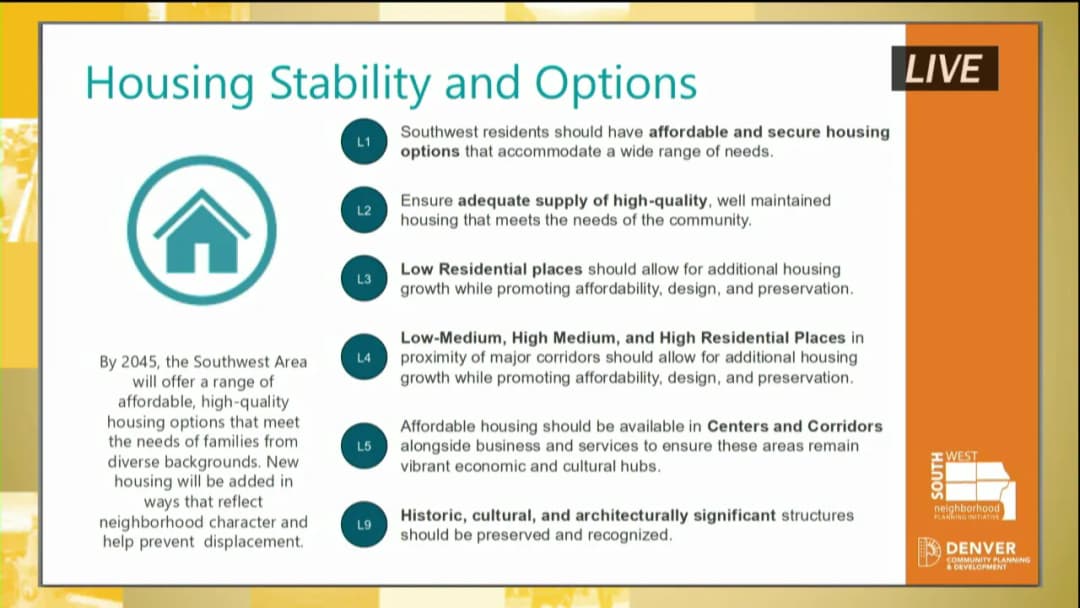
On Monday, March 2, 2026, the Denver City Council held a regular session starting at 3:30 PM (recessed and reconvened for public hearings). Twelve of thirteen council members were present (Councilmember Parady absent). The meeting included a proclamation, postponements of two resolutions, final passage of a law enforcement identification ordinance, and two public hearings—a required rezoning for West 32nd Avenue and a courtesy hearing on the Southwest Area Plan. The meeting adjourned at 6:49 PM. Consent Calendar - Minutes of February 23, 2026 were approved without correction. - Proclamation 26-0224 (Adelante Latina Day) was adopted unanimously (12–0), declaring March 5, 2026 as Adelante Latina Day in Denver. - En bloc approval of 17 resolutions and one bill (26-0128, financial reporting) passed 12–0. Key items included: - 26-0145: Amendatory agreement for affordable housing at 1625 & 1675 S Birch St. - 26-0146–0148: HUD grants for HOME, Emergency Solutions, and HOPWA programs ($2.38M, $580,396, $4.06M respectively). - 26-0119: Second amendatory agreement with Base Tactical Disaster Recovery for FEMA administration (adds $728,750). - 26-0152: CDBG grant of $6,585,718. - 26-0134: Site investigation at Denver Fire Training Center. - 26-0135: Digitization of Rocky Mountain News collection ($500,000 added). - 26-0136: Kanopy video streaming contract amendment ($960,090 added). - 26-0121: Mississippi Ave Vision Zero Safety Project ($2.94M contract). - 26-0137: Purchase of two wastewater vans ($645,272). - 26-0140: Plat approval for Central Park Filing No. 63. - 26-0141: Purchase of a robotic system truck ($543,888). - 26-0142: Amendatory agreement with Denver Botanic Gardens for Solar Garden Project. - 26-0149: Roof maintenance at Denver International Airport ($5M, 5 years). - 26-0150: Street dedication for West 38th Avenue. - 26-0159: CDOT grant for Alameda Ave & Dayton St safety improvements ($2.765M). - 26-0175: Street dedication for West 10th and 11th Avenues. - Bills for introduction (26-0151, 26-0153, 26-0154, 26-0139, 26-0138) were ordered published. Public Comments & Testimony Required hearing – Rezoning 26-0026 (West 32nd Avenue): - Eric Rymarz (West Highland Neighborhood Association) spoke in support, emphasizing the need to protect the retail corridor and small businesses. He cited recent closures and argued the DO-8 overlay would prevent loss of commercial anchors. - Bill Hare (resident, West Highland) also supported, noting the rezoning is a preemptive measure to preserve the retail character. - Jesse Parris (Black Star Action Movement) opposed, arguing the rezoning ignores gentrification and fails to address affordability for longtime residents. - Alejandra Castaneda (District 1 resident) opposed, contending the rezoning stunts housing growth and uses a narrow definition of community; she questioned why the area cannot accommodate five-story buildings like nearby Tennyson. Courtesy hearing – Southwest Area Plan 26-0103: - Rebecca Greek (Overland resident, advisory committee) spoke in favor, praising engagement and urging protection against data centers. - Diego Olivan (Westwood youth representative) supported, highlighting youth involvement and the plan's reflection of community voices. - Maya Velasco (Westwood resident) supported, but expressed concern about a proposed gas station on Morrison Road contradicting the plan’s goals. - Renee Martinez-Stone (Denver Housing Authority) supported, emphasizing affordable housing and anti-displacement efforts. - Jesse Parris opposed, criticizing the plan for not addressing gentrification and lacking a NEST study. Discussion Items - Postponements: Councilmember Lewis called out Resolution 26-0105 (ComplyAI contract) and Resolution 26-0158 (RTD grant) for one-week postponements to March 9, 2026, to gather more information. - Police Identification Ordinance (26-0125): Councilmembers Lewis and Alvidrez, co-sponsors, described the bill as a minimal transparency measure requiring law enforcement to display identification. Multiple council members spoke in favor, noting it enhances public trust and accountability, especially given recent masked federal enforcement actions. The bill passed 12–0. - West 32nd Avenue Rezoning (26-0026): Council President Sandoval, sponsor, explained the effort to preserve the commercial character of Highland Square. Councilmember Romero Campbell supported, noting the long community process. The bill passed 9–0 (four absent). - Southwest Area Plan (26-0103): Staff presented the plan covering five neighborhoods (Westwood, Ruby Hill, Marley, Athmar Park, Overland). Councilmembers Alvidrez, Torres, Flynn, and Kashmann expressed support, highlighting inclusive engagement, housing provisions, and the need to address data centers. The bill passed 10–0 (three absent). Key Outcomes - Law enforcement identification ordinance (26-0125) adopted, requiring officers to display visible identification. - West 32nd Avenue rezoning (26-0026) approved, changing zoning to U-MX-3 and U-MS-3 with Design Overlay 8 to preserve commercial uses. - Southwest Area Plan (26-0103) adopted as a supplement to Comprehensive Plan 2040, guiding growth and development in southwest Denver. - Two resolutions (26-0105 and 26-0158) postponed to March 9, 2026. - Consent agenda and other items passed en bloc with unanimous support (12–0) on all votes. - Council announcements included upcoming community events and acknowledgments.

COMMUNITY ENGAGEMENT 19% · PUBLIC SAFETY 14% · LAND USE ZONING 12% · AFFORDABLE HOUSING 11%
185
FEB 25, 2026 · DENVER, COLORADO · COUNCIL COMMITTEES
Health and Safety Committee Meeting - February 25, 2026

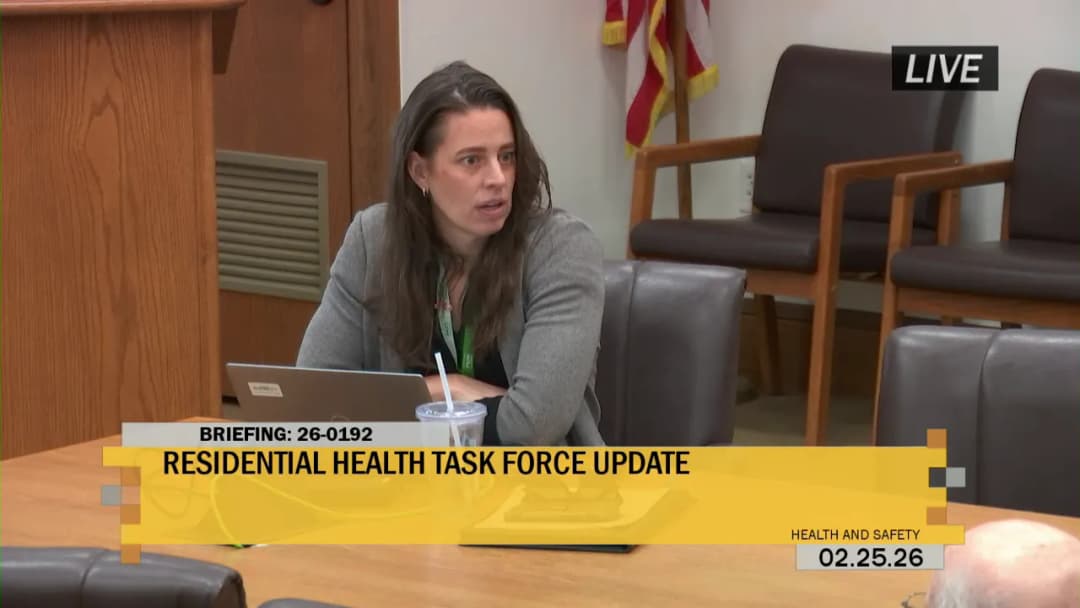
The Health and Safety Committee of the Denver City Council met on Wednesday, February 25, 2026, at 10:30 AM in Room 391 of the City & County Building. Chair Darrell Watson presided. The committee heard two briefings and approved two consent items. Consent Calendar - 26-0170: Approved a grant from the U.S. Department of Health and Human Services Health Resources and Services Administration for $2,135,483.00 with an end date of 2-28-2027 to provide care, treatment, and supportive services to individuals living with HIV/AIDS in the Denver Transitional Grant Area through the 2026 Ryan White Part A Renewal Grant Award (Round 1), citywide. - 26-0171: Approved a grant agreement with Caring for Denver Foundation for $506,389.00 with an end date of 11-30-2027 to establish a Peer Support Supervision and Technical Assistance Hub, supporting peer support programs and launching Denver’s first Peer Support Registered Apprenticeship Program, citywide. Caring for Denver Foundation Update (26-0191) Lorez Meinhold, Executive Director of Caring for Denver Foundation, presented on community engagement and strategic funding. She highlighted that access to trusted care remains the top community priority and outlined three areas: care that fits, care transitions, and stronger care systems. The foundation has a $2.5 million administrative budget and is subject to an annual audit. Meinhold acknowledged an audit finding regarding approximately $1,000 per year over three years for alcohol reimbursement, which was allowable under nonprofit policies but symbolically problematic; the foundation will no longer reimburse alcohol. Councilmembers raised concerns about the audit response, particularly disagreements with some recommendations. Councilmember Torres expressed discomfort with the foundation’s autonomy given its sole source of tax dollars. The foundation and DDPHE (Megan Parizzo) explained that disagreements were often due to the 500-character response limit and the desire to align changes with the ordinance renewal in 2027. Councilmember Flynn questioned due diligence on grantee background checks; the foundation noted that the city does not require individual background checks for its own grants. Councilmember Alvidrez asked about seven grants awarded to the foundation itself; Meinhold clarified those were grants for capacity building of nonprofits, with funds going to contractors, not the foundation. Councilmember Parady raised concerns about the legal interpretation of the ordinance and sought clarity on whether certain funded activities could be challenged. Councilmember Sandoval questioned the foundation structure vs. other 501(c)(3) entities. Councilmember Gonzales-Gutierrez asked about the grantee selection process and scoring; the foundation explained they use a high/medium/low assessment tool rather than numerical scoring, and will improve documentation. Residential Health Task Force Update (26-0192) Danica Lee and Nicol Caldwell from DDPHE presented on enforcement of housing habitability standards. They reported that in 2024, nine investigators handled approximately 1,800 complaints, issued 99 administrative citations totaling about $415,000, and implemented a lien process for unpaid fines totaling $520,000. The fine cap was raised from $999 to $5,000 per violation per day. The team conducted proactive inspections and collaborated with licensing. A stakeholder group, initiated in February 2025, has produced recommendations around tenant protection, reporting, and enforcement. New measures include copying complainants on all orders and developing a public violation enforcement dashboard. The dashboard allows searches by address and shows complaints, inspections, citations, and fines; a heat map by council district is forthcoming. Challenges remain with out-of-state investor owners and multi-unit issues. A formal regulation revision process will begin in the coming months. Councilmember Gonzales-Gutierrez praised the work and noted upcoming policy efforts with Councilmember Sawyer. Councilmember Parady highlighted the increase in fines as proof of progress and raised concerns about tenants displaced by placarded properties; she suggested better connection to housing navigation services. Key Outcomes - Both consent items were approved unanimously. - The Caring for Denver Foundation will revise its alcohol reimbursement policy and improve documentation of grantee selection processes. - DDPHE will continue stakeholder engagement and begin formal regulation revisions, with a focus on tenant empowerment, data accessibility, and enforcement against out-of-state owners. - A public dashboard for housing violations is operational, with a council district heat map under development. - Councilmembers expressed intent to bring forward policy proposals related to tenant protection in coordination with the mayor’s office.

CONTRACTS AND PROCUREMENT 42% · AFFORDABLE HOUSING 28% · MENTAL HEALTH AWARENESS 15% · PROCEDURAL 5%
186
FEB 24, 2026 · DENVER, COLORADO · COUNCIL COMMITTEES
Community Planning and Housing Committee: Rezoning & Housing Policy Update - February 24, 2026

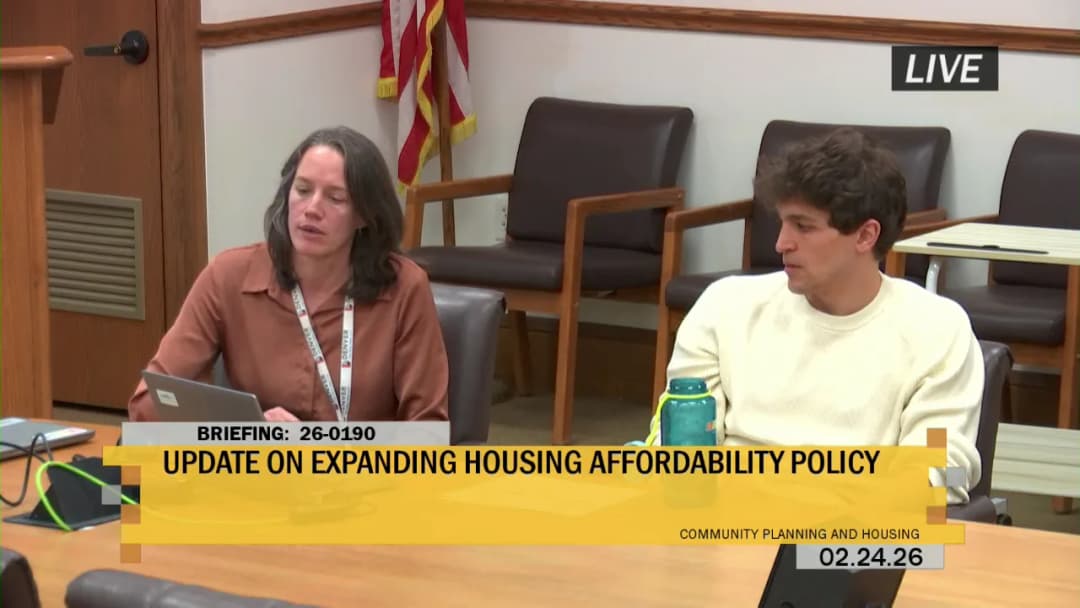
The Community Planning and Housing Committee of Denver City Council met on February 24, 2026, to consider a rezoning action for the Denver Spur property and receive a briefing on the Expanding Housing Affordability (EHA) policy. The meeting included a consent calendar, public testimony, and detailed discussion on both items. Consent Calendar - Three consent items were approved without objection. Public Comments & Testimony - On the Denver Spur rezoning, two public comments were received: the Montbello 2020 and Beyond Registered Organization submitted a letter in support, citing the applicant's community engagement and public amenities (school, park, affordable housing). One neighboring resident submitted a comment in opposition, expressing concerns about traffic, loss of green space, and public safety from additional multi-unit housing. Discussion Items - Rezoning for 1760 East 56th Avenue and 4991 North Telluride Street (Denver Spur): Staff planner Libby Glick presented the request to rezone two parcels (totaling 74 acres) from CMU-10 and CMU-30 (former Chapter 59 code) to SMX-5 (up to 5 stories/70 feet) and SMX-8 (up to 8 stories/110 feet), both mixed-use districts. The property is in Council District 11 (Gateway Green Valley Ranch). Key project components include: 17 acres sold to Denver Public Schools for a future K-8 school; dedication of approximately 6 acres for a regional park (adding to 3 existing city-owned acres); a regional trail; and a High Impact Development Compliance Plan requiring 12% of residential units at up to 60% AMI, 10% at up to 30% AMI, and at least 70% of income-restricted units having two or three bedrooms. The rezoning went through Large Development Review and was recommended for approval by Planning Board on January 21, 2026. Council discussion focused on whether housing is guaranteed (the applicant, Peter Wall, explained the horizontal mixed-use plan includes three separate residential areas, with commercial fronting Telluride and 56th Avenue), green space details, and community engagement. Councilmember Alvidres inquired about the community process, which included surveys and collaboration with Montbello 2020, leading to increased retail acreage and the school site. The item was approved. - Briefing on Expanding Housing Affordability Policy Update: Laya Mitchell (HOST), John Colorelli (HOST), and Emily Collins (CPD) presented outcomes since adoption in June 2022. Key data: 60 EHA-eligible projects (10+ units) in pipeline; 42 signed affordable housing agreements (24 recorded); expected to produce 6,400 total units, with 570 income-restricted units (9% of total). Approximately 28% of projects use height/density incentives. Fee-in-lieu projects: 8 projects (mostly townhomes) opting out, expected to generate $10 million (paid at building permit issuance; only one project has paid so far). High-impact developments (sites over 10 acres or with public financing) include 6 projects (5 signed/recorded) producing substantial affordable units. Linkage fee investments (from smaller developments and non-residential) totaled $48 million since 2022, funding over 1,000 affordable units across 21 projects. Council discussion: Council President Sandoval noted the extensive policy history and requested projections and heat maps for incentives. Councilmember Sawyer raised concerns about prevailing wage applicability to city-funded projects ($48 million) and requested data on pre-EHA affordable housing agreements. Councilmember Alvidres requested breakdowns of fee-in-lieu sources and a map of high versus typical market areas. Councilmember Torres asked for mapping of linkage fee investments and clarification on how fee-in-lieu funds will be reinvested (currently used to reimburse CPD for incentives). The briefing was informational; follow-up items were requested. Key Outcomes - Denver Spur Rezoning Approved: Councilmember Alvidres moved approval, seconded by Council President Sandoval; the motion passed unanimously. - EHA Policy Update Received: No formal action was taken. Councilmembers requested follow-up data including: a map of projects using height incentives; a breakdown of pre-EHA affordable housing agreements and their status; maps of fee-in-lieu projects, high market areas, and linkage fee investments; and clarification regarding enforcement of prevailing wage requirements on city-funded affordable housing projects.

AFFORDABLE HOUSING 93% · COMMUNITY ENGAGEMENT 3% · RACIAL EQUITY 1% · ENVIRONMENTAL PROTECTION 1%
187
FEB 24, 2026 · DENVER, COLORADO · COUNCIL COMMITTEES
Finance and Business Committee Briefing on Convention Center Fire Alarm Project - February 24, 2026

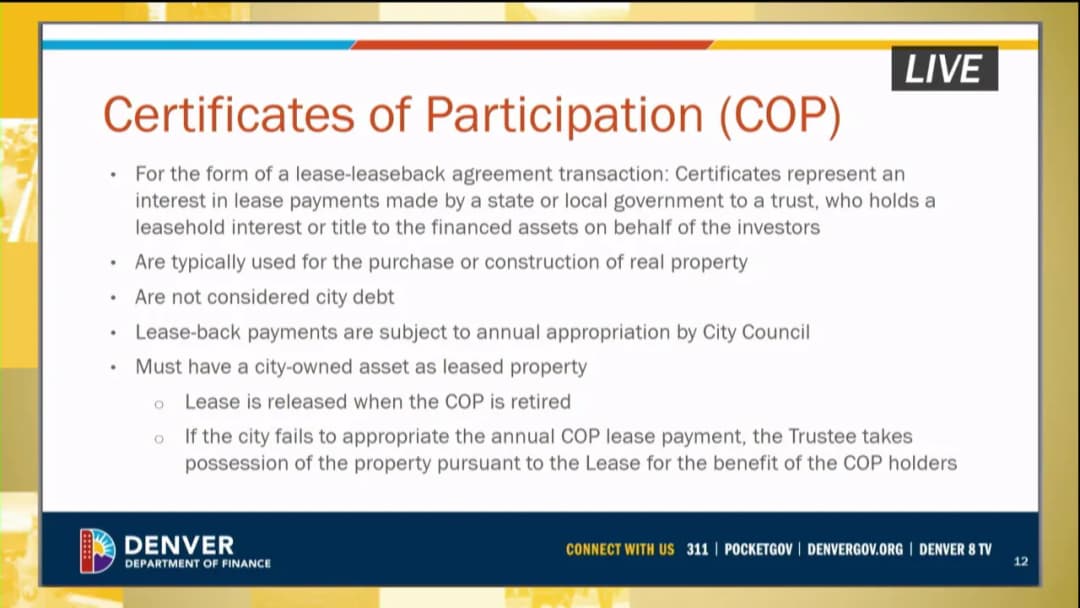
The Finance and Business Committee of the Denver City Council met on February 24, 2026, for a briefing on the Colorado Convention Center Fire Alarm System Replacement financing via Certificates of Participation (COPs). The committee also advanced three consent items to full council. No action was taken on the COP transaction, which was presented for transparency following a delay from July 2025. Consent Calendar - Three items on the consent calendar were moved forward to full council without objection. Discussion Items - Ross Coon, Jackson Brockway, and Travis Bogan from the Department of Finance and DOTI presented the Series 2026 COPs for the fire alarm system replacement, with a principal amount not to exceed $108 million. - The transaction was delayed from July 2025 to align with the 2026 budget release and the General Obligation (GO) bond transaction, ensuring full transparency to investors. The delay allowed the city to include the most recent financial data in offering documents, which was well-received during rating calls. The city’s triple-A rating was reaffirmed, and Fitch upgraded the excise tax bonds from AA- to AA. - The convention center generates over $500 million in annual economic impact, projected to exceed $3 billion through 2034. The 2024 expansion (250,000 sq ft) enabled 30 new bookings representing $453 million in economic impact. - The existing fire alarm system is at end of life; components are becoming harder to replace. A temporary certificate of occupancy for the expansion is renewed every six months. The project is 20% complete, with work sequenced to minimize event disruptions. - Early contractor engagement with Hensel Phelps (who built the 1990s expansion) saved an estimated $3 million compared to delaying until February 2026, avoiding construction cost escalation of approximately 3.75% over three quarters. An independent cost estimate from RLB matched Hensel Phelps’ bid within 3%. - Financing terms: competitive tax-exempt sale, interest rate not to exceed 5.5%, estimated annual lease payment $7.8 million, 20-year term with final maturity December 2045. Lease property includes the convention center parking garage and the performing arts center parking garage. Repayment sources are the convention center capital fund, capital improvement fund, and the C-tax (emissions facilities fund), with no general fund contribution. - Future convention center capital priorities include dry pipe fire suppression in the parking garage, roof membrane assessment, and building system upgrades (conveyance, carpets). - Financing timeline: city council first reading March 23, second reading March 31, pricing week of April 12, close and fund April 30. Project completion expected in 2028. - Councilmember Cashman acknowledged the necessity, noting a friend’s garage fire. Councilmember Heinz thanked for the briefing and referenced Denver’s recent large fire. Councilmember Watson praised the Department of Finance for innovative financing and the $3 million savings, calling their work "magicians behind the scene." Council Pro Tem Campbell asked whether the financing term correlates with project duration; Ross confirmed the project ends in 2028 while financing extends to 2045. Key Outcomes - No votes were taken on the COP transaction; the briefing was informational. - Consent calendar items were referred to full council. - The fire alarm project is on track to meet Denver Fire Department acceptance dates for the certificate of occupancy.

FISCAL SUSTAINABILITY 61% · ENGINEERING AND INFRASTRUCTURE 16% · PUBLIC SAFETY 11% · PROCEDURAL 7%
188
FEB 24, 2026 · DENVER, COLORADO · MAYOR-COUNCIL MEETING
Weekly Joint Meeting of Mayor and Denver City Council - February 24, 2026: Medicaid Eligibility Changes Briefing

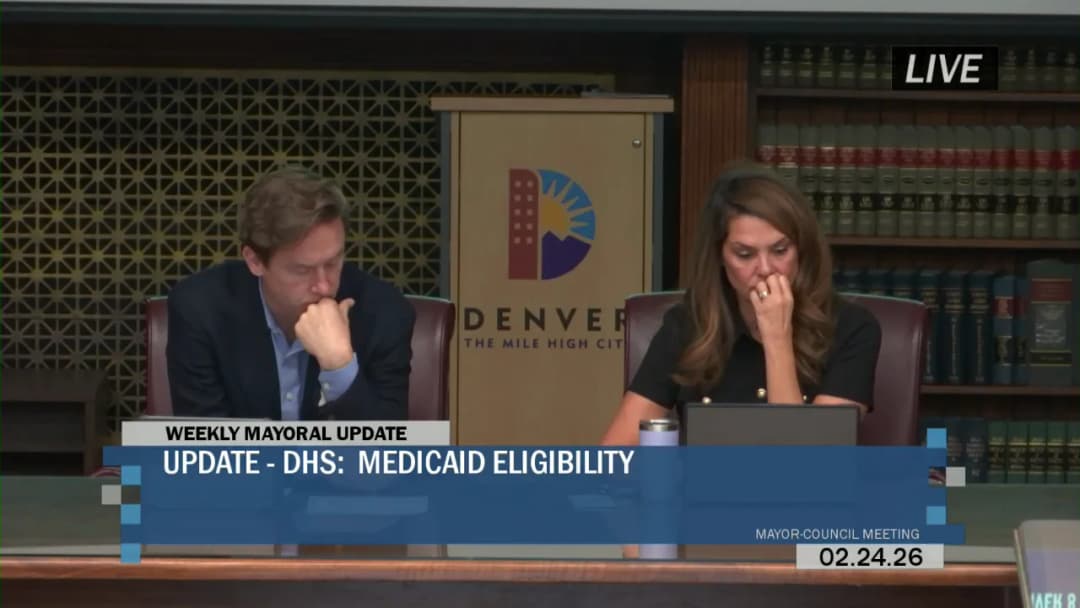
This joint meeting of Mayor Mike Johnston and the Denver City Council began with announcements from council members and then focused on a presentation from Denver Human Services (DHS) regarding upcoming Medicaid eligibility changes due to federal legislation (HR 1). The briefing covered the federal timeline, expected enrollment impacts, fiscal and operational challenges, and coordination efforts. Council Member Announcements - Councilman Alvidres announced a playback theater improv show featuring immigrant stories on Saturday, February 28 at 1 p.m. at HQ, 60 South Broadway. - Councilman Gonzalski announced a multi-level government town hall on Saturday, February 28 at 12 p.m. hosted by Representative Cecilia Espanosa for House District 4, with himself, Councilwoman Sandoval, Councilwoman Torres, and school board Director Solchica. - Councilman Watson announced a community discussion on data centers on the evening of February 24 from 5:30-7 p.m. at Geotech Environmental Equipment, emphasizing that CoreSite will not attend but city partners will. He also announced a Black History Month celebration on Friday, February 27 from 5:30-7:30 p.m. at Struggle of Love. - President Pro Tem announced a community input session for the Kennedy Golf Course clubhouse redesign on Thursday from 5:30-7 p.m., and a community open house on March 18 at TJ. - Councilman Cashman announced an "Academy in the Community" event on April 1 at Cook Park Recreation Center, and the 100th anniversary of Denver South High School on April 11. He expressed support for the data center moratorium, stating Denver is "slow in getting into the discussion" compared to other cities. - Mayor Johnston thanked council members for partnering on the data center moratorium and expressed interest in being "pro-technology and pro-climate." Discussion Items Medicaid Eligibility Changes Presentation Kay Templeton, Deputy Executive Director for Eligibility at Denver Human Services, and Chief Financial Officer Clint Woodruff presented on federal changes under HR 1, effective January 1, 2027, with phased implementation through 2032. Key changes: - Individual-level renewals: Household members aged 19–64 must now redetermine separately, increasing application volume. Example: a 19-year-old in a family of three would submit a standalone application. - Six-month renewals for expansion population: Redeterminations shift from annual to every six months, increasing workload. - Work requirements: Adults 19–64 must participate in work, education, or community engagement for 80 hours per month and report it. Previously applied to ages 19–55; now expanded to 55–64. - Immigrant eligibility restrictions: Only Haitian and Cuban green card holders and U.S. citizens will be eligible for emergency Medicaid; other immigrant populations lose coverage. - Retroactive coverage limit: Reduced from 90 days to 30 days prior to application. - Provider tax reductions: Phased from 6% to 3.5% by 2032, costing the state an estimated $2.5 billion in revenue at full implementation. - Enrollment trends: Medicaid enrollment is already declining from pandemic peaks. Statewide, 100,000–300,000 people are expected to lose eligibility due to HR1 changes, though precise numbers depend on alternative qualifications. Fiscal and operational impacts: - The state proposed $17 million in additional county administration funding, primarily for shared services and districting, but this is a cost containment measure rather than cost savings. - DHS has begun staff training, system updates, and meetings with Arapahoe County, the state, and managed care organizations (HCPF, Colorado Access). - Shared services being considered include call centers, document scanning, quality assurance, and fraud investigations. Districting proposals include a potential Denver-Arapahoe combined district. - Federal guidance on detailed implementation rules is still pending, adding uncertainty. Council Questions and Responses - Councilman Alvidres asked about the connection between Medicaid and SNAP eligibility (rules differ). He also inquired about plans for people losing care; DHS will start meeting with medical facilities and community partners next week to refer individuals to alternative resources. - Councilman Hines noted that many people are bumped off Medicaid in January due to system churn, citing his own experience. DHS acknowledged this and will raise it with state and CBMS stakeholders. - President Pro Tem asked about impacts on multi-generational families and seniors in long-term care. Templeton said exemptions may help but promised to follow up with more details. - Councilman Parady (late entry) raised concerns about work requirements for unhoused populations and suggested shelter providers could help people meet the 80-hour requirement, creating a beneficial loop for Medicaid billing at shelter sites. He also suggested the mayor could press nonprofit hospital systems to spend community benefits fees on Medicaid enrollment and work requirement support. Templeton was not aware of existing conversations on these points but will explore. - On staffing, Woodruff said DHS is planning for next year's budget and has done pre-work for SNAP changes; more funds for county administration may offset some workload increases, but concerns remain. - Council President (Madam President) noted that quarterly updates will be brought to the Government and Intergovernmental Committee starting March 18. Councilwoman Torres has been connecting with city providers to help people meet the 80-hour volunteer requirement, and she urged DHS to add council offices to the list of volunteer hosts. - Councilman Watson confirmed the work requirement details and noted that DHS has a marketing piece for newsletters; Templeton agreed to refresh and distribute to all council members. - Mayor Johnston thanked the DHS team and noted that nearly one in three Denverites rely on their services. Key Outcomes - No formal votes were taken. - DHS will continue to meet with community stakeholders (starting next week) and provide updated communication materials to council members. - Quarterly updates on Medicaid changes will be presented to the Government and Intergovernmental Committee, beginning March 18. - Council offices will be considered as potential volunteer sites to help constituents meet work requirements. - DHS will follow up on specific questions regarding seniors in long-term care, unhoused populations, and nonprofit hospital engagement.

PUBLIC HEALTH POLICY 52% · COMMUNITY ENGAGEMENT 16% · FISCAL SUSTAINABILITY 15% · PROCEDURAL 10%
189
FEB 23, 2026 · DENVER, COLORADO · COUNCIL COMMITTEES
Denver Budget and Policy Committee Meeting – February 23, 2026

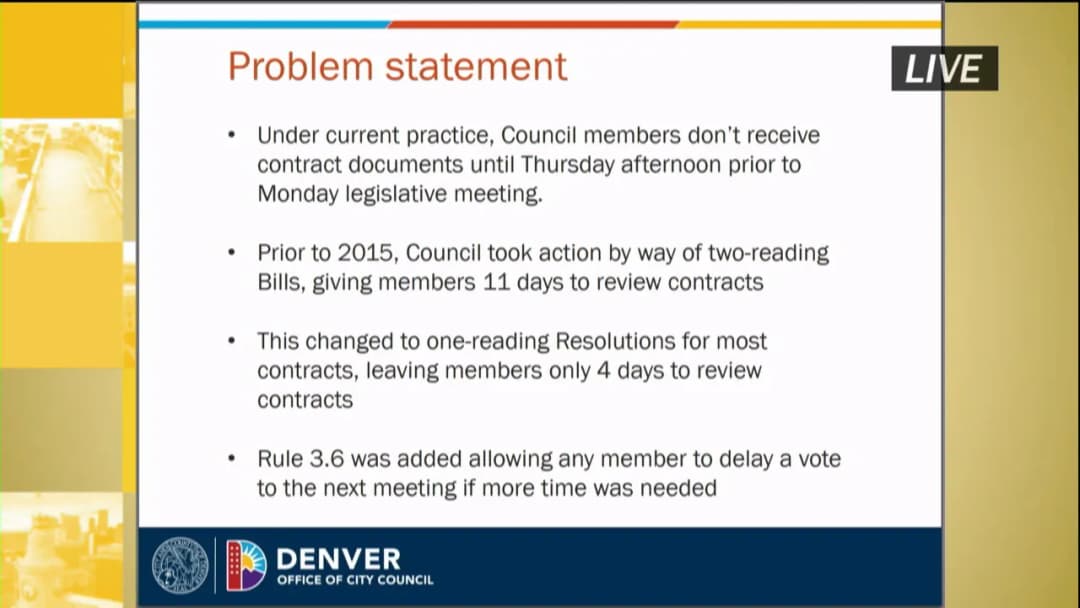
The Budget and Policy Committee of the Denver City Council met on February 23, 2026, to discuss three briefings: a proposed rule change to require contract documents be provided at committee, an update on establishing a civic assembly process, and proposed amendments to the affordable housing preservation ordinance. The meeting lasted from approximately 12:30 p.m. to 3:00 p.m. No formal votes were taken; the committee heard presentations and discussed next steps. Discussion Items 1. Contract Document Rule Change (DRMC Amendment and Rules of Procedure) Councilmember Flynn, co‑sponsored by Council President Sandoval and Councilmember Parady, presented a proposal to amend the Denver Revised Municipal Code (Chapter 13, Article 2) and the Council’s Rules of Procedure to require that the current draft of any contract valued at $500,000 or more be provided to council members at the time of committee review, rather than only when filed for full council action. The change would also clarify that the 30‑day “shot clock” for council review begins at the Thursday noon filing for the Monday council meeting, not at the committee presentation. Councilmember Flynn noted that the current practice gives council members only four days to review contracts, often over weekends, and that the issue came to a head during the women’s soccer stadium transaction when blank exhibits were provided. Councilmember Alvidrez expressed support and asked about related documents (e.g., appraisals), to which Councilmember Flynn replied that the rule change would not directly cover those but that committee chairs could withhold items until all necessary materials are available. Councilmember Torres highlighted the added responsibility for committee chairs. Councilmember Hays commended the proposal as a reaffirmation of the legislative branch’s role. Councilmember Lewis noted that the change would give departments more advance notice rather than last‑minute postponements. The item will be scheduled for a future committee hearing. 2. Civic Assembly Proposal Councilmember Lewis presented an update on a proposal to create a civic assembly process, potentially through a charter change. A civic assembly would bring together a diverse group of residents selected by lottery to deliberate on a specific issue and produce recommendations requiring 70% consensus. Councilmember Lewis outlined three ways to convene an assembly: by the mayor, by a majority vote of council, or by community petition. She noted that the assembly would be advisory and that recommendations would be implemented only if the convening body (mayor or council) committed to do so. Councilmember Flynn expressed concerns that binding the council to assembly recommendations would surrender its charter authority and diminish representation of his constituents. Councilmember Watson echoed concerns about pre‑committing to implement outcomes without full council approval. Councilmember Parady asked about the Fort Collins civic assembly that Councilmember Lewis had observed; Lewis described how delegates deliberated over a weekend and produced a recommendation that the council then referred to voters. Councilmember Sandoval questioned whether the assembly should be placed in the charter before operational details are settled. Councilmember Torres noted the need for clear guardrails and warned against handing over council power. Councilmember Lewis offered to continue discussions with individual members. No formal action was taken. 3. Affordable Housing Preservation Ordinance Amendments Kendra Garrett, Housing Development Officer with the Denver Office of Housing Stability (HOST), presented proposed amendments to the city’s preservation ordinance. The changes would extend the required affordability covenant from 60 to 99 years, add a right‑of‑first‑offer (ROFO) for market‑rate properties of at least 15 units and at least 30 years old (with no cap, as directed by the mayor), and include an opt‑out resolution from House Bill 24‑1175. Garrett reported that the city has preserved 1,443 affordable units since 2019, but has exercised its right of first refusal only twice (both for properties at risk of conversion to market rate). She explained that the two‑year and six‑month notices for expiring affordability restrictions would align with state law. Councilmember Alvidrez questioned the 15‑unit threshold, noting that smaller properties (4‑14 units) could be lost to the market. She also asked about enforcement for owners who fail to notify the city; Garrett replied that civil fines and other enforcement measures exist. Councilmember Flynn asked how many 15‑100‑unit properties over 30 years old exist in Denver; staff did not have the data but offered to provide it. Councilmember Torres asked about price negotiation on naturally occurring affordable housing and whether sellers could inflate prices; Garrett explained that if a seller sets an unrealistic price and then later markets at a lower price, the city’s right would be re‑triggered. The ordinance will be introduced in the Community Planning and Housing Committee on April 28, 2026, with individual briefings requested before that date. Key Outcomes - The contract document rule change will be scheduled for a future committee hearing. - No formal action was taken on the civic assembly proposal; Councilmember Lewis will continue to meet with interested members. - The preservation ordinance amendments will proceed to the Community Planning and Housing Committee on April 28, 2026, with staff directed to provide individual briefings to council members before that date.

AFFORDABLE HOUSING 28% · PUBLIC ENGAGEMENT 23% · CONTRACTS AND PROCUREMENT 18% · COMMUNITY ENGAGEMENT 11%
190
FEB 23, 2026 · DENVER, COLORADO · CITY COUNCIL
Denver City Council Meeting – February 23, 2026

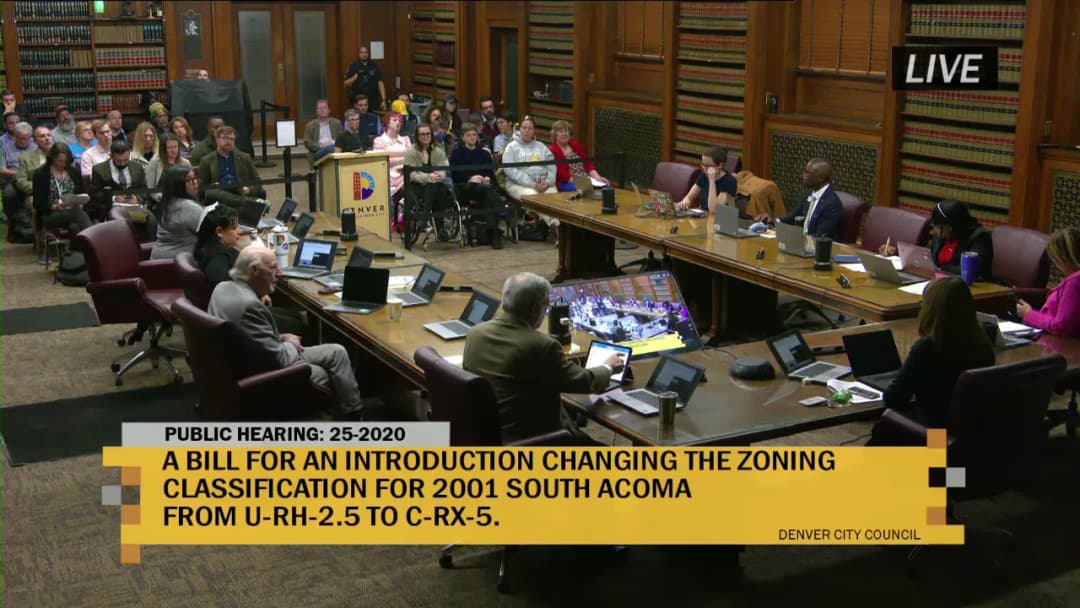
The Denver City Council met on Monday, February 23, 2026, at 10:30 AM (Mountain Time) for a regular session that included proclamations, consent agenda items, and three public hearings on zoning changes. The meeting began with a land acknowledgment and the Pledge of Allegiance, followed by council announcements and the adoption of two proclamations. The council then considered a block vote on consent items, later reconvened for required public hearings, and concluded with the passage of all three zoning bills. Consent Calendar - Approved minutes from February 17, 2026. - Adopted Proclamation 260197 honoring the African American Kwanzaa tradition in Denver (13-0 vote). - Adopted Proclamation 260202 recognizing February 2026 as Black History Month (11-0). - Adopted Proclamation 260198 honoring the life and legacy of Norman Strickland Early Jr. (11-0). - Passed a block of resolutions and bills on final consideration including: - Council Bill 260128: Financial reporting to City Council. - Council Bill 260125: Amending law enforcement officer identification requirements (commented on by Councilmembers Alvidres, Lewis, Watson, and Sandoval). - Council Bill 260103: Approving the Southwest Area Plan. - Council Resolution 260122: Purchase order for replacement vehicles for Denver Police Department (discussed fleet management and underfunding). - Council Resolution 260109: Microsoft software licensing for Denver County Court (raised concerns about ICE contracts). - Council Bill 260096: Updating property tax rebate program to address gentrification (commented on by Councilmembers Sawyer and Gilmore). - Numerous other bills and resolutions passed unanimously (13-0). Public Comments & Testimony - Council Bill 25-2020 (2001 S. Acoma rezoning): One speaker (Andrew Ulry, property owner) answered questions; one speaker (Jesse Paris) asked about AMI levels, traffic, parking, and community benefits. Overall, two comments in support, one in opposition received by staff. - Council Bill 26001 (12150 E. Andrews Drive rezoning): Two speakers: Peter Hines (Open Arms Assisted Living) described the need for expanding affordable assisted living for Medicaid and low-income residents, noting 63 additional beds planned. Jesse Paris voiced support after hearing details on AMI and parking. - Council Bill 25-1069 (Tramway block rezoning): Thirty-nine speakers registered; many testified in support or opposition. Supporters included nonprofit tenants (Family Theater Company, Viva Wellness, Denver Youth Program, etc.), community members, and organizations like Historic Denver, Colorado Nonprofit Association, and Habitat for Humanity. They stressed the importance of preserving the historic tramway building, maintaining affordable office space for nonprofits, and building 63 units of deeply affordable housing. Opponents (including nearby residents) raised concerns about building height (four stories), parking, traffic, loss of sunlight, and inadequate community outreach. A protest petition signed by neighbors representing 19.7% of the land area fell short of the 20% threshold for a supermajority vote. Discussion Items - Council Announcements: Covered a range of topics including upcoming town halls, a data center community meeting, the halt of Native dance programming at the National Western Stock Show, recognition of Black History Month and the murder of Ahmaud Arbery, and updates on detention centers and the Denver Kwanzaa tradition. - Proclamations: Councilmembers Lewis (Black History Month and Kwanzaa) and Watson (Norman Early) read detailed proclamations, with many councilmembers offering personal reflections on community resilience and the fight for justice. - Rezoning Hearings: - 2001 S. Acoma: Staff explained consistency with adopted plans (Comp Plan 2040, Blueprint Denver, Evans Station Area Plan). The proposed CRX-5 zoning allows up to five stories; the applicant plans five market-rate townhomes. Some councilmembers questioned the timing, as the Southwest Area Plan (which designates this area as urban center) has not yet been adopted. - 12150 E. Andrews Drive: The rezoning from SMU-3 to MX-3 will permit expansion of an assisted living facility from 30 to 63 beds, adding a type-3 residential care use. Staff noted the project aligns with equity goals in the Far Northeast Area Plan and provides services for residents below 60% AMI. Councilmember Lewis apologized for the group-living text amendment that created additional hurdles. - Tramway Block (Cole neighborhood): The most complex rezoning, converting Chapter 59 zoning to a PUD to preserve the historic tramway building, allow continued nonprofit offices, and build affordable housing on a vacant lot. Staff detailed the PUD’s three subareas, the affordable housing plan (100% of units income-restricted, with a mix of 30% to 60% AMI), and the extensive mediation process that did not resolve height concerns. Councilmembers questioned parking (48 spaces planned, shared parking), design (brick facade), and the impact on neighbors. The council ultimately focused on the legal criteria (consistency with plans, public interest, PUD standards) and the preservation of the building and services. Key Outcomes - Consent Agenda: All resolutions and bills on final consideration passed unanimously (13-0). - Council Bill 25-2020: Approved 11-0. The rezoning will allow a five-story mixed-use building on a single-family lot near the Evans light rail station. - Council Bill 26001: Approved 11-0. The rezoning enables expansion of affordable assisted living beds in Montbello. - Council Bill 25-1069: Approved 11-0. The PUD rezoning facilitates preservation of the tramway building, continuation of 15+ nonprofits, and construction of 63 income-restricted apartments in the Cole neighborhood. - Next Steps: A required public hearing on the Southwest Area Plan (Council Bill 261003) is scheduled for Monday, March 2, 2026.

AFFORDABLE HOUSING 38% · RACIAL EQUITY 10% · COMMUNITY ENGAGEMENT 8% · HISTORIC PRESERVATION 8%
OPENPUBLICA · PUBLIC MEETING INDEXUPDATED DAILY · openpublica.com