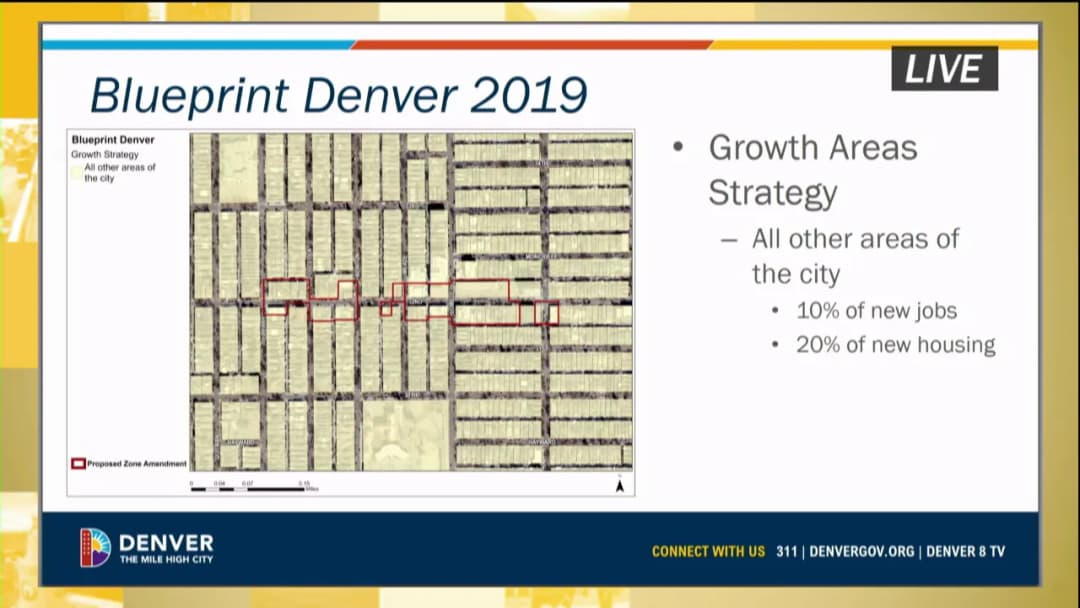
On January 23, 2026, the Denver City Council's Transportation & Infrastructure Committee convened to discuss the Alameda Lane Repurposing project. Department of Transportation and Infrastructure (DOTI) staff presented an updated analysis that led to a proposed shift from the originally planned full lane repurposing (one lane each direction) to a partial lane repurposing (two eastbound lanes, one westbound, with turn pockets). The discussion focused on community engagement, safety data, diversion impacts, and trust in the process. Councilmembers expressed mixed views, with some supporting the full reduction and others questioning the data and process. DOTI proposed a temporary demonstration deployment to test both designs. Discussion Items - DOTI Presentation: Molly and Amy from DOTI explained the project history, including a virtual open house in 2020, a 2024 public meeting, and petitions from both supporters and opponents. They cited updated crash data showing 58 crashes on Virginia Avenue (2019-2023) with pedestrian and cyclist involvement, versus 255 severe crashes on Alameda (primarily vehicle crashes). The partial lane repurposing was chosen to avoid diverting traffic onto Virginia Avenue, which could increase risk to pedestrians and cyclists near Wash Park. They committed to a community working group and a temporary demonstration to validate data. - Councilmember Concerns: - Councilwoman Alvedres expressed concern about car crashes into homes and the need to prioritize safety over driver convenience. She questioned the 5% diversion impact and requested crash severity comparisons. She supported the demonstration but wanted the full lane design tested first. - Councilman Cashman, a supporter of the full lane reduction, criticized the process as incomplete and lacking community trust. He noted the decision to shift to partial was reportedly made on August 14, 2024, before additional analysis, though DOTI denied this. He argued the full repurposing should be implemented to restore trust. - Councilman Parady challenged DOTI's accuracy, citing an email indicating a clear direction on partial reduction on August 14. He rejected the characterization of community support as 50-50, stating the pro-full petition had 1,100 signatures (70% from the neighborhood) versus the opposition petition with 300 (12% from nearby). He demanded evidence for partial lane safety benefits and questioned the objectivity of DOTI's analysis, arguing the risk to pedestrians on Alameda outweighed the marginal risk on Virginia. - Councilman Hines (in a wheelchair due to a bike crash) pressed DOTI on how partial lane reduction aligns with Vision Zero goals, asking for data on crash reduction. He noted the previous road diet on Alameda (2011-2012) increased crashes and was removed, and he requested comparative data on average daily traffic and crash causes. - Councilwoman Flint highlighted the past failure of the full lane repurposing and stressed that safety data, not politics, should drive decisions. - Councilwoman Gilmore criticized the loss of public trust, pointing to a former DOTI lobbyist involved in opposition. She praised committee members for increasing accountability. - Process and Engagement: The Chair questioned DOTI's engagement strategy, noting the difference between informing and engaging the public. She asked when DOTI informed the community about the shift from community-co-created design to the new proposal. DOTI stated they communicated in October-November 2024, but councilmembers and community disputed this. Key Outcomes - DOTI committed to a temporary demonstration deployment of either the full or partial lane repurposing, to be designed with a community working group within the next month. The demonstration will run for several months to gather real-world data on congestion, diversion, safety, and pedestrian comfort. - DOTI will continue permanent safety improvements such as flashing beacons at Franklin and signal upgrades at Virginia and Downing, planned for 2026. - Council requested a collective follow-up meeting with shared data and reports to ensure consistent information. - No formal vote was taken; the committee will receive further updates.
Public Meetings - Denver, Colorado
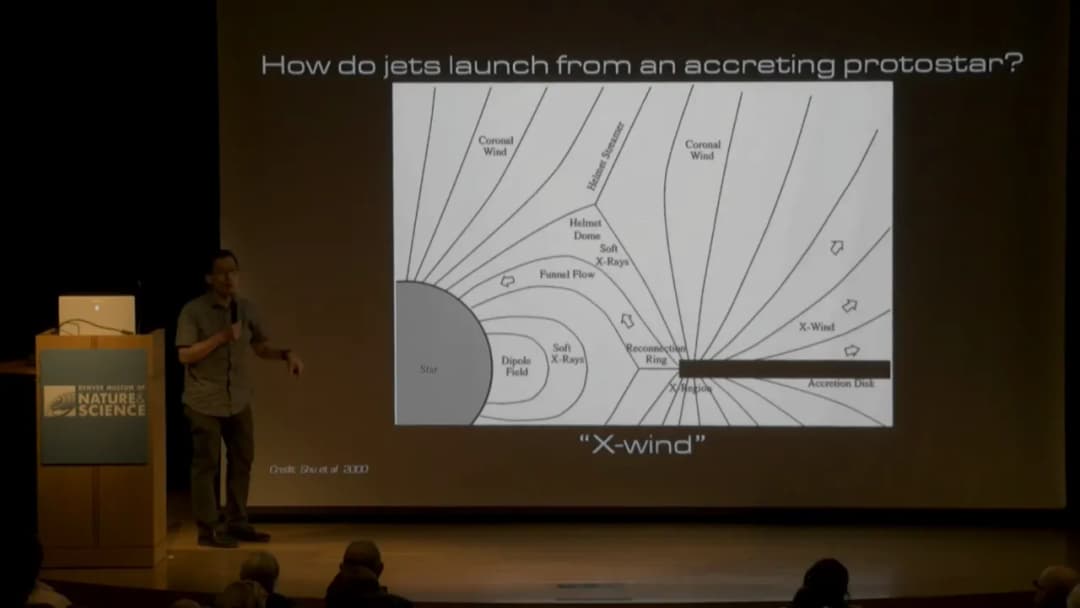
Public Meetings - Denver, ColoradoThe meeting consisted solely of a scientific presentation on star formation, Herbig-Haro objects, jet formation mechanisms, and recent observations from the James Webb Space Telescope. No city business was conducted. Discussion Items - A speaker presented a detailed overview of star formation, including the discovery of HH objects in infrared light, the role of accretion disks and jets, and the self-limiting nature of star formation. - The presentation discussed the X-wind theory proposed by Frank Hsu, which explains how magnetic fields at the accretion disk edge funnel gas into jets along the poles. - Recent James Webb Space Telescope and ALMA radio array observations by Chin-Fei Li were shown, highlighting infrared emissions from the HH211 jet and other protostars. Key Outcomes - No votes, decisions, or directives were made. The presentation was informational only.
The Transportation and Infrastructure Committee of Denver City Council met on January 21, 2026, to discuss the Alameda Lane Repurposing project. The primary focus was a proposed shift from a full lane reduction (one lane in each direction) to a partial lane reduction (two eastbound lanes, one westbound), driven by updated traffic analysis and community feedback. DOTI staff presented the project history, engagement efforts, and a plan for a demonstration deployment to test the designs. Public Comments & Testimony - Councilmember Alvidrez expressed strong support for the original full lane reduction, citing safety concerns for pedestrians and cyclists. She noted that 300 signatures on an opposition petition were not representative of the neighborhood and that a 1,100-signature petition in favor came overwhelmingly from the area. She emphasized that diversion concerns were overstated and that the city must prioritize safety over driver convenience. - Councilmember Cashman supported the full lane reduction, stating it was crafted with ample community input. He questioned the timing of the change, noting that DOTI’s internal email from August 14, 2025, indicated a decision before additional analysis was complete. He called for transparency and urged DOTI to deploy the full lane design as a demonstration to rebuild trust. - Councilmember Hines, who uses a wheelchair after being hit by a car while biking, questioned how DOTI can achieve Vision Zero goals while scaling back pedestrian and cyclist improvements. He also noted that a stakeholder process had recommended the full lane reduction and argued that DOTI’s subsequent analysis undermined that collaborative effort. - Councilmember Parady criticized DOTI for inaccuracies in communications, including misrepresenting petition demographics and claiming no decision was made before August 14. He demanded that safety analysis, not political compromise, drive outcomes. He asked for evidence that a partial lane reduction would provide similar safety benefits as a full reduction. - Councilmember Gilmore (Chair) raised equity concerns, noting that the most dangerous parts of Alameda are in her district, where families face highways daily. She feared that prioritizing the Wash Park segment over more hazardous areas sets a precedent of wealthy interests influencing decisions. She also questioned the focus on car diversion over pedestrian safety, given Vision Zero commitments. - Councilmember Flint pointed out that a previous full lane repurposing on Alameda in 2011-2012 actually increased crashes. He requested hard data comparing that design to the current proposal and supported the idea of a demonstration but urged that it test the full lane reduction first. Discussion Items - Project History and Rationale for Change: Molly (DOTI) explained that the original full lane repurposing was designed to reduce crashes—primarily left-turn and sideswipe collisions—on Alameda. However, modeling showed that the full reduction could increase congestion and divert traffic to side streets, especially Virginia Avenue, which already has 58 crashes (including pedestrian and cyclist incidents) over four years. The partial lane repurposing retains two eastbound lanes and signal improvements to mitigate diversion while maintaining most pedestrian safety features (flashing beacons, ADA upgrades) on Alameda. - Community Engagement: DOTI acknowledged a gap between initial engagement (2021 virtual open house, 2024 public meeting) and implementation. A petition with 300 signatures opposing the project and a counter-petition with 175 signatures in favor prompted a relook at data. DOTI stated that the decision to move to a partial reduction was made after internal analysis in August-October 2025, though an August 14 email from project staff indicated “clear direction” on a partial lane path. DOTI asserted that final approval came later, after additional crash analysis on Virginia. - Trust and Transparency Concerns: Multiple council members criticized DOTI for eroding public trust, citing inaccurate statements, late communication of design changes, and the influence of a former DOTI employee turned lobbyist. They emphasized that safety data must be objective and not swayed by political pressure. - Proposed Demonstration Deployment: Amy (DOTI) outlined plans to conduct a temporary demonstration of lane configurations (full or partial) over several months in 2026. The demonstration would collect real-world data on diversion, congestion, crashes, and pedestrian comfort. DOTI committed to engaging a community working group in designing the demo and to reporting results to the committee. - Timeline and Next Steps: DOTI will develop the demonstration plan within a month, with the goal of presenting an update at the committee’s February 18, 2026, meeting. Permanent safety improvements on Alameda (flashing beacons, signal upgrades) will proceed concurrently. Key Outcomes - No formal vote was taken; the discussion was informational. - DOTI agreed to return to committee on February 18, 2026, with a detailed plan for the demonstration deployment and to provide requested data, including crash comparisons between the 2011-2012 road diet and the current proposal. - DOTI will engage a community work group to refine the demonstration’s scope, metrics, and implementation timeline. - Councilmembers expressed a strong preference (though not binding) that the demonstration test the full lane reduction first to evaluate its effectiveness before considering compromises.
The Community Planning and Housing Committee met on Tuesday, January 20, 2026 at 1:30 p.m. to consider two action items: a rezoning along West 32nd Avenue in West Highland to add the Design Overlay 8 (DO8) and increase heights, and a revised landmark designation for the Knights of Columbus building at 1555 North Grant Street. Both items were moved forward to the full City Council. Public Comments & Testimony - Rezoning (West 32nd Avenue): No live public testimony was given. Written comments included a letter of support from the West Highland Neighborhood Association and 16 comments from neighbors: 14 in support (many from business owners), one expressing concern about parking, and one requesting more information. - Landmark Designation (1555 Grant): One letter of support was received from Historic Denver. Discussion Items Item 1: Rezoning of West 32nd Avenue (Perry to Julian) – Design Overlay 8 and Height Increase Libby Gluck (Community Planning and Development) presented a proposal to rezone a portion of West 32nd Avenue in West Highland from Urban Mixed Use 2 stories (UMX-2) and PUD 162 to Urban Mixed Use 3 stories (UMX-3) on the western portion, and to apply Design Overlay 8 (Active Centers and Corridors) to the entire corridor. The eastern portion is already zoned Urban Main Street 3 (UMS-3) and would also receive the overlay. The overlay requires active ground-floor uses (e.g., commercial/retail) to prevent the corridor from converting to purely residential. Council President Sandoval, the sponsor, described extensive outreach including mailers, four town halls, and walking the corridor with aides. She noted that the overlay builds on similar efforts on Tennyson, Santa Fe, East Colfax, and Federal. The PUD currently allows one-story height and paint-shop uses; the change to UMX-3 aligns with Blueprint Denver’s growth plan for local corridors. The Planning Board voted unanimously to recommend approval on December 16, 2025. Staff found all review criteria met, including consistency with the comprehensive plan and Blueprint Denver equity concepts. Concerns: Council Member Alvidrez asked about accessory uses and EV charging stations under DO8, referencing a prior issue on East Colfax. Ms. Gluck said she would follow up. Council President Sandoval explained that historic districts along the corridor were excluded from the rezoning (the “Swiss cheese” effect). Item 2: Revised Landmark Designation – 1555 North Grant Street (Knights of Columbus Building) Abigail Christman (MREC Preservation) presented a revised application for landmark designation of the Knights of Columbus District 539 property. The original application (December 2, 2025) had been deferred due to concerns about including a parking lot as a contributing element. The revised application keeps the parking lot within the boundary but designates it as non-contributing, allowing future redevelopment (e.g., park, additional building) with Landmark Preservation Commission review. Two structures remain contributing: the 1928 event hall and the 1963 meeting hall. The building is being recommended for designation for its association with the Knights of Columbus, its role as a USO center during WWII, its mid-century modern architecture by prolific Denver architect John Melan, and its innovative use of pre-stressed double T concrete (possibly the first such use in Colorado). The period of significance is 1928–1982. Council President Sandoval worked with the applicants to revise the application quickly, and also coordinated with the Assessor’s Office to delay any tax reassessment. Council Member Torres, Alvidrez, and others thanked the sponsor for resolving the parking lot issue. The Landmark Preservation Commission voted unanimously to approve the revised designation. Key Outcomes - Rezoning (West 32nd Avenue): A motion to forward the rezoning to the full City Council was made and seconded; all committee members signed off (voice vote). The item will proceed to the full council. - Landmark Designation (1555 Grant): A motion to forward the revised landmark designation to the full City Council was made and seconded; all committee members approved. The item will proceed to a public hearing and full council vote. - Both items were moved to the full council without opposition.
The committee received a briefing from the Office of Human Resources (OHR) on changes to Career Service Rule 10 (paid leave) and the Care Hours program. Most changes aligned with state and federal law. No public testimony was heard. No votes were taken; the briefing was informational. Discussion Items - Rule 10 (Paid Leave) Updates: OHR Director Heather Britton and Manager Marilyn Carroll presented revisions effective August 2025. Changes included: - Removing the shared-living-expense requirement for domestic partner eligibility (to match the Colorado Healthy Families and Workplaces Act). - Streamlining immediate family definitions (removing duplicative in-law references; adding sibling’s child and miscarriage as covered for bereavement leave). - Clarifying that PTO can be used for school/workplace closures due to inclement weather, loss of power/heating/water, and for evacuations (matching state law). - Adding Indigenous Peoples’ Day as a paid holiday. - Adjusting comp time payout from April to January. - Updating military leave to match federal law. - Care Hours (Paid Family Leave) Changes: - Renamed from “Care Bank” to “Care Hours.” - Removed probation-based eligibility; employees now must have one year of service and qualify for FMLA to use Care Hours. This change affected 128 employees in 2023, 98 in 2024, and 46 in 2025 who had used Care Hours with less than one year of service. - Clarified that Care Hours cannot count toward overtime, allowing employees using Care Hours to work more than 40 hours in a week. - Aligned dependent definitions with Rule 12 (which references Colorado FCA, including significant personal bond). OHR confirmed no reduction in eligible dependents. - Council Questions: - Council Member Parody expressed concern that removing the specific “significant personal bond” language from Rule 10 might narrow eligibility, even though Rule 12 incorporates Colorado FCA. OHR stated the definitions overlap and no coverage was lost. - Council Member Torres questioned the shift from 6‑month to 1‑year eligibility for Care Hours, noting that some employees complete probation at 6 months but must wait for the benefit. OHR explained that probationary periods vary (0–12 months) and aligning with FMLA’s 1‑year requirement provides consistency. They noted employees with less than 1 year still qualify for unpaid job-protected leave under ADA and donated leave (Care Bank). - Council Member Flynn requested additional data on the average number of Care Hours used, the range, and the highest individual usage. OHR agreed to provide it. Key Outcomes - No votes or formal decisions were taken. The committee received the briefing for informational purposes. - OHR will provide supplemental statistics on Care Hours usage (average hours, range, maximum). - The meeting adjourned without further action.
The Mayor and Denver City Council held a joint meeting on January 20, 2026, at 9:30 AM MT (16:30 UTC). The brief general session featured announcements from council members regarding community events and initiatives, followed by a unanimous vote to enter an executive session for legal advice on intergovernmental agreements. Announcements - Councilmember Sawyer reminded residents of the January blood drive at Vitalant in Lowry (National Blood Donor Month) and her annual community open house on February 10, 2025, at George Washington High School, offering direct access to city agencies. - President Pro Tem Romero-Campbell announced a Denver Golf survey for input on the redeveloped Clubhouse at Kennedy Golf Course, with details available on her website or Denver Golf. - Councilmember Cashman highlighted the Denver People's Budget, a $2 million initiative ($1 million for citywide improvements, $1 million for near southeast neighborhoods) where residents can submit spending ideas online at denvergov.org/denverpb. Key Outcomes - Council unanimously approved a motion to move into executive session pursuant to DRMC 234A sections 3 and 6 to receive legal advice on intergovernmental agreement negotiations. No other votes or decisions were made during the public session.
The Denver City Council held its weekly general session on Tuesday, January 20, 2026, at 5:30 PM (recessed from the 10:30 AM session). The meeting included the Pledge of Allegiance, a land acknowledgement, roll call (12 members present initially, later 13), approval of minutes from January 12, announcements, introduction of bills, and votes on several resolutions and ordinances. Key discussion items included a request to list written testimony in minutes, a contract for police uniforms, a rezoning in East Colfax, and a new Parks maintenance facility. A half‑hour general public comment session was scheduled for 5 PM, but no transcripts of public testimony were provided. Consent Calendar - Approval of Minutes (January 12, 2026): Council Member Gilmore requested that future minutes include the number and names of individuals who submitted written testimony, citing transparency. Legal counsel advised that this is a protocol change requiring discussion at an Operations or Budget and Policy meeting, not a correction. The minutes were approved as presented. Council Member Perry noted that written comments are already publicly attached in Legistar. - Consent Block Vote: 14 resolutions (25‑2111, 25‑2130, 25‑2155, 25‑1980, 25‑2129, 25‑2131, 25‑2158, 25‑2133, 25‑2145, 25‑2159, 25‑2160, 25‑2161, 25‑2162, and 25‑2165) were adopted by a 13‑0 vote (with Council Member Hines joining). Public Comments & Testimony - No public testimony transcript was included in the meeting materials. Council Member Lewis invited public comment on the rezoning of 1965 Verbena Street (Bill 25‑2138) via email and sign‑up for the February 17, 2026 public hearing. A general public comment session was scheduled for 5 PM, but its content was not recorded in the transcript. Discussion Items - Resolution 25‑2130 – Police Uniforms (Sags Company Inc.): Council Member Parity questioned the contract increase and durability of the new blower uniforms. Department of Safety (Emily Lack), General Services (Elizabeth Hughes), and Police Uniform Commander Michelle explained that a new solicitation in 2025 selected a different vendor, that three vendors responded, and that the blower material offers better durability, safety, and fluid‑wicking. Parity was satisfied and did not postpone. - Resolution 25‑2166 – Legal Services (Squire Patton Boggs): Council Member Lewis postponed this item to the January 26, 2026 meeting, citing unresolved questions. - Council Bill 25‑2138 – Rezoning at 1965 Verbena Street, East Colfax: Council Member Lewis introduced the item and encouraged residents to submit comments (for or against) via email and to testify at the February 17, 2026 public hearing. Because this is a quasi‑judicial rezoning, council members did not discuss merits. - Resolution 25‑2128 – New Parks and Recreation Facility at Cornevaca Park (Far Northeast Maintenance Shed): Council Member Gilmore voted no, arguing that transparency and accountability were lacking. She stated that the Green Valley Ranch Far Northeast Maintenance Facility was the department’s top priority but has received only $2.5 million for a satellite shop (estimated need in 2011 dollars was $1.8 million) and that the study is outdated. Council Member Lewis expressed support but noted that the predominantly Black and Latino neighborhoods of Green Valley Ranch and Montbello (18.7% Black, 29.2% Latino, 17.9% mixed race) have been historically underinvested, and she committed to working with Gilmore and Parity to ensure sufficient funding and personnel for the facility. The resolution passed 12‑1 (Gilmore no, 12 ayes). Key Outcomes - Minutes Approved: January 12, 2026 minutes approved as presented; future changes to written testimony listing to be discussed at Operations/Budget and Policy meeting. - Resolution 25‑2130 (Police Uniforms): Adopted as part of consent block. - Resolution 25‑2166 (Legal Services): Postponed to January 26, 2026. - Bill 25‑2138 (Rezoning): Ordered published; public hearing set for February 17, 2026. - Resolution 25‑2128 (Parks Maintenance Facility): Adopted 12‑1. - Consent Block: 13 resolutions and bills adopted by unanimous vote (13‑0). - Announcements: Blood drive (January at Vitalant), District 5 open house (February 10), District 11 meeting on Far Northeast Maintenance Shed (February 3), Park Hill Park open house (January 22), Sloan’s Lake Boathouse open house (January 29). - Bills for Introduction: Multiple ordinances from committees, including zoning changes and bond funding (Series 2026A‑B General Obligation Bonds, up to $410,075,000 for Vibrant Denver projects).
The South Platte River Committee of Denver City Council met on January 14, 2026, to consider a rezoning application for 2001 South Acoma Street and to receive a briefing on parkland and open space deficits along the South Platte River corridor. The committee voted to advance the rezoning to full council and discussed strategies to increase park acreage across Denver. Public Comments & Testimony - On the rezoning request, two written comments were received in support (supporting additional density near transit) and one in opposition (preferring to preserve the single-family nature of the area). No oral public testimony was heard. Discussion Items Rezoning: 2001 South Acoma Street (URH-2.5 to CRX-5) - Planner Fritz Claussen (Community Planning and Development) presented the request to rezone a 6,250-square-foot residential property from URH-2.5 to CRX-5. The property is in Council District 7 (Overland statistical neighborhood) near the Evans light rail station. The CRX-5 zone allows townhouse and general building forms up to five stories, intended to enable more housing density and limited mixed-use. - Process: Informational notice first went out August 25, 2025. Planning board hearings were held November 19, 2025 and January 7, 2026 (reheard after an email notice error). Both times the planning board recommended approval. - Public comments: two in support, one in opposition. - Councilmember Torres questioned the applicant, Andy (architect), about the timeline and engagement with the Overland Neighborhood Association. Andy explained delays due to market changes and a lease. He indicated plans for either four to five townhomes or a small apartment building, with flexibility from the general building form. Councilmember Flynn asked for deeper justification of the context change from Urban to Urban Center in Blueprint Denver; staff noted surrounding Urban Center designations and plan consistency. - Andy agreed to meet with the Overland Neighborhood Association before the full council hearing. Briefing: Parkland and Open Space Deficits and River Corridor Opportunities - Rocky Piro (former city planner, retired) and Frank Rowe (Denver Park Trust) presented a citywide park deficit analysis. Key statistics: Denver currently has 9 acres of parkland per 1,000 residents, compared to the national average of 13 acres per 1,000. The 2019 Game Plan identified a gap of 1,300 acres citywide. Per council district: District 1 (9.7 acres/1,000), District 2 (3.3), District 3 (4.4), District 4 (close to 13), District 7 (4.5), District 8 (exceeds 13), District 9 (9.5), District 10 (2.5). Only District 8 meets or exceeds the national average. - Along the South Platte River, challenges include E. coli levels at 137 times the federal safety standard, compromised vegetation, and incompatible adjacent land uses (e.g., industrial, auto repair, hot tub businesses). Vacant and underutilized parcels present opportunities. - Piro and Rowe proposed exploring a river-sensitive overlay district or new zoning to guide development, potentially modeled on other cities' river districts. They emphasized the need for a coordinated vision, retention strategies to avoid displacement, and demonstration projects (e.g., Sun Valley 11-acre park, River Sisters' Turquoise Necklace concept). - Council President Sandoval discussed the complexity of creating a new zoning district and the need for research into existing municipal code provisions. Councilmember Hines noted the challenge of downtown's 2.5 acres/1,000 and the potential for using city-owned assets (e.g., Bannock Street conversion). Councilmember Watson inquired about partnerships with Denver Public Schools for shared green space. - Committee members raised concerns about gentrification and displacement, and Councilmember Torres stressed the importance of retention strategies. Key Outcomes - The committee voted unanimously (motion by Councilmember Sandoval, second by Councilmember Alvarez) to advance the rezoning of 2001 South Acoma Street to the full City Council, contingent on the applicant meeting with the Overland Neighborhood Association. A tentative council hearing date of February 23, 2026 was noted. - The committee expressed strong interest in further exploring a river corridor zoning district, parkland acquisition strategies, and potential legislation to achieve 13 acres of parkland per 1,000 residents by 2040. Staff were directed to research options and bring back recommendations.
The Health and Safety Committee of the Denver City Council, chaired by Councilmember Darrell Watson (District 9), held two briefings: an update from the Prosperity Denver Fund and a presentation on the implementation of the flavored tobacco ban from the Department of Public Health and Environment (DDPHE). No votes or consent items were taken. Prosperity Denver Fund Update - Rebecca Arno (CEO), board chair Teresa Pena, and chair-elect Felicia Houston presented the fund’s progress since its 2019 inception. - Key statistics: 89 partner organizations, over 15,000 scholarships, 1,100 credentials, 47,000 high school students served, and $65 million distributed. In 2023–24, $16.3 million was disbursed; the first cycle of 2024–25 already reached $16.6 million. - Programs: college/technical school scholarships, career training (apprenticeships/credentials), and high school support services (mentorship, financial aid, family connection, academic support, mental health). - Fund balance: Approximately $30 million in 2024, with $2.6 million spent in the past year. The board projects full expenditure by fiscal year 2027. A commitment reserve was established to support current students through college in case the program sunsets in 2030 without reauthorization. - Outcomes: Investment increased college attendance and graduation rates in Denver by 8% per year. The Denver Scholarship Foundation increased scholarships by 41% and the amount per scholarship by 28%. - Future plans: Expand partner organizations, create evaluation cohorts to measure student outcomes (especially for small nonprofits), conduct an economic impact study, and strengthen the post-secondary ecosystem through a learning community. - Discussion: Councilmember Cashman asked about high school support services; Arno explained the five focus areas. Council President Pro Tem Romero Campbell praised the acceleration of funding distribution and the commitment to students. Council President Sandoval questioned whether the ordinance requires a vote of the people for reauthorization, citing the Denver Preschool Program’s experience with a council-sponsored ordinance to remove sunset. She advised the fund to exhaust all options before pursuing a ballot measure. Teresa Pena noted a separate reauthorization committee is being formed. Flavored Tobacco Ban Implementation - Teddy Montoya (Tobacco Program Manager) and Brendan Gentry (Tobacco Program Supervisor) presented on the enforcement of the flavored tobacco ban, effective January 1, 2026, after 70.5% of Denver voters approved Referendum 310 in November 2025. - Evidence base: CDC recommends comprehensive bans (including menthol) to reduce youth initiation. Flavors mask harsh tastes, and menthol increases addiction. Disproportionate targeting of Black, Latino, and LGBTQ communities. - Youth data: Past 30-day vaping dropped from 19.5% (2019) to 6.5% (2023); flavored product use declined from 27% to 19%. However, menthol use remains around 30% among youth (statewide). Retail compliance is a concern: youth not refused when purchasing rose from 72% to 87% (2023). - Enforcement: DDPHE conducts undercover age inspections (two to four per retailer annually; 578 retailers). Updated fine schedule (April 2025) treats flavored tobacco sales as a critical violation. If sold to a minor, two violations apply: $1,000 and $2,000 fines plus a 30-day suspension. A look-back period expands from 12 months (2026) to 24 months (2027) to 36 months (2028). - Retailer education: Bulletins, FAQs, direct mail, window clings, point-of-sale decals, and a forthcoming compliance video. In-person outreach will resume after a pause in Q3 2025. - Discussion: Councilmember Sawyer reported that her teenager purchased flavored vapes from the back of a store on Colfax, highlighting continued black-market sales. She asked how to report (311) and if the ordinance language may need tightening; DDPHE agreed to return with recommendations. Council President Pro Tem Romero Campbell asked about measuring youth reduction; DDPHE noted reliance on biennial Healthy Kids Colorado data (lagging) and a pilot vape waste diversion program with five Denver high schools (tracking brands and flavors). Daniel Neiman explained the environmental hazards of discarded vapes. Key Outcomes - The committee received both briefings as information items; no formal votes were taken. - Prosperity Denver Fund will continue individual district meetings with council members and provide newsletter content. - DDPHE will deliver an annual evaluation report on the flavored tobacco ban to the council in June or July 2026. - Councilmember Sawyer and staff will follow up with DDPHE on potential ordinance amendments to address enforcement gaps. - The committee chair, Darrell Watson, thanked co-sponsors of the flavored tobacco ordinance (Sawyer, Gonzalez-Gutierrez, Lewis) and the supporting agencies.
The Community Planning and Housing Committee of the Denver City Council met on January 13, 2026, at 2:00 PM local time, chaired by Councilmember Diana Romero-Campbell (District 4). The committee reviewed and voted on three major agenda items: approval of Housing Central Command contracts for 2026, a rezoning request at 12150 East Andrews Drive to expand an assisted living facility, and a complex rezoning and Planned Unit Development (PUD) for the Tramway Nonprofit Center to preserve the historic building and allow a 63-unit affordable housing development. Housing Central Command (HCC) Contracts - The committee received a presentation from Evie Benja (Assistant Director of Homelessness Resolution) and Midori Higa (Director of Homelessness Resolution Programs) on the 2026 operations of Housing Central Command (HCC), a crisis response model to rapidly house individuals experiencing homelessness. - Three contracts were presented for approval: - 25-2152 with Community Economic Defence Project for HCC navigation: $1,243,974 in 2026 (total three-year $3,762,388). - 25-2154 with Colorado Coalition for the Homeless for HCC stabilization: $2,231,731 in 2026 (total three-year $6,448,595). - 25-2153 with Housing Connector for rent payment and unit acquisition: $2,049,386 in 2026 (total three-year $9,581,406). - In 2025, HCC served 426 households (exceeding the goal of 399), housed clients in an average of 46 days, and saw 138 households exit to permanent/stable housing. The goal for 2026 is to reduce time to housing to 30 days and increase permanent exits to 75%. - Councilmembers questioned coordination with coordinated entry, landlord relationships, and data systems. Councilmember Watson requested a heat map of placements. - Key Outcome: The committee unanimously approved the three contracts in a block motion (moved by Councilmember Sawyer, seconded by Councilmember Torres). Rezoning: 12150 East Andrews Drive - Edson Ibanez of Community Planning & Development presented a request to rezone 12150 East Andrews Drive from a Multi-Unit (MS-3) to a Mixed-Use (SMX-3) zone district, both up to three stories. - The property is a 3.5-acre assisted living facility (30 beds) that seeks to add 63 beds. The current zoning does not allow residential care facilities larger than 40 beds (Type 3), necessitating the rezoning. - The site is in Council District 8 (Councilmember Lewis) in the Montbello neighborhood, adjacent to industrial and single-family zones. The proposal aligns with Plan Denver 2040 and Blueprint Denver for infill and affordable housing—the expansion will serve residents at 60% or less of Area Median Income (AMI). - The planning board approved the rezoning unanimously. One letter of support from the Montbello 2020 RNO and three additional letters were received; no opposition letters were noted. - Key Outcome: The committee approved the rezoning by unanimous vote (moved by Councilmember Lewis, seconded by Councilmember Sawyer). Rezoning and PUD: Tramway Nonprofit Center - Edson Ibanez presented a rezoning and PUD application for properties at 1620, 1625, 675 East 35th Avenue, and 3532, 3580 North Franklin Street, and 3558 North Gilpin Street, known as the Tramway Nonprofit Center. - The site is currently zoned under former Chapter 59 (RMU-20 with waivers and PUD 534). The requested PUD (PUD G38) creates three sub-areas: Sub-area A (the historic Tramway building) rezoned to UMX-2x with conservation requirements; Sub-area B (vacant portion) rezoned to URX-3 with a height of four stories (45 feet) for a 63-unit affordable housing development at 80% AMI with a 99-year covenant; Sub-area C (surface parking) rezoned to USU-A. - The applicant, Urban Land Conservancy (represented by Andrea Burns), stated the rezoning is needed to bring the existing nonprofit center into compliance (currently exceeding office space limits and containing non-permitted uses such as workforce development), preserve the historic building, and allow affordable housing using Low-Income Housing Tax Credits (LIHTC) awarded in November 2025. - Public comments: 44 letters in support (including from Historic Denver, Catholic Charities Housing, and others), and 45 letters in opposition (citing height, parking, density, traffic). The Cole Neighborhood Association took a neutral position after mediation failed to resolve differences over the four-story height. - The planning board recommended approval unanimously. Councilmembers questioned the rationale for four stories given existing entitlements and the mediation process. A neighbor, Katie Hanna, spoke to the impasse: neighbors sought three stories to better fit the residential character. - Key Outcome: The committee approved the rezoning and PUD by unanimous vote (moved by Councilmember Lewis, seconded by Councilmember Sawyer), sending it to the full City Council. The vote included a note that the existing zoning already allows four stories, and the PUD is necessary to preserve the Tramway building and enable affordable housing.