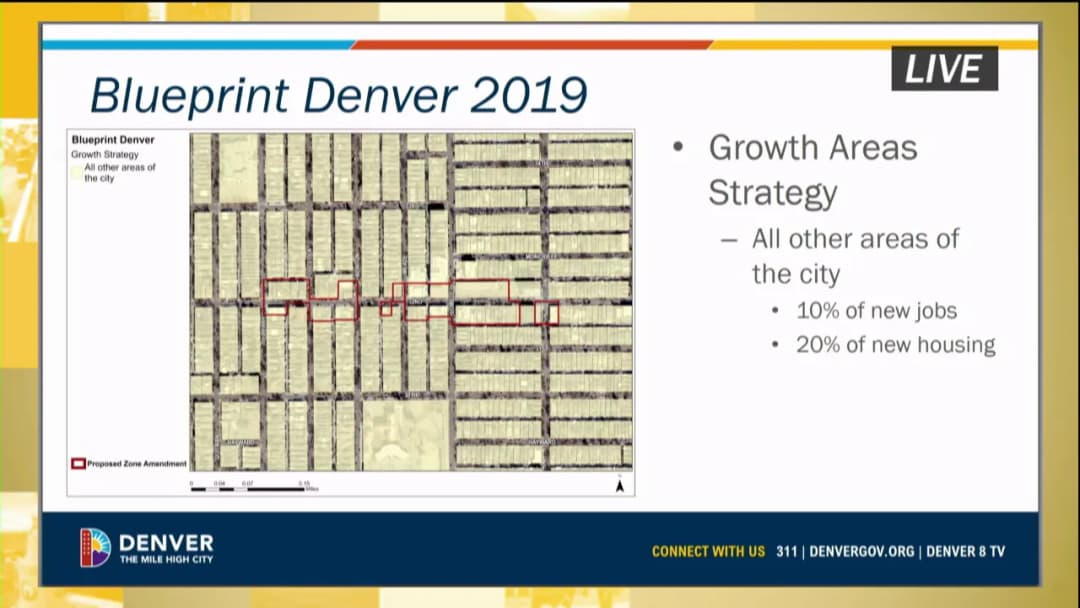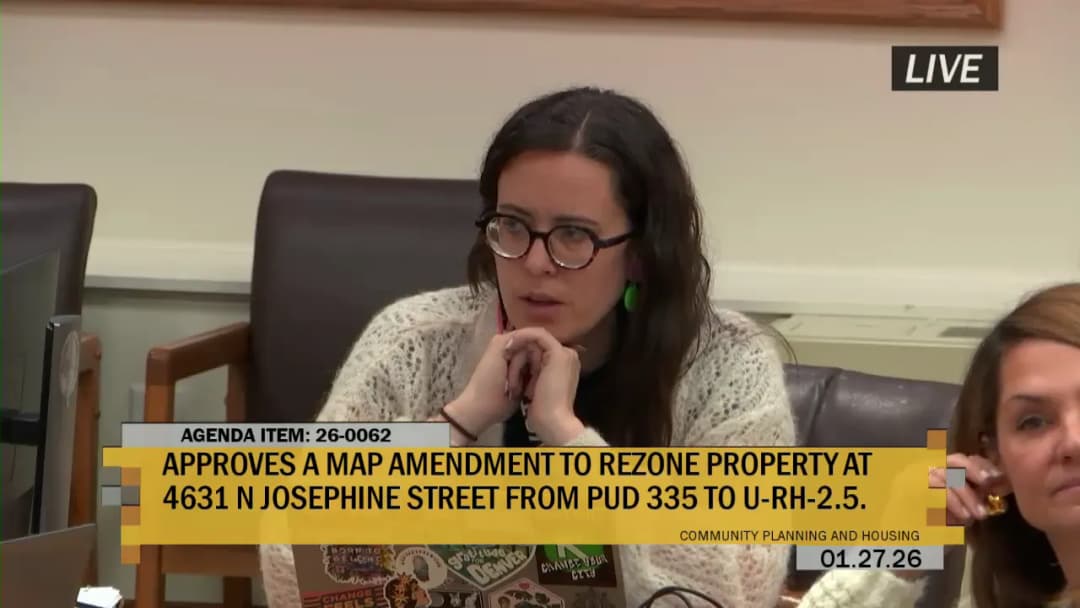
This weekly meeting of the Denver City Council Community Planning and Housing Committee, chaired by Councilmember Sarah Parady, was held on January 27, 2026. The sole agenda item was a rezoning application (case 260062) for a vacant remnant parcel at 4631 Josephine Street in the Elyria-Swansea neighborhood, which was acquired following the I-70 expansion. The committee voted unanimously to forward the rezoning to the full City Council for a public hearing. Consent Calendar - No items were on the consent calendar. Public Comments & Testimony - No public comments were made during the meeting. The staff report noted 22 letters of support and one letter of support from the Elyria-Swansea Registered Neighborhood Organization (RNO), all citing support for affordable housing and housing diversity. Discussion Items - Rezoning 260062 – 4631 Josephine Street - Applicant: Tierra Colectiva Community Land Trust (represented by Nola Miguel, Executive Director, and Danny Slebo, Real Estate Director). - Proposal: Rezone the 9,484-square-foot vacant parcel from former Chapter 59 PUD (auto body shop) to U-RH-2.5 (row house, up to 2.5 stories) to allow construction of four affordable homeownership row houses. - Background: The parcel is a remnant of the I-70 expansion, which removed 56 homes in Elyria-Swansea. Tierra Colectiva purchased the land from CDOT at market rate using congressionally designated funds secured through Senator Hickenlooper's office. - Affordability: Homes will be income-restricted to households at or below 80% of Area Median Income (AMI), with purchase prices between $200,000 and $225,000 for a three-bedroom house (about one-third of market rate). A 99-year renewable ground lease with a $90/month land lease fee ensures permanent affordability. No HOA is planned. - Community Process: Tierra Colectiva prioritizes families already living in Elyria-Swansea through orientations, waitlists, and credit repair assistance. The homes are designed for families (multiple bedrooms, yards). - Staff Findings: Community Planning and Development (CPD) staff recommended approval, finding the rezoning consistent with Comprehensive Plan 2040, Blueprint Denver, and the Elyria-Swansea Neighborhood Plan. The site is in a growth area (20% of new housing growth anticipated by 2040) and supports missing middle housing, infill development, and climate goals. - Councilmember Questions: Councilmember Sawyer clarified the parcel's actual size (approx. 9,484 sq ft vs. 16,000 sq ft in GIS records) and whether future homeowners would pay property tax on the portion now roadway (they will not; taxes are paid only on the home's resale value). Councilmember Alvides inquired about income qualification (50–80% AMI, typical household income $50,000–$100,000), the absence of HOA, and how Tierra Colectiva works with local families. Council President Sandoval praised the work of Tierra Colectiva and noted the difficulty of navigating CDOT bureaucracy. Key Outcomes - The committee voted unanimously (by voice vote, with thumbs up) to approve the rezoning and move it to the full City Council for a public hearing scheduled for March 9, 2026. - Councilmember Watson, the district sponsor, highlighted the rezoning as a step toward repairing harm from the I-70 expansion, restoring housing, and keeping families rooted in the community. - No other business was conducted; the meeting adjourned after the vote.
Public Meetings - Denver, Colorado
Public Meetings - Denver, ColoradoThis weekly joint meeting of the Mayor and Denver City Council began with council member announcements on property tax outreach, community budgeting, blood donation, neighborhood events, and concerns regarding federal actions. The meeting then moved into executive session for legal advice on intergovernmental agreements and litigation. Announcements - Council Member Kevin Flynn (District 2) raised concerns about the city's property tax mailer being the only reminder for payment, particularly affecting seniors and offline residents. He requested a strategy to help those who may be confused. The Treasury and Finance Office (TFO) representative Nicole Duhani noted a strategy exists and will share details. - Council Member Paul Cashman (District 6) reminded residents about the Denver People's Budget, a $2 million program with $1 million for citywide projects and $1 million for the southeast area (Districts 4, 5, 6). Residents can submit suggestions at denvergov.org/denverpb. - Council Member Amanda Sawyer (District 5) announced a blood drive through January 31st at Vitalant in Lowry and the District 5 annual open house on February 10th, 5:30 p.m. at George Washington High School. - Council Member Diana Romero-Campbell (District 4) noted a survey open until end of month for input on the new Kennedy Golf Club clubhouse. - Council Member Albedris expressed concern about an assault at the tiny home village and echoed colleagues' concerns about federal-level actions. - Council President Amanda Sandoval (District 1) reflected on national tragedies, calling for recommitment to justice, compassion, and accountability. - Mayor responded by affirming the city's commitment to safety and inclusiveness. Key Outcomes - Motion to enter executive session pursuant to DRMC 234A, sections 3, 6, and 7 for legal advice on intergovernmental agreements and pending litigation. The motion was seconded and passed unanimously with no opposition. The meeting then adjourned to executive session.
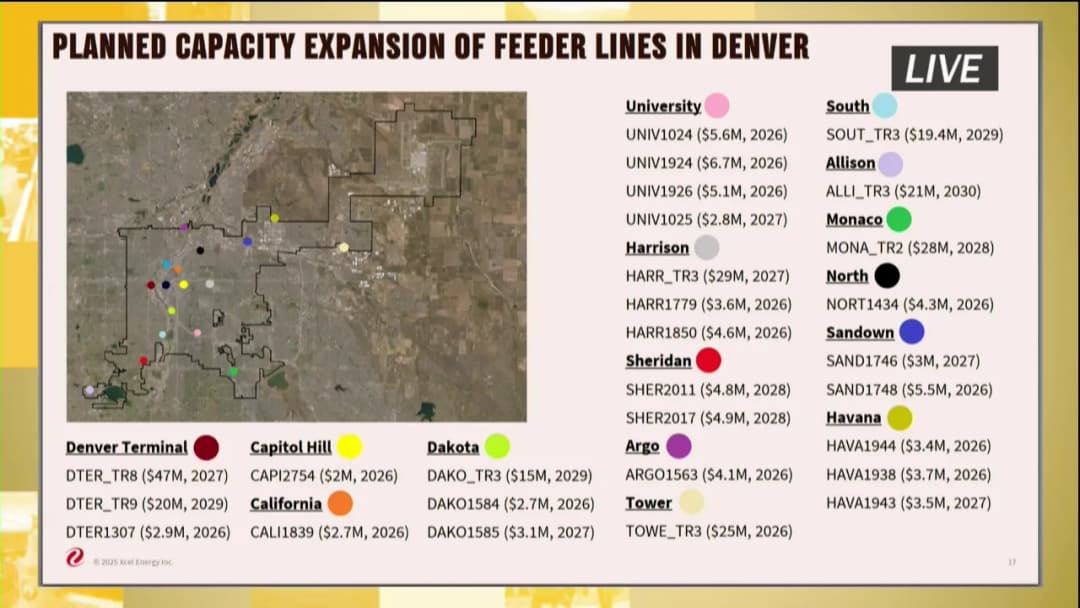
The Denver City Council received a presentation from Xcel Energy on January 26, 2026, regarding the company's operations, clean energy goals, and planned investments in Colorado's electric and gas infrastructure. The presentation highlighted the need for significant grid expansion to meet growing demand from electrification, data centers, and development. Councilmembers asked questions about union labor, customer service, data center impacts, and substation siting, with several follow-up actions committed by Xcel. Discussion Items - Xcel Energy Overview and Clean Energy Goals: Xcel operates in eight states, with Colorado as its largest, serving 1.6 million electric and 1.7 million gas customers. Reliability is at 99.97%. Goals include 100% carbon-free electricity by 2050, net-zero gas emissions by 2050, and supporting 1 million electric vehicles by 2030. As of 2024, the energy mix is 46% renewable (35% wind, 9% solar, 1% hydro), 34% natural gas, and 20% coal. By 2030, Xcel aims for 88% carbon-free, retiring all coal (last unit at Comanche by end of 2031). - Investment Plans: Xcel announced a $22.5 billion infrastructure investment over five years, including $1.6 billion for electric generation (800-1,000 MW of natural gas combustion turbines), $3.6 billion for renewable generation (4,000 MW), $7.5 billion for distribution system upgrades, and transmission projects like the Colorado Power Pathway (500-mile line, segments online by end of 2028). The distribution system plan, filed with the Public Utilities Commission (PUC), proposes $3 billion for 2026-2028, but the PUC has proposed cutting investments by half. Xcel is negotiating for higher funding. - Denver-Specific Infrastructure: In Denver, $700 million in distribution and transmission investments are planned over nine years to serve growth areas like River Mile, Ball Arena, Burnham Yards, and Denver International Airport (DEN). Xcel identified 12-13 new or expanded substations and numerous feeder upgrades. DEN currently uses 45 MW, expecting to need 400 MW by 2045; Xcel and DEN meet monthly to plan capacity, with new substations at DIA South (2028) and DIA North (2030) approved by PUC. - Data Centers and Large Loads: Data centers over 20 MW must connect to transmission and own their distribution equipment. Xcel is developing a large load tariff (to be submitted April 2026) ensuring no cost shift to other customers. For the CoreSite data center in District 9, initial service will come from Podair substation, with potential transition to transmission over 7-10 years. - Customer Service and Franchise Agreement: Xcel committed to improvements including a council listening tour, a rapid response team for constituent issues, and engagement with 176 community organizations. Councilmember Cashman criticized insufficient communication about pole replacements in Virginia Village, and Xcel pledged better notification, acknowledging that legal easements do not preclude proactive outreach. Key Outcomes - No formal votes were taken; the meeting was informational. - Xcel agreed to provide follow-up data on: number of Denver customers referred for energy assistance (over 20,000 statewide in 2024-2025 program year) and reasons for ineligibility; union contract quotas for major projects; detailed timeline for CoreSite data center substation; rate increase history since 2015; and updated timeline for outage notification technology using smart meters. - Councilmembers urged Xcel to prioritize equity when siting substations, avoiding disproportionate impacts on historically marginalized neighborhoods, and to plan substations on-site for large developments (e.g., River Mile, Ball Arena) to avoid locating them in other communities. - Xcel committed to early coordination with the city on master planning to ensure substations are incorporated into development plans, as demonstrated by ongoing projects with the Denver Broncos and Burnham Yards.
On Monday, January 26, 2026, the Denver City Council held its weekly general session. The meeting included a proclamation honoring Tracy Huggins for 33 years of service at the Denver Urban Renewal Authority, extended council member statements on federal immigration enforcement and local safety issues, and adoption of several resolutions and bills. All 12 council members were present. Consent Calendar - Proclamation 26-0078: Adopted unanimously (12-0) honoring Tracy Huggins for 33 years of service to Denver, recognizing her leadership in major redevelopment projects including Stapleton, Lowry, Union Station, and the 16th Street Mall. - Council Resolution 25-2154: Approved (12-0) a contract with the Colorado Coalition for the Homeless for the Housing Central Command (HCC) Stabilization Project, providing funding for client stability beyond rental assistance citywide. - Council Resolution 25-2153, 25-2151, 25-2166, 26-0002, 26-0003, 26-0018, 26-0019, 26-0020, 25-1982, 26-0004, 26-0007, 25-2149, 25-2146, 25-2156, 25-2144: All adopted or passed as part of the consent agenda with 12-0 votes. Council Member Announcements (Extended Testimony on National and Local Issues) - Councilmember Gonzalez-Gutierrez reported attending a teachers’ walk-in at Skinner Middle School in solidarity with Minneapolis, denouncing ICE enforcement and calling for abolition of ICE. She urged contacting U.S. Senators to oppose additional ICE funding. - Councilmember Alvidrez raised concerns about a tiny home village in District 7, noting an assault on a resident and questioning operator response (resident had to run to a neighbor to call 911). He asked the mayor to re-evaluate operations. - Councilmember Parody requested the mayor join calls for senators to vote against ICE funding, even at risk of government shutdown, criticizing the mayor’s statement for not addressing the upcoming funding vote. - Councilmember Watson reported on a community meeting regarding Denver Water’s potential move into the Laird-Swansea neighborhood, and noted the National Western Stock Show set a record with over 750,000 visitors. - Councilmember Cashman highlighted the “People’s Budget” participatory budgeting process, with $2 million available citywide and $1 million for southeast Denver neighborhoods. - Councilmember Sawyer promoted the District 5 blood drive and community open house. - Councilmember Romero-Campbell noted ICE presence in southeast Denver and encouraged Know Your Rights outreach, and reminded about surveys for Kennedy Golf course redevelopment. Discussion Items - Council Resolution 25-2154 (Questions before vote): Councilmember Parody asked the Department of Housing Stability (HOST) about performance-based contract elements, including cost-of-living adjustments (2.5%), staff caseload ratios, retention rates, and pay transparency. HOST representatives (Jeff Kositsky and Midori Higa) explained that caseload ratios are monitored weekly, with a target of 1 case manager per 20 households; the contract adds eight new case manager positions (totaling 16). HOST does not mandate specific pay rates but reviews provider budgets. Parody expressed intent to ensure contracts support fair wages. - Council Resolution 26-0040 (Postponement): Postponed one week to February 2, 2026, at the request of the Department of Transportation and Infrastructure to finalize paperwork for a robotic system truck purchase. - Council Bill 25-2156 (Comments): Councilmember Alvidrez supported the consolidation of the Office of Special Events into Denver Arts & Venues, noting cost savings and easier community access. Key Outcomes - Proclamation Adopted: Unanimous adoption of Proclamation 26-0078 honoring Tracy Huggins. - Consent Agenda Passed: 12-0 block vote adopting multiple resolutions and bills. - Contract Approved: Funding for Colorado Coalition for the Homeless HCC Stabilization Project approved (12-0) after questions. - Resolution Postponed: Council Resolution 26-0040 (Vortex Companies truck purchase) postponed to February 2, 2026. - Public Hearings Scheduled: February 23, 2026, for zoning changes at 1675 E 35th Ave, 2001 S Acoma, and 1215 E Andrews Dr. Protests due by noon on February 17, 2026. - Meeting Adjourned: Regular meeting adjourned; general public comment began at 5 p.m.
The Denver City Council Transportation and Infrastructure Committee held a meeting on January 24, 2026, to discuss the proposed lane repurposing project on Alameda Avenue. The Denver Department of Transportation and Infrastructure (DOTI) presented an update on the project, including a shift from a full lane reduction to a partial lane reduction, citing concerns about traffic diversion onto side streets such as Virginia Avenue. Council members expressed strong opinions on safety, community engagement, transparency, and equity. No formal votes were taken, but the committee requested further data and a return presentation on February 18, 2026, with a preference for a demonstration of the full lane reduction. Discussion Items Project Background and Design Change - DOTI staff (Molly and Amy) presented the project history, noting that the full lane repurposing design was originally developed in 2020–2021 but implementation was delayed due to funding and COVID-19. In 2024, after receiving a petition with 300 signatures opposing the project and a counter-petition with 175 signatures supporting it, DOTI reanalyzed data and found 58 crashes on Virginia Avenue, leading to concerns about side street diversion. This prompted a change to a partial lane reduction (two eastbound lanes, one westbound lane) to avoid pushing traffic onto Virginia, which has higher pedestrian and cyclist activity. - Amy emphasized that pedestrian safety improvements (e.g., flashing beacons at Franklin, signal upgrades, ADA ramp upgrades at Emerson Street) are retained under both designs. The full reduction would have created a buffer for pedestrians but was not supported by documented crash reduction data; the partial design focuses on maintaining safety while mitigating diversion. - Councilman Cashman questioned the timeline, noting that the decision to shift appeared to have been made in August 2024 before additional analysis, based on internal emails. Amy clarified that while initial analysis began in August, the final decision was made after further study through October 2024. Council Member Concerns and Positions - Councilman Alvidrez expressed support for the full lane reduction, emphasizing that crashes on Alameda are severe (255 severe crashes over five years) and that pedestrian safety should be prioritized. He noted that diversion of 5% traffic to Virginia could still increase risk, and he requested data comparing crash severity between Alameda and Virginia. He also criticized the length of time projects take and the lack of equity, noting that more dangerous sections of Alameda in his district (e.g., near Federal) have received less attention. - Councilman Cashman strongly supported the full lane reduction, arguing that the stakeholder process had recommended it and that changing the design after a lobbyist (former DOTI employee) influenced the decision erodes public trust. He called for the full repurposing to be implemented first to test its effectiveness. - Councilman Hines (in a wheelchair due to a bicycle crash) questioned how DOTI can achieve Vision Zero goals if pedestrian and cyclist improvements are scaled back. He noted that the decision to go with the partial design contradicts the stakeholder group's recommendation and undermines future engagement. - Councilwoman Parady challenged the accuracy of DOTI's statements, pointing to an August 2024 email that indicated a clear decision before additional analysis. She also argued that DOTI's response to council letters mischaracterized community support: only 12% of the 300 petition signatures came from nearby neighborhoods, while the counter-petition of 1,100 signatures was 70% from the neighborhood. She rejected the framing of pedestrian safety as “good” for partial and “moderate” for full, stating that the serious risk on Alameda (255 severe crashes) outweighs potential minor increases on Virginia (58 crashes, mostly vehicular). She demanded evidence that a partial reduction provides comparable safety. - Councilman Flynn recalled a previous road diet on Alameda in 2011–2012 that increased crashes, leading to its removal. He requested data on average daily traffic (ADT), which DOTI said dropped from over 20,000 to 15,000–17,000, and asked what differences make the current full reduction likely to succeed. He supported the demonstration project but preferred the full design first. - Councilwoman Gilmore (District 11) expressed deep concern about trust, noting that a lobbyist who formerly worked for DOTI influenced the project. She stated that DOTI’s credibility is “nil” and urged the committee to continue questioning. She also highlighted equity issues, noting that most of the community engagement focused on Wash Park East while more dangerous areas (e.g., Montbello) lack resources. - Councilwoman Morrah (Chair) asked why the focus was on driver concerns (congestion, diversion) rather than pedestrian safety, given Vision Zero goals. She also questioned the “engage vs. inform” slide, noting that DOTI did not clearly communicate to the community when they moved from engagement (co-creating designs) to informing (announcing decisions). She requested a timeline for the demonstration project and emphasized the need for a collective return to committee. Demonstration Deployment - DOTI announced plans to conduct a temporary demonstration deployment of one or both lane configurations over several months to gather real-world data on safety, congestion, and diversion. They will engage a community working group to design the demonstration metrics and expect to return to committee on February 18, 2026, with updates. The committee chair expressed a preference for demonstrating the full lane reduction first. Key Outcomes - No formal votes were taken; the meeting was informational and deliberative. - DOTI committed to returning to the Transportation and Infrastructure Committee on February 18, 2026, with additional data requested by council members (crash severity comparison, ADT history, crash analysis from 2011–2012, and details of the demonstration project). - DOTI will proceed with planning the demonstration deployment, engaging a community working group, and will report back on design and metrics. - The committee chair stated a personal preference for demonstrating the full lane reduction, but no binding direction was given. - Council members emphasized the need for transparency, accurate data, and restored public trust in DOTI’s processes.
This meeting of the Denver City Council Health and Safety Committee, chaired by Councilmember Darrell Watson (District 9), featured two briefings: first on continuing education and training for the Denver Police Department (DPD) and Denver Sheriff Department (DSD), and second on the operations and challenges of the PACE (Prosecution and Community Engagement) section of the City Attorney's Office. Councilmembers present included Amanda Sawyer, Kevin Flynn, Laura Alvitres, Paul Cashman, Jamie Torres, and Council President Pro Tem. Discussion Items DPD and DSD Continuing Education Briefing - Lieutenant Campion (DPD), Jesse (DPD), Mike (DSD curriculum developer), and Captain Sims (DSD) presented training requirements. DPD must meet 24 hours of POST minimums, including 12 hours of perishable skills (arrest control, emergency driving, firearms). They train 1,462 officers annually. DSD is not POST-certified but uses Triple Crown accreditation (ACA, NCCHC, CALEA) requiring 40 hours of training annually. - Programs highlighted: ABLE (Active Bystandership for Law Enforcement) from Georgetown University (8-hour initial, 2-hour annual refresher), crisis intervention training, annual supervisor training (sergeants and lieutenants), and hands-on citizen service training reinstated after COVID. DSD is adopting the HEROES adaptation of ABLE focused on corrections settings (launching February 9, 2026). - Logistics challenges: limited facility space (only 15 range stalls, two padded cells at sheriff's academy, old mats), scheduling to minimize overtime, and staffing constraints. DPD schedules in-service a year ahead; DSD holds training on off-days to avoid replacement. - Councilmember Torres asked how new requirements (state or local) are integrated; Lieutenant Campion described a quarterly trends group (including Independent Monitor) that develops training within weeks to months. Councilmember Flynn questioned whether low staffing at the jail changes training needs; DSD noted they currently do not have specific low-staff protocols but will follow up. Councilmember Perry asked for sample training transcripts and noted the minimum training hours; DPD reported recruits receive over 1,000 hours in academy plus 16-week field training, while experienced officers often exceed the 24-hour minimum. - Councilmember Alvitres raised concerns about officer mental health and overtime. DPD highlighted wellness teams, peer support (60 members), reintegration programs for those returning from leave, and a partnership with Dr. Bruce Perry's Neurosequential Model for trauma-informed training. DSD emphasized normalizing asking for help and family nights in the academy. - Councilmember Sawyer asked about online vs. in-person training, ammo costs (not paid by officers), and autism training; DPD said they would provide details offline. Councilmember Cashman had no questions. PACE (Prosecution and Community Engagement) Briefing - Director Marlee Bordowski, Linda Laughlin-Pettit (victim advocacy), Reggie Newbein (assistant director), and Genevieve St. Ledger presented. PACE is a charter agency prosecuting all municipal ordinance violations, with four trial courtrooms (currently 2.5 attorneys each, aiming for 3), traffic and juvenile dockets, and courtroom 2100 in the detention center operating seven days a week. - Statistics: 14,300 cases in 2025 (up 2% from 2024, which was up 12% from 2023); 2,500 were domestic violence cases (up 19%, a 10-year high). Traffic cases fluctuated. Juvenile cases decreased 6% due to diversion programs and the Alternatives to Citation program rolled out citywide in 2024. - Other PACE functions: legal support for licensing, public nuisance abatement (including street racing vehicle seizures), mental health team (over 1,300 involuntary commitment cases and 48 extreme risk protection order filings in 2025, a statewide high), and the Neighborhood Partnership Team (e.g., Denver Methamphetamine Abatement Partnership – 33 residences tested positive in 2025). - Linda Laughlin-Pettit presented slides on domestic violence cases with images of injuries and victim quotes. Councilmember Sawyer objected to the use of images, citing privacy concerns and questioning the narrative of victims voicelessness, and asked for data on how many prosecuted by PACE are experiencing homelessness (previously estimated at 54% in 2023). Marlee Bordowski said they do not currently track that data but would follow up. - Councilmember Alvitres asked about improving victim access to services (e.g., online protection orders) and why domestic violence is rising; PACE noted the Denver Domestic Violence Collaborative reinstigated in 2025 to address prevention and response. - Councilmember Flynn asked about the drop in domestic violence cases year-over-year (though 2025 was higher than 2021); PACE had no definitive answer. He also asked about follow-up for methamphetamine contamination; PACE explained DDPHE works on landlord requirements and alternative housing. - Councilmember Sawyer requested removal of case numbers from the slides; legal counsel was to determine if possible under open meetings law. Key Outcomes - No formal votes were taken during the committee meeting. - DPD and DSD agreed to follow up on specific questions: sample training transcripts, information on autism training, and consideration of low-staffing protocols for the jail. - PACE agreed to pursue removing case numbers from the presentation slides if legally permissible and to provide data on the percentage of defendants experiencing homelessness. - The committee received the presentations and will continue oversight of training and prosecution practices.
On January 23, 2026, the Denver City Council's Transportation & Infrastructure Committee convened to discuss the Alameda Lane Repurposing project. Department of Transportation and Infrastructure (DOTI) staff presented an updated analysis that led to a proposed shift from the originally planned full lane repurposing (one lane each direction) to a partial lane repurposing (two eastbound lanes, one westbound, with turn pockets). The discussion focused on community engagement, safety data, diversion impacts, and trust in the process. Councilmembers expressed mixed views, with some supporting the full reduction and others questioning the data and process. DOTI proposed a temporary demonstration deployment to test both designs. Discussion Items - DOTI Presentation: Molly and Amy from DOTI explained the project history, including a virtual open house in 2020, a 2024 public meeting, and petitions from both supporters and opponents. They cited updated crash data showing 58 crashes on Virginia Avenue (2019-2023) with pedestrian and cyclist involvement, versus 255 severe crashes on Alameda (primarily vehicle crashes). The partial lane repurposing was chosen to avoid diverting traffic onto Virginia Avenue, which could increase risk to pedestrians and cyclists near Wash Park. They committed to a community working group and a temporary demonstration to validate data. - Councilmember Concerns: - Councilwoman Alvedres expressed concern about car crashes into homes and the need to prioritize safety over driver convenience. She questioned the 5% diversion impact and requested crash severity comparisons. She supported the demonstration but wanted the full lane design tested first. - Councilman Cashman, a supporter of the full lane reduction, criticized the process as incomplete and lacking community trust. He noted the decision to shift to partial was reportedly made on August 14, 2024, before additional analysis, though DOTI denied this. He argued the full repurposing should be implemented to restore trust. - Councilman Parady challenged DOTI's accuracy, citing an email indicating a clear direction on partial reduction on August 14. He rejected the characterization of community support as 50-50, stating the pro-full petition had 1,100 signatures (70% from the neighborhood) versus the opposition petition with 300 (12% from nearby). He demanded evidence for partial lane safety benefits and questioned the objectivity of DOTI's analysis, arguing the risk to pedestrians on Alameda outweighed the marginal risk on Virginia. - Councilman Hines (in a wheelchair due to a bike crash) pressed DOTI on how partial lane reduction aligns with Vision Zero goals, asking for data on crash reduction. He noted the previous road diet on Alameda (2011-2012) increased crashes and was removed, and he requested comparative data on average daily traffic and crash causes. - Councilwoman Flint highlighted the past failure of the full lane repurposing and stressed that safety data, not politics, should drive decisions. - Councilwoman Gilmore criticized the loss of public trust, pointing to a former DOTI lobbyist involved in opposition. She praised committee members for increasing accountability. - Process and Engagement: The Chair questioned DOTI's engagement strategy, noting the difference between informing and engaging the public. She asked when DOTI informed the community about the shift from community-co-created design to the new proposal. DOTI stated they communicated in October-November 2024, but councilmembers and community disputed this. Key Outcomes - DOTI committed to a temporary demonstration deployment of either the full or partial lane repurposing, to be designed with a community working group within the next month. The demonstration will run for several months to gather real-world data on congestion, diversion, safety, and pedestrian comfort. - DOTI will continue permanent safety improvements such as flashing beacons at Franklin and signal upgrades at Virginia and Downing, planned for 2026. - Council requested a collective follow-up meeting with shared data and reports to ensure consistent information. - No formal vote was taken; the committee will receive further updates.
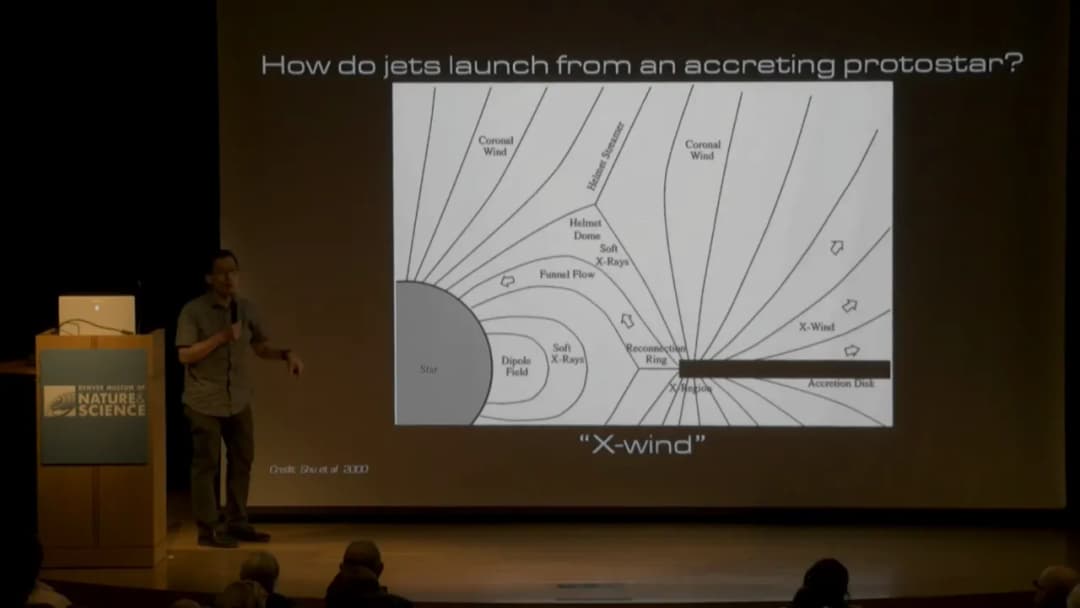
The meeting consisted solely of a scientific presentation on star formation, Herbig-Haro objects, jet formation mechanisms, and recent observations from the James Webb Space Telescope. No city business was conducted. Discussion Items - A speaker presented a detailed overview of star formation, including the discovery of HH objects in infrared light, the role of accretion disks and jets, and the self-limiting nature of star formation. - The presentation discussed the X-wind theory proposed by Frank Hsu, which explains how magnetic fields at the accretion disk edge funnel gas into jets along the poles. - Recent James Webb Space Telescope and ALMA radio array observations by Chin-Fei Li were shown, highlighting infrared emissions from the HH211 jet and other protostars. Key Outcomes - No votes, decisions, or directives were made. The presentation was informational only.
The Transportation and Infrastructure Committee of Denver City Council met on January 21, 2026, to discuss the Alameda Lane Repurposing project. The primary focus was a proposed shift from a full lane reduction (one lane in each direction) to a partial lane reduction (two eastbound lanes, one westbound), driven by updated traffic analysis and community feedback. DOTI staff presented the project history, engagement efforts, and a plan for a demonstration deployment to test the designs. Public Comments & Testimony - Councilmember Alvidrez expressed strong support for the original full lane reduction, citing safety concerns for pedestrians and cyclists. She noted that 300 signatures on an opposition petition were not representative of the neighborhood and that a 1,100-signature petition in favor came overwhelmingly from the area. She emphasized that diversion concerns were overstated and that the city must prioritize safety over driver convenience. - Councilmember Cashman supported the full lane reduction, stating it was crafted with ample community input. He questioned the timing of the change, noting that DOTI’s internal email from August 14, 2025, indicated a decision before additional analysis was complete. He called for transparency and urged DOTI to deploy the full lane design as a demonstration to rebuild trust. - Councilmember Hines, who uses a wheelchair after being hit by a car while biking, questioned how DOTI can achieve Vision Zero goals while scaling back pedestrian and cyclist improvements. He also noted that a stakeholder process had recommended the full lane reduction and argued that DOTI’s subsequent analysis undermined that collaborative effort. - Councilmember Parady criticized DOTI for inaccuracies in communications, including misrepresenting petition demographics and claiming no decision was made before August 14. He demanded that safety analysis, not political compromise, drive outcomes. He asked for evidence that a partial lane reduction would provide similar safety benefits as a full reduction. - Councilmember Gilmore (Chair) raised equity concerns, noting that the most dangerous parts of Alameda are in her district, where families face highways daily. She feared that prioritizing the Wash Park segment over more hazardous areas sets a precedent of wealthy interests influencing decisions. She also questioned the focus on car diversion over pedestrian safety, given Vision Zero commitments. - Councilmember Flint pointed out that a previous full lane repurposing on Alameda in 2011-2012 actually increased crashes. He requested hard data comparing that design to the current proposal and supported the idea of a demonstration but urged that it test the full lane reduction first. Discussion Items - Project History and Rationale for Change: Molly (DOTI) explained that the original full lane repurposing was designed to reduce crashes—primarily left-turn and sideswipe collisions—on Alameda. However, modeling showed that the full reduction could increase congestion and divert traffic to side streets, especially Virginia Avenue, which already has 58 crashes (including pedestrian and cyclist incidents) over four years. The partial lane repurposing retains two eastbound lanes and signal improvements to mitigate diversion while maintaining most pedestrian safety features (flashing beacons, ADA upgrades) on Alameda. - Community Engagement: DOTI acknowledged a gap between initial engagement (2021 virtual open house, 2024 public meeting) and implementation. A petition with 300 signatures opposing the project and a counter-petition with 175 signatures in favor prompted a relook at data. DOTI stated that the decision to move to a partial reduction was made after internal analysis in August-October 2025, though an August 14 email from project staff indicated “clear direction” on a partial lane path. DOTI asserted that final approval came later, after additional crash analysis on Virginia. - Trust and Transparency Concerns: Multiple council members criticized DOTI for eroding public trust, citing inaccurate statements, late communication of design changes, and the influence of a former DOTI employee turned lobbyist. They emphasized that safety data must be objective and not swayed by political pressure. - Proposed Demonstration Deployment: Amy (DOTI) outlined plans to conduct a temporary demonstration of lane configurations (full or partial) over several months in 2026. The demonstration would collect real-world data on diversion, congestion, crashes, and pedestrian comfort. DOTI committed to engaging a community working group in designing the demo and to reporting results to the committee. - Timeline and Next Steps: DOTI will develop the demonstration plan within a month, with the goal of presenting an update at the committee’s February 18, 2026, meeting. Permanent safety improvements on Alameda (flashing beacons, signal upgrades) will proceed concurrently. Key Outcomes - No formal vote was taken; the discussion was informational. - DOTI agreed to return to committee on February 18, 2026, with a detailed plan for the demonstration deployment and to provide requested data, including crash comparisons between the 2011-2012 road diet and the current proposal. - DOTI will engage a community work group to refine the demonstration’s scope, metrics, and implementation timeline. - Councilmembers expressed a strong preference (though not binding) that the demonstration test the full lane reduction first to evaluate its effectiveness before considering compromises.
The Community Planning and Housing Committee met on Tuesday, January 20, 2026 at 1:30 p.m. to consider two action items: a rezoning along West 32nd Avenue in West Highland to add the Design Overlay 8 (DO8) and increase heights, and a revised landmark designation for the Knights of Columbus building at 1555 North Grant Street. Both items were moved forward to the full City Council. Public Comments & Testimony - Rezoning (West 32nd Avenue): No live public testimony was given. Written comments included a letter of support from the West Highland Neighborhood Association and 16 comments from neighbors: 14 in support (many from business owners), one expressing concern about parking, and one requesting more information. - Landmark Designation (1555 Grant): One letter of support was received from Historic Denver. Discussion Items Item 1: Rezoning of West 32nd Avenue (Perry to Julian) – Design Overlay 8 and Height Increase Libby Gluck (Community Planning and Development) presented a proposal to rezone a portion of West 32nd Avenue in West Highland from Urban Mixed Use 2 stories (UMX-2) and PUD 162 to Urban Mixed Use 3 stories (UMX-3) on the western portion, and to apply Design Overlay 8 (Active Centers and Corridors) to the entire corridor. The eastern portion is already zoned Urban Main Street 3 (UMS-3) and would also receive the overlay. The overlay requires active ground-floor uses (e.g., commercial/retail) to prevent the corridor from converting to purely residential. Council President Sandoval, the sponsor, described extensive outreach including mailers, four town halls, and walking the corridor with aides. She noted that the overlay builds on similar efforts on Tennyson, Santa Fe, East Colfax, and Federal. The PUD currently allows one-story height and paint-shop uses; the change to UMX-3 aligns with Blueprint Denver’s growth plan for local corridors. The Planning Board voted unanimously to recommend approval on December 16, 2025. Staff found all review criteria met, including consistency with the comprehensive plan and Blueprint Denver equity concepts. Concerns: Council Member Alvidrez asked about accessory uses and EV charging stations under DO8, referencing a prior issue on East Colfax. Ms. Gluck said she would follow up. Council President Sandoval explained that historic districts along the corridor were excluded from the rezoning (the “Swiss cheese” effect). Item 2: Revised Landmark Designation – 1555 North Grant Street (Knights of Columbus Building) Abigail Christman (MREC Preservation) presented a revised application for landmark designation of the Knights of Columbus District 539 property. The original application (December 2, 2025) had been deferred due to concerns about including a parking lot as a contributing element. The revised application keeps the parking lot within the boundary but designates it as non-contributing, allowing future redevelopment (e.g., park, additional building) with Landmark Preservation Commission review. Two structures remain contributing: the 1928 event hall and the 1963 meeting hall. The building is being recommended for designation for its association with the Knights of Columbus, its role as a USO center during WWII, its mid-century modern architecture by prolific Denver architect John Melan, and its innovative use of pre-stressed double T concrete (possibly the first such use in Colorado). The period of significance is 1928–1982. Council President Sandoval worked with the applicants to revise the application quickly, and also coordinated with the Assessor’s Office to delay any tax reassessment. Council Member Torres, Alvidrez, and others thanked the sponsor for resolving the parking lot issue. The Landmark Preservation Commission voted unanimously to approve the revised designation. Key Outcomes - Rezoning (West 32nd Avenue): A motion to forward the rezoning to the full City Council was made and seconded; all committee members signed off (voice vote). The item will proceed to the full council. - Landmark Designation (1555 Grant): A motion to forward the revised landmark designation to the full City Council was made and seconded; all committee members approved. The item will proceed to a public hearing and full council vote. - Both items were moved to the full council without opposition.