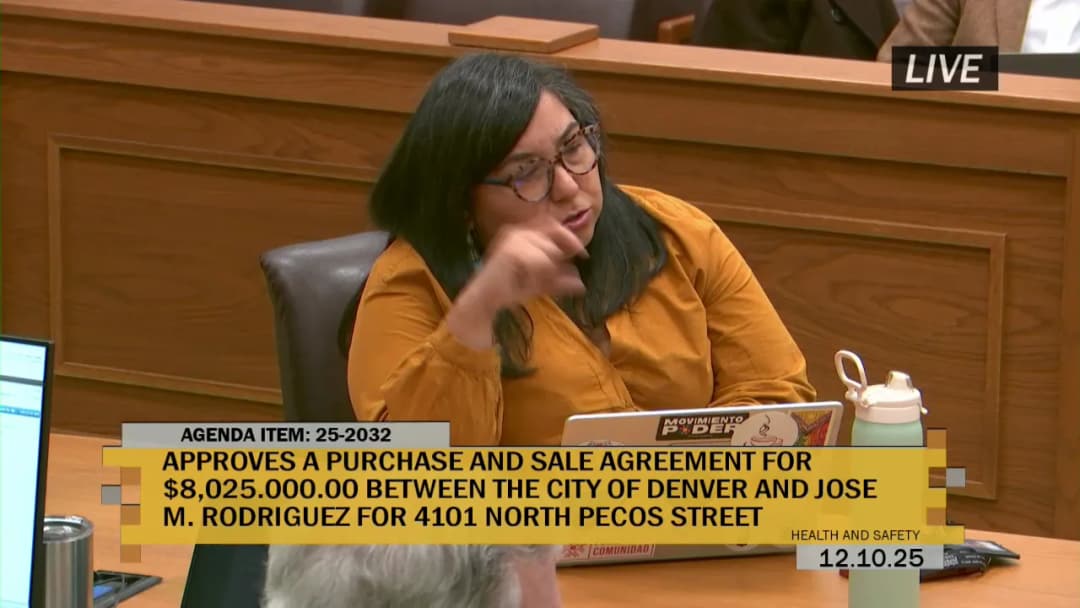
The Health and Safety Committee of the Denver City Council met on December 10, 2025, chaired by Councilmember Daryl Watson. The meeting included one action item (acquisition of Independence House for community corrections) and a briefing from the Office of the Independent Monitor (OIM) on its semi-annual report. The consent calendar was approved without any items pulled. Consent Calendar - Routine approvals from prior meetings were adopted unanimously with no items removed. Discussion Items 1. Action Item: Acquisition of Independence House (Bill 252032) - Presenter: Lisa Lumley (Director of Real Estate) and Greg Morrow (Director of Community Corrections, Department of Safety) - Background: The city has been transitioning away from for-profit private prison operators (GEO and CoreCivic) since 2019, closing six residential programs and losing 500 beds. Three city-owned facilities (Dahlia, Columbine, Thule Hall) have been purchased, and a lease at 570 West 44th was secured. Current total bed capacity is approximately 270, down from a 2019 peak of 750. The target is 360–450 beds. Independence House, operated by Manny Rodriguez at 4101 North Pecos Street, currently houses 75 men. Mr. Rodriguez plans to exit the state contract, and the city seeks to purchase the site for $8,025,000 (including $25,000 in closing costs) from the Capital Improvement Fund. The acquisition would preserve 75 beds and allow continued operation through late 2026/early 2027 while the Dahlia facility (90 beds) undergoes renovation. - Key Statistics: Waiting list for community corrections is 120 individuals; 50 are in jail awaiting placement. Average wait time is nearly six months. The purchase price is $8 million for CIP, with an additional $25,000 for closing costs. Estimated life-safety and ADA improvements based on prior acquisitions range from $250,000 to $400,000. - Council Questions & Comments: Councilmembers expressed strong support and appreciation for Mr. Rodriguez’s work. Councilmember Flynn inquired about the Dahlia renovation schedule and noted the decline from 750 to 270 beds, asking why the target is not higher. Morrow explained that fewer people are being afforded community corrections due to capacity constraints, and DOC referrals have dropped. Councilmember Torres asked about the loss of the ARTS contract (therapeutic community beds operated by CU Denver) and its impact on treatment options. The program provided 125 beds for intensive substance-use treatment; those beds are now closed statewide. 2. Briefing: Office of the Independent Monitor (OIM) Semi-Annual Report - Presenter: Monitor Elizabeth Perez Castle - Topics Covered: - Suspected Overdoses in DSD Jails: Nine deaths in 2025 so far, four confirmed as overdoses. The OIM recommended administrative investigations; on July 25, 2025, Director Saldate ordered such investigations. The OIM is part of a task force to address contraband. - Education-Based Development (EBD): The OIM opposes EBD, arguing it undermines accountability. They reviewed draft policies in March, July, and August 2025. A final draft is expected to be sent to OIM for review. A full council briefing is planned for Q1 2026. - OIM Audit: The Denver Auditor’s Office completed an audit in September 2025 with four findings and six recommendations. OIM generally disagrees with the findings but will implement recommendations, particularly regarding transparency around deliberative privilege. - Aggregate Discipline Data (first half of 2025): DPD closed 216 cases; OIM returned 34.7% for additional work. DSD closed 178 cases; OIM returned 56.2%. Seven DPD officers terminated, six retired/resigned; four suspended. For DSD: 104 community inmate complaints (12% increase from 2024), 219 internal complaints (14% increase from 2023); eight deputies retired/resigned; two suspended. - Staffing Needs: OIM requested an additional position (approved for half-year in 2026) but caseloads have doubled since 2022. They may request another analyst. - Council Discussion: Councilmember Parady asked about the distinction between criminal and administrative investigations. Councilmember Sawyer highlighted that increased complaints may not reflect increased misconduct but better reporting; she asked for clearer communication in future reports. Councilmember Flynn defended EBD, stating it can offer corrective paths for low-level violations and that the program has evolved since July. The Chair noted a final document will be presented for full council discussion in Q1 2026. Key Outcomes - Action Item Approved: The acquisition of Independence House (Bill 252032) was moved, seconded, and passed unanimously (via thumbs-up vote). The purchase price is $8,025,000 from CIP funds. The closing is expected to align with the end of 2026, contingent on extending the service agreement with Mr. Rodriguez. - OIM Briefing Received: The committee received the semi-annual report. No formal vote was taken. The Chair committed to scheduling a full council briefing on the final EBD policy in the first quarter of 2026. - Next Steps: The Department of Finance and Real Estate will proceed with due diligence and facility assessments. The OIM will continue to monitor overdose investigations and provide updates in the annual report (due March 15, 2026).
Public Meetings - Denver, Colorado
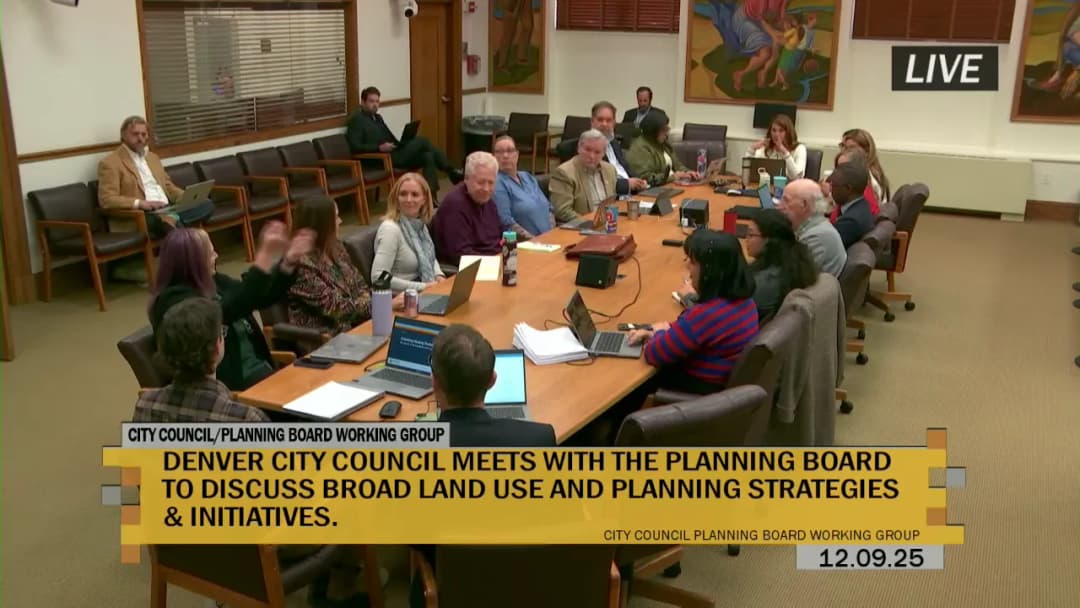
Public Meetings - Denver, ColoradoOn December 9, 2025, the Denver City Council Planning Board Working Group held a special session from approximately 12:30 PM to 2:30 PM to receive an update on the Unlocking Housing Choices (UHC) project. City Planner Rob Haig presented a phased approach to the project, which had been restructured due to budget and staffing challenges. The presentation outlined Phase 1 strategies focused on incentivizing retention of existing homes and requiring affordability for new structures, along with updates to residential design standards to reduce building scale. Council members and Planning Board members provided extensive feedback, raising concerns about timeline, market feasibility, alignment with adopted area plans, unintended consequences, and the need for broader community engagement. No votes were taken; the discussion set the stage for future refinement and public outreach in 2026. Discussion Items - Project Update & Phased Approach: Rob Haig (City Planner) explained that UHC is now split into two phases. Phase 1 (targeting adoption by end of 2026) focuses on: (1) allowing missing middle housing when an existing home is retained, and (2) allowing new missing middle housing when one unit is set aside as affordable. Phase 2 (targeting adoption by 2029) would address broader market-rate missing middle options. The project scope remains unchanged. - Building Form Updates: Staff discussed introducing a maximum floor area limitation (similar to a floor area ratio) to discourage large single-family homes and incentivize more units. Council member Serratore noted her district already uses a maximum floor area allowance (excluding basements) in Sunnyside and Harkness Heights. - Market Trends & Affordability: Presentation slides indicated that a typical demolished-and-replaced single-family home sells for over $1.4 million and exceeds 3,000 sq ft, while new duplexes/triplexes/row homes in the same scenario are often under $800,000 and under 3,000 sq ft. However, many council members argued that $800,000 remains unattainable for many residents. - Council Member Positions: - Council Member Parady expressed hope for a broader menu of options and analysis, noting the complexity and the need to consider market-rate density in targeted locations. - Council Member Alvidrez emphasized declining homeownership rates among communities of color (Black homeownership fell from 40% to 38%; low-to-moderate homeownership from 36% to 32%). She stressed that market-rate housing could boost homeownership opportunities. - Council Member Hines supported the idea of subdividing existing large homes (like in Capitol Hill) to preserve character and reduce demolition waste, and inquired about pre-approved ADU designs to speed permitting. - Planning Board member Fred Quick raised concerns about unintended consequences: land values, compliance complexity for deed-restricted units, and the risk that only developers—not families—would use the new tools. He asked for analysis of building code and tap fee implications. - Planning Board member Mary Coddington argued that Phase 1's affordability requirement could hinder supply, and favored a full policy (including market-rate options) by 2027 rather than a partial policy by 2026. She highlighted finance as a bigger barrier than zoning for missing middle housing. - Council Member Romero Campbell questioned how the proposal would work in southeast Denver, and noted that many residents already rent out rooms without formal subdivision. - Council Member Flynn (via Council President Sandoval) stressed that adopted plans (Blueprint Denver and NPIs) do not support a blanket allowance of fourplexes on all single-family lots, and urged a location analysis tied to plan guidance. - Council Member Sawyer called for a “return on investment” analysis, noting that large lots needed for Phase 1 are mostly in southeast Denver, limiting citywide impact. She prioritized fixing the “2-to-9 unit gap” in building forms and incentivizing three- and four-bedroom units. - Council Member Torres pointed to the West Area Plan's desire for affordability and warned that without deed restrictions, new units may not benefit current residents. She noted the existing gap between SU/TU and RH zoning for triplexes/quadplexes. - Council Member Gilmore highlighted her district's need to avoid displacement and preserve existing brick homes; she questioned the carbon footprint of demolition and fire access issues in neighborhoods without alleys. - Council Member Watson provided an example of new condos where one- and two-bedroom units sell quickly, but three-bedroom units (income-restricted at $93,000 for a family of three) cannot find qualified buyers, illustrating a mismatch between affordability targets and wealth-building. - Council Member Lewis noted that zoning changes alone won't solve the problem; building code and policy tools like group living allowances should also be explored. - Council President Sandoval (District 1) reflected on negative experiences in Jefferson Park where upzoning led to instability, shoddy construction, and renters replacing owners. She stressed that outreach is essential: few residents are currently aware of UHC, and council members must partner with CPD to engage neighborhoods in 2026. Key Outcomes - No formal votes or decisions were made. - Council members and Planning Board members provided clear feedback requesting: - Financial feasibility and market analysis before proceeding. - Alignment with adopted area plans rather than citywide blanket allowances. - Consideration of building code, finance, and enforcement challenges. - Broader public engagement in 2026, with council members as ambassadors. - Staff noted that preliminary financial feasibility results are expected in early 2026. - Council President Sandoval offered to coordinate quadrant meetings with CPD for 2026 to improve outreach. - The next advisory committee meeting is anticipated in January 2026.
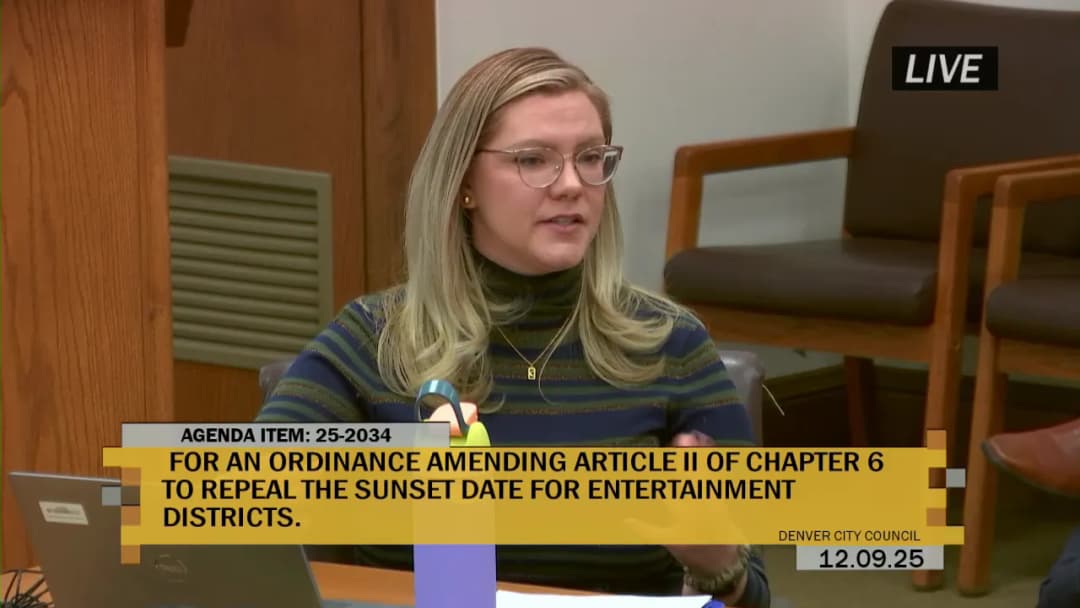
The Finance and Business Committee convened on December 9, 2025, at 9:45 AM under chair Councilmember Satana Gonzalez Cuchez. The committee reviewed two major agenda items: the creation of the North Wing Coop Entertainment District and the associated repeal of the pilot program's sunset date, followed by a briefing on the City's Recreational Vehicle (RV) Disposal Program. Consent calendar items were also approved. Consent Calendar - Routine approvals and unanimous actions were passed without discussion or opposition. Public Comments & Testimony - Alison Frieden (Westfield Company, representing North Wing Coop Entertainment District Promotional Association) expressed full support for the common consumption area, stating it provides flexibility and community building opportunities. She highlighted the underutilized plaza and noted that similar models at Stanley Marketplace have proven successful for multi-generational activations. - Stuart Jensen (Peach Grease Club, a participating business) voiced strong support, emphasizing the challenges of operating a bar/restaurant in Denver and the potential for increased revenue and community gathering. He noted his experience with a common consumption area in Edgewater and stressed the responsibly managed space can reduce unregulated drinking. Discussion Items 1. Establishment of North Wing Coop Entertainment District & Repeal of CCA Program Sunset - Erica Rogers (Deputy Executive Director, Department of Licensing and Consumer Protection) presented the history of the common consumption area (CCA) program, created by state law in 2011 and adopted by Denver as a pilot in 2021. The proposed entertainment district covers 13 acres near I-70 and the RTD 38th & Blake station, anchored by three participating businesses (Chubby Unicorn, Peach Grease Club, Left Hand Brewing). Mission Ballroom is not participating. The applicant (North Wing Coop Promotional Association) completed all state and local requirements, including a public hearing on October 7, 2025, with no opposition. The resolution creates the entertainment district; a separate bill removes the pilot program's June 2026 sunset date to provide certainty for future applicants. City Council must approve the district before the CCA license can be issued. - Councilmembers expressed a range of concerns: - Councilmember Cashman questioned the 100-acre maximum (state-mandated), the district's actual size (13 acres), whether common consumption areas increase DUIs or fights (no evidence found), and security measures. - Councilmember Heinz asked why Mission Ballroom is not participating (speculated due to ticketed event logistics) and noted the program's low uptake. - Councilmember Gilmore raised safety questions regarding harm reduction (Narcan, drug testing strips), re-entry protocols, and potential for increased incidents near EDM shows. Stuart Jensen and Ali Frieden responded that staff are trained in harm reduction and that EDM nights typically have low alcohol sales. - Council President Pro Tem Romero Campbell questioned whether the program would require additional police overtime; Erica Rogers stated it would not. She also expressed concern that briefings were only offered last week, and requested a written security plan and DPD validation. - Councilmember Watson thanked the team and applicants for their work, noting the difficulty of creating such a district. 2. Briefing on the Recreational Vehicle (RV) Disposal Program - Steve Gonzalez (General Services, RV Disposal Program Manager) presented the program, established formally in April 2025 with a $450,000 general fund budget. Since January 2022, the city has demolished 1,400 RVs. The program addresses severely damaged RVs on public right-of-way (118 responses) and stored at the Sheriff's Vehicle Impound Facility (VIF) at 4650 Steele Street (145 spaces, 50-75% capacity). Intake peaked in 2023 (510 units); dropped 28% in 2025 (317 demolished, but over 400 received, with 100 still pending). Cost per unit decreased from $3,700 in 2022 to $1,400 in 2025 due to contractor efficiencies. The process involves hazardous waste removal (propane, batteries, biohazards, fentanyl residue) and on-site demolition. The city is exploring scrap metal revenue and DOTI crew collaboration for cost savings. - Councilmembers raised questions about owner reclaiming RVs (Sergeant Shelley explained it rarely happens due to missing titles and multiple transfers), enforcement of 72-hour parking rules, and policy support. President Sandoval thanked the team and offered to collaborate on policy improvements. Key Outcomes - Motion to Advance the Entertainment District Resolution and Sunset Repeal Bill: Council President Pro Tem Romero Campbell moved, seconded by Councilman Heinz. The motion passed without a roll-call vote, sending both items to the full City Council for first and second readings. - RV Disposal Program: The briefing was informational; no formal action was taken. Councilmembers expressed support and requested follow-up tours and policy discussions. - Councilmember Gilmore requested a written security plan and DPD validation for the CCA license; the administration agreed to provide it by the end of the day. - Consent Agenda: Approved without discussion.
The Denver Mayor and City Council held their weekly joint meeting on December 9, 2025. The session opened with introductions and announcements from council members, followed by a presentation from Denver Human Services (DHS) on the Gift Center and Give Donations program. The meeting concluded with a unanimous motion to enter executive session for legal advice, litigation settlement, and real estate discussions. Announcements - Councilman Sawyer reminded District 5 residents to complete the annual survey by December 31, 2025. - Councilman Watson congratulated the Park Hill Pirates for attending the Nationals in Florida. - Mayor announced the senior luncheon at Wilshaw Golf Course (100-year celebration in 2026), donuts with Grinch at Eisenhower Rec Center on Saturday, the closure of Ross University Hills Library for renovations starting December 20, and that December 9 is Colorado Gives Day. - Councilman de Vitre highlighted that District 7 is featured in the CityCast Denver Awards for community leadership (Caitlin Braun and Blake David), best neighborhoods (South Broadway and Athmar Park), and best artist (Amy from Chaos Bloom Theater). He also noted District 3 nominee Tron Gifts with Mimi and District 1 nominee convivial. - Councilman Cashman announced that the Virginia Village Library in District 6 is now open seven days a week. Discussion: Labor Measure - Mayor expressed concerns about a recent council action on collective bargaining, specifically the addition of pecuniary, financial, and punitive damages against the city (no precedent), moving oversight from career services/HR to another agency, and the risk of unilaterally exiting bargaining mid-term without mutual agreement. He noted significant changes were made after committee and expressed hope to work with council on a resolution. - Councilwoman Torres supported the measure, arguing that relying solely on OHR limits employee paths against union retaliation or ULPs. She noted as a former city employee, significant job duty changes could warrant reopening negotiations, and that the agreement would specify how and when bargaining occurs. - Mayor responded that independent action against a labor entity could be handled through an outside partner, while HR has capacity to adjudicate actions against the corporation, so both remedies could exist. Presentation: Denver Human Services Gift Center & Give Donations - Celia Leal (Gift Center supervisor) and Eileen Alrado (Give Donations program overseer) presented the program's role in Denver's safety net. The Gift Center provides emergency goods and services to Denver County residents every 60 days (food boxes, hygiene, diapers, clothing, resource navigation). The Give Donations team works with the giving community for year-round intake and drives (hygiene, school supply, holiday gift drives). - In November 2025, when SNAP benefits were delayed, DHS held an internal food drive that doubled its goal of 1,000 items. - Current holiday gift drive runs with partner Denver Santa Claus Shop; participation includes volunteering, Amazon wish list donations, and monetary contributions. - 2025 statistics: provided over 18,000 pounds of food and 18,600 snack items, distributed 37,000 hygiene items, 8,000 clothing items (including winter coats), and 469 snack bags via Give on the Go (which also offers hygiene kits, menstrual products, vital document fee waivers for CO ID and birth/death certificates). - School supply drive gave away close to 1,500 backpacks. - The team is just two full-time staff plus volunteers. Increased need seen in food insecurity, diapers, and vital documents for employment. - Council members thanked the team and asked about mobility devices (not actively advertised but can connect to community resources). Councilman asked if the Gift Center always operated with two staff; previously it was one staff member, now two. Key Outcomes - Unanimous motion (all present in favor) to move into executive session under RMZ 234A three four six and seven for legal advice, potential litigation settlement, and real estate acquisition/sale/use. - No public comments or consent calendar items were noted. - The meeting adjourned to executive session after the DHS presentation.
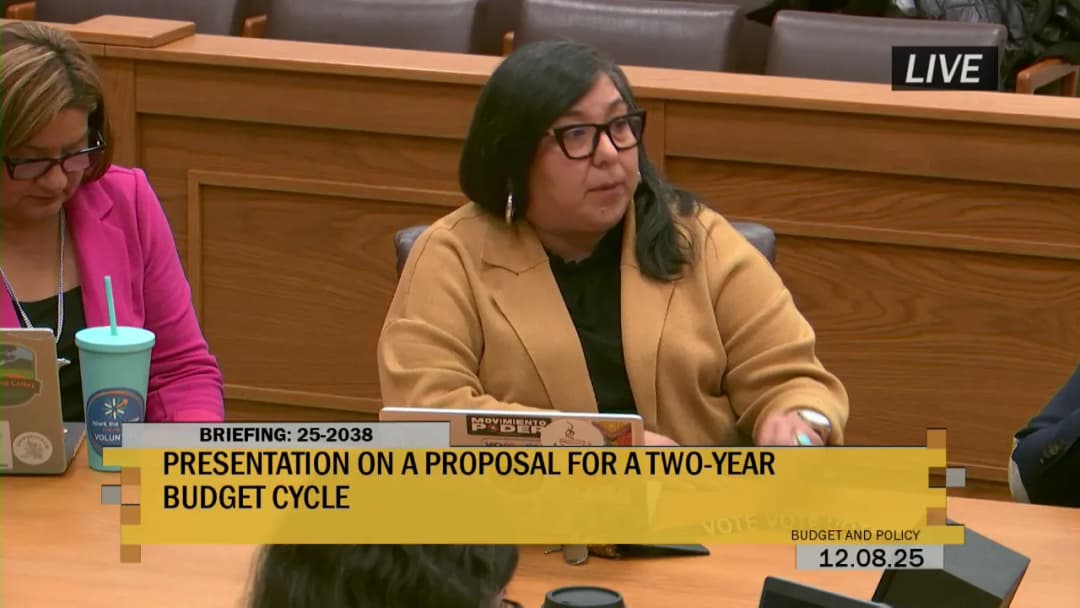
The Budget and Policy Committee of the Denver City Council held its final meeting of 2025 on December 8, 2025, at 12:30 PM. The primary agenda item was a briefing on a proposed charter change to transition the city from an annual to a two-year budget cycle, with an option to revert to a one-year cycle during economic uncertainty. The proposal was sponsored by Councilmembers Sawyer, Gilmore, and Lewis. Council President Mandy Sandoval chaired the meeting. Discussion Items - Proposal for a Two-Year Budget Cycle - Councilmember Sawyer presented the current budget timeline, noting that the July 1st base budget provides "false information to the community" and that the compressed September 15th deadline leaves council only five days to review a thousand-page document. The proposal aims to address these issues by moving to a two-year cycle (on-year for the full budget, off-year for adjustments) and simplifying the process by removing the July 1st requirement and moving the September 15th date earlier. - Councilmember Gilmore presented research from King County, Washington, and Fort Collins, Colorado, which both use flexible biannual budgets. She highlighted that both jurisdictions allow for a one-year cycle during high uncertainty and that Fort Collins ties its budget to a community-informed strategic plan. - Councilmember Lewis emphasized that a two-year cycle would increase transparency through quarterly financial reporting, a defined balanced budget, and a required public process for resident feedback. She noted a November 5, 2025 community feedback session had already been held, with a long list of pros and a shorter list of cons. - Councilmember Concerns and Questions - Councilmember Lane expressed skepticism, noting that many jurisdictions have moved away from biannual budgets. She raised concerns about forecasting accuracy, the lack of a clear definition of a balanced budget, and the difficulty of locking in two-year projections with collective bargaining underway. She asked if the proposal could include a provision that the budget does not automatically pass if council fails to approve it. - Councilmember Torres questioned the timing of the two-year cycle, suggesting it might begin at the start of a new mayoral term (e.g., 2028). She also asked about the strategic planning process, noting that inheriting a predecessor's budget might limit a new administration's ability to set different priorities. - Councilmember Parody distinguished between the budget process and project/strategic planning, questioning whether the proposal conflates them. She suggested that some transparency improvements (e.g., quarterly updates, re-forecasting) could be implemented without a two-year cycle. - Council President Sandoval expressed a general concern about giving away council power, particularly during the off-year. She noted that the current $500,000 contract threshold (under which council does not review contracts) already limits transparency, and she worried that a two-year cycle might further reduce council oversight. She also pointed out that many planning documents in Denver are not implemented, raising doubts about the effectiveness of a new strategic plan. - Councilmember Cashman asked whether the charter change could include language requiring the mayor's office to implement council-adopted amendments as written, but acknowledged that might undermine the strong-mayor form of government. - Councilmember Watson sought clarification on the strategic planning process—who runs it, how council participates, and whether the plan is tied to budget outcomes. The sponsors responded that the mayor's office would lead the outreach and set the strategic plan, with council continuing to provide input through its budget priorities. - Supporting Points from Sponsors - Councilmember Sawyer argued that a two-year cycle would allow for more meaningful community engagement because projects (e.g., street improvements, safety infrastructure) typically take longer than one year. She cited the Place Network Investigations (PNI) program as an example where a one-year goal was unrealistic, but a two-year window would allow for measurable outcomes. - Councilmember Gilmore noted that non-profit organizations would benefit from multi-year funding certainty, and that the off-year could serve as a reconciliation point for residents to hold the administration accountable for promises made in the strategic plan. - Timeline and Next Steps - The sponsors outlined a proposed timeline: public outreach meetings in February 2026, return to Budget and Policy in April 2026 for further input, stakeholder briefings in May, governance committee review over the summer, and a potential ballot referral in November 2026 for a vote by Denver residents. Key Outcomes - No votes were taken; the discussion was for information and feedback purposes. - Councilmembers requested additional research, including a list of municipalities with strong-mayor forms of government that use biannual budgets (e.g., San Francisco, Seattle). The sponsors agreed to provide links to Fort Collins' strategic planning materials and other peer city data. - The proposal will be refined based on committee feedback and brought back to Budget and Policy in April 2026. Council President Sandoval emphasized that she would oppose any change that reduces council power, and that the final language must preserve council's role in budget oversight.
The Denver City Council met on Monday, December 8, 2025, for a regular session that included council announcements, proclamations, resolutions, bills, and public hearings. Key actions included the adoption of two Urban Alchemy contracts (shelter operation and community ambassador services), the failure of a construction contract for Cornavaca Park, the passage of collective bargaining amendments, and approval of several land-use items, including the Far Southwest Area Plan and Regis University rezoning. Consent Calendar - Proclamation 2043 honoring fallen Denver Police Detective Donald L. De Bruno on the 50th anniversary of his end of watch was adopted unanimously (13-0). - Proclamation 2045 honoring the fifth anniversary of the Black Santa Project was adopted unanimously. - A block of resolutions and bills on final consideration was adopted with a 13-0 vote. - Council Resolution 2062 (late filing for SNAP benefits) was introduced after unanimous suspension of rules (11-0). Public Comments & Testimony - General Public Comment: A half-hour session was held before the evening’s hearings. (No specific testimony summarized in the transcript.) - Public Hearings on Land-Use Items: - Bill 1635 (Regis Village PUD): Eleven speakers testified; most supported the rezoning, citing community benefits, student housing, and economic development. Jesse Paris raised concerns about lack of development detail, traffic, and affordability. - Bill 1636 (Regis campus rezone): One speaker (Jesse Paris) questioned the delay in updating zoning and requested assurances about development. - Bill 1874 (Far Southwest Area Plan): Five speakers testified; Andrew Arbuckle, Jackie Martinez Wells, and Peter White expressed strong support, highlighting community engagement and preservation of suburban character. Jesse Paris opposed, arguing the plan fails to address gentrification and affordability. Discussion Items - Councilmember Announcements: Several members highlighted community events, including the Denverist Awards, DFD toy drive, senior luncheon, and cold-weather shelter openings. Councilmember Lewis criticized the administration for not consulting her before opening a new cold-weather shelter at 4380 Peoria Street in District 8, calling it a pattern of disrespect and concentrated poverty. - Proclamation 2043: Councilmembers Flynn and Hines presented a proclamation honoring Detective De Bruno. It was adopted unanimously. - Proclamation 2045: Councilmember Lewis celebrated the Black Santa Project’s fifth anniversary. Founder Ayante Anderson accepted, noting a federal Toys for Tots denial due to the project’s name and requesting donations to meet a 7,000-toy shortfall. - Resolution 1883 – Urban Alchemy Shelter Contract: Council debated a $30 million, three-year contract for Urban Alchemy to operate the Aspen non-congregate shelter in District 8. Councilmember Lewis and others expressed concerns over Urban Alchemy’s track record in other cities, lack of communication from the administration, and the district’s disproportionate shelter burden. Host Deputy Director Jeff Kositsky and Urban Alchemy representatives defended the contract, citing new performance-based metrics and oversight. Councilmember Sawyer supported the contract to avoid displacing 220 guests in winter. The resolution passed 9-4 (Ayes: Flynn, Gonzalez-Gutierrez, Heinz, Cashman, Romero-Campbell, Sawyer, Torres, Watson, Sandoval; Nays: Alvidrez, Gilmore, Lewis, Parity). - Resolution 1881 – Urban Alchemy Ambassador Services: This $3 million, three-year contract for community ambassador services (including outreach, cleaning, and pro-social behavior education) also sparked debate. Councilmember Parity and Gilmore questioned the shift from housing-focused outreach to ambassador roles. Cole Chandler (Mayor’s Office) argued the program would reduce police calls and connect people to services. Urban Alchemy stated no weapons are carried and training includes de-escalation. The resolution passed 9-4 (same vote split as 1883). - Resolution 1925 – Cornavaca Park Construction: Councilmember Torres moved to vote down the contract because the building plan had been postponed to January 12, 2026. Resolution failed 0-13. - Resolution 1957 – Cold Weather Shelter at 4040 Quebec: Councilmember Lewis opposed, citing an earlier commitment that the Aspen site would not be used for cold-weather sheltering. Failed 2-11 (Ayes: Flynn, Watson; Nays: 11 others). - Bill 1556 – Collective Bargaining Rights: Extensive discussion on two amendments. Amendment 2 (unfair labor practices process via Denver Labor) passed 9-4. The amended bill then passed 11-1 (Watson dissenting). - Bill 1992 – Landmark Designation at 1555 North Grant Street: Applicants withdrew the request; bill failed 0-13. - Bill 1960 – City Council Fund Transfer: Passed 13-0. - Bill 1891 – Supplemental Appropriations: Councilmember Parity expressed concerns about rising police overtime. Passed 12-0. - Late Filing Resolution 2062: Introduced for SNAP benefits; passed 11-0. - Public Hearings (Bills 1635, 1636, 1874): All three items passed with 12-0 votes after public testimony and staff presentations. Key Outcomes - Resolution 1883 (Urban Alchemy shelter contract): Adopted 9-4. - Resolution 1881 (Urban Alchemy ambassador contract): Adopted 9-4. - Resolution 1925 (Cornavaca Park construction): Failed 0-13. - Resolution 1957 (cold-weather shelter at Quebec site): Failed 2-11. - Bill 1556 (collective bargaining, as amended): Passed 11-1. - Bill 1992 (landmark designation): Failed 0-13. - Bill 1960 (fund transfer): Passed 13-0. - Bill 1891 (supplemental appropriations): Passed 12-0. - Bill 1635 (Regis Village PUD): Passed 12-0. - Bill 1636 (Regis campus rezone): Passed 12-0. - Bill 1874 (Far Southwest Area Plan): Passed 12-0. - Proclamations 2043 and 2045: Adopted unanimously. - Consent block of resolutions and bills: Adopted 13-0.
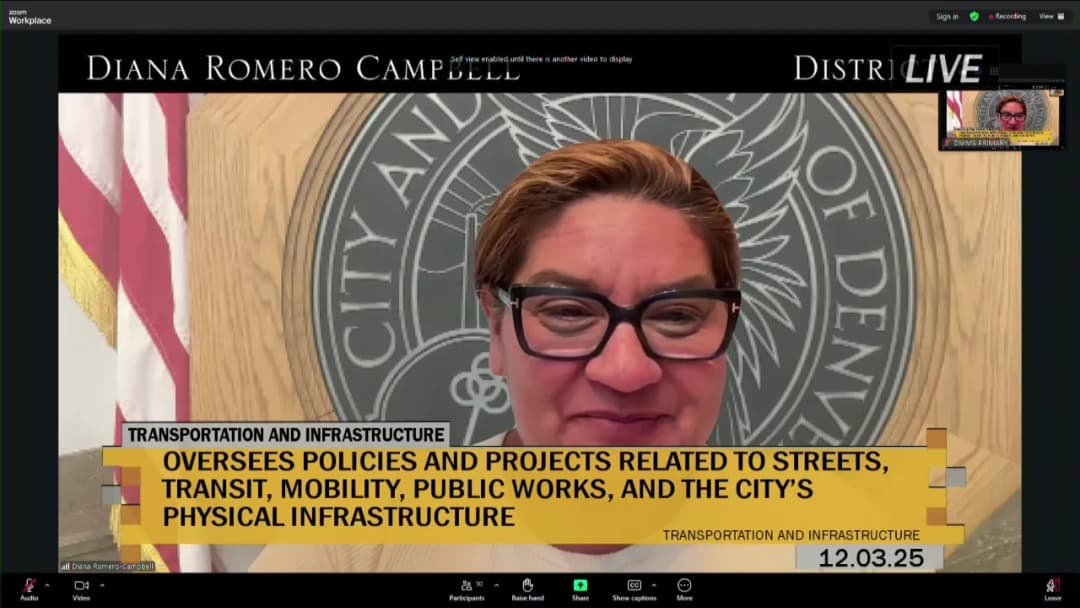
The Transportation and Infrastructure Committee of the Denver City Council met on Wednesday, December 3, 2025, to consider a proposal from the Office of Climate Action, Sustainability and Resiliency (CASER) to expand the allowable uses of the Disposable Bag Fee Special Revenue Fund. The meeting was chaired by Councilwoman Chantel Lewis (District 8) and included council members Kevin Flynn, Diana Romero Campbell, Flora Vitrez, Paul Cashman, Council President Sandoval, and Councilman Hines. After extensive discussion about fiscal responsibility, program priorities, and the original intent of the bag fee, the committee voted to advance the ordinance as is to the full council, with plans to amend it on the floor. Discussion Items - CASER Deputy Executive Director Jonathan Wachtel presented an overview of the existing disposable bag fee program, which imposes a 10-cent fee per bag (60% remitted to the city). Since its launch in 2021, the program has achieved a 50% reduction in disposable bag usage, avoided over 50 million plastic bags, and maintained 99% compliance. Revenue is declining as behavior changes, with current projections falling below $1 million annually and expected to drop to $300,000–$400,000 by 2030. - The proposed ordinance would expand the fund’s allowable uses beyond administration, education, and reusable bag giveaways to include support for the Universal Recycling and Composting Ordinance (the Waste No More citizen initiative), studies on waste reduction and circular economy, and one-time catalytic investments (e.g., a $4.7 million transfer to DOTI’s volume-based pricing fund for citywide compost rollout, already approved in the 2025 budget but contingent on this code change). - Councilman Hines expressed concern that the phrase “and related activities” in the proposed allowable uses was overly broad, potentially allowing spending unrelated to the listed 14 specific uses. He asked for tighter language to restrict spending to that list. - Council President Sandoval argued that the proposed expansion effectively repurposed the bag fee fund into a general zero-waste implementation fund and suggested renaming it to reflect its new scope. She also opposed using funds for studies (Section I) rather than direct programs and raised concerns about the inconsistent service levels for trash, recycling, and composting pickup in her district. - Councilwoman Vitrez questioned how expanded uses would contribute to greenhouse gas reduction and whether small businesses (including carnicerías) were receiving adequate support. Natalie, the program administrator, confirmed ongoing outreach and quarterly compliance checks with all businesses, noting that some small stores have opted to stop providing disposable bags. - Councilwoman Romero Campbell asked about the long-term sustainability of the volume-based pricing program if bag fee revenues continue to decline. Justin Sykes (Budget Management Office) noted that the program has required General Fund transfers (e.g., $22 million in 2023) and that future state Extended Producer Responsibility (EPR) revenues may help offset costs. - Councilman Kevin Flynn proposed striking all new allowable uses except the $4.7 million transfer to avoid jeopardizing the 2025 budget, warning that failure to act could push the city’s fund balance below the mandatory 10% threshold. Council President Sandoval suggested a compromise: transfer $1.5 million instead to ease budget concerns while allowing more time to discuss the full expansion. - Liz Babcock, Executive Director of CASER, urged the committee not to eliminate the additional allowable uses, citing the aggressive September 2026 deadline to implement the Universal Recycling and Composting Ordinance and the need for flexible funding to meet community expectations. Key Outcomes - The committee voted 4–1 to move the ordinance forward as written to the full City Council, with the understanding that amendments will be introduced on the floor. Councilmember Cashman voted no, expressing that he would not support the bill on the floor without changes. - The intention, as stated by several council members and the administration, is to amend the ordinance on the floor to limit newly allowed uses to the $4.7 million (or possibly $1.5 million) transfer for the volume-based pricing program, while striking the broader expansion. Further discussion on renaming the fund and adding other allowable uses is expected early in 2026. - The committee did not address any consent calendar items, and no public testimony was given.
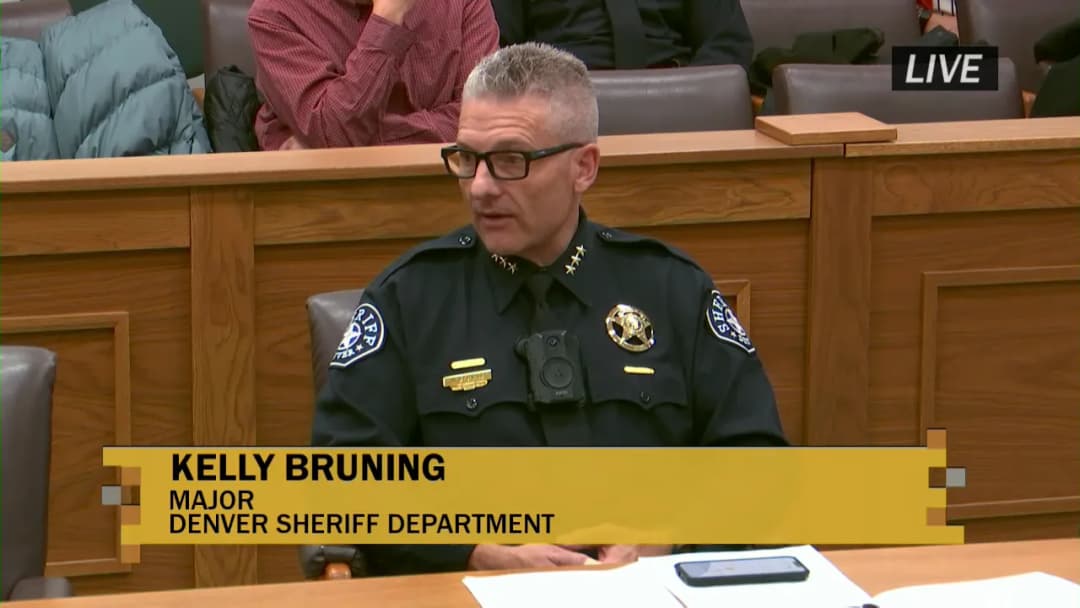
The Health and Safety Committee, chaired by Councilmember Daryl Watson, met on December 3, 2025. The meeting included two main items: an action item to approve amendments and a new contract with Axon Enterprises for law enforcement technology, and a briefing on the Gun Violence Awareness and Intervention Network (GAIN) pilot program. The committee voted to advance the Axon contracts to full council. The GAIN briefing prompted significant discussion about community trust, data practices, and the need for earlier collaboration with council. Action Item: Axon Contract (Items 25-1967 & 25-1968) Presentation - Emily Locke (Legislation & Policy Director, Department of Public Safety) presented two items: a $450,000 increase to the current Axon contract (to close out 2025 invoices for Sheriff’s Department body-worn camera licenses and storage), and a new five-year contract with a maximum spend of $27 million (2026-2030) covering police, sheriff, and fire departments. The scope includes body-worn cameras, Taser devices, docking stations, interview room technology, and digital evidence management. - Commander Cliff Barnes (DPD) highlighted operational needs: individual docking stations to reduce overtime ($80,000–$100,000/year) and ensure firmware updates; interview rooms (used for tens of thousands of interviews since 2018); increased Taser count from 1,000 to 4,000 to equip all patrol and line officers; and body-worn camera count (1,637 sworn plus 19 civilians plus 69 spares). - Major Kelly Bruning (Sheriff’s Department) explained needs for 730 body-worn cameras and 400 Taser 10 devices (330 outside jails, 70 inside), replacing outdated equipment. - Fire Department will receive 13 body-worn cameras for arson investigators (best practice, not legally required). Councilmember Questions and Discussion - Councilmember Parady questioned the justification for overtime costs for off-duty employment and the cost-effectiveness of single-bay docking stations ($1M total) versus overtime savings. She also expressed concern about Axon’s monopoly and the quadrupling of annual DPD costs from $1M to $4M. - Councilmember Torres asked about Denver International Airport’s contribution to the contract; CFO Sine Cummings explained it is handled through formulaic cost allocation based on officers assigned to DEN. Torres also inquired about the use of a national cooperative (NASPO) for the RFP; Emily Locke confirmed it was authorized under DRMC and that the city plans to move to a local competitive process for the next contract. - Councilmember Gonzalez Gutierrez asked about the Axon Customer Experience Improvement Program (opt-in/opt-out) and the Ring camera integration. Axon’s Ben Rubke explained the opt-out is easy and Ring footage integration is solicitation-based and voluntary. She also clarified that DPD will treat Ring footage as raw digital evidence, not using any facial recognition features. - Councilmember Sawyer confirmed the funds were already appropriated in the 2026 budget and that the national cooperative process has been used elsewhere (e.g., cell phone contracts, office supplies, fleet vehicles). - Councilmember Flynn noted the city received a 19% discount off NASPO list price and supported the docking stations as a tool for accountability. Motion and Vote - Councilmember Flynn made a motion to move both items (25-1967 and 25-1968) to the full council floor. Councilmember Torres seconded. The committee approved by voice vote with no opposition. Briefing: Gun Violence Awareness and Intervention Network (GAIN) Pilot Program Presentation - Megan Rohr (Director of Mural Initiatives), Kristen Jacobi (Interim Director, DPD Data Analysis Bureau), Lynn Sanders (Executive Director, Office of Social Equity and Innovation), and Commander Herrera presented the GAIN pilot, a year-long focused deterrence program concluded in October 2025. The program aimed to identify high-risk individuals via a data model (using offense points, role points, and time decay) and offer them services through Community Violence Solutions. Key findings: 222 individuals screened, 51 selected for the program, 30 contacted, 9 accepted services. The program had no arrests, no sentencing, and no measurable impact on shootings. The pilot was wound down due to resource intensity, difficulty contacting individuals, and reputational risk to community programs. Councilmember Questions and Discussion - Councilmember Cashman asked about the satisfaction with the data model; Commander Herrera noted the model was objective but resource-intensive and suggested a Denver-specific model could be better. - Councilmember Torres emphasized the need for community trust and connection, noting letters from DPD and DA could be intimidating. She mentioned the upcoming community-led safety grants and the need for alignment. - Councilmember Parady questioned the use of federal partners (ATF, FBI) in the “mothership” meetings and the letter sent to individuals. She clarified that the data model includes about 7,500 people with gun crime scores over three years, but analysts only pull the top 10 highest scores at a time. She pressed on the mismatch between community concerns and the presentation. - Councilmember Gonzalez Gutierrez criticized the letter’s tone (including DA involvement) and noted the lack of community partnership. She questioned why the city would continue with a program that showed no impact when other strategies are working. She urged looking at existing programs like Denver Collaborative Partnership and community-led safety grants. - Councilmember Flynn requested a comparison of GAIN to Boston’s Operation Ceasefire to understand differences. - Council President Sandoval highlighted the absence of the Office of Children’s Affairs from the mothership meetings and the lack of city council involvement. She noted her own experience with gun violence and stressed that councilmembers are community experts who should be partners, not just briefed. She urged better collaboration in 2026. No vote taken – this was a briefing only. Key Outcomes - Axon Contracts: Approved to move to full council with a vote (unanimous). The amendment (25-1967) and new contract (25-1968) will be on the December 8 council agenda and will skip mayor-council review. - GAIN Pilot: No decisions made. The program is paused; the city intends to redesign it in 2026, incorporating lessons learned and improving communication and partnership with council and community. - Future Actions: The committee and presenters agreed to share additional data (DEN cost allocation, Taser deployment numbers, comparison with Operation Ceasefire) and to include council earlier in program design.
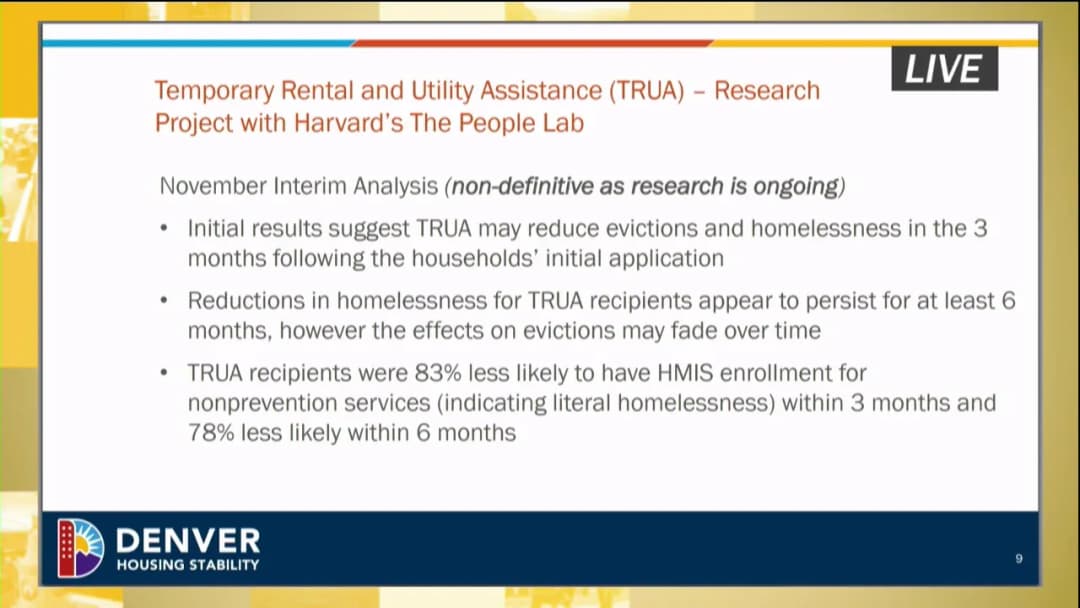
The Community Planning and Housing Committee of the Denver City Council met on Tuesday, December 2, 2025, at 12:00 PM. The meeting covered three main agenda items: approval of 2026 contracts for housing stability programs from the Department of Housing Stability (HOST), approval of miscellaneous shelter contracts, and a presentation and vote on a landmark designation for 1555 Grant Street. The committee voted to send all action items to the full council, including the landmark designation, which passed on a 5-1 vote despite significant concerns about designating a parking lot as historic. Consent Calendar - Approved eight HOST contracts for the Temporary Rental and Utility Assistance (TRUA) program, property tax relief, foreclosure financial assistance, and housing resource navigation. These included amendments to existing contracts with providers such as Brothers Redevelopment, Community Economic Defense Project, Jewish Family Service, and East Colfax Community Collective. The total funding amounts and households served were detailed in the presentation. - Approved one miscellaneous shelter contract for Work Options for Women, which provides meals at micro-communities. The contract is for six months at $9.97 per meal for breakfast/lunch and $11.47 for dinner. The motion was made by Councilmember Alvidrez and seconded by Councilmember Sawyer; all committee members voted in favor. Discussion Items - TRUA and Property Tax Relief Program Updates: Melissa Tati, Director of Stability and Prevention, presented an overview of the 2026 contracts. Key statistics: TRUA has $16.1 million available in 2025 and $15.1 million in 2026; as of November 24, 2025, over 1,500 households have been served with an average assistance of $7,600 over 4.9 months. The property tax relief program served over 1,200 households (59% renters, 41% homeowners) with average rebates of $1,400 for homeowners and under $1,000 for renters. Councilmembers discussed the historical underspend, outreach efforts, and the DPS pilot program which enrolled 89 families. Councilmember Torres requested district-level data for property tax relief. Councilmember Sawyer noted the eviction clinic on the first floor of the City and County Building provides TRUA case management and legal services. Council President Sandoval asked about school-level data for the DPS pilot. Councilmember Romero Campbell inquired about demographic data for property tax relief. Chair Perity requested month-over-month data for TRUA spending and updated eligibility criteria. The committee also discussed upcoming changes to property tax relief, including phasing out renters by 2030. - Miscellaneous Shelter Contracts: Jeff Kozitsky, Deputy Director of HOST, presented several contracts: Colorado Coalition for the Homeless Bridge Housing (175 clients in 2024, 72% exit to permanent housing), St. Francis Day Shelter (served 8,398 households in 2024), off-site storage (1,194 households), and SafeHouse Denver (domestic violence shelter, 123 clients). Councilmember Torres inquired about ownership of the storage building. Council President Sandoval raised concerns about meal container waste at micro-communities and the need for a second day shelter. Councilmember Sawyer discussed the importance of mail services at St. Francis and a recent meeting with DHS about benefits mail. Council President Sandoval also noted zoning challenges for a new day shelter and suggested a mapping exercise. - Landmark Designation for 1555 Grant Street: Kara Hahn, Landmark Planning Supervisor, presented the application from the Knights of Columbus to designate the entire parcel, including a parking lot, as a historic landmark. The property includes a 1928 event hall and a 1963 mid-century modern structure designed by architect John F. Milan, which features pre-stressed concrete double T members (a significant innovation). The property meets four of ten criteria: association with the Knights of Columbus (significant for hosting half a million service members during WWII), architecture, work of a recognized architect, and innovation in materials. Landmark staff and the commission recommended approval. Councilmembers expressed strong reservations about designating the parking lot as historic. Councilmember Sawyer questioned the rationale and noted it would freeze the parking lot in perpetuity. Council President Sandoval argued it sets a bad precedent, especially during a housing crisis, and questioned its impact on assessed value. Councilmember Torres asked about alternative options like rezoning, which the applicants said were not pursued. Councilmember Alvidrez noted other cities have landmarked parking areas like Chicago's Motor Club building. Councilmember Romero Campbell suggested checking for deed restrictions. Chair Perity rejected the idea that car culture deserves landmark protection and noted the parking lot only meets one of ten criteria. Despite these concerns, the committee voted 5-1 to send the designation to the full council, with Councilmember Lewis voting nay. The vote was not a statement on merits but on procedural readiness. Key Outcomes - All eight HOST contracts and the Work Options for Women contract were approved unanimously by voice vote and will proceed to the full council. - The landmark designation for 1555 Grant Street was moved out of committee on a 5-1 roll call vote (Councilmember Lewis opposed). The full council will consider the designation at first reading. Council members suggested the applicants might explore rezoning or a planned unit development (PUD) as an alternative to including the parking lot in the landmark.
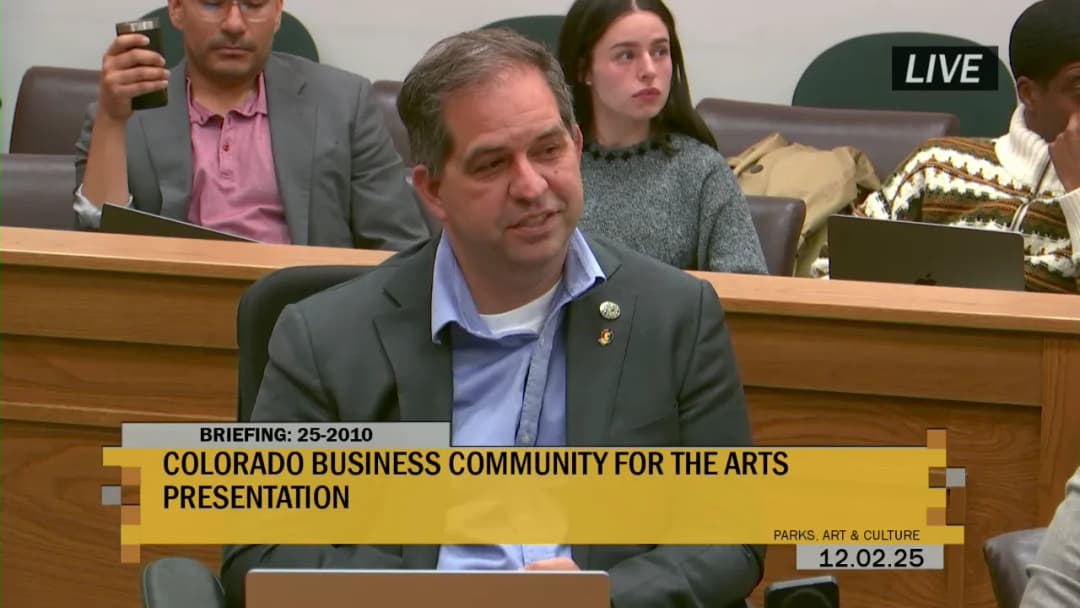
The Parks, Arts and Culture Committee of Denver City Council met on December 2, 2025, to receive a presentation from the Colorado Business Committee for the Arts (CBCA) on the economic impact of arts, culture, and scientific organizations in the Denver metro area. The presentation highlighted record-breaking figures, ongoing challenges, and policy priorities for the creative sector. Discussion Items - CBCA Economic Impact Study Presentation: Meredith Badler, Deputy Director of CBCA, presented findings from the biennial Economic Activity Study, conducted in partnership with the Scientific and Cultural Facilities District (SCFD). Key data points for 2024 included: - Total economic activity: $3.12 billion (a 36% increase over 2019 and a significant increase over 2022). - Cultural tourist spending: $692 million (record-breaking, with a large increase in international visitors). - Attendance: 14.5 million engagements (a 12% increase over 2022 but still below 2019 levels). - Educational experiences: 4.5 million (consistent increases over 2019 and 2022). - Jobs: 14,466 (an 8% increase over 2019, but personnel costs rose 46% over the same period). - Contributed income: $286 million in 2024 (a slight dip due to the end of federal pandemic relief, with a 90% decrease in federal support from 2022). Individual donations rose 10%, foundation giving rose 36%, and corporate giving rose only 4%. The SCFD provided $85 million, or 30% of contributed income. - Q&A with Council Members: Council Member Heinz questioned the relationship between declining attendance (still behind 2019) and rising revenue, and asked about inflation-adjusted changes. Council Member Watson asked about CBCA's equity and inclusion work statewide. Council Member Romero Campbell asked about disaggregating Denver-specific data (not provided due to regional focus), demographics of attendees (limited by SCFD reporting), and support for grassroots organizations. Council Member Sandoval highlighted the importance of arts for mental health and youth, and expressed concern about the loss of events like the Underground Music Showcase. Key Outcomes - Calls to Action: Badler emphasized the need for community attendance, increased corporate giving, and continued policy support for the creative economy. She shared a policy framework from community engagement focusing on accessible arts, creative economy support, creative worker sustainability, and arts education equity. - Upcoming Presentation: The committee noted that Andrea (SCFD) will present in February 2025 on the SCFD reauthorization process (scheduled for 2028). - No Formal Votes: The meeting did not include any consent calendar items, public testimony, or votes. The presentation was informational. Meeting Adjournment The meeting was adjourned after the presentation and discussion.