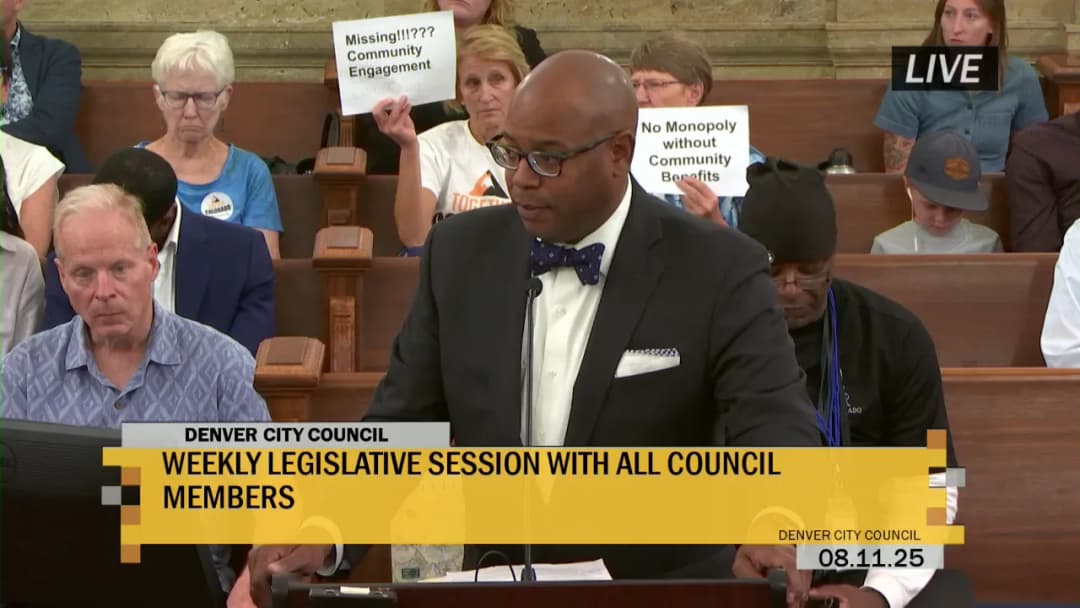
The Denver City Council met on August 11, 2025, from 3:30 PM to 9:20 PM in the Cathy Reynolds City Council Chamber. The meeting featured extensive debate on three major items: the proposed Xcel Energy franchise agreement and related contracts, a charter amendment to split at-large council seats into separate races, and an instant-runoff voting (IRV) proposal. All 13 council members were present. Key decisions included the failure of the Xcel franchise and operating agreements, approval of the at-large seat split measure for the November ballot, and rejection of the IRV proposal. Consent Calendar - Proclamation 25-1150 honoring Owen Brigner was adopted en bloc. - Resolution 25-1082 (Kappa Tower II loan amendment) was postponed to August 18, 2025, after a motion by Councilmember Lewis passed unanimously (13-0). - Resolution 25-0809 (Beeler Park Flats affordable housing loan) was initially flagged for postponement but later returned to consent after Councilmember Lewis received needed information. - A block of 16 resolutions and bills on final consideration were approved unanimously (13-0), including: - 25-1083 (Rock Drill Urban Redevelopment Plan public hearing) - 25-1061 (Civil Service Commission reappointment) - 25-1087 (Nossaman LLP contract amendment, $750,000) - 25-1086 (Bayaud Enterprises/ServiceSource contract, $715,064) - 25-1101, 25-1102, 25-1103 (Head Start contracts with Catholic Charities, Clayton Early Learning, and Denver Public Schools, totaling $7,906,819) - 25-1153 (settlement of $15,000 for Taylor Heit) - 25-1154 (settlement of $50,000 for Jordan M. Smith and Peter J. Weddle) - 25-1080 (public alley dedication) - 25-1062 (revocable permit for 2682 S. Cook Street) - 25-1072 (Jewell/Evans Station bicycle/pedestrian bridge design contract amendment, $287,390) - 25-1084 (DEN domes and ramps project, $5,156,165) - 25-1085 (DEN boarding passes and bag tags, $1,200,000) - 25-1044 (Community Corrections funding, $8,376,054) - 25-1043 (revoke permit for Argus of Colorado Home Health) Public Comments & Testimony - Xcel Energy Franchise Agreement (25-0922, 25-0987, 25-1149): Multiple speakers expressed opposition, including Councilmembers Gilmore, Lewis, Parady, Hinds, and Alvidrez, who argued the agreement lacked binding commitments on clean energy, data sharing, and customer service. Councilmember Gilmore read a detailed history of failed negotiations with Xcel regarding the Swire Coca-Cola project, highlighting delays that jeopardized $252 million in lease revenue. Councilmember Parady contrasted Denver's weak provisions with Boulder's franchise agreement, which includes data sharing, specific project lists, and carbon reduction targets. Public testifiers included Together Colorado members who criticized the lack of community engagement. Xcel President Robert Kenney and staff defended the agreement, noting the new binding Energy and Infrastructure Agreement (EIA) and commitments to service. Council President Sandoval and Councilmember Torres supported the EIA as a step forward, but the majority cited insufficient time for review and weak terms. - At-Large Council Seat Split (25-0920): Supporters included former Councilmembers Kendra Black, Debbie Ortega, and Doug Linkhart, who argued that requiring a majority vote for each at-large seat aligns with other citywide offices and reduces undervoting. Opponents, including Marilyn Ackerman, Kim Ray, Jesse Parris, and Luchia Brown, argued the change would confuse voters, reduce choice, and advantage well-funded candidates. They also noted that the proposal was not properly stakeholder-engaged and that ranked-choice voting or staggered terms would be better alternatives. Councilmember Lewis read a letter of opposition from the Colorado Civic Engagement Roundtable. - Instant-Runoff Voting (25-1014 and 25-1148): Supporters included Luchia Brown, Cory Montreuil, Aly Belknap, Cameron Hill, Jana Everett, Landon Mascareñaz, Susan Stark, and Evaristo Gomez, who highlighted reduced negative campaigning, cost savings, and higher voter satisfaction. Opponents, notably Rosemary Rodriguez, raised concerns about voter education costs and potential Voting Rights Act implications. Councilmember Flynn provided extensive data from 72 RCV elections, arguing that exhausted ballots disenfranchise voters and that RCV often fails to produce true majority winners. Discussion Items - Xcel Energy Franchise and Related Agreements: The council spent over two hours debating the three Xcel items. Key points: the franchise agreement (25-0922) would have submitted a 20-year right-of-way agreement to voters in November 2025; the operating agreement (25-0987) covered services at Denver International Airport; and the Energy and Infrastructure Agreement (25-1149) was a companion binding contract negotiated after the initial failure. Councilmembers Gilmore and Lewis detailed past failures in Xcel's service to Denver, especially for the Swire Coca-Cola project, and argued that the agreements lacked enforceable commitments on clean energy, reliability, and consumer assistance. Council President Sandoval and Councilmember Torres, who negotiated the EIA, argued it provided a binding framework for future collaboration, including a new advisory group and a $250,000 annual fallback for low-income assistance if state/federal funds were reduced. The EIA also included a commitment to explore data sharing, but Councilmember Parady noted it was weaker than Boulder's provisions. Xcel's Robert Kenney stated the company had invested $500,000 in the Swire project and had two substations planned for DIA. The votes resulted in defeat of all three items. - At-Large Council Seat Split (25-0920): Sponsors Councilmembers Flynn, Watson, Gilmore, Alvidrez, and Sawyer argued that the current system (plurality voting for two at-large seats) leads to winners with less than a majority, often around 30% of the vote. They proposed separate ballots for "At-Large A" and "At-Large B" to require a majority for each, aligning with other citywide offices. They cited historical data showing undervoting in at-large races is 12 times higher than in mayoral races. Opponents, including Councilmembers Lewis, Parady, Torres, and Gonzalez-Gutierrez, argued the change would reduce voter choice, favor incumbents, and increase the influence of money. Councilmember Lewis noted that only three people of color have ever been elected at-large, but argued the fix was not a structural change but a need for deeper engagement. The measure passed 7-6, sending it to the November ballot. - Instant-Runoff Voting (25-1014 and 25-1148): Sponsors Councilmembers Parady and Watson proposed charter amendments to allow IRV, which would eliminate separate runoff elections by allowing voters to rank candidates. They argued it would save money, increase turnout, and reduce negative campaigning. Councilmember Watson emphasized that IRV would force candidates to reach beyond their base. Councilmember Flynn led opposition, citing data that RCV often results in exhausted ballots (13% on average) and fails to produce majority winners. He also noted that the proposal would require repeal of the charter's majority-vote requirement for other offices. The measures failed 6-7. Key Outcomes - Council Bill 25-0922 (Xcel franchise agreement) failed (6-7). - Council Bill 25-0987 (Xcel operating agreement for DEN) failed (0-13). - Council Resolution 25-1149 (Energy and Infrastructure Agreement) failed (0-13). - Council Bill 25-0920 (At-large seat split) passed (7-6) and will be on the November 4, 2025 ballot as a charter amendment. - Council Bill 25-1014 (IRV charter amendment) failed (6-7). - Council Bill 25-1148 (IRV implementation) failed (6-7). - Resolution 25-1082 (Kappa Tower II) postponed to August 18, 2025. - All other consent agenda items were approved unanimously. - Next steps: A public hearing on zoning change 25-1070 (2501 South High Street) is scheduled for September 8, 2025, with protests due by September 2, 2025.
Public Meetings - Denver, Colorado
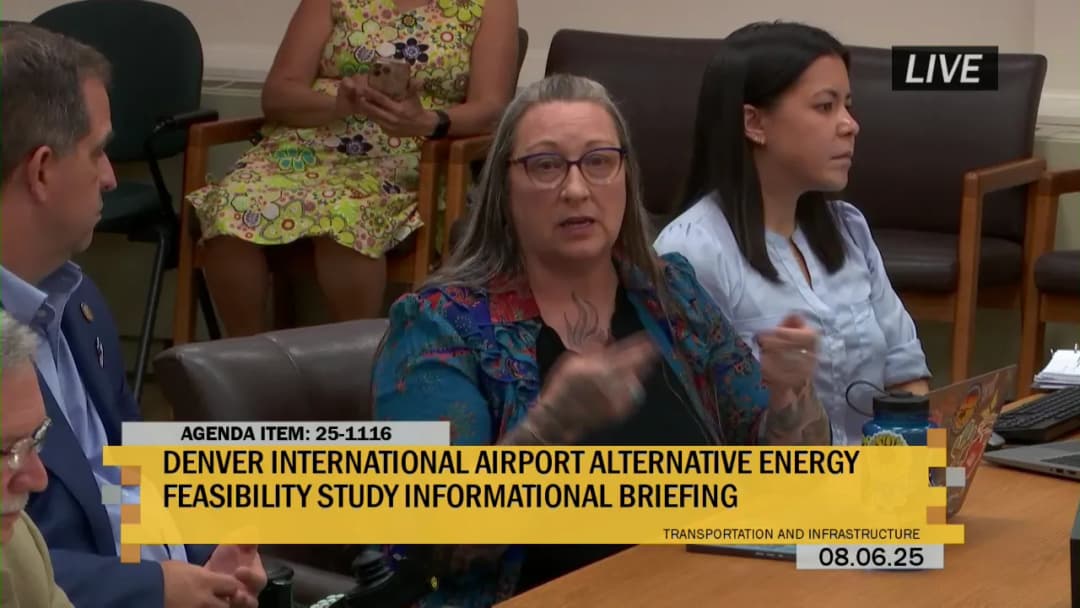
Public Meetings - Denver, ColoradoThe Transportation and Infrastructure Committee of Denver City Council met to receive a briefing from Denver International Airport (DEN) officials on a feasibility study for Small Modular Nuclear Reactors (SMRs) as an alternative energy source. The discussion centered on DEN's growing power needs, potential benefits of SMRs, and significant concerns regarding safety, water usage, radioactive waste, and community engagement. Discussion Items - DENS Alternative Energy Feasibility Study Briefing: DEN CEO Phil Washington presented the airport's plan to issue a Request for Proposal (RFP) for a feasibility study on SMRs, released earlier that morning. He stated that DEN's current energy demand is 45 megawatts, with projections requiring an additional 235-400 megawatts due to expansion. Washington emphasized that SMRs could provide carbon-free power, enhance resilience, and create career pathways, but noted the study would first assess viability without commitment. - Council Member Questions and Positions: - Councilman Hines expressed full support for the study, aligning with DEN's goal to become the greenest airport and praising the innovative approach. - Councilwoman Gilmore raised strong opposition to the lack of prior communication, citing that the RFP was released without consulting her as the district representative. She voiced concerns about water usage (250-400 gallons per reactor), radioactive waste disposal, environmental risks near the Rocky Mountain Arsenal Superfund site, and potential impacts on community water rights. - Council President Sandoval sought clarity on the RFP details, asking about radioactive waste management, water cooling technologies, decommissioning plans, and safety regulations. She requested access to the RFP and suggested adding comparisons to other green energy sources. - Other council members, including Flynn and Watson, inquired about costs, scalability (starting at 75 megawatts, up to 924 megawatts), interaction with Excel Energy's grid, and community outreach requirements. DEN officials agreed to incorporate additional questions into the study tasks. Key Outcomes - DEN released the RFP for the feasibility study, which will run for approximately 90 days, with vendor selection expected in Q4 2025. The study duration is estimated at 6-12 months. - DEN committed to providing the RFP to the committee, adding tasks such as comparing SMRs to other clean energy sources, and returning with updates before contract award. - DEN acknowledged the need for community engagement, with Washington pledging to work with Councilwoman Gilmore on outreach meetings in District 11 and to comply with environmental regulations. - No formal votes were taken; the briefing was informational, with next steps including council review of any future contract for the study.
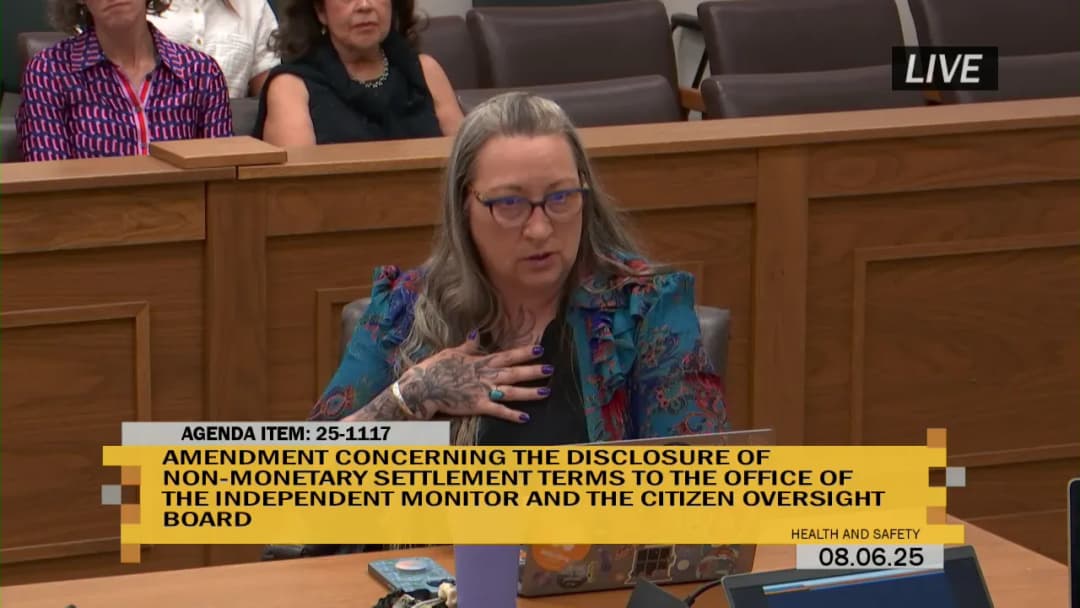
The Health and Safety Committee of the Denver City Council, chaired by Darrell Watson, met on August 6, 2025 at 9:15 AM to consider one action item and four consent items. The action item (25-1117) was an ordinance amending the municipal code to require disclosure of non-monetary settlement terms to the Office of the Independent Monitor (OIM) and the Citizen Oversight Board (COB). The committee voted 7-0 to approve the ordinance for filing, and all consent items were approved. Consent Calendar - 25-1101: Approved a contract with Catholic Charities for $1,803,786 to provide Head Start services through Denver Great Kids Head Start (DGKHS), citywide, ending June 30, 2026. - 25-1102: Approved a contract with Clayton Early Learning for $2,462,604 for Head Start services, same terms. - 25-1103: Approved a contract with Denver Public Schools for $3,640,429 for Head Start services, same terms. - 25-1106: Approved an amendment to an Intergovernmental Agreement with the Colorado Department of Human Services adding $1,935,836.67 for a new total of $5,286,364.76, extending 12 months to June 30, 2026, for continued access to Equifax Verification Services. Public Comments & Testimony - Elizabeth Perez Castle (Independent Monitor): Expressed support for the ordinance, stating it will increase transparency and accountability for harm by law enforcement, allowing the OIM to review individual and systemic harm. - Julia Richmond (Chair, Citizen Oversight Board): Fully supported the changes, noting that non-monetary settlement terms often drive structural changes to prevent future harm. She cited examples where the city either did not fully comply or did the bare minimum, and that the ordinance will help monitor compliance. - No other members of the public spoke. Discussion Items - Action Item 25-1117 – Ordinance on Disclosure of Non-Monetary Settlement Terms: - Councilmembers Jamie Torres and Stacy Gilmore presented the ordinance, which requires the city attorney to forward full settlement agreements with non-monetary terms to the OIM and COB within 30 days of final settlement or council approval. It applies to allegations of improper conduct by public safety and agreements requiring departmental action, but excludes discipline or disqualification appeals. - Background: The COB reviewed over 150 settlement agreements (2017-2024) and found only four with non-monetary terms. Three examples (Michael Marshall, Jamal Hunter, Emily Rice) were highlighted where terms were not disclosed. The ordinance aims to prevent future gaps. - Councilmember Kevin Flynn asked for details on the four non-monetary settlements. Julia Richmond provided them: Jessica Hernandez (2017, fatal police shooting), Michael Marshall (2017), Susan Green (2019, wrongful arrest for First Amendment recording), and a class action selective enforcement of curfew against George Floyd protesters (2023). - Councilmember Sarah Parady raised questions about settlement compliance and whether council should also receive the information. Councilmember Torres noted they may add provisions for reporting back to council. - Broader discussions included the need for more oversight resources, the OIM being understaffed, and the COB having two vacancies (one for 18 months). Education-based discipline was also discussed, with COB chair Julia Richmond warning it could undermine accountability. - Councilmember Amanda Sandoval and others emphasized the importance of filling COB vacancies and ensuring the OIM has adequate staffing. Key Outcomes - Action Item 25-1117: The committee approved the ordinance for filing by a vote of 7-0 (Ayes: Flynn, Gonzales-Gutierrez, Parady, Sandoval, Sawyer, Torres, Watson; Nay: 0). It will proceed to first reading at the full council meeting on August 25, 2025. - Consent Items: All four resolutions (25-1101, 25-1102, 25-1103, 25-1106) were approved by consent. - Next Steps: Councilmembers Torres and Gilmore indicated they may add amendments before first reading, including requiring the Department of Safety to publicly post non-monetary settlement terms (already initiated) and requiring annual reports to council on compliance. - Other: The committee noted that Chief Thomas's presentation on education-based discipline, originally scheduled, has been rescheduled to August 19, 2025.
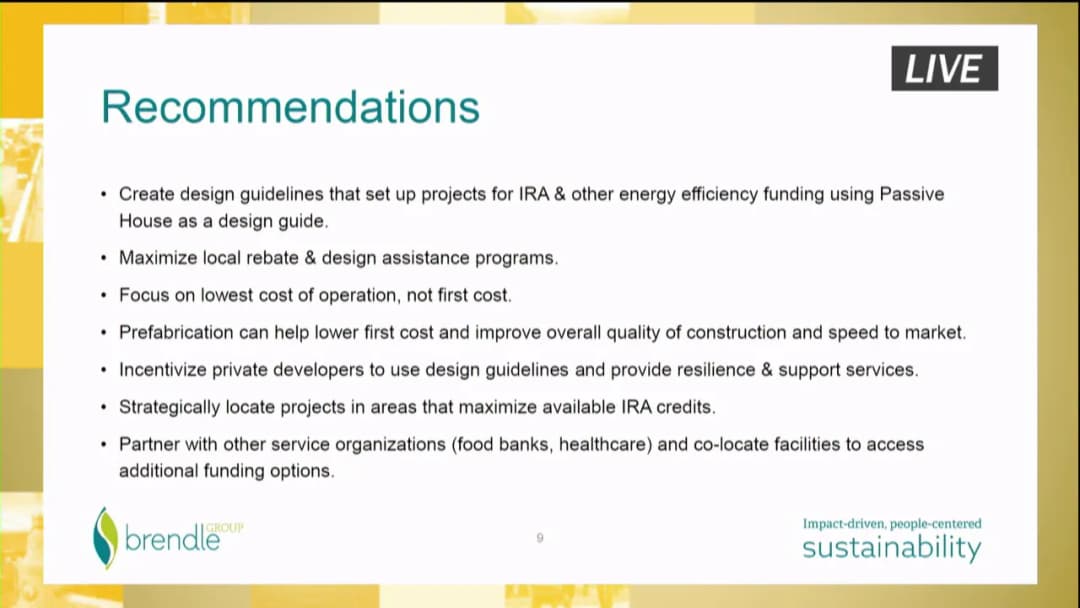
The Community Planning and Housing Committee convened on August 5, 2025, with a packed agenda focusing on affordable housing financing, a rezoning request, and a study presentation on sustainable social housing. Discussions involved detailed presentations and council member inquiries on resident impacts, affordability, and environmental standards. Consent Calendar - One routine consent item was not called off, leading to adjournment without further action. Discussion Items - Kappa Building Loan Agreement Amendment: Housing Stability Department staff (Autumn Bueller, Maureen Morley) presented an amendment to allow future development of Kappa Tower 3 for senior affordable housing. Councilmember Lewis expressed concerns about resident council involvement and challenges with a new online rent payment system disproportionately affecting seniors. Management representatives (Adrian Leah, Larry Williams) acknowledged the issues, discussed efforts to provide alternatives like e-money orders, and stated that late fees were waived during the transition. - Rezoning at 4626 East Louisiana Avenue: CPD staff (Edson Ivanis) presented a request to rezone from single-unit to row-house district, recommending approval based on consistency with area plans. Councilmember Torres inquired about the property owner's intentions, and Councilmember Sawyer raised concerns about gentrification and affordability. The applicant's architect (Howard) stated the owner aims for middle-class attainable housing but may sell the property after rezoning. - Green Social Housing Study: Consultants from Brundel Group (Shelby Summer, Paulina Somosa) presented findings from a 2024 study on sustainable affordable housing, highlighting case studies with passive house design and social services. Recommendations included adopting passive house standards and braiding funding opportunities. Agency representatives (e.g., from HOST, CPD) discussed existing green building codes and data tracking efforts. Key Outcomes - Motion to move the Kappa building loan agreement amendment to full city council, seconded and approved. - Motion to move the rezoning request to full city council, seconded and approved. - No formal votes were taken in committee; both items advanced for further consideration at the full council level.
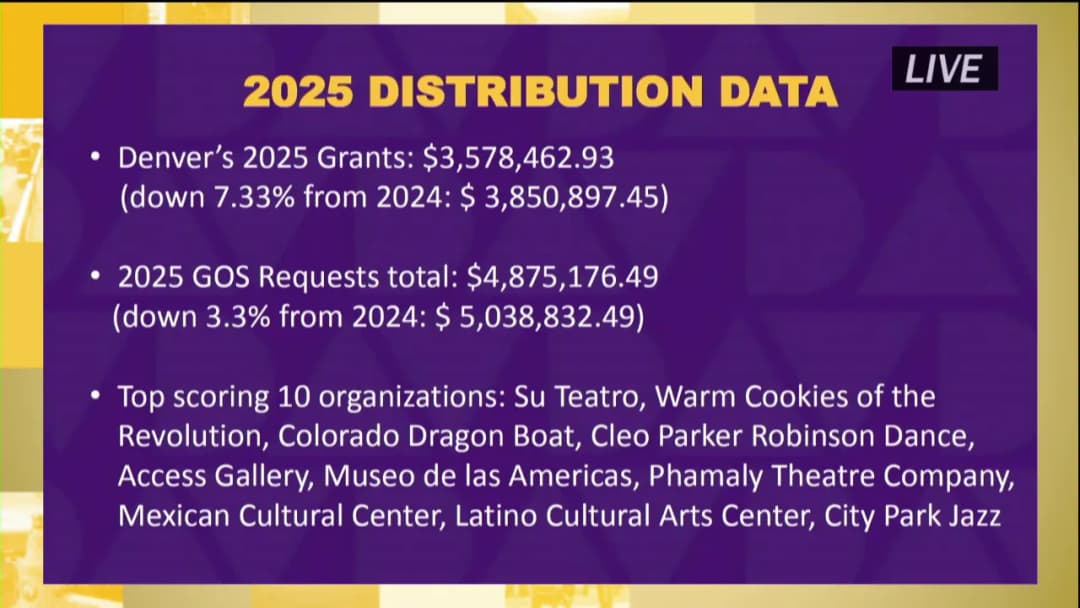
The Arts and Culture Committee convened for a presentation and discussion on the Scientific and Cultural Facilities District (SCFD) funding allocated to Denver's tier three arts and cultural organizations. Representatives from Denver Arts and Venues and the Denver County Cultural Council provided details on the funding process, evaluation criteria, and 2025 distributions, followed by questions from council members. Discussion Items - Presentation on SCFD Funding: Tariana Navas Nieves, Deputy Executive Director for Denver Arts and Venues, and José Rosales, Chair of the Denver County Cultural Council, outlined the SCFD structure, including tier one (64% to major organizations like the Denver Art Museum), tier two (22% to mid-sized groups), and tier three (14% to community-based organizations). They explained that Denver's tier three organizations will receive $3.5 million in 2025, distributed to 87 groups, with a focus on general operating support. The evaluation rubric emphasizes organization mission, operations, equity, financial responsibility, and impact on residents. José Rosales noted that the council decided to roll the 5% discretionary fund into general operating support this year to address funding decreases and organizational needs. - Council Q&A: Council Member Diana Romero Campbell asked about grant guidelines, confirming that funds are primarily for general operating support and that requests are capped at 25% of income or $90,000. She expressed full support for this approach, stating it reduces administrative burden on organizations. Council Member Sarah Parity inquired about organization eligibility, diversity tracking, and county allocations. José Rosales explained that Denver prioritizes equity, with top-scoring organizations including diverse groups like Su Teatro and Warm Cookies of the Revolution. Council Member Parity expressed appreciation for Denver's commitment to diversity and inclusion in arts funding, especially in a national context where DEI efforts are being challenged. Tariana Navas Nieves added that funding allocations per county are based on sales tax revenue generated in that county.
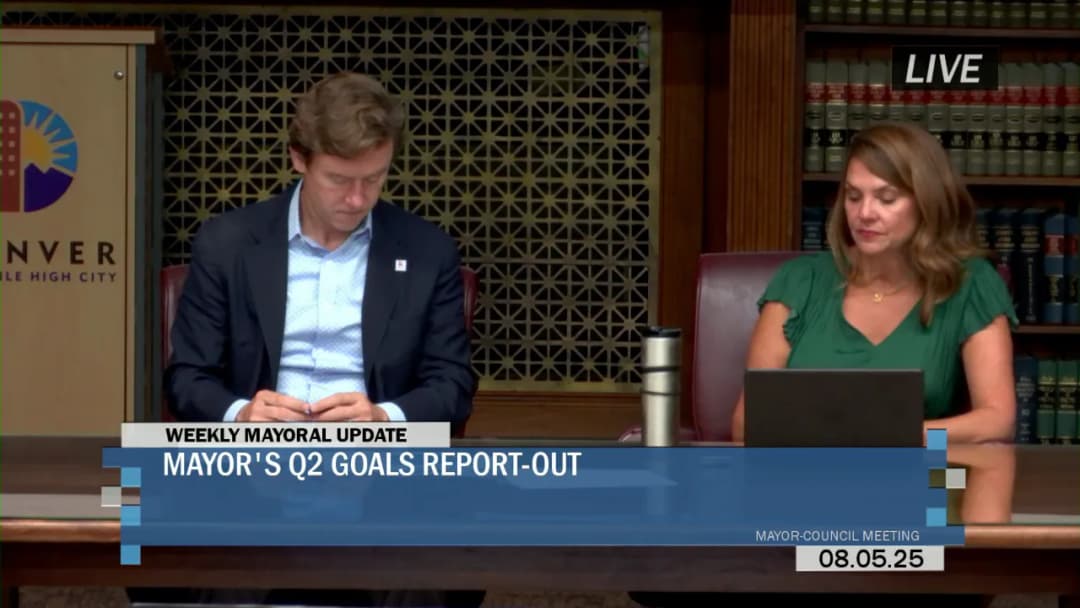
The Denver City Council convened for a meeting focused on a mid-year progress report from the Mayor on six key citywide goals. The session included announcements of upcoming community events, a detailed presentation on goal achievements and challenges, and a subsequent discussion among council members. The meeting concluded with a motion to enter an executive session. Announcements - Council members announced several upcoming community events, including: a two-day Asian and Latino heritage festival; the South by Southeast Festival featuring the Colorado Symphony; the Park Hill Day of Legends youth sports event; and a movie night in Zuni Park. Discussion Items - Mayor's Quarterly Goals Update: The Mayor provided a detailed progress report on the city's six strategic goals for 2025: - Vibrant: Highlighted community involvement in the bond package, the reopening of the 16th Street Mall, 41 new downtown leases, and the launch of the Denver Permitting Office. - Safe: Reported significant decreases in violent crime, including a nearly 50% reduction in homicides and a 66% drop in resident calls regarding homelessness over two years. Noted ongoing work with the Place Network Investigations (PNI) initiative to address crime hotspots. - Affordable: Stated the city has created about 1,100 affordable units, behind the goal of 3,000. Launched a middle-income housing program and an RFP for developing affordable housing on city-owned land. Expressed concern over cuts to federal and state housing vouchers impacting progress. - All-In Mile High (Homelessness): Reported over 1,500 people moved indoors, ahead of the 2,000-person goal. Noted 743 exits to permanent housing, below the 1,000-person target, attributing the shortfall partly to voucher cuts. - Climate Resilient: Reported good progress on installing heat pumps, EV chargers, and solar arrays, and planting 3,000 trees. Expressed confidence in meeting water conservation goals through natural landscaping. - Family-Friendly: Reported 34,000 children connected to out-of-school programming and over 3,000 youth placed in summer jobs, surpassing the 2,500 goal. - Council Questions and Comments: - Councilwoman Torres emphasized involving partners like the Denver Housing Authority in affordable housing development. - Councilwoman Sandoval inquired about the continuation of the PNI public safety initiative and was assured it is active and effective. - Council President Pro-Tem sought more detailed data on family homelessness and its connection to affordable housing. - Councilman Watson shared a positive anecdote from a visitor noting the visible reduction in street encampments and inquired about the city's response to the emerald ash borer threat to the tree canopy. - Councilwoman Sandoval initiated a discussion on redefining "play" in the city to be inclusive of all ages and intergenerational activities, beyond traditional playgrounds. Key Outcomes - The council unanimously voted to enter an executive session to receive legal advice and discuss a potential settlement against the city.
The Budget & Policy Committee of the Denver City Council met on August 4, 2025, to discuss a proposed ordinance aimed at preventing the retail sale of dogs, cats, and rabbits from commercial breeding facilities, commonly known as 'puppy mills.' Councilmember Hines led the presentation with advocates from Colorado Voters for Animals and Humane World for Animals. The proposal is preventative, as there are currently no pet stores selling these animals in Denver. Public Comments & Testimony - Roland Halpern (Colorado Voters for Animals) expressed support, urging preventative action to deter high-volume, out-of-state pet stores with poor animal welfare and consumer protection records from opening in Denver. - Amy and Jesse (Humane World for Animals) provided supporting data and emphasized the public health risks and financial burdens associated with puppy mill animals. They advocated for the ordinance to protect consumers and animals. Discussion Items - Ordinance Overview: Councilmember Hines presented the proposal to prohibit pet shops from selling, bartering, or transferring dogs, cats, and rabbits. The ordinance would not affect responsible local breeders, pet stores hosting adoption events with shelters, or stores focusing on pet products/services. - Rationale: Advocates described puppy mills as operations that prioritize profit over animal health, leading to sick animals, costly medical expenses for buyers, and predatory lending schemes. They cited a 44% increase in animal intake at Denver Animal Shelter and over 500 localities with similar bans. - Ordinance Language: The specific text (proposed for Chapter 8, Article 4, Division 1 of the DRMC) was reviewed. It bans retail sales but allows shelters/rescues to host adoption events on pet shop premises. - Clarifications & Questions: - Councilmembers sought clarity on the ordinance's scope, including its interaction with a new state law banning unlicensed parking lot sales (which exempts licensed shelters). - It was confirmed the ordinance applies only to retail pet shops (as defined by existing code) and would not affect sales at events like the National Western Stock Show. - Enforcement was discussed; Excise & Licenses would handle licensing, and DDPHE's Animal Welfare division would likely handle enforcement for existing businesses. - The definition of a 'pet shop' as a business involved in selling/trading pet animals was confirmed. Key Outcomes - The committee discussed the proposal with no formal vote taken during this initial presentation. - Next Steps: Councilmember Hines will distribute the final ordinance language to all council members. The proposal will be referred to the appropriate committee (likely Excise & Licenses or the committee overseeing DDPHE) for a voting recommendation.
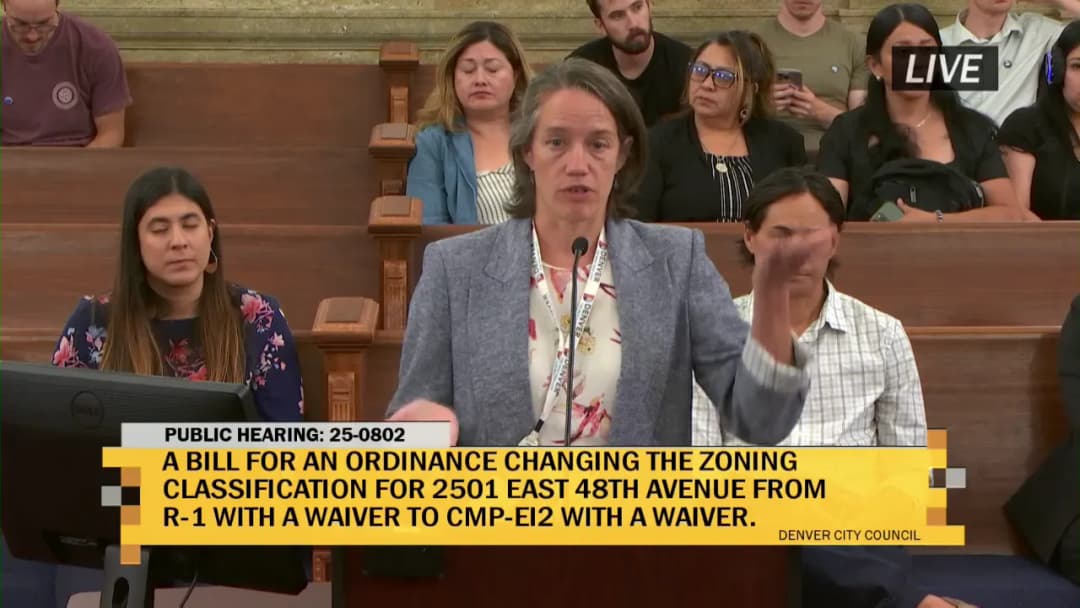
The Denver City Council held a regular meeting on August 4, 2025, starting at 3:30 PM and adjourning at 12:02 AM on August 5. The meeting included proclamations, adoption of resolutions, and final consideration of several major items, including the $950 million Vibrant Denver Bond package, the creation of the Broadway Denver General Improvement District, and the repeal of minimum parking requirements. The council also heard public testimony on zoning changes and debated a rezoning application that ultimately failed. Consent Calendar - Approved the minutes of July 28, 2025 (25-1118). - Adopted Proclamation 25-1123 recognizing National Health Center Week (August 3-9, 2025). - Adopted Proclamation 25-1124 recognizing the annual Brothers Redevelopment and Denver Employee Volunteer Opportunities Paint-A-Thon Day on August 9, 2025. - Approved all resolutions on the consent agenda en bloc, including: - 25-1033: Master Purchase Order with United Rentals ($950,000). - 25-1038: Appointment of Heather Edwards to the Mile-High Regional Emergency Medical & Trauma Advisory Council. - 25-1020: Grant agreement with Clayton Early Learning ($1,000,000). - 25-0978: Amendment with West Publishing Corporation for investigative database access ($320,000 addition). - 25-0999: Grant agreement with the Office of National Drug Control Policy ($842,544). - 25-0876: Amendment with Hamon Infrastructure for Jewell/Evans Bicycle and Pedestrian Bridge ($15,885,703.90 addition). - 25-1019: Contract with BNSF Railway for Washington Street Revitalization ($783,615). - 25-1034 to 25-1047: Various street and alley dedications across districts 1, 3, 6, 8, and 11. - 25-1045: Amendment with Merchant Aviation for Denver International Airport planning services ($2,000,000 addition). - Placed bills for introduction on final consideration: - 25-1044: Amendatory Revenue Agreement for Denver Community Corrections ($8,376,054.13 addition). - 25-1043: Revocation of permit for Argus of Colorado Home Health. - Approved classification and pay plan changes (25-1010) en bloc. Public Comments & Testimony - Broadway Denver General Improvement District (25-0917): 13 speakers spoke in favor, including business owners, residents, and representatives of the Broadway Merchants Association. They cited safety concerns, cleanliness, and the need for enhanced services to support small businesses. One speaker, Jesse Parris, opposed the district, arguing it could lead to gentrification and displacement. - Rezoning 2501 East 48th Avenue (25-0802): 14 speakers testified. Supporters (including staff from Focus Points and community members) highlighted the need for affordable housing and community services. Opponents (including former participants and advocates) alleged labor exploitation by Focus Points and questioned the lack of a concrete development plan. The GES Coalition (Tierra Collective) stated they were not partners but had reached a mediated MOU. - Repeal of Minimum Parking Requirements (25-0684 and 25-0685): 31 speakers testified, all in favor. They cited benefits to housing affordability, climate goals, and walkability. No speakers opposed the measure during the public hearing, though written opposition was noted from some residents. Discussion Items - Vibrant Denver Bond Package (25-1060, 25-1053-1057): The council debated and amended the bond package, which authorizes up to $950 million in general obligation bonds for voter approval on November 4, 2025. Key amendments included: - Reducing the transportation bond from $446.42 million to $441.42 million (removing the citywide street paving program and shifting funds). - Reducing the facilities bond from $252.43 million to $244.43 million (removing non-specific city facility improvements). - Increasing the housing and shelter bond from $46.3 million to $59.3 million, with language clarifying funds support affordable housing and mitigate residential displacement. - These changes were part of a package to replenish the affordable housing line item to $59.3 million. Councilmembers Alvidrez, Hinds, and Parady expressed concerns about the process, equity, and undefined projects, with Alvidrez voting no on the transportation and facilities bonds. The bond package passed with amendments, sending six ballot questions to voters. - Broadway Denver General Improvement District (25-0917): After public testimony, the council approved the creation of the district, which will impose a mill levy of up to 8.96 mills on taxable property. The district will fund safety, cleaning, maintenance, and marketing. The district must hold a special election in November 2025 for voter authorization of the mill levy and potential debt issuance. - Rezoning 2501 East 48th Avenue (25-0802): The council debated a request to rezone property from R-1 with a waiver to CMP-EI2 (campus education institution) with a waiver. Staff from Community Planning and Development recommended approval, citing the affordable housing plan (18% of units at 70% AMI). However, councilmembers raised concerns about inconsistency with the Elyria Swansea Neighborhood Plan (which recommends 2.5 stories), lack of a concrete development plan, and allegations of labor violations at Focus Points. After a motion to postpone failed, the rezoning was voted down 12-0. - Modernizing Parking Requirements (25-0684 and 25-0685): The council considered a text amendment to repeal minimum vehicle parking requirements citywide, going beyond state law HB 1304. Supporters argued it would reduce housing costs, improve environmental sustainability, and streamline city processes. Councilmembers Sawyer and Flynn opposed, citing concerns about local control, lack of reliable transit, and potential overparking by developers. The measure passed 9-3. - Consequential Parking Repeal (25-0686): A companion bill repealing parking incentives and exemptions in Chapter 27 (Housing) passed 9-3. Key Outcomes - Vibrant Denver Bond Package: Approved as amended (25-1060, 25-1053-1057). The bond package will be placed on the November 4, 2025 ballot for voter approval. The total bond amount is $950 million, with maximum repayment costs adjusted accordingly. Votes: 25-1060 (13-0), 25-1053 (11-2), 25-1054 (11-2), 25-1055 (13-0), 25-1056 (12-1), 25-1057 (13-0). - Broadway Denver General Improvement District: Approved (12-0). The district will be established subject to voter approval in November 2025. - Rezoning 2501 East 48th Avenue (25-0802): Failed (0-12). The application is denied with a one-year cooling-off period for the same zone district. - Repeal of Minimum Parking Requirements (25-0684 and 25-0685): Passed (9-3). The zoning code and Chapter 59 amendments take effect immediately. - Repeal of Parking Incentives (25-0686): Passed (9-3). - Postponed Items: Council Bills 25-0922 (Xcel Energy franchise) and 25-0987 (Xcel Energy operating agreement at DEN) were postponed to August 11, 2025. - Adjournment: The meeting adjourned at 12:02 AM on August 5, 2025.
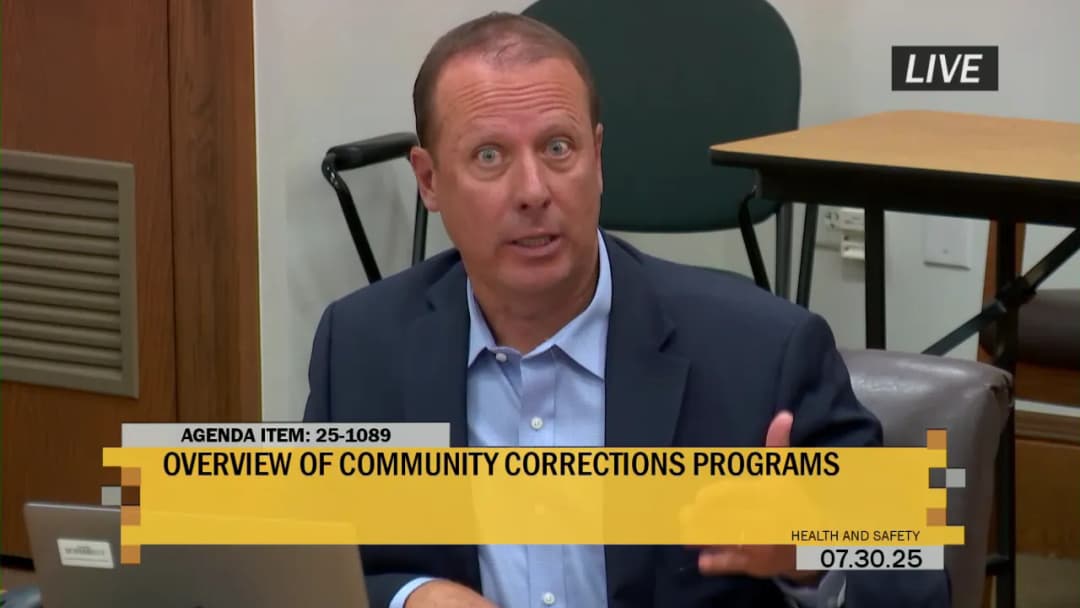
The Denver City Council Health and Safety Committee convened on July 30, 2025, for a briefing on the city's Community Corrections programs. The Department of Safety's Director of Community Corrections, Greg Morrow, and managers Stephanie Robertson and Aubrey Cote presented an overview of three program models: residential services (halfway houses), pretrial services, and in-home detention. The committee engaged in a Q&A session focusing on program capacity, demographics, outcomes, and impacts on participants. Briefing & Discussion Items - Presentation Overview: Greg Morrow outlined the three core community corrections models providing alternatives to incarceration, emphasizing their role within a comprehensive public safety strategy. - Residential Services (Halfway Houses): The presentation detailed referral pathways, participant demographics (78% with mental health needs, 71% with substance use issues), and current capacity challenges. The city has 273 beds open, down from a 2019 capacity, with over 140 individuals waiting in jail or DOC. Efforts to open a fourth site at the Dahlia property are delayed until late 2026. Outcomes included a less than 2% termination rate for new crimes and a 59% successful completion rate in 2024. - Pretrial Services: The team explained the constitutional framework for bail, their 24/7 risk assessment and reporting for courts, and supervision of release conditions. Data showed about 2,300 individuals supervised daily, with a 63% overall success rate for court appearance and no re-arrest. - In-Home Detention: This sentencing alternative, primarily for DUIs, involves electronic monitoring with high success rates and an average 30-day stay. - Community Corrections Board: The board's composition, including 21 members with criminal justice expertise and lived experience, and its role in reviewing referrals were discussed. Committee Questions & Key Points - Councilmember Flynn sought clarification on population statistics and program success rates, expressing concern over the multi-year delay in rebuilding bed capacity since 2019. - Councilmember Gonzalez Guterres inquired about the demographics of the Community Corrections Board and requested a comparative analysis of program participant demographics versus the general jail population to identify potential disparities in access to alternative programs. - Councilmember Parity followed up on a prior study with Arizona State University regarding the effectiveness of electronic monitoring (GPS) for the pretrial population, particularly in domestic violence cases. Aubrey Cote indicated preliminary data showed GPS did not increase new crime after removal, and a final report is pending information from the Colorado Bureau of Investigation. - Council President Pro Tem (online) asked about the impact of federal immigration enforcement actions on court attendance and the pretrial system. Greg Morrow stated the department does not track immigration status but acknowledged anecdotal reports of fear impacting participation. - Chairperson Watson invited staff to share success stories. Stephanie Robertson highlighted participant achievements including long-term housing stability, sobriety, family reunification, disruption of intergenerational incarceration, and community violence reduction, crediting staff with lived experience for their supportive role. Key Outcomes - The committee received an informational briefing. No votes or formal actions were taken. - Department staff committed to providing follow-up data, including a slide comparing the race/ethnicity of program participants to the Denver jail population. - The committee acknowledged the ongoing capacity shortage in residential programs and the delayed opening of the Dahlia facility. - The study on electronic monitoring effectiveness is ongoing, with final results contingent on data from the Colorado Bureau of Investigation.
The joint meeting of the Mayor and Denver City Council was a short general session focused on announcements and reflections from the previous night's bond vote hearing. Council members and the mayor discussed ongoing commitments to city services and collaboration. Discussion Items - Council Member Daryl Watson addressed the bond vote, emphasizing that the exclusion of funding for the clerk and recorder's office does not reflect a lack of support for fair and transparent elections. He expressed respect for the clerk and called for collaborative efforts to find solutions. - The mayor echoed Council Watson's sentiments and stressed the importance of city departments delivering high-quality services within existing fiscal constraints, noting the need for efficiency amid challenging economic conditions.