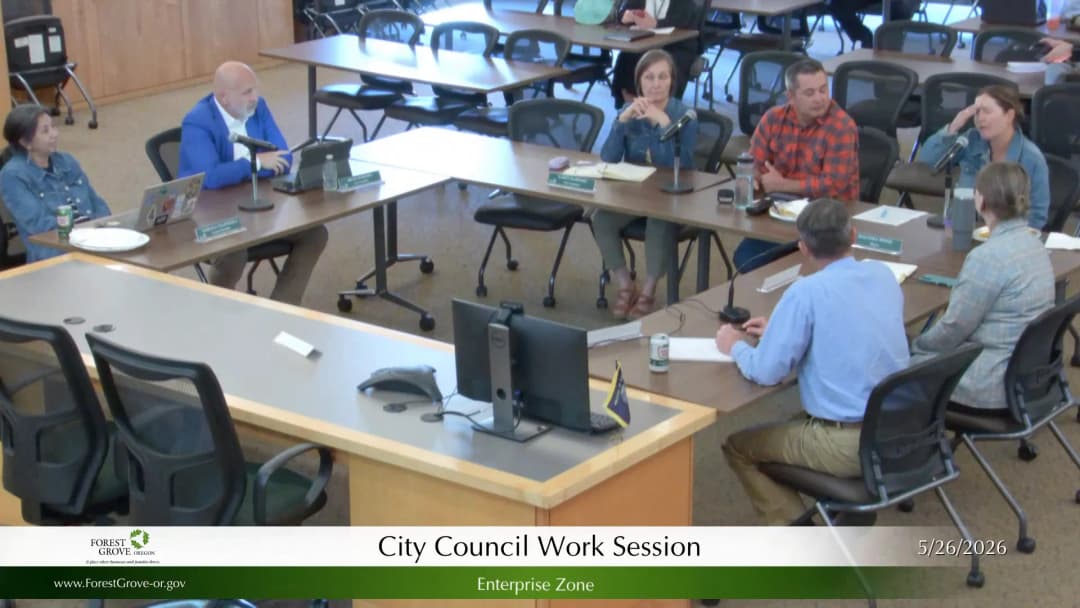
The Forest Grove City Council convened a work session on May 26, 2026, to discuss the city's enterprise zone program, which expires June 30, 2026, and to review federal activities including a FOIA request to ICE and updates on police mask-wearing policy. No public comment was taken and no formal action was taken, as this was a work session. Discussion Items - Enterprise Zone Overview and Policy Questions: Staff presented a comprehensive overview of the state enterprise zone program, its history in Forest Grove (since 2006, amended to include Cornelius in 2008, extended to 2026), and the state and local requirements for three-year and five-year tax abatements. The program has resulted in 14 applications, 421 jobs, and $129 million in investment since inception, with two active applications for 36 jobs and $321 million investment. Staff outlined 12 policy questions for council consideration, including: the geographic area, duration (three vs. five years), application fee cap, minimum investment, number of jobs required, wage requirements, community support fee, school support fee, limitations on extensions, pre-application requirements, and potential moratoriums on specific industrial uses. - Council Discussion on Enterprise Zone: Councilor Valenzuela expressed support for continuing the program but with modifications to align with the city's 2040 plan and community goals. Councilor Schimmel emphasized the need for strategic alignment with long-term plans, employment objectives, infrastructure capacity, and neighborhood compatibility. Councilor Martinez questioned the school support fee (currently 15% going to state) and whether the city could direct funds locally. The mayor noted that the state moratorium on data centers is for one year and the city may have tools to address specific industries through job requirements. Staff clarified that if the council wishes to make changes, the current program would need to be allowed to expire and a new application submitted, or the program could be extended without changes. The council will have another work session at the first June meeting to discuss specific policy decisions. - Federal Activities Update: City Recorder Mariah reported on a FOIA request submitted to ICE on January 27, 2026, for records of ICE activities in Forest Grove. The request has not been processed beyond the 20-day window; a follow-up received a response on May 12 stating it is in queue. Options include mediation or an administrative appeal. Police Chief reported no local incidents of individuals impersonating ICE agents. The city is awaiting a vendor update on a mask-wearing policy to align with state law, but currently compliant with name tag requirements. - Council Discussion on Federal Work Sessions: The mayor proposed that future federal activity work sessions be scheduled only upon council request during council communications or if an incident warrants, rather than on a regular schedule. Council concurred with this approach. Key Outcomes - The council will hold a work session at the first June 2026 meeting to decide whether to renew, modify, or let the enterprise zone program expire. Staff will provide additional information as needed. - The council agreed not to schedule regular work sessions on federal activities; instead, sessions will be added per council request or emergent need. - The city will continue to pursue the ICE FOIA request and may seek mediation or file an administrative appeal. - No formal actions were taken at this work session.
Public Meetings - Forest Grove, Oregon
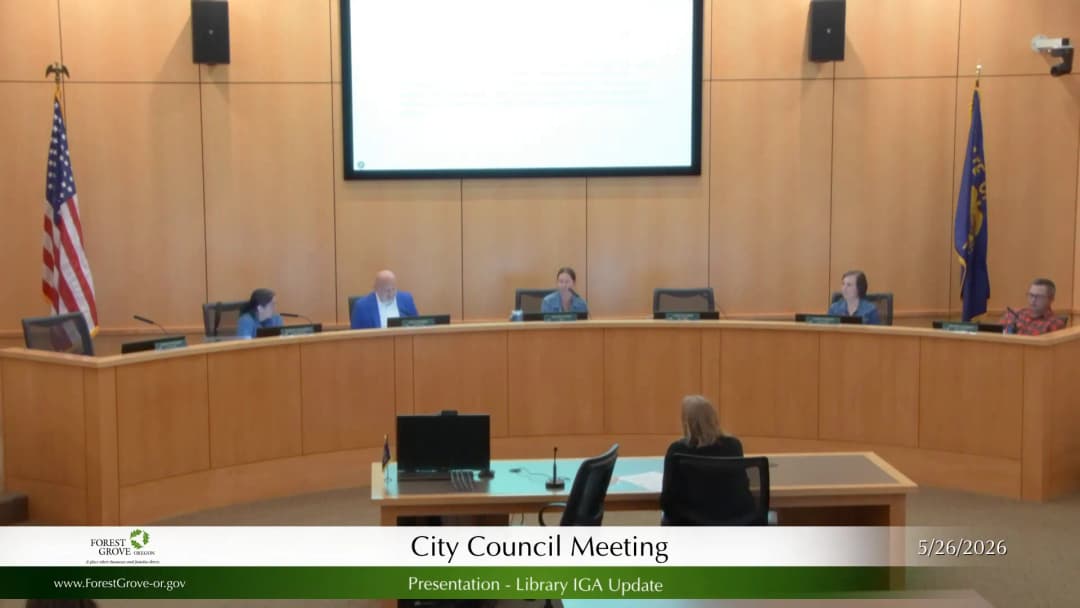
Public Meetings - Forest Grove, OregonThe Forest Grove City Council met on May 26, 2026, to address a consent agenda, public comments, multiple resolutions, and council communications. Key discussions included library funding, police services, fee adjustments, labor agreements, and emergency planning. Consent Calendar - The consent agenda was approved unanimously (5-0) with no items removed or discussed separately. Public Comments & Testimony - David Dion made a public comment questioning the purpose of federal agencies such as ICE, DHS, FBI, and the National Guard. He argued that the purpose of a system is what it does, citing examples of communities living in fear, families torn apart, and First Amendment rights violations. He asked how willing the council is to see those purposes carried out in Forest Grove. - Michael Miller also provided comment via Zoom; his remarks were not detailed in the transcript. Library IGA Update with Washington County - Colleen Winters, Library Director, presented an update on the intergovernmental agreement (IGA) with Washington County. She noted that after extensive discussions, the county proposed revised language for the IGA, which was presented to the council. The new language does not obligate the county to contribute general fund monies as part of the formula, which was a concern for many cities. - Mayor Wenzel expressed frustration, stating that the county secured the library levy endorsement from mayors and community members but now appears to be making decisions unilaterally. She called it a breach of partnership. - Councilor Schimmel agreed, noting a pattern of levied funds being siphoned away, and criticized the county for dismissing late feedback as disingenuous when the full agreement was only received two weeks prior. He acknowledged Commissioner Willie for advocating on behalf of the city. - The council expressed concern about the process and the county's lack of responsiveness to feedback. Resolutions - Resolution 2026-15 & 2026-16: Unanimously approved (5-0). These resolutions certify city services and declare the city's election to receive state revenues for fiscal year 2026-2027. Projected revenues include approximately $450,000 in alcohol tax, $15,000 in cigarette tax, $41,000 in marijuana tax, $300,000 in state revenue sharing, and $2.2 million in state gasoline tax. - Resolution 2026-17: Unanimously approved (5-0). Adopts the Capital Improvement Program Excise Tax for FY 2026-2027, with an expected collection of about $407,000. 90% of proceeds fund public safety capital needs; the remaining 10% supports general government programs. The fee remains unchanged since 2014. - Resolution 2026-18: Unanimously approved (5-0). Sets fees and charges for the 2025-2027 biennial budget. Most fees increased by 3%, with specific adjustments for business licenses, liquor licenses (reduced to state level), Rogers Room rental (from $19 to $21), pool/spray park rentals (10% increase), and out-of-city rental differentials (30%). No new fees were created. - Resolution 2026-19: Unanimously approved (5-0). Approves a one-year intergovernmental agreement (IGA) with Forest Grove School District for a School Resource Officer (SRO), with two optional one-year extensions. The agreement includes a 4% annual increase in officer wages. Councilor Martinez praised the SRO's positive engagement with students. - Resolution 2026-20: Unanimously approved (5-0). Adopts the city's Emergency Operations Plan (EOP), the first update since 2014. The plan complies with the National Response Framework, NIMS, ICS, and Oregon law. The fire chief confirmed that training and exercises will follow to ensure readiness. - Resolution 2026-21: Unanimously approved (5-0) by roll call vote. Ratifies a three-year collective bargaining agreement with the International Brotherhood of Electrical Workers (IBEW) Local 125, effective July 1, 2026 through June 30, 2029. Key terms include: 10%/5%/5% wage increases for journeyman linemen over the three years, and 4%/3.5%/3% for warehouse workers. Insurance shifts to LineCo trust, with the city paying 95% of premiums. The city and IBEW will split any premium savings 60/40 (60% to IBEW members via VIPA accounts). Council Communications and City Manager Report - Council President Valenzuela reported on library commission business, including a new assessment tool and successful Friends of the Library book sale ($7,000 raised). - Councilor Shimmel noted a well-attended ADU workshop (35 attendees) and upcoming sessions; economic development commission focus on placemaking and tourism; and the TV Highway Transit Project (completion 2030) requires securing $56 million in state funding to unlock a $150 million federal match. - City Manager Jesse Van Der Zanden reported the city successfully applied for an $11.26 million Safe Streets and Roads for All (SS4A) grant (total project cost $14.76 million). The police collected a record 700+ pounds of prescription drugs during the Drug Take Back event. The city is collaborating on a new IT services IGA with TIGER. The city is also working on a housing capacity analysis and placemaking engagement with community groups. Key Outcomes - All six resolutions were approved unanimously (5-0). - The council expressed strong dissatisfaction with Washington County's handling of the library IGA and pledged continued advocacy. - The city applied for and received a major federal transportation safety grant. - Next steps include community engagement on placemaking, housing capacity, and the TV Highway Transit Project funding advocacy.
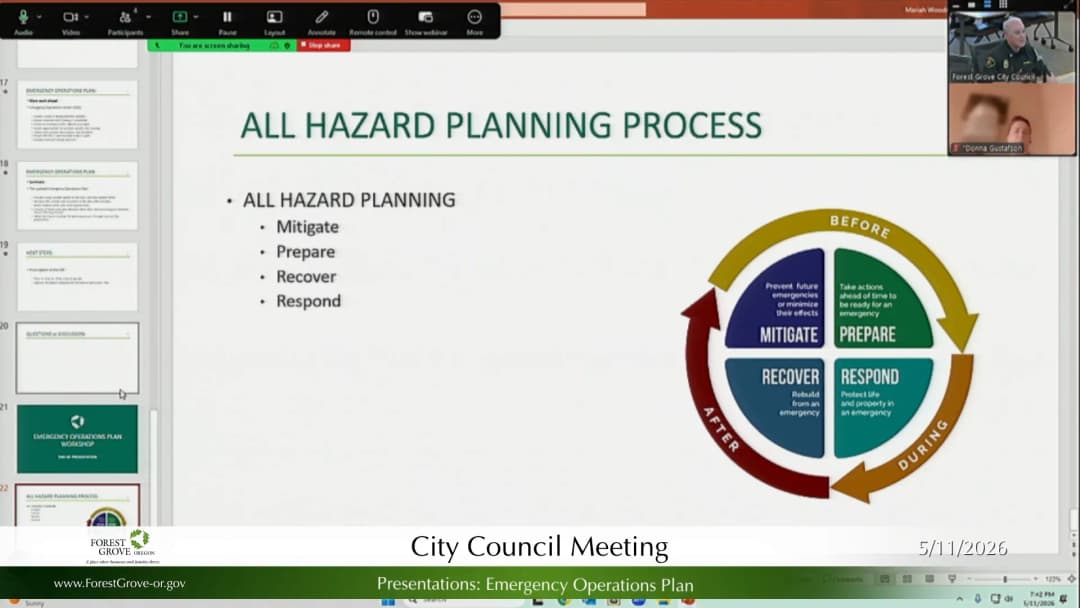
The Forest Grove City Council met on May 11, 2026, at 7:01 PM. The meeting included a proclamation, an award presentation, public comments, updates on the Historic Landmarks Board, Emergency Operations Plan, and IT services, adoption of two resolutions, and reports from council members and staff. The meeting adjourned at 8:06 PM. Proclamation and Awards - Mayor Wenzel read a proclamation designating May 2026 as National Preservation Month in Forest Grove, Oregon, presented in both English and Spanish. - Natasha Triplett from the Historic Landmarks Board presented the Eric Stewart Award to Skip Mueller for his many years of dedication to preserving Forest Grove history, including work with Friends of Historic Forest Grove and Valley Art Association. Public Comments & Testimony - David Dion suggested performing the land acknowledgement in the language of the original inhabitants (Atfalati/Calapooia). He also expressed concerns about federal government compiling lists of immigrants, minorities, and political opponents, and urged non-compliance with such efforts. - Mr. Feek (last name spelled phonetically) offered a subscription to Heather Cox Richardson's Substack to the Mayor, who declined due to ethical concerns. Mr. Feek encouraged all council members to read Richardson's work. - Carol Allery recited Bible verses (Romans 3:23, 6:23, 5:8; John 3:16-18) and urged the council to share the gospel. - Mary Jo Murley (1320 Cedar Street) spoke about the Washington County historical collection, now locked and inaccessible at Rock Creek Community College. She said it could take eight to ten years to become accessible again and urged the council to be aware of the risk to the collection. Discussion Items Historic Landmarks Board (HLB) Annual Update - Presented by Brian Pohl, Community Development Director, pinch-hitting for Matt. The HLB is an advisory board appointed by council, overseeing preservation of architectural and cultural heritage. In 2025, accomplishments included a window restoration workshop by Brian Petrowski and a legal training by former city attorney Chris Kreen. The HLB adopted a work plan focusing on downtown historic standards and guidelines, community engagement on trash can designs, and evaluating options for the next grant cycle. Councilor questions addressed landmark designations (voluntary opt-in program) and potential outside investment grants. Emergency Operations Plan (EOP) Update - Presented by Chief Gearing. The EOP update aligns with the Vision 2040 goal to improve public safety response. The current EOP was adopted in 2014 and was jointly operated with Cornelius; after dissolution of the IGA, each city now has its own plan. The updated plan was developed by Stacy M. Burr Consulting (selected from five respondents) and has three main elements: the basic plan, functional support annexes, and a hazard planning annex. The EOP is not a resident guide but a framework for city-level response. Council roles remain unchanged, including declaring a state of emergency. A resolution to adopt the EOP will be on the May 25 council agenda. Chief Gearing noted that community engagement is ongoing through partnerships (e.g., dialysis clinic, active shooter response, tabletop exercises) and that future efforts will include reaching out to community groups. IT Update - Presented by Assistant City Manager Kim Ezel. The update connected to Vision 2040 goal of community connection. After the IT manager resigned in 2025, the city hired IT services firm Structured (contract expires October 2026). Since then, IT services have stabilized: workstations updated, most computers upgraded to Windows 11, critical cybersecurity upgrades completed, servers entering regular patching. Three future options were identified: (1) re-establish internal IT manager, (2) continue contract with private sector, (3) enter an intergovernmental agreement (IGA) with another municipality. The city is developing an IGA with the City of Tigard, which has completed similar upgrades (phone system, standardized workstations, cybersecurity) and uses the same enterprise system (Tyler ERP). This IGA could serve as a pilot for shared municipal IT services across Washington County. Councilor Shimmel asked about compliance with state law on data sharing; Ezel noted partnering with a local government ensures mutual compliance with Oregon requirements. Key Outcomes - Resolution 2026-13: Authorizing the city manager to endorse the Community Enhancement Program (CEP) intergovernmental agreement with Metro. The agreement extends Forest Grove's participation through December 31, 2030, with Metro collecting $1.50 per ton of waste at the transfer station and transferring approximately $100,000 per year to the city for community enhancement grants. The IGA requires adding one community member to the CEP grant committee. Approved 7-0. - Resolution 2026-14: Adopting the city's investment policy (annual requirement per ORS). The policy applies to most city funds except defined benefit plan investments. The outside investment advisor reviewed the policy and recommended no changes; no state law changes since last review. Approved 7-0. Council Communications - Council President Valenzuela reported no meetings for the Policy Advisory Board in May and June; also announced the birth of his third grandchild. - Councilor Feltner welcomed new HLB member Natasha Triplett and thanked her for presenting the award. - Councilor Griffson, Marshall, and Martinez each reported no items. Councilor Martinez noted the Rural Fire Board has tentatively finished its budget and hired a new bookkeeper, Amber Woodford. City Manager's Report - Metro's future vision survey is open until May 31 for regional participation; the city will post it on its website. - Congressional directed spending request for TV Highway submitted by Rep. Bonamici is pending reconciliation between House and Senate. - Farmers market started last Wednesday. Changes: 21st Avenue between Maine and A will not be closed due to discontinuation of Festival of the Arts; additional barricades and signage are being added for safety on South Maine and North Main. - Two studies (grocery store analysis for urban renewal properties and boutique hotel analysis) are complete or near completion; results will be summarized at an urban renewal agency work session in June. - ODOT will begin construction on TV Highway A and B mid-block crossing (pedestrian crossing with rapid flashing beacon) in late May. - ODOT assisted in contacting railroad for the Safe Routes to School project on Mountain View. - Emergency water intertie (72-inch line from Joint Water Commission to Hillsboro) will be fully completed in June. - Public Works Administrative Building is ahead of schedule by about a month and under budget. - Friends of the Library book sale runs Thursday through Saturday; Pacific University art is displayed at the library. - Light and Power completed underground wires for Heather Street extension from Mountain View to Poplar. Mayor's Report - Mayor Wenzel reported on feedback from the first farmers market, including questions about data centers, park maintenance, and the need to restore park history information on the city website (specifically for Abigail's Park). She encouraged council members to staff the city booth at future farmers markets to advocate for the police facility bond. - Attended Pat Truax's funeral. - Expressed frustration with ODOT's Region 1 ACT (Area Commission on Transportation) regarding the SIP (capital investment plan) process, which required three meetings without clear criteria for additional projects. - Met with OSU Extension and 4-H representatives, who are considering a taxing district on the May 2027 ballot due to Washington County's $10 million budget deficit. She suggested waiting to see if there is traction before inviting them to present to council. - Announced upcoming Metro meeting on long-term strategic plan at Hidden Creek Rec Center (Hillsboro) on Thursday, 4-6 PM. - Reminded council of budget committee meeting on May 12 at the Light and Power building, and that the next council meeting is Tuesday, May 26 (instead of May 25) due to Memorial Day.
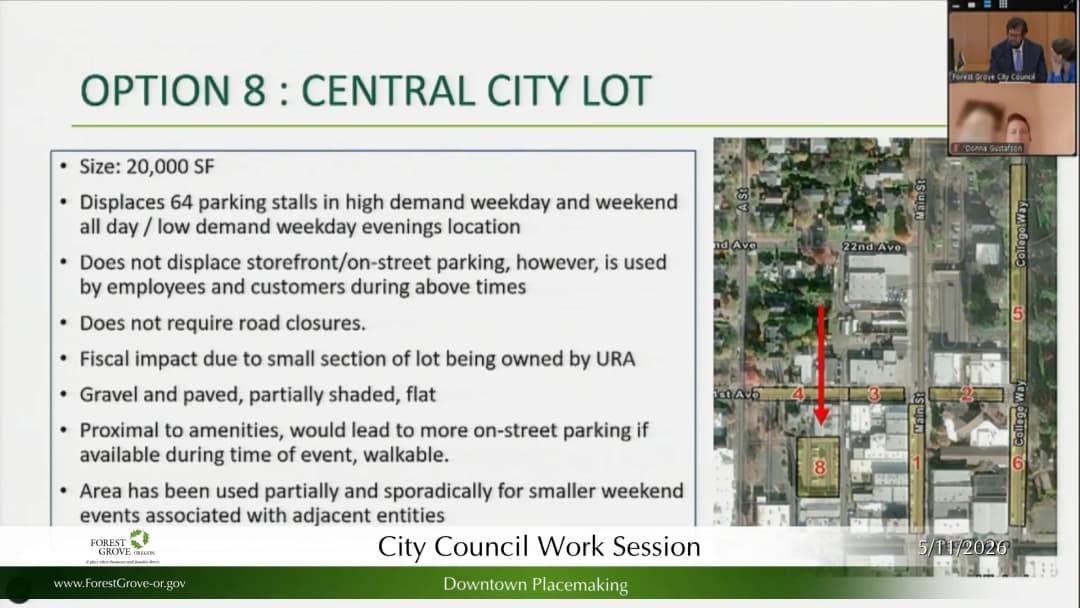
The Forest Grove City Council held a work session on May 11, 2026, covering two major topics: downtown placemaking and water fluoridation. No formal action was taken, and no public comment was accepted. The meeting lasted approximately one hour and included presentations from staff, council discussion, and feedback gathering. Consent Calendar - None. Public Comments & Testimony - None (work session with no public comment period). Discussion Items Downtown Placemaking - Staff recapped the April 13th work session on downtown parking, where council reached consensus on six actions: prioritize parking code enforcement, install wayfinding signage to city parking lots (estimated $5,000 from CIP excise tax), maintain current hour limits, prioritize improvements to Lot 2 (central city lot), install a pilot 15-minute fast-stop stall on Main Street, and restripe downtown parking to add approximately 16 stalls (estimated $25,000, subject to budget adjustment). Public works is assembling bid packages; code enforcement compliance has improved stall turnover. - Parking study findings: Main Street and 21st Avenue (the "T" intersection) are busiest after 4 p.m. and on weekends; College Way is busiest during daytime weekdays due to university parking; the central city lot is nearly full weekdays until 4 p.m.; all other city lots are under 85% capacity. - Staff presented 10 placemaking options with attributes: size, parking displacement, business impact, usage pattern, fiscal impact, environmental considerations, accessibility, location, and longevity. Options included: 1. Main Street (Pacific to 21st) – 12,000 sq ft, 32 stalls, 22 storefronts, historically used for events. 2. 21st Avenue (College to Maine) – 6,000 sq ft, 14 stalls, 4 storefronts, identified as Phase 1 of Festival Street. 3. 21st Avenue (Maine to alley) – 5,500 sq ft, 11 stalls, 5 businesses, never used alone. 4. 21st Avenue (alley to A Street) – 8,500 sq ft, 15 stalls, 5 businesses, used as expansion. 5. College Way (21st to University) – 28,000 sq ft, 73 stalls, no business impacts, can close independently. 6. College Way (Pacific to 21st) – 12,000 sq ft, 35 stalls, 1 business, requires closure of 21st (College to Maine) and College (21st to University). 7. Woodfold lot (URA-owned) – 55,000 sq ft, informal parking, food carts, interim use only. 8. Central city lot (city-owned) – 20,000 sq ft, 64 stalls, no business impacts, used sporadically for small weekend events. 9. Site B (URA-owned, undeveloped) – 35,000 sq ft, gravel, sloped, not used for events. 10. Gravel lot near city hall (city-owned) – 15,000 sq ft, informal parking, shaded, high visibility. - Council discussion: Councilor Falkner suggested adding the alley adjacent to option 8 to create a night market activation. Councilor Valenzuela raised safety concerns about option 10 due to traffic on 19th Avenue. Councilor Marshall noted time-place-manner restrictions could limit evening events at option 10. Councilor Schimmel emphasized the need for targeted feedback from partners (Adelante Chamber, downtown businesses, Downtown Association) and alignment with outside investment opportunities (Travel Oregon, Oregon Main Street). - Council identified key attributes: location (with proximity to existing events and safety), business impact, parking displacement, safety (added as an attribute), longevity, and environmental considerations. Councilor Falconer stressed safety and the importance of concentrating placemaking efforts rather than spreading thin. - Council identified top locations: options 2 (21st/College to Maine), 5 (College/21st to University), and 6 (College/Pacific to 21st) received strong interest. Option 8 (central city lot plus alley) also gained interest for future night markets. Councilor Falconer expressed interest in keeping option 9 for a future permanent public market with housing above, but agreed to remove it from current consideration. - Council agreed to remove options 7 (Woodfold lot), 9 (Site B), and 10 (gravel lot near city hall) from further consideration. Options 7 and 10 were removed due to interim use limitations and safety concerns; option 9 was removed because it is intended for future redevelopment as a public market. Water Fluoridation - City Manager Greg presented the history: Forest Grove has fluoridated its water since 1952 by council resolution. The current budget impact is approximately $28,000/year ($25,000 for chemical procurement, $3,000 for operations, maintenance, and testing). The city uses two injection points (at the watershed and at the Joint Water Commission entry point) with real-time SCADA monitoring and daily calibration. The target fluoride level is 0.7 mg/L, consistent with U.S. Department of Health and Human Services and Oregon Health Authority recommendations. - Approximately 25% of Oregon community water supplies fluoridate (serving about 900,000 people); nationally, 73% fluoridate. In the Portland metro area, only Beaverton, Forest Grove, and Tualatin Valley Water District fluoridate; Hillsboro does not. The Joint Water Commission does not fluoridate, allowing member cities to decide. - Council discussion: Councilor Valenzuela noted that levels above 0.7 mg/L (e.g., 1.5 mg/L) have been linked to cognitive effects in children, but at the recommended level, studies show benefits such as improved cognition in secondary school. Councilor Falconer emphasized that negative studies involved double the recommended amount and that organizations like the CDC, Oregon Dental Association, and American Dental Association strongly support fluoridation, citing Calgary, Canada's recent reintroduction. Councilor Gustison supported fluoridation for its dental health benefits, especially for low-income populations, noting that dental health issues affect everyone through higher costs. Councilor Martinez expressed preference for natural fluoride (mineral) over chemical additives, noted that 2023 testing showed Forest Grove at 0.95 ppm and Joint Water Commission at 1.04 ppm (within range), and suggested the issue should be put to a community vote. No consensus emerged to change current practice. Key Outcomes - Downtown Placemaking: Staff will use council feedback on attributes and preferred locations to prepare recommendations for the next work session. Council identified options 2, 5, and 6 as top candidates for further exploration, along with option 8 (central city lot plus alley). Options 7, 9, and 10 were removed from consideration. Council requested staff to seek input from downtown partners (Adelante Chamber, businesses, Downtown Association) and to explore alignment with Oregon Main Street network resources. - Water Fluoridation: No consensus to change current fluoridation policy. Council discussion will be noted; no further action is planned. Councilor Martinez suggested the possibility of a future ballot measure, but no formal motion was made. - Both items were work sessions; no formal votes or decisions were taken.
The Forest Grove City Council met on April 27, 2026, at 7:00 PM. The meeting included roll call (all seven councilors present), a land acknowledgement, the Pledge of Allegiance, recognition of employee Leo Cortez for 20 years of service, two proclamations, public comment, consent agenda approval, and several presentations. Council communications covered various city updates. Recognition - Leo Cortez was honored for 20 years of public service to the City of Forest Grove. Cortez holds bachelor's and master's degrees in engineering and provides GIS services and civil infrastructure inspections. Proclamations - Vietnamese American Remembrance Day – April 30, 2026, was proclaimed in recognition of the 50th anniversary of the end of the Vietnam War and the contributions of Vietnamese Americans. - Small Business Week – May 3–9, 2026, was proclaimed to recognize the role of small businesses in the community. The proclamation was read in English and Spanish. Public Comments & Testimony - Danielle Whiteworth, a Forest Grove resident, expressed concern about a detention operation on April 21, 2026, involving DEA, Oregon State Police, Tualatin Police, and ICE/CBP. She reported that a vehicle with Oregon plates 711 JFA (seen entering an ICE detention center) ran a stopped school bus stop sign while transporting a detainee, endangering children. She claimed sanctuary policies may have been violated and called for accountability and transparency from city officials. Consent Calendar - The consent agenda was approved by a vote of 7–0. Presentations Mayor’s Youth Advisory Council (MYAC) Trip to Washington, D.C. Four students – Hazel Kiblinger, Annie Goff, Morgan Tremblay, and Maya Andrade – presented on their trip to the National League of Cities student delegation. They met with Congresswoman Bonamici for 30 minutes, discussed women’s rights and civic engagement, toured the African American Museum, and networked with lobbyists and interns. They emphasized the importance of youth involvement and learning about policy-making. Economic Development Commission Annual Report Tim Butleman (EDC Chair) and Miles Glowacki (Economic Development Program Coordinator) presented the annual report. Highlights included: - Population: 27,241 (3.17% growth over 5 years). - Unemployment: 5.2% (slight uptick post-COVID). - Median household income: $87,933 (behind Washington County but above Oregon). - Poverty rate: 15.3–15.4% (includes university students). - 6,843 jobs in the city; top sectors: accommodation/food, healthcare, education, manufacturing (10%), retail trade (10%). - 918 active business licenses, 628 with Forest Grove addresses. - Nearly 9,800 housing units; 62% owner-occupied; median sale price $5,000 (likely typo; context suggests $500,000+ but not clarified). - Industrial vacancy near zero; 78 acres entitled/under development; 16,000 sq ft under construction. - 5 acres commercial entitled; 15,000 sq ft under construction (school district property). - Building Improvement Grant: 9 applications in 2025, 7 in 2026. - Ongoing efforts: boutique hotel analysis, grocery store analysis, enterprise zone, and updating the economic development strategic plan. Library IGA with Washington County Cooperative Library Services (WCCLS) Library Director Colleen Winners presented proposed changes to Intergovernmental Agreements (IGAs) for operations and governance. Key points: - Forest Grove is a founding member of WCCLS. - Proposed revisions clarify decision-making roles, service levels (45 hours/week, free computers), and service boundaries. - A significant change: removing the formula for annual increases tied to assessed value, replacing it with more ambiguous language. Mayor and councilors expressed concern about loss of transparency and potential funding instability, especially given recent county budget deficit behavior (e.g., diverting MISTIP funds). - Centralized collections are being explored by the county; Forest Grove has had initial meetings but details are unclear. - Next steps: Feedback from member city councils will be collected by May 8, 2026 (week from Friday). Council Communications - Council President Valenzuela: No meetings to report. - Councilor Falkner: Chamber workshop on recovering tariff funds; tariff impacts on JWC material costs. - Councilor Gustison: Public Arts Commission discussed garbage can failures (warranty issues) and potential replacement; also noted Family Peace Center open house on April 30, 2026 (ribbon cutting 5 PM). - Councilor Marshall: Tree canopy tool presented by Nature Conservancy; Forest Grove may be included in Portland region mapping. - Councilor Martinez: Attended National Crime Victims Rights Week event. - Councilor Schimmel: Site walk of TV Highway/Marathon project; discussed pedestrian safety concerns at the 47/8 intersection, particularly a dangerous slip lane. Councilor Falconer cautioned against removing pedestrian crossings, advocating for safety improvements instead. - City Manager Jesse Liu: Updates on diaper drive (May 1–21), farmers market (May 6), teen driver safety event (May 9), grant applications (Safe Streets for All, BRIC), BPA pole relocation for TV Highway project, pool deck progress, parks master plan proposals (4 received), and Public Works facility nearing completion. - Mayor Wenzel: Commented on Washington County budget meetings being rescheduled, causing frustration; attended a candidate forum hosted by Forest Grove Indivisible. Key Outcomes - Consent agenda approved (7–0). - Concerns raised about the WCCLS IGA funding formula change; councilors requested more specific language before approval. - Direction given for Public Arts Commission to seek council authorization if planning fundraising. - Continued attention to pedestrian safety at TV Highway intersections, with potential action if ODOT does not improve striping/signage. - No formal votes taken on presentations; items were informational.
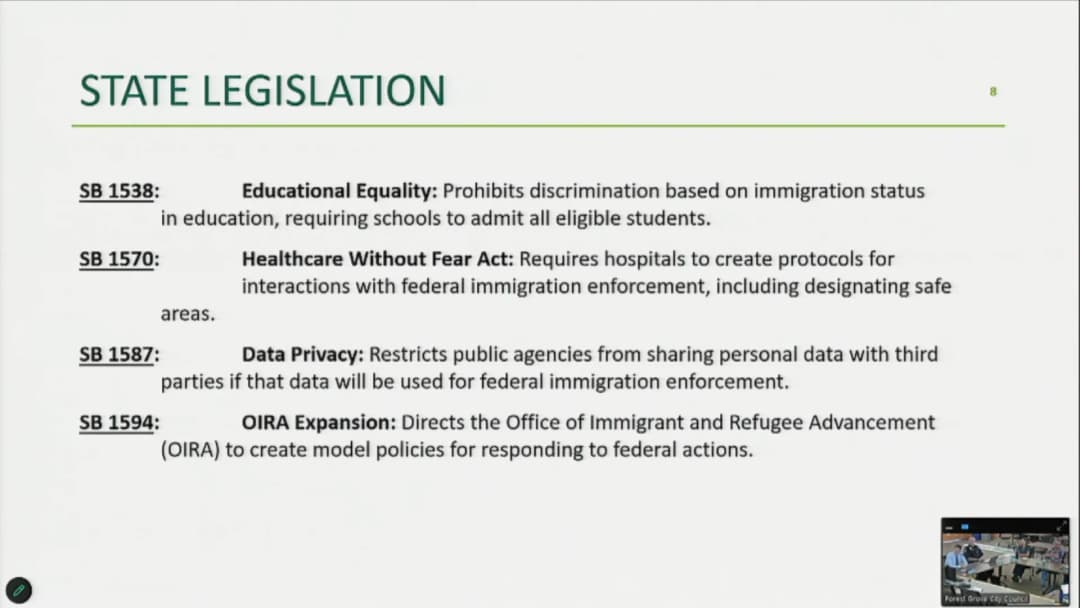
This work session of the Forest Grove City Council on April 27, 2026, covered three main topics: an update from Clean Water Services (CWS) on proposed rate increases, scoping for a new Economic Development Strategic Plan, and a discussion on federal immigration enforcement activities and related state legislation. No formal actions were taken; the session was informational and for council direction. Clean Water Services Rate Update Joe Gall (Chief Utility Relations Officer) and Kathleen Leader (CFO) presented results of the cost-of-service study and proposed 4% rate increases for fiscal year 2027 for both sanitary sewer and surface water management services. - Historical rate increases averaged 3.38% annually over the last 10 years. - The current regional rate for Forest Grove customers is $49.39 per month. A proposed 4% increase would raise it to $51.36 per month (increase of $1.97). - For surface water management, a 4% increase would add $0.11 per month in 2027. - CWS plans to spend $754 million on sewer capital projects and $11.7 million on surface water capital over the next five years. - The proposed budget uses reserves to cover deficits until 2031, with replenishment beginning in 2032. Council members asked about local infrastructure upgrades, the intergovernmental agreement (IGA) with the city, billing responsibilities, and representation on the CWS advisory committee. Councilor Falkner raised concerns about public trust following previous spending issues and asked about community engagement to explain the rate increases. Presenters acknowledged the need for transparency and noted a new general manager will start in late May. Next steps: The CWS budget committee will meet May 8, 2026, and the board will adopt rates on June 9, 2026, effective July 1, 2026. Economic Development Strategic Plan Scoping Kim Isell (Assistant City Manager) and Miles Glowaki (Economic Development Coordinator) presented the draft scope for a new Economic Development Strategic Plan, aligning with Vision 2040. - The plan will be a 5-10 year roadmap covering equitable growth, workforce development, incentives (enterprise zones, opportunity zones), and urban renewal. - Eight tasks were outlined: project management, review of existing plans, stakeholder engagement, target industry analysis, urban renewal opportunities, implementation framework, and final plan adoption. Council feedback: The Mayor emphasized optimizing the existing Urban Renewal District and ensuring alignment with new property acquisitions. Councilor Schimmel called for codifying Vision 2040 into the development code and enterprise zone framework. Councilor Falkner requested that the plan prioritize timely actions to address current conversations. No changes to the scope were proposed; staff will proceed with the RFP. City Discussion on Federal Activities City Manager Jesse Vanderzannen and Police Chief Dave Marzilli led a discussion on ongoing efforts related to federal immigration enforcement and Oregon legislation passed in the 2025-2026 session. - Previous actions include declaring Forest Grove a sanctuary city (2025), codifying sanctuary into city code (2026), staff training, marking non-public areas, and sending public records requests to DHS regarding ICE activity. - Eight bills from the Oregon Legislature were summarized, including HB 4138 (law enforcement identification and face coverings) with which the city is already in compliance, and SB 1587 (restricting sharing of personal data for immigration enforcement) for which legal guidance is being sought. - Councilor Schimmel expressed concerns about the enforceability of the new laws and the need for public education to clarify what is practically enforceable, especially regarding reporting of ICE activity. He noted confusion from a recent incident where a DEA vehicle was mistaken for ICE. - Councilor Falkner noted that the city's public records requests to DHS have been acknowledged but not fulfilled, and asked for a timeline. Council agreed to continue monthly work sessions on this topic, with the next session in May to follow up on the DHS records request and further discussion. Key Outcomes - No formal votes were taken. - CWS will provide follow-up information on local infrastructure projects and billing responsibilities. - Staff will proceed with issuing the RFP for the Economic Development Strategic Plan, incorporating council feedback. - The city will continue monthly work sessions on federal activities, with the next session scheduled for May 2026 to include an update on DHS public records requests and ongoing legislative guidance.
This work session of the Forest Grove City Council covered two major topics: the development of historic downtown design standards and guidelines, and a review of downtown parking conditions and potential solutions. No public comment was taken, and no formal action was approved. The meeting began with a presentation on historic design standards, followed by a detailed discussion on the 2022 downtown parking study. Council members provided feedback and direction on both topics. Discussion Items Historic Downtown Design Standards and Guidelines - Staff (Jesse, Kim, Matt) and consultant Robert Dortnet presented the timeline from the 2017 historic preservation plan to the 2020 designation of the national historic district, and the current project to create design standards and guidelines funded by an Oregon Heritage grant. - Robert explained the difference between clear-and-objective standards and flexible guidelines, using examples from residential districts he previously worked on for Forest Grove (2014). - The consultant reviewed scope: establish framework, define district character, develop detailed design guidance for building features, conduct field review (which occurred that day), and prepare supporting graphics. - State review of the initial draft must occur by the end of July 2026 to meet federal Department of Interior standards; the city can then refine and adopt locally on its own timeline. - Councilmembers expressed several positions: - Councilor Valenzuela urged that standards not deter investment, should incentivize preservation, and should not require new development to mimic historic styles (avoid “theme park” architecture). - Councilor Schimmel, with commercial renovation experience, discussed operationalizing guidelines for materials and methods, noting challenges with seismic retrofits and code compliance. - Mayor raised concerns about structural integrity of adjacent buildings when one owner makes changes, and about ensuring grant investments do not harm neighboring properties. - The consultant noted that life-safety codes supersede historic review, and that party walls and structural issues are outside the design guidelines but may arise during permitting. Downtown Parking Study - Jesse and Greg presented the 2022 parking study (cost $14,000), which analyzed parking occupancy on a Tuesday (school day) and Saturday, using the 85% occupancy threshold. - Key findings: overall supply is adequate, but localized congestion occurs at peak times (Main Street and 21st Avenue). Central City Lot (Lot 2) is heavily used by employees during weekdays; other lots (4–7) are underutilized. - Recommendations included: prioritize maintenance of Lot 2, improve wayfinding signage, consider employee-only designation for Lot 2, add two-hour time limits to Lot 1, and create fast-stop positions. - Council discussed each potential solution: - Code Enforcement: Councilor Marshall noted that effective enforcement requires dedicated staffing; Mayor asked about metrics and efficiency. Jesse acknowledged challenges balancing parking enforcement with other code complaints. - Signage and Wayfinding: Council supported a comprehensive, branded signage plan; Councilor Falkner emphasized consistent design (e.g., standard blue P symbol). Staff aim to install signage summer 2026, possibly requiring a supplemental budget request. - Central City Lot (Lot 2): Councilor Valenzuela initially supported employee-only signs, but after discussion with Councilor Marshall (small business owner) and others, consensus was not to designate Lot 2 as employee-only at this time. Instead, the city should first improve wayfinding and education. - Lot 1 (18 spaces): Proposed two-hour time limit. Councilor Marshall opposed, noting the lot is already used heavily by employees; Council decided not to impose time limits or employee-only designation now. - Fast‑Stop Positions: Staff proposed a 15‑minute pilot stall at the no‑parking zone in front of Pizza Schmizza (corner of 21st and Main). Council supported this as a trial, noting it creates a new spot without eliminating existing parking. - Additional Parking Spots: Greg and Crystal from Public Works identified up to 16 additional on‑street stalls (primarily on Pacific Avenue) by restriping yellow zones and underutilized areas. Council endorsed adding these spots, possibly using existing summer striping contract. - Private Parking Lots: Staff have approached private owners (e.g., Wells Fargo North lot) without success. Councilor Valenzuela suggested exploring shared‑use agreements with Pacific University and other institutions, citing examples of underused lots during evening or weekend events. - Events and Placemaking: Council discussed moving major events (Uncorked, Oktoberfest) off Main Street to reduce 32 days of closures. Councilor Falkner supported evaluating College Way and 21st Avenue as festival streets. Staff agreed to bring back information on placemaking options, including use of the city‑owned former theater site (Lot B). Councilor Marshall requested a cost estimate for resurfacing the central gravel lot as part of any event space. Key Outcomes - Historic Design Standards: Council provided general guardrails – standards should incentivize preservation, not deter investment; new development should not be forced to mimic historic styles; and flexibility is needed for structural and life‑safety improvements. No formal action taken; staff will incorporate feedback as the consultant drafts guidelines. - Parking – Fast‑Stop Pilot: Staff will proceed with installing a 15‑minute fast‑stop stall in front of Pizza Schmizza as a pilot project, pending signage and striping. - Parking – Additional Spots: Staff will add up to 16 new on‑street parking spaces downtown, likely this summer, adjusting striping as needed. - Parking – Signage: Staff will develop a comprehensive wayfinding sign plan incorporating branding, with installation targeted for summer 2026 (may require a budget amendment). - Parking – Code Enforcement: Council directed staff to prioritize a dedicated percentage of code enforcement time to parking compliance and to explore more efficient enforcement technologies. - Placemaking and Events: Staff will prepare options for a work session on creating a central gathering space and potentially relocating major events to College Way or 21st Avenue. The URA may also discuss the former theater site for mixed‑use development including parking and a festival street. - No formal votes were taken; these outcomes reflect council consensus and direction to staff.
The Forest Grove City Council met on April 13, 2026, at 7:04 PM. The meeting included the swearing-in of Police Chief Marzilli, three proclamations (Arbor Month, Library Week, and Child Abuse Prevention/Sexual Assault Awareness/Crime Victims Rights Week), public comment, approval of the consent agenda, presentations from the Family Peace Center, Library Commission, Community Forestry Commission, and a comprehensive plan update, a public hearing and vote on Resolution 2026-12, and council communications. Consent Calendar - The consent agenda was approved with a vote of 6-0. Public Comments & Testimony - David Dion spoke about the importance of equal application of the law and expressed concerns about federal overreach, stating that no elected official has unlimited authority and that the rule of law must apply to all. - Carol Allery expressed opposition to fluoridating the water, citing health risks including tooth discoloration, skeletal weaknesses, neurological problems for children, and links to high blood pressure and seizures. She urged the council to consider the negative effects. Presentations Family Peace Center Update (Rachel Schutz, Executive Director) - Since its founding, the Family Justice Center (now Family Peace Center) has served over 31,000 survivors with 54,000 services. In 2025, 12,500 services were provided to approximately 6,000 survivors. The top three services were basic needs (food, clothing, hygiene), advocacy, and legal support. - A notable dip in survivors occurred in 2025 (excluding 2020) due to increased immigration enforcement, which also reduced crisis line calls and hospital visits. However, the average number of services per survivor increased. - The new Family Peace Center opened on January 21, 2026. In its first two and a half months, over 1,200 people walked in. For Forest Grove, 88 individuals were served in 2025; 32 have already been served in 2026, on track to more than double. - The council received the annual report and thanked Rachel Schutz for her work. A grand opening is scheduled for April 30, 2026. Library Commission Annual Report (Morgan, Chair) - The library has a refreshed children's area, fireplace area, and new signage. Two new staff members (Jack Buck, Amanda Woods) joined. Pacific University has 10 work-study students at the library. - 2026 goals include reviewing the library's mission (first time in over 10 years), inventorying and revising policies, conducting a user survey, filling commission vacancies (especially a student position), and developing guidance for public art. - National Library Week is April 19-25, 2026. The library levy recently passed, enabling potential service expansion. The library also offers free notary services. Community Forestry Commission Annual Report (Dan Reardon, Mark Nagajima) - Forest Grove achieved Tree City USA designation for the 36th consecutive year. 2025 highlights included an Arbor Month tree planting at Thatcher Park, work on updating the "Tour of Trees" map guide, and reviews of dangerous tree removals affecting power lines (especially Oregon White Oaks in the Uplands). - 2026 priorities: completing the tree tour map, a citywide tree canopy assessment, the annual Arbor Day tree planting on April 16 at 10 AM at Lincoln Park, and updating the Urban Forest Management Plan. - Councilor Marshall suggested linking the tree tour with public art and tourism; Councilor Falconer noted that some Main Street tree locations might be better suited for public art. Comprehensive Plan Update (Dan Rurdin, Planning Division) - The existing comprehensive plan was adopted in 2014; the new Forest Grove Forward 2040 vision provides the basis for an update. A housing capacity analysis is required by December 2027. - Staff recommended issuing a Request for Proposals (RFP) for a qualified planning consultant to evaluate the current plan and develop a scope of work, community engagement plan, and sequencing strategy. The budget for FY26-27 is $150,000. - The council concurred with the recommendation, noting that hiring a consultant is appropriate given the project's complexity and staff capacity. Public Hearing & Resolution - Resolution 2026-12: Adopting the amended Urban Planning Area Agreement (UPAA) between Washington County and the City of Forest Grove, repealing Resolution 2018-75. The UPAA clarifies roles for land use planning in areas within the urban growth boundary. The Planning Commission unanimously recommended adoption on March 2, 2026. - The amendment updates annexations since 2018, removes a de-annexed area, and adjusts the boundary near Cornelius (2.6 acres). A subsequent comprehensive plan map amendment will be required. - The resolution was approved with a vote of 6-0. Council Communications - Council President Valenzuela reported on the Policy Advisory Board approving the 2026 Annual Action Plan for HUD funding, and noted National Community Development Week and Fair Housing Month activities. - Councilor Falconer reported on a walking tour of the historic downtown district, JWC meeting, and a chamber ribbon cutting at Camelas. - Councilor Marshall reported on Parks and Rec discussions about parking and maintenance, the upcoming East Side Park construction, and a pop-up event at Kyle Park on May 16 with mountain bike coach Robbie. - Councilor Martinez reported on the Rural Fire Department budget and a new reader board, and the Sister City Committee's progress on 501(c)(3) documentation. - Councilor Shimmel reported on the TV Highway Transit Project, noting that the TriMet CEO will visit on April 17 for a street-level orientation, and mentioned the potential study of converting Pacific Avenue to two-way. - City Manager reported on budget preparations for May 12, grants (BRIC for water reservoir, Safe Streets for All for TV Highway), progress on the public works building remodel, and the Housing Authority's RFP for 60 units of permanent supportive housing. - Mayor Wenzel reported on the MYAC trip to Washington, D.C., Region One Transportation funding discussions, TriMet service cuts (merging lines 58/19 and 97/38), and proposed a work session on immigration for April 27. She also announced the passing of community volunteer Pat Truex and offered condolences to her family. Key Outcomes - Consent agenda approved 6-0. - Resolution 2026-12 approved 6-0. - Presentations received; council directed staff to proceed with the comprehensive plan RFP. - Mayor announced a work session on immigration for April 27, 2026.
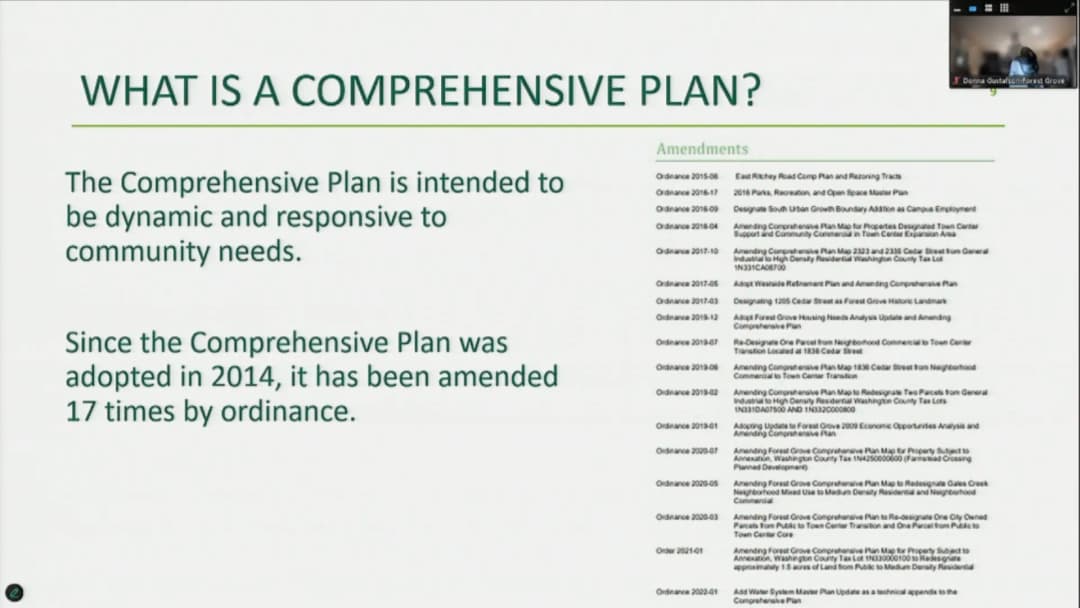
The Forest Grove City Council convened on March 9, 2026 at 7:04 PM with Mayor Wenzel presiding and all seven councilors present. The meeting included a proclamation for National Community Development Week, public comments from two speakers, approval of the consent agenda, a detailed presentation on the comprehensive plan, adoption of one ordinance and five resolutions, and council communications. Consent Calendar - Items C1 and C3 (routine approvals) were approved 7-0. - Item C4 (board and commission resignations) was removed for discussion and approved 7-0, with Councilor Schimmel highlighting Steve Crotchide's decade of service on the Economic Development Commission. - Item C2 (tourism sponsorship award) was removed by Councilor Gustison, who recused herself; the item was approved 6-0. Public Comments & Testimony - A community member expressed concern about ICE and federal detention facilities, warning that ICE might seek to use properties in Forest Grove as detention facilities in the future. They urged oversight and reform. - Dale Feek, representing Indivisible Forest Grove, described recent protests against the Trump administration, expressed opposition to U.S. military action in Iran, and praised Mayor Wenzel's efforts to protect residents from ICE. He called on mayors to coordinate actions to defend due process and constitutional rights. Discussion Items - Comprehensive Plan Presentation: Community Development Director Brian Poll and Senior Planner Dan Rearden presented an educational overview of the city's comprehensive plan. They explained its purpose (a long-range policy document implementing Oregon's 19 statewide planning goals), its structure (chapters covering land use, housing, economy, transportation, etc.), and how it relates to other planning documents. Potential additions discussed include a climate action plan, Vision Zero, urban forest program, 15-minute neighborhoods, and bird-safe dark sky policies. The presentation was the first in a series of work sessions; no vote was taken. - Downtown Parking Work Session: Councilor Gustison requested a work session on downtown parking. Council reached consensus to schedule a future work session to review parking data and discuss potential changes. Key Outcomes - Ordinance 2026-02: Second reading of development code amendments (Articles 8 and 12) was approved 7-0. - Resolution 2026-06: Transferring appropriations for an economic development strategic plan was approved 7-0. - Resolution 2026-07: Adoption of the 2026–2028 City Council Action Plan was approved 7-0. - Resolution 2026-08: Updated city manager performance evaluation forms were approved 7-0. - Resolution 2026-09: Authorizing purchase of a railroad spur and 2.83-acre parcel (for stormwater management and street purposes) from ODOT for $27,400 was approved 7-0. - Resolution 2026-10: Intergovernmental agreement with Washington County for the Contamination Reduction Program (recycling modernization) was approved 7-0.
The Forest Grove City Council held a work session on March 9, 2026, to discuss whether to place a $29.5 million bond measure for a new police facility on the November 2026 ballot. No public comment was taken, and no formal action was voted on; the council reached consensus to proceed with the bond and the November timeline. Discussion Items - Presentation by City Staff: Jesse and the police chief presented the background, noting that a $3 million state grant application (submitted February 26, 2026) was unsuccessful, so the bond amount remains $29.5 million. The city’s operating levy expires in 2028; to meet the three-election lead time, the levy would need to go on the May 2027 ballot. - Ballot Timeline Options: Two options were outlined: November 2026 (a large election, six months after the levy election, 1.5 years from the failed 2024 police facility measure) and May 2027 (a smaller ballot, with the operating levy also planned). The pollster strongly recommended against placing two local revenue measures on the same ballot. - Communications Plan: Staff presented a plan running March through November 2026, with advocacy after ballot title approval, education efforts, and potential formation of a political action committee (PAC). Staff cannot advocate during work hours or use city resources; board and commission members are treated as volunteers. - Council Feedback on PAC Formation: The mayor asked councilors to recruit community members for a PAC to fundraise and drive education. Two councilors reported having people committed, with others indicating interest. Key Outcomes - Consensus to Place Bond on Ballot: All councilors present expressed support for asking voters for a $29.5 million police facility bond. - Consensus for November 2026 Ballot: The council agreed to target the November 2026 election, allowing more time for a communications campaign over the summer. - Next Steps: Staff will prepare a resolution approving the ballot title, question, and summary by July 13, 2026, to meet the election deadline.