Browse by city
Date range
Search help

Search titles, summaries, topics and stored transcripts together. Keywords may match separately; put the whole query in double quotes for a phrase. Matching follows word analysis, so punctuation is not exact. Both dates are included. Documents are not searched.

SHOWING 11–20 ENTRIES
11
SEP 22, 2026 · FREDERICK, MARYLAND · CITY COUNCIL COMMITTEE MEETINGS
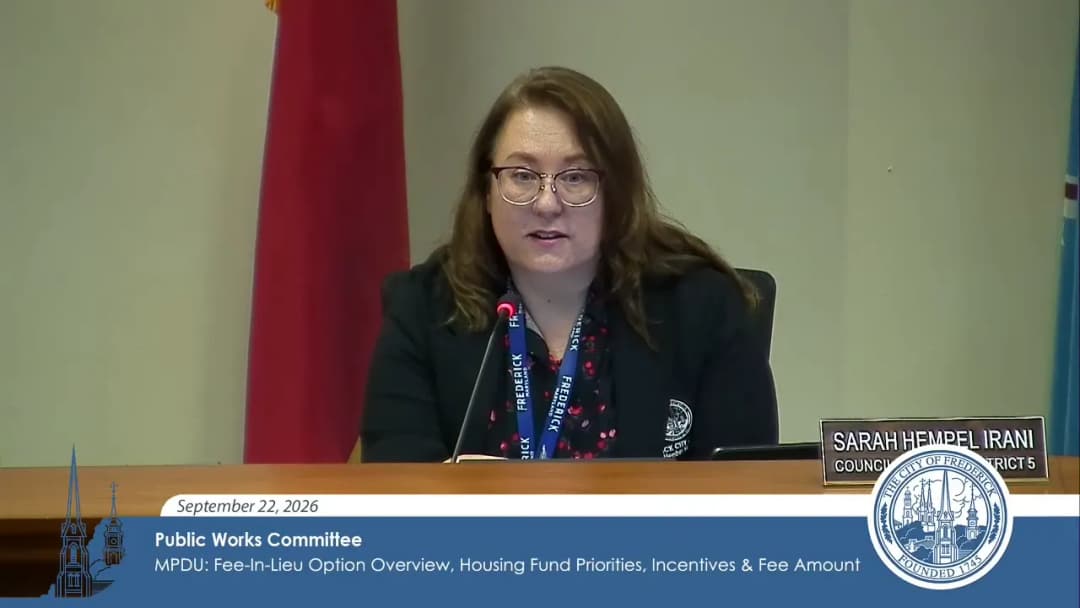
Public Works Committee Workshop on MPDU Policies - September 22, 2026

This workshop focused on the Moderately Priced Dwelling Unit (MPDU) program, including the fee-in-lieu option, housing fund priorities, incentives, and fee amounts. Staff presented recommendations from the MPDU Task Force, and council members discussed potential changes to increase affordable housing production. Discussion Items - MPDU Trigger Threshold: Proposed reducing the minimum number of units triggering MPDU requirements from 25 to 10, in line with national best practices. Council considered implications for pilot agreements and alignment with county rules. - Fee Structure and Review Frequency: The current fee (based on square footage) remains lower than the county’s to encourage development. No fee increase was recommended until projects are built under the new structure. The three-year review frequency was discussed but no change advised at this time. - Administrative Approval for 100% Affordable Projects: Discussed whether MPDU agreements for entirely affordable projects could be handled administratively rather than requiring council approval, to speed up the process while maintaining accountability. - Clarifying Definitions: Need to clarify what constitutes a “city project” (e.g., financial contribution, land, fee waivers) and the role of nonprofit partners in exemptions from MPDU agreements. - Incentives for MPDU Construction: Explored density bonuses tied to APFO relief, fee reductions/waivers (parkland, schools, roads), expedited permitting, reduced parking minimums, and enhanced PILOT agreements for deeper affordability (30-50% AMI). - City Housing Fund (Section 19-18): Recommended extracting the housing fund into a separate ordinance to allow general fund allocations and other revenue sources. Uses discussed include program administration, housing navigator, gap financing, revolving loan fund, homebuyer assistance, home repair, rental assistance, and emergency needs. Public Comments & Testimony - Jim Smersal (Downtown Frederick resident): Proposed considering lower onsite percentages (e.g., 5%) versus higher fee percentages (e.g., 8%) to incentivize building. Suggested accepting developed lots from nonprofits as MPDU credit and adding land purchase to allowed fund uses. Noted density bonuses may be ineffective under APFO caps. - Ann Ryan (Frederick Housing Solutions Task Force): Supported the broader thinking but asked what happens if developers do not choose to build affordable units despite incentives. Urged exploring other uses of the housing fund to create deeper subsidies for very low-income renters. - Darby Swanson (Habitat for Humanity of Frederick County): Commended the council for moving the policy forward. Emphasized the importance of homebuyer assistance and home repair programs for existing homeowners, especially seniors below 50% AMI, and thanked the council for past support. Key Outcomes - No formal votes were taken; the workshop served as a policy discussion to guide future ordinance amendments. - Council members agreed to pursue incremental changes, starting with low-hanging fruit in the MPDU ordinance. - Staff will work with planning, legal, and DPW departments to refine definitions, evaluate incentives, and develop the new housing fund ordinance. - Next steps include bringing draft legislation before the committee for further consideration.

AFFORDABLE HOUSING 58% · MODERATELY PRICED DWELLING UNITS 24% · FEE STRUCTURE 4% · PUBLIC ENGAGEMENT 4%
12
SEP 21, 2026 · FREDERICK, MARYLAND · PLANNING COMMISSION
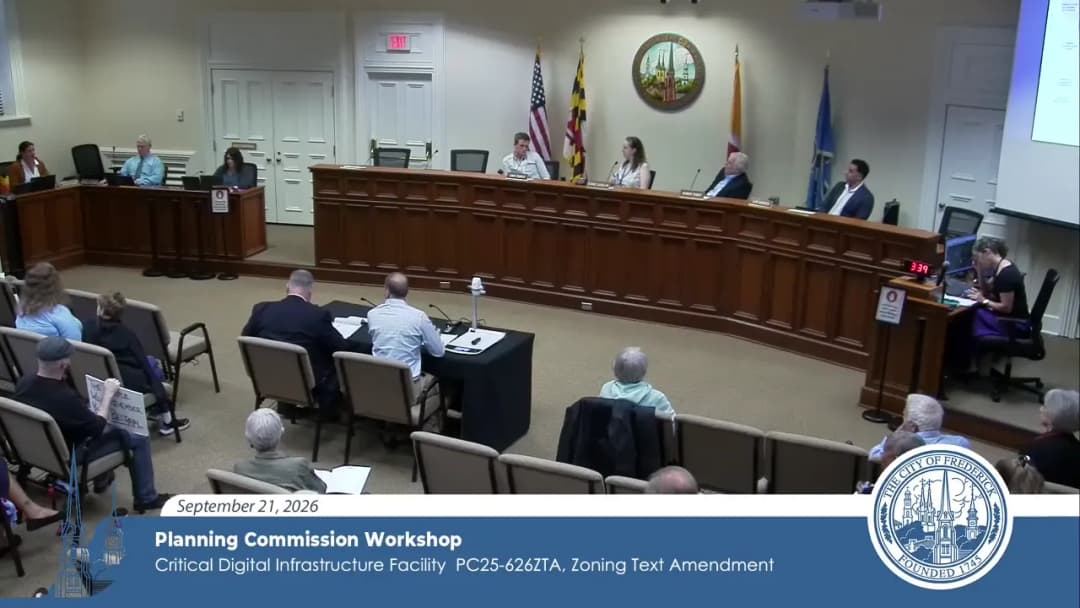
Planning Commission Workshop on Hood College, Winpenny Annexation, and Data Center Zoning - September 21, 2026

The Frederick Planning Commission held a workshop on September 21, 2026, to discuss three agenda items: a final site plan for Hood College's Hodson Hall, the annexation of the Winpenny II property, and a proposed zoning text amendment (ZTA) for critical digital infrastructure facilities (data centers). Commissioners reviewed applicant presentations, posed questions, and received staff and public input. No formal votes were taken; the commission will make recommendations to the City Council at future meetings. Hood College, Hodson Hall (PC26-151FSI, PC26-152FSCB) - Applicant Adtek presented a proposal for interior renovations and limited site improvements to enhance accessibility, infrastructure, and stormwater management, including a new concrete ramp, relocation of emergency generator and cooling tower, restriping parking to add five spaces, and a micro-bioretention facility. - Commissioner Robey questioned a requested modification to reduce an access road from 15 feet to 11 feet, suggesting parallel parking instead of angled to maintain safety and maneuverability. The applicant agreed to consider the suggestion. - Chair Strawson asked about light spillover from lighting modifications; the applicant confirmed zero foot candles at the adjacent residential property line and proposed redirecting lights. Staff requested a lighting plan demonstrating compliance. - Staff noted that the forest conservation plan would be withdrawn because the limit of disturbance (13,000 sq ft) does not trigger requirements. Commissioner Temple inquired about piecemealing; staff acknowledged ongoing discussions with Hood College about an overall forest plan but found no issue with this minor change. - No public comments were received. Winpenny II Annexation (PC26-129ANX) - Applicant Buckeye Winpenny II LLC seeks annexation of a 9-acre parcel adjacent to the previously annexed 79-acre Winpenny I project (316 residential units). The annexation primarily provides a second road access point and integrates the parcel into the larger development without adding density. All conditions from the original annexation agreement would apply. - Commissioners expressed support for the connectivity. A historic home on the property will be preserved as a residence; staff requested a Maryland Inventory of Historic Places (MIHP) form to evaluate its significance before the next step. - Commissioner Temple asked about historic preservation overlay; staff explained that the MIHP evaluation would inform future decisions, and the city's demolition review process already protects historic structures. - Commissioner Robey inquired about community benefits; the applicant stated no new proffers beyond existing obligations but remained open to discussion during the process. - No public comments were received. Critical Digital Infrastructure Facility (PC25-626ZTA) - Applicant Trammell Crow Company proposes a ZTA to add "critical digital infrastructure facilities" (data centers) as a permitted use in M1 and M2 zones, with restrictions including a minimum 75-acre parcel size, 1,000-foot setback from residential curtilage (increased from 500 feet), 2,000-foot setback from schools, noise limit of 55 dBA, groundwater cooling prohibition, LEED-equivalent design, and post-construction sound studies. The amendment would apply only to four parcels at Frederick Commerce Center. - Staff noted the City Council is considering a potential moratorium on data centers (tentatively October 8, 2026 work session), but this does not affect the current workshop. - Commissioner Temple disclosed his employment with Hanwa Data Centers and stated he would participate in discussion but recuse from voting on the ZTA, per ethics commission advice. - Commissioners raised concerns: Commissioner Robey emphasized the need for a "stop button" to limit data centers, questioned water and power demands (suggesting limits like the county's), and highlighted low-frequency tonal noise. Commissioner Montes argued the use is incompatible with the comprehensive plan (citing land use, sustainability, water resources policies) and should not be permitted by right, supporting staff's recommendation for a floating zone instead. Chair Strawson noted missing information such as the State of Maryland impact study (delayed to late 2026), noise proofing, property value impacts, diesel storage setbacks (calling 100 feet insufficient), and compatibility with comprehensive plan Chapter 7. - Staff reiterated their recommendation for a floating zone rather than by-right, citing the need for site-specific evaluation and future implications for M1 zoning. Public Comments & Testimony (on ZTA only) - 13 registered speakers and additional unscheduled speakers all opposed the ZTA. Key points: data centers threaten livability, consume excessive electricity and water, produce harmful noise and emissions (including low-frequency hum), and do not align with the city's comprehensive plan. Several called for a moratorium or permanent prohibition, referencing experiences in Virginia, Ireland, and other jurisdictions. One speaker (real estate broker) offered a balanced perspective, acknowledging the need for tax base but also the proximity to residential areas. Many noted that data centers are heavy industrial (M2) uses, not M1, and that the city should wait for the state impact study. Key Outcomes - No votes were taken; the workshop was for discussion and public input. - For Hood College: The applicant will consider modifications to access road width and lighting. The forest plan will be withdrawn. The item will proceed to a hearing. - For Winpenny II: The annexation process continues; the applicant will file an MIHP form for the historic home before the next public hearing. - For the ZTA: The commission will deliberate and make a recommendation to the City Council at a future meeting. Commissioner Temple will recuse from voting. The City Council will consider a potential moratorium in October. Public comments will be included in the record.

DATA CENTER SUSTAINABILITY 43% · ZONING AND LAND USE 10% · PUBLIC COMMENT 8% · ANNEXATION 7%
13
SEP 17, 2026 · FREDERICK, MARYLAND · CITY COUNCIL COMMITTEE MEETINGS
City of Frederick Community & Culture Committee Workshop: Public Art Strategic Plan – September 17, 2026

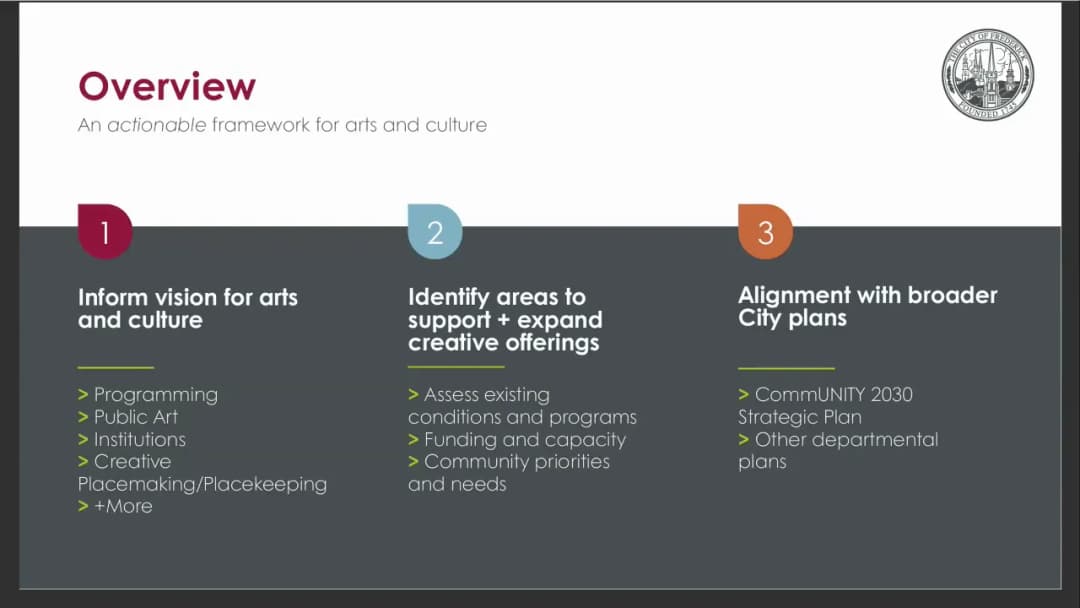
The Community & Culture Committee met on September 17, 2026, for a workshop on the city's Arts and Culture Strategic Cultural Plan. The agenda listed a 3:00 P.M. start, while the transcript opens with 'Good evening'; the agenda item to approve the September 3, 2026 minutes was not recorded in the transcript. The meeting was informational and no formal votes were taken. Workshop: Arts and Culture Strategic Cultural Plan - Layla Jadala, community arts manager, presented the plan's goal: an actionable framework for arts and culture covering public art programming, institutions, creative placemaking and placekeeping, and broader creative offerings. The plan is meant to be community-informed and align with Frederick's 2030 strategic plan and other city/departmental plans. - The city's lead partner is Designing Local, a national arts and culture planning firm based in Ohio with recent Maryland work, including county historic preservation and arts/culture projects. The firm began a two-day tour of Frederick in late August 2026 and is helping design engagement and recommendations. - Background work begun in 2025 includes a cultural asset map, a public art conservation assessment, and collections management. A steering committee, including representatives from major city departments and Councilmember Hempelarani, held an initial meeting in August 2026. - External engagement so far includes: a resident survey that has received more than 150 responses (about 10–15 minutes to complete, with optional demographics and a map exercise) and about half of 30 one-on-one interviews with creative businesses, nonprofit leaders, and artists. - Planned next steps include affinity-group meetings and feedback tables at city events, such as the Golden Mile Small Area Plan process, in mid-November 2026. The consultants will return in mid-November for a second round of engagement. The presenter referenced 'next January and March 2027' in discussing timeline milestones, with a final plan expected by spring 2027. Council Discussion and Questions - A councilmember (the transcript spells the name as both 'Hempelarani' and 'Hambler') asked how the city coordinates with the Frederick Arts Council and county initiatives such as makerspace studies, noting the arts council is countywide and based in the city and that about one-third of the county population lives in the city. Jadala said prior work, including the Frederick Arts Council public art plan and a county-commissioned makerspace study, was shared with the consultants, and the arts council is expected to be a close partner on the steering committee. - The same councilmember praised the consolidated leadership for arts and culture and asked for a sneak preview of draft recommendations so they are not too late to inform budget decisions. Jadala said she would try to do that. - A councilmember also asked what recommendations might look like for partnering with nonprofits through MOUs; no specific answer is captured before the discussion moved on. - No public comments appear in the transcript. After the discussion, the chair noted no further business and the meeting adjourned. Key Outcomes - No formal votes or motions were made at the workshop. - Staff will attempt to provide councilmembers an early preview of draft recommendations before the final plan is completed. - The committee's next public engagement milestone is mid-November 2026; the final arts and culture strategic plan is expected by spring 2027, with recommendations presented to the council and public before finalization. - Approval of the September 3, 2026 minutes appeared on the agenda, but the transcript does not record action on the minutes.

ARTS AND CULTURE 76% · COMMUNITY ENGAGEMENT 24%
14
SEP 17, 2026 · FREDERICK, MARYLAND · CITY COUNCIL
Frederick City Council Public Meeting - September 17, 2026

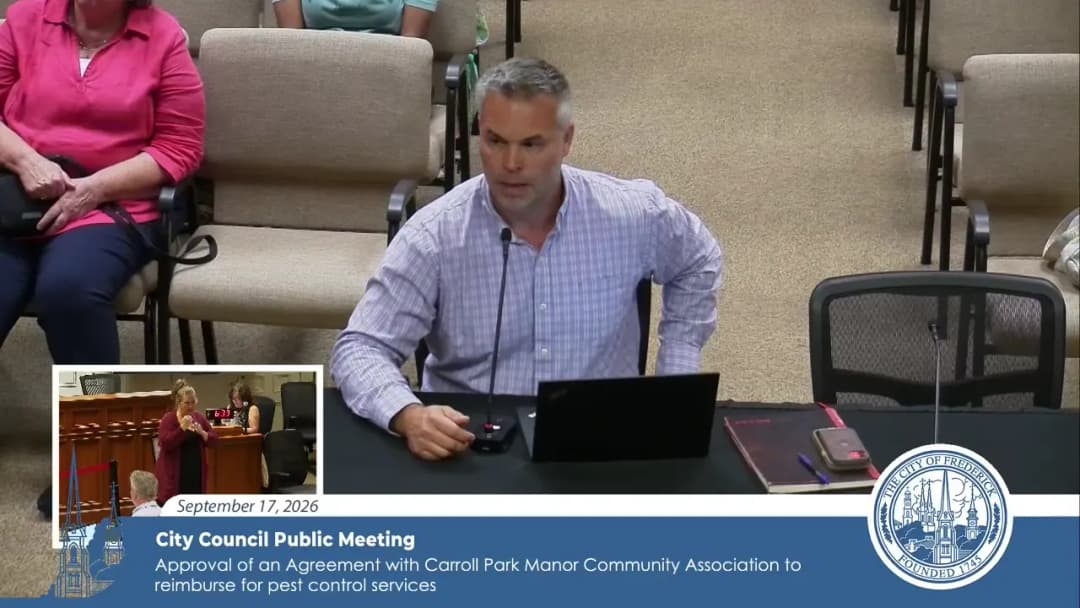
The Frederick City Council held a regular public meeting on September 17, 2026, at 6:00 p.m. at City Hall. The meeting featured proclamations for Deaf Awareness Month and Economic Development Week, approval of multiple contracts and ordinances, a public hearing on the CDBG annual report, and extended council comments addressing ethics complaints, leadership concerns, and calls for ranked-choice voting. All votes were unanimous (5–0) unless noted. Proclamations and Presentations - Deaf Awareness Month Recognition: Marcia Flowers, outreach coordinator for the Maryland Deaf Community Center, highlighted that an estimated 50,000 deaf and hard-of-hearing residents live in Frederick County and approximately 3,000 within the city. She noted that Maryland has over 1.2 million deaf and hard-of-hearing residents and that Frederick now hosts the state’s first Maryland Deaf Community Center, which provides ASL-accessible programs. Council President recognized Linda Stoltz for her leadership. - Economic Development Week Proclamation: Councilmembers read a proclamation declaring September 28 – October 2, 2026, as Economic Development Week. The city is home to more than 80,000 residents, a workforce of approximately 53,000, over 57,000 jobs provided by more than 4,100 businesses, and the Office of Economic Development supports business attraction, retention, and entrepreneurship. Approval of Minutes - The minutes of the September 3, 2026 regular public meeting and closed session were approved unanimously. Purchases and Contracts - Monocacy Boulevard Improvements: Approved a contract with Lingg Property Consulting for $77,500 for design of road improvements, stormwater management, and a railway pedestrian crossing from Zero Storage Way to South Street. - Airport Crack Seal Project: Approved Special Ordinance S-26-20 to amend the FY2027 budget for runway 12/30 crack seal and marking maintenance (total $124,555 including contingency) and approved a purchase order to Airfield & Pavement Maintenance LLC for $94,555. Assistant Airport Manager Sean Dempsey noted the state is expected to fund 75% of costs. - Miscellaneous Concrete Work: Approved a contract with HMF Paving Contractors Inc. for professional services and line item pricing. The bid fell 18.8% below FY26 pricing. - Weatherization Services: Approved three separate contracts (Zerodraft Maryland, General Maintenance II, Epic Homes) to provide weatherization services to eligible households. The program serves Frederick, Carroll, and Washington Counties, and over three years the grant agreement totals over $3 million. Director Michelle Ott noted that all households in the Office of Home Energy Assistance are automatically referred. - Carroll Park Manor Pest Control Reimbursement: Approved an agreement to reimburse the Carroll Park Manor Community Association up to $65,280 for one year of pest control services covering all 204 properties ($320 per property per year). Public commenter Mary Ann Brown expressed concerns about the HOA’s past performance and urged monitoring. Public Hearing - CDBG Consolidated Annual Performance and Evaluation Report (CAPER): Housing Policy Advisor Jody Ostech presented the report for FY2026 (July 1, 2025 – June 30, 2026). $357,312 in CDBG funds were expended, helping 953 persons (786 homeless or at risk). The public comment period closes September 18, 2026. Councilmembers noted the report's format is federally mandated and suggested adding a summary graphic. Council Business – Development Approvals - MPDU Agreement – Wormans Mill Court Apartments: Approved the Moderately Priced Dwelling Units agreement with Standard Wormans Venture LP. The project includes 306 multifamily units, of which 12.5% (39 units) must meet MPDU standards under city code. However, all 306 units will be restricted to households at or below 60% AMI for at least 40 years under the LITEC program. The agreement was modified to reflect compliance with Chapter 19. - Parkland Fee-in-Lieu Resolution 26-13: Set the fee for 2.93 acres of parkland dedication at $240,000, based on an appraisal. The developer received credit for 0.58 acres of on-site amenities (tot lot, dog park, community gardens). Councilmember Hemplerani raised policy questions about crediting off-site improvements like Rails-to-Trails, but the resolution passed unanimously. Ordinance - Second Read – Ordinance G-26-11 (Maryland Housing Certainty Act): City Attorney Rachel Gray presented the interim ordinance to align city processes with state law effective October 1, 2026. Key changes: housing development applications are evaluated under laws in effect on the date the application is deemed complete; if not deemed complete within 30 days, it is deemed complete on day 35; once fully approved, the developer has a vested right for at least five years; impact fees cannot be collected until just before certificate of occupancy or final inspection. The ordinance passed 5–0. Council Comments - Councilmember Shackelford: Criticized Council Vice President Nash for past ethics findings and for not addressing a “disturbing video” that disparaged council members. Stated that leadership is a trust, not a right. - Council Vice President Nash: Did not respond to Shackelford’s comments. Instead, spoke about a “pregnancy resource center” on Market Street operated by CareNet, calling it a facility that misleads women seeking reproductive healthcare and has a “blatant anti-abortion agenda.” Urged the council to examine transparency and accountability. - Councilmember Brem: Praised the Economic Development team for creating bilingual videos promoting business resources, launched September 14. - Councilmember Hemplerani: Addressed a recent ethics complaint filed by Vice President Nash against Mayor O’Connor concerning ArtSpiration Frederick. Noted that the complaint named city employee Kiki Wilson, but no evidence of misuse of resources was presented. Cited Nash’s two prior ethics commission findings (2022 and 2025) and a pending complaint. Called on Nash to take responsibility, seek restoration, and step down from leadership and the Government Operations Committee chair. Public Comments - Ranked Choice Voting: Multiple speakers (Jason Laird, Julie Odlin, Grady O’Rear, Margaret Heinman, Hanni Ambrose, Milton Howland) urged the council to adopt ranked choice voting for city elections, arguing it increases voter representation, reduces negative campaigning, and ensures majority winners. The League of Women Voters of Frederick County endorsed the proposal. - Tiana Massicoy: Addressed intersectionality, urging councilmembers who support parts of a person’s identity to also speak out against disrespect shown by colleagues. Referenced prior comments about Vice President Nash and called for courage. - Grady O’Rear: Also spoke against federal immigration enforcement actions in Frederick, the war in Gaza, and the U.S.-initiated war against Iran, calling on the city to use its voice through the National League of Cities and with federal officials. Key Outcomes - Approved unanimously (5–0): Minutes, all contracts (Lingg, airport crack seal, HMF paving, three weatherization vendors), pest control agreement, MPDU agreement, Resolution 26-13 (parkland fee), and Ordinance G-26-11. - Public comment period for CDBG CAPER remains open until September 18, 2026; report due to HUD by September 30. - Council directed staff to consider future policy approaches for pest control and parkland dedication incentives. - No action taken on ranked choice voting; topic remains under council consideration.

AFFORDABLE HOUSING 17% · PUBLIC COMMENT 15% · PUBLIC ENGAGEMENT 8% · RODENT CONTROL 8%
15
SEP 14, 2026 · FREDERICK, MARYLAND · PLANNING COMMISSION
Frederick Planning Commission Meeting Summary – September 14, 2026

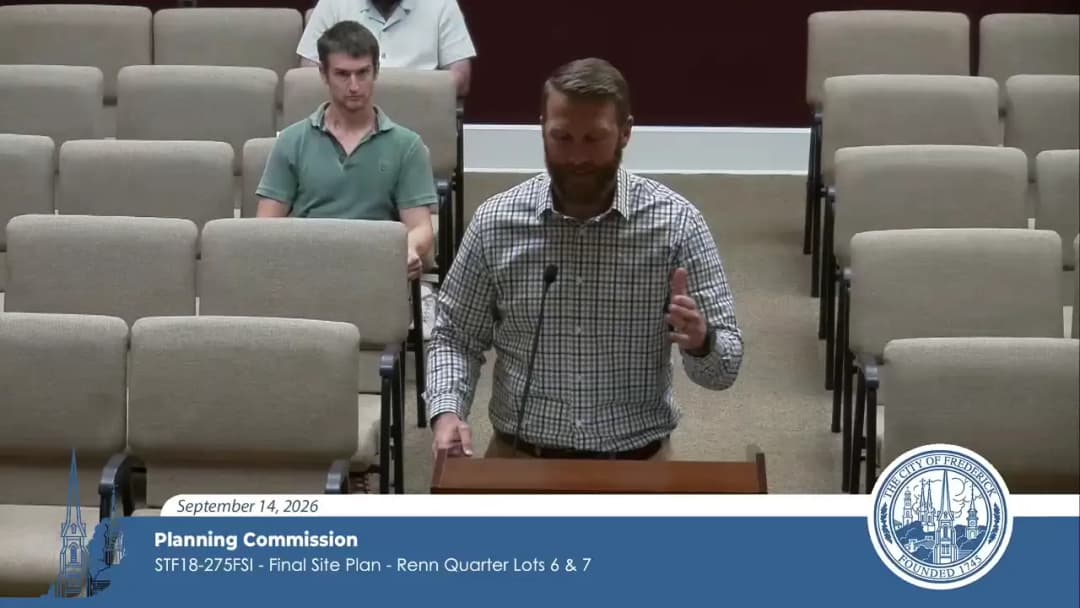
The Frederick Planning Commission met on September 14, 2026 at 6:00 p.m. at City Hall, 101 North Court Street. The commission approved minutes, approved a preliminary-plat continuance, approved two final-site-plan extensions, approved an architectural review, approved an industrial site plan with conditions, and continued a group-housing zoning text amendment to gather additional case studies. Announcements - Staff announced the September 21 Planning Commission workshop at 2 p.m. and a citywide community outreach meeting at 6 p.m., both in the same room. Consent Calendar - No consent items were considered. Minutes - The commission approved the August 10, 2026 Planning Commission minutes, the August 17, 2026 workshop minutes, and the September 11, 2026 pre-planning meeting minutes by voice vote. Public Comments & Testimony - Renn Quarter extension: Rob Thompson, 806 Bond Street, said he is a member of the Renn Quarter community and encouraged the commission to grant the two-year extension so plans could move forward. - Group Housing ZTA: Ann Ryan, Frederick Housing Solutions Task Force under Healthier Frederick, supported the amendment. She said people making under $25,000 have almost no legal housing options, referenced a recent city resolution on housing innovation, and asked the commission to move forward with regulatory and supervisory safeguards. - No public comment was offered for East Pat Lofts, Renn Quarter Phase 3 architectural review, or AstraZeneca. Bowers Park and Birdseye View Preliminary Plats (PC26-97PSU / PC26-98PSU) - These two preliminary plats, located northwest of US-40, bordered by Bowers Road and Rock Creek Drive, were continued to the October 2026 Planning Commission meeting because staff lacked enough information to make a decision due to a clerical error. The continuance carried 4-0. Renn Quarter Lots 6 & 7 Final Site Plan Extension (STF18-275FSI) - Staff reported that the approved final site plan for 279 multifamily units at Monocacy Boulevard, East Church Street, and Monroe Avenue was expiring September 27, 2026, and that no building permits had been issued. The applicant sought a two-year extension to September 27, 2028, citing economic conditions and the need to coordinate required retail components. - Staff recommended approval, noting that the master plan has no expiration date and that APFO certificates are valid until March 20, 2032. - Brian Morris of Mountain Company, for the applicant, said the Renn Quarter master plan totals 1,050 units and up to 105,000 square feet of non-residential space, and that Section 417D requires about 27,000 square feet of non-residential construction before more multifamily units can proceed. He said he expected to return with about 30,000 square feet of retail plans. - Several commissioners discussed APFO capacity, water/sewer allocation, and the importance of a walkable mixed-use neighborhood. One commissioner asked the applicant to update website imagery that appeared to advertise ground-floor retail not shown on approved plans. - The extension was approved 4-0 to September 27, 2028. East Pat Lofts Final Site Plan and APFO Extension (PC21-1431FSI) - Staff presented the request for 12-month extensions for the final site plan and APFO certificates at 319 E. Patrick Street. The project includes a three-story mixed-use building with 17 dwelling units, 2,590 square feet of non-residential space, and a 29-space parking garage, plus renovation of seven existing units and office space. The approvals were set to expire October 10, 2026. Improvement plans were approved, but no building permits had been issued. - Staff found the project was exempt from road capacity testing because it generates fewer than 50 new weekday peak-hour trips and 100 or fewer Saturday midday peak-hour trips; water, sewer, and school certificates were issued with no provisions. - Matt Rockwell of EastPAT Property LLC said the project needs interest rates at or below 6% to be feasible; rates were 6.75% at the time. - Commissioners discussed APFO context and asked for a future engineering overview of traffic and water/sewer capacity. Staff agreed to consider a workshop discussion. - The commission approved the 12-month final site plan extension 4-0 to October 10, 2027. - The commission approved the corresponding waterline, sewer, and school APFO certificate extensions 4-0 to October 10, 2027. Renn Quarter Phase 3, Section 2 Architectural Review (PC14-913-11MU) - Staff recommended unconditional approval of the Fuller model townhouse elevations. The applicant selected five required Class A design elements: street-facing main entrances, sidewalks serving all units, roofs with a minimum 5:12 pitch, exterior materials including cementitious siding and brick, and window/entryway design standards. - Matt McJunkin of Renn Quarter THLC described wider townhomes with open floor plans, an optional fourth bedroom on exterior units, and fenced artificial-turf backyards. He said vinyl siding would be used only on rear elevations and fronts would be about 40% brick. - Commissioner Robey asked about artificial-turf drainage and odor; the applicant said the system uses a filtration base and that maintenance teams inspect backyards. - Commissioner Temple said street-facing entrances and sidewalk connectivity should be baseline standards rather than optional design elements, and suggested raising that issue in future LMC updates. - The architectural elevations were approved 4-0. AstraZeneca Final Site Plan (PC26-134FSI) - The proposal was a pharmaceutical manufacturing addition at 633-636 Research Court. The agenda described it as a 24,000-square-foot addition, while staff and applicant materials described a 24,500-square-foot column-packing addition. The project would consolidate purification operations from Buildings B633 and B636 to support production of critical cancer treatments. - Staff reported the site is zoned light industrial, the highway noise overlay does not apply, prior forest conservation obligations have been met, and no new landscaping is triggered. A full water APFO certificate was issued, the sewer certificate was provisional pending an APFO sewer study, and road capacity was exempt. - Staff recommended approval with five conditions: water/sewer utility approval; relocation of the water meter southwest of transformer equipment; preparer signature and seal on the landscape plan; APFO certificate approval dates added to the cover sheet; and correction of setback tabulations on the cover sheet, including changing a rear setback to a side setback adjacent to lot 13. - Applicant representatives said the two-story addition would house column-packing operations, GMP clean rooms, support spaces, and H-rated hazardous-material areas. - Commissioner Robey noted a 234,000 gallons-per-day water demand figure for the addition and asked the applicant to provide campus-wide water demand context. The applicant said they would follow up and noted some water is evaporated through cooling towers rather than sent to sewer. - Commissioner Montes asked about regulatory oversight of hazardous materials; the applicant cited building inspection and external agency oversight but did not provide full detail. - The final site plan was approved 4-0 with the five conditions. Group Housing Zoning Text Amendment (PC26-128ZTA) - Staff summarized the proposed amendment to add a new Group Housing land use, described as personal living quarters (PLQ), to the Land Management Code. A PLQ would consist of six or more individual living units (ILUs) that do not have complete cooking facilities. Each ILU would allow up to two occupants plus a related child under 18. Shared kitchens would be required at one per nine ILUs and shared bathrooms at one per four ILUs. A designated owner/operator would be required. (The transcript contains an internal inconsistency about the exact PLQ threshold: staff initially said five or fewer ILUs are not a PLQ and later said at five it becomes a PLQ.) - The proposal would allow PLQs by right in many residential, downtown, professional business, and mixed-use districts, and as conditional uses in R4/R6, neighborhood commercial, general commercial, and institutional districts. Parking would be required at 0.25 spaces per ILU, waived within half a mile of transit; bike parking at one per five ILUs; leases of at least four months; and site-plan review for larger PLQs. - Commissioner Temple asked that public comments be posted going forward for transparency; staff said comments are forwarded to the applicant and City Council. - Jessica Underwood, a for-profit developer, and City Council Vice President Katie Nash presented the amendment. Underwood said the amendment originated in April 2025 to address single-room-occupancy housing. She cited the 2026 Frederick Housing Needs Assessment showing Frederick County needs 31,000 housing units by 2035 and that 30% of the population lives alone. She said typical apartment construction costs $200,000-$250,000 per unit versus $50,000-$100,000 for group housing, and described existing group housing renting for $800-$1,050 per month compared with $1,500-$1,700 for a one-bedroom plus utilities. Nash said the city needed a test case to prove the concept before pursuing nonprofit partnerships. - Staff recommended a positive recommendation to the City Council, finding the amendment consistent with the LMC and with housing policies in the comprehensive plan. - Commissioner Roby expressed strong support for the affordability concept. Commissioner Temple raised concerns about the shared kitchen ratio and bike parking, and Commissioner Montes asked for evidence from other jurisdictions, warning about density, sanitation, and potential for-profit exploitation. Several commissioners noted the commission's vote would be a recommendation to the City Council, not a final adoption, and wanted any concerns included for council consideration. - The commission voted 3-0 with one abstention to continue the item to October 12, 2026, so the applicant could provide comprehensive case studies of group housing in similar cities, including examples of both success and failure. Key Outcomes - Minutes and workshop minutes approved. - Bowers Park and Birdseye View preliminary plats continued to October 2026 (4-0). - Renn Quarter Lots 6 & 7 final site plan extension approved to September 27, 2028 (4-0). - East Pat Lofts final site plan and APFO certificate extensions approved to October 10, 2027 (4-0 on each motion). - Renn Quarter Phase 3, Section 2 Fuller townhouse elevations approved (4-0). - AstraZeneca final site plan approved with five conditions (4-0). - Group Housing ZTA continued to October 12, 2026 (3-0, one abstention), pending case-study information.

AFFORDABLE HOUSING 30% · SITE PLAN APPROVAL 17% · ZONING AND LAND USE 10% · MIXED USE DEVELOPMENT 7%
16
SEP 14, 2026 · FREDERICK, MARYLAND · CITY COUNCIL COMMITTEE MEETINGS
Government Operations Committee Meeting - September 14, 2026

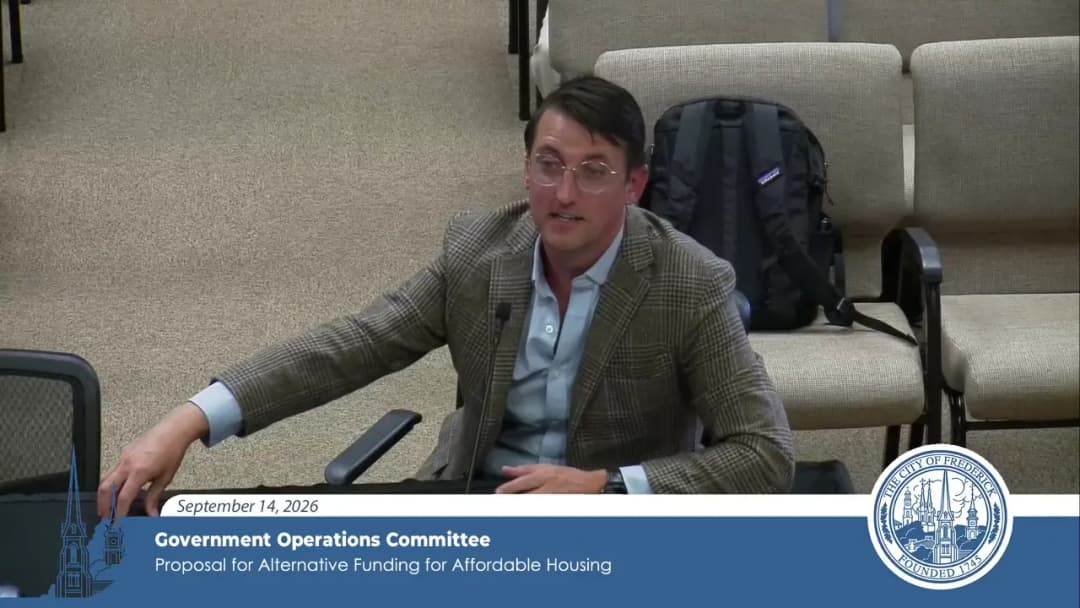
The Government Operations Committee of the City of Frederick met on September 14, 2026, to discuss a proposal for an alternative funding mechanism for affordable housing, consider several charter amendments, and review other items. The meeting included presentations, public comments, and committee deliberation. Consent Calendar - Approved minutes from August 3, 2026, and August 10, 2026, unanimously (3-0). Public Comments & Testimony - Ann Ryan (Frederick Housing Solutions Task Force, Frederick House) expressed support for the revolving loan fund concept, suggesting a pilot project using $5 million for innovative affordable housing initiatives, such as on church property or for single-room occupancy (SRO) units. - Danny Adams (Executive Officer, Frederick County Building Industry Association) supported creative public-private partnerships and recommended including vacancy rates in feasibility studies, ensuring qualification processes for rental and for-sale units. - Sharon Camper Cerez (resident, former housing policy analyst, Montgomery County National Park and Planning Commission) endorsed the revolving fund over a general fund set-aside, emphasized that a standalone commission (like HOC) is essential for integrity, and suggested using short-term rental hotel tax revenue to supplement the bond program. She also urged moving forward with form-based code and noted that the break-even for MPDUs in Montgomery County was at least 14.5%. Discussion Items - Proposal for Alternative Funding for Affordable Housing (Workshop Item A): Ryan Trout, a Frederick resident and volunteer, presented a concept for a $15 million bond-funded revolving loan fund ("Housing Accelerator Fund") to replace expensive private equity (16-22% returns) in the capital stack for mixed-income rental housing. The fund would lend at 5-7% interest, with savings used to create affordable units (e.g., 30-60% AMI). The bond would cost the city an estimated $1-1.2 million annually but generate $900,000 in interest, netting $100,000-$300,000 per year. Chattanooga and Montgomery County models were cited. Committee members discussed governance (housing authority vs. standalone entity), the need for a feasibility study, staffing costs, and potential to use MPDU fees. Chairwoman Nash indicated plans to draft an ordinance. - Charter Consideration: City Administration (Workshop Item D): Councilmember Brem proposed establishing a Chief Administrative Officer (CAO) position appointed by the mayor but removable by council majority, elevating the Director of Planning and HR to cabinet-level, and requiring council advice and consent for terminations of such appointees. Councilmember Akins opposed, arguing redundancy and that the mayor should have flexibility. Councilmember Nash favored professionalizing management. No action taken; further discussion planned. - Charter Consideration: Public Property – Eminent Domain (Workshop Item B): Chairwoman Nash raised the topic for future discussion, noting other jurisdictions use eminent domain for vacant property enforcement and that a presentation on state practices may be appropriate. - Charter Consideration: Public Sidewalks (Workshop Item C): Councilmember Nash proposed language clarifying the city's authority over sidewalks while reserving the right to assume costs, pending a DPW sidewalk study and financial analysis. Committee supported the approach. - Old Business: Referenced a proposed charter amendments list for review. Key Outcomes - No formal votes were taken on substantive items. - The committee agreed to proceed with drafting an ordinance for the Housing Accelerator Fund, including a feasibility study and governance structure. - Further discussions on charter amendments for administration, eminent domain, sidewalks, and public property disposition were scheduled for future meetings. - The chair directed staff to draft a short-term rental hotel tax ordinance, as previously discussed. - Committee members requested additional information on the use of MPDU funds, bond costs, and staffing implications for the housing fund.

AFFORDABLE HOUSING 60% · PUBLIC PRIVATE PARTNERSHIPS 9% · PERSONNEL MATTERS 9% · PROCEDURAL 6%
17
AUG 25, 2026 · FREDERICK, MARYLAND · ZONING BOARD OF APPEALS
Frederick Zoning Board of Appeals Meeting - August 25, 2026

The Zoning Board of Appeals met on August 25, 2026, at 7:00 PM at City Hall to consider five conditional use applications and conduct an election of officers. The board approved all applications with varying conditions, including five-month compliance reviews for two establishments. The meeting included extensive public testimony on noise concerns related to outdoor amplified music. Consent Calendar - Approval of Minutes: The board unanimously approved the minutes from the June 23, 2026 meeting (motion by Bob Sisson, second by Stephen Colar). Public Comments & Testimony - No general public comment was offered at the start of the meeting. - Sandbox Brewhouse (880 N East St): Neighbors testified about past noise from food truck generators and amplified music causing vibrations inside homes. They expressed distrust and asked for denial. Supporters highlighted the venue's community role and financial need. One neighbor noted five police calls but no formal reports. - Wagbar (925 N East St): No public comment was offered. - The Banyan (216 E Patrick St): Over a dozen downtown residents described rooftop amplified music as plainly audible inside homes, with lyrics and vibrations even with windows closed. Some acknowledged the restaurant's indoor entertainment and requested limiting rooftop to acoustic/unamplified sound. A few employees and patrons argued the business had made mitigation efforts and deserved a chance. - Lima Soul (14 E Patrick St): No public comment was offered; the applicant stated they had established good relations with upstairs neighbors. Discussion Items - ZBA26-21CU – 358 W. Patrick Street (Condominium Conversion): Applicant requested conversion of two ground-floor office units to residential. Staff found the residential character of the block and lack of commercial interest made the request appropriate. No public comment. Approved unanimously. - ZBA26-16CU – 880 N. East Street (Sandbox Brewhouse): Conditional use to allow live entertainment until midnight Fridays and Saturdays (up to three weekends per month). Staff recommended approval with conditions. Following public debate, the board approved with a five-month staff compliance report (motion by Dixon Hicks, second by Bob Sisson). Vote: 4-0. - ZBA26-23CU – 925 N. East Street (Wagbar): Conditional use for a restaurant with an outdoor off-leash dog park as entertainment. Staff noted the unique use required a zoning determination. Applicant described a national franchise with no issues. No public comment. Approved unanimously. - ZBA26-6CU – 216 E. Patrick Street (The Banyan Restaurant and Bar): Request for indoor entertainment until midnight (7 days) and rooftop until 9/10 pm. Staff recommended approval with those hour limits. After extensive public testimony, the board approved with conditions: entertainment hours per staff recommendation plus a five-month compliance report. Chair Jim Racheff voted no, citing concerns about outdoor music. Vote: 4-1. - ZBA26-10CU – 14 E. Patrick Street (Lima Soul): Conditional use for indoor entertainment Fridays and Saturdays until 1 am, Sundays until 10 pm. Staff recommended limiting Sunday to 10 pm. Applicant described Peruvian cultural performances and neighbor outreach. No public comment. Approved unanimously. Key Outcomes - All five conditional use applications were approved. - Sandbox Brewhouse and The Banyan must provide a staff compliance report after five months; additional noise-related conditions apply. - The Banyan rooftop entertainment hours are limited to 9 pm Sunday–Thursday and 10 pm Friday–Saturday; the chair dissented. - Lima Soul entertainment on Sundays is limited to 10 pm. - The board re-elected Jim Racheff as chair and Lawrence Aronow as vice chair for another term.

NOISE ORDINANCE 38% · ZONING AND LAND USE 28% · PUBLIC COMMENT 8% · PROCEDURAL 5%
18
AUG 25, 2026 · FREDERICK, MARYLAND · CITY COUNCIL COMMITTEE MEETINGS
Public Works Committee – Sidewalk Study Review – August 25, 2026

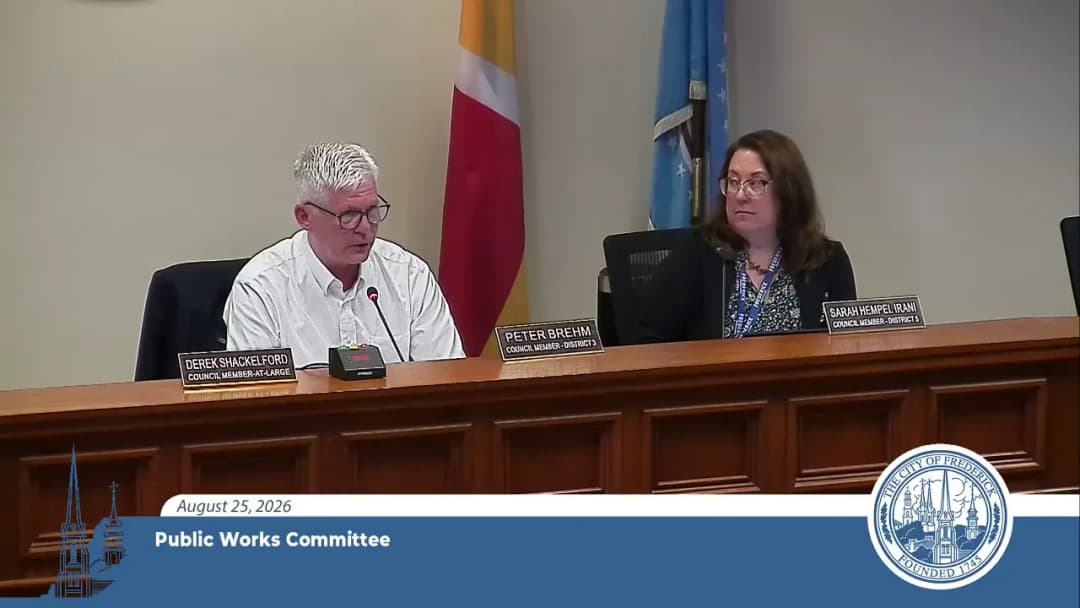
The Public Works Committee of the City of Frederick met on August 25, 2026, to receive a presentation on the completed Sidewalk and ADA Ramp Condition Assessment. The study, performed by O'Connell and Lawrence, inventoried 343 miles of sidewalk (4,649 segments) and 6,196 ADA ramps within city right-of-way. The citywide sidewalk condition index averaged 78 (satisfactory), while 62% of ADA ramps failed inspection, predominantly due to missing tactile warning pads. The committee discussed findings, repair costs, prioritization, and next steps for funding and policy changes. Discussion Items - Sidewalk Condition Findings: The overall sidewalk condition score for the city is 78 (satisfactory). 74% of sidewalk segments fell into good or satisfactory categories; 12% fair; 14% poor or very poor (740 segments totaling 20.46 miles). The most common distress was grade differentials (223,643 identified), with 96% under 1 inch and 8,905 over 1 inch. Downtown historic areas and Whittier/Walnut Ridge showed higher concentrations of poor-condition segments. - ADA Ramp Findings: Of 6,196 ramps, 2,002 passed and 3,841 failed (62% failure). 85% of failures (3,282 ramps) were due to missing tactile warning pads. Historic district ramps have exemptions; alternative treatments exist. - Prioritization Scoring: A prioritization score combined sidewalk condition index (50 points) with proximity to transit stops (5 points), school zones (15 points), equity emphasis areas (15 points), and downtown historic district (15 points). The highest priority concentrations were in the south downtown historic area. - Cost Estimates: Planning-level cost estimates: priority grade differential repairs (poor/very poor segments) at $6 million (precision cut) to $53 million (full replacement); citywide grade differential program $11.2 million (precision cut under 1/2 inch) to $53.4 million (replace all); ADA ramp compliance $20.4 million (full reconstruction) with lower options via tactile paver retrofits. - Policy and Funding Considerations: Current sidewalk repair program is complaint-driven with a $2 million expenditure in FY26 (467 repairs, 2.4 miles), partially funded by property owner contributions (50% or 100% for tree-related). The committee discussed shifting to a city-funded, proactive program. Challenges include charter and code changes (property owner responsibility), potential grandfathering issues, and the need for consistent multi-year funding. - Tree and Downtown Streetscape: Discussion noted tree root damage to sidewalks, especially downtown, and the Downtown Frederick Partnership’s streetscape redesign grant as a potential concurrent effort. Key Outcomes - Next Steps: Staff will develop a five-year plan for sidewalk and ADA ramp repairs, incorporating the prioritization list and considering both cost-share and fully city-funded scenarios. - Funding: The current FY27 budget includes $500,000 more for complaint-driven repairs; a shift to proactive segmental repairs would be presented during the FY28 budget cycle. - Policy Review: The Government Operations Committee will begin discussions on modifying the city code and charter regarding sidewalk ownership and repair responsibility. - No Formal Votes: The committee directed staff to return with options for a phased, funded approach, including efficiency comparisons between complaint-based and programmatic repairs.

SIDEWALK MAINTENANCE 42% · PUBLIC WORKS 29% · BUDGET EQUITY ANALYSIS 12% · ACCESSIBILITY 9%
19
AUG 24, 2026 · FREDERICK, MARYLAND · CITY COUNCIL COMMITTEE MEETINGS
Government Operations Committee Meeting - August 24, 2026

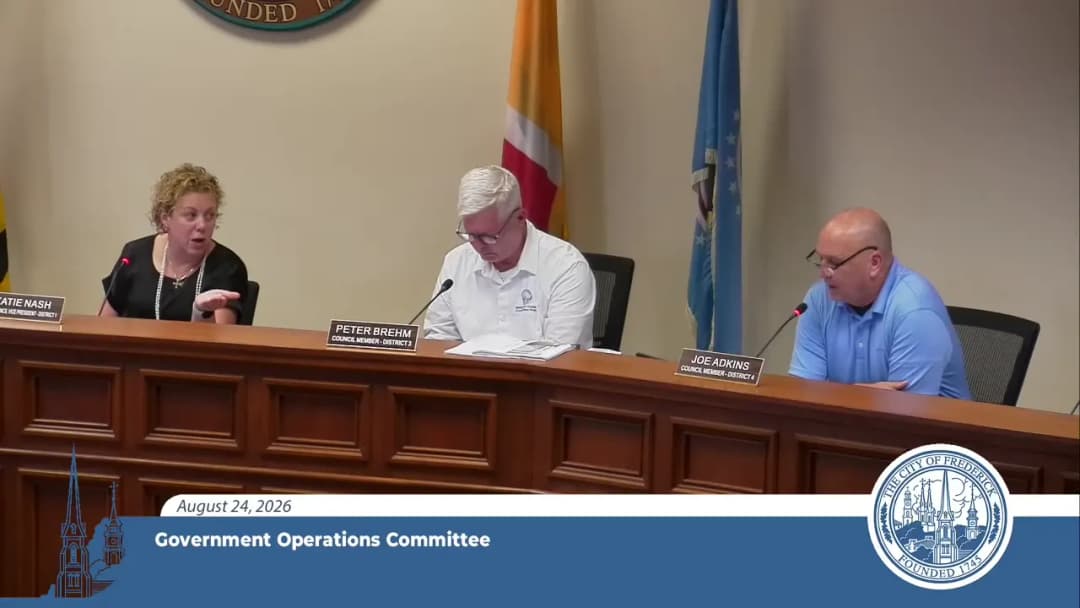
The Government Operations Committee met on August 24, 2026, at 4:00 PM to discuss the APFO School Mitigation Fee, charter amendments regarding council operations staff and appointed positions, and the charter consideration schedule. The committee focused on refining proposals and next steps for school mitigation fund usage and council staffing. Discussion Items APFO School Mitigation Fee - Councilmember Nash presented a draft ordinance to create a mechanism for transferring school mitigation funds (currently amassed with no ongoing disbursement process) to Frederick County Public Schools (FCPS). The proposal aims to use approximately $6 million for career technical education (CTE) and the Career Technology Center (CTC) located in the city. Nash expressed support for universal pre-K but noted the funds may be insufficient; she emphasized the need to get money out of the account and into programs. - Councilmember O'Connor supported the philosophy but questioned whether to be prescriptive (as in the draft) or broader. He suggested adding school building construction as an allowed use. Nash indicated openness to broader language, noting the prescriptive text came from the county's workforce feasibility study. - Councilmember Brockens argued the discussion is premature without consulting FCPS. He noted that $4.5 million was previously allocated for portables at Whittier and Hillcrest and suggested waiting until January to meet with FCPS, then allocate funds in June. He also mentioned that buying land for CTC in Riverside would be a good use. - Councilmember Nash responded that the study documents the need for CTE, and she has had preliminary conversations with County Councilmember Young, who supports the concept but has not formally vetted with FCPS. She proposed sending a letter to FCPS Superintendent Dr. Libo and the county council to get input before moving forward. - The committee agreed to send a letter to FCPS and the county council for input, and to forward the draft ordinance to the city attorney for legal review. Charter Consideration: Council Operations Staff - Councilmember Nash presented a proposed charter amendment to allow the city council to have its own staff (hiring, supervising, firing). The current draft language also included a provision granting city council direct access to city staff reporting to the mayor. - Councilmember O'Connor noted that the direct access provision is a separate issue from council staff. He compared it to a February 2026 memorandum between the mayor and council president, which currently governs staff access. He suggested splitting the two concepts. - Councilmember Atkins agreed the direct access issue is a departure from current practice and should be a separate discussion. He expressed concern about multiple council members querying staff directly, preferring to go through department directors. - Councilmember Nash clarified she intended only the council staff language, and the direct access language was unintentionally included. She agreed to separate the two items for future discussion. - The committee decided to split the amendment into two distinct proposals: (1) council authority to hire/supervise/separate its own staff, and (2) city council direct access to city staff (with or without coordination through department directors). Both will be revisited at a future meeting. Charter Consideration: City Appointed Positions - Councilmember Atkins presented a proposal to review which city positions should be mayoral appointees. He noted that historically, deputy directors were appointed but did not report directly to the mayor, leading to confusion. He is unsure whether to keep them as appointed or make them career positions. - Councilmember Nash suggested providing an org chart and current list of appointees to inform the discussion. The committee agreed to obtain an updated list and org chart from staff. - Councilmember Brockens noted that the org chart itself may be a reflection of the mayor's organizational structure, which may not need charter change. The committee will review the list and decide on next steps. Key Outcomes - APFO School Mitigation Fee: Committee directed Councilmember Nash to send a letter to FCPS and the county council requesting input on the proposed use of funds for CTE/CTC. The draft ordinance will also be sent to the city attorney for review. A follow-up discussion will occur after feedback is received. - Council Operations Staff: The proposed charter amendment will be split into two separate items: (1) council authority to manage its own staff (hiring, supervision, separation), and (2) council direct access to city staff. Both will be brought back for further discussion. - Appointed Positions: Councilmember Atkins will obtain an updated list of mayoral appointees and an org chart to inform future consideration. - Schedule: The next meeting is set for September 14, 2026. An item on removing council members from leadership positions was added to the September 28, 2026 agenda. - Public Comment: None.

SCHOOL MITIGATION FEE 31% · CHARTER AMENDMENTS 25% · PERSONNEL MATTERS 24% · EDUCATIONAL FACILITIES 13%
20
AUG 20, 2026 · FREDERICK, MARYLAND · CITY COUNCIL
Frederick City Council Public Meeting – August 20, 2026

The Frederick City Council held a public meeting on August 20, 2026, at 6:00 PM in City Hall. The agenda included a pledge of allegiance, a presentation/proclamation, approval of minutes from August 6, 2026, appointments/reappointments, council comments, a consent calendar, and a public hearing. No transcript or minutes were provided; this summary is based solely on the published agenda. Consent Calendar - Special Ordinance S-26-15: To amend the FY 2027 Budget to include revenue and expenditures for a FY 2026 Certified Local Government (CLG) grant from the Maryland Historical Trust for education and training. - Special Ordinance S-26-16: To amend the FY 2027 Budget for a U.S. Department of Justice, Office of Justice Programs 2025 BJA Edward Byrne Memorial Justice Assistance Grant. - Special Ordinance S-26-17: To amend the FY 2027 CIP 120014 Budget for grant funds from the Maryland Department of Housing and Community Development for building improvements at the National Museum of Civil War Medicine. - Special Ordinance S-26-18: To amend the FY 2027 CIP Budget for grant funds for predevelopment activities at the Downtown Frederick Hotel and Conference Center. Discussion Items Public Hearing – Purchases - Fall Protection Upgrades: A contract with Summit Anchor Company in the amount of $1,448,601.57 and purchase order of $1,545,571 for professional services related to fall protection upgrades at thirteen City water and sewer facilities. - Pedestrian Bridge Design: A contract change order with A. Morton Thomas for a not-to-exceed amount of $325,120.30 for design of a pedestrian bridge crossing an onsite private road at the Worman’s Mill Court Apartment project. Public Hearing – Ordinances (Second Readings) - Ordinance G-26-8: Concerning fees. - Ordinance G-26-4: Concerning fines for automatic enforcement. - Ordinance G-26-10: To amend the Land Management Code concerning vertical mixed use, including a Planning Commission recommendation letter and project report. Key Outcomes No decisions, votes, or specific outcomes were recorded in the available agenda. Consent calendar items were listed as routine and likely approved collectively. Public hearings were held on the purchases and ordinances, but results are unknown. Council business and public comments were listed but not transcribed.

OPENPUBLICA · PUBLIC MEETING INDEXUPDATED DAILY · openpublica.com