Browse by city
Date range
Search help

Search titles, summaries, topics and stored transcripts together. Keywords may match separately; put the whole query in double quotes for a phrase. Matching follows word analysis, so punctuation is not exact. Both dates are included. Documents are not searched.

SHOWING 71–80 ENTRIES
71
MAY 19, 2026 · GREAT BARRINGTON, MASSACHUSETTS · SELECTBOARD & TOWN BOARDS
Great Barrington Affordable Housing Trust Meeting – May 19, 2026

The Great Barrington Affordable Housing Trust met remotely on May 19, 2026, to approve minutes, receive updates on CPA funding and financial corrections, discuss the ADU vendor contract, and review development options for the Risingdale ball field site. Members voted on several financial items and set next steps for the ADU program and site planning. Consent Calendar - Approved the minutes of April 21, 2026, with an amendment to include specific projections provided by Joey regarding the need for a new rental assistance grant. Vote: Fred Clark – yes, Ananda Timpain – yes, Bill Cook – yes, Garfield Reed – yes, Peter Most – yes, Joseph Method – abstain. Public Comments & Testimony - Donna Jacobs, a neighbor at 260 Park Street, expressed regret over the loss of the ball field as open space, supported the idea of affordable housing, but wished the Area Median Income (AMI) limits could be adjusted so local youth could qualify. She urged that affordable housing remain accessible to Great Barrington residents. - Ananda Timpain clarified that the town cannot restrict housing to town residents and that AMI is set by the state using federal HUD data. Discussion Items - Town Meeting Action & CPA Funding: Town meeting approved CPA funds of $325,000 for FY27 and $31,933.99 from the short-term rental special revenue fund for the Affordable Housing Trust. The town also adopted the seasonal communities designation; Peter Most will present a report on the opportunities (including a potential regional affordable housing trust and seed grant up to $4 million) at the June meeting. - ADU Vendor Selection: The trust reviewed a proposed contract from BRPC. The cost structure was $3,500 per applicant (plus up to $1,000 for applicants who withdraw after substantial staff time), rather than the previously approved flat $5,000. The contract did not include the key task of applying the rubric and scoring applications. Members discussed whether to revise the scope or approve a higher budget. No vote was taken; the trust will either schedule a special meeting or revisit in June. - FY26 Financial Corrections: A broken spreadsheet formula had understated the starting balance by $23,000; the trust voted unanimously to accept the corrected starting balance. They also voted to rescind a $250 grant-writing support fee (approved in November 2025 but not used) and to approve a $310 recording fee for the first ADU grant deed documents. - Risingdale Ball Field Development: Fred Clark presented a detailed analysis of site constraints, zoning options (3 units by right, residential cluster development allowing 4–64 units with 35% open space), market feasibility (sales price must be ≤$350,000 to meet 100% AMI), and community input (desire for green buffer, infill character). He advocated for 6–8 units as duplexes to preserve neighborhood scale. Discussion included comparing with Prosperity Way (Habitat for Humanity project): Ananda noted 72 pre-screens resulted in only 8 viable applicants, while Bill Cook highlighted the lengthy Habitat qualification process. The trust agreed to develop a list of top-five criteria (density, affordability, non-negotiables like tree buffer) to guide an RFP, with possible formation of a subcommittee over the summer. Key Outcomes - Votes taken: - Approved April 21 minutes as amended (6-0-1). - Accepted corrected FY26 starting balance (unanimous). - Rescinded $250 grant-writing support (unanimous). - Approved $310 recording fee for first ADU deed documents (unanimous). - Directives/Next Steps: - Peter Most will present a report on seasonal communities and the regional affordable housing trust at the June 16 meeting. - The ADU vendor issue will be revisited either in a special meeting or at the June meeting; Chris Rembold will contact BRPC about including application scoring. - For Risingdale, the trust will prepare a task list covering density, affordability, community-specific requests, and unknowns (e.g., construction costs). A subcommittee may be formed to draft the RFP. - Member reappointment forms should be returned to the Select Board office.

AFFORDABLE HOUSING 52% · BUDGET EQUITY ANALYSIS 12% · PUBLIC ENGAGEMENT 9% · ZONING AND LAND USE 8%
72
MAY 18, 2026 · GREAT BARRINGTON, MASSACHUSETTS · SELECTBOARD & TOWN BOARDS
Great Barrington Select Board Meeting Summary – May 18, 2026

The Great Barrington Select Board convened on Monday, May 18, 2026. An executive session scheduled for 5:00 p.m. was postponed, and the Board proceeded directly with the open meeting, which ran past 6 p.m. The meeting covered the town manager's report, a public hearing, and numerous license approvals. The Board established subcommittees for policy review and a community care team, approved a historical kiosk for the Town Hall lawn, and heard a proposal for deeply affordable housing to address a lengthy waitlist. Consent Calendar & Routine Approvals - Approval of Minutes: The minutes of the April 27, 2026 meeting were approved 4-0 with a minor edit. - Common Victualler License: Approved for Styling Franks Hot Rods (Main Street), contingent on written sidewalk permission. - Temporary Liquor License: Approved for the Mahaiwe Performing Arts Center's annual Gala at Memorial Field on August 2, 2026 (5 p.m. to 11 p.m.). - Parking Lot Use: Approved for the Mahaiwe Gala to use the Town Hall parking lot (4 p.m. to 11 p.m.). - Vendor Licenses: Approved for Berkshire Bus for a summer series on Railroad Street (July 4, 11, 18) and a Housatonic Pop-Up on Depot Street (July 18). - Entertainment Permit: Approved for Black Bear Training's second-annual First Responders Fundraiser at the fire station (June 20), which raised over $3,000 for departments last year. - Public Hearing: Closed the hearing and approved National Grid's petition to install a utility pole on Main Street to service a new structure. - Donation Acceptance: Voted to accept a $150 donation for the town's transit system. Discussion Items - Town Manager's Report: The manager reported on a MassDOT public hearing regarding the Housatonic River bridge replacement (May 21) and the Housatonic Waterworks reimbursement program, which served 171 households with $131,441 distributed. The manager clarified that redactions on recent invoices were performed by Town Council, not the manager's office. - Du Bois Freedom Center Interpretive Kiosk: Beth Carlson and Marcus Smith presented a kiosk for the Town Hall lawn honoring Elizabeth Freeman and her legacy. The Board discussed the rigorous historical process involving multiple historians and the ability to update panels as new scholarship emerges. The project was unanimously approved, subject to Historic District Commission review and a maintenance agreement. - Bylaws, Policies, and Procedures Subcommittee: The Board accepted the draft charge. Members Bill and Phil were appointed. - Community Care Team Pilot Program: The Board accepted the draft charge for a one-year pilot. The Town Manager will recruit up to nine members from the community. - Affordable Housing Proposal (State Road): Joey Lindstrom of a local affordable housing organization requested a letter of support for a state grant application. The proposal involves developing 5 to 15 deeply affordable units, which would help address a current waiting list of 600 households. The Board referred the request to the Town Manager as it was not on the published agenda. Public Comments & Testimony - Ben: Criticized Town Council transparency on redacted invoices and cannabis issues, and raised concerns about tick infestations, urging better public health awareness. - Jane: Asked about town funding for lifeguards at Mansfield. The Board stated no plans exist and a citizen's petition would be required. - Steve: Clarified the veterans' established rotation schedule for Memorial Day parades across Great Barrington and West Stockbridge. Key Outcomes - Subcommittee Appointed: Bill and Phil appointed to the Bylaws, Policies, and Procedures Subcommittee. - Kiosk Approved: Du Bois Freedom Center kiosk for Town Hall lawn approved with conditions (HDS review, maintenance agreement). - Community Care Team Draft Charge Accepted: Recruitment for the pilot program will begin. - Public Hearing Completed: National Grid pole installation on Main Street approved. - Business Licenses Granted: Multiple seasonal and special event licenses approved unanimously. - Housing Proposal Referred: Request for a letter of support referred to Town Manager for a future agenda item.

PROCEDURAL 40% · LICENSE AND PERMITS 21% · HISTORIC PRESERVATION 20% · PUBLIC ENGAGEMENT 9%
73
MAY 14, 2026 · GREAT BARRINGTON, MASSACHUSETTS · SELECTBOARD & TOWN BOARDS
Great Barrington Planning Board Organizational Meeting and Solar Permitting Report – May 14, 2026

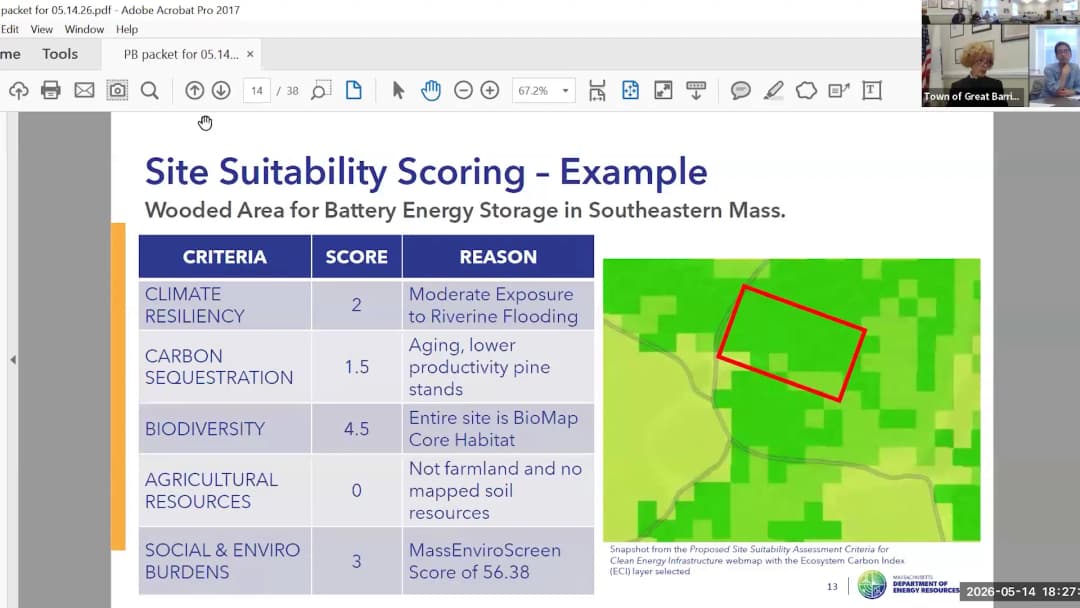
The Great Barrington Planning Board held its annual organizational meeting on May 14, 2026, with all five members present. Members elected officers, appointed representatives to town and regional committees, and recommended an alternate delegate to the Berkshire Regional Planning Commission. The board also reviewed state clean-energy permitting changes, heard public testimony about traffic and tree protection at a Main Street construction site, and received staff updates on enforcement, the Open Space and Recreation Plan, and possible zoning issues. Organizational Business - The board elected Brandy as Chair, Pedro as Vice Chair, and Jackie as Clerk for the year; votes were unanimous with no objections. - Board members were appointed to committees: Jeremy to the Community Preservation Committee, Jackie to the Design Advisory Committee, Brandy to the Lake Mansfield Improvement Task Force, and Pedro to the Regional Planning Commission. All appointments passed without opposition. - The board voted to recommend Malcolm Vick to the Select Board as alternate delegate to the Berkshire Regional Planning Commission so he could continue one more year as president. - No Form A applications were received. - The April 23, 2026 meeting minutes were approved as amended. Board member Kim abstained because she had not attended that meeting. Public Comments & Testimony - Aislin Amore, a Mahewee Street resident and parent of three young children, reported dangerous speeding from Route 7 onto Mahewee Street and said she was willing to organize neighbors, correspond with the board, and learn more about a possible one-way street designation. - Aislin Amore also spoke about the large maple tree near the proposed 21-unit apartment complex across from her home. She said the current permit appears to require fencing about 25 feet from the property line, roughly half the distance to the tree's dripline, while the Tree Committee had been told the tree would be protected to the dripline. She said she was not trying to stop the project but asked the board to clarify and strengthen protection measures before foundation excavation begins. - Julie Anna, chair of the Tree Committee, asked that the Tree Warden be included before any pruning decisions, noting heavy equipment was already sitting within the tree's dripline and some limbs support other limbs. She also asked for information on the Open Space and Recreation Plan to share with the Parks and Recreation Commission. - Eileen asked whether data centers would be multi-story; staff said large data centers are generally one-story warehouse-like structures. - James, of 84 North Plain Road, called the Mahewee Street situation a lost opportunity because residents had raised narrow-street concerns before approval, and the issue should have been addressed at the beginning. - Shannon Boris, a direct abutter to the project at 546 Main Street, said vehicles had twice parked next to the tree, that the developer's communication had been weak, and that the development was off to a bad start. She asked for enforcement, neighborhood involvement in any traffic changes, and continued effort to put access on Main Street rather than Mahewee Street. Discussion: Construction Site and Traffic Concerns - Board members reported resident concerns about an excavator at the Main Street site and said the planning/building department had already contacted the developer about tree protection fencing and would monitor the project. - Members discussed Mahewee and Division Street speeding, traffic calming, complete streets, and the possibility of one-way streets in the MXD zone between Route 7 and Route 23. Some members felt the site plan matter was closed, while others wanted to revisit the complete streets plan or address the issues through the upcoming master plan. No formal action was taken. Discussion: Clean Energy Permitting Report - Staff member Chris reported that Pedro, Jonathan, and he attended an April 30, 2026 Berkshire Regional Planning Commission/DOER presentation titled New Local Permitting for Clean Energy Projects. The speaker was Rick Collins, interim director of the Siting and Permitting Division of the Massachusetts Department of Energy Resources. - DOER plans to launch an online permitting portal in July, initially as a work in progress. The portal would consolidate state and local permitting pathways and provide site-suitability scoring tools. Board discussion indicated lower scores generally mean less impact and are more compatible with solar development, while high scores flag sensitive resources. - Municipalities are the permitting authority for small clean-energy generation projects up to 25 megawatts; projects of 25 megawatts or more fall under the Energy Facilities Siting Board. Board members noted the town's largest solar facility is roughly 2 to 2.5 megawatts and expressed concern that local control is limited and may take the form of conditions and input rather than prohibition. - The town has been awarded BRPC technical assistance to review the town's solar bylaw for compliance with new state regulations, including permitted zones, size thresholds, conditions, and energy storage. BRPC will also review zoning for the new seasonal communities designation; the work is likely to occur this summer. Discussion: Joint Select Board Meeting and Data Centers - The board agreed to hold a joint meeting with the Select Board on Monday, June 1, 2026, at 6:00 p.m. to align on planning, zoning, housing, economic development, and seasonal communities priorities. All board members said they were available. - Staff shared American Planning Association materials on AI data centers and noted that while the largest hyperscale centers use energy equivalent to roughly 100,000 households and are unlikely in the Berkshires, smaller data centers may emerge. Potential zoning considerations include treating data centers as a distinct use, noise, water and electrical utility impacts, diesel backup generators, stormwater, and construction impacts. No zoning change was proposed. Staff Reports and Next Steps - Staff reported complaints from Barrington Brook subdivision residents about unfinished work and likely non-compliance with special permit and subdivision conditions. Staff will follow up, send a letter if needed, and may withhold permits or certificates of occupancy if enforcement is warranted. - A draft update to the Open Space and Recreation Plan is expected to be posted online over the following weekend and discussed at the board's May 28, 2026 meeting. The meeting adjourned at 7:08 p.m.

ENERGY EFFICIENCY 26% · TRANSPORTATION SAFETY 15% · TECHNOLOGY AND INNOVATION 12% · PROCEDURAL 10%
74
MAY 14, 2026 · GREAT BARRINGTON, MASSACHUSETTS · SELECTBOARD & TOWN BOARDS
Great Barrington Board of Health Remote Meeting: May 14, 2026

The Great Barrington Board of Health met remotely on May 14, 2026, under the state's remote-participation orders. Board members Peter Stanton, Ruby, and Michael Lanute were present, joined by health agent Rebecca. The board handled routine approvals, heard an update from the Southern Berkshire Public Health Collaborative, appointed collaborative inspectors as agents, and discussed tick season, swimming-water testing, and follow-up on Housatonic Water Works. The meeting adjourned at 7:47 PM. Reorganization and Approvals - The board voted unanimously to retain the current chair and vice chair for another year; the chair offered to step aside if anyone wanted the role. - The board approved the April meeting minutes unanimously. Board of Health Updates: Tick Awareness - Ruby reminded the public that ticks are widespread and carry Lyme disease, ehrlichiosis, anaplasmosis, and alpha-gal syndrome from the Lone Star tick. She urged checking bodies, children, and pets, removing ticks promptly, and avoiding squeezing the tick body. - She recommended fine-point tweezers, grabbing the tick at the mouthparts, and pulling straight out; removing ticks within 24 to 48 hours (or 36 hours) lowers disease risk. - Members noted ticks have gone from rare to common in Great Barrington over roughly 30 years and discussed climate change as a factor; mosquito-borne illnesses such as dengue and chikungunya were described as close to the region. - The board agreed to look into posting updated tick-awareness materials on the town website; Ruby will send Rebecca a flyer or graphic. - Rebecca said she would follow up with DPW on the number of bags collected during the Earth Day cleanup; a fall cleanup was mentioned as a possible follow-up. Southern Berkshire Public Health Collaborative Presentation Jane Smith and Jason Dragonetti presented the collaborative's planned work with Great Barrington for the next fiscal year. - Public health nursing: The collaborative has two public health nurses, Jill Sweet and Denise Cox (19 hours per week). Denise runs monthly wellness sessions at the senior center; the most recent topic was tick awareness. Nurses are available for camp health-record checks, and a summer intern, Ariana Hall, will assist with outreach. - Tick education: A $10,000 grant can fund tick removers, potentially branded 'Town of Great Barrington,' and metal signs for posting. Jane offered to work with Rebecca on distribution. - Vaccines: The Vaccine for Children program is reconciling school immunization records with MIIS because records from pediatricians were not all reaching the state system. Almost all fall flu/COVID clinics are scheduled. Jane confirmed the collaborative uses the Pfizer COVID vaccine and has not ordered mRNA flu vaccine; Ruby noted the mRNA flu vaccine is more effective but has somewhat higher side effects, and the board may revisit that next year. - Inspections: New inspector Rebecca Clerget has 25 years of restaurant experience and will focus on food inspections, expanding capacity and backup for inspector Jason. - Title 5: The collaborative identified property transfers with no Title 5 septic inspection, including an example in Sandisfield with 15 transfers and 3 missing inspections, and is offering towns follow-up packets. - Community initiatives: Southern Berkshire is forming a hub model for wraparound services, similar to the successful Northern Berkshire hub. An emergency-housing group of seven or eight partners is exploring options because there is no safe overnight shelter in southern Berkshire County; hotel-funding options are being pursued for next winter. - Animal control: Ruby asked about Great Barrington's roughly $20,000 annual animal-control expense and whether regional services could help. Jane said the missing piece in southern Berkshire is kenneling, and she hopes for a future regional animal officer. - Hazardous waste and sharps: Household hazardous waste day is coming; typically about 300 people participate, and more than 400 have signed up this year. Sharps disposal is available at the transfer station and health office, and Berkshire Harm Reduction collects and pays for disposal. - Funding and sustainability: The collaborative has $10,000 in grant funds for equity, emergency needs, community meals, and outdoor-access programming. The Public Health Excellence Grant is in its final year; the state budget includes $15 million for public health across the state, and SAPHE 2.0 requires essential public health services. The collaborative is also preparing for the state's METRIK reporting system. - Tobacco compliance is provided by Tri-Town through a tobacco grant at no cost to Great Barrington; kratom is not covered under that grant. Appointment of Collaborative Inspectors as Agents - Health agent Rebecca noted that the collaborative's contract runs through June 30, 2027 and will provide about 15 hours per week of inspection capacity, primarily for food inspections. - An introductory email with photos and photo ID badges listing Great Barrington will be sent to food establishments before inspections begin. - The board voted unanimously to appoint all inspectors associated with the Southern Berkshire Public Health Collaborative to work jointly with the health agent and perform inspections. Health Department Updates: Swimming Water Testing - Weekly E. coli testing will begin next week and continue through Labor Day at Lake Mansfield, the Williams River at Old Maids Park, and the Green River at Seaconk Crossroad. The two permitted beaches open for Memorial Day weekend. - The Seaconk Crossroad site is private property and not a permitted beach, but it is tested as a community service because it has historically had dangerous E. coli levels. - The board closes a beach immediately after one high bacteria detection; the state allows two confirming samples 24 hours apart, but the board errs on the side of caution. - The board will promote the state's interactive water-quality dashboard for weekly permitted-beach results. Lake Mansfield Goose and Intern Funding - A proposed water-quality intern or dedicated beach-raking position was contingent on Proposition 2.5 passing, which did not pass; no additional funding source has been identified. - Goose waste at Lake Mansfield remains a public health concern. The Lake Mansfield Task Force has been considering goose-deterrence strategies and maintains a volunteer list; Rebecca will continue discussions with the task force. Housatonic Water Works Follow-up - A board member asked for an update on Housatonic Water Works' manganese filtration system: the deadline was moved to June 1, 2026, and monthly progress reports are received from MassDEP but have not always been distributed to the board. - The board agreed to invite a MassDEP representative to the next meeting to confirm whether the project is on schedule and to discuss brown-water contingency planning before summer. - Eileen asked to receive the progress reports as well; Rebecca will send the March report and noted that a public records request would be needed for older reports. Next Meeting and Key Outcomes - The board tentatively set the next meeting for June 18, 2026, to be held virtually, with MassDEP invited to attend. - Key decisions this meeting: unanimous vote to retain chair and vice chair; unanimous approval of April minutes; unanimous appointment of Southern Berkshire Public Health Collaborative inspectors as agents; direction to invite MassDEP to the June 18 meeting; and plans to update tick-awareness materials and promote beach water-testing results.

PUBLIC HEALTH 48% · PROCEDURAL 17% · WATER AND WASTEWATER MANAGEMENT 14% · PUBLIC ENGAGEMENT 7%
75
MAY 13, 2026 · GREAT BARRINGTON, MASSACHUSETTS · SELECTBOARD & TOWN BOARDS
Great Barrington Select Board Meeting Summary – May 13, 2026

The Great Barrington Select Board met on Thursday, May 13, 2026. The meeting included board reorganization, a driveway permit hearing, a proclamation for Jewish American Heritage Month, and a fiscal update from the Town Manager following the failure of the operational override vote. The board also heard public comments on the town's fiscal direction and development. Consent Calendar - The Select Board unanimously approved the meeting minutes from April 13 and April 14, 2026. Public Comments & Testimony - Driveway Permit Hearing (Abutter): Roger McDonald, representing the neighboring property at 14 Oak Street, expressed concerns about the expansion of a paved parking area at 16 Oak Street (OPL Foundation). He argued it negatively impacted the historic character of "The Hill" neighborhood and encroached on the property line. He suggested the applicants use the existing driveway on the other side of the house. - Citizen Speak – James Garzone (84 North Sign Road): Garzone argued voters clearly rejected endless tax increases by not passing the override while approving the school. He criticized the town's approach to economic development (citing recent business closures) and called for greater fiscal discipline and the release of redacted invoices, stating transparency is not optional. - Citizen Speak – Eric June (264 Main Street): June inquired about the town's cash flow situation following the override vote and suggested the root issue is the decline in state municipal aid. He urged the board to lobby the state legislature for increased aid. Discussion Items - Select Board Reorganization: Ben was elected Chair and Eric Gabriel was elected Vice Chair. The board confirmed existing liaison assignments. - Town Manager Reports & Announcements: The Town Manager announced several initiatives including an Open House at Old Maid's Park (May 16-17), a MassDOT meeting on the French Street bridge, a new Affordable Housing Trust Fund RFP, a Crosswalk Art Initiative for the July 4th 250th anniversary, a "GB Gratitude" staff recognition platform, and National Public Works Week events. - Fiscal Update & Override Impacts: The Town Manager confirmed the FY27 budget webpage has been updated to reflect the failed override, outlining program services and capital purchases that will not move forward. A strategic planning workshop will address the override's impacts and adjustments needed for strategic priorities. - Driveway Permit Hearing (16 Oak Street): The applicant, Rachel Kalen of OPL Foundation (a group home operator), stated the parking pad was necessary for staff and client vehicles. She proposed reducing the parking area to the maximum 16-foot driveway width, reseeding the adjacent area, and installing a split-rail fence to prevent future expansion. Board members acknowledged the necessity but recommended adding screening shrubbery to mitigate visual impacts and act as a good-faith gesture to the neighborhood. Key Outcomes - Driveway Permit Approved: The Select Board voted unanimously to grant the driveway permit for 16 Oak Street as presented. The board included a recommendation for planting shrubbery or hedges along the property line for screening. - Proclamation Adopted: A proclamation recognizing May 2026 as Jewish American Heritage Month in Great Barrington was approved unanimously. - Crosswalk Committee Appointment: Garfield was appointed to the Town Manager's 250th Crosswalk Concept Review Team. - Executive Session: The board voted unanimously via roll call (Phil, Ben, Garfield, Eric, Aye) to enter executive session to approve previous executive session minutes and confirmed they would not return to public session.

PROCEDURAL 18% · ZONING AND LAND USE 18% · PUBLIC ENGAGEMENT 16% · HISTORIC PRESERVATION 12%
76
MAY 13, 2026 · GREAT BARRINGTON, MASSACHUSETTS · SELECTBOARD & TOWN BOARDS
Great Barrington Board of Library Trustees Meeting Summary: May 13, 2026

The Great Barrington Board of Library Trustees met on Wednesday, May 13, 2026, from 5:30 p.m. to 7:41 p.m. The meeting focused on the Ramsdale Renovation Project and the expiring Ramsdale Building Committee, the library website, and officer nominations, with additional reports from the library director and Friends of the Library. Attendance and Minutes - Trustees and the library director attended; Lauren Clark joined the meeting at 5:38 p.m. Guests included Sharon Gregory in the audience and Frederika Siegel online. - The board corrected and then approved the April 15 minutes. Corrections included removing a duplicated phrase, replacing “director” with “trustee,” fixing typos in “initiative” and “liaison,” and adding a note that Pamela Means will perform at the library in September. Pat abstained. Public Comments & Testimony - No members of the public offered comments during the citizen-speak portion of the meeting. Chair’s Update - The chair called the defeat of the Proposition 2½ override “resounding” and said the town must come to terms with budget constraints this year. She urged the board to plan outreach and conversations so community support for library projects, especially Ramsdale, is not taken for granted. - A draft memo to the Community Preservation Committee was set aside pending board consensus; the chair said she personally would wait a month or two before acting. - The board will revise and update its meeting room and exhibits policy. Dawn and Laura will form the subcommittee, with work scheduled for the July agenda. - The board welcomed new Trustee Donna Jacobs (listed in the roll call as Donna Jacobson) and said goodbye to departing Trustee Sandy Pantorno. The chair read Pantorno’s farewell statement, which stressed listening, respect, and continuing advocacy for the libraries. Library Director’s Report - Library Director Dawn Jardine reported that the elevator is still out of order; Otis has been unable to diagnose the problem after two visits. The lower level currently requires stairs or going outside to access. - An art show featuring work from W.E.B. Du Bois Middle School and Hillcrest is on display throughout the library. - Jardine will be on vacation the first week of June; Donna will be the point person during that time. Friends of the Library - The Friends are assembling rolling carts so book-sale books can be rolled in and out on weekends and covered at night. Volunteer sign-up details will be circulated by email; the goal is to cover the six-week period while organizer Ed Abrams is away. - The April poetry reading drew about 45 people. The May date was to be announced. Ramsdale Renovation Project - Ramsdale Building Committee Chair Ruby reported that the Massachusetts Historical Commission had not received the project’s design. The committee is now pursuing two tracks: submitting an alternate plan that includes the 1930 addition and explaining why it could not be retained, and working with the local historical commission to support the submitted plan. Architect Michael will prepare the evidence without charging extra unless the work exceeds his contract. - Parking discussions with town official Chris Randall are continuing. Options include angled parking and possibly one-way street changes. Dawn said a meeting with Town Manager Liz and nearby property owners would happen after two municipal votes scheduled for June 1 and June 8. Dawn also clarified that the 22-foot width is needed only where parking is located, not necessarily along the whole driveway. - The current Ramsdale Building Committee expires June 30. Dawn has discussed restructuring with Town Manager Liz, including a possible standing building committee modeled on Westfield. MBLC requires the library director and two trustees on the committee. No decisions have been made; Dawn will meet with Liz again in June. - Ruby noted that the committee had held more than 30 meetings and that its members deserved thanks. - Laura and Lauren reported that the Housatonic Improvement Committee has not yet finalized Ramsdale outreach materials or FAQs. They also raised concerns that the proposed Long Table street closure has not included outreach to residents on the affected street. - The board discussed the risk of losing institutional knowledge when the current committee dissolves. After debate, the consensus was to ask the town manager to include more members of the original Ramsdale Building Committee than the MBLC minimum when the committee is reconstituted. Dawn agreed to convey that concern before or at her June meeting with the town manager. Website Redesign - The deadline for the state grant was extended to April 2028, but the project must be completed within 22 weeks of the grant award, so the board needs to be ready before applying. - Dawn outlined three options: rebuild the site for about $13,050 plus add-ons (roughly $15,000 total), patch the existing site, or add accessibility subscriptions ($1,490 per year plus Recite Me at about $1,000 per year). The current site is five years old, heavily overcoded, difficult for staff to update, and lacks a functioning calendar. - The board agreed the site should be rebuilt rather than repurposed and unanimously approved a motion directing Dawn to write and issue an RFP for a new website. Staff needs, public input, references, and independent maintenance were identified as evaluation criteria. Officer Nominations and Other Business - Officers will be elected at the June meeting because the town election had been held the previous day. Three trustees were nominated for two co-chair positions, and Trustee Sharon was nominated as secretary/treasurer. The board also discussed possibly expanding the six-member board or creating an advisory committee. - Liaison appointments are expected to be made by the new co-chairs in July. - The food and potable water purchasing issue was tabled to June, as were the homebound delivery update, the trustee/RBC collaboration statement, and the MOU update from the town manager. - The FY27 meeting schedule will be confirmed next month; the November date needs adjustment because it falls on Veterans Day. Key Outcomes - April 15 minutes approved as amended, with one abstention. - Unanimous vote to direct the library director to draft an RFP for a new website. - Consensus that the reconstituted Ramsdale Building Committee should retain key members from the current committee for institutional knowledge; Dawn to communicate this to the town manager. - Officer election deferred to June, with three co-chair nominees and one secretary/treasurer nominee. - Food/potable water policy, homebound delivery update, collaboration statement, and MOU update tabled to June. - The board adjourned by unanimous consent at 7:41 p.m.

LIBRARY SERVICES 16% · LIBRARY FACILITIES 14% · HISTORIC PRESERVATION 14% · PUBLIC ENGAGEMENT 13%
77
MAY 4, 2026 · GREAT BARRINGTON, MASSACHUSETTS · SELECTBOARD & TOWN BOARDS
Great Barrington Annual Town Meeting Resumed on 2026-05-04

The Great Barrington Annual Town Meeting for 2026 resumed on Monday, 2026-05-04, with a quorum present, following Saturday's adjournment. Neither the agenda nor minutes were available, so this summary is based solely on the raw transcription. The meeting acted on remaining warrant articles, including Community Preservation Committee funding, a seasonal community designation, and an advisory residential tax exemption vote. Article 19: Unemployment Trust Fund Transfer - The Finance Committee moved to appropriate $40,000 from free cash to the town's unemployment trust fund. The fund is a reserve used to cover unemployment benefit claims and helps avoid operating-budget surprises. The motion carried. Article 20: Short-Term Rental Impact Fees to Affordable Housing Trust - The town voted to transfer $31,933.99 from the short-term rental special revenue fund to the Affordable Housing Trust Fund. These funds were 3% impact fees on professionally managed short-term rentals and on short-term rentals in two- and three-family dwellings, collected under G.L. c.64G §3D(a) and §3D(b). A prior transfer of $71,747.17 had been made last May. The motion passed. Community Preservation Committee Appropriations, Article 21 - Karen Smith, CPC chair, moved the FY27 Community Preservation Fund appropriation: $67,500 to the historic resources reserve; $67,500 to the community housing reserve; $0 to the open space reserve; $53,513 for Memorial Field Improvement Project debt service; $10,000 for administrative expenses; and $476,487 to the FY27 budgeted reserve. - She explained that the CPA was adopted in 2012 and is funded by a property-tax surcharge plus a state match. The FY26 surcharge cost for a median single-family home was about $164, with the median home value cited as roughly $512,000. Low- and moderate-income seniors may apply for an exemption. - Since adoption, CPA has awarded 98 grants totaling $9.4 million: 23 affordable housing grants totaling $3.9 million, 43 historic preservation grants totaling $3 million, and 32 open space and recreation grants totaling $2.5 million. These have helped produce 170 new affordable housing units and preserved numerous historic, open space, and recreation sites. The motion carried. Community Preservation Committee Project Appropriations, Article 22 - The CPC recommended eight project appropriations totaling $993,000, with each item treated as a separate appropriation: $325,000 for the Affordable Housing Trust; $37,000 for the Unitarian Universalist Meeting of South Berkshire; $200,000 for the Du Bois Freedom Center; $50,000 for Town Clerk Document Preservation; $75,000 for Elmwood Cemetery Monument; $91,000 for Brown Mausoleum Preservation; $50,000 for Old Maid's Park Engineering and Design; and $165,000 for Housatonic Playground Improvements. - Town Planner Chris Rembald presented the projects. He said the Affordable Housing Trust's FY27 emphasis would be down payment assistance and possible development of land it has acquired; the Du Bois Freedom Center grant is $200,000 toward a $1.6 million project phase; the town clerk's project would begin preserving required records, including the 1761 town meeting warrant and historic vital records; and the Housatonic playground project would resurface the cracked basketball court and make it usable as a pickleball court. - Sharon Gregory, a former Finance Committee chair, said she supported CPA adoption in 2012 but now is concerned that the grant process lacks Finance Committee and Select Board review, that the town collects roughly $1 million annually, and that the town must be prudent after writing a $5 million marijuana settlement check and struggling to cut expenses. - During the item-by-item discussion, a resident asked whether the $50,000 document preservation project would extend to donated historic materials beyond town hall. Town Manager Liz Harsgrove answered that it is limited to documents in the town clerk's purview at town hall. - James Bailey asked about the CPA state match; the response was that it was originally about 100% and has fallen to about 25% as more towns adopted CPA. - On the cemetery items, Walter Atwood, Cemetery Commission chair, said the perpetual care fund earns only about $1,700 a year and cannot keep up with fallen stones; he noted the town has already repaired the Weatherby mausoleum as precedent. Steve Bannon said fallen monuments are a safety issue and a matter of respect. A motion to delete line 5 (Elmwood Cemetery, $75,000) failed, as did a motion to delete line 6 (Brown Mausoleum, $91,000). Denise Forbes, who moved to delete line 6, argued the money should instead go to town-owned buildings such as Ramsdale Library and that the town should take care of the living. The final Article 22 motion passed. Article 23: Property Tax Exemption for Legally Blind Residents - The town voted to accept MGL c.59, s.5, cl.37A, increasing the property tax exemption for legally blind residents from $437.50 to $500. Once accepted, the prior Clause 37 exemption would no longer apply. The motion carried. Article 24: Seasonal Community Designation - The town voted to accept designation as a seasonal community under G.L. c.23B, s.32B and the Affordable Homes Act. Acceptance does not change zoning immediately; the town has up to 24 months to adopt any required zoning amendments, and the designation can be revoked without financial penalty if the town chooses not to. - Officials said the designation provides access to tools such as year-round occupancy restrictions, local housing trust funds, fair-housing-compliant preferences for essential employees and artists, expanded residential exemption authority, and zoning for undersized lots and tiny homes. It also makes the town eligible for up to $2 million in grant funds and a seat on a state advisory council. Great Barrington's seasonal-unit share was cited as 12.71%, with 7.60% short-term rentals; the state threshold is 12.5%. - Trevor Forbes asked for the seasonal population definition and data, saying Great Barrington may be lower than many other communities. James Bailey opposed the designation, saying the Massachusetts Municipal Association is opposed to aspects of it, state mandates would reduce local zoning control, and the town should retain control over its character; he also cited existing affordable housing achievements and said a no vote did not mean opposition to affordable housing. - Residents who spoke in favor included Ray Matos, who said the designation would allow affordable housing to be prioritized for police, teachers, EMTs, and other essential workers; and Fred Clark, Affordable Housing Trust co-chair, who said it would expand income eligibility headroom and provide new tools for projects such as the former Simon's Rock property. Charles Ferris said he generally favored it but cautioned the Select Board against optional provisions such as a 50% residential exemption. Officials confirmed that EMTs and other first responders qualify as essential employees. The motion passed. Article 25: Brush Hill Road Culvert Easements - The town authorized the Select Board to acquire temporary easements by donation, purchase, or eminent domain for the Brush Hill Road culvert replacement and streambank restoration, and appropriated $1,000 from Chapter 90 funds. Because the article involved real estate interests, a two-thirds vote was required; the motion passed. Article 26: Sheffield Resident on the Housing Authority Board - The town authorized filing special legislation to allow one resident of Sheffield to serve as an appointed member of the Great Barrington Housing Authority Board. The Housing Authority oversees properties in both towns; the article only requested the eligibility change and did not make an appointment. Karen Smith supported it as a long-overdue representation issue, and the Housing Authority board chair noted that no specific Sheffield candidate has yet stepped forward. The motion carried. Article 28: Cannabis HCA Impact Fee Reimbursement - The moderator noted that Article 27 had been dealt with on Saturday. The town then voted to appropriate $118,014.16 from free cash to reimburse Great Barrington Retail, Inc. (formerly Coastal Cultivators, LLC) for community impact fees it paid under its host community agreement. The stated rationale was consistency with settlements with other cannabis establishments and avoiding litigation risk; the money had already been received and was not added to the tax rate. - Denise Forbes opposed the reimbursement, citing youth-impact concerns raised on Saturday and the town's budget difficulties. A Select Board response said the payment was proactive, avoided tens of thousands of dollars in legal fees, and treated this establishment consistently with others. In answer to a resident's question, officials said host community agreement awards were one-year awards, and current HCAs now follow state Cannabis Control Commission guidelines. The motion carried. Articles 29 and 30: Residential Tax Exemption and Related Article - Ray Murray took over as moderator for Articles 29 and 30. Article 29 was an advisory resolution, moved by Bill Meyer, that the Select Board implement the residential tax exemption under MGL c.59, s.5C at its next annual tax classification hearing. - Bill Meyer spoke in support, saying the RTE is a state-authorized tool that would stabilize the community; he disclosed that he might pay more if it passed. He used 20% as a middle example and stressed that the Select Board could set, change, or end the exemption annually. He noted that about 15% of housing stock is owned by second homeowners and argued the RTE would spread the burden of coming capital costs fairly and prevent unsustainable tax increases for vulnerable residents. - Opponent Chip Elitzer, a part-time resident since 1995, said the RTE is revenue-neutral and works best in towns where 80–90% of property value is second homes; Great Barrington has only about 15% second homes. He cited a calculation that a full 50% RTE would create a tax rate of $21.47 per thousand, 55% higher than the FY2024 actual rate of $13.89, and that even a 20% RTE would put Great Barrington among the 25 highest-tax cities and towns in Massachusetts. He argued the root problem is the regional school district allocation formula, which he said makes Great Barrington overpay by $7.1 million, and urged support for Senate bill S400. - Additional opponents included Jonathan Hankin, who said the RTE is a bad fit with only 8–12% second homes and would cost $75,000 to implement; a resident who built during the pandemic, who said her property assessment rose more than 40% and the RTE would add about $2,345 on top of school-related increases; Trevor Forbes, who said it penalizes people who improve their homes and would hurt fixed-income and longtime residents; Myron Falchuk, who cited resale-value effects and one original petitioner's second thoughts; Charles Ferris, a real estate attorney, who said it would shift more than $300 million of assessed value onto roughly 500 second homeowners, raise rents, and could lower home values; Vivian Orlowski, who said it ignores income and would hurt full-time residents on fixed incomes and proposed a task force; and Michelle LeBert, who said Wellfleet's assessor told her the RTE works best with a wide resident/non-resident split and that Great Barrington's split is too narrow. - Supporters included a lifelong resident who said 40% of Great Barrington residents earn $50,000 or less, the RTE would reduce taxes for 90% of resident homeowners, and Barnstable's adoption led to population growth, a 27% residential tax-rate reduction, and stable second-home ownership. Another supporter said side effects were manageable, projected rental increases were small (about 3%), and Cape demand had not collapsed. Alan Larr said he supported it only as a short-term stopgap and favored Senate bill S400 as the long-term solution. Eric Brune confirmed with the moderator that the vote was advisory only. - The advisory resolution failed by recorded teller vote: 28 yes to 95 no. - Immediately afterward, a motion was made to take no action on Article 30. It was seconded, no comments were offered, and the moderator initially announced the motion did not carry, then corrected that it carried; the original Article 30 motion was abandoned. The meeting then dissolved. Key Outcomes - Approved: Article 19 ($40,000 unemployment trust fund transfer), Article 20 ($31,933.99 to the Affordable Housing Trust), Article 21 (CPC FY27 administration, reserves, and Memorial Field debt service), Article 22 ($993,000 in CPC project grants), Article 23 (blind residents' exemption increase), Article 24 (seasonal community designation), Article 25 (culvert easement authorization, passed by two-thirds), Article 26 (Sheffield Housing Authority legislation), and Article 28 ($118,014.16 cannabis HCA reimbursement). - Failed amendments: motions to delete Elmwood Cemetery and Brown Mausoleum projects from Article 22. - Article 29 failed, 28–95. Article 30 was disposed of by a successful motion to take no action; the original motion was abandoned. - The meeting dissolved after the votes.

TAX TITLE FORECLOSURE 26% · AFFORDABLE HOUSING 16% · HISTORIC PRESERVATION 14% · ZONING AND LAND USE 11%
78
MAY 2, 2026 · GREAT BARRINGTON, MASSACHUSETTS · SELECTBOARD & TOWN BOARDS
Great Barrington Annual Town Meeting Passes Budget, Marijuana Settlement, Adjourns to May 4, 2026

The Great Barrington Annual Town Meeting convened at 2:00 PM on May 2, 2026, at Monument Mountain Regional High School under Moderator Michael Wise. Over the course of more than four hours, voters approved articles including the town's operating budget, an accounting transfer for marijuana host-community fee refunds, and numerous other appropriations, many contingent on the outcome of a Proposition 2.5 override election scheduled for May 12. The meeting adjourned before completing all warrant items and will reconvene on Monday evening, May 4, at 6:00 PM. Consent Calendar - Article 4 (Rescind Borrowing): Voted unanimously, 237-0. - Article 5 (Elected Officials' Salaries): Voted unanimously, 238-0. Public Comments & Testimony - Trevor Forbes (325 N Plain Rd) repeatedly called for greater transparency and criticized the lack of line-item detail in the warrant, questioning increases well above inflation. - Michelle Loubert (70 Division St) urged a no vote on Article 3 ($1M procurement reserve), stating she was uncomfortable approving a large sum without a completed audit. - Charles Ferris (5 Burning Tree Rd) also opposed Article 3, saying the reserve amount was "tremendous" and needed further detail; he noted the town could call a special meeting. - Denise Forbes (325 N Plain Rd) questioned whether the town had conducted impact studies for marijuana establishments and argued that HIPAA prevents hospitals from documenting all incidents, so the true impact is unknown. - Ruby Chang (253 Long Pond Rd) asked whether the select board had anticipated the marijuana litigation and what impact studies were done. - Garfield Reed (select board) and Martha Clay (30 Gilmore Ave) defended the use of community impact funds, citing support for youth and addiction programs. - Peter Most (E Mountain Rd) opposed Article 3 and moved to postpone it, arguing that the $1M reserve had no contingency and that other essential programs (Art. 7, 16, 17) were dependent on the override ballot. - Bob Braddock (8 Blue Hill Ln) questioned the process that led to the marijuana liability and asked whether the town had explored other options. - James Bailey (Housatonic) spoke in support of the VFW post and argued for careful accountability in funding, later commenting on the sludge loadout damage. - Janice Lucy (415 Monterey Rd) from Berkshire South Regional Community Center defended lifeguard funding, noting over 13,500 lake visitors and zero fatalities. - Various speakers on the school budget expressed concerns about the regional funding formula, the proportion of property taxes going to schools, and the 7.8% assessment increase. Finance Committee members Rich Skylar and Madonna Marb explained their no votes on the article. - John Grogan (360 N Plain Rd) criticized the meeting's reliance on the Prop 2.5 override, saying it was "putting the cart before the horse." - Sharon Gregory (Holland Beck Ave) asked if reducing the total budget could allow the discretionary items to be funded without the override. - Alan Larr (208 Pine St, Housatonic) urged support for the school budget while advocating for a change to the regional funding formula. - Eric Brun (264 Main St) raised a policy question about the town's shift away from using free cash to reduce the tax levy. - Vivian Orlovsky (Lakeview Rd) recommended a collaborative committee model for addressing school budget affordability. - Sam Ernst (74 Division St), a teacher, defended the school budget and urged a yes vote. - Aileen Mooney (Bernard Gibbons Dr, Housatonic) suggested continuing financial articles after the override election. - Patrick White (SBAS CFO) provided details on the ambulance budget and capital request timeline. - Fred Clark (388 Park St N) commented on the ambulance capital motion and the software contract. - Kate Van Holst (24 Heart St) expressed confusion about the ambulance capital motion. - Jeff Winick (7 Callista Hill) moved to adjourn for the evening. Discussion Items - Article 1 (Unpaid Bills): $52,542.45 from free cash for prior fiscal year obligations. Passed 202-2 after a hand count confirmed a four-fifths majority. Town Manager Liz Hartzkov explained the items were unanticipated or discovered after the fiscal year close. - Article 2 (Salary/Debt adjustments): $140,000 from free cash and $286,360 from wastewater retained earnings. Approved with a simple majority (220-22). - Article 3 (Procurement Reserve): A proposed $1M reserve fund for potential procurement obligations was postponed indefinitely via a 232-? vote, after opposition from voters and Finance Committee members who said the audit was not complete and the amount was too large. - Article 6 (Town Operating Budget): $16,345,834 was approved. Discussion focused on line-item increases and whether the budget document provided sufficient detail. The town manager explained centralized purchasing partly caused increases in the town manager's line. - Article 7 (Discretionary Services/Prop 2.5 Override Contingent): $341,964 for items ranging from lifeguards to co-responder funding. The motion to remove the Prop 2.5 contingency was ruled out of order. A motion to separate VFW and American Legion leases from the article failed. The article passed 339-?. - Article 8 (Free Cash for Operating Budget): $2M if override passes, $4M if not. Approved 353-? as a flexible approach to budget balancing. - Article 10 (School District Assessment): $23,873,781 passed 426-?. The Superintendent presented the budget, noting a 7.8% increase in Great Barrington's assessment. Many citizens criticized the regional funding formula and the high proportion of taxes directed to schools. The Finance Committee recommendation was not unanimous (3-2); members explained their no votes as a call for better communication and sustainable planning. - Article 14 (Ambulance Operations): $327,777 to support Southern Berkshire Ambulance Squad (SBAS). An amendment to specify SBAS as the recipient passed. The article then passed (voice count indicated approx 658 in favor). Town Manager stated she sought a 7.5% increase and a three-year contract to control costs. - Article 15 (Ambulance Capital): $240,000 for two ambulances. After extensive debate about the lack of a contract and concern over the squad ordering vehicles without prior appropriation, a motion to postpone indefinitely passed 525-?. The meeting declined to fund the capital request at this time, and SBAS representatives announced they would pursue a special town meeting. - Article 27 (Marijuana Settlement Accounting): Moved to earlier consideration. The town transferred $5,026,008.44 from free cash to reconcile court judgments on reimbursements to four cannabis retailers. Select Board members and the town council characterized it as an accounting reconciliation with no impact on taxes (if approved). Passed 316-?. Key Outcomes - The town operating budget ($16.35M) and wastewater budgets were approved for FY2027. - Marijuana host-community fee accounting authorized, avoiding a potential tax levy impact. - Ambulance operational funding ($327,777) was approved, but capital funding for two new ambulances ($240,000) was postponed indefinitely, leaving the allocation for the operation to a future meeting. - Several articles (Arts. 7, 8, 16, 17) were made contingent on the May 12 Prop 2.5 override election; their funding will only be available if the override passes. - The meeting adjourned before completing Articles 19–30, to reconvene Monday, May 4, 2026 at 6:00 PM at the same location.

BUDGET EQUITY ANALYSIS 30% · PROCEDURAL 15% · EMERGENCY MEDICAL SERVICES 14% · EDUCATION FUNDING 12%
79
APR 28, 2026 · GREAT BARRINGTON, MASSACHUSETTS · SELECTBOARD & TOWN BOARDS
Great Barrington Candidates Forum and Finance Committee Discussion – April 28, 2026

On April 28, 2026, the town of Great Barrington held a candidates forum organized by the Republican and Democratic Town Committees and Eileen Mooney's newsletter. No agenda or minutes were provided, so this summary is based solely on the raw transcript. Eleven candidates introduced themselves, and the Finance Committee received extended questioning because it was the only contested race. The moderator set rules: three-minute introductions, 90-second answers, a pink highlighter warning at 15 seconds, the town warrant as an overtime signal, and a 30-second rebuttal if a candidate was named. The forum was recorded for broadcast on CTSB. Candidate Introductions - Michael Weiss, running for re-election as moderator, said he has served for 10 years and believes meetings have been run efficiently and positively. Asked about handling warrant articles, he said he usually lists items individually but a general objection can be raised at the start; he also noted a substitute moderator will preside over the last two residential exemption articles. - Dr. Ruby Chang, running for the Board of Health, said she is a retired pediatrician with more than 40 years of practice and 10 years on the Board. She cited work on Title V, vaccinations, communicable diseases, hauler regulations, and dark sky regulations, and noted Great Barrington's hauling costs are about $82,000 a year, with each haul costing about $600. - Donna Jacobs, library trustee candidate, highlighted her social work and psychoanalytic training, her affection for both Great Barrington and Housatonic, and her dual involvement with the library trustees and the Great Barrington Library Fund. - Sharon Shalow, incumbent library trustee candidate, said she has served a two-year term and chaired the board. She stressed the importance of libraries as trusted sources of information in an era of misinformation. - Michelle Costa Luber, Finance Committee candidate, said she was born and raised in Great Barrington, holds an MPA from Westfield State, previously served on the Finance Committee, and was appointed last year to fill a vacancy. She emphasized openness, transparency, accountability, and ethics. - Rayo Matsuzaki, Finance Committee candidate, said he is a political science professor at Trinity College with a PhD from MIT and a background in forensic data analysis. He said listening to the town budget process convinced him to run. - Olivia Ramsey, Finance Committee candidate, said her family moved from New York City in September, she has worked in education for 25 years, runs preschools and a tutoring business, and served on the Du Bois Principal Search Committee. - Jeffrey Rothenberg, Finance Committee candidate for the one-year unexpired term, said he has an MBA, worked at General Electric and Accenture, and is chief development officer at the UMass Amherst Foundation. He said representative democracy carries a duty to give back. - Jackie Kane, Planning Board candidate, said she has served three years as a Planning Board associate and cannot vote in that role. She cited the Simon's Rock campus overlay district and residential cluster development as important zoning work from last year's town meeting. - The moderator acknowledged Ben Elliott as the Select Board candidate, but no introduction from him appears in the transcript. Public Comments & Testimony - Sandy Pantono, an outgoing library trustee, asked Donna Jacobs about potential conflicts of interest from serving on both the library trustees and the Great Barrington Library Fund. Jacobs said she would recuse herself from discussions and votes involving the Library Fund. - An audience member asked Dr. Ruby Chang whether the Board of Health should be expanded. Chang said the same three members have served together, more members would help cover the workload, and further discussion should involve the town manager. - Phil Orenstein asked Finance Committee candidates how they would manage the difficult, personal trade-offs inherent in budget decisions. - Walter Atwood advised Finance Committee candidates to ensure there is a strong association dealing with the Select Board and School Committee, and to get a handle on school choice. - A resident from 325 North Plain Road said taxes are out of control, the town's credit rating has dropped, and the town should cut expenses such as the $91,000 mausoleum preservation project. The resident cited about $5 million in free cash tied to marijuana-related lawsuit payments, including over $4 million to Theory Wellness, $189,000 to one firm, $315,000 to another, and $118,000 to another. He opposed Proposition 2½ and the residential exemption, asked about Housatonic Water, and said he would tell everyone to vote no on Proposition 2½. - A resident from 253 Long Pond asked candidates how they would ensure accountability for every dollar spent and how they would use creative initiatives to prevent future financial problems. Finance Committee Discussion: School Budget - The moderator noted the Berkshire Hills Regional School District assessment is about $23.8 million and asked how candidates would respond if school spending continues to outpace town revenue growth. - Rayo Matsuzaki said the school share of about 75% of the town budget is unsustainable. He called for long-term regional agreement negotiations with Stockbridge and West Stockbridge, and for short-term scrutiny of tuition arrangements. - Michelle Costa Luber said the April 9 joint Finance Committee and Select Board meeting addressed the town's relationship with Berkshire Hills. She noted that school finance committee meetings are now held at 4 p.m., making attendance difficult, and said communication norms between the two bodies are essential. - Several candidates said they would not be a rubber stamp on the school budget. Olivia Ramsey said she would be comfortable voting no, but only after fully understanding the budget from multiple perspectives. Rayo Matsuzaki also said he would not be afraid to vote no. Jeffrey Rothenberg said a no vote would create a real crisis and would require a great deal to have gone wrong. - Candidates also emphasized the need to consider both student needs and taxpayer burdens, including retirees on fixed incomes. Finance Committee Discussion: Ambulance Funding - The moderator asked about the town's proposed $327,000 ambulance contract and a citizen petition for $490,000 to fund 50% of two new ambulances. - Candidates described reliable emergency medical services as a top life-safety priority. Several said the negotiated operating amount was reasonable and that a predictable contract with the ambulance vendor is important. - Michelle Costa Luber noted the Finance Committee and Select Board had not yet taken a final vote. Rayo Matsuzaki said ambulance costs are rising because of broader healthcare and insurance costs, but the town and the ambulance service appear willing to keep negotiating. - Olivia Ramsey said life safety is always her top budget priority, and she praised the process that brought the cost down while preserving service. Finance Committee Discussion: Proposition 2½, Taxes, and Revenue - Michelle Costa Luber said she is not supporting the Proposition 2½ override and also opposes the residential exemption. She said taxpayers are already drowning in taxes, past mistakes should not be blamed on taxpayers, and a one-year debt exclusion could have been used. She urged candidates to remember lower-income residents, including people who cannot afford to shop in Great Barrington. - Rayo Matsuzaki said the town cannot keep borrowing, free cash has been nearly depleted, and bond ratings matter. He argued the town needs new revenue sources, including tourism and redevelopment, and said if voters approve warrant spending, they have a responsibility to approve the Proposition 2½ override to pay for it. He warned that depleting cash reserves is financially irresponsible. - One candidate said Proposition 2½ is a reality because fixed costs outpace 2.5%, and the budget has already been reviewed line by line. Another candidate said she needed more research on Proposition 2½ and the residential exemption, and suggested examining tax thresholds, second-homeowners, and tourism revenue. - Candidates discussed expanding the tax base by attracting businesses. Jeffrey Rothenberg cited Hadley, Massachusetts as a business-friendly model. Rayo Matsuzaki noted Great Barrington has a relatively small commercial tax base and a uniform tax rate. Michelle Costa Luber recalled past car dealerships and said Great Barrington's commercial base is only about 16%, which limits the feasibility of a split tax rate. Finance Committee Discussion: Accountability and Economic Development - In response to the accountability question, Michelle Costa Luber said she disagrees that there is nothing to cut, pointing to a $1 million procurement-related set-aside in the budget. She said taxpayers, not town officials, end up paying for mistakes, and finance members must ask uncomfortable questions. - Olivia Ramsey said accountability requires not stopping until answers are explicit, and then explaining the due diligence process clearly to taxpayers. - Jeffrey Rothenberg said accountability must be shared by town staff, the Finance Committee, the Select Board, and voters who come to town meeting educated. He also urged the town to pursue state and federal grants and work closely with elected officials. - Rayo Matsuzaki said transparency is not the same as overwhelming information. He suggested presenting budget information in a more readable way so voters can make informed decisions. Key Outcomes - No formal votes or decisions were made; this was a candidates forum. - Finance Committee candidates agreed on the need for better communication with the Berkshire Hills Regional School District, stronger accountability, and expanded revenue sources. - Candidates disagreed on Proposition 2½ and the residential exemption, with Michelle Costa Luber opposing both and others expressing conditional support or a need for further research. - Voters were urged by the moderator to attend the annual town meeting, vote, and enjoy refreshments after the forum.

FISCAL SUSTAINABILITY 21% · EDUCATION FUNDING 20% · COMMUNITY ENGAGEMENT 12% · PUBLIC ENGAGEMENT 8%
80
APR 28, 2026 · GREAT BARRINGTON, MASSACHUSETTS · SELECTBOARD & TOWN BOARDS
Great Barrington Finance Committee Meeting – April 28, 2026: Discussion of Citizens' Petition for Ambulance Funding

The Finance Committee met remotely on April 28, 2026, pursuant to Governor Baker's March 12, 2020 order and Governor Healy's March 13, 2025 order extending remote participation. The primary agenda item was to review and consider a recommendation on Article 15, a citizens' petition seeking $490,000 from free cash for Southern Berkshire Ambulance Services (SBAS) to fund approximately 50% of the cost of two new ambulances. During the meeting, committee members discussed the fiscal impact, contract negotiations, and oversight concerns, and heard public testimony. No vote was taken; the committee will revisit the recommendation at a joint meeting prior to town meeting. Discussion Items - Citizens' Petition Overview: The petition originally sought $490,000 for two ambulances currently on order. Town Manager Liz stated that if the full amount passed or was reduced to $240,000 (as later proposed), several other capital items would not move forward, including the Plymvale event, backup turn gear for the fire department, body cameras, two electric vehicles for transit, and the manhole installation at Pearl Street. Items such as the master plan, online permitting software, assessor software upgrades, and a cruiser would remain in free cash. - Contract Status: Liz confirmed she met with SBAS on April 24 and is finalizing a three-year contract with an oversight committee to meet quarterly, comprising the fire chief, town manager, a select board representative, and two SBAS members. - Reduction Proposal: Committee members received an email from SBAS representative Peter Mose stating the intention to move to reduce the appropriation to $240,000 at town meeting. The reduced figure represents Great Barrington's assessed share of capital costs over the three-year term of the proposed contract, rather than the full $490,000 in a single year. Peter Mose explained that the $240,000 covers the first three years of payments, with $250,000 remaining for the subsequent two years, funded through outside financing. - Committee Member Concerns: - Anne requested clarification on what would not be funded if the petition passed. - Michelle asked about contract negotiations and noted her vote on capital expenditure is contingent on Article 14 (operating) and floor action. - Milena expressed discomfort with the town handing taxpayer money to an outside entity without direct oversight, questioned the math behind the reduced figure, and requested a clear breakdown of tax impact (estimated by Patrick White at approximately $67 per year for the average taxpayer, representing about 1% of the tax levy). - Madonna felt the citizens' petition created a "sticky wicket" and opposed the three-year spread, as floor action could revert to $490,000. - Rich Guiler argued that capital expenses should be the entity's responsibility, suggesting SBAS seek loans, grants, or fundraising. - Oversight Clarification: Liz clarified the oversight committee is operational, focusing on runs, operations, and contract compliance—not advising on business fundraising. Public Comments & Testimony - Jim Santos (SBAS Board): Emphasized that SBAS provides an essential service, loses money on every call due to insurance reimbursement, and defended efforts to be transparent. He noted that SBAS has increased fundraising and welcomed questions. - Peter Mose (SBAS Representative): Explained the rationale for reducing the request to $240,000, aligned with the three-year contract term to avoid a large upfront burden on the town. He cited the public purpose doctrine under Massachusetts law, which permits towns to fund outside entities for valid municipal functions. - Patrick White (SBAS Budget Builder): Stated he built the budget accounting for federal revenue uncertainty, made line-by-line budgets available, and increased direct appeals. He noted that $240,000 in extra funds came in from July to December 2025 through fundraising. He estimated the total tax impact for Great Barrington at about $67 per taxpayer annually. Key Outcomes - No Vote Taken: Due to time constraints (committee members had to leave), the committee did not take a vote on a recommendation. Chair Rich Guiler agreed to add a potential vote to the agenda of the joint meeting before town meeting (scheduled for May 1 or 2). - Next Steps: The committee will continue listening to public input and revisit the recommendation at the upcoming joint meeting. Town Manager Liz will prepare a tax impact breakdown for town meeting.

EMERGENCY MEDICAL SERVICES 63% · FUNDING 14% · PROCUREMENT PRACTICES 13% · BUDGET EQUITY ANALYSIS 8%
OPENPUBLICA · PUBLIC MEETING INDEXUPDATED DAILY · openpublica.com