Browse by city
Date range
Search help

Search titles, summaries, topics and stored transcripts together. Keywords may match separately; put the whole query in double quotes for a phrase. Matching follows word analysis, so punctuation is not exact. Both dates are included. Documents are not searched.

SHOWING 11–20 ENTRIES
11
JUN 16, 2026 · HILLSBORO, OREGON · CITY COUNCIL
Hillsboro City Council Work Session on Avenida Diaz Equitable Development Strategy - June 16, 2026

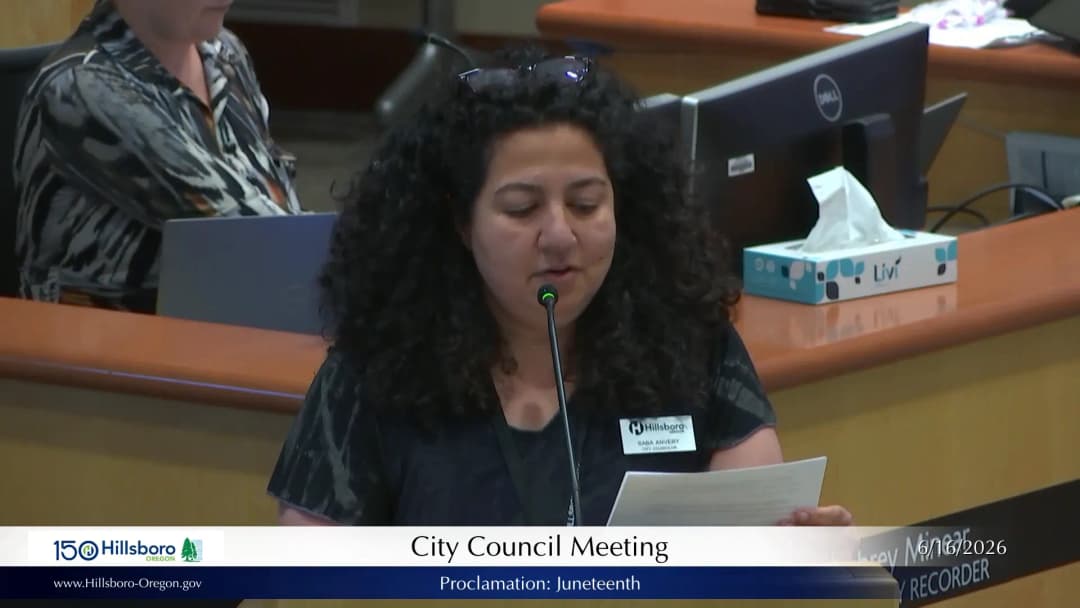
The work session on June 16, 2026, provided an informational update on the Avenida Diaz (10th Avenue) program, focusing on the Equitable Development Strategy (EDS). The council heard from staff about the program's background, community engagement, draft actions, and a timeline for adoption in fall 2026. The regular council meeting that followed was cut short due to public disruptions. Consent Calendar - No routine approvals or unanimous actions were presented. Public Comments & Testimony - The first initial segment of the meeting (work session) included council questions and public testimony. Key points: - Councilor Salgado asked about the percentage of community members participating in the Community Advisory Committee (CAC) relative to the area's population, and whether engagement would be expanded. Staff noted the existing engagement is a small sample and that a summer 2026 round of engagement would seek feedback on draft actions, though goals are unlikely to change. - Councilor Salgado also raised concerns about public safety, ICE activity, and homelessness, asking how these would be addressed. Staff acknowledged these issues are frequently raised by the community and, while outside the original scope, are being documented and incorporated where possible. - Councilor St. Claire reported feedback from local small businesses, including frustration about inadequate water access for pressure washing, lack of consistent city engagement, and the need for more housing, pedestrian, and landscaping investments. - Several public speakers spoke against the Century Boulevard Extension project, citing insufficient public engagement and environmental harm. - Paige Mendocino criticized the council for not investigating a data center moratorium as promised, for not pursuing a legal review of data center deals, and for perceived lack of transparency. The speaker accused councilors of using AI-generated images and of dismissive behavior. Discussion Items - Program Overview: Staff (Justin DeMello, Emma Castillo, City Manager Robbie Hammond, and Dan) presented the Avenida Diaz program, which covers an area from about 5th Avenue to 13th/18th Avenues along Main Street and TV Highway. The program was launched to support the predominantly Hispanic community and Hispanic-owned small businesses, and to prevent displacement. - Equitable Development Strategy (EDS): The draft EDS will contain 20 specific actions aimed at supporting investment and mitigating displacement. The presentation emphasized that the EDS builds on existing plans (e.g., Downtown Framework Plan, Housing Production Strategy) and was developed with extensive community engagement, including a CAC, five focus groups, a 150-response intercept survey, two open houses, and technical advisory meetings. - Community Engagement: Staff highlighted that all materials were bilingual (Spanish first), CAC meetings were held in Spanish, and engagement was adjusted (one open house moved virtual) due to community fear around ICE activity. The engagement process was designed to be two-way, with city staff learning from residents' lived experiences. - Coordination with Partners: The program established monthly and quarterly coordination meetings with organizations such as TriMet, Metro, Washington County, and city departments to align efforts and avoid over-engaging the community. - Quick-Action Projects: The city has already implemented some projects in response to community feedback, including increased street lighting and a rapid-flashing pedestrian crossing at 12th and Main. - Police Department Block Redevelopment: Staff shared that a potential redevelopment of the police department block (on Timber & Baseline) is being explored in partnership with a neighboring property owner. Community feedback emphasized needs for family-sized housing (3-4 bedrooms), youth amenities (sports courts, playgrounds), and safety. Designs for the block were developed based on city policies and community input. - Adoption Timeline: The EDS will go through a work session in August 2026, then to the Planning Commission for a recommendation, followed by a council vote via ordinance (amending the Comprehensive Plan and Downtown Plan District). A parallel process will amend the Urban Renewal Plan to list eligible projects. Final adoption is anticipated in September or October 2026. - Public Safety and Signage: Councilor Alcair suggested adding culturally responsive signage (e.g., police, fire, emergency contacts) in the Avenida Diaz area. Staff committed to considering this in the next draft. - Youth Infrastructure: Councilor Salgado raised the need for a multi-use sports court near Shute Park Library, noting a potential partnership with the U.S. Army Corps of Engineers to prepare the site at no cost. Staff acknowledged the feedback and said it aligns with community priorities. Key Outcomes - No formal votes were taken during the work session. The meeting was informational, with a directive for staff to return for a full work session on the draft EDS in August 2026 and for final adoption in fall 2026. - During the regular council meeting that followed, the council passed a motion to adjourn (3-2 vote: Councilors Harris, Salgado, and Case in favor; Councilors Anbury and Alcair against) after public disruptions led to a brief recess and inability to proceed. - Staff committed to: - Provide a follow-up email on the lighting study and investments made in the Avenida Diaz area. - Incorporate feedback from Councilor St. Claire and Councilor Alcair regarding small business needs, safety signage, and youth amenities into the next draft of the EDS. - Continue engagement over summer 2026 to gather feedback on the draft actions. - A separate request from Monica DeShayne (permit delay for sewer work) will be followed up by staff outside the meeting.
COMMUNITY ENGAGEMENT 37% · PROCEDURAL 19% · PUBLIC ENGAGEMENT 11% · AFFORDABLE HOUSING 9%
12
JUN 9, 2026 · HILLSBORO, OREGON · CITY COUNCIL
Hillsboro City Council Work Session on Data Centers and Enterprise Zone - June 9, 2026

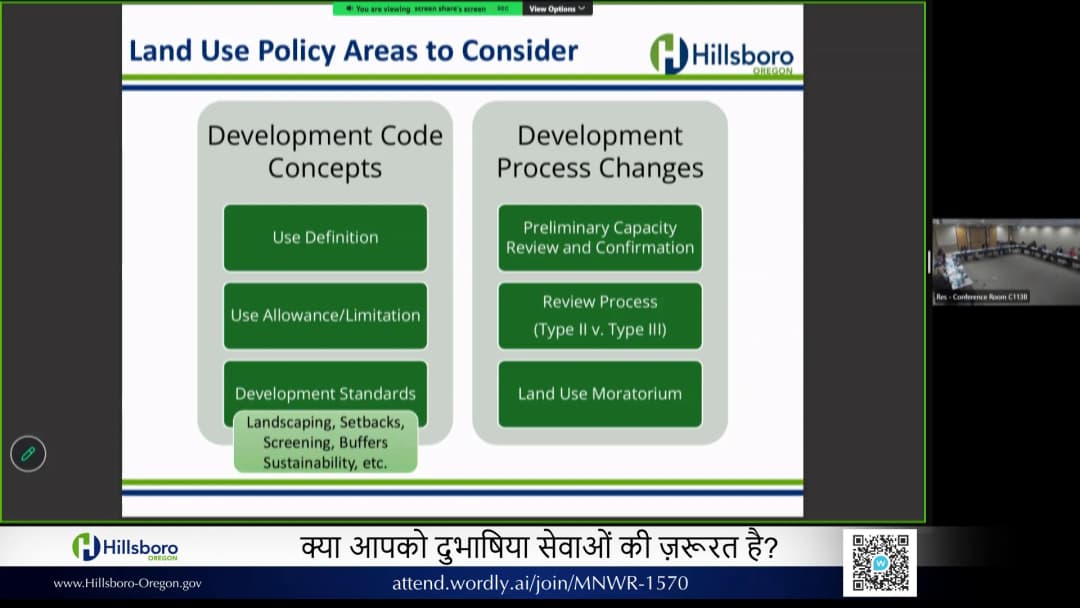
The Hillsboro City Council held a work session on June 9, 2026, to discuss data centers and the Enterprise Zone program. The session included presentations on land use regulations, environmental protections, enterprise zone history, financial impacts, and policy options. Council members debated and provided direction on a range of potential changes to land use codes, enterprise zone policies, and community benefits. The meeting began at approximately 7:00 PM and included four main sections: background, land use, enterprise zone, and a catch-all for additional policy discussion. Consent Calendar - No consent calendar items were discussed. Public Comments & Testimony - No public comments were taken, as this was a work session. Council President Harris noted that the next opportunity for public comment would be at the regular City Council meeting on June 16, 2026. Several audience disruptions occurred, and warnings were issued to individuals for interrupting. Discussion Items - Background and Environmental Protections: Staff presented layers of regulation for waterways and sensitive areas (SNRO, Clean Water Services, floodplains, jurisdictional wetlands). Maps showed overlapping protections and examples of development avoided or mitigated. - Land Use: Planning staff reviewed zones where data centers are allowed, the development review process (type II administrative decisions, public notice), and the process for code amendments (80-90 days, public hearings at planning commission and council). A land use moratorium process was also outlined (45-day notice, public hearing). - Enterprise Zone Program: Economic development staff described the program history, 20 years with 100 approved applications, 50 active, representing $11.6 billion in investment and 3,200 jobs (median compensation $126,500). Community Service Fee (CSF) revenues have grown significantly; currently $55 million in a dedicated fund. CSF must be used for workforce development (years 1-3) and economic development (years 4-5) per state and local policy. Local requirements include minimum investment, wages starting at 102% of minimum wage, annual local procurement reports, training, and a 15% school support fee in years 4-5. Phased projects are allowed under state law; each phase can receive up to five years of exemption. - Finance and Tax Data: A case study of QTS data center showed property taxes paid on land and personal property ($22.5 million in FY2526), with an additional estimated $19.6 million if the enterprise zone exemption expired. School funding formula was explained—local property tax increases offset state funding, so school districts do not see a net budget benefit. - New Proposals and Council Discussion: Councilors discussed multiple policy directions: - Creating a new use category for data centers in the development code. - Adding development standards for environmental impacts (noise, proximity to wetlands/schools) and energy efficiency. - Geographic limitations on where data centers can locate. - Requiring environmental and economic impact studies for future data center applications. - Exploring a land use moratorium to pause development while code updates are prepared. - Reviewing the Enterprise Zone community service fee structure and how CSF funds are programmed. - Proposing a utility affordability fund (electricity and water bill credits) for low-income households, funded by data center fees. - Reconsidering the delegation of enterprise zone application approval. A motion to require council approval of all data center EZ applications was voted down 4-2. Key Outcomes - Direction to Staff: Council reached consensus on several next steps: - Explore a new land use category for data centers. - Investigate additional development standards (environmental, energy, setbacks). - Evaluate geographic restrictions (e.g., limiting data centers to certain industrial zones). - Examine a land use moratorium as a temporary measure while code amendments progress. - Review and potentially revise the Community Service Fee formula and local enterprise zone requirements. - Commission environmental and economic impact studies. - Analyze the feasibility of a utility bill credit fund for income-qualified households. - Engage state-level advocacy on enterprise zone and school funding formula changes. - Vote Defeat: A proposal to require City Council approval for all enterprise zone applications failed (4-2), though council supported ongoing transparency and delegation to the city manager with notification to council. - Future Work: City Manager Robbie Hyman committed to providing a summary of council direction and a timeline for further staff work and presentations.

DATA CENTER REGULATION 25% · ECONOMIC DEVELOPMENT 22% · ENGINEERING AND INFRASTRUCTURE 9% · PROCEDURAL 8%
13
JUN 2, 2026 · HILLSBORO, OREGON · CITY COUNCIL
Hillsboro City Council Work Session and Regular Meeting: Data Centers, Youth Advisory Council, and Public Testimony - June 2, 2026

The June 2, 2026 meeting consisted of an initial work session focused on data center impacts and regulations, followed by a regular council meeting that included proclamations, presentations from the Youth Advisory Council (YAC), extensive public comment, and action on consent and ordinance items. The work session was scheduled to continue on June 9, 2026, after technical and time constraints halted the presentation. Consent Calendar - The consent agenda (one item) was approved unanimously: motion by Councilor Anvery, second by Councilor Alcare, with all council members voting aye. Public Comments & Testimony - Paul Clemenchick (Hillsboro resident, 35-year engineer) urged a full environmental impact review (EIR) paid for by industry, citing projected 200-300x compute growth and power demand increase, and suggested mitigations like local solar PV and community energy centers. - Mike McTernan expressed feeling betrayed by city leaders, saying they rushed data center approvals, lacked transparency, and did not seek community input before decisions. - Elaine Twos asked for on-site water testing at data centers and raised concerns about a neighbor's fire pit smoke. - Tiffany St. Clair King (Hillsboro homeowner) called for a pause on data centers, citing land use, water, energy costs, heat pollution, and lack of permanent jobs. She urged council to use community development code to downgrade data centers from primary to accessory use. - Octavian St. Clair King (Hillsboro youth) stated AI data centers used 17 billion gallons of water in 2023 and contribute to air pollution and higher electricity bills affecting low-income communities. - Lou Dreeson questioned trust in the city's management of enterprise zones, noting water rate increases and electricity cost spikes, and called for public votes on zones. - Ryan Syog (first council meeting) said data centers do not bring jobs (lights-out operations) and that 50-year tax abatements divert school funding. - Martin Lehman argued data centers are not built in wealthy neighborhoods, criticized the education model, and called for systemic change. - Jodie Clark Lumpa (ADA accommodation) said she withheld applause but criticized council for not having information before citizens asked; demanded action on water, power, land use. - Carolyn Cohout referenced HB 4084 rules, noting that fast-track permitting may have reached 15 projects, and questioned whether data centers qualify as advanced manufacturing. - Jody Weiser asked why data centers are not paying for infrastructure (roads, sewer, water) and why building heights are developer-set. She noted staff did not raise community service fees when applications surged, and urged council to take back responsibility. - Simone Campbell demanded a state of emergency based on community wellness, invoked home rule, and suggested suing the state as done in 2022. - Chris Pinkham (Beaverton resident) said data centers drain regional resources with no local benefit, cause rolling blackouts, and are a "terror" for the community. - Aaron Haig (Shute-Meyer-Jurgen Farmstead owner) said the city condemned farmland via urban renewal for data centers and broke promises on memorials for Native American burial grounds. - Jacob Roloff criticized the mayor's absence, demanded knowledge of who leases co-location data centers, and noted one data center's tax filing error increased county growth estimates by 1.5%. He called for council members to resign if they claim hands are tied. - Jana Denise Kerr said the city's FAQ uses manipulative statistics (absolute numbers vs. percentages) and accused the city of being dishonest about job numbers from Intel's peak. She cited other cities rejecting data centers (La Pine, LA). - Paige Mendocino asked how many jobs data centers have added and why no environmental impact reports are required; said council is losing community trust. - Myrna Munoz thanked Councilors Alcare and Sinclair for leadership, and begged council to require health and safety impact studies. - Tonya Golden (North Plains) asked why the city is taking water, air, and land for data centers, and said council is cutting off democracy and future generations. - Kelly Dunlap (Tigard) noted the issue is regional, criticized Mayor Pace's absence, and questioned Councilor Anvery's role as an Intel employee, suggesting a conflict of interest. - Sandra (name from transcript) recited a Native American proverb about not being able to eat money, and said the city is ignoring the people. - Al Weibel noted no mention of hard stops for permit violations, questioned the feasibility of air cooling at high temperatures, and urged outside sources to verify energy forecasts. - Other speakers (Tino, Robert Bailey, Charlene Hockeling, etc.) expressed similar concerns about job quality, tax abatements, land use, and lack of community involvement. Discussion Items - Work Session (Pre-Council): Council President Harris opened with acknowledgments for the large turnout, outlined meeting protocols, and noted the city's enterprise zone renewal process (2028 expiration, council vote in 2027). Staff (Dan Dias, Nikki Iverson, Rachel Marble) presented data center types, locations, and stats: 21 data center sites in Hillsboro (as of June 1, 2026), totaling 470 gross acres; largest site 91 acres; 1.8% of city's annual water demand used by data centers (primarily ambient air cooling, not water-intensive). A JLL study indicated 80% of Pacific NW data center capacity supports technology industries (vs. 30% in Silicon Valley). Councilors asked questions: Councilor Alcare raised concerns about international burden, energy waste, and protections in agreements; Councilor Case asked about AI inclusion in cloud/tech categories; Councilor Sinclair asked about public notice for multi-decade agreements and outside-enterprise-zone rules; Councilor Salgado asked about location drivers and policy recommendations. The work session was paused at 7 PM for the regular council meeting. - Regular Council Meeting: - Proclamations: Pride Month (June 2026) and Pollinator & Monarch Awareness Week (June 22-28, 2026) were presented, accepted by city staff. - Youth Advisory Council Presentations: Five subcommittees reported: - Arts & Culture: Hosted a youth arts and culture farmers market on May 16, 2026, with 325+ attendees, 30 face paintings, 35 community drawings, 85 YAC booth interactions, and 85 watching mariachi performance. - Climate Resiliency & Sustainability: Created a plant-based eating webpage (live on city site), and held an ivy pull volunteer event at Noble Woods Park on April 25 (Global Youth Services Day) with strong turnout. - Equity & Inclusion: Hosted Access to Success College & Career Fair with 30+ organizations and 200+ attendees (up from 30 at pilot); developed an interactive accessibility map for public restrooms (gender-neutral, wheelchair accessible, etc.) to be live on city website soon. - Youth Engagement: Held Youth City Day with 101 attendees (up from 30 last year), including 19 hands-on sessions with city departments, free lunch, and bus transportation provided. - Youth Welfare: Collected 3,872 hygiene items for HomePlate Youth Services (total cost $30), and served 60 meals at a home plate meal night, with leftovers feeding 10 more individuals. - Councilors asked a few questions (e.g., attendance, website launch timeline); Council members thanked YAC and recognized graduating seniors. - Public Comment: See above. - Consent Agenda and Ordinances: Approved consent agenda (roll call: all aye). First reading of two ordinances: - Ordinance 6517 (Comprehensive Plan Amendment 002-26 for 0.94-acre property at 1055 NE 47th Ave, changing designation to residential low density) passed 4-1 (Councilor Alcare nay). - Ordinance 6518 (Community Development Code Amendment 003-26 to align with SB 974 and HB 4037) passed 4-0-1 (Councilor Sinclair abstained citing lack of public engagement). - Council Comments: Councilor Harris (new Ed.D.) connected data center impacts to his research on rainforest destruction; Councilor Case noted updated FAQ on school funding formula and encouraged contacting state representatives; Councilor Salgado raised concerns about raising fees on data centers, protecting local jobs, and criticized targeting of undocumented community; Councilor Sinclair thanked public for engagement and encouraged continued participation; Councilor Robinson (Council President) shared his decades-long involvement on enterprise zone issues and encouraged citizens to listen to the full work session. Key Outcomes - Continuation of Work Session: The council voted unanimously to continue the work session on Tuesday, June 9, 2026, at 7:30 PM (special meeting) to complete the remaining presentation (environmental, land use, enterprise zone sections) and allow for extended council discussion and direction. - Statistical Highlights from the Evening: - Hillsboro has 21 data center sites (470 gross acres), with 5 additional potential sites (177 acres) not yet in permitting. - Data centers account for 1.8% of Hillsboro's annual water demand (ambient air cooling primarily); no water cooling reported. - 80% of Pacific Northwest data center capacity supports tech industries (per JLL). - Over 40 public speakers addressed the council, overwhelmingly critical of data center proliferation and requesting moratoriums, impact studies, and more transparency. - Decisions: Consent agenda and two ordinance first readings approved; no substantive policy decisions on data centers were made, but council agreed to continue discussions on June 9. - Next Steps: Staff will provide the full presentation deck to council and public; council members will submit questions and policy recommendations in advance of June 9 meeting.

DATA CENTER REGULATION 36% · PROCEDURAL 11% · YOUTH PROGRAMS 9% · PUBLIC ENGAGEMENT 9%
14
MAY 19, 2026 · HILLSBORO, OREGON · CITY COUNCIL
Hillsboro City Council Work Session and Regular Meeting - May 19, 2026

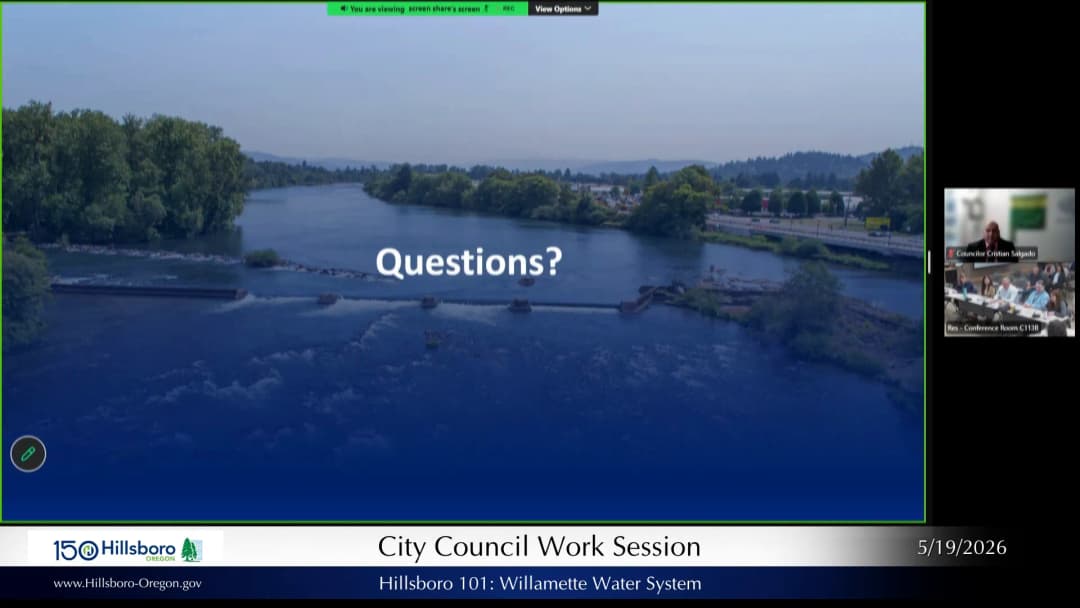
The meeting began with a work session (before 7:00 PM) on the Willamette Water Supply Program (WWSP), followed by a regular council session at 7:00 PM. The work session provided a detailed overview of the multi-billion-dollar regional water supply project, including history, partnerships, costs, rate impacts, environmental mitigation, and community engagement. The regular session included public comments overwhelmingly focused on data center tax abatements, adoption of several ordinances and resolutions, and council comments. Consent Calendar - Approved the consent agenda (one item) unanimously. Public Comments & Testimony - Sarah Richmond (virtual) requested a pause on the Sky Harbor Hangar project (private jet hub), citing concerns about noise, air pollution, property values, and procedural issues (FAA analysis delay, incorrect multiplier). She asked for an independent environmental assessment and notification of impacted residents. - Madeline Brink read from Wendell Berry's essays, calling for a philosophical shift toward ecological stewardship and opposing data centers; she suggested requiring solar panels, rewilding, and decommissioning clauses. - Simone Campbell criticized data center tax breaks, citing $7.2 billion in exempted property taxes, 50% rate hikes, and grid strain. She demanded a one-year moratorium, release of the city attorney's findings, and noted that House Bill 4084 may prohibit new deals before 2027. She referenced recalls in Festus, Missouri, and a Maine moratorium. - Blaine Ackley expressed unease about data centers, arguing they take land, offer few jobs, and pay little taxes. He questioned the city administrator's authority to sign contracts without council approval and urged council to void those contracts. - Antonia Lopez accused Councillor Case of slander, abuse, and conflict of interest due to his role as campaign manager for a senator championing data center legislation. She demanded that Councillor Case and Mayor Pace recuse themselves from data center decisions. - Jana (last name not given) spoke about school funding losses from enterprise zone tax abatements, estimating $67 million per year in lost property tax revenue statewide, with $900,000 lost locally for Hillsboro School District, leading to 131 positions cut and larger class sizes. She called for firing Economic Development Director Dan Diaz. - Ann Sandra (name unclear from transcript) read climate-themed poetry and quoted David Suzuki, urging council to consider environmental degradation. - Jacob Roloff criticized the planned executive session on May 26 as too late and behind closed doors. He argued that Hillsboro is using inflated community service fees to gain net revenue at the expense of school district and county revenues, with data showing a net loss of $63 million to the school district over five years for one site. He noted that a councilor told him "you're not my constituent" when asked about data center agreements. - Diana Jackson (planning commission member) expressed concern about data center sprawl, power grid upgrades, and rising utility bills. She criticized the lack of council attendance at community events and lack of urgency on immigration raids. - Denise Kerr read a sarcastic public comment supporting data centers and development, but the tone was clearly critical of the council's pro-development stance. - Mr. Persley addressed council behavior, stating that council members who dismiss non-constituents as not being their responsibility are failing to represent the broader community. Discussion Items - Willamette Water Supply Program Work Session: - Presented by Water Director Nikki Emerson, with supporting staff (Lee Lindsay, Chris Wilson, Jessica Dorsey, Stacey Steele). - Overview: The WWSP is a $1.6 billion regional partnership (Hillsboro, Beaverton, Tualatin Valley Water District) to build a seismically resilient drinking water system. Hillsboro's share is 33% ($534 million). - Current capacity: Joint Water Commission (JWC) treatment capacity is 41.75 million gallons per day (MGD); peak day demand is 33 MGD. The Willamette system initially provides 15 MGD (Hillsboro's share) with potential expansion to 36.2 MGD. - Funding: Revenue bonds, a federal EPA loan (1.36% interest), and cash reserves. A placeholder for an additional bond is noted but not yet needed. - Water rates: A typical residential monthly bill is $56.26. A 5.7% increase ($3/month) for 2026, with 4% forecast for 2027-2028. Other customer categories range from 3.2% (commercial/nonprofit) to 8.3% (industrial). - Environmental: 700 permits obtained; work with tribal governments (Section 106); restoration projects at Molalla River State Park, Tualatin River National Wildlife Refuge (Chicken Creek reconnection), and Rood Bridge Park (Rinco Woods). - Economic impact: 77% of expenditures ($1 billion) spent locally in Oregon/Washington. - Integration: Finalizing integration plan, water quality blending studies, and operator training program (OIT) which has attracted 200 applicants for recent positions. - Councilors asked about data center water usage (1.76% of total supply, most use ambient air cooling), rate structure justification, workforce development, and coordination with rural communities. - Regular Council Session: - Historic Preservation Month proclamation and awards for six properties: McFeeder House, Ulrich House, Masonic Temple (Tualatin Lodge), Collective Market building, Hill Theater, and 375 SE Walnut Street. - Appointment to Planning and Zoning Hearings Board (approved unanimously). - Second reading of Ordinance 6514 (Comprehensive Plan major amendment to update Parks and Recreation goals and policies) – adopted unanimously. - Second reading of Ordinance 6516 (Community Development Code update to comply with state regulations on child care, residential treatment, and middle housing land division) – adopted unanimously. - Resolution 2920 (Parks and Recreation Department to apply for Metro large-scale community vision grant for Working Theory Farm property acquisition and enter into MOU) – adopted with Councillor Sinclair recusing herself. - Resolution 2921 (Support for Metro 2040 planning and development grant for consultant support on Urban Growth Boundary expansion concept plan) – adopted unanimously. - City Manager Report: Public Works Day on the plaza, Oregon International Air Show, and farewell to Deputy City Manager Raheem Harji (last meeting). - Council Comments: Councillor Sinclair stated she will ask legal counsel to halt pending data center tax abatements, rescind delegated signature authority, and require public hearings. Councillor Case thanked staff and emphasized respectful workplace. Councillor Salgado expressed interest in child abuse prevention efforts. Key Outcomes - Approved consent agenda unanimously. - Adopted Ordinance 6514 (Comprehensive Plan amendment) unanimously. - Adopted Ordinance 6516 (Community Development Code update) unanimously. - Adopted Resolution 2920 (Working Theory Farm grant) with Councillor Sinclair recusing. - Adopted Resolution 2921 (Metro 2040 planning grant) unanimously. - Approved appointment to Planning and Zoning Hearings Board unanimously. - Councillor Sinclair announced intention to pursue options to halt data center tax abatements, including rescinding staff delegated authority and requiring public hearings, with a request for legal analysis at the May 26 executive session. - No formal council action was taken on data center concerns during the meeting; further discussion scheduled for a June 2 work session.

WATER AND WASTEWATER MANAGEMENT 36% · PROCEDURAL 9% · DATA CENTER REGULATION 9% · PUBLIC ENGAGEMENT 8%
15
MAY 5, 2026 · HILLSBORO, OREGON · CITY COUNCIL
Hillsboro City Council Meeting - May 5, 2026: Land Use Legislation, Data Center Tax Abatements, and Community Testimony

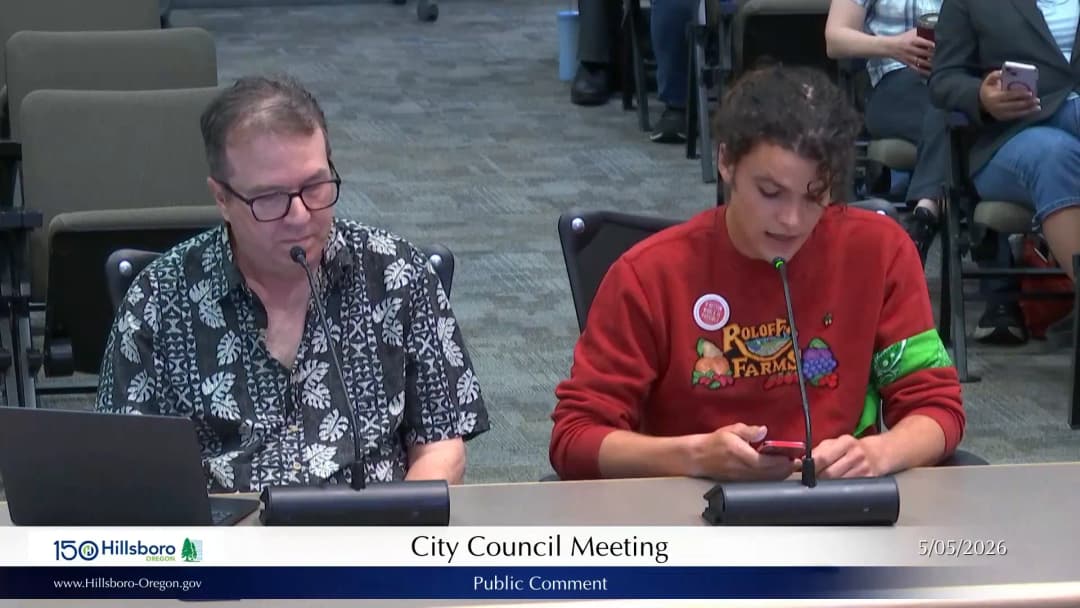
The May 5, 2026 Hillsboro City Council meeting included an HEDC (Hillsboro Economic Development Council) meeting followed by the regular City Council meeting. Key topics included a presentation on recent state land use legislation (SB 974 and HB 4037) affecting housing applications, public hearing and noticing requirements, extensive public testimony on data center tax abatements, a street naming policy request, and several ordinance adoptions. The meeting featured the Youth Advisory Council (YAC) shadowing and a proclamation for Asian American, Native Hawaiian, and Pacific Islander Heritage Month. Consent Calendar - HEDC Meeting: The council approved the HEDC minutes from September 2025 and adopted Resolution 94-26 authorizing the sale of real property in the Jackson East North area to the City of Hillsboro (unanimous). - City Council Consent Agenda: Approved a single consent agenda item (unanimous). Public Comments & Testimony Nearly 20 community members provided testimony, predominantly opposing data center tax abatements and raising concerns about transparency. - Destin Brown (Exec. Director, Hillsboro Farmers Markets) thanked the city for financial support, noting $2.14 million in sales and over 200,000 annual visitors. - Denise Van Domlin requested an exception to the street naming policy to add names "Wally" (after her father) and "Beaver" to the database, citing family history and community significance. - Leif Eckles opposed data centers, stating they create few jobs (9–22 per facility) while receiving three years of zero property tax, and cited contamination risks (Amazon settlement in NE Oregon). - Simone Campbell expressed concerns about data centers, criticized Mayor Pace’s endorsement of a senator, and raised a potential conflict of interest due to the mayor’s spouse being a police department commander. - Paige Mendocino called for a halt to data center tax abatements, stating that one center received $5.5 million in breaks for 11 jobs ($500,000 per job). Demanded all pending agreements go through a public hearing. - Dirk Knutsen urged immediate code changes to restrict data centers, imposition of a privilege tax on large energy users (e.g., 1.5% on users over 20 MW), and transparency in agreements. He also criticized Economic Development Director Dan Diaz for approving deals without council oversight. - Jacob Roloff expressed anger over 13 new enterprise zone agreements signed before a June moratorium, stating that schools lose revenue, and called for the removal of Dan Diaz and City Manager Robbie Hammond. - Vern discussed European Union water usage efficiency (WUE) standards and urged Hillsboro to set performance standards for data centers. - Martin Lemmon presented a draft "Commercial Resource Impact Surcharge Ordinance" targeting large data centers, with exemptions for manufacturing, healthcare, and high-job-creators, to fund residential utility relief. - Karen Jocelyn asked questions about Hillsboro Airport expansion, noise, and prohibited use of airport structures for housing, seeking clearer avenues for community input. - Yadira criticized state land use changes as benefiting wealthy interests, questioned who benefits from eliminating public hearings, and referenced the city's newsletter lacking prior data center information. - Mr. Brown Wildfire demanded a complete halt to data centers, criticized police funding, and questioned the mayor’s conflict of interest due to his spouse’s police role. - Denise Kerr alleged disinformation in city communications about data centers and questioned why a KGW news segment was pulled after a request for equal time. - Myrna Munoz cited that top data centers average 26 employees and receive $7.6 million annually in tax breaks ($294,000 per job), calling it corporate welfare. - Elijah Radford noted 25 data center addresses with $6 billion real market value, taxed at $1.5 billion, and referenced a Georgia audit finding 70% of data centers would have located there without subsidies. - Antonia Lopez accused city leaders of selling land before a moratorium, and criticized the mayor’s marital conflict of interest. Discussion Items Land Use Legislation Update (Rachel Marble, Dan Dias) - SB 974 and HB 4037: Effective July 1, 2026, these bills prohibit public hearings for certain housing applications (e.g., residential PUDs, major modifications, zone changes) and limit initial decisions to staff level. Appeals still allow hearings. - Public Notice Changes: Required notice radius reduced to 100 feet for some applications (floor), with no option to extend for subdivisions; for others (e.g., zone changes) the city may extend to 200 or 500 feet if submitted concurrently with a Type III application. - Appeal Rights: Public appeal rights eliminated for housing applications subject to clear and objective standards; only the applicant may appeal locally or to LUBA. - Council discussion revealed concerns about loss of community engagement. Councilor Salgado emphasized transparency and community outreach; Councilor Harris questioned staff discretion vs. council authority. Staff noted that map changes still require council approval due to charter requirements. - Staff presented two options for noticing (follow statute vs. use greater notice). Council indicated preference for Option Two (greater notice where allowed), though no formal vote was taken. - Upcoming code amendments in fall 2026 will address HB 2138 (detached plexes, cottage clusters, density bonuses) and housing production strategy actions. Naming Policy Request - The council debated a request to add street names "Wally" and "Beaver." After an amendment to approve only "Beaver" failed (2-2-1, with mayor breaking tie to oppose), the motion to decline both names passed 4-1 (Councilor Salgado abstained). The request was declined. Other Business - Proclamations: Recognized Asian American, Native Hawaiian, and Pacific Islander Heritage Month (May 2026) and Public Works Week (May 17-23, 2026). - Youth Advisory Council Presentation: YAC delegates shared experiences from the National League of Cities Conference in Washington, D.C., highlighting networking, sessions, and a Capitol Hill visit. - Appointments: Bridget Harrington and Paul Vonday appointed to the Public Engagement Committee (unanimous). - Ordinances: - Ordinance 6514 (Parks and Recreation Comprehensive Plan Update): first reading approved. - Ordinance 6516 (Child Care, Residential Treatment, MHLD Code Update): first reading approved. - Ordinance 6515 (Transportation Systems Plan Update): adopted. - Resolutions: - Resolution 2917 (Grant application for Griffin Oaks Park playground): adopted. - Resolution 2918 (2024 Sanitary Sewer Master Plan): adopted. - Resolution 2919 (Property purchase from HEDC): adopted (Councilor Alcare voted no). Key Outcomes - Approved all consent items and most agenda items, with the exception of the street naming request (declined). - Council directed staff to explore options for enhanced public notices where state law allows. - Council expressed support for Councilor Salgado’s proposal to partner with a Spanish-language radio station for downtown revitalization; staff will scope the idea. - Councilor Alcare raised a future discussion topic: removing barriers for renters to run for city council. - Staff will update data center FAQs and provide a follow-up report on land use changes after sufficient project examples have been processed. - The post-council work session was postponed to a future date.

COMMUNITY ENGAGEMENT 16% · DATA CENTER REGULATION 16% · PUBLIC ENGAGEMENT 13% · PROCEDURAL 13%
16
APR 21, 2026 · HILLSBORO, OREGON · CITY COUNCIL
Hillsboro City Council Meeting Summary: April 21, 2026 – Legislative Update, Police HQ, PGE Deal, Church Appeal

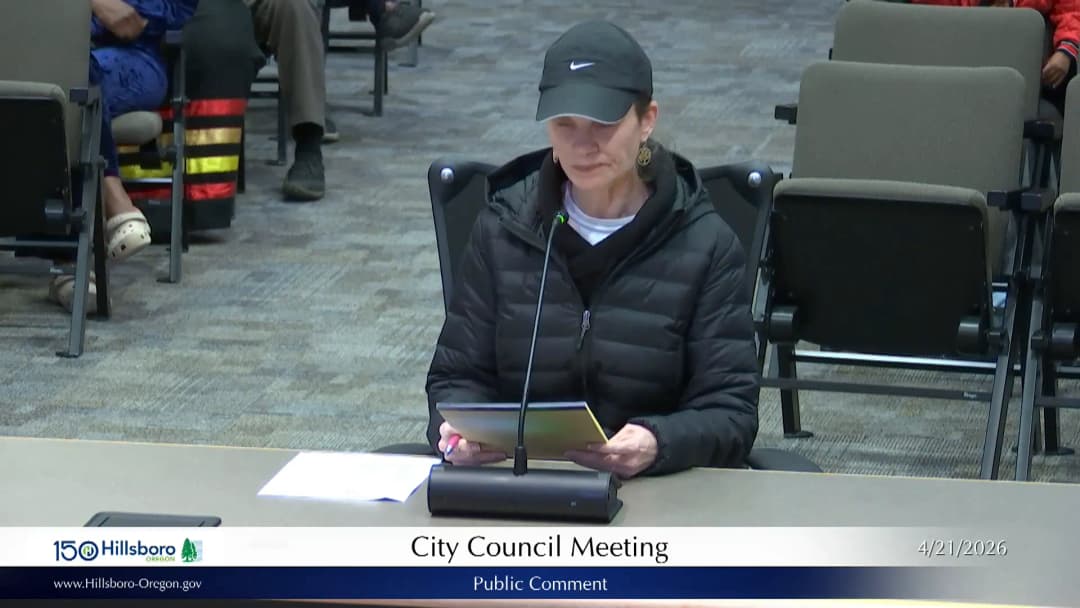
The meeting began with a work session on the 2026 legislative session, followed by the regular council meeting at 7:00 PM. Major actions included approval of a $73.4 million guaranteed maximum price for a new police headquarters, adoption of a supplemental franchise agreement with PGE (Resolution 2916), and a compromise on a church appeal involving a trail easement. Public comments raised concerns about the PGE agreement and data center policy. Consent Calendar - Approved unanimously (6-1, with Councilor Alcair voting no). Items included routine approvals. Public Comments & Testimony - Denise Van Domlin requested postponement of item 5.2 (street naming) to May 5, 2026. - Brown Wildfire criticized police funding and tax breaks for large corporations, expressing solidarity with missing and murdered indigenous people. - Elijah Radford and Jacob Roloff opposed Resolution 2916 (PGE agreement), arguing the 3.5% franchise fee is passed to residents and lacks transparency; Radford noted 2,200+ petition signatures for a data center moratorium. - Shiloh Loren shared personal experiences of homelessness and safety concerns. Discussion Items - Legislative Update (Work Session): Government Relations Manager Ariel Nelson reported on the 2026 short session (adjourned March 6). Key challenges: $750M general fund shortfall and $300M ODOT gap. Senate Bill 1507 disconnected tax code to raise $311M; Republicans referred it to voters. Transportation bills SB 1599 (moved ballot election) and SB 1601 (redirected federal funds) passed. City priorities included immigration enforcement (three bills passed on data sharing, masking, and sanctuary), economic development (Oregon Jobs Act did not pass; Governor’s HB 4084 funded $15M for site readiness), and housing (bills funded $100M in bonds for affordable housing and expanded UGB tools). - Police Headquarters (Item 5.1): Presentation by staff and Chief Coleman. Guaranteed maximum price $73.4 million, funded by $95 million in bonds/strategic investments without tax increases. Construction starts summer 2026, occupancy targeted December 2027–January 2028. - PGE Franchise Agreement (Item 5.3): Resolution 2916 adopted after debate. The 3.5% franchise fee (unchanged) is built into rates; the agreement clarifies payment terms and preserves the city's ability to impose a privilege tax. Councilor Sinclair abstained, citing need for more public engagement. - Street Naming Request (Item 5.2): Staff recommended declining a request to add names “Wally” and “Beaver” to the city’s asset name database, citing policy and code conflicts. After discussion, council voted to postpone pending clarification on the timeline for needing street names. - St. John the Baptist Church Appeal (Item 8.1): Public hearing on a planning commission decision requiring a trail easement and construction. The appellant argued the church’s architecture provides public benefit, and a trail is not needed. After testimony and negotiations, council approved a compromise: the church grants an easement, contributes $10,000 for off-site trail design, and allows its SDCs to fund trail construction. The city will build the trail. Motion passed unanimously. Key Outcomes - Police Headquarters: Approved GMP of $73.4 million (unanimous). - PGE Agreement: Resolution 2916 adopted (5-1, with one abstention). - Street Naming: Motion to postpone passed; staff to provide timeline. - Church Appeal: Compromise motion passed unanimously; condition 44 modified. - Data Centers: Councilor Harris requested staff inventory on standalone data centers and a possible temporary pause; supported by several councilors. - PGE Billing: Council supported requesting itemized billing from PGE. - Future Agenda Items: Council agreed to bring back council rules and group agreements; discussion on affordable housing exemption to be included in a future housing work session. - Other: Mayor Pace noted DEA action in Hillsborough (3.8 kg meth seized) and highlighted resources for victims of drugging/assault at the Family Peace Center.

PROCEDURAL 26% · ENGINEERING AND INFRASTRUCTURE 11% · PUBLIC ENGAGEMENT 9% · TRANSPORTATION SAFETY 7%
17
APR 7, 2026 · HILLSBORO, OREGON · CITY COUNCIL
Hillsboro City Council Meeting – April 7, 2026: Rules, Group Agreements, and Affordable Housing Tax Exemption

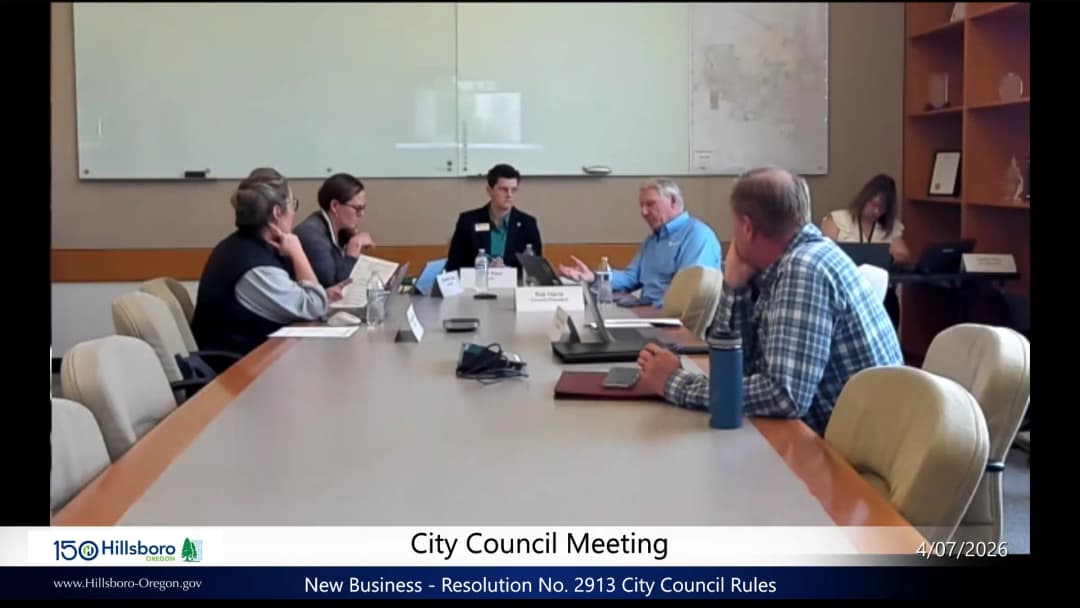
The City Council held a brief evening meeting on April 7, 2026, adjusting the schedule to allow attendance at the Hillsboro Hops ballpark grand opening. The agenda included approval of the consent calendar, adoption of updated council rules and group agreements, and a resolution for the nonprofit affordable housing property tax exemption program. Councilors debated the potential impact of the rules on dissent and public communication before voting. Consent Calendar - The consent agenda was approved unanimously via roll call (Counselor Case, Ambry, St. Clair, Harris voting aye; no items removed for separate consideration). Public Comments & Testimony - No public comment period was scheduled; the next in-person public comment will occur at the April 21 meeting. Discussion Items - Resolution 2913 (Revising Council Rules): Councilor Sinclair requested a continuance to May 5, arguing that new language (particularly in group agreements) could censor councilors and that some rules contradicted each other. Specifically, she cited concerns that rules requiring “assume positive intent” and “maintain decorum” could be weaponized, and that provisions on stating the city’s official position first might limit dissent. City Attorney Chad Jacobs and other councilors noted most language was pre-existing and not new; any unintended violations would be interpreted narrowly. Councilor Harris suggested a redline version for future review. After discussion, the motion to adopt passed with all present voting aye (Case, Ambry, St. Clair, Harris, Salgado). - Resolution 2914 (Adopting Council Group Agreements): Continued discussion from the prior item. Councilor Salgado asked for clarification on the term “undermine” to ensure it does not stifle diverse perspectives. Council agreed to address this later. The resolution adopted unanimously via roll call. - Resolution 2915 (Nonprofit Affordable Housing Property Tax Exemption – 2627 Tax Year): The finance committee recommended approving qualifying properties. Councilor Salgado abstained, stating the decision lacked sufficient information and needed more discussion, citing concerns about uniformity and empty units in Portland’s affordable housing. The resolution passed 4 in favor (Case, Ambry, Sinclair, Harris) and 1 abstention (Salgado). Key Outcomes - Consent Agenda: Approved unanimously. - Resolution 2913 (Council Rules): Adopted 5–0 (all present). Councilor Sinclair’s request for continuance was denied; staff will provide a redline of changes and council may revisit specific language later. - Resolution 2914 (Group Agreements): Adopted 5–0. Clarification on “undermine” will be provided at a future meeting. - Resolution 2915 (Property Tax Exemption): Approved 4–0–1 (Salgado abstaining). No further action scheduled. - Proclamations: Arab American Heritage Month, Fair Housing Month, Volunteer Week, and Arbor Day were acknowledged.

PROCEDURAL 72% · AFFORDABLE HOUSING 15% · MISCELLANEOUS 13%
18
MAR 3, 2026 · HILLSBORO, OREGON · CITY COUNCIL
Hillsboro City Council Work Session and Regular Meeting – March 3, 2026

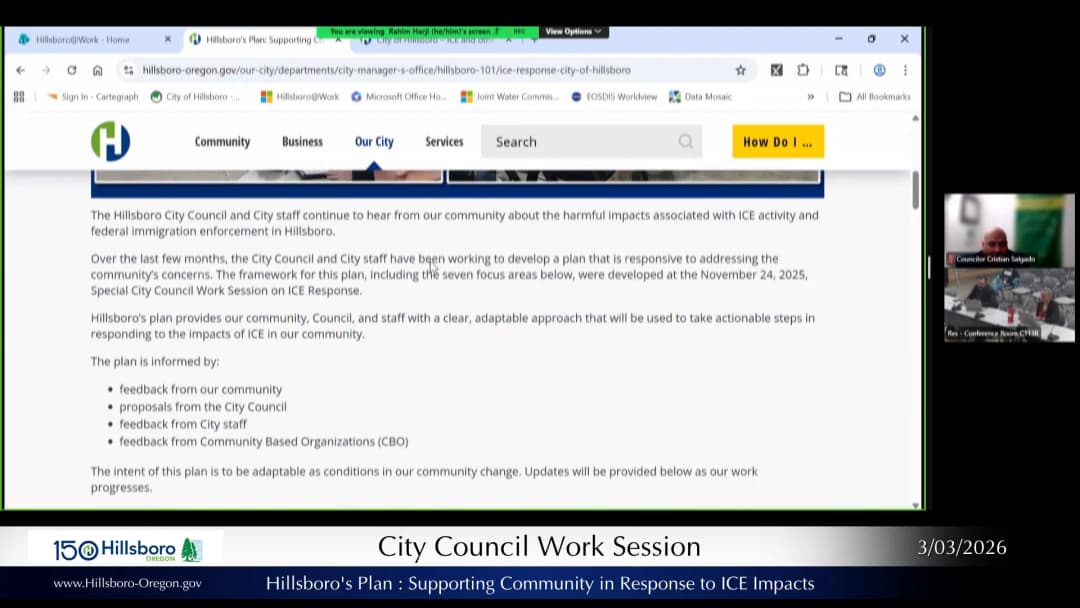
The Hillsboro City Council held a work session and regular meeting on the evening of March 3, 2026. The work session focused on codifying the city's sanctuary status, including a review of the proposed ordinance, community engagement, and updates on ICE-related reporting. The regular meeting included a proclamation for Women's History Month, public comments, approval of the consent agenda, land use items, and the unanimous adoption of Ordinance 6513 codifying the Sanctuary Promise Act. The council also participated in a training on quasi-judicial land use appeal procedures. Consent Calendar - The consent agenda was approved unanimously by roll call vote (all present in favor). Items included routine approvals and actions. Public Comments & Testimony - Barry Johnson Smith (community organizer, speaking virtually) expressed strong support for Ordinance 6513, highlighting the inclusion of public reporting and CBO collaboration. He urged the council to vote yes. - Blaine Solomon-Pearson (community member) thanked the city for inclusive engagement and voiced support for the ordinance. He also asked the council to center Persian and Iranian voices regarding the situation in Iran. - Jacob Roloff (Helvetia resident) expressed support for the sanctuary codification and also raised concerns about data center tax breaks and farmland preservation, noting that bills SB 1586 and HB 4084 had been dropped for now. - Denise Kerr (39-year resident) opposed SB 1586, criticizing Intel's declining workforce and the lack of environmental and traffic studies. She urged the council to protect farmland and community health. Discussion Items - Codification of Sanctuary Status (Ordinance 6513): Staff presented the history of the codification process, including engagement with council, community members, and CBOs. Key additions to the code included a reporting structure and coordination with CBOs. The council discussed training, public signage, and the community advisory committee (CAC) formation. Staff noted that training for employees is underway, and a new ICE-related incident reporting platform is live. The council also explored options for one-reading adoption with an emergency clause. - Annexation and Zone Change (South Hillsboro – Risewell Homes): Planning staff presented a request to annex 45.88 acres and apply a concurrent zone change consistent with the South Hillsboro concept plan. No public testimony was heard. The council approved the order and the first reading of the related ordinance. - Plan Unit Development 002-25 (Synopsis West): The council adopted order number 31 approving a 610-unit multi-dwelling complex, including 578 units in four-story buildings and 32 townhouse-style units, with adjustments per state law. - Land Use Appeal Training: After the regular meeting, staff conducted a training on quasi-judicial land use appeal procedures, covering bias, ex parte contacts, conflict of interest, and the 120-day rule. Council members participated in a mock hearing exercise. Key Outcomes - Ordinance 6513 (Sanctuary Codification) adopted unanimously in a single reading with an emergency clause, taking effect immediately upon enactment. The ordinance adds subchapter 2.68 to the Hillsboro Municipal Code, codifying Oregon's Sanctuary Promise Act and related policies. - Annexation 001-26 and Zone Change 002-26 approved: Order number 30 adopted unanimously. First reading of Ordinance 6512 passed (second reading scheduled for April 21, 2026). - Plan Unit Development 002-25 approved: Order number 31 adopted unanimously for the 610-unit Synopsis West development. - Proclamation for Women's History Month read by Mayor Pace. - Public hearing set for a land use appeal on April 21, 2026, as part of the council's quasi-judicial duties.

PROCEDURAL 29% · COMMUNITY ENGAGEMENT 28% · LAND USE APPEALS 14% · PUBLIC SAFETY 12%
19
FEB 17, 2026 · HILLSBORO, OREGON · CITY COUNCIL
Hillsboro City Council Meeting - February 17, 2026

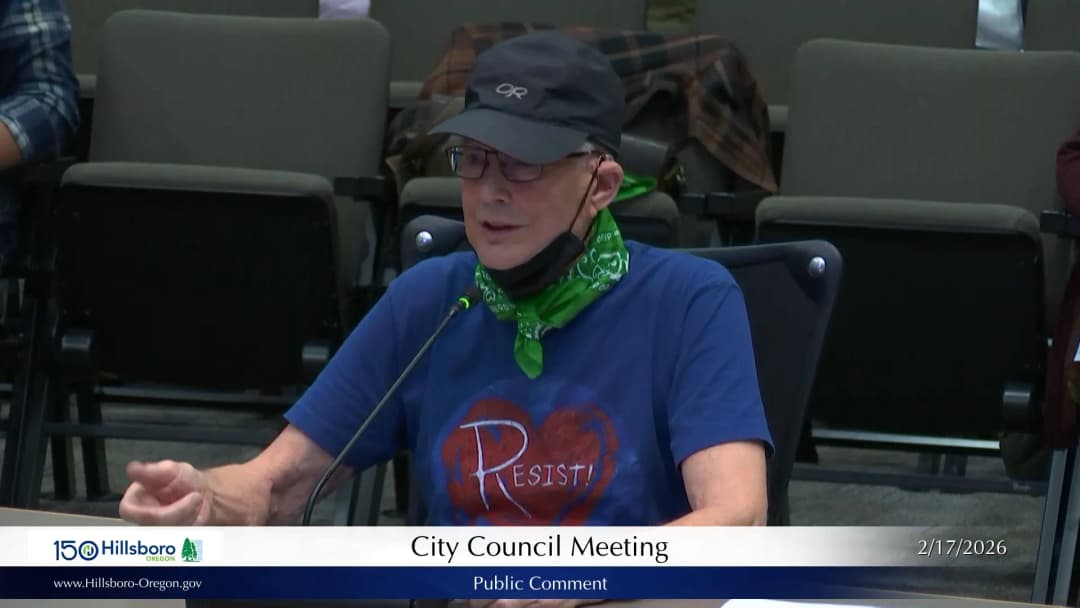
This regular City Council meeting included public testimony on Senate Bill 1586 (the Oregon Jobs Act), approval of the consent agenda, a public hearing on Pioneer Cemetery fees, approval of a revised plan for the Fairgrounds Sports Complex, and a work session on legislative priorities for the 2026 short session. Consent Calendar - The consent agenda was approved unanimously (all present members voted aye). Items included routine approvals and were not discussed separately. Public Comments & Testimony Support for Senate Bill 1586 (Oregon Jobs Act): - Jen Klotz, representing Genentech, expressed strong support for the Jobs Act, emphasizing that build-ready industrial land and incentives are essential for attracting capital investment and high-paying jobs. She noted Genentech's parent company Roche committed $50 billion in U.S. investment over five years and that without past state foresight, Genentech would not be in Oregon today. - Adalie Mitchell, a former participant in the PCC Quick Start Semiconductor Program, described how the program helped her move from low-income to a career at Intel, and urged support for the Jobs Act to create similar opportunities. Opposition to Senate Bill 1586: - Denise Van Domlin (not present) – no testimony. - Pam Code – not present. - Ricky Noak opposed the bill, arguing that expanding the urban growth boundary (UGB) would upset the balance between farmland and industry, and would benefit AI corporations at the expense of human workers. - Mary Mullen opposed the bill, linking it to budget cuts that harm people with disabilities and calling for prioritizing real people over tech companies. - Brown (first name not given) expressed distrust in elected officials and argued that working-class people have the power, urging the council to listen and act. - Leif Eccles, a parent and semiconductor industry worker, opposed SB 1586, stating it would absorb 1,700 acres of pristine farmland while plenty of land exists within the current UGB. He argued data centers create few jobs, use excessive water and electricity, and do not contribute meaningfully to tax revenue. - Blaine Ackley, a 36-year resident, opposed the bill, noting no public hearings in Hillsboro and that it violates the 2014 Grand Bargain. He also raised concerns about lead contamination from the Hillsboro Airport affecting proposed softball fields. - Nelly McAdams asked the council to withdraw support for SB 1586, calling it a waste of public resources that would benefit a few landowners while providing few jobs and high utility costs. - Luce Vierones (name as spelled in transcript) opposed the bill, reading from Chief Seattle's letter and urging protection of the land for future generations. - Scott Ellis, a farmer living on the 1,700 acres, opposed the bill, stating it would not save Oregon and that big businesses receive tax breaks while residents bear costs. He noted a 300,000 sq. ft. building sitting empty. - Aaron Nichols, a neighboring farmer, opposed the bill, emphasizing damage to soils and the agricultural community. He noted over 600 people testified with 92% opposed, and that 15 years of growth-at-any-cost have failed to deliver high-paying jobs. - Alexis Bastida Pinede (small business owner) opposed the bill, citing utility rate increases borne by residents and the risk of data centers exacerbating infrastructure costs. - Myrna Munoz, a bilingual educator, opposed the bill, calling it a land grab and criticizing the lack of community engagement. - Dirk Knutsen exposed what he called a linguistic fraud in the bill, arguing that an executive order redefined data centers as industrial infrastructure, making the “no standalone data centers” promise meaningless. He also raised questions about campaign donations. - Denise Kerr opposed the bill, comparing it to a previous land-use effort and arguing it would fragment farming and violate the 2014 Grand Bargain. - Jean Kristen spoke on a separate issue: an appeal of proposed street names in the Havenwood development, urging culturally appropriate names that reflect the land's history and tribal heritage. - Alan Rappleyea, a retired land-use attorney, urged the council to oppose SB 1586, calling it rushed, a violation of the Grand Bargain, and bad planning. He noted the 500 acres of industrial land already available. - Mickey Barnes opposed SB 1586 and also raised concerns about lead emissions from the airport affecting the proposed softball fields at the fairgrounds. - Jody Clark Lampa criticized the short notice of the bill and the lack of community input, urging the council to prioritize schools, health care, and help for neighbors. - Fawn Hosey provided historical background on the 2014 Grand Bargain, arguing that Hillsboro has acted in bad faith by repeatedly attempting to expand the UGB. She noted over 600 people have registered opposition to SB 1586. Other Public Comments: - Dr. Theme (Hillsboro resident 25 years) thanked the city for focusing on the fairgrounds sports complex and advocated for including pickleball courts. - Regina (first name only) extended an invitation to Fest Femina, an International Women's Day event on March 8. Discussion Items Fairgrounds Sports Complex (Items 8.2, 8.3, 8.4): - Staff presented a revised plan to mitigate the loss of fields at Gordon Faber Recreation Complex due to the new Hillsboro Hops ballpark. The plan is to build a sports complex at the Washington County Fairgrounds, including four artificial-turf softball fields (multi-use), improved grass fields with better drainage and lighting, a new north parking lot, and potential future courts. The 20-year lease with the county includes no rent; the city will maintain the fields. - Councillor Sinclair requested environmental testing for lead emissions from the nearby airport before final approval. Staff agreed to include testing during the design phase. - Councillor Harris declared a conflict of interest (daughter works for HHPR) and abstained from voting on items 8.2, 8.3, and 8.4. - The total project cost is estimated at $25 million, funded by $20 million from Hops ticket surcharges and $5 million from system development charges. Legislative Update (Work Session): - Ariel (legislative affairs) provided an update on the 2026 short session. Key issues: budget cuts, federal tax disconnect, and transportation funding. The Senate Bill 1586 (Jobs Act) has been amended via a Hillsboro-Metro compromise: the UGB expansion would be reduced from 1,700 acres to 373 acres, with the remainder going into urban reserves. The 373 acres would be zoned for industrial use (high-tech and advanced manufacturing), with a prohibition on standalone data centers. Data centers are permitted only as an accessory to advanced manufacturing. - Councillors and staff discussed the definition of “accessory use” and potential loopholes. Staff argued that similar language has been successfully enforced on existing sites to prevent standalone data centers. Councillor Case expressed concerns about the language and requested further clarification. - Councillor Harris questioned the accessory language and noted that the city should monitor PGE’s allocation of infrastructure costs. - The work session also covered the city’s three legislative priorities: federal immigration enforcement response, economic development, and housing production/homelessness response. Key Outcomes - Consent Agenda: Approved unanimously. - Resolution 2912 (Pioneer Cemetery rules, regulations, and fees): Adopted unanimously. - Item 8.2 (Revised mitigation plan for GFRC fields and lease with Washington County): Approved (3-0, with Harris abstaining). - Item 8.3 (Design contract with HHPR Inc. for $1,097,316): Approved (3-0, Harris abstaining). - Item 8.4 (Exemption from competitive sealed bidding for Fairgrounds Sports Complex): Approved (3-0, Harris abstaining). - Lead Testing: Staff committed to performing environmental testing for lead at the fairgrounds site before final construction approval. - Street Naming Appeal (Item 8.1): Moved to a future meeting; no action taken.

ECONOMIC DEVELOPMENT 26% · PARKS AND RECREATION 14% · DATA CENTER REGULATION 7% · PROCEDURAL 6%
20
FEB 3, 2026 · HILLSBORO, OREGON · CITY COUNCIL
Hillsboro City Council Work Session and Meeting - February 3, 2026

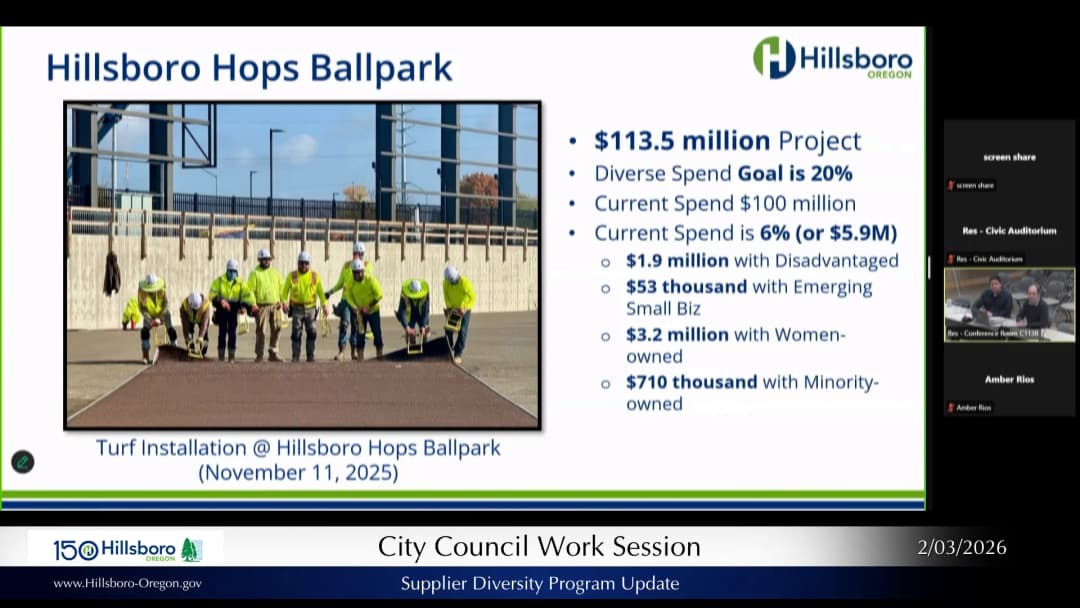
On February 3, 2026, the Hillsboro City Council held a work session from approximately 6:00 PM to 7:00 PM, followed by a regular council meeting at 7:00 PM. The work session focused on an update on the city's Supplier Diversity Program, led by program administrator Danny Morato and procurement services manager Dan Spiro. The regular meeting included a proclamation for Black History Month, public comments, adoption of a consent agenda, two new business items (grant application authorization and climate action plan adoption), and a city manager's report. Consent Calendar - The consent agenda was approved unanimously via roll call (Councillor Case moved, Councillor Harris seconded). Public Comments & Testimony - Denise Van Domlin requested an exception to street naming policy to name two new streets in the proposed Van Domlin Acres subdivision after her parents, Wallace and Helene Van Domlin, to honor their legacy. She noted she had worked with city staff and was seeking council approval. - Mickey Barnes, founder of Oregon Aviation Watch, opposed the Hillsboro Airport's expansion (specifically the Sky Harbor hangar project) and urged the city to reduce aviation emissions, citing that private jets produce 500 times more CO2 per person than the average individual. He also criticized flight training activity over surrounding communities. - Elijah opposed data center development, citing a 18% increase in his electricity bill over three years, water quality concerns, and the use of AI surveillance tools by ICE. He urged a pause on data centers. - William Hoffman opposed data centers, stating they increase electricity bills, harm water quality, create few jobs, and benefit only the wealthy. - Carter Calhoun opposed data centers north of Evergreen Road, arguing they damage water supply, raise bills, generate no jobs, and enable ICE surveillance. He urged reconsideration of the city's position. Discussion Items - Work Session: Supplier Diversity Program Update - Staff provided a detailed overview of the program, which began in 2021. Highlights included: - 387 attendees at the Westside Open House (fourth annual event, co-hosted with Washington County), 125 new business owners engaged, 64 exhibitors, and 8 educational sessions. - Launch of an "On-Call Connect" event for more intimate networking between city project managers and certified firms (e.g., COBID-certified and women-owned businesses). - The Minority, Women, and Veteran-Owned Business Directory now lists 55 active businesses, self-identified or COBID-certified, headquartered in Washington County. - Capital project tracking of $146 million in cumulative construction payments, of which $12.1 million (approx. 8.3%) went to COBID-certified firms. Specific projects (Lotus Apartments, Hillsboro Shelter, Hillsboro Hops Ballpark) showed varying progress toward diverse spend goals (30% or 20% aspirational targets). - Price agreement spending increased from $340,000 in FY21 to $1.4 million in FY25, attributed partly to a veteran-owned plumbing firm. - An internal community of practice meets every six weeks to share successes and lessons. - Council members asked about goal setting, tracking bids from unaccredited firms, retention, and the balance between cost and diversity. Staff acknowledged challenges with aspirational goals and capacity constraints of small firms. Council requested more frequent project-by-project updates. - Regular Meeting: New Business Items - Item 8.1 – Resolution 2910: Authorized the city manager to apply for federal, state, and regional grants for two transportation projects and to use $175,000 in transit transportation impact fee funds for the required local match. Approved unanimously on roll call. - Item 8.2 – Resolution 2911: Adoption of the City's Climate Action Plan. Passed with a 4-1 vote (Councillor Sinclair dissenting). Councillor Sinclair expressed concern that the plan did not address lead emissions from aircraft and felt insufficient time to review the final document. The mayor noted the plan is a living document and encouraged further engagement with staff. Key Outcomes - Consent Agenda: Approved. - Resolution 2910 (Grant Applications): Adopted unanimously. - Resolution 2911 (Climate Action Plan): Adopted with a 4-1 vote. - City Manager Report: Announced the launch of a Small Business Stabilization Program (grants up to $10,000, applications open February 9–27, 2026) to support businesses impacted by ICE immigration enforcement. Also promoted the State of the City event on February 19, 2026, at 6 PM. - Executive Sessions: Two executive sessions were scheduled after the meeting (ORS 192.660(2)(c) for safety and ORS 192.660(2)(d) and (f) for labor negotiations and exempt records), with no action to be taken.

ECONOMIC DEVELOPMENT 25% · COMMUNITY ENGAGEMENT 14% · PROCEDURAL 11% · PROCUREMENT 10%
OPENPUBLICA · PUBLIC MEETING INDEXUPDATED DAILY · openpublica.com