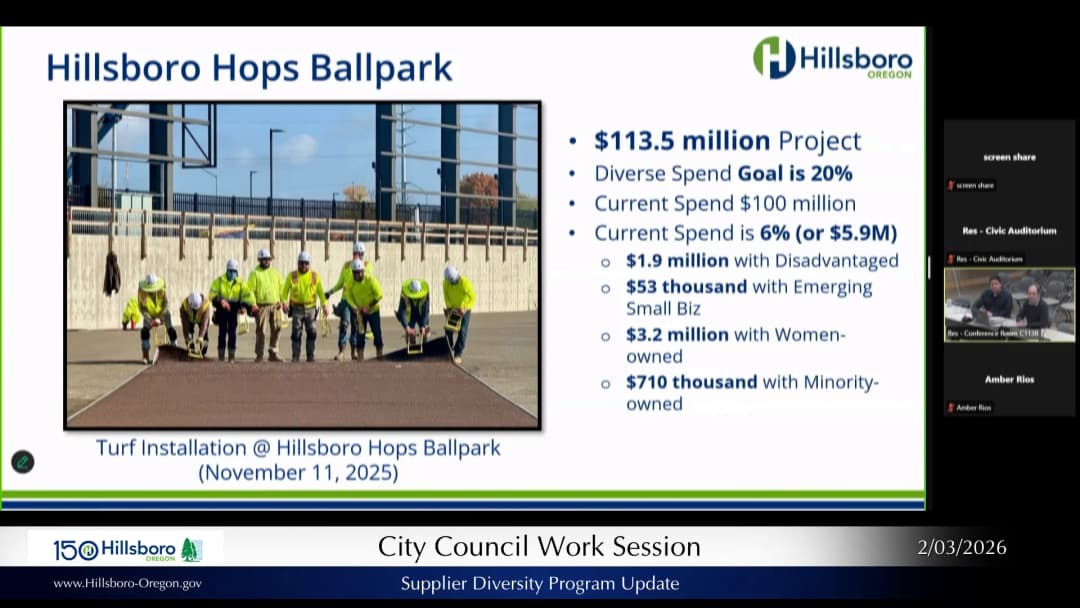
On February 3, 2026, the Hillsboro City Council held a work session from approximately 6:00 PM to 7:00 PM, followed by a regular council meeting at 7:00 PM. The work session focused on an update on the city's Supplier Diversity Program, led by program administrator Danny Morato and procurement services manager Dan Spiro. The regular meeting included a proclamation for Black History Month, public comments, adoption of a consent agenda, two new business items (grant application authorization and climate action plan adoption), and a city manager's report. Consent Calendar - The consent agenda was approved unanimously via roll call (Councillor Case moved, Councillor Harris seconded). Public Comments & Testimony - Denise Van Domlin requested an exception to street naming policy to name two new streets in the proposed Van Domlin Acres subdivision after her parents, Wallace and Helene Van Domlin, to honor their legacy. She noted she had worked with city staff and was seeking council approval. - Mickey Barnes, founder of Oregon Aviation Watch, opposed the Hillsboro Airport's expansion (specifically the Sky Harbor hangar project) and urged the city to reduce aviation emissions, citing that private jets produce 500 times more CO2 per person than the average individual. He also criticized flight training activity over surrounding communities. - Elijah opposed data center development, citing a 18% increase in his electricity bill over three years, water quality concerns, and the use of AI surveillance tools by ICE. He urged a pause on data centers. - William Hoffman opposed data centers, stating they increase electricity bills, harm water quality, create few jobs, and benefit only the wealthy. - Carter Calhoun opposed data centers north of Evergreen Road, arguing they damage water supply, raise bills, generate no jobs, and enable ICE surveillance. He urged reconsideration of the city's position. Discussion Items - Work Session: Supplier Diversity Program Update - Staff provided a detailed overview of the program, which began in 2021. Highlights included: - 387 attendees at the Westside Open House (fourth annual event, co-hosted with Washington County), 125 new business owners engaged, 64 exhibitors, and 8 educational sessions. - Launch of an "On-Call Connect" event for more intimate networking between city project managers and certified firms (e.g., COBID-certified and women-owned businesses). - The Minority, Women, and Veteran-Owned Business Directory now lists 55 active businesses, self-identified or COBID-certified, headquartered in Washington County. - Capital project tracking of $146 million in cumulative construction payments, of which $12.1 million (approx. 8.3%) went to COBID-certified firms. Specific projects (Lotus Apartments, Hillsboro Shelter, Hillsboro Hops Ballpark) showed varying progress toward diverse spend goals (30% or 20% aspirational targets). - Price agreement spending increased from $340,000 in FY21 to $1.4 million in FY25, attributed partly to a veteran-owned plumbing firm. - An internal community of practice meets every six weeks to share successes and lessons. - Council members asked about goal setting, tracking bids from unaccredited firms, retention, and the balance between cost and diversity. Staff acknowledged challenges with aspirational goals and capacity constraints of small firms. Council requested more frequent project-by-project updates. - Regular Meeting: New Business Items - Item 8.1 – Resolution 2910: Authorized the city manager to apply for federal, state, and regional grants for two transportation projects and to use $175,000 in transit transportation impact fee funds for the required local match. Approved unanimously on roll call. - Item 8.2 – Resolution 2911: Adoption of the City's Climate Action Plan. Passed with a 4-1 vote (Councillor Sinclair dissenting). Councillor Sinclair expressed concern that the plan did not address lead emissions from aircraft and felt insufficient time to review the final document. The mayor noted the plan is a living document and encouraged further engagement with staff. Key Outcomes - Consent Agenda: Approved. - Resolution 2910 (Grant Applications): Adopted unanimously. - Resolution 2911 (Climate Action Plan): Adopted with a 4-1 vote. - City Manager Report: Announced the launch of a Small Business Stabilization Program (grants up to $10,000, applications open February 9–27, 2026) to support businesses impacted by ICE immigration enforcement. Also promoted the State of the City event on February 19, 2026, at 6 PM. - Executive Sessions: Two executive sessions were scheduled after the meeting (ORS 192.660(2)(c) for safety and ORS 192.660(2)(d) and (f) for labor negotiations and exempt records), with no action to be taken.
Public Meetings - Hillsboro, Oregon
Public Meetings - Hillsboro, OregonOn January 20, 2026, the Hillsboro City Council held a work session in the morning and a regular city council meeting at 7:00 PM. The work session focused on two major topics: codifying the city's sanctuary status and establishing a human rights office. The regular meeting featured public testimony, consent agenda approval, and a city manager report. No final votes were taken on the sanctuary or human rights office items; instead, the council provided direction for further engagement with community-based organizations (CBOs) and staff analysis. Consent Calendar - The consent agenda was approved unanimously on a motion by Councillor Case, seconded by Councillor Ambry, with all councilors voting aye. Public Comments & Testimony - Sanctuary Codification: Seventeen speakers testified during the regular meeting, the majority urging the council to pass an ordinance codifying the Oregon Sanctuary Promise Act. Speakers included Callie Peters, Sandra, Sam, Dr. Vanessa Samoano, William (school bus driver and former testifier), Barry Johnson Smith, Luz Gutierrez, Andrés Pérez Lata, Maria, Abigail Ramirez, S.M., Erica Villa, and Carter Calhoun. They expressed fear, urgency, and described the impact of ICE enforcement on families, children, and small businesses. Some speakers also criticized delays and called for immediate action. - Other Issues: Barry Johnson Smith also spoke against the Oregon Jobs Act, arguing it would expand the urban growth boundary without public input and benefit data centers. Andrés Pérez Lata raised concerns about data center encroachment. - Police Response: Several testifiers recounted an incident at a Martin Luther King Day protest where a counter-protester allegedly assaulted a minor, and criticized police response. They urged the council to take stronger action to protect immigrant communities. Discussion Items 1. Sanctuary Codification - City Attorney Chad Jacobs presented a proposed ordinance that mirrors the state sanctuary promise act, defines key terms, and authorizes the city manager to implement training and signage. He recommended codifying some aspects and implementing others via policy, citing collective bargaining and flexibility concerns. - Councillor Sinclair advocated for codification to ensure accountability and transparency, especially mandatory logging and reporting of ICE activity. She noted that policy changes have already been made but argued codification would build trust. - Councillors Alcare, Harris, Case, and Ambry expressed reservations about codifying beyond state law, preferring policy for flexibility and noting that codification could create false security or legal risks. They also emphasized the need for further input from CBOs. - Outcome: No consensus on codification. Staff were directed to share the draft proposal with CBOs, review additional material submitted (e.g., proposal from Barry Johnson Smith), and bring back feedback. A special work session with CBOs was discussed but not scheduled. 2. Human Rights Office (HRO) - Assistant City Manager Simone Brooks and City Manager Robbie Hammond presented a proposal to create a Human Rights Office with a manager, coordinator, and a communications assistant, at an annual cost of $321,000-$553,000. The office would coordinate with CBOs, document ICE interactions, and provide community education. - Councillor Salgado and Sinclair strongly supported full establishment, arguing it builds capacity and aligns with the city's values. They noted the city has sufficient funds and that the office is a necessary service. - Councillors Alcare, Case, Harris, and Ambry preferred option two: first convene a Community Advisory Committee (CAC) to advise on whether and how to establish the office. They cited letters from CBOs (e.g., Adelante Mujeres, Bienestar) requesting a pause and redirecting funds to emergency assistance like rent and food. - Outcome: The council did not reach consensus to establish the HRO. Instead, they agreed to: - Proceed with forming the CAC (already in progress). - Council to review the CAC charter within two weeks and provide feedback. - At a future meeting, the council will determine the specific questions to ask the CAC about the human rights office. - Staff will explore additional funding options for CBOs, separate from the HRO proposal. 3. Other Updates - Small Business Stabilization: A $200,000 program is being finalized. The $50,000 originally for financial literacy will be redirected to sole proprietors affected by ICE enforcement. - Eviction Prevention: $200,000 in partnership agreements (e.g., with Bienestar) are near completion. - Training: City employee training on sanctuary policy is nearly finalized; council may also receive the training. - Notary Services: Libraries will increase notary availability; legal review is ongoing for notarizing parental delegation forms. - Police Hiring: Detailed background checks are in place; any red flags (e.g., past controversial agency employment) are thoroughly investigated. - Automatic License Plate Readers: Only Oregon entities with MOUs consistent with sanctuary laws will have access; cameras are used only for specific events. - Eviction Moratorium: Councillor Salgado proposed a limited moratorium on evictions at affordable housing complexes; staff will conduct a legal analysis and consult with CBOs. - City Manager Report: Hillsboro will host the new women's professional softball team (Portland Cascades) starting June 18, 2026. The annual street leaf collection program removed over 5,000 cubic yards of leaves and collected 600 pounds of food. The State of the City is scheduled for February 19, 2026. Key Outcomes - Sanctuary Codification: Staff to share the ordinance draft with CBOs, review community proposals, and bring back feedback. No decision on codification. - Human Rights Office: Not established. Proceed with the Community Advisory Committee (CAC). Council to review the CAC charter within two weeks. Future council meeting to define questions for the CAC regarding the HRO. - Additional CBO Funding: Staff to explore and bring back options for increasing support to CBOs. - Eviction Moratorium: Staff to research and report on the feasibility of a limited moratorium for affordable housing. - Small Business Support: The $50,000 in financial literacy funding will be redirected to sole proprietors; communication on the application process will follow. - Police and Training: Continued implementation of policy changes for recording ICE interactions; council training to be scheduled. - Public Engagement: The city encourages residents to sign up for newsletters (Creciendo Juntos and City Views) for updates.
The Hillsboro City Council held a combined work session and regular meeting on January 6, 2026. The meeting centered on reviewing the city's 2026 federal and state legislative priorities, receiving an update from Clean Water Services, hearing public testimony from over a dozen residents, and conducting official business including the adoption of a new city flag. Work Session: 2026 Federal and State Legislative Agenda City Government Relations Manager Ariel Nelson, alongside state lobbyist Andy Smith and federal lobbyist Jeff Markey, presented the draft legislative agenda for the upcoming short session (Feb 2 – Mar 6), which is heavily shaped by state budget deficits and federal uncertainty. Federal Priorities: - Staff outlined a dual-track approach: (1) pushing back against what they termed undemocratic and discriminatory federal actions to protect community members, and (2) maintaining traditional advocacy for core city funding and infrastructure. - Councillor Sogato questioned the potential strategic conflicts between these two tracks. Staff acknowledged the need for careful balancing, consulting legal counsel on legal risks, and navigating the tension at the administrative and congressional levels. - Staff noted positive progress on a $1,092,000 federal earmark for a seismically resilient water treatment plant. State Priorities & Policy Context: - Major state-level dynamics include significant budget deficits (the first in over a decade) and the uncertain status of the recent transportation funding package, which faces a referendum. - Immigration Enforcement Response: The city proposes to support state-level data privacy (e.g., exempting automatic license plate reader data from public records requests), and seek state funding for impacted families and small businesses. - Councillor Alcair stressed the urgency of state funding, noting that city resources are finite and the timeline for state support is too slow for families in crisis. - Councillor Sogato advocated for expanding data privacy protections to other state-collected data beyond just license plate readers. - Economic Development: The city is backing Senator Solman's "Oregon Jobs Act." Key proposals include legislative authority to bring 1,700 acres of land (former urban reserves) into the urban growth boundary for advanced manufacturing, expanding the state R&D tax credit, and creating a local-option property tax exemption for high-tech equipment. - Councillor Harris expressed significant concern over the land use approach, arguing the city must retain flexibility to zone portions of the expansion for high-density residential, office, or green space to ensure good urban planning. He also questioned the sustainability of workforce development in the context of major tech layoffs. - Councillor Anvery expressed concern that tax abatements could shift the financial burden onto residents. Staff clarified that mechanisms like the enterprise zone community service fee help offset foregone property tax revenue. - Housing Production and Homelessness Response: The city supports preserving funding for affordable housing and shelter, and refining state laws to facilitate housing for older adults and manufactured homes. Presentation: Clean Water Services (CWS) Partnership Update CWS Interim CEO Rick Shanley and Chief Utility Relations Officer Joe Gall provided an overview of the regional partnership. Highlights included the completed West Basin Master Plan, which identifies $1.4 billion in regional infrastructure investments over 20 years. CWS is launching a study of its billing structure to explore efficiencies. Council members questioned the potential impact of billing changes on customer costs and asked for details on how infrastructure costs are recovered from large industrial users. Public Comments & Testimony Over a dozen residents provided testimony on several topics: - Sanctuary City Opposition: John Grabski and Colleen McGee spoke against the city's sanctuary policies, arguing they burden local resources and harbor illegal activity. - Land Use Planning Process: Dirk Keniston criticized the contrast between the community-engaged process for the new city flag and the perceived lack of public involvement in decisions regarding the 1,700-acre industrial land expansion. - Battery Storage and Data Centers: Aaron Nichols opposed a battery storage facility located near West Union Elementary School, citing public safety risks and wasteful use of industrial land. Erica Halperin requested the council address community concerns about UGB expansion for data centers, questioning who benefits and who pays for infrastructure. - Economic Hardship from Immigration Enforcement: A group of Latino small business owners and advocates (Myra Contreras, Johanna Soto, Maria, Antonio Mendoza, Liliana Castro, Candido Lara) testified about the severe economic impact of immigration enforcement on their customer base and businesses. They pleaded for financial assistance, describing struggles with rent, business permits, and the potential closure of their family-run businesses and commercial plazas. - Response from Council: Councillor Sogato directly responded to the anti-sanctuary testimony, stating, "If you believe the lies that were told today... Research the data," and urged the council and community to base decisions on factual research about crime rates and undocumented immigrants. Key Outcomes - Annual Appointments: The council approved the annual appointments and reappointments to city boards and commissions. - Metro Policy Advisory Committee (MPAC): An appointment to the MPAC was approved. Councillor Alcair abstained, stating they needed more time to review the document. - Ordinance 6511: Adopted. - Hillsboro Community Flag: Resolution 2909, adopting a new community flag designed by the Civic Leadership Academy, was approved. Council members celebrated the inclusive, bilingual community process that led to its creation. Councillor Alcair did not participate in the vote, noting they had not been present for the flag presentation. - City Manager Contract: The second amendment to City Manager Robbie Hammond's employment contract, following his annual review, was approved. Councillor Alcair abstained, citing a conscious decision not to engage in the full review process. - Community Events & City Anniversary: City Manager Hammond reported on recent event successes: Litopia drew nearly 17,000 cars and 200 bicyclists, and Winter Village ice skating sessions frequently reached their 50-person capacity. He also announced the city's 150th anniversary celebration, planned for October 2026.
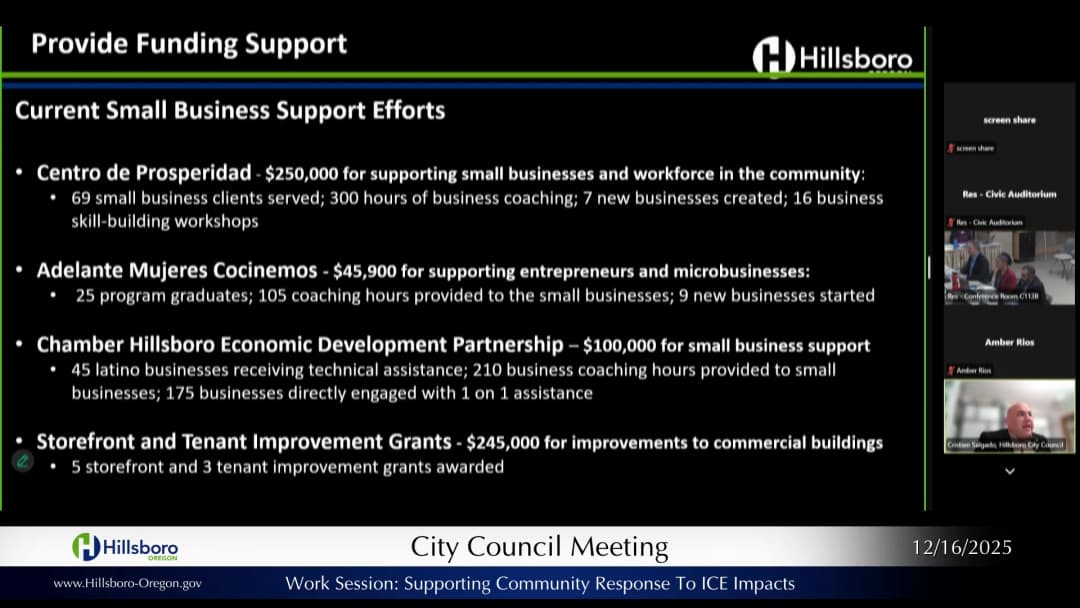
The meeting began with a work session (6:00–7:30 PM) focused on the city's ongoing response to ICE enforcement, followed by a regular city council meeting at 7:30 PM. Staff presented updates on community-focused funding, a small business stabilization grant program, and a proposed Human Rights Office. Council discussion revealed divisions on the office, with some members preferring direct funding to community-based organizations. Public testimony emphasized codification, police presence, mental health support, and faster action. Consent Calendar - The consent agenda was approved unanimously via roll call (7-0). Public Comments & Testimony - Aaron Palmer urged the council to codify jurisdiction into law, noted 373 ICE raids in Oregon in November (130 in Washington County, 25% from Hillsboro), and called for leadership and accountability. - Luce Gutierrez expressed gratitude for the updates and requested mental health funding, a dedicated officer to report ICE abuses, and continued support for her community. - William criticized loss of trust in police and government, highlighted community self-protection efforts, and called for education on ICE funding history. - SM raised concerns about Flock cameras in retail parking lots being accessed by federal officials and asked for regulation; also urged the city to act more quickly. - Jody Clark Lampa requested immediate police involvement to make ICE agents uncomfortable and support citizen observers, rather than waiting until January for decisions. Discussion Items - Community-Focused Funding (Simone) : $200,000 was already distributed for food, legal, and rental assistance (32 organizations funded). A new proposal for an additional $200,000 for eviction prevention and rental support, with case management flexibility, was presented. Council consensus to move forward with this round, with emphasis on metrics and long-term sustainability. - Small Business Stabilization Grant Program (Dan Diaz) : Proposed $200,000 in direct grants (max $10,000) plus $50,000 for financial literacy support, targeting restaurants, food markets, and retail stores with 2–10 employees and gross revenue under $2.25M. Council discussed eligibility, verification, and timeline (late February–March 2026). General consensus to proceed with refinements. - Human Rights Office (Robbie Hammond & Simone) : Proposed new positions (Human Rights Office Manager, Assistant Communications Manager) within the City Manager's Office. Goals include partnering with CBOs, convening a community advisory committee, and addressing broader human rights issues. Council split: Mayor, Councillor Alcair, and Councillor Case expressed concerns about cost and effectiveness compared to funding CBOs; Councillor Sinclair and Councillor Salgado supported the office, noting CBOs are overwhelmed. Council agreed to first form the community advisory committee before deciding on the office, and to revisit with budget estimates in January. Key Outcomes - Consensus to fund $200,000 for eviction prevention/rental support using four named organizations, with staff to finalize agreements in January. - Consensus to proceed with small business grant program with refinements based on council feedback (e.g., minimum revenue consideration, clearer employee criteria). - No final decision on Human Rights Office ; council directed staff to provide budget estimates and continue community advisory committee work, with a follow-up discussion at the second council meeting in January 2026. - Codification of sanctuary policy to be discussed at the January work session. - Approval of consent agenda and three ordinances (Fire Code, Comprehensive Plan amendments) via unanimous roll calls. - Library levy update : 64% of Hillsboro voters supported the county library levy, including 63% in South Hillsboro.
The meeting began with a work session on the Climate Action Plan, followed by the regular city council meeting which included public comment, a public hearing on the Housing Production Strategy, adoption of several resolutions and ordinances, and a city manager report. The work session lasted approximately one hour, with the regular meeting concluding at 8:20 PM for an executive session. Consent Calendar - The consent agenda was approved unanimously without separate discussion. Public Comments & Testimony - Steve Stoltenberg (general public comment) asked three questions: what is the oath of office for council members, what is illegal, and who do they represent. He did not receive answers per public comment rules. - Sarah Taylor (general public comment) urged the council to enact a 120-day eviction moratorium for families affected by ICE activity, address ICE vehicles operating without license plates, and provide direct financial support to affected families. She asked each council member to donate one month's salary. - Andrew Barker (on Housing Production Strategy) criticized the timeline of high-impact actions, noting many do not begin until 2028, and urged the council to direct staff to prioritize high-impact items for 2026. - Written testimony from Dirk Knutson (former technical advisory committee member) advocated for a faster timeline for the system development charge (SDC) study and adjustments for middle housing. Discussion Items - Climate Action Plan (Work Session): Robin Strong, sustainability and resiliency manager, presented the city's first comprehensive climate action plan after 2.5 years of development. Key statistics: the city's total emissions are 2.9 million metric tons of CO2 equivalent (local emissions account for 54%, imported for 46%). The plan aims for net-zero local emissions by 2050. Community engagement reached over 2,500 people, with more than 400 survey responses; 90% supported bold action. Strategies include building energy efficiency, renewable diesel, active transportation, food waste reduction, and resiliency measures for social and infrastructure systems. Councillors asked for cost estimates and staff time for all actions, both in the emissions reduction plan and resiliency plan. City Manager Robbie Hammond noted the plan is not under a tight deadline and another work session could be scheduled. - Housing Production Strategy (Public Hearing): Dan Rutzick presented the readoption of the Housing Production Strategy 2025-2030, required by the state. The plan includes 22 actions in regulatory, land-based, partnership, incentive, and investment categories. Discussions focused on the timeline for the SDC study (expected to begin in 2026, with adoption by 2028) and the urgency of reducing housing costs. Councillor Harris and Salgado expressed concern over the timeline and requested a faster process. Staff explained the study involves multiple partner agencies and fiscal impact assessments, but will work to expedite. - Community Wildfire Protection Plan (New Business): Fire Chief Downey and GIS Supervisor Kristen Judy presented a digital tool for the plan, which identifies wildfire risks in city green spaces. Although the probability of a catastrophic fire is low, impacts could be significant. The digital application includes interactive maps, defensible space guidance, and a quiz. The city will form a steering committee to prioritize actions, focusing on removing dead and down fuels (ladder fuels) rather than tree removal. The tool is expected to be live by Q1 2026. Key Outcomes - Consent agenda approved unanimously. - Resolution 2907 (Housing Production Strategy readoption) adopted on a roll call vote: 5-0. - Ordinance 6509 (Comprehensive Plan amendment for Public Facilities Plan) adopted on a roll call vote: 5-0. - Ordinance 6510 (Comprehensive Plan amendment for Regional and Town Center Boundaries) adopted on a roll call vote: 5-0. - Resolution 2904 (Grant application for nature play area at Evergreen Park) adopted on a roll call vote: 5-0. - Resolution 2908 (Community Wildfire Protection Plan adoption) adopted on a roll call vote: 5-0. - Council directed staff to provide cost estimates for all climate action plan actions and requested a faster timeline for the SDC study. - The meeting adjourned at 8:20 PM for an executive session to review the performance of the chief executive officer (ORS 192.660(2)(i)).
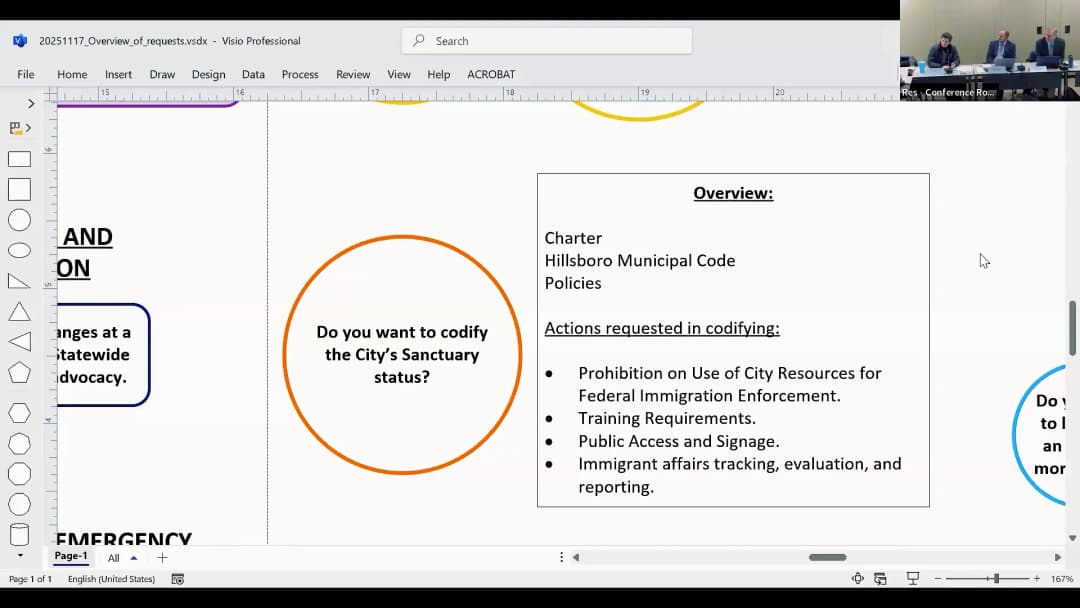
On November 24, 2025, the Hillsboro City Council held an emergency work session to discuss proposals for responding to increased Immigration and Customs Enforcement (ICE) activity in the community. The session, which began at 8:00 PM and included a break at 9:30 PM, was a continuation of a prior work session. No votes were taken; the council provided guidance and intent for staff to explore options and return with detailed plans. Staff presented a framework organized into themes: internal focus, partnering with community, funding support, calling for state/federal action, and implementing the local emergency declaration. The council reached consensus on several immediate actions and directed staff to bring back options on more complex items. Discussion Items - Review of Council Proposals: Staff summarized proposals from each councilor. Topics included: - Councilor Ambry: Improving information availability (Know Your Rights, translations), ongoing community funding, signage in public spaces, collaboration with other jurisdictions, supporting state/federal legislation on face masks and identification. - Councilor Salgado: A two-track approach: (1) stand up a civil and human rights office with a legal observer data recorder, legal resource navigator, and emergency fund coordinator; (2) a charter amendment to create a human rights council, along with community engagement and urgent timelines. - Councilor Kerr: Boundaries in public spaces, safety barriers near schools, a position reporting to council for training/engagement, a human rights council, enforcing laws against ICE, canceling public gatherings, expanding family leave, tracking detained individuals, HPD reporting, and requesting a statewide emergency. - Councilor Case: An ICE response page for HPD, a codified sanctuary policy, education on surveillance technology (e.g., license plate readers), expanded Know Your Rights communication, and comprehensive staff training. - Councilor Sinclair: Codify city sanctuary status and jurisdictional protections, direct staff to prepare an administrative roadmap, explore long-term institutionalization, and create reporting systems for ICE activity. - Councilor Harris: Supported a phased approach: first implement the resolution, then set up a human rights department, and later focus on sanctuary code. Emphasized keeping code concise and not duplicating state law. - Internal Focus Areas (Consensus): Staff proposed and the council agreed on: - Signage in non-public areas and exploring signage for public spaces and private businesses. - Employee training on ICE interactions, sanctuary promise laws, and immigration topics, to be developed with HR and community input. - Developing reports and documenting ICE interactions across all city departments. - Reviewing and updating city policies and guidance for ICE interactions, with recognition of legal limitations. - Exploring additional staffing resources, especially bilingual support. - Partnering with Community (Consensus): Council agreed to set up ongoing forums with community-based organizations (CBOs), including city administration and HPD leadership, to develop solutions and share accurate information. The city will also continue to participate in meetings convened by partners. - Funding Support (Consensus): - Staff will complete the review of community-focused funding applications (initial $200,000) and return with a request for additional funding. - Explore a grant program to support small businesses. - Provide support to Hillsboro School District: $4,000 for the McKinney-Vento program and $4,000 for online learning staffing. - Enhance utility assistance by first directing residents to existing programs, then evaluating shutoff delays if needed. - Calling for State/Federal Action (Consensus): Council directed staff to bring back more information on advocating for a statewide emergency declaration and to include relevant legislative priorities in the upcoming session. - Items Needing Further Consensus (staff to bring back options): - Setting up a Human/Civil Rights Office or Infrastructure: Council discussed the scope, goals, and whether to staff internally, fund CBOs, or use a hybrid approach. Councilor Salgado emphasized the need for institutional backing and data collection for accountability. Councilor Case expressed concern about the city managing sensitive data. Councilor Kerr advocated for a collaborative office with equal investment from CBOs. Councilor Harris proposed naming a point person (e.g., a human rights officer) within the city manager’s office to start immediately. Staff will bring back options including a community advisory committee, a dedicated office, and a charter amendment for a human rights commission. - Codifying Sanctuary Status: Legal advisor Chad explained the current framework (charter, municipal code, policies). Councilor Sinclair argued that codification provides accountability and trust. Staff will analyze each provision of the proposal to determine what is covered by state law, policy, or requires new codification, and will return with recommendations. - Legal Observers: Staff clarified that requiring employees to be legal observers is not legally permissible, but the city could explore coordinating or hiring staff for that role. This will be incorporated into the broader infrastructure discussion. - Canceling Public Gatherings: Councilor Kerr raised concerns about safety at city events, especially those targeting the Latino community. Councilor Salgado and others opposed blanket cancellations, noting that events serve the whole community. Council agreed to enhance safety information (Know Your Rights) and consider virtual options for targeted events, rather than canceling. - Eviction Moratorium: Councilor Kerr proposed a moratorium for those impacted by ICE. Councilor Harris cautioned against placing the full burden on landlords, suggesting a voluntary program or rental assistance instead. Staff will pivot to exploring rental assistance for both residential and small business tenants, possibly through partnerships with affordable housing providers. Key Outcomes - Consensus on Immediate Actions: The council endorsed: - Signage, training, documentation of ICE interactions, policy reviews, and community partnerships. - Additional funding for community-focused grants, school district support, small business grants, and utility assistance. - Staff to bring back information on a statewide emergency declaration. - Next Steps for Complex Items: Staff will: - Present options for a human/civil rights office, community advisory committee, and charter amendment (including legal observer coordination) by the next work session on December 16, 2025. - Analyze Councilor Sinclair’s codification proposal and return with a breakdown of provisions suitable for policy, code, or legal definition. - Explore rental assistance models for residential and business tenants, with a focus on avoiding unintended consequences. - Enhance event safety communications and consider virtual options for targeted gatherings. - Timeline: Staff will provide a clear timeline at the December 16 work session. The council will not meet on the week of December 1 due to the holiday; the next regular meeting is December 16, which will be dedicated to this topic. - No Public Comment: The work session did not include public comment, per the mayor’s announcement. The session concluded with an executive session (closed to the public).
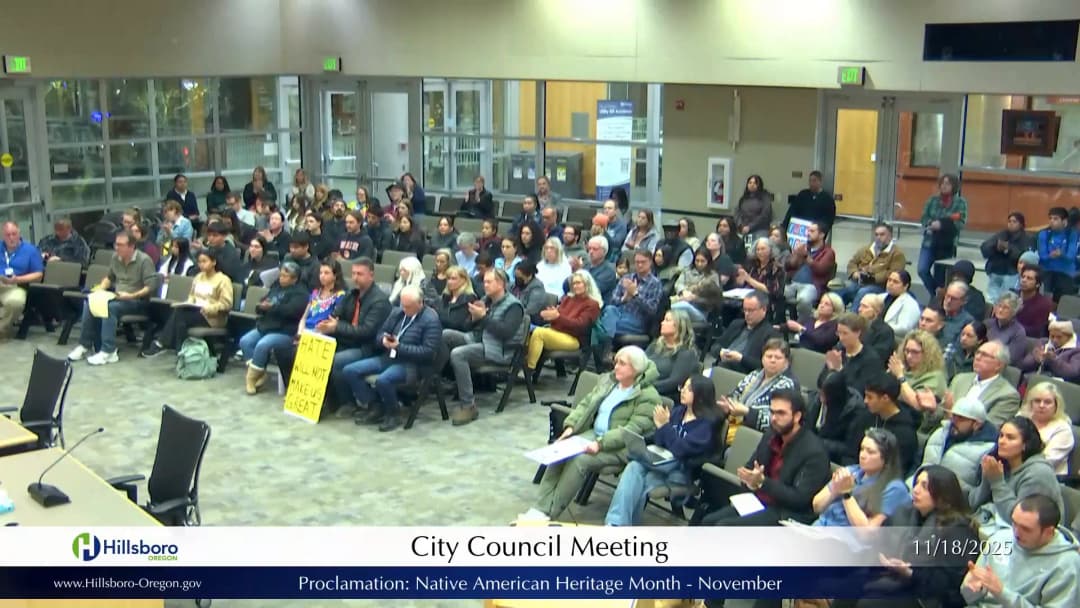
On November 18, 2025, the Hillsboro City Council held a work session and a regular meeting to address the ongoing impacts of Immigration and Customs Enforcement (ICE) in the community. The council unanimously adopted an emergency declaration (Resolution 2906) acknowledging the crisis and the city's values, allocated $200,000 in community-focused funding, discussed police department policies, and heard over three hours of public testimony. A special work session was scheduled to review council proposals for further action. Consent Calendar - The consent agenda was approved unanimously, including items not removed for separate consideration. Councilor Salgado expressed appreciation for the naming of the Hillsboro Shelter as a simple, equity-centered approach. Public Comments & Testimony - Over 30 community members spoke during the regular meeting, with many expressing fear, frustration, and demands for stronger protection against ICE activity. - Speakers included State Senator Janine Sollman (SD 15), who called for a unified state response and urged Governor Kotek to convene stakeholders. She described ICE actions as "human trafficking and kidnapping." - Multiple residents described personal experiences: witnessing abductions, family members detained, vehicles without license plates, and ICE agents not identifying themselves. One speaker, Erica, recounted being followed by an unmarked vehicle and having a rifle pointed at her. - Teachers and school staff reported children's fear, families preparing separation plans, and educators acting as safety nets. Adrian Smith, a school counselor, stated that parents are being snatched from cars at school drop-off. - Business owner Myra Contreras reported an 80% decline in business and requested a small business recovery grant program. - Several speakers criticized the city's initial guidance prohibiting city employees from filming ICE activity, though the policy was later revised to allow recording with caution. - Some speakers expressed gratitude for the emergency declaration but stressed it is a first step. Others demanded the city codify sanctuary protections, enforce state laws (e.g., license plate requirements, impersonation of officers), and hold police accountable for perceived inaction. Discussion Items - Emergency Declaration (Resolution 2906): City Attorney Chad Jacobs presented a draft emergency declaration that declares a state of emergency without invoking emergency powers, to remain in effect indefinitely. The resolution outlines the city's values, condemns ICE actions, and calls for congressional immigration reform. Councilor Harris's amendments (stronger language on congressional delegation) were included. Councilor Alcara expressed concern about being informed late; Councilor Sinclair noted the resolution does not replace an ordinance to codify sanctuary status. The council voted to adopt the resolution unanimously. - Community-Focused Funding ($200,000): Assistant City Manager Simone Brooks updated that the grant application opened November 12 with a 5-day window. Over 30 organizations submitted more than 50 applications (up to $40,000 each; max $50,000). Categories (food, legal services, rent assistance, etc.) were prioritized by council weighting. Disbursement expected first week of December. An addendum clarified that funds should free up other monies for undocumented individuals and that no personally identifiable information is required. Councilor Sinclair questioned the 5-day window for smaller organizations; Brooks noted the response was strong. - City Employee Guidance on ICE: Brooks explained that initial guidance (February 2025) prohibited filming ICE to protect staff from safety risks per DHS expansion of threat definitions. After feedback, the prohibition was removed and updated guidance posted (English and Spanish). Councilor Alcara requested earlier notification of internal policies. The city also clarified that public comment now requires only a name for logistical purposes. - Police Department (Chief Jim Coleman and Deputy Chief Mike Leader): Topics included automated license plate readers (ALPRs), data sharing with other agencies (via MOUs, not used for immigration enforcement), and limitations on enforcing traffic laws against ICE vehicles. Chief Coleman stated officers cannot arrest federal agents for lawful detentions but document incidents, file police reports, and help reunite families with property. Councilors pressed for more proactive enforcement (e.g., tickets for missing plates), but acknowledged legal limits. Councilor Salgado noted that ICE agents often have superior firepower, making confrontation unrealistic. Councilor Alcara questioned an incident where an officer called a protester by name; Chief Coleman defended professionalism. It was confirmed that HPD is not on scene for most ICE operations; they respond only when called. - Council Proposals: Due to time, discussion was postponed. Councilor Salgado motioned to hold a special work session before the next regular meeting to focus on the proposals; motion passed unanimously. City Manager Raheem outlined a format grouping proposals by theme (e.g., emergency declaration done, internal signage, charter amendments, new commissions) and noted that resource-intensive items require council consensus to proceed. Key Outcomes - Adopted Resolution 2906 (emergency declaration) unanimously with Councilor Harris's amendments. - Approved Consent Agenda and two new business items (Planned Unit Development at Riverside at Butternut Woods; interfund loan of $710,000 for transportation infrastructure). - Scheduled Special Work Session to continue discussion of council proposals (date to be set via poll). The session will include police department participation and may be followed by an executive session on litigation. - Staff directed to compile information on charter amendment processes, existing intergovernmental agreements (MOUs), and language from the FBI memo regarding impersonators of ICE officers. - Community funding to be disbursed first week of December; small business grant program under consideration.
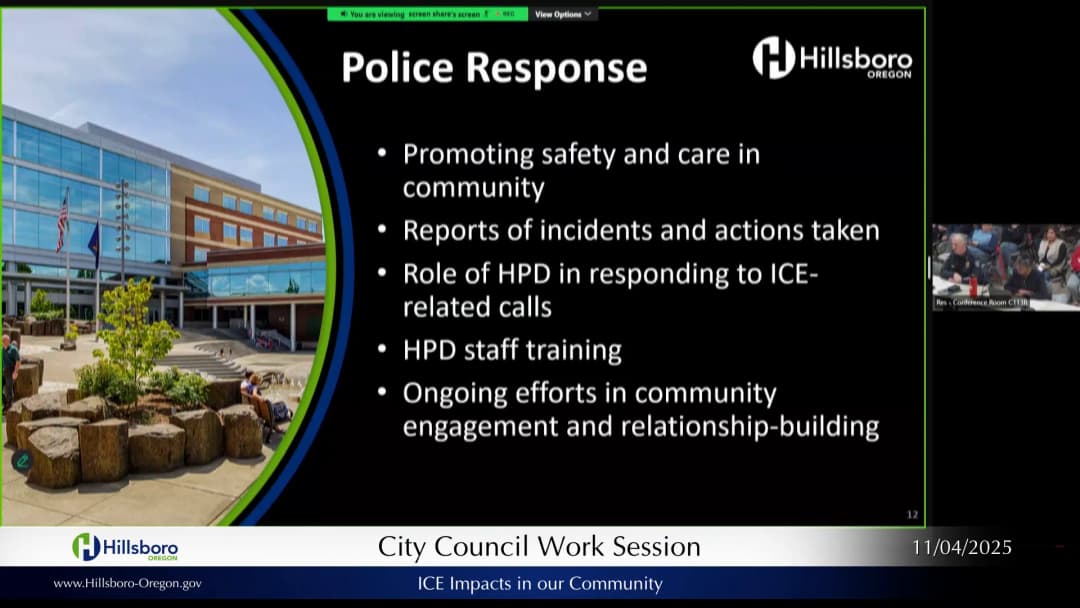
The meeting on November 4, 2025, began with a work session from 6:00–6:50 PM, followed by a regular city council session at 7:00 PM, and concluded with a resumed work session to hear from Police Chief Jim Coleman. The primary topic was the recent surge in ICE enforcement activity in Hillsboro. Staff from the city manager's office, city attorney, police department, and community partners (Latino Policy Council, Washington County Chamber of Commerce's Latino Business Advisory Council) provided briefings. Over three hours of public comment were heard during the council session, with community members sharing fears, personal stories of family members detained, and demands for a state of emergency and increased protections. The council discussed legal limitations, funding for community organizations, police response protocols, and a proposal to study the feasibility of a human and civil rights department. Consent Calendar - The consent agenda, including a Veterans Day proclamation and other routine items, was approved unanimously via roll call. - Ordinance No. 6508 (Community Development Code amendment) was adopted unanimously via roll call after second reading. Public Comments & Testimony - Over 50 speakers, both in person and virtually, addressed the council. Many expressed fear, described witnessing ICE arrests, and shared personal trauma. Several speakers demanded a state of emergency, immediate action from the city, and clearer guidance for law enforcement. - Youth spoke of fearing for their parents' safety and the impact on their education and mental health. - Medical professionals reported patients skipping care due to fear, and noted increased no-shows at clinics. - Business owners described declining customers and revenue, with some temporarily closing. - The Mexican Consulate offered a 24/7 hotline for Mexican nationals. - Multiple speakers criticized the Hillsboro Police Department for perceived inaction and called for officers to document incidents and respond to calls where ICE agents use excessive force or operate in unmarked vehicles without identification. - Speakers urged the council to declare a state of emergency to unlock resources and coordinate with community organizations. Discussion Items - Staff Presentations: Assistant City Manager Simone Brooks outlined current communications (Know Your Rights videos, webpage, social media) and proposed a $200,000 low‑barrier grant fund for community‑based organizations. City Attorney Chad Jacobs explained legal limits: Hillsboro's sanctuary status complies with state law but cannot prevent ICE actions due to federal supremacy; officers cannot interfere with ICE but can document incidents; an emergency declaration has limited legal effect (mostly procurement flexibility). - Community Partners: Oliver Cunha (Latino Policy Council) described ICE agents in plain clothes and unmarked cars, proposed that police document all ICE encounters. Joanna Para and Fernando Lida (Latino Business Advisory Council) reported that small businesses need customers not just funding; many owners are afraid but need to stay open. They urged collaboration and accurate information to counter fearmongering. - Police Chief Jim Coleman (Work Session Part 2): Reported 26 ICE‑related incident reports in October. Officers respond to all 911 calls but cannot demand identification from federal agents unless there is reason to believe they are not lawful agents. HPD does not use Flock cameras (automated license plate readers) and has not shared data with federal agencies, but will verify sharing by partner agencies. Officers have requested ICE agents respect public safety, but have been refused. Chief emphasized the risk of tragedy if community members try to block ICE vehicles. - Council Discussion: Councilors discussed the need for retraining officers on sanctuary city policy, the emotional toll on bilingual officers, and the need for more frequent updates from HPD. Councilor Salgado proposed a motion to direct staff to study the creation of a human and civil rights department within the city, with a report due in two weeks. After debate about timing and the need for careful review, the motion was seconded then withdrawn. Council agreed to hold another work session in two weeks and to review the proposal individually, providing feedback to staff. - Legal Clarification: City Attorney Jacobs advised that councilors may not deliberate via email (serial meeting concerns) but may send individual feedback to staff. Key Outcomes - The city will expedite the low‑barrier $200,000 grant process (separate from existing $200,000 community services grants) to quickly fund community‑based organizations. - Staff will investigate whether any city or county technology (e.g., license plate readers) inadvertently shares data with federal agencies and will report back. - The council plans a follow‑up work session within two weeks to discuss further actions, including Councilor Salgado's proposal for a human/civil rights department. - No formal vote was taken on the proposal; councilors will review the document and provide individual feedback to staff rather than a collective decision via email. - The city will continue updating staff training and public-facing resources (Know Your Rights, signage, FAQs). - Councilors requested more frequent briefings from the police department as the ICE enforcement situation evolves.
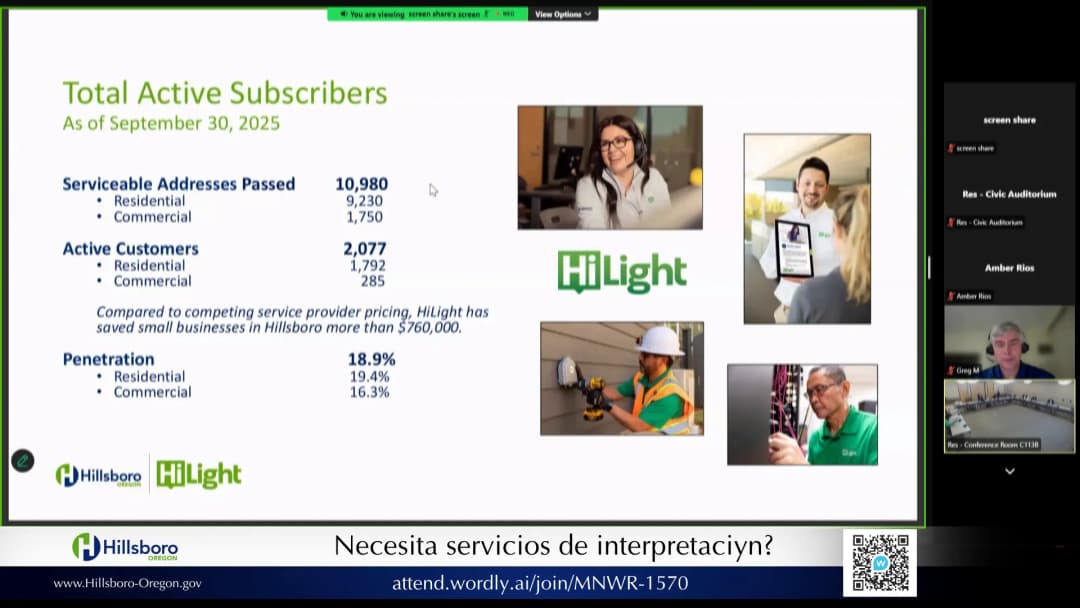
The October 21, 2025 Hillsboro City Council meeting featured presentations from the 2025 Civic Leadership Academy on proposed community flag designs, a recognition of arts and culture organizations, an update on the Hillsboro 2035 Community Plan, a presentation on the new Police Department Headquarters, a change order for an emergency water well at South Hillsboro Fire Station 9, and an annual update on the Highlight broadband utility. The council approved consent items, first reading of an ordinance, and several resolutions. The meeting concluded with a work session and executive session on labor negotiations. Consent Calendar - Approved consent agenda items including renewal of the Liberty High School Fire Science Program IGA and fully staffing Rescue 6 at Station 6. Public Comments & Testimony - Jeff Perkins (Hillsboro Ward 3 resident) spoke in strong support of consent items 4.4 and 4.5, stating they represent "real tangible investments in public safety, education, and the long-term resilience of our city." Discussion Items - 2025 Civic Leadership Academy (CLA) Flag Design Presentation: The CLA presented three community flag design options to celebrate Hillsboro's 150th anniversary. The designs were developed through 460+ hours of collective effort, including a survey of 77 respondents and stakeholder interviews. Presenters highlighted themes of community, nature, history, and technology. The three designs are: (1) horizontal stripes with five seeds in a circle; (2) oak leaves, railroad tracks, and an arrow; (3) a trillium blossom with four green panels. The CLA recommended a community vote on all three designs. - Hillsboro Arts and Culture Council (HACC) Annual Update: Chair Joan Callaway and Vice Chair Bo Wrights reported on efforts to increase access and remove barriers to arts programs, including scholarships (24 students served), the Arts for All program (offering $5 tickets), free community events, and bilingual programming. The endowment was highlighted as a stable funding source. - Hillsboro Community Foundation Update: President Funda Kelsi reported that the foundation's funds totaled $7.25 million (a 15.47% increase) and distributed over $660,000 in grants, scholarships, and awards, including $86,000 in scholarships to 32 students. - Hillsboro 2035 Community Plan Update: Program Coordinator Daisha Bacum presented the updated plan, which contains 125 actions (46 new) with 18 continuing and 5 new lead partners. The plan is available in English and Spanish. Council adopted Resolution 2903. - Hillsboro Police Department Headquarters Project: Public Works Project Manager Jeffrey Cavallo, Capital Development Division Manager Sean Morrison, and Police Chief Jim Coleman presented the $94.3 million project at NE 25th Avenue. The design emphasizes equity, operational resiliency, wellness, and community connectivity. The council approved early procurement activities. - Emergency Water Well at South Hillsboro Fire Station 9: Project Manager David Johnson presented a change order for $1,242,789.99 to drill a 700-foot well to provide emergency water. The well will be the first of its kind in Hillsboro and is powered by a generator. - Highlight Broadband Annual Update: Highlight officials reported 2,077 subscribers (20-21% of the city), cumulative savings of $760,000 for small businesses, and a net promoter score of 82.1. The utility's fund has received $51.5 million in transfers (from gain share, SIP, and ARPA). Future challenges include an identified funding gap for full city buildout, particularly in multi-family housing. Key Outcomes - Flag Design Next Steps: Council agreed to put all three flag designs to a community vote, with the official flag to be revealed at the February 19, 2026 State of the City event. (Unanimous consensus, no formal vote taken) - Appointments to Downtown Urban Renewal Advisory Committee: Approved. (Motion carried unanimously) - Omnibus Code Amendment (First Reading): Ordinance 6508 approved for first reading; second reading scheduled for November 4, 2025. (Motion carried 7-0) - Local Contract Review Board Administrative Rules: Resolution 2902 adopted. (Motion carried 7-0) - Reed’s Crossing Density Increase: Order 28 adopted. (Motion carried 7-0) - Hillsboro 2035 Community Plan: Resolution 2903 adopted. (Motion carried 7-0) - Police Department Headquarters Early Procurement: Approved. (Motion carried 7-0) - Emergency Water Well Change Order: Approved. (Motion carried 7-0)
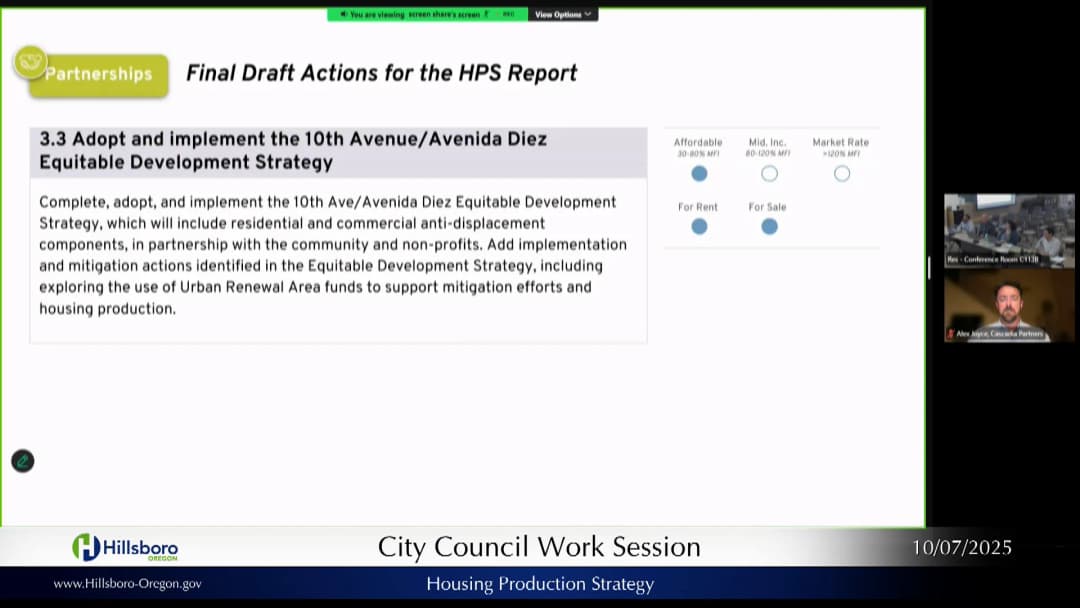
Hillsboro City Council Meeting and Housing Production Strategy Work Session - October 7, 2025\n\nThe City Council of Hillsboro, Oregon, convened on October 7, 2025, for a regular meeting followed by a work session on the Housing Production Strategy (HPS). The regular meeting included public comments, approval of the consent agenda, adoption of library rules, and a city manager report. The subsequent work session focused on revisions to the HPS in response to a remand from the Oregon Department of Land Conservation and Development (DLCD). Council members engaged in detailed discussion on housing needs, action items, and next steps.\n\n Consent Calendar\n- The consent agenda was approved unanimously via roll call (Mayor Pace, Councilors Harris, Sinclair, Salgado, Case, Ambry; Councilor Alcare absent).\n- Resolution 2901, adopting library administrative rules on collection development, unattended children, and gallery space/exhibits, was adopted unanimously.\n\n Public Comments & Testimony\n- Dirk Knutson (resident/broker): Expressed concern about the proliferation of data centers in Hillsboro (20 existing, 10 planned), citing grid instability, loss of industrial land, and missed franchise fee revenue (estimated $50–70 million/year). Urged the city to consider imposing franchise fees on data centers as communication companies and to establish a committee on energy policy. He noted he has written an initiative petition on the matter.\n- Kanishkan Tamilarasan (resident): Presented the Seva Diwali food drive (September 20–November 10, 2025), aiming to collect non-perishable vegetarian food for local pantries. In 2024, the drive collected over 8,000 pounds in Oregon and 700,000 pounds nationally. Invited council and community to participate.\n- Jaime Miranda (MN Marketplace representative): Thanked the council for supporting diversity, equity, and inclusion and invited them to the 25th anniversary celebration of MN Marketplace (October 25–26, 2025), featuring folkloric groups, live music, step dancers, and community art.\n\n City Manager Report\n- City Manager Robbie Hammond clarified a helicopter circling downtown was Hillsboro Aviation performing infrared calibration, not police-related.\n- Announced the library’s “Library of Things” community voting on Engage Hillsborough (through mid-November; over 800 responses already).\n- Promoted the Hillsboro Fire & Rescue open house on October 11, 2025, at Ronler Acres Fire Station 3 (10 a.m.–2 p.m.).\n\n Work Session: Housing Production Strategy (HPS) Update\n- Presenters: Paul Runge and Alex Joyce from Cascadia Partners (urban planning consultants) presented the revised HPS following DLCD’s remand in April 2025. City staff (Becky Catino, Dan Retic, Dan Diaz) also participated.\n- Context: The original HPS was adopted by the previous council, submitted to DLCD, and remanded with two conditions: (1) remove Action 2.2 on urban growth boundary (UGB) expansions from the HPS (though UGB expansion remains possible via other processes), and (2) clarify actions, timelines, and alignment with identified housing needs.\n- Housing Needs Overview: The Housing Needs Analysis (HNA) projects a need for approximately 14,000 housing units over 20 years (2023–2043) using a statutory 0.7% growth rate, though the city’s historical growth is 1.6%. Needs break down into: 37% affordable (<80% median family income, MFI), 21% middle income (80–120% MFI), and 42% market rate (120% MFI). Cost burden is prevalent: 43% of renters spend 30% of income on rent, with higher rates among Black households. Seniors and people with disabilities also face housing challenges.\n- Revised Actions (20 total): Presenters walked through changes, emphasizing strengthened commitment language (e.g., “will” instead of “may”), addition of an opportunity/vulnerability analysis for zoning (Action 1.1), density bonuses for affordable and accessible units (Actions 1.2, 1.3), refined middle housing standards (Action 1.4), streamlining design standards (1.5), adopting a user-friendly code (1.6), permit process barrier removal (1.7), pre-approved ADU plans with universal design (1.8), land inventory for affordable housing (2.1, 2.2), partnerships for affordable homeownership (3.2), equitable development strategy for 10th Avenue/Avenida Diaz (3.3), fee studies (4.1, 4.2), tax exemption programs (4.3, 4.4, 4.5), infrastructure investment analysis (5.1), exploring regional revenue sources (5.2), completing a year-round homeless shelter (5.3 – already underway/funded), and directing resources to supportive/accessible housing (5.4). Some actions are “exploratory” (studies), others “committal.”\n- Council Discussion: Councilors asked about definitions of affordable, middle, and market-rate housing (based on percentage of MFI and cost burden), the relationship between growth rates and need, and the timeline for implementation. City staff clarified that the HPS will include a work plan with years for initiation, adoption, and implementation. The equitable development strategy will come back as a separate work session. The homeless shelter is fully funded. Public comment on the revised HPS will open for two weeks starting the week of October 13, 2025, with a final adoption hearing scheduled for December 2, 2025.\n\n Key Outcomes\n- Consent agenda and Resolution 2901 adopted unanimously.\n- Council received the revised HPS presentation and provided feedback; no formal action taken during the work session.\n- Next steps: Public comment period (mid-October), informal DLCD review, possible additional revisions, and council adoption expected in December 2025.\n- Council members emphasized the importance of clear definitions and alignment between actions and affordable housing outcomes.