The Minneapolis City Council’s Committee of the Whole met on Tuesday, November 18, 2025 (regular meeting; broadcast with real-time captioning). Chair Jason Chavez convened the meeting, the clerk conducted roll call (10 members present; quorum confirmed), and the committee received standing committee reports, approved a short consent calendar, and discussed a proposed resolution to adopt an updated enterprise policy framework. The policy framework item was ultimately delayed to the next Committee of the Whole meeting. Attendance / Roll Call - Present (10): Chair Jason Chavez; Vice Chair Aisha Chughtai (noted later as Vice President “Chuck Tye” joining); Council Members Payne, Wansley, Rainville, Vita, Osman, Cashman, Koski, Misano, Vice Chair Chowdhury. - Absent (3): Ellison, Jenkins, Chughtai (initially called as absent earlier in roll call, but later Vice President Chughtai was acknowledged as present—transcript contains a discrepancy). Standing Committee Reports (Items forwarded to the Thursday council meeting unless otherwise noted) - Administration & Enterprise Oversight (Chair: Council Member Wansley): 22 items - Included: gift acceptances (Cities Today Institute; Public Rights Project), multiple bids (e.g., sidewalks snow/ice removal; Target Center steam station improvements; Fridley Softening Plant lime system replacement), master contract for workforce development providers (2026–2028), multiple contract amendments (e.g., legal after-action reviews; Target Center lighting/escalator lobby; Phillips Traffic Safety; Bridge 9 improvements; remote interpreting; community trauma response; immigration legal services), partnership engagement fund contracts, Minnesota Historical Society cooperative funding agreement (St. Anthony Falls Heritage Board), disability advisory committee appointments, 2025 special assessments for delinquent utility charges, and several legal settlements (workers’ compensation/claims). - Budget Committee (Chair: Council Vice President Chughtai): 1 item - Resolution to approve adjusted 20-year Neighborhood Park Plan guaranteed minimum annual amounts for 2027–2031 due to inflation. - Business, Housing & Zoning (Chair: Council Member Osman): 22 items - Included: heritage preservation regulation ordinance; liquor/sidewalk café/extended-hours licenses; annual special assessment levies; denial of an appeal for 2821 Brookwood Terrace; an appeal involving 1717 Developers and demolition of the John Cook House (sent forward without recommendation); additional liquor/gambling renewals; dislocated worker grant acceptance; decertification of three TIF districts; comprehensive plan amendment for River North development; modification to a preservation fund; contract amendment for 1200 W Broadway; two new street names honoring Kirk Washington, Jr. and Chi Xiong (submitted by Council Member Allison); appropriations for demolishing two City properties; restated land sale for Homes for Homeies (Emergency Stabilization Pilot Program); annual Affordable Housing Trust Fund awards; registration of 9% LIHTC; and an amended signage-on-premises ordinance. - Climate & Infrastructure (Chair: Council Member Cashman): 10 items - Included: resolution honoring staff/contractors for Hennepin Ave S reconstruction; multiple reconstruction packages (First Ave S; Cedar Ave; Lowry Ave NE Phase 2) including ordering work, special assessments, and Board of Estimate & Taxation actions for assessment bonds and areaway removals; subordinate funding agreement for Blue Line Extension local work/design/admin costs; 2025 capital improvement appropriation adjustments/closures/reallocations; cooperative agreement with Hennepin County for Cedar Ave reconstruction; utility easement for storm sewer/stormwater basins within Columbia Golf Course/park; joint powers agreement with Park Board for parkway paving repair/reconstruction; and an EV Spot Network pilot rate/price structure update for right-of-way EV charging. - Intergovernmental Relations (Chair: Vice Chair Chowdhury): receive & file - 2026 legislative policy priorities; presentation on 2025 federal legislative updates. - Public Health & Safety (Vice Chair: Council Member Wansley): 2 items - Opioid overdoses and possession of naloxone/other opiate antagonists. - Toward Zero Death grant from the State of Minnesota (through the City of Crystal Police Department) to improve Minneapolis road safety. Consent Calendar - Approved unanimously (voice vote) - Set two public hearings for December 9, 2025 at 1:30 p.m. (Committee of the Whole): - Ordinance related to employee authority in immigration matters. - Appointment of Patrick Burns to the Ethical Practices Board. - Referred to staff: ordinance related to city government structure implementation. Discussion Items - Enterprise Policy Framework (“policy on policies”) — presented by City Clerk Casey Carl - Presenter: Casey Carl, City Clerk. - Purpose described by staff: Replace the City’s 2004 “policy on policies” framework (Council Action 2004A0966) with an updated, government-structure-aligned framework. - Key context from staff: - The 2004 approach was described as having been “fumbled” in implementation: the Policy Review Group (PRG) became largely editorial, the policy library was abandoned due to resources, and the overall process became inconsistent, making it difficult to locate policies or know if they are current and legally effective. - Minneapolis government structure changed in 2021 (Legislative Council / Executive Mayor separation of powers), and staff stated existing policies do not reflect that structure. - Framework described: - Enterprise policies (Council + Mayor as governing body): high-level, enterprise-wide statements of values/goals/standards; adopted by resolution; to be codified in a digital policy library for “universal access” (filed with clerk, posted digitally, distributed to departments, available as public data). - Administration policies (Mayor / executive branch): management/operational direction; promulgated by executive order filed with the clerk; also to be placed in the policy library for transparency. - Department policies: departmental implementation/work rules under delegated authority. - Policy Review Group (PRG): staff review body facilitated by the City Operations Officer; includes City Attorney and City Clerk (or designees) and other departments; responsible for internal vetting and regular review of enterprise and administration policies. - Funding / timeline details: - Staff noted $300,000 previously allocated (from the legislative department budget) for acquisition of an enterprise policy management system; staff anticipated seeking a budget amendment to roll the funds into FY2026 so the City does not lose the money and can complete procurement/implementation. - Proposed next steps included establishing the PRG and organizing two workgroups (system implementation; collecting/classifying existing policies), with implementation and library launch anticipated by Q2 2026, followed by a lengthy effort to reclassify and load existing policies during 2026. Public Comments & Testimony - None captured in the transcript. Key Outcomes - Consent calendar approved (voice vote; unanimous, no abstentions stated): public hearings set for Dec. 9, 2025 at 1:30 p.m. and one ordinance referred to staff. - Enterprise Policy Framework resolution delayed: - Motion by Council President Payne (seconded) to delay the enterprise policy framework resolution to the next Committee of the Whole meeting on December 9, 2025 at 1:30 p.m. - Rationale stated (positions): - Council Member Cashman raised concerns about council representation/oversight in the PRG. - Council Member Wansley expressed interest in further discussion before Thursday to address representation/reporting concerns. - Council President Payne stated a desire not to make the process feel rushed and highlighted urgency around not impeding the budget rollover for the $300,000 system funds. - Vote: Passed by voice vote (“ayes” heard; no nays/abstentions stated). Adjournment - Chair Chavez adjourned the meeting after concluding business.

Public Meetings - Minneapolis, Minnesota
Public Meetings - Minneapolis, MinnesotaThe Intergovernmental Relations Committee met on Tuesday, November 18, 2025 (regular meeting; broadcast live with real-time captioning). Chair Aurene Chowdhury convened the meeting with a quorum present (8 members at roll call). The committee received and filed two informational items—(1) a preview of 2026 legislative policy position recommendations (no formal action taken; action planned in the new year ahead of the February legislative session) and (2) a federal update, including the end of a 43-day federal shutdown on Nov. 12 and federal changes affecting hemp-derived THC. Attendance - Present at roll call (8): Chair Aurene Chowdhury; Vice Chair Rainville; Council Members Payne, Wansley, Vita, Chavez, Chughtai, Palmisano - Absent at roll call: Ellison, Osman, Cashman, Jenkins, Koski - Joined later: Council Members Osman and Cashman Discussion Items - 2026 Legislative Policy Positions — Policy Liaison Team (PLT) recommendations (10 items) - Presenters: - Aurene Chowdhury (Chair) - Intergovernmental Relations (IGR): Director Katie Topinka; Government Relations Representative Indiria Filana; Senior Government Relations Representatives Steve Huser and Lauren Olson - CPED: Sarah Milner, Policy Research & Outreach Manager (on linkage between sign ordinance and legislative authority) - PLT process overview (Filana): annual interdepartmental review of departmental proposals (policy/technical/language) for potential inclusion in the City’s legislative policy positions and agenda. - New policy position recommendations presented (with key context/requests): 1. Elections (City Clerk/Elections Office): seek state statutory clarification for municipal candidate filing and campaign finance responsibilities shifted from Hennepin County to Minneapolis in 2022. 2. CPED—Entertainment districts/digital signage revenue: seek special legislation to allow revenue capture/fees tied to permitting newly authorized digital outdoor signage in an entertainment district (not currently allowed under state law), with example earmarks described as public art, public safety, or similar improvements. 3. Health Department (Sustainability team)—Energy code enforcement support: request $500,000 in additional ongoing funding for building science/new technology experts embedded in local jurisdictions to support enforcement of updated building/energy codes (building code updates effective 2020; energy code updates effective 2024; new codes adopted every six years in Minnesota). 4. CPED—Cannabis policy updates (four areas): (a) express support for restoring local cannabis aid removed from the last state budget bill; (b) support legislative streamlining for local/state process issues (including local site approval, building/fire code enforcement, and the 30-day deadline tied to sign-off with the state/Office of Cannabis Management); (c) address impacts of license transfers/sales; (d) support changes to employment restrictions to allow more employer discretion based on offense/job relevance. 5. Neighborhood Safety—Data Practices (Chapter 13): seek state changes so certain violence prevention program data (Minneapolis Group Violence Intervention and Youth GVI participant/volunteer information) would be non-public, to increase participant confidence and participation. 6. Public Works—Low-income water affordability program: support a statewide affordability program funded via a statewide fee on drinking water/wastewater service connections to help offset drinking water, wastewater, and stormwater bills for qualifying low-income households; proposal included an opt-out concept for jurisdictions with a local program. 7. Public Works—Municipal State Aid (MSA) street design flexibility: propose more specific support for using alternative design standards (e.g., MnDOT design guide or NACTO standards) and improvements to the variance process, including an appeals option. 8. Public Works (Solid Waste & Recycling)—C&D debris: note construction and demolition debris is more than twice the amount of municipal solid waste but does not factor into municipal solid waste goals; seek funding and workforce development for reuse, recycling, and deconstruction, referencing an MPCA task force (2019) recommendation. 9. Public Works (Solid Waste & Recycling)—Statewide food disposal ban: support a statewide ban on disposal of food from landfills and waste-to-energy for large generators (e.g., restaurants, grocery stores), requiring organics recycling; described as long advocated by Hennepin County and anticipated as a returning MPCA initiative. 10. Civil Rights—Expand Minnesota Human Rights Act: add protected classes consistent with a recent Minneapolis ordinance: justice-impacted status, housing status, and height and weight; described as improving statewide consistency and strengthening legal protection. - Member questions and discussion on 2026 items - Council President Payne asked about the impact of a federal ban/change affecting hemp-derived THC and whether state lawmakers were discussing responsive changes. Steve Huser said the development was recent; noted Minnesota’s low-dose hemp law is tied to the former federal definition and may require legislative review; also stated the federal change reportedly has a one-year runway before taking effect. - Council Member Wansley previewed priorities she planned to bring forward in early January: - Expressed support for investing in a non-fatal shooting task force model; referenced Ramsey County/St. Paul implementation and stated Ramsey County increased clearance rates (she cited “up to 75%”). - Sought extension of the University of Minnesota Good Neighbor Fund for another 20 years, with a new focus on food security and grocery stores; stated the fund was chartered by the legislature in 2007 and is scheduled to sunset after 20 years. - Advocated for “Dinky After Dark” Phase 2 pedestrian lighting; referenced the City’s $500,000 investment in Phase 1 and requested additional state participation. - Chair Chowdhury encouraged members to begin sharing legislative priorities with IGR staff earlier in the cycle. - Chair Chowdhury asked about how the signs ordinance work underway in the Business, Housing & Zoning Committee relates to the proposed entertainment district legislative authority. Director Topinka explained the City would need state authorization to charge a fee/create an overlay mechanism akin to an improvement district; Sarah Milner (CPED) offered additional briefings. - Chair Chowdhury expressed a position that the City should prioritize the revenue authority request and suggested considering broader uses of potential revenue (not limited to arts/safety), including more equitable distribution supporting underinvested areas and commercial corridors. - Federal update (Olson/Huser) - Presenter: Lauren Olson (Senior Government Relations Representative), with additional detail from Steve Huser. - Federal shutdown: Olson reported the 43-day shutdown ended Nov. 12, 2025 (described as the longest in U.S. history). She said funding was extended through Jan. 30 for parts of government, while some areas were funded through Sept. 30, 2026. She said nine appropriations bills still needed action by Jan. 30 or another shutdown could occur. - Program funding details: Olson stated the USDA appropriations (“ag bill”) included SNAP and WIC funded at 2025 enacted levels, and that VA/Military Construction and legislative branch funding were among bills funded. - Operational directives/impacts: She described commitments to reimburse states for federal program expenditures during the shutdown (generally presumed to include SNAP), reverse shutdown layoffs, provide furloughed employee back pay, and prohibit other mass layoffs through year-end. She flagged concerns about layoffs in Health and Human Services’ Office of Population Affairs, which supports programming connected to school-based clinics. - Affordable Care Act tax credits: Olson said enhanced ACA tax credits were not extended in the shutdown resolution; Senate Majority Leader Thune committed to a vote in December. - Hemp-derived THC change (Huser): Huser described a federal change lowering allowable THC levels in hemp products, impacting manufacturing and interstate commerce, with a one-year window before full implementation. He said Minnesota’s state cannabis law would remain in place for Minnesota-legal products, but interstate sales and access to banking/finance for hemp-derived THC businesses would be affected. - Congressional item mentioned: Olson noted an expected House vote (around 2:00 PM that day) related to the “Epstein files,” describing a discharge petition process and noting it would still require Senate passage and presidential signature. - Earmark noted: Olson reported the City’s surviving earmark request at that point was $250,000 for the Logan Park rail crossing safety project (she noted the City had requested about $1.8 million). Key Outcomes - Quorum established: 8 members present at roll call. - Item 1 (2026 legislative policy positions update): Received and filed (no formal action on positions; formal action planned for early 2026). - Item 2 (federal update): Received and filed. - Next steps: Members were encouraged to share legislative priorities with IGR ahead of the February session; Council Member Wansley indicated she would bring forward specific priorities in early January. - Adjournment: Meeting adjourned after completion of business (no objections noted).
The Minneapolis City Council Budget Committee met on Monday, November 17, 2025 (afternoon meeting; called to order by Chair Aisha Chughtai) to consider a single ordinance-related item: an inflationary adjustment to the 20-Year Neighborhood Park Plan guaranteed minimum annual funding amounts for 2027–2031. The committee received a staff presentation from Finance & Property Services and approved the item by voice vote for consideration by the full City Council. Discussion Items - 20-Year Neighborhood Park Plan — guaranteed minimum annual amounts (2027–2031 inflationary adjustment) - Presenter: Liam O’Brien, Senior Budget Analyst, Finance & Property Services Department. - Background/ordinance framework: - Established in 2016 (Municipal Code Chapter 16, Article 14) to provide guaranteed minimum annual allocations over a 20-year period to address gaps in neighborhood parks and streets infrastructure. - Requires the City and Minneapolis Park & Recreation Board (MPRB) to collaborate every five years to review and adjust amounts using a mutually agreed-upon objective measure of inflation. - Prior adjustment: First adjustment approved December 15, 2021, providing a 3% inflationary increase for 2022–2026. - Funding context and projections (parks infrastructure component): - Ordinance originally required $10.5 million annually for park development and rehabilitation (noted as provided from 2016–2020). - With the prior inflationary adjustment, annual funding is expected to reach $13.1 million by 2026. - Proposed new adjustment: 4% annual compounded increase for 2027–2031. - Based on that rate, $13.1 million (2026) is projected to grow to approximately $15.9 million by 2031, with the increase planned to be covered through increased capital bonding. - Clarifications from staff (project description vs. purpose): - Staff stated the increase is not intended to increase the number of park projects, but to account for construction inflation costs associated with planned projects and maintain the effectiveness of allocated funding. - The resolution does not program or appropriate funding at this time; after approval, staff will coordinate with MPRB to incorporate the escalator into the park capital program beginning in 2027. - Basis for the 4% escalator (collaboration and analysis): - MPRB submitted a consultant letter from Rockwise Strategies recommending a 4% annual cost escalator based on multiple quarterly construction cost index reports. - The City Budget Office reviewed non-residential construction cost indices and calculated year-over-year increases from 2023–2025, finding: - National non-residential construction costs rose 3.8% over the period. - Twin Cities costs increased 3.4%. - Staff noted some city capital estimating practices typically use 3% annual inflation, but cited current conditions (including tariffs for construction goods) and concluded 4% is reasonable. - Ordinance-driven timeline and next steps: - Concurrent City and MPRB resolutions must be approved by December 15, 2025. - MPRB approved its resolution on November 5, 2025. - If advanced, the full City Council was stated to be scheduled to vote on November 20, 2025. Public Comments & Testimony - No public comment/testimony was reflected in the provided transcript. Key Outcomes - Approved the proposed inflationary adjustment resolution (4% compounded annually for 2027–2031) by voice vote (ayes heard; no nays or abstentions stated). - Next meeting announced: Wednesday, November 19, 2025 at 6:05 p.m., for the committee’s third public hearing on the 2026 budget.
The Climate & Infrastructure Committee met on November 13, 2025 (afternoon; meeting adjourned after committee business) under Chair Katie Cashman. The committee issued an honorary resolution recognizing the multi-year reconstruction of Hennepin Avenue South and then approved multiple consent items and three street reconstruction public-hearing items (First Ave S, Cedar Ave, Lowry Ave NE Phase II). The committee held an extensive public hearing on proposed gas and electric franchise fee ordinance amendments (over 50 speakers; testimony limited to 60 seconds each) focused on climate equity funding, program transparency, and customer cost impacts; the committee continued the franchise fee ordinances to December 4, 2025 (committee) with anticipated full council consideration on December 11, 2025. Honorary Resolution: “Hennepin Avenue Day” (Hennepin Avenue South Reopening) - Chair Katie Cashman presented a resolution recognizing City staff and contractors involved in the design and construction of Hennepin Avenue South in Uptown, noting a seven-year effort and “over 100” City staff involved. - Project elements and statistics cited in the resolution included: - Water infrastructure: relocated 21 hydrants; replaced 25 lead service lines; stormwater/electrical coordination at 15 intersections; rebuilt 20 original 1880s brick maintenance holes; replaced 9 water main isolation valves. - Transportation and safety: narrower roadway; 2 new signalized pedestrian crossings; two-way off-street bike facility; dynamic transit priority lanes; BRT stations and transit signal priority; 10 fully rebuilt traffic signals with ADA ramps and accessible push-buttons; “100 new street lights” plus decorative festoon lighting. - Stormwater: 11 bioswales; 26 stormwater planter boxes; 23 tree trenches; 10 infiltration box culverts; 1.2 miles of stormwater pipe. - Active transportation: wider sidewalks; raised median; “1.11 miles of protected bikeway.” - Transit investment: referenced Metro E Line opening “in a couple weeks,” described as a “$64 million investment” expected to increase bus trips to/from Uptown by “20 to 30 percent.” - Citywide policy linkage: cited the City’s mode-shift goal of “three out of every five trips” by walking, biking, or transit. - Resolution action: recognized November 13, 2025 as “Hennepin Avenue Day in Minneapolis.” - Speaker: Adam Don Elwood (Director of Transportation Engineering & Design, Public Works) thanked project team for work since 2018 and called the corridor “transformative.” Consent Calendar - Approved unanimously (voice vote) items 1–6: - Subordinate funding agreement with Metropolitan Council for Blue Line Extension local work design/costs. - 2025 Capital Improvement Appropriation resolution amendments for project/program closures and appropriation adjustments. - Cooperative agreement with Hennepin County for Cedar Avenue reconstruction. - Utility easement agreement with Minneapolis Park & Recreation Board for storm sewer/stormwater basins at Columbia Golf Course. - Joint powers agreement with Park Board for parkway paving repair and construction. - Resolution updating EV charging rates for the EV Spot Network pilot and incorporating fees into the Parking & Mobility fee schedule. Public Comments & Testimony Lowry Avenue NE Phase II Reconstruction (Public Hearing) - Abdi Fatah Abdi (speaking on behalf of “a number of” organizations/center) requested the City waive or reduce assessments, stating the project-related costs were a major financial burden and referencing amounts “more than $70,000” and “almost close to $100,000” in documentation received; said the center could close when construction begins. Gas & Electric Franchise Fee Ordinance Amendments (Public Hearing) - Utilities and business organizations opposed the proposed increases primarily on process and customer-cost impacts: - Suzanne Murphy (Xcel Energy Community Relations Manager) opposed; stated the City receives “about $29 million in electric franchise fees alone,” argued the process lacked engagement this year, and said Xcel “do[es] not support” the ordinance. - Kat Knudsen (CenterPoint Energy) opposed; emphasized franchise fees are paid “100% by our customers,” and said CenterPoint could not support the gas franchise fee increase due to the process. - Business representatives (including hospitality and chamber/downtown council speakers) raised concerns about pass-through costs, competitiveness impacts on smaller businesses, and requested more transparency. - Many residents and advocacy groups supported increasing franchise fees to expand climate equity and clean-energy home programs: - Multiple speakers supported raising fees to avoid program funds running out mid-year and to expand weatherization, electrification (including heat pumps and electric stoves), and related health benefits (e.g., asthma reduction). - Several speakers urged stronger increases than proposed (e.g., calls for $15 million or $20 million annually), while others supported the committee’s proposed ordinance as a step toward meeting climate goals. - Several speakers highlighted transparency/equity concerns and requested clearer reporting: - Leslie Jackson (Green Zones advocate) argued the City promised “40%” reinvestment but delivered “11%,” urging the City to fix implementation before increasing burdens. - Justice Jones (Ward 7; connected to CMEJ) urged the City to resolve what he described as contradictory information being shared with community members about where funds are going. - Michelle Shaw (Ward 1) supported funding but asked for neighborhood-level breakdowns, explanation for why funding runs out in August, and clarified eligibility questions. - Jera Elhassan (Ward 5; program recipient) described difficulties navigating grant/loan processes and concerns about retrofit choices, while still stating Northside residents support the franchise fee. Discussion Items First Avenue South Reconstruction — Project 2347 (Public Hearing & Action) - Staff presentation: Mohamed Omar (Public Works engineer). - Scope: reconstruct 0.5 miles of 1st Ave S from Grant St to Franklin Ave, including full right-of-way work, sidewalks, ADA ramps, bicycle accommodations, pavement, curb/gutter, utilities, signals/signage/markings, and stormwater infrastructure. - Costs/assessments: - Total project cost: $11,540,000. - Total reconstruction assessment: $637,767. - 2026 uniform assessment rates: $3.20/sq ft (non-residential), $1.12/sq ft (residential), payable over 20 years. - Other funding: municipal state aid, value capture, and storm sewer funds. - Outreach: virtual pre-assessment meeting held November 6, 2025. - No public testimony. - Council Member Osman raised concerns about prior lead service line work impacts and current street/parking conditions. - Staff response: Oli Marisimer (Principal Professional Engineer, Public Works) said lead service line replacement work north of Franklin earlier in the year was restored; no current parking changes were believed to be in effect. - Action: Approved (voice vote; unanimous among members present). Cedar Avenue Reconstruction — Project 2370 (Public Hearing & Action) - Staff presentation: Spencer Everett (Public Works engineer). - Scope: county-led reconstruction of 0.75 miles of Cedar Ave from 24th St E to Lake St E (full roadway removal; sidewalks; bike facility; ADA ramps; lighting; signals; medians; green stormwater infrastructure; utilities; signage/markings). - Costs/assessments: - Total project cost: $17,596,038; City portion $4,250,000. - Total assessment: $828,170.32. - 2026 uniform assessment rates: $3.20/sq ft (non-residential), $1.12/sq ft (residential), payable over 20 years. - Remaining local funding: $3,360,752 net debt bonds. - Outreach: virtual pre-assessment meeting November 10, 2025 had “zero attendees.” - No public testimony. - Action: Approved (voice vote; unanimous). Lowry Avenue NE Phase II Reconstruction — Project 2361 / CPV074 (Public Hearing & Action) - Staff presentation: Alabel Mahari (Senior Project Engineer, Public Works). - Scope: county-led reconstruction of 0.74 miles of Lowry Ave NE from Marshall St NE to Washington St NE; full roadway removal; ADA ramps; sidewalks; bicycle facility; pavement; curb/gutter; wider boulevards; lighting; utilities; signage/markings. - Costs/assessments: - Total project cost: $14,388,153.16; City participation estimated at $2,421,000. - Total assessment: $871,039.23. - 2026 uniform assessment rates: $3.20/sq ft (non-residential), $1.12/sq ft (residential), payable over 20 years. - Funding source: net debt bonds (beyond assessments). - Outreach: virtual pre-assessment meeting November 5, 2025. - Public testimony: Abdi Fatah Abdi requested waivers/reductions for nonprofit/organizational properties due to large assessment burden. - Committee questions and staff responses: - Council Member Rainville asked about mitigation; Paul Keating (Management Analyst, Public Works) stated assessments are collected via property taxes over 20 years with interest; deferment is available only for certain homesteaded residential properties, not non-residential. - Construction timeline: Kelly Augusto (Senior Professional Engineer, Hennepin County) stated a two-season staging: - 2026 (April/May, weather-dependent): 4th St to Washington St. - 2027: Marshall St to 3rd Ave. - Council Member Osman asked whether the cited $70,000 burden was for one building or multiple parcels; staff said parcel-level review would be needed and the clerk would note follow-up. - Coordination: gap near University Ave is tied to MnDOT’s University Ave project; Hennepin County indicated MnDOT work expected to start in 2027 and likely span multiple seasons. - Action: Approved (voice vote; unanimous). Gas & Electric Franchise Fee Ordinance Amendments (Public Hearing; No Final Action Taken) - Presentation (City Attorney’s Office and Health Department): - Jocelyn Bremer (Senior Assistant City Attorney) described franchise authority under Minn. Stat. 216B.36 and noted franchise fees are pass-through costs. - Reported historical revenue: franchise fees generated $28–$38 million annually from 2019–2023; City last increased fees in fall 2023, estimated to generate an additional $8–$10 million annually dedicated to the Climate Legacy Initiative. - Proposed 2025 amendments: - Update references to align with new 2025 franchise agreement ordinances. - Align customer categories with utility rate books filed with the Minnesota PUC. - Increase fees across categories, estimated to raise an additional $5 million annually (based on 2024 data), with authoring members intending dedication to Climate Legacy Initiative programming. - Effective date proposed as 90 days after publication of approved ordinances (subject to PUC approval). - Luke Hollenkamp (Sustainability Program Manager, Health Department) summarized proposed rate changes and estimated residential impact: - Gas: residential proposed 6% → 7%; other commercial/industrial categories proposed increases ranging from +0.5% to +1% depending on class. - Electric: residential proposed 5.25% → 5.5%; small commercial/industrial categories to 7.25%; largest categories to 7.75–7.76% (with slight differentiation due to Xcel billing/revenue reporting constraints). Municipal pumping/street lighting categories proposed unchanged. - Typical 2024 residential total energy costs cited as $1,753 (down from $2,037 in 2022), attributed to warmer weather and lower gas prices. - Estimated bill impact of proposed increase: about $10/year for an average residential customer. - Cited potential savings from Green Cost Share projects: $225/year for weatherization + air sealing; up to $550/year for more comprehensive upgrades including HVAC. - Deputy Commissioner Patrick Hanlon provided program allocation/implementation clarification during post-hearing discussion (using Q3 2025 update snapshot dated 10/16): - Residential investments year-to-date snapshot referenced 218 projects in green zones or low-income qualified properties, about 54% of funding at that time (he stated the share was “up a little bit higher” by the meeting date). - Environmental justice (EJ) definition used by staff included Northside Green Zone, Southside Green Zone, and low-income projects (based on Green Zones and Energy Visioning Advisory Committee recommendations). - Year-to-date 2025 EJ results cited: 268 EJ projects; $1.8 million; 60% of dollars to EJ projects. - Breakdown cited: 13% to Northside Green Zone and 8% to Southside Green Zone; he noted Northside Green Zone represents about 3.7% of Minneapolis properties. - Chair Cashman noted that “seven of the 10 most energy burdened neighborhoods” are not in green zones and raised the possibility of future discussion about expanding the Northside Green Zone boundaries. - Committee direction/next steps: - Council Member Rainville requested, prior to the full council vote, a breakdown of how much of the proposed increase would be borne by commercial/industrial users versus residential customers. - Chair Cashman stated the committee would not vote on the franchise fee ordinances at this meeting to honor timing/coordination with utilities; planned dates were December 4, 2025 (committee) and December 11, 2025 (full council). Key Outcomes - Approved unanimously (voice votes): - Consent calendar items 1–6. - First Ave S Reconstruction (Project 2347): ordered work to proceed; adopted special assessments; authorized sale of assessment bonds; authorized removal of areaways in conflict. - Cedar Ave Reconstruction (Project 2370): ordered work to proceed; adopted special assessments; authorized sale of assessment bonds; authorized abandonment/removal of areaways in conflict. - Lowry Ave NE Phase II Reconstruction (Project 2361/CPV074): ordered work to proceed; adopted special assessments; authorized sale of assessment bonds; authorized abandonment/removal of areaways in conflict. - Continued item: - Gas and Electric Franchise Fee Ordinance Amendments: continued to December 4, 2025 by voice vote (motion carried). Planned for full council consideration on December 11, 2025. - Follow-ups requested: - Parcel-level clarification on the Lowry Ave assessment testimony referencing $70,000–$100,000 burdens. - Distribution to committee members of memo/breakdown requested by Council Member Rainville regarding share of increased franchise fees paid by commercial/industrial vs residential customers. - Sharing of Deputy Commissioner Hanlon’s contextual email regarding green zone funding information and interpretation differences.
The Business, Housing and Zoning Committee met on November 13, 2025, chaired by Councilmember Jamal Osman. The committee approved a consent agenda (excluding item 24), held public hearings on several licenses and ordinances, debated the appeal of a historic house demolition, and approved sign code amendments and affordable housing funding. Consent Calendar - Approved items 8-25 with the exclusion of item 24 (setting public hearing for Tenant Opportunity to Purchase Act ordinance), which was pulled for discussion. The consent agenda included liquor and gambling license approvals, grant acceptance, TIF certifications, street name changes, and setting public hearings for December 2, 2025. Public Comments & Testimony - John Cook House appeal: Multiple neighbors and advocates spoke in favor of preserving the historic house at 948 18th Ave NE, citing the owner's lack of maintenance and the community's desire to retain historic character. The applicant's attorney argued the building is unsalvageable and that the city's fines have been burdensome. - Special assessment levy: An attorney for property owner Hamoodi Sabri argued that the city was "triple-dipping" by levying fines for public health cleanup, administrative citations, and a district court case, and claimed lack of due process. City staff stated proper notice was given. - Variance appeal (2821 Brookwood Terrace): The appellant, a neighbor, argued the proposed garage addition would negatively impact views from the new Minnehaha Creek trail and was not in harmony with the 2040 plan. The homeowners and their architect testified that the addition had been reduced in size and would match the home's historic character. Discussion Items - Item 24 – TOPA Ordinance Public Hearing: Councilmember Vita expressed concerns about lack of stakeholder engagement since the ordinance was introduced in February 2024. CPED Director Hansen stated staff would work with authors to provide engagement information. Councilmember Chavez expressed strong support for the ordinance as an anti-displacement measure. The committee voted to set the public hearing for December 2. - Heritage Preservation Ordinance (Chapter 599): Staff presented updates to the code, last revised in 2001, to clarify processes for landmark designation, demolition review, and design changes. The committee approved the ordinance. - John Cook House Appeal: The committee considered an appeal of the Heritage Preservation Commission's denial of a demolition permit. Staff reported $73,906.85 in fines assessed since 2014. The applicant's attorney stated the cost to rehabilitate the building is $1.5 million, making demolition the only feasible option. The committee voted 4-2 to forward the appeal without recommendation to the full council, meaning the council will make the final decision. - Variance Appeal (2821 Brookwood Terrace): The committee reviewed an appeal of the Zoning Board of Adjustment's grant of a steep slope variance for a garage addition. Staff recommended denying the appeal, noting the addition is on a flat portion of the lot and complies with impervious surface limits. The committee voted 6-0 to deny the appeal and adopt staff findings. - Affordable Housing Trust Fund Awards: Staff recommended $14.5 million for nine projects creating or preserving 597 units. Projects included Linquist Apartments, Wellstone, Zari Apartments, Penwood Village, and Flower Exchange. The committee approved. - 9% Low-Income Housing Tax Credit Recommendations: Staff recommended awarding $1.48 million to 2116 Nicolet and the remaining $289,000 to Claire 5 Housing. The committee approved. - Sign Code Amendments: Planner Sarah Roman presented amendments to increase flexibility for downtown signage, retire the billboard credit system, impose a pause on new billboards while pursuing revenue-sharing legislation, and create exemptions for painted wall signs and civic/cultural signs. Councilmember Cashman introduced an amendment to allow digital conversion of static billboards in the Downtown West Entertainment Billboard District. The amendment passed 5-1, and the amended ordinance passed 6-0. - Tenant Relocation Assistance Report: Manager Nicole Gonzalez presented findings from a legislative directive on expanding assistance for temporary displacement. She noted legal constraints and recommended a city-funded grant program, but identified operational challenges. The committee received and filed the report. Key Outcomes - Approved: Consent agenda (except item 24), heritage preservation ordinance, Baby Cajun liquor license, U Tobacco extended hours (with 6-month probation at 2am), Sip of Silk extended hours, 2025 special assessment levy, affordable housing trust fund awards, LIHTC recommendations, and sign code amendments (with amendment). - Denied: Appeal of the steep slope variance for 2821 Brookwood Terrace. - Forwarded without recommendation: Appeal of John Cook House demolition denial (to full council on November 20). - Received and filed: Tenant relocation assistance report.
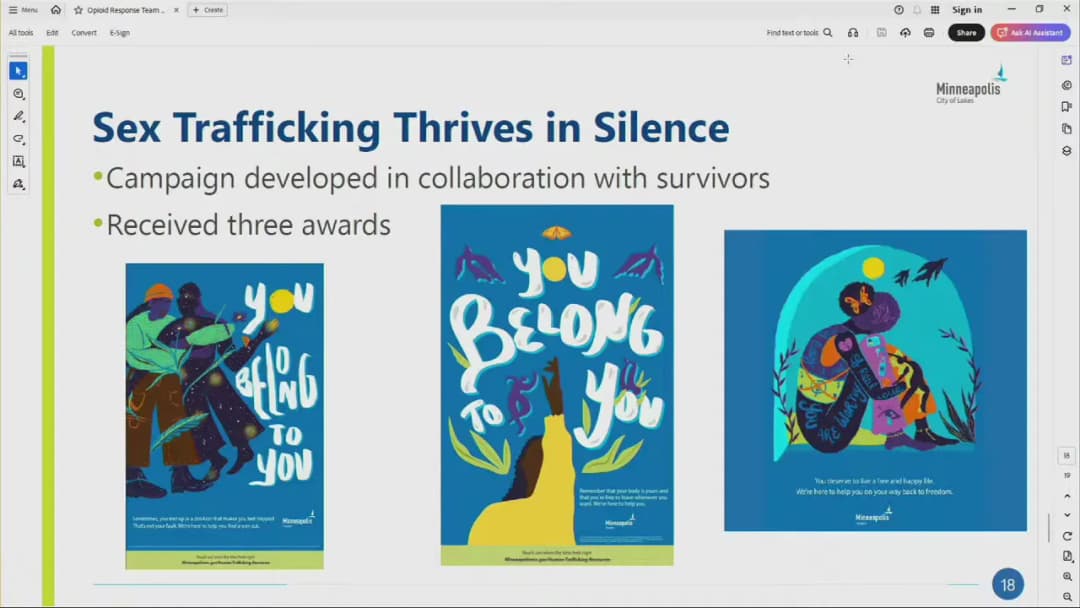
On November 12, 2025, the Minneapolis Public Health and Safety Committee, chaired by Councilmember Jason Chavez, held a regular meeting. The committee approved a consent calendar with six items and received presentations on public restrooms, police case clearance rates, and the city's opioid epidemic response. The meeting adjourned at approximately 3:45 PM to allow setup for a subsequent committee meeting. Consent Calendar - Items 1 through 6 were approved unanimously with a voice vote. Item 1 authorized a legislative directive requesting information on requiring certain businesses and institutions to possess opioid antagonists (Narcan). Item 2 approved a federal grant for the Towards Zero Death traffic initiative and a contract with the city of Crystal. Item 3 referred to staff an ordinance on police department public data reporting. Items 4, 5, and 6 set public hearings for December 3, 2025, on ordinances related to lead paint, off-duty use of city resources, and the small business/underutilized business enterprise program, respectively. Councilmember Rainbow requested that the cost of mandated Narcan possession be included in the staff report for Item 1, and Chair Chavez agreed to follow up. Discussion Items Presentation on Standalone Public Restrooms Ashley Jook from the Legislative Research and Oversight Policy and Research Division presented findings on public restrooms. Minneapolis has an estimated 18 public restrooms per 100,000 people, compared to the national average of 8 and Madison, Wisconsin's 35. The presentation covered models such as the Portland Loo, Throne Labs (rented, high-tech), and others. Key considerations included winterization, location (parks, public right-of-way), costs (varying by model), and the importance of monitoring and community engagement. The Peavey Plaza seasonal restroom trailer (installed 2019, cost $79,000) is staffed by the Downtown Improvement District. The Park Board reported issues at Bde Maka Ska and The Commons with prostitution, drug use, and vandalism. Councilmembers discussed potential models, particularly Throne Labs (which had 83,000 uses in a pilot year in Ann Arbor with a 4.4/5 cleanliness rating), and the possibility of incentivizing private businesses. The report noted zoning constraints and the need for city council findings to address public health and safety. The committee received and filed the report. Presentation on Police Department Case Clearance Rates Deputy Chief Emily Olson presented on investigative division clearance rates for 2024. Key statistics: property crimes had very low clearance rates (11 investigators for 28,106 cases). Violent crime investigative division (VCID) had 36 investigators with a median of 237 cases per week; Special Crimes (SCID) had 44 investigators with 620 cases per week. Clearance rate methodology was explained (cleared by arrest, complaint, declined, or exceptionally). Staffing dropped from 161 investigators in 2019 to 90 in 2024 (a 43% reduction). External barriers included technological issues, lack of cooperation, and weather. Internal barriers included staffing shortages, an antiquated records management system, and inability to use facial recognition. Deputy Chief Olson mentioned misinformation from public officials harming community trust, citing the New Deland LGBTQ+ shooting as an example. Chair Chavez asked for specific names, but she declined. Councilmember Cashman questioned why two of five civilian investigator positions funded by the council were not hired; Deputy Chief Olson stated she was authorized to hire only three. Council President Payne noted the council funded five, indicating a disconnect. Councilmember Chowdry discussed online reporting issues and the need for better customer service. The committee received and filed the report. Presentation on Opioid Epidemic Response Deputy Commissioner of Health Heidi Ritchie presented on the city's opioid response. Preliminary data showed a 26% decrease in opioid-involved deaths in Minneapolis in 2024 (32% statewide). However, deaths among American Indian residents held steady, and Black and American Indian rates remain three and eight times higher than white residents, respectively. Initiatives included three Narcan vending machines (560 boxes distributed through October 2025), syringe abatement (26 drop boxes with 15 more planned, cleanups using 311 calls with a 24-hour response SLA), a mobile medical unit (33 deployments since August 29, 2025, with over 1,300 interactions, 178 medical encounters, 110 referrals, and 336 Narcan boxes distributed), and the First Step hospital-based treatment program (being replicated statewide). Youth prevention uses the Brain Waves neuroscience curriculum, and a sex trafficking awareness campaign (relaunching January 2026) won three awards. Council President Payne praised the work as a model of effective government. Chair Chavez noted community interest in placing campaign materials on Lake Street. The committee received and filed the report. Key Outcomes - Approved the consent calendar (Items 1-6) unanimously. - Received and filed the standalone public restrooms report. - Received and filed the police clearance rates report. - Received and filed the opioid epidemic response report. - Committee members will follow up on specific requests: cost analysis for Narcan mandate, status of two unfilled civilian investigator positions, and community input on the sex trafficking campaign location.
The Administration and Enterprise Oversight Committee of the Minneapolis City Council met on November 10, 2025, at a regular scheduled meeting. Chair Robin Wansley called the meeting to order with five members present (Payne, Vita, Chuck Tai, Vice Chair Palmasano, and Wansley; Cashman absent), establishing a quorum. The committee approved a walk-on addition to the agenda: a request to accept a gift from the Public Rights Project for conference travel, lodging, and mail expenses for City Attorney Kristen Anderson and Assistant City Attorney Sarah Lathrop (item 25). The consent agenda, now comprising 25 items, was moved and passed without discussion. Consent Calendar - Item 1: Gift acceptance from Cities Today Institute for lodging and mail expenses. - Item 2: Bid for public sidewalk snow and ice removal. - Item 3: Bid for Target Center steam station improvements. - Item 4: Bid for Fridley Softening Plant Lime System Replacement. - Item 5: Bid for Lindale Ave North Traffic Control Signal Systems and Storm Sewer / Pedestrian Curb Ramps Improvement Project. - Item 6: Master contracts with eligible providers of workforce development services for 2026 through 2028. - Item 7: Contract with Kodak Architectural Group for Architecture and Engineering Services for the Carpenter and Mechanics Shop on the Fridley Water Treatment Campus. - Item 8: Contract amendment with Hogan's Adams PLLC for after-action reviews and reports. - Item 9: Contract amendment with Shehee Construction Company for lighting replacement and target center escalator lobby. - Item 10: Contract amendment with Tizac Concrete Inc. for the Phillips Traffic Safety Project. - Item 11: Contract amendment with Bolton and Mink Inc. for engineering and design services for Bridge 9 improvement project. - Item 12: Contract amendment with Certified Languages International LLC for remote interpreting services. - Item 13: Contract amendments with multiple vendors for community trauma response services. - Item 14: Contract amendments with various immigration legal services providers. - Item 15: Contracts with various organizations for partnership engagement fund projects. - Item 16: Cooperative funding agreement with Minnesota Historical Society for the St. Anthony Falls Heritage Board. - Item 17: Minneapolis Advisory Committee on People with Disabilities appointments. - Item 18: 2025 property tax special assessment of delinquent utility charges. - Item 19: 2025 Outcomes Minneapolis Milestone update (received and filed without presentation). - Item 20: Legal settlement – Workers' compensation claim of Jarrett Moore. - Item 21: Legal settlement – MDC R charge number 2309198. - Item 22: Legal settlement – Marion Lewis v. City of Minneapolis, and setting the public hearing for that ordinance to December 1, 2025. - Item 23: (Not separately listed in transcript; appears to be omitted or part of item 22). - Item 24: Civil service commission appointments. - Item 25 (walk-on): Gift acceptance from Public Rights Project for conference travel, lodging, and mail expenses for city attorneys. Key Outcomes - Motion to add item 25 to the agenda passed by voice vote (unanimous ayes). - Motion to approve the consent agenda as amended passed by voice vote without objection. - No other discussion, public comments, or votes occurred. The committee adjourned shortly thereafter.
The Minneapolis City Council, acting as the city's Canvassing Board, convened on Monday, November 10, 2025, to canvas and certify the official results of the 2025 municipal election held on November 4, 2025. The board also set the date for the post-election review (PER) and conducted a random selection of precincts for a hand count to verify tabulation accuracy. Election Results Certification - Director of Elections and Voter Services Katie Smith reported a record-breaking turnout: 147,702 total ballots cast, representing 55% of registered voters. Early voting accounted for 17.9% of turnout (with 317 hours of in-person voting over 46 days), and Election Day saw 121,259 voters (82.1%). A total of 15,629 voters (10.6%) used same-day registration. - Smith detailed the completion of ranked-choice tabulation on November 5, 2025, with all unofficial winners declared before 3 p.m. - The board adopted a motion to certify the official returns, declare winners, and direct the city clerk to submit certified results to Hennepin County and preserve election records. The motion passed unanimously with 12 ayes. Post-Election Review (PER) Selection - The board set the PER for November 20, 2025, at 9:00 a.m. at the Elections and Voter Services office (980 East Hennepin Avenue). - A random drawing selected the following precincts for a hand count: for city council races – Ward 11, Precinct 11 and Ward 3, Precinct 11; for the Board of Estimate and Taxation – Ward 12, Precinct 7 and Ward 13, Precinct 12. The multi-seat race to be audited is either the Park Board or the Board of Estimate and Taxation (precincts for that race were not specified in the drawing). Key Outcomes - The 2025 municipal election results were officially certified, triggering a seven-day contest period starting November 10, 2025. After that period, the city clerk will issue certificates of election to declared winners. - The post-election audit is scheduled for November 20, 2025, with specific precincts selected for manual recounts to verify the accuracy of tabulation equipment.
The Minneapolis City Council met on November 6, 2025, at 9:39 AM under the leadership of Council President Elliot Payne. The meeting began with honorary resolutions recognizing Veterans Day (November 11, 2025) and Principal Christian Alberto Ledesma of Roosevelt High School, named 2025 Minnesota High School Principal of the Year. The council then proceeded to adopt the agenda, approve minutes from October 23, 2025, and refer petitions and communications. Committee reports from Administration and Enterprise Oversight (AEO), Business, Housing and Zoning (BHZ), Climate and Infrastructure, and Public Health and Safety (PHS) were presented and voted on. Four ordinance introductions and four resolutions were approved. New business items included a contract amendment with Idea Analytics, an extension of authority to sue federal actions, and a nomination to the Civil Service Commission. Announcements highlighted record voter turnout (55% of registered voters, 147,702 ballots cast) and upcoming budget proceedings. Consent Calendar - Adoption of the agenda (9-0 initially, 10-0 after roll call). - Acceptance of minutes from October 23, 2025 (9-0 initially, later 10-0). - Referral of petitions, communications, and reports to proper committees (9-0 initially, later 10-0). Honorary Resolutions - Veterans Day Recognition: Council President Payne presented a resolution recognizing November 11, 2025, as Veterans Day in Minneapolis and honoring city staff who have served in the U.S. military. A speaker noted that nearly 10% of the city workforce are veterans, praising their leadership and public service. - Principal Christian Ledesma Recognition: Councilmember Chowdhury presented a resolution honoring Principal Ledesma for being named 2025 Minnesota High School Principal of the Year. Students and staff expressed support, highlighting his leadership, dedication to equity, and growth of the dual language program at Roosevelt High School. Committee Reports Administration and Enterprise Oversight (AEO) - Items 1-8 and 11: Approved unanimously (10-0). Included contracts for construction, equipment, and services, plus a paid parental leave policy update to comply with state law by adding foster placement and removing a payback provision. - Items 9 and 10 (Gift Acceptances): Pulled for separate vote. These late-submitted gifts (for transportation/lodging for Chief Brian O'Hara and another) drew criticism from Vice President Chughtai and several councilmembers for non-compliance with the city's gift acceptance policy. Councilmember Palmasano noted that MPD is developing a policy to ensure timely submittal. The items passed 9-1 (Vice President Chughtai nay), with multiple members warning it would be the last time they would support late submissions. Business, Housing and Zoning (BHZ) - Items 1-3, 6-17: Approved unanimously (10-0). Included cannabis event licenses, affordable housing definitions, liquor licenses, demolition agreements, rezoning, grants, and housing tax credit plan changes. - Items 4 and 5: Deleted from the agenda as requested. These involved license revocations for Pimento Jamaican Kitchen; the applicant withdrew the licenses. Climate and Infrastructure - Items 1-3: Approved unanimously (10-0). Included special assessments levy, bike advisory committee appointment, and grant application for inflow/infiltration program. - Item 4 (35th and 36th Street Reconstruction): Delayed one cycle after a motion by Councilmember Jenkins, who cited constituent concerns about the layout. The motion passed unanimously (10-0). Public Health and Safety (PHS) - Item 1: Accepted reimbursement from the Minnesota Board of Firefighter Training and Education (11-0). - Item 2 (Legislative Directive on Charter Compliance): Passed 8-3. The directive aims to explore tools for enforcing charter compliance by city leaders. Councilmembers Palmasano, Rainville, and Vita voted no. Discussion included Councilmember Cashman's frustration that a prior legislative directive on investigation clearance rates was not presented by the deadline (October 29, 2025) and Councilmember Chavez's statement that the mayor had not met that deadline. The directive was amended to include "in consultation with the Office of City Attorney." Introduction and Referral Calendar - Four ordinance introductions were approved unanimously (11-0): 1. Amending fire and police protection code to add public data reporting requirements (referred to PHS). 2. Amending housing code to update lead-safe standards and cross-department enforcement (referred to PHS). 3. Amending administration code for payroll, pensions, and deductions (referred to AEO). 4. Amending fire and police protection code to add reporting requirements for use of city resources and outside work (referred to PHS, co-authored by Vice President Chughtai and Councilmember Chowdhury due to Councilmember Wansley's absence). Resolutions - Four resolutions were adopted unanimously (11-0). No details provided in the transcript. New Business - Contract Amendment with Idea Analytics: Approved unanimously (11-0). Staff explained that additional training services were needed for supervisor leadership training, partly due to scheduling conflicts after the Annunciation shooting. The training is a settlement agreement requirement; the budget was exceeded to maintain a low instructor-student ratio. - Extension of Authority to Sue Federal Actions: Approved unanimously (11-0). The city attorney requested extending delegated authority through January 20, 2029, to allow the office to quickly join or initiate lawsuits against the Trump administration. The council had previously passed a similar resolution expiring January 22, 2026. Council President Payne expressed support, noting the need for a legal response to potential federal actions. - Nomination of Anthony Kelly to Civil Service Commission: Referred to the AEO committee for a public hearing (11-0). Announcements - Election Turnout: The clerk announced a record 55% voter participation with 147,702 ballots cast in the 2025 municipal election. The council will serve as the canvassing board on November 10, 2025, to certify results, with election certificates to be issued November 18. - Ride Share Zone: Councilmember Rainville announced the first official ride share zone in the North Loop, developed with Uber and Lyft, to improve pedestrian safety and reduce U-turns on Washington Avenue North. - Purple Rain Musical: Councilmember Rainville highlighted the opening of the Purple Rain musical in Minneapolis, celebrating the city. - Veterans Day: Councilmember Chowdhury wished veterans a happy Veterans Day and urged support for veterans facing poverty, disabilities, and lost care. Key Outcomes - All committee reports adopted with votes as noted. - Items 9 and 10 from AEO passed 9-1, with a warning about future compliance. - Item 4 from Climate and Infrastructure delayed one cycle. - Item 2 from PHS passed 8-3 with an amendment for attorney consultation. - New business items approved unanimously. - All resolutions adopted unanimously. - Record voter turnout of 55% (147,702 ballots) celebrated. - Next meetings: Election canvass November 10; budget public hearing November 19; final budget action December 9.
On October 30, 2025, the Minneapolis Climate and Infrastructure Committee, chaired by Councilmember Katie Cashman, convened a regular meeting. The committee approved consent items and discussed a legislative directive on the city's recycling rates and zero waste program. The meeting was broadcast live with real-time captioning. Consent Calendar - Items 1–3 were approved unanimously: (1) a resolution levying various public works special assessments and adopting related assessment roles; (2) an appointment to the bicycle advisory committee (Jackson Hampton, seat 14); (3) authorizing a grant application for the 2026 Private Property Inflow and Infiltration Grant Program. - Item 4 (approving a concept layout for 35th and 36th Street from Chicago Ave to Blaisdell Ave, with a resolution seeking a variance from municipal state aid rules) was pulled for questions. Fontaine Burrus (Transportation Planner, Public Works) explained that the variance is needed to reduce lane width to allow a separated two-way bikeway instead of a shared-use path. The variance committee meets quarterly; the next meeting is December 2025, and if missed, the next would be spring 2026, potentially impacting federal authorization (June 2026). Construction is planned for 2027–2028. Item 4 was approved for recommendation to full council (voice vote, all ayes). Discussion Items - Legislative Directive on Recycling Rates and Zero Waste Program – Director Nick Gerald presented a detailed status update covering eight items from the legislative directive passed the previous month. Key points included: - The city's 80% waste diversion goal by 2030; current projections show only 50% without significant changes. - Residential capture rate targets based on a 2022 study (e.g., 50% of aluminum cans still go to garbage). - Compliance rates: 91% of buildings verified as having recycling; 347 buildings remain unverified. Enforcement is complaint-based for commercial buildings; multi-units are enforced by Solid Waste & Recycling using county funds. - Steps toward organized collection for commercial, industrial, and multi-unit sectors require formal assignment of responsibility and a funding mechanism study (expected December 2025). - Mandatory recycling for city service properties will begin with a warning system in 2027, moving to fines; multi-unit ordinances will define “adequate” recycling capacity, with compliance expected by 2028. - Mandatory organics is not recommended yet due to contamination risks; a phased approach (e.g., requiring organics upon tenant request) is considered. - Updates to the Green to Go ordinance (requiring all to-go containers to be recyclable, compostable, or reusable) are underway; amendments planned for 2026, compliance in 2027. - Chair Cashman emphasized the goal of reducing waste to shut down the incinerator and highlighted priorities: recycling in multifamily buildings and organics at food establishments. She asked about requiring building owners to provide organics pickup for restaurant tenants. Director Gerald noted that restaurants must provide front-of-house organics containers but would check on building-level requirements. - No committee questions beyond Chair Cashman’s; the report was filed. Key Outcomes - Approved: Consent items 1–3. - Approved for full council: Item 4 (concept layout and MSA variance request). - Filed: Discussion item on the legislative directive; no formal vote taken.