The Health and Human Services (HHS) Committee held its second day of annual priority meetings with HHS boards, committees, and commissions on October 22, 2026, from 9:30 a.m. to 11:30 a.m. virtually. Chaired by Councilmember Laurie-Anne Sayles, with members Andrew Friedson and Dawn Luedtke, the committee heard from three panels covering health care access, juvenile justice, community health, children and youth, foster care, childcare, social services, health equity, and substance use. Discussions emphasized coordination, workforce sustainability, communication gaps, and equity. Discussion Items Panel 1: Health Care Access, Juvenile Justice, and Community Health - Dr. Catherine Kelly (Montgomery Cares Advisory Board) presented five priorities: - Increase provider reimbursement to $175 per encounter (70% of care cost) to stabilize clinics reduce ER visits. - Achieve payment parity between Care for Kids and Montgomery Cares for pediatric and adult care. - Expand the East County dental pilot (currently serving 300 residents) to upcounty, targeting an additional 150 residents. - Develop an integrated behavioral health respite and substance use stabilization program for homeless individuals with complex needs. - Fund two bilingual social workers for the Montgomery Perinatal Program to reduce barriers for high-risk pregnant women. - Frederick Hawkins (Commission on Juvenile Justice) outlined six priorities: diversion programs, delinquency prevention (mentoring, leadership, out-of-school time), coordination between DJS and HHS, reducing school exclusion, improving behavioral health services, and state legislative advocacy. He noted the commission is exploring data on school suspensions and arrests. - Donna Collie (Commission on Health) focused on three areas: behavioral health (workforce shortage projected at 32,800 additional workers needed in MD by 2028), communication and engagement (citing 98.2% school vaccination compliance as a successful outreach example), and nutrition (food insecurity as a chronic disease driver). She called for strengthening navigation and coordination across programs. Panel 2: Children, Youth, and Family Supports - Marie Lenise Cruz-Weiss (Commission on Children and Youth) identified two priorities: juvenile crime/safety and school-based mental health services. She highlighted that youth often don't know about available programs and emphasized the need for trauma-informed, culturally competent adults. She noted a youth roundtable is being planned to gather direct input. - Melin Edson (Citizens Review Panel for Children) presented two focus areas for FY27: support for older foster youth (18–21) reluctant to engage in service planning, and mentoring for those aging out. The panel reviews monthly data on child welfare calls, investigations, foster care placements, and resource homes. - Dr. Ramona Johnson (Commission on Childcare) reported refreshed membership after pandemic challenges. Priorities include onboarding new commissioners, assessing childcare funding streams, and reviewing MCPS community use of public facilities policies to support stable after-school care. She cited low pay for early childhood educators and expensive childcare as key issues, noting that many providers leave for paraeducator roles. Panel 3: Social Services, Health Equity, and Substance Use - Larnice McCoy Moore (Board of Social Services) reviewed accomplishments (marketing campaign for resource parents) and priorities: reduce barriers for foster parent recruitment, raise awareness of social services, collaborate with other BCCs, and advocate on emerging issues. The board has almost full membership with a mentoring program for new members. - Dr. Wang (Asian American Health Initiative) reported serving 32,000 individuals through 33 community organizations over four years. Priorities: building capacity of CBOs for behavioral health and senior wellness, and developing a data system to capture disaggregated AAPI data. He noted challenges with language diversity (20+ languages) and limited English proficiency (26%). - Chair Mitchell (Alcohol and Other Drug Addiction Advisory Council) highlighted all 16 seats filled after recruitment. Priorities: increase outreach and education (e.g., naloxone access, prevention across lifespan), reduce stigma, update county code for stigmatizing language, and improve treatment/recovery access. She noted a 49% reduction in overdose fatalities but 83 deaths in the last year, with rising concerns for youth and adults over 50. She called for better coordination with MCPS and other bodies. - Jackie Williams (African American Health Program) presented two priorities: sustain the SMILE program for black maternal health (severe maternal morbidity 54% higher for black women; nationally 44.8 vs 14.2 deaths per 100,000) and support displaced federal workers through hiring preference (Bill 10-25E) and visible job announcements. She reported over 100 SMILE clients, many with advanced maternal age (35+) and chronic conditions. Key Outcomes - Chair Sales directed follow-up on several items: establishing quarterly meetings with the HHS director (last held 2 years ago), improving communication from BCCs to the public, exploring internship programs with Montgomery College for social media outreach, and better coordination across BCCs to avoid silos. - Councilmember Friedson reiterated support for phased-in reimbursement parity and promised to follow up on data from the Montgomery Cares board and best practices for black maternal health. - Councilmember Luedtke flagged the state’s bed capacity crisis, delays in psychiatric evaluations, and the Handle with Care program (state dashboard available). She requested further details from AODAC on reducing opioid prescribing for those under 25. - The committee emphasized the need to translate existing resources into measurable resident outcomes, especially in behavioral health, food security, and foster care transitions. - No formal votes were taken; the meeting concluded with thanks to all participants and a commitment to incorporate priorities into budget and policy deliberations.
Public Meetings - Montgomery County, Maryland
Public Meetings - Montgomery County, MarylandOn October 21, 2026, the Health and Human Services (HHS) Committee, chaired by Councilmember Laurie-Anne Sayles, held a virtual annual meeting with the Department of Health and Human Services' advisory boards, committees, and commissions (BCCs). The committee heard from 17 BCCs and three health initiatives over two days. Presenters outlined priorities for FY28, highlighting gaps in workforce, housing, behavioral health, and safety net services amid federal policy changes and fiscal constraints. The meeting focused on four questions: what is working, greatest gaps, what residents are saying, whether investments reach intended people, and specific actions needed. Panel 1: Victim Services, Montgomery Cares, Mental Health Advisory, Latino Health Initiative - Victim Services Advisory Board: Co-chairs Celeste Roja and Sean Quineta Anderson advocated for fully staffing HHS trauma services and expanding access to bridge housing. They noted that the Betty and Cranking shelter remains over capacity and that temporary housing often leads survivors back into dangerous situations due to lack of long-term options. They also highlighted the need for transportation and resources for male victims. - Mental Health Advisory Committee (MHAC): Elizabeth Neil presented four structural themes: workforce shortages in mental health/substance use, Medicaid sustainability, housing instability linked to behavioral health, and insufficient treatment for youth. She urged the committee to stabilize Medicaid safety net, confront workforce crisis (especially bilingual clinicians), mitigate school-based mental health staffing reductions, and stabilize housing crisis response. She noted chronic absenteeism at a five-year high and support for the crisis stabilization room. - Latino Health Initiative: Chair Diego Yerburo reported that federal ICE actions and policies are causing widespread fear, limiting access to medical services, and increasing chronic absenteeism in schools. He urged the county to increase safety net services for immigrant communities and to develop a coordinated strategy for mental health services. Committee Questions: Councilmembers asked about specific staffing needs for victim services (two additional advocates), bridge housing formula knowledge, and coordination with bills/legislation. Councilmember Ludke discussed need for warm handoffs between bridge housing and ongoing housing. Councilmember Friedson asked about regional best practices; Yerburo stated Montgomery County leads in culturally competent services. Councilmember Ludke also raised the need for better communication about student telehealth policies. Panel 2: Interagency Commission on Homelessness, Intellectual & Developmental Disabilities Commission, Community Reinvestment and Repair Fund - Interagency Commission on Homelessness (ICH): Chair Dr. Ebony Gray reported on 2026 Point-in-Time count (26% reduction, 390 fewer individuals) but noted a 12% increase in total people experiencing homelessness in CY2025 (3,613 individuals). Statewide trends show 30% increase in non-disabled individuals experiencing homelessness in Montgomery County. Priorities: establish a homelessness preference for public housing authority resources (HOC vouchers) and expand permanent housing/rental assistance for single adults. - Intellectual & Developmental Disabilities Commission (IDDC): Chair Susan Harton identified three priorities: employment (85% unemployment among people with IDD, citing the previous MCPIP program), restructuring the commission (26% vacancy rate), and proactive IEP progress communication (mid-year outreach when students are not on track). Also proposed using IDDC website as a resource hub. - Community Reinvestment and Repair Fund: Chair Colin Frazier explained that funds from cannabis sales will be used for re-entry, housing, mental health, and youth programs. They are developing an RFP and will track KPIs. The fund aims to offset cuts from federal reductions. Committee Questions: Councilmember Sayles asked about measurable improvements (KPI tracking, pre/post surveys). Dr. Gray discussed the cost per shelter bed ($28,923) and per overflow bed ($40,150). Councilmember Friedson asked about permanent supportive housing underfunding; Dr. Gray noted federal priority shifts to workforce development. Councilmember Friedson asked IDDC about employment feasibility study; Harton mentioned collaboration with other counties and the 2018 work group report. Councilmember Ludke discussed re-entry and youth justice, and the need for non-congregate shelter alternatives. Panel 3: Community Action Board, Commission on Veterans Affairs, Commission on People with Disabilities, Commission on Aging - Community Action Board (CAB): Chair David Rowley outlined two priorities: stronger protections for immigrants (concern about TPS ending, reduced Medicaid/SNAP, proposed citizenship question on tax forms) and protecting federally funded programs (Head Start, SNAP, Medicaid). He asked council to expand local tax credits (WFIS) and support outreach. CAB's VITA program generated $8.9 million in tax refunds last year. - Commission on Veterans Affairs: Chair Michael Wilson focused on communication/outreach to veterans (Operation Greenlight, speakers bureau) and supporting establishment of a veterans treatment court in Montgomery County. He noted need for permanent supportive housing vouchers for homeless veterans. - Commission on People with Disabilities (COPD): Chair Tony Gilchrist prioritized employment (request written employment outcomes plan from OHR), affordable and accessible housing (improve Design for Life and HARP), transportation safety (floating bus stops and bike lanes), and respite services (waiting lists for Social Services to Adults and SOR). Also called for education/enforcement of ADA and Fair Housing Act. - Commission on Aging (COA): Co-chair Lydia Bragowski presented two priorities: strengthening home accessibility programs (Design for Life and HARP) and a 12-month housing navigation pilot for older adults. She requested $1 million annually for HARP and regular reporting. Also supported HHS priorities including mitigating loss of Medicare/Medicaid coverage, rate increases for respite, and additional FTEs. Committee Questions: Councilmember Sayles asked CAB about preserving Head Start standards and immigrant outreach. CAB staff noted proactive outreach and collaboration with food hubs. Councilmember Sayles asked Veterans Commission about Operation Greenlight; Chair Wilson noted website and collaboration. Councilmember Sayles asked COPD about employment outcomes; Gilchrist cited AI/gig economy impacts and federal job losses, discussed floating bus stop inconsistency. Councilmember Friedson commented on Design for Life and HARP underutilization and need for legislative changes. CAB reported a dip in VITA use due to fear. Councilmember Ludke suggested using food distribution hubs for service outreach. COPD and COA discussed accessible parking shortages and elevator inspection issues. Key Outcomes - The committee received detailed recommendations from each BCC and will use them to guide oversight and budget decisions for FY28. - Councilmember Sayles committed to following up with the executive branch on delays in filling BCC vacancies and on coordinating advocacy efforts. - Councilmember Ludke committed to connecting the truancy prevention program (State’s Attorney’s Office) with the Mental Health Advisory Committee and to addressing student telehealth policy communication. - Councilmember Friedson noted ongoing work on Design for Life and HARP in the PHP committee and encouraged continued collaboration. - The committee will continue hearings on October 22 with remaining advisory boards on health care access, children and families, juvenile justice, behavioral health, and health equity.
The Montgomery County Council convened on Tuesday, October 20, 2026, for a full-day session. The morning began with presentations recognizing Breast Cancer Awareness Month and International Pronouns Day, accompanied by testimony from community members and survivors. The council then enacted seven bills during Legislative Session Day 26, covering tenant protections, consumer safety, traffic enforcement, and public safety. The afternoon featured a proclamation for National Arts and Humanities Month, a public hearing on a supplemental appropriation that drew no registered speakers, and a worksession with a straw vote on the 2026-2035 Comprehensive Water Supply and Sewerage Systems Plan. Proclamations & Public Testimony - International Pronouns Day: Councilmembers Stewart, Mink, and Glass presented the proclamation. Speakers: Ever Hannah (Policy Director, Trans Maryland) stressed that respecting pronouns is the bare minimum of respect and urged protection for trans youth; Yeliya Melindis (Moco Pride Center) highlighted the global history of non-binary identities; and Shane Hannah (Rainbow Youth Alliance) also spoke. The proclamation recognized October 21, 2026, as International Pronouns Day. - Breast Cancer Awareness Month: Councilmembers Sayles, Stewart, and Balcombe presented the proclamation. Speakers: Rebecca Castillo shared her personal story of survival and asked the community to provide support beyond October. Oge Ilogu (Primary Care Coalition) detailed the Montgomery CARES program, which covers mammograms for uninsured residents earning at or below 250% of the federal poverty level. Councilmember Balcombe noted she is a 16-year survivor. Statistics cited: 1 in 8 women diagnosed; 38% higher mortality rate for Black women. - National Arts and Humanities Month: Councilmember Friedson presented the proclamation. Speakers: Katie Hecklinger (BlackRock Center for the Arts) emphasized the arts as an economic driver and community builder. Lisa Laragoite (Young Artists of America) stated the arts are crucial for creating better humans and building community. Consent Calendar The council approved the Consent Calendar (11-0), introducing or approving numerous budget amendments, regulations, and appointments. Key items included: - Transfer of $7,290,637 in unexpended MCPS project funds. - Supplemental appropriations for Energy Conservation ($1,172,927), ABS Retail Store Refresh ($185,000), and multiple Health and Human Services programs (High-Need Medicaid, $1.2M; Behavioral Health, $486,506; Shelter Custodial Services, $885,000; Adult Shelter, $619,158; Dental Programs, $487,096; Immigrant Services Corps, $220,000; Lighthouse Immigration Legal Services, $500,000; Kids in Need of Defense, $170,000). - Approval of Executive Regulation 25-25 (Repeal of Context Sensitive Road Design Standards) and Executive Regulation 26-25 (Complete Streets). - Confirmed appointments: Jennifer Weil (Landlord-Tenant Commission), Beth Kinsey (Silver Spring Urban District Advisory Committee), and Stacey Kernisan (Montgomery College Nominating Committee). Legislative Session / Bills Enacted - Bill 8-26 (Price Coordination and Rent Algorithms): Enacted 11-0. Prohibits algorithmic devices for setting rents using non-public competitor data, aligning with the City of Rockville. Sponsor Councilmember Jawando noted 86 multifamily properties in the county are named in related lawsuits. - Expedited Bill 16-26 (Financial Exploitation Protection Act): Enacted 11-0. Expands consumer protection for scams targeting vulnerable adults and residents 68 and older. - Bill 17-26 (Speed Monitoring Systems): Enacted 11-0. Authorizes cameras in 20 mph school zones and on high-risk highways. County officials clarified no partnership exists with Flock cameras and all traffic camera data is secured and segregated. - Bill 27-26 (Unlawful Racing and Street Takeovers): Enacted 11-0. Establishes a Class A violation for street takeovers. A proposed amendment by Councilmembers Mink, Jawando, and Evans to change the definition from "such as" to "limited to" to explicitly exclude peaceful protest failed 5-6. The Montgomery County Police Department opposed the amendment, arguing it would limit enforcement flexibility. Council President Fanny Gonzalez spoke against it, stating the First Amendment already protects peaceful assembly. The underlying bill passed unanimously. - Expedited Bill 32-26 (Survivor Benefits Expansion): Enacted 11-0. Expands death benefits for Groups E and J members. - Bill 33-26 (Community Media Organizations): Enacted 11-0. Updates governance requirements for community media organizations, including board composition and equity statements. - Bill 36-26 (Fire and Emergency Services Commission): Enacted 11-0 as amended. The council adopted amendments to increase public membership on the commission, remove dispatch review from its duties, and protect collective bargaining agreements. Introduction of Bills - Bill 51-26 (Streets and Roads Amendments): Introduced by Councilmember Glass to streamline sidewalk construction. The introduction cited 335 pedestrians struck, 41 serious injuries, and 17 deaths in the first nine months of 2026. A public hearing is scheduled for November 10, 2026. Worksession / Straw Vote - Comprehensive Water Supply and Sewerage Systems Plan 2026-2035: Following committee review, council staff presented policy updates including a commercial service policy, abutting mains rights transfer policy, and the removal of a sewer service exclusion for the Palatine of Potomac neighborhood. A septic system pump-out rebate program was discussed. The council took a straw vote (11-0) to move forward, with final action tentatively scheduled for October 27, 2026. Key Outcomes - Enactments: Seven bills enacted (11-0 each). One amendment (to Bill 27-26) rejected 5-6. - Appointments: Three appointments confirmed. - Fiscal Actions: Consent Calendar approved; Supplemental Appropriation 27-15 for the Economic Development Fund ($1,650,000) approved. - Next Steps: Final action on the Water Plan scheduled for October 27, 2026. Public hearing for Bill 51-26 scheduled for November 10, 2026.
The PHP Committee met on October 19, 2026, to consider Bill 38-26, which amends discriminatory housing practices and early lease termination, and to continue discussions on local housing targets. The committee voted unanimously to advance the bill with amendments and provided guidance on housing targets, focusing on 2040 and 2050 goals. Bill 38-26: Discriminatory Housing Practices and Early Lease Termination Amendments - Sponsor McCartney-Green presented the bill, which adds citizenship and immigration status as protected classes under county fair housing law and allows early lease termination for tenants facing immigration proceedings. - The committee adopted amendments: prohibiting rental application inquiries about citizenship/immigration status; prohibiting requests for documentation to verify status; and creating an exception for mortgage lending and programs required by federal, state, or local law or program. - The provision allowing lease termination if a tenant is "held for more than 30 days" due to immigration proceedings was removed, limiting termination to deportation or detention. - Chair Friedson requested that the Department of Housing and Community Affairs (DHCA) provide written guidance on documentation standards for lease termination notices, with examples from other listed reasons. - The bill was approved with a unanimous 3-0 vote and will be transmitted to the full council. Discussion: Local Housing Targets - Lisa Gavoni (Planning Department) presented an update on housing targets, noting that from 2020-2025, permitting declined (2,900 units in 2024; 1,300 in 2025), and the county is not on pace to meet 2030 targets. The development tracker (pipeline) shows an anticipated contribution of 10,000 units toward the 16,000 remaining needed. - The committee decided to focus on 2040 and 2050 targets, as 2030 is too near for policy impact; the resolution will reference 2030 but not break it down by planning area. Planning staff concurred that 2040/2050 targets better align with master planning horizons. - Affordable housing goals: A countywide goal of 15% income-restricted units within housing targets was discussed (equating to 9,000 new affordable units by 2050). The committee stressed the need for further analysis involving DHCA and the Department of Permitting Services (DPS), and recommended that affordability standards be included as an addendum updated periodically. - Next steps: Planning staff will draft a resolution incorporating committee guidance; further committee work sessions will finalize the recommendation to the full council. Key Outcomes - Bill 38-26 approved unanimously (3-0) with amendments and forwarded to full council. - PHP Committee directed planning to prioritize 2040/2050 housing targets, develop a resolution with affordability goals as a revisable addendum, and collaborate with DHCA/DPS on future discussions.
The Montgomery County Council's Government Operations & Fiscal Policy (GO) and Public Safety (PS) committees held a joint work session on Monday, October 19, 2026, from 1:30 p.m. to 4:30 p.m. to consider Expedited Bill 29-26, Personnel and Human Resources – Eligibility for County Employment, also known as the “Community Trust in County Employees Act.” This work session followed the committees’ initial discussion on October 1, 2026. The bill is intended to preserve community trust by restricting county employment for individuals who worked for U.S. Immigration and Customs Enforcement (ICE), U.S. Customs and Border Protection (CBP), or who participated in federal immigration detention, removal, or deportation work. Staff attorney Ms. Wellons led the discussion; panelists included Luisa Cardana from the County Executive’s Office and Dr. Lisa Whedon from the Office of Human Resources (OHR). Discussion Items - Restricted applicant definition: The committee reviewed an amendment narrowing the definition from individuals who participated in “enforcement of federal immigration laws” to those who participated in “detention, removal, or deportation of individuals under federal immigration laws.” The amendment also excluded adjudicated whistleblowers, exempted CBP employees assigned to the Office of Trade, Office of Trade Relations, Office of International Affairs, or Office of Laboratories and Scientific Services, and retained the existing exclusion for individuals whose federal employment/contract ended on or before six months after the assignment date. Chair Katz supported the language, saying Montgomery County police hiring was already highly selective and the bill would not affect qualified hires. Councilmember Luedtke expressed strong concern, calling the prohibition “governmentally blessed discrimination” based solely on prior employment and saying it prevented applicants from even being considered. Councilmember Mink defended the bill as a response to a discriminatory and unconstitutional federal immigration system that had eroded community trust. - HR implementation: OHR described a self-reporting process in which applicants who fall within the restricted applicant definition would not be considered for sensitive positions in direct services agencies. Councilmember Evans asked whether the bill would impose additional HR workload; OHR confirmed it would not require new staffing. OHR also said an applicant who fails to self-report and is later discovered would normally be terminated for dishonesty. - Direct services agencies: The committee approved expanding the definition of direct services agency to add the full community engagement cluster, MC 311, Alcohol Beverage Services, Animal Services, Department of Finance, and Office of Procurement. - Sensitive positions: The committee voted to shift responsibility for identifying sensitive positions from OHR to individual hiring departments, on the grounds that departments are better able to identify which positions require heightened scrutiny. - Regulations and transparency: The committee agreed to add a non-codified section requiring OHR to adopt regulations within 90 days after the effective date, with implementation to begin immediately upon adoption; OHR said the full 90 days was needed. A committee member asked that materials sent to the full Council make clear that only specific sensitive positions are covered, not all positions in the listed departments, and that job advertisements identify those positions. OHR said sensitive positions would be listed in each advertisement, and staff agreed to add this context to the packet. The member abstained pending that information. Key Outcomes - Adopted the restricted applicant definition amendment 5-0. - Adopted the direct services agency expansion 5-0. - Adopted the sensitive position identification amendment unanimously. - Adopted the 90-day regulations amendment unanimously. - Adopted the technical amendment unanimously. - Voted 4-0-1 to advance Expedited Bill 29-26 to the full Council with a favorable report as amended, with one abstention.
The Montgomery County Council Public Safety (PS) Committee, chaired by Sidney Katz, held a work session on Monday, October 19, 2026, to receive an update on the Police Accountability Board (PAB) Annual Report. The meeting included presentations from PAB Chair Paul Walker, Vice Chair George Juetis, ACC Chair James Hopkins, and PAB/ACC staff, facilitated by Council Staff Ms. Farag. The discussion centered on the PAB's focus memo which identified operational challenges and three central requests to improve data transparency and effectiveness. Discussion Items - PAB Annual Report Findings: PAB leadership presented data showing a significant increase in public engagement, with cases rising from 8 in 2022 to 85 in the latest reporting period. Of the 434 total allegations, 80% relate to bias or use of force. The board highlighted that residents identifying as Black are overrepresented in complaints at approximately 35%. A critical challenge is the lack of visibility into final trial board outcomes; for example, three Montgomery County Police Department (MCPD) termination trial boards resulted in zero officer terminations. The PAB stated it cannot fully meet its statutory mandate to make specific policy recommendations without stronger data from the ACC and law enforcement agencies. - Legislative Request for ACC Data: The PAB formally requested an amendment to county law to require the Administrative Charging Committee (ACC) to provide its written opinions to the PAB under existing confidentiality protections. Council Staff Ms. Farag noted a 2025 special counsel opinion states the ACC is not required, but may, share these opinions. ACC Chair James Hopkins raised concerns about protecting the identities of officers and complainants. PAB members countered that they receive this front-end data, are willing to sign additional non-disclosure agreements (NDAs), and require the full data for robust trend analysis. - Data Analyst Staffing Request: The PAB requested funding for a full-time research and data specialist (Grade 90 or higher), noting that jurisdictions like Prince George's County employ multiple analysts to support similar boards. - Trial Board Coordination: The committee discussed the disconnect between ACC charging decisions and trial board outcomes. Councilmember Mink argued that trial board counsel must have input into the charging process to fix the current system yielding incongruent results. Key Outcomes - Formal Support for PAB Requests: Committee Chair Sidney Katz formally supported all three PAB requests: amending the county code to mandate ACC data sharing, funding a dedicated data analyst position, and improving legal coordination for trial boards. He noted it is a "cruel joke" to assign duties without providing resources. - Mandate vs. Voluntary Approach: Councilmember Luedtke expressed strong frustration over the lack of progress since March and advocated mandating data sharing through legislation rather than relying on ongoing voluntary discussions, stating the PAB cannot fulfill its mandate under the status quo. - Path Forward: The committee committed to bringing forward the necessary legislative and budgetary items. The PAB's willingness to sign enhanced NDAs was highlighted as a viable solution to address confidentiality impasses, allowing data-driven oversight of police accountability processes.
The Transportation and Environment Committee of the Montgomery County Council, chaired by Councilmember Evan Glass, met on October 19, 2026, to consider two items: legislation on forest conservation for agricultural brush management (Bill 35-26) and the facility planning study for the New Hampshire Avenue Bus Rapid Transit (BRT) corridor. The committee took unanimous action on both items. Discussion Items Bill 35-26 - Forest Conservation - Trees - Applicability - Brush Management Councilmember Marilyn Balcombe, the bill sponsor, explained that the legislation streamlines the approval process for routine vegetation maintenance on agricultural land by removing the requirement for pre-approval from the planning department when a landowner has an approved soil conservation and water quality plan. The bill originally specified two categories of exempt activities, but the Planning Board proposed an amendment to simplify the language, exempting "agricultural activities" that are performed under an approved conservation plan. The committee heard from Christina Soranto and Kelsey Desmond from the Planning Department, who supported the amendment as a clearer version of the bill's intent, and Mike Scheffel from the Office of Agriculture, who noted the existing pre-approval process created timing challenges for farmers. Councilmember Balcombe expressed disagreement with the Racial Equity and Social Justice (RESJ) impact statement's conclusion that the bill could burden equity focus areas, arguing that the exemption already exists and streamlining would not affect tree removal or replanting. Chair Glass acknowledged the difficulty of applying RESJ analysis to this sector. The committee voted unanimously to adopt the Planning Board's amendment and then passed the bill as amended without objection. New Hampshire Avenue Bus Rapid Transit (BRT) Facility Planning Review The committee received a presentation from MCDOT's BRT team, led by BRT Implementation Manager Jamie Hinson and Project Manager Justin Willitz, along with consultant Adat Diain Amdhar from Kittleson & Associates. The study covers the 8.5-mile corridor from Eastern Avenue to Randolph Road, with 70 percent of the corridor within a half mile of an equity area. Current peak-hour bus speeds average under 10 miles per hour. The team presented five alternatives. After analyzing travel time, cost, and impacts, they developed a "hybrid alternative" (Alternative 5) that combines curbside bus lanes in southern segments, mixed-traffic operations with queue jumps in constrained segments, and additional curbside lanes in the north. This alternative provides the best balance of travel time improvements for BRT, local buses, and general traffic, at an estimated capital cost of $114 million (excluding $28 million in rolling stock). Key stakeholder support was noted: the Prince George's Council preferred the hybrid alternative; the City of Tacoma Park supported it and requested coordination with its New Avenue Bikeway project; the State Highway Administration supported both Alternative 2 and the hybrid; and the Montgomery County Planning Board recommended advancing the hybrid alternative. Councilmember Kate Stewart, whose district covers part of the corridor, emphasized the importance of a one-seat ride to Fort Totten and the need to integrate with the Tacoma Park bikeway and pedestrian safety improvements. Key Outcomes - Bill 35-26: The committee voted unanimously to pass the legislation with the Planning Board's amendment, effective immediately. - BRT Preferred Alternative: The committee unanimously endorsed the hybrid alternative (Alternative 5) as the corridor's preferred BRT design. - Staff Recommendations: The committee endorsed five specific recommendations from council staff: 1. Advance the hybrid alternative as preferred. 2. Continue evaluating a station at the Colesville Park and Ride lot. 3. Coordinate with Tacoma Park's New Avenue Bikeway project. 4. Explore interim bus improvements, including expanding Metro D6X service and implementing transit signal priority. 5. Ensure a comprehensive approach to pedestrian and cyclist safety, potentially through a standalone CIP project if necessary. The committee adjourned after completing both agenda items. The recommended alternative and staff recommendations will inform future capital improvement program funding and design stages.
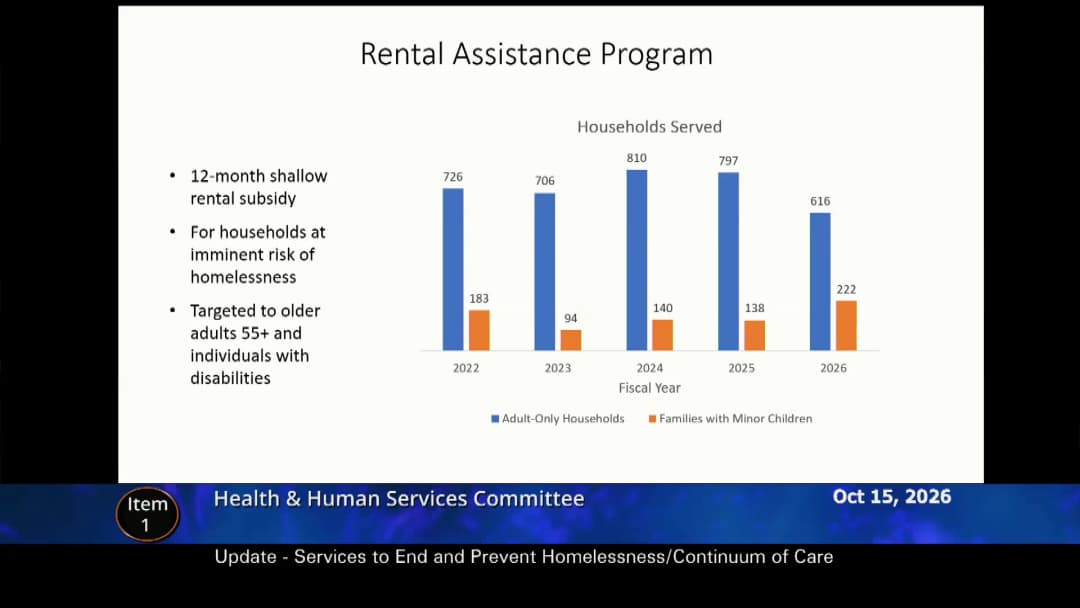
On October 15, 2026, from 1:30 to 4:30 p.m., the Montgomery County Council Health and Human Services (HHS) Committee met in the Council Hearing Room in Rockville, Maryland, to review services to end and prevent homelessness and the Continuum of Care. Chair Laurie-Anne Sayles presided, joined by Councilmembers Dawn Luedtke and Andrew Friedson, with Councilmember Kate Stewart and Councilmember Kristin Mink also participating. DHHS staff and community partners were acknowledged for the county's homelessness work. No formal votes were taken. Homelessness Data and Trends - The 2026 point-in-time count identified 1,120 people experiencing homelessness, a 26% decrease from the prior year, including a 47% decrease among people in families. Chronic homelessness increased 14%. The June mid-year unsheltered count found 174 unsheltered residents, and staff reported 30 active encampments. - Street outreach served 458 individuals in FY26, a 104% increase since 2022. The coordinated entry list contained 630 households (734 people, including 70 families) awaiting housing. - Inflow and outflow data showed families being housed nearly every month faster than they entered homelessness, while individual adults continued to enter faster than they were housed. - Officials identified housing affordability, inflation, stagnant wages, rent and utility arrearages, federal policy cuts, SNAP losses, household vulnerability, and domestic violence as drivers. Staff noted 30,000 Maryland residents are losing SNAP benefits, including 11,000 people experiencing homelessness. - Councilmember Friedson cautioned against overreacting to one-night point-in-time counts and asked for more standardized use of by-name and street-outreach data to assess trends. Shelter Operations and Hypothermia Season Readiness - Shelters are generally at or above capacity, and lengths of stay are rising because of limited permanent housing. Under the September 1 shelter transition, the main men's shelter's year-round capacity was reduced from 200 to 140, with overflow adding 80 beds; Crabs shelter now serves 60 men year-round; TAF Court shelter increased from 35 to 70 women; and Rainbow shelter increased from 28 to 33. Staff reported improved safety and more individualized services. - Two DHHS supplementals will be introduced October 20: one for shelter custodial services and one for expanding women's shelter beds. A public hearing is scheduled for November 10, followed by a committee work session. - Hypothermia season is expected to begin in November; outreach kickoff meetings were scheduled for October 21 and October 23. SHARP and Rental Assistance Program Updates - SHARP provides locally funded rental assistance at 100% of base rent for 12 months, with light-touch case management. In FY26, SHARP housed 227 families (713 people); with 127 families housed in FY25 through special appropriation funding, the total reached 354 families. Average household size was three and the largest household served had nine members. - SHARP will begin accepting referrals for individual adults on October 19, with funding anticipated to serve 100 to 120 individuals. The expansion will initially target individuals assessed as needing minimal supports and will include more intensive case management and employment services when needed. - RAP served 616 adult-only households and 222 families in FY26, focusing on households at imminent risk of homelessness, adults 55 and older, and people with disabilities. - Councilmember Luedtke and Councilmember Friedson requested a look-back analysis of SHARP participants to measure returns to homelessness and support future investment. Continuum of Care NOFO and Federal Funding Risk - Staff detailed the litigation-affected HUD Continuum of Care NOFO process: the FY26 NOFO was published June 1, Tier 1 was set at 60%, and $1.3 billion was set aside nationally for new projects; the NOFO was vacated August 7, later remanded, and the county submitted its application September 30 after a 12-day turnaround. A new motion was filed October 14, leaving awards uncertain. - Tier 1 consists of renewal permanent supportive housing projects. Tier 2 includes two permanent supportive housing renewals and four programs applying to convert to transitional housing. Tier-two risk was described as nearly $5 million. Chair Sayles's opening remarks cited almost $5 million in risk for six projects affecting over 500 households; Councilmember Mink later asked about $12 million in existing-program exposure, and staff confirmed the full existing-program annual renewal demand is about $12.6 million. - Staff said 822 clients are currently served by these Continuum of Care programs; 30 percent are children under 18 and 25 percent are adults 55 or older. One program, Home First, had to move clients because of delayed HUD funding. - A contingency of about $700,000 is set aside for grants expiring this fiscal year, using HUD GAAP funds and a loan through the Latino Economic Development Center. Councilmember Friedson urged the executive branch to develop an FY28 contingency strategy before December 31 and brief the incoming council early. HOC Voucher Prioritization and Regional Coordination - Chief Hong recommended that HOC adopt a 50 to 80 percent homeless preference for Housing Choice Vouchers, take referrals directly from the coordinated entry list, and reduce leasing barriers for people with no income, prior rental or criminal history, and substance-use histories. She said the county executive, councilmembers, and advocates support this approach. - Councilmember Mink said the Interagency Commission on Homelessness has sought this HOC local preference for 12 years and called it a must-do. She noted HOC left $11.5 million in Housing Choice Voucher funds unspent in calendar year 2025 and that $6 million was recaptured. Councilmember Stewart underlined the shelter concentration in her district and warned of growing older-adult foreclosures. - On regional coordination, COG's data-sharing warehouse with the District and Prince George's County identified 1,131 shared clients over three years: 97 percent shared between two jurisdictions, 3 percent across all three, 61 percent individuals, and 39 percent families with children. Staff flagged that two unsheltered/sheltered data points appeared switched and said they would correct the slide. Behavioral Health, Outreach Capacity, and Eviction Prevention - Shelter-based psychiatric services, peer specialists, and client-choice engagement continue to connect residents to treatment. Chief Hong said services are always offered but housing is not conditioned on accepting services; she also identified a need for behavioral health respite and assisted-living-style programs for older adults experiencing chronic homelessness. - Councilmember Luedtke raised the recurring emergency-petition and hospital-release cycle for high-needs individuals and called for better long-term placement options. - Outreach funding totals about $2 million, including Bethesda Cares at $800,000, EveryMind at $146,000, City of Gaithersburg at $45,000, children/youth/families at $387,000, Pathways to Housing at $280,000, and Shepherd's Table at $324,000. Staff said all partners carry open-ended caseloads and have roughly three outreach workers each; the upcounty geographic area remains a strain. - Eviction data showed Montgomery County averaged about 207 evictions per month in 2025, the fourth-highest rate in Maryland. After Expedited Bill 3125, evictions fell to about 73 per month, a 64% decrease. Staff credited Councilmember Mink's sponsorship and interbranch collaboration. Key Outcomes - No formal votes or approvals were made at the work session. - Staff will provide corrected Continuum of Care data slides, outreach funding and population details, and standardized by-name data for future committee briefings. - Staff will develop a SHARP recidivism and outcomes analysis. - The committee and staff will continue pressing HOC to adopt a homelessness preference and will follow up with HOC and the incoming county executive. - The administration was urged to plan FY28 Continuum of Care contingencies before the end of 2026. - DHHS will introduce the custodial services and women's shelter bed supplementals on October 20, with a November 10 public hearing and future work session.
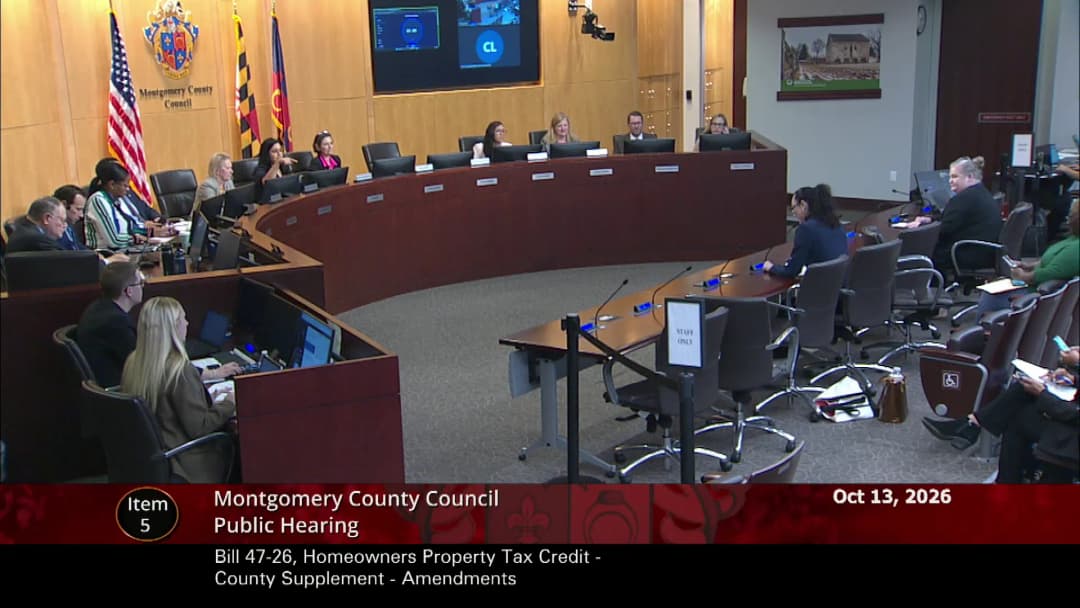
The Montgomery County Council met on Tuesday, October 13, 2026, starting at 12:00 p.m. with a Maryland Association of Counties (MACo) meeting, followed by a proclamation, general business, multiple public hearings, legislative session, and district council session. The meeting was chaired by Council President Nara Lifani Gonzalez. Key actions included approval of consent items, adoption of the Gude Landfill disposition, receipt of public testimony on four bills, introduction of two expedited bills, and approval of two local map amendments. Proclamation - Fire Prevention Month The Council presented a proclamation recognizing October as Fire Prevention Month, with the theme "Charge into Fire Safety: Safe Charging is a Superpower." Councilmembers Mink and Lukey spoke, along with Fire Chief Smedley, emphasizing fire safety practices such as closing doors before sleeping, proper battery charging, and having escape plans. The proclamation was presented by the Public Safety Committee. Consent Calendar The Council approved the consent calendar unanimously (9-0) with the following items: - A. Received and released Office of Legislative Oversight Report 2026-16: Group Health Insurance Cost Drivers. - B. Introduced a Resolution to approve Supplemental Appropriation 27-7 to the FY27 Operating Budget ($100,000 from General Fund Undesignated Reserves for Labor Management Relations Committee). Public hearing scheduled for October 27, 2026. - C. Adopted Resolution to confirm County Executive’s appointments to the Community Action Board: Ayana Singhateh and Nancy Traver (Resolution 20-1232). - D. Adopted Resolution to confirm appointments to the Workforce Development Board: Kevin Armstrong, Sonya Bruton, James Carmen, Stephanie Crane, Shantá Johnson, Mary Lang, Yomi Ntewo, Grant Shmelzer (Resolution 20-1233). Public Hearing and Action - Declaration of No Further Need for Gude Landfill A public hearing was held on a resolution to approve the disposition of a portion of the Gude Landfill. No speakers registered. The hearing was closed, and the Council adopted the resolution unanimously (9-0). Public Hearing - Bill 39-26: Wheaton Urban District Boundaries Amendments This bill expands the boundaries of the Wheaton Urban District to include the Wheaton Library and Community Recreation Center and Wheaton Local Park. The record remained open until October 19, 2026. Testimony was received from: - Nadia Klute (Interim Mid-County Regional Service Center Director) testified in support on behalf of the County Executive. - Jim Epstein (private citizen, Wheaton Urban District Advisory Committee) testified in support. - Sonia Climaco (resident) testified in support, noting the urban district's role in cleanliness and community events. - Martin Smith (Executive Director, Creative Wheaton) testified in support, citing benefits for integration and clean/safe teams. All speakers supported the bill. No opposition was voiced. Public Hearing - Bill 46-26: Taxation - Child Tax Credit Supplemental Grant This bill provides a $500 county grant per qualifying child to eligible taxpayers with federal adjusted gross income under $15,000. The record remained open until October 22, 2026. The Government Operations Committee worksession is scheduled for October 29, 2026. Testimony included: - Jodi Finkelstein (Executive Director, Montgomery County Commission for Women) spoke in support of Bill 46, 47, and 48, emphasizing economic security for women and families. - Timothy Robinson (Community Action Board) testified in strong support of Bill 46, noting its anti-poverty impact. - Gordy Brennan (Taxpayers League) testified in opposition to all three tax credit bills, citing structural deficits, administrative costs, and equity concerns. - Esther Wells (private citizen) testified in strong opposition to all three bills, arguing they fail to restore the eliminated ITOC credit and harm black homeowners. - Eric Smith (Greater Capital Area Association of Realtors) testified in support of all three bills, but noted housing supply issues remain. - Ronald Spohr (Habitat for Humanity Metro Maryland) testified in support of Bills 46, 47, and 48. - Christopher Cannon (SEIU 500) testified in strong support of all three bills, calling them a "slam dunk" for struggling families. - Kimberly Rosnak (Children's Opportunity Alliance) testified in support of Bills 46 and 48, but urged raising the income threshold for the child tax credit. - Pablo Blank (CASA) testified in support of Bill 46, emphasizing need for free tax preparation access. - Robin McKeany (Cash Campaign of Maryland) testified in support of Bill 46, highlighting its anti-poverty effectiveness. Positions were mixed, with a majority of speakers supporting the bill. Public Hearing - Bill 47-26: Homeowners Property Tax Credit - County Supplement Amendments This bill raises the maximum household income eligibility limit for the county's homeowners property tax credit supplement from $75,000 to $106,800. Record open until October 22, 2026. Testimony: - Mary Kohler (Montgomery Housing Alliance) testified in support, noting benefits for homeownership affordability and equity. - Helene Meister (long-term resident) testified in support but proposed amendments including a letter of determination explaining the credit calculation. Public Hearing - Bill 48-26: Property Tax Credit - Public School Employees This bill extends a $2,500 property tax credit to eligible public school employees (teachers and support staff). Record open until October 22, 2026. Testimony included: - Nancy Andrade (parent, Action in Montgomery) testified in support. - Lorena Hoya (parent, Action in Montgomery) testified in support. - Brenda Wolf (Board of Education member) testified in support, noting over 6,700 employees live outside the county. - David Stein (President, MCEA) testified in support, emphasizing equity and retention. - Pia Morrison (SEIU 500) testified in support. - Tamara Kelly (MCPS administrative secretary, SEIU 500) testified in support. - Deborah Monk (past board president, Interfaith Works) testified in support, citing personal experience as a former principal. All speakers supported the bill. Legislative Session - Introduction of Bills The Council introduced two expedited bills: - Expedited Bill 49-26: Administration - Office of the County Executive - Non-merit Positions. Lead sponsor Councilmember Jawando. Would increase the number of Assistant Chief Administrative Officers from four to six by repurposing existing positions. Public hearing October 27, 2026. - Expedited Bill 50-26: Administration - Non-merit Appointments - Deputy Directors. Lead sponsor Councilmember Jawando. Would require council confirmation for all deputy directors and certain fire division chiefs and office directors, converting the last seven merit positions to non-merit. Public hearing October 27, 2026. Councilmember Sales requested to be added as a co-sponsor to both bills. District Council Session - Resolution 20-1235: Extended the time for the Office of Zoning and Administrative Hearings to transmit a report and recommendation for Local Map Amendment H-159 (Notley Assemblage LLC, Silver Spring) to November 19, 2026. Adopted unanimously (11-0). - Action on Local Map Amendment H-160: Approved rezoning of 9101 Old Georgetown Road, Bethesda, from R-6C (TDR 8.0) to CRTF (1.25, C-1.0, R-1.0, H-55) for the Foundation for Advanced Education in the Sciences, allowing redevelopment with 8 townhouses, 8 single-family homes, and a 5,000 sq ft event center. Adopted unanimously (11-0). Key Outcomes - Approved minutes of September 15 and 22, 2026. - Approved consent calendar items. - Adopted resolution for Gude Landfill disposition. - Received public testimony on Bills 39-26, 46-26, 47-26, and 48-26; records remain open for written comments. - Introduced Expedited Bills 49-26 and 50-26; public hearings set for October 27, 2026. - Extended time for OZAH on LMA H-159. - Approved LMA H-160. - All votes on action items were unanimous.
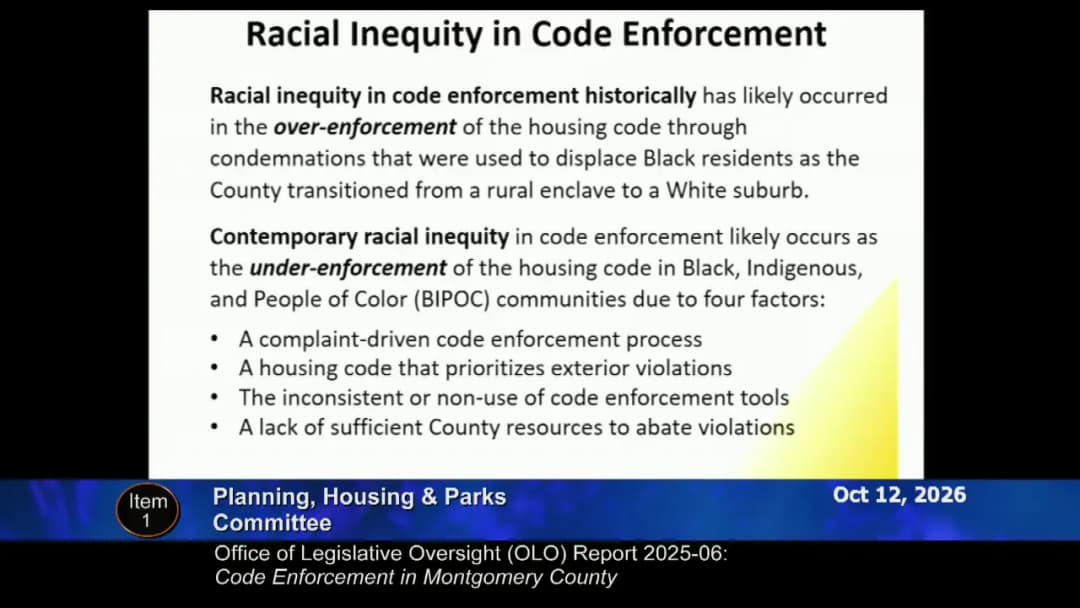
The Montgomery County Council Planning, Housing & Parks (PHP) Committee met on October 12, 2026, from 1:30 p.m. to 4:30 p.m. in the Council Hearing Room, 100 Maryland Avenue, Rockville, Maryland. Committee Chair Andrew Friedson presided; Councilmember Will Jawando and Council President Laurie-Anne Sayles took part in the discussion. The work session covered three items: an Office of Legislative Oversight (OLO) report on code enforcement, an OLO report on government programs that subsidize home modifications for aging in place, and a briefing on state-designated Transit-Oriented Development (TOD) areas. Discussion Items Code Enforcement (OLO Report 2025-06) - OLO researchers Gabriela Monson-Reynolds and Dr. Elaine Bonner-Tompkins presented OLO Report 2025-06. They found that the county housing code generally aligns with the National Healthy Housing Standards, but includes exterior building requirements aimed at minimizing visual blight, such as tall-grass rules and exterior paint maintenance. - OLO found that DHCA relies on three code enforcement processes: complaint-driven inspections, mandated multifamily property inspections, and proactive inspections. OLO also found that DHCA did not use standardized inspection checklists, did not consistently use available enforcement tools, did not charge required reinspection fees, only partially complied with Bill 19-15 annual reporting requirements, and classified too many multifamily properties as compliant under Executive Regulation 5-17 AM. - OLO reported that DHCA collected $9.1 million in landlord-tenant fees in FY25, compared with a $6.2 million budget for code enforcement. Data showed code inspections increased 37% between FY19 and FY23, most 311 complaints in FY24 were for single-family properties, the share of code enforcement service requests resolved within 60 days increased 6% between FY18 and FY23, and citations issued to multifamily properties increased from 307 to 754 between FY19 and FY24. - OLO also found that contemporary racial inequity in code enforcement likely appears as underenforcement in Black, Indigenous, and people of color communities, driven by a complaint-driven process that directs resources to single-family and predominantly white communities, a code that emphasizes exterior blight, inconsistent use of enforcement tools, and limited abatement resources. - DHCA Director Scott Bruton and Division Chief Nathan Bovale responded with FY26 data: 37 housing code inspectors and 6 supervisors; about 115,000 rental units, including about 85,000 multifamily and 30,000 single-family units; about 80,000 unit inspections, including roughly 14,000 scheduled inspections and 65,000 complaint-based inspections; about 2,300 multifamily notices of violation covering more than 15,000 violations and 466 citations; and about 3,400 single-family notices covering about 12,000 violations and 750 citations. - DHCA highlighted improvements since 2023, including revised standard operating procedures, an updated code enforcement application, reinspection fees implemented in May 2026, integration of troubled and at-risk property regulation with rent stabilization, and a new collaboration with the University of Maryland National Center for Smart Growth. DHCA reported a 78% decrease in units in troubled properties and a 69% decrease in units in at-risk properties between FY24 and FY26. - OLO recommended developing a code enforcement strategic plan with community stakeholders, improving disaggregated data collection, revising the multifamily property classification methodology, and considering nine secondary recommendations, including increased multifamily staffing. - Councilmember Jawando raised concerns about staffing allocation: 16 of 37 inspectors are dedicated to multifamily, while the remaining 21 are split among upper county, down county/ADU, and Takoma Park teams. He questioned whether the county has enough multifamily inspectors, whether the inspection cadence is appropriate, and whether those measures are tied to clear goals. Chair Friedson called for a written strategic plan with metrics and accountability rather than informal continuous improvement alone. Council President Sayles praised DHCA's responsiveness and outreach to people of color, noted tight budget constraints, and urged maximizing the effectiveness of existing inspectors. - DHCA agreed to provide written responses to committee questions and a proposed engagement and strategic-plan framework within 30 days. Aging in Place Home Modification Programs (OLO Report 2025-12) - OLO's Leslie Rubin presented a review of 18 state and local government programs that subsidize home modifications to support aging in place. OLO's recommendation was to consider design changes that could expand participation, such as opening programs to renters or rental property owners, removing the primary-residence requirement from the first tier of the Design for Life program, or lowering the HARP age limit. - Montgomery County has two programs. The Department of Permitting Services (DPS) implements the Design for Life program, a property tax credit with no income, age, or disability limits. It provides 50% of costs up to $2,500 at the accessibility level, and 100% of costs up to $3,000 or $10,000 at the visitable and livable levels. Annual funding is capped at $100,000 for the accessibility level and $500,000 split between the visitable and livable levels. Since FY15, the program has issued about $65,608 in accessibility tax credits, $9,000 in visitable credits, and $810,000 in livable credits, using roughly 11% of available funds. The accessibility level currently requires the property to be the owner's primary residence. - The Home Accessibility Rehabilitation Program (HARP), implemented by DHCA, funds up to $35,000 in home modifications per project and does not require participants to pay upfront. HARP has income limits of 80% of AMI or below, with priority at 50% of AMI or below, and is open to homeowners aged 65 or older or households with a permanent disability. Since the program began, it has renovated 254 properties using $2.4 million of the $3.1 million available; 59% of participants had incomes at or below 30% of AMI. - DPS Director Rabia Sabeakan and Division Chief Gail Lucas described actions taken after the committee's previous briefing: expanding eligible accessibility features, adding residential condominiums as eligible properties, simplifying the online application process, and increasing outreach. They also said DPS is considering incorporating visitability and accessibility provisions into the next county building code cycle, following approaches used in other jurisdictions such as Prince George's County. - Chair Friedson expressed strong support for treating accessible housing as a broad public benefit and questioned restrictions that exclude rental properties, require owner occupancy at the accessibility level, or may discourage landlords from making accessibility improvements. Councilmember Jawando supported raising the Design for Life accessibility tax credit to 75% of project costs up to $10,000, keeping the $100,000 annual cap, and removing the primary-residence requirement. DPS noted that, in practice, it does not ask whether an applicant is owner-occupied, but the stated policy still contains the restriction. - The committee reached consensus to move forward with legislation this year, with Council staff directed to begin drafting a bill. State-Designated Transit-Oriented Development (TOD) Areas Briefing - Planning Department Deputy Director Robert Kronenberg and Division Chief Carrie McCarthy briefed the committee on applications to be submitted to the Maryland Department of Transportation (MDOT) for state TOD designation of four downtown areas: Wheaton, Silver Spring, Bethesda, and Friendship Heights. The proposed boundaries generally follow existing central business district and sector/master plan boundaries, narrowed to commercial and mixed-use areas zoned for redevelopment. - Benefits of state TOD designation include eligibility for the state TOD capital grant and revolving loan fund, additional points in low-income housing tax credit and state agency project applications, and priority advocacy with MDOT. The designation does not preempt local zoning or mandate a certain type of development. - North Bethesda (White Flint) and Rockville previously received TOD designations; the four new applications are separate. DOT Deputy Director Haley Peckett said DOT fully supports all four designations and that DOT is using a $250,000 state grant from the TOD fund for North Bethesda planning and outreach. - Council staff flagged that under the 2026 Maryland Transit and Housing Opportunity Act, the four areas would automatically become state enterprise zones once designated as TODs after October 1, 2026, unless the local government elects in writing not to designate them. The council resolution accompanying the applications should state whether the council supports or opposes the enterprise-zone designation for each area. - OMB's Gary Nelvin said enterprise-zone tax credits involve shared state and local revenue costs, and recommended assessing revenue impacts before moving forward. He said typical fiscal impact statements take two to three weeks and this one could be more complicated. The chair asked OMB to provide, within 48 hours, a timeline for completing a fiscal impact analysis. - Follow-up questions were directed to MDOT about whether the council can opt out at the time of TOD designation and later opt in to enterprise-zone status, and whether the council can make different enterprise-zone decisions for different areas. Council President Sayles expressed support for the TOD designations, particularly in Wheaton and Silver Spring, and asked that Glenmont be considered among future TOD areas. Planning staff noted other future possibilities include the Purple Line corridor, Germantown MARC, and additional Metro or MARC stations. Key Outcomes - DHCA will provide written responses to committee questions and a proposed strategic-plan and engagement framework within 30 days, including staffing capacity and allocation data. - The committee agreed to draft legislation this year to increase the Design for Life accessibility tax credit to 75% of project costs up to $10,000, retain the $100,000 annual cap, and remove the primary-residence requirement. HARP expansion and funding will be explored separately. - For TOD, no formal vote was taken. The council will seek follow-up answers from MDOT on enterprise-zone opt-out and opt-in timing and per-area decisions; OMB will provide a timeline for a fiscal impact statement within 48 hours; and a broader discussion on enterprise-zone tax policy may be referred to the full council or the Government Operations & Fiscal Policy Committee.