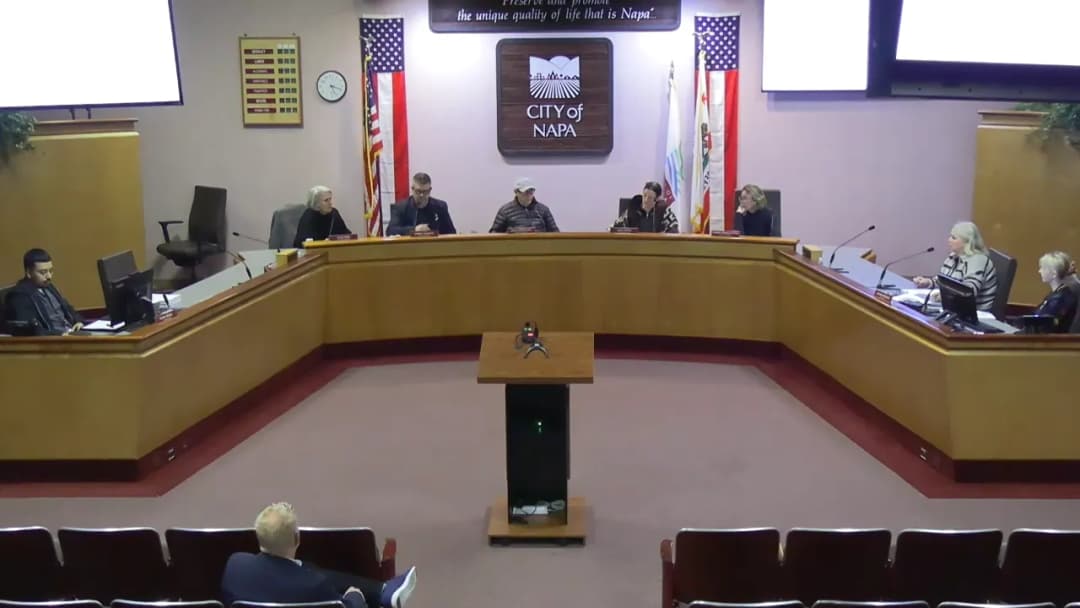
The Public Art Steering Committee (PASC) held a regular meeting on January 28, 2025, at 5:00 PM in City Hall Council Chambers. The committee reviewed and approved the September 2024 minutes, discussed the 2nd Street Corridor Pavement Artwork Project, nominated new officers for 2025, and approved the 2025 meeting calendar. All actions were unanimous. Consent Calendar - The committee unanimously approved the meeting minutes from September 24, 2024. Public Comments & Testimony - Robert Reaver, a retired city planner and member of the city's Bicycle and Pedestrian Advisory Committee (speaking as an individual), expressed strong support for the pavement art project and offered several recommendations: (1) use high-grip, skid-resistant thermoplastic for safety; (2) consider incorporating vertical art such as artistic bicycle racks in the daylighting zones; (3) expand traffic-calming public art beyond downtown; (4) collaborate with other city committees; and (5) seek additional funding sources like transportation safety grants and public-private partnerships. Discussion Items - 2nd Street Corridor Pavement Artwork Project (Item 6A): Public Art Coordinator Sarah Winsky presented the project, which will create pavement art at five four-way intersections (Type A) and one three-way pedestrian scramble intersection (Type B) along 2nd Street. The project uses pre-formed thermoplastic for durability. The artist selection process includes an RFQ phase, followed by an RFP for 16 finalists (12 for Type A, 4 for Type B), each receiving a $1,000 stipend for concept designs. Six final artists (five Type A, one Type B) will receive $4,000 for final designs. The total budget is $2,000 from the previously approved pedestrian scramble fund, plus $150,000 from the Downtown Napa Property and Business Improvement District and $75,000 from the public art fund ($40,000 allocated to artist fees). Committee members provided feedback emphasizing the need for evaluation criteria that assess community engagement and site-specificity, not just visual quality. Concern was raised about ensuring unique, community-connected designs rather than off-the-shelf art. The committee also discussed the design of delineators and the impact of bulb-outs on parking. Sarah Winsky confirmed that high-grip thermoplastic will be used and that bike racks may be considered in adjacent sidewalk areas. The committee nominated two members—Julie Eppich and Clay Newton—to serve on the Art Selection Panel (a motion to allow two members was passed unanimously). - 2025 Chair & Vice Chair Nominations (Item 6B): Outgoing Chair John Hannaford announced he would not seek re-election as chair, expressing gratitude for his service. Julie Eppich was nominated and unanimously elected as chair. John Hannaford was then nominated and unanimously elected as vice chair. - 2025 Meeting Calendar (Item 6C): The committee reviewed and approved the 2025 meeting schedule, which includes monthly meetings through June and September through November, with no meetings in July and December. A request was made that any meeting time changes be announced at least one week in advance. Key Outcomes - Unanimous approval of the September 24, 2024 meeting minutes. - Unanimous approval to nominate two committee members (Julie Eppich and Clay Newton) to the Art Selection Panel for the 2nd Street Corridor Pavement Artwork Project. - Unanimous election of Julie Eppich as chair and John Hannaford as vice chair for 2025. - Unanimous approval of the 2025 meeting calendar, with a staff commitment to provide at least one week's notice for any time changes. - The committee's feedback on the RFQ for the pavement art project will be incorporated by staff; the RFQ submission deadline is March 3, 2025, with installation anticipated in September or October 2025.
Public Meetings - Napa, California
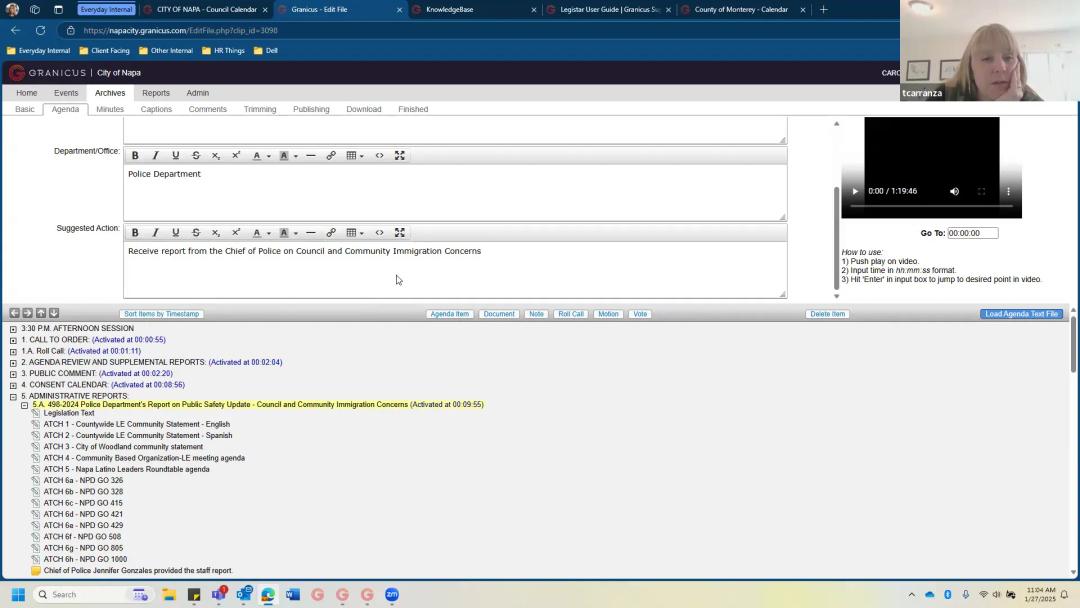
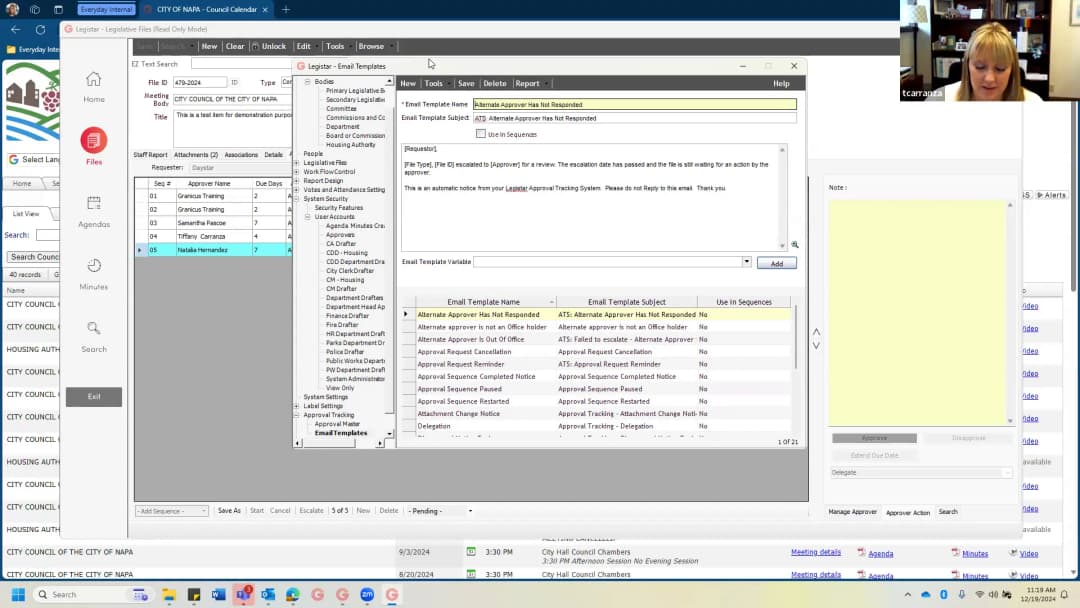
Public Meetings - Napa, CaliforniaThis was a training and optimization session for Napa city staff led by Granicus consultant Carolyn. Participants included Tiffany, Sam, Natalia, and others. The meeting covered updates to council member records in Legistar, deep dives into the approval tracking system (ATS), permissions, email templates, and a new feature for displaying agenda dates in the approval queue. Discussion Items - Office Member Record Updates: The group adjusted start and end dates for council members due to recent re-elections and role changes. Bernie Narvaez's vice mayor term ended December 18, 2024, and he became a regular council member on December 19, 2024. Mary Luros became vice mayor on December 18. Liz’s departure was noted. The importance of non-overlapping dates was stressed to avoid double-counting in roll call. The body header for agendas was updated for interim periods. - Approval Tracking System (ATS) Permissions: - Drafters can: add approvers to a sequence, reorder approvers, save personal sequences, and pause/restart the sequence. They cannot remove approvers or change due dates. They also cannot cancel a sequence or extend due dates (these are reserved for administrators). - Approvers can: pause/restart a sequence, delegate to another person, and approve/disapprove. They cannot edit the sequence itself. Delegation is allowed with a note. - The group confirmed that the “disapprove” button wipes the pending sequence but preserves the document; it should only be used for fundamental flaws. For minor corrections, pausing and asking the drafter to fix is preferred. - Due date windows are set per role (e.g., city attorney given 30 days to avoid auto-escalation to an unavailable alternate; department heads given 7 days). Escalation is automatic but can also be triggered manually by administrators. - Email Templates: The system has 21 built-in templates; most are enabled. The subject line for individual review requests includes “ACTION NEEDED” in all caps. Notes left by approvers are not automatically included in emails; a request was made to add that variable (pending programmer confirmation). - New Feature – Agenda Dates in Approval Queue: The new setting displays the agenda date before each file on the home screen approval list, and files are grouped by agenda date to help prioritize. This feature has been turned on. - Early Approvers: Not needed because Napa’s approval sequences are strictly linear (department head → attorney → finance → clerk → city manager). - Future Training: The next session will focus on minutes (scheduled for two hours) and an administrative session. Key Outcomes - Council member records were updated with correct non-overlapping dates for Bernie, Mary, and Liz. - Permissions for drafters and approvers were clarified and left as configured; drafters cannot cancel or extend due dates. - The “show agenda dates” feature is now active. - No changes to email templates at this time, but the possibility of adding note content to emails will be investigated. - The group agreed to proceed with the current ATS setup; no immediate adjustments to sequences or due dates were made. - Future training on minutes and administration was scheduled.
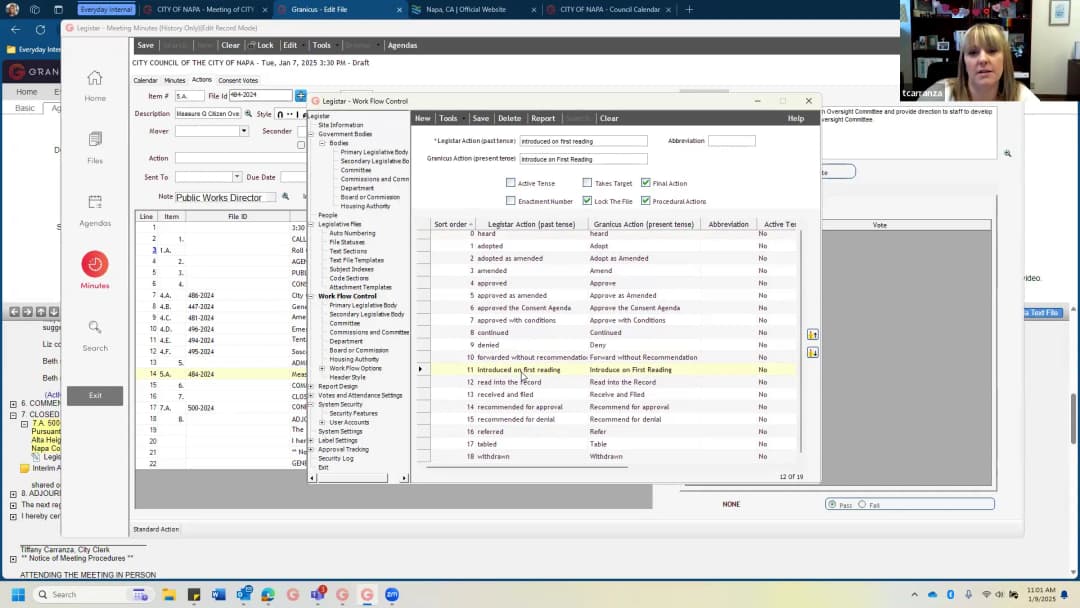
This was a technical working session between city staff (Tiffany, Sam, Natalia) and consultant Carolyn to review and optimize use of the Legistar agenda and minutes management system. Discussions covered system security, workflow refinements, and minutes formatting improvements. Consent Calendar - No consent calendar items were discussed. Public Comments & Testimony - No public comments were made. Discussion Items - Legislative File Creation Privileges: Staff discussed restricting the ability to create new legislative files to the city clerk's office, with the city manager serving as an approver to prevent surprises. Various workflow options were explored, including making the city manager both first and last approver. - Agenda Status Color Coding: Staff requested that items in draft, paused, or other non-publishable statuses be displayed in red (or yellow for pause) instead of green to easily identify readiness. Carolyn agreed to take this to product team, suggesting the color be driven by the "available on web" checkbox. - Minutes Publishing and Consent Voting: Detailed walkthrough of minutes module—importing video, marking consent items, using draft unapproved status, and publishing results before formal minutes. A setting to auto-mark consent calendar items as consent in live manager was identified as needing investigation. - Motion Text and Action Customization: Staff requested new action types (e.g., “Provided direction to staff”) and renaming of rarely used actions to avoid clutter. Carolyn also proposed adding the enactment number to the motion text to reduce manual data entry. - Historical Meeting Data: A 2015 special meeting was found to be missing from public view; staff will republish it after suppressing the printed on date to avoid confusion. - Standard Paragraphs: Carolyn explained how to create reusable text blocks for frequently used minutes notes (e.g., amended votes) to save time. Key Outcomes - Default privilege for creating new legislative files will be removed from all groups except the city clerk's office; new process will require email approval from city manager before file creation. - Carolyn will request product team to change agenda status color coding—red for any non-publishable status, yellow for pause. - The “printed on date” will be suppressed from agenda reports; 2015 special meeting will be republished after that change. - New actions “Provided direction to staff” and “Approved first reading” will be added; unused actions will be renamed to sort to the bottom of the list. - Carolyn will investigate why consent calendar items are not auto-marked in live manager and work on inserting the enactment number into motion text. - Follow-up training on minutes (with Lauren) and administrative topics scheduled for next session. - Staff encouraged to test consent marking in live manager using the minutes module in advance of exporting the agenda.
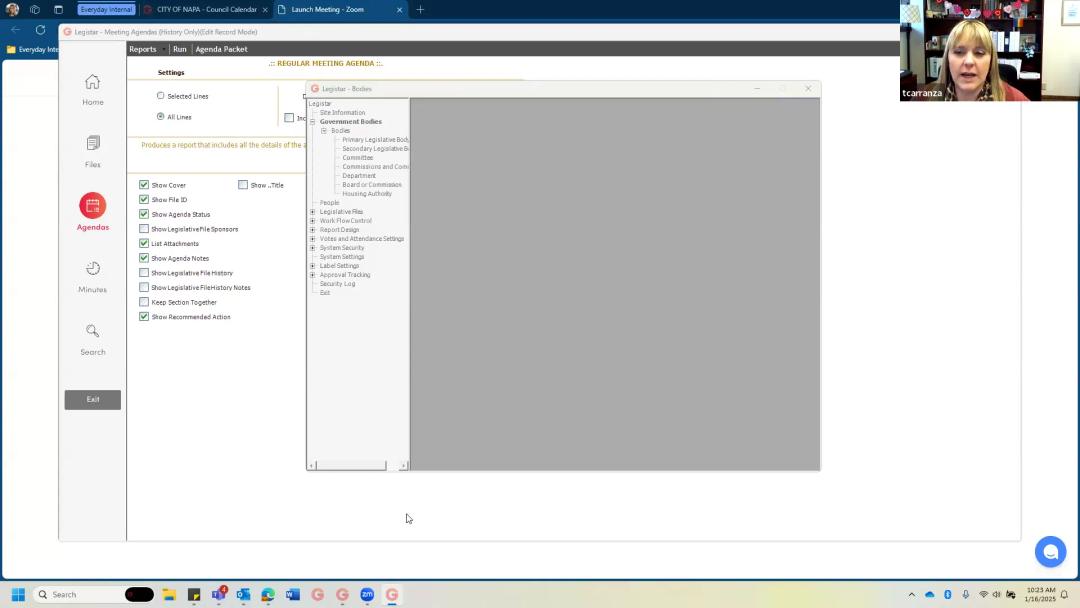
This training session, held on January 27, 2025, from approximately 6:45 PM to 8:15 PM UTC, focused on Legistar administration for City of Napa staff. Carolyn (Granicus trainer) led the session, with participation from Sam, Natalia, and Tiffany. The meeting addressed key administrative functions, including managing body types, workflows, user accounts, and permissions, with a goal of streamlining operations and preparing for the migration of boards and commissions from Media Manager to Legistar. Discussion Items - Site Information & Government Bodies: Carolyn demonstrated how to update jurisdiction name, logo, physical address (e.g., for off-site meetings), and how temporary address changes should be made before publishing an agenda. The group discussed the need to separate the Housing Authority and Public Finance Authority (PFA) from the primary legislative body type to prevent incorrect item pulls. It was noted that the primary legislative body is unique in that it can pull items from other bodies, whereas other body types cannot. - Body Types & Workflow Control: Carolyn explained that body types control agenda output and order of operations. She demonstrated creating a new workflow for the Housing Authority, using sequence numbers in increments of 10 to allow for future insertions. The workflow included sequences for call to order, roll call, agenda review, public comment, consent calendar, administrative reports, public hearings, and adjournment. Boilerplate text (e.g., notice of meeting, certification) was added as forced sequences. The same process was applied to the PFA with its unique general procedures. - People & User Management: The group reviewed how to add, deactivate, and manage people records. Tiffany noted issues with deactivating former staff (Carlise) and adding new council member Chris. Carolyn emphasized that office members should not be users of the system. The discussion also covered assigning departments to staff to ensure proper default department on new files. - User Groups & Security: Sam raised concerns about the large number of user groups (e.g., fire drafter, finance drafter) and the desire to consolidate. Carolyn explained that many groups are redundant and can be deprecated by renaming them with a 'Z' prefix to move them to the bottom of the list. She recommended moving all drafters to a single 'department drafters' group and all approvers to a single 'approvers' group, with a separate 'agenda and minutes creators' group reserved for future board and commission staff. The 'view only' group was retained for potential use. Carolyn also introduced a password policy option (NIST-compliant, 180-day expiry) that would allow users to self-reset passwords, but advised announcing it before activation. - Legislative Files & File Types: The group discussed adding file types for boards and commissions, such as 'council workshop', and how to set up auto-numbering (suffixes reset annually). The use of text file templates (staff report templates from 2017) was noted; Carolyn suggested they could be updated easily by downloading, editing in Word, and re-uploading. - Media Manager & Integration: The export settings for Housing Authority and PFA were configured to ensure proper streaming and trimming of video. Carolyn advised setting default to 'public' but allowing editing after publication. Key Outcomes - Housing Authority and PFA Separation: Carolyn successfully created new body types for the Housing Authority and PFA, assigned them separate workflows, and moved them out of the primary legislative body type. This should prevent cross-contamination of items between these bodies and the City Council. A test Housing Authority meeting was generated to confirm correct behavior. - User Group Cleanup: Carolyn renamed extraneous user groups with a 'Z' prefix, reducing the active list to six groups: administrators, department drafters, approvers, department head approvers, agenda and minutes creators, and view only. Sam will move users from deprecated groups to the appropriate standard groups. - Motion Text Fix: Lauren will assist Carolyn in fixing the motion text field in Media Manager, which was broken when a new field was added after the media manager motion text field. - Next Steps: The next scheduled call will be a workflow review to test the Housing Authority export/import process and confirm the motion text fix. Additionally, Sam will begin the process of migrating the Planning Commission to Legistar, with a potential supplemental call with Carolyn to help pitch the system to commission staff. Sam will also gather file types and general procedures for the remaining boards and commissions. Note: This meeting was a training session; no formal public comments or consent calendar items were considered.
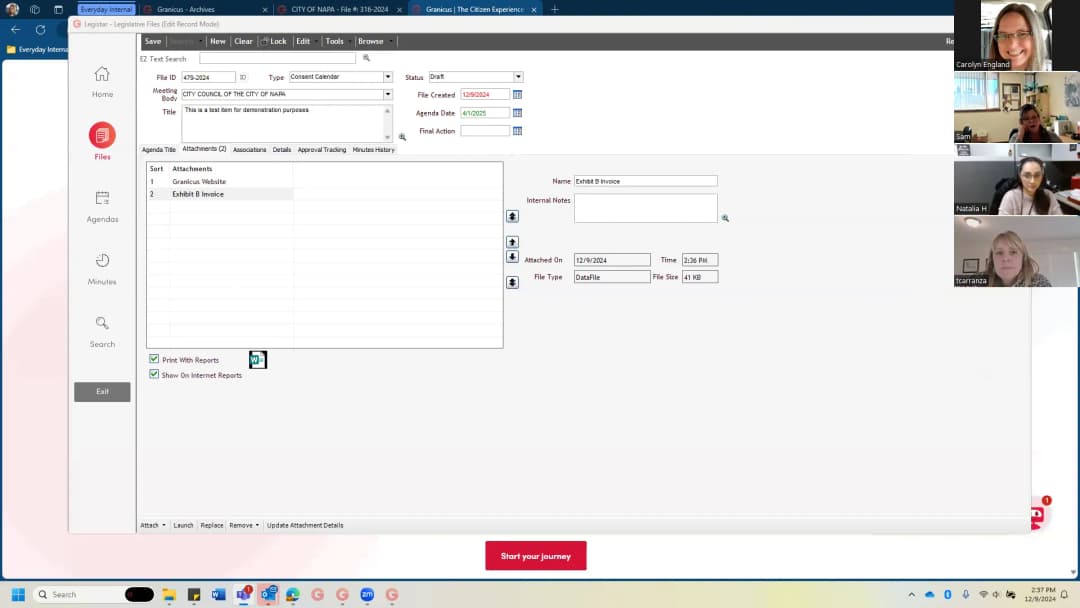
This training session, conducted by Granicus consultant Carolyn, covered the use of the Legistar Files module for City of Napa staff members Tiffany, Sam, and Natalia. The focus was on improving the efficiency of file creation, document management, template usage, attachment handling, and report generation. Several process improvements and new feature enablements were discussed and agreed upon. Discussion Items - Searching and Creating Files: Carolyn demonstrated how to search for files by ID, date range, type, and status; how to create new files and use the auto-numbering system (resetting the suffix for 2025 to "2025" with leading zeros). - Agenda Date and File Status: The agenda date field is required; it locks to scheduled meeting dates. File statuses (Draft, Agenda Ready, Approval, etc.) were reviewed, and the concept of version control was discussed. - Staff Report Template: The team reviewed the Microsoft Word integration for staff reports. They discussed customizing the template with instructional text, content control boxes, dropdown menus (e.g., for department head names), and pre-built tables for financial impacts. Carolyn offered to create a table-enhanced template after consulting with the Finance department. - Attachments and Public Comments: Carolyn explained how to attach files (including hyperlinks and images), the 100 MB size recommendation, and the handling of track changes. The team discussed a more efficient workflow for public comments received by email: attaching them to the item before the meeting and republishing the agenda packet. A suggestion was made to move the public comment cutoff from 30 minutes to 1 hour before the meeting to allow time for processing. - File Associations and Reports: The team reviewed the Associations tab (Indexes and Related Files) and agreed to disable unused fields (Code Sections, Sponsors) while potentially using Indexes and Related Files in the future. Carolyn showed the Security Log for auditing. - One-Click Packet / HTML Agendas: Carolyn demonstrated the new "one-click packet" feature that automatically generates a paginated, bookmarked PDF packet, eliminating the need to manually compile and upload. She also confirmed that HTML agendas would be enabled to allow online manipulation without a PDF upload. - Version Management: The team decided against using Legistar's versioning feature due to complexity and error risk. Instead, they will use two separate processes: (1) simple continuation (same item, no changes) and (2) for substantially reworked items, close out the original item and create a new copy, then link them via the Related Files field. Key Outcomes - Carolyn will submit a ticket to engineering to enable one-click packets for the City of Napa, scheduled for implementation after Friday (to avoid disruption during the work week). - The staff report tab will be renamed from "Agenda Title" to "Staff Report." - The "In Control" field label will be changed to "Meeting Body." - Carolyn will create a Word template with a pre-built table for financial impact sections after receiving input from the Finance department. - The team will review and clean up the Indexes list, removing outdated entries and using it for search optimization. - Public comment cutoff time will be formally considered for change to 1 hour before the meeting to allow for attachment publication. - Training on the new template and processes will be provided; staff will be instructed to always use the template correctly (no wholesale copy-paste). - The next call will focus on Approval Tracking and Minutes History.
This meeting was the final formal call between Granicus consultants (Carolyn and Brian) and Napa city staff (Tiffany and Sam) to review completed changes and outstanding items for the Legistar agenda and meeting management system reconfiguration. The project involved separating the Housing Authority (HA) and Public Finance Authority (PFA) into their own body types, enabling new reporting features, and documenting remaining tasks. Discussion Items - Review of Completed Changes: Carolyn confirmed that boilerplate language for meeting bodies has been updated live. Tiffany noted that the PFA boilerplate still needs to be copied from a recent agenda; Carolyn will assist. - Separation of Body Types: The Housing Authority and Public Finance Authority were split from the primary legislative body into their own types. This prevents cross-contamination of items and allows distinct procedural rules. All relevant workflow controls and office members have been configured. - HTML Agendas and Minutes: Carolyn will enable the feature. HTML versions will apply only to new meetings published going forward. The team agreed to start using it from February 1, with existing January meetings to be republished retroactively. - One-Click Packet Generation: This will allow collation of packets with bookmarks for printing. Carolyn will enable both the internal single-click PDF and the packet publication to Insight. Brian warned that signed or encrypted PDFs may need flattening (e.g., via Microsoft Print to PDF) to avoid collation errors. - Report Changes: The “printed on” date will be suppressed. Fonts and alignment have already been adjusted to place recommendation/attachments under the item number, which staff approved. - Feature Request: Staff requested that non-ready statuses (draft, approval review, approval paused) appear in red instead of green in the agenda module, to avoid confusion with items that are actually ready to publish. Carolyn will submit a feature request and tie it to a support ticket for updates. - Repairs: - Special meetings imported from historical data (e.g., 2015) are missing from Insight. Carolyn will investigate with the migrations team (Chris Minton); worst case, they can be republished. - Motion text in minutes was confirmed to be working correctly for the January 21 meeting. A closed session problem (pulled item lacking “withdrawn” action) was resolved by adding additional action types (withdrawn, continued) to the closed session workflow. - Consent Calendar Issue: Tiffany reported that when processing consent votes in Legistar, the first item (typically Minutes) frequently fails to retain the standard action, requiring manual correction. Carolyn asked Tiffany to record a screen capture of the issue for analysis. - Live Manager Use: Tiffany expressed interest in using Live Manager to edit motion text (e.g., changing future tense to past tense) during meetings. Brian and Carolyn confirmed that if the “use media manager text on import” setting is enabled, editing in Live Manager should work. They recommended testing on a small upcoming meeting (February 4). - Next Steps for Planning Commission: Sam will independently migrate the Planning Commission from Media Manager to Legistar. Carolyn will provide a list of file types in advance. Training sessions with Lauren are scheduled: three sessions the week of February 3 and two the following week. Key Outcomes - Action Items for Carolyn (Granicus): - Enable HTML agendas and minutes (target: January 30 so staff can start February 1). - Enable one-click packet generation (both for internal and Insight publication). - Suppress “printed on” date on reports. - Submit feature request for status color changes and tie it to a support ticket. - Upload all remaining project call recordings to the Media Manager folder (Legistar Optimization Project). - Investigate missing special meetings from Insight. - Provide Sam with the list of file types for Planning Commission setup. - Action Items for Napa Staff: - Tiffany to republish January 2025 meetings after HTML feature is enabled (excluding cancellations). - Sam to consolidate drafter/approver groups on her own timeline. - Staff to test Live Manager editing on February 4 meeting. - Tiffany to record a screen capture of the consent calendar issue and share it with Carolyn. - Training: Lauren will conduct scheduled training sessions starting February 3, with emphasis on Live Manager and consent calendar processes. - Support: After project close, minor tweaks can be handled via Granicus support; larger projects would require a new project engagement.
The Napa Planning Commission held a regular meeting on January 16, 2025, at 5:30 PM in City Hall, Council Chambers. The meeting was brief, lasting approximately five minutes, and covered routine approvals of minutes and two consent hearing items for liquor license upgrades at existing restaurants. No public comments were received, and there were no public hearings or administrative reports. Consent Calendar - Planning Commission Minutes (December 19, 2024): Approved unanimously. Consent Hearings - Item 6A – Mother’s Tacos Use Permit (3150 Jefferson Street, Suite A): An application to upgrade an existing Type 41 (on-sale beer and wine) ABC license to a Type 47 (on-sale general) license. Commissioner Huether recused himself and abstained from the vote. The motion to approve passed with the remaining three commissioners (Myers, Owen, Shotwell) voting in favor. The project is exempt from CEQA per Section 15301. - Item 6B – Villa Corona Use Permit (3614 Bel Aire Plaza): An application to upgrade an existing Type 41 ABC license to a Type 47 license. The motion to approve passed unanimously. The project is exempt from CEQA per Section 15301. Public Comments & Testimony - No members of the public provided comments on non-agenda items or on any consent hearing items. Comments by Commissioners and Staff - Staff announced that Planning Commission interviews for upcoming vacancies are scheduled for February 4, 2025, with four applicants. The time of day (afternoon or evening) was still being finalized. - Commissioners noted that the meeting was likely the shortest on record, lasting under five minutes. - Note: The agenda stated the next regular meeting would be February 6, 2025, but during the meeting, the adjournment announcement referred to February 20, 2025. This discrepancy was not resolved during the meeting. Key Outcomes - Vote on Item 6A: Approved (3-0-1, with Commissioner Huether abstaining). - Vote on Item 6B: Approved (4-0). - Next Steps: The next regular Planning Commission meeting was announced as February 20, 2025 (per the adjournment), though the agenda listed February 6, 2025.
The Napa Planning Commission met on December 19, 2024, at 5:30 PM in City Hall Council Chambers. The meeting marked Chair Gordon Heuther's final meeting after 20 years of service. The agenda included a consent calendar, a consent hearing that was pulled for public comment, and commissioner comments honoring Heuther's tenure. Consent Calendar - Minutes of December 5, 2024: Approved unanimously without discussion. Public Comments & Testimony - Kevin Teague (1455 First Street) thanked Commissioner Heuther for his work advancing design and quality in Napa, calling it a fitting farewell. - Commissioner Myers (as a commissioner, not public) expressed gratitude for Heuther's role model and leadership. - Jeremy Sill, local resident, praised Heuther's thoughtful comments and noted the impact of the city's art ordinance. - Lisa Masaro thanked Heuther for caring about the community. - No public comments on non-agenda items. Discussion Items - 2047 Big Ranch Road Tentative Parcel Map (PL24-0097): This item was pulled from the consent hearing at the request of a commissioner due to concerns from neighbors. The project proposes subdividing a 1.0-acre parcel into four parcels and a remainder, located in the RS-5 zone. Staff presented a modified condition of approval (19AV) that would allow adjacent neighbors (May Shue at 2033 and Todd Morris at 2023) unimpeded access to the proposed private street extension. - May Shue expressed concern she had not consulted with her engineer (out for Christmas) and requested a one-month continuance to review the new condition, noting earlier opposition from applicant Josh Winston. Todd Morris supported the continuance but said he favored the project after the condition was modified. Staff clarified the condition gives Shue the option to connect; no engineer is needed to interpret it. Applicant Josh Winston opposed a continuance, stating the condition already addresses access and he preferred a decision that evening. - Commissioners affirmed the condition provides clear access for Shue, with Commissioner Owen and Shotwell emphasizing the language is plain on the record. Commissioner Myers suggested improving noticing for future projects, noting that mailed notices are sometimes returned or overlooked. The public hearing was closed, and the item was approved. Key Outcomes - Consent Calendar: Approved (moved by Commissioner Myers, seconded, unanimous). - 2047 Big Ranch Road Tentative Parcel Map: Approved with the modified condition 19AV as outlined in supplemental memo 2. The motion was made by Chair Heuther (who initially recused himself but later participated) and seconded; the vote was unanimous (Commissioners Owen, Shotwell, Myers, and Heuther in favor). Commissioner Huether recused himself due to a potential bias early in the hearing but later returned and made the motion. - Next Meeting: January 2, 2025. Commissioner and Staff Comments - Staff (Ricky Caperton, Ryder Dilley) praised Heuther's guidance and lasting impact on Napa's built environment. - Commissioners Owen, Shotwell, and Myers delivered farewell remarks, highlighting Heuther's passion for design, public art, and high standards. A message from former Commissioner Paul Kelley (who left three weeks prior) was read, calling Heuther a fierce advocate and friend. - Chair Heuther thanked the commission and staff, reflecting on the transformation of downtown Napa over 20 years and pledging to remain involved on issues of public art and design. - The meeting was adjourned.
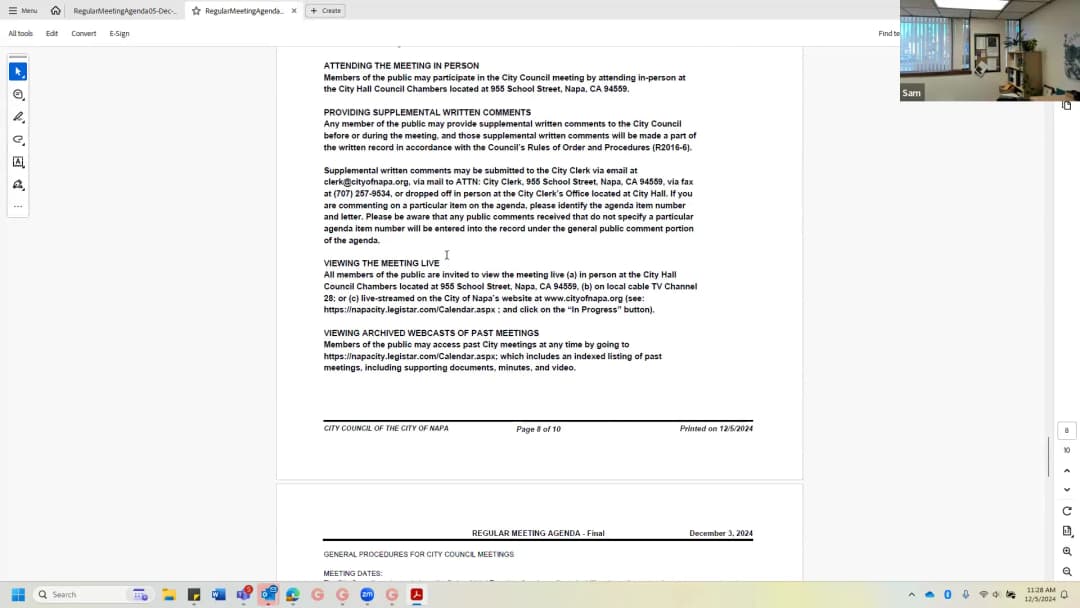
The City of Napa staff held a training session on December 9, 2024, to optimize the Legistar agenda management system. The session covered three primary pain points: housing authority items generating into city council meetings, excessive agenda editing after generation, and potential design changes to the agenda report. Attendees included Tiffany, Sam, Natalia, and Carolyn, with Carolyn leading the training. The meeting was originally scheduled for 90 minutes and ran over, but no additional cost was incurred. Discussion Items - Agenda Generation & Workflow Controls: Carolyn demonstrated how to create a new meeting, set date/time, and use statuses (Draft, Closed, Final, Final Revised). She enabled a new 'Hidden' status for scheduling future meetings without public visibility. The team discussed closing agendas the Wednesday before a meeting, then moving to Thursday morning to accommodate late items. - Housing Authority Item Separation: A test showed that housing authority items still appear in city council agendas. Carolyn implemented a temporary fix by filtering consent and administrative report sections to only city council-controlled items. She plans to create a separate workflow for the Housing Authority and Public Financing Authority to permanently resolve the issue. - Page Breaks & Section Formatting: Carolyn showed how to insert manual page breaks using 'page break' header comments, and how 'keep section together' toggle affects layout. They agreed to revisit the two-page boilerplate notice of meeting procedures to condense it, and possibly link to it online if legally permissible. - Accessible HTML Agenda & Translation: Carolyn recommended enabling an HTML (accessible) agenda with a Google Translate widget, which improves screen reader compatibility and multi-language support. She also suggested enabling an 'Upcoming Meetings' section on the public portal for easier navigation. - File Cleanup: Many old items (from 2017, 2020) were still open in the system. Carolyn offered to bulk-assign final action dates to close them out, which would clean up the agenda creation list. She also showed the 'add many lines' feature and color-coded file availability. - Agenda Report Design: The team liked the current left-aligned Arial font style. They noted a spelling error on the cover page (Councilmember Beth Painter's name misspelled as 'Paintner'), which Carolyn fixed. They also decided to suppress the 'Printed on' date from the PDF to avoid public confusion. Key Outcomes - Spelling Fix: Carolyn corrected the misspelling of 'Paintner' to 'Painter' and will update the member titles after the December 17th meeting when a new vice mayor is elected. - Boilerplate Text: Carolyn will add the public participation instructions (from the December 3 agenda) into the workflow control so it automatically appears in all agendas. - Hidden Status: Enabled to allow advance scheduling without public visibility. - Housing Authority Workflow: A separate workflow will be created to stop items from bleeding into city council agendas. - Accessible HTML: To be enabled in the near future. - Upcoming Meetings Section: To be enabled for the public portal. - Printed On Date: To be removed from the PDF agenda design. - File Cleanup: Carolyn will close out old items (2017–2020) in the background. - Next Meeting: The group will reconvene on December 10 (Monday) for a 90-minute session to cover files and minutes modules.
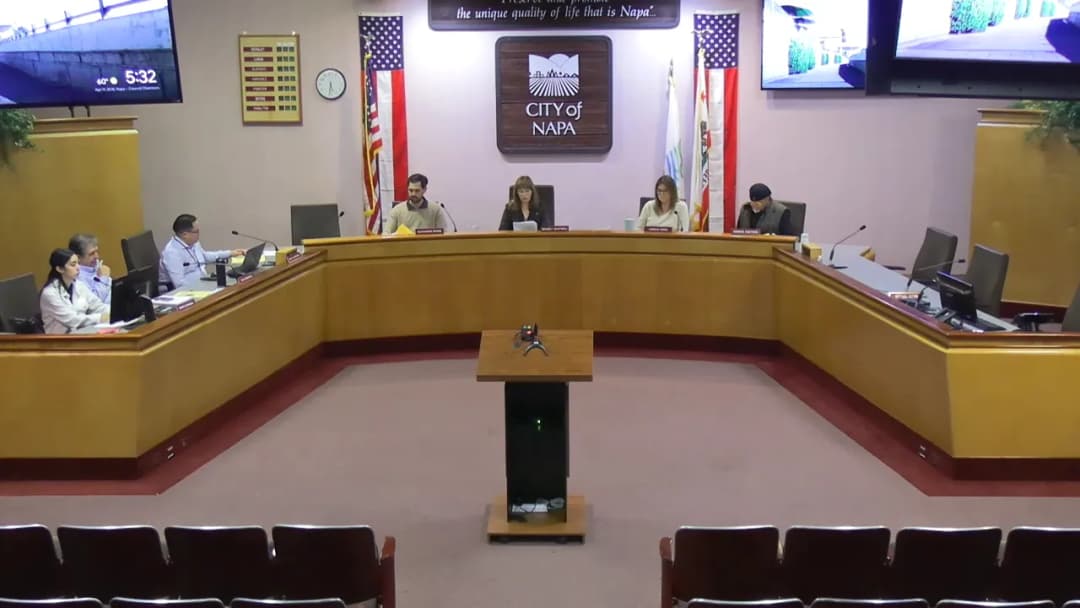
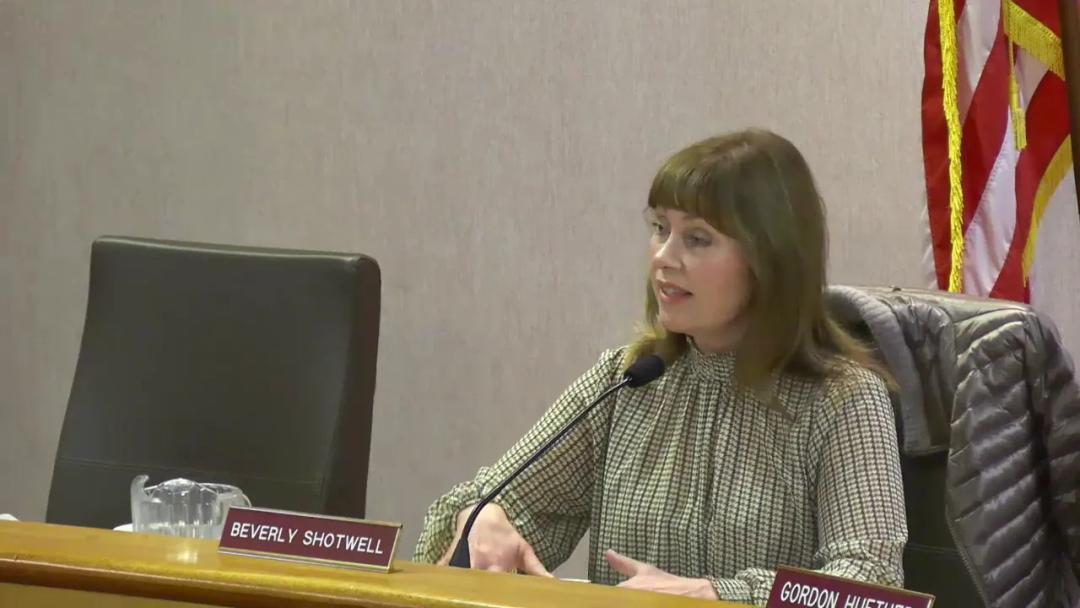
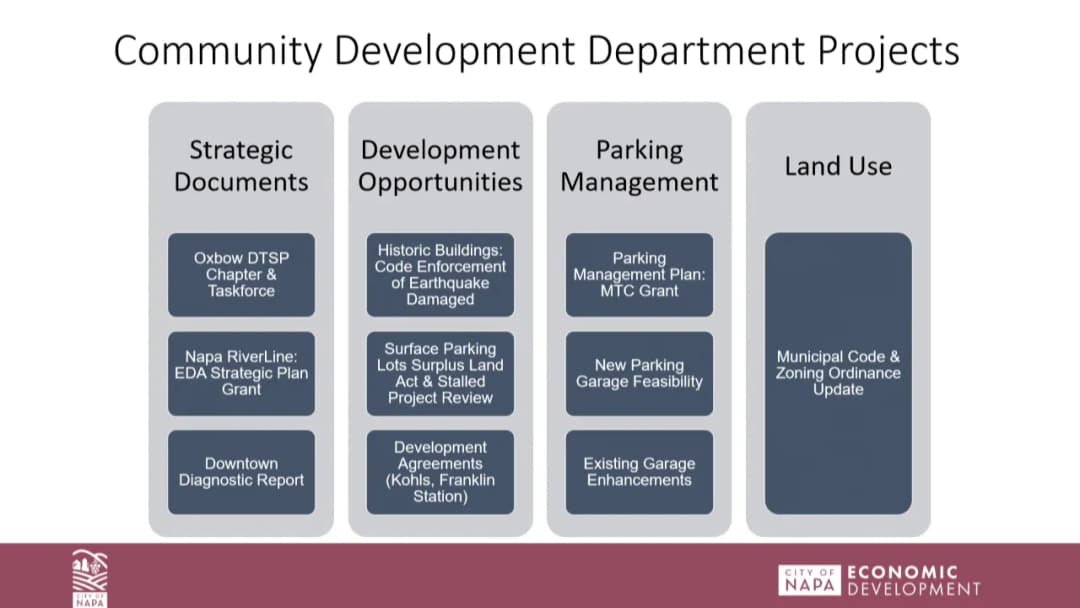
The Napa Planning Commission met on December 5, 2024, at 5:30 PM in City Hall Council Chambers. The meeting included public comments, approval of consent calendar minutes, and two administrative reports: a pre‑application design review for Hilario's Wheel & Tire accessory structures and a progress review of the Downtown Specific Plan. The meeting also featured a special recognition of outgoing Commissioner Paul Kelly for his years of service. Consent Calendar - The Planning Commission approved the Regular Meeting Minutes of November 7, 2024, with Commissioner Owen abstaining. Public Comments & Testimony - Maureen Trippi (co‑founder of Slow Down Napa) urged the Commission to consider updating the circulation element of the General Plan now rather than waiting seven years to revisit the Downtown Specific Plan, citing new traffic data, technology, and resources from Vision Zero and the Napa Valley Transportation Authority. - Sergio Barajas (field representative, North Cal Carpenters Union Local 180) expressed the union’s support for local hiring, apprenticeship programs, health benefits, and prevailing wages on city projects. - Councilmember Bernie Narvaez, Councilmember Beth Painter, Councilmember Liz Alessio, and Jay Jacobson (architect and friend) each spoke in tribute to Commissioner Paul Kelly, thanking him for his decade of service on the Planning Commission and earlier on the Cultural Heritage Commission, highlighting his thoughtful, detail‑oriented approach and positive impact on the city. Discussion Items Hilario's Wheel & Tire Pre‑Application – 2601 Solano Ave. (PL24‑0069) - Project Description: The applicant (property owner) seeks preliminary design review for three prefabricated metal accessory structures (painted red) used for storage. The property, zoned single‑family residential but designated General Commercial, was annexed in 1965; the existing automotive repair use is non‑conforming. The structures were built without permits and are the subject of a code enforcement case. - Staff Presentation: Community Development staff noted that a “best fit” determination designates the property as Local Commercial. Two of the three structures meet setbacks; Building C is two feet short of the transitional side setback and would need to be moved. Staff recommended the Commission provide design feedback; no formal action was required. - Commission Discussion: Commissioners expressed strong concerns about the precedent of permitting unpermitted structures and about the interpretation of the front lot line (staff designated Waverly Street as front; several commissioners argued Solano Avenue is the true front). Commissioners offered suggestions: Commissioner Huether proposed adding gooseneck lamps, metal trellis, and planter boxes to soften the appearance; Vice Chair Kelly recommended exploring a clean‑slate site redesign, possibly consolidating storage behind the main building and converting building A into a retail sales space with glass roll‑up doors facing Solano. Commissioners also noted fire‑rating requirements and the need to address parking lot circulation. The applicant’s representative confirmed the structures can be moved. - Outcome: The Commission provided extensive design feedback for the applicant to incorporate into a formal application (Design Review and Use Permit) that will return for a future hearing. Downtown Specific Plan Progress Review - Presentation: Community Development Director Vince Smith and Economic Development Manager Neil Harrison reported on the implementation status of the 2012 Downtown Specific Plan (20‑year plan, midpoint review). Key accomplishments included phase one streetscape improvements, wayfinding, public art, and development projects (First Street Napa, Archer Hotel, Wiseman Building, CIA Copia, Register Housing). Financing mechanisms include benefit zones, property‑based improvement district, and an Enhanced Infrastructure Financing District. - Current Initiatives: Oxbow District chapter (draft to come Q1 2025), Napa River Line trail design (spring 2025), downtown diagnostics report (imminent), parking management study (MTC grant, including evaluation of new parking garage at Lot A or Lot X), and a municipal code/zoning update. - Commission Feedback: Commissioner Huether opposed a parking garage behind the Goodman Museum (Lot A), preferring the Synodome site (Lot X). Vice Chair Kelly urged a mid‑course plan revision to prioritize housing downtown, noting the parking requirements have hindered residential development; he also advocated for a light‑rail corridor. Commissioner Owen supported staff’s ongoing work on the Oxbow and Synodome focus areas. Chair Shotwell emphasized clear public messaging about the funding source for the parking study (restricted parking impact fees). - Outcome: No formal action; staff will continue implementation and return with the Oxbow chapter and River Line plan in the next six months. Key Outcomes - Consent Calendar approved: November 7, 2024 minutes (Owen abstaining). - Hilario’s Wheel & Tire: Commission gave design guidance; formal application to follow. - Downtown Specific Plan: Staff to pursue council‑directed work (Oxbow chapter, parking study, entertainment district expansion, ground‑floor use updates) and report to Planning Commission on key projects. - Commissioner Paul Kelly was formally recognized for his service; his term ends with this meeting.