Browse by city
Date range
Search help

Search titles, summaries, topics and stored transcripts together. Keywords may match separately; put the whole query in double quotes for a phrase. Matching follows word analysis, so punctuation is not exact. Both dates are included. Documents are not searched.

SHOWING 91–100 ENTRIES
91
MAY 21, 2024 · NASHVILLE, TENNESSEE · METROPOLITAN COUNCIL
Metropolitan Council Meeting Summary - May 21, 2024

The Metropolitan Council of Nashville and Davidson County met on May 21, 2024 at 6:30 p.m. in the Metropolitan Courthouse. The meeting included elections, confirmations, nominations, public hearings, resolutions, and ordinances on multiple readings. Key actions included adopting a resolution supporting MNPS’s decision not to arm teachers, passing a resolution recognizing Jewish American Heritage Month, and deferring several zoning items. Consent Calendar - Approved unanimously: Multiple resolutions and ordinances on second and third reading, including budget-related items, grants, contracts, and zoning changes. Items removed from consent were taken up separately. Public Comments & Testimony - Dan Horwitz (Rabbi, Jewish Federation of Greater Nashville): Spoke in support of Resolution RS2024-475 recognizing Jewish American Heritage Month, noting rising anti-Semitism. - Jason Sparks (Jewish community member): Supported the resolution, emphasizing the importance of community support. - Annie Claver (River Queen Voyages): Spoke in favor of Resolution RS2024-351 regarding the Cumberland River, highlighting the need for riverfront activation and safety. - Andrew Ostrowski (River business owner): Supported the same resolution, advocating for water taxis and river access. - Catherine Bennett (Community Resource Center): Supported Resolution RS2024-476 recognizing Period Poverty Awareness Week, citing the need for period products. - Steve Ryder (citizen): Expressed concerns about RS2024-351, stating it was overly broad and could restrict river access. - Elizabeth Doros, Josh Goldberg, Aaron Witis, and Reven Freedman (Jewish community members): Spoke in support of Jewish American Heritage Month, sharing personal experiences of anti-Semitism. - James Cisco (leaseholder): Opposed a zoning change (BL2024-227) at 4000 Andrew Jackson Parkway, citing flood risks and community opposition. Discussion Items - Election to CATV Special Committee: Allen Williams was elected to fill a vacancy. - Appointments and Confirmations: Multiple appointments to boards and commissions were confirmed unanimously, including Bicycle and Pedestrian Advisory Commission, Board of Health, and others. - Rules of Procedure Amendment: Council adopted a substitute amendment to Rule 43.4, exempting zoning bills on public hearing from automatic deferral after 60 days. - Late Resolution RS2024-478: Council adopted a resolution condemning white supremacy and recent hateful displays, reaffirming commitment to protect all residents. - Resolutions on Public Hearing: Four short-term rental distance exemptions (RS2024-382 through RS2024-385) and a beer permit exemption (RS2024-445) were adopted after public hearings. - RS2024-351 (Cumberland River Analysis): Adopted with an amendment, requesting a comprehensive analysis of safety, housing, and cleanliness along the riverfront. - RS2024-416 (Forensic testing agreement): Approved after clarification. - RS2024-434 (Honoring Berdelle Campbell): Approved unanimously. - RS2024-455 (School purchase): Deferred one meeting to allow for proper process (ordinance needed). - RS2024-460 (Celebrate Nashville contract): Deferred. - RS2024-467 (Aerial encroachment for Morgan Wallen’s bar): Failed after debate over Wallen’s behavior. - RS2024-472 (Stormwater easements): Deferred. - RS2024-473 (MNPS firearms policy): Adopted with Rule 12.3, co-sponsors added. - RS2024-475 (Jewish American Heritage Month): Adopted. - RS2024-476 (Period Poverty Awareness Week): Adopted. - RS2024-477 (Harvey Milk Day): Adopted. - Bills on First Reading: BL2024-187 (zoning) was substituted and passed; other first-reading bills passed. - Bills on Second Reading: BL2024-183 (fireproofing) withdrawn; BL2024-343 and BL2024-344 deferred; BL2024-349 (street renaming) deferred; BL2024-354 and BL2024-355 (contracts) passed with late amendments. - Bills on Third Reading: BL2024-271/272 and BL2024-317/318 (zoning) deferred. Key Outcomes - Elected: Allen Williams to CATV Special Committee (voice vote). - Confirmed: 10 appointments to various boards/commissions unanimously. - Adopted Resolutions: RS2024-478 (anti-white supremacy); RS2024-351 (Cumberland River analysis); RS2024-416, 434, 473, 475, 476, 477; four short-term rental exemptions; one beer permit exemption. - Deferred Items: RS2024-455, RS2024-460, RS2024-472, RS2024-474, BL2024-343, BL2024-344, BL2024-349, BL2024-271/272, BL2024-317/318, and others. - Failed: RS2024-467 (aerial encroachment) – 30 no votes. - Withdrawn: BL2024-183 (fireproofing) – to be refiled. - Next Meeting: June 4, 2024, at 6:30 p.m. with budget hearings.
PROCEDURAL 44% · PUBLIC SAFETY 8% · ZONING AND LAND USE 6% · PUBLIC ENGAGEMENT 5%
92
MAY 21, 2024 · NASHVILLE, TENNESSEE · METROPOLITAN COUNCIL
Nashville Metro Council Meeting – May 21, 2024

The Metropolitan Council convened on Tuesday, May 21, 2024, for a regular meeting. The session began with the announcement period, followed by two presentations recognizing community achievements. Councilmembers also made numerous announcements about upcoming community meetings, events, and budget discussions. Proclamations and Recognitions - McGavock High School Wrestling Team: Councilmember Jeff Offman presented a proclamation honoring the team for its outstanding 2024 season. The team achieved a 11-4 record, a third-place finish at the girls' regional duels, and five medalists at the state tournament. Individual standouts included Halai Cox (132-pound state champion, record 29-1) and Emmanuel Claybrooks (fifth place at state). Assistant Coach James Brown was voted TAASAA Girls Section 3 Assistant Coach of the Year. The proclamation was accepted by a team representative, who thanked the coaches and athletes. - Lesbian Day of Visibility: Councilmember Emily Benedict presented a resolution recognizing April 26, 2024, as Lesbian Day of Visibility in Nashville and Davidson County. The resolution highlighted the contributions of lesbian leaders, including former Councilmember Nancy Van Reese, Councilmember Olivia Hill, and Judges Rachel Bell and Jennifer Smith. Former Councilmember Van Reese and Judge Bell spoke, emphasizing the importance of visibility and acceptance. Judge Jennifer Smith was unable to attend due to a docket conflict. Announcements and Upcoming Events - Councilmember Olivia Hill welcomed being back to speaking after a 30-day hiatus. - Councilmember (District 2) announced the monthly District 2 community meeting on Tuesday, May 28, at 6 p.m. (in-person and via Zoom). - Councilmember Gamble (speaking for Councilmember Hancock) announced a community meeting on the Madison Station Park on Tuesday, May 28, from 5 to 7 p.m. at the Madison Community Center. - Councilmember Joy Styles announced a District 32 community meeting on Wednesday, May 22, at 6 p.m. at Southeast Community Center, with a major announcement about a new cultural amenity. - Councilmember (District 5) announced a District 5 community meeting on Wednesday, May 29, at 6 p.m. at Hamilton United Methodist Church, focusing on safety with guests from Hub Nashville, Metro Police, and Metro Fire. - Councilmember Benedict reminded of a Memorial Day wreath-laying ceremony at the Lytton Alumni Center on Monday, May 27, at 10 a.m. - Councilmember Bo announced a Memorial Day 5K run on Monday, May 27, from 6 to 9 a.m. at the Nashville City Cemetery. - Councilmember Kutpin announced a neighborhood cleanup in Germantown and Salem Town on May 25 (10 a.m.–11 a.m.) and a Summer Kickoff Party on May 31 at 1606 4th Avenue North. - Councilmember Porterfield reported on budget listening sessions held in Bellevue and North Nashville and invited residents to the final two sessions: Saturday, May 25, at 10 a.m. (Southeast Community Center) and 2 p.m. (Hermitage Library). Public comment on the budget is also available on June 4 at 6:30 p.m. - Councilmember Offman announced a community cleanup in the Donelson/Hermitage area on Saturday, June 1, from 9 a.m. to 12 p.m., meeting at the Hermitage Library. - The Pro Tem (Councilmember) added that the Budget Chair would host a conversation with union leaders on Saturday afternoon via Facebook Live at 3:30 p.m., as part of a series of budget deep dives. No formal votes, consent calendar items, or public comments were recorded during this portion of the meeting.

COMMUNITY ENGAGEMENT 26% · PUBLIC ENGAGEMENT 20% · LGBTQIA RIGHTS 18% · SPORTS AND RECREATION 16%
93
MAY 16, 2024 · NASHVILLE, TENNESSEE · METROPOLITAN COUNCIL
Metro Arts Commission Meeting Summary - May 16, 2024

The Metro Arts Commission convened on May 16, 2024, at 6:15 PM. The meeting included public comments, committee reports, a budget presentation revealing a projected deficit, discussion of Director Singh's employment status, and concluded with a loss of quorum preventing official action. An interim director was introduced, and a special called meeting was scheduled to address urgent matters. Consent Calendar - Approved the April 18, 2024 meeting minutes unanimously. Public Comments & Testimony - Nicole Williams expressed opposition to the potential firing of Director Singh, urging commissioners to treat the issue with respect and reminding them that he is a human being with children. She criticized Commissioner Neflin's behavior at a previous meeting, stated that cultures of fear are pervasive across Metro departments, and shared her own experience of leaving Metro due to retaliation concerns. She quoted Vice President Kamala Harris: "You think you just fell out of a coconut tree. You exist in the context of all in which you live and what came before you." - Emma Supka, founding director of a small arts organization and performing theater artist, stated she was not there to discuss personnel issues but expressed gratitude for Director Singh's intent to distribute arts funding equitably, while criticizing a system rooted in colonialism and white supremacy. She highlighted the financial toll on small and mid-sized arts organizations, noting her organization received only half of its allocated funding from Metro Arts in December 2023, forcing program cuts and personal credit card use by staff. Discussion Items - Budget and Oversight Committee Report – Commissioner Watts presented FY24 and FY25 budgets. FY24 projected budget availability is $48,423, with additional projected expenses of approximately $1.2 million through June 30, 2024. FY25 is a flat budget of $5,461,700. Commissioner Jester detailed deficits: consultants year-to-date $426,736 with a $313,836 deficit, and temporary services budget $56,000 with year-to-date $396,192 and additional projected expenses of $36,000, creating a $375,792 deficit. Questions were raised about how the deficit occurred and who managed expenditures. A meeting with the mayor's office is scheduled for May 23 at 4 PM. - Grants and Funding Committee Report – Commissioner Jester reported on discussions to delay the grant funding cycle and bring the Thrive program into compliance, noting no conclusions were reached and that decisions would wait for executive director leadership. - CARE Committee Report – Commissioner Harden announced a meeting on May 24 at 10 AM to reorient the committee's purpose and goals. - Staff & Communications Update – Director Singh came off FMLA on May 16; his administrative leave began May 17 and ends May 30. The commission discussed the need to address the overlap with the interim director before that date. - Quorum and Legal Opinion – Commissioner Lefkowitz read the bylaw stating quorum is a majority of total members whose terms are effective. Metro Legal advised that quorum is eight based on a 15-member commission. Commissioner Wade and Chair Love disagreed, arguing that with only 11 appointed members, the commission would be perpetually disadvantaged. Legal counsel reiterated the advice. After Commissioner Watts left, the commission lost quorum and could no longer conduct official business. - Interim Director Introduction – Dr. Coleman introduced herself, expressing commitment to arts transformation, concern about the May 23 budget hearing, plans to work with committees, and a call for respect and collaboration. - Legislation Updates – Chair Love reported on appearances before the rules committee and three pieces of legislation: adding "promote equity in the arts" to the commission's purpose, requiring annual disclosures for board members, and changing commission composition to 16 members including a council member. Commissioner Lefkowitz spoke against the council member addition. Key Outcomes - Approved April minutes. - Commissioner Watts will distribute budget documents to commissioners. - A special called meeting will be scheduled before May 30 to address Director Singh's status and the quorum question; a Doodle poll will be sent. - Chair Love will appoint a nominating committee for September elections. - The commission could not take further official action due to lack of quorum.

GOVERNANCE STRUCTURE 34% · BUDGET AND OVERSIGHT 32% · PUBLIC ENGAGEMENT 9% · ARTS AND CULTURE 9%
94
MAY 16, 2024 · NASHVILLE, TENNESSEE · METROPOLITAN COUNCIL
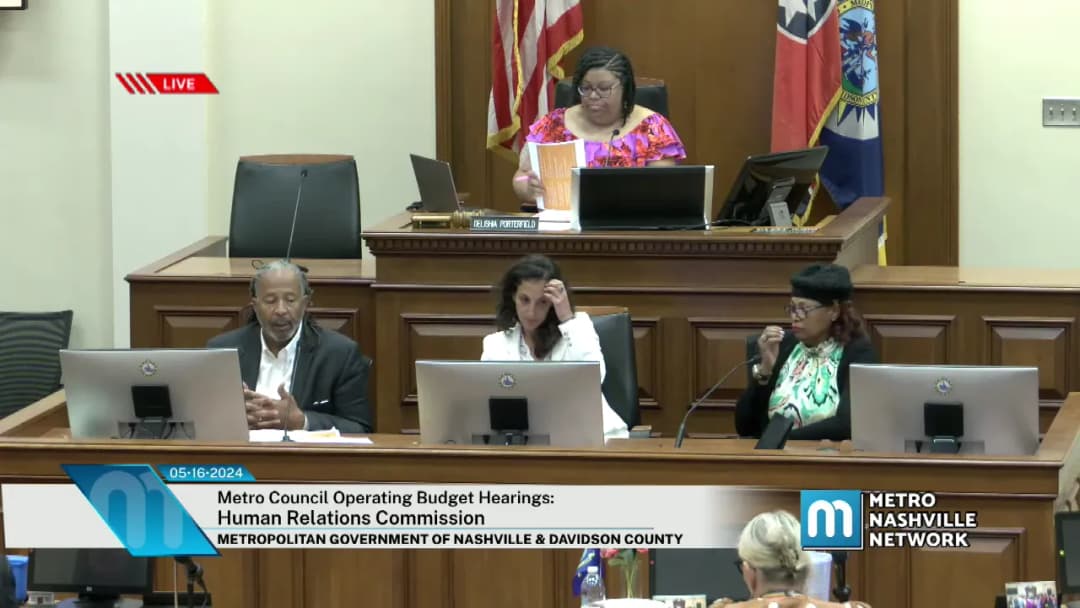
Metro Human Relations Commission Budget Request Hearing - May 16, 2024

On May 16, 2024, the Metro Human Relations Commission (MHRC) presented a budget request to the council committee. Executive Director David Tucker, along with commissioners Miriam Abba Faso, John Mestringa Holmes, and Dr. Ben Tran, testified in support of a $250,000 appropriation to fund one new position and adjust salaries for existing staff. The meeting included discussion of MHRC programs, the commission's historical underfunding, and the challenges of operating with a staff size unchanged for 25 years despite a tripling city population. Public Comments & Testimony - Commissioner John Mestringa Holmes expressed that the commission's office is doing amazing work with the same staff size as 25 years ago while the city has tripled or quadrupled in size and needs. She urged the committee to pay attention to the work done and the need for a budget increase. - Commissioner Dr. Ben Tran described the commission's role stemming from the Civil Rights Act of 1964, noting its work in investigations, hearings, and ensuring balance of power. He highlighted the recent Metro Arts investigation, which consumed all available manpower, and asked for support to add a director of advocacy and maintain staff. - Commissioner Miriam Abba Faso (Chair) noted the commission's growth in impact with limited resources, calling the Title VI investigation Herculean. She argued that the executive director's salary is at the lowest echelon and does not reflect the commission's value, and requested full funding of the budget request, particularly for staff salaries. - Executive Director David Tucker presented the budget request of $250,000 for one employee (Director of Advocacy) and salary adjustments. He noted MHRC will celebrate its 60th year in 2025, has been historically underfunded, was abolished for five years, and has had the same staff size for 25 years. He emphasized the commission's semi-autonomous nature and its role in continuing DEI work amid anti-DEI trends. He also highlighted MHRC's coordination of 13 organizations with COVID funds and annual events. Discussion Items - Councilmember Ewing asked about the "Just Conversations" and "Mobile Diversity Tour" programs. Director Tucker explained that Just Conversations is a series on social issues with subject matter experts, and the Mobile Diversity Tour takes police recruits to engage with diverse communities (LGBTQ, Muslim, Black). The tour is on pause with MNPD but under consideration for restart. Tucker stated that restarting would require additional funding and the chief's approval. - Councilmember Vaux asked about staffing reclassification, an immigrant study (last done 20+ years ago), and the "City Hall Pass" platform. Tucker responded that the larger budget proposal includes tracking metrics annually, and that City Hall Pass is a beta-tested platform ready for community groups to share information, but needs a host organization as MHRC lacks capacity. - Councilmember Cortez asked how many new hires MHRC would need to be fully effective. Tucker said five professionals would be ideal but would not future-proof the organization indefinitely; it depends on the city's political will to support equity and inclusion. He also noted that the director of advocacy is the priority position because it would enhance work across strategic vision. - Councilmember Cortez also raised a question about a policy/equity position funded last year in another department. Tucker clarified that MHRC's work complements but does not overlap with that department, and that MHRC often is in conflict with Metro, which is part of its design. - Commissioner Holmes shared a personal story about the Mobile Diversity Tour, describing how she connected with police recruits by sharing her fear for her son, a Marine severely injured in an explosion. The tour helped recruits see real people and break stereotypes, and she urged support for the program. Key Outcomes - No formal vote was taken during this hearing. The committee received the budget request and will consider it as part of the budget process. - MHRC requested $250,000 for one new position (Director of Advocacy) and salary adjustments for existing staff to address chronic underfunding and a staff size unchanged for 25 years. - The committee was reminded of upcoming budget hearings on Wednesday and Thursday, and community budget meetings on Saturday and May 25. - The meeting was adjourned.

RACIAL EQUITY 42% · PUBLIC SAFETY 22% · COMMUNITY ENGAGEMENT 7% · IMMIGRATION AND INCLUSION 7%
95
MAY 16, 2024 · NASHVILLE, TENNESSEE · METROPOLITAN COUNCIL
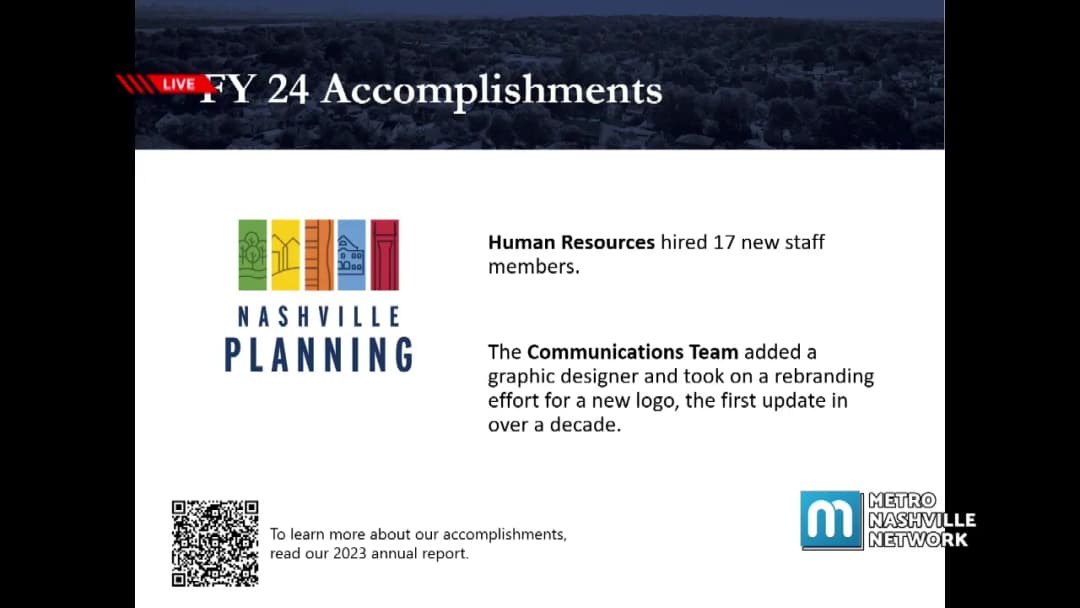
Planning Department FY24 Accomplishments and Housing Initiatives Briefing - May 16, 2024

The Metropolitan Council's Planning and Zoning Committee heard a presentation from the Planning Department on its FY24 accomplishments, with a focus on affordable housing initiatives. The presentation highlighted the department's growth, housing production metrics, and strategies for utilizing Metro-owned land for housing. Council members posed questions regarding budget requests, property utilization, and funding gaps. Discussion Items - Department Overview and FY24 Accomplishments: Planning Director Lucy reported on the department's evolution from a regulatory body to a full-service planning agency. Key accomplishments included the Nashville Next strategic plan, the creation of a long-range planning section, a redesigned urban design quality focus, East Bank implementation, review of 1,600 building permits, and hiring of 17 new staff. - Housing Team Update: Angie Hubbard, Director of Housing, presented housing metrics: the department has funded an average of 3,500 homes per year (unduplicated) for preservation or creation, up from 1,300 in 2021. The goal is 5,000 annually to meet the need for 52,000 units over 10 years. The Barnes Fund has invested over $110 million, leveraging over $1 billion (9:1 return). Affordability restrictions have been extended from 20 to 30 years. - Upcoming Initiatives: The Catalyst Fund will launch soon to provide nimble capital. A Unified Housing Strategy is underway with HRNA advisors. Community engagement will begin. A new housing dashboard, required by ordinance, is now online and updated quarterly. - Metro-Owned Land for Housing: Hubbard detailed the process for evaluating tax-delinquent and surplus properties. Over 100 tax-delinquent properties have been awarded. A new land bank position will expedite title clearing. Surplus properties require coordination with multiple departments. An interactive map shows approximately 74% of Metro land is held by Parks, with other holdings by Schools and other entities. Specific opportunities include Water surplus properties, Second & Gay (Stroble Center), East Bank, Global Mall, 88 Hermitage, Brick Church Pike, school property, and Inglewood Library co-location. - Budget Requests: The department requested a $2.29 million adjustment for additional positions, salary adjustments, a pattern book, public engagement, and $1.1 million for a housing infrastructure study. It was clarified that the housing infrastructure study is actually funded at $2.4 million from surplus fund balance, available after January 2025. The pattern book may be delayed. $80,000 for dashboard maintenance was not funded, but the department hopes to manage within existing resources. - Council Questions: Councilmembers raised several issues: - Chair Gamble asked about unfunded requests, particularly the housing infrastructure study. Staff confirmed funding via surplus. - Councilmember Bradford asked about surplus school property (Hillwood High School site). Staff noted that two executive orders were filed that afternoon to clarify roles for surplus property disposition. - Councilmember Allen asked about the $80k housing dashboard maintenance; staff said they would try to absorb the cost. - Councilmember Cash inquired about vacant properties (not tax-delinquent). Staff explained that without code violations, the department is developing the Catalyst Fund to help nonprofits acquire and rehab such properties. - Councilmember Quinn Evans Siegel asked about grant-seeking efforts and software licenses. Staff reported ongoing grant applications and plans for new community engagement software. Key Outcomes - The housing infrastructure study ($2.4 million) is funded through surplus, with planning department covering upfront costs and reimbursing later. - The pattern book initiative may be delayed due to budget constraints. - A follow-up communication will be sent to councilmembers linking to the Ernst & Young study and providing a list of available Metro properties. - Two executive orders were signed by the mayor to clarify roles of departments in surplus property disposition. - No formal votes were taken; the hearing was informational.

AFFORDABLE HOUSING 46% · BUDGET AND OVERSIGHT 23% · PLANNING AND ZONING 18% · PUBLIC LAND USE 9%
96
MAY 16, 2024 · NASHVILLE, TENNESSEE · METROPOLITAN COUNCIL
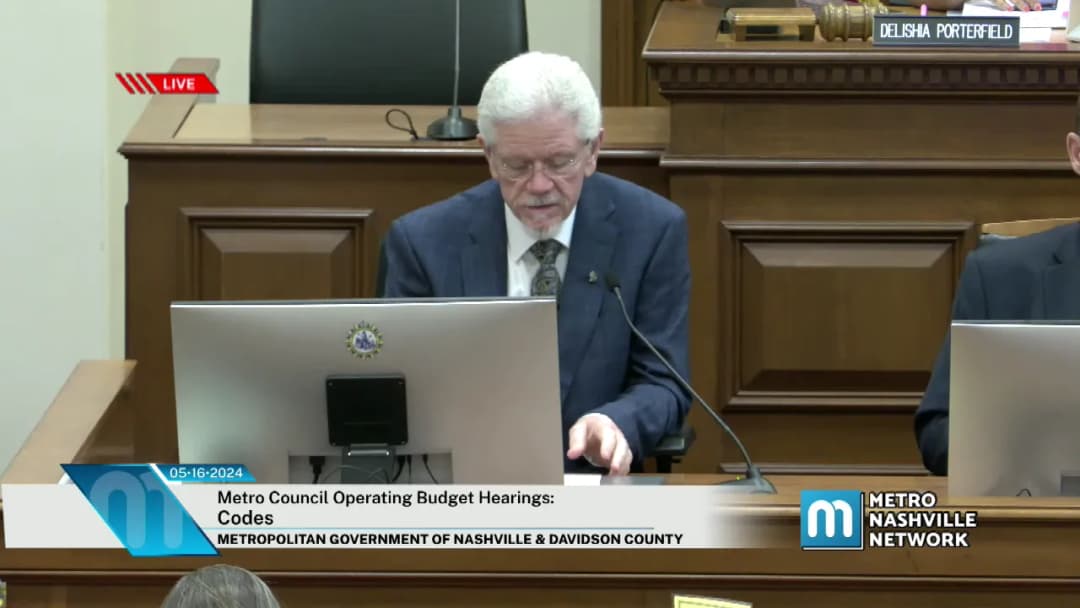
Metro Codes Department Presentation and Q&A - May 16, 2024

The Metro Codes Department presented its operations and fiscal year 2025 budget to the council committee. Director Bill Herbert and Operational Director Byron Hall highlighted the department's core functions, performance metrics, and staffing updates. Council members asked questions and expressed support for the department's initiatives. Discussion Items - Budget and Revenue: The department expects to operate within the mayor's proposed operating budget without requesting additional full-time positions. Year-to-date revenue is over $25 million, with $29 million projected by fiscal year end. The department has issued over 12,000 building permits (approximately 60,000 total permits). Construction value of permits is projected to exceed $4 billion. The department also noted a newly executed multi-year demolition contract that will address abandoned or fire-damaged properties. - Staffing and Vacancies: The department has 166 positions, up from 107 in 2000. Current vacancies are 17, a 50% reduction from 34 last year. A pay grade increase for inspection staff in July will aid recruitment and retention. The department has also added bilingual and multilingual staff and participates in a language access pilot program. - COLA for Data Analyst: Councilmember Toombs asked about a $10,200 COLA increase for an ITS data analyst paid by the department. The department stated that if not included in the budget, it could be covered by salary savings. - Customer Service Improvements: Electronic permitting is fully online, and customers can print alarm permits via the e-permit system. The department is developing a gas meter release program to streamline approvals. The rental vehicle program ensures inspectors have continuous access to vehicles, reducing downtime. The department expanded its partnership with Hub Nashville, assigning a dedicated hub cue manager for each division and hiring an internal coordinator. The language access pilot with Tennessee Language Center provides 24/7 interpreter and document translation services. - Nighttime Inspectors: Councilmember Allen inquired about two property standards positions being transferred to the Nightlife director for nighttime code enforcement. The department confirmed noise and light meters will be provided to the new inspectors. - State Law Changes: In response to a question about HB1892, the department stated it already allows third-party plan reviews and inspections. With a 1.5-day average turnaround time for inspections, no significant impact is expected. - Demolition Fund: Councilmember Gamble asked about a $275,000 budget line for professional and purchase services. The department explained it recently executed a multi-year residential and commercial demolition contract, which will allow for more spending on demolitions. - Vehicle Rental vs. Purchase: Chair Bradford inquired about the rental program's cost-effectiveness. The department noted that overall operating costs are not lower, but it reduces capital expenditures for General Services by providing newer vehicles and minimizing inspector downtime. - COD System: Councilmember Allen asked about a new platform replacing CityWorks. The department deferred to ITS for planning, noting it will allow multiple departments to share development services information. Key Outcomes - No votes were taken; the presentation was informational and part of the budget process. - Council members expressed appreciation for the department's performance, particularly in language access, electronic permitting, and filling vacancies. - The department will continue to operate within existing resources and fill remaining vacancies. - The new demolition contract and nighttime inspection program are set to be implemented.

ENGINEERING AND INFRASTRUCTURE 32% · PERSONNEL MATTERS 26% · BUDGET AND OVERSIGHT 26% · NOISE POLLUTION 7%
97
MAY 16, 2024 · NASHVILLE, TENNESSEE · METROPOLITAN COUNCIL
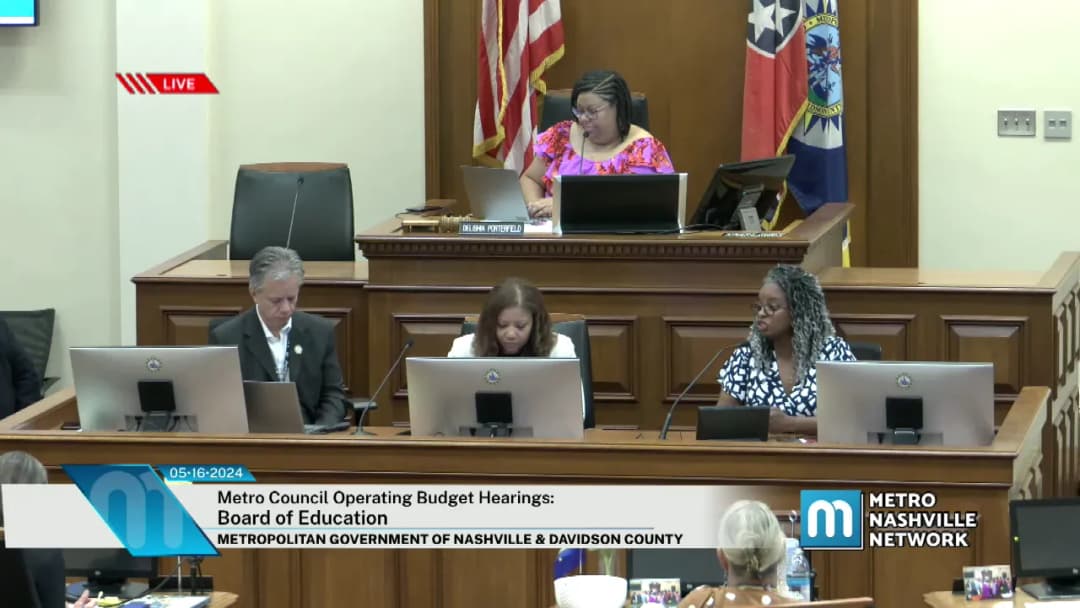
Budget Hearing for Metro Nashville Public Schools Board of Education - May 16, 2024

The Budget and Finance Committee, chaired by Councilmember Porterfield, held a hearing on May 16, 2024, to review the proposed FY2025 operating budget for Metro Nashville Public Schools (MNPS). Director of Schools Dr. Adrienne Battle, School Board Budget Chair Frida Player, and CFO Jorge Robles presented the budget, highlighting student achievement gains, funding priorities, and the need for a one-time ESSER bridge fund. Council members asked questions about employee compensation, program sustainability, and fiscal reserves. Discussion Items - MNPS Achievements & Context: Dr. Battle reported that MNPS is a Level 5 TVAAS district for two consecutive years, ranked third in math growth and sixth in reading growth among the top 100 largest U.S. districts, and one of only two urban districts in the top 10 for both. She noted partnerships with universities and a recent ERS case study highlighting effective ESSER fund use. - Proposed Operating Budget: The board’s initial request of $63 million was adjusted to $41.6 million in the mayor’s proposed budget, plus $18 million one-time for textbooks. The $41.6 million funds a 3.5% cost-of-living adjustment (COLA) and step increases for all employees, as well as inflationary contract increases. The total MNPS operating budget would be $1.247 billion. - ESSER Bridge Funding: CFO Robles explained that $77 million in one-time fund balance transfers (including $66 million from the prior year and $11 million new) would sustain critical programs originally funded by federal ESSER dollars, such as advocacy centers, peace centers, navigators, and literacy support. The district plans to eventually move some of these programs into the operating budget. - Employee Compensation: Several council members (Cash, Allen, Cortez) asked about increasing the COLA beyond 3.5% and raising minimum pay to $20/hour. MNPS confirmed that additional funding from the council would be needed to increase the COLA. School Board Chair Player noted that the board’s top priorities are employee compensation, continuity of ESSER-funded programs, and operational stability. - School Board Pay and Professional Development: Councilmember Cash raised the issue of school board member pay (currently $14,560, unchanged since 2003) and requested funding for a pay study. Board members noted that comparable districts pay $30,000, and travel/professional development costs are underfunded. They asked for a transparent process to increase board compensation and a line item for travel. - Specific Programs: Questions covered literacy investments ($1.7 million for literacy coaches and specialists), social-emotional learning programs (evaluated via Vanderbilt PIR and surveys), restorative practice assistants (in all middle and high schools), navigator program (every student assigned a caring adult), and textbook adoption ($18 million for science curriculum next). Councilmember Bradford asked about the fund balance impact: after the $77 million transfer, the district expects to have 4–6% above the required 17% reserve. - Insurance and Fees: CFO Robles noted a 12.8% insurance increase ($16.376 million), with employees also facing higher premiums due to high claims post-COVID. AP exams remain funded, and the ACT is covered twice per student (once junior, once senior). Key Outcomes - No votes were taken; the hearing was informational. - MNPS will identify approximately $15 million in budget cuts to balance its operating budget, but has not made final decisions, pending state TISA allocation and council action. - Council members expressed support for further increasing employee COLA if additional funds become available, and for funding a school board pay study. - Next steps: Budget work sessions begin May 28; wish lists due May 23 (edited versions June 6); public hearing on June 4 at 6:30 p.m. during the regular council meeting. Additional Information - The meeting included announcements about upcoming community budget meetings: May 18 (Northwest YMCA), May 25 (Southeast Community Center and Hermitage Library). - Council members noted the importance of clear communication regarding any future COLA increases to avoid confusion, referencing a prior year’s miscommunication.

EDUCATION FUNDING 66% · BUDGET AND OVERSIGHT 18% · FISCAL SUSTAINABILITY 6% · PUBLIC ENGAGEMENT 4%
98
MAY 15, 2024 · NASHVILLE, TENNESSEE · METROPOLITAN COUNCIL
Metro Council Budget Hearing for Nashville Police Department - May 15, 2024

Police Chief Drake presented the FY2025 budget request for the Metropolitan Nashville Police Department (MNPD) to the Metro Council. The hearing covered crime statistics, staffing challenges, school safety initiatives, and specific budget requests. Council members questioned the chief about funding for technology, recruitment, and community programs. Crime Statistics and Public Safety Initiatives - Homicide is down 29% compared to the same time last year; overall violent crime is down 6%. - A motor vehicle theft initiative launched in February has recovered 238 stolen vehicles and 101 guns. - Guns stolen from vehicles declined 13% last year and are down 35% this year so far. - Partners in Care, a collaboration with the Mental Health Co-op, has responded to over 27,000 calls; less than 4.5% resulted in arrests and less than 2.2% involved use of force. Staffing and Recruitment - MNPD is currently 153 officers below authorized strength. There are 61 trainees in three academy classes, and the department expects to go below 100 vacancies soon. - The mayor's recommended budget includes no new positions and a 1.41% budget adjustment requiring $4.168 million in savings. Approximately 90% of the MNPD budget is personnel. - Attrition is about 20%, and about one-third of officers are near retirement age. The department is focusing on employee culture and wellness to retain officers. - Recruitment includes both entry-level and lateral classes; female representation has increased from about 9% to almost 15% under the 30x30 initiative. School Safety Programs - Twenty-six school resource officer vacancies have been filled, placing permanent SROs in every public school and middle school. - A pilot program places officers in three schools since April 15, with possible expansion to all schools next year. - The Rapid School Safety Team and the Alternate Police Reporting (APR) program are at risk of being folded back into regular operations if not permanently funded. APR has handled over 47,000 calls; costs are $2.034 million for APR and $2.57 million for rapid response. Budget Requests and Financial Questions - License plate readers are estimated to cost $2.3 million; a taser upgrade to Taser 10 was discussed. - Councilmember Webb asked which budget items were partially funded. It was clarified that item 8 is partially funded ($64,300 out of $451,400), item 9 is partially funded ($315,000 for leasing the Airways Plaza building), item 10 is partially funded ($1.6 million for taser training and recruitment), and item 13 is fully funded ($2.24 million for the Secondary Employment Unit, which is revenue neutral). - The new Southeast Precinct received all requested FTEs except one civilian administrative assistant position. - No funding was included for a new training facility; the department also cannot use the state training facility because it operates a year-round academy. - A child care center for officers is under exploration but not in the current budget. Key Outcomes - Council members asked for follow-up meetings to discuss specific items, including the community safety center and other proposals. - Finance Director Pratt clarified that departments may use salary savings within their budgets without prior approval as long as they stay within the council-defined budget; the 1.41% adjustment relies on natural budget givebacks. - No formal votes were taken; the hearing concluded with plans to reconvene the next day at 4 p.m.

PUBLIC SAFETY 55% · BUDGET AND OVERSIGHT 22% · PERSONNEL MATTERS 16% · PUBLIC ENGAGEMENT 3%
99
MAY 15, 2024 · NASHVILLE, TENNESSEE · METROPOLITAN COUNCIL
Nashville Metro Public Defender's Office Budget Hearing - May 15, 2024

This budget hearing focused on the funding requests of the Nashville Metro Public Defender's Office, led by Chief Defender Johnson Moore. The discussion centered on salary parity, workload, retention, and technology needs, with council members asking detailed questions about the office's challenges and proposed solutions. Discussion Items - Salary Parity: Chief Johnson Moore highlighted that experienced attorneys in her office earn $20,000 to $50,000 less than their counterparts in the District Attorney's office. For example, a lawyer with 20 years of experience would earn $175,000 in the DA's office but is paid $45,000 less as a public defender. This disparity is causing retention issues, with several senior lawyers leaving recently. - Workload: Attorneys in the serious felony team carry double or nearly triple the recommended caseload. General sessions attorneys handle between 100 and 300 cases each, while the target is 100. The office requested one additional position to address workload, but Chief Johnson Moore stated that even with that position, compliance with workload standards would not be achieved. A recent workload study indicated the need for seven additional attorneys for serious felony cases. - Cloud-Based Storage: The office requested $62,000 per year for five years to transition to cloud-based storage for body-worn camera footage, following the police department's move to cloud storage. Without this, the office cannot store evidence properly due to different retention policies. - Audit Compliance: The 2021 audit found workload exceedances. The office has been working on a plan, including participating in national workload studies, but additional resources are needed. - Salary Savings Reallocation: Chief Johnson Moore stated that salary savings from vacancies cannot be used for operating costs. Councilmember Evans noted a potential inconsistency with other departments and asked finance to revisit the policy. Finance indicated they would look into it. - IDEA Project: Councilmember Allen asked about funding for the Indigent Defense Excellence and Advocacy (IDEA) project, which requested $880,000 to handle 50 serious felony cases. Chief Johnson Moore said she would prefer that funding go to her office to address systemic needs, but acknowledged the appointed bar's low pay is also a critical issue. - Incentives for Attorneys: In response to questions about non-monetary incentives, Chief Johnson Moore highlighted the office's strong training program, focus on self-care, and flexible culture, which help attract and retain staff despite lower pay. Key Outcomes - No formal votes were taken during this hearing. - The finance team agreed to revisit the policy on reallocating salary savings for non-salary purposes, with a follow-up expected. - The council members expressed appreciation for the public defender's office and indicated they would consider the budget requests in future deliberations.

LEGAL AFFAIRS 69% · PERSONNEL MATTERS 10% · BUDGET AND OVERSIGHT 9% · TECHNOLOGY AND INNOVATION 7%
100
MAY 15, 2024 · NASHVILLE, TENNESSEE · METROPOLITAN COUNCIL
Nashville Budget Committee Reviews Sheriff's Office Funding and Staffing on May 15, 2024

On May 15, 2024, the Metro Council Budget and Finance Committee held a hearing on the Davidson County Sheriff's Office budget request. Sheriff Daron Hall presented a "status quo" budget accompanied by an $8.5 million supplemental request to close a compounding deficit driven by jail population growth, state reimbursement delays, and staffing shortages. Council members questioned the Sheriff on costs, mobile booking, mental health programs, and facility needs. Discussion Items - Budget shortfall and state reimbursement: Sheriff Hall said the office is not asking for new program money but for a "significant hole" to be patched. Since COVID, the jail population has increased 60%, with a 23% rise in the last year. The $8.5 million mayor's recommendation is largely a reimbursement from the state for housing former CoreCivic inmates; the state owes Metro an estimated $5–6 million from the prior year, creating cash-flow challenges. He emphasized that much of the appropriation will eventually return to the city's general fund. - Staffing and part-time worker program: The Sheriff described overhauling the hiring process to onboard applicants within days rather than 12–14 weeks, and creating a part-time program that pays higher hourly rates without benefits. Nearly 100 part-time workers currently fill shifts, and 60% are women with children. Overtime costs have declined steadily from nearly $4 million last year, but the agency still has about 120 vacancies. - Mobile booking units: Two mobile booking units exist, but only one is staffed. Mobile booking takes about 20 minutes compared to 1.5 hours for standard booking. The budget requests funding to permanently staff a unit for downtown, enabling police to return to patrol quickly. Without funding, the unit cannot remain downtown regularly. - Facilities and capacity: The Sheriff's Office operates five facilities with approximately 2,400 beds; the current population is about 2,330, meaning the system is effectively full. A jail facility built in 1996 is deteriorating and needs replacement; the Sheriff requested a feasibility study. He also noted a future need for a kitchen at the Harding campus. - Mental health and population drivers: The Behavior Care Center, opened in 2020, provides immediate mental health assessment by master's-level clinicians. The return-to-jail rate for participants is 20%, compared to a national rate of about 90% for mentally ill individuals released from jail. Sheriff Hall attributed the recent population increase to slowed transfers to state prison—166 inmates are awaiting TDOC placement—not to higher arrest rates, which remain steady at about 60 bookings per day. - Security technology request: The $200,000 request would fund equipment and technology to reduce manpower needs, such as scanning systems and monitoring devices, helping address staffing shortages. - Voter registration for incarcerated individuals: The transfer of an election commission employee to the Sheriff's Office supports voter registration and absentee voting for eligible incarcerated people, a program the Sheriff said is showing progress. - Food service contract: A new food service contract was recently awarded for the same vendor, with a 20% cost increase due to inflation and the difficulty of hiring staff in jail settings. - Hospital security clarification: Sheriff Hall clarified that his office still provides security for arrestees at hospitals. It stopped providing general public security at Nashville General Hospital in 2020 after a nine-year arrangement, because hospital security requires different training. Inmate medical costs are not in the Sheriff's budget. Key Outcomes - No formal votes were taken during the hearing; the committee will consider the Sheriff's requests during budget deliberations. - The Sheriff's office is seeking $8.5 million in supplemental funding to cover state reimbursement shortfalls and operational costs. - A schedule change was announced: the Public Defender would present next, followed by the Metropolitan Nashville Police Department.

BUDGET AND OVERSIGHT 28% · PUBLIC SAFETY 25% · PERSONNEL MATTERS 19% · MENTAL HEALTH AWARENESS 9%
OPENPUBLICA · PUBLIC MEETING INDEXUPDATED DAILY · openpublica.com