The New York City Council Committee on Finance, chaired by Councilmember Linda Lee, met on October 8, 2026 at 11:30 AM to vote on two preconsidered resolutions granting real property tax exemptions under Article 11 of the Private Housing Finance Law for affordable housing developments. The committee approved both items by a unanimous roll call vote of 15 in favor, 0 against, with no abstentions. Councilmember Shaun Abreu was absent, and Councilmember Darlene Mealy was excused on medical leave. Consent Calendar - T2026-2630 (LU 0146-2026): Fordham Bedford Cluster Phase 1 – Block 3304, Lot 156; Block 3324, Lot 99, Bronx, Community District 7, Council Districts 11 and 15 (sponsored by Councilmembers Dinowitz and Feliz). Approved via Resolution No. 669. - T2026-2631 (LU 0147-2026): Gowanus Green A – Block 471, Lot 1, Brooklyn, Community District 6, Council District 39 (sponsored by Councilmember Hanif). Approved via Resolution No. 670. Key Outcomes - Both resolutions were approved by a roll call vote of 15–0 (with one absence and one medical excusal). - The approved resolutions provide real property tax exemptions for the two affordable housing projects, enabling their development.
Public Meetings - New York City, New York
Public Meetings - New York City, New YorkThe New York City Council's Committee on Cultural Affairs, Libraries and International Relations, chaired by Councilmember Nantasha M. Williams, convened on Thursday, October 8, 2026, at 10:00 AM at 250 Broadway. The committee held hearings and voted on two resolutions. Six members were present (Williams, Hudson, Louis, Maloney, Ossé, Ung), one member was absent (Stevens), and Councilmember Aldebol attended. The meeting covered a resolution calling for the designation of Little Yemen as a cultural district and a resolution declaring Hindu American Awareness and Appreciation Month. Public Comments & Testimony - Zaid Nagy, President of the Alliance of Yemeni Americans, testified in support of Resolution 458-A. He highlighted the 7,000-year history of Yemeni culture and argued that the Little Yemen cultural district designation is crucial for bringing tourism to the Bronx, a borough he stated is often neglected. He described the district as a potential destination for tourists interested in Yemeni, Arab, and Muslim culture, which would create more jobs. Discussion Items - Resolution 458-A (Little Yemen Cultural District): Councilmember Shirley Aldebol, the sponsor, delivered remarks expressing strong support. She framed the resolution as a united stance against Islamophobia and racism. She described the Little Yemen neighborhood in Van Ness Morris Park as a vibrant community with significant cultural institutions and small businesses, emphasizing that the state cultural district designation would open new funding pathways for investment. - Resolution 646 (Hindu American Awareness and Appreciation Month): Sponsored by Councilmember Amanda Fadius, this resolution seeks to officially designate October as Hindu American Awareness and Appreciation Month in New York City to recognize the contributions of the Hindu American community. Key Outcomes - Resolution 0458-2026 (Proposed Res. No. 458-A): The committee held a hearing, proposed and adopted an amendment. The resolution was approved by a roll call vote of 6–0 (Williams, Hudson, Louis, Maloney, Ossé, Ung in favor; Stevens absent). The approved document calls on the Governor to sign S.6487C/A.7033D to empower the New York State Council on the Arts to designate Little Yemen as a cultural district. - Resolution 0646-2026: The committee held a hearing. The resolution was approved by a roll call vote of 6–0 (Williams, Hudson, Louis, Maloney, Ossé, Ung in favor; Stevens absent).
The New York City Council Subcommittee on Early Childhood Education, chaired by Councilmember Jennifer Gutiérrez, held an oversight hearing on Wednesday, October 7, 2026, at 1:00 PM at 250 Broadway – 8th Floor – Hearing Room 1 to examine the implementation and expansion of the 2K program, which provides free child care for two-year-olds. The hearing featured testimony from the Mayor's Office of Childcare and Early Childhood Education, New York City Public Schools (NYCPS), and multiple panels of public witnesses. The program, launched in Fall 2026 with 2,000 seats across five school districts, saves enrolled families up to $26,000 per year per child. Over 5,700 applications were received for the initial 2,000 seats, with 59% of families receiving their top choice, 82% receiving one of their top three choices, and 99% receiving an offer to a program on their application. The hearing focused on lessons from year one, plans to expand to 12,000 seats by Fall 2027 and universal access by 2029, and long-standing systemic challenges including pay inequities, contract and payment delays, and inclusion of home-based providers. Consent Calendar - The oversight resolution (T2026-2552) was filed by committee after the hearing. Public Comments & Testimony Over 15 public witnesses testified in person and via Zoom, representing parent advocacy groups, community-based organizations, family child care networks, and early childhood educators. Key themes included: - Kayleigh Iar (parent leader, New Yorkers United for Childcare) shared her family's struggle to afford child care for her three-month-old daughter, noting that five-day-a-week care would cost at least $36,000/year in her neighborhood. She expressed hope that 2K expansion would allow her family to stay in New York City and save for their daughter's future. - Alison Liu (senior organizer, New Yorkers United for Childcare) testified that before 3K, her family went into debt and forwent health insurance to pay for child care. She reported that one parent leader is now expecting a second child after 2K made the prospect affordable. She urged the city to ensure child care workers receive living wages. - Nora Moran (director of policy and advocacy, United Neighborhood Houses) supported the 2K expansion but stressed the need for pay parity between CBO educators and NYCPS counterparts, adequate NYCPS staffing to process contracts and payments, reimbursement for the true cost of care, and developmentally appropriate professional development for two-year-old educators. - Karen Rogan (director of community programs, Literacy Inc./LINC) highlighted the need for the city to invest in community-based infrastructure to help families navigate enrollment, particularly immigrant and multilingual families, through organizations that already have trusted relationships. - Robert Gordon (CEO, Grand Street Settlement) urged investment in workforce compensation, timely payments, and building 2K through existing CBOs, noting that bureaucratic delays with DOH and FDNY inspections remain a barrier. - Tara Gardner (executive director, Daycare Council of New York) reported that 87% of her members expressed interest in 2K but raised concerns about staffing and payment delays. She called for contracts reflecting true costs, timely advances, and workforce investments. - Lara Kiriyakou (senior director of policy, All Our Kin) noted that only about 20% of family child care programs are part of a DOE network, and many independent providers fear loss of control over their business. She emphasized the importance of continuity of care across age groups rather than single-age programs. - Betty Baez Melo (director of early childhood education, Advocates for Children of New York) called for a comprehensive inclusion strategy for children with disabilities in 2K, including dedicated resources for accommodations, specialized staff, and program models for children with significant needs. - Joy Farina Foscett (representing People's Early Childhood Coalition) stressed that CBO financial instability is a system problem, not a provider problem, and called for structural fixes to contracting and payments before further expansion. - Dr. Zoe B. Sparaza (education director, Kitty Academy of Williamsburg) and Lori Cangiolosi (director, The Playgroup Experience) both testified passionately about pay equity, stating that CBO educators doing the same work as DOE educators should receive comparable compensation, benefits, and retirement security. - Adrian Bond (executive director, Quickstart Daycare Center) described struggling to open her center and keep staff paid despite providing high-quality care with certified educators, pleading for a full partnership and timely payments. - Kamila Faruqi (founder, Manhattan Schoolhouse) warned that providers are
The Committee on Consumer and Worker Protection, chaired by Harvey D. Epstein, held a public hearing on seven proposed local laws (Intros 64, 77, 673, 992, 993, 1026, and 1063) aimed at comprehensive reform of the pedicab industry. The hearing featured testimony from city agencies (Department of Consumer and Worker Protection, Taxi and Limousine Commission), industry representatives, advocacy groups, and members of the public. No votes were taken; all introductions were laid over for future consideration. Public Comments & Testimony - Danielle Mendez (Midtown Community Justice Center) expressed full support for the package of bills, stating they reflect recommendations from a multi-stakeholder roundtable. She argued that shifting oversight from DCWP to TLC would bring necessary licensing and enforcement changes, provided additional resources are allocated. - Makan Camara (President, New York Pedicab Alliance) expressed support for enforcement, transparent pricing, accessible training, and electric assist. He urged that any reforms protect honest drivers and preserve safety standards. He voiced openness to regulatory oversight by TLC but requested more information about its impact. - Kenneth Winter (23-year pedicab driver) expressed support for electric assist, citing physical strain and health issues. He described how unlicensed operators face no real consequences, undermining compliant drivers. - Christine Nicholas (Broadway Association) expressed strong support for Intros 992, 673, and 77 (meters, visible pricing, scannable plates), and Intro 993 (moving oversight to TLC). She urged consolidation of the bills for clarity and stressed the need for enforcement, recommending continued NYPD involvement. - David Saltenstahl (Central Park Conservancy) expressed support for the full package, emphasizing that a well-regulated fleet would protect visitors and honest drivers. He noted that nearly all visitors are aggressively solicited near the park. - Tom Harris (Times Square Alliance) expressed support for treating pedicabs as vehicles for hire, with fixed fares, meters, visible identification, civil penalties, and TLC jurisdiction. He advocated for electric assist and increased TLC staffing. - Justin Garbeit (Fire Island Pedicab) expressed support for holding operators accountable and for distance-based fares. He proposed a pilot program to test regulations before citywide implementation. - Hisham Mahmoud and Adamu Mazaru (pedicab drivers) expressed support for electric assist (In 1063), citing age and physical limitations that make manual pedaling difficult. - Keenan Delancy (pedicab driver) expressed strong support for Intro 1026 (designated curb spaces), arguing it would reduce traffic congestion and pedestrian conflicts. - Amadou Gassimu (pedicab driver) expressed support for electric assist, uniform pricing, and driver training. - Christina Hansen (carriage driver) expressed support for visible, theft-resistant license plates on pedicabs, noting that current plates are easily covered or counterfeited. - Paul Bader (TLC Commissioner, Queens) expressed fiscal concerns about transferring pedicab oversight to TLC, noting that TLC’s budget was cut and it lacks resources. He suggested redirecting unused funds from a previous law enforcement initiative. - Kristen March (ride-hailing app developer) expressed support for allowing software-based metering (on a passenger's phone) as a supplement to bike-mounted meters. Discussion Items - Chair Epstein and Councilmembers Brewer, Hanks, Maloney, Schulman, and Wilson questioned DCWP and TLC representatives about enforcement gaps, low compliance, and the disconnect between licensing and on‑street enforcement. DCWP Deputy Commissioner Carl Ortiz acknowledged that 35% of pedicab summonses are deemed legally insufficient, 25% dismissed in the interest of justice, and 20% not pursued. He stated that of 135 overcharge complaints received in 2025, none resulted in consumer redress. DCWP reported 330 registered pedicabs (out of a cap of 840) and an estimated 1,200–1,500 unlicensed units. - Councilmember Brewer raised the issue of insurance costs, which have risen from $600 to nearly $6,000 per unit per year, and asked about the feasibility of a meter system. DCWP indicated support for meters but concerns about price controls. - Councilmember Maloney questioned TLC’s capacity to take on pedicab enforcement and asked whether TLC peace officers could enforce pedicab laws. TLC’s Ira Goldapper stated that TLC does not have the resources or expertise for pedicabs and that its enforcement is targeted on taxis and FHVs. - Councilmember Hanks asked about electric‑assist concerns; DCWP deferred to NYPD on speed enforcement. Public witnesses argued that pedicabs have a perfect safety record with no fatalities. - Councilmember Schulman asked about noise complaints and whether a scannable code would help consumers. DCWP said they are evaluating costs for scannable plates. - Chair Epstein questioned DCWP about why three‑quarters of pedicabs operate without licenses. DCWP noted that the cost‑benefit analysis favors non‑compliance given weak enforcement. The Chair pressed for alternative enforcement mechanisms beyond ticketing. Key Outcomes - All seven proposed introductions (Intros 64, 77, 673, 992, 993, 1026, and 1063) were laid over by the committee, meaning no vote was taken and the bills remain under consideration. - DCWP and TLC representatives committed to providing additional data on enforcement, complaints, and confiscations to the committee. - Several witnesses and councilmembers urged consolidation of the bills and called for a referred bill package with dedicated resources if oversight is transferred to TLC. - The committee will continue to work with stakeholders and agencies to refine the legislation before any vote.
The New York City Council Committee on Small Business, chaired by Councilmember Shanel Thomas-Henry, met on Wednesday, October 7, 2026, at 11:00 AM at 250 Broadway, 8th Floor, Hearing Room 3. The committee voted on two items sponsored by Councilmember Yusef Salaam: a proposed local law (Int. No. 799-A) to establish a support fund for small retail businesses affected by roadway construction, and a resolution (Res. No. 328) calling on the New York State Legislature and Governor to provide a tax credit for businesses negatively impacted by infrastructure construction. All seven members present voted unanimously in favor of both items. Discussion Items - Int. No. 799-A – Small Retail Business Support Fund: Chair Thomas-Henry presented the legislation, which would require the Department of Small Business Services (SBS) to create a grant program for Business Improvement Districts (BIDs) and community-based organizations (CBOs) to support small businesses affected by city construction projects. To qualify, a BID or CBO must demonstrate that businesses within its purview fall within a “qualifying construction project area,” defined as two blocks from a project authorized by a Department of Transportation permit for at least 90 days. Each qualifying project can receive one grant of up to $100,000 for marketing, wayfinding, and other services, and a reimbursement program would allow small businesses near construction to be reimbursed for eligible costs up to $10,000 per business. The program has a three-year sunset. The chair noted that New York City has a record 183,000 small businesses, many dependent on foot traffic, and cited research from the Minnesota Department of Transportation showing independent non-chain businesses are most hurt by construction. She also referenced the Second Avenue Subway construction, where the Manhattan Chamber of Commerce reported that nearly half of businesses between 68th and 95th Streets moved or closed within five years due to declining revenue. - Res. No. 328 – State Tax Credit for Businesses Affected by Infrastructure Construction: This resolution urges the New York State Legislature to pass and the Governor to sign legislation providing a tax credit to businesses negatively affected by infrastructure construction, including state-led projects like MTA work. Chair Thomas-Henry emphasized that the city cannot address such impacts alone. Key Outcomes - Vote on Int. No. 799-A and Res. No. 328: Both items were coupled for a single roll call vote. Councilmembers voted as follows: Chair Thomas-Henry (yes), Brooks-Powers (yes, with an explanation: she congratulated Councilmember Salaam and requested to be added as a co-sponsor of Res. No. 328), Hanif (yes), Salam (yes), Maloney (yes, with an explanation: her district borders the Second Avenue Subway and she expressed gratitude for the legislation), Santosuosso (yes), and Morano (yes). The motion passed with 7 affirmative votes, 0 negative, and 0 abstentions. The items were thereby adopted by the committee.
On October 7, 2026, at 12:00 PM in Hearing Room 3, 250 Broadway, the Committee on Education, chaired by Councilmember Eric Dinowitz, met to vote on proposed Intro 684-A, a local law requiring a study on how language access needs and geographic location affect access to early elementary gifted and talented programs. The committee approved the legislation by a vote of 12 to 0, with Councilmember Farías not voting. The bill now advances from committee with an amendment. Discussion Items - Chair Dinowitz described the bill as requiring the Mayor's Office of Child Care and Early Childhood Education, working with the Department of Education and community-based early childhood providers, to study how language access and geography affect eligibility, nomination, and enrollment in kindergarten through third-grade gifted and talented programs. The study would evaluate barriers for families with limited English proficiency, review translation, interpretation, and outreach efforts, break down disparities by language group, borough, community district, and community school district, and include recommendations for multilingual households and underserved areas. He said access to an existing public school program should not depend on a family's zip code or English proficiency, and he supported the bill as a co-sponsor. - Councilmember Zhuang, the bill's sponsor, stated that Intro 684 would help identify how language access and location affect who learns about gifted and talented programs and who is admitted. She emphasized that immigrant, low-income, and minority families face barriers that can make these opportunities seem out of reach, and she announced a press conference at the Department of Education the following day to advocate for increased educational access. - Councilmember Brewer expressed support for gifted and talented programs even though that may be a minority view, and voted aye. - Councilmember Narcisse, speaking as a parent of four children who went through the city's public school system, praised the bill and Councilmember Zhuang's work. Key Outcomes - The committee voted on Intro 684-A: 12 affirmative votes (Dinowitz, Brewer, De La Rosa, Gutiérrez, Joseph, Krishnan, Lee, Louis, Narcisse, Schulman, Wong, and Zhuang), 0 negative votes, and 0 abstentions. Councilmember Farías was present but non-voting. - The introduction was amended by the committee and approved by the committee, with a committee report and fiscal impact statement. If enacted, the required study's findings must be publicly posted within one year.
The New York City Council Committee on Land Use, chaired by Councilmember Kevin C. Riley, convened on October 6, 2026, to vote on five rezoning proposals (comprising 10 land use applications) from Brooklyn, Bronx, and Queens. The committee approved all items, with modifications to four proposals and one dissenting vote on the Sojourner Truth – Mapes Rezoning. Discussion Items - Fort Hamilton Mews Rezoning (LUs 0131-0132): Proposed by 9305 5th Ave LLC in Bay Ridge, Brooklyn (Community District 10, Council District 47). The zoning map and text amendments facilitate a mixed-use residential project with approximately 292 apartments, up to 88 permanently affordable via Mandatory Inclusionary Housing (MIH). The committee modified the proposal to map the rezoning district as an R7D district and to add MIH Option 1. - Park Avenue Brooklyn Rezoning (LUs 0133-0134): Proposed by Park Avenue Rezoning Partners LLC in Bedford-Stuyvesant/South Williamsburg (Community District 3, Council District 33). The project will generate approximately 391 apartments, up to 101 affordable, and is expected to create 2,500 school seats. Councilmember Lincoln Restler (District 33) spoke in support, noting collaboration with property owners and challenges with city agencies. The modification removed MIH Option 2. - Sojourner Truth – Mapes Rezoning (LUs 0135-0136): Proposed by 2136 Crotona Parkway HDFC in the Bronx (Community District 6, Council District 15). This rezoning enables a 100% affordable mixed-use project with approximately 457 apartments across two development sites. The committee approved the items with a companion resolution, but Councilmember Justin Sanchez voted no. - 69-67 108th Street Rezoning (LUs 0137-0138): Proposed by 108 St., LLC in Forest Hills, Queens (Community District 6, Council District 29). The project includes approximately 59 apartments, up to 18 affordable. The committee modified the proposal to remove MIH Option 2 and add MIH Option 3. - 289 Kent Avenue Rezoning (LUs 0139-0140): Proposed by Web Holdings LLC in Williamsburg, Brooklyn (Community District 1, Council District 33). The project will redevelop the former Vice Media headquarters into a mixed-use development with approximately 278 apartments, up to 83 affordable. Councilmember Restler noted the developer's support for the cultural organization Triscallian Arts. Modification removed MIH Option 2 and added MIH Option 3. Key Outcomes - All items were approved by the committee. - Vote tallies (roll call): LUs 0131-0134 and 0137-0140 each received 12 votes in favor, 0 against. LUs 0135-0136 received 11 votes in favor (Riley, Banks, Brooks-Powers, Cabán, Carr, Encarnación, Louis, Ossé, Salaam, Thomas-Henry, Zhuang) and 1 negative (Sanchez). Councilmember Abreu was absent. - Next steps: Approved applications will be referred to the City Planning Commission (CPC) for final action, except for LUs 0135-0136 which were approved with a companion resolution. Note: No public testimony was heard during this voting session.
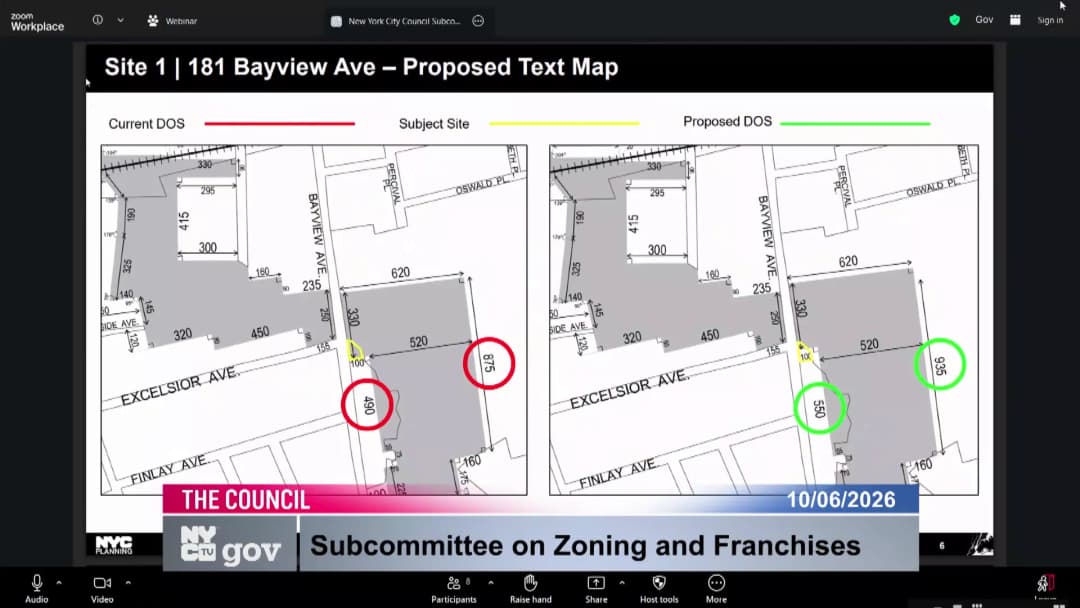
The New York City Council Subcommittee on Zoning and Franchises, chaired by Council Member Farah N. Louis, met on October 6, 2026 at 11:00 AM at 250 Broadway. The committee voted on five rezoning proposals and held hearings on three pre-considered items. All votes passed with modifications, except for the Sojourner Truth–Mapes rezoning which saw one dissenting vote. Public testimony was heard on the 100-12 Queens Boulevard proposal. Public Comments & Testimony - 100-12 Queens Boulevard Rezoning: Multiple residents and representatives spoke. Residents of the nearby Fontaine building expressed concerns about blockage of light and air, loss of local businesses, and construction impacts. However, some Fontaine residents and board members noted that the proposed rezoning would push the building farther away from their building compared to the as-of-right option, and they are working toward a written agreement with the developer. Labor unions (32BJ and Carpenters) expressed support, citing affordable housing and union job commitments. Other community members spoke in favor of the development to address housing needs. Discussion Items - Fort Hamilton Mews Rezoning (LU 0131-0132): Proposal to rezone in Brooklyn Community District 10 to R7X with C2-4 overlay and MIH. Committee recommended modifications to limit to R7D to ensure transition. Council Member Santos (district member) supported. Vote: approved with modifications (9-0). - Park Avenue Brooklyn Rezoning (LU 0133-0134): Rezoning from manufacturing to mixed-use M1-4/R6-1 and M1-4/R7D with MIH. Modification removed MIH Option 2 for lower affordability. Council Member Restler supported. Vote: approved with modifications (9-0). - 289 Kent Avenue Rezoning (LU 0139-0140): Rezoning from M3-1 to mixed-use in Williamsburg. Modification removed MIH Option 2 and added Option 3 for deeper affordability. Council Member Restler supported. Vote: approved with modifications (9-0). - Sojourner Truth–Mapes Rezoning (LU 0135-0136): 100% affordable housing development in Bronx. Council Member Feliz supported. However, committee members expressed concerns about lack of labor guarantees and union engagement. Vote: approved (8-1, with Council Member Sanchez dissenting). Chair Louis and Council Member Shulman noted concerns about insufficient union commitments. - 69-67 108th Street Rezoning (LU 0137-0138): Rezoning in Forest Hills to R7D with C2-4 overlay. Modification removed MIH Option 2 and added Option 3. Council Member Schulman supported. Vote: approved with modifications (9-0). - 108-05 68th Road Rezoning (Preconsidered): Hearing held; applicant proposed 33 apartments (8 affordable) with community facility. No public testimony. Item laid over. - 100-12 Queens Boulevard Rezoning (Preconsidered): Hearing held; applicant proposed 389 apartments (100 affordable) with retail and design modifications. Public testimony heard. Item laid over. - South Richmond Designated Open Space Amendment (Preconsidered): Zoning text amendment to correct mapping errors. No public testimony. Item laid over. Key Outcomes - Approvals: - Fort Hamilton Mews (LUs 131-132): Approved with modifications (9-0). - Park Avenue Brooklyn (LUs 133-134): Approved with modifications (9-0). - 289 Kent Avenue (LUs 139-140): Approved with modifications (9-0). - Sojourner Truth–Mapes (LUs 135-136): Approved (8-1, Sanchez opposed). - 69-67 108th Street (LUs 137-138): Approved with modifications (9-0). - Hearings Held and Laid Over: - 108-05 68th Road (T2026-2620/2621): Hearing held, no public testimony, laid over. - 100-12 Queens Boulevard (T2026-2622/2623): Hearing held, public testimony received, laid over. - South Richmond Open Space (T2026-2624): Hearing held, no public testimony, laid over. - Next Steps: Approved items will be referred to the full Land Use Committee and then to the City Council for final vote. Laid-over items await further action.
The Committees on Consumer and Worker Protection, Transportation and Infrastructure, and Public Safety held a joint oversight hearing on micromobility in New York City, examining regulation, accountability, and safety. The hearing considered a record 23 bills and resolutions aimed at improving safety for pedestrians, cyclists, and delivery workers, including measures on e-bike classification, point-of-sale enforcement, delivery app licensing, crash reporting, and infrastructure improvements. All introductions were heard and laid over by committee; the oversight was filed. Public Comments & Testimony - Numerous victims and family members testified about being struck by e-bikes or e-scooters, describing severe injuries and lack of accountability. Many called for passage of Priscilla's Law (Intro 802) requiring licensing and registration of e-vehicles. - Representatives from Transportation Alternatives, RPA, Open Plans, and other advocacy groups supported bills that ban high-speed devices, regulate delivery apps, and improve infrastructure, while opposing excessive enforcement and e-bike licensing. - Workers' Justice Project and dozens of delivery workers testified against bills that would increase NYPD enforcement, confiscate bikes, or ban class 3 e-bikes without a funded transition plan. They highlighted pressure from delivery apps, unsafe working conditions, and unjust deactivations. - Uber and Lyft representatives (via written testimony and in person) opposed certain liability and tracking bills, while supporting some safety measures. - Disability rights advocates stressed the need for accessible infrastructure and data collection on crashes involving people with disabilities. - Community groups like Good Neighbors of Park Slope urged citywide rules-of-the-road education campaigns. Discussion Items - Administration Testimony: DOT Commissioner Mike Flynn, DCWP Commissioner Sam Levine, and NYPD officials testified, outlining enforcement efforts, point-of-sale inspections, and support for many bills with suggested amendments. They expressed concerns about sidewalk detection technology, dynamometer feasibility, and potential unintended consequences for workers. - Councilmember Questions: Speaker Adrienne Adams and committee chairs pressed agencies on lack of enforcement of existing laws (e.g., vest requirements), age verification for Citi Bike, and data on collisions involving illegal devices. There was extensive debate on banning class 3 e-bikes, with some councilmembers arguing 20 mph is plenty, while others worried about impacts on delivery workers. - Trade-in Program: Chair Abreu's Intro 985-A was discussed as a way to transition users to slower devices, but DOT cited resource constraints and lessons from a pilot program. - Delivery App Accountability: Multiple bills (e.g., Intro 950, Intro 1069) would license delivery services and require trip-level data to study safety. Administration supported the intent but suggested placing data oversight with DOT. Key Outcomes - All 23 introductions and resolutions were heard and laid over by committee; no votes were taken. The oversight (T2026-2311) was filed. - The administration committed to enforcing existing micromobility laws, including the vest requirement, and to providing written data on enforcement and collisions. - Speaker Menon announced a forthcoming bill mandating age verification for Citi Bike. A Vision Zero hearing is scheduled for October 27, 2026, focusing on car and truck safety. - Several councilmembers emphasized the need for a balanced approach that protects delivery workers while getting high-speed illegal devices off streets.
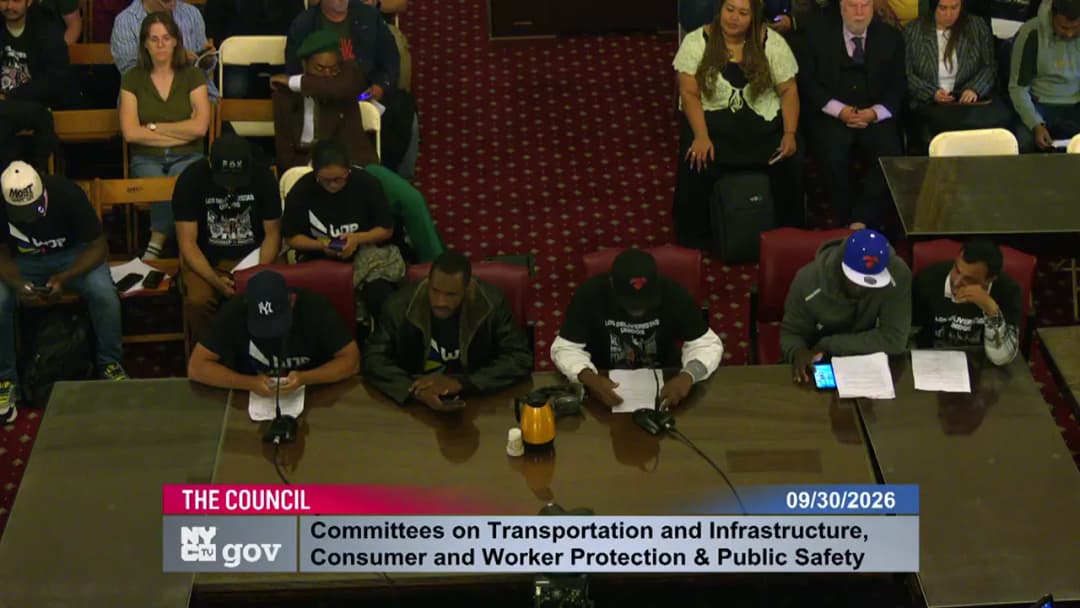
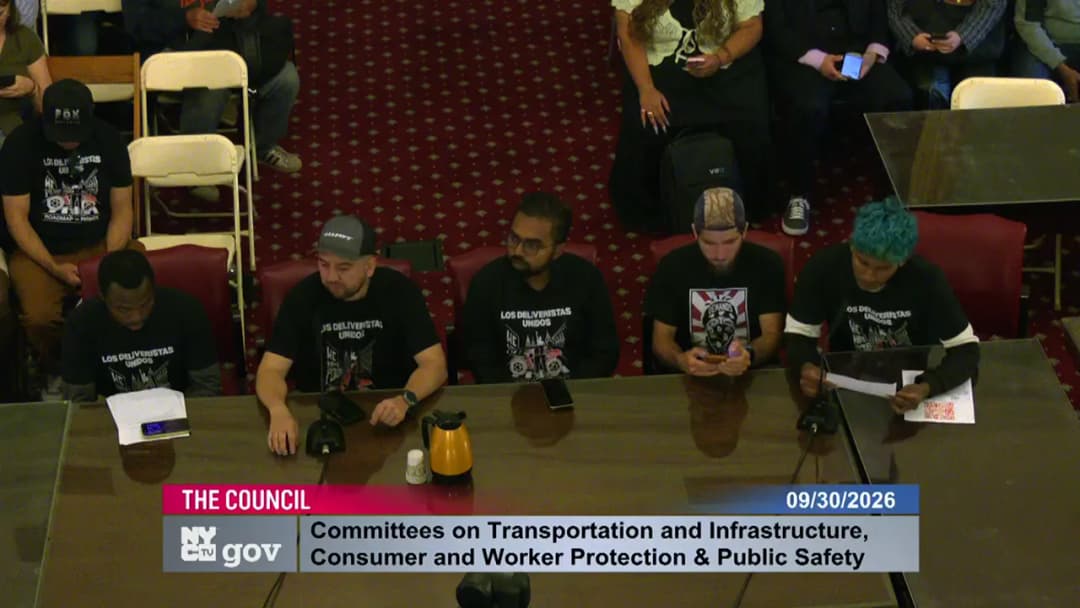
The New York City Council’s Committees on Public Safety, Transportation and Infrastructure, and Consumer and Worker Protection held a historic joint hearing on Wednesday, September 30, 2026, from 10:00 AM to well into the evening. The hearing examined micromobility regulation, accountability, and safety in New York City, and considered a record 23 pieces of legislation and two resolutions. No votes were taken; all bills were heard and laid over or filed, with the oversight item filed. Public Comments & Testimony - Victims of e-bike and e-scooter crashes, members of the Electric Vehicle Safety Alliance (EVSA), and senior citizens testified in support of stricter accountability measures, particularly the licensing and registration of all e-vehicles (Priscilla’s Law, Intro 802, which was not on the agenda). They described severe injuries, hit‑and‑runs, and the inability to identify riders. Multiple speakers called for a ban on class‑3 e‑bikes and for removing motorized devices from parks. - Delivery workers and immigrant advocacy groups (Workers Justice Project, Los Deliveristas Unidos, New York Immigration Coalition) opposed bills that they said would lead to increased NYPD enforcement, bike confiscation, and unjust deactivation by app companies. They argued that the real problem is unsafe infrastructure and aggressive delivery algorithms. They supported licensing of delivery apps and safe transition programs. - Transportation Alternatives, StreetsPAC, Open Plans, RPA, and environmental groups supported a comprehensive approach that includes banning class‑3 e‑bikes, a trade‑in program, dynamometer testing, and holding delivery apps accountable. They emphasized that “20 is plenty” and that infrastructure improvements are essential. - Representatives of Lime, JOCO, PopWheels, Upway, and VEO described their safety technologies (geofencing, speed limiters, UL‑certified batteries) and urged the Council to use proven solutions rather than broad bans. - Uber’s representative opposed liability insurance mandates and worker tracking, but supported banning dangerous delivery time practices. - Community boards and disability rights advocates stressed the need for accessible infrastructure and inclusion of disabled New Yorkers in policy design. Discussion Items - Oversight – Micromobility Safety (T2026‑2395) The hearing began with opening remarks from Majority Leader Abreu, Speaker Adams, Committee Chairs Epstein and Feliz, and multiple councilmembers. They described recent fatal crashes involving high‑speed illegal e‑bikes, the 31.7% increase in e‑bike collisions over the prior year, and the need for a comprehensive approach combining enforcement, education, infrastructure, and app accountability. - 20+ Bills Introduced and Heard - Int 0078 (retention of delivery data) – Supported by agencies, but recommended placement with DOT. - Int 0095 (moped retailer ownership info) – Supported. - Int 0110 (commercial delivery safety for all two‑wheeled devices) – Supported. - Int 0214 (rules of the road display on bike‑share) – Supported. - Int 0244 (ban sale/rental of class‑3 e‑bikes) – Supported by DOT and DCWP with concerns about enforcement; opposed by delivery worker groups. - Int 0389 (moped registration verification by delivery apps) – Supported with worker protection amendments. - Int 0787 (NYPD reporting on targeted traffic enforcement) – Supported but NYPD noted operational challenges. - Int 0950 (licensing delivery services) – Supported, targeted at large app companies. - Int 0985‑A (trade‑in program for powered bicycles) – Supported but DOT noted high cost; amendments proposed. - Int 0986 (dynamometer testing of micromobility devices) – Supported in concept; practical and equity concerns raised. - Int 0988 (ban misleading ads of DMV‑registrable vehicles as e‑bikes) – Supported, but needs to cover illegal devices not DMV‑registrable. - Int 0989 (bike‑share safety reporting) – Supported. - Int 0994 (liability insurance for delivery apps) – Supported by agencies and some advocates; opposed by Uber. - Int 1004 (pedestrian safety signage) – Supported but concerns about effectiveness. - Int 1021 (annual safety report from delivery apps) – Supported; recommended placement with DOT. - Int 1052 (crash data on micromobility devices) – Supported. - Int 1066 (traffic calming in bike lanes at 50 intersections) – Supported. - Int 1069 (study of safe delivery times) – Supported; recommended placement with DOT. - T2026‑2570 (safe delivery time standards) – Heard as pre‑considered; no formal position. - T2026‑2590 (sidewalk riding detection on share systems) – Supported in intent; technology readiness questioned. - T2026‑2361 (ban operation of class‑3 e‑bikes) – Opposed by DCWP and many advocates due to equity and enforcement concerns; DOT neutral pending analysis. - T2026‑2587 (tracking unsafe traffic behavior of delivery workers) – Opposed by DCWP and worker advocates as intrusive and prone to misuse. - Res 0043 (support for State Commercial E‑Bike Licensing Act) – No formal vote; opposed by some advocates. - Res 0044 (increased penalties for leaving e‑scooter accident scene) – Supported. - Agency Testimony - DOT Commissioner Mike Flynn Stressed the need to remove illegal high‑speed devices, improve infrastructure, and hold delivery apps accountable. Supported many bills but expressed concerns about resources and implementation. - DCWP Commissioner Sam Levine Emphasized worker protections, enforcement of deactivation protections (Local Law 34), and the need for balanced regulation. Supported bills that target corporations, not workers. - NYPD Chief O’Bay and Deputy Chief Thomas Alps Described enforcement initiatives: 15 high‑visibility corridors, point‑of‑sale sweeps, ghost plate operations, and data‑driven deployment. Reported over 10,000 e‑bike moving summonses and 10,000 moped seizures year‑to‑date. Acknowledged challenges in identifying illegal devices without technology. Key Outcomes - No bills were passed. All introductions and resolutions were heard and laid over; the oversight was filed. The Council will consider amendments and further action in the coming weeks. - Speaker Adams announced that the Council will release legislation mandating age verification for bike‑share in the coming weeks. - Majority Leader Abreu committed to a separate hearing on October 27, 2026, focused on Vision Zero and dangers from cars and trucks. - DOT and DCWP agreed to work with the Council on revising several bills, including those on data reporting, trade‑in programs, and delivery app licensing. - NYPD agreed to provide additional data on enforcement, collisions, and seizures, and to examine training on existing laws (e.g., delivery worker vest requirement). - The administration expressed openness to increasing penalties for first‑time violations of e‑bike sale laws and to exploring dynamometer technology, subject to piloting and further study. - The hearing concluded with a clear split between advocates of strong enforcement and registration (victims and safety alliances) and advocates of worker‑friendly, infrastructure‑centered reforms (delivery workers, immigrant rights groups).